Tuesday, December 07, 2004

Hydrogen Production from Nuclear Energy


DOE Researchers Demonstrate Feasibility of Efficient Hydrogen Production from Nuclear Energy

ford focus fuel cell car

WASHINGTON, DC – In a major step toward achieving President George W. Bush’s goal of ensuring America’s energy security through innovative technologies, researchers at the U.S. Department of Energy’s Idaho National Engineering and Environmental Laboratory (INEEL) and Ceramatec, Inc. of Salt Lake City, Utah have demonstrated the feasibility of using nuclear energy to efficiently produce hydrogen from water.

“With America’s growing demand for oil, also comes a host of environmental challenges. Because of the need to develop new energy sources in an environmentally sound way, the President and our Administration recognize that the benefits of hydrogen technologies are too great to ignore. This major breakthrough signals that we are systematically achieving our hydrogen goals,” Secretary Abraham said.

Using hydrogen to fuel our economy can reduce dependence on imported petroleum, diversify energy resources, and reduce pollution and greenhouse gas emissions. To this end, the Department of Energy is actively exploring clean hydrogen production technologies using fossil, nuclear and renewable resources to revolutionize the way we power our Nation’s cars, homes and businesses.

This achievement demonstrates high-temperature electrolysis which utilizes heat to decrease electricity needed for splitting water into hydrogen and oxygen. Instead of conventional electrolysis, which uses only electric current to separate hydrogen from water, high-temperature electrolysis enhances the efficiency of the process by adding substantial external heat – such as high-temperature steam from an advanced nuclear reactor system. Such a high-temperature system has the potential to achieve overall hydrogen production efficiencies in the 45 to 50 percent range, compared to approximately 30 percent for conventional electrolysis. Added benefits of the nuclear energy source include the avoidance of both greenhouse gas emissions and air pollutants.

The researchers have shown that hydrogen can be produced at temperatures and pressures suitable for integration with the new Generation IV nuclear reactor design being developed by the Department.

Energy Secretary Spencer Abraham stated, “The Generation IV nuclear technologies will take us to the next level in terms of efficiency, reliability, and safety. Coupling high temperature electrolyzer technology with the Gen IV reactors provides another pathway to produce hydrogen for powering future fuel cell vehicles.”

Fuel cell vehicles running on hydrogen produce no pollutants or carbon emissions.

Improvements in solid oxide electrolyzer design made by Ceramatec, Inc. will enable a 3-fold decrease in equipment size allowing greatly reduced capital costs. INEEL developed the system concept design and performed the feasibility testing.

This demonstration follows Secretary Abraham’s recent announcement of a $2 million grant to Ceramatec who is teamed with INEEL, University of Washington, and Hoeganaes Corporation in Riverton, New Jersey. The team will continue to work remaining challenges to lower costs, increase materials durability and improve efficiency of the solid oxide electrolyzer technology.

This development is a major step towards the hydrogen economy and realizing the President’s vision described in his 2003 State of the Union Address that “the first car driven by a child born today could be powered by hydrogen, and pollution-free.”

For more information on advanced nuclear energy concepts, see
gen-iv.ne.doe.gov. For more information on electrolyzers, see energy.gov/hydrogenandfuelcells/production/.

Media contacts:Mike Waldron, 202/586-4940Tom Welch, 202/586-5806
Number: R-04-359

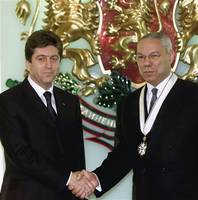
Georgi Purvanov Colin Powell


Secretary Powell President Parvanov
Remarks With Bulgarian President Georgi Purvanov at the Award Ceremony for the Stara Planina First Order Medal

Secretary Colin L. Powell Presidential Palace, Coat of Arms Hall Sofia, Bulgaria December 7, 2004
PRESIDENT PURVANOV: (in Bulgarian) Decree Number 348, pursuant of Article 98, Item eight of the Constitution of the Republic of Bulgaria, I decree, hereby awarding Mr. Colin Powell, Secretary of State of the United States of America, with the Order of Stara Planina in the First Order, for his exceptional contribution to the development of Bulgarian-American relations and on the occasion of the Centennial of the establishment of diplomatic relations between the Republic of Bulgaria and the United States of America, issued in Sofia on the 22nd of November, 2004; President of the Republic, Georgi Purvanov.

Esteemed President Zhelev, ladies and gentlemen, ministers, members of parliament, excellencies, ladies and gentlemen, it is an honor for me, and I feel deep satisfaction at exercising my constitutional obligations to award to Secretary of State Colin Powell the highest award of this country, for his exceptional contribution to the development of bilateral relations.

This is the highest award that is being awarded on this day by the governmental institutions of this country, which has shown a consensual agreement as to the reasons for which it is being awarded. It is awarded because of the personal merits of Secretary of State Colin Powell. It is awarded the contribution he has made over the past several years in attaining political dialogue, in being able to promote economic relations between our two countries, and also for his contribution in the area of security.

Mr. Colin Powell is an outstanding American politician, and I do hope he will agree with me when I say that he is one of the leaders of our time. Of course, this award is not only a token of the personal contribution to the development of bilateral relations, it is also an assessment of his achievements. And you probably remember that recently we celebrated the Centennial of the establishment of diplomatic relations between our two countries, which these celebrations were attended by Mr. Powell in person. And never before in these hundred years have our relations been better. These are not only relations of partnership, these are relations between allies and relations between good friends.
Of course, we are also fully aware that there is a much greater potential in these relations, especially in the economic area. That leaves much to be desired. That leaves much to be desired as regards the trade balance between our two countries, and also in relation to investment opportunities, which we of course see primarily in the direction from the United States to Bulgaria.

Ladies and gentlemen, allow me to once again congratulate Secretary of State Colin Powell on his award with the highest state award of Bulgaria. And, once again express the hope that wherever he is, whatever position, he will continue to be one of Bulgaria’s great friends.

SECRETARY POWELL: Thank you very much, Mr. President. Mr. President, members of the cabinet, members of the parliament, ladies and gentlemen, it’s a great pleasure to be here this evening in Sofia and to receive this decoration. It means a very great deal to me.

I first visited this city 31 years ago as a young Army lieutenant colonel in the depths of the Cold War. I had come out from a trip in the Soviet Union and I came to Sofia and I saw some color and I saw some light and I saw some smiles and I saw some hope. And I knew then, even as a young lieutenant colonel, that what I was seeing in the political system of Bulgaria was not something that would stay forever, that sooner or later Bulgaria would come back to where it belonged among the freedom-loving nations of the world as a democracy. I didn’t know when it would happen but I was confident it would happen.

I’m so honored that I went through those days of the Cold War as a soldier and then was able to come back in the government as Secretary of State at a time when Bulgaria was truly was coming out from behind the iron curtain, out into democracy and out into freedom. Now I’m here not as a lieutenant colonel in the days of the Cold War, but as a Secretary of State who is here to visit for the second time in the last year and a half a NATO friend, a NATO ally. I was privileged to be here when we celebrated the 100th anniversary of diplomatic relations and I will never forget that day in the square when I was able to speak to all the wonderful people who were cheering and waving the flags of the United States and the flags of Bulgaria—so many of them. I will never forget it.

And to be the Secretary of State as you are fully inside NATO, as you are slowly gaining full acceptance within all other European institutions, and to be here as you serve as Chairman-in-Office of OSCE, an important organization—all of this demonstrates the role that Bulgaria will be playing in the trans-Atlantic community, the vitality of your political system and the visibility that you are gaining on the world stage.

We are now having the best relations that we have ever had with Bulgaria, in so many different manifestations: our political relationship, what we are trying to do with respect to helping your economy. I heard clearly what the President said about trade and trade deficits. We’ll do everything we can to increase investment in Bulgaria. We stand together in dealing with the challenges of our time: in Iraq, in Afghanistan, in the Balkans. Bulgaria has reached out to freedom-loving people and you’ve reached out not just with words but also with actions, your willingness to send your soldiers in harm’s way.

I take this opportunity to again thank the Bulgarian people and to extend my condolences to the families of those who lost their lives in the cause of freedom. Your actions have been noble. They will not be forgotten by the Iraqi people, the people of Afghanistan and certainly not by the American people. We consider Bulgaria an ally, but more than an ally, a friend. I want to assure you, Mr. President, of President Bush’s commitment to Bulgaria, his appreciation and thanks for all you have done.

I accept this high honor, this award—the Stara Planina—not only for me, but as a symbol of the friendship that exists between our two countries our two peoples. And it will always be in an honored place in my home and I look forward to returning to Bulgaria in the future. And you can be sure that you will always have a friend whenever I come back. Whatever I can do in private life to assist Bulgaria, I am at your call.

Thank you very much, Mr. President.
2004/1317

### [End] Released on December 7, 2004