


Technorati Tags: President Bush and German Chancellor Merkel or Angela Merkel and Germany and Merkel and NATO or German and G-8 Summit or St. Petersburg, Russia and Stralsund or Trinwillershagen
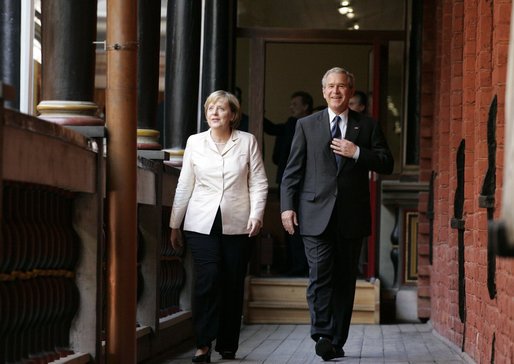
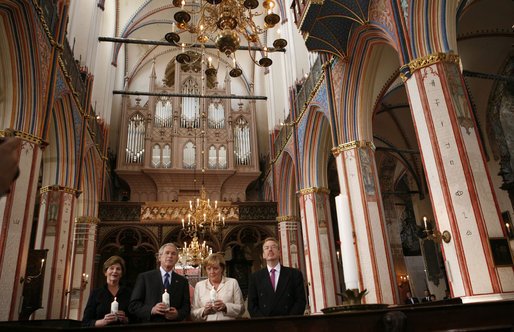
President Bush and German Chancellor Merkel Participate in Press Availability, Town Hall, Stralsund, Germany, 12:34 P.M. (Local), President's Trip to Germany and Russia.
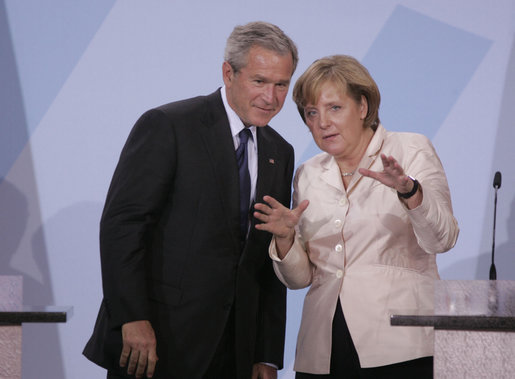 | CHANCELLOR MERKEL: (As translated.) Ladies and gentlemen, I am delighted to be able to welcome the President of the United States here to Stralsund yet again. We had a lengthy conversation right now in the Office of the Mayor. |
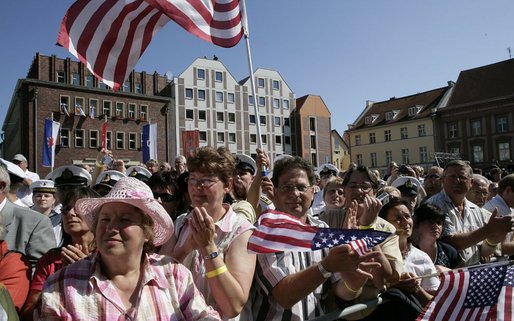 | We shall, later on, see a little bit more of the countryside here, of the city itself. I am really pleased to be able to show to the President of the United States how matters have developed here, |
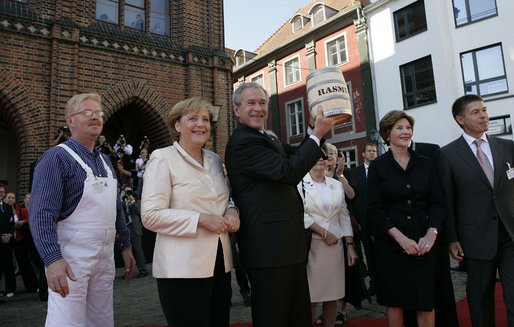 | Just now, in our talks, we talked at great length about international issues. Unfortunately, there are quite a lot of problems that we need to deal with and for whose solution we feel responsible. |
 | And this is why it was only consistent that yesterday the foreign ministers decided yet again to show clearly, also through a resolution in the U.N. Security Council, that should Iran not in any way reply to this offer |
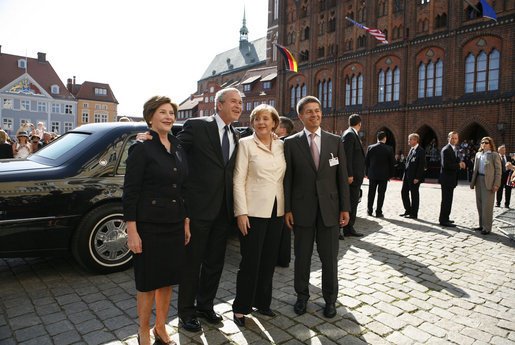 | We also addressed the very disturbing situation in the Middle East, and it fills us with concern and we have also stated clearly that everything needs to be done in order to come back to a peaceful resolution. |
 | We would like to appeal to the powers in the region to see to it that further escalation is warded off, and that, first and foremost, the root causes of this conflict are removed. |
 | We also addressed matters of trade, global trade. Here we -- and I'm saying this from a German perspective -- have a common interest in seeing this world round be a successful one, this world trade round. |
 | We also addressed those issues that will be on the agenda at the G8 in St. Petersburg. Here, first and foremost, energy policy, secure energy supply, was at the top of the agenda. We addressed African issues, |
 | We found that there is a lot that we agree on, as regards our common responsibilities, responsibilities that we see for the two of us the world over. And I, for one, think that as regards, |
 | PRESIDENT BUSH: Chancellor, thank you very much. Thanks for the invitation. This is a beautiful part of the world, and Laura and I are so honored to come to your constituency and meet some of the friendly people who live here. |
We had a good discussion -- it's more than a discussion, it's really a strategy session, is the way I'd like to describe it. We talked about a lot of subjects. We talked about the Middle East and Iran, and I briefed the Chancellor on North Korea. We talked about Iraq and Afghanistan, as well.
But when we talked about the issues, it's important for you to understand we're really trying to figure out how to work together to solve problems. And I appreciate -- appreciate the Chancellor's judgment a lot. It's an interesting conversation, you know, when you toss out what may seem to be a problem that's insoluble, and all of a sudden, two people start thinking about how to solve it, solve the problem. And that's what we're doing.
You know, on the Iranian issue, for example, the last time that we were together we talked -- spent a lot of time on Iran, and the Chancellor was wondering whether or not the United States would ever come to the table to negotiate with the Iranians. You made that pretty clear to me that you thought it was something -- an option we ought to consider, which I did. And I made it clear to the Iranians that if they were to do what they said they would do, which is to stop enrichment in a verifiable fashion, we're more than pleased to come back to the table.
There's no question that this issue can be solved diplomatically, and there's no question that it can be solved diplomatically with Germany and the United States strategizing as how to solve it. And I want to thank the Chancellor's leadership on this issue. It's really important for Europe to speak with one common voice. And it's important for Angela and myself to work with Vladimir Putin, which we will do at the G8, to continue to encourage him to join us in saying to the Iranians loud and clear, we're not kidding, it's a serious issue, the world is united in insisting that you not have a nuclear weapons program.
We talked about the Israeli-Palestinian and Israeli issues with Hezbollah, and our common desire to work together to help bring peace to that troubled region.
My attitude is this: There are a group of terrorists who want to stop the advance of peace. And those of -- who are peace-loving must work together to help the agents of peace -- Israel, President Abbas, and others -- to achieve their objective. You got to understand when peace advances, it's in the terrorists' interests in some cases to stop it. And that's what's happening.
We were headed toward the road map, things looked positive, and terrorists stepped up and kidnaped a soldier, fired rockets into Israel. Now we've got two more kidnapings up north. Hezbollah doesn't want there to be peace. The militant arm of Hamas doesn't want there to be peace. And those of us who do want peace will continue to work together to encourage peace.
We talked about North Korea. I assured the Chancellor that I'm committed to the six-party talks and that the five of us in the six-party talks will work to convince North Korea to come back to the table. I'm hopeful that we can get some U.N. action on North Korea.
We did talk about Doha, the trade round, and it's -- look, these trade rounds are difficult to negotiate with; we've all got our own interests. But the good news is we do share a common desire to open up markets. Germany is a great exporter. It's in Germany's interest that tariffs be reduced around the world. It's in our interests that tariffs be reduced around the world. And I committed to what I told the world back last September, we will reduce agricultural subsidies. But all we want is fair treatment when it comes to market access.
I'm optimistic we can still get something done on the Doha Round. It's going to take work, but G8 is a good place for us to continue the dialogue, and we will.
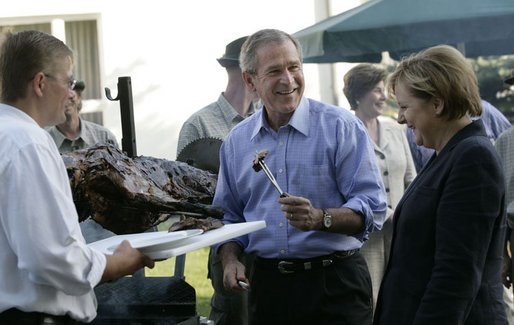
And I guess that's about all -- we discussed a lot of things, in other words. And thank you for having me. I'm looking forward to that pig tonight. (Laughter.)
I'll be glad to answer a couple of questions. Do you want to start her off?
Q Chancellor, you spoke about charting a new course as regards a response to the Iranian conflict. What new course will that be? You talked about the results of the foreign ministers' meeting where they will appeal to the Security Council. What sort of action will there be? Again, just a resolution that only demands certain things, or is the objective a resolution that will then actually threaten sanctions of a specific nature? This question is also addressed to the President.
CHANCELLOR MERKEL: Well, essentially what we're talking about here is not a totally new process, it's just another phase. We have waited patiently whether Iran will examine this offer and in which way it will react. So far we have not had any sort of reliable reaction. And for us, the precondition for talks has always been suspension of the enrichment activities, and a precondition for talks has always been, well, we will then, under the circumstances, not react with sanctions. But through this common action, we are now making clear, because we are not receiving a reply, that there will be a concerted action and that there will be specific steps. And we're defining what steps these will be if Iran continues to let us wait with its response.
So we wanted to demonstrate yet again that the international community is willing to show resolve to pursue this strategy further in every direction. Iran has received a proposal that I think is a very substantive one, a very good one, one that is good for the development of its own country, of its own interests -- is in its own interests. But if Iran should not reply, if they think they can prevaricate in the hope of the international community being split, then this proves them wrong. And this is why I am so happy about the conclusion of that meeting of the foreign ministers.
PRESIDENT BUSH: This notion that the Iranians must understand that they can't wait us out and can't hope to split a coalition -- and so the first step is to go to the United Nations and speak with as common a voice as possible.
Your question really is, how fast should the process move along? And my attitude is, the answer to that is, it should move as fast as necessary to make it effective, which is a non-answer, admittedly. But the truth of the matter is, diplomacy takes a lot of work, and there are different interests involved here. We do share a common goal of no nuclear weapon and no program. And, by the way, we've already sanctioned Iran, so we've got a different position than others. It's easy for me to espouse sanctions, since it's already a fait accompli. But we understand other nations have got -- there's a pace to this diplomacy. And I assured the Chancellor that the United States will continue to work to make sure the process is steady as it moves forward.
The key first step is, common goal, which is no nuclear weapon or program, and united message to the Iranians. I truly think they're trying to wait us out. They think it's a matter of time before people lose their nerve, or a matter of time before different interests are able to influence the process. And I think they're going to be sorely mistaken. I think they're going to be disappointed that this coalition is a lot firmer than they think.
It is in our interests to make sure they don't have a weapon. It would be dangerous if the Iranians had a nuclear weapon. And that's a recognizable fact now. So I appreciate the Chancellor's position on this.
Yes, Terry.
Q Madam Chancellor, Mr. President. Terry Hunt with the AP. Looking ahead to St. Petersburg, I'd like to ask you, do you think that Russia is honoring human rights and democratic freedoms and has a responsible approach to energy security?
And, Mr. President, were you surprised by President Putin replying to Vice President Cheney's criticism, saying that it was an "unsuccessful hunting shot?"
PRESIDENT BUSH: Did I think it was a clever response? It was pretty clever. Actually, quite humorous -- not to dis my friend, the Vice President. I don't know, do you want to start with this? I'd be glad to -- (laughter.) No, I think our job is to continually remind Russia that if he wants to do -- have good relations, that she ought to share common values with us. We share common values -- free press is a common value we share. And I've expressed my opinion to President Putin. You might remember my visit with him in Slovakia where I was quite pointed in my concerns about whether or not there is a free and vibrant press in Russia. We share concerns about the ability for people to go to the town square and express their opinions, and whether or not dissent is tolerated, whether or not there's active political opposition.
And so I will continue to carry that message. My own view of dealing with President Putin, though, is that nobody really likes to be lectured a lot, and if you want to be an effective person, what you don't go is scold the person publicly all the time; that you remind him where we may have a difference of opinion, but you do so in a respectful way, so you can then sit down and have a constructive dialogue.
And that's exactly how I'm going to continue my relations with President Putin. I'll be firm about my belief in certain democratic institutions; I'll be firm in my belief about the need for there to be an active civil society and NGOs should be allowed to function in Russia without intimidation. But I'm also going to be respectful of the leader of an important country. And I may not tell you exactly what I talked to him about in private. And I would hope that he wouldn't tell you what he talks to me about in private.
But, yes, we've got issues. Listen, we've got common problems that we need to work together to solve -- North Korea and Iran are two. And we've also got -- I hope he continues to understand that it's in his country's interest to implement the values that Germany and Russia -- Germany and the United States share.
CHANCELLOR MERKEL: Well, first as to the issue of energy security, I can safely say that, looking at Germany over the past few decades, Russia has always proved to be a reliable supplier of energy. They have always abided by the treaties that we signed. But we would wish -- and I've addressed this with the Russian President -- that they actually bring the energy charter to its completion, that is to say, commit themselves to it, because then we would have a greater degree of certainty and security that we understand our common commitments on this.
As regards -- a strategic link between Russia and Europe, obviously, is of tremendous importance. It's important because we need energy supplies from Russia. And this is why we shall work towards Russia accepting that charter, that energy charter, so that we get a legitimate charter that is also based on contracts. But again, it has to be said that Russia has always been a reliable supplier.
As to democracy and human rights, during my visit to Russia I met with a number of representatives of non-governmental organizations. We discussed what is desirable, what ought to be there as regards Russia's further development, and what needs to be addressed, time and again, and let me tell you that I talked to the President about these issues.
I think also we ought to have an open, confidential dialogue. We should not sort of speak loudly and in public about certain issues; that we have different ideas about how a pluralist society, a democratic society ought to work; that there ought to be a strong opposition is certainly one of the realities of life. There are differences of opinion between Russia and the European Union. We would wish for Russia to embark on a path that leads to a lively and very pluralistic political landscape, that they enter into a dialogue with their civil society, which is at yet not there, for many reasons.
But we would like to share with them also the experience that we've made with democracy, that pluralism in a democracy, last but not least, actually enhances stability in a country. And that is an experience that we have made, and that is a very strong force which drives reform processes forward. For example, we've seen that in German unity. It's sometimes complicated to bring those decision-making processes forward in a democracy, but then you receive the necessary legitimacy. And that is the experience that informs us in our talks.
Q A question addressed to you both. You talked about the Middle East, and what is your assessment of the military action of Israel in Lebanon? The French Foreign Minister already said it is disproportionate. Does that give you cause for Europe or the United States to intervene?
And apart from the pig, Mr. President, what sort of insights have you been able to gain as regards East Germany? -- (inaudible) --
CHANCELLOR MERKEL: Neither have I, but apparently a camera team was there when it was shot. So apparently it is already there, physically. (Laughter.) I hope it's actually roasting; otherwise we won't be able to eat it tonight.
Well, as to the violence in the Middle East, particularly as regards Lebanon, I think that one needs to be very careful to make a clear distinction between the root causes and the consequences of something. So we started here from a case of kidnaping of a soldier, and one of the other root causes also is the activity of Hezbollah. And it's most important for the Israeli government to be strengthened, but it is also clearly shown that these incursions, such as the kidnaping of soldiers, is not acceptable.
And the parties to that conflict obviously have to use proportionate means, but I am not at all for sort of blurring the lines between the root causes and the consequences of an action. There has to be a good reaction now, not from the Israeli government, but from those who started these attacks in the first place.
PRESIDENT BUSH: -- to help calm the situation, we've got diplomats in the region. Secretary of State Rice, who is here, is on the phone talking to herf counterparts. I'll be making calls.
I gave you my initial impression earlier, and that is that it's a sad situation where -- when there is a very good chance for there to be a two-state solution enacted -- that is two states living side-by-side in peace -- it's really sad where people are willing to take innocent life in order to stop that progress. As a matter of fact, it's pathetic.
And having said that, Israel has a right to defend herself. Every nation must defend herself against terrorist attacks and the killing of innocent life. It's a necessary part of the 21st century.
Secondly, we -- whatever Israel does, though, should not weaken the Siniora government in Lebanon. We're concerned about the fragile democracy in Lebanon. We've been working very hard through the United Nations and with partners to strengthen the democracy in Lebanon. The Lebanese people have democratic aspirations, which is being undermined by the actions and activities of Hezbollah.
Thirdly, Syria needs to be held to account. Syria is housing the militant wing of Hamas. Hezbollah has got an active presence in Syria. The truth of the matter is, if we really want there to be -- the situation to settle down, the soldiers need to be returned, and President Assad needs to show some leadership toward peace.
To answer your question about the involvement, we will be involved diplomatically, and are involved diplomatically.
Steve.
Q Thank you, sir. Just to follow up --
PRESIDENT BUSH: Follow up on?
Q On both of these. Does it concern you that the Beirut airport has been bombed? And do you see a risk of triggering a wider war?
And on Iran, they've, so far, refused to respond. Is it now past the deadline, or do they still have more time to respond?
PRESIDENT BUSH: I thought you were going to ask me about the pig.
Q I'm curious about that, too. (Laughter.)
PRESIDENT BUSH: The pig? I'll tell you tomorrow after I eat it.
The Iranian issue is -- will be taken to the U.N. Security Council. We said that we have -- to the Iranians, we said, here's your chance to move forward, and we'd like a response in a reasonable period of time. And we meant what we said. One of the important things about moving toward the Security Council, it shows that when we say something, we mean it. In order for -- to help solve these problems, you just can't say things and not mean it. And so when we spoke, we said, reasonable period of time; weeks not months -- that's what we explained to the Iranians. They evidently didn't believe us. And so now we're going to go to the Security Council, and we're united in doing that.
Q Their deadline has passed --
PRESIDENT BUSH: Their deadline passed, right. That's why we're going to the U.N. Security Council.
Q -- have time?
PRESIDENT BUSH: Oh, they've got plenty of time. I mean, the U.N. Security Council, they've got time to react. They've got time to make a decision. By the way, it's their choice. We've made our choice. It's the Iranian choice. And as Angela mentioned, there was an offer put on the table, a reasonable offer for them to make the choice as to the way forward.
And our choice is, look, we want to have relations with you, but you're not going to have a weapon or the capacity to make a weapon. It would be incredibly dangerous if we -- five years from now, Iran shows up with a nuclear weapon and threatens people in the neighborhood, and they're going to say, where were you? What were you doing during that period of time? And that's what we're working on.
And so time -- that's -- when we said, weeks not months, we meant it. And now we're heading to the U.N. Security Council. They can show up any time and say, wait a minute, now we'd like to go back and negotiate, now -- take a look at the interests. We're not precluding any further negotiations with the Iranians.
In order for us to come to the table, however, what they must do is verifiably show that they're not enriching, like they said they would do earlier. This is not a -- this is not a new statement by them. They agreed to this in Paris. All we're asking them to do is to honor what they said they would do in the past in a verifiable fashion.
The rest of your four-part question?
Q Sorry about that, sir.
PRESIDENT BUSH: That's okay, it just -- it's a bad habit.
Q Does the Beirut -- the attack on the Beirut airport, does that concern you, and are you concerned about triggering a wider Middle East war?
PRESIDENT BUSH: As I mentioned, my biggest concern is whether or not actions taken will weaken the Siniora government. Democracy in Lebanon is an important part of laying a foundation for peace in that region. We have worked really hard to get Syria out of Lebanon -- U.N. Resolution 1559, and it's follow-up Resolution 1680 were manifestations of the work of the international community to get Syria out of Lebanon. We've always felt that a democracy in Lebanon is important for the Lebanese people, and it's important for the region.
So the concern is that any activities by Israel to protect herself will weaken that government. And we have made that -- or topple that government -- and we've made it clear in our discussions.
Having said all that, people need to protect themselves. There are terrorists who will blow up innocent people in order to achieve tactical objectives. In this case, the objective is to stop the advance of peace -- which is a remarkable statement, isn't it? Willing to kill to stop peace.
We have a good chance to get a two-state solution, two democracies living side-by-side in peace. It is a clear and achievable vision. There is a way forward called the road map to achieve that vision. What will prevent that vision from being achieved is -- are terrorist activities, and that's what you're seeing taking place.
Thank you all.
CHANCELLOR MERKEL: Thank you.
END 1:03 P.M. (Local), For Immediate Release, Office of the Press Secretary, July 13, 2006
Related: Keyword Germany, Friday, June 30, 2006 , Wednesday, April 12, 2006 President Bush to Welcome German Chancellor Merkel, Friday, January 13, 2006 President Bush, German Chancellor Merkel (VIDEO), Friday, February 04, 2005 Condoleezza Rice Tony Blair Jack Straw Gerhard Schroeder, Saturday, February 05, 2005 Secretary Rice Europe and the Middle East, Wednesday, February 23, 2005 Bush Schröder Exchange Toasts, Wednesday, March 02, 2005 Sale of U.S. Military Equipment from Germany to Greece, Tuesday, March 08, 2005 Nazi Medical Experiments, Friday, March 18, 2005 GERMANY PARTNERS WITH IRAQ, UNITED ARAB EMIRATES FOR TRAINING, Sunday, May 08, 2005 President Honors and Commemorates Veterans in the Netherlands, Friday, May 20, 2005 President to Welcome German Chancellor Schroeder, Tuesday, May 24, 2005 pseudoneglect phenomenon, Monday, June 27, 2005 President Welcomes German Chancellor, Thursday, July 21, 2005 William Robert Timken, Jr Ambassador to Germany, Tuesday, September 20, 2005 Simon Wiesenthal - A Short Biography, Thursday, October 06, 2005 German-American Day, 2005,Thursday, December 01, 2005, President Bush to Welcome German Chancellor Merkel, Tuesday, December 21, 2004 President to Germany, Slovak Republic,


