Tuesday, July 25, 2006

President Bush, Prime Minister Maliki VIDEO

Technorati Tags: and or and or and or and or and or

In Focus: Renewal in Iraq
President Bush and Prime Minister Maliki of Iraq Participate in Press Availability, FULL STREAMIMG VIDEO, The East Room, 11:27 A.M. EDT, In Focus: Renewal in Iraq

PRESIDENT BUSH: Thank you all. Please be seated.
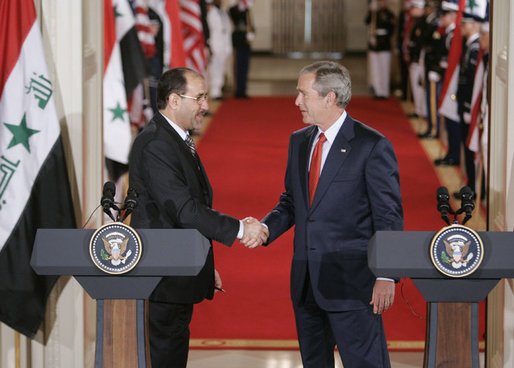
Mr. Prime Minister, welcome to the White House. I just had a very constructive meeting with the leader of a government that has been chosen by the Iraqi people in free and fair elections.
I appreciate your vision for a free Iraq, and I appreciate you briefing me on a strategy to reduce violence and to rebuild your country.
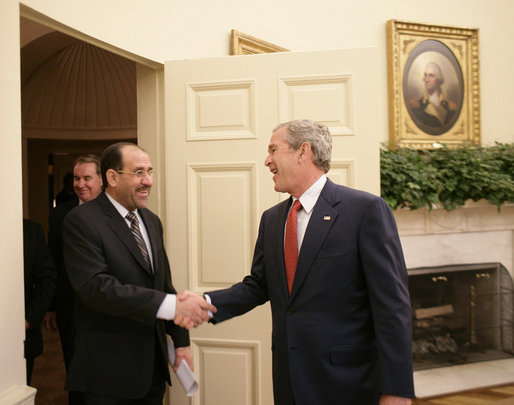
President George W. Bush welcomes Iraqi Prime Minister Nouri al-Maliki into the Oval Office of the White House Tuesday, July 25, 2006, where the two leaders talked about plans to expand the security presence in the neighborhoods of the Iraqi capital. White House photo by Eric Draper.You have a strong partner in the United States of America, and I'm honored to stand here with you, Mr. Prime Minister. It's a remarkable and historical moment, as far as I'm concerned,
to welcome the freely elected leader of Iraq to the White House.
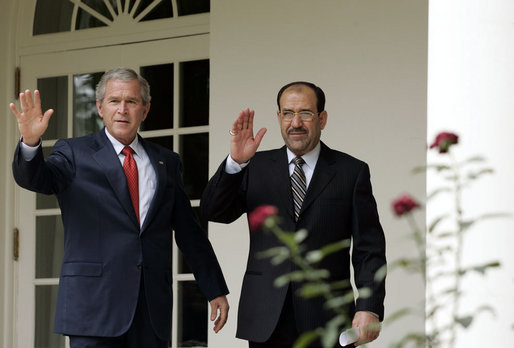
President George W. Bush and Iraqi Prime Minister Nouri al-Maliki walk along the colonnade of the Rose Garden after meeting in the Oval Office Tuesday, July 25, 2006. White House photo by Paul Morse.We discussed a lot of issues. The Prime Minister has laid out a comprehensive plan. That's what leaders do. They see problems, they address problems, and they lay out a plan to solve the problems.
The Prime Minister understands he's got challenges and he's identified priorities.

Our priority is to help this government succeed. It's in the national interest of the United States that a unity government, based upon a constitution that is advanced and modern, succeed. And that's what I told the Prime Minister. He comes wondering whether or not we're committed. He hears all kinds of stories here in the United States. And I assured him that this government stands with the Iraqi people. We're impressed by your courage, Mr. Prime Minister, and we're impressed by the courage of the Iraqi people. And we want to help you.

We talked about security in Baghdad. No question the terrorists and extremists are brutal. These are people that just kill innocent people to achieve an objective, which is to destabilize his government. The Prime Minister tells me that he and his government are not shaken by these actions. They're concerned about them, they're not shaken by them.

The Iraqi people want to succeed. They want to end this violence. Our strategy is to remain on the offense, including in Baghdad. Under the Prime Minister's leadership, coalition and Iraqi leaders are modifying their operational concept to bring greater security to the Iraqi capital. Coalition and Iraqi forces will secure individual neighborhoods, will ensure the existence of an Iraqi security presence in the neighborhoods, and gradually expand the security presence as Iraqi citizens help them root out those who instigate violence.

This plan will involve embedding more U.S. military police with Iraqi police units to make them more effective. The Prime Minister advised me that to support this plan, he and General Casey have agreed to deploy additional American troops and Iraqi security personnel in Baghdad in the coming weeks. These will come from other areas of the country. Our military commanders tell me that this deployment will better reflect the current conditions on the ground in Iraq.

We also agreed that Iraqi security forces need better tools to do their job. And so we'll work with them to equip them with greater mobility, fire power, and protection.

We still face challenges in Baghdad, yet we see progress elsewhere in Iraq. Iraqi security forces are growing in strength and capability, and recently, a key province in southern Iraq was transferred to full Iraqi civilian control. In the midst of all the violence in Baghdad, sometimes a -- success is obscured. And this transfer of a key province is a beginning of other provinces to be transferred to full Iraqi control. It's a sign of progress. No question it's tough in Baghdad, and no question it's tough in other parts of Iraq. But there are also places where progress is being made, and the Prime Minister and I talked about that progress.

The Prime Minister and I agreed to establish a joint committee to achieve Iraqi self-reliance. This new partnership will seek to ensure the smoothest and most effective assumption of security responsibility by Iraqi forces. Prime Minister Maliki was very clear this morning; he said he does not want American troops to leave his country until his government can protect the Iraqi people. And I assured him that America will not abandon the Iraqi people.

Tomorrow, the Prime Minister and I will travel to Fort Belvoir in Virginia to visit with American troops and their families so we can thank them for their courage and their sacrifice. And we in the United States need to recognize the enormous sacrifice of the Iraqi people. The people are suffering hardships. These terrorists and killers are trying to shake the will of the Iraqi people. But despite large casualties, both civilian and military, the Iraqi people continue to stand for public office, enlist in their security forces, and, through their actions, demonstrate every day that they want to raise their families and live their lives like other free people around the world. And I'm impressed by the courage of the Iraqi citizens, Mr. Prime Minister.

Citizens continue to believe in the future of their country and to subscribe to the notion upon which America is also founded, that the freedom of their country is worth fighting for. America is proud to be allied with such people. It's important the Iraqi people hear of our pride and our determination, Mr. Prime Minister.

We also discussed several new initiatives we're undertaking to create opportunity for the Iraqi people, and one of them is called the Iraqi Leaders Initiative. And starting next summer, 200 high school and university students from all regions of Iraq and all sectors of Iraqi society will come to America to study at local institutions and build personal friendships with the people of our country. This is going to be the largest program of its kind, and it will help build the next generation of leaders for a free and democratic Iraq.

The Prime Minister and I spent time talking about Lebanon, and we had a frank exchange of views on this situation. I listened closely to the Prime Minister, and I valued a chance to hear his perspective. I heard him on the seriousness of the humanitarian crisis in Lebanon, and the need to do more for the Lebanese people. I told him that Secretary Rice has announced greater humanitarian measures for Lebanon, to include $30 million in aid. America is concerned about the women and children who suffer in that country, concerned about the loss of innocent life. I reminded him and told him that Condi is over there working to establish corridors to ensure the delivery of humanitarian aid and central relief supplies.

I told him I support a sustainable cease-fire that will bring about an end to violence, and I talked about the importance of strengthening the Lebanese government and supporting the Lebanese people.

Prime Minister and I also discussed his proposal for an international compact for Iraq. The compact will outline Iraq's commitment to specific economic reforms and the international community's commitment to support those reforms. We expect the international compact will be signed later this year. And I told the Prime Minister that the United States will work to encourage other countries to support the compact, and for other countries that have made pledges to Iraq, to make good on their pledges.

In light of the recent violence in the Middle East, some are questioning whether democracy can take root in the region. I believe that the Iraqi people are showing us their answer. They're making enormous sacrifices to secure their freedom, and they've elected leaders who are making tough decisions.

And, Mr. Prime Minister, you're such a leader, and I welcome you to the White House. Thanks for coming.

PRIME MINISTER MALIKI: (As translated.) Thank you very much. In the name of God, the most merciful and the passionate. I would like to thank President George Bush. Mr. President, I would like to thank you for your invitation to come here and visit the United States of America. And I would like to thank you for the warm welcome that myself and my delegation received. And also I appreciate very much your interest in the situation in Iraq and the responsible spirit that has dominated our discussions today.

We have discussed with President Bush clearly and frankly all the current challenges, and the horizon and the future, and ways of cooperation between our two countries in order to build a democratic, united, flourishing Iraq that enjoys its full national sovereignty. We have agreed that building the security and military institutions in Iraq in terms of numbers, equipment, firearms, and as quickly as possible, represents the fundamental base in order to stabilize the country and to have security and defeat terrorism.

I reaffirmed to the President Iraq's need to the cooperation from the international community and your cooperation. And I have seen a great deal of understanding for this very vital issue from the President. I also expressed my appreciation to the role that's been played by the multinational forces and the exerted efforts to support us and to help us in building our security organizations, to allow our organizations to fully be in control of the security position and the security circumstances.

I agreed with the President to form a joint committee of experts and connections in order to achieve the self-sufficiency for the Iraqi forces. This will allow these forces to bear the responsibility of protecting security and confronting terrorism in our country. And in this field, we have achieved our first and initial success when our forces assumed the responsibility in the Muthanna governorate. This is a very important step, will be followed by similar steps in many other governorates in Iraq.

We are determined to defeat terrorism, and the security plan for Baghdad has entered the second phase and it's achieving its objectives in hunting the terrorist networks and eliminating it.

I have informed the President about the national reconciliation plan, which I have launched in order to attract more Iraqi forces which have not engaged in the political process yet. This initiative represents, in addition to building the Iraqi armed forces, one of the initiatives that will contribute to choking terrorism and defeating terrorism in Iraq.

On the economic sphere and the reconstruction of Iraq, I have seen support from President Bush to ensure the success of the international compact, which we hope that, through it, we'll be able to have the support of the world community in reconstructing Iraq and improving the services that the government is providing to its own Iraqi people. We hope that many other countries will participate and contribute in that conference that will be convened in the next few months in order to sign this international compact. I assured the President Iraq's readiness to make this conference a success and accept the mutual commitments between Iraq and those who will sign the compact. The President reaffirmed his administration's commitment to encourage as many countries as possible to support this compact.

I also discussed with the President the issue of Lebanon in all seriousness, in a way that matches the importance of the size of destruction that happened to the Lebanese people as a result of the military air and ground attacks. And I also emphasized the importance of immediate cease-fire, and call on the international community to support the Lebanese government and support the Lebanese people to overcome the damage and destruction that happened.

I also expressed to the President about Iraq's desire and Iraq's political leadership's desire to merge in the international community and its institutions, and to participate effectively in the various issues on the basis of mutual interest, and to be committed to the policy of not interfering or intervening in the domestic policies of other countries. I also reaffirmed the importance of approaching every issue through peaceful and diplomatic means to deal with the problems that exist in our region. These chronic problems require a great deal of wisdom and patience and perseverance in order to find the just and successful and fair solution.

Mr. President, I thank you once again for your kind invitation and for your very warm hospitality and generosity.

PRESIDENT BUSH: Two questions a side, starting with you, Tom.

Q Mr. President, and Mr. Prime Minister, why should one expect this new security crackdown in Baghdad to succeed when all previous ones have failed?

And, Mr. President, you've said before that withdrawal of U.S. troops would depend on conditions on the ground. What do conditions on the ground now in Baghdad suggest in terms of whether there can be a significant withdrawal of American forces by the end of the year?

PRESIDENT BUSH: I'll start -- do you want to start? Go ahead.

PRIME MINISTER MALIKI: Actually, the circumstances that the Baghdad security plans, or other plans related to Basra and other places are different in terms of circumstances from the previous plans. Today Iraq has a national unity government, that is basically composed of -- all elements of the Iraqi people are represented in this government. Iraq has a parliament; it has a constitution to face all these challenges. So what the Baghdad security plan gains in terms of support is support from all over the segments of the Iraqi population.

Secondly, by monitoring the reality on the ground, we will be able to ensure the success, especially what happens against the innocent people. The Baghdad security forces was able to eliminate many hot spots of crimes and troubles in Baghdad.

PRESIDENT BUSH: One of the things that's important is for -- and one of the reasons why you trust the commanders on the ground is because there needs to be flexibility. And I explained to the Prime Minister that I'll be making my decisions based upon the recommendations of General Casey. And, obviously, the violence in Baghdad is still terrible, and, therefore, there needs to be more troops. In other words, the commanders said, what more can we do; how best to address the conditions on the ground. And they have recommended, as a result of working with the Prime Minister, based upon his recommendation, that we increase the number of U.S. troops in Baghdad, alongside of Iraqi troops. And we're going to do that.

The second request that the Prime Minister made was that he needs more equipment for his troops. And General Dempsey, along with General Casey have reviewed his requests and his ideas. And I told the Prime Minister if this is what these generals recommend, it's what I support.

Conditions change inside a country, Tom. And the question is, are we going to be facile enough to change with -- will we be nimble enough; will we be able to deal with the circumstances on the ground? And the answer is, yes, we will.

Mr. Prime Minister, would you like to call on somebody? There you go.

Q I have two questions. One, President Bush. The first one: Is there an obvious change that could be made to the security status, particularly in Baghdad right now?

And the second question for you, Mr. Prime Minister. You said in a press conference in Baghdad that your visit to Washington, you will cross the T's and dot the I's, especially regarding the security needs. Did you cross the T's and dot the I's in your discussion with President Bush?

PRESIDENT BUSH: -- a lot of time talking about security, and I can understand why. Because there's -- there are people who are willing to destroy innocent life to achieve a political objective. And the Prime Minister is deeply concerned about the lives of his fellow citizens. And I appreciate that concern. I would be very worried if a Prime Minister came to talk about his country and did not mention, first and foremost, protecting people's lives. That's, after all, the most important responsibility of government.

And he believes, and I believe, that the -- there needs to be more forces inside Baghdad who are willing to hold people to account. In other words, if you find somebody who's kidnapping and murdering, the murderer ought to be held to account. It ought to be clear in society that that kind of behavior is not tolerated.

And that's the attitude of the Prime Minister. My attitude is, we shouldn't try to gauge whether or not someone is justified, or not; we ought to be saying that if you murder, you're responsible for your actions. And I think the Iraqi people appreciate that type of attitude.

And so we -- so we're not only talking about adjusting a Baghdad plan at the Prime Minister's request, to make it more effective, we're also talking about how to make the Iraqi army more effective. But the truth of the matter is, the Iraqi army is becoming a highly professional force that will help bring confidence to the people inside Iraq that the government has got the capacity to protect them.

PRIME MINISTER MALIKI: Thank you, Mr. President. Actually, successful acts and large issues has to be based on a clear vision. And through the serious discussion and the clear and the frank conversation that I had with President George Bush, that we are truly crossing the T's and dotting the I's in terms of enhancing the security and supporting the reconstruction. Through the discussion we were able to go through the details of the vision that will cover the future, because we are not talking here about a specific phase of the reconstruction, but we are facing the necessity of continuous work in order to make sure that the entire political experiment will succeed.

I believe with a great deal of confidence that I have reaffirmed through this, and I became convinced that, I have full confidence of victory and we will be highly capable of defeating terrorism in Iraq.

Q -- you had a frank exchange on the Middle East. How can you get Arab nations to apply pressure to stop the fighting in the Middle East, if allies like the Prime Minister won't condemn Hezbollah?

And, Mr. Prime Minister, what, exactly is your position on Hezbollah? Thank you.

PRESIDENT BUSH: The terrorists are afraid of democracies. And what you've witnessed in Israel, in my judgment, is the act of a terrorist organization trying to stop the advance of democracy in the region.

I assured the Prime Minister that I care deeply about the suffering that takes place, that we understand the anguish of leaders in the region who see innocent people losing their life. I also assured him that Condi Rice's mission is to help get humanitarian aid to the Lebanese people. She's working on not only air corridors, but sea corridors and land corridors, to get aid to the people. And the United States will participate, as will other nations.

I also talked about making sure that we adhere to U.N. Resolution 1559, which basically -- not basically -- strongly urges political parties not to be armed. A key part of our strategy is to support democracy. And so, not only do we support democracy in the Palestinian Territory, we also support the Lebanese democracy. I think the Prime Minister was pleased to hear my strong support for the Siniora government.

And so Condi goes with the following messages: We support the Siniora government; we care about the people; we will help to get aid to the people; and that we want a sustainable cease-fire. We don't want something that's short-term in duration. We want to address the root causes of the violence in the area, and therefore, our mission and our goal is to have a lasting peace -- not a temporary peace, but something that lasts.

And I believe that Iraq, in some ways, faces the same difficulty, and that is a new democracy is emerging and there are people who are willing to use terrorist techniques to stop it. That's what the murder is all about. People fear democracy if your vision is based upon kind of a totalitarian view of the world. And that's the ultimate challenge facing Iraq and Lebanon and the Palestinian Territories, and that is, will the free world, and the neighborhood, work in concert to help develop sustainable democracy?

And Iraq took a long step along that -- a big step on that path when they developed a constitution that was ratified by the Iraqi people. And it's a modern constitution, and it's a landmark moment in the history of freedom advancing in the Middle East.

I believe that deep in everybody's soul, Mr. Prime Minister, is a desire to be free. And when 12 million Iraqis went to the polls and said, I want to be free, it was an amazing moment. I know it seems like a long, long time ago that that happened. But it was a powerful statement about what is possible in terms of achieving peace.

PRIME MINISTER MALIKI: Thank you. Here, actually we're talking about the suffering of a people in a country. And we are not in the process of reviewing one issue or another, or any government position. The important thing here is what we are trying to do is to stop the killing and the destruction, and then we leave the room and the way for the international and diplomatic efforts and international organization to play the role to be there.

We are not here facing a situation only in Lebanon, but would be facing a variety of issues in different countries. I'm talking here about the approach that should be used in order to stop this process of promoting hatred, that has to be superior decisions coming from above in order to protect these experiments, particularly the democratic experiments that should be protected by those who are trying to oppose it.

Q Thank you very much, Mr. Prime Minister. General Abizaid said that the danger that Iraq is facing is the religious danger. Do you agree with his assessment? And do you see that is there any security plan that can really curb the religious violence?

(For President Bush) -- humanitarian aid to Lebanon. Yet there's also reports that your administration are speeding up delivery of laser-guided missiles to Israel and bunker-buster bombs. And do you see this -- if this is true, do you see it as contradictory? On one hand, you allow Israel to kill people, and civilian, in particular, and on the other hand, you're trying to aid the very people that have been suffering and killed as a result?

PRESIDENT BUSH: No, I don't see a contradiction in us honoring commitments we made prior to Hezbollah attacks into Israeli territory. And I -- like the Prime Minister, I'm concerned about loss of innocent life, and we will do everything we can to help move equipment -- I mean, food and medicines to help the people who have been displaced and the people who suffer.

PRIME MINISTER MALIKI: I do not reduce the risk and the danger of the religious feelings, especially through some of the organizations that are trying to promote this hatred. And there are -- some of the events are on the basis of religious divide, but I would like to assure the political and religious leaders and civil societies that the Iraqi parties, politicians, religious leaders are rising to their responsibility and are condemning those who are cooperating with al Qaeda and those who are trying to start a civil war.

The most important element in the security plan is to curb the religious violence, because we will not allow any Iraqis to use this background. This is one of the main objectives of the security plan. It is the policy of the government: There is no killing or discrimination against anyone. Everything is by law and everything based on the constitution and the law. The government responsibility is to protect all Iraqis, regardless of their ethnic or religious background. It's important to say that we are shedding the light against those who are calling for sectarian religious, because we feel that this is a great danger to Iraq. And, God willing, there will be no civil war in Iraq.

Thank you very much.

PRESIDENT BUSH: Thank you.

END 11:56 A.M. EDT, For Immediate Release, Office of the Press Secretary, July 25, 2006

Related: Keyword Iraq, Monday, June 26, 2006 President Bush Meets with Supporters of U.S. Military (VIDEO), Monday, June 26, 2006 Sheikh Mansur Interdiction gun camera footage (VIDEO), Wednesday, June 21, 2006 Military Working Dog's Best Friend (VIDEO), Monday, June 19, 2006 Female Sailors first to be deployed forward (PODCAST, Saturday, June 17, 2006 Maj. Gen. Caldwell missing soldiers 06/17/06 (VIDEO), Saturday, June 10, 2006 Maj. Gen. Caldwell, neutralization of terrorist Musab Al Zarqarwi (VIDEO), Friday, June 09, 2006 Gun Camera Footage of Zarqawi Elimination (VIDEO), Friday, June 09, 2006 the President on Death Zarqawi (VIDEO), Thursday, May 11, 2006 President Discusses NSA Surveillance Program (VIDEO, Monday, March 20, 2006 Third Anniversary of Beginning of Iraq Liberation (VIDEO), Tuesday, March 14, 2006 President Discusses Freedom and Democracy in Iraq, 03/13/05 VIDEO, Thursday, March 09, 2006 President Signs USA PATRIOT Act (VIDEO), Saturday, February 25, 2006 President Addresses American Legion, Discusses Global War on Terror (VIDEO), Wednesday, January 25, 2006 President Discusses War on Terror at K-State (VIDEO), Wednesday, January 04, 2006 President Discusses War on Terror Following Pentagon Briefing (VIDEO), Monday, December 19, 2005 President's Address to the Nation (VIDEO) 12/18/05, Thursday, December 15, 2005 President, McCain, Warner, Discusses Interrogation, Wednesday, December 14, 2005 Iraqi Elections, Victory in the War on Terror (VIDEO), Monday, December 12, 2005 President Discusses War on Terror and Upcoming Iraqi Elections (VIDEO),

Monday, July 24, 2006

WTO Doha Development Agenda, Susan C. Schwab and Mike Johanns

Technorati Tags: and or and , or and , or , and , or and or and or and or and or , or , or ,

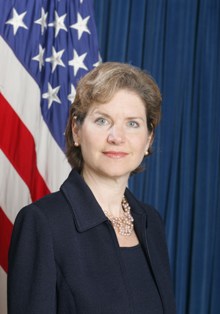
Ambassador Susan C. Schwab, United States Trade RepresentativeFacts on Global Reform, File is in PDF format.

Transcript of Press Availability on the Doha Development Agenda with Ambassador Susan C. Schwab and Mike Johanns, Secretary of Agriculture WTO Headquarters, Geneva, Switzerland 07/24/2006
Ambassador Schwab: Good morning everyone.

We are obviously very disappointed that the G-6 Ministers were not able to reach an agreement last night. The United States came to Geneva with the flexibility to offer more on domestic support and market access. We took seriously the admonition of the leaders of the G-8 Summit in St. Petersburg, but unfortunately the promises of flexibility and market access coming from St. Petersburg did not materialize in Geneva.

Unless we figure out how to move forward from here we will have missed a unique opportunity to help developing countries and to spur economic growth.

While the United States was prepared to do more, yesterday’s focus on the loopholes in market access, on the layers of loopholes, revealed that a number of developed and advanced developing countries were looking for ways to be less ambitious, to avoid making ambitious contributions.

But that doesn’t mean the United States is giving up. ‘Doha Lite’ has never been an option for the United States; it is still not an option. There was no package on the table yesterday that we could have recommended to the President or to the United States Congress.

That said, the United States remains committed to a successful Doha Development agreement. One that creates real market openings, that brings new economic opportunities, opens markets for all WTO member countries. We feel strongly that we need to avoid the temptation in the coming weeks and months as we sort out where we go from here. We feel strongly that we need to avoid the temptation of pulling anything off the table. We need to focus on how we move forward, how we make a success of the Doha round, how we achieve the promise of the Doha round without degenerating into a finger-pointing exercise.

Let me end my formal comments by extending our appreciation and thanks to Director-General Pascal Lamy for his tireless efforts. We look forward to working with him as we move forward to see the Doha Round realize its full potential.

Thank you.

Secretary Johanns: Let me, if I might, start my comments by also expressing my appreciation to Director-General Lamy. He has worked very, very hard through this process and diligently worked to try to close the gap.

We in the United States also appreciate the good work of the WTO, the World Trade Organization. We believe in it, we believe that it is key to the future of the world, and we are absolutely committed to its success.

I also want to indicate at the outset how much I appreciate the leadership of our President. It was our President that some weeks ago, actually some months ago, announced maybe to the surprise of the world, that he favored the complete elimination of trade-distorting subsidies. His commitment to ambition in this round has truly been an inspiration to me and to Susan.

I also want to express my appreciation to our Congress and to our commodity groups. In October we tabled a really historic, ambitious, bold offer. Just to remind everyone, we proposed cutting our Amber Box, which is the heart of our farm program, by 60 percent. It would have eliminated the possibility of the same farm program. It just wouldn’t fit. The cut was too dramatic. We also proposed cutting the Amber Box and the De Minimus Boxes, rather the Blue Box and the De Minimus Boxes. In the case of the Blue Box we went well beyond what was called for by the July framework. During the many weeks of very difficult negotiations they hung in there and stuck with us on this proposal.

Some weeks ago at a time when there was a transition in our government from Ambassador Portman to Ambassador Schwab, we felt that it was very important that we return to Geneva, all of us, to speak to our colleagues from around the world. We had a whirlwind trip those days that we were here. We spoke to you at that time. We met with Ministers from over 90 countries. It was a rather remarkable 72-hour period of time.

The issue that we raised during those discussions was an issue that we had had conversations about before, but we felt it was an issue that we revisit and give our colleagues from around the world the opportunity to offer their input. That issue was the level of ambition in this Doha round. We used words like ‘Doha Lite’ to try to describe a lesser result and ambition to describe a strong result. To the contrary, to the contrary our colleagues from around the world committed again to an ambitious Doha round.

Now any study that has ever been done relative to this round or to trade in general will tell you that the real gains will be made in market access. It’s not something we invented because we happened to think it up, it is something that has been studied, economically analyzed, and the future of this world depends upon our ability to wrestle the trade distortion out of our market access situation.

So we returned to the negotiating table with Ambassador Schwab, and my next thank you is to her because she maintained that strong level of ambition and commitment to get an ambitious result from the Doha round.

We said from the very beginning and we said over the last couple of days, look, we will be flexible. If we can see ambition in market access we can be ambitious, as we have been, with domestic support.

Well, let me just give you one example. I’ll kind of approach this from two different angles. Approach number one is developed countries, the EU proposal. We finally got down to some specifics. You all know that around the world a lot of beef is grown. We’re not the only country that grows beef. There was this talk about 800,000 tons of beef that would come in, and I must admit I was confused by it. I really couldn’t see it in what was being tabled. Well, as it came out it was pretty clear that beef was going to be a sensitive product so therefore there would be a TRQ for beef.

The current tariff for high quality beef in the EU is 80 percent. That blocks the market. There is no more effective trade distortion than that. To just simply block the market, to close the door. Under the proposal, the new tariff would be 61 percent. That is still a remarkable blocking of the market. It makes it impossible to compete. It makes it impossible to sell beef into that marketplace.

So the TRQ, we finally found out after discussion, for the whole world ladies and gentlemen, would allow in 160,000 tons of beef. That’s two percent of the market. That’s what we were getting. For the world. That wasn’t a bilateral discussion, this is a multilateral discussion.

We then went on to the discussion about developing countries and I said a few weeks ago when we were here I was worried about what was being proposed for developing countries. Now advanced developing countries are world class competitors. This would be China, this would be India, this would be Brazil, this would be other countries around the world that quite honestly can compete with anybody very effectively. Yet in the proposal that they tabled, it essentially blocked 95 to 98 percent of their market. Not our figures. That was an analysis done right here at the TWO.

So in the end, what we were faced with is this: we’ve got a very bold proposal already, we’ve announced our willingness to be flexible but we’re still not seeing the market access that is necessary for world trade. And again, let me just wrap up my comments and say this. Many countries will come before you today. The multilateral process is bigger than any one country, the United States included . It is a process that is designed to lift people out of poverty, to open up new markets, to increase trade flows so all have an opportunity for economic advancement.

I just rest my case by saying and asking the question, can anybody seriously argue, for example, that 160,000 tons of beef, two percent of the marketplace, is an increase in trade flow? Can anybody seriously argue that advanced developing countries literally arguing for 95 to 98 percent of their marketplace being protected in agriculture is going to result in an increase in trade flows? I think not.

But I agree with Susan. I strongly feel that even though today truly represents a failure, let’s be blunt about it, that this isn’t a time to pull offers off the table, to talk about take it or leave it. If you look at the history of the Uruguay round it stopped and started a number of times. We are committed to the multilateral process, we are committed to these negotiations, we are committed to the WTO, and we have a President who is committed to the elimination of trade distorting domestic support. We have a historic opportunity here.

It is very, very difficult for us today to sit here before you and recognize this is where we’re at, but we’re going to do everything we can to encourage this discussion to continue to occur. There’s too much at stake not to.

Question: Fishermen from Asia were having a press conference a half an hour ago and they said that the WTO is for the rich only and it works for the poverty of the poor, making the poor more poor, and that they would like to dismantle it. What is your reaction?

Ambassador Schwab: I think the WTO is and should continue to be a real friend of developing as well as developed countries. The WTO is a venue where developing countries, no matter how small, have the opportunity to come in and enforce their rights, require that other countries meet their obligations vis-à-vis that country. It is a forum where the dispute resolution process enables developing countries to make a case.

In the case of the Doha round negotiations, the large majority of developing countries would not have been asked to make any contributions whatsoever in terms of market access. In fact they would have been 100 percent beneficiaries of this round without being required to pay anything for this round. This as a development round is fine for the middle tier and certainly the least developed countries, so this is a wonderful organization for developing countries in that it promotes their rights, it promotes growth and economic development, and access for their goods in other markets in ways that no other institution in the world could help them, and I would note that the implications of trade generated growth are so much greater than anything that you can get in overseas development assistance. Any comparison you look at, the benefits to those farmers, to those fishermen, from trade far out-pays anything that an official aid agency could ever provide.

Question: My question would be about a possible timetable. Has there been any kind of timetable, any idea of when these talks could get restarted? Probably at the next ministerial of the WTO next year?

Ambassador Schwab: I think we should defer to the Director-General in terms of the schedule going forward. As Secretary Johanns noted, this is a serious failure that we find ourselves in and the question is how to regroup and how quickly could one regroup and move forward and in what manner. I think Pascal Lamy will address that today.

I think the members of the WTO need to stand ready, willing and able to engage in this process. I don’t think we can leave it entirely up to the Director-General. The Director-General shouldn’t be expected to do this on his own, shoulder this burden on his own. Hence our comment that it is within our power not to pull anything off the table, to make sure that we are positioned to move forward and generate more momentum when we have a sense of the best direction to go in. So I would defer to Pascal Lamy in terms of timing and pacing, but I think the key role for individual members of the WTO, particularly those of us in a leadership role, is to do everything we can through bilateral meetings, through small group meetings. There are a series of opportunities coming up and opportunities we can create for ourselves to help him, to help the Director-General move the process forward.

Question: Secretary Johanns, I hear you mention the TRQ on beef. As I understand it, the combined tariff cuts and TRQ on beef would give an extra 800,000 tons of access to the European market. I was surprised to hear you use that as an example because as I understand it the US doesn’t export beef to the EU because of the hormone ban.

Secondly, did you make any new offer on domestic support at all? Thanks.

Secretary Johanns: The hormone ban on beef, I would love to spend the next 15 minutes visiting with you about that. We absolutely want to ship beef to the European Union. The European Union uses a number of mechanisms, phyto-sanitary/sanitary mechanisms, in addition to their tariffs that really create challenges, and I’m being very diplomatic here, really create challenges in terms of our ability to sell products into their marketplace. But let there be no doubt about it. We want to sell beef to the European Union, we want to sell grains, we want to sell poultry, and yet we continue to struggle with them on phyto-sanitary/sanitary bans. We’ve, as you know, exercised our rights in the WTO process, I might add successfully, but we still struggle to find entry to that market.

I ask you to study that 800,000 ton figure very, very carefully because once I came to understand what they were promising, I have to tell you I was very surprised. What the TRQ actually promises is 160,000 tons worldwide. The way they get up to 800,000 tons is somebody did a study saying, but we may need additional beef. We’re not going to give it to you in a TRQ, we just may need it. So the study says that you will have the possibility of selling that into our marketplace.

Now there is no definition of market access that I know of that says that that’s the appropriate approach to bind an agreement between parties in a multilateral basis. So in effect what you end up with is a maybe on the vast majority and a binding on 160,000 tons that we get to share with the whole world, or the whole world gets to share is a better way of putting that. That’s two percent of the marketplace. That’s just really minuscule. That really isn’t opening at all, that isn’t market access even setting aside that phyto-sanitary/sanitary issue which again I think is very, very clear, we need to overcome to get the marketplace open in the first instance.

In terms of our flexibility, let me remind everyone again, there is one leader in the world who has called for the elimination of trade-distorting domestic support. You know where our President stands on this issue and he hasn’t been shy about repeating that statement. And like I said, I think he probably surprised a lot of people in the world.

We came here and expressed our willingness to be flexible. To be flexible on domestic support, to be flexible on market access. But in the end when we studied the market access proposals on the table there was no there there. There was no additional market access that we could grab a hold of and say we are making progress. In fact, speaking of ‘Doha Lite’, ‘Doha Lite’ got a lot lighter in the past 30 days. All of a sudden we came to realize that not only was there going to be substantial protection and barriers in developed countries, but in these advanced developing countries that are world class competitors to everybody, that they were basically arguing that 95 to 98 percent of their ag market should be protected. That they would have the ability to choose when, how and if they would do business. And that was the proposal.

Now again, if somebody can make a case to me that that somehow was market access that we could respond to, I’m all ears, but I didn’t see it. Just the facts, not indicting anybody, but the reality is the facts are that there was no there there on market access.

Question: I’m sorry. To be clear, you're saying you didn’t put anything new on the table?

Secretary Johanns: We did. We indicated our flexibility from the very first statement.

Question: But you didn’t make any new offer with any numbers yesterday?

Secretary Johanns: What we did in the opening yesterday is we said we are ready to be flexible. We have to see something in market access. And quite honestly, we didn’t see it. It wasn’t there. There just was nothing there that we could grab onto that allows us to take that step. There was just simply nothing there.

Ambassador Schwab: Let me add to that. We not only said we were prepared to do more in terms of cutting trade distorting subsidies along with obviously our commitment to eliminate export subsidies, we also indicated that we understood that other countries had some sensitivities that they would want to protect. And that we were even prepared to allow sensitive products, the scope of sensitivities, to be greater than that which had been in our position in October, but not to the extent of negating the fundamental market access purpose of this round.

Question: There is a general perception among the trade ministers who attended the meeting yesterday that your maximalist agenda on market access does not quite match with your minimalist agenda on the trade distorting domestic support because there was no clarity in terms of balance between what you are ready to reduce in trade distorting domestic support and what you in turn want in the market access. That’s just one issue.

The second issue is you keep mentioning about these layers of protection through the special products. Can you actually indicate as you indicated in the case of beef for the European Union, can you actually indicate what are the products that you Rae currently facing problems entering into markets like China or India? Given the low tariffs, you have a tariff of about five to ten percent on wheat; you have a tariff of zero percent on many dairy items. What exactly is it that you're facing in terms of your entry into the emerging economies? Because the general argument is you are not a competitive exporter in relation to Argentina or Brazil or Australia or Thailand.

Secretary Johanns: Ravi, let me take a first attempt at your question and let me again maybe study a little history in terms of our domestic support proposal.

Our farm programs by and large fit into a classification that you’re all very familiar with. We call it the Amber Box. That really is the majority of the US farm programs. They are slotted into that box.

When we were out there talking to our colleagues around the world about what they thought we should do in terms of our proposal, some said you’ve got to cut your Amber Box by 50 percent; some said you’ve got to cut your Amber Box by 55 percent. We listened to that very, very carefully. We consulted with Congress, our commodity groups, our President, and we decided that we should cut our programs by 60 percent in the Amber Box.

Now what’s the bottom line, ladies and gentlemen? That eliminates those programs. They don’t fit any more. Our farm program has just disappeared because there is no other way you can pigeon-hole our programs into any other area.

Go to the July framework. The July framework said that we should be at five percent of production on the Blue Box. We thought long and hard about that. We could have safely, confidently chosen to abide by that July framework and it would have been all the protection we needed. But the world was asking for leadership by the United States, and again, we debated that with our President and our Congress and our commodity groups, and we said you know what? We’re going to go beyond the July framework and we’re going to cut that to two and a half percent.

Now let me explain to you the significance of that. There was a lot of uneasiness that we might take our counter-cyclical program and slide it over to Blue Box. We could have done that had we chosen to keep it at five percent. We said to ourselves, the world needs greater leadership than that, and we literally cut it to a point where we can’t fit our counter-cyclical program into the Blue Box. Another piece of our program just disappeared.

People have raised the issue about the De Minimus Box. We don’t use a lot of De Minimus, we use some. But cost out the programs. They don’t fit into the De Minimus Box.

So in effect what we have said to our farmers in the United States is that programs that date back to the Great Depression, to the 1930s, will disappear. Will disappear.

Now if that isn’t dramatic I don’t know how you could possibly describe these programs.

Now by comparison we said look, from day one we said look, we know we’ve done something really dramatic, we know we’ve eliminated the possibility of our farm programs continuing in their form in the United States, we know that we are flying in the face of 75 years of history here with our farm programs, we have to have market access.

Meaningful flow of trade. We’re not asking for the world. We’re just asking that we be able to look at what we accomplish and see trade moving. Does anybody want to argue with me that trade is moving when 95 to 98 percent of a marketplace is protected? Anyone want to argue with me that trade is moving when what you really come down to with beef products is 160,000 ton TRQ for the whole world? Does anybody want to make that case? It’s not a case you can make.

Now in terms of specific products, here’s the problem with your analysis. That would be like the United States saying look, folks, we want a trade agreement that says we can deal with you when and if we choose to and we’ll decide under what circumstances we’ll deal with you. That’s in effect what this proposal is in terms of developing countries, whether it’s wheat or any other product.

Now Ravi, as you know, wheat’s probably a poor example because even though there have been tenders for wheat, the phyto-sanitary/sanitary requirements put in place for example by India have made it impossible for us to enter that market. We hope we can change that. We hope we can bring about a more sensible approach because phyto-sanitary/sanitary barriers can also be very very effective barriers to trade.

So the bottom line is we did submit a very very bold proposal. It stands as a bold proposal. The world acknowledged it as a bold proposal, but we even said from day one this is negotiation. We will be flexible. We announced it again during the course of this meeting. And I have to tell you, I have reached the conclusion, as I said, that in the last 30 days ‘Doha Lite’ got a lot more light in the market access area.

Question: Do you think, Ambassador Schwab, first do you think that disputes will increase in this meanwhile since countries have no other choice than to try to resolve their issues in the dispute settlement body?

And secondly, do you think now is the time to perhaps renew the attempt of the FTAA since this trade agreement will not be completed?

Ambassador Schwab: I think that it is probably inevitable that disputes will increase. I think that we all need to be mature and sensible in terms of how we approach the next several weeks and several months to make sure that the progress we have made in connection with the Doha Round isn’t lost and that we’re in a position to build on it going forward.

I think going to your second point, I think the critical issue going forward is before jumping to conclusions about this kind of approach and that kind of approach, the US remains fully committed to the multilateral trading system and to the World Trade Organization. We also have a very ambitious agenda in terms of bilateral and regional negotiations and we’ll see how that plays out.

For my part, over the next several months and weeks, and days actually, I intend and I know Secretary Johanns intends to be very active in terms of exploring options and seeing what we can do to move forward on a multilateral agenda. That means in my case travel, not yet confirmed but as early as next week. Next month I’ll be going to meet with the ASEAN Trade Ministers. There is a meeting of CAIRNS Group Trade Ministers scheduled in September. The APEC Summit, the APEC Ministers meeting in Vietnam in November. So there are a series of meetings and engagements that will punctuate these efforts to move the ball forward.

Thank you.

RELATED: Keyword, Susan C. Schwab, Saturday, April 29, 2006 Softwood Lumber Trade Dispute Resolved, Tuesday, April 18, 2006 President Nominates Rob Portman as OMB Director Susan Schwab for USTR (VIDEO),

Related: Keyword Agriculture, Thursday, December 29, 2005 USDA ASSISTANCE TO COMBAT WILDFIRES IN TEXAS AND OKLAHOMA, Thursday, December 02, 2004 Mike Johanns Secretary of Agriculture, Thursday, January 06, 2005 Michael Johanns Agriculture Nomination Hearing, Friday, January 21, 2005 SECRETARY OF AGRICULTURE MIKE JOHANNS, Sunday, February 20, 2005 USDA contributing $10.7 million to restore wetlands, Friday, February 25, 2005 USDA Raises FY 2005 Agricultural Export Forecast, Wednesday, March 02, 2005 S. J. RES. 4 bovine spongiform encephalopathy, Wednesday, March 02, 2005 USDA's Minimal-Risk Rule, Thursday, March 10, 2005 USDA KICKS OFF NATIONAL SCHOOL BREAKFAST WEEK, Sunday, March 20, 2005 Agriculture Secretary Mike Johanns, bovine spongiform encephalopathy (BSE), Tuesday, March 22, 2005 USDA REVISES STANDARDS FOR SWEET POTATOES, Tuesday, March 22, 2005 ARS Laboratory Will Focus on Egg Safety and Quality, Saturday, April 09, 2005 GRAIN INSPECTION ADVISORY COMMITTEE, Sunday, April 17, 2005 2010 Health Goals For E. Coli 0157, Thursday, April 21, 2005 Growth in biomass road to energy independence, Sunday, May 01, 2005 International Food Aid Conference VII, Sunday, May 08, 2005 Laser Shows if Fruit's Beauty is Only Skin Deep, Monday, May 23, 2005 Members And Alternates Named To National Peanut Board, Monday, May 23, 2005 Alternate Producer Member Named To Hass Avocado Board, Sunday, May 29, 2005 regarding over-fortified corn soy blend,