


Technorati Tags: State Department and Secretary of State or Resolution 1701 and LEBANON, or Israel and Resolution 1559 or Condoleezza Rice, or Middle East and UN Security Council,, or President Bush, and Hezbollah, or PODCAST, and Lebanese Army, or Hamas, and VIDEO, or UNIFIL, and Israeli Hostages
Daily Press Briefing, Spokesman Sean McCormack, FULL STREAMING VIDEO, file is windows media format, running time is 30:37 PODCAST, file is mp3 in m3u format for streaming playback, running time is 30:37, DOWNLOAD, file is mp3 format for PODCAST, running time is 30:37, Washington, DC, August 14, 2006
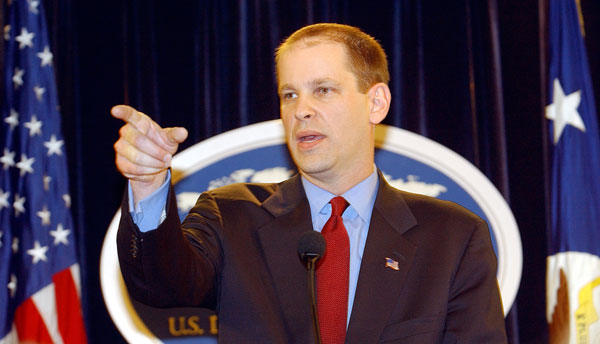 | Department Spokesman Sean McCormack (shown during the Daily Press Briefing) was sworn in as Assistant Secretary for Public Affairs and Department Spokesman on June 2, 2005. |
MR. MCCORMACK: Good afternoon. How are you?
QUESTION: Good.
MR. MCCORMACK: Good. I don't have any opening statements. You all know the President will be over here just a little bit later this afternoon. He's going to have some briefings, going to cover the War on Terror, counter-proliferation, public diplomacy, transformational diplomacy, foreign assistance reform, and the Middle East. And then --
QUESTION: In how many minutes?
MR. MCCORMACK: Excuse me?
QUESTION: Over how many minutes?
MR. MCCORMACK: It's going to be over a couple of hours. He's going to have --
QUESTION: Could you say it slower one more time, the issues?
MR. MCCORMACK: Sure, yeah, three separate briefings. First one is War on Terror, counter-proliferation, and public diplomacy, those subjects grouped together. Transformational diplomacy and foreign assistance reform, grouped together, and then the Middle East, and then he will come out and talk to the pool and have some remarks.
QUESTION: Okay.
QUESTION: Will the Secretary accompany him in the remarks?
MR. MCCORMACK: I think they'll work that out. She'll be there, obviously. I don't know what speaking role she'll have, if any.
QUESTION: On the pool?
MR. MCCORMACK: What's that?
QUESTION: On the pool?
MR. MCCORMACK: It's a White House event. It's going to be the White House pool. It's a pretty small space up there.
QUESTION: Is she going to be in all three of these?
MR. MCCORMACK: Yes, yeah, she'll be in all three of those.
QUESTION: But there will be a changing cast?
MR. MCCORMACK: That's right; there will be a rotating cast of characters actually doing the briefings, yeah.
QUESTION: Okay.
MR. MCCORMACK: Well, okay. Lead off, Barry.
QUESTION: Yeah, you want to -- have anything to say about how things are going so far in the ceasefire?
MR. MCCORMACK: I think you guys --
QUESTION: It's awful early, but go ahead.
MR. MCCORMACK: Right, yeah, you guys have all reported on that. Thus far, the large-scale violence has ended. Thus far, the parties seem to be largely complying with the terms of the resolution. And if we all do our work, as the Secretary has said, over time, this will lay the foundation for a durable, lasting cessation of violence and ceasefire and a much more stable strategic situation along that border area, along that northern Israeli border, Barry.
QUESTION: All right. Now if I read it right, I thought -- I think Hezbollah is saying that as long as Israel occupies Lebanese territory --
MR. MCCORMACK: Right.
QUESTION: You know, they'll -- prepared to do what's necessary to end it. So there is an overlap, maybe a couple of weeks, maybe three weeks until the force is in place?
MR. MCCORMACK: I don't have a timeline for you, Barry. We're pushing for this force to be generated as quickly as possible. I would expect that there would be a force-planning contributors conference up at the UN very, very soon and we, obviously, want to see that force generated as quickly as possible.
QUESTION: I don't know if you want to be the one to tick off some of the volunteers, but --
MR. MCCORMACK: No, I'll let them speak for themselves.
QUESTION: But along those lines, Sean, weren't -- those meetings were supposed to start already on Saturday, so there have been some discussions?
MR. MCCORMACK: There's already -- there's a rolling start to this. For example, John Hillen, our Assistant Secretary for Political and Military Affairs, has already been up to the UN a couple of times over the past week to help them with their planning in terms of defining what size force you need, what functions will this force need to do, what sort of combat power will they need. So there has been some planning going on. There have, as I mentioned over the past week, been some countries that have expressed an interest now in going in there. And I think now that they have a look at the resolution, they'll have a better idea of whether or not they'll be able to follow through on that interest. And I would hope that very quickly, we would see countries coming forward and saying that they will participate in the force.
QUESTION: What would you consider a very quick timeframe? I mean, there are logistical issues even after the planning.
MR. MCCORMACK: Right.
QUESTION: So what do you --
MR. MCCORMACK: I don't -- I'm not going to set a specific timeline. It just needs to get done as quickly as possible.
QUESTION: So you see them in -- within how long?
MR. MCCORMACK: As quickly as possible.
Yeah.
QUESTION: In terms of the prisoners, I know the Italian Foreign Minister is in Beirut and met with Nabih Berri and apparently, Nabih Berri announced that he would no longer -- didn't want to be involved and he was going to be the mediator and not -- and he no longer wants to be involved. Is that not a very good start to the --
MR. MCCORMACK: We obviously want to see those prisoners, those Israeli hostages returned as quickly as possible, safe to their families. I think that that was the feeling expressed by the resolution as well.
QUESTION: What's your understanding of the process for that to take place?
MR. MCCORMACK: The process for that is not something the United States is involved in, but in only to the extent that we would want very much to see those prisoners, those hostages released at the earliest possible moment. And we would certainly expect that the Government of Lebanon would do everything it could to affect their release and return to Israel.
Joel.
QUESTION: Sean, following this ceasefire is there any regard to what happens to these Hezbollah guerillas? Is that to be integrated in with the Lebanese army?
MR. MCCORMACK: I don't think -- you know, again, Joel, the -- how the Lebanese army functions is going to be a decision for the Lebanese Government and the Lebanese people. Hopefully, we won't have to live with such a term Hezbollah "guerilla" for much longer, because Resolution 1559 actually calls upon the Lebanese Government to disarm Hezbollah so that you don't have these militias -- we would say terrorist groups -- operating outside of the control of the central government.
QUESTION: Sean, following up on that --
MR. MCCORMACK: Yeah, sure.
QUESTION: -- does that mean that the United States is prepared to accept Hezbollah as a political entity of they disarm --
MR. MCCORMACK: Again, that's not the situation we find ourselves. Hezbollah has to make a choice. They have to make the choice between whether or not they are going to be in a political camp or whether or not they are going to be a terrorist group. You can't have one foot in each camp. And how the Lebanese people decide to organize themselves politically is up to them. But you can't have the current situation. It is a contradiction that needs to be resolved. The way it gets resolved is by the Lebanese people. And you posed the question -- you would face a fundamentally different situation whereby you have a group of people who are not committed to terrorism. That is not in fact the case. It is the case now that you have a group that is committed to the use of terror, and they have to make a choice and the Lebanese people have to make that same choice.
QUESTION: But surely you don't want to see the same thing happen as happened in the Palestinian territories where they -- the people did choose the group --
MR. MCCORMACK: Again, we've gone over this territory before. They didn't run -- Hamas did not run on the platform of we're going to send your 16-year-old kids to blow up Israeli citizens. They run on the platform of we're going to clean up your government.
Now, again, we've gone over this before. It is unusual that there -- just as there was the beginnings of some potentially positive ferment within the Palestinian political system, you had the most radical, violent elements of Hamas staged that attack on the Israeli guard post and capturing an Israeli soldier. They knew the effect that that would have on the political process within Palestinian areas. So we certainly want to get back to the point where you can even have the hope of getting back on the roadmap, some sort of positive political process. And the way you do that is you have these groups recognize the right of Israel to exist, abide by the international obligations that have been outlined for them. That's certainly what we hope to -- we would hope to get back to that point.
Secretary Rice, when she went to the region, sent that message to President Abbas. And we certainly stand with President Abbas. We believe that he is a -- somebody who is interested in peace and has a positive vision for the Palestinian people.
QUESTION: Sean, one final one. What is your understanding of how soon the Lebanese army would go down? We don't know about the international force yet, but the Lebanese army conceivably will be moving in concert with those troops or --
MR. MCCORMACK: I think that those movements have to be coordinated and that it's envisioned that the international force would be supporting the Lebanese army. And I think we all understand that the Lebanese army at this point is not a force that can really exert that kind of positive control over southern Lebanon. So I would expect that those movements would be coordinated. That's going to be part of the function of this international force working with the Lebanese Government to coordinate those movements. You also have to figure in the Israeli military to this equation as well, so there's a lot of complicated, complex coordination that needs to be done. We're going to do everything that we can to help facilitate that and I would expect the UN would be deeply involved as well.
QUESTION: I have one more. Is there any clarification that France is going to take the lead in the force?
MR. MCCORMACK: I don't know that they've said that in public. I think that they're -- I think the expectation is that they would play a significant role in the force.
QUESTION: To follow up on that part of your answer --
MR. MCCORMACK: Yeah, sure.
QUESTION: Did I understand correctly you don't assume the Lebanese army move to southern Lebanon until the international force moves there?
MR. MCCORMACK: I said only, Charlie, that those movements would have to be coordinated with the international force. I would expect that those movements would be done in concert, Charlie. I don't have a timeline for either of those right now, but those things would have to be done together. I think the understanding, when the resolution was passed, is that the international force would be going down in support of the Lebanese army because it didn't have the wherewithal, at this point, to fulfill the mandate of the resolution.
QUESTION: But in the meantime, and you're hoping for -- you know, a force getting down there as soon as possible, but in the meantime, Israel keeps troops in Lebanon?
MR. MCCORMACK: Right.
QUESTION: And Israel -- you know, is prepared to shoot if provoked. Does the Administration have any problem with the -- because it could be the thing that stimulates or sets off a Hezbollah attack. Does the U.S. have any problem with Israeli troops hanging in there for another couple of weeks until the force takes over?
MR. MCCORMACK: Well, the -- well, two things. One, we want the force generated as quickly as possible and -- because that triggers a number of things. It triggers a deploying of the international force and in parallel with that deployment, the withdrawal of Israeli forces. And that's an important point, that they get done in parallel. So there's a rough equivalence there in terms of international forces, Lebanese forces coming into an area and what Israeli forces are leaving an area. So that's the first thing.
Second of all, Barry, you want to -- the terms of the resolution are very clear. It talks about what is incumbent upon the Government of Lebanon and Hezbollah to do. Hezbollah needs to cease all activities, all military kinds of activities, whether that's launching rockets or launching attacks. The resolution calls on Israel to stop all offensive military operations. There's nothing in this resolution that calls upon Israel to abrogate its rights to self-defense.
QUESTION: Okay. That answers it.
MR. MCCORMACK: Lambros.
QUESTION: It was -- New York Times reported today on the front page, "When Israel began Counterattack on Hezbollah one month ago, the U.S. Administration backed Israel's plan to destroy the militia."
MR. MCCORMACK: Where is this, Lambros?
QUESTION: In New York Times, front page, and "to destroy the militia (inaudible) targets resisting efforts by France, and now they’re alleged call for a ceasefire immediately." Could you please comment on that?
MR. MCCORMACK: On what part of it, what part of it?
QUESTION: The question is if it's true that you're trying -- you are resisting efforts by France and other allies to call a ceasefire.
MR. MCCORMACK: We have plowed this ground so many times, I think we're clear from the very beginnings of it. President Bush, Secretary Rice, when they were in Germany, as well as in Russia, made very clear that we wanted an end to the violence as quickly as possible, but we wanted an end to the violence that would be durable. You had to have an end to the violence that would be -- that would last beyond -- you know, two days, three weeks, six years. And that's what this resolution -- what we have the potential for.
Joel, do you have one on this topic or is it a different topic?
QUESTION: No, it's referring back to the earlier topic. Do you think Iran is still running this particular show and they have till August 31st? Of course, you bring them as well as --
MR. MCCORMACK: That's a different topic, Joel.
QUESTION: Well -- but are they still running the show? Because currently, Iran and Hezbollah are now using media tactics. You had Mike Wallace with President Ahmadi-Nejad yesterday and also, apparently he's making nice, saying he now has a personal blog, that's Ahmadi-Nejad.
MR. MCCORMACK: Right. Look, you know, I don't even know where to begin with all of that. But certainly, Iran continues to be a state sponsor of terror. Iran is very clearly a sponsor of Hezbollah, give them political diplomatic as well as material support. But I think it's fair to say as -- if this resolution and when this resolution is fully implemented, this is a strategic setback for Iran. This is a strategic setback for Syria, because you will have a strengthened, democratic Lebanon. You will have a more stable area along that border. You will not have Hezbollah roaming freely in the south of Lebanon. Iran and Syria will not have had the ability to re-arm Hezbollah. So I think that very clearly that when this resolution is fully implemented and when you have 1559 implemented, even further, that would represent a setback to Iran.
Kirit.
QUESTION: One on Iran.
QUESTION: Eh--
MR. MCCORMACK: Sure.
QUESTION: I was going to ask -- a few days ago, maybe it was you. It probably was you. Saw no rainbow, no prospect of Iran complying with either its own August 21st deadline, and the UN August -- end of August deadline for stopping its uranium enrichment. Has anything changed? Is there a glimmer of --
MR. MCCORMACK: Not going to try to assess, Barry. That would require getting into the decision-making processes of the Iranian regime into which I don't have great -- we don't have great insight. We would hope that they take up the opportunity that's been given to them. Thus far, they -- we have received no official word through Mr. Solana that they have decided to take up the world on that offer. And what happens next is that they face sanctions under a Chapter 7 resolution.
QUESTION: That has to be planned, doesn't it?
MR. MCCORMACK: Excuse me?
QUESTION: If there are sanctions, you have to have planning --
MR. MCCORMACK: Well, there are --
QUESTION: -- meetings.
MR. MCCORMACK: Well, there are steps that individual states can take. There are states that we can take collectively under the rubric of the UN Security Council resolution and that, of course, would entail discussions, you know, up in New York and in capitals on what a next resolution would entail and exactly what sanctions would be enacted under that resolution.
QUESTION: Last thing.
MR. MCCORMACK: Mm-hmm.
QUESTION: If I can go back to Lebanon?
MR. MCCORMACK: Sure.
QUESTION: The usual question -- has the Secretary been in touch with anybody of late?
MR. MCCORMACK: No phone calls today, Barry.
QUESTION: Okay, thanks.
MR. MCCORMACK: Elise.
QUESTION: Also on Iran and the resolution. Given the fact that you're -- on the whole Hezbollah issue and talking about an arms embargo because Iran's one of the main suppliers of Hezbollah, is there any effort to expand the action against Iran or at the UN Security Council to include some of the activities of arming Hezbollah, anything like that? Like not just dealing solely with the nuclear issue but other concerns that you have on Iran?
MR. MCCORMACK: Well, 1701 talks about -- calls upon all the states not to -- not try to export arms into Lebanon without the explicit permission of the Lebanese Government and it calls upon the Lebanese Government not to permit such arms in. So clearly that puts a crimp in the Iran-Hezbollah operating style if it is fully implemented.
Kirit.
QUESTION: If I could ask something about the Lebanon resolution?
MR. MCCORMACK: Sure.
QUESTION: Can you help define for us what exactly would be a non-offensive action by Israel? What would be a defensive action?
MR. MCCORMACK: I'm not going to try get into the military definitions. I think that in its most simple form it calls upon Israel not to continue on with ground offensives, not continue actively trying to go after and take more Lebanese territory from -- in the kinds of operations that they were engaged in. In terms of a defensive action, I think that there were some reports of some skirmishes. The Israel Government said that their soldiers were threatened by armed Hezbollah militants. They took actions. I haven't heard any dispute with that characterization at this point.
QUESTION: With regard to aerial attacks and so on, how would that fit into offensive verses defensive?
MR. MCCORMACK: Again, you know, what this resolution calls upon is for an end to large-scale violence of the kind that we had seen before. But again, like I said, it doesn't abrogate Israel's right to defend itself.
Dave.
QUESTION: You got into a little winners and losers there with Joel's question. There's a widespread impression in the Middle East that the conflict has elevated Nasrallah's status, practically a hero across the Arab world. There's also some suggestion, certainly by many analysts, that because of Hezbollah's showing on the field that the United States had to settle for less than it wanted with the resolution.
MR. MCCORMACK: How so less than we wanted?
QUESTION: Well, less of an international force, just an augmentation of UNIFIL, for instance, which is sort of --
MR. MCCORMACK: Well, what we have is the version of UNIFIL with an "S" on its chest as opposed to the Clark Kent* version of UNIFIL. No, in fairness, that -- the previous UNIFIL had a weak mandate, relatively weak mandate. This is an enhanced UNIFIL. This is just a different -- it's just -- it may have the same name, but it is -- you know, it is a completely different organization in terms of its size, its abilities, and its mandate.
In terms of Nasrallah, I haven't seen him pop his head out from whatever cave or basement he happens to be hiding in. And in terms of -- you know, the feelings throughout the Middle East, look, it's an emotional time. But I expect that at the end of the day, that the people of the region will look at a Lebanon -- once this resolution is implemented, they will see a Lebanon that is -- that has enhanced democratic institutions, that has a strong prime minister in Prime Minister Siniora, that is committed to implementing these resolutions, that is committed to a more peaceful, stable, democratic Lebanon that will see Hezbollah out of business in the south of Lebanon. And they will also see an international community coming together to stop -- to call for the end of re-supplying of Hezbollah.
And just look at the statements. Look at Secretary General Annan's statement right before the vote this past Friday, in which he singled out Hezbollah as the group responsible for starting this current crisis. So once, I think, the emotions settle from what has been -- you know, very clearly, an emotional time in the Middle East, I think that people will start to look at the facts, and I think that the facts will show that this is -- that this will be a changed, strategic environment in that small part of the world.
Yeah.
QUESTION: Talking about change of the strategic environment in that part of the world, do you seem to miss -- after you're mentioning that this has been -- this war in south Lebanon has been representing a setback for some countries, but what about it being a fact that has changed the equation that Israel cannot depend on its military might in the area to -- for launching more wars and conquering -- and other countries? And do you -- does the United States have any more positive attitude toward the Arab call for new efforts for -- to bring peace to the Middle East and for the United States to convince Israel to come back to the peace negotiations?
MR. MCCORMACK: Well, I will leave it to other states in the region to make their own assessments about Israel's military capabilities and factor that into their decision-making. And as for what level of degradation Israel -- the Israeli military inflicted upon Hezbollah and its fortifications in the south, again, I'll leave it to the Israeli military to describe what it is that they think that they have accomplished. It's not for me to say. I'm not a military man. I'm not here to provide military analysis.
As for peace in the Middle East, of course; I don't think that there has been an Administration that has been more dedicated to trying to resolve differences between the Israeli Government and the Palestinians and to try to -- and for the first time, Barry, since the establishment of the State of Israel, you actually have Palestinians now with their own territory, after the Israeli withdrawal from Gaza. Our hope had been that that might have led the parties to be able to move further down the roadmap. That didn't happen. Hamas won an election.
And you said that -- well, what will the U.S. do -- and this is paraphrasing -- do to get Israel back to the peace table? Well, there is a partner for peace in Israel. It's the Israeli Government. Unfortunately, on the other side of the table, there isn't a partner for peace in the form of the Palestinian Government led by Hamas. They haven't met the most basic requirements agreed upon across the international community, and I think if you talk to Arab leaders, I think that they would say the same thing, that this government has not met the most basic requirements to start discussing peace negotiations to even get back into the roadmap. So we would very much hope for the day when we could get into a serious discussion of the roadmap, how to move forward to a final settlement. And before that time, we're going to do everything that we can to work with those people who do want to bring peace to the region; work with the Israeli Government, work with President Abbas.
QUESTION: It is sad when the Arab countries and Arab people are seeing now, that the Middle East peace process is being shrunk to only Palestinian-Israeli conflict. The Arab summit of Beirut a few years ago and now the Arab delegation at the United Nations have been calling for a comprehensive peace to settle the whole conflict of the Middle East between Israel and all the Arab -- other Arab countries. We're not talking here about only the Palestinians and the Israelis, so is there a movement or is there a thought -- kind of thinking, a school in this Administration that is going to take this goal more seriously?
MR. MCCORMACK: I guess I would differ with the interpretation that we haven't taken it seriously; of course we have. Just look at the fact that there are Arab governments that have taken the steps themselves to make peace with Israel. You look at Egypt; you look at Jordan. There are states, and it is certainly up to individual -- Israel's individual neighbors to take the steps that they feel necessary and feel that they can to make peace with Israel. That is their choice. They can. Right now today, they could. They could take those steps. But very often, you hear that -- hear from them that they -- you need to address the Israeli-Palestinian conflict before they would feel comfortable doing that. That's why I focused on that aspect of it. But there's nothing -- there wouldn't be anything stopping another -- any of Israel's neighbor from establishing diplomatic relations with them.
Yeah.
QUESTION: Do you have any comment on the reports that Hassan Nasrallah has been hiding out in the Iranian embassy in Beirut for the last --
MR. MCCORMACK: I don't know where he's been hiding.
Yes.
QUESTION: What's your take on the pictures that have emerged from Fidel Castro and his brother?
MR. MCCORMACK: I've seen them. That's all I would say about it, yeah.
QUESTION: And the situation in Cuba, how is it now, the situation in Cuba, do you know?
MR. MCCORMACK: Well, the Cuban people still won’t live under a dictatorship.
QUESTION: Is there any change in American policy because of what -- or any --
MR. MCCORMACK: No.
Yeah.
QUESTION: I want to go back to Iran, terrorism, and on Sri Lanka. On terrorism, as far as this plot which was discovered by the British -- against U.S. and British interest or airlines, this is not the norm. I understand that I was told that -- by the writers and commentators and all that, this had been going on for some time and British knew about it for the last whole year. My question is that if they had ever briefed the U.S., if U.S. knew that something like this is going -- under investigation and another -- and second, during Ambassador Richard Boucher's visit to (inaudible) and to Bangladesh and Pakistan -- I mean Bangladesh and India, if he -- if this issue came ever during his visit or talks between any of the leaders in the area?
MR. MCCORMACK: On the second, we'll try to get you an answer, Goyal. I don't know. I haven't talked to Richard.
On the first, there have been people that have addressed that question in public, including Fran Townsend who's the President's Homeland Security adviser. So I would leave it to those more directly involved to answer those questions.
QUESTION: Just to follow one more. A lot of press reports and all the major newspapers are blaming or talking, or naming Pakistan's hand. Where do you see any --
MR. MCCORMACK: Again, Goyal, I'll leave it to others that have been more directly involved in this plot, and foiling this plot to talk about those things.
QUESTION: Finally, on Sri Lanka, fighting terror and killing still going on again. Do we see any end to -- any resolution, UN resolution or any kind of, again, ceasefire?
MR. MCCORMACK: We, Goyal, we would very much hope that the parties could get back to a ceasefire. We have been working towards that end. We are very much concerned by the situation there and we would hope we could get back to the point of a ceasefire, then from there move on to something, a more lasting settlement.
Kirit.
QUESTION: Today, the new passports are being rolled out with the electronic chip inside them. Are you guys confident that all security concerns have been addressed?
MR. MCCORMACK: Well, in terms of -- we'll try to get you more information on the passports. I know that there's been a lot of discussion about -- one aspect of the security features of these passports. But I have to tell you, there were a number of overlapping, redundant security features to the passports, so that is just one aspect of it. And I am told the information contained on that chip is no more extensive than you would find on the inside flap written down on that passport.
QUESTION: So you're not concerned about the ability to alter that information, using outside devices or --
MR. MCCORMACK: Well, again, we will get you another -- get you more briefings on this, and people can go in as much depth as they possibly can in describing the security features of it, but there are overlapping security features to these passports. So it's not just -- it doesn't rest -- there's no single point failure here on these passports.
Okay, thanks.
(The briefing was concluded at 12:30 p.m.), DPB # 136
--------------------------------------------------------------------------------
* Clark Kent: Comic book character; Superman disguised himself as a human without super powers, named Clark Kent. Released on August 14, 2006
Related: Keywords State Department, Thursday, August 10, 2006 State Department Daily Press Briefing, VIDEO, PODCAST, TEXT, 08/10/06, Saturday, August 12, 2006 UN Adopts Resolution on Lebanon (VIDEO), Friday, August 11, 2006 International Initiative to Combat Kleptocracy VIDEO, PODCAST, TEXT, Thursday, August 10, 2006 State Department Daily Press Briefing, VIDEO, PODCAST, TEXT, 08/10/06, Wednesday, August 09, 2006 Media Stakeout Minister Tarek Mitri Lebanon (VIDEO), Wednesday, August 09, 2006 Media Stakeout Ambassador Dan Gillerman Israel (VIDEO), Wednesday, August 09, 2006 Media Stakeout Ambassador John Bolton (VIDEO), Tuesday, August 08, 2006 Lebanon - Stakeout by Ambassador de La Sablière VIDEO, PODCAST, TEXT, Monday, August 07, 2006 Condoleezza Rice on Mid East Cease-Fire (VIDEO), Friday, August 04, 2006 Condoleezza Rice to the People of Cuba VIDEO, PODCAST, TEXT, Wednesday, July 26, 2006 State Department Daily Press Briefing, VIDEO, PODCAST, TEXT, 07/26/06, Tuesday, July 25, 2006 Condoleezza Rice With Israeli Foreign Minister Livni in Jerusalem, Saturday, July 22, 2006 Condoleezza Rice, Middle East and Europe VIDEO, PODCAST, TEXT, Friday, July 21, 2006 State Department Daily Press Briefing, VIDEO, PODCAST, TEXT, 07/20/06, Thursday, July 20, 2006 Secretary Rice, Patriarch Nasrallah Sfeir, VIDEO, PODCAST, TEXT, Tuesday, July 18, 2006, Evacuation of U.S. Citizens from Lebanon VIDEO, PODCAST, TEXT, Monday, July 17, 2006 For U.S. Citizens Seeking Assistance in Lebanon, VIDEO, PODCAST, TEXT, Saturday, July 15, 2006 U.S. Embassy Information for American Citizens in Lebanon,


