Monday, September 18, 2006

Annual Report on International Religious Freedom (VIDEO)

Secretary Condoleezza Rice Remarks on the U.S. Department of State's Annual Report on International Religious Freedom FULL STREAMING VIDEO
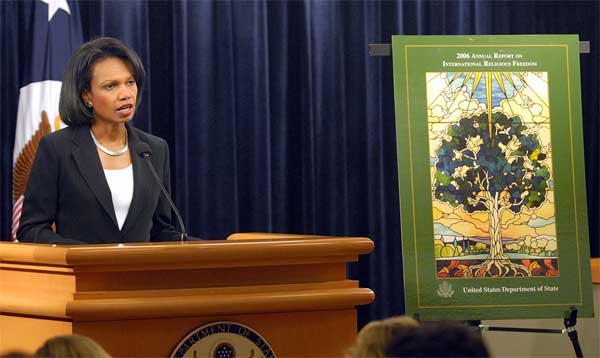
Washington, DC, September 15, 2006, Secretary Rice speaks to the press about the U.S. Department of State's Annual Report on International Religious Freedom. State Department photo by Michael GrossWashington, DC, September 15, 2006, Secretary Rice speaks to the press about the U.S. Department of State's Annual Report
on International Religious Freedom. State Department photo by Michael Gross.

Secretary Condoleezza Rice, Washington, DC, September 15, 2006, (10:07 a.m. EDT)

SECRETARY RICE: Good morning. Today, I have transmitted to Congress the 8th Annual Report on International Religious Freedom. We hope that this report which is also available at the State Department's website will serve as a resource for all in the United States and in the international community who share our concerns about religious freedom. We also hope that it will serve as a source of encouragement to those whose plight is documented in the report and whose right to believe and practice and worship as they choose is still denied by their governments.

Five years ago this week, the American people observed a national day of prayer and remembrance for those who died in the terrorist attacks. We gathered in the National Cathedral and in houses of worship all across the country and indeed across the world to draw strength and solace from one another and from our faiths. We came together, Muslims and Jews, and Christians, Sikhs, Hindu, Buddhists, people of every faith united in grief, united in resolve, and united in conviction that the power of compassion and love is stronger than the forces of hate.

On Monday we marked the fifth-year anniversary of September 11th with a ceremony at the State Department to remember the more than 90 countries that lost citizens in those attacks. Some victims were in the United States on business, others were visiting relatives. It was a stark reminder that the entire world was affected by these brutal and horrific attacks, and the entire world is threatened by the extremist ideology of hate and bigotry and religious intolerance.

Indeed, September 11th has made us more aware of our own religious diversity in the United States and how important it is. The events of that day make this report all the more important, and they renew our determination to honor the highest ideals that we have always affirmed throughout our history, the ideals of a democratic society that protects and respects religious differences. Religious freedom is deeply rooted in our principles and our history as a nation. And it is now integral to our efforts to combat terrorism and the ideology of hatred that fuels it.

In today's world, our goal of fostering religious freedom and tolerance beyond our borders is an essential component even of national security. Through our bilateral relationships, our work in international fora and our many ongoing discussions on this issue with people around the world, the United States seeks to promote religious freedom and tolerance and build a more peaceful world for the peoples of all faiths.

It is now my pleasure to introduce Ambassador Hanford, who leads the State Department’s work in religious freedom and tolerance. And Ambassador Hanford will provide additional details about the report and will answer your questions.

Thank you very much. 2006/824 Released on September 15, 2006

Technorati Tags: and or and , or and or ,

Related: Keywords State Department, Wednesday, September 13, 2006
State Department Daily Press Briefing, VIDEO, PODCAST, TEXT, 09/12/06, Monday, September 04, 2006 Media Stakeout Ambassador John Bolton 09/01/06 (VIDEO), Monday, September 04, 2006 Condoleezza Rice American Legion Convention VIDEO, PODCAST, TEXT, Thursday, August 31, 2006 United Nations Daily Press Briefing 08/31/06 (VIDEO), Monday, August 28, 2006Media Stakeout Ambassador John Bolton 08/28/06 (VIDEO), Wednesday, August 23, 2006 Iranian Response to the P5+1 Package, Tuesday, August 22, 2006 Media Stakeout Ambassador John Bolton 08/22/06 (VIDEO), Tuesday, August 22, 2006 Media Stakeout Ambassador John Bolton 08/15/06 (VIDEO), Friday, August 18, 2006 State Department Daily Press Briefing, VIDEO, PODCAST, TEXT, 08/17/06, Thursday, August 17, 2006 Media Stakeout Ambassador Anne Woods Patterson Sudan VIDEO, Wednesday, August 16, 2006 Middle East Update 08/16/06 VIDEO, PODCAST, TEXT, Tuesday, August 15, 2006 Media Stakeout Ambassador John Bolton 08/15/06 (VIDEO), Tuesday, August 15, 2006 State Department Daily Press Briefing, VIDEO, PODCAST, TEXT, 08/14/06, Thursday, August 10, 2006 State Department Daily Press Briefing, VIDEO, PODCAST, TEXT, 08/10/06, Saturday, August 12, 2006 UN Adopts Resolution on Lebanon (VIDEO), Friday, August 11, 2006 International Initiative to Combat Kleptocracy VIDEO, PODCAST, TEXT, Thursday, August 10, 2006 State Department Daily Press Briefing, VIDEO, PODCAST, TEXT, 08/10/06,

Sunday, September 17, 2006

Rodent's bizarre traits deepen mystery of genetics, evolution

WEST LAFAYETTE, Ind. - A shadowy rodent has potential to shed light on human genetics and the mysteries of evolution.

Caption: Picture of a vole, Credit: Purdue News Service, Usage Restrictions: None, Related news release: RODENT'S BIZARRE TRAITS DEEPEN MYSTERY OF GENETICS, EVOLUTIONCaption: Picture of a vole, Credit: Purdue News Service, Usage Restrictions: None, Related news release: RODENT'S BIZARRE TRAITS DEEPEN MYSTERY OF GENETICS, EVOLUTION, High Resolution Image
Purdue University research has shown that the vole, a mouselike rodent, is not only the fastest evolving mammal, but also harbors a number of puzzling genetic traits that challenge current scientific understanding.

"Nobody has posters of voles on their wall," said J. Andrew DeWoody, associate professor of genetics in the Department of Forestry and Natural Resources, whose study appears this month in the journal Genetica. "But when it comes down to it, voles deserve more attention."

Small rodents often confused for mice, except with shorter tails and beady eyes, voles live throughout the Northern Hemisphere and are often considered agricultural pests because they eat vegetation. Nevertheless, voles are an "evolutionary enigma" with many bizarre traits, DeWoody said. Understanding the basis for these traits could lead to better understanding of the same phenomena in human genetics and genetic disorders, and could have implications for gene therapy, he said.

The study focuses on 60 species within the vole genus Microtus, which has evolved in the last 500,000 to 2 million years. This means voles are evolving 60-100 times faster than the average vertebrate in terms of creating different species. Within the genus (the level of taxonomic classification above species), the number of chromosomes in voles ranges from 17-64. DeWoody said that this is an unusual finding, since species within a single genus often have the same chromosome number.

Among the vole's other bizarre genetic traits:

In one species, the X chromosome, one of the two sex-determining chromosomes (the other being the Y), contains about 20 percent of the entire genome. Sex chromosomes normally contain much less genetic information.

In another species, females possess large portions of the Y (male) chromosome.

In yet another species, males and females have different chromosome numbers, which is uncommon in animals.

A final "counterintuitive oddity" is that despite genetic variation, all voles look alike, said DeWoody's former graduate student and study co-author Deb Triant.

"All voles look very similar, and many species are completely indistinguishable," DeWoody said.

In one particular instance, DeWoody was unable to differentiate between two species even after close examination and analysis of their cranial structure; only genetic tests could reveal the difference.

Nevertheless, voles are perfectly adept at recognizing those of their own species.

"I have seen absolutely no evidence of mating between different species," Triant said. "We don't know how they do this, but scent and behavior probably play a role."

DeWoody said, "The vole is a great a model system that could be used to study lots of natural phenomena that could impact humans."

His research focuses on the mitochondrial genome, the set of DNA within the cellular compartment responsible for generating energy (the mitochondria). Some of Triant's additional work explores the unique ability of vole's mitochondrial DNA to insert itself within DNA in the cell nucleus. The nuclear genome, as it is known, contains the vast majority of a cell's DNA and is responsible for controlling cellular function and development.

"Deb's work in this area could potentially have some basic science impact on gene delivery mechanisms, such as those used in gene therapy," DeWoody said.

In this relatively new therapy, treatment involves the insertion of a gene into human patients' cells in order to counter some illness or disease like hemophilia. However, it is often difficult to insert the desired gene in the "correct" location, or a location where it does what it is supposed to do. A better understanding of the unusual prevalence of this activity in voles, and the manner in which it happens, could have important human implications.

DeWoody's research was funded by the National Science Foundation and the U.S. Department of Agriculture. DeWoody hopes to continue his work on vole genetics at some point in the future. ###

Writer: Douglas M Main, 765-496-2050, dmain@purdue.edu
Sources: J. Andrew DeWoody, 765-496-6109, dewoody@purdue.edu
Deb Triant, 765.496-6868, dtriant@purdue.edu
Ag Communications: (765) 494-2722; Beth Forbes, forbes@purdue.edu
Agriculture News Page

To the News Service home page

Technorati Tags: or and or and or and or

RELATED: Keyword biology, Sunday, September 10, 2006 chemicals produced from ethanol feedstocks could boost biorefinery, Sunday, September 03, 2006 Atmospheric Ozone Shows Signs of Recovery, Sunday, August 27, 2006 Population Growth, Environmental Degradation, Sunday, August 13, 2006 religious garment defines a new generation of women, Sunday, August 13, 2006 Multiracial congregations offer different social ties, Sunday, August 06, 2006 Scientists develop artwork that changes to suit your mood, Sunday, August 06, 2006 Washington, DC getting a summertime air quality exam, Sunday, July 30, 2006 The World Map of Happiness, Sunday, July 23, 2006 The Occult Life of Things, Sunday, July 23, 2006 Why we could all do with a siesta, Sunday, July 16, 2006 Hope I die before I get old?, Sunday, July 09, 2006 People more likely to help others they think are 'like them!, Sunday, July 09, 2006 Jefferson Team Designs Program that Helps Elderly Live Longer, Sunday, July 02, 2006 Gabapentin cools hot flashes as well as estrogen, Sunday, June 25, 2006 Estrogen plays different role during stress in black and white teens, Sunday, June 25, 2006 Our grip on reality is slim, Sunday, May 21, 2006 Genome doesn't start with 'G', Sunday, May 07, 2006 Lying Is Exposed By Micro-Expressions We Can't Control, Sunday, April 30, 2006 Mothers often have inaccurate perceptions of their children's body weight, Sunday, April 16, 2006 Other people influence us and we don't even know it!, Tuesday, January 04, 2005 The Cassini-Huygens mission to Saturn, Sunday, March 20, 2005 Agriculture Secretary Mike Johanns, bovine spongiform encephalopathy (BSE), Thursday, March 24, 2005 Fish Oil Holds Promise in Alzheimer's Fight,