


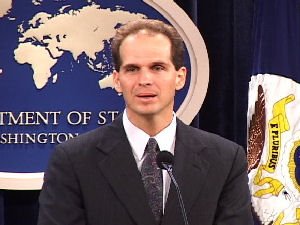
 | State Dept. Briefing with Tom Casey U.S. State Department spokesman Tom Casey briefs the press and answers questions.9/21/2006: WASHINGTON, DC: 29:57 min. FULL STREAMING VIDEO, M3U for streaming audio, |
TRANSCRIPT: 12:50 p.m. EDT
MR. CASEY: Good afternoon, everybody. Don't have any opening statements for you, so Barry, why don't we go right into questions.
QUESTION: All right. Thailand, absent from the two statements the State Department put out yesterday, any comments on whether you approve of a coup or, for instance, whether you think the overthrown government was corrupt? There's no value -- there are no value judgments -- just, you know, hope things are sorted out in a democratic way. Were they justified in overthrowing the government and do you think the rule -- the military rule will be as temporary as they say it will be?
MR. CASEY: Well, Barry, first of all, there is no justification for a military coup in Thailand or in any place else. And we certainly are extremely disappointed by this action. It is a step backward for democracy in Thailand. And I think it is important that that step backward now be resolved in accordance with the rule of law and democracy. We very much urge that democratic elections be held as soon as possible, which is a commitment military officials have made. That commitment needs to be met and it needs to be respected. And in that process, we need to make sure that there is full respect for freedom of speech and assembly and that violence be avoided.
There are also consequences when these kinds of actions take place and obviously in light of what's happened, in light of this coup, there are aspects of our relationship that we are going to have to review. There are certain legal and other requirements out there. I certainly don’t want to get ahead of any evaluations that are currently being made. But again it is something we're going to have to look at. But certainly, I would characterize this as a coup and certainly under no circumstances should a military coup ever be deemed acceptable.
QUESTION: Could you at least give us the categories of the relationship that would be under review?
MR. CASEY: Well, I think first and foremost, there are sections of the Foreign Operations Act concerning assistance that are considered. I think the specific citation for you, Barry, would be Section 508 of the Foreign Operations Act of '06. I believe there are some other ones potentially out there. That's the one that usually comes into play when a situation like this happens. But again, I think the most important thing is that we want to see a resolution of this situation in accordance with the rule of law, in accordance with democratic procedures and that certainly means a restoration of civilian rule in Thailand as quickly as possible.
QUESTION: You described it as a step backwards. Wouldn't the appropriate step be not the restoration of civilian rule, but the restoration of the Thaksin government?
MR. CASEY: Well, again, I'm not going -- I'm trying to make sure that we lay out the basic positions here. There is still a lot that's happening on the ground in Thailand, but the main thing is that there needs to be democratic rule there. The military individuals who are now running the country have stated that their objective is to have elections, is to have a return to civilian democratic rule, and to do so in very quick order, and that's what we want to see happen.
QUESTION: Do you have any figure for assistance?
QUESTION: Can I follow up on this and then we get to the assistance?
MR. CASEY: Why don't we -- Arshad, why don't you follow up and then we'll go on to the assistance.
QUESTION: The thing that perplexes me is that if no military coup is justified and if, you know, ousting elected governments is something the United States Government does not approve, why you would simply lay out your desire for a restoration of civilian rule rather than Thaksin, who was -- who won an election, should be restored. Why isn't that your preferred outcome?
MR. CASEY: Look, at this point I'm not offering any specific prescriptions on this. These are issues for the Thai people to determine. What is important is that the coup leaders live up to their public commitment to restore democracy rapidly.
QUESTION: Can I follow up on --
MR. CASEY: Well, let's go to Barry first.
QUESTION: I just wondered if you had any assistance figure.
MR. CASEY: You know I don't have specific figures on foreign assistance.
QUESTION: Do you have -- if you don't have specific figures, do you have categories, what kind of aid do we give the Thais?
MR. CASEY: No, I honestly don't, Charlie. I haven't done a review of what's out there. Certainly there are a number of different categories. I'm sure we can come up with a listing for you of the amounts of aid involved and wherever. Thailand is, of course, a country that has made a great deal of progress in building and strengthening democracy over the past decades. It's had, though -- it certainly has had its ups and downs. It is a growing economy and it is an important economy. So I don't believe it is a major recipient of U.S. assistance, but certainly we can look for you at the various categories of aid that are out there.
QUESTION: And just to go back a step, I am perplexed as well, similarly to Arshad. I don’t understand why the government that's been overthrown shouldn't be restored or why you're reluctant to call for that. And it seems -- it doesn't seem to add up that you, you know, promote democracy and rule of law and then a government is overthrown and not to take the step to call for the restoration of that government.
MR. CASEY: Well, look again, Charlie, I think the facts on the ground are that a coup has happened. Certainly we wish that that had not occurred in the first place. But the important thing now is that we move forward to make sure that those who have engaged in this activity live up to their public commitments. And again, those public commitments are to restore democracy as quickly as possible. The determinations and the specifics of that are things that we need to let the Thai people work out and resolve, and I am simply not in a position to do that for them. This is an issue that they are going to need to work out.
Mr. Lambros, same issue?
QUESTION: Yes. Any communication with the King, who in this day is acting as (inaudible) cooperating with a military (inaudible) democracy in Thailand?
MR. CASEY: Well, I don’t have any information on the King's role specifically. Certainly, what we are doing is talking to all different political actors in Thailand. Again, what we're doing is encouraging everyone to have, first, the coup leaders act out on their commitments and restore democratic rule as quickly as possible. And again, with everyone in the political process, we are also encouraging everyone to do so in a way that is respective of the rule of law, that carries out things in a manner that is nonviolent, and that leads to a quick and peaceful resolution of this issue.
QUESTION: A follow-up. What is the status of the Prime Minister of Thailand who is in New York on American soil?
MR. CASEY: I am not sure where he is right now. I have seen press reports indicating that he is in or perhaps is en route to London, but I don't have any information about where he is right now.
QUESTION: Can you tell us about any contacts the U.S. may have had with either the Thai Government or the Prime Minister's government or the coup leaders?
MR. CASEY: Well, again, I understand we're talking to a broad variety of individuals. I don't have anything for you on specific contacts that have been made. Again, I think our message, though, is the same to everyone and it is one that we are disseminating broadly both with officials here in Washington as well as those in Thailand.
QUESTION: Broadly have they been in touch with the government and then with the coup leaders --
MR. CASEY: My understanding is we are talking to all actors involved, and I would assume that includes military officials as well.
Mr. Lambros.
QUESTION: Yes, on the Pope. The head of (inaudible) says, Mr. Casey, requests yesterday that the Department of Justice in Turkey that the Pope Benedict, head of the Catholic Church, must be arrested upon his arrival in Turkey during the upcoming visit in November and should be tried and punished because the Pope, with his illicit remarks about Islam violated several statutes of the Turkish law, encouraging discrimination based on religion, including Islam and Prophet Mohammed. Any comment?
MR. CASEY: I haven't seen those remarks, Mr. Lambros. Obviously, we've spoken to this issue before. What we believe is important and appropriate is for representatives of all religions to work together to help promote tolerance and to promote a culture of freedom of religion. That is what is important to us.
QUESTION: One more. U.S. House of Representatives' resolution (inaudible) -- the U.S. Congress yesterday is urging Turkey to respect the rights and the religious freedom of the Ecumenical Patriarch, head of Constantinople in Istanbul, Turkey, under the auspices of the Ecumenical Patriarch Bartholomew to recognize its international status and allow the re-opening of the theological school at Halki. May we have your comments since (inaudible) from the Congress now?
MR. CASEY: I'm not familiar with that particular piece of legislation. I don't believe there is a statement of Administration position on it. Again, I'd simply refer you back to what I've said previously and what you heard from John Hanford here. We do have concerns about promoting religious freedom including in Turkey. There are issues that you can look at within that Religious Freedom Report that talk about issues related to the Ecumenical Patriarch, but I don't have anything new to add on that for you.
Kirit.
QUESTION: President Bush yesterday had said that he was directing Secretary Rice to approach a new diplomatic effort, I guess to read it here, to engage moderate leaders across the region to help the Palestinians reform their security services, support the Israeli and Palestinian leaders in their efforts to come together and resolve their differences. Do you have anything as far as how she'll be taking -- undertaking that?
MR. CASEY: Well, I think in some ways she's doing it already. She's met up in New York with President Abbas, with Foreign Minister Livni. She's met with KingAbdullah. She's speaking with other leaders around the region. The President, of course, met with President Abbas today, and the Secretary was there for that. You've heard from both of them on it.
I think mostly what we are trying to do here is have her look for opportunities to be able to move the process forward. You've heard from us on these issues before. Certainly among the other things, as you heard the President mention, is a focus on the security service. That means continuing with the work that had been done by General Dayton, among others, to try and help reform and improve the security services, to help bring about stability in Gaza and in other places in the territories. That's something that ultimately is in the interest of the Palestinian people and is ultimately in the interest of the security of Israel. Certainly she's going to be continuing to meet with officials from the region up in New York.
While I certainly don't have anything to announce for you, I would expect that at some point in the future after the events of the General Assembly are over that she will have an opportunity to travel to the region as well. But again, I think what the President's remarks highlight is his commitment to making progress on the roadmap and to ultimately achieving his vision of a two state solution. That really is -- been the goal of this Administration, and it's something that he really wishes to see move forward.
QUESTION: Is General Dayton still on the payroll?
MR. CASEY: My understanding is that he is, in fact, still on the payroll, Charlie.
QUESTION: Doing his work in -- with the Palestinian security --
MR. CASEY: I do not know exactly where he is today, but yes, my understanding is he's still on the payroll.
QUESTION: I don't mean that -- he's still in his job of trying to reform Palestinian security?
MR. CASEY: Yes, I believe there's a transition that's coming up in that, but I don't believe it's happened as of yet.
Arshad, welcome back.
QUESTION: Thank you. Good to be back. I've got a couple of things, if I may. The Iraqi Government has replaced the judge presiding over Saddam Hussein's genocide trial. That action has led some human rights groups to suggest it is unwarranted meddling in the judicial affairs of Iraq by the Iraqi Government and does not speak well of the separation of powers there. What is your reaction to the government's decision to replace the judge?
MR. CASEY: Well, first of all, this is an Iraqi process and it is governed by the Iraqi High Tribunal statute. I think really the best place to have the specifics of this decision explained are with Prime Minister Maliki's government and his officials. That said, our understanding is that the statute does give the Iraqi Council of Ministers the legal authority to replace judges in this case. So in that sense, our understanding is this is a decision that was taken in conformity with the relevant legal statutes.
I think, though, what is more important than the issue of who is presiding over the trial is whether the defendants in it are receiving a fair one. And we certainly support the efforts that are underway by the Iraqi High Tribunal to investigate in a thorough, transparent and appropriate manner. Those cases that are being prepared against Saddam Hussein as well as against others in the regime, to try them in accordance with the rule of law, for actions that they took while the previous regime was in power. And that is something that is important not only for the international community but for the Iraqi people to have accountability for those who committed crimes during the previous regime.
QUESTION: There were suggestions, I think, by Saddam Hussein's defense lawyers that he's not getting a fair trial and I'm -- according to our story at least the new judge said, well, if you want to leave you can, and the defense lawyers then stood up and left. Doesn't the replacement of a judge in what is, if not the, one of the most high-profile cases in postwar or post-invasion Iraq -- doesn't it undermine the credibility of the judiciary and of the process and of whether it will or -- you know, to summarily replace the judge, even if that is, you know, acceptable and provided for under a statute? Wouldn't you prefer that they just left the trial to unfold as it would?
MR. CASEY: Well, Arshad, I think our goal here again is seeing that there is a transparent, open trial process that meets international standards, that conforms with the relevant Iraqi laws. And again, I think what is important most of all is that this be a process that has that kind of credibility for the Iraqi people. Again, this is a decision that the Iraqi Government has made. And I think at this point, what I would do is just allow them to describe it. But again, our view of it is that this was done in accordance with the law and we do want to see this process move forward.
QUESTION: And just one last one on this. Do you regard it as a transparent and open process?
MR. CASEY: Well, we believe that the Tribunal has been set up in accordance with not only Iraqi law but international laws. We believe that the procedures that have gone forward while certainly not always have gone forward smoothly, have been done in a way that meets that international standards.
Let's go over here.
QUESTION: What is your reaction to President Chavez today speaking for the UN, calling President Bush the devil and referring to him as an imperialist seeking to dominate the world?
MR. CASEY: Well, I don't think you'll find it surprising that we disagree with the views that were expressed in President Chavez's remarks. Certainly I think it is disappointing that you see personal attacks issued by any head of state. The UN is an important world stage and an important forum and leaders come there representing their people and their country and I'll leave it to the Venezuelan people to determine whether President Chavez represented them and presented them in a way they would have liked to have seen.
Kirit.
QUESTION: The AU today extended the AMIS forces mandate through the end of the year. I was wondering if you had any reaction to that? And then also how this is going to change or if it will change the U.S. plans to put a UN force into Darfur?
MR. CASEY: I understand that they were going to extend the mandate. I haven't actually seen confirmation that it has. Either way, though, we have said before that we expect there to continue to be peacekeeping forces in Darfur. We think it is important that those forces transition as quickly as possible to a UN-led mission as has been called for. We also expect as well that during that transition period the international community will do everything it can to help support the AMIS force and to help expand it and make it stronger and more capable of carrying out the requirements under the Darfur Peace Agreement.
I know that there are a number of donors out there who have expressed interest in providing funding to help AMIS continue its mission during the transition period. We, of course, have contributed substantial funds to that effort as well. We have allocated or requested funds – excuse me -- for the budget for the upcoming year to help support an UN force as well as to help support the transition. So it is definitely positive to have that force continue. It is definitely important, though, that while that force continues that we do move with it and working together with it to expand it, enhance it and to have it then become the UN force that has been envisioned by the Security Council because that's ultimately the way to help achieve a lasting solution in Darfur.
I also do want to note, too -- since we didn't have an opportunity to brief yesterday – and that, of course, is one of the other things the President did in his address at the United Nations was announce the appointment of a special envoy for Sudan. That person is in the form of Mr. Andrew Natsios who I think many of you know from his time as Administrator at the U.S. Agency for International Development here. Andrew is in fact in New York today. He is actually there most immediately to honor a previous commitment to participate in a private event there. But he will be participating in the Secretary's meeting on Sudan on Friday and we certainly look forward to him being able to meet with various officials and those involved in this issue, and also can travel to the region in the not-too-distant future.
Arshad.
QUESTION: Since you didn't brief yesterday, I wanted to raise something that I would have raised, had there been a briefing.
MR. CASEY: Oh, I opened the door, didn't it?
QUESTION: Yeah.
MR. CASEY: Okay.
QUESTION: Hungary. As you're well aware, there had been what are described as the worst protests in Hungary since 1956, sparked by the Prime Minister's -- by the revelation the that Prime Minister had lied about the budget. Do you have any comment on this, either on the protest, but also on the Hungarian Prime Minister lying to his public ahead of an election about the budget?
MR. CASEY: Well, look, certainly this is a major issue in Hungary. And it's one that has a lot of ramifications for politics in that country. For that reason, Arshad, I think we are just going to leave it to the folks in Hungary, certainly it political leadership, but also its citizens to determine what to make of this and how best to proceed. I understand in terms of the situation on the ground that the Hungarian police have established security controls in a number of different locations around Budapest. Protests, as I understand it, have caused some injuries and some damage. Certainly, as any one moves through a politically difficult period, we want to see things proceed in accordance with the laws of the country and we certainly hope that people will act in a peaceful manner. But we do understand obviously that this is a major issue for the Hungarian Government and the Hungarian people. But we do think it's one that's best left to their own judgments.
QUESTION: Is it acceptable to lie about budgetary matters?
MR. CASEY: Well, I know it's never acceptable to lie from the podium under any circumstances. Again, I'm not going to try and make a value judgment on it.
QUESTION: Thank you.
MR. CASEY: Oh, let's go over to here, back there. And then, Mr. Lambros, we'll see if we got time for an extra shot.
Let's go to her first, though.
QUESTION: Can you tell us anything about the U.S. will hold three-party talks soon -- Japan, South Korea, United States?
MR. CASEY: In terms of six-party talks?
QUESTION: Yes.
MR. CASEY: Well, we continue to as we have in the past, called for North Korea to return to the talks as quickly as possible. We believe it's long overdue that they do so. But I'm not aware that there's been any movement in that direction. Again, the other five parties are willing to meet at any time. We are simply waiting for North Korea to make the right decision and come to the talks.
QUESTION: Does the United States have any inducement plan to get North Korea come back to the six-party talks?
MR. CASEY: Well, I think the plan that's on the table is the September 19th agreement, which is one that does offer benefits to North Korea if, in fact, they choose to come to the table and negotiate an end to their nuclear program as they agreed to do in that date.
Let's go back over here.
QUESTION: On Japan, Mr. Shinzo Abe was elected the new leader of the Liberal Democratic Party of Japan. Does the State Department have any comments on that?
MR. CASEY: Well, I understand that's happened. Obviously that's an internal matter for the Liberal Democratic Party to decide. We also understand that Diet will be meeting, I believe, on September 26th to select a new government. The important thing to us is regardless of who ultimately is in that new government, we look forward to continuing our warm, friendly relationship and our great alliance with Japan. Japan is a tremendous partner for the United States on a wide variety of issues. And we expect that we will have as good and warm relations with a future government as we have with the current one.
Mr. Lambros, last shot.
QUESTION: On Cyprus. Anything to say, Mr. Casey, about yesterday's one-hour meeting between -- in New York City between the Greek Cypriot Foreign Minister Yiorgos Lillikas and Assistant Secretary Daniel Fried?
MR. CASEY: Since I wasn't aware that the meeting took place, Mr. Lambros, no, I don't have anything specific for you on the meeting. Again, our ongoing efforts with respect to Cyprus are in accordance with our longstanding policy. We do want to see a resolution of this dispute. We believe that it is possible to do so. And we certainly, though, want that resolution to be something that is agreeable to all communities on the island.
QUESTION: But yesterday's meeting between the Cypriot President Tassos Papadopoulos and the UN Secretary General Kofi Annan produced no results, Mr. Casey, absolutely nothing. Therefore, I'm wondering how do you assess now the Annan plan since Mr. Annan is departing from the UN by the end of this year and his era is over.
MR. CASEY: Well, look, I'd refer you either to the Cypriot President or the UN Secretary General for details on their meeting. As I've stated, we have a pretty clear policy out there. We want to see a resolution of this. We want to see that done in accordance with the wishes of both communities in a manner that's acceptable to both of them. But I don't have anything really to offer you on that.
QUESTION: And the last one --
MR. CASEY: Let's go over to Barry first, and then we'll --
QUESTION: That's all right. Have you said anything about the Sudanese President's UN speech?
MR. CASEY: No, and I haven't seen it, but --
QUESTION: Well, he says that human rights groups have exaggerated the crisis in Darfur to help their fundraising and charged that demands for UN peacekeepers are meant to protect Israel. Do you have anything to say about that?
MR. CASEY: Well, I don't have anything to say specifically on his speech because, again, I haven't seen it.
QUESTION: Okay.
MR. CASEY: In terms of the situation in Darfur, I think we have been quite clear. It's a grave humanitarian crisis. We have made a formal legal finding, which is not only legal but proper and appropriate that the actions that have gone on in Darfur are genocide. The President has called it that, and we certainly don't have any change in our views.
Thanks everyone.
QUESTION: Oh, there was something else. It's --
MR. CASEY: All right, Barry, one last one. Hang on everybody.
QUESTION: You know it's been a hectic few minutes here. Iran is increasing its restrictions on American media. Officials are saying that the move is justified because the U.S. denied Iranian journalists visas to attend the UN General Assembly.
MR. CASEY: Well, okay. Well, let me just clarify what the situation is there. First of all, we received 150 applications for individuals to participate as part of the Iranian delegation to the UN General Assembly.
QUESTION: Right.
MR. CASEY: One hundred and twenty-five of those to date have been granted. What our records show is that on Friday, meaning September 15th, 15 journalists applied for visas to travel on the following Monday, on September 18th, as part of the or with the Iranian delegation. Certainly as you know, and as the Iranian Government certainly well knows, there are a number of procedures that we have to do to conform with U.S. law to be able to grant Iranian citizens visas to come to the U.S., and they generally are not something that can be done when one hands in applications on the close of business Friday and expects visas on a Monday morning. So we were in the process of evaluating those visas, of adjudicating them, and on Tuesday, yesterday the 19th, the Iranian mission withdrew a number of pending applications, including those for all those journalists. So certainly --
QUESTION: Fifteen plus?
MR. CASEY: Yes. So certainly there were no visas denied to journalists nor did we signal to the Iranians that we intended to do so. We were simply trying to comply with U.S. law and the necessary processes involved in that. Obviously, again, that is something that -- for Iranian citizens because of our concerns, because we don't have diplomatic relations, because they are the leading state sponsor of terror, do in fact take time. But it's certainly wrong to suggest that we either denied visas or had signaled to the Iranians that we had done so.
Thank you.
(The briefing was concluded at 1:20 p.m.)
DPB # 151 Released on September 20, 2006
Technorati Tags: State Department and Secretary of State or PALESTINIAN AUTHORITY and VIDEO, or Military+Coup and TURKEY or Condoleezza Rice, or THAILAND and PODCAST, or VENEZUELA,
Related: Keywords State Department, Wednesday, September 20, 2006 Mahmoud Ahmadinejad Iran UN (VIDEO), Tuesday, September 19, 2006 Media Stakeout Ambassador John Bolton 09/18/06 (VIDEO), Tuesday, September 19, 2006 Kristen Silverberg On-the-Record Briefing (VIDEO), Monday, September 18, 2006 Annual Report on International Religious Freedom (VIDEO), Wednesday, September 13, 2006State Department Daily Press Briefing, VIDEO, PODCAST, TEXT, 09/12/06, Monday, September 04, 2006 Media Stakeout Ambassador John Bolton 09/01/06 (VIDEO), Monday, September 04, 2006 Condoleezza Rice American Legion Convention VIDEO, PODCAST, TEXT, Thursday, August 31, 2006 United Nations Daily Press Briefing 08/31/06 (VIDEO), Monday, August 28, 2006Media Stakeout Ambassador John Bolton 08/28/06 (VIDEO), Wednesday, August 23, 2006 Iranian Response to the P5+1 Package, Tuesday, August 22, 2006 Media Stakeout Ambassador John Bolton 08/22/06 (VIDEO), Tuesday, August 22, 2006 Media Stakeout Ambassador John Bolton 08/15/06 (VIDEO), Friday, August 18, 2006 State Department Daily Press Briefing, VIDEO, PODCAST, TEXT, 08/17/06, Thursday, August 17, 2006 Media Stakeout Ambassador Anne Woods Patterson Sudan VIDEO, Wednesday, August 16, 2006 Middle East Update 08/16/06 VIDEO, PODCAST, TEXT, Tuesday, August 15, 2006 Media Stakeout Ambassador John Bolton 08/15/06 (VIDEO), Tuesday, August 15, 2006 State Department Daily Press Briefing, VIDEO, PODCAST, TEXT, 08/14/06,


