President Bush and President Musharraf of Pakistan Participate in Press Availability FULL STREAMING VIDEO, The East Room, 10:21 A.M. EDT General Pervez Musharraf Official Biography
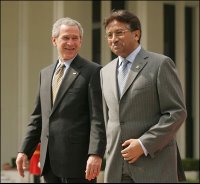 | President George W. Bush and Pakistan President Pervez Musharraf walk together to their joint news conference at Aiwan-e-Sadr in Islamabad, Pakistan, Saturday, March 4, 2006. |
PRESIDENT BUSH: Thank you very much, please be seated. Laura and I appreciate the opportunity to welcome President and Mrs. Musharraf here to Washington. We remember fondly, Mr. President, your great hospitality in Pakistan and we remember the importance of that visit -- it reconfirmed our friendship, gave you and me a chance to discuss important issues. And there's no more important issue than defending our peoples.
This President is a strong defender of freedom and the people of Pakistan, and I appreciate your leadership.
PRESIDENT MUSHARRAF: Thank you very much.
PRESIDENT BUSH: He understands that we are in a struggle against extremists who will use terror as a weapon. He understands it just about as good as anybody in the world -- after all, they've tried to take his life. These extremists who can't stand the thought of a moderate leader leading an important country like Pakistan want to kill the President. That should say things to the people of Pakistan and the people of America, that because he has been a strong, forceful leader, he has become a target of those who can't stand the thought of moderation prevailing.
I admire your leadership. I admire your courage. And I thank you very much for working on common strategies to protect our respective peoples.
We had a good discussion here today. We talked about how our intelligence cooperation can continue. I want to remind the people of Pakistan and the people of America that because of the good work of our intelligence forces and Pakistani intelligence forces, as we helped people in the United Kingdom, we prevented the loss of innocent life. That kind of cooperation is necessary in a world in which extremists and radicals are willing to kill to try to achieve political objectives.
We talked about the earthquake recovery, and our nation was proud to support you, Mr. President, because we care when we see people suffering. And I was briefed by you and your administration when I was there and I was impressed by the great organization and compassion shown for the Pakistani people by your government. I hope all is going well, particularly for those who suffered mightily.
We talked about economic development and the need to move forward on a reconstruction opportunity zones, as well as a bilateral investment treaty. In other words, our relationship is more than just helping to secure our respective homelands. Ours is a relationship that recognizes that through economic prosperity, people can embetter themselves.
We had a very interesting briefing on the federally administered tribal areas. The governor of the areas are with us here, and he briefed me and members of my national security team on the strategy to strengthen governance and to promote economic development.
We talked about education. The first time I ever met President Musharraf, he talked about the need to make sure that school systems in Pakistan worked well. I was impressed then, and I'm impressed now, by your commitment to an education system that prepares students for the -- and gives students the skills necessary to compete in a global economy.
We talked about democracy. The last time I was with the President, he assured me, and assured the people that were listening to the news conference, that there would be free and fair elections in Pakistan in 2007. He renewed that commitment, because he understands that the best way to defeat radicalism and extremism is to give people a chance to participate in the political process of a nation.
We talked about -- we talked about India in relations -- and the President's relations with India. I was pleased to see that in Havana Prime Minister Singh and President Musharraf had another discussion. I think it's very important that the -- that the issue of Kashmir move forward and be resolved peacefully. And I appreciate your efforts, Mr. President.
We talked, of course, about Afghanistan. And President Musharraf and President Karzai and I will have dinner right here in the White House next week. And it's going to be an important discussion. It's going to be an important discussion because one of the most important avenues for peace is for Afghanistan to succeed. And it's in our mutual interests that we work together to help that country that's been devastated by war succeed. And so I look forward to our trilateral discussion, Mr. President. It's going to be a good one and it's going to be an interesting one. And it's an important discussion.
All in all, we've had yet another good meeting between people who are able to speak frankly with each other and people who share the common desire for our people to live in security and peace.
Welcome.
PRESIDENT MUSHARRAF: Thank you very much. I would like to, first of all, express my gratitude and also on behalf of my entire delegation for the warmth and hospitality that we have received, and many courtesies that are being extended to us since our arrival in the United States.
I had an excellent meeting with President Bush. We, first of all, reinforced our trust and confidence in each other. I trust President Bush, and I have total confidence in him that he desires well for Pakistan and for our region. And I trust him also that he's trying to do his best for bringing peace to the world. And I trust him also that he's trying to resolve the core issue of the Palestinian dispute.
We discussed the entire gambit of relations bilaterally between the United States and Pakistan, and also in our region and on international issues. Bilaterally, we reinforced our desire to have this relationship on a long-term basis, broad-based, and a strategic relationship. When we are talking of broad-based, whatever the President has said, it involves all aspects which we discussed. It has its political and diplomatic aspects, which we reinforced, and then our desire to fight terrorism and succeed against terrorism.
Other than that issue in the social sector, on the economy, how whatever assistance is being given to us, whatever assistance we require, our requests on that -- especially in the field of trade and investment, which are the main areas which we require assistance in -- otherwise, on a broad-based level, assistance in the education and health sector, on the defense side, the F-16 deals. All this was discussed.
On the regional issues, on the international plain, we did discuss the core issue of the Palestinian dispute, which needs to be resolved, and being at the core. And I am extremely glad that the President has a desire and a will to resolve this Palestinian dispute. I wish him very well because that lies at the heart of all problems, even at the heart of terrorism and extremism.
On the regional side, in our region, we also discussed the rapprochement going on between Pakistan and India. And I proudly told the President that we had -- I had an excellent meeting with Prime Minister Manmohan Singh in Havana. And it was a step forward towards resolution of disputes between India and Pakistan. I did tell him on the way forward that we are moving on the Kashmir dispute especially.
Coming on the other side, we had an in-depth discussion on what is happening in Afghanistan and our tribal agency. They are -- I explained to him whatever we are doing in the form of the peace treaty that we have just signed through a grand jirga, which is an assembly of elders.
This treaty is not to deal with the Taliban. It is actually to fight the Taliban. The misperception in the media, I did clarify to the President. And may I very briefly say -- and what I explained to the President -- that this is a holistic approach that we are taking to fighting terrorism in Pakistan, in the tribal agencies of Pakistan. This is a political site of the holistic strategy -- the holistic strategy being the military arm being used, a political element, an administrative element, and a reconstruction element.
We want to move on all these aspects forward, confining myself to this deal. This deal is not at all with the Taliban, as I said, this is against the Taliban, actually. This deal is with the tribal elders of north Waziristan agency. And the deal has three bottom lines, which we fixed for ourselves. And this is very important, which I explained to the President.
Number one, there will be no al Qaeda activity in our tribal agency or across the border in Afghanistan. There will be no Taliban activity in our tribal agency or across in Afghanistan. There will be no Talibanization, which is an obscuritas thoughts or way of life -- no Talibanization. All these three have been agreed by the tribal elders who signed that deal. And when they signed the deal, they are honor-bound, and they have already strict honor code to not only abide by it, but also that whoever violates it, they'll move against them.
So this is, in brief, the deal which I explained to the President. And I know that he's satisfied with that deal. And maybe this shows the light or the way forward for bringing peace to the region.
So this is what we discussed holistically. I would like to conclude by saying we had a total understanding of views between President Bush and myself. And as I said, we reinforced our trust and confidence in each other. Thank you very much.
PRESIDENT BUSH: Good job.
Two questions apiece. Deb.
Q Mr. President, after 9/11, would the United States have actually attacked Pakistan if President Musharraf had not agreed to cooperate with the war on terrorism? He says that the United States was threatening to bomb his country back into the stone age.
And, President Musharraf, would Pakistan have given up its backing of the Taliban if this threat had not come from Armitage?
PRESIDENT BUSH: First, let me -- she's asking about the Armitage thing. The first I heard of this was when I read it in the newspaper today. You know, I was -- I guess I was taken aback by the harshness of the words.
All I can tell you is, is that shortly after 9/11, Secretary Colin Powell came in and said, President Musharraf understands the stakes and he wants to join and help route out an enemy that has come and killed 3,000 of our citizens. As a matter of fact, my recollection was that one of the first leaders to step up and say that the stakes have changed, that attack on America that killed 3,000 of the citizens needs to be dealt with firmly, was the President. And if I'm not mistaken, Colin told us that, if not the night of September the 11th, shortly thereafter. I need to make sure I get my facts straight, but it was soon.
I don't know of any conversation that was reported in the newspaper like that. I just don't know about it.
PRESIDENT MUSHARRAF: I would like to -- I am launching my book on the 25th, and I am honor-bound to Simon and Schuster not to comment on the book before that day. (Laughter.)
PRESIDENT BUSH: In other words, buy the book, is what he's saying. (Laughter.)
Q My question is for the U.S. President. Your Excellency, President Musharraf has issued a call for building bridges and promoting interfaith harmony between the West and the Islamic world, which is in upheaval and in complete turmoil. So your comments of Islamic fascists, and then the comments of the Pope, have inflamed the Islamic world. And my question is that would you take the leading role, along with President Musharraf, to build these bridges and promote interfaith harmony to avert any wrong notion of class of civilizations, sir?
PRESIDENT BUSH: I appreciate the President's leadership in promoting harmony. There is unbelievable propaganda in the Middle East these days that try to inflame passion. The propagandists are attempting to create conditions where terror is justified. And so at my speech at the United Nations, I stood up and said loud and clear, America respects Islam. And we do. We don't respect people who kill in the name of Islam to achieve political objectives, like the terrorists do.
As a matter of fact, these extremists exploit propaganda in order to justify their behavior. All of us need to step up and talk about a world in which we respect each other's religions. As a matter of fact, it's very important for Muslims around the world to know there's a lot of Muslims living at peace here in the United States. They are proud Americans and they're equal to me as a citizen. We respect their religions.
I repeat to you, however, that the free world and the moderate world must stand up to these extremists and not let them spread their hateful propaganda, not let them try to incite people to acts of violence, because these extremists are not only against Western people, they're also against moderate people. And the President is reaching out to help understand -- the world to understand the Muslim religion is a peaceful religion is very important. And we can help, and we will help.
One way we can help is to work with the Palestinians and the Israelis to achieve peace. I'm the first President ever to have articulated a two-state solution. I believe a Palestinian state, as a democracy living side-by-side with Israel, will yield the peace. What's important is for people to understand that in order to have that peace and that Palestinian state, people have got to recognize Israel's right to exist in order for this to happen. You can't ask people to negotiate with people who say you shouldn't exist.
We will continue to give aid to people who suffer. We didn't ask the question whether -- you know, what was the nature of the religion of the people who suffered in Pakistan when we spent a half a billion dollars to help this President. We said, they're suffering and we want to help. And so we will continue to outreach.
It's important, however, for people in the Middle East to reject the extremist propaganda that is spreading, in many cases, absolute lies about the intentions of the United States. They love to say this is a war against Islam. I can't think of anything more false. These are moderate, reasonable people who reject extremism in order for there to be peace. And so I'll work hard to do my part. Thank you for that question.
Steve.
Q Thank you, sir. There's been a back-and-forth this week over whether the U.S. needs permission to strike inside Pakistan if Osama bin Laden is located. Could each of you give your position on that? And did you -- are you satisfied with his assurances on the tribal deal?
THE PRESIDENT: Well, first of all, I appreciate the briefing on the tribal deal. When the President looks me in the eye and says, the tribal deal is intended to reject the Talibanization of the people, and that there won't be a Taliban and won't be al Qaeda, I believe him, you know? This is a person with whom I've now had close working relationships for five-and-a-half years. And when he says, if we find -- when we find Osama bin Laden, he will be brought to justice, I believe him. And we'll let the tactics speak for themselves after it happens.
We're on the hunt together. It's in the President's interest that al Qaeda be brought to justice. And it's in our interest. And we collaborate and we strategize and we talk a lot about how best to do this.
Q So you do have permission to go inside Pakistan?
PRESIDENT BUSH: All I can tell you is, is that when Osama bin Laden is found, he will be brought to justice. And that's what we've continually discussed.
PRESIDENT MUSHARRAF: May I add?
PRESIDENT BUSH: Yes, please.
PRESIDENT MUSHARRAF: I think, as the President said, we are on the hunt together against these people. Now why are we bothering or how to -- the semantics of the tactics of how to deal with the situation? We will deal with it. We are on the hunt together. You want the person -- if at all we confront him, if at all we find out his location, we are quite clear what to do.
But let's not get involved in how it ought to be done, by whom it ought to be done. There's total coordination at the intelligence level between the two forces, there's coordination at the operational level, at the strategic level, even at the tactical level. So, therefore, we are working together, and when the situation arises, we need to pick the right decision to strike. That's how I --
PRESIDENT BUSH: You probably don't want to let them know what we're thinking about anyway, do we?
PRESIDENT MUSHARRAF: And may I also say that we need to have -- ladies and gentlemen here, we have the pieces of -- a relationship is trust and confidence. Now, if we don't have that trust and confidence in each other, and we think that we are bluffing each other -- I don't think that's a good way of moving forward, anyway.
Q Mr. President, I have two-part question. And, first, I must (inaudible) the remarks which you gave at the outset about President Musharraf. And second is, Mr. President, in Pakistan, we cherish the idea of having strategic and long partnership with United States of America. But we found that there is a discriminate (inaudible) is being followed by your great country pertaining to the (inaudible) of the nuclear technology for the peaceful purpose. Pakistan needs energy, and we have been denied of that. Could you ensure us that this discrimination will come to an end after this great meeting with President Musharraf?
And the second part of my question, Mr. President, is that President Musharraf has been asking resolution of the problem of Palestine and Kashmir for the sustainable peace in the world, especially in this part of the world. Aren't you going to contemplate -- are you contemplating some step to take some initiative to resolve these two problems? And question for Mr. President is, is how far --
PRESIDENT MUSHARRAF: Three in one. (Laughter.)
PRESIDENT BUSH: If I ask him -- then I'll remember yours.
Q -- talk about these discussions with President Bush and the agenda, the item for which you are going to take up with the President of the United States -- (inaudible). Thank you, sirs.
PRESIDENT BUSH: Man, you represented the entire press corps there, that's good. (Laughter.) We talked about energy, and we talked about our need to work through the recent history that we've had together on dealing with proliferation matters.
Secondly, in terms of Kashmir and Palestine: Kashmir issue will be solved when two leaders decide to solve it. And we want to help. The United States can't force nations to reach an agreement just because we want there to be an agreement. Lasting agreements occur when leaders of nations say, let's get the past behind us and let's move forward.
I am encouraged by the meetings that the President and the Prime Minister of India have had. It is an indication that there is desire at the leadership level to solve this longstanding problem.
Leadership is also going to be required between Israel and Palestine. We, of course, can help and will help. But it's important for you to understand that we cannot impose peace. We can help create the conditions for peace to occur. We can lay out vision. We can talk to world leaders, and we do. We can provide aid to help institutional building, so that a democracy can flourish.
But, ultimately, peace, longstanding peace depends upon the will of leaders. I'm impressed by this President's will to get something done in Kashmir. He and I have talked about this issue in the past. He has said he was going to reach out to the Prime Minister of India, and he has. And our hope is that this process continues move forward.
I asked the President, just like I would ask the Prime Minister of India, what can we do to help; what would you like the United States to do to facilitate an agreement? Would you like us to get out of the way? Would you like us not to show up? Would you like us to be actively involved? How can we help you, if you so desire, achieve peace? And that's the role of the United States, as far as I'm concerned.
PRESIDENT MUSHARRAF: Thank you. I think I've already answered. We had far-reaching discussion, encompassing bilateral issues, regional and international. I think we have general consensus on all issues.
PRESIDENT BUSH: Thank you, Mr. President. Good job.
PRESIDENT MUSHARRAF: Thank you.
PRESIDENT BUSH: Buy the book. (Laughter.)
END 10:46 A.M. EDT, For Immediate Release, Office of the Press Secretary, September 22, 2006
Technorati Tags:
President Bush and
White House or
General Pervez Musharraf and
Islamic Republic of Pakistan or
9/11RELATED: Keywords, President to Welcome, Wednesday, September 20, 2006
President Bush Meets with President Abbas Tuesday, September 12, 2006
President to Welcome Prime Minister Erdogan of Turkey, Tuesday, September 12, 2006
President to Welcome President Nursultan Nazarbayev of Kazakhstan, Wednesday, September 06, 2006
President Welcomes the Amir of Kuwait, Tuesday, August 22, 2006
President Bush to Welcome President Roh Moo-hyun of the Republic of Korea, Tuesday, August 22, 2006
President Bush to Welcome President Alan Garcia of PeruFriday, July 28, 2006
President Bush and Prime Minister Blair 07/28/06 VIDEO, Wednesday, July 19, 2006
President Bush Meets with Indian Prime Minister Singh , Wednesday, July 19, 2006,
President Bush Meets with President Hu of China at the G-8 Summit (VIDEO), Wednesday, July 05, 2006
President Bush Welcomes President Saakashvili, Thursday, June 29, 2006
President Welcomes Prime Minister Koizumi (VIDEO), Wednesday, June 21, 2006
President Bush to Welcome President Mikheil Saakashvili, Wednesday, June 14, 2006
President Bush Welcomes President Bachelet of Chile (VIDEO), Saturday, June 10, 2006
Bush and Prime Minister Rasmussen of Denmark (VIDEO), Monday, June 05, 2006
President Bush Welcomes President Sassou Nguesso of the Congo , Monday, May 29, 2006
President Bush to Welcome Prime Minister Harper of Canada,