Wednesday, October 04, 2006

Spinach E. coli O157:H7 Outbreak Warrants

OFFICE OF THE UNITED STATES ATTORNEYSOUTHERN DISTRICT OF CALIFORNIA, San Diego, California, United States Attorney Carol C. Lam, October 4, 2006

Statement on Search Warrants Related to September 2006 Outbreak of E. coli

Escherichia coli in FA stained section of intestine from an 8-month old child suffering from chronic diarrhea. In a small number of individuals (mostly children under 5 and the elderly), E. coli can cause hemolytic uremic syndrome, in which the red blood cells are destroyed and the kidneys fail.* The U.S. Attorney's Office for the Northern District of California announced that agents of the FBI and FDA Office of Criminal Investigations executed two search warrants today
on Growers Express in Salinas, CA, and Natural Selection Foods in San Juan Batista, CA, in connection with the September 2006 outbreak of E. coli 0157:H7 that the FDA has traced to spinach grown in the Salinas area.

"FDA continues to work with the U.S. Attorney's Office and the FBI to determine the facts behind this outbreak," said Dr. Robert Brackett, Director of the FDA Center for Food Safety and Applied Nutrition.

United States Attorney Kevin V. Ryan stated that "I want to reassure the public that there is no indication in this investigation that leaf spinach was deliberately or intentionally contaminated. We are investigating allegations that certain spinach growers and distributors may not have taken all necessary or appropriate steps to ensure that their spinach was safe before they were placed into interstate commerce. Moreover, the investigation has not revealed any evidence of a new or continuing threat to public health in connection with the matters under investigation."

FDA Announces Findings From Investigation of Foodborne E. coli O157:H7 Outbreak in Spinach

FDA is announcing today that all spinach implicated in the current outbreak has traced back to Natural Selection Foods LLC of San Juan Bautista, California. This determination is based on epidemiological and laboratory evidence obtained by multiple states and coordinated by the Centers for Disease Control and Prevention. Natural Selection Foods issued a recall of all implicated products on September 15, 2006. Four other companies have issued secondary recalls because they received the recalled product from Natural Selections. See below for a complete list of brand names that are subject of the recalls. Spinach processed by other manufacturers has not been implicated in the outbreak.

FDA, the State of California, the Centers for Disease Control and Prevention and the United States Department of Agriculture continue to investigate the cause of the outbreak. This includes continued inspections and sample collection in facilities, the environment and water, as well as studies of animal management, water use and the environment.

Next Steps

Although the current outbreak may ultimately trace back to a specific field(s), there has been a long history of E. coli O157:H7 outbreaks involving leafy greens from the central California region. Spinach processed by other manufacturers has not been implicated in this outbreak, however, based on discussions with industry, and given the past E. coli O157:H7 outbreaks, FDA and the State of California expect the industry to develop a comprehensive plan which is designed to minimize the risk of another outbreak due to E. coliO157:H7 in spinach grown in central California. While this plan is under development, FDA and the State of California reiterate our previous concerns and advise firms to review their current operations in light of the agency's guidance for minimizing microbial food safety hazards.

FDA and the State of California have previously expressed serious concern with the continuing outbreaks of foodborne illness associated with the consumption of fresh and fresh-cut lettuce and other leafy greens. After discussions with industry, FDA and the State of California, as part of a longer term strategy, now expect industry to develop a plan to minimize the risk of another outbreak due to E. coli O157:H7 in all leafy greens, including lettuce.

The Grower Shipper Association of Central California, the Produce Marketing Association, the United Fresh Produce Association, and the Western Growers Association, said today, "We are committed to working together as one industry to learn everything we can from this tragedy, and will redouble our efforts to do everything in our power to reduce the potential risk of foodborne illness. As we have in the past, we will work aggressively with the Food and Drug Administration and state regulatory authorities to ensure the industry's growing and processing practices continue to be based on the very best scientific information available, and that we are doing everything possible to provide the nation with safe and healthy produce."

Implementation of these plans will be voluntary, but FDA and the State of California are not excluding the possibility of regulatory requirements in the future.

FDA will be holding a public meeting to address the larger issue of food borne illness linked to leafy greens later in the year once the current investigation is complete.

Advice to Retailers, Restaurateurs and the Public

FDA is still reminding the public that Natural Selection Foods has recalled all spinach products under multiple brand names with a date code of October 1 or earlier. There have been four other recalls from different companies because they received Natural Selection Foods spinach. See below for a complete list of brand names that are subject of the recalls.

In order to protect consumers, retailers and restaurateurs should not sell raw spinach or blends that may contain spinach that was processed by Natural Selection Foods and all other brands subject to the recalls.

Consumers are advised that proper storage of fresh produce can affect both quality and safety. To maintain quality of fresh produce, certain perishable fresh fruits and vegetables (like strawberries, lettuce, herbs, and mushrooms) can be best maintained by storing in a clean refrigerator at a temperature of 40° F or below. All produce that is purchased pre-cut or peeled should be refrigerated to maintain both quality and safety.

Many precut, bagged produce items like lettuce are pre-washed. If so, it will be stated on the packaging. This pre-washed, bagged produce can be used without further washing.

Processed spinach (e.g., frozen and canned spinach) is not implicated in this outbreak.

Number of Cases of Infection, Hospitalization and Death

To date, 187 cases of illness due to E. coli O157:H7 infection have been reported to the Centers for Disease Control and Prevention (CDC), including 29 cases of Hemolytic Uremic Syndrome (HUS), 97 hospitalizations and one death.

States Involved and Number of Cases

The 26 affected states are: Arizona (7), California (2), Colorado (1), Connecticut (3) Idaho (4), Illinois (1), Indiana (9), Kentucky (8), Maine (3), Maryland (3), Michigan (4), Minnesota (2), Nebraska (9), Nevada (1), New Mexico (5), New York (11), Ohio (25), Oregon (6), Pennsylvania (9), Tennessee (1), Utah (17), Virginia (2), Washington (3), West Virginia (1), Wisconsin (49), and Wyoming (1). In addition, Canada has one confirmed case.

Laboratory Findings

There are now a total of 10 confirmed product samples that contain the E. coli O157:H7 outbreak strain.
  • The Colorado Department of Public Health and Environment has confirmed the presence of the outbreak strain of E. coli O157:H7 in a sample of Dole spinach with a lot code of P227A02, and a "best if used by" date of August 30, 2006.
  • The Ohio Department of Health confirmed the isolation of E. coli O157:H7, matching the outbreak strain, from a package of bagged spinach.
  • The Wisconsin Department of Health and Family Services has confirmed that E. coli O157:H7, the same strain as that associated with the outbreak, has been found in 2 bags of Dole Baby Spinach with lot codes of P227A.
  • The Nevada Department of Health and Human Services has reported a confirmed finding of E. coli O157:H7 in bagged spinach, matching the outbreak strain. The Nevada sample was analyzed by FDA Pacific Regional Lab NW.
  • The Pennsylvania Department of Health has confirmed that E. coli O157:H7, the same strain as that associated with the outbreak, has been found in 2 individual bags of Dole spinach purchased in Pennsylvania with a "best if used by" date of August 30, 2006, and a lot code of P227A01.
  • The Utah Department of Health (UDOH) and the Salt Lake Valley Health Department (SLVHD) have confirmed that E. coli O157:H7, the same strain as that associated with the outbreak, has been found in a bag of Dole Baby Spinach purchased in Utah, with a lot code of P227A01. Laboratory tests were conducted by the Utah Public Health Laboratory (UPHL).
  • The New Mexico Department of Health announced on September 20, 2006, that it had linked a sample from a package of spinach with the outbreak strain of E. coli O157:H7. DNA fingerprinting tests determined that the strain from the spinach matches the strain from patients in the outbreak. The package of spinach that tested positive was Dole Baby Spinach, with a lot code of P227A03.
  • The Illinois Department of Public Health has confirmed that E. coli O157:H7, matching the outbreak strain, has been found in a package of Dole Fresh Spinach with a lot code of P227A02, and a "best if used by" date of August 30.
Product Recalls (5)

To date, 5 firms have initiated recalls:

1) On September 22, 2006, Pacific Coast Fruit Company of Portland, Oregon initiated a voluntary recall of products that may include spinach supplied by Natural Selections Foods. Pacific Coast Fruit Company stopped making all products with spinach supplied from California on September 14, 2006. The recalled products are:

Baby Spring Mix Salad Kit (4.6 lbs), Chef on the Run- Bacon Spinach Salad (9 oz. plus 2 fl. oz. dressing), Chef on the Run - Spring Greens Salad (5 oz. plus 2 fl. oz. dressing), Chef on the Run - Willamette Valley Salad (10 oz. plus 2 fl. oz. dressing),Trader Joe's - Baby Spinach and Greens with Bleu Cheese, Candied Pecans and Cranberries with Raspberry Vinaigrette Dressing (10 oz.), Trader Joe's - Baby Greens and Spinach Salad with Wild Maine Blueberry Dressing (10 oz.), Mediterranean Veggie Blend Kit - 15 lbs, and My Brothers Pizza Spinach and Garlic - 15 oz. and 36 oz.

Most of the salad products can be identified by the labels Trader Joe's, My Brothers Pizza or Chef on the Run and are in clam shell containers. Pizza products are in round cardboard bottoms with a plastic over wrap. All salad products will have a "USE BY DATE" on or before Sept 20, 2006. Pizza products will have a "USE BY DATE" on or before September 23, 2006. The products were distributed through various retail outlets in Alaska, Oregon, Washington and Idaho. There is no international distribution.

2) On September 22, 2006,Triple B Corporation, doing business as S.T. Produce, of Seattle, Washington, initiated a voluntary recall of its fresh spinach salad products with a "Use By" date of 8/22/2006 thru 9/20/2006. Spinach used in these products may have been supplied from Natural Selections Foods of California. The recalled products were distributed in Washington, Oregon, Idaho and Montana to retail stores and delis and sold in a hard plastic clamshell container.

The products recalled by S.T. Produce are: NWG Spinach Salad (5 oz.),Spinach Salad, QFC (5 oz.), Charlie's Spinach Salad (5 oz.), Charlie's Tabouli & Goat Cheese Salad (10 oz.), NWG Tabouli & Goat Cheese Salad (10 oz.),Tabouli & Goat Cheese Salad, QFC (10 oz.), T/H Spring Mix Salad (5.5 oz.), T/H Mozzarella Spring Mix Salad (5.5 oz.), T/H Baby Spinach Salad (5.5 oz.), Walnut and Blue Cheese Salad w/ Grilled Chicken Breast (6.5 oz.), Larry's Market Tabouli & Goat Cheese Salad (10 oz.), Charlie's Seasonal Greens Salad (2.5 oz.), Charlie's Seasonal Greens Salad (4 oz.), Charlie's Baby Spinach Salad (6 oz.), Charlie's Baby Spinach Salad (5 oz.) and Caesar Bowtie Noodle Salad Kit with Grilled Chicken Breast (6.9 lbs).

3) On September 19, 2006, RLB Food Distributors, L.P., West Caldwell, NJ, initiated a voluntary recall of certain salad products that may contain spinach with an 'Enjoy Thru' date of 9/20/06.

The products recalled by RLB are: Balducci's Mesclun Mix 5 oz., Balducci's Organic Baby Spinach 5 oz., Balducci's Mixed Greens 5 oz., FreshPro Mesclun Mix 5 oz., FreshPro Organic Baby Spinach 5 oz., FreshPro Mixed Greens 5 oz., FreshPro Salad Mix with Italian Dressing 4.75 oz., and FreshPro Salad Mix with Ranch Dressing 5.25 oz.

4) On September 17, 2006, River Ranch, of Salinas, California, announced a voluntary recall of packages of spring mix containing spinach. River Ranch obtained bulk spring mix containing spinach from Natural Selections. The following brands are involved: Fresh N' Easy Spring Mix and Hy-Vee Spring mix containing baby spinach, distributed to retailers in Texas, Iowa, New Mexico, Georgia and Ohio. Product was packed in 5 oz. bags and 5 oz. plastic trays. Products that do not contain spinach are not part of this recall.

5) On September 15, 2006, Natural Selection Foods, LLC, of San Juan Bautista, California, announced a voluntary recall of all products containing spinach in all brands they pack with "Best if Used by Dates" of August 17, 2006 through October 1, 2006. These products include spinach and any salad with spinach in a blend, both retail and food service products. Products that do not contain spinach are not part of this recall.

Natural Selection Foods, LLC brands include: Natural Selection Foods, Pride of San Juan, Earthbound Farm, Bellissima, Dole, Rave Spinach, Emeril, Sysco, O Organic, Fresh Point, River Ranch, Superior, Nature's Basket, Pro-Mark, Compliments, Trader Joe's, Ready Pac, Jansal Valley, Cheney Brothers, D'Arrigo Brothers Co. of New York, Green Harvest, Mann, Mills Family Farm, Premium Fresh, Snoboy, The Farmer's Market, Tanimura & Antle, President's Choice, Cross Valley, and Riverside Farms. The affected products were also distributed to Canada, Mexico, Taiwan, Hong Kong and Iceland. FDA continues to investigate whether other companies and brands are involved.

Symptoms of E. coli O157:H7 Illness

E. coli O157:H7 causes diarrhea, often with bloody stools. Although most healthy adults can recover completely within a week, some people can develop a form of kidney failure called HUS. HUS is most likely to occur in young children and the elderly. The condition can lead to serious kidney damage and even death.

Lettuce Safety Initiative

The FDA developed the Lettuce Safety Initiative cfsan.fda.gov/~dms/lettsafe in response to recurring outbreaks of E. coli O157:H7 in lettuce. As a result of this outbreak, the initiative has been expanded to cover spinach. The primary goals of the initiative are to reduce public health risks by focusing on the product, agents and areas of greatest concern and to alert consumers early and respond rapidly in the event of an outbreak. This initiative is based on the 2004 Produce Safety Action Plan, intended to minimize the incidence of food borne illness associated with the consumption of fresh produce.

Additional Information, FDA continues to work closely with the CDC and state and local agencies to determine the cause and scope of the E. coli O157:H7 outbreak in spinach. Please check fda.gov for updates.

Additional information regarding safe handling of raw produce and fresh-squeezed fruit and vegetable juices can be found at cfsan.fda.gov/~dms/prodsafe. For additional general food safety tips, go to fightbac.org. ####

#### More Information and Nationwide E. coli O157:H7 Outbreak: Questions and Answers Media Inquiries: Julie Zawisza, 301-827-6242 julie.zawisza@fda.hhs.gov Susan Bro susan.bro@fda.hhs.gov Consumer Inquiries: 888-INFO-FDA

*This image is in the public domain and thus free of any copyright restrictions. As a matter of courtesy we request that the content provider be credited and notified in any public or private usage of this image.

Technorati Tags: or and or and or and or and or and or and

Related: Keyword biology, Thursday, August 24, 2006 FDA Approves Over-the-Counter Access for Plan B (morning after pill), Sunday, July 02, 2006 Gabapentin cools hot flashes as well as estrogen, Sunday, June 25, 2006 Estrogen plays different role during stress in black and white teens, Sunday, June 25, 2006 Our grip on reality is slim, Sunday, May 21, 2006 Genome doesn't start with 'G', Sunday, May 07, 2006 Lying Is Exposed By Micro-Expressions We Can't Control, Sunday, April 30, 2006 Mothers often have inaccurate perceptions of their children's body weight, Sunday, April 16, 2006 Other people influence us and we don't even know it!, Tuesday, January 04, 2005 The Cassini-Huygens mission to Saturn, Sunday, March 20, 2005 Agriculture Secretary Mike Johanns, bovine spongiform encephalopathy (BSE), Thursday, March 24, 2005 Fish Oil Holds Promise in Alzheimer's Fight, Sunday, April 10, 2005 National Human Genome Research Institute (NHGRI), Friday, April 15, 2005 Study uncovers bacteria's worst enemy , Sunday, May 01, 2005 Yes, it is an exoplanet 2M1207 system, Friday, May 20, 2005 a polysaccharide called hyaluronan, Tuesday, May 24, 2005 pseudoneglect phenomenon, Friday, June 03, 2005 DOE JGI sequences DNA from extinct cave bear, Monday, June 06, 2005 From a Few Wild Ancestors, a Citrus Cornucopia, Tuesday, June 07, 2005 NHGRI Selects 13 More Organisms for Genome Sequencing, Sunday, July 24, 2005 Prehistoric Native Americans maize cultivation ,

Tuesday, October 03, 2006

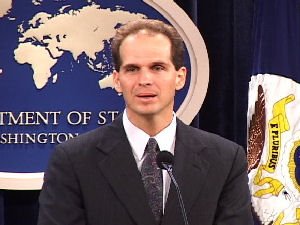
State Department Daily Press Briefing, VIDEO, TEXT, 10/02/06

Tom Casey, Director, Office of Press Relations, Bureau of Public AffairsState Dept. Briefing with Tom Casey U.S. State Department spokesman Tom Casey briefs the press and answers questions.10/02/2006: WASHINGTON, DC: 25:20 min. FULL STREAMING VIDEO.
TRANSCRIPT: 12:50 p.m. EDT.

MR. CASEY: Afternoon, everybody. Welcome. Don't have any opening statements or announcements for you. So let's go right to your questions.

Sue.

QUESTION: Javier Solana said he's going to be talking today to Larijani. I just wondered what your -- what the prospects were you thought for them for a successful outcome of that discussion. The Secretary had some fairly negative comments in her overnight briefing.

MR. CASEY: Well, I think the Secretary has addressed this on her briefing on the way over to Saudi Arabia, and I don't think I really have much of an update for you from that point. Clearly, as Mr. Solana has said recently as well, time is running out. And certainly one of the things that came out of the Secretary's call with her P-5+1 colleagues over the weekend was a continued commitment on the part of all the P-5+1 to Resolution 1696.

And certainly while we very much have encouraged and supported Mr. Solana's efforts to try to get the Iranians to agree to a suspension and to be able to then start negotiations to move in a positive direction, certainly nothing that Mr. Solana has said to the P-5+1 or to us individually indicates that the Iranians, in fact, have made that decision. So certainly the ball's in their court. We'd very much like to see them agree to this so that we could move forward with negotiations and hopefully have a resolution to this crisis without having to move towards sanctions. But again, I think the P-5+1 is firm in saying that if the Iranians are unwilling to do so that that's the direction we will in fact be moving in.

QUESTION: So is that what you picked up over the weekend in the discussions with Mr. Solana, that you're all on the same page on this? Are China and Russia still on board in the same way as they were when they voted in favor of the resolution?

MR. CASEY: Again, everyone agreed to the terms of 1696, and there has been no change in that. And again, we have been engaging in conversations among the political directors of the P-5+1 to talk about the shape and scope of what that resolution would look like, and those conversations are continuing. Certainly, I would expect they'd be accelerated if we, in fact, get a definitive answer from the Iranians that is not a decision to comply with the terms of 1696 and engage in a suspension.
QUESTION: Are you expecting a definitive answer or are you just expecting this to --

MR. CASEY: Well, again, I think it's clear that time is limited. The Secretary said that and we've said that previously. It's now more than a month since the deadline in Resolution 1696 passed. Certainly I think Mr. Solana has said that it's getting towards the end of the time that he would expect for the Iranians to be able to make a definitive -- give a definitive answer and choose the path that we'd all like to see them move on, which is a suspension. But if they don't, again, I think we'll probably wind up moving fairly quickly down the road towards a sanctions resolution.

QUESTION: Just one more. The head of the Russian security -- national security council is going to meet with Larijani. Is that part of a -- is that a coordinated effort?

MR. CASEY: Certainly we're in touch with all of the P-5+1 members, but the Russians certainly have a longstanding relationship with the Iranians and I'd certainly expect that in any meetings they'd have that they would again convey the wishes of the P-5+1 that Iran actually take up this opportunity, decide to suspend, do so in a verifiable way so that negotiations can begin. The channel, or the formal channel, for communications between the P-5+1 and the Iranians remains Mr. Solana with Mr. Larijani, but that certainly doesn't exclude any other parties having conversations whether with Mr. Larijani or other officials in the Iranian Government.

QUESTION: So once Mr. Solana has finished his conversation with the Iranians today, if he doesn't manage to get some kind of solution, do you see his job as being over as being your sort of negotiator with the Iranians?

MR. CASEY: Well, I think first of all Mr. Solana has been engaged in all of the conversations with the P-5+1. I certainly think we value his efforts and his activities. I would expect he'd remain part of the conversation and then discussions on this issue. What other discussions he might or might not have with the Iranians, that's something we'll just have to wait and see.

QUESTION: But once he's finished these talks today, if nothing comes out of them, that, as far as you're concerned, is the end of the sort of P-5+1 discussions?

MR. CASEY: Well, again, at any point in time the Iranians can, in effect, call a time out in the Security Council process by agreeing to suspend enrichment activities, do so in a verifiable way, and then we could move to negotiations. Again, the goal here is not imposing sanctions. The goal here is changing Iranian behavior. If Iran wishes to take up this offer after we've started down the sanctions path, that's something that certainly we would welcome and like to see happen. But again, what I can't predict for you is what particular kinds of discussions or other kinds of activities outside of that process might go on and what Mr. Solana's role might be in that.

Yeah.

QUESTION: Change the topic? Is that okay?

MR. CASEY: Okay, sure.

QUESTION: The Georgia-Russia spy standoff seems to have been partially resolved, but President Putin has talked about what he called the destructive policies of the United States in Georgia. Do you have any comment on that?

MR. CASEY: Well, I haven't seen President Putin's comments. Certainly though we welcome the actions that the Government of Georgia took to return the four Russians that were arrested last week and we very much appreciate the role that was played by the Chairman-in-Office of the OSCE to facilitate that transfer, and encourage the Government of Russia and the Government of Georgia to continue to take steps to deescalate the tensions in the days and weeks ahead.

Certainly, our position on these issues has been clear and remains so. We certainly reaffirm our support for Georgia's territorial integrity within its internationally recognized borders. And as always, we continue to call for the peaceful resolution of the conflicts in Abkhazia and South Ossetia.

The U.S. role in any situation like this is to simply do that, to try and call for a peaceful resolution of differences between neighbors. We certainly want to see Georgia have good relations with Russia, and Russia have good relations with Georgia. There is a great deal of history there. They are neighboring states, and they -- we certainly want to have -- see them have positive relations. And that's the role that we have been playing in this is encouraging them to work out these differences.

QUESTION: Did you see the meetings over the weekend between Mr. Putin and the leaders of Abkhazia and South Ossetia as being an unhelpful step?

MR. CASEY: Well, again, what we see as important is that there be a resolution of these differences and in a way that recognizes the territorial integrity of Georgia. Any conversations that help promote that effort are obviously positive. Any ones that don't would not be helpful.

But again, I think the important thing here is when it comes to relations between these two countries, our goal is to see them work cooperatively with one another in a way that's respectful of each other's rights and in a way that allows for a peaceful resolution of differences.

Yeah.

QUESTION: Tom, would you say that the release of the Russians by the Georgians came at the encouragement of the United States?

MR. CASEY: Well, David, obviously it’s up to the Georgian Government to talk about the reasoning behind their decisions. Certainly, again, our counsel to both Georgian Government officials as well Russian Government officials is that they work with one another to peacefully resolve their differences.

QUESTION: What has been the degree of direct U.S. contact with both? I understand, for instance, that President Bush may have talked to President Putin about this. I know that's a White House business but --

MR. CASEY: Yeah.

QUESTION: -- if you could --

MR. CASEY: I don't have any information about Presidential activities. Obviously, we've been engaged throughout this with our friends in Georgia and our friends in Russia. The Secretary did speak with both President Saakashvili as well as Foreign Minister Lavrov over the course of the last few days. That's part of our effort simply to encourage them to work out these differences and to be able to do so in a way that leads to a peaceful resolution of conflict.

Michel.

QUESTION: Secretary Rice said yesterday that she wants Saudi's involvement in the stabilization of Iraq and Lebanon through resources and political support. How do you think that the Saudis can be more helpful on these issues?

MR. CASEY: Well, I think what the Secretary is referring to is the effort that she is making to engage with moderate states in the region, not only Saudi Arabia but also Egypt, the members of the GCC, Golf Cooperation Council, to be able to encourage them to do what they can to help the government of Iraq as it deals with the many challenges that are before it. That's certainly something that is not exclusive to Saudi Arabia but includes the other governments of the region. It's part of what we discussed in the Iraq compact meeting at the UN and part of our continuing efforts to see that not only the United States and members of the international community more broadly, but that Iraq's neighbors do what it can to assist the government of Prime Minister Maliki to be able to carry out some of the difficult tasks before them. That includes helping not only with the political development of the country but also with its economic development, with spurring investment, with helping economic reform and reconstruction. Certainly it also involves doing whatever we can as individual states to assist them in terms of gaining control of the security situation as well.

Yeah, Kirit.

QUESTION: On Thailand, this interim Prime Minister has now been formally appointed. Do you have any comment on his appointment and his ability to lead the country?

MR. CASEY: Well, a little bit. First of all, in naming Prime Minister Surayud the council did fulfill a pledge that it made to its people as well as to the international community to name an interim prime minister within two weeks of taking power. And we hope that the new Prime Minister as well as those in his cabinet will work with a broad spectrum of Thai society, and we hope this does facilitate an early return to democratic rule.

One thing, as you know, that we've been concerned about are the restrictions that have been placed on political activity and freedom of expression. My understanding is the interim constitution that he will be working under provides guarantees for basic civil liberties and basic rights of the people, and that that is something we very much want to see carried out and we want to make sure that that interim government lives up to the letter of that interim constitution.

QUESTION: The U.S. Ambassador to Thailand was the first foreign diplomat to meet with this new Prime Minister. Doesn't that seem like some sort of approval for the coup that took place two weeks ago?

MR. CASEY: Well, no. And in fact, part of what Ambassador Boyce's meeting with the new Prime Minister did was to continue to reiterate our concerns about the coup itself and the importance of this interim government taking the steps that it's pledged to take to bring about a return to democracy as soon as possible. And I think it's appropriate and important that that message be conveyed directly from our Ambassador to the head of this new government, because we are serious about seeing this process move forward and seeing a return to democracy in Thailand as quickly as possible.

Sue.

QUESTION: On Zambia.

MR. CASEY: Okay.

QUESTION: On Thailand?

MR. CASEY: You want to stick with Thailand?

QUESTION: Yeah, one more. Do you have anything new on Cobra Gold and whether that's going to go ahead and the exercises --

MR. CASEY: No, I don't. That's something that's still under consideration but no final decisions have been made.

QUESTION: Okay.

MR. CASEY: We're going to go to Zambia.

QUESTION: Yeah, Zambia.

MR. CASEY: Okay.

QUESTION: The opposition challenger, Michael Sata, in the Zambian election claims that there was vote-rigging and there were various protests overnight. Banks and businesses are still closed in Zambia. I wondered whether you were able to ascertain whether the election was free and fair, and whether you had any comments on what has happened since the election.

MR. CASEY: Well, first of all, my understanding is they're still working on producing the results. I think something on the order of 135 of 150 constituencies have had reports in, so the results of the election are not final.

From what we have seen, certainly the voting appeared to us to be peaceful and transparent. And while there were some minor localized problems that were reported, the electoral commission of Zambia and their efforts at running this election have generally gotten positive reviews from a number international observers that were there. And for our part what we want to do is encourage all people an all members of the political establishment there to respect the democratic results. And certainly we look forward to being able to work with the next government of that country.

So at this point certainly what we'd like to see is a final tally be produced. And if there are -- as in any election, if there are charges of irregularities, if there are any problems, certainly they should be looked into an investigated by the competent authorities. But in the process of doing so, we definitely do urge calm and urge people to respectfully proceed with any concerns they have within the rule of law.

QUESTION: So would you be urging Michael Sata, then, to encourage his supporters to show restraint and wait until the results come out?

MR. CASEY: Well, I think we would encourage all parties to refrain from violence under any circumstances. There are legal channels for pursuing any problems or disputes within the Zambian system.

Again, the at least initial reporting that we have from international observers is that the Zambian Electoral Commission has, in fact, done a good job of running these elections. And I would certainly hope that if there are charges that need to be investigated, that any parties involved or any parties that have concerns would bring them to the appropriate authorities and let that process move forward in a peaceful way.

QUESTION: Thanks.

MR. CASEY: Sure.

David.

QUESTION: Still on Africa.

MR. CASEY: Okay.

QUESTION: Sudan. Has there been any change in the situation in terms of travel restrictions on U.S. diplomats and the visa for Andrew Natsios?

MR. CASEY: Well, first of all, in the case of Mr. Natsios, as you know our Special Envoy Andrew Natsios was over at the White House today, had a meeting with the President to talk about his mission. And we think it's very important that he has been named and that he's in a position to help carry out the President's policy to try and help bring peace in Darfur.

He does intend to travel somewhere around the middle of the month, and certainly we anticipate a positive response from the government of Sudan in terms of permitting him the opportunity to travel.

QUESTION: Including inside the country? I mean does he have the visa yet?

MR. CASEY: He has not applied as of yet.

QUESTION: Okay. So what about the restrictions in terms of diplomats in --

MR. CASEY: Well, again, there's been a lot of discussion about that. As far as I know, we are still able to have freedom of movement for our diplomatic officials there. If we have any updates on that issue, I'll let you know.

QUESTION: Do you have any more details on the USAID contract or grant or whatever it was that was granted for southern Sudan to help with infrastructure development?

MR. CASEY: No, I don't, Sue. I'm sorry, I'm not sure if that was something you asked about last week.

QUESTION: No, I didn’t.

MR. CASEY: I don't. If you want, we can try and find out something for you.

QUESTION: Can I just go back on the -- I'm confused because on Friday Sean mentioned this restriction within 25 kilometers of Khartoum, and now you're saying that there's freedom of movement.

MR. CASEY: It's something that's been -- that, you know, has been -- remarks that have been made by President Bashir and others to the best of my knowledge no physical restrictions on our current diplomatic staff in Khartoum have been implemented. I'm not saying that's the end of the story, I'm just saying that at this point I don't have anything that sort of amplifies on those remarks.

QUESTION: But have any U.S. Embassy staff members been to Darfur or outside of that 25K perimeter?

MR. CASEY: My understanding is they have. But I can check for you if you want.

QUESTION: They have?

MR. CASEY: Yeah.

Sure, let's go back here.

QUESTION: On Japan, new Prime Minister Abe is expected to hold talks with China and South Korea later this week. What hopes does the U.S. have for the resumption of high level talks between Japan and its neighbors?

MR. CASEY: Well, certainly, we want to see all parties in the region have good relations with one another. We definitely want to see Japan have positive relations with all its neighbors including Korea and China. But this is really a matter for those countries to work out and to discuss on their own.

There are certainly many issues on the agenda for them. We believe one of the things that we very much appreciate and value is the work that all three of those countries have done with us in terms of trying to support a resolution of the North Korean nuclear issue. And that's simply one of the ways in which they are all cooperating together with each other, as well as with us, to do something that's in the interest of the broader international community. But certainly it's a matter for the Japanese Government, the governments of South Korea and China to work out, but we do encourage those contacts and hope that they will continue to work on a positive relationship.

Yeah, let's go here.

QUESTION: On Japan real quick. Shinzo Abe has said in his latest speech that he foresees a more muscular military role, including possible changes to the Constitution. How would the U.S. feel about such a development?

MR. CASEY: We'd feel it would be a matter for the Japanese people to work out among themselves. Obviously anything involving decisions affecting the constitution of Japan are for the Japanese people to make. There is a lot of history there, and there are certainly a lot of issues for people to consider, but that really is a Japanese internal matter.

QUESTION: (Inaudible) the deployment of -- they've already started the PAC-3 Patriot missile system?

MR. CASEY: Can't tell you how a decision that hasn't been made might affect another one. It's hypothetical.

Let's go back here.

QUESTION: Can we jump over to the Palestinian territories for a little bit?

MR. CASEY: Sure.

QUESTION: In I think April, Secretary Rice was asked if the cutting of aid to the Palestinian -- direct aid to the Palestinian Authority would create a -- or destabilize the situation in the Gaza Strip. With the recent violence, I was wondering if there's a reconsideration of that statement.

MR. CASEY: Well, I think our policy with respect to the territories has been clear. I also think that it's important to remember that while the United States and the rest of the international community has not been providing direct support to the Hamas-led government that there has been a tremendous effort to provide for the humanitarian needs of the Palestinian people, that the United States has dedicated over $450 million to that effect this year, and other donors are making other support for the Palestinian people through a variety of different means.

The Quartet statement that just came out after the meeting with the Quartet members at the United Nations talked about a number of other things, including a continuation of the temporary fund to support the Palestinian people. It also encouraged Israel to consider taking the tax revenues that it has received and put it into that mechanism so that there can be additional support given to the Palestinian people while, again, not providing assistance to the Hamas-led government.

So I think the international community has done quite a bit to help fulfill the needs of the Palestinian people, and it's something that we are going to continue to work on. It's certainly one of the issues as we look forward to her meetings with President Abbas that will be coming up later in the week. But again, I think we have made efforts to ensure that even while we are maintaining our principles of the Quartet with respect to the Palestinian Authority government that we are doing quite a bit to support the Palestinian people and also doing what we can to work with the President Abbas and those elements of the government under his control to be able to deal with some of the challenges that are faced in the territories.

QUESTION: Do you know out of the $450 million pledged how much has been disbursed in the last six months?

MR. CASEY: My understanding is that that money is all in this fiscal year, the fiscal year -- last fiscal year now since the fiscal year began. So my assumption is that all of those funds have at least been allocated in one form or another. Whether they've actually been spent at this point I would not think so, but as far as I know they've all been allocated.

QUESTION: And what is being done in a sense right now to try to alleviate some of the pressure that is in Gaza for all these civil servants that have not been paid for seven months?

MR. CASEY: Well, again, I think one of the issues that are being confronted there is the problem that the Hamas-led government has faced in trying to not just win an election but trying to govern. And as we've said, the Hamas-led government needs to be able to govern responsibly. Part of the responsibility is seeing to the needs of your people and making sure that you have the funds available to be able to pay your employees.

Again, what we have done is assured ourselves to the best of our ability that we are able to contribute to some of the basic needs of the Palestinian people in terms of meeting their basic humanitarian considerations. That includes providing medicine. That includes, where appropriate, providing food. But at this point, it is frankly up to the Palestinian Authority government to determine how to govern and these are choices that it's going to have to make, how it handles issues with its own employees, how it handles pay for them. These are the kinds of decisions that any government authority is going to have to deal with.

David.

QUESTION: Over the weekend, the Serbian parliament approved a constitution that declares Kosovo basically to be irrevocably part of Serbia and that would seem to preclude any other kind of solution in this diplomatic process that's now underway. I wonder if you have any response to that.

MR. CASEY: Well, David, I don't think we've had a chance to look at the specific language that was passed and certainly I think we want to do that before we respond specifically to this issue. However, I think the position of the United States and the international community as a whole is quite clear. What we are supporting is a final status process for Kosovo that will ultimately involve an agreement between the parties that is acceptable to all. That's something that Martti Ahtisaari and his team are working very closely on. Frank Wisner, who is our advisor and envoy to that process, continues to be engaged. But neither party is going to unilaterally decide this. This is going to be something that's going to have to be worked out among them through this negotiated process that was mandated under the original UN Security Council resolution -- I believe it's 1244, that was in effect at the time of the conflict in Kosovo.

QUESTION: You don't accept this as a fait accompli then, what they've done constitutionally?

MR. CASEY: Well, again, the international community has made it clear how this issue of Kosovo's final status will be resolved, and that's through a negotiated process and the one currently being led by Mr. Ahtisaari.

David.

QUESTION: Since the Congress went into recess and Ambassador Bolton's position is still not finalized, what's the status there and what's the situation? What's the process moving forward without that?

MR. CASEY: Well, first of all, Ambassador Bolton remains the UN Permanent Representative -- the U.S. Permanent Representative to the United Nations. We think he's doing a terrific job. He has led the U.S. delegation there at a time of tremendous activity, including on some of the critical issues before us, including Iran, including Iraq, including North Korea. The list goes on. He's certainly been an active proponent of UN reform, which is a key priority for us because we want to see the UN be able to effectively handle all of the many issues that are before it.

We fully expect that if given an up-or-down vote on the Senate floor that Ambassador Bolton will receive the advice and consent of the Senate. We certainly hope that will happen. Congress will reconvene, as I understand it, in mid-November and we'd hope that they would bring him up for a vote at that time. But our basic position hasn't changed: We think he's the right man for the job, we believe he's the best person that we can have up in New York right now at a difficult time, and we certainly hope that his service will be able to continue up there and we look for the Senate to be able to take up his nomination again when they return.

Thank you, guys.

(The briefing was concluded at 1:10 p.m.), DPB # 159, Released on October 2, 2006

Technorati Tags: and or and , or and or , or and , or ,

Related: Keywords State Department, Thursday, September 21, 2006
State Department Daily Press Briefing, VIDEO, PODCAST, TEXT, 09/21/06 Wednesday, September 20, 2006 Mahmoud Ahmadinejad Iran UN (VIDEO), Tuesday, September 19, 2006 Media Stakeout Ambassador John Bolton 09/18/06 (VIDEO), Tuesday, September 19, 2006 Kristen Silverberg On-the-Record Briefing (VIDEO), Monday, September 18, 2006 Annual Report on International Religious Freedom (VIDEO), Wednesday, September 13, 2006State Department Daily Press Briefing, VIDEO, PODCAST, TEXT, 09/12/06, Monday, September 04, 2006 Media Stakeout Ambassador John Bolton 09/01/06 (VIDEO), Monday, September 04, 2006 Condoleezza Rice American Legion Convention VIDEO, PODCAST, TEXT, Thursday, August 31, 2006 United Nations Daily Press Briefing 08/31/06 (VIDEO), Monday, August 28, 2006Media Stakeout Ambassador John Bolton 08/28/06 (VIDEO), Wednesday, August 23, 2006 Iranian Response to the P5+1 Package, Tuesday, August 22, 2006 Media Stakeout Ambassador John Bolton 08/22/06 (VIDEO), Tuesday, August 22, 2006 Media Stakeout Ambassador John Bolton 08/15/06 (VIDEO), Friday, August 18, 2006 State Department Daily Press Briefing, VIDEO, PODCAST, TEXT, 08/17/06, Thursday, August 17, 2006 Media Stakeout Ambassador Anne Woods Patterson Sudan VIDEO, Wednesday, August 16, 2006 Middle East Update 08/16/06 VIDEO, PODCAST, TEXT,