Monday, November 13, 2006

Martin Luther King, Jr. National Memorial (VIDEO)

President Bush Attends Ceremonial Groundbreaking of the Martin Luther King, Jr. National Memorial, FULL STREAMING VIDEO, National Mall, Washington, D.C. 10:07 A.M. EST. In Focus: African-American History

African-American History
THE PRESIDENT: Thank you all very much. I'm honored to join you today in today's ceremony. I'm proud to dedicate this piece of our Nation's Capital to the lasting memory of a great man.

We have gathered in tribute to Dr. Martin Luther King, to the ideals he held and to the life he lived. Dr. King showed us that a life of conscience and purpose can lift up many souls. And on this ground, a monument will rise that preserves his legacy for the ages. Honoring Dr. King's legacy requires more than building a monument; it required the ongoing commitment of every American. So we will continue to work for the day when the dignity and humanity of every person is respected, and the American promise is denied no one.

This project has been over a decade in the making, and I thank those who have worked to bring about this day. I particularly want to thank my predecessor, the man who signed the legislation to create this memorial, President Bill Clinton. (Applause.) It sounds like to me they haven't forgotten you yet. (Laughter.) He's become, as you know, my fourth brother. (Laughter.)

I want to thank Harry Johnson. I appreciate the members of my Cabinet who are here. I welcome the members of Congress. I thank my Mayor, Tony Williams, who is here. I'm proud to be with the members of the King family. I thank the representatives of the community and civil rights groups who have joined us. I thank the Martin Luther King, Jr. National Memorial Project Foundation board members and executive cabinet. Most of all, thank you all for coming. (Applause.)

Our Declaration of Independence makes it clear that the human right to dignity and equality is not a grant of government. It is the gift from the Author of Life. And Martin Luther King considered the Declaration one of America's great, as he called it, "charters of freedom." He called our founders' words, "a promise that all men -- yes, black men, as well as white men -- would be guaranteed the unalienable right of liberty, life, and the pursuit of happiness."

Throughout Dr. King's life, he continued to trust in the power of those words, even when the practice of America did not live up to their promise. When Martin Luther King came to Washington, D.C. in the summer of 1963, he came to hold this nation to its own standards, and to call its citizens to live up to the principles of our founding. He stood not far from here, on the steps of the Lincoln Memorial. With thousands gathered around him, Dr. King looked out over the American capital and declared his famous words, "I have a dream."

His dream spread a message of hope that echoed from his hometown of Sweet Auburn, Georgia, to the pulpit of Dexter Avenue Baptist Church, to the Edmund Pettus Bridge. An assassin's bullet could not shatter the dream. Dr. King's message of justice and brotherhood took hold in the hearts of men and women across the great land of ours. It continues to inspire millions across the world.

As we break ground, we give Martin Luther King his rightful place among the great Americans honored on our National Mall. The King Memorial will span a piece of ground between the Jefferson and Lincoln Memorials. And by its presence in this place it will unite the men who declared the promise of America and defended the promise of America with the man who redeemed the promise of America. (Applause.)

The memorial will reflect the arc of Dr. King's life, his search for justice, and the enduring beauty of his words. The memorial will include a wall where visitors can read passages from Dr. King's sermons and speeches through a stream of water. And on the banks of the Potomac, visitors will walk from the Mountain of Despair to the Stone of Hope, where Dr. King's image is rendered.

Today we see only these open acres, yet we know that when the work is done, the King Memorial will be a fitting tribute, powerful and hopeful and poetic, like the man it honors. As we break ground, we remember the great obstacles that Dr. King overcame and the courage that transformed American history. The years of Martin Luther King's life were tumultuous, difficult, and an heroic time in the life of our country. Across our nation, African Americans faced daily cruelties and pervasive wrongs. In 1955, a woman, Rosa Parks, challenged these wrongs on a bus in Montgomery, Alabama, when she refused a driver's order to give her seat to a white man. Her act of defiance inspired a young Baptist minister and changed our nation forever.

Within days of Rosa Parks' lonely protest, Dr. King helped organize a boycott that captured the attention of our country. When Dr. King's leadership -- with Dr. King's leadership, the boycott forced America to confront the glaring contradiction between the sign on the bus and the words of our Declaration of Independence. And on this date, exactly 50 years ago, the Supreme Court ruled the segregation of public buses unconstitutional. And so today we celebrate the courage that won victories and helped spark one of the greatest movements for equality and freedom in American history.

Eventually, the civil rights movement would succeed in persuading Congress to pass sweeping legislation that represented a new founding for our nation. On July 2, 1964, President Johnson signed the Civil Rights Act at the White House. As of that date, no longer could weary travelers be denied a room in a hotel, or a table at a restaurant on account of their race. And no longer could any American be forced to drink from a separate water fountain, or sit at the back of the bus just because of their race.

Dr. King liked to say that our Civil Rights Act was written in the streets by citizens who marched for the idea that all men are created equal. He was right; yet there is no doubt that the law came as it did when it did because of the courage and leadership of Martin Luther King.

As we break ground, we recognize our duty to continue the unfinished work of American freedom. America has come a long way since Dr. King's day; yet our journey to justice is not complete. There are still people in our society who hurt, neighborhoods are too poor. There are still children who do not get the education they need to fulfill their God-given potential. There's still prejudice that holds citizens back. And there's still a need for all Americans to hear the words of Dr. King so we can hasten the day when his message of hope takes hold in every community across our country.

We go forward with the knowledge that the Creator who wrote the desire for liberty in our hearts also gives us the strength and wisdom to fulfill it. We go forward with trust that God, who has brought us thus far on the way, will give us the strength to finish the journey. And we go forward with the confidence that no matter how difficult the challenge, if we remain true to our founding principles, America will overcome.

Dr. King was on this Earth just 39 years, but the ideas that guided his work and his life are eternal. Here in this place, we will raise a lasting memorial to those eternal truths. So in the presence of his family, his coworkers in freedom's cause, and those who carry on his legacy today, I'm proud to dedicate this ground on behalf of the American people as the site of the Martin Luther King, Jr. Memorial. May God bless you all. (Applause.)

END 10:17 A.M. EST. For Immediate Release, Office of the Press Secretary, November 13, 2006

Technorati Tags: and or and or and or and or and

Sunday, November 12, 2006

What does the public really know about HPV?

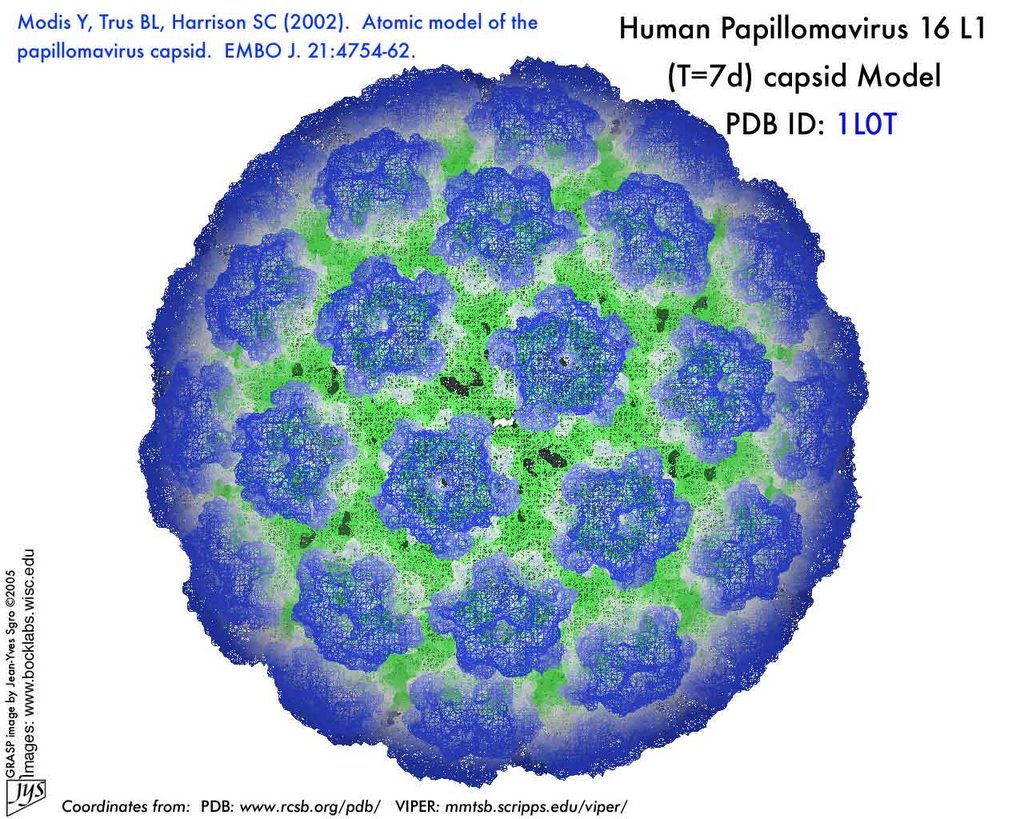
© 2006 virusworld, jean-yves sgro, institute for molecular virology, university of wisconsin-madison. Permission is granted for the non-profit educational use of the ICTV images in classrooms and seminars.© 2006 virusworld, jean-yves sgro, institute for molecular virology, university of wisconsin-madison. Permission is granted for the non-profit educational use of the ICTV images in classrooms and seminars.
High Resolution Image. Images from the ICTV 8th report. References and information about these images are available in the following documents as plain text or PDF format (recommended).

Researchers gauge women's understanding of the link to cancer and response to the new vaccine

BOSTON -- Human papillomaviruses (HPV) are the most common sexually transmitted infections in the United States, and certain "high risk" types have been shown to cause cervical cancer. Despite recent advances in the detection and prevention of HPV, the link between the virus and cervical cancer is not well known to the public. In June 2006, the Food and Drug Administration (FDA) approved the first vaccine to prevent infection of two high risk types of HPV, and two types that cause genital warts. The Advisory Committee on Immunization Practices (ACIP) recommended it for females 9 to 26 years of age.

Two studies presented today at the American Association for Cancer Research's Frontiers in Cancer Prevention Research meeting in Boston assess the public's understanding of HPV and whether discussion of the vaccine by the media and public has influenced the decision to vaccinate among women at risk.

What Do U.S. Women Know About Human Papillomavirus (HPV) and Cervical Cancer?

Many women with HPV show no symptoms of the virus, and infections often clear without need for treatment. Because of this, many women do not have the opportunity to speak with their physicians about HPV and therefore may not learn that some HPV infections are persistent and can develop into cervical cancer.

The National Cancer Institute (NCI) created the Health Information National Trends Survey (HINTS) to monitor health communications about cancer. In 2005, one high-priority research aim was to assess, for the first time, the awareness and knowledge of HPV in a nationally representative sample of women.

To identify factors associated with U.S. women's awareness of HPV and its link to cervical cancer, researchers from NCI analyzed cross-sectional data collected from more than 3,000

women ages 18 to 75 who responded to HINTS. Researchers found that:

Only 40 percent had ever heard about HPV;

Among them, less than half were aware of the virus' connection to cervical cancer;

64 percent knew that HPV could be sexually transmitted, and 79 percent knew it could cause abnormal Pap smears.

The public needs education about HPV and cervical cancer in order to make appropriate, evidence-based health care choices among existing prevention strategies, including the Pap test, HPV DNA test, and HPV vaccine, researchers concluded.

"Individuals are constantly being presented with new health care research that updates previous knowledge, might conflict with prior knowledge, or provides entirely new options for diagnosis and treatment," said Jasmin A. Tiro, Ph.D., MPH, in the Division of Cancer Control and Population Sciences, NCI, Bethesda, Md. "With limited awareness about HPV among women in this country, there is a need for clear, consistent information about HPV transmission, prevention, detection and the link to cervical cancer. We expect that media coverage over the past year and direct-to-consumer marketing efforts by the makers of the HPV DNA test and the HPV vaccine will increase awareness, and NCI is conducting studies to monitor this possible increase. We plan to track the diffusion of knowledge to make sure that all women have accurate knowledge about HPV and how to prevent cervical cancer."

The Effects of Information Framing on Intentions to Vaccinate Against HPV

The success of the HPV vaccine depends largely on the public's willingness to accept vaccination. Because of the potentially controversial nature of the vaccine, researchers at the University of Pennsylvania's EPIC Center of Excellence in Cancer Communication Research assessed how its portrayal in the media would affect attitudes toward vaccination among women.

The study was a part of the Annenberg National Health Communication Survey, a monthly barometer of the public's health communication practices and needs. The survey is jointly funded by the National Cancer Institute, the Annenberg School for Communication and the Sunnylands Trust at Annenberg. It was fielded in June, 2006, roughly coinciding with FDA approval of the vaccine.

A nationally representative sample of U.S. adults over 18 was randomly assigned to read one of three paragraphs about the vaccine, each emphasizing a different point of view: the vaccine protects against cervical cancer; the vaccine protects against cervical cancer and sexually transmitted infections; or, the vaccine protects against cervical cancer, sexually transmitted infections and may or may not lead to increased sexual promiscuity among those vaccinated. The survey was then given to gauge intentions toward vaccination. It was completed by 635 adults, 49 percent of whom were women.

Researchers found:

More than half of respondents (56 percent) had heard of HPV and reported that they had seen or heard news or ads about HPV in the past week;

Although 42 percent of respondents had heard about a vaccine for HPV, 80 percent indicated never having talked to a health care provider about the virus.

How the vaccine was presented greatly affected women's intentions to vaccinate. When women read that the vaccine protects only against cervical cancer, 63 percent indicated they were "very likely" or "somewhat likely" to get vaccinated, compared to 43 percent of women who read that the vaccine protects against cervical cancer and a sexually transmitted infection.

"Despite high levels of exposure to and awareness of the newly approved HPV vaccine, intentions to vaccinate are mixed," said Amy Leader, MPH, Research Director, EPIC Center of Excellence in Cancer Communication Research. "Trends indicate that intentions are highest when the vaccine is framed to solely prevent cervical cancer and lowest when the vaccine is framed to prevent both cervical cancer and a sexually transmitted infection, or STI, indicating that people may feel the need for an STI vaccine is unnecessary."

Participants were also asked about their intentions to vaccinate if they had to pay for the vaccine or if the vaccine were provided at little or no cost. Although the majority reported having some form of health insurance coverage, intentions to vaccinate one's self or a daughter were substantially higher when the vaccine was available at little or no cost. For example, 54 percent of parents indicated that they were "very likely" or "somewhat likely" to want the vaccine for their daughter if it were provided at little or no cost, compared to 38 percent of parents who would consider the vaccine for their daughter if it would cost their family. ###

The mission of the American Association for Cancer Research is to prevent and cure cancer. Founded in 1907, AACR is the world's oldest and largest professional organization dedicated to advancing cancer research. The membership includes more than 24,000 basic, translational, and clinical researchers; health care professionals; and cancer survivors and advocates in the United States and more than 70 other countries. AACR marshals the full spectrum of expertise from the cancer community to accelerate progress in the prevention, diagnosis and treatment of cancer through high-quality scientific and educational programs. It funds innovative, meritorious research grants. The AACR Annual Meeting attracts over 17,000 participants who share the latest discoveries and developments in the field. Special Conferences throughout the year present novel data across a wide variety of topics in cancer research, diagnosis and treatment. AACR publishes five major peer-reviewed journals: Cancer Research; Clinical Cancer Research; Molecular Cancer Therapeutics; Molecular Cancer Research; and Cancer Epidemiology, Biomarkers & Prevention. Its most recent publication, CR, is a magazine for cancer survivors, patient advocates, their families, physicians, and scientists. It provides a forum for sharing essential, evidence-based information and perspectives on progress in cancer research, survivorship and advocacy.

Technorati Tags: and or and and or and or and or and