Monday, November 20, 2006

President Bush and Prime Minister Abe

President Bush Meets with Prime Minister Abe of Japan, The Sheraton Hanoi, Hanoi, Vietnam, 12:47 P.M. (Local), APEC 2006 12:47 P.M. (Local)
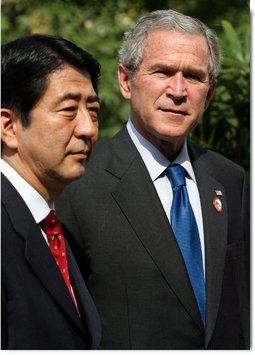
President George W. Bush and Prime Minister Shinzo Abe of Japan talk with the media during a photo opportunity Saturday, Nov. 18, 2006, following their lunch at the Sheraton Hanoi hotel. White House photo by Eric Draper.PRESIDENT BUSH: Mr. Prime Minister, thank you very much for your time. We just had a very frank and full discussion. I admire the Prime Minister's intellect, I'm very comfortable with his style, and I'm very confident we'll be able to work together for the common good.
The relationship between Japan and the United States is strong and we will keep it that way. And a strong relationship between our two countries is good for the security of the East. We talked a lot of issues. And we spent time talking about North Korea and our common commitment to see that the six-party talks succeed. We spent a lot of time talking about bilateral issues. And one of the most interesting issues we discussed was our common desire to continue to cooperate on ballistic missile defense.

I told the Prime Minister he needs to get over to the United States quickly. I'm looking forward to hosting him. And thank you for your time.

PRIME MINISTER ABE: (As translated.) I was able to spend a very meaningful and wonderful time with the President today. So thank you very much, Mr. President.

Japan and U.S. share an alliance which is based on fundamental values, such as freedom, democracy, basic human rights and the rule of law. And we agreed with each other that strengthening our alliance would be a good in maintaining peace and security of not just Japan and the region surrounding Japan, but the entire world.

Also concerning North Korea, as the President mentioned, we agreed that we would take a coordinated approach to reach a final resolution of the issue, and also to achieve some concrete results at an early stage. We also agreed to strengthen and accelerate our cooperation concerning ballistic missile defense, and we will instruct our foreign ministers and defense ministers to conduct consideration concerning this matter.

We are faced with many difficult issues, like North Korea, the fight against terror, and also Iraq. But we agreed that we will be utilizing the alliance we have between Japan and the United States for the good of the world and the region (inaudible).

I'm looking forward to visiting the United States sometime next year and seeing the President. Thank you.

END 12:52 P.M. (Local)

For Immediate Release, Office of the Press Secretary, November 18, 2006

Technorati Tags: and or and or and or and

Sunday, November 19, 2006

Scrap tires filter wastewater

Scrap tires can be used to filter wastewater

Photo credit JM http://www.logodesignweb.com/stockphotoHarrisburg, Pa. -- Every year, the United State produces millions of scrap tires that clog landfills and become breeding areas for pests.
Finding adequate uses for castoff tires is a continuing challenge and illegal dumping has become a serious problem throughout the nation.

Dr. Yuefeng Xie, associate professor of environmental engineering at Penn State Harrisburg, has developed a method that uses crumb rubber to filter wastewater, which can help ease the tire problem and clean up the environment at the same time.

"My research has found that crumb rubber, derived from waste tires, can be used as a filter media," Xie explains. "The crumb rubber could be used for treating wastewater, ship ballast water, and storm water."

Crumb rubber is produced by chopping up and grinding up waste tires to a desired size, cleaning the rubber and removing any metal particles. It is currently being used in highway pavement, athletic track surfaces, playgrounds, landfill liners, compost bulking agents, various manufactured products, energy recovery and even as artificial reefs for aquatic life.

For traditional wastewater filtration, gravity downflow granular filters using sand or anthracite as a medium are commonly used. One major problem with these filters is that upon backwashing the particles, the larger ones settle at a greater rate than the smaller.

The Penn State researcher explains that this causes the top of the filter bed to hold the smallest medium particles and the bottom to hold the largest with the small medium particles or top layer of the filter tending to become clogged quickly.

In his research, he has proved that crumb rubber is not a rigid material; instead it can be easily bent or compressed. Through the crumb rubber method, the larger solids are removed at the top layer of the filter and the smaller solids at a lower level, greatly minimizing the clogging problem.

Several studies conducted by Xie show that the crumb rubber filter is much more cost effective than conventional sand or anthracite filters. Because of substantially higher water filtration rates and lighter weight in comparison to sand or anthracite, crumb rubber filters may also be used in a mobile treatment unit for disaster relief operations, he adds.

Because the crumb rubber is compressible, the porosity of the particles is decreased which resembling an ideal filter medium configuration. It can then be used at higher filter rates while performing similarly to other media now in use. The crumb rubber media provide better effluent qualities and larger media allow longer filter runs at higher flow rates.

Also a Professional Engineer, Xie holds a U.S. patent on the technology. With more than 20 years of research experience in water and wastewater treatment, he focuses his work on water disinfection, disinfection byproduct control, water reuse and acid mine abatement.

Contact: Steve Hevner sdh4@psu.edu 717-948-6029 Penn State

Technorati Tags: and or and and or and or and or