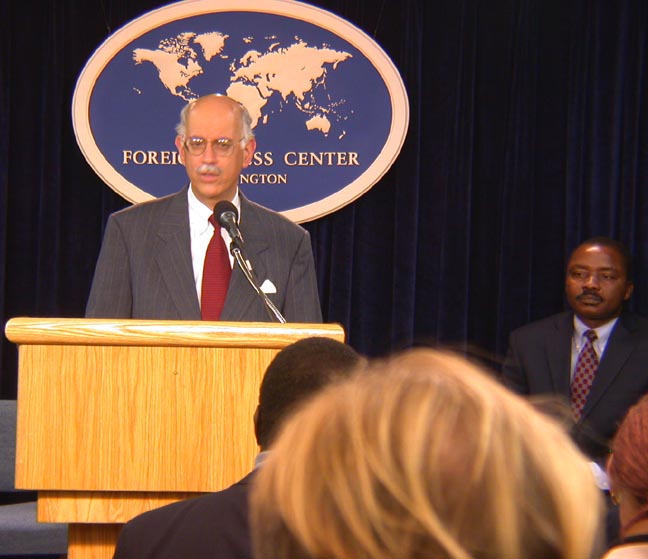
Tuesday, November 21, 2006

NATO Summit, R. Nicholas Burns (VIDEO)

Special Briefing on 2006 NATO Summit, Under Secretary Burns, FULL STREAMING VIDEO,
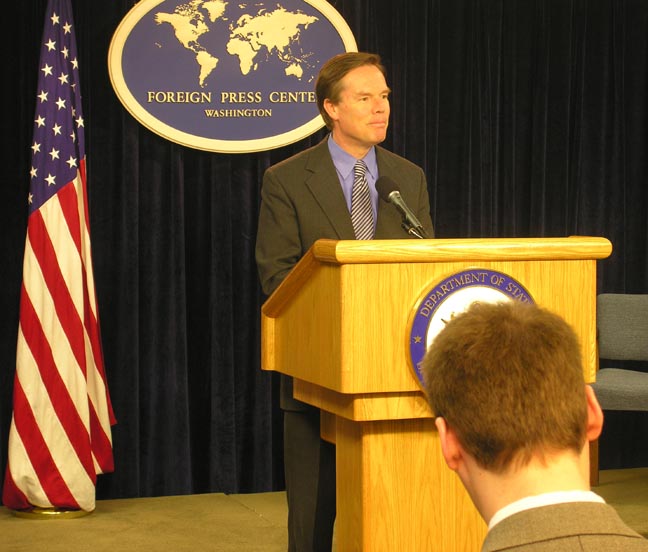
R. Nicholas Burns, Under Secretary of State for Political Affairs at the Washington Foreign Press Center, briefing on 'U.S.-India Civil Nuclear Agreement.'Nov. 21, 2006, R. Nicholas Burns, Under Secretary for Political Affairs, provided remarks about the 2006 NATO summit during a special press briefing at the U.S. Department of State November 21, 2006.
MR. GALLEGOS: Good morning, thank you for coming. This morning we have Under Secretary R. Nicholas Burns who will speak to you about the NATO summit. Under Secretary Burns.

UNDER SECRETARY BURNS: Thank you.

QUESTION: Could you before that perhaps say something about the assassination of still another Maronite Lebanese official? Well, not an official --

UNDER SECRETARY BURNS: We just --

QUESTION: -- a prominent whatever --

UNDER SECRETARY BURNS: Yes. Thank you, Barry. We just heard the news just about a half hour ago of the assassination of Pierre Gemayel in Lebanon. Obviously this is a very sad day for Lebanon. We were shocked by this assassination. We view it as an act of terrorism. We also view it as an act of intimidation against the March 14th Coalition. And we believe it's the responsibility of all countries to support the Siniora government and to oppose those who would try to divide Lebanon or return violence to political life in Lebanon. The Gemayel family has played a very important role in the history of Lebanon. They have suffered too much tragedy as a family and our condolences go to the Gemayel family.

We think it's very, very important that those who would divide Lebanon, who would use violence to destabilize the political situation, not be able to succeed. And we will give full support to the Siniora government in the days and weeks ahead to support that government, to support its continuation because it's been duly elected by the people of Lebanon, to support what it needs to do to reconstruct the country.

QUESTION: Does this cast any doubt on the ability to construct a carefully balanced government in Lebanon, which you're calling a democracy? We have had our own assassinations and we're a democracy, but does this say something about the abilities of the various Lebanese people to pull together for the good of the country?

UNDER SECRETARY BURNS: Well, it's unfortunately all too -- part of an all too often pattern of violence and assassination in Lebanon's recent political history over the last 30 to 40 years. We support the Government of Lebanon. We support Prime Minister Siniora. We have felt for the last year and a half that the March 14th Coalition represents what's right about Lebanon: politicians, political leaders who are dedicated to democracy, who wanted to return Lebanon to a position of real sovereignty and free Lebanon from Syria's influence, and free Lebanon from the politics of violence and assassination. It's a very sad day to see someone -- a young leader like this, who was devoted to public service, to be gunned down. And so it does instill in us a belief that we have to redouble our efforts and those of our friends in the Arab world as well as in Europe to support the Siniora government. We have seen statements from Mr. Nasrallah and others over the past few weeks that are meant, we believe, to destabilize Lebanon and to divide the country and we oppose those statements. And we call on all countries to support the unity and territorial integrity of Lebanon and to free Lebanon from these acts of political intimidation and terrorism. This was an act of terrorism today.

Okay. If we have -- if you have no further questions on Lebanon, I'm happy to talk about NATO. You know that President Bush and Secretary Rice will be leaving early next week for the NATO summit in Riga in Latvia. And I think the White House will obviously talk to you about the President's schedule about where he's going, the other stop that he's making so I won't go into that. But let me just go over the substance of how we view NATO and how we view this summit and what we see unfolding at the NATO summit in Latvia.

You know that over the past few years we've made a very strong attempt to strengthen our relations with the European governments. We went through a difficult patch with some of those governments in 2002, in 2003. But beginning with President Bush's trip to Europe in mid-February of 2005, when he met with the NATO and EU leaderships in Brussels, when he met with President Chirac and then-Chancellor Schroder in Minsk, the United States has worked very, very hard to rebuild those bridges across the Atlantic and to sustain our ties with Europe and we think we've been successful. We think our partnership with Europe now is fully restored and strengthened. We are partners with the major European governments on the issue of Iran at the Security Council. We are partners with them on the issue of North Korea. We are partners with them in Afghanistan and I'll go into that in just a moment. And we continue to rely on both the military and economic and political support of most of the great majority of the European governments for what the United States is trying to do in Iraq. So in our sense, there has been a full renovation of our relations with Europe and we're very pleased about that.

It's also true that in many ways our relations with Europe are transformed. Now that Europe is, in the words of President Bush 41, "whole, free and at peace" and there are no longer any vital threats to the security of the United States emanating from Europe, the agenda with Europe has changed.

Our agenda with Europe is now a global agenda and it tends to be about the rest of the world, about what we can do as partners in the Middle East, in South and East Asia, in Africa and in Latin America. And that is a fully modern agenda and it's a great change from the agenda that we had with the Europeans for the five decades during the Cold War. So as the President goes to NATO, we not only have a reinforced U.S.-European relationship, greatly strengthened from 2003 and 2004 on the major political issues of the day, we have a transformed agenda which is much more global in orientation. And that really sets the stage for what's going to be the heart of the agenda as we see it in Riga at the NATO summit.

For us the number one issue is Afghanistan. NATO has taken on the lead role now in Afghanistan. NATO troops are in each sector of the country, including now in eastern Afghanistan as well as southern Afghanistan, and that is a historic mission for NATO. It's actually the first major combat operation in the history of the NATO Alliance going back to April 1949. NATO didn't fire a shot for its first five decades in existence. We then had the very successful peacekeeping missions in Bosnia between 1995 and 2004, and in Kosovo between 1999 and the present day, and that mission continues so this operation in Afghanistan is like no other NATO has undertaken in its history.

It is 2000 miles from the heart of Europe. There are 37 countries involved, 26 NATO allies and 11 partners including Australia and South Korea and Japan and Jordan. And this is an urgent mission because we have to try to help stabilize the country to protect that country's borders, to defend Afghanistan from the threat of the Taliban and al-Qaida offensive over the last year. NATO has established 25 Provincial Reconstruction Teams outside of Kabul. These are the combined military and civilian teams that both seek to assert security, but also bring development assistance and those have proven to be very effective.

NATO is -- the core of NATO's operation right now is in the south, in Kandahar, in Helmand and in Oruzgan provinces. And that's where Britain and the Netherlands and Canada and the United States have deployed over the last six months. And the NATO forces there have seen a good deal of combat action. There has been a major Taliban offensive over the past year and our view is that NATO has done very well. Contrary to some of the conventional wisdom that you read about, sometimes in press reports, our belief is that NATO has taken that fight to the Taliban forces in those three provinces and has inflicted a far greater number of casualties on the Taliban forces than they have been able to inflict on the NATO forces. And we're very pleased to see the way that Canada and the Netherlands and the United Kingdom have acquitted themselves. Each of these three countries has taken a significant number of casualties among its forces. The United States has taken a significant number of casualties. And yet we're continuing to stand there and defend those provinces and defend the Government of Afghanistan and to take the fight to the Taliban itself.

And this will be the major focus of the NATO summit, so the leaders will want to review the strategy and the tactics of this military operation. We stand by the strategy and tactics because they are proving to be successful, in our view. We want to see what NATO can do with international civil institutions like the United Nations or the European government -- Union -- or governments like the United States to work on the problem of counternarcotics to try to encourage a decrease in poppy production, particularly in those provinces that I mentioned, particularly in Helmand and Kandahar provinces, and discourage the trafficking of poppy out through Central Asia into Russia and into Europe. That's a major problem and NATO of course is trying its best to work with civil institutions to prevent that problem from continuing.

So I think Afghanistan will be the focus. I'll be happy to talk about any aspect of that that you want. It's also true that NATO has been transforming itself. As recently as just a few years ago, this was an alliance of 19 allies. It's now 26. It was an alliance that had never fought outside of Europe. It is now fighting in Afghanistan, has gone far beyond the shores of Europe. It was an alliance that thought of itself purely comprised of countries from the transatlantic area. Now we have a flourishing number of partners in the Caucasus and in Central Asia and in the Middle East. There are six Arab countries that are partners with NATO and Israel is a partner with NATO.

And one of the big, major proposals that President Bush will take to the NATO summit is a proposal to establish a program of global partners, and this will have NATO reach out to Australia and to Japan and to South Korea and to Sweden and Finland, the five countries that most prominently train with us, exercise with us in NATO and deploy in the Balkans and Afghanistan with us. These five countries -- at least the three Asian countries, I should say, Australia, Japan and South Korea -- do not seek NATO membership, but we seek a partnership with them so that we can train more intensively from a military point of view and grow closer to them because we are deployed with them. Australia, South Korea and Japan are in Afghanistan. They have all been in Iraq, as you know. They have all been in the Balkans. And so we want to grow closer to them. And indeed I think the foreign ministers of each of these countries have visited NATO headquarters outside of Brussels in the last two years to make the case for a closer relationship and that will be a priority issue for the United States at this summit, and we believe NATO will agree to this program of global partnerships.

Finally, let me talk about the challenges that NATO faces. We have a transformed alliance. We have a healthy alliance. We have an alliance that's really working quite well to respond to modern security challenges. But there are some weaknesses in the alliance structure that need to be addressed. It is still true that only seven of the NATO allies spend more than 3 percent of their gross domestic product on defense. This is a very meaningful metric that seeks to measure a country's ability to be successful in the alliance and to contribute to the alliance. The United States is one of those seven countries. We spend 3.7 percent of our gross domestic product on our national defense, but the majority of the allies spend less than 2 percent of GDP on national defense. And what that essentially means in a multinational alliance, a collective military organization, is that we have a lack of strategic lift and of air-to-air refueling and of combat service support and of special forces, and these are the necessary ingredients for modern warfare, for counterinsurgency warfare, the type of counterinsurgency warfare that unfortunately we now have to practice in places like Afghanistan and Iraq. And there are weaknesses of the alliance that need to be addressed.

So I think that the United States delegation led by President Bush and Secretary Rice at the summit will be pressing this idea as they did in Istanbul in 2004 and in Prague in 2002 to encourage the allies, the European allies to spend more on defense, to acquire the systems and capabilities that are absolutely necessary for success on the modern battlefield and in modern peacekeeping. And there will be a NATO initiative, we hope, to announce that there'll be a NATO purchase of C-17 airlift which should help the alliance to do a better job in lifting its forces both to training exercises but also to combat operations in distant places like Afghanistan.

I should also say that, and this is the final point that I'll make, another challenge for us is to make sure that when countries deploy forces, those forces are free to operate in the country to which they're assigned. Let me give you two examples. In Kosovo in 2004, in March of 2004, there was rioting in Pristina, the capital of Kosovo, and that rioting was essentially rioting against the Serb population. That rioting led to the death of Serbs, burned down homes and burned churches. NATO did not deploy as quickly and as efficiently into the streets to put down that rioting two years ago -- nearly three years ago I should say -- as it should have because many of the allies had restricted the ability of the troops in Kosovo to operate under the authority of the NATO commander there without the expressed permission of the capital, and so many of the troops stayed in their barracks. It was a wake-up call for NATO. And we pledged at NATO, after March 2004, we would never let that happen again, and these so called caveats, restrictions placed on NATO military forces, were completely removed from the forces in Kosovo. And so as we transition to final status in Kosovo, which will be another issue for this summit obviously, looking towards final status in early 2007, we know that we have a NATO force 15,000 strong in Kosovo that can maintain public order. And if there is a violation of public order or demonstrations or acts of violence, the NATO troops will put them down.

In Afghanistan today, we have the same problem in 2006 that we had in Kosovo in 2004. A number of the NATO countries have essentially said that their troops assigned to NATO command in Afghanistan can only be deployed -- they cannot be deployed at the suggestion of the commander in the country, but are controlled in essence by the defense ministries back in the capitals in Europe. What that essentially means is that if the commander decides to redeploy troops to meet an emergency, he cannot do so quickly; he must go through capitals and that slows us down and that doesn't allow us to accomplish the mission we need to accomplish. We hope very much that the European allies, those that have these restrictions on their forces, will lift them so that we have a very quick, forceful and energetic force in Afghanistan, the one we need to be fully successful in the years ahead.

With that, I'll be happy to take your questions.

QUESTION: Can I ask you about -- Dan Fried, your colleague, just briefed about an hour ago and said there will be no new invitations for membership in NATO at this summit.

UNDER SECRETARY BURNS: He was briefing here, Barry? Was there a briefing here?

QUESTION: Well, it was a Defense Writers breakfast. You've had -- I'm trying to figure out if this partnership has any real meaning, frankly, or if it's --

UNDER SECRETARY BURNS: Which partnership? The one I just talked about?

QUESTION: The global partnership.

UNDER SECRETARY BURNS: It has great meaning.

QUESTION: You had in the past, coalition of the willing.

UNDER SECRETARY BURNS: Yeah.

QUESTION: You have a group -- and I don't even remember the names -- in which Ukraine is a member of, if that's the right word. You have another group with at least three countries that are members. So you're creating now still another category. To convince us that means something, could you tell us what the obligations and who are the targeted countries for this? You're running out of European countries to put in pigeon holes, or to put in classifications.

UNDER SECRETARY BURNS: Good, I'm happy to take that question.

QUESTION: Okay.

UNDER SECRETARY BURNS: Think of NATO as 26 members and then a mosaic of partnerships, and there are three major partnerships in NATO. The first partnership is essentially what you all know as the Partnership for Peace, which was created about ten years ago, and that includes most of the countries in Eastern Europe that are not members of NATO -- Albania, Macedonia, Croatia. It also includes Azerbaijan, Armenia and Georgia and it includes the five Central Asian countries. Those are the partners of NATO and they train with us and work with us. They meet with us politically around the table once a month to talk about doctrine. And we encourage them to be close to NATO, to work with us, to deploy with us. Some of them are seeking membership. So President Bush has come out and said that he supports Croatia for membership in 2008. We're looking at Albania and Macedonia as possible candidates for NATO membership. Some are looking for unique relationships with NATO. Ukraine and Georgia have had unique relationships with NATO. And so that's partnership.

The second group of countries, called the Mediterranean Dialogue Countries, and for ten years now they've been partners with NATO -- six Arab countries from North Africa and the Levant, and Israel. And we meet with them several times a year and we sometimes train with them and have military exercises. So NATO has tried to reach outside its membership and say if we're going to do the job that we must do to secure Europe and the Mediterranean and the Balkans, then we must have partners as well as members.

There's a third group of partners now we seek to create at the Riga summit called the global partners -- Japan, Australia and South Korea in the Far East. Why those three countries? None of them are seeking NATO membership, as I said before. But all of them are very interested in working more closely with NATO. So meeting with us politically from time to time to talk about the strategic landscape in the world, where the threats are occurring. They also want to train more frequently with us militarily because they're operating with us militarily. The three countries have been in Iraq, they've been in Afghanistan and they've been in the Balkans. And so we want to grow closer to them. We don't see them as future members, but we want to have a closer relationship.

We add to those three Sweden and Finland because Sweden and Finland are not members of NATO but they are very actively involved in NATO and they frequently contribute troops to NATO operations. Both of them, for instance, have been in Bosnia and Kosovo, and both of them have taken a leading role in some of the Provincial Reconstruction Teams in Afghanistan in the northern part of Afghanistan.

So that's the concept of global partners. It fits seamlessly, Barry, with the ten-year tradition of the Partnership for Peace and Mediterranean Dialogue and it's the latest and now third grouping of partners that we add to NATO. And I hope you're fully convinced this is a brilliant idea.

(Laughter.)

QUESTION: It sounds wonderful. Especially getting two neutral countries to become part of a military alliance is quite an accomplishment.

UNDER SECRETARY BURNS: Yeah, and I must say we've been very impressed by the Swedes and the Finns, the quality of their troops and their willingness to operate with us.

QUESTION: There goes history.

UNDER SECRETARY BURNS: And of course, both of those countries -- the door is always open to both of those countries should they ever seek NATO membership. Yes. Sweden and Finland.

QUESTION: Christoph Marschall from the German daily Der Tagesspiegel. I have to admit I am unfortunately also one of those who have a rather dark picture of the situation in Afghanistan and the developments there. Security is deteriorating. More and more fights with insurgents. Even in the north we count more and more attacks on the Bundeswehr and the north is supposed to be very peaceful, as you said yourself.

So what is better in Afghanistan than in Iraq and what gives us the hope that the situation in Afghanistan next summer will not be very, very similar to Iraq?

UNDER SECRETARY BURNS: There is no question that there has been an increase in the number of Taliban and al-Qaida attacks on the NATO forces, as well as the Afghan national forces with which we work in Afghanistan. And you can chart the increase in those attacks in 2006. No question about it.

There is also no question that when NATO deployed to the southern part of Afghanistan in this past summer, to Helmand and Uruzgan and Kandahar provinces, NATO deployed in far greater numbers than the U.S. had had present since 2001. And so as NATO deployed to the towns and cities of those provinces, we came up against Taliban forces and collided with them.

And the story as I understand it, and we've done a very close look at this, of the picture between July and November is that NATO has dealt a fairly serious blow to those Taliban forces operating in those three provinces. Now, the Taliban has come in greater numbers than before. They have an ability to re-supply and also send in new fighters. So I'm not saying -- I don't mean to say at all or claim that somehow this threat has been taken care of. It has not. The threat continues. But the NATO forces have been skillful and very courageous in taking the fight to the Taliban and al-Qaida and we have scored a number of tactical victories.

The key thing for us will be to maintain this level of activity and strong political will, so to keep resisting the attempts by the Taliban to come into some of these towns to assassinate local leaders, to try to intimidate women from going to work or girls from going to school, which they try to do, and to destabilize the political order in these three provinces. And so the fight is there and NATO is well armed. There are 32,000 NATO troops in the country, including the American forces assigned to NATO. And we need to maintain that troop strength, as the Secretary General of NATO has suggested. We need to be very vigorous in taking the fight to Taliban and al-Qaida, which we will do.

So we don't feel that the situation is somehow one that is sliding away. We feel this is a manageable situation, but it is certainly one of increased combat, increased threat, but NATO is meeting that threat. The American forces -- there are some assigned to NATO. In fact, the United States represents the largest national contingent in NATO, 12,000 troops. We also have American forces operating along the eastern border in the mountains and they are American national forces operating with the Afghan National Army. There are still 20,000 American troops in country. We're the largest contingent by far. And this combination of the United States, Britain, Canada, the Netherlands in the south and east has been very effective, in our view. We just need to maintain the intensity and attain our purpose in defending the government and defending the people of Afghanistan from this destabilization.

Yes, sir.

QUESTION: You mentioned before that the transatlantic alliance is exhibiting its restored strength, especially in tackling the Iran problem, so I wonder if I can ask you about Iran.

UNDER SECRETARY BURNS: Nice segue.

QUESTION: Seamless.

UNDER SECRETARY BURNS: It really was a seamless transition. (Laughter.)

QUESTION: In New York in September during the UN General Assembly you told us that we were in extra innings, and then in London you told us that extra innings had ended. Is there even a baseball metaphor that suffices to describe the situation now? Is it the case that the Russian pitchers have struck us out entirely?

UNDER SECRETARY BURNS: Well, first of all, let me just agree with your first point, and that is the fact that we have restored fully our partnership with the major European countries. The health of these relations is very good. We are partners in all the leading security challenges around the world. I mentioned some of them -- Iran and North Korea, the Middle East, Iraq, Afghanistan. And we're very pleased that in 2006 we can look back and say because of the efforts we have made and the European countries have made, we have a very solid alliance partnership with them and the days of crisis and of discord from 2002 and '3 have passed from our relations.

I would say on the subject of Iran I think the longest baseball game every played -- Barry and Charlie might correct me -- I think it was 21 or 22 innings. And I don't know, we may be in the 13th or 14th, I think.

QUESTION: Twenty-six, Boston Braves.

UNDER SECRETARY BURNS: The Boston Braves, 26 innings. That's right. What year was it?

QUESTION: I don't know. Probably the teens.

UNDER SECRETARY BURNS: Yeah, okay. Just after the First World War. So we know we're not going to defeat that record.

QUESTION: Thanks for ruining the sound bite. (Laughter.)

UNDER SECRETARY BURNS: Let me start all over again here.

QUESTION: Give me the 13, 14 again.

UNDER SECRETARY BURNS: I think we're still in extra innings. The good news is this. China, Russia, UK, France, Germany and the United States have a deal, and that deal was made on July 31st of 2006 in Resolution 1696 in the penultimate paragraph of that resolution. Chapter 7, Article 41 sanctions will be placed on Iran if it doesn't meet the condition of a temporary suspension of its enrichment programs at its plant in Natanz. They didn't meet that condition.

We, the P-5, the permanent five countries of the UN, the Security Council and Germany gave Iran four and one half months to think about the offer we made to negotiate -- it was a serious offer to suspend its enrichment program -- and they decided not to do it. So they walked away. Iran walked away from negotiations. We now have no alternative but to pass a Chapter 7, Article 41 sanctions resolution to display the unity of the international community in telling the Iranians we are not going to support a continuation of your enrichment programs.

We believe that that resolution will pass in the Security Council. We hope it will pass as quickly as possible. We're working very hard on it. I had a conversation this morning with European colleagues. I have another conversation tomorrow, Ambassador Bolton is working very hard at the UN, and we are confident that that Security Council resolution is going to pass.

The Iranians will then have to reflect on the fact that they are isolated, that they are one of the few countries in the world with Chapter 7 sanctions placed upon them by the Security Council. We will leave the offer to negotiate on the table, we won't withdraw it, and we hope the Iranians will recalculate the cost to them of the sanctions regime and will turn back to negotiations. We want to have negotiations with Iran, but not at any price. They've got to suspend their enrichment program first.

QUESTION: What's the problem?

UNDER SECRETARY BURNS: This is a very -- well, I think the issue is this is a very complex issue. It's not often that the Security Council passes sanctions resolutions and there have been some tactical differences among some of the major countries. I believe we're beginning to narrow those differences and I do believe we'll have a resolution.

QUESTION: But if you've had a deal -- if I had a deal with somebody on July the 31st and we were now closing out the month of November, I wouldn't feel as if my partner were being faithful to that deal.

UNDER SECRETARY BURNS: I did say I thought we were in extra innings and we're definitely in extra innings and we're working hard to end this process and I believe we can do so.

QUESTION: Is Russia being faithful to the deal you had in July?

UNDER SECRETARY BURNS: I believe the Russian Government will meet its commitment to its partners. I believe China will as well. I was in Beijing two weeks ago. I had extensive talks with the Chinese Government about this. We've been in -- I've been in touch, Secretary Rice has been in touch with the Russian Government and we believe that Russia and China will work out an arrangement with us to pass a Security Council Resolution imposing sanctions on Iran.

Yes.

QUESTION: Can you just summarize for us what their concern is, what their problem is?

UNDER SECRETARY BURNS: You know, I'm not a spokesman for the Russian and Chinese government, so I think you'll have to ask them.

QUESTION: But you know what's happening and we don't.

UNDER SECRETARY BURNS: Yes. And I would just say this, I think that we agree on more than we disagree on, but there have been some important tactical issues we've had to discuss. I think we're working our way through them and I do believe we'll have a resolution.

Yes, sir.

QUESTION: President Ahmadi-Nejad of Iran has come out saying that they'll help negotiate with -- in Baghdad with the Baghdad new interim government or present government. Is this just plain silliness on his part? It just came out in the news overnight.

UNDER SECRETARY BURNS: Well, I haven't seen President Ahmadi-Nejad's statement, so I probably shouldn't comment on that particular statement that I haven't read. But I will say this, there's been a lot of talk in recent days about whether or not Syria and Iraq will normalize their relations or whether or not some of the Iraqi leaders will travel to Iran. The United States, of course, wants a sovereign Iraqi Government to have good relations with all of its neighbors, including Iraq -- Iran and including Syria. And so we would obviously want to see an improvement of relations between Iran and Syria with Iraq. But probably more importantly, we want to see Iran and Syria be good neighbors.

Right now, the Syrian Government permits people -- insurgent fighters to cross its border to go into Iraq to kill American soldiers and to kill Iraqis. That ought to stop. The Iranian Government, we believe, has given assistance, material and otherwise, to Shia insurgent groups that are attacking Sunni Iraqis, but also attacking American and British forces. That has to stop.

So I think the real story here is are -- will Iran and Syria act in a more responsible and constructive way to support a unitary state in Iraq and to support the process that we support of political reconciliation among Shia, Sunni and Kurd and a more stable political environment. The challenge really is to the leadership in Tehran and Damascus to demonstrate that they have good faith here. It's not just to remark about meetings. It's to see some substantive change, policy change on the ground. That's what everyone's looking for.

Yes, sir.

QUESTION: A breaking news question, on Lebanon, they just assassinated this morning the Minister of Industry Pierre Gemayel. What is the reaction of the -- oh, you did? Oh, I'm sorry.

UNDER SECRETARY BURNS: I did. I spoke to that.

QUESTION: I was delayed because of the --

UNDER SECRETARY BURNS: Thank you. I spoke to that and I'll be happy to give you the transcript of what I said. I'm happy to take any specific question you have.

Yes, sir.

QUESTION: Thank you. Coming back to the issue of Russian (inaudible) NATO (inaudible) cooperation again, Assistant Secretary Fried said a month or so ago in one of the similar briefings about the upcoming Riga NATO summit, that the potential of cooperation between Russia and NATO pretty much remains untapped from the point of view of the Bush Administration. May we expect any talks about the possible increase of this cooperation in Riga, either in form of NATO-Russia Council or any new category? And as a follow-up to that, there was an idea of cooperation on missile defense either in bilateral or trilateral form. Is it already dead or --

UNDER SECRETARY BURNS: We formed the NATO-Russia Council four years ago. And we were happy to do so. The NATO partnership with Russia is extremely important to us. I think all of us would agree that we can do more to build that partnership. I know that will be a topic at the Riga summit and we look forward to hearing the views of allies as to how we can strengthen that partnership. Whether it's in a possible -- whether it's in military deployments, which we have done from time to time, Russia has participated in Operation Active Endeavor, NATO's effort in the Mediterranean Sea to interdict terrorist groups, and Russia has been also a very good partner in trying to help us think through how we counter the threat of biological and chemical and nuclear attack. And we've done some exercises in Russia in the northern part of Europe with the Russian Government. So there have been some good high points, positive points in the last four years, but I think all of us would agree, and I'm sure the Russian Government would as well, we can do more and we can build this relationship further.

I'm sorry, I've got to leave. Thank you very, very much for your attention.
2006/1060

Released on November 21, 2006

Technorati Tags: and or and , or and or , or and ,, or , and , or , and , or , and , or , and

Special Briefing on Sudan, Andrew Natsios (VIDEO)

Special Briefing on Sudan, Andrew Natsios - FULL STREAMING VIDEO.

Andrew S. Natsios, Administrator U.S. Agency for International Development at Washington Foreign Press Center Briefing on the 'International Reconstruction Conference on Liberia'.President Bush's Special Envoy for Sudan, Andrew S. Natsios, briefed members of the press on Sudan-related issues at the U.S. Department of State November 20, 2006.
MR. CASEY: Good afternoon again, everybody. Welcome back to round two. As you know, we'd promised for some time to bring our Special Envoy, President's Special Envoy Andrew Natsios down to speak with you. This is, I think, a good moment for him to do so in light of the agreements that have been reached on the subject of peacekeeping forces in Darfur.

I want to take the opportunity and invite Andrew to come up here now. We'll let him make some introductory comments, and then we'll go right on into your questions.

MR. NATSIOS: Thank you very much. I just did a long -- much longer talk at Brookings as some of you I know, George, you were there, and I think Sue, you were there as well. So I'm not going to -- but since everybody wasn't there, I will try to go through the highlights of that and not talk for half an hour and then certainly take questions.

I really do want to focus my attention on the events of the conference in Addis which took place late last week that was led by Kofi Annan and Konare, the Chairman of the African Union. I have to say they did an excellent job. In my view, I think Kofi Annan's leadership was very powerful and moved the process along.

I also want to thank Ambassador Wong, the permanent rep of the Chinese Government to the United Nations. He was there and at critical moments he intervened in a very helpful and useful way as did Amre Moussa, the Director of the General Secretary of the Arab League, and as did Abul Gheit, the Foreign Minister of Egypt. So I think the strategy of bringing other countries in to the process has been useful. And I think they didn't do it in a hostile way, but the tried to explain why certain things were done they way they were and tried to put aside the technical issues on peacekeeping so that they did not interfere with the debate.

Our position now is to support the single process that we've set before us between now and the end of the year that is being led by Kofi Annan. It's not that we agree with the United Nations on everything, but on four critical issues with respect to the peacekeeping operation there is, I think, unanimity of opinion between the United Nations and the United States Government, and I'll go into those in a few minutes.

So I think one of the accomplishments of the effort was a consensus-building among African leaders, among European leaders, United States, the Chinese, the Russians were there, and the Arab states behind a attempt to get a resolution of this and a effective and efficient peacekeeping operation. Ultimately, if we do not protect the people on the ground, this is not going to succeed. And I think Jean-Marie Guehenno, the Under Secretary General for Peacekeeping Operations of the United Nations, said it well this morning at Brookings where he said that if there is chaos or widespread fighting and there is no political process to resolve that, that no amount of troops in any peacekeeping operation is going to be successful. There has to be some political process to resolve the issues outstanding in Darfur. The DPA certainly is a base for that. But in and of itself, it does not gather enough support to prevent that from happening.

And so I think there is one thing there is general agreement on between the Sudanese Government, the United Nations, the African Union and the rest of us bilaterally is that we should start with a DPA and add protocols onto it on the remaining issues that have not been resolved such as compensation for individual people who are in the camps whose livestock has been looted, whose homes have been destroyed, whose farm equipment is gone, who could not go back to their villages without some kind of package of support. And there are several other issues like that that we think the rebels, the groups -- there are eight now independent rebel groups that command the loyalty of either people in the camps or of military units in the field, some of which have been expecting a cease-fire since May and others have not.

Kofi Annan asked us to not focus on step one, which is the light package of assistance which you may find in the Secretary General July 28th report to the United Nations. There is a second package, a heavy package they call it, which is in paragraphs 48 through 60 of the Secretary General's July 28th report which is a much more robust set of packages. And Lam Akol said at the -- that's the Foreign Minister of Sudan said at his conference that the Sudanese Government in principle accepts the second step, or this package of heavy support, which by the way they had not done until that time. So I saw that as a step forward in and of itself.

They also accepted the notion of UN backstopping in technical areas such as -- and we explained what this was all about. There are systems that have been set up to pay troops on time. If you have a large number of troops that have not been paid for three or four months in any peacekeeping operation or any regular military, you have a morale problem and you eventually will have serious discipline problems. That is one of the problems we're having in Darfur now. We do not have the systems in place within the AU because this is the first time they have run this sort of effort to make this happen. We don't have a steady stream of funding to make sure that there's revenues in the bank to do all of this stuff.

The United States has put in $300 million plus into the AMIS peacekeeping operation. The Europeans have put a very large amount of money as well, in addition to the 1.6 billion we've put into the humanitarian assistance operations of the NGOs and the UN and the ICRC over the last two years. So it is not that we have not committed resources. We have done that.

But the backstopping of the force that would come in from the United Nations to AMIS was explicitly agreed to by the Sudanese delegation.

The Sudanese also have accepted the notion of UN funding of the operation. I'm not sure everybody understands entirely what that means. Not in terms of the source of the revenue -- it would clearly be the UN regular peacekeeping operation budget -- but the processes that would be needed to get the UN to agree to what is a hybrid. And a hybrid means the UN and the AU would work together. The SOSG, the Special Representative of the Secretary General of the UN, and the senior political appointee of the African Union in Sudan would be a single position jointly appointed by both the AU and the UN. Having a joint appointment would mean we would not have a situation where we had two senior officials, one Jan Pronk and another Kingibe, Ambassador Kingibe from Nigeria, who was the senior rep. Having one person with a dual appointment we think makes sense. And the proposal in the package as well is that the general force commander of this new force, this hybrid force, would also be a joint appointment in terms of the original appointment.

And finally, the document says that the command-and-control structure, which is critically important, would be through the United Nations. It would be to DPKO in New York.

Ultimately though, what counts is whether this is effective or not. And so in the draft there is a long statement about, one, a cease-fire. We have a cease-fire now that's not being -- it's been more violated than it has implemented by the parties. We need an effective cease-fire that really works and a mechanism for monitoring that. The Sudanese Government did move off, purge from the committee, all of the people -- groups that did not sign the May DPA agreement. We need to have those people -- all those groups added back in. You can't have an effective cease-fire monitoring commission which, by the way, was in the N'Djamena Accords of 2004. So it already exists. It's been approved by everybody. Everybody signed the accords in N'Djamena in 2004. And they are still in effect according to the DPA. We need that commission stood up again and all of the eight independent groups added back in.

We also need a process which the document that was produced at Addis says should be managed by the UN and the AU. There are like six different initiatives now to get a supplemental process for adding these protocols to the Darfur Peace Agreement that I mentioned earlier. We can't have six processes. That is confusing the whole thing. It will ensure we never have a final definitive set of protocols.

The reason we had success in the Comprehensive Peace Agreement process between the North and the South was because we had a single process. Once we had that and we all agreed how the process would work and who was involved in it, it made the thing work much more rapidly and much more successfully and it was much more productive in terms of these sessions. So we've now agreed the UN and AU will sponsor the follow-on meetings on the political processes with respect to the DPA.

And finally, there is a Darfur-to-Darfur dialogue and the question of reconstruction and the resettlement voluntary, voluntary resettlement and repatriation of refugees and internally displaced people, it's also in the document.

The Sudanese Foreign Minister Lam Akol and his delegation in principle agreed to this document. I mean, there were three issues that were outstanding: the number of troops; the joint appointment of these two people, the SRSG, the Special Representative to the Secretary General and the AU and the force commander remained outstanding, that they said they would take back and consult with their government. We urge the Sudanese Government to adopt the package that was a consensus document of the international community.

And I might conclude, by simply repeating the time limits that we are under. The AU, the African Union force mandate ends on January 1st. There is no other force after that. Two, the Secretary General is leaving office January 1st. And three, a new Congress takes power -- I mean, takes office in the third week of January, but January 1st effectively the Democrats will be in control of the Congress. And I really think that if we want to get this resolved, January 1st of this year needs to be the deadline. And it's not an arbitrary date. It's based on elections in the United States, which were a major actor in this. It is the fact that there's a new Secretary General, and the fact that the AU mandate runs out. We need to put a time limit on where this is going.

So that's where we are. And I might add that the major provisions of 1706 are in the Addis agreement as far as we're concerned. Now, is it the same document? No, it's not the same document. But a much larger group of -- body of international organizations has now participated in producing, the writing and drafting the Addis agreement. It is a broader consensus-building document. The Sudanese had a very large delegation, much larger than our delegation from the United States, at this meeting. They participated in this for ten hours. It went from three in the afternoon 'til one in the morning. And we hope that this -- these steps taken, which are not now conclusive, there's no big breakthrough but there were steps forward. We want each day now -- between now and the end of the year for those steps forward in moving us along to resolution that will allow us to have an effective and efficient operation. Are there any questions?

Yes.

QUESTION: Isn't the fact that the Sudanese have yet to agree on the dispatch of a substantial number of UN peacekeepers a rather significant hurdle?

MR. NATSIOS: Well, that's what this is -- that's what the whole thing is about, Charlie.

QUESTION: I mean, you can't do any victory laps.

MR. NATSIOS: I'm not -- I don't -- I've learned that in this new world we don't have victory laps, George. I could measure it when I was in AID and we were running humanitarian relief operations. If I saw the mortality rates dropping, I said we won. There are no quantitative measurements at the State Department I'm learning with respect to international diplomacy, never has. That's not the way it works. It's more subtle and nuanced. I'm having to learn how to do that. (Laughter.) It's not easy to do either. (Laughter.)

QUESTION: It seems to me that the recent statement suggests that they continue to be opposed to the --

MR. NATSIOS: George, I mentioned several things that they had not agreed to before Addis that they've agreed to now. They've made some statements since Addis, some of them not too helpful, some of them helpful which agree to other things which they had not agreed to in Addis. We are not -- knowing the Sudanese Government, I worked with them, or against them for 17 years now, I know how they operate. You frequently will take two steps forward and a step back and it's just the nature of how -- what their strategies are and I understand their strategies. Our goal here is to get the Sudanese Government to negotiate an agreement that they will then carry out with the United Nations that will result in a force, a hybrid force, going to Darfur.

I think it's in their interest to do it and I said that repeatedly in Addis. This is not something that we're imposing on them because there's some other agenda at work, some of which are utterly ridiculous in my view, rumors that are around as to what are our intentions as government. We have a humanitarian and human rights agenda in Darfur and that's it. There is no other agenda for the United States Government, publicly, privately, in any of the meetings I've been in. We want this resolved because the human cost of this has been so horrific. The trauma to the province has been terrible. It's the worst conflict in the history of the province. And the people were destitute and impoverished to begin with. This is the third war now in 20 years. I went to the first war in 1991. It was just ending the first (inaudible) Arab war. It started even before this government was in power. And then there was a second war in '96 to '98. Now this is the third war, by far the worst. We're hoping it will be the last. We don't want a patchwork conclusion to this that will simply result in postponing bloodshed in two or three more years.

Yes.

QUESTION: It's obvious that there are suspicions on both sides. There was a fellow from the Sudanese Embassy who was quite forthright in the suspicions that he had. Do you think that you're going to be able to overcome these suspicions to an extent that you'll have the -- that you'll be able to get a hybrid force in there that will be able to do its job?

MR. NATSIOS: I hope so. And but let me just add this. I have not talked with many of you for the last three months deliberately because speaking publicly actually limits my ability to do that. They take one or two words that you say and they will have -- they will extrapolate meanings that you did not intend when you say it through the media. So you cannot conduct diplomacy effectively in the media. I'm doing this now because we've had the Addis agreement, it's in writing, something was agreed to and I wanted to explain that publicly. But I'm finding that personal contact with them over time helps at least to, by repeating things over and over again, get the message of what really counts.

I did send the message at Brookings today but also privately and in my trip to Khartoum that there is an issue that we're not negotiating on, and that's the atrocity issue. Human rights abuses are not negotiable. There's no compromise on that. Attacking noncombatants, women and children, deliberately and killing them is outrageous. It's not acceptable. Sudanese officials I've talked to said that is not our policy. And I said, well, it's what's happening.

So the purpose of all this is to prevent that from happening in the future and to create a structure of peace that will in fact protect the people over the long term. Is this easy? No. This is a very difficult negotiation. It's a very difficult situation.

QUESTION: So at what point are you going to deal with all of the atrocities that have been committed?

MR. NATSIOS: We are dealing with them now, but privately.

QUESTION: But what --

MR. NATSIOS: And there's a point -- January 1st is either we see a change or we go to Plan B. And I'm not -- I think making threats is not a wise thing to do. I'm hoping that the forces of moderation in Sudan, including the southerners, I might add, who are urging restraint -- they are part of the Government of Sudan -- on these issues, we understand if a military force is attacked they have to defend themselves, but shooting children is not part --

QUESTION: I'm sorry, can I just follow up on what is -- I mean, you say Plan B so you're -- are you laying down a January 1 deadline and then after that you'll bring out the big sticks? Because at the moment these -- the carrots are that you're not using sticks.

MR. NATSIOS: I'm not going to go into that.

QUESTION: Could you elaborate a bit more? Because that's a bit open-ended. I mean --

MR. NATSIOS: It is open-ended. I'm going to leave it at that.

QUESTION: Our imaginations could run wild.

MR. NATSIOS: Pardon me?

QUESTION: Our imagination can run wild. What is Plan B?

MR. NATSIOS: Plan B is a different approach to this.

Yes.

QUESTION: Secretary Rice on September 27th has called Sudanese Government to immediately and unconditionally accept a UN peacekeeping force into Darfur. Why did you change your position?

MR. NATSIOS: Well, we are still urging them to accept the UN force and under the principles within 1706. 1706 has now become, because of the number, a red line for everybody. We won't go over it because we still support it and the Sudanese will never support it. So the strategy has been to look in what is actually in the resolution. And all of the major elements of 1706 that we think are important to create an efficient and effective force in Sudan is in the Addis agreement, and more actually.

I might also add there are a lot of things in 1706 that are in the Darfur Peace Agreement which the Sudanese Government says they support, and I have no doubt that they do -- they signed it. But there's a lot of coincidence between the Darfur Peace Agreement and 1706.

Elise.

QUESTION: Just to go back to the whole atrocities issue, I mean, you've been focusing in your remarks today and the diplomacy has been focused on getting this peacekeeping force in. But as you know, you know, while it's a Chapter 7 mandate and they may have to defend themselves, I mean, there needs to be some kind of peace to keep, and the Janjaweed are still -- I mean, even though the government has signed the peace agreement, the Janjaweed are still running around, there's still a lot of violence and, I mean, it doesn't seem as if anyway there's any kind of political process that is putting an end to this in order for these --

MR. NATSIOS: There are two routes out of this. One route is the route that is laid out in several documents. Part of it's the DPA, part of it is what I think are the provisions of 1706 and our government does, and also what's in the Addis agreement that was a consensus document. That is a constructive way to approach in terms of process and in terms of goals what needs to be done to resolve the crisis in Darfur. I think it's in the interest of the Sudanese Government to take the constructive role. They'll have a lot of support if they choose that.

We don't know if they've made a decision to try a military solution. There are some people who argue since August that they have. I don't know whether that is -- I have no definitive information as to whether or not they have. We are watching --

QUESTION: Military action against the Janjaweed or against the Darfurians?

MR. NATSIOS: Well, against the rebel groups. They're not against the Janjaweed. They're allies with the Janjaweed.

QUESTION: No, I know. I mean, but what I'm saying is, I mean, you've been focusing on, like you've been calling on your actions to the government to let this force in. But that's just to protect the people from the Janjaweed that are running around. I mean, what --

MR. NATSIOS: Well, you know, it's not quite true. Okay? The problem with all the reporting -- a lot of the reporting -- and the interest groups as well is some of the rebel groups have committed massacres, and because there are eight groups now and some of them are tribally based and some of the tribes hate each other and they have a long history of enmity, they are committing violence against each other. So it is not accurate to say that if we simply deal with the Arab militia problem that everything is going to go away. It's not going to go away. I could go through a whole list of them. I'm not going to do that now. The fact of the matter is it is beyond just that. But that is a major problem and it has to be dealt with and we want a way out.

QUESTION: But I mean, beyond -- I'm sorry, just to finish up. But beyond getting the government to allow this force in, I mean, presumably there are other things that you're looking for the government to do, if you can lay them out.

MR. NATSIOS: I'm sorry?

QUESTION: Presumably, just beyond allowing this UN force to come in, I mean, the support for particular rebels -- I mean, the government is supporting rebels groups that have signed the agreement now.

MR. NATSIOS: Yes, they are supporting --

QUESTION: Minni Minawi's group, for instance.

MR. NATSIOS: That is correct.

QUESTION: So I mean, presumably, just beyond allowing this force into Darfur, there are other things that you're looking for the government to do.

MR. NATSIOS: Yes, but that is in the DPA. The DPA is simply not an a peacekeeping operation. It's also on a set of political processes and processes with respect to cease-fire. How do you get the commanders, for example, to sit down and talk with the government if there's a major battle going on? And there is right now. So you have to have a cease-fire that's real.

Glenn.

QUESTION: I mean, since the DPA was signed, the situation has gotten worse. In fact, it seems to have exacerbated some of the tensions among those eight rebels groups that you talked about. Was it a mistake at the time to push forward with the DPA so strongly? I mean, was there another way here that would not have exacerbated this problem?

MR. NATSIOS: I don't know what the other way is. In fact, it's very interesting if you read the document. I didn't interfere with -- I put several critical points in the document that were important to the United States, but there was criticism in the document -- read it, it's a public document -- on the DPA. And then on the other side, even though they criticize the DPA, then they say the only basis for further negotiations is the DPA in the same document. So I think there's an understanding that something very useful was done but it wasn't completed, and we need to complete it now. We need to get the other rebel groups, some of which have indicated to us that they are willing, if these protocols are added, to sign this.

I met with some of the rebel leaders in Paris on Saturday.

QUESTION: These protocols, are they acceptable to Sudanese Government?

MR. NATSIOS: I know I've raised some of them. I asked them, for example, in the camps what is infuriating people more than anything else -- there are many things infuriating people -- but one major issue is the compensation issue. In the traditions of Darfur, in fact much of North Africa -- not just -- other areas of the developing world, when a crime takes place, they don't have a traditional trial and they put someone in jail. There are no jails and there are no regular judicial system. There's a traditional system where a sheikh or a chief sits down, makes a judgment and the sheikhs will negotiate with each other and then blood money is paid. Money is paid in many traditions as a way of dealing with some violence that's taken place. And many of the people in the camp say $30 million doesn't do it, doesn't deal with what we went through or is going to allow us to, you know, restock our animals and build our farms back.

The Sudanese Government has made several concessions on that since May. The most recent one was last week. They didn't announce it publicly, and I don't want to start using figures, but they have raised the amount, and I believe that they are sincere when they say that. I think they are willing to raise that amount. I think they are willing to deal with some of the operational issues as to how the disarmament of heavy weaponry is to take place. I think that's one of the reasons the UN-AU hybrid force is so important is to do that disarmament of heavy weaponry which (inaudible).

Yes.

QUESTION: Are you planning to visit Sudan anytime? And does this agreement in part improve facilitate the chances for President al-Bashir to meet with you next time?

MR. NATSIOS: I expect the next time I go to Sudan I will meet with President Bashir first. Secondly, I expect to travel to Sudan soon. I don't want to give you a date --

QUESTION: Tomorrow?

MR. NATSIOS: No, not tomorrow. I have to rest first. We have Thanksgiving. Okay.

Charlie.

QUESTION: Andrew, I know you have some feelings about the stories that have been written about the intelligence issue.

MR. NATSIOS: You were there this morning?

QUESTION: I was a witness to it by video, certain technological loops.

MR. NATSIOS: I see. Okay.

QUESTION: -- and even though it's asking you in a way to repeat some of it, would you address the issue that has been raised?

MR. NATSIOS: I've got to learn nuance, Charlie, you know.

QUESTION: Yes.

MR. NATSIOS: I have seen no evidence that what we do in Darfur is being driven in any way by the cooperation between the intelligence community of the United States Government and intelligence community within the U.S. in terms of the GOS. I've asked about it, I've looked at it. I've waited for someone to say something in a meeting. But I brought up a lot of very aggressive measures in interagency meetings, which I am not going to describe to you because they're classified, as to what our policy is and how will we proceed. And if there is this hidden agenda going on, it would have to have come out because someone would have said, stop it, because of this other -- these other relationship and that did not happen and the decisions were made. So I simply think it is part of the Beltway chatter about motives of the Administration or trying to explain why what's happened in Darfur -- the reason what happened in Darfur happened the way it did, from my perspective is that we don't have all of the instruments of influence we think we have. And as I study many of them carefully, we don't have as much leverage as we'd like to have. There are some things that we have done. We did them in 1998.

One of the reasons that this Bashir would not see me the day I arrived was because it was the day the President signed the Darfur Peace and Accountability Act and signed the Executive Order implementing it and it had new sanctions in it. And they are very upset. They canceled all visas for Americans. The NGOs aren't getting visas now and it's still in effect. So I know there are things that we've done that I've upset the Sudanese Government. And again, the President did it and this intelligence thing did not factor into this. I've been at all the meetings on Sudan. So I really think we should try to deal with reality. Now I think some of the think tanks have been very thoughtful about things they've written and very helpful and very realistic. I mean, we need to understand what the realities are, how we're going to change the situation.

My ultimate goal, Charlie, is -- having been where I was for most of my career is what's going to happen to people in the camps. It's nice to have all this rhetoric and all these position papers. But if people stay in those camps forever, I mean, it is damaging to their communities and to their culture to be in displaced camps and refugee camps. They need to be back in their villages. And the only way to do that is to develop a process where there's some kind of effort to reach a consensus so that we can implement an agreement to get these people back securely and safely and then to do a development and reconstruction plan, so that people will be able to support themselves over the longer term.

MR. CASEY: Andrew, why don't we just go down to Sue and David here.

MR. NATSIOS: Yes, go ahead.

QUESTION: So, okay. Go on.

QUESTION: I was going to back to the atrocities and plan B. There's no (inaudible) there's no offer of immunity involved anywhere in this for potential crimes against humanity?

MR. NATSIOS: No, it's not my -- I'm not getting involved in any kind of immunity. I don't know if we have any power to do that and I haven't raised it and we're not dealing with it.

QUESTION: And there's not discussion on this issue?

MR. NATSIOS: No.

QUESTION: So just to get back to the January 1 sort of deadline, is this something that the UN, the EU and others also agreed and the Arab League, are you all looking to January 1 as the deadline for them to agree to the hybrid force in particular or to --

MR. NATSIOS: No, no, the whole package.

QUESTION: The whole package.

MR. NATSIOS: Whole package.

QUESTION: And then secondly, the --

MR. NATSIOS: Understanding that a lot of it's already been agreed to and isn't really in dispute. Some of the things in the package the Sudanese Government wanted in the package like the reconstruction program. They don't want all these people in these camps either for perhaps different receipts that we don't want them in the camps. But there are things in the package which they are favorable to.

QUESTION: Is there a deadline for deployment?

MR. NATSIOS: Oh, no. Deployment, 10,000 troops

QUESTION: To get to start --

MR. NATSIOS: To get the process started, it's going to take months to do it. You don't move -- just think of this now, Port Sudan to El Geneina, the capital of Western Darfur, is a 1,000 miles. Djibouti, where there's an American military base, to El Geneina is 1500 miles and El Geneina to the Mediterranean coast is 1500 miles. This is one of the most remote locations logistically in the world. So, it's not easy to get to Darfur.

QUESTION: How long do you think it will take, because you've mentioned in a comment to the UN's peacekeeping guy this morning that, you know, if you need any help working out your peacekeeping plans, you know, we'd be happy to help you.

MR. NATSIOS: Sue, don't put it in that tone. (Laughter.)

QUESTION: I just --

MR. NATSIOS: I mean, I was being constructive --

QUESTION: -- wondered. I just wondered --

MR. NATSIOS: -- and offered help.

QUESTION: I just wondered on that constructive offer of help, does that imply that maybe they're not moving possibly as fast as you would like them to?

MR. NATSIOS: No, I think Jean-Marie Guehenno is moving as rapidly as he can. Kofi Annan knows he's leaving office and he is committed to getting this done. It's very -- I've talked with him repeatedly over the last few weeks as I have Guehenno, as I have Mark Malloch Brown, daily basis in some cases last week. It's very clear they want to have this resolved before they leave.

MR. CASEY: All right. Elise, real last question.

MR. NATSIOS: Yes, Elise, go ahead.

QUESTION: When you talk about a political processs, are you prepared to be a mediator in a --

MR. NATSIOS: A mediator.

QUESTION: -- in a future political process, bringing more rebel groups in along the lines of what Deputy --

MR. NATSIOS: We want the mediator to be the UN and the AU. We will help -- I will go -- as I saw, I saw the rebel -- one of the rebel leaders in Paris and had a long conversation with he and his people. I will continue to do that. But the message I had to them is the UN and the AU are in charge of this, and I'm helping them. Kofi will call and say, Andrew, would you call this person. And that's what I will do. President Bush has already asked me to do some things and so has Dr. Rice; I will do them.

QUESTION: There has been -- you talked about a plan B in terms of --

MR. NATSIOS: Let's not talk about the plan B.

QUESTION: Well, no, no, no, that the Sudanese Government does not do what you're looking to do. There's also been --

MR. NATSIOS: If we find out that there's not been a reciprocal effort on our part -- on their part to respond to our efforts at a constructive engagement with them, then we have to find some other way of dealing with them.

QUESTION: But are you prepared to offer incentives to the government if they're willing to --

MR. NATSIOS: At this point, I have not offered any incentives publicly or privately to the Sudanese Government. I've told them that it's very difficult in the atmosphere of Washington with the atrocities going on right now. I mean, there have been three incidents in the last three weeks that are different than what's gone on 2005 and the beginning of 2006, not military battles but attacks against soft civilian targets where a lot of noncombatants were killed deliberately. That is for us not a negotiable question. And if that continues then there's going to be a reassessment of our policies. We will not negotiate that.

MR. CASEY: Thanks, everybody. Thank you. Released on November 20, 2006

Technorati Tags: and or and , or and or , or and ,, or , and , or , and , or , and , or , and