


Question: Today [February 7], the Secretary welcomed Chairman Lantos' proposal for an international nuclear fuel bank. What will the US contribution be to such a fuel bank?
Answer: As Secretary Rice indicated during testimony yesterday, the Department looks forward to working with Chairman Lantos on this legislation. In the President's address at the National Defense University on February 11, 2004, he announced a number of initiatives to strengthen international efforts to stop the spread of nuclear weapons. Among them was a call for the world's leading nuclear exporters to ensure that states have reliable access at reasonable cost to fuel for civilian reactors, so long as those states renounce enrichment and reprocessing.
As the Secretary indicated, Bob Joseph, the Under Secretary for International Security, has been engaging with other nations about the potential for developing, with major commercial suppliers of reactor fuel and with the International Atomic Energy Agency ("IAEA"), a concept for the establishment of a fuel supply mechanism at the IAEA.
The United States and other major supplier states share the view that such an assurance of reliable access to nuclear fuel would be an important incentive for states that wish to pursue civil nuclear energy to do so without developing their own enrichment and reprocessing facilities, which are not only expensive and technologically challenging to build and operate, but also have the potential to produce fissile material for weapons, and thereby undermine the nuclear non-proliferation regime.
In September 2006 the IAEA held a "Special Event on Assurances of Supply and Nonproliferation" during its annual General Conference. At the Special Event a number of ideas for fuel supply assurances were put forward, including the approach that the United States and five other supplier states are advocating. The details of these proposals and the modalities for implementing them remain under active discussion at the IAEA and we expect the IAEA to prepare a report on them this summer.
Within this context, the United States is converting more than 17 metric tons of highly enriched uranium excess to national security needs to low enriched uranium to create a U.S. reserve to back up fuel supply assurances. We are also encouraging others to create such reserves. Further details on U.S. plans for a fuel reserve may be obtained from the U.S. Department of Energy.
We will carefully consider Chairman Lantos' proposed legislation and look forward to working with the Congress on this important initiative.
2007/087, Released on February 8, 2007
Taken Question Office of the Spokesman Washington, DC February 8, 2007 Taken Question from February 7, 2007 Daily Press Briefing
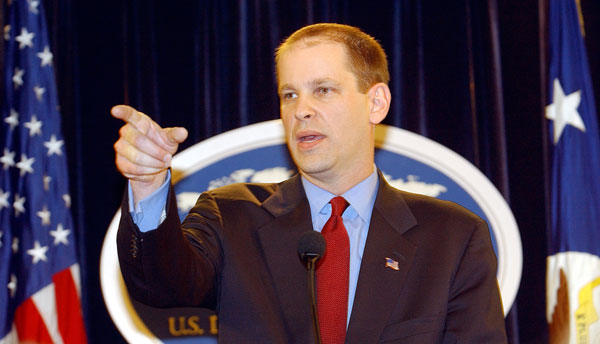 | Department Spokesman Sean McCormack (shown during the Daily Press Briefing) was sworn in as Assistant Secretary for Public Affairs and Department Spokesman on June 2, 2005. |
Technorati Tags: State Department and Secretary of State or International Nuclear Fuel Bank and Chairman Lantos, or Bob Joseph Under Secretary for International Security and International Atomic Energy Agency or Condoleezza Rice,

![Lebanese Internal Security Forces (ISF) cadets show off INL-provided civil disorder management equipment. [Photo courtesy U.S. Embassy Beirut, Lebanon]](https://blogger.googleusercontent.com/img/b/R29vZ2xl/AVvXsEiAUMx_aZ1ryh5r3IBzR3rAOHZl4sJicnUCswG5K1N9lBGyxgR7DMFarTCuZ3O6b5hctcGsBqZzjL-OaCy8zXvtyYlJObpcrqaYi1krJtDCNX-udY5QAgiETDjajisrpdupdjU1/s1600-h/state_suv.jpg)


