President Bush Discusses Comprehensive Immigration Reform in Yuma, Arizona U.S. Border Patrol - Yuma Station Headquarters, Yuma, Arizona. FULL STREAMING VIDEO, Fact Sheet: Acting This Year to Pass Comprehensive Immigration Reform, and In Focus: Immigration Reform, 10:21 A.M. MST
THE PRESIDENT: Thank you all. Thank you all very much, please be seated. Thanks for the warm welcome. Thanks for the warm weather. (Laughter.)
AUDIENCE MEMBER: Twenty-eight degrees in Washington.
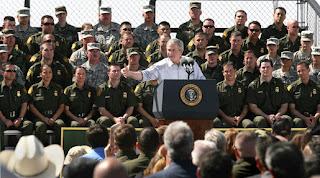 | THE PRESIDENT: Yes, 28 degrees in Washington, that's right. I appreciate you sharing that with me. (Laughter.) Sometimes it's a little hotter than that in Washington. But I'm glad to be back here in Yuma. |
Thank you so very much for your hospitality. Thanks for your service to the country. I appreciate so very much the work you're doing day and night to protect these borders. And the American people owe you a great debt of gratitude.
 | The Border Patrol is really an important agency. I know some people are wondering whether or not it makes sense to join the Border Patrol. My answer is, I've gotten to know the Border Patrol, I know the people serving in this fine agency -- |
I would strongly urge our fellow citizens to take a look at this profession. You're outdoors, you're working with good people, and you're making a solid contribution to the United States of America. And I want to thank you all for wearing the uniform and doing the tough work necessary, the work that the American people expect you to do.
Last May, I visited this section of the border, and it was then that I talked about the need for our government to give you the manpower and resources you need to do your job. We were understaffed here. We weren't using enough technology to enable those who work here to be able to do the job the American people expect. I Returned to check on the progress, to make sure that the check wasn't in the mail -- it, in fact, had been delivered.
I went to a neighborhood that abuts up against the border when I was here in May. It's the place where a lot of people came charging across. One or two agents would be trying to do their job and stopping a flood of folks charging into Arizona, and they couldn't do the job -- just physically impossible. Back at this site, there's now infrastructure, there's fencing. And the amount of people trying to cross the border at that spot is down significantly.
I appreciate very much Ron Colburn and Ulay Littleton. They gave me the tour. Colburn, as you know, is heading up north. He's going to miss the weather. More importantly, he's going to miss the folks he worked with down here. I appreciate both of their service, I appreciate the tour. The efforts are working -- this border is more secure, and America is safer as a result.
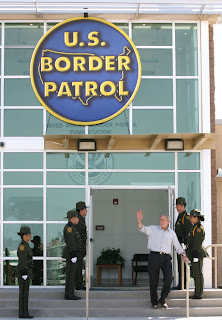 | Securing the border is a critical part of a strategy for comprehensive immigration reform. It is an important part of a reform that is necessary so that the Border Patrol agents down here can do their job more effectively. Congress is going to take up the legislation on immigration. It is a matter of national interest and it's a matter of deep conviction for me. I've been working to bring Republicans and Democrats together to resolve outstanding issues so that Congress can pass a comprehensive bill and I can sign it into law this year. (Applause.) |
I appreciate the hard work of Secretary Michael Chertoff, the Secretary of the Department of Homeland Security. I appreciate Commissioner Ralph Basham, he's the main man in charge of U.S. Customs and Border Protection. David Aguilar, Chief of the Border Patrol is with us. David, thank you for the job you're doing. Lieutenant General Steven Blum, Chief of the National Guard Bureau. I want to thank the governor of the state of Arizona, Janet Napolitano. I appreciate you being here, Governor, thank you for taking time from the session to be down here. It means a lot when the governors take an active interest in what's going on in the borders of their respective states.
I appreciate so very much Senator John Kyl. Kyl is one of the most respected United States senators and I'm proud to be with him today -- and glad to give him a ride back to Washington, I might add. (Laughter.)
I appreciate members of the congressional delegation who have joined us: John Shadegg; Jeff Flake -- from Snowflake, Arizona, I want you to know -- and I appreciate you working on this immigration issue; Congressman Trent Franks, and Congressman Harry Mitchell. I appreciate you all taking time for being with me here today, it means a lot that you'd come.
I want to thank Senator Tim Bee, he's the president of the Arizona State Senate, for being here. Mr. Mayor, thank you for coming. Larry Nelson, the Mayor of Yuma, Arizona. I appreciate you being here, Mr. Mayor.
I do want to thank Major General David Ratacheck, the Adjutant General of the state of Arizona; thank all the local and state officials; and, most importantly, I want to thank the Border Patrol agents and I want to thank the National Guard folks for wearing the uniform. I am proud to be the Commander-in-Chief of all these units here today and I appreciate your service to the United States of America. (Applause.)
I hope by now the American people understand the need for comprehensive immigration reform is a clear need. Illegal immigration is a serious problem -- you know it better than anybody. It puts pressure on the public schools and the hospitals, not only here in our border states, but states around the country. It drains the state and local budgets. I was talking to the governor about how it strained the budgets. Incarceration of criminals who are here illegally strains the Arizona budget. But there's a lot of other ways it strains the local and state budgets. It brings crime to our communities.
It's a problem and we need to address it aggressively. This problem has been growing for decades, and past efforts to address it have failed. These failures helped create a perception that America was not serious about enforcing our immigration laws and that they could be broken without consequence. Past efforts at reform did not do enough to secure our nation's borders. As a result, many people have been able to sneak into this country.
If you don't man your borders and don't protect your borders, people are going to sneak in, and that's what's been happening for a long time. Past efforts at reform failed to address the underlying economic reasons behind illegal immigration. People will make great sacrifices to get into this country the find jobs and provide for their families.
When I was the governor of Texas I used to say family values did not stop at the Rio Grande River. People are coming here to put food on the table, and they're doing jobs Americans are not doing. And the farmers in this part of the world understand exactly what I'm saying. But so do a lot of other folks around the country. People are coming to work, and many of them have no lawful way to come to America, and so they're sneaking in.
Past efforts at reform also failed to provide sensible ways for employers to verify the legal status of the workers they hire. It's against the law to knowingly hire an illegal alien. And as a result, because they couldn't verify the legal status, it was difficult for employers to comply. It was difficult for the government to enforce the law at the work site. And, yet, it is a necessary part of a comprehensive plan. You see, the lessons of all these experiences -- the lesson of these experiences is clear: All elements of the issue must be addressed together. You can't address just one aspect and not be able to say to the American people that we're securing our borders.
We need a comprehensive bill, and that's what I'm working with members of Congress on, a comprehensive immigration bill. And now is the year to get it done. The first element, of course, is to secure this border. That's what I'm down here for, to remind the American people that we're spending their taxpayer -- their money, taxpayers' money, on securing the border. And we're making progress. This border should be open to trade and lawful immigration, and shut down to criminals and drug dealers and terrorists and coyotes and smugglers, people who prey on innocent life.
We more than doubled the funding for border security since I've been the President. In other words, it's one thing to hear people come down here and talk; it's another thing for people to come down and do what they say they're going to do. And I want to thank Congress for working on this issue. The funding is increasing manpower. The additional funding is increasing infrastructure, and it's increasing technology.
When I landed here at the airport, the first thing I saw was an unmanned aerial vehicle. It's a sophisticated piece of equipment. You can fly it from inside a truck, and you can look at people moving at night. It's the most sophisticated technology we have, and it's down here on the border to help the Border Patrol agents do their job. We've expanded the number of Border Patrol agents from about 9,000 to 13,000, and by the end of 2008, we're going to have a total of more than 18,000 agents.
I had the privilege of going to Artesia, New Mexico, to the training center. It was a fantastic experience to see the young cadets getting ready to come and wear the green of the Border Patrol. By the time we're through, we will have doubled the size of the Border Patrol. In other words, you can't do the job the American people expect unless you got enough manpower, and we're increasing the manpower down here.
This new technology is really important to basically leverage the manpower. Whether it be the technology of surveillance and communication, we're going to make sure the agents have got what is necessary to be able to establish a common picture and get information out to the field as quickly as possible so that those 18,000 agents, when they're finally on station, can do the job the American people expect.
But manpower can't do it alone. In other words, there has to be some infrastructure along the border to be able to let these agents do their job. And so I appreciate the fact that we've got double fencing, all-weather roads, new lighting, mobile cameras. The American people have no earthly idea what's going on down here. One of the reasons I've come is to let you know, let the taxpayers know, the good folks down here are making progress.
We've worked with our nation's governors to deploy 6,000 National Guard members to provide the Border Patrol with immediate reinforcements. In other words, it takes time to train the Border Patrol, and until they're fully trained, we've asked the Guard to come down. It's called Operation Jump Start, and the Guard down here is serving nobly.
I had the chance to visit with some of the Guard, and Mr. Mayor, you'll be pleased to hear they like being down here in Yuma, Arizona. They like the people, and they like the mission. More than 600 members of the Guard are serving here in the Yuma Sector. And I thank the Guard, and, equally importantly, I thank their families for standing by the men and women who wear the uniform during this particular mission. You email them back home and tell them how much I appreciate the fact they're standing by you.
I appreciate very much the fact that illegal border crossings in this area are down. In the months before Operation Jump Start, an average of more than 400 people a day were apprehended trying to cross here. The number has dropped to fewer than 140 a day. In other words, one way that the Border Patrol can tell whether or not we're making progress is the number of apprehensions. When you're apprehending fewer people, it means fewer are trying to come across. And fewer are trying to come across because we're deterring people from attempting illegal border crossings in the first place.
I appreciate what Colburn said -- he puts it this way, they're watching -- "They see us watching them," that's what he said, "and they have decided they just can't get across." And that's part of the effort we're doing. We're saying we're going to make it harder for you, so don't try in the first place.
We're seeing similar results all across the southern border. The number of people apprehended for illegally crossing our southern border is down by nearly 30 percent this year. We're making progress. And thanks for your hard work. It's hard work, but necessary work.
Another important deterrent to illegal immigration is to end what was called catch and release. I know how this discouraged some of our Border Patrol agents. I talked to them personally. They worked hard to find somebody sneaking in the country, they apprehended them; the next thing they know, they're back in society on our side of the border. There's nothing more discouraging than have somebody risk their life or work hard and have the fruits of their labor undermined. And that's what was happening with catch and release. In other words, we'd catch people, and we'd say, show up for your court date, and they wouldn't show up for their court date. That shouldn't surprise anybody. But that's what was happening. And the reason why that was happening is because we didn't have enough beds to detain people
Now, most of the people we apprehend down here are from Mexico. About 85 percent of the illegal immigrants caught crossing into -- crossing this border are Mexicans -- crossing the southern border are Mexicans. And they're sent home within 24 hours. It's the illegal immigrants from other countries that are not that easy to send home.
For many years, the government didn't have enough space, and so Michael and I worked with Congress to increase the number of beds available. So that excuse was eliminated. The practice has been effectively ended. Catch and release for every non-Mexican has been effectively ended. And I want to thank the Border Patrol and the leaders of the Border Patrol for allowing me to stand up and say that's the case.
The reason why is not only do we have beds, we've expedited the legal process to cut the average deportation time. Now, these are non-Mexican illegal aliens that we've caught trying to sneak into our country. We're making it clear to foreign governments that they must accept back their citizens who violate our immigration laws. I said we're going to effectively end catch and release, and we have. And I appreciate your hard work in doing that.
The second element of a comprehensive immigration reform is a temporary worker program. You cannot fully secure the border until we take pressure off the border. And that requires a temporary worker program. It seems to make sense to me that if you've got people coming here to do jobs Americans aren't doing, we need to figure out a way that they can do so in a legal basis for a temporary period of time. And that way our Border Patrol can chase the criminals and the drug runners, potential terrorists, and not have to try to chase people who are coming here to do work Americans are not doing.
If you want to take the pressure off your border, have a temporary worker program. It will help not only reduce the number of people coming across the border, but it will do something about the inhumane treatment that these people are subjected to. There's a whole smuggling operation. You know this better than I do. There's a bunch of smugglers that use the individual as a piece of -- as a commodity. And they make money off these poor people. And they stuff them in the back of 18-wheelers. And they find hovels for them to hide in. And there's a whole industry that has sprung up. And it seems like to me that since this country respects human rights and the human condition, that it be a great contribution to eliminate this thuggery, to free these people from this kind of extortion that they go through. And one way to do so is to say you can come and work in our country for jobs Americans aren't doing for a temporary period of time.
The third element of a comprehensive reform is to hold employers accountable for the workers they hire. In other words, if you want to make sure that we've got a system in which people are not violating the law, then you've got to make sure we hold people to account, like employers. Enforcing immigration is a vital part of any successful reform. And so Chertoff and his department are cracking down on employers who knowingly violate the law.
But not only are there coyotes smuggling people in, there are document forgers that are making a living off these people. So, in other words, people may want to comply with the law, but it's very difficult at times to verify the legal status of their employees. And so to make the work site enforcement practical on a larger scale, we have got to issue a tamper-proof identification card for legal foreign workers.
We must create a better system for employers to verify the he legality of the workers. In other words, we got work to do. And part of a comprehensive bill is to make sure work site enforcement is effective.
Fourth, we've got to resolve the status of millions of illegal immigrants already here in the country. People who entered our country illegally should not be given amnesty. Amnesty is the forgiveness of an offense without penalty. I oppose amnesty, and I think most people in the United States Congress oppose amnesty. People say, why not have amnesty? Well, the reason why is because 10 years from now you don't want to have a President having to address the next 11 million people who might be here illegally. That's why you don't want amnesty. And, secondly, we're a nation of law, and we expect people to uphold the law.
So we're working closely with Republicans and Democrats to find a practical answer that lies between granting automatic citizenship to every illegal immigrant and deporting every illegal immigrant.
It is impractical to take the position that, oh, we'll just find the 11 million or 12 million people and send them home. It's just an impractical position; it's not going to work. It may sound good. It may make nice sound bite news. It won't happen.
And, therefore, we need to work together to come up with a practical solution to this problem, and I know people in Congress are working hard on this issue. Illegal immigrants who have roots in our country and want to stay should have to pay a meaningful penalty for breaking the law, and pay their taxes, and learn the English language, and show work -- show that they've worked in a job for a number of years. People who meet a reasonable number of conditions and pay a penalty of time and money should be able to apply for citizenship. But approval would not be automatic, and they would have to wait in line behind those who played by the rules and followed the law.
What I've described is a way for those who've broken the law to pay their debt to society and demonstrate the character that makes a good citizen.
Finally, we have got to honor the tradition of the melting pot, and help people assimilate into our society by learning our history, our values and our language. Last June I created a new task force to look for ways to help newcomers assimilate and succeed in our country. Many organizations, from churches to businesses to civic associations, are working to answer this call, and I'm grateful for their service.
And so here are the outlines for a comprehensive immigration reform bill. It's an emotional issue, as I'm sure you can imagine. People have got deep convictions. And my hope is that we can have a serious and civil and conclusive debate. And so we'll continue to work with members of both political parties. I think the atmosphere up there is good right now. I think people generally want to come together and put a good bill together -- one, by the way, that will make your job a lot easier.
It's important that we address this issue in good faith. And it's important for people to listen to everybody's positions. It's important for people not to give up, no matter how hard it looks from a legislative perspective. It's important that we get a bill done. We deserve a system that secures our borders, and honors our proud history as a nation of immigrants.
And so I can't think of a better place to come and to talk about the good work that's being done and the important work that needs to be done in Washington, D.C., and that's right here in Yuma, Arizona, a place full of decent, hardworking, honorable people. May God bless you all. (Applause.)
END 10:45 A.M. MST.
For Immediate Release, Office of the Press Secretary, April 9, 2007
Technorati Tags:
President Bush and
White House radio or
Comprehensive Immigration Reform


