


Tuesday, January 18, 2005

Dr. Condoleezza RiceSecretary of State Nomination Part I
HEARING before the COMMITTEE ON FOREIGN RELATIONS UNITED STATES SENATE ONE HUNDRED NINTH CONGRESS FIRST SESSION
Time: 9:00 AM - 12:00 PM - Break - 2:00 PM - 5:00 PM
Place: 216 Hart Senate Office Building Presiding: Senator Lugar
Nominee:
Dr. Condoleezza Rice To be Secretary of State
The Hearing will Commence on Tuesday, January 18, 2005 and will Continue, If Necessary, on the Following Day Wednesday, January 19, 2005. Immediately Following the Conclusion of Hearing, the Chairman Will Convene a Business Meeting to Vote on the Nomination.
Secretary of State Nomination Part II
Wednesday, January 19, 2005
Time: 9:00 AM - 12:00 PM - Break - 2:00 PM - 5:00 PM Place: 216 Hart Senate Office Building Presiding: Senator Lugar
Nominee:
Dr. Condoleezza Rice To be Secretary of State
Immediately Following the Conclusion of Hearing, the Chairman Will Convene a Business Meeting to Vote on the Nomination.
Witness names in blue are links to the statement given. Statements are only posted if provided electronically by witness.
Monday, January 17, 2005
Secretary of State Nomination
0
comments
||
||

Elections Iraqis Train Iraqis
Iraqis Train Iraqis In Preparation for Elections
Fact of the Day
Iraq's Coalition of Non-partisan Elections Monitors has trained representatives of non-governmental organizations to monitor the elections. In its most recent training session, members of the non-partisan coalition and 41 representatives from 24 different NGOs attended. In addition, 27 Iraqi elections trainers from South Central Iraq, 33 from Southern Iraq and 22 from Baghdad participated in other NGO-sponsored workshops. In another training initiative, 30 Iraqi journalists attended media and elections training in the Al Basrah governorate. These are just a few examples of Iraqis working to ensure that their elections are free and democratic.
Source: The U.S. Department of State
For Immediate Release January 17, 2005
0
comments
||
||
Sunday, January 16, 2005
Al Ghafari School, AL Rashid District, Baghdad, Iraq
School Supply Distribution Ends With a Bang

iraqi children 1 AL Rashid District, Baghdad, Iraq – An Army truck pulls up to a dilapidated school where children stand in line, waiting. Troops move with a purpose, getting boxes unloaded and opened. What could be inside that’s so important? Ammunition? Medical supplies? More like pencils, notebooks and backpacks. A different kind of ammunition that proved to be just as important during a distribution at the Al Ghafari School January 12th in the Arab Jabor neighborhood of the 1st Battalion, 8th Cavalry Regiment area of operations. 
iraqi children 2 
iraqi children 3 The mission started off like most any school supply distribution. A civil affairs team attached to 1-8 Cav., 5th Brigade Combat Team, convoyed to the south-east region of Baghdad along the Tigris River. The team brought enough backpacks and supplies for 1000 children. “It was set up like a recruit’s trip to the initial issue where you get a duffle bag and put everything in,” said Capt. John Morris, a civil affairs team chief in Co. A, 403rd CA Battalion attached to 1-8 Cav. “We would give every kid a backpack and start stuffing in pencils and notebooks, crayons and glue and everything we had.” 
iraqi children 4 
iraqi children 5 Due to finals testing, the children had been released early that day. Still, there were plenty of children around the area to happily except these supplies donated by family readiness groups in the United States, and backpacks purchased locally.
“There were kids on site and school wasn’t going to open up for three more weeks because of a break, so we decided to pass out bags anyway and try to have a positive effect,” said Capt. Elizabeth Willett, the 5BCT education officer.
“It ended up having a great effect. Ten minutes [after arriving] a kid told us there was an improvised explosive device (IED) nearby,” she said. Soldiers seemed skeptical at first, but security called for further investigation.
“I talked to the boy’s father and he said, ‘I’m not really sure, you know how kids are, they tell stories.’ I figured it may just be a story, but let’s go look,” said Morris, an Indianapolis native. “We saw fresh dirt where he pointed. I very gently moved the dirt of the way. You could clearly see the artillery shell.”
Soon after, everyone was moved beyond a cordon around the shell where Soldiers continued giving out school supplies. An explosive ordinance disposal team showed up. With the help of a remote-controlled robot, they safely detonated the bomb. The only visible damage done was to a transformer on a power line above the blast, according to Morris.
IEDs are common in Arab Jabor. This poor, rural area gives way to an unhealthy population of anti-Iraqi forces, but the particular placement of this wire-rigged, 125-millimeter artillery shell was enough to raise some eyebrows.
“We believe terrorists placed that IED there because it’s been selected as a polling site for the upcoming elections,” Morris said. “The anti-Iraqi forces knew that it had that potential.”
“The IED wouldn’t have done much harm to the school,” explained Willett, a Cheyenne, Wyo. native. “We believe it was for political motivation. There would have been voters lined up to vote right next to it, and it would have hurt or killed quite a few of them.”
Finding this roadside bomb with the help of a local child showed the civil affairs Soldiers an up-close look at the bounties of their objectives.
“It’s hard for the people in this area to show their appreciation to us,” said Morris. “It’s easy for the AIF to bully the people here. But with what we saw at the school tells us that all the school renovations and other projects are helping to show them we really are here to help.”
While hunting for IEDs wasn’t the original intent of the school distribution, it was certainly a welcome bonus for the 1-8 Cav. civil affairs team to what they love doing every day.
“I like the fact that I get to go out everyday and talk to Iraqis and help improve their way of life,” Morris concluded. “The civil affairs mission is great and rewarding. It provides a lot of purpose and just a good feeling knowing your improving lives.”
Release #050116d
0
comments
||
||
FREEDOM Support Act Azerbaijan
Memorandum for the Secretary of State Presidential Determination No. 2005-18
SUBJECT: Extension of Waiver of Section 907 of the FREEDOM Support Act with respect to Assistance to the Government of Azerbaijan
Pursuant to the authority contained in title II of the Kenneth M. Ludden Foreign Operations, Export Financing, and Related Programs Appropriations Act, 2002 (Public Law 107-115), I hereby determine and certify that extending the waiver of section 907 of the FREEDOM Support Act of 1992 (Public Law 102-511):
- is necessary to support United States efforts to counter international terrorism;
- is necessary to support the operational readiness of United States Armed Forces or coalition partners to counter international terrorism;
- is important to Azerbaijan's border security; and
will not undermine or hamper ongoing efforts to negotiate a peaceful settlement between Armenia and Azerbaijan or be used for offensive purposes against Armenia.
You are authorized and directed to notify the Congress of this determination and to arrange for its publication in the Federal Register.
GEORGE W. BUSH # # #
For Immediate Release Office of the Press Secretary January 13, 2005
RELATED:
0
comments
||
||
Kent R. Hill, William T. Ryan, David A. Balton, Joseph R. DeTrani
President George W. Bush today announced his intention to designate one individual, appoint one individual and nominate two individuals to serve in his administration:
The President intends to designate Kent R. Hill, of Massachusetts, to be Acting Assistant Administrator (Global Health) at the United States Agency for International Development.
The President intends to appoint William T. Ryan, of Montana, to be a Member of the Board of Directors of the Rural Telephone Bank as a Department of Agriculture representative.
The President intends to nominate David A. Balton, of the District of Colombia, for Rank of Ambassador during his tenure of service as Deputy Assistant Secretary of State for Oceans and Fisheries.
The President intends to nominate Joseph R. DeTrani, of Virginia, for Rank of Ambassador during his tenure of service as Special Envoy for the Six Party Talks.
# # #
For Immediate Release Office of the Press Secretary January 14, 2005
Personnel Announcement January 14, 2005
0
comments
||
||
Saturday, January 15, 2005
Jim Towey Director Faith-Based Community Initiatives.
President George W. Bush today announced that he has named Jim Towey to be Assistant to the President and Director of the Office of Faith-Based and Community Initiatives. Since 2002, he has served as Deputy Assistant to the President and Director of the Office of Faith-Based and Community Initiatives.
"Jim Towey is helping to empower the armies of compassion in America to solve some of our Nation's most pressing problems. He is a tireless servant for those in need, and I look forward to his continued counsel in a second term," stated President Bush.
Mr. Towey was a senior advisor to U.S. Senator Mark Hatfield and Florida Governor Lawton Chiles. In 1993, Governor Chiles appointed him Director of the Florida Department of Health and Rehabilitative Services. In 1985, Mr. Towey met Mother Teresa while visiting her home for the dying in Calcutta, India. He went on to serve as legal counsel to her for 12 years and in 1990 lived as a full-time volunteer in her home for people with AIDS in Washington, D.C. Mr. Towey received his bachelor's degree and J.D. from Florida State University. He and his wife Mary have five children. # # #
Personnel Announcement For Immediate Release Office of the Press Secretary January 13, 2005
0
comments
||
||
order of participants for the 55th Inaugural Parade
January 15, 2005
PIC Announces Participants Invited to Perform in 55th Inaugural Parade
WASHINGTON, D.C. – Today, the 55th Presidential Inaugural Committee (PIC) announced the order of participants for the 55th Inaugural Parade.
Division One
U. S. Army Staff
U. S. Army Field Band
U. S. Army Military Academy Company
U. S. Army Active Company
U. S. Army Color Guard
U. S. Army National Guard Company
U. S. Army Reserve Company
University of Texas Longhorn Band – Austin, TX
Celebrating Freedom, Honoring Service - Float
Stone High School Band – Wiggins, MS
American Rescue Dog Association – Woodford, NY
NYPD Emerald Society Pipes and Drums – Bronx, NY
NYC Emergency Vehicles
FDNY Emerald Society Pipes and Drums – Breezy, Point, NY
Senators Burns and Baucus -- Montana
Grant Wood All City Drum Corps – Cedar Rapids, IA
Mobile Azalea Trail – Mobile, AL
Arcadia High School Marching Band – Arcadia, CA
Tulsa County Sheriff's Office – Tulsa, OK
Arizona Angels – Scottsdale, AZ
Scarborough and Elliot PD Explorer Posts – Scarborough, ME and Elliot, ME
Northern State University Marching Wolves – Aberdeen, SD
Culver Black Horse Troop & Equestriennes – Culver, IN
Crawford High School Pirate Band – Crawford, TX
Division Two
U. S. Marine Corps Staff
U. S. Marine Band
U. S. Marine Corps Active Company
U. S. Marine Corps Color Guard
U. S. Marine Corps Reserve Guard
Wyoming High School All State Marching Band – Worland, WY
Wyoming Float
Texas A&M University - Fightin' Texas Aggie Band – College Station, TX
Ross Volunteer Company of Texas A&M University – College Station, TX
Broken Arrow High School Marching Band – Broken Arrow, OK
United States Army Caisson Platoon – Ft. Myer, VA
Easton Area High School "Red Rover" Marching Band – Easton, PA
Ring of Fire – Hillsboro, OR
21st Ohio Infantry-Civil War History Group – Suwanee, GA
Lakeville Senior High School Marching Band – Lakeville, MN
USSS Uniform Division Honor Guard – Washington, DC
USSS Uniformed Division Motorcycle Guard – Washington, DC
Spartans Drum & Bugle Corps – Nashua, NH
Connecticut's First Company Governor's Horse Guard – Avon, CT
Connecticut's Second Company Governor's Horse Guard – Newtown, CT
Lincoln-Way Central High School Marching Knights – New Lenox, IL
Division Three
U. S. Navy Staff
U. S. Navy Band
U. S. Naval Academy Company
U. S. Navy Active Company
U. S. Navy Color Guard
U. S. Navy Reserve Company
Camden Fairview High School Marching Band – Camden, AR
Marion County Sheriff's Precision Drill Squad – Indianapolis, IN
The Ohio State University Marching Band – Columbus, OH
Ft. Riley Commanding General's Mounted Color Guard – Ft. Riley, KS
West Monroe High School Marching Band – West Monroe, LA
The Summerall Guards - The Citadel – Charleston, SC
Lowndes High School "Georgia Bridgemen" Band – Valdosta, GA
Warren County Prevention Partnership – Bowling Green, KY
Gaither High School Marching Cowboys – Tampa, FL
Military Order of the Purple Heart – Riverdale, MD
accompanied by Century Link America with Old Glory
Marshall County High School Marching Marshalls – Benton, KY
Kilgore College Rangerettes – Kilgore, TX
Halau Ho'omau l I Ka Wai Ola O Hawai’i – Alexandria, VA
West Johnston High School Band – Benson, NC
Rhode Island National Guard – Cranston, RI
American Fork High School Marching Band – American Fork, UT
Division Four
U. S. Air Force Staff
U. S. Air Force Band
U. S. Air Force e Academy Company
U. S. Air Force Active Company
U. S. Air Force Color Guard
U. S. Air Force National Guard
U. S. Air Force Reserve Company
Menasha High School Bluejay Brigade Marching Band – Menasha, WI
Mid American Pompon – Farmington, Hills, MI
Stars 'N' Steeds Mounted Drill Team – Willard, MO
University of Tennessee – Knoxville, TN
Merced County Sheriffs Posse – Merced, CA
North Dakota Float– Legendary – Medora, ND
American Originals Fife & Drum Corps – Annapolis, MD
Lincoln Highway National Museum & Archives – Galion, OH
Norwich University – Northfield, VT
Easley NJROTC – Easley, SC
Jackson Memorial High School Band – Jackson, NJ
St. John's College High School – Washington, DC
McQueen High School Band – Reno, NV
Freedom Riders – Kersey, CO
Auburn University Marching Band – Auburn University, AL
Division Five
U. S. Coast Guard Staff
U. S. Coast Guard Band
U. S. Coast Guard Academy Company
U. S. Coast Guard Active Company
U. S. Coast Guard Color Guard
U. S. Coast Guard Reserve Company
U. S. Merchant Marine Academy Staff
U. S. Merchant Marine Academy Band
U. S. Merchant Marine Academy Color Guard
U. S. Merchant Marine Academy Company
University of Nebraska at Omaha Marching Mavericks – Omaha, NE
U.S. Border Control, El Paso Sector – El Paso, TX
Washington Crossing Foundation – Newtown Square, PA
Lincoln Minute Men – Lincoln, MA
Americanas – Rexburg, ID
Ballou High School Band – Washington, DC
Red Hot Mamas, Ltd – Hayden, ID
Liberty High School – Clarksburg, WV
New Castle County Police Mounted Unit – New Castle, DE
Zuni Pueblo Band – Zuni, NM
Virginia Military Institute – Lexington, VA
First Cavalry Division Horse Cavalry Detachment – Fort Hood, TX
Virginia Tech Regimental Band – Blacksburg, VA
Route Bands
Geoff Bach Juggling Entertainment – Erie, PA
Star 'd Clown – Amarillo, TX
The Firecrackers – Maineville, OH
33rd Volunteer Regiment Band – Bloomington, IL
Douglas High School Band – Minden, NV
Gautier High School Marching Band – Gautier, MS
Spaulding High School Marching Band – Rochester, NH
0
comments
||
||
Cuban Liberty and Democratic Solidarity (LIBERTAD)
Text of a Letter from the President to the Chairmen and Ranking Members of the House Committees on International Relations and Appropriations and the Senate Committees on Foreign Relations and Appropriations
Dear Mr. Chairman:(Dear Representative:) (Dear Senator:)
Consistent with section 306(c)(2) of the Cuban Liberty and Democratic Solidarity (LIBERTAD) Act of 1996 (Public Law 104-114)(the "Act"), I hereby determine and report to the Congress that suspension for 6 months beyond February 1, 2005, of the right to bring an action under title III of the Act is necessary to the national interests of the United States and will expedite a transition to democracy in Cuba.
Sincerely,
GEORGE W. BUSH # # #
For Immediate Release Office of the Press Secretary January 14, 2005
0
comments
||
||
bush radio address 01/15/05 full audio, text transcript
President's Radio Address
RADIO ADDRESS BY THE PRESIDENT TO THE NATION
THE PRESIDENT: Good morning. This week, I met with some of our fellow citizens from across the country to discuss one of the great responsibilities of our nation: strengthening Social Security for our children and grandchildren.
For 70 years, the Social Security system has fulfilled the promise made by President Franklin Roosevelt, keeping our elderly citizens out of poverty, while assuring younger Americans a more secure future. Along with employer-funded pensions and personal savings, Social Security is for millions of Americans a critical element to their plans for a stable retirement. And for today's senior citizens and those nearing retirement, the system is sound. But for younger workers, Social Security is on the road to bankruptcy. And if we do not fix it now, the system will not be able to pay the benefits promised to our children and grandchildren.
When President Roosevelt signed the Social Security Act in 1935, the average life expectancy was about 60 years, which meant that most Americans would not live to become eligible for benefits, then set at age 65.
Today, most Americans enjoy longer lives and longer retirements. And that presents a looming challenge. Because Social Security was created as a pay-as-you-go system, current retirees are supported by the taxes paid by current workers. Unfortunately, the ratio of workers to retirees is falling steadily. In the 1950s, there were about 16 workers paying in for each person drawing out. Today, it's about three workers for every beneficiary. And by the time today's workers in their mid 20s begin to retire, there will be just over two.
What this means is that in the year 2018, the system will go into the red -- paying out more in benefits each year than it receives in payroll taxes. After that, the shortfalls will grow larger until 2042, when the whole system will be bankrupt. The total projected shortfall is $10.4 trillion. To put that number in perspective, $10.4 trillion is nearly twice the combined wages of every single working American in 2004.
Every year we put off the coming crisis, the higher the price our children and grandchildren will have to pay. According to the Social Security trustees, waiting just one year adds $600 billion to the cost of fixing Social Security. If we do not act now, government will eventually be left with two choices: dramatically reduce benefits, or impose a massive economically ruinous tax increase. Leaving our children with such a mess would be a generational betrayal.
We owe it to the American worker to fix Social Security now. And our reforms begin with three essential commitments. First, if you're receiving your Social Security check, or nearing retirement, nothing will change for you. Your benefits are secure. Second, we must not increase payroll taxes on American workers because raising taxes will slow economic growth. Third, we must give younger workers -- on a voluntary basis -- the option to save some of their payroll taxes in a personal retirement account.
Unlike Social Security benefits, which can be taken away by politicians, the money in a personal account would be yours. And unlike the money you put into Social Security today, the money in personal accounts would grow. A child born today can expect less than a 2 percent return after inflation on the money they pay into Social Security. A conservative mix of bonds and stocks would over time produce a larger return. Personal accounts would give every younger worker, regardless of income, the chance to save a nest egg for their later years and pass something on to their children.
Saving Social Security is an economic challenge. But it is also a profound moral obligation. Today's young Americans deserve the same security their parents and grandparents enjoyed. Because the system is broken and promises are being made that Social Security cannot keep, we need to act now to strengthen and preserve Social Security.
I look forward to working with members of Congress from both parties to keep the promise of Social Security.
Thank you for listening.
For Immediate Release January 15, 2005 President's Radio Address
0
comments
||
||
Friday, January 14, 2005
Cassini Huygens Saturn mission

Cassini Huygens 1 | The Cassini-Huygens mission to Saturn is the most ambitious effort in planetary space exploration ever mounted. A joint endeavour of the European Space Agency (ESA), NASA and the Italian space agency, Agenzia Spaziale Italiana (ASI), Cassini-Huygens is sending a sophisticated robotic spacecraft to orbit the ringed planet and study the Saturnian system in detail over a four-year period. |
Saturn is the second largest planet in the Solar System. Like the other gaseous outer planets – Jupiter, Uranus and Neptune – it has an atmosphere made up mostly of hydrogen and helium. Saturn’s distinctive, bright rings are made up of ice and rock particles ranging in size from grains of sand to a freight container.
| More moons of greater variety orbit Saturn than any other planet. So far, observations from Earth and space have found Saturnian satellites ranging from small asteroid-size bodies to the aptly named Titan, which is the second largest moon of the Solar System (after Jupiter's Ganymede) and is larger than the planet Mercury. | 
Cassini Huygens 2 |

Cassini Huygens 3 | Titan is a fascinating world because its thick nitrogen-atmosphere is very rich in organic compounds which are constantly reacting. If they were found on a planet with Earth-like conditions, their presence would be considered as a sign of life. |
The Cassini-Huygens mission is named after two European astronomers from the 17th century. The Dutch astronomer Christiaan Huygens (1629-1695) discovered Saturn's rings and Titan.
| A few years later the French-Italian Astronomer Jean-Dominique Cassini (1625-1712) discovered Saturn’s four other major moons – Iapetus, Rhea, Tethys and Dione. He also discovered that Saturn’s rings are split largely into two parts by a narrow gap, known since as the 'Cassini Division'. | 
Cassini Huygens 4 |
CASSINI PHOTO ESSAY
PHOTO SOURCE: NASA Cassini-Huygens Mission
TEXT SOURCE: ESA
0
comments
||
||
Deep Impact spacecraft comet Tempel
DEEP IMPACT STATUS REPORT FULL STREAMING VIDEO
Launch Services - Why launch anything into space?
Calling All Astronomers - Discover how you too can participate in the Deep Impact mission.
Comets -- the Cosmic Nomads - Throughout history, comets have inspired curiosity, fear, fascination and dread.
What is a Comet Made Of? - NASA's Deep Impact mission to begin a new era of comet exploration
Journey to a Comet Begins in Florida - The Deep Impact spacecraft gets a pre-launch check-up at the Kennedy Space Center.
NASA's Deep Impact spacecraft is out of safe mode and healthy, and on its way to an encounter with comet Tempel 1 on July 4, 2005.
Launched from Cape Canaveral Air Force Station on Wednesday, the Deep Impact spacecraft entered a state called safe mode soon after separation from the launch vehicle. When a spacecraft enters safe mode, all but essential spacecraft systems are turned off until it receives new commands from mission control. When Deep Impact separated from the launch vehicle, the spacecraft computer detected higher than expected temperatures in the propulsion system.
While in the safe mode, the spacecraft successfully executed all mission events associated with commencing space flight operations. Data received from the spacecraft indicate it has deployed and locked its solar panels, is receiving power and achieved proper orientation in space.
"We are out of safe mode and proceeding with in-flight operations," said Deep Impact project manager Rick Grammier of NASA's Jet Propulsion Laboratory. "We're back on nominal timeline and look forward to our encounter with comet Tempel 1 this summer."
Deep Impact is comprised of two parts, a "fly-by" spacecraft and a smaller "impactor." The impactor will be released into the comet's path for a planned collision on July 4. The crater produced by the impactor is expected to be up to the size of a football stadium and two to 14 stories deep. Ice and dust debris will be ejected from the crater, revealing the material beneath.
The fly-by spacecraft will observe the effects of the collision. NASA's Hubble, Spitzer and Chandra space telescopes, and other telescopes on Earth, will also observe the collision.
Comets are time capsules that hold clues about the formation and evolution of the Solar System. They are composed of ice, gas and dust, primitive debris from the Solar System's distant and coldest regions that formed 4.5 billion years ago.
The management of the Deep Impact launch was the responsibility of NASA's Kennedy Space Center, Fla. Deep Impact was launched from Pad 17-B at Cape Canaveral Air Force Station, Fla. Delta II launch service was provided by Boeing Expendable Launch Systems, Huntington Beach, Calif. The spacecraft was built for NASA by Ball Aerospace and Technologies Corporation, Boulder, Colo. Deep Impact project management is by JPL.
For more information about the mission on the Web, visit nasa.gov/deepimpact or deepimpact.jpl.nasa.gov.
For information about NASA and other agency programs on the Web, visit nasa.gov.
- end -
DC Agle (818) 393-9011 Jet Propulsion Laboratory, Pasadena, Calif.
Gretchen Cook-Anderson (202) 358-0836 Dolores Beasley (202) 358-1753 NASA Headquarters, Washington 01.13.05 RELEASE: 2005-016
0
comments
||
||
2005 Freedom Calendar
January 14, 1975
Republican William T. Coleman nominated as first African-American to be U.S. Secretary of Transportation.
January 15, 1901
Republican Booker T. Washington protests Alabama Democratic Party’s refusal to permit voting by African-Americans.
January 16, 1954
Consuelo Bailey (R-VT) announces her ultimately successful candidacy to become nation’s first woman elected Lt. Governor of a state.
January 17, 1874
Armed Democrats seize Texas state government, ending Republican efforts to racially integrate government
January 18, 1815
Birth of Republican Gov. Richard Yates (R-IL), who prevented Democrat-controlled legislature from withdrawing state troops from the Union Army.
January 19, 1818
Birth of anti-slavery activist Alvan Bovay, who organized first meeting of Republican Party in 1854, to oppose Democrats’ pro-slavery policies,
January 20, 2001
Mississippi Republican Rod Paige is confirmed as first African-American U.S. Secretary of Education; calls for school choice to allow poor and minority children to “throw off their chains”.
SOURCE: 2005 Republican Freedom Calendar
0
comments
||
||
Thursday, January 13, 2005
Defense Logistics Agency (DLA tsunami relief
DLA at forefront of tsunami relief
Hundreds of thousands of pounds of supplies winging in on hundreds of U.S. military sorties are finding their way to those hardest hit by last month’s catastrophic tsunamis in South Asia. The death toll exceeds 150,000 people with another 1.5 million displaced by the disaster.
In size and scope, Air Force Brig. Gen. Jan-Marc Jouas, director of Combined Support Force 536’s air component coordination element at Utapao, Thailand, said this is "the largest humanitarian relief effort since the Berlin Airlift of 1947." He told reporters during a Pentagon teleconference Jan. 9 that the challenges include the great distances that have to be covered and the complexities of working from assorted locations in Thailand, Indonesia and Sri Lanka.
At the foundation of the operation are myriad essentials ranging from first-aid equipment and goods to pre-prepared rations, all arranged through Defense Logistics Agency activities and contractors around the world.
In its normal activities, DLA provides supply support, and technical and logistics services to the U.S. military services and several federal civilian agencies. Headquartered at Fort Belvoir, the agency is the one source for nearly every consumable item, whether for combat readiness, emergency preparedness or day-to-day operations. The unprecedented tsunami-relief operation shows, according to officials, how DLA can jump into a huge humanitarian-relief operation while still supporting far-flung troops in the ongoing global war on terrorism.
Calling from his newly set up post, Marine Brig. Gen. Christian B. Cowdrey, commander of Combined Support Group-Indonesia, described to Pentagon reporters Jan. 8 how all the military services are working together to deliver supplies to people most in need. Less than two weeks after the Dec. 26 disaster, C-130 aircraft had reached out on an air bridge created from Medan near Banda Aceh, Indonesia, to sites near devastated costal areas, from which helicopters fly the last legs to make direct deliveries to tsunami victims.
"All the services are playing a part," the senior military lead for all U.S. military efforts in Indonesia said. "We’re getting better at it every day."
Just during the 24 hours closing out Jan. 9 in Indonesia, Marines and sailors of the USS Abraham Lincoln Carrier Group and USS Bonhomme Richard Expeditionary Group flew 60 sorties to the towns of Kalang, Lamno, Kuede Tennom, Meulaboh, Lhdong, Kreung Raya and Panga Jaya, transported 98,600 pounds of water, food and relief supplies, and medically evacuated 30 Indonesians.
Through Jan. 9, Combined Support Group-Indonesia had flown 266 sorties to deliver 479,600 pounds of relief supplies, transported 200 relief workers, supported 264 reporters and evacuated 158 seriously injured Indonesians.
"We’ve got a lot of people, both in and out of uniform, doing great things for a devastated area," Cowdrey said, talking with reporters Jan. 8.
During his teleconference, which he shared with U.S. Agency for International Development officials, Cowdrey was asked how well Defense Logistics Agency supported what is now designated as Operation Unified Assistance. The general said, at that point, his focus was on delivering the goods rather than the warehousing aspect. However, he added, the end result speaks for DLA’s success.
"We’re taking planeloads of [humanitarian daily rations] to everybody, and we pay attention to those in need," Cowdrey said. "We defer to what they say and deliver what they need, and we’re getting better at it every week. The AID officials with me are nodding in the affirmative."
Less than 24 hours after the widespread tsunami struck South Asia, the U.S. military mobilized its forces for the huge recovery operation, drawing on the Defense Logistics Agency for support and supplies to aid the injured and homeless and even attending to the deceased.
U.S. Pacific Command took the lead in the relief operation, anticipating the need for drinking water, shelter, food and medical support. For these essentials, the Defense Logistics Agency was already on the job.
Fortunately, only weeks before the tsunamis struck, DLA had evaluated its Pacific Command Deployment and Distribution Operations Center concept with DLA-Pacific employee Allen Frenzel, DLA’s liaison officer for U.S. Pacific Command, playing a key role in the exercise. The center unexpectedly switched from concept to reality when the tsunamis roared ashore.
Suddenly, Frenzel was again called on to coordinate DLA support for disaster relief supplies.
Frenzel was far from alone. The operations center was initially staffed by people within DLA-Pacific, including Danny L. Baker, Jose B. Bermudez, Mary K. Horimoto and Janice M. Niizawa from Defense Distribution Center, Pearl Harbor, Hawaii; and Lt. Col. Cal Reid, DLA’s liaison officer to U.S. Forces Korea.
Together they teamed to draw from Defense Logistics Agency’s vast stockpiles of supplies stored around the world to support any emergency. The agency’s Far Eastern branch, DLA-Pacific, based at Camp Smith, Hawaii, is now the focal point for Indian Ocean operations. DLA-P routinely provides customer assistance, liaison, services, war planning interfaces and logistics support to U.S. Pacific Command.
While the United States has officially pledged $350 million to tsunami relief, that figure does not include millions of dollars per day pouring into the stricken region in the form of $65 million worth of articles and services now being drawn down, at presidential directive, from Defense Department inventories and resources.
This support includes not only massive ships and multitudes of aircraft, all powered by fuel arranged through DLA’s Defense Energy Support Center, but also large stocks of medical supplies already on scene and aboard the USNS Mercy, a Navy hospital ship en route from San Diego to the Indian Ocean.
Medical supplies are contracted through the Medical Directorate at DLA’s Defense Supply Center Philadelphia, which is the wholesale-level partner in the Defense Medical Logistics Standard Support program. Items supplied include thousands of bandages, surgical gear and equipment, first-aid kits, water purification equipment, blankets and disinfectants.
Besides medical supplies, Defense Supply Center Philadelphia calls on its Clothing and Textiles Directorate to provide clothing, textiles and equipment. Human remains pouches are also being delivered in the tens of thousands to the disaster area.
To keep survivors fed, the supply center’s Subsistence Directorate serves as the key link between the armed forces and the U.S. food industry. For Operation Unified Assistance that means providing humanitarian daily rations, also known as Meals Ready to Eat, for the thousands of hungry tsunami victims. In Singapore alone, almost 40,000 humanitarian daily rations had arrived by Jan. 7.
Putting all this together is the task of Defense Supply Center Philadelphia’s Pacific Region office at Pearl Harbor, Hawaii, working with DLA-Pacific to support U.S. Pacific Command.
Other DLA activities at the forefront include the Defense Energy Support Center, which has tapped existing fuel stocks and modified fuel-servicing contracts to surge airport fueling capacities at Colombo, Sri Lanka; Medan; and Utapao, Thailand. At Banda Aceh, DESC has worked with the local fuel company to put in place an 11,000-gallon refueler to increase capacity. The airport at Banda Aceh is operational, but supply is very limited. Truck deliveries to Banda Aceh are bringing in 23,000 liters of fuel per day, having to make continuous roundtrip cycles taking six days each due to poor road conditions.
Defense Reutilization and Marketing Service’s Operations Asia Pacific Forward Support Team, Pacific Command Customer Support and Defense Reutilization and Marketing Offices are providing global coverage to support requests for critical medical equipment and life-support items, and other requested property in DRMS stocks. DRMS people are also helping the Defense Department by researching DRMO inventories and processing requisitions for supporting activities in the shortest time possible.
Other Defense Logistics Agency activities at the forefront include Defense Supply Centers Columbus, Ohio, and Richmond, Va., which have provided critical consumables and repair parts. Water purification and reverse osmosis water purification units were foremost on their list of contributions.
The Defense Distribution Center at New Cumberland, Pa., was instrumental in overcoming time and distance challenges of an operation more than 10,000 miles and 12 time zones away, most of which is over water. Workers at Distribution Depots in San Joaquin, Calif.; Pearl Harbor; and Yokosuka, Japan, had many items palletized and ready for air shipment long before customers began to think of their requirements.
Even Celia Pinkston and others at DLA Operations Research and Resources Analysis in Richmond have played a large role as that office helps DLA Pacific capture requirement data to not only document and improve current operations, but also help the agency further improve support of similar operations in the future.
DLA provides supply support, and technical and logistics services to the U.S. military services and several federal civilian agencies. Headquartered at Fort Belvoir, Va., the agency is the one source for nearly every consumable item, whether for combat readiness, emergency preparedness or day-to-day operations.
January 13, 2005 05-05 Media Contact: Dawn Dearden 703-767-6310 dawn.dearden@dla.mil
SOURCE: The Defense Logistics Agency (DLA)
0
comments
||
||
Ramadi, Fallujah
"It was the best of times, it was the worst of times, it was the age of wisdom, it was the age of foolishness, it was the epoch of belief, it was the epoch of incredulity, it was the season of Light, it was the season of Darkness, it was the spring of hope, it was the winter of despair, we had everything before us, we had nothing before us, we were all going direct to Heaven, we were all going direct the other way - in short, the period was so far like the present period, that some of its noisiest authorities insisted on its being received, for good or for evil, in the superlative degree of comparison only."
U.S. Soldiers Near Ramadi Assist Injured civilians; Iraqi citizens in Fallujah Assist U.S. Marines
Camp Blue Diamond, Iraq – Soldiers from the 1st Battalion, 9th Infantry Regiment, 2nd Brigade Combat Team, 2nd Infantry Division currently assigned to the 1st Marine Division, I Marine Expeditionary Force, provided medical assistance to Iraqi civilians, who were involved in a two-vehicle accident on a main thoroughfare near Ramadi at approximately 6:45 a.m., Jan. 12.
U.S. Army medics from the unit responded to the scene and provided medical care to the injured people. One man was taken by military ambulance to a Multi-National Forces medical facility for treatment. He was later flown to Baghdad for follow-on treatment.
Meanwhile in Fallujah, Iraqi citizens reported two separate weapons caches in the southern part of the city to a U.S. Marine patrol at approximately 12:30 p.m.
A citizen stopped the Marine patrol and reported that he had discovered an RPK machinegun next to his house. As the Marines retrieved the weapon, another resident approached the Marines and reported a cache near his home.
The second individual led the Marines to a buried cache that consisted of (4) RPG rounds, (2) 57mm rockets, (1) RPK machine gun, (2) RPG launchers, (1) mortar tube, (2) gas masks and numerous magazines. All of the weapons and munitions were collected for future demolition.
The Marines, Soldiers and Sailors of the 1st Marine Division of the I Marine Expeditionary Force continue to enhance security in the Al Anbar Province in advance of the upcoming elections. Release #050112x
0
comments
||
||
Status of Preparations for Elections in Iraq
Status of the Out-of-Country Voting Program for Iraqi Citizens in the United States and the Accelerating Pace of Preparations for Elections in Iraq
Ambassador Michael Kozak , Acting Assistant Secretary for Democracy, Human Rights and Labor
Special Briefing Washington, DC January 12, 2005 (2:40 p.m. EST)
MR. ERELI: Hello, everyone. Welcome. Pleased you could join us for what I'm sure will be a very informative briefing with our Acting Assistant Secretary for Democracy, Human Rights and Labor, who will talk to us about what the U.S. -- cooperation with the U.S. Government, the Independent Election Commission of Iraq and the International Organization of Management to facilitate Out-of-Country voting in the United States by Iraqis in the elections and then be able to answer, perhaps, hopefully, other questions you might have about the electoral process from a human rights perspective.
Mike, welcome. Thank you
AMBASSADOR KOZAK: Thanks, Adam. Thank you. I'm glad to have the opportunity.
I thought I might just briefly describe the different ways in which the U.S. Government is interacting with the Iraqi Independent Electoral Commission. As you probably know, this Commission is something that's separate from the executive branch or the legislative or judicial branches in Iraq. Under the Transitional Administrative Law, it was set up as a -- it was kind of like our SEC or something. It's an element of the government, but it's not subordinate to any of the political or judicial branches.
So they have control over the elections. They have been staffed up or receiving technical assistance in this from the United Nations, which has the lead, but also the American NGO, IFES, which is always the International Foundation for Electoral Systems -- I know acronyms better than I do names -- has been working under that UN aegis also in providing technical assistance.
So this is the whole range of things, from helping them write the regulations and write the rules for the elections, setting up the training courses and so on for poll workers and that whole range of activity. And it's been going on for some time. So that's one element in which you've got U.S. involvement but it's in that business of supporting the UN and supporting the Iraqi Election Commission.
Another aspect that we've been working with is that there is a group of electoral officials from a number of different countries led by Canada and Yemen, but where they have a steering committee with, I think, 11 different countries and then officials from a lot of other countries that are going to provide sort of an assessment of the election. The UN doesn't observe elections that itself is running. And if it were in this hemisphere, you'd have the Organization of American States or the Carter Center watching after it. If it were in Europe or Eurasia, you'd have OSCE doing it. But there isn't such a critter in the Middle East area, so this has come together and we've been very supportive of that effort, as well.
And then the final element is this Out-of-Country voting where up until mid-November, I think the initial UN recommendation to the Iraqi Independent Electoral Commission had been, don't do overseas voting, it's just a complicated deal and you've got plenty on your plate already. But the Iraqi parties basically came and said, we really want to have this aspect, and the Iraqi Central Election Commission made the decision to do that.
They have made an arrangement with the International Organization for Migration to administer on their behalf, or help them create and administer and assist them to do this. They, after looking at where populations of Iraqis were located, the system they came up with involves having polling places in 14 different countries outside of Iraq. Again, I emphasize, this was not a decision made by the U.S. or that we had any particular part in; it's made by the Iraqis, they are financing this themselves out of their budget and they've contracted with, you know, a worldwide expert, IOM, to do this. IOM had done it in Bosnia, and most recently, in Afghanistan, so they do have some idea of what they're doing.
Where U.S. Government comes in in this in terms of the U.S. part of it; obviously a significant Iraqi population is resident in the United States. I think the first biggest is in Iran and Syria and Jordan and you've got, you know, the immediately neighboring countries. We have got a big chunk, and then there are some in Europe as well. But with each of those countries, IOM, acting on behalf of the Iraqi Commission entered into a memorandum of understanding, and, in our case, we joined with them in that. But our obligation is to facilitate their efforts. We're not the ones making the rules; we're not the ones selecting the sites, but we've facilitated them. In this case, Department of Homeland Security, for example, gave them the U.S. data about where Iraqi residents, as best we can tell, are located around the United States so that they could take that into account in trying to find, you know, the places that would be most convenient to people to be able to vote.
The procedures for voting and, you know, the days and the eligibility, again, all of that is being governed by them. We've been active and the White House has been active in working with, through the intergovernmental liaison with local authorities on issues like security and finding appropriate locales for these voting sites.
I think probably in that -- this is a somewhat unprecedented step. Normally, when countries do overseas elections in the United States or elsewhere, either they do them like we do with the mail, or, a lot of them do it in their embassies and/or their consulate. But here, because Iraq doesn't really -- they had not had very many embassies or consulates when the change of regime occurred, and, I guess, don't even have some in some of these places, they decided to go and just set up sites for those specific days that IOM is arranging. But our job has been facilitation, helping them get in touch with the right people to do security, giving them data and that type of thing.
On the details of, you know, who can vote, what the dates are, and that kind of thing, I'd refer you to the International Organization for Migration. They've got a website called -- what is it -- www.iraq.ocv -- for Out-of-Country voting -- .org.
MS. JOHNSTONE: No dot. It's iraqocv.org.
AMBASSADOR KOZAK: Yeah, iraqocv.org. I put one too many dots in there. Okay. And then they have a hotline as well that's listed there where people can call in to explain their own situation and get information.
But that's sort of the parameters of that part. I think it's an important step that they're taking. We were just talking. There are 14 million estimated voters in Iraq and they're estimating somewhere around a million in the exterior that are -- you know, it's always hard to tell who's going to turn up or who will claim eligibility, but potentially a million people that are in these other countries, including the United States.
So with that, maybe I'll go to questions. Status of the Out-of-Country Voting Program for Iraqi Citizens in the United States and the Accelerating Pace of Preparations for Elections in Iraq FULL TEXT
0
comments
||
||
Bush Tsunami Relief, War on Terror
President Briefed on Tsunami Relief, War on Terror
The Pentagon 11:21 A.M. EST
THE PRESIDENT: Mr. Secretary, thank you very much for the briefing that we just had. The Secretary arranged for a briefing from Admiral Fargo and our commanders on the ground who are providing organization and handling the relief effort for the victims of the tsunamis. I got to tell you our military is making a significant difference in providing relief and aid and help and compassion for those who have suffered. I am very impressed, Mr. Secretary, by how quickly we have responded and the assets that you have ordered deployed to help these people. And there's a lot of talk about how some in the world don't appreciate America, well, I can assure you that those who have been helped by our military appreciate America.
We also talked about the war on terror. We're constantly reviewing our strategy as to how to defeat the enemy -- fully recognize that the war on terror will require a coordinated effort within our own government, as well as a coordinated effort with the countries around the world which understand the stakes of this war. I am pleased with the response from around the world, appreciate so many nations understanding that we must work together to defeat these killers. I'm mindful of the fact that we have -- constantly have got to review our plans and never lose our will.
So, Mr. Secretary, thanks for the briefing. It was a very good briefing, and you're doing a fine job on behalf of the American people.
SECRETARY RUMSFELD: Thank you, sir.
THE PRESIDENT: Thank you all. END 11:24 A.M. EST
For Immediate Release Office of the Press Secretary January 13, 2005
0
comments
||
||
Wednesday, January 12, 2005
Tsunami Relief Contributions Tax Deductable
A new law allows taxpayers who itemize to deduct on their 2004 tax returns certain contributions to charities to aid the victims of the tsunami even if the contribution was made during January 2005. For more information, see New Law Encourages Tsunami Relief Contributions.
Generally, contributions are deductible for the year in which they are actually made.
Contributions to domestic, tax-exempt, charitable organizations that provide assistance to individuals in foreign lands qualify as tax-deductible contributions for federal income tax purposes provided the U.S. organization has full control and discretion over the uses of such funds.
Publication 3833, Disaster Relief: Providing Assistance through Charitable Organizations (PDF 507K), explains how the public can use charitable organizations to help victims of disasters, and how new organizations can obtain tax-exempt status.
New Organizations
New organizations seeking tax-exempt status to provide relief to victims of the December 2004 tsunami in Southeast Asia should apply by filing Form 1023, Application for Recognition of Exemption (PDF 882K) and write "Tsunami Relief" at the top of the form. The IRS will give these applications immediate attention.
0
comments
||
||
No Child Left Behind High School Initiatives
President Discusses No Child Left Behind and High School Initiatives J.E.B. Stuart High School Falls Church, Virginia
No Child Left Behind: High-Quality, High School Initiatives Fact Sheet
Presidential Action
- President Bush on January 12, 2005 highlighted the need to do more to prepare our high school students for the future. His education proposals would ensure that every high school student graduates with the skills needed to succeed in college and in a globally competitive workforce
- The President’s Fiscal Year 2006 budget will provide $1.5 billion in funding for a new High School Initiative to help states hold high schools accountable for teaching all students and to provide effective and timely intervention for those students who are not learning at grade level. This initiative includes requirements for state assessments in high school to ensure that diplomas are truly meaningful.
- The President’s plan for high schools will help to ensure excellence for every student.
- President Bush will propose to increase funding for his Striving Readers program to $200 million annually, and will propose $269 million for the Mathematics and Science Partnership program.
- To reward teachers who demonstrate success in preparing their students through increases in student achievement and teach in low-income schools, he will propose a $500 million incentive fund for states and school districts.
- The President’s support for Advanced Placement programs will not only encourage the growth of AP and IB courses, but also serve as a mechanism for upgrading the entire high school curriculum for all students. President Bush will also propose the State Scholars Initiative for states to develop and promote strong courses of study to increase student achievement.
Background on Presidential Action
President Bush’s plan to reform our Nation’s elementary and secondary schools to ensure that all children are proficient in reading and math by the 2013-14 school year was passed in Congress with bipartisan majorities. The President signed into law the No Child Left Behind Act (NCLB) so that testing, accountability, and high standards will join with record new funding to help ensure educational excellence for every child. The early grades are seeing progress across America, but we must finish the job with American high schools.
According to the latest results from the Program for International Student Assessment, America's 15-year-olds performed below the international average in mathematics literacy and problem-solving, placing 27th out of 39 countries. These disappointing results should be a call to action so that our graduates are prepared for a lifetime of achievement and active participation in our country. To build on America’s education reforms, the President’s high school initiatives will increase the quality of secondary education and ensure that every student graduates from high school prepared to enter college or the workforce with the skills to succeed.
- The President’s New High School Initiative: High School Intervention and State Assessments
- The President’s new High School Initiative will provide $1.5 billion in the Fiscal Year (FY) 2006 budget. $1.2 billion will be used for High School Intervention to help states hold high schools accountable for teaching all students and to provide effective interventions for those students who are not learning at grade level. In return for a commitment to improve academic achievement and graduation rates for secondary school students, states will receive the flexibility to choose which programs will be most effective in serving the needs of their high school students. And $250 million will be used for State Assessments to ensure that high school diplomas are truly meaningful with required state assessments in high school.
- To make the taxpayer dollar work smarter, and still provide funding for states under the High School Initiative, programs with a narrow focus and programs that have not proven effective in improving our secondary students’ academic achievement will be consolidated.
- Increasing Reading Skills for America’s Striving Readers
- Students who fall behind in reading have a greater chance of dropping out of high school altogether. The President’s Striving Readers initiative provides a focus on improving the reading skills of high school students who read below grade level. This Presidential initiative, first funded in 2005, builds on the No Child Left Behind elementary school reading initiatives. The President’s FY 2006 budget will provide $200 million, an increase of $175 million, eight times the 2005 level to improve the reading skills of these high school students.
- Enhancing Mathematics and Science Achievement
- To accelerate mathematics and science achievement for our high school graduates, the President will again propose a total of $269 million in the FY 2006 budget, for the Mathematics and Science Partnership program authorized in the No Child Left Behind Act. $120 million will be dedicated to support projects to accelerate the mathematics achievement of all secondary students, and especially low-achieving students. The program works to ensure that states and school districts implement professional development projects for mathematics teachers that are strongly grounded in research, and that help mathematics teachers strengthen their skills.
- The President also supports partnerships between school districts and public-private institutions to create an Adjunct Teacher Corps, with opportunities for professionals to teach middle and high school courses in the core academic subjects, particularly in mathematics and science. Many school districts are in need of personnel to strengthen instruction in middle and high schools in the core academic subjects, especially mathematics and science.
- Accelerating Student Achievement with Advanced Placement and International Baccalaureate
- President Bush will propose $52 million in the FY 2006 budget for the Advanced Placement program authorized in the No Child Left Behind Act – an increase of 73%. This funding will help ensure that teachers in low-income schools are well-trained to teach Advanced Placement (AP) and International Baccalaureate (IB) courses. The President’s support for Advanced Placement programs will not only encourage the growth of AP and IB courses, but also serve as a mechanism for upgrading the entire high school curriculum.
- Promoting Scholastic Achievement with State Scholars
- President Bush will propose $45 million to encourage students to take more rigorous high school courses. Under the President’s State Scholars Initiative, 12 states have already received assistance to create the State Scholars program which requires high school students to take at least three years of math and science, three and one-half years of social studies, four years of English, and two years of foreign language courses.
- In addition, low-income high school students will be eligible for up to $1,000 in additional Pell Grant aid for the first two years of college if they complete the State Scholars curriculum.
###
For Immediate Release Office of the Press Secretary January 12, 2005
0
comments
||
||
Security Planning 2005 Presidential Inaugural
Media Advisories
Metropolitan Police Department Inauguration Information (Street Closures)
(Courtesy of Metropolitan Police Department)
Riding Metro to the Presidential Inauguration
(Courtesy of WMATA)
U.S. Capitol Police Inauguration Information (Swearing-In Ceremony)
(Courtesy of U.S. Capitol Police)
Security Planning Underway for 2005 Presidential Inaugural
The United States Secret Service, under the leadership of the U.S. Department of Homeland Security (DHS) and in cooperation with its local, state and federal security and public safety partners, has developed an overall security plan for the 55th Presidential Inauguration.
Files are in PDF format
Press Release
Initial Security Information
Event Maps
General Public Entry Points for the 2005 Inaugural Parade
Road Closures for 2005 Presidential Inaugural
Additional Information
List of Street Closings for 2004 Presidential Inaugural
(Courtesy of Metropolitan Police Department)
SOURCE: The United States Secret Service
RELATED
- 55th Presidential Inaugural Committee announced participants to perform - WASHINGTON, D.C. – Today, the 55th Presidential Inaugural Committee (PIC) Executive Director Greg Jenkins announced the initial list of participants invited to perform in the 55th Inaugural Parade.
- Presidential Inaugural Committee - The following is a list of the Members of the 2005 Presidential Inaugural Committee: The committee will be responsible for planning and coordinating all official activities associated with the President's upcoming Inauguration
- 55th Presidential Inaugural Committee - "On January 20, 2005, George W. Bush and Vice President Cheney will be inaugurated for a second term as President and Vice President of the United States. The 55th Presidential Inaugural Committee (PIC) organizes, plans, and executes most Inaugural celebration activities as well as works to select participants for the Inaugural parade and assign credentials to media covering the Inauguration and surrounding festivities. All Americans are invited to share in this historic celebration."
0
comments
||
||
Mineta Announces Laser Warning System
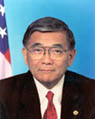
Norman Y. Mineta | U.S. Secretary of Transportation Norman Y. Mineta Announces New Laser Warning and Reporting System for Pilots Measures to Safeguard Pilots and Passengers, Support Timely Enforcement |
“Shining these lasers at an airplane is not a harmless prank. It is stupid and dangerous,” said Secretary of Transportation Norman Y. Mineta. “You are putting other people at risk, and law enforcement authorities are going to seek you out, and if they catch you, they are going to prosecute you.”
The measures, which are outlined in an Advisory Circular from the Department of Transportation’s Federal Aviation Administration (FAA), recommends that pilots immediately report any unauthorized laser events to air traffic controllers. As soon as personnel with the FAA get these reports, they will notify appropriate law enforcement and security agencies through the Domestic Events Network. The changes will provide police with more timely and detailed information to help them identify and prosecute those who are shining lasers at planes.
The new measures also include requirements that air traffic controllers immediately notify pilots about the laser events. If pilots have a laser pointed at them, the circular strongly advises pilots and air crew to avoid direct eye contact given the health and safety risks posed by some types of lasers.
The Department also will be working with the Food and Drug Administration, the Consumer Product Safety Commission and others to improve product labeling and better educate the public.
“We are treating lasers in the cockpit as a serious aviation safety matter,” the Secretary said. “We must act now before someone’s reckless actions lead to a terrible and tragic incident.”
The Secretary announced the new measures today because of a recent spike in the number of incidents of laser being shined at airplanes. Since December 23, there have been 31 reported lasers incidents involving aircraft, seven in the past weekend alone. Since 1990 there have been over 400 similar incidents.
The Secretary noted that there are no indications that the people shining lasers at planes are anything other than careless individuals who are using commercially available lasers in a manner that is reckless and illegal. “There is no specific or credible intelligence that would indicate that these laser incidents are connected to terrorists.”
FAA research has shown that laser illuminations can temporarily disorient or disable a pilot during critical stages of flight such as landing or take-off, and in some cases, may cause permanent damage. However, given the relatively small number of incidents, there is no need to require new equipment for aircraft and aircrew at this time, the Secretary said.
The Secretary announced the new measures today during a simulator demonstration of the dangers posed to pilots from shining lasers into cockpits. The demonstration was held at the Mike Monroney Aeronautical Center in Oklahoma City, OK, where the FAA conducts research on a range of aviation-related health and safety issues. The FAA will continue to conduct research to determine if there are technological solutions for enhancing air crew safety during laser events, the Secretary added.
A copy of the FAA’s advisory circular is available at faa.gov/. ###
DOT 08-05 Contact: Robert Johnson, Tel.: (202) 366-4570 Wednesday, January 12, 2005
0
comments
||
||


