


Mike Johanns was sworn in as the 28th Secretary of the U.S. Department of Agriculture (USDA) on January 21, 2005.
Secretary Johanns' strong agricultural roots stretch back to his childhood. He was born in Iowa and grew up doing chores on his family's dairy farm. As the son of a dairy farmer, he developed a deep respect for the land and the people who work it. He still describes himself as "a farmer's son with an intense passion for agriculture."
That passion showed during Johanns' tenure as Nebraska's 38th governor. During his six years in office, Johanns was a strong advocate for rural communities and farmers and ranchers. He enacted a Value-Added Agriculture Initiative, signed into law the "Agricultural Opportunities and Value-Added Partnership Act," supported the development of a hydroponic produce facility, and signed legislation that focused financial resources on providing transferable, non-refundable gas tax credits for the production of ethanol. He also led eight delegations of Nebraska government, business, and agriculture leaders on trade missions to foreign countries including Japan, Taiwan, China, Hong Kong, Australia, Korea, Singapore, Malaysia, Brazil and Chile.
Johanns served as chairman of the Governors' Biotechnology Partnership and as the state government representative on the advisory committee to the Export-Import Bank of the United States. As a member of both the National Governors' Association and the Western Governors' Association, Johanns concentrated on issues important to agriculture, including drought relief, ethanol, and the 2002 Farm Bill.
Secretary Johanns is a graduate of St. Mary's University of Minnesota in Winona. He earned a law degree from Creighton University in Omaha and practiced law in O'Neill and Lincoln, Nebraska. Johanns served on the Lancaster County Board from 1983-1987, and on the Lincoln City Council 1989-1991. He was elected mayor of Lincoln in 1991. He was reelected in 1995, and successfully ran for governor three years later.
Secretary Johanns is married to Stephanie Johanns, a former Lancaster County Commissioner and State Senator. The couple has two children.
SOURCE: USDA
Friday, January 21, 2005
SECRETARY OF AGRICULTURE MIKE JOHANNS
0
comments
||
||

Indiana disaster Federal aid
The President today declared a major disaster exists in the State of Indiana and ordered Federal aid to supplement State and local recovery efforts in the area struck by severe winter storms and flooding beginning on January 1, 2005, and continuing.
The President's action makes Federal funding available to affected individuals in the counties of Bartholomew, Benton, Blackford, Boone, Brown, Carroll, Cass, Clark, Clay, Clinton, Crawford, Daviess, Decatur, Delaware, Dubois, Floyd, Fountain, Gibson, Grant, Greene, Hamilton, Hancock, Harrison, Hendricks, Henry, Howard, Huntington, Jackson, Jay, Jennings, Johnson, Knox, Lawrence, Madison, Marion, Martin, Miami, Monroe, Montgomery, Morgan, Orange, Owen, Parke, Pike, Posey, Putnam, Randolph, Rush, Scott, Shelby, Sullivan, Tippecanoe, Tipton, Vanderburgh, Vermillion, Vigo, Wabash, Warren, Warrick, Washington, Wells, and White.
Assistance can include grants for temporary housing and home repairs, low-cost loans to cover uninsured property losses, and other programs to help individuals and business owners recover from the effects of the disaster.
Federal funding is also available on a cost-share basis for hazard mitigation measures statewide.
Representing the Federal Emergency Management Agency (FEMA), Michael D. Brown, Under Secretary for Emergency Preparedness and Response, Department of Homeland Security, named Ron Sherman as the Federal Coordinating Officer for Federal recovery operations in the affected area.
The Agency said that damage surveys are continuing in other areas, and more counties and additional forms of assistance may be designated after the assessments are completed.
The Agency said that residents and business owners who sustained losses in the designated counties can begin applying for assistance tomorrow by registering online at http://www.fema.gov or by calling 1-800-621-FEMA(3362) or 1-800-462-7585 (TTY) for the hearing and speech impaired. The toll-free telephone numbers will operate from 7 a.m. to 7 p.m. seven days a week until further notice.
FOR FURTHER INFORMATION CONTACT: FEMA (202) 646-4600.
For Immediate Release OFFICE OF THE PRESS SECRETARY January 21, 2005 Statement by the Press Secretary STATEMENT BY THE PRESS SECRETARY
0
comments
||
||
Jeffrey F. Kupfer Director Federal Tax Reform
President George W. Bush today announced his intention to appoint one individual to serve in his administration:
The President intends to appoint Jeffrey F. Kupfer to be Executive Director of the President's Advisory Panel on Federal Tax Reform. He currently serves as Deputy Chief of Staff at the Treasury Department. Mr. Kupfer previously served as Special Assistant for policy in the White House Chief of Staff's office. Earlier in his career, he served as a Tax Counsel for the Senate Finance Committee and was a trial attorney in the Department of Justice's Tax Division. He earned his bachelor's degree from Yale University and his law degree from Harvard Law School. # # #
For Immediate Release Office of the Press Secretary January 19, 2005 Personnel Announcement
0
comments
||
||
MICHAEL K. POWELL LEAVING
STATEMENT OF FCC CHAIRMAN MICHAEL K. POWELL ON LEAVING THE COMMISSION
Today, I sent a letter to the President thanking him for the incredible privilege of chairing the Federal Communications Commission during his first term. With a mixture of pride and regret I informed him of my intention to step down as a commissioner and chairman some time in March.
Having completed a bold and aggressive agenda, it is time for me to pursue other opportunities and let someone else take the reins of the agency. During my tenure, we worked to get the law right in order to stimulate innovative technology that puts more power in the hands of the American people, giving them greater choices that enrich their lives. Evidence of our success can be seen increasingly in the offices, the automobiles and the living rooms of the American consumer.
The seeds of our policies are taking firm root in the marketplace and are starting to blossom. The use of cell phones, digital televisions, personal video recorders, and digital music players, is exploding. These devices are increasingly connected anytime, anywhere by a wide variety of broadband networks enabling a host of competitive services and new applications. Our children will inherit this exciting future.
My only significant regret is that I will no longer have the pleasure and privilege of working shoulder to shoulder with the most talented and dedicated staff and colleagues that I have known. I look forward to spending some time off with my wife and two boys, before taking up my next challenge. They have been wonderfully supportive and patient. –FCC–
Attached are highlights from the Chairman’s tenure at the Commission. and this document in PDF format
Federal Communications Commission 445 12th Street, S.W. Washington, D. C. 20554
FOR IMMEDIATE RELEASE NEWS MEDIA CONTACTS January 21, 2005 David Fiske 202-418-0513 Richard Diamond 202-418-0506
0
comments
||
||
Thursday, January 20, 2005
Bush Inaugural Speech Full Text, Streaming Video
Bush 2d Inaugural Speech Full Text, Steaming Video
President Sworn-In to Second Term
President's Remarks
Vice President Cheney, Mr. Chief Justice, President Carter, President Bush, President Clinton, reverend clergy, distinguished guests, fellow citizens:
On this day, prescribed by law and marked by ceremony, we celebrate the durable wisdom of our Constitution, and recall the deep commitments that unite our country. I am grateful for the honor of this hour, mindful of the consequential times in which we live, and determined to fulfill the oath that I have sworn and you have witnessed.
At this second gathering, our duties are defined not by the words I use, but by the history we have seen together. For a half century, America defended our own freedom by standing watch on distant borders. After the shipwreck of communism came years of relative quiet, years of repose, years of sabbatical - and then there came a day of fire.
We have seen our vulnerability - and we have seen its deepest source. For as long as whole regions of the world simmer in resentment and tyranny - prone to ideologies that feed hatred and excuse murder - violence will gather, and multiply in destructive power, and cross the most defended borders, and raise a mortal threat. There is only one force of history that can break the reign of hatred and resentment, and expose the pretensions of tyrants, and reward the hopes of the decent and tolerant, and that is the force of human freedom.
We are led, by events and common sense, to one conclusion: The survival of liberty in our land increasingly depends on the success of liberty in other lands. The best hope for peace in our world is the expansion of freedom in all the world.
America's vital interests and our deepest beliefs are now one. From the day of our Founding, we have proclaimed that every man and woman on this earth has rights, and dignity, and matchless value, because they bear the image of the Maker of Heaven and earth. Across the generations we have proclaimed the imperative of self-government, because no one is fit to be a master, and no one deserves to be a slave. Advancing these ideals is the mission that created our Nation. It is the honorable achievement of our fathers. Now it is the urgent requirement of our nation's security, and the calling of our time.
So it is the policy of the United States to seek and support the growth of democratic movements and institutions in every nation and culture, with the ultimate goal of ending tyranny in our world.
This is not primarily the task of arms, though we will defend ourselves and our friends by force of arms when necessary. Freedom, by its nature, must be chosen, and defended by citizens, and sustained by the rule of law and the protection of minorities. And when the soul of a nation finally speaks, the institutions that arise may reflect customs and traditions very different from our own. America will not impose our own style of government on the unwilling. Our goal instead is to help others find their own voice, attain their own freedom, and make their own way.
The great objective of ending tyranny is the concentrated work of generations. The difficulty of the task is no excuse for avoiding it. America's influence is not unlimited, but fortunately for the oppressed, America's influence is considerable, and we will use it confidently in freedom's cause.
My most solemn duty is to protect this nation and its people against further attacks and emerging threats. Some have unwisely chosen to test America's resolve, and have found it firm.
We will persistently clarify the choice before every ruler and every nation: The moral choice between oppression, which is always wrong, and freedom, which is eternally right. America will not pretend that jailed dissidents prefer their chains, or that women welcome humiliation and servitude, or that any human being aspires to live at the mercy of bullies.
We will encourage reform in other governments by making clear that success in our relations will require the decent treatment of their own people. America's belief in human dignity will guide our policies, yet rights must be more than the grudging concessions of dictators; they are secured by free dissent and the participation of the governed. In the long run, there is no justice without freedom, and there can be no human rights without human liberty.
Some, I know, have questioned the global appeal of liberty - though this time in history, four decades defined by the swiftest advance of freedom ever seen, is an odd time for doubt. Americans, of all people, should never be surprised by the power of our ideals. Eventually, the call of freedom comes to every mind and every soul. We do not accept the existence of permanent tyranny because we do not accept the possibility of permanent slavery. Liberty will come to those who love it.
Today, America speaks anew to the peoples of the world:
All who live in tyranny and hopelessness can know: the United States will not ignore your oppression, or excuse your oppressors. When you stand for your liberty, we will stand with you.
Democratic reformers facing repression, prison, or exile can know: America sees you for who you are: the future leaders of your free country.
The rulers of outlaw regimes can know that we still believe as Abraham Lincoln did: "Those who deny freedom to others deserve it not for themselves; and, under the rule of a just God, cannot long retain it."
The leaders of governments with long habits of control need to know: To serve your people you must learn to trust them. Start on this journey of progress and justice, and America will walk at your side.
And all the allies of the United States can know: we honor your friendship, we rely on your counsel, and we depend on your help. Division among free nations is a primary goal of freedom's enemies. The concerted effort of free nations to promote democracy is a prelude to our enemies' defeat.
Today, I also speak anew to my fellow citizens:
From all of you, I have asked patience in the hard task of securing America, which you have granted in good measure. Our country has accepted obligations that are difficult to fulfill, and would be dishonorable to abandon. Yet because we have acted in the great liberating tradition of this nation, tens of millions have achieved their freedom. And as hope kindles hope, millions more will find it. By our efforts, we have lit a fire as well - a fire in the minds of men. It warms those who feel its power, it burns those who fight its progress, and one day this untamed fire of freedom will reach the darkest corners of our world.
A few Americans have accepted the hardest duties in this cause - in the quiet work of intelligence and diplomacy ... the idealistic work of helping raise up free governments ... the dangerous and necessary work of fighting our enemies. Some have shown their devotion to our country in deaths that honored their whole lives - and we will always honor their names and their sacrifice.
All Americans have witnessed this idealism, and some for the first time. I ask our youngest citizens to believe the evidence of your eyes. You have seen duty and allegiance in the determined faces of our soldiers. You have seen that life is fragile, and evil is real, and courage triumphs. Make the choice to serve in a cause larger than your wants, larger than yourself - and in your days you will add not just to the wealth of our country, but to its character.
America has need of idealism and courage, because we have essential work at home - the unfinished work of American freedom. In a world moving toward liberty, we are determined to show the meaning and promise of liberty.
In America's ideal of freedom, citizens find the dignity and security of economic independence, instead of laboring on the edge of subsistence. This is the broader definition of liberty that motivated the Homestead Act, the Social Security Act, and the G.I. Bill of Rights. And now we will extend this vision by reforming great institutions to serve the needs of our time. To give every American a stake in the promise and future of our country, we will bring the highest standards to our schools, and build an ownership society. We will widen the ownership of homes and businesses, retirement savings and health insurance - preparing our people for the challenges of life in a free society. By making every citizen an agent of his or her own destiny, we will give our fellow Americans greater freedom from want and fear, and make our society more prosperous and just and equal.
In America's ideal of freedom, the public interest depends on private character - on integrity, and tolerance toward others, and the rule of conscience in our own lives. Self-government relies, in the end, on the governing of the self. That edifice of character is built in families, supported by communities with standards, and sustained in our national life by the truths of Sinai, the Sermon on the Mount, the words of the Koran, and the varied faiths of our people. Americans move forward in every generation by reaffirming all that is good and true that came before - ideals of justice and conduct that are the same yesterday, today, and forever.
In America's ideal of freedom, the exercise of rights is ennobled by service, and mercy, and a heart for the weak. Liberty for all does not mean independence from one another. Our nation relies on men and women who look after a neighbor and surround the lost with love. Americans, at our best, value the life we see in one another, and must always remember that even the unwanted have worth. And our country must abandon all the habits of racism, because we cannot carry the message of freedom and the baggage of bigotry at the same time.
From the perspective of a single day, including this day of dedication, the issues and questions before our country are many. From the viewpoint of centuries, the questions that come to us are narrowed and few. Did our generation advance the cause of freedom? And did our character bring credit to that cause?
These questions that judge us also unite us, because Americans of every party and background, Americans by choice and by birth, are bound to one another in the cause of freedom. We have known divisions, which must be healed to move forward in great purposes - and I will strive in good faith to heal them. Yet those divisions do not define America. We felt the unity and fellowship of our nation when freedom came under attack, and our response came like a single hand over a single heart. And we can feel that same unity and pride whenever America acts for good, and the victims of disaster are given hope, and the unjust encounter justice, and the captives are set free.
We go forward with complete confidence in the eventual triumph of freedom. Not because history runs on the wheels of inevitability; it is human choices that move events. Not because we consider ourselves a chosen nation; God moves and chooses as He wills. We have confidence because freedom is the permanent hope of mankind, the hunger in dark places, the longing of the soul. When our Founders declared a new order of the ages; when soldiers died in wave upon wave for a union based on liberty; when citizens marched in peaceful outrage under the banner "Freedom Now" - they were acting on an ancient hope that is meant to be fulfilled. History has an ebb and flow of justice, but history also has a visible direction, set by liberty and the Author of Liberty.
When the Declaration of Independence was first read in public and the Liberty Bell was sounded in celebration, a witness said, "It rang as if it meant something." In our time it means something still. America, in this young century, proclaims liberty throughout all the world, and to all the inhabitants thereof. Renewed in our strength - tested, but not weary - we are ready for the greatest achievements in the history of freedom.
May God bless you, and may He watch over the United States of America. # # #
For Immediate Release Office of the Press Secretary January 20, 2005
0
comments
||
||
Wednesday, January 19, 2005
'America's Future Rocks' Concert
President Encourages Service at 'America's Future Rocks' Concert FULL STREAMING VIDEO
District of Columbia National Guard Washington, D.C.
President's Remarks 6:54 P.M. EST
THE PRESIDENT: Thank you all for coming. (Applause.) I hope you've enjoyed this fantastic concert. (Applause.) I'm traveling -- as you can see, I'm traveling in pretty good company today, with the First Lady of the United States, Laura. (Applause.) The mother of Barbara and Jenna -- (applause) -- who we love dearly.
Listen, I want to thank all the entertainers who were here today. How about Hilary Duff. She was fantastic. (Applause.) Thank you, Hilary. JoJo -- JoJo is here -- yeah. (Applause.) Rubin Studdard -- you talk about a success story. (Applause.) Ryan Cabrera, I appreciate Ryan being here. (Applause.) How about Three Doors Down? (Applause.) Pretty cool guys, right? Seem cool to me. (Applause.) Fuel -- I appreciate Fuel being here. (Applause.) Jason Sehorn -- I'm honored that my friend, Jason -- and I'm really proud and pleased that he brought his wife, Angie Harmon. (Applause.)
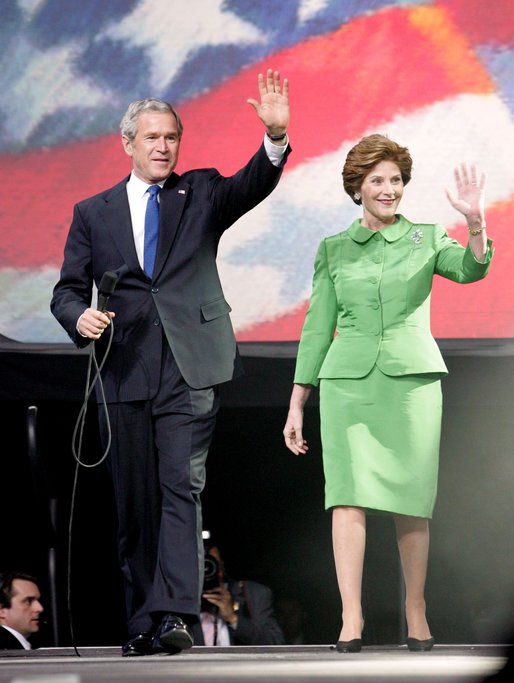
america rocks 1 | I want to thank Steve Baldwin for being with us today. I'm honored that Steve was here. Erika Harold, Miss America 2003 -- what a fine person Erika is. (Applause.) How about Kelly Purdue, the "apprentice." (Applause.) Next thing you know, the guy will be running for President. (Applause.) Nancy O'Dell -- I'm honored that Nancy is with us. I appreciate you all coming. |
You know what that means? It means love a neighbor just like you'd like to be loved yourself. Take time -- (applause)
| -- take time out of your life to make somebody else's life better. By helping heal a broken heart, or surrounding a friend with love, or feeding the hungry, or providing shelter for the homeless, you can help change America for the better, one heart, one soul, one conscience at a time. | 
america rocks 2 |
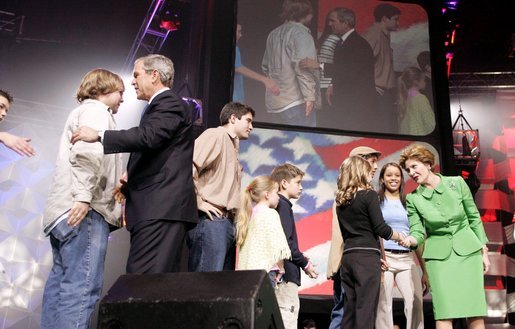
america rocks 3 | And my call to you all is that as you enjoy the great freedoms of America, and as you enjoy yourself at this inauguration, I hope you take away the lesson of helping somebody in need. And when you do, it will not only make our country a better place, it will lift up your own spirit. |
END 7:00 P.M. EST
For Immediate Release January 18, 2005
0
comments
||
||
Adolfo A. Franco, Roger Noriega, Gregory B. Jaczko, Peter B. Lyons
President George W. Bush today announced that he has recess appointed the following individuals:
Adolfo A. Franco, of Virginia, to be a Member of the Board of Directors of the Inter-American Foundation (Government Representative).
Roger Noriega, of Kansas, to be a Member of the Board of Directors of the Inter-American Foundation (Government Representative).
Gregory B. Jaczko, of the District of Columbia, to be a Member of the Nuclear Regulatory Commission.
Peter B. Lyons, of Virginia, to be a Member of the Nuclear Regulatory Commission.
# # #
For Immediate Release Office of the Press Secretary January 19, 2005
Personnel Announcement January 19, 2005
0
comments
||
||
Tuesday, January 18, 2005
Nomination of Dr. Condoleezza Rice to be Secretary of State
Nomination of Dr. Condoleezza Rice to be Secretary of State FULL STREAMING VIDEO
Opening Statements for Tuesday, January 18, 2005
U.S. Senate Foreign Relations Committee Chairman Dick Lugar made the following opening statement at the hearing on the nomination of Dr. Condoleezza Rice to be Secretary of State:
The Committee on Foreign Relations meets today to consider the nomination of Dr. Condoleezza Rice to be Secretary of State. We are very pleased to welcome Dr. Rice to the Committee. As a result of her distinguished service as National Security Advisor to President Bush and her earlier assignments on the NSC, she is well known to many members of this Committee. We admire her accomplishments, and we are particularly thankful for the cooperation that she has provided to this Committee.
The enormously complex job before Dr. Rice will require all of her talents and experience. American credibility in the world, progress in the war on terrorism, and our relationships with our allies will be greatly affected by the Secretary of State’s actions and the effectiveness of the State Department in the coming years. Dr. Rice is highly qualified to meet these challenges. We recognize the deep personal commitment necessary to undertake this difficult assignment, and we are grateful that a leader of her stature is willing to step forward.
The Secretary of State serves as the President’s top foreign policy advisor, as our nation’s most visible emissary to the rest of the world, and as manager of one of the most important Departments in our government. Any one of these jobs would be a challenge for even the most talented public servant. But the Secretary of State, at this critical time in our history, must excel at all three roles.
Senate Committee on Foreign Relations Chairman Richard G. Lugar FULL TEXT in PDF format
Opening Statement by Dr. Condoleezza Rice Senate Foreign Relations Committee January 18, 2005
Thank you Chairman Lugar, Senator Biden, and Members of the Committee. And let me also thank Senator Dianne Feinstein who, as a fellow Californian, I have long admired as a leader on behalf of our state and our nation.
Mr. Chairman, members of the Committee, it is an honor to be nominated to lead the State Department at this critical time – a time of challenge and hope and opportunity for America, and for the entire world.
September 11th, 2001 was a defining moment for our nation and the world. Under the vision and leadership of President Bush, our nation has risen to meet the challenges of our time: fighting tyranny and terror, and securing the blessings of freedom and prosperity for a new generation. The work that America and our allies have undertaken, and the sacrifices we have made, have been difficult … and necessary … and right. Now is the time to build on these achievements … to make the world safer, and to make the world more free. We must use American diplomacy to help create a balance of power in the world that favors freedom. And the time for diplomacy is now.
Opening Statement by Dr. Condoleezza Rice
FULL TEXT in PDF format.
0
comments
||
||
International Emergency Economic Powers Act (50 U.S.C. 1701-1706)
Continuation of the National Emergency with Respect to Terrorists Who Threaten to Disrupt the Middle East Peace Process
On January 23, 1995, by Executive Order 12947, the President declared a national emergency pursuant to the International Emergency Economic Powers Act (50 U.S.C. 1701-1706) to deal with the unusual and extraordinary threat to the national security, foreign policy, and economy of the United States constituted by grave acts of violence committed by foreign terrorists who threaten to disrupt the Middle East peace process. On August 20, 1998, by Executive Order 13099, the President modified the Annex to Executive Order 12947 to identify four additional persons, including Usama bin Laden, who threaten to disrupt the Middle East peace process.
Because these terrorist activities continue to threaten the Middle East peace process and continue to pose an unusual and extraordinary threat to the national security, foreign policy, and economy of the United States, the national emergency declared on January 23, 1995, as expanded on August 20, 1998, and the measures adopted on those dates to deal with that emergency must continue in effect beyond January 23, 2005. Therefore, in accordance with section 202(d) of the National Emergencies Act (50 U.S.C. 1622(d)),
I am continuing for 1 year the national emergency with respect to foreign terrorists who threaten to disrupt the Middle East peace process.
This notice shall be published in the Federal Register and transmitted to the Congress.
GEORGE W. BUSH
For Immediate Release January 18, 2005 THE WHITE HOUSE, January 17, 2005.
0
comments
||
||
National Emergencies Act (50 U.S.C. 1622(d))
Text of a Letter from the President to the Speaker of the House of Representatives and the President of the Senate
Dear Mr. Speaker: (Dear Mr. President:)
Section 202(d) of the National Emergencies Act (50 U.S.C. 1622(d)) provides for the automatic termination of a national emergency unless, prior to the anniversary date of its declaration, the President publishes in the Federal Register and transmits to the Congress a notice stating that the emergency is to continue in effect beyond the anniversary date. In accordance with this provision, I have sent to the Federal Register for publication the enclosed notice, stating that the emergency declared with respect to foreign terrorists who threaten to disrupt the Middle East peace process is to continue in effect beyond January 23, 2005. The most recent notice continuing this emergency was published in the Federal Register on January 21, 2004 (69 FR 2991).
The crisis with respect to the grave acts of violence committed by foreign terrorists that disrupt the Middle East peace process that led to the declaration of a national emergency on January 23, 1995, as expanded on August 20, 1998, has not been resolved. Terrorist groups continue to engage in activities that have the purpose or effect of threatening the Middle East peace process and that are hostile to United States interests in the region. Such actions constitute an unusual and extraordinary threat to the national security, foreign policy, and economy of the United States. For these reasons, I have determined that it is necessary to continue the national emergency declared with respect to foreign terrorists who threaten to disrupt the Middle East peace process and to maintain in force the economic sanctions against them to respond to this threat.
Sincerely, GEORGE W. BUSH
For Immediate Release January 18, 2005
0
comments
||
||
Martin Luther King, Jr. Holiday, 2005
Martin Luther King, Jr. Holiday, 2005 THE WHITE HOUSE
Dr. Martin Luther King, Jr., was a visionary American and a dedicated leader who believed deeply in liberty and dignity for every person. His faith and courage continue to inspire America and the world. We honor his life and his work.
Growing up in Atlanta, Georgia, Dr. King witnessed firsthand the injustice of a segregated society. He realized that change was necessary to ensure the full promise of our Constitution for all Americans, and his charismatic leadership awakened the conscience of America.
Dr. King's dream inspired our Nation with what he called "a certain kind of fire that no water could put out." Since Dr. King's involvement in the civil rights movement in the 1950s and 1960s, Americans have witnessed the power of the law to prevent injustice and encourage the finest qualities of our Nation. Last year, we celebrated the 40th anniversary of the Civil Rights Act of 1964. Once this landmark legislation was signed into law, Americans could no longer be denied a room in a hotel or a table at a restaurant because of their race.
Our Nation has accomplished much over the past 40 years. Our journey toward justice and equality has not always been an easy one, and it is not over. However long the journey, our destination is set: liberty and justice for all. Dr. Martin Luther King, Jr., believed in the good that exists in all men and women. We will remember the work of Dr. King as we continue striving to meet the founding ideals of our great Nation.
NOW, THEREFORE, I, GEORGE W. BUSH, President of the United States of America, by virtue of the authority vested in me by the Constitution and laws of the United States, do hereby proclaim Monday, January 17, 2005, as the Martin Luther King, Jr., Federal Holiday. I encourage all Americans to observe this day with appropriate activities and programs that honor the memory and legacy of Dr. King.
IN WITNESS WHEREOF, I have hereunto set my hand this fourteenth day of January, in the year of our Lord two thousand five, and of the Independence of the United States of America the two hundred and twenty-ninth.
GEORGE W. BUSH # # #
For Immediate Release January 15, 2005 Office of the Press Secretary
0
comments
||
||
Religious Freedom Day
Religious Freedom Day, 2005 THE WHITE HOUSE
George Washington wrote, "The liberty enjoyed by the people of these States, of worshipping Almighty God agreeably to their consciences, is not only among the choicest of their blessings, but also of their rights." On Religious Freedom Day, Americans commemorate the passage of the Virginia Statute for Religious Freedom in 1786, which helped set the course for freedom of religion to be included in the First Amendment to our Constitution.
Our Founding Fathers knew the importance of freedom of religion to a stable and lasting Union. Our Constitution protects individuals' rights to worship as they choose. Today, we continue to welcome the important contributions of people of faith in our society. We reject religious bigotry in every form, striving for a society that honors the life and faith of every person. As we maintain the vitality of a pluralistic society, we work to ensure equal treatment of faith-based organizations and people of faith.
As the United States advances the cause of liberty, we remember that freedom is not America's gift to the world, but God's gift to each man and woman in this world. This truth drives our efforts to help people everywhere achieve freedom of religion and establish a better, brighter, and more peaceful future for all.
NOW, THEREFORE, I, GEORGE W. BUSH, President of the United States of America, by virtue of the authority vested in me by the Constitution and laws of the United States, do hereby proclaim January 16, 2005, as Religious Freedom Day. I encourage all Americans to reflect on the great blessing of religious freedom, to endeavor to preserve this freedom for future generations, and to commemorate this day through appropriate events and activities in homes, schools, and places of worship.
IN WITNESS WHEREOF, I have hereunto set my hand this fourteenth day of January, in the year of our Lord two thousand five, and of the Independence of the United States of America the two hundred and twenty-ninth.
GEORGE W. BUSH # # #
For Immediate Release January 15, 2005 Office of the Press Secretary
0
comments
||
||
Monday, January 17, 2005
'Let Freedom Ring' Event
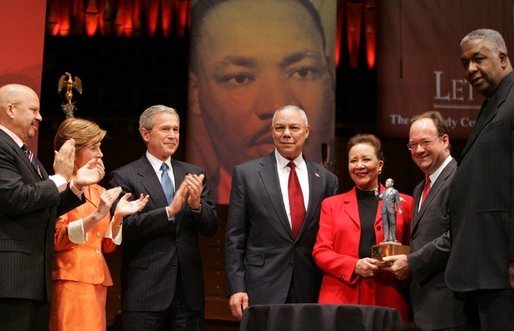
President Honors Secretary, Mrs. Powell at 'Let Freedom Ring' Event Georgetown University 4:16 P.M. EST
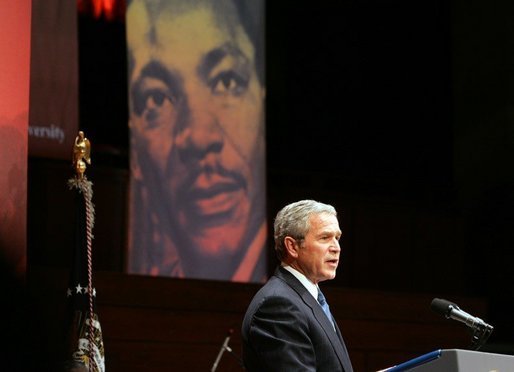
THE PRESIDENT: Thank you all. Thanks for coming. Thanks for the invitation. Laura and I are pleased to join you on this national holiday as we honor two exceptional Americans who we're proud to call friends.
I want to thank Dr. DeGioia and Georgetown University for sponsoring the John Thompson Legacy of a Dream Award. I want to thank the Georgetown Gospel Choir for sharing their gifts at this celebration. I want to thank John Thompson for being here and for setting such a great example. I appreciate the thoughtful words from one of the most recognized voices in America, Tom Joyner. (Applause.) I can't wait to hear Aaron Neville. (Applause.) I want to thank the members of Congress, the members of my administration and all the distinguished guests who are here today. I also want to thank Dr. Dorothy Height for joining us this afternoon. (Applause.)
Every year on this day we reflect the history of civil rights in America. It's a story of our founders, among them, slave owners, who declared a standard of equality and justice that would one day be used to put an end to slavery. It's a story of a terrible war that freed men and women from bondage, but not from oppression and segregation. It's a story of generations "not having received the promises, but having seen them afar off." And it's a story of Americans like Reverend Dr. Martin Luther King, Jr., who held our nation to those promises and would not rest until they were written into law. (Applause.)
Dr. King was a minister of the gospel who could have had an easy life in a respected pulpit. Today, he would be just 76 years old. Instead, he chose to minister in the spirit of John Wesley, who said, "I look upon all the world as my parish." The nation first took notice in the 1950s and in the 1960s, when he wrote, "I am in Birmingham because injustice is here." In the space of just a few years, through the power of his intellect, the truth of his words, and the example of his courage, he left this country a different and better place, and made his own journey to a different and better place. (Applause.)
Dr. King believed so fully in the ideals of America that he was offended every day that they were violated. He had studied the founding documents and found no exceptions to the promise of freedom. He was disappointed in the unfair practices of his country. Yet he said, "There can be no deep disappointment where there is not deep love." Dr. King loved America enough to confront its injustices, not compromising the truth and not fearing any man -- and America loves him in return. (Applause.)
Martin Luther King also knew that man's right to be free is rooted in something far beyond the charters of a country. He believed and he knew that the image of God we share is a source of our dignity as human beings and the basis for our equality. He believed and he knew that the teachings of Jesus stand in eternal judgment of oppression. He believed and he knew that the God who made us for freedom will bring us to freedom. (Applause.)
freedom 1 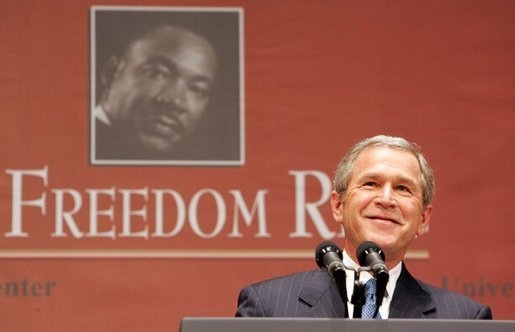
freedom 2
By observing and honoring Dr. King's birthday, we teach the next generation lessons that must never be forgotten. We need our children to know how great the struggle for racial justice in our society has been, and how much work remains to be done. (Applause.) We need them to know that the greatest causes sometime involve the greatest sacrifices, and that history moves forward on the strength of those sacrifices. And we need the children of America to know that a single life of conscience and purpose can touch and lift up many lives. The influence of one good life is also the message of the Legacy of a Dream Award -- in this case the influence of two good lives.
Alma and Colin Powell are among the most admired people in our country. (Applause.) For these four years, they've also been America's representatives to the world. They are honorable people who bring honor to this nation, and America is grateful for their example of service.
As their friends know, Alma and Colin met on a blind date. (Laughter.) Alma has said she remembers the future general looking like a lost 12-year-old. (Laughter and applause.) And that's the side of the man I've never seen before. (Laughter.) For his part, Colin has said that night he was "mesmerized by a pair of luminous eyes, an unusual shade of green." And from that day to this, he has been fortunate to have this beautiful, accomplished woman at his side. (Applause.)
Colin Powell has lived his own inspiring story, a story of exceptional accomplishment that started before segregation ended. When he was a young officer, someone told him, "You are the best black lieutenant I have ever known." He later wrote, "Inside me, I was thinking, if you intend to measure me only against black lieutenants, you are making a mistake." (Laughter and applause.) "I'm going to show you" -- he went on to write, "I'm going to show you the best lieutenant in the Army, period." (Applause.)
The best lieutenant in the Army went on to a distinguished military career that ended with four stars on his shoulder. (Applause.) Along the way, he earned two Purple Hearts, the Bronze Star, the Soldier's Medal, the Legion of Merit, the Congressional Gold Medal and two Presidential Medals of Freedom. (Applause.) I'm not through yet. (Laughter.) I'm just getting started. (Laughter.) See, he's been an official in the administration of six Presidents, including service as the National Security Advisor to President Reagan, the Chairman of the Joint Chiefs of Staff under Presidents Bush and Clinton.
More than four years ago, when I needed a Secretary of State, I knew what I was looking for. I wanted someone who believed deeply in the values of our country, and could share them with the world; a person of wisdom and decency; a leader who could bring out the best in people. I found all this and more in Colin Powell. (Applause.) Our 65th Secretary of State became one of the most effective and admired diplomats in America's history. He has helped to rally the world in a global war and to resolve dangerous regional conflicts and to confront the desperate challenges of natural disaster and hunger and poverty and disease. He's been tireless and selfless and principled. In the work he and I have shared, he has become a great friend, and I appreciate all he has done for our wonderful country. (Applause.)
freedom 3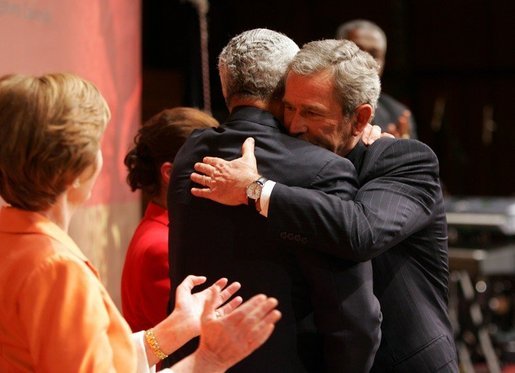
freedom 4
His proudest achievements probably have little to do with public service. See, he's a wonderful dad to Michael and Annemarie and Linda. Over the years, he's been a mentor to young people. As a founder of America's Promise, Colin has drawn countless others to become involved in the lives of children, and to give them the hope and confidence they need for a successful life. Today, we honor not just Colin Powell's lifetime of leadership, but we honor his great kindness and his compassion. (Applause.)
The same kinds of idealism and character have marked the life of Alma Johnson Powell. Like her husband, she was raised by strong and decent people. And Birmingham, where Martin Luther King was jailed -- Birmingham, which -- where he was jailed, was also the home of the Johnson family. That's where she was raised in other words. (Laughter.) Alma remembers her father during the worst of days sitting up at night with a shotgun by his side to protect his wife and his children. Mr. Johnson was a high school principal, and he was a legend to generations of students who remember his high standards and his imposing presence. His daughter, Alma, has always been impressive, as well, because of her grace and her principle.
For many years, Alma served America as a soldier's wife, moving the household 18 times, and leading the family when the Army -- (Applause.) Anyone who wants to know the meaning of duty and unselfish love can look at our military families like the Powells. (Applause.) This good-hearted mother and grandmother shares her love with others as the Chair of America's Promise. People here at the Kennedy Center know her as the leading member of the board of trustees. She's a noted author of several children's books, and a volunteer who gives her time to help young people make good choices in life. Alma Powell is one of the finest people Laura and I are privileged to know. And she is a superb choice for the Legacy of a Dream Award. (Applause.) I'm not kidding, either. (Applause.)
You have chosen, on this important day for America, to pay tribute to a woman and a man who have upheld the highest ideal of American citizenship. In their love of country, and their heart for service, they show the same character found in the life of Dr. Martin Luther King. Thank you for the privilege of joining you this afternoon, and for the pleasure of being able to honor these fine, fine Americans.
May God bless the Powells, and may God continue to bless the United States of America. (Applause.)
END 4:30 P.M. EST
For Immediate Release Office of the Press Secretary January 17, 2005
0
comments
||
||
President Holds Press Conference
President Holds Press Conference
The James S. Brady Briefing Room
10:00 A.M. EST

press 1 | THE PRESIDENT: Good morning. With the second term underway and a new Congress at work, we're moving forward on great goals for our country. In my inaugural address I renewed this nation's commitment to expanding liberty at home and promoting liberty abroad. |
| Terrorists in that country have declared war against democracy, itself, and thereby, declared war against the Iraqi people, themselves. Yet the elections will go forward. Millions of Iraqi voters will show their bravery, their love of country, and their desire to live in freedom. | 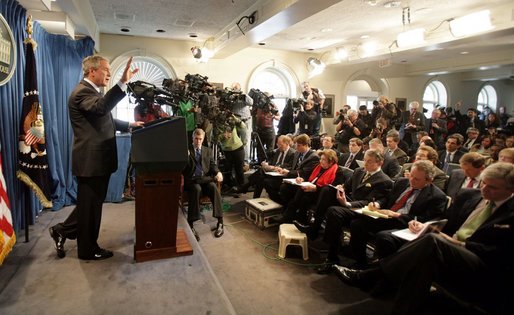
press 2 |
Next week, I will report to Congress on the state of the union and describe in more detail a legislative agenda to serve the goals I have outlined. I'll ask the House and Senate to act soon on the issue of Social Security, so that we don't pass a bankrupt system on to our children and our grandchildren. I'm open to good ideas from members of Congress. I'll work with both parties to get results. Any solution must confront the problem fully and directly by making the system permanently solvent and providing the option of personal accounts.
For this new term, I've assembled an exceptional Cabinet, and several members are taking office this week. In addition to speedy action on all my nominees, I especially urge the Senate to confirm Condoleezza Rice today, and to promptly act and confirm Judge Al Gonzales.
We have a full agenda. I'm looking forward to the work ahead. And now I'm looking forward to answering some of your questions. Terry.
Q Mr. President, the insurgents in Iraq are threatening to kill anyone who comes out to vote on Sunday. Do you think they'll succeed in killing or scaring away enough people so that the elections will be rendered seriously flawed or not credible?
THE PRESIDENT: We anticipate a lot of Iraqis will vote. Clearly, there are some who are intimidated. Surveys show that the vast majority of people do want to participate in democracy. And some are feeling intimidated. I urge all people to vote. I urge people to defy these terrorists. These terrorists are -- do not have the best interests of the Iraqi people in mind. They have no positive agenda. They have no clear view of a better future. They're afraid of a free society.
I am impressed by the bravery of the Iraqi citizens. I am heartened by the strong words of Prime Minister Allawi. I talked to him yesterday on the phone. He is determined to lead his country forward into the elections. I appreciate the hard work of the United Nations, which is providing good leadership on the ground. And I anticipate a -- a grand moment in Iraqi history. If we'd been having this discussion a couple of years ago and I'd have stood up in front of you and said the Iraqi people would be voting, you would look at me like some of you still look at me, with a kind of blank expression. People are voting. And this is a part of a process, to write a constitution and then elect a permanent assembly. And it's exciting times for the Iraqi people.
Steve.
Q Can I ask a follow-up, sir? What would be a credible turnout number?
THE PRESIDENT: The fact that they're voting, in itself, is successful. Again, this is a long process. It is a process that will begin to write a constitution and then elect a permanent assembly. And this process will take place over this next year. It's a -- it is a grand moment for those who believe in freedom.
Q Sir, your inaugural address has been interpreted as a new, aggressive posture against certain countries, in particular Iran. Should we view it that way?
THE PRESIDENT: My inaugural address reflected the policies of the past four years that said -- that we're implementing in Afghanistan and Iraq. And it talked about a way forward. I think America is at its best when it leads toward an ideal. And certainly, a world without tyranny is an ideal world. The spread of freedom is important for future generations of Americans. I firmly believe that free societies are peaceful societies, and I believe every person desires to be free. And so I look forward to leading the world in that direction for the next four years.
Q Do you see it as a policy shift?
THE PRESIDENT: No, as I said, it reflects the policy of the past, but it sets a bold, new goal for the future. And I believe this country is best when it heads toward an ideal world. We are at our best. And in doing so, we're reflecting universal values and universal ideas that honor each man and woman, that recognize human rights and human dignity depends upon human liberty. And it's -- I'm looking forward to the challenge, and I'm looking forward to reaching out to our friends and allies to convince them of the necessity to continue to work together to help liberate people.
Yes, Terry.
Q Mr. President, let me take you up on that, if I may. Last month in Jordan, a gentleman named Ali Hatar was arrested after delivering a lecture called, "Why We Boycott America." He was charged under section 191 of their penal code for slander of government officials. He stood up for democracy, you might say. And I wonder if here and now, you will specifically condemn this abuse of human rights by a key American ally. And if you won't, sir, then what, in a practical sense, do your fine words mean?
THE PRESIDENT: I'm unaware of the case. You've asked me to comment on something that I didn't know took place. I urge my friend, His Majesty, to make sure that democracy continues to advance in Jordan. I noticed today that he put forth a reform that will help more people participate in future governments of Jordan. I appreciate His Majesty's understanding of the need for democracy to advance in the greater Middle East. We visited with him at the G8, and he has been a strong advocate of the advance of freedom and democracy.
Now, let me finish. Obviously, we're discussing a process. As I said in my speech, not every nation is going to immediately adopt America's vision of democracy, and I fully understand that. But we expect nations to adopt the values inherent in a democracy, which is human rights and human dignity, that every person matters and every person ought to have a voice. And His Majesty is making progress toward that goal.
I can't speak specifically to the case. You're asking me to speak about a case that I don't know the facts.
Q Fair enough. If I could just follow up. Will you then -- does your inaugural address mean that when it comes to people like Mr. Hatar, you won't compromise because of a U.S. ally and you will stand --
THE PRESIDENT: Again, I don't know the facts, Terry. You're asking me to comment on something I do not know the facts. Perhaps you're accurate in your description of the facts, but I have not seen those facts. Now, nevertheless, we have spoken out in the past and we'll continue to speak out for human rights and human dignity, and the right for people to express themselves in the public square.
Q Mr. President, in the debate over Dr. Rice's confirmation, Democrats came right out and accused you and the administration of lying in the run-up to the war in Iraq. Republicans, in some cases, conceded that mistakes have been made. Now that the election is over, are you willing to concede that any mistakes were made? And how do you feel about --
THE PRESIDENT: Let me talk about Dr. Rice -- you asked about her confirmation. Dr. Rice is an honorable, fine public servant who needs to be confirmed. She will be a great Secretary of State. And Dr. Rice and I look forward to moving forward. We look forward to working to make sure the Iraqis have got a democracy. We look forward to continuing to make sure Afghanistan is as secure as possible from potential Taliban resurgence. We look forward to spreading freedom around the world. And she is going to make a wonderful Secretary of State.
Q No reaction to the lying? No reaction? (Laughter.)
THE PRESIDENT: Is that your question? The answer is, no. Next.
Q I'd like to ask you -- sir, I'd like to ask you about the deficit. But before I do that, there is a developing story this morning -- the helicopter crash in Iraq. Can you tell us what you know about that, what may have caused it, and your reaction to it?
THE PRESIDENT: I know that it's being investigated by the Defense Department. And, obviously, any time we lose life it is a sad moment.
Q Don't know whether it was weather-related, or not --
THE PRESIDENT: Not yet. I've heard rumors, but I'll wait to the facts.
Q You're preparing to ask Congress for an additional $80 billion in war spending in Afghanistan and Iraq. The White House is also prepared to predict a budget deficit of $427 billion for this year. You talk about sacrifice in this country. Do you think that you're really asking Americans to sacrifice financially -- when you're asking them to fund the war, yet, at the same time, perhaps pay an exorbitant amount to set up private accounts in Social Security, pay for a prescription drug benefit, as well as other spending plans?
THE PRESIDENT: So the --
Q And tax cuts, to make those permanent? It's a lot of money.
THE PRESIDENT: Okay, let me see if I can dissect your question into separate parts. First, Americans pay a lot of taxes. They pay tax at the federal level, they pay tax at the state level, they pay tax at the local level. Americans do pay taxes.
Secondly, I made the commitment to our troops, we'll fund them. And that's exactly what we're doing. We've got people in harm's way; I look forward to working with Congress to fund what is necessary to help those troops complete their mission.
Thirdly, we have presented a plan in the past, and we'll present one here next -- earlier -- later on this -- in February, that will show we will cut the deficit in half. And it's obviously going to require cooperation with the United States Congress to make some very difficult decisions when it comes to funding the budgets.
Fourthly, we not only were attacked and needed -- therefore, needed to defend ourselves, we also had a recession. And I felt it was very important to reduce the tax burden on the American people to get out of the recession. In other words, we were dealing with twin problems. And because of the tax relief our economy is growing forward.
Last year at this time, the projected budget was $527 billion. You might remember that. It turned out that the budget was $412 billion for last year. Now the budget is projected to be at $427 billion. We look forward to working to hold the line with the United States Congress on spending. And as I say, I'll promote a package that will show the budget being cut in half over the next five years.
John.
Q Mr. President, I want to try another way to ask you about Iraq. When you made the decision to go to war in Iraq, you clearly had majority support in the country. A string of recent polls have shown a clear majority of the American people now believe it was a mistake to go to war in Iraq. You've asked for $80 billion in more money on top of the billions already spent. The army says that we'll probably have 100,000 or more troops in Iraq for at least another year. What would you say to the American people, including a significant number who supported you at the beginning of the war, who now say this is not what we were led to believe would happen?
THE PRESIDENT: A couple of things, John. I'd say the world is better off without Saddam Hussein in power. A world with Saddam Hussein in power would have been a -- would have been a more dangerous world today. Secondly, that we're making progress in helping Iraq develop a democracy. And in the long-term, our children and grandchildren will benefit from a free Iraq.
In terms of troop levels, obviously, we'll have the troop levels necessary to complete the mission. And that mission is to enable Iraq to defend herself from terrorists -- homegrown or terrorists that come in from outside of the country. And so our mission is focused on not only an increase in the number of Iraqis in uniform -- whether it be Army or National Guard or border patrol or police -- but to make sure the quality of their ability to fight is enhanced. And so, over the next year we'll be advancing our plan to make sure the Iraqis are better prepared to defend themselves and to fight. There's been some really fine units that have been stood up so far, and obviously we want to make sure there are more units that are capable of fighting.
Listen, this problem will eventually be solved when the Iraqis take the initiative and the Iraqi people see Iraqi soldiers willing to defend them. And so -- and the American people, when they see the Iraqis step up and begin to fight, will see progress being made toward an objective which will make this world a better place.
I don't want to rehash something that I'm sure you got tired of hearing me talk about on the campaign trail, but it is -- the decisions we make today can affect how people live 30, 40 or 50 years from now. And I bring up, once again, my example about working with Prime Minister Koizumi of Japan. And it wasn't all that long ago that Japan was a bitter enemy. And today, because Japan is a democracy and a free country, the Japanese are strong allies with the United States of America and we're better off for it.
And listen, the story today is going to be very discouraging to the American people. I understand that. We value life. And we weep and mourn when soldiers lose their life. And -- but it is the long-term objective that is vital, and that is to spread freedom. Otherwise, the Middle East will be -- will continue to be a cauldron of resentment and hate, a recruiting ground for those who have this vision of the world that is the exact opposite of ours.
Carl, welcome to the beat. Is everybody thrilled Carl is here?
Q Yes. (Laughter.)
Q Thanks, very much.
THE PRESIDENT: Please express a little more enthusiasm for him. (Laughter.)
Q A question on Social Security, if we may, sir. There has been, as you move forward to making your plan -- your ultimate proposal, growing concern among Republicans on Capitol Hill. We had Chairman Thomas last week with some concern about the process, and Senator Olympia Snowe on the other side suggesting that she's concerned about an absentee guaranteed benefit -- excuse me. Are you prepared today to say that those who opt into a potential private account -- personal account could, in fact, have a guaranteed benefit, as well? And what do you say to Republicans who are beginning to worry?
THE PRESIDENT: I am looking forward to working with both Republicans and Democrats to advance a plan that will permanently solve Social Security.
There is -- I met yesterday with members of the United States Senate, I'm meeting today with members of the House of Representatives to discuss the need to work together to get a -- a solution that will fix the problem. And here's the problem: the -- as dictated by just math, there is -- the system will be in the red in 13 years, and in 2042 the system will be broke. That's because people are living longer, and the number of people paying into the Social Security trust is dwindling. And so, therefore, if you have a child -- how old is your child, Carl?
Q Fourteen years old.
THE PRESIDENT: Yes, 14. Well, if she were --
Q He, sir.
THE PRESIDENT: He, excuse me. (Laughter.) I should have done the background check. (Laughter.) She will -- when she gets ready to -- when she's 50, the system will be broke, if my math is correct. In other words, if you have a child who is 25 years old, when that person gets -- gets near retirement, the system will be bankrupt. And therefore, it seems like to me -- and if we wait, the longer we wait, the more expensive the solution. So, therefore, now is the time to act.
And Social Security has been an issue that has made people nervous. I understand that. I mean, it's -- people felt like it was the third rail of American politics. That means if you touch it, you will have -- it will be political death. I have said to the American people that our job is to confront issues and not pass them on. And we have a serious issue with Social Security. The math shows that we have an issue, and now is the time to come together to solve it. And so -- what you're hearing a little bit is whether or not -- whether or not it is worth the political price. I think it is. And I'm looking forward to leading the Congress. And I'm looking forward to taking the case to the American people.
I will begin -- begin -- I will continue that process with the State of the Union address. And then I look forward to taking off shortly thereafter and traveling around the country discussing this issue -- similar to what President Clinton did. President Clinton highlighted the issue as an issue that needed to be addressed, and an issue that needed to be solved. He fully recognized, like I recognize, that it's going to require cooperation in the House and the Senate. And in anticipation of this moment, obviously, you might remember, we brought together a distinguished group of our citizens to analyze the issue and they came forth with some very interesting ideas.
As well, it is very important for us to reassure the seniors that nothing changes. I fully understand the power of those who want to derail a Social Security agenda by scaring people. It's been a tactic for a long period of time by those who believe the status quo is acceptable. And so one of the things you'll hear me constantly doing is reminding our senior citizens that nothing will change and that we have a duty to act on behalf of their children and grandchildren.
David, and then Baker.
Q Mr. President, if I could return for a moment to your inaugural address. Dr. Rice referred in her testimony to six outposts of tyranny, countries where we clearly, I think, have a pretty good idea of your policies. What we're confused by right now, I think -- or, at least, I'm confused by, is how you deal with those countries like Russia, China, Saudi Arabia, with whom we have enormous broad interests. Should the leaders of those countries now be on notice that the primary measure of their relationship with the United States should be their progress toward liberty? Or can they rest assured that, in fact, you've got this broad agenda with them and you're willing to measure liberty up against what China does for you on North Korea, what Russia does for you in other areas?
THE PRESIDENT: I don't think foreign policy is an either/or proposition. I think it is possible when you're a nation like the United States to be able to achieve both objectives -- one objective, the practical objective of dealing, for example, as you mentioned, with North Korea. But I -- in my meetings with Chinese leadership in the past, and my meetings with Chinese leadership in the future, I will constantly remind them of the benefits of a society that honors their people and respects human rights and human dignity. I have -- for example, in meetings with the Chinese in the past, I have brought up the Dalai Lama, I've brought up concerns of the Catholic church. I have discussed my belief that a society that welcomes religious freedom is a wholesome and -- religious freedom is a part of a wholesome society and an important part of a society.
Vladimir Putin -- I have discussed with Vladimir Putin some of his decisions. I will continue -- as you might remember in our meeting in Chile. I will continue to do so. I will remind him that if he intends to continue to look West, we in the West believe in Western values.
I -- democracy is a progress -- you'll see progress toward a goal. There won't be instant democracy. And I remind people that our own country is a work in progress. We declared all people equal, and yet, all people weren't treated equally for a century. We said, everybody counts, but everybody didn't count.
And so I fully understand developing a democratic society in the -- adhering to the traditions and customs of other nations will be a work in process. That's why I said we're talking about the work of generations. And so in my talks, in my discussions with world leaders to solve the problem of the day, I will constantly remind them about our strong belief that democracy is the way forward.
Yes, Peter.
Q Mr. President, Dr. Rice again -- quoting your future Secretary of State, wrote in "Foreign Affairs Magazine" in 2000, outlining what a potential Bush administration foreign policy would be, talked about things like security interests, free trade pacts, confronting rogue nations, dealing with great powers like China and Russia -- but promotion of democracy and liberty around the world was not a signature element of that prescription. I'm wondering what's changed since 2000 that has made this such an important element of your foreign policy.
THE PRESIDENT: I'm the President; I set the course of this administration. I believe freedom is necessary in order to promote peace, Peter. I haven't seen the article you're referring to. I can assure you that Condi Rice agrees with me that it's necessary to promote democracy. I haven't seen the article, I didn't read the article. Obviously, it wasn't part of her job interview. (Laughter.) Condi is a firm believer in democracy.
Yes, sir.
Q Mr. President, Chairman Thomas and some others on the Hill have suggested taking up tax reform at the same time that you deal with Social Security reform, and to consider alternatives such as a value-added tax to the current payroll tax for financing Social Security. Are you willing to consider combining those two big projects, or do you prefer to keep them on separate tracks?
THE PRESIDENT: I look forward to working with the Congress to move the process forward. I appreciate people bringing forth ideas. I think it is a constructive part of the process. I'll have my own -- I'll be a little more specific as time goes on, and perhaps at the State of the Union, talking about how to -- how I think we can have a real, long-term solution.
But I think it's constructive that Chairman Thomas, who will be charged with having a bill come out of the Ways and Means, is thinking creatively, is willing to figure out ways to bring people along. I am -- and you'll find, as this process unfolds, that there will be a lot of different suggestions -- some of them valid, some of them not valid. But the idea that people are bringing forth ideas is a really good sign.
The threshold question is, will Congress -- is Congress willing to say we have a problem. We do have a problem. The math shows we have a problem. And now is the time to act on the problem. And once people realize there's a problem, then I believe there's an obligation for all sides to bring forth ideas. And that's what you're seeing with Chairman Thomas. And I appreciate that. I'm looking forward to my visit with him this afternoon.
Yes, sir.
Q Mr. President, I'd like to ask you about the Gonzales nomination, and specifically, about an issue that came up during it, your views on torture. You've said repeatedly that you do not sanction it, you would never approve it. But there are some written responses that Judge Gonzales gave to his Senate testimony that have troubled some people, and specifically, his allusion to the fact that cruel, inhumane and degrading treatment of some prisoners is not specifically forbidden so long as it's conducted by the CIA and conducted overseas. Is that a loophole that you approve?
THE PRESIDENT: Listen, Al Gonzales reflects our policy, and that is we don't sanction torture. He will be a great Attorney General, and I call upon the Senate to confirm him.
Q Mr. President, at the beginning of your remarks today you referred to two criteria that you're looking for on the Social Security fix, namely, permanent solvency and personal accounts. Does that mean that you would be willing to consider some changes that might broaden the base of revenues for the system as a way of addressing solvency?
THE PRESIDENT: I look forward to a fruitful discussion of all ideas, with the exception of raising the payroll tax.
Judy.
Q Thank you, Mr. President. Sir, can you update us, please, on your search for a director of national intelligence? Are you having trouble finding the right person? And do you worry at all that the delay might suggest to some people that it's not a high priority for you?
THE PRESIDENT: When the bill looked like it wasn't going to pass, we weighed in to get it passed and we worked with members of both parties to get a bill out of the Congress. It's clearly a high priority. It is a priority for us to make sure that I get the very best intelligence in order to make wise decisions for the American people. And a search goes on to find the right person to handle this very sensitive position.
We're dealing with a brand new agency that is going to require a -- somebody with extraordinary experience. And we're looking. And no one should read anything other than, we want to make sure we make the right choice.
Yes, ma'am.
Q Thank you, sir. Any -- back on Social Security -- any transition to personal accounts is estimated to cost between $1 trillion to $2 trillion over 10 years. Without talking about specific proposals, do you plan to borrow that money, or will you, when your plan comes out --
THE PRESIDENT: You're asking me to talk about specific proposals. And I'm looking over --
Q -- will you be able to pay for it, though?
THE PRESIDENT: Over the -- I fully understand some people are concerned about whether or not this is affordable. And at the appropriate time, we'll address that -- that aspect of reform. But personal accounts are very important in order to make sure that young workers have got a shot at coming close to that which the government promises. They're also important because a personal account, obviously under strict guidelines of investment, will yield a better rate of return over -- than the money -- the person's money is earning in the Social Security trust. And personal accounts will enable a worker to be able to pass on his or her earnings to whoever he or she chooses, which is an important part of promoting an ownership society. We want people to own and manage their own assets. After all, it is their own money.
And so it's a very important part, in my judgment, of reforming the system permanently. But there -- I fully understand that accounts is not the only thing that will be necessary to make sure the system is permanently secure.
Ken. Welcome. Is this -- let me ask you, are you here temporarily, permanently, and who do you represent?
Q Well, that will be up to my wife, sir, as you well know.
THE PRESIDENT: Yes, thank you.
Q Mr. President, on Social Security, you say the math clearly shows -- as you know, most of us became reporters because of our deep affection for math -- if the math clearly shows it, why are you having so much trouble on the Hill getting some to share your urgency? Do you think they're looking at the numbers differently, honestly, or are they running from the third rail?
THE PRESIDENT: Glad to have you here. (Laughter.) I am going to continue to speak directly to the American people about this issue and remind them about the math; and remind them that if you're a senior, nothing changes; and speak to the younger folks coming up about the forecasts. I mean, if you're a 20-year-old person and you look at the math, you realize that you will inherit a bankrupt system, which means either there will be significant benefit cuts or significant payroll tax increases in order to fund that which the government has laid out for you as a part of your retirement.
And the Congress tends to listen to the people. And so I will continue to speak to the people and at the same time, reach out to members of both parties. We have been through these kinds of questions before in my early press conferences. I can remember -- I can't remember exactly the questions, but I do remember the tone, about people saying, how can you possibly get tax cuts through the Congress when so-and-so said that they shouldn't be done, or such and such said this, or this report said that, or the American people didn't want this. And so I am heartened by past experiences to believe that it is possible to do big things in Washington, D.C. And I look forward to working with members of the Congress to achieve big, notable reform.
Yes, Ken, follow-up. This is a home boy follow-up.
Q I seem to remember a time in Texas on another problem, taxes, where you tried to get out in front and tell people it's not a crisis now, it's going to be a crisis down the line -- you went down in flames on that one. Why --
THE PRESIDENT: Actually, I -- if I might. (Laughter.) I don't think a billion-dollar tax relief that permanently reduced property taxes on senior citizens was "flames," but since you weren't a senior citizen, perhaps that's your definition of "flames."
Q I never got my billion --
THE PRESIDENT: Yes. Because you're not a senior citizen yet. Acting like one, however. Go ahead. (Laughter.)
Q What is there about government that makes it hard --
THE PRESIDENT: Faulty memory. (Laughter.)
Q -- to address things in advance, before it's a crisis?
THE PRESIDENT: Do we have a crisis in Texas now on school property taxes?
Q Yes, we do.
THE PRESIDENT: Thank you.
Q Are you going to put forward your own plan on Social Security, or not?
Q Mr. President --
THE PRESIDENT: Let's get some order here, please.
Q Mr. President --
THE PRESIDENT: April. Abril.
Q Thank you, Mr. President. First of all, I have two questions, one on Iraq. You say about the troop withdrawal --
THE PRESIDENT: No, no, I said what --
Q No, I'm going to the question -- to the answer --
THE PRESIDENT: I thought you said on troop withdrawal --
Q I'm -- yes, I'm talking about troop withdrawal. Don't mess me up, now. (Laughter.) You said in a response just now that it depends on the initiative of the Iraqis. Are you giving the Iraqis a timetable for what you're going to do with troop withdrawal and when?
THE PRESIDENT: We will complete the mission as quickly as possible. And that mission of a secure and stable Iraq will be achieved when the Iraqis are fighting the former regime elements and people like Zarqawi. Therefore, the -- it is important that we continue to press forward with proper training. Now, training means not just signing people up. Training means equipping and preparing them for tough fights, as well as developing a chain of command. A good military requires a chain of command from top to bottom, so that orders and plans and strategies can be effected efficiently. And we have work to do there and we will do the work.
Second question.
Q Second question, on race. You brought it up in the inaugural address, and yesterday and today you have black leaders here at the White House discussing issues of race. Yesterday you didn't discuss civil rights. But where are you in the second term as it relates to race in America?
THE PRESIDENT: Civil rights is -- is a good education. Civil rights is opportunity. Civil rights is home ownership. Civil rights is owning your own business. Civil rights is making sure all aspects of our society are open for everybody. And we discussed that yesterday. And I believe that what I said was important, that we've got to shed ourselves of bigotry if we expect to lead by example. And I'll do the very best I can as the President to make sure that the promise -- and I believe in the promise of America -- is available for everybody.
Let's see. Hold on for a second. Mark. The person who doesn't yell will be called on.
Q Mr. President, do you think it's a proper use of government funds to pay commentators to promote your policies?
THE PRESIDENT: No.
Q Are you going to order that --
THE PRESIDENT: Therefore, I will not pay you to -- (laughter.)
Q Fair enough. Are you ordering that there be an end to that practice?
THE PRESIDENT: Yes, I am. I expect my Cabinet Secretaries to make sure that that practice doesn't go forward. There needs to be independence. And Mr. Armstrong Williams admitted he made a mistake. And we didn't know about this in the White House, and there needs to be a nice, independent relationship between the White House and the press, the administration and the press. So, no, we shouldn't be going for it.
Yes, sir.
Q Well, Mr. Williams made a mistake --
THE PRESIDENT: Who?
Q Mr. Williams made a mistake. Did the Department of Education make a mistake?
THE PRESIDENT: Yes. They did.
Q What will happen to the people that made this decision?
THE PRESIDENT: We've got new leadership going to the Department of Education. But all our Cabinet Secretaries must realize that we will not be paying commentators to advance our agenda. Our agenda ought to be able to stand on its own two feet. I'm confident you'll be, over the course of the next four years, willing to give our different policies an objective look -- won't you? Yes, I can see that.
Yes, sir.
Q Thank you. Senate Democratic leaders have painted a very bleak picture of the U.S. economy. Harry Reid was talking about soup lines, and Hillary Clinton was talking about the economy being on the verge of collapse. Yet, in the same breath, they say that Social Security is rock-solid and there's no crisis there. How are you going to work -- you said you're going to reach out to these people -- how are you going to work with people who seem to have divorced themselves from reality?
THE PRESIDENT: Continue to speak to the American people. Right after my State of the Union, I think I'm going to four or five states to continue to address this issue. You know, I can remember President Clinton doing the same thing on Social Security. I thought he was very effective in teeing up the issue, of making the case. And I will do the same thing. There is a -- in terms of whether the economy is growing or not, there is a -- the jobs are increasing, the forecast looks strong. Obviously, there are some things we need to do to make sure that America is a good place to continue to risk capital and invest. That's why I'm urging the Congress to pass legal reform.
You might remember, one of the first issues that I addressed after election was legal reform, asbestos reform, class-action reform, medical liability reform. I believe if there is a -- that we've got a chance to get some good, meaningful legislation out of the Congress early, which will send a good signal that we will address those issues that make -- that stand in the way for further economic expansion. We need an energy bill and I look forward to working with members of both parties to get a good energy bill out.
Obviously, people in the capital markets are going to be watching the issue of twin deficits -- on the one hand, the spending deficit, the fiscal deficit. We'll address that in our budget that we're getting ready to submit to Congress. Obviously, we're going to have to work closely together to send the signal that we're willing to tackle some tough issues. The budget I'll be submitting is one that says, we'll spend money on projects that work, but we must make sure we're not wasting the taxpayer's money.
In terms of the trade deficit, it is important for us to make sure that -- in countries that are -- that countries treat their currencies in market fashion. I've been working with China, in specific, on that issue. Secondly, that people knock down their barriers to our goods and services. Thirdly, that we continue to grow our economy at home by making -- by some of the reforms I've just discussed.
But I think most people are optimistic about the economy next year. It's very important that we continue to put pro-growth policies in place.
Q Mr. President, Senator Ted Kennedy recently repeated his characterization of Iraq as a "quagmire" and has called it your Vietnam. And the questioning of Alberto Gonzales and Condi Rice in the Senate has been largely used by Democrats to criticize your entire Iraq program, especially what you're trying to do postwar. I wonder if you have any response to those criticisms. And what kind of an effect do you think these statements have on the morale of our troops and on the confidence of the Iraqi people that what you're trying to do over there is going to succeed?
THE PRESIDENT: I think the Iraqi people are wondering whether or not this nation has the will necessary to stand with them as a democracy evolves. The enemy would like nothing more than the United States to precipitously pull out and withdraw before the Iraqis are prepared to defend themselves. Their objective is to stop the advance of democracy. Freedom scares them. Zarqawi said something interesting the other day, that -- he was talking about democracy and how terrible democracy is. We believe that people ought to be allowed to express themselves, and we believe that people ought to decide the fates of their governments.
And so I -- the notion that somehow we're not making progress I just don't subscribe to. I mean, we're having elections. And I think we need to put this moment in history in proper context. That context, of course, starts with whether or not the world would be better off with Saddam Hussein in power, and whether or not America would be more secure. After all, I've always felt the Iraqi theater is a part of the war on terror.
And I am encouraged and I am heartened by the fact the Iraqi citizens are showing incredible bravery. They're losing a lot of people. Obviously, these targeted assassinations of innocent civilians is -- is having an effect on Iraqi families. But they want to vote. They want to participate in democracy. They want to be able to express themselves. And, to me, that is encouraging. There is a notion in some parts of the world that certain people can't self-govern; certain religions don't have the capacity of self-government. And that condemns people to tyranny. And I refuse to accept that point of view.
I am -- I am optimistic about the advance of freedom, and so should the American people. After all, look what's happened in a brief period of time -- Afghanistan; Palestinian elections, which I think are incredibly hopeful elections; as well as the Ukraine; and now Iraq. It is -- we're witnessing amazing history. And the fundamental question is: Can we advance that history? And that's what my inauguration speech said. It said, yes, we can. I firmly planted the flag of liberty, for all to see that the United States of America hears their concerns and believes in their aspirations. And I am excited by the challenge and am honored to be able to lead our nation in the quest of this noble goal, which is freeing people in the name of peace.
Bennett.
Q Mr. President, the Senate Republicans recently listed their priorities, and immigration reform wasn't on it. Do you think this means it's dead for this year? And why are you having so much trouble with your own party on that?
THE PRESIDENT: No, I appreciate that question. It will be one of my priorities. I believe it's necessary to reform the immigration system. I'm against amnesty; I've made that very clear. On the other hand, I do want to recognize a system where a willing worker and a willing employer are able to come together in a way that enables people to find work without jeopardizing a job that an American would otherwise want to do.
I also happen to believe immigration reform is necessary to help make it easier to protect our borders. The system right now spawns coyotes and smugglers and people willing to break the law to get people in our country. There is a vast network of kind of shadowy traffickers. And I believe by making a -- by advancing a program that enables people to come into our country in a legal way to work for a period of time, for jobs that Americans won't do, will help make it easier for us to secure our borders. And so --
Q Why the resistance in your party so much?
THE PRESIDENT: Well, I think -- I'm looking forward to discussing it with members of both parties. I believe it's a very important issue that we need to address. I've had a lot of experience with dealing with borders, as the governor of Texas. I know there's a compassionate, humane way to deal with this issue. I want to remind people that family values do not stop at the Rio Grande River. People are coming to our country to do jobs that Americans won't do, to be able to feed their families. And I think there's a humane way to recognize that, at the same time protect our borders, and at the same way to make sure that we don't disadvantage those who have stood in line for years to become a legal citizen. And I'm looking forward to working with people of both parties on the issue.
David.
Q Mr. President, we saw the Democrats yesterday devote nine hours to Ms. Rice. We may see something similar with regard to Judge Gonzales. There's just simply a lot of anger on the Hill by Democrats at you, personally, and at your administration. And isn't this going to dog your efforts at whatever you do down the line, from the Supreme Court to immigration to whatever?
THE PRESIDENT: You know, we're all here to serve the people. And as I say, I'm going to go out and explain why I think it's important for us to address big issues, like Social Security reform; and take my case to the people and let them hear the rationale about why even address big issues, much less the reason why I think, for example, in Social Security there is an issue. As I just laid out the math, it is clear that now is the time to act.
And I don't know about hostility and all that business. That's -- I guess that's your job to gauge that. When I've talked with people, I feel like people are looking forward to working with us.
Q Well, you had a Democratic Senator basically call your Secretary of State nominee a liar. That's pretty harsh language coming from --
THE PRESIDENT: Well, there are 99 senators other than that person. And I'm looking forward to working with as many members as we can. Condi Rice is a fine, fine public servant, greatly admired here in America, and greatly admired around the world. And she will make a great Secretary of State. And I'm looking forward to working with her.
Listen, thank you all, very much, for your time. I appreciate this. And I'm looking forward to working with you all as we have a productive 2005.
Thank you.
END 10:47 A.M. EST
For Immediate Release Office of the Press Secretary January 26, 2005
0
comments
||
||
Status of Kirkuk
U.S. Policy on the Status of Kirkuk
Efforts to remedy the unjust policies of the Saddam government in and around Kirkuk, which included the forced deportation of residents, confiscation of property and the manipulation of administrative boundaries, are internal issues for Iraqis to decide. The Transitional Administrative Law (TAL), which was drafted and agreed to by Iraqis, lays out specific steps to undo Saddam Hussein's terrible legacy.
The United States supports the full implementation of the Transitional Administrative Law, including Article 58 related to Kirkuk.
2005/60 Released on January 13, 2005 Press Statement Richard Boucher, Spokesman Washington, DC January 13, 2005
0
comments
||
||


