


bush radio address 02/05/05 full audio, text transcript
President's Radio Address
THE PRESIDENT: Good morning. In my State of the Union address, I discussed the need to act to strengthen and save Social Security. Since then, I have traveled to eight states and spoken with tens of thousands of you about my ideas. I have reminded you that Social Security was one of the great moral successes of the 20th century. And for those born before 1950, I have assured you that the Social Security system will not change in any way, and you will receive your checks.
I've also warned our younger workers that the government has made promises it cannot pay for with the current pay-as-you-go system. Social Security was created decades ago for a very different era. In 1950, about 16 workers paid into the system for every one person drawing benefits. Today, we have only about three workers for each beneficiary, and over the next few decades, baby boomers like me will retire, people will be living longer and benefits are scheduled to increase dramatically. Eventually, there will be just two workers per beneficiary. With every passing year, fewer workers will be paying ever-higher benefits to ever-larger numbers of retirees.
So here is the result: 13 years from now, in 2018, Social Security will be paying out more than it collects in payroll taxes; and every year afterward will bring a new and larger shortfall. For example, in the year 2027, the government will somehow have to come up with an extra $200 billion a year to keep the system afloat. By the year 2033, the annual shortfall would be more than $300 billion a year. And by the year 2042, the entire system would be bankrupt. If we do not act now to avert that outcome, the only solutions would be dramatically higher taxes, massive new borrowing or sudden and severe cuts in Social Security benefits or other government programs.
To keep the promise of Social Security alive for our children and grandchildren, we need to fix the system once and for all. Fixing Social Security permanently will require a candid review of the options. In recent years, many people have offered suggestions, such as limiting benefits for wealthy retirees; indexing benefits to prices, instead of wages; increasing the retirement age; or changing the benefit formulas and creating disincentives for early collection of Social Security benefits. All these ideas are on the table.
I will work with members of Congress and listen to any good idea that does not include raising payroll taxes. But we cannot pretend that the problem does not exist. Social Security will go broke when some of our younger workers get ready to retire, and that is a fact. And if you're a younger person, you ought to be asking your elected officials, what are you going to do about it -- because every year we wait, the problem becomes worse for our children.
And as we fix Social Security permanently, we must make it a better deal for younger workers by allowing them to set aside part of their payroll taxes in personal retirement accounts. The accounts would be voluntary. The money would go into a conservative mix of bond and stock funds that would have the opportunity to earn a higher rate of return than anything the current system could provide. A young person who earns an average of $35,000 a year over his or her career would have nearly a quarter million dollars saved in his or her own retirement account. And that money would provide a nest egg to supplement that worker's traditional Social Security check, or to pass on to his or her children. Best of all, it would replace the empty promises of the current system with real assets of ownership.
Reforming Social Security will not be easy, but if we approach this debate with courage and honesty, I am confident we will succeed, because our children's retirement security is more important than partisan politics.
Thank you for listening. END For Immediate Release February 12, 2005
Saturday, February 12, 2005
bush radio address 02/12/05 full audio, text transcript
0
comments
||
||

Friday, February 11, 2005
Economic Support Funds with Respect to Jordan
Presidential Determination No. 2005-20
SUBJECT: Waiving Prohibition on Use of Fiscal Year 2005 Economic Support Funds with Respect to Jordan
Consistent with the authority vested in me by section 574 of the Foreign Operations, Export Financing, and Related Programs Appropriations Act, 2005 (the "Act"), Division D of Public Law 108-447, I hereby:
$ Determine that it is important to the national security interests of the United States to waive, for a period of 6 months from the date of this determination, the prohibition of section 574(a) of the Act with respect to Jordan; and
$ Waive the prohibition with respect to this country for that period.
You are authorized and directed to report this determination to the Congress, and to arrange for its publication in the Federal Register.
GEORGE W. BUSH # # #
For Immediate Release Office of the Press Secretary February 11, 2005 Memorandum for the Secretary of State
0
comments
||
||
Roland W. Betts New York Olympic Committee
President George W. Bush today announced his intention to name Roland W. Betts as a member of the New York Committee on the Olympic Games Board of Directors.
The International Olympic Committee will be making their final selection on the host city for the 2012 Olympic Games this summer. Mr. Betts will serve on the NYCOG Board of Directors if New York City is selected to host the 2012 Olympic Games by the IOC.
Mr. Betts is Founder and Chairman of Chelsea Piers, L.P., which developed and operates the Chelsea Piers Sports and Entertainment complex in New York City. In addition, he is Founder and President of Silver Screen Management, Inc. Mr. Betts is also a Director of the Lower Manhattan Development Corporation, which is charged with rebuilding Lower Manhattan. Earlier in his career, Mr. Betts was lead owner of the Texas Rangers Baseball Club. He received his bachelor's degree from Yale University and his J.D. from Columbia Law School. # # #
For Immediate Release Office of the Press Secretary February 10, 2005 Personnel Announcement
0
comments
||
||
Department of Defense Announces Operation Iraqi Freedom (OIF) Rotational Units
Department of Defense Announces OIF Rotational Units
The Department of Defense announced today that the Headquarters, V Corps, Heidelberg, Germany, and major subordinate units of the Corps will deploy to Iraq in support of the Operation Iraqi Freedom (OIF). Headquarters, V Corps is scheduled to replace XVIII Airborne Corps as the headquarters for the Multi-national Corps-Iraq in early 2006.
Major subordinate units of V Corps scheduled to deploy include the 3rd Corps Support Command, V Corps Artillery, 205th Military Intelligence Brigade, 130th Engineer Brigade, 22nd Signal Brigade and 30th Medical Brigade, are all based in Germany.
Other units identified as part of this rotation were previously announced on Dec. 14, 2004, Jan.4, and Jan.18, 12005.
DoD will continue to announce large units as they are identified and alerted.
For information on Army units involved in this rotation please contact Army public affairs at (703) 692-2000. For information specific to the units announced today please contact the V Corps public affairs office at (49) 6221-57-5816/5813.
No. 148-05 IMMEDIATE RELEASE February 11, 2005
0
comments
||
||
U.S.-Pakistan Bilateral Investment Treaty
U.S.-Pakistan Bilateral Investment Treaty Negotiations
Representatives of the United States and Pakistan met February 7-10 in London for the first negotiating session for a Bilateral Investment Treaty. Officials from the Department of State and the Office of the U.S. Trade Representative led the U.S. delegation. The Secretary of the Pakistani Board of Investment headed the Pakistani delegation.
The delegations examined the draft text in detail, making progress and reaching informal agreement on several issues. The negotiating teams intend to meet for another round of negotiations in Pakistan this spring.
2005/181 Released on February 11, 2005 Media Note (Revised) Office of the Spokesman Washington, DC February 11, 2005
0
comments
||
||
Yankees Bernie Williams, Department of State Cultural Ambassador
New CultureConnect Ambassador Bernie Williams Visits Venezuela and Colombia
Bernie Williams, star centerfielder for the New York Yankees and newly selected U.S. Department of State Cultural Ambassador, is traveling to Venezuela and Colombia for his inaugural CultureConnect trip, starting February 11. He will conduct baseball clinics with young baseball players in Caracas, Venezuela, before traveling to Cartegena and Baranquilla in Colombia, to lead additional baseball clinics. In addition to the baseball events, Williams, who is an accomplished jazz and Latin guitarist, will perform with the Etnia Latin Jazz Band at the Uni Norte Auditorium in Baranquilla.
Williams was introduced as a CultureConnect Ambassador at an awards ceremony in December 2004. The CultureConnect program, created two years ago by Assistant Secretary of State for Educational and Cultural Affairs Patricia S. Harrison to reach younger audiences, comprises accomplished men and women from the arts, sports and business who generously contribute their time and talent on behalf of youth. These Cultural Ambassadors have worked with young people worldwide, through master classes, concerts and discussions. They also continue to mentor young people they have met through the CultureConnect website, cultureconnect.state.gov/. Other CultureConnect Ambassadors who have traveled under U.S. Department of State auspices include: Debbie Allen, Michael Kaiser, Denyce Graves, Daniel Libeskind, Yo-Yo Ma, Wynton Marsalis, Frank McCourt, Joel Meyerowitz, Doris Roberts, Ron Silver, and Mary Wilson. In addition, two recently graduated Georgetown basketball players, Courtland Freeman and Omari Faulkner, have joined the program as CultureConnect Envoys, traveling to all regions of the world to conduct basketball clinics.
Through the CultureConnect program, Cultural Ambassadors and Cultural Envoys have traveled to over 40 countries and worked with tens of thousands of youth. The Bureau of Educational and Cultural Affairs manages more than 30,000 annual professional, cultural and academic exchanges, including the Fulbright Program and the International Visitor Leadership Program. For more information on CultureConnect or other ECA exchanges, please visit exchanges.state.gov.
2005/178 Released on February 11, 2005 Media Note Office of the Spokesman Washington, DC February 11, 2005
0
comments
||
||
H.R.418 REAL ID Act of 2005
H.R.418 Title: To establish and rapidly implement regulations for State driver's license and identification document security standards, to prevent terrorists from abusing the asylum laws of the United States, to unify terrorism-related grounds for inadmissibility and removal, and to ensure expeditious construction of the San Diego border fence. Sponsor: Rep Sensenbrenner, F. James, Jr. [WI-5] (introduced 1/26/2005) Cosponsors (140) Related Bills: H.RES.71, H.RES.75 Latest Major Action: 2/10/2005 Passed/agreed to in House. Status: On passage Passed by the Yeas and Nays: 261 - 161 (Roll no. 31).
Bill Summary & Status for the 109th Congress
REAL ID Act of 2005 - Amends the Immigration and Nationality Act to require asylum applicants accused of being members or supporters of guerrilla, militant, or terrorist organizations to prove that race, religion, nationality, membership in a particular social group, or political opinion was or will be (if removed) the central reason for their persecution.
Allows credible, persuasive, and fact-specific testimony of the applicant to sustain this burden of proof without corroboration unless corroborative evidence is requested by the trier of fact.
Lists factors relevant to credibility determinations in asylum cases.
Amends the Illegal Immigration Reform and Immigrant Responsibility Act of 1996 to authorize the Secretary of Homeland Security to waive laws as necessary to ensure expeditious construction of certain barriers and roads at the U.S. border.
Expands grounds of inadmissibility and deportability due to terrorist or terrorist-related activity.
Modifies the provision defining "engage in terrorist activity" to eliminate the possibility of discretionary waivers of inadmissibility for material support of organizations or individuals that have engaged in terrorist activity.
Expands the definition of "terrorist organization."
Prohibits Federal agencies from accepting State issued driver's licenses or identification cards unless such documents are determined by the Secretary to meet minimum security requirements. Sets forth issuance standards for such documents that require, among other things: (1) evidence that the applicant is lawfully present in the United States; and (2) issuance of temporary driver's licenses or identification cards to persons temporarily present that are valid only for their period of authorized stay (or for one year where the period of stay is indefinite). Authorizes the Secretary to impose additional requirements.
Requires States, as a condition of receiving financial assistance, to participate in the interstate compact regarding the sharing of driver's license data.
Authorizes the Secretary to make grants to States to assist them in conforming to the document standards of this Act.
Repeals overlapping provisions of the Intelligence Reform and Terrorism Prevention Act of 2004.
0
comments
||
||
Thursday, February 10, 2005
Human Rights Watch Allegations on Nepal
Human Rights Watch Allegations on Nepal
Question: What is the U.S. view of today’s Human Rights Watch allegations that Nepal opposition members will be made to “disappear?”
Answer: The United States is concerned about the welfare of Nepalese opposition, student and human rights activists and leaders detained under the state of emergency imposed by King Gyanendra on February 1. The United States has called repeatedly for the King to release detainees, lift house arrest and restore civil liberties and freedom of the press. U.S. Ambassador to Nepal James Moriarty made these points directly to the King when he met him on February 7, and has also been meeting with members of Nepal’s civil society. He has, however, been prevented by Nepalese security forces from meeting with several senior political leaders under house arrest in Kathmandu. The United States will continue to press for the restoration of civil liberties in Nepal.
2005/170 Released on February 9, 2005
Taken QuestionOffice of the SpokesmanWashington, DCFebruary 9, 2005 Question Taken At February 9, 2005 Daily Press Briefing
0
comments
||
||
Class Action Fairness Act Roll Call Vote
U.S. Senate Roll Call Votes 109th Congress - 1st Session as compiled through Senate LIS by the Senate Bill Clerk under the direction of the Secretary of the Senate
Vote Summary
Question: On Passage of the Bill (S. 5 )
Vote Number: 9
Vote Date: February 10, 2005, 03:03 PM
Required For Majority: 1/2
Vote Result: Bill Passed
Measure Number: S. 5, Full bill history. (Class Action Fairness Act of 2005), Full Roll Call Vote.
Measure Title: A bill to amend the procedures that apply to consideration of interstate class actions to assure fairer outcomes for class members and defendants, and for other purposes.
Vote Counts: YEAs, 72, NAYs, 26, Not Voting, 2
0
comments
||
||
Class Action Bill S.5
President's Statement on Class Action Bill
( Class Action Fairness Act of 2005 S.5)
Our country depends on a fair legal system that protects people who have been harmed without encouraging junk lawsuits that undermine confidence in our courts while hurting our economy, costing jobs, and threatening small businesses. The class action bill is a strong step forward in our efforts to reform the litigation system and keep America the best place in the world to do business. I applaud the strong bipartisan majority in the Senate for passing this bill, and I call on the House to act promptly so that I can sign it into law. # # #
For Immediate Release Office of the Press Secretary February 10, 2005
0
comments
||
||
Robert B. Zoellick Richard Lee Armitage
Nomination Sent to the Senate 2005
NOMINATION SENT TO THE SENATE:
Robert B. Zoellick, of Virginia, to be Deputy Secretary of State, vice Richard Lee Armitage, resigned. # # #
For Immediate Release Office of the Press Secretary February 10, 2005
0
comments
||
||
North American Free Trade Agreement ("NAFTA")
Modifying Rules of Origin Under the North American Free Trade Agreement, 2005 A Proclamation by the President of the United States
1. Presidential Proclamation 6641 of December 15, 1993, implemented the North American Free Trade Agreement (the "NAFTA") with respect to the United States and, pursuant to the North American Free Trade Agreement Implementation Act (the "NAFTA Implementation Act"), incorporated in the Harmonized Tariff Schedule of the United States (the "HTS") the tariff modifications and rules of origin necessary or appropriate to carry out the NAFTA.
2. Section 202 of the NAFTA Implementation Act provides rules for determining whether goods imported into the United States originate in the territory of a NAFTA party and thus are eligible for the tariff and other treatment contemplated under the NAFTA. Section 202(q) of the NAFTA Implementation Act (19 U.S.C. 3332(q)) authorizes the President to proclaim, as a part of the HTS, the rules of origin set out in the NAFTA and to proclaim modifications to such previously proclaimed rules of origin, subject to the consultation and layover requirements of section 103(a) of the NAFTA Implementation Act (19 U.S.C. 3313(a)).
3. I have determined that the modifications to the HTS set out in the Annex to this proclamation are appropriate. For goods of Mexico, I have decided that the effective date of the modifications shall be determined by the United States Trade Representative (USTR).
4. Section 604 of the Trade Act of 1974, as amended (the "1974 Act") (19 U.S.C. 2483), authorizes the President to embody in the HTS the substance of the relevant provisions of that Act, of other Acts affecting import treatment, and actions thereunder, including the removal, modification, continuance, or imposition of any rate of duty or other import restriction.
NOW, THEREFORE, I, GEORGE W. BUSH, President of the United States of America, acting under the authority vested in me by the Constitution and the laws of the United States, including section 604 of the 1974 Act, section 202 of the NAFTA Implementation Act, and section 301 of title 3, United States Code, do hereby proclaim:
(1) In order to modify the rules of origin under the NAFTA, general note 12 to the HTS is modified as provided in the Annex to this proclamation.
(2) Any provisions of previous proclamations and Executive Orders that are inconsistent with the actions taken in this proclamation are superseded to the extent of such inconsistency.
(3) The modifications made by the Annex to this proclamation shall be effective with respect to goods of Canada that are entered, or withdrawn from warehouse for consumption, on or after January 1, 2005. The modifications made by such Annex shall be effective with respect to goods of Mexico that are entered, or withdrawn from warehouse for consumption, on or after a date that the USTR announces in the Federal Register.
IN WITNESS WHEREOF, I have hereunto set my hand this ninth day of February, in the year of our Lord two thousand five, and of the Independence of the United States of America the two hundred and twentyninth.
GEORGE W. BUSH # # #
For Immediate Release Office of the Press Secretary February 10, 2005
0
comments
||
||
Railroad Retirement Board, Act, Insurance
Memorandum for the Chairman of the Railroad Retirement Board
SUBJECT: Delegation of Reporting Authority
By the authority vested in me as President by the Constitution and the laws of the United States, including section 301 of title 3, United States Code, I hereby delegate to you the functions and authority conferred upon the President by section 7(b)(6) of the Railroad Retirement Act and section 12(l) of the Railroad Unemployment Insurance Act to provide the specified report to the Congress.
You are authorized and directed to publish this memorandum in the Federal Register.
GEORGE W. BUSH # # #
For Immediate Release Office of the Press Secretary February 10, 2005
0
comments
||
||
$950 Million for Tsunami Relief
President's Statement on Additional $950 Million for Tsunami Relief
More than six weeks have passed since the tsunami took over 150,000 lives in one of the world's worst natural disasters. Thanks to the immediate and effective response of the U.S. military and the U.S. Agency for International Development, the United States working with other members of the international community was able to prevent additional loss of life and to deliver relief to those in need.
I will seek $950 million as part of the supplemental appropriations request to support the areas recovering from the tsunami and to cover the costs of relief efforts to date. This amount includes an additional $600 million above my initial commitment of $350 million. We will use these resources to provide assistance and to work with the affected nations on rebuilding vital infrastructure that re-energizes economies and strengthens societies.
I appreciate the efforts of former Presidents Bush and Clinton to raise private donations in the United States, and we are grateful to all of those who have donated money to help those in need. # # #
For Immediate Release Office of the Press Secretary February 9, 2005
0
comments
||
||
BUSH KWASNIEWSKI 02/09/05 text, video
President and Polish President Discuss International Policy FULL STREAMING VIDEO
The Oval Office
President's Remarks 11:50 A.M. EST
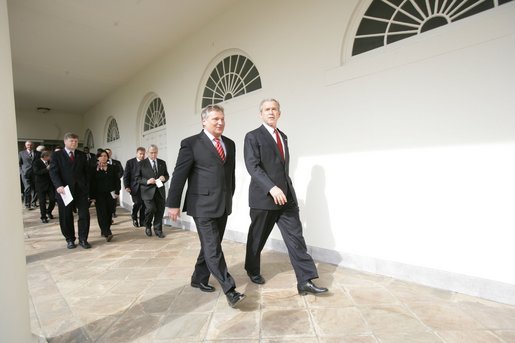
George W. Bush and Aleksander Kwasniewski | PRESIDENT BUSH: The President and I will have opening statements. I'll answer a question from the American press; he'll answer a question -- or somebody will answer a question from the Polish press. And we'll do this twice. |
| We'll continue to discuss the Ukraine. And let me just step back and say that I'm impressed by the leadership of President Kwasniewski when it came to the Ukraine. He showed remarkable leadership. And the people of Ukraine are better for it, and the world appreciates that and I appreciate it. | 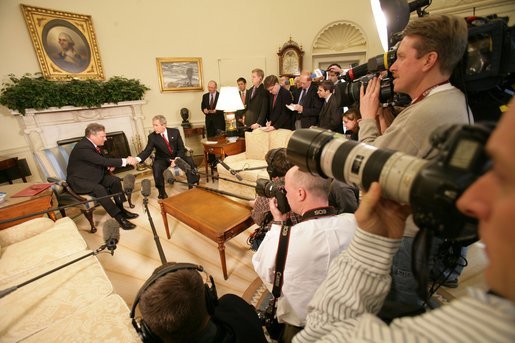
George W. Bush and Aleksander Kwasniewski 2 |
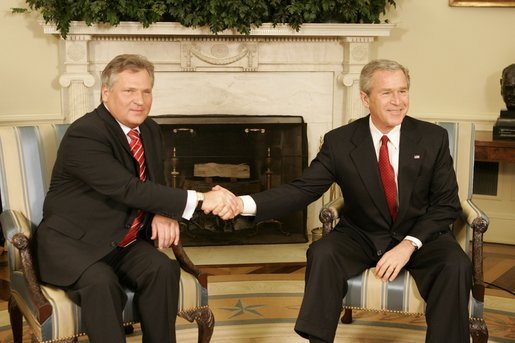
George W. Bush and Aleksander Kwasniewski 3 | We'll spend time continuing to talk about the importance of our bilateral relationship, whether it be trade and commerce, or whether it be the ability of Polish folks to travel to the United States of America. The visa policy of the country has been under review for a while, and now we've got a way forward to make trips to America easier for Polish citizens. |
PRESIDENT KWASNIEWSKI: No.
PRESIDENT BUSH: It's a lateral transfer. (Laughter.) Anyway, I am thrilled you're here, and look forward to seeing you not only over lunch, but in Brussels on my trip. Welcome.
PRESIDENT KWASNIEWSKI: Thank you. So I should speak Polish in the beginning.
Mr. President, ladies and gentlemen, first of all, I would like to express my joy that this is my fourth visit already to the White House, visiting President George W. Bush.
I want to tell you that we talked about Polish-American cooperation, which has now a strategic, lasting character. And in the recent years, we have had many successful events in cooperation with the United States.
During our meeting today we talked about Iraq. Poland participates in the stabilization mission in Iraq, and we are full of optimism thinking about that country and about the successful completion of our mission.
We have been talking about the transatlantic relationships, and we are very happy that America is getting closer and is having better and better relations with our European neighbors and also with Poland. We talked about bilateral cooperation, and both President Bush and myself talked about the adoption of the road map that is going to solve the visa problem. And it implies concrete decisions that are going to be made in relation to the visa regime, doing away with some old information -- old data, statistics concerning the immigration violation from before 1989, easing the procedures, review of different -- that are connected to the visa system, and further cooperation with the Congress in order to facilitate the process as much as possible.
We hope that the road map that has been accepted will be a very good solution. Poland will have to observe many rules, and it will bring about a final doing away with this problem that has been present in our talks for many years now.
I would like also to say that as far as the thank-you words concerning Ukraine are concerned, everything wouldn't be possible without the participation of the United States. And without the United States' role, it wouldn't be possible to finish the crisis situation in Ukraine and strengthen democracy in that country. It is the success of Ukraine and the Ukrainian people, but it is also the success of all of us.
PRESIDENT BUSH: Very good, thank you.
Deb.
Q Mr. President, Secretary Rice said today in Brussels that the United States would not tolerate foot-dragging by Tehran on accounting for their nuclear program. Is time running out for Iran to come to terms with the European negotiators?
PRESIDENT BUSH: The Iranians just need to know that the free world is working together to send a very clear message: Don't develop a nuclear weapon. And the reason we're sending that message is because Iran with a nuclear weapon would be a very destabilizing force in the world.
And I look forward to going over to Europe to continue discussing this issue with our allies. It's important we speak with one voice. I'm very pleased with the response that European leaders have given to Dr. Rice on this issue. She has made -- her trip, by the way, has been a fantastic trip. I want to thank Aleksander, the President, for being so gracious to her on the first leg of her trip, or one of the first legs on her trip. But the message is, is that we're going to speak with one voice, and we'll continue to do so.
Yes, Polish --
PRESIDENT KWASNIEWSKI: Yes, please, Polish press.
Q I have a question to President Bush. Are you going to -- concerning the visa problem, are you going to support the legislation being introduced in the Congress? I talked to some congressmen; they say they keep receiving mixed signals from the White House concerning the issue.
PRESIDENT BUSH: Well, we've got a way forward to answer the questions of a lot of the members of the United States Congress to get this issue solved. And the President has been very -- hard at work in helping develop a road map that is fair to the Polish people. And I adopt the principles and accept the recommendations of the road map, and that will become the basis for legislation.
Adam.
Q Mark McClellan is now acknowledging the new Medicare drug benefit will cost $720 billion, far more than the White House initially said. Will you consider steps to lower the cost? Might Medicare be a bigger problem now than Social Security?
PRESIDENT BUSH: Well, there's no question that there is a unfunded liability inherent in Medicare that we're -- Congress and the administration is going to have to deal with over time. Obviously, I've chosen to deal with Social Security first. And once we accomplish -- once we modernize and save Social Security for a young generation of Americans, then it will be time to deal with the unfunded liabilities in Medicare. The same issue that deals with -- creates a problem with Social Security creates a problem for Medicare. In other words, baby boomers are retiring with fewer payers going into the system. And I look forward to working with them.
Listen, the reforms haven't even begun yet. I signed a piece of legislation last year and the major reforms of providing prescription drugs for our seniors kicks in next year. And I look forward to watching those reforms take effect. I'm convinced they'll have cost savings for our society, and I know it will make the life of our seniors better.
And so we look forward to working with Congress to make sure that the Medicare reforms that are in place are fully enacted and the people can realize the benefits of them.
Q I've got a question to President Bush. Sir, will the United States increase its assistance in modernization of Polish armed forces?
PRESIDENT BUSH: We -- Aleksander and I, the President and I talked about that. He has been very insistent that -- about our mil-to-mil relations. He's been very forthright and very clear, and I appreciate his leadership on this issue. I am -- intend -- I say "intend" because our system is one where I make requests; Congress has to appropriate the money. But we will make requests that will enable there to be a mil-to-mil expenditure to help Poland modernize and fulfill its mission of about $100 million this year.
Now, again, I repeat, I don't get to write the checks in the American system; the government -- the Congress does that. But I get to put out requests. And I assured the President that would be -- when it's all said and done, that would be the request that we would put forward. I'm confident the Congress will respond.
Listen, Poland has been a fantastic ally, because the President and the people of Poland love freedom. And I know the people of your country must have been thrilled when the millions of people went to the polls and showed that people from all parts of the world want to live in a free society, just like your great nation has shown the world over the last decade.
So, Mr. President, welcome. Thanks for coming. I value our friendship.
PRESIDENT KWASNIEWSKI: Thank you, Mr. President.
PRESIDENT BUSH: Thank you all. END 12:01 P.M. EST
For Immediate Release Office of the Press Secretary February 9, 2005
0
comments
||
||
Wednesday, February 09, 2005
Class Action Fairness Act of 2005 S.5
Class Action Fairness Act of 2005 S.5
(This measure has not been amended since it was introduced. The summary has been expanded because action occurred on the measure.)
Class Action Fairness Act of 2005 - (Sec. 3) Amends the Federal judicial code to specify the calculation of contingent and other attorney's fees in proposed class action settlements that provide for the award of coupons to class members.
Prohibits a Federal district court from approving: (1) a proposed coupon settlement absent a finding that the settlement is fair, reasonable, and adequate; (2) a proposed settlement involving payments to class counsel that would result in a net monetary loss to class members, absent a finding that the loss is substantially outweighed by nonmonetary benefits; or (3) a proposed settlement that provides greater sums to some class members solely because they are closer geographically to the court.
Specifies requirements for serving notices of proposed settlements on appropriate State and Federal officials. Prohibits issuance of an order giving final approval to a proposed settlement earlier than 90 days after such service. Allows class members to refuse compliance with settlement agreements or consent decrees absent notice.
(Sec. 4) Grants district courts original jurisdiction of any civil action in which the matter in controversy exceeds $5 million, exclusive of interest and costs, and that is between citizens of different States, or citizens of a State and a foreign State or its citizens or subjects.
Lists those factors pursuant to which a district court may, in the interests of justice and based on the totality of the circumstances, decline to exercise jurisdiction over a class action in which more than one-third but less than two-thirds of the members of the proposed plaintiff classes in the aggregate and the primary defendants are citizens of the State in which the action was originally filed, based on consideration of whether: (1) the claims involve matters of national or interstate interest; (2) the claims will be governed by laws of the State where the action was originally filed or by the laws of other States; (3) the class action has been pleaded in a manner that seeks to avoid Federal jurisdiction; (4) the action was brought in a forum with a distinct nexus with the class members, the alleged harm, or the defendants; (5) the number of citizens of the State of original filing in all proposed plaintiff classes in the aggregate is substantially larger than the number of citizens from any other State and the citizenship of other proposed class members is dispersed; and (6) during the three-year period preceding filing, one or more other class actions asserting the same or similar claims on behalf of the same persons have been filed.
Specifies those circumstances in which a district court must decline jurisdiction, including those class actions in which: (1) more than two-thirds of the members of the proposed plaintiff classes in the aggregate are citizens of the State where the action was originally filed, at least one defendant is a defendant from whom significant relief is sought, whose alleged conduct forms a significant basis for the claims asserted, and who is a citizen of the State where the action was originally filed, and principal injuries resulting from the alleged or related conduct were incurred in such State; and (2) during the three-year period preceding filing, no other class action has been filed asserting the same or similar factual allegations against any of the defendants on behalf of the same or other persons; or (3) two-thirds or more of the members of all proposed plaintiff classes in the aggregate, and the primary defendants, are citizens of the State where the action was originally filed.
Makes provisions of this Act concerning the application of Federal diversity jurisdiction applicable to any class action before or after entry of a class certification order.
(Sec. 5) Sets forth provisions governing the removal of interstate class actions to Federal district court and the review on appeal of remand orders.
(Sec. 6) Directs the Judicial Conference of the United States to report on class action settlements, incorporating recommendations for best court practices to ensure fairness for class members and appropriate fees for counsel.
(Sec. 7) States that amendments to Federal Rule of Civil Procedure 23 (governing class actions) set forth in the Supreme Court order entered on March 27, 2003, shall take effect on the date of enactment of this Act or on December 1, 2003, whichever occurs first.
(Sec. 8) Retains the authority of the Supreme Court and Judicial Conference to propose and prescribe general rules of practice and procedure.
0
comments
||
||
Inter-American Committee Against Terrorism
U.S. Delegation to the Fifth Regular Session of the Inter-American Committee Against Terrorism
The Fifth Regular Session of the Organization of American States (OAS) Inter-American Committee Against Terrorism (CICTE), will take place in Port-of-Spain, Trinidad and Tobago, on February 16-18, 2005. Asa Hutchinson, Under Secretary for Border and Transportation Security at the Department of Homeland Security (DHS), will lead the U.S. delegation. Ambassador John F. Maisto, U.S. Permanent Representative to the OAS, and William P. Pope, the State Department's Acting Coordinator for Counterterrorism are also scheduled to join him.
The conference will build on the momentum created by the Inter-American Convention Against Terrorism, which was signed in the wake of the attacks of September 11, 2001. The member states of the committee expect to approve a political declaration that strengthens the hemisphere's commitment to counterterrorism cooperation. The participants will focus on a broad range of issues, including strengthening border and financial controls and addressing threats to cybersecurity, transportation infrastructure and document security.
2005/169 Released on February 9, 2005 Media Note Office of the Spokesman Washington, DC February 9, 2005
0
comments
||
||
Medicare Drug Benefit Estimates Unchanged
Fact Sheet: Setting the Record Straight: Medicare Drug Benefit Estimates Unchanged
Myth: Today's Washington Post story (p A1), headlined "Medicare Drug Benefit May Cost $1.2 Trillion," is simply wrong. The article says "the White House released budget figures yesterday indicating that the new Medicare prescription drug benefit will cost more than $1.2 trillion in the coming decade, a much higher price tag than President Bush suggested when he narrowly won passage of the law in late 2003." This statement in the first paragraph of the story is flat wrong. The White House is seeking a correction from The Washington Post.
Here are the Facts:
In 2003, President Bush committed to spending $400 billion over the next 10 years (2004 to 2013) to modernize Medicare and add an Rx benefit to the program. In December 2003, President Bush signed into law the Medicare Modernization Act, which the Congressional Budget Office scored as costing $395 billion over the 10 year period the President discussed (2004 to 2013). The Medicare Actuaries later estimated that the Act's 10 year cost for the period 2004-2013 would be $534 billion. The Congressional Budget Office continued to estimate $395 billion for the same time frame. The 2004-2013 CMS net estimate of Federal spending on the Medicare prescription drug benefit is virtually unchanged from previous estimates. Last year, CMS estimated the cost of the first 10 years of the program (2004-2013) at $511 billion, and this year, they believe that cost to be $518 billion. This cost estimate includes two years (2004 and 2005) before the Medicare drug benefit is scheduled to begin. The FY 2006 budget includes a cost estimate for the Rx drug benefit for a different 10-year time frame, 2006-2015, when the drug benefit is fully phased in. The 2006-2015 CMS net estimate of Federal spending on the Medicare prescription drug benefit is $723 billion. The $1.2 trillion figure from today's Washington Post is flat wrong, because it does not take into account savings to the government from premium payments, state payments, and savings from the Medicaid system.
Remember:
Beginning next January, all Medicare beneficiaries will be eligible for prescription drug coverage, regardless of their income, or whether they're enrolled in traditional fee-for-service or a Medicare Advantage plan. Seniors already are benefiting from better preventive coverage under Medicare that took effect last month. These new benefits include screenings for diabetes, heart disease and breast cancer. In addition, beneficiaries entering the Medicare program are eligible for a "Welcome to Medicare" physical. Through the Medicare-approved drug discount program, the purchasing power of seniors is finally being pooled to provide real savings on prescription medicines. Prior to the discount program, seniors often have had to pay full price for drugs. And the drug card program also gives seniors unprecedented information on drug prices to comparison shop. More than 6.2 million of these seniors are now saving on their prescriptions through Medicare drug discount cards. Seniors can use the card to save 15 to 30 percent off the usual retail price of most brand name drugs and more on generics at neighborhood pharmacies. Savings from the cards are even greater when seniors choose generics. A new CMS study shows that savings on generic drugs range from 28 to 75 percent below the average generic prices paid by all Americans. Generic drugs are just as safe and effective as brand-name drugs in the United States, saving consumers billions of dollars annually. Low-income seniors can get these savings and an additional $600 a year - a total of $1,200 for 2004 and 2005. An estimated 1.7 million seniors are receiving this credit through cards with the Medicare-approved seal. There is no enrollment fee on any card for people who qualify for the $600 low-income credit. Beneficiaries who exhaust the $600 subsidy may get additional savings. A growing list of drug manufacturers has agreed to make many of their products available at a nominal price to beneficiaries who have used up their $600 subsidy on prescription medicines. These seniors are benefiting in three important ways from the cards: 1) lower prices on their medicines; 2) a $600 subsidy to help them buy these medicines at the discounted prices; and 3) availability of drugs at a nominal price through manufacturers once they've spent the subsidy. # # #
For Immediate Release Office of the Press Secretary February 9, 2005
0
comments
||
||
William McGurn Assistant to the President for Speechwriting
President George W. Bush announced that he has named William McGurn Assistant to the President for Speechwriting.
"Bill McGurn is an accomplished writer, with extensive experience in foreign affairs and economic policy. He will make an excellent addition to my speechwriting team," stated President Bush.
Mr. McGurn previously served as an executive in the Office of the Chairman at News Corporation. Prior to that, he was the chief editorial writer for the Wall Street Journal and a member of its editorial board. From 1992 to 1998, Mr. McGurn was a senior editor for the Dow Jones-owned Far Eastern Economic Review in Hong Kong. Earlier in his career, he served as the Washington bureau chief for National Review. Mr. McGurn is a graduate of the University of Notre Dame and Boston University. # # #
For Immediate Release Office of the Press Secretary February 9, 2005 Personnel Announcement
0
comments
||
||
Solidarity Initiative Partners in Freedom $400 million
President Bush Announces Solidarity Initiative to Support our Partners in Freedom
The President intends to ask Congress to support $400 million in additional funding to strengthen the capabilities of our partners to advance democracy and stability around the world. These funds, which the Administration will seek in the supplemental budget request, reflect the principle that an investment in a partner in freedom today will help ensure that America will stand united with stronger partners in the future. This assistance will support nations that have deployed troops in Iraq and Afghanistan, as well as other partners promoting freedom around the world.
As President Bush has said, "the best hope for peace in our world is the expansion of freedom in all the world." Our closest partners agree. For many of these partners, now vibrant democracies and staunch allies, the tragedy of tyranny is a painful chapter in their own recent histories. They understand the value of freedom, and are delivering on their strong commitment to fostering democracy at home by helping to advance freedom and stability abroad.
Today, the President met with one of our strongest partners in freedom, President Aleksander Kwasniewski of Poland. The Solidarity Initiative will assist nations such as Poland, which have taken political and economic risks in order to act on their convictions, to develop and sustain the capabilities needed to do so.
Congress has consistently supported our partners in freedom in the past. We urge continued Congressional support for these partners in the future. # # #
For Immediate Release Office of the Press Secretary February 9, 2005 Statement by the Press Secretary
0
comments
||
||


