


President Bush to Welcome King Harald V and Queen Sonja of Norway to the White House
The President and Mrs. Bush will host the King and Queen of Norway for lunch at the White House on March 7, 2005. The United States and Norway share a long history of friendship and a strong commitment to freedom. Norway is contributing to democracy and stability in Afghanistan, the Balkans and Iraq, and working with us to resolve conflicts and provide assistance in Sudan, Sri Lanka and elsewhere around the world. The visit of Their Majesties King Harald and Queen Sonja will mark 100 years of U.S.-Norwegian diplomatic relations. # # #
For Immediate Release Office of the Press Secretary February 15, 2005
Tuesday, February 15, 2005
White House, King Harald V and Queen Sonja of Norway
0
comments
||
||

Supplemental Budget appropriations of $81.9 billion
President's Statement on Supplemental Budget
With the help of the United States and coalition partners, the Iraqi and Afghan people have set their countries on the path of democracy and freedom. As both nations work to cement this great progress, our troops and assistance will continue to play a critical role.
The majority of this request will ensure that our troops continue to get what they need to protect themselves and complete their mission. It also provides for the continued pursuit of al-Qaida and other terrorist elements in Afghanistan and elsewhere. And it reflects our core mission in Iraq and Afghanistan by providing funding to accelerate efforts to train and equip Iraqi and Afghan forces, so they can assume greater responsibility for their own security and our troops can return home with the honor they have earned.
Other important funding in this emergency request includes resources to seize the opportunity to build peace and democracy in the Middle East, to continue helping nations affected by the tsunamis, and to address other unforeseen needs.
I urge the Congress to move quickly so our troops and diplomats have the tools they need to succeed. # # #
For Immediate Release Office of the Press Secretary February 14, 2005
Related:
0
comments
||
||
H.CON.RES.25 `Greensboro Four'
CONCURRENT RESOLUTION
Recognizing the contributions of Jibreel Khazan (Ezell Blair, Jr.), David Richmond, Joseph McNeil, and Franklin McCain, the `Greensboro Four', to the civil rights movement.
Whereas on February 1, 1960, Jibreel Khazan (Ezell Blair, Jr.), David Richmond, Joseph McNeil, and Franklin McCain, four African-American freshman students at North Carolina Agricultural & Technical State University, walked into the F.W. Woolworth store in downtown Greensboro, North Carolina, and sat at the `whites only' lunch counter, thereafter becoming known as the `Greensboro Four';
Whereas the `Greensboro Four' were refused service but continued to sit at the lunch counter in nonviolent protest;
Whereas the sit-in by the `Greensboro Four' was an act of courage and conscience, and inspired sit-ins across North Carolina and the southern United States to protest racial segregation in public accommodations and in other areas of life;
Whereas the courageous protest of the `Greensboro Four' and all of the sit-in demonstrations made a critical contribution to the civil rights movement, leading to the enactment of the Civil Rights Act of 1964 and the integration of public accommodations; and
Whereas the civil rights movement made our nation more just and decent, and the courage and conscience of the `Greensboro Four' should inspire all Americans to act against injustice: Now, therefore, be it
Resolved by the House of Representatives (the Senate concurring), That the Congress--
(1) applauds the valor and courageous efforts of Jibreel Khazan (Ezell Blair, Jr.), David Richmond, Joseph McNeil, and Franklin McCain, known as the `Greensboro Four'; and
(2) encourages all Americans to remember the contributions they made to the civil rights movement and to conduct appropriate ceremonies, activities, and programs to commemorate the sit-in of the `Greensboro Four'. Bill Summary & Status for the 109th Congress
0
comments
||
||
SENATOR COLLINS, Michael Chertoff
SENATOR COLLINS CALLS FOR SENATE APPROVAL OF HOMELAND SECURITY SECRETARY NOMINEE Collins manages nomination on Senate floor; Vote to confirm Michael Chertoff expected Tuesday
Washington, DC – Senator Susan Collins today called on her colleagues in the Senate to act quickly to approve the President’s nominee to be the Secretary of the Department of Homeland Security (DHS), Judge Michael Chertoff. Senator Collins managed the nomination debate on the Senate floor and spoke strongly in favor of Judge Chertoff. She said that the DHS needed a new leader as soon as possible, pointing out that the Secretary position was vacated thirteen days ago, and that Judge Chertoff is the right person for the job.
The confirmation of Judge Michael Chertoff was approved last week in a unanimous vote by the Homeland Security and Governmental Affairs Committee, which Senator Collins chairs.
In a speech to the Senate, Senator Collins said, “I am convinced that Michael Chertoff has the character and the qualifications to excel in what is one of the most challenging positions in all of government. The strengths and experience he brings are impressive. He has devoted a significant part of his life to public service, as a federal prosecutor in New Jersey, as the head of the Justice Department’s Criminal Division, and now as a federal judge.”
“He knows what is needed to fight a war on terrorism, the importance of strategic planning and the need to constantly improve information sharing and cooperation among agencies at all levels of government. Our nation will benefit greatly from these attributes and experiences in our next Homeland Security Secretary,” Senator Collins added.
Senator Collins said that she is also impressed with his commitment to civil liberties. She said that in border states like Maine, it is crucial that there is a balance between border security and the need to allow the free flow of individuals. Chertoff’s response to Senator Collins’ concerns was, “I believe that we cannot live in liberty without security, but we would not want to live in security without liberty.”
Senator Collins called on her colleagues to approve Chertoff’s nomination as soon as possible. “Judge Chertoff’s commitment to work tirelessly as the next DHS Secretary, combined with his character and qualifications, make it a privilege to enthusiastically present his nomination to my colleagues in the Senate.”
The Senate is expected to vote on Chertoff’s nomination on Tuesday. ###
February 14, 2005 Contact: Elissa Davidson (202) 224-4751
0
comments
||
||
Monday, February 14, 2005
Korea, Christopher Hill Six-Party Talks
Korea – Appointment of Head of the U.S. Delegation to the Six-Party Talks
Secretary Rice today appointed our Ambassador to Korea, Christopher Hill, to serve concurrently as the head of the U.S. Six-Party Talks delegation.
Ambassador Hill is a career foreign service officer and a veteran negotiator.
Ambassador Hill will remain in Seoul but plans at an early opportunity to meet with his counterparts. He will lead the interagency delegation to the next plenary session of the talks, which we believe should occur at an early date and without preconditions.
Ambassador Hill’s appointment underscores U.S. support for the Six-Party Talks and the goal of a diplomatic solution ending North Korea’s nuclear weapons programs.
Special Envoy Joseph DeTrani will continue to be responsible for the day-to-day oversight of the Six-Party Talks issues.
2005/191 Released on February 14, 2005 Daily Appointments Schedule Richard Boucher, Spokesman Washington, DC February 14, 2005
0
comments
||
||
Death of Rafik Hariri
Death of Former Prime Minister Rafik Hariri Secretary Condoleezza Rice Washington, DC February 14, 2005
The United States expresses its deepest condolences to the family and loved ones of former Prime Minister Rafik Hariri and to the others who were killed and wounded in the brutal terrorist attack in Beirut today. We state our unequivocal condemnation of this act of terrorism. We call on all parties to maintain calm and avoid further violence.
Prime Minister Hariri was a statesman who was committed to the restoration and renewal of Lebanon after the ravages of that country’s tragic civil war. His vision of a prosperous Lebanon, living in peace with its neighbors, sent a powerful message of hope to the people of Lebanon and the region.
In its Resolution 1566, the United Nations condemned “in the strongest terms all acts of terrorism” and called upon States “to cooperate fully in the fight against terrorism.”
All of those responsible for this terrible crime must be brought to justice immediately. The United States, together with the international community, will follow closely to ensure that this happens.
In its Resolution 1559, the United Nations Security Council called for “all parties concerned to cooperate fully and urgently” in “the restoration of the territorial integrity, full sovereignty, and political independence of Lebanon.” It called for the Government of Lebanon to extend its control over all Lebanese territory.
The United States takes this opportunity to once again call for the immediate implementation of Resolution 1559, including the withdrawal of all Syrian forces, the disbanding and disarmament of all militias, and an end to foreign interference in the political independence of Lebanon. The Lebanese people must be free to exercise their political choices without intimidation or the threat of violence. 2005/187 Released on February 14, 2005
0
comments
||
||
Department of Defense Announces Contract Reviews
Department of Defense Announces Contract Reviews
Michael W. Wynne, acting under secretary of defense for acquisition, technology and logistics announced today that he has asked the DoD Inspector General to review eight contracts which were under the decision-making purview of convicted former Air Force acquisition manager Darlene Druyun.
The Defense Contract Management Agency reviewed all the contracts that Ms. Druyan was directly involved with since 1993 at the request of Wynne. They examined more than 8,000 pages of information in 407 contracts and identified these eight contracts that appear to have anomalies in them which warrant further review. A list can be found at defenselink.mil/news/
Wynne developed a three-part plan to ensure that all contracting procedures in the Department were reviewed, this completes one step of that plan. Additionally, the Defense Science Board task force has examined the processes the department makes in acquisition decisions. This report, which will be issued in March, looks at the checks and balances necessary to preserve the integrity of those decisions. Lastly, the Government Accountability Office was asked to review protests by other defense contractors based upon the actions mentioned in Druyun’s plea agreement.
The department is committed to ensuring that all contract processes are conducted within the legal and ethical requirements set forth by law. The responsibility to oversee the proper expenditure of tax dollars is critical to the department.
No. 157-04 IMMEDIATE RELEASE February 14, 2005
0
comments
||
||
United Nations Oil-for-Food Program
U.S. Senate Committee on Governmental Affairs Permanent Subcommittee on Investigations Chairman Susan Collins and Ranking Member Joseph Lieberman
Title: The United Nations’ Management and Oversight of the Oil-for-Food Program
Date: 2/15/05 Time (EST): 9:30 AM Place: Dirksen Senate Office Building, Rm. 342
The Subcommittee’s first hearing on the Oil-for-Food Program (“OFF Program”) laid the foundation for future hearings by describing how the OFF Program was exploited by Saddam Hussein. This second hearing will examine the operations of the independent inspection agents retained by the United Nations and their role within the OFF Program. The administration of the OFF Program by the U.N. Office of the Iraq Program and the findings of the U.N. Office of Internal Oversight Services will also be examined.
Witnesses
Panel 1
Robert M. Massey , Cheif Executive Officer , Cotecna Inspection S.A.
Andre E. Pruniaux , Former Senior Vice President , Africa and Middle East Division, Cotecna Inspection S.A.
John Denson , General Counsel , Saybolt Group
Verne Kulyk , Former Customs Officer , United Nations Office of the Iraq Program (OIP) TBA , Former Inspector , Cotecna Inspection S.A.
Panel 2
Joseph A. Christoff , Director , International Affairs and Trade Team, Government Accountability Office
Dileep Nair , Under Secretary General , Office of Internal Oversight Services (OIOS)
Stafford Clarry , Former Humanitarian Affairs Advisor , United Nations Oil-for-Food Program
Panel 3
Patrick F. Kennedy , Ambassador to the United Nations for Management and Reform , United States Mission to the United Nations.
0
comments
||
||
John B. Bellinger III, R. Nicholas Burns, C. David Welch
NOMINATIONS SENT TO THE SENATE:
John B. Bellinger III, of Virginia, to be Legal Adviser of the Department of State, vice William Howard Taft, IV.
R. Nicholas Burns, of Massachusetts, to be an Under Secretary of State (Political Affairs), vice Marc Isaiah Grossman, resigned.
C. David Welch, of Virginia, to be an Assistant Secretary of State (Near Eastern Affairs), vice William J. Burns. # # #
For Immediate Release Office of the Press Secretary February 14, 2005
0
comments
||
||
Lester M. Crawford Commissioner of Food and Drugs
President George W. Bush today announced his intention to nominate one individual to serve in his Administration:
The President intends to nominate Lester M. Crawford, of Maryland, to be Commissioner of Food and Drugs at the Department of Health and Human Services. Dr. Crawford currently serves as Acting Commissioner of the Food and Drug Administration. He previously served as Chair of the Department of Physiology-Pharmacology at the University of Georgia, Administrator of the Food Safety and Inspection Service and Deputy Commissioner of FDA. Earlier in his career, Dr. Crawford was Director of the Center for Food and Nutrition Policy at Georgetown University and Virginia Tech. He has served as an advisor to the United Nations' World Health Organization for nearly twenty years. Dr. Crawford is a Member of the National Academy of Sciences' Institute of Medicine and is a Fellow of the Royal Society of Medicine (UK). He earned his Doctor of Veterinary Medicine from Auburn University and his PhD in pharmacology from the University of Georgia. # # #
For Immediate Release Office of the Press Secretary February 14, 2005 Personnel Announcement
0
comments
||
||
President's Statement on Beirut Terrorist Attack
Statement on Beirut Terrorist Attack
The President was shocked and angered to learn of the terrorist attack in Beirut today that murdered former Prime Minister Hariri and killed and injured several others. Mr. Hariri was a fervent supporter of Lebanese independence, and worked tirelessly to rebuild a free, independent, and prosperous Lebanon following its brutal civil war and despite its continued foreign occupation. His murder is an attempt to stifle these efforts to build an independent, sovereign Lebanon free of foreign domination. The people of Lebanon deserve the freedom to choose their leaders free of intimidation, terror, and foreign occupation, in accordance with UN Security Council Resolution 1559. The United States will consult with other governments in the region and on the Security Council today about measures that can be taken to punish those responsible for this terrorist attack, to end the use of violence and intimidation against the Lebanese people, and to restore Lebanon's independence, sovereignty, and democracy by freeing it from foreign occupation. # # #
For Immediate Release Office of the Press Secretary February 14, 2005
0
comments
||
||
Attorney General Gonzales at Swearing-In Ceremony
President Thanks Attorney General Gonzales at Swearing-In Ceremony FULL STREAMING VIDEO and transcript U.S. Department of Justice Washington, D.C. 10:06 A.M. EST
THE PRESIDENT: Good morning. Laura and I are pleased to be here with Al Gonzales, his wife Becky, and their wonderful family. Thank you all for coming. I turned to Al and said, "It seems like they're cheering pretty loud." He said, "Most of them work for me now." (Laughter.)
For the past decade, Al has been a close advisor, an honorable public servant, and a dear friend. Now, he assumes a new title. Today it is my honor to call this son of Humble, Texas, the 80th Attorney General of the United States. (Applause.)
I appreciate Justice Sandra Day O'Connor for administering the oath, and admitting publicly that she was born in Texas. (Laughter.) I want to thank the current and former members of my Cabinet who are here. I appreciate Senator Pat Leahy, Senator Judd Gregg and Kathy, Senator John Cornyn and Sandy, Senator Mel Martinez for joining us today. I thank Congresswoman Grace Napolitano for joining us. I thank the other distinguished guests who are here, and I thank the Texans who have come up. (Applause.)
As Attorney General Gonzales begins his service, he will build on the outstanding work of Attorney General John Ashcroft. (Applause.) Over the past four years, Attorney General Ashcroft has started the Department of Justice on the right course in the war on terror; he's helped reduce violent crime to a 30-year low; he's taken vital new steps to protect children from exploitation. John Ashcroft has worked tirelessly to make our nation safer and more just, and America is thankful for your lifetime of service. (Applause.)
Attorney General Gonzales now joins every employee at the Department of Justice in an urgent mission to protect the United States from another terrorist attack. Few periods in our history have demanded so much of this department. With Al's principled leadership, the Department of Justice will continue this important mission, and will defend the security of all Americans and the liberty of all Americans.
The men and women of this department are meeting your duty every day -- from your headquarters in Washington to U.S. Attorneys offices across the country, to dangerous posts overseas. You've reorganized your resources to confront the threats of this new war. You've devised effective methods to investigate and prosecute terrorists. Some of you have volunteered for demanding new duties in complex areas such as intelligence and counterterrorism. Our nation is grateful for your dedication and sacrifice.
And in return, we must provide you all the tools you need to do your job. And one of those tools is the Patriot Act, which has been vital to our success in tracking terrorists and disrupting their plans. Many key elements of the Patriot Act are now set to expire at the end of this year. We must not allow the passage of time or the illusion of safety to weaken our resolve in this new war. To protect the American people, Congress must promptly renew all provisions of the Patriot Act this year. (Applause.)
Your mission to ensure equal justice for every American extends far beyond the war on terror. By aggressively prosecuting gun criminals and drug dealers, you make neighborhoods safer for all families. By holding corporate wrongdoers to account, you build confidence in our economy. By protecting victims of child abuse and domestic violence, you help guarantee a compassionate society. And by defending the civil rights of every American, you affirm the dignity of every life, and you set an example of liberty for the entire world.
As we strive to provide equal justice, we must ensure that Americans of all races and backgrounds trust the legal system. By spreading the use of DNA analysis, we can solve more crimes, lock up more criminals, and prevent wrongful conviction. So I've asked Congress for more than a billion dollars over five years to expand this vital technology. And to help ensure that the death penalty is applied justly, I've also requested new funding to train prosecutors, judges and defense counsels in capital cases.
To maintain confidence in the legal system, we must ensure that judges faithfully interpret the law, not legislate from the bench. I've a constitutional responsibility to nominate well-qualified men and women for the federal courts -- I have done so. And I've benefited greatly from the sound judgment of Attorney General Gonzales on picking qualified people to serve on our benches. I will continue to rely on his advice. And the United States Senate must also live up to its constitutional responsibility. Every judicial nominee deserves a prompt hearing and an up or down vote on the floor of the United States Senate. (Applause.)
As he embarks on all these duties, Attorney General Gonzales has my complete confidence. From his early days of selling soda at Rice University football games, to his time in the Air Force, to his distinguished legal career and service on the White House staff, Al has been a model of courage and character to his fellow citizens. I've witnessed his integrity, his decency, his deep dedication to the cause of justice. Now he will advance that cause as the Attorney General and ensure that more Americans have the opportunity to achieve their dreams.
Attorney General -- or, General -- congratulations. (Applause.)
GENERAL GONZALES: Thank you.
From the day the President announced my nomination as the Attorney General of the United States, three months ago, I have thought often about how to best prepare to meet the awesome responsibilities of this office. Outside these walls, the cries of those powerless souls who are injured, disenfranchised, or otherwise aggrieved may, indeed, be faint. But those same pleas for help echo powerfully within the Department of Justice. Every day, like a steady drum beat, we are asked to provide an answer to a problem, to secure a remedy, to be a champion. And every day, this department responds, as it has done so time and time again throughout the history of our beloved America.
There has been much discussion during my confirmation about the appropriate role of the Attorney General, certainly an important and legitimate debate about the individual viewed by many as the primary guardian of our rights and protector of our freedoms. Undeniably, the Attorney General is a member of the President's Cabinet, a part of his team. But the Attorney General represents, also, the American people, and his first allegiance must always be to the Constitution of the United States.
And so I rise today to reassure you that I understand the special role of this office, and to commit to do my best on behalf of the American people, to fulfill the confidence and trust reflected in my appointment. I rise also to express my thanks to all of you here and around the country, particularly in Texas, who have walked with me, even for just a short time, along my journey.
My words, I fear, are inadequate to convey my gratitude for picking me up when I have stumbled. Can a son repay the debt reflected in a lifetime of sacrifice by his parents? Can a husband express in appropriate words and deeds his love and respect for the many years of affection and loyalty of a loving wife? Can a friend compose a message of sufficient gratitude for a President who has been an inspiration and mentor? Mom, Becky, Mr. President: I do not believe I can, nor do I intend to even try in this abbreviated ceremony, other than to acknowledge, from the bottom of my heart, how much each of you has meant in my life. In the years ahead, I hope that my service as Attorney General will serve to honor your faith and trust in me.
Finally, I rise to embrace the employees of the Department of Justice. I assume this office knowing that the dedicated men and women here are focused on protecting the lives and the liberties of our citizens. Tremendous strides in the war on terrorism were made under the leadership of Attorney General John Ashcroft, and I thank him for his service to our country and to the cause of freedom. Like John, I am but one instrument in our battle for freedom and the protection of our rights. And I am confident that in the days and years ahead, we in the department will work together tirelessly to address terrorism and other threats to our nation, and to confront injustice with integrity and devotion to our highest ideals.
America is my home. I believe in her promise, and I will do what I can to secure that promise for future generations of our children. America is great, not because of our military might or our economic strength, but because of the greatness of Americans. And I welcome the opportunity to stand shoulder to shoulder, side by side, with each of you, to preserve our heritage, rich in liberty and justice for all.
Thank you, and may God continue to bless the United States of America. (Applause.)
END 10:19 A.M. EST For Immediate Release Office of the Press Secretary February 14, 2005
0
comments
||
||
Sunday, February 13, 2005
Personal Retirement Accounts
“As we fix Social Security, we also have the responsibility to make the system a better deal for younger workers. And the best way to reach that goal is through voluntary personal retirement accounts.”
President George W. Bush State of the Union Address February 2, 2005
The President believes personal retirement accounts must be part of a comprehensive solution to strengthen Social Security for the 21st century.
Under the President’s plan, personal retirement accounts would start gradually. Yearly contribution limits would be raised over time, eventually permitting all workers to set aside 4 percentage points of their payroll taxes in their accounts. Annual contributions to personal retirement accounts initially would be capped, at $1,000 per year in 2009. The cap would rise gradually over time, growing $100 per year, plus growth in average wages.
Personal retirement accounts offer younger workers the opportunity to build a “nest egg” for retirement that the government cannot take away.
• Personal retirement accounts could be passed on to children and grandchildren. The money in these accounts would be available for retirement expenses. Any unused portion could be passed on to loved ones. Permitting individuals to pass on their personal retirement accounts to loved ones will be particularly beneficial to widows, widowers, and other survivors. According to the non-partisan analysis by the Social Security Administration’s Office of Retirement Policy, the ability to inherit personal accounts provides the largest gains to widows and other survivors.
• Personal retirement accounts help make Social Security better for younger workers. A personal retirement account gives a younger worker the chance to save a portion of his or her money in an account and watch it grow over time at a greater rate than anything the current system can deliver. The account will provide money for the worker’s retirement in addition to the check he or she receives from Social Security. Personal retirement accounts give younger workers the chance to receive a higher rate of return from sound, long-term investing of a portion of their payroll taxes than they receive under the current system.
Personal retirement accounts would be voluntary. At any time, a worker could “opt in” by making a one-time election to put a portion of his or her payroll taxes into a personal retirement account.
• Workers would have the flexibility to choose from several different low-cost, broadbased investment funds and would have the opportunity to adjust investment allocations periodically, but would not be allowed to move back and forth between personal retirement accounts and the traditional system. If, after workers choose the account, they decide they want only the benefits the current system would give them, they can leave their money invested in government bonds like those the Social Security system invests in now.
• Those workers who do not elect to create a personal retirement account would continue to draw benefits from the traditional Social Security system, reformed to be permanently sustainable.
Personal retirement account options and management would be similar to that of the Federal employee retirement program, known as the Thrift Savings Plan (TSP). A centralized administrative structure would be created to collect personal retirement account contributions, manage investments, maintain records, and facilitate withdrawals at retirement. The structure would be designed to facilitate low costs, ease of use for new investors, and timely crediting of contributions. This centralized investment structure would help minimize compliance costs for employers.
• Contributions would be collected and records maintained by a central administrator. Similar to the TSP, private investment managers would be chosen through a competitive bidding process to manage the pooled account contributions.
• The central administrator would answer questions from account participants and distribute periodic account statements.
• The central administrator would also facilitate withdrawals and the purchase of annuities with account balances.
• Like TSP, we expect participants to have easy access to investment information and to their accounts. Participants could easily check account balances and adjust investment allocations.
Personal retirement accounts would be invested in a mix of conservative bonds and stock funds. Guidelines and restrictions would be put in place to provide sound investment choices and prevent individuals from spending the money in these accounts on the lottery or at the race track. Workers would be permitted to allocate their personal retirement account contributions among a small number of very broadly diversified index funds patterned after the current TSP funds.
• Like TSP, personal retirement accounts could be invested in a safe government securities fund; an investment-grade corporate bond index fund; a small-cap stock index fund; a large-cap stock index fund; and an international stock index fund.
• In addition to these TSP-type funds, workers could choose a government bond fund with a guaranteed rate of return above inflation.
• Workers could also choose a “life cycle portfolio” that would automatically adjust the level of risk of the investments as the worker aged. The life cycle fund would automatically and gradually shift the allocation of investment funds as the individual neared retirement age so that it was weighted more heavily toward secure bonds.
Personal retirement accounts would be protected from sudden market swings on the eve of retirement. To protect near-retirees from sudden market swings on the eve of retirement, personal retirement accounts would be automatically invested in the “life cycle portfolio” when a worker reaches age 47, unless the worker and his or her spouse specifically opted out by signing a waiver form stating they are aware of the risks involved. The waiver form would explain in clear, easily understandable terms the benefits of the life cycle portfolio and the risks of opting out. By shifting investment allocations from high growth funds to secure bonds as the individual nears retirement, the life cycle portfolio would provide greater protections from sudden market swings.
Personal retirement accounts would not be eaten up by hidden Wall Street fees. Personal retirement accounts would be low-cost. The Social Security Administration’s actuaries project that the ongoing administrative costs for a TSP-style personal account structure would be roughly 30 basis points or 0.3 percentage points, compared to an average of 125 basis points for investments in stock mutual funds and 88 basis points in bond mutual funds in 2003.( ici.org/issues/fee/fm-v13n5).
• The low costs are made possible by the economies of scale of a centralized administrative structure, as well as limiting investment options to a small number of prudent, broadly diversified funds.
• Most of these administrative costs are for recordkeeping which would be done by the government, not investment management done by Wall Street. (Report of the 1994-1996 Advisory Council on Social Security, p. 171 & January 31, 2002 Memorandum from the Social Security Actuary in the Final Report of the President’s Commission on Social Security, p. 19).
Personal retirement accounts would not be accessible prior to retirement. American workers who choose personal retirement accounts would not be allowed to make withdrawals from, take loans from, or borrow against their accounts prior to retirement.
Personal retirement accounts would not be emptied out all at once, but rather paid out over time, as an addition to traditional Social Security benefits. Under a system of personal retirement accounts, procedures would be established to govern how account balances would be withdrawn at retirement. This would involve some combination of annuities to ensure a stream of monthly income over the worker’s life expectancy, phased withdrawals indexed to life expectancy, and lump sum withdrawals. Individuals would not be permitted to withdraw funds from their personal retirement accounts as lump sums, if doing so would result in their moving below the poverty line. Account balances in excess of the poverty-protection threshold requirement could be withdrawn as a lump sum for any purpose or left in the account to accumulate interest. Any unused portion of the account could be passed on to loved ones.
Personal retirement accounts would be phased in. To ease the transition to a personal retirement account system, participation would be phased in according to the age of the worker. In the first year of implementation, workers currently between age 40 and 54 (born 1950 through 1965 inclusive) would have the option of establishing personal retirement accounts. In the second year, workers currently between age 26 and 54 (born 1950 through 1978 inclusive) would be given the option and by the end of the third year, all workers born in 1950 or later who want to participate in personal retirement accounts would be able to do so.
The President’s personal retirement account proposal is fiscally responsible. The President's proposal is consistent with his overall goal of cutting the deficit in half by 2009. Based on analysis by the Social Security Administration Actuary, the Office of Management and Budget estimates that the President’s personal retirement account proposal will require transition financing of $664 billion over the next ten years ($754 billion including interest). This transition financing will not have the same effect on national savings, and thus the economy, as traditional government borrowing. Personal retirement accounts will not reduce the pool of savings available to the markets because every dollar borrowed by the Federal government to fund the transition is fully offset by an increase in savings represented by the accounts themselves. Moreover, the transition financing for personal retirement accounts should be viewed as part of a comprehensive plan to make the Social Security system permanently sustainable. Publicly released analysis by the Social Security Administration has found that several comprehensive proposals including personal accounts would dramatically reduce the costs of permanently fixing the system.( ssa.gov/OACT/solvency/).
Establishing personal retirement accounts does not add to the total costs that Social Security faces. Personal retirement accounts effectively pre-fund Social Security benefits already promised to today's workers and do not represent a net increase in Federal obligations. The obligation to pay Social Security benefits is already there. While personal retirement accounts affect the timing of these costs, they do not add to the total amount obligated through Social Security.
8
View entire document in PDF format: Strengthening Social Security for the 21st Century SOURCE: whitehouse.gov
0
comments
||
||
President Iraqi election provisional results
Two weeks ago, more than eight million Iraqis defied terrorists and went to the polls. The world saw long lines of Iraqi men and women voting in a free and fair election for the first time in their lives. The United States and our Coalition partners can all take pride in our role in making that great day possible.
Today, the provisional results of the election have been announced. We still await their review and certification. I congratulate the Iraqi people for defying terrorist threats and setting their country on the path of democracy and freedom. And I congratulate every candidate who stood for election and those who will take office once the results are certified. # # #
For Immediate Release Office of the Press Secretary February 13, 2005 Statement by the President
FULL Provisional RESULTS IN PDF FORMAT Provisional Results for 6 Governorates, Kurdistan Assembly and Transitoinal National Assembly From the IECI (Independent Electoral Commission of Iraq). The IECI is a wholly independent body, set up and run using funds allocated in the Iraqi Budget.
0
comments
||
||
The Iraqi Elections Results
Provisional Results for 6 Governorates, Kurdistan Assembly and Transitoinal National Assembly
FULL Provisional RESULTS IN PDF FORMAT From the IECI (Independent Electoral Commission of Iraq). The IECI is a wholly independent body, set up and run using funds allocated in the Iraqi Budget.
The Commission is tasked by law to prepare for and conduct elections in Iraq in accordance with the highest international electoral standards. It must be completely impartial and thoroughly professional in order to help ensure the credibility of the coming polls.
Members of the Commission were selected by a committee formed of international judges and legal experts attached to the U.N.O. No governmental party, either Iraqi or foreign, has intervened in this mission. It was a prior condition that the selected member should be a non-partisan Iraqi national, never worked before with the previous repressive institutions which contributed or cooperated in oppressing citizens, should not have amassed a fortune through illegal ways to the detriment of the country and the public treasury and was never convicted with an immoral or dishonorable crime. The Commission is an Iraqi entity unbiased toward any political, dogmatic, religious, sectarian or national inclination. It is internationally recognized and enjoys an independent legal personality beside its full financial and administrative autonomy. It is not subjected in its work to any governmental or other administrative authority. It possesses the prerogative of declaring, execution and imposition of regulations, rules and procedures according to laws in force concerning elections during the transitional period. The Commission is fully independent of the legislative, legal and executive branches of the State and it is the only electoral authority in Iraq. SOURCE: Independent Electoral Commission of Iraq
World Leaders React to The Iraqi Elections
Iraqis in large numbers voted at 5,216 polling centers around Iraq on January 30.
Iraqi officials organized the election and Iraqi security forces protected the polling places. Over 30,000 trained Iraqis monitored the elections.
More than 265,000 Iraqis participated in the Out-of-Country Voting program, held in 14 countries worldwide. 94% of those who registered reportedly voted.
A 275-member Transitional Assembly will be seated within the next few weeks.
Leaders around the globe responded quickly and favorably to the January 30 Iraqi elections, praising the courage and determination of the Iraqi people in going to the polls. They also recognized that the election, while a milestone, is a first step on a longer road to democracy. Some of their statements follow.
North America
Canadian Minister of Foreign Affairs Pierre Pettigrew: “This Sunday marks an important milestone in Iraq’s political transition toward a stable and functioning democracy.... Despite obvious challenges, Iraqis have shown determination and commitment to their electoral process.”
Mexican President Vicente Fox: The Iraqi election “is an important democratic step and we hope that the process won’t be impeded by violence.”
Central America
El Salvadoran President Elias Antonio Saca: “I believe that very few in the world expected such a marvelous response on the part of the Iraqi people – that such a high percentage went out to vote.... We’ve been through the most difficult part, today comes the most important part, which is to allow the established authorities to be at the forefront of control in their country.”
Europe
British Prime Minister Tony Blair: “It was moving and humbling... to see the simple determination and clear-sighted courage of millions of Iraqis exercising the right to vote for the first time in their lives. A democratic Iraq is not just a giant step forward for Iraq itself; it is a blow right at the heart of global terrorism....”
German Foreign Minister Joschka Fischer: Iraqis “deserve great recognition for the will they have shown to shape the future of their country peacefully and democratically, despite massive intimidation.”
Polish Defense Minister Jerzy Szmajdzinski: “These elections show we are dealing with an optimistic scenario.... For sure the high election turnout shows the Iraqis, in contrast to the black scenarios and various predictions, have made this their day, their celebration.”
Portuguese Prime Minister Pedro Santana Lopes: “The future of Iraq will be determined by Iraqis themselves. That is the message coming from today’s elections.”
Russian President Vladimir Putin: “The conditions for the election in Iraq were, to put it mildly, very difficult. At the same time it is a step in the right direction; it is a positive event.”
Asia and the Pacific
Indonesian Foreign Ministry Spokesman Marty Natalegawa: “Their active participation, despite the very difficult security situation, reflects a commendable determination to seize their own destiny in restoring sovereignty and in establishing a democratic Iraq.”
New Zealand Foreign Minister Phil Goff: “These elections represent a key step toward achieving a democratic and peaceful Iraq.”
South Korean Foreign Affairs and Trade Minister Ban Ki-moon: “We highly praise and celebrate Iraq's general elections, which we have viewed as an opportunity to bring peace and stability to the nation.”
The Middle East
Iranian Parliamentary Deputy Alaeddin Boroujerdi: The vote is “a great step for Iraqis towards an independent and popular regime.”
Jordan’s King Abdullah II: “If we have good examples of democratic process, whether it's in Iraq or with the Palestinians, it does help countries such as Jordan to be able to push the envelope. So I think what we saw yesterday in Iraq is a positive thing. I think it is a thing that will set a good tone for the Middle East, and I’m very optimistic.”
Kuwaiti Oil Minister Sheikh Ahmad Fahd al-Saabah, the President of OPEC: “I think this is the first step for a stable Iraq.”
South Asia
Afghan President Hamid Karzai: “I am happy for the people of Iraq and hope that today’s elections will be another important step on the path of achieving stability, democracy and prosperity for our Iraqi brothers and sisters.”
Other Leaders
UN Secretary General Kofi Annan: “The Iraqis who turned out today are courageous; they know that they are voting for the future of their country. We must encourage them and support them to take control of their destiny.”
European Union Foreign Policy Chief Javier Solana: “Despite the many difficulties that lie ahead, the elections mark progress towards a transition to a democratic, free and peaceful Iraq.”
Vatican Secretary of State Cardinal Angelo Sodano: “The international community hopes this day may magnify a future of peace.”
Bureau of Public Affairs Washington, DC February 8, 2005
0
comments
||
||
Saturday, February 12, 2005
bush, HHS Secretary Leavitt at Swearing-In Ceremony
10/03/05 - President Nominates Harriet Miers Supreme Court Justice (VIDEO)
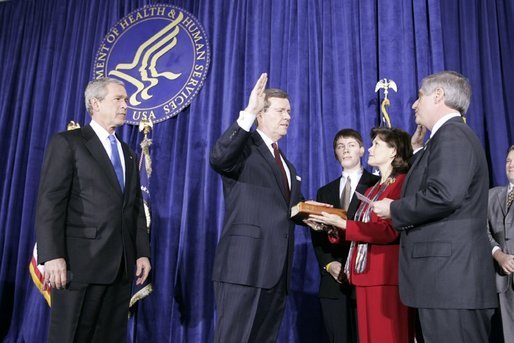 bush leavitt 1 | President Thanks HHS Secretary Leavitt at Swearing-In Ceremony FULL STREAMING VIDEO The Great Hall U.S. Department of Health and Human Services Washington, D.C. 10:45 A.M. EST |
| THE PRESIDENT: Good morning. I'm proud to visit this fine Department and to congratulate my friend, Michael Leavitt, on becoming America's 20th Secretary of Health and Human Services. Congratulations. | 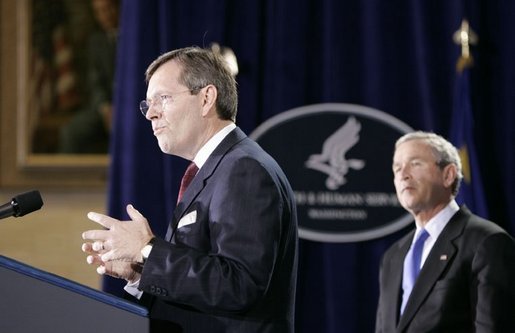 bush leavitt 2 |
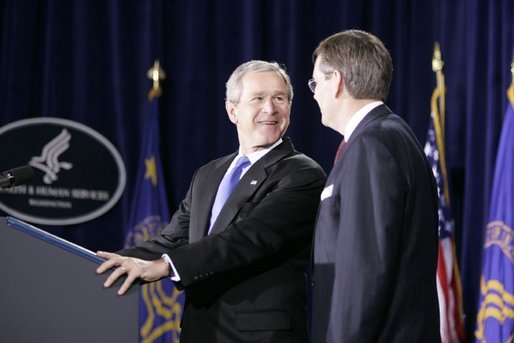 bush leavitt 3 | THE PRESIDENT: I know this is a particularly special day for Mike -- after all, it's his 54th birthday. (Laughter and applause.) And it's always a special day for him when his family members are here. |
| He loves his family. He's got a great wife, named Jackie; Westin is here representing his brothers and sisters; his dad's first name is Dixie -- kind of sounds like he should be from Texas. (Laughter.) Appreciate the other members of the Leavitt family who are here. | 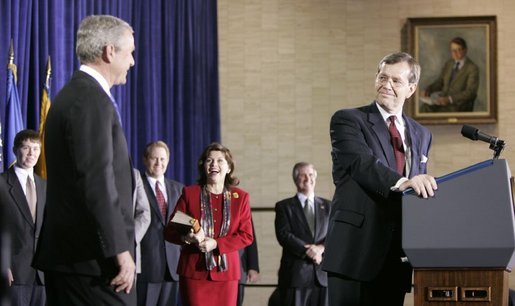 bush leavitt 4 |
Thanks to Secretary Tommy Thompson's superb leadership, HHS has helped our medical community prepare for a new era in public health. You've made groundbreaking progress toward new cures for disability and disease. You've led a bold initiative to win the global fight against HIV/AIDS. The good work of this Department is making America healthier and more hopeful, and I thank each of you for your commitment and your compassion. As Secretary Leavitt begins his service, HHS is embarking on a set of new challenges and historic opportunities. One of your most important responsibilities will be implementing the Medicare Modernization Act, which I signed some 14 months ago. This law is a landmark achievement in American health care, and millions of older Americans are already benefiting from its reforms.
Because we acted, Medicare now covers preventive medicine, including screenings for heart disease and diabetes, and a "Welcome to Medicare" physical. Instead of waiting to get sick or facing costly treatments, seniors can now identify problems early and manage them before they grow worse. By reducing major surgeries and longtime hospital stays, preventive medicine will save money, and, more importantly, it will extend the lives of our seniors.
Because we acted, Medicare will also cover prescription drugs. Under the old system, Medicare would pay $28,000 for ulcer surgery, but not the $500 a year for the prescription drugs that eliminated the cause of most ulcers. That system didn't make any sense. It made no sense for our seniors; it made no sense for American taxpayers.
Because prescription drugs are expensive, many seniors face the terrible choice between buying groceries and buying medicine. We left those days behind with the Medicare Modernization Act. Low-income seniors can get up to $600 to buy medicine this year. Next January, every senior in Medicare will have the option of a prescription drug benefit. And so that all seniors can get the care they need, low-income seniors will get extra assistance and will pay a reduced premium or no premiums at all on prescription drugs.
Because we acted, seniors in Medicare will have more control over their health care. Seniors will be able to choose a health plan that meets their needs and health plans will compete for their business, which will lower costs throughout the program. The system probably sounds familiar to some here -- (laughter) -- after all, it's what we offer federal employees. If choosing your health plan is good enough for the federal employees, it's good enough for America's seniors, as well.
Putting these reforms in action will be challenging. But with the leadership of Secretary Leavitt and Administrator McClellan, I know you're up to the task. We all know the alternative to reform: a Medicare system that offers outdated benefits and imposes needless costs. For decades we promised America's seniors that we can do better, and we finally did. Now we must keep our word. I signed Medicare reform proudly and any attempt to limit the choices of our seniors and to take away their prescription drug coverage under Medicare will meet my veto. (Applause.)
Secretary Leavitt will also lead important reform in the Medicaid program. He will work closely with the governors to make Medicaid more fair and more flexible. And together, we will take new steps to ensure that Medicaid fully serves our most vulnerable citizens, especially our children. Both Medicare and the State Children's Health Insurance Program -- it's what's called S-CHIP -- offer preventive care to low-income families at little or no cost. Yet, millions of eligible American children are not signed up. So I proposed a billion-dollar effort called, "Cover the Kids," to help state and community groups and faith-based charities enroll more children in Medicaid and S-Chip. We must not allow a lack of attention or a lack of information to stand between these children and the health care they need.
To reinforce America's health safety net we are also increasing support for community health centers. These compassionate facilities meet a critical need by providing primary care to the poor and the uninsured. They also take the pressure off of our emergency rooms and our hospitals. When I took office, I pledged to open or expand 1,200 community health centers by 2006. Thanks to the hard work of this Department, we've opened or expanded 619 centers so far, and we're on track to meet our objective by the end of next year. Now Secretary Leavitt and I are working toward a new goal: We will ensure that every poor county in America has a community health center. (Applause.)
As we deliver quality health care to those in need, we must also help more adults find private health insurance at their jobs. More than half of all the uninsured Americans are small business employees and their families. To help these people get good coverage, I have asked Congress to allow small businesses to pool together to buy insurance at the same discounts that big companies get. I've proposed tax credits for small businesses and low-income workers that would allow more people to open tax-free health savings accounts. To reduce health care costs and prevent medical errors, we're working to expand the use of information technology in health care. And to make health care more affordable for every doctor, patient and entrepreneur, Congress needs to pass medical liability reform this year. (Applause.)
At HHS you bring the hope of better health to millions of your fellow citizens, and you do much more. HHS promotes adoption, and abstinence and pre-school education, and leads our efforts to stop drug abuse and domestic violence. Secretary Thompson has called this "America's Department of Compassion," and I know Secretary Leavitt sees it the same way.
Many of your greatest allies in the armies of compassion are found in faith-based and community groups. With Secretary Leavitt's leadership, we'll continue to support the hopeful works of these caring citizens. We'll also work with Congress to reauthorize welfare reforms that require work and strengthen marriage and promote responsible fatherhood. We'll continue the life-saving work of combating HIV/AIDS at home and abroad.
As you fulfill all these duties, HHS is also meeting the needs of a nation at war. Researchers at NIH and the Centers for Disease Control are on the front lines of defending America against the threat of bioterror. FDA inspectors are expanding efforts to secure the food supply and ensure the safety of medicine. We've completed the doubling of funding for medical research at NIH. Yet spending is not our only measure of success. When we commit taxpayer dollars, we will insist on results in return. And in every scientific pursuit, we will uphold the values of freedom, equality and human dignity. We must never sanction the creation of life, only to destroy it. (Applause.)
With this new responsibility, HHS Secretary Leavitt continues a distinguished career of public service. I've known him as a governor. We're members of the ex-governor's club. (Laughter.) I've known him as the administrator of the EPA. I've witnessed his integrity and creativity and compassion. He has a proven ability to move beyond the partisan debate, to work with leaders at all levels of government and to improve the lives of the people he serves.
That is what I've asked Mike to do as America's Secretary of Health and Human Services. With your help, I know he will succeed. Congratulations. (Applause.)
SECRETARY LEAVITT: Thank you, Mr. President. Mr. President, I approach this task with enormous optimism, and appreciation. I feel the gravity of the responsibility. But I feel your confidence. And I feel the fundamental privilege it is to serve the people of the United States of America.
I'd like to thank my family and so many friends who have traveled to Washington today for this ceremony. I also want to acknowledge a couple of members of my family who are not here -- my four children that aren't present with Jackie and my son Westin; our oldest son, Mike, and his wife, Carrie; Taylor and spouse Tammy; Anne Marie, our only daughter, and Hyrum, her husband; and our son Chase, who is doing missionary service for our church; and also my mother, who is off on a mission of her own today helping some grandchildren at a moment of need. (Laughter.)
I'd also like to thank a number of special guests that are here -- my colleagues on the Cabinet: Elaine Chao, Margaret Spellings, John Walters, Steve Johnson, the acting administrator of the EPA. I know so many of my friends from the White House, which I find gratifying that you would come. Secretary Card, thank you for administering the oath of office -- Heidi Smith, Jim Connaughton, John Walters, Terrel Halaska. I saw Doug Badger, Philo Hall, I think I notice Harriet Miers and Dan Bartlett and Dina Powell. All of them I deeply appreciate your coming.
I must also say Senator Bennett and Mr. Regula, how much I appreciate you're being here, two people I look forward to working with on so many of these issues.
And I've asked two of my colleagues from HHS to attend, representing my new colleagues here at this department -- Mirtha Beadle. Mirtha, I thank you. Mirtha is the acting Deputy Director of the office of -- a very important office here at this department, Minority Health. She's responsible for providing leadership on important issues like minority health and assuring that we do away with the health disparities that so often creep into our society. She's also known in this department for remarkable dedication.
I'd also like to introduce you to Daniel Baker. Daniel Baker began working in federal service in November of 1939. He has been working in federal service for 65 years. The only break he has had was to serve in World War II, to fight for this country. I met Mr. Baker, and it reminded me, Mr. President, of a conversation I had with a man about Mr. Baker's age, and I said to him, "So have you lived in this town your whole life?" And he said, "Not yet, I haven't." (Laughter.) I think the same could be said of Mr. Baker. He has made not just a career, but a life out of serving the disabled and the elderly in this country. And interestingly enough, he was part of the original work team that was established to create Medicare.
I also want to acknowledge -- (applause.) I also want to recognize Tommy Thompson, whose portrait will soon hang on this wall. He inspired this department. His four years at the helm made America a healthier and a safer place, and I will build on that legacy.
I want to make clear that I understand the very clear mission that the President of the United States has given me, and that is to help Americans live longer and healthier, and to do it in a way that protects our economic competitiveness as a nation.
Now, this is a new chapter for me in my public service. But, Mr. President, as I listened to you today articulate your agenda, it reminded me of an incident that I have recounted on other occasions as I began a new chapter, that I believe defines in many ways my own aspirations. When I was a boy I spent a lot of time on our farm. There was a farmer down the road from my grandfather who always had more land than he could afford and a brand-new John Deere tractor that I admired.
One day I said to him, "Grandpa, how can he do that?" My grandfather said, "Mike, if we'll stick with what's real and right, we'll be farming a long time after he's been repossessed." (Laughter.) And that's exactly what happened. A few years later the new tractor was gone, but we were still farming.
So as I heard you articulate your agenda today, I -- that story came back to me, because it's what's real and what's right. Responsibility to care for the truly needy is real. Fostering self-reliance as we do it is right. The enabling and ennobling virtue of work is real. The responsibility to remember that as we make national policy on human service programs is right. The responsibility to nurture children, to care for the elderly, to arm future generations with enduring values is real. Strengthening marriages and protecting families is right.
This commitment we have as a nation to provide health care for the disabled, for the elderly, for children and low-income families, that's very real. And as you said, fixing Medicaid is right. The opportunity to transform, to fundamentally transform our health care system is real. Putting health insurance, health records, health savings that we own into the reach of every American, that's right.
The need for fewer medical mistakes, for lower costs, for better health care fundamentally is real. A health system that revolves around consumers, and not the system, that's right.
NIH, in its opportunity to eliminate cancer, and diabetes, and the cause of human suffering and pain, with focused, real peer-reviewed science is, in fact, real. Transforming CDC to prevent diseases, rather than to simply treat them, is right. The threat of bioterrorism is real. Being vigilant and ready is right. The trust that this nation places in the Food and Drug Administration is real. Adopting a new and a more bold -- an emboldened vision for that agency for the 21st century is right.
Real and right, Mr. President, values that we should all be teaching our children, and it's the way I aspire to lead this department.
During the time that I served as governor I kept a treasures box -- just little things that I thought would mean a lot to me in the future. I've begun to sort through them on occasion, as I have time. And the other day I found a note that my mother had written to me just before I was sworn in as governor. I thought maybe I would read it to you today.
"Dear Michael: When you were a little boy, and television had just come to our town, the show you never missed was Gunsmoke. Strangely, the part you liked the most occurred before the episode began. It was the part where Matt Dillon rode his horse up onto a ridge, and paused, leaned forward onto the saddle horn and described the rigors of being a U.S. Marshall in Dodge City. Mr. Dillon would say, 'It's a chancy job, and a little lonely.' In perfect imitation, you used to gallop your stick-horse around the house, stopping at appropriate intervals to declare in your deepest four-year-old voice, 'It's a chancy job, and a little lonely.'" (Laughter.)
"Well," she continues, "Here you are again, son, a chancy job, this time for real. But I have a strong sense of security knowing that you understand so well that this job, as well as any other, even when you feel lonely, you really never need to be alone."
Well, Mr. President, it's occurred to me that Washington is a little like Dodge City. (Laughter and applause.) And I just want to assure you and the people of this country that I understand the principle well. I do not intend to approach this job alone. Not only will I depend on so many remarkable people, but I will acknowledge the blessings of God on this country, and I will seek his help.
Thank you. (Applause.) END 11:07 A.M. EST For Immediate Release Office of the Press Secretary February 11, 2005
0
comments
||
||
AL MADINAH, Iraq 1st Marine Division
Ribbon cutting ceremony
AL MADINAH, Iraq -- Local residents and U.S. Marines from the 1st Marine Division of the I Marine Expeditionary Force celebrated the completion of a village improvement project here with a ribbon-cutting ceremony on Feb. 10.
The ribbon cutting symbolized a "mission complete" for the Marines of 2nd Battalion, 10th Marine Regiment, who will return to Camp Lejeune in the coming weeks.
Throughout the past seven months, the Marines worked with village leaders here to build working relationships and identify ways to improve the village's living conditions.
The battalion invested more than $360,000 for the refurbishment of 32 homes, which provided residents with new septic and electrical systems. The projects improved the quality of life for the Iraqi people, and strengthened their local economy - many of them were hired to do the work themselves, according to Chief Warrant Officer Dwight Torres, the information operations officer for the battalion.
Prior to the upgrades, the village was in a state of decay. The ground was covered in litter and the homes lacked such amenities as running water and electricity.
“I don’t believe this change,” said Mamud, a furniture salesman and resident who welcomes new business as a result of the improvement project. “I would never have believed my home would look like this.”
The Marines have spent the deployment building relations and trust with the residents of Al Madinah - one of two local towns the battalion has worked with in an effort to improve quality of life for the residents.
The battalion has also aided Al Kabani, a local fishing village, with a water pipeline system and a means to access electricity. They oversaw the contracting to have Kabani's school reconditioned, and had a soccer field made last fall.
The Camp Lejeune, N.C.-based battalion, which is at the end of a seven-month deployment to Iraq, provides security for Camp Taqaddum, the headquarters base for 1st Force Service Support Group, and other U.S. military posts in Al Anbar province, Iraq.
THIS STORY HAS ACCOMPANYING PHOTOGRAPHS. TO RECEIVE THE PHOTOS, E-MAIL THE CPIC PRESS DESK AT CPICPRESSDESK@BAGHDADFORUM.COM.For more information, please contact Capt. Amy Malugani, public affairs officer, 1st Force Service Support Group, at maluganiae@1fssgdm.usmc.mil Release #A050211k
0
comments
||
||
Hkun Htun Oo (UNA) arrested in Burma
Arrest of Pro-Democracy Leaders in Burma
The United States is deeply concerned that the Burmese junta has arrested several pro-democracy leaders, including Hkun Htun Oo, the chairman of the Shan National League for Democracy. We also are concerned that authorities have prohibited the United Nationalities Alliance (UNA), Burma’s leading coalition of pro-democracy ethnic political parties, from commemorating Union Day on February 12. These actions further demonstrate the junta’s rejection of genuine national reconciliation as well as its disregard for the well being of the Burmese people and the views of the international community.
We reiterate our call on the junta to release Aung San Suu Kyi and all political prisoners immediately and unconditionally, to allow the National League for Democracy to reopen its offices nationwide, and to engage the democratic opposition in a meaningful dialogue leading to genuine national reconciliation and the establishment of democracy. 2005/183
Released on February 11, 2005 Press Statement Richard Boucher, Spokesman Washington, DC February 11, 2005
0
comments
||
||
Freedom Calendar 02/12/05 - 02/19/05
February 12, 1909, On 100th anniversary of Abraham Lincoln’s birth, African-American Republicans and women’s suffragists Ida Wells and Mary Terrell co-found the NAACP.
February 13, 1862 Birth of Republican Benigno Hernandez, first Hispanic U.S. Representative from New Mexico (1915-17, 1919-21).
February 14, 1928, Birth of Ben Garrido Blaz, Hispanic Republican and former Brigadier General; served as Delegate from Guam to U.S. Congress, 1985-93.
February 15, 1932, Republican President Herbert Hoover nominates Benjamin Cardozo as second Jewish Justice on U.S. Supreme Court.
February 16, 1812 Birth of Republican civil rights activist and U.S. Senator (R-MA) Henry Wilson, Vice President under Ulysses Grant.
February 17, 1973, Republican Navy Secretary John Warner commissions frigate in honor of first African-American naval aviator, Jesse L. Brown, who died in combat during Korean War.
February 18, 1946, Appointed by Republican President Calvin Coolidge, federal
judge Paul McCormick ends segregation of Mexican-American children in California public schools.
February 19, 1976, President Gerald Ford formally rescinds President Franklin Roosevelt’s notorious Executive Order authorizing internment of over 120,000 Japanese-Americans during WWII.
“I do order and declare that all persons held as slaves within said designated States, and parts of States, are, and henceforward shall be free; and that the Executive government of the United States, including the military and naval authorities thereof, will recognize and maintain the freedom of said persons.”
From the final Emancipation Proclamation
SOURCE: 2005 Republican Freedom Calendar
0
comments
||
||
predator mq-1
Title: The MQ-1 Predator (drone), a lightweight, low horsepower
Description: The MQ-1 Predator (drone), a lightweight, low horsepower, unmanned aerial vehicle capable of flying more than 20 hours of intelligence, reconnaissance and surveillance aids in the protection of ground troops and LSA Anaconda force protection. (U.S. Army photo by Spc. Leah R. Burton, 28th Public Affairs Detachment) (released)
Location: Balad Country: Iraq Photographer: Spc. Leah R. Burton Date Taken: 2005-01-25
predator (drone) mq-1
0
comments
||
||


