


US-EU Joint Statement on Somalia
"The United States and the European Union welcome Somali efforts to conclude an agreement on the relocation of the Somali Transitional Federal Institutions to Somalia, including the efforts of the Somali parties to facilitate demilitarization in Mogadishu, which should be incorporated into a national plan as soon as possible.
"The Somali reconciliation process is at a critical stage. There is an urgent need for a viable agreement on relocation and security endorsed by the Transitional Federal Institutions. In order for this process to succeed, the Somali people, through the Transitional Federal Institutions, must make their own decisions regarding how best to relocate to Somalia and begin the gradual process of establishing governance.
"The European Union and United States urge all Somali parties to continue their efforts towards reconciliation and dialogue and quickly come to an agreement that will facilitate the relocation of the Transitional Federal Institutions to Somalia.
"The European Union and the United States also welcome the visit of Prime Minister Ali Mohamed Ghedi to Mogadishu. This visit represents a positive step forward in the reconciliation process. We deeply regret, however, the incident of May 3rd at Mogadishu Stadium during the Prime Minister’s visit and we extend our condolences to the families and relatives of the victims."
SOURCE: state.gov 2005/504 Press Statement Richard Boucher, Spokesman Washington, DC May 11, 2005
Wednesday, May 11, 2005
US-EU Joint Statement on Somalia
0
comments
||
||

Venezuelan Oil Company Tax Proposal
Venezuelan Oil Company Tax Proposal (Taken Question)
Venezuelan Oil Company Tax Proposal Question: What does the United States think about the Venezuelan Government’s proposal to apply retroactive taxes to U.S. oil companies, for revenues they owed to that country, but allegedly failed to pay?
Answer: We have not seen the proposal, but as a general principle we would have serious concerns about any tax that is applied in a discriminatory manner against U.S. companies.
2005/504 Released on May 11, 2005 Taken Question Office of the Spokesman Washington, DC May 11, 2005 Question Taken at the May 11, 2005 Daily Press Briefing
0
comments
||
||
Ethiopia: Human Rights Watch report on Oromia Region and Elections
Ethiopia: Human Rights Watch report on Oromia Region and Elections
Question: Does the United States have any reaction to the Human Rights Watch report on Ethiopia?
Answer: We have seen the Human Rights Watch report on the Oromia region of Ethiopia that was released today and are reviewing it. We regularly raise human rights concerns with the Ethiopian Government and discuss related issues with grass roots organizations, including the Ethiopian Human Right Council in Addis Ababa. We will continue to stress the importance of respect and promotion of human rights in our conversations with all Ethiopians. Our Embassy in Addis Ababa will be following the May 15 Ethiopian national and local elections carefully. The Carter Center will be observing the elections as well.
2005/500 Released on May 10, 2005 Taken Question Office of the Spokesman Washington, DC May 10, 2005 Question Taken from the May 10, 2005 Daily Press Briefing
0
comments
||
||
Clearing Landmines and Aiding Disabled Orphans in Cambodia
Grapes for Humanity Raises Money for Clearing Landmines and Aiding Disabled Orphans in Cambodia
The U.S. Department of State salutes Grapes for Humanity U.S., Inc., a not-for-profit charitable foundation that works in partnership with the Department’s Office of Weapons Removal and Abatement, for raising $75,000 to help clear persistent landmines and assist disabled orphans, some injured by landmines, in Cambodia.
$50,000 will be directed to The HALO Trust, a non-governmental organization that specializes in landmine clearance, to help clear three minefields in Cambodia. $25,000 will be directed to the Lavalla School orphanage on the outskirts of Phnom Penh.
The money was raised at a charity dinner in New York City honoring Mr. Jean-Guillaume Prats, Chief Executive Officer of the Cos d’Estournel vineyards in France, featuring five of his best vintages generously contributed at no cost for this event. G.H. Mumm and Inniskillin also contributed some champagne and wine.
Grapes for Humanity U.S., Inc. is one of the Office of Weapons Removal and Abatement’s over fifty public-private partners that support humanitarian mine action (landmine and unexploded ordnance clearance, mine risk education, mine survivors assistance).
The Office of Weapons Removal and Abatement in the Bureau of Political-Military Affairs currently manages humanitarian mine action programs in 22 countries around the world including Cambodia, encourages public-private partnerships to support mine action, and oversees efforts to reduce illegal trafficking in and increase international safeguarding of small arms, light weapons and man-portable air defense systems (MANPADS). To learn more, visit state.gov/t/pm/wra.
Grapes for Humanity U.S., Inc., based in Toronto, Canada, seeks to improve the lives of survivors of landmines and other accidents and disasters. Through fundraising events centered on the tasting of fine wines, Grapes for Humanity has helped to support the rehabilitation of mine survivors in Angola, Cambodia, Ethiopia, Honduras and Nicaragua. To learn more, visit grapesforhumanity.com/. 2005/494 Released on May 10, 2005 Media Note Office of the Spokesman Washington, DC May 10, 2005
0
comments
||
||
Pakistan Concerns About Guantanamo Allegations
Pakistan Concerns About Guantanamo Allegations
Question: Has the government of Pakistan protested to the United States about the report in this week’s Newsweek magazine alleging that U.S. interrogators in Guantanamo Bay desecrated the Quran during an interrogation?
Answer: The Government of Pakistan has expressed its serious concern to senior officials at our Embassy in Pakistan about these allegations.
All credible allegations of maltreatment or abuse of detainees at Guantanamo are reported and investigated. If these allegations prove to be substantiated, the perpetrators of abuses will be held accountable.
The alleged desecration, if it occurred, would be deplorable and completely out of keeping with our deeply-held values of religious freedom and tolerance. Desecration of the Holy Quran is a reprehensible act that would not be sanctioned by the United States for any purpose.
2005/499 Released on May 10, 2005 Taken Question Office of the Spokesman Washington, DC May 10, 2005 Question Taken at the May 10, 2005 Daily Press Briefing
0
comments
||
||
Humanitarian Impact of Landmines
Public Access to Information about the Humanitarian Impact of Landmines
The Survey Action Center, a non-governmental organization, today unveiled a first-of-its kind web-based research tool, the “LIS Explorer,” funded by a $25,000 grant from the U.S. Department of State’s Office of Weapons Removal and Abatement, that enables decision makers and the general public to easily examine the results of Landmine Impact Surveys (LIS) in selected countries to better understand the scope of the problem and make more informed decisions.
The LIS Explorer contains extensive data on landmine and unexploded ordnance infestation and casualties in Bosnia and Herzegovina, Chad, northwestern Somalia (“Somaliland”), Thailand and Yemen. Data on Afghanistan, Azerbaijan, Eritrea, Ethiopia, Lebanon and northeastern Somalia will be added to it shortly.
Until the advent of the LIS Explorer, the locations of suspected mined areas, their relative impact on men, women, children and other demographic information, and degree to which the mines infested vital natural resources and infrastructure, were not accessible to the general public, nor readily available to government officials. Now, anyone with access to the Internet can use the LIS Explorer at sac-na.org/lisexplorer/ to review the findings of comprehensive nationwide landmine impact surveys. These surveys have already revealed that over 80 per cent of landmines’ social and economic harm is caused by less than 20 per cent of the world’s minefields. With the help of the LIS Explorer, officials in the surveyed countries and foreign donors will be able to more effectively prioritize landmine clearance, refine mine risk education campaigns, and better direct health care and psycho-social assistance to landmine survivors.
The Office of Weapons Removal and Abatement in the Bureau of Political-Military Affairs currently manages humanitarian mine action programs in 22 countries around the world, encourages public-private partnerships to support mine action, and oversees efforts to reduce illegal trafficking and increase international safeguarding of small arms, light weapons and man-portable air defense systems (MANPADS). To learn more, visit state.gov/t/pm/wra.
To learn more about the Survey Action Center, based in Takoma Park, Maryland, and its years of experience in conducting landmine and unexploded ordnance surveys worldwide, visit sac-na.org.
2005/496 Released on May 10, 2005
Media Note Office of the Spokesman Washington, DC May 10, 2005
0
comments
||
||
U.S. Participation in the Arab-South American Summit in Brazil
U.S. Participation in the Arab-South American Summit in Brazil
Question: Did the United States ask the Brazilian government for permission to be an observer at the Summit of South America-Arab Countries?
Answer: During the early stages of planning for this summit, we asked the host, Brazil, if they intended to invite observers. We were informed that the organizers would not invite observers, since the summit was expected to be covered widely by the media. They also noted that the only Western Hemisphere countries being invited to participate in this summit were South American states.
2005/498 Released on May 10, 2005 Taken Question Office of the Spokesman Washington, DC May 10, 2005 Question Taken at the May 10, 2005 Daily Press Briefing
0
comments
||
||
Doors to Diplomacy Award Winners Announced
Doors to Diplomacy Award Winners Announced
The Department of State is pleased to announce the selection of two winning websites for its 2005 Doors to Diplomacy Award. The awards recognize the websites that best teach about the importance of international affairs and diplomacy. A total of 293 student teams from 39 countries, ranging in age from 15-18, participated in the contest, which was co-sponsored by the Department of State and Global SchoolNet.
The winning sites are: All the World Is One: This site, built by a team of students from Gurgaon, Haryana, India, explores international security by considering global realities and threats while celebrating the mutual cooperation and celebration that support diplomacy.
Vaccinations for Nations: This site was built by a team of students from Toledo, Ohio, USA. Their site aims to educate young people about the diseases that ravage innocent children, and also provides ways students can help.
Each student member of the winning Doors to Diplomacy Award teams will receive a $2,000 scholarship and a trip to Washington, DC this spring, where they will receive a private tour of the State Department facilities, meet with key officials, and participate in a special award presentation ceremony. In addition, the winning coaches and schools will each receive a $500 cash award.
Judging was performed by peers and educational professionals, with the final selections made by a team of State Department judges from the Bureaus of Public Affairs and Educational and Cultural Affairs. The winning sites will be linked from the State Department's youth site at future.state.gov/ later this month.
Global SchoolNet is a non-profit, Internet-based education program. The Doors to Diplomacy Award was specially created for Cyberfair, a contest that encourages students and educators to join together to build high-quality, educational websites on a variety of topics. These website entries will be available on the web as learning tools to millions of people around the globe.
To learn more about Doors to Diplomacy projects visit: globalschoolhouse.org/doors/
For more information, contact: Yvonne Marie Andres Global SchoolNet Telephone: 760-635-0001 E-mail: diplomacy@globalschoolnet.org or Janice Clark U.S. Department of State Telephone: 703-875-5086E-mail: clarkje4@state.gov 2005/490 Released on May 9, 2005 Media Note, Office of the Spokesman, Washington, DC, May 9, 2005
0
comments
||
||
Quartet Statement
Quartet Statement, Following is the text of the Quartet Statement: BEGIN TEXT:
The Quartet met today in Moscow. The Quartet emphasizes that this is a hopeful and promising moment for both Palestinians and Israelis, and that they deserve the full support of the international community in helping them with the hard work and difficult decisions required in order to make positive use of this opportunity. The Quartet welcomed the commitments of the parties at the Sharm el-Sheikh summit of February 8 and urged them to renew their efforts to fulfill the commitments they agreed to at that time, in order to maintain momentum at this fragile moment of opportunity. The Quartet, underscoring the urgency of the matter, affirms its commitment to fully support the efforts of both parties to ensure successful Israeli withdrawal from Gaza and parts of the northern West Bank.
The Quartet strongly reiterated its commitment to the two-state solution, and to Israeli withdrawal as a way to re-energize the Roadmap. The Quartet stresses the importance of full and complete Israeli withdrawal from Gaza in a manner consistent with the Roadmap as an important step paving the way toward realizing the vision of two democratic states, Israel and Palestine, living side by side in peace and security. The Quartet affirms that a new Palestinian state must be truly viable, with contiguity in the West Bank; reminds all concerned that a state of scattered territories will not work; and emphasizes that no party should take unilateral actions that prejudge final status issues. The Quartet also affirms that the two-state vision and the Roadmap are the best means of achieving a settlement negotiated between the two parties, leading to a permanent peace and an end to the occupation that began in 1967. With respect to this, the Quartet observes that the Roadmap has been endorsed by Israel and the Palestinian Authority and remains the objective of the international community; and urges both parties to take steps to fulfill all their obligations under the Roadmap.
The Quartet expresses its full support for its Special Envoy for Gaza Disengagement, James Wolfensohn. His mandate is to focus on the non-security aspects of withdrawal, particularly disposition of assets; passages, access and trade; and revival of the Palestinian economy during and after Israeli withdrawal. This will require close coordination with both Israel and the Palestinians to identify and implement those actions and policies that will ensure a smooth and successful implementation of the Israeli initiative. On the Palestinian side, this includes above all a strong commitment to security reform and performance; and the building of transparent, accountable government institutions and an investor-friendly climate, with a view to restoring growth. On the Israeli side, this involves relieving the economic hardships faced by the Palestinian people and facilitating rehabilitation and reconstruction by easing the system of restrictions on the movement of Palestinian people and goods and taking further steps to respect the dignity of the Palestinian people and improve their quality of life -without endangering Israeli security -and taking into consideration the World Bank report of December 2004. At the London meeting on March 1, the international community underscored its readiness to play a vital role by providing financial support to the Palestinians at this critical moment. Creating the environment conducive for a long-term, sustainable and viable economic development of all the Palestinian territories would constitute a suitable basis for additional assistance efforts by the international community.
The Quartet emphasizes Mr. Wolfensohn's mandate to promote direct dialogue and cooperation between Palestinians and Israelis on these economic issues, to ensure a smooth transition in Gaza and parts of the northern West Bank. In this context, the Quartet stresses the urgent need for Israelis and Palestinians to coordinate directly and fully on withdrawal preparations.
The Quartet recognizes that economic development and progress on security go hand in hand as security reforms and the reestablishment of the rule of law are necessary to create an enabling environment for economic growth and political progress. The Quartet also recognizes the need for continued efforts by the international community to assist the PA in accomplishing these tasks, including rebuilding the capabilities of the Palestinian security services. Ongoing assistance by the international community, in particular members of the Quartet and countries of the region, constitutes a significant contribution to these efforts. The Quartet calls upon Israel and the Palestinian Authority to facilitate these efforts.
In that regard, the Quartet expresses its full support for General William Ward, U.S. Security Coordinator, to assist the Palestinians in reforming and restructuring their security forces, and to coordinate international assistance towards those efforts. The Quartet welcomes the recent concrete steps that President M. Abbas has taken towards reform of the Palestinian security services, and stresses the need to continue implementation of these reforms in order to permanently reinstate law and order in Gaza and the West Bank.
The Quartet commends the Palestinian people's and leadership's commitment to democracy and attaches great importance to a successful continuation of the democratic process. The latest round of municipal elections has just been conducted. The Quartet commends the Government of Israel for facilitating the operations. The holding of free, fair, and transparent multi-party legislative elections in the West Bank, Gaza and East Jerusalem, under the scrutiny of international observers, will be another vital step forward on the path towards building a reformed and accountable Palestinian Authority. As additional voter registration for these elections has just begun, the Quartet calls on both the PA and Israel to urgently take all necessary steps, including freedom of movement for candidates and voters, to achieve this goal and renews its offers of technical support and providing election observation services.
The Quartet deems it necessary to ensure continued efforts aimed at full implementation of the Roadmap following Israeli withdrawal from Gaza and parts of the northern West Bank.
The Quartet reiterates its commitment to the principles outlined in its previous statements, including those of March 1, 2005 and May 4, 2004; and reaffirms its commitment to a just, comprehensive, and lasting settlement to the Arab-Israeli conflict based upon resolutions 242 and 338, and will remain engaged with all parties to help ensure that progress towards this goal is achieved.
SOURCE: state.gov END TEXT. 2005/487 Released on May 9, 2005 Press Statement Tom Casey, Acting Spokesperson Moscow, Russia May 9, 2005
0
comments
||
||
Office of Weapons Removal and Abatement
U.S. Department of State Awards Multiple Contracts to Clean Up Battlefields and Control Conventional Weapons
The Office of Weapons Removal and Abatement in the Bureau of Political-Military Affairs has competitively awarded performance-based service contracts to ArmorGroup North America, DynCorp International LLC, and RONCO Consulting Corporation. They are to provide a full range of peace-enhancing services around the world ranging from landmine clearance to the construction of facilities to secure a variety of small arms and light weapons.
The three indefinite delivery/indefinite quantity contracts have a total, maximum potential value of up to $500 million over a term of one base year and four option years. No funds are being obligated at this time. Funds will be obligated on task orders to be competed among the three awardees.
The Office of Weapons Removal and Abatement manages the State Department’s portion of the multi-agency U.S. Humanitarian Mine Action Program, the world’s largest such program and one of its oldest. The office also conducts humanitarian mine action (landmine clearance, mine risk education and mine survivors assistance) in 22 countries at present and operates the world’s only Quick Reaction Demining Force that can be deployed globally on short notice. It will also continue to help countries destroy or better secure their excess munitions and light conventional weapons.
The services provided by these three prime contractors will enable the Office of Weapons Removal and Abatement to continue to undertake these vital functions. To learn more about the Office of Weapons Removal and Abatement, visit state.gov/wra.
Visit the ArmorGroup North America (armorgroup.com/servicesMineAction), DynCorp International LLC (dyncorpinternational.com/dyncorp) and and RONCO Consulting Corporation (roncoconsulting.com/hmc) websites to learn about their expertise in removing explosive remnants of war, training local personnel to safely clear landmines, developing host-nation humanitarian mine action capacity building, providing logistics, supply, physical security, and other related services.
SOURCE: state.gov 2005/489 Released on May 9, 2005 Media Note Office of the Spokesman Washington, DC May 9, 2005
0
comments
||
||
President Discusses Foreign Trip with Members of Congress
President Discusses Foreign Trip with Members of Congress, FULL STREAMING VIDEO The Cabinet Room President's Remarks, 3:05 P.M. EDT
THE PRESIDENT: I thank the members of Congress for coming down to give me and the Secretary of State a chance to talk about our recent trip to Europe. It was a great trip, and it's such an honor to represent the United States.
Sitting in Red Square honoring the veterans of World War II was an amazing event. I remember as a kid watching the missiles parade through Red Square -- and here I sat as the President of the United States in Red Square, paying homage to people who died to defeat Nazism. And I was sitting beside a friend. Russia is not an enemy; Russia is our friend. And it's important that we work together to achieve peace. Obviously, we have a difference of opinion on certain issues, but we don't have a difference of opinion on working together for peace.
I went to the Baltics, had a great trip to Latvia. It's such an inspiring experience to be in countries that are newly-minted democracies that love freedom. And I met with civil society advocates. I look forward to briefing you on the situation that this young democracy faces in making sure that all people are participating in the democracy.
Went to The Netherlands. Her Majesty kindly came and visited, paid a visit with us. I laid a wreath with Her Majesty, honoring the U.S. soldiers who died at the end of World War II. Interestingly enough, some of my father-in-law's unit were there, and it was neat for Laura to be able to hug them and to remember her dad, as she paid tribute to the veterans.
Then I went to Georgia. It was -- standing in front of 150,000 people that love freedom was a fantastic experience.
The lessons of World War II is to honor the sacrifice of those who helped us keep the peace, and to remember that the United States is always the beacon of freedom, and that when we find people living under tyranny we've got to work to free them in order to make the world more peaceful.
And so I want to thank you all for coming. I look forward to briefing you in specific on some of the conversations I had and I'm looking forward to your comments, as well.
END 3:08 P.M. EDT For Immediate Release Office of the Press Secretary May 11, 2005
0
comments
||
||
NOAA and National Hurricane Preparedness Week
NOAA OFFICIALS TO ANNOUNCE 2005 ATLANTIC HURRICANE SEASON OUTLOOK, Event Kicks Off National Hurricane Preparedness Week
WHAT: Representatives from NOAA and hurricane preparedness partner organizations will kick off National Hurricane Preparedness Week with the release of the 2005 Atlantic Hurricane Season Outlook.
WHAT: News conference opens the 2005 Atlantic Hurricane Season by:
- Issuing NOAA's 2005 Atlantic Hurricane Season Outlook
- Announcing Presidential Proclamation for National Hurricane Preparedness Week
WHEN: Monday, May 16, 2005, 11:30 a.m. CDT, Coordinates for live satellite broadcast will follow in a second advisory.
WHERE: Stennis International Airport, Bay St. Louis, Miss. The airport is one mile north of the Interstate 10 interchange with Mississippi highway 603.
WHO: Vice Admiral Conrad C. Lautenbacher, Jr., USN (Ret.), undersecretary of commerce for oceans and atmosphere and NOAA administratorMichael D. Brown, undersecretary of homeland security for emergency preparedness and response and director, FEMABrigadier General David L. Johnson, USAF (Ret.), assistant administrator for Weather Services and director, NOAA National Weather ServiceMax Mayfield, director, NOAA National Hurricane Center
Relevant Web Sites: NOAA Hurricane Center, NOAA Hurricanes Page
Media Contact: Frank Lepore, NOAA Hurricane Center, (305) 229-4404
FOR IMMEDIATE RELEASE May 10, 2005 MEDIA ADVISORY
0
comments
||
||
National Hurricane Preparedness Week, 2005
National Hurricane Preparedness Week, 2005, A Proclamation by the President of the United States of America
Each year from June through November, Americans living on the Eastern seaboard and along the Gulf of Mexico face an increased threat of hurricanes. These powerful storms can create severe flooding, cause power outages, and damage homes and businesses with their high winds, tornadoes, storm surges, and heavy rainfall. The effects of these storms can be devastating to families and cause lasting economic distress. During National Hurricane Preparedness Week, we call attention to the importance of planning ahead and securing our homes and property in advance of storms.
Last year, six hurricanes and three tropical storms hit the United States, causing the loss of dozens of lives and billions of dollars in damage. Across the United States, Americans responded to these natural disasters with extraordinary strength, compassion, and generosity. Many volunteers donated their time and talents to help with the cleanup, recovery, and rebuilding of communities devastated by the hurricanes and tropical storms.
To prepare for the 2005 hurricane season, I urge all our citizens to become aware of the dangers of hurricanes and tropical storms and to learn how to minimize their destructive effects. Our Nation's weather researchers and forecasters continue to improve the accuracy of hurricane warnings, enabling residents and visitors to prepare for storms. By working together, Federal, State, and local agencies, first responders, the news media, and private citizens can help save lives and diminish the damage caused by these natural disasters.
NOW, THEREFORE, I, GEORGE W. BUSH, President of the United States of America, by virtue of the authority vested in me by the Constitution and laws of the United States, do hereby proclaim May 15 through May 21, 2005, as National Hurricane Preparedness Week. I call upon government agencies, private organizations, schools, and the news media to share information about hurricane preparedness and response to help save lives and prevent property damage. I also call upon Americans living in hurricane-prone areas of our Nation to use this opportunity to learn more about protecting themselves against the effects of hurricanes and tropical storms.
IN WITNESS WHEREOF, I have hereunto set my hand this tenth day of May, in the year of our Lord two thousand five, and of the Independence of the United States of America the two hundred and twenty ninth.
GEORGE W. BUSH
# # # For Immediate Release, Office of the Press Secretary, May 10, 2005
0
comments
||
||
Tuesday, May 10, 2005
Nominations Sent to the Senate 05/10/05
Nominations Sent to the Senate
James M. Derham, of Virginia, a Career Member of the Senior Foreign Service, Class of Minister-Counselor, to be Ambassador Extraordinary and Plenipotentiary of the United States of America to the Republic of Guatemala.
Robert Johann Dieter, of Colorado, to be Ambassador Extraordinary and Plenipotentiary of the United States of America to Belize.
Rodney E. Hood, of North Carolina, to be a Member of the National Credit Union Administration Board for a term expiring April 10, 2009, vice Dennis Dollar, resigned.
Zalmay Khalilzad, of Maryland, to be Ambassador Extraordinary and Plenipotentiary of the United States of America to Iraq.
Jill L. Sigal, of Wyoming, to be an Assistant Secretary of Energy (Congressional and Intergovernmental Affairs), vice Rick A. Dearborn.
John J. Sullivan, of Maryland, to be General Counsel of the Department of Commerce, vice Theodore William Kassinger, resigned.
James Philip Terry, of Virginia, to be Chairman of the Board of Veterans' Appeals for a term of six years, vice Eligah Dane Clark, term expired.
Rodolphe M. Vallee, of Vermont, to be Ambassador Extraordinary and Plenipotentiary of the United States of America to the Slovak Republic.
R. Thomas Weimer, of Colorado, to be an Assistant Secretary of the Interior, vice Patricia Lynn Scarlett.
# # # For Immediate Release Office of the Press Secretary May 10, 2005
0
comments
||
||
50th Anniversary of the Austrian State Treaty
President George W. Bush today announced the designation of a Presidential Delegation to Austria to attend the 50th Anniversary of the Austrian State Treaty on May 15, 2005.
The Honorable Rudolph E. Boschwitz, Ambassador and Representative of the United States of America on the Human Rights Commission of the Economic and Social Council of the United Nations, will lead the delegation.
Members of the Presidential Delegation are:
The Honorable W.L. Lyons Brown, Ambassador of the United States to Austria
The Honorable Vincent Obsitnik, Member, U.S. Commission for the Preservation of America's Heritage Abroad
Mr. Alfred Hoffman, Chairman of the Board of Directors, WCI Communities, Inc.
Mr. Davis Phillips, Chairman and CEO, Phillips Industries, Inc.
# # # For Immediate Release, Office of the Press Secretary, May 10, 2005 Personnel Announcement
0
comments
||
||
Mark A. Limbaugh, Henrietta Holsman Fore, William Alan Eaton
President George W. Bush today announced his intention to nominate three individuals to serve in his Administration:
The President intends to nominate Mark A. Limbaugh, of Idaho, to be Assistant Secretary of the Interior (Water and Science). Mr. Limbaugh currently serves as Deputy Commissioner of the Bureau of Reclamation at the Department of the Interior. He previously served as Payette River Watermaster for Water District 65 in Payette, Idaho. Earlier in his career, Mr. Limbaugh served as Executive Director for the Payette River Water Users Association. He earned his bachelor's degree from the University of Idaho.
The President intends to nominate Henrietta Holsman Fore, of Nevada, to be Under Secretary of State for Management. She currently serves as the 37th Director of the United States Mint. Director Fore previously served as Chairman and President of Stockton Products. Earlier in her career, she worked at the United States Agency for International Development as Assistant Administrator for Asia and as Assistant Administrator for Private Enterprise. Director Fore earned her bachelor's degree from Wellesley College and her master's degree from the University of Northern Colorado.
The President intends to nominate William Alan Eaton, of Virginia, to be Ambassador Extraordinary and Plenipotentiary of the United States of America to the Republic of Panama. A career member of the Senior Foreign Service, Mr. Eaton currently serves as Assistant Secretary for Administration at the Department of State. He previously served as Executive Director of the Bureau of European Affairs at the Department of State. Earlier in his career, Mr. Eaton worked in various offices in the State Department, including the Office of the Deputy Secretary, Under Secretary for Management and the Assistant Secretaries for Administration and Diplomatic Security. He has also served in various positions at U.S. Missions in Guyana, the Soviet Union, Italy, and Turkey. He earned his bachelor's degree from the University of Virginia.
# # # For Immediate Release Office of the Press Secretary May 10, 2005 Personnel Announcement
0
comments
||
||
President's Statement on Judicial Nominations
President's Statement on Judicial Nominations
Four years ago today, I nominated Justice Priscilla Owen and Judge Terry Boyle to serve on the Federal courts of appeals. Four years later, neither has received an up-or-down vote in the Senate. Both have been rated well-qualified by the American Bar Association, the highest ABA rating a judicial nominee can receive. Both have been waiting to fill vacancies that have been designated judicial emergencies by the Judicial Conference of the United States. Much more than enough time has passed for the Senate to consider these nominations. The Senate should give these extraordinarily qualified nominees the up-or-down votes they deserve without further delay.
It is only fair that the Senate promptly consider judicial nominees on the floor, discuss and debate their qualifications, and then vote to confirm or not to confirm them. Nominees who have the support of a majority of the Senate should be confirmed. Unfortunately, a minority of Senators is blocking the will of the Senate.
Over the course of the past four years, the blocking of judicial nominees in the Senate has escalated to an unprecedented level. Last Congress, ten of my appeals court nominees were filibustered. Each of these highly qualified nominees enjoyed the bipartisan support of a majority of Senators. Each would have been confirmed if given a simple up-or-down vote. Each deserved a simple up-or-down vote by the entire Senate.
I urge the Senate to put aside the partisan practices of the past and work together to ensure that all nominees are treated fairly and that all Americans receive timely justice in our Federal courts.
### For Immediate Release, Office of the Press Secretary, May 9, 2005
0
comments
||
||
President Addresses and Thanks Citizens in Tbilisi, Georgia
President Addresses and Thanks Citizens in Tbilisi, Georgia, FULL STREAMING VIDEO Freedom Square, Tbilisi, Georgia, 1:27 P.M. (Local)
PRESIDENT BUSH: Mr. President, thank you for that introduction. Citizens of a free Georgia, Laura and I were in the neighborhood -- we thought we'd swing by and say gamarjoba. (Applause.)
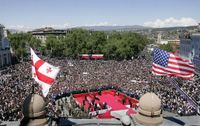 | I am proud to stand beside a President who has shown such spirit, determination, and leadership in the cause of freedom. (Applause.) And Laura and I are proud to stand with the courageous people of Georgia, in this place that has earned a proud name -- Freedom Square. (Applause.) |
The following year, Georgians returned to this square and pulled down the statue of Lenin. And on April 9th, 1991, you declared to the world that Soviet Georgia was no more, and that the independent nation of Georgia was born. (Applause.) On that historic day, you reclaimed your sovereignty, but the hopeful start you made was not fulfilled. So 18 months ago, Georgians returned to this square to complete the task you began in 1989. You gathered here armed with nothing but roses and the power of your convictions, and you claimed your liberty. And because you acted, Georgia is today both sovereign and free, and a beacon of liberty for this region and the world. (Applause.)
The path of freedom you have chosen is not easy, but you will not travel it alone. Americans respect your courageous choice for liberty. And as you build a free and democratic Georgia, the American people will stand with you. (Applause.)
You are building a free future for your children and grandchildren, and you are helping other nations to do the same. When the Afghan people defied terrorists to vote in that nation's first free presidential elections, Georgian soldiers were there to provide security. (Applause.) And last year -- and last year, when terrorist violence in Iraq was escalating, Georgia showed her courage. You increased your troop commitment in Iraq fivefold. The Iraqi people are grateful, and so are your American and coalition allies. (Applause.)
You are making many important contributions to freedom's cause, but your most important contribution is your example. In recent months, the world has marveled at the hopeful changes taking place from Baghdad to Beirut to Bishkek. But before there was a Purple Revolution in Iraq, or an Orange Revolution in Ukraine, or a Cedar Revolution in Lebanon, there was the Rose Revolution in Georgia. (Applause.) Your courage is inspiring democratic reformers and sending a message that echos across the world: Freedom will be the future of every nation and every people on Earth. (Applause.)
Building a free society is the work of generations. It took nearly 15 years of struggle before liberty and justice fully took root in this country. Many of the students and workers who gathered here on this square 18 months ago were too young to remember the protests of 1989, but they took up freedom's cause and finished the work that their parents had begun. (Applause.)
Now, across the Caucasus, in Central Asia and the broader Middle East, we see the same desire for liberty burning in the hearts of young people. They are demanding their freedom -- and they will have it. (Applause.)
As free nations, the United States and Georgia have great responsibilities, and together, we will do our duty. Free societies are peaceful societies. And by extending liberty to millions who have not known it, we will advance the cause of freedom, and we will advance the cause of peace. (Applause.)
In this global struggle for liberty, our duties begin at home. While peaceful revolutions can bring down repressive regimes, the real changes and the real challenge is to build up free institutions in their place. This is difficult work, and you are undertaking it with dignity and determination. (Applause.) You have taken tough steps to reform your economy and to crack down on corruption. You are building a democratic society where the rights of minorities are respected, where a free press flourishes, a vigorous opposition is welcome, and unity is achieved through peace. In this new Georgia, the rule of law will prevail, and freedom will be the birthright of every citizen. (Applause.)
This was a dream of your late Prime Minister Zhvania who once said, "It is not by mere chance that we have adopted two very important ideas as our watch words: freedom and responsibility." Today, we pay tribute to this Georgian patriot who became a great leader of the global democratic revolution. In building a free and responsible society, you honor his memory and you carry on his legacy. (Applause.
As you build free institutions at home, the ties that bind our nations will grow deeper, as well. We respect Georgia's desire to join the institutions of Europe. We encourage your closer cooperation with NATO. Georgia's leaders know that the peaceful resolution of conflict is essential to your integration into the transatlantic community. At the same time, the sovereignty and territorial integrity of Georgia must be respected -- the territorial [sic] and sovereignty of Georgia must be respected by all nations. (Applause.)
We are living in historic times when freedom is advancing, from the Black Sea to the Caspian, and to the Persian Gulf and beyond. As you watch free people gathering in squares like this across the world, waving their nations' flags and demanding their God-given rights, you can take pride in this fact: They have been inspired by your example and they take hope in your success. (Applause.)
As you build freedom in this country, you must know that the seeds of liberty you are planting in Georgian soil are flowering across the globe. (Applause.) I have come here to thank you for your courage. The American people value your friendship, and admire your determination. On behalf of all Americans, thank you, God bless you. Sakartvelos gaumarjos. (Applause.)
END 1:45 P.M. (Local) For Immediate Release, Office of the Press Secretary, May 10, 2005
0
comments
||
||
President and President Saakashvili Discuss NATO, Democracy
President and President Saakashvili Discuss NATO, Democracy Parliament Building Tbilisi, Georgia 10:27 A.M. (Local)
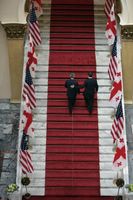 | PRESIDENT SAAKASHVILI: I'll say a few words in English. I want to welcome you, Mr. President, for this historic occasion. You know, right now we have in the streets of Tbilisi, as they are telling me, more than 150,000 people assembled, and I can tell you, no event in the history of this country has ever assembled anything close to these numbers. It shows the importance of this visit. |
You know, outside this building, 18 months ago, also 100,000 Georgians came in defense of democracy with a dream of living free. And in the weeks and months after the Rose Revolution, no country stood closer to Georgia than the United States, whether it was diplomatic support, economic aid, security assistance, or --, the United States was there. For this support, the Georgian people will be eternally grateful.
So I once again, want to welcome Mr. President to Georgia. The partnership between the U.S. and Georgia is about more, and we should make it very clear the strategic interests -- more than oil pipelines, more than any kind of economic or military cooperation; it's about shared values and our shared belief in freedom and in democracy.
And President Bush is a man of vision who believes in the triumph of liberty over forces of tyranny. I know he was also inspired by our journey toward democracy. President Bush is in Georgia because we agree that free people cannot rest while tyranny exists. We know that our liberty must be defended from those who seek to extinguish it. And of course, when we are together, that's much more hopeful and much more efficient.
That's why over 800 troops are in Iraq -- Georgian troops side-by-side with the Americans, and Iraqis and many others, to defeat those who live only to kill, to enslave, to frighten people. That is why Georgians are in Afghanistan, and NATO-led missions, and that is why we appreciate the U.S. support for our NATO aspirations, just like the U.S. supported Ukraine on its NATO aspirations.
The United States supports the total integrity of Georgia within its internationally recognized borders. We appreciate this support and recognize our responsibilities. We will peacefully resolve our disputes with our long-suffering South Ossetian and Abkhaz citizens and the territories. We will widen and deepen our democratic reforms to better the lives of Georgians. And we seek friendly relations with all our neighbors. And we know we can count on the support of the United States in all these vital tasks.
Mr. President, you are a decisive and visionary leader. Georgia is humbled and honored that you have come to visit our small country, but great land. We Georgians have a belief that guests are a gift from God, and you are a most treasured guest. Mr. President, welcome.
PRESIDENT BUSH: Thank you, Mr. President. I'm -- first, I'm so grateful for your hospitality. Laura and I really enjoyed our time last night. I learned firsthand what it means to be fed by a Georgian. I'm really full. (Laughter.) And the food was great. I should have eaten my meal first, and then danced. (Laughter.)
The cultural dancing and singing was spectacular. It was really impressive. And I want to thank those who put on the performance last night.
I also appreciate our visit today. We had a very frank discussion. That's what I like about the President. He speaks his mind. If he's got something on his mind, he'll tell you. What I find on his mind is very refreshing; he loves democracy and loves freedom, and he loves the people of Georgia.
The Rose Revolution was a powerful moment in modern history. It not only inspired the people of Georgia, it inspired others around the world that want to live in a free society. I think people will look back at this moment in history and be -- and marvel at the courage of people who have said, I want generations to grow up in a hopeful world.
And so, Mr. President, thank you for setting such a good example, you and your people. I appreciate the reforms you have put in place here. Georgia has come a long way very quickly. The President recognizes there's a lot of work to be done to leave the foundations, institutional foundations in place, so that no one will ever be able to overturn democracy. That's an independent judiciary, rule of law, free media. He was complaining about the media, which is a good sign. (Laughter.) It means you're free. I sometimes complain about ours, but not too publicly, of course.
I'm looking forward to the meeting with members of the civil society. The President kindly set up a meeting where I will remind people that a truly democratic society is one that honors and respects minorities. This is a very diverse country. You've had a great tradition of honoring minorities in this country, and your democracy will continue to do so.
We talked about NATO. The President is very clear about his intentions to meet the obligations to join NATO. And, Mr. President, we look forward to working with you to meet those obligations. NATO is a very important alliance for the United States of America. It's a place where we have our strategic conversations with our transatlantic friends, and we want to help you achieve your objective there.
I thank the President again; I want to thank the people of Georgia for contributing troops to Iraq and Afghanistan. You've got a fine group of people that are helping serve the cause of freedom. We discussed the way forward in Iraq, discussed the importance of a democracy in the greater Middle East in order to leave behind a peaceful tomorrow. We talked about the peaceful resolution of regional issues. And I look forward to working with the President on his request, if he so chooses, to help deal with some of these issues, like stuff he says here --*. But one of the things that I was most appreciative of is his full understanding of the need and the desire to settle these issues peacefully. And I'm confident, with good work and cooperation, we can solve them peacefully. He can solve them peacefully, with our help.
This has been a visit I've really been looking forward to. I look forward to going into Freedom Square -- think about that -- Freedom Square -- to represent my country and to give our thanks to the Georgian people for the example they've set, and the pledge to the Georgian people that you've got a solid friend in America.
Thank you, Mr. President.
PRESIDENT SAAKASHVILI: Thank you, Mr. President. So we'll have, like, two questions each. First, I guess, Georgian journalists, and then whoever.
Q Shall I ask the question in Georgian?
PRESIDENT BUSH: You can ask anybody you want. You can ask me --
Q I have a question to President Bush. Did you have a conversation with Putin regarding the military bases, with old military bases from Georgia? Do you think this question and this issue will be the decision of the OSCE Summit?
PRESIDENT BUSH: This question was about the presence of military troops -- Russian troops in Georgia. We discussed this at the meeting with President Putin at his house. He knew that I was coming to Georgia, of course. I said I was looking forward to talking to my friend, President Saakashvili, and was confident that the issue of military bases would come up. After all, we discussed this -- (inaudible) -- and I've discussed this issue with the Russians before, as well. So this isn't the first time I've had this conversation with President Putin on this issue. -- (inaudible) -- an agreement in place -- (inaudible) -- said to the Russians, we want to work with the government to fulfill -- (inaudible) -- and I think that is a commitment, an important commitment for the people of Georgia to hear, and it's a -- it shows there's grounds for work to get this issue resolved.
Jennifer.
Q Sir, how important is it for the United States to step into issues like that troop issue, to ensure democratic progress? And also, does your commitment to democracy mean that separatist regions deserve independence -- deserve independence if they want it?
PRESIDENT BUSH: Two points to that question. One, my commitment to democracy means that democracies can solve their problems in peaceful ways. And in terms of separatist movements within a -- within Georgia, that, one, the issue can be resolved peacefully; secondly, it will be resolved in a transparent way. The President has put a way forward that encourages autonomy and self-government, but does not encourage dividing up this great country. It would seem like to me to be a very reasonable proposition. But his commitment, and an important commitment, is one that this issue will be resolved peacefully.
And secondly, it's always important for the United States to stand strongly for democracy and freedom. That's what we believe in. And so standing with the President of Georgia should send a message that we embrace freedom movements and we stand with young democracies and we want to help where we can help build the institutions that outlast the moment, so that future generations of Georgians can grow up in a free society. And we've got a great partner in President Saakashvili. He is a strong believer in democracy. And I appreciate his leadership on the issue.
PRESIDENT SAAKASHVILI: Well, just to add one thing, that certainly I believe that -- I believe in strong self-government. I myself came to this -- to my office from self-government. I know what self-government means. I know how people can feel strongly about their identities. Georgia's strength is its diversity. It's not its weakness, it's our strength.
Now, the problem with those regions are, especially with Abkhazia, that they're throughout almost whole populations.* So we are talking about democratic choice. First, those people should be able to regain their property, to regain their right to there, to regain their right to be safe, and rules for their self-government, rules for autonomy, rules for all kind of arrangement that would materialize their rights. It's not like this, that you throw out the people and then you hold elections with ten percent of the population to decide, and you call it democracy. It's not democracy, it's something else. And that's why it's so important to speak about peace, about peaceful settlements, about democratic choices within the framework of peace, because when guns speak, then people cannot materialize their rights. That's obvious for us. And we suffered a lot, and this region suffered enough from the conflicts and we don't want any more of them. And this is our very strong position.
Q Question to Mr. Bush. You discussed the settlement -- in Georgia, and United States will play an active role in this process. In specific, what kind of help United States can offer to Georgia for conflict resolution? Because Georgian government has a position to settle this resolution peacefully and this conflict peaceful. Do you think that the main problem is outside force?
PRESIDENT BUSH: -- (inaudible) -- disputes. And first, I'm confident that the government of Georgia has got a good society go move forward to resolve the disputes. And obviously, if the President were to call and want me to make a phone call or two, I'd be more than happy to do so. But this is a dispute that is going to be resolved by the Georgian government and by the folks in the separatist regions.
The United States cannot impose a solution, nor would you want us to. But what we can do is we can help. We can work with international bodies and work with the U.N., for example. We can work with other groups, all aimed at helping resolve this issue peacefully. But this is an issue that will be resolved by the duly-elected government of Georgia in a peaceful way. And the President has, as just mentioned, reached out in a constructive way, suggested autonomy and self-government, but he doesn't want to -- he wants the country to remain intact. And we're more than willing. And, listen, we talk quite often. When he calls, if he's got some suggestions where I can -- where he thinks I can help and I think it makes sense, I will be glad to do so.
Q Did you get President Putin to see the importance of democracies on his border? And you've also complimented a recent speech he gave on democracy. But has he taken any concrete steps to satisfy your concerns?
PRESIDENT BUSH: Well, he gave the speech, I think, three days ago, and it was -- or maybe four or five days ago -- it was a very constructive speech, I thought, where he did talk about the benefits of democracy for his people. And democracies are peaceful countries. And when you have peaceful countries on your border, it -- you benefit. And Georgia is a peaceful country. Georgia is a democracy. The people here are trying to right the wrongs of the past and move forward. The President spends a lot of time talking to me about economic improvements, entrepreneurship and small businesses, and vitality of the economy so people can make a living. And when you have countries focused on the needs of the people, it tends to make them peaceful neighbors.
And so, over time, any country will recognize the benefits of democracy on her border. And I'm confident Russia will recognize the benefits of having democracies on her border. And Georgia is a great example of a peaceful democracy, that wants to resolve whatever lingering disputes there may be in a peaceful fashion.
And so I want to, one, again thank the President for his hospitality and for setting such a vivid example of what is possible when the people speak. And it's this democratic movement that took place here in Georgia that is going to help transform the greater Middle East. And that's important for people in Georgia and around the world to understand, that democracies in the greater Middle East will make the world a more peaceful place. A democracy in Iraq will send such a strong and vivid example to others about what is possible. And democracies are peaceful societies. And one of the things that we all long for -- at least I long for, I'm confident the President does, as well -- is to leave behind a more peaceful world for our children and grandchildren.
So, thank you, Mr. President. Thank you all for the press conference.
PRESIDENT SAAKASHVILI: Thank you.
END 10:46 A.M. (Local) For Immediate Release Office of the Press Secretary May 10, 2005
0
comments
||
||
Russian Victory Day Parade, Video, Photos
 | Russian Victory Day Parade FULL STREAMING VIDEO, more like this EuroNews, Russian soldiers march through Moscow's Red Square, Monday, May 9, 2005, during a parade commemorating the 60th Anniversary of the end of World War II. White House photo by Eric Draper |
0
comments
||
||


