


Foreign Relations Committee Vote on the Bolton Nomination , Secretary Condoleezza Rice Washington, DC May 12, 2005
I am pleased that the Foreign Relations Committee has voted to send John Bolton’s nomination as Ambassador to the United Nations to the full Senate for consideration. I recommended John for this critical position because he has the skill and dedication necessary to advance the President’s reform agenda at the United Nations. I have believed from the outset that he is the right man for this challenging assignment and I hope the Senate will now move quickly to confirm him so that he can begin his work at the United Nations.
SOURCE: state.gov 2005/510 Released on May 12, 2005
Friday, May 13, 2005
Secretary Condoleezza Rice, Bolton Nomination
0
comments
||
||

Deputy Secretary Zoellick (CAFTA-DR)
Deputy Secretary Zoellick To Speak on U.S.-Central America-Dominican Republic Free Trade Agreement
Deputy Secretary of State Robert B. Zoellick will deliver a speech on the U.S.-Central America-Dominican Republic Free Trade Agreement (CAFTA-DR) at noon, Monday, May 16 at the Heritage Foundation in Washington, DC.
Entitled “From Crisis to Commerce: CAFTA and Democracy in our Neighborhood,” Deputy Secretary Zoellick's speech will look back two decades to when Central America was enveloped in violence and civil war, and the United States was helping people in the region establish democratic governments. Now, after 20 years of democratic reform, six nations are seeking to sign a free trade agreement with the United States. The Deputy Secretary will discuss how CAFTA-DR will promote economic growth, rising incomes, and freedom in a region of strategic interest to the United States.
Members of the press wishing to cover Deputy Secretary Zoellick’s speech should contact Chris Kennedy at the Heritage Foundation at (202) 675-1761. The Heritage Foundation is located at 214 Massachusetts Ave. NE, Washington, DC.
SOURCE: state.gov 2005/506 Released on May 12, 2005 Notice to the Press Office of the Spokesman Washington, DC May 12, 2005
0
comments
||
||
Machine-Readable Passport Requirements
Machine-Readable Passport Requirements To Take Effect at U.S. Borders on June 26, 2005
The Department of Homeland Security today announced that as of June 26, 2005, all persons traveling under the auspices of the Visa Waiver Program (VWP) must present a machine-readable passport (MRP) to travel to the United States without a visa.
The Immigration and Nationality Act originally set October 1, 2003 as the date by which Visa Waiver Program travelers were required to present a machine-readable passport for visa-free travel to the United States. Twenty-three of the 27 Visa Waiver Program countries requested and were granted a postponement to October 26, 2004 of this requirement. The countries not requesting this postponement were Andorra, Brunei, Liechtenstein, and Slovenia. Nationals of those four countries have been required to present a machine-readable passport for visa-free travel since October 1, 2003. Belgian nationals traveling under the auspices of the Visa Waiver Program have been required to present a machine-readable passport since May 15, 2003.
For a limited period that started on October 26, 2004, the Department of Homeland Security has provided immigration inspectors at U.S. borders and ports of entry the authority to grant a one-time entry at no charge for Visa Waiver travelers arriving without a machine-readable passport. This limited period will end on June 26, 2005. Starting on that date, transportation carriers will be fined $3,300 per violation for transporting any Visa Waiver traveler to the U.S. without a machine-readable passport.
The Department of State has been working closely with Visa Waiver Program countries to communicate information about the machine-readable passport requirement to their citizens. Since October 26, 2004, Department of Homeland Security Customs and Border Protection officers have been notifying Visa Waiver travelers entering the United States with a letter explaining the machine-readable passport requirements.
Machine-readable passports include two optical-character, typeface lines at the bottom of the biographic page of the passport that, when read, deters fraud and helps confirm the passport holder’s identity quickly. A sample image of a machine-readable passport may be found at travel.state.gov/visa/.
Visa Waiver travelers who are not in possession of machine-readable passport may also apply for a nonimmigrant visa at a U.S. embassy or consulate abroad if seeking entry for business or tourist visits to the United States. Information on the Visa Waiver Program and how to apply for a U.S. visa is available at travel.state.gov and unitedstatesvisas.gov.
The machine-readable passport requirements do not affect the separate deadline requiring Visa Waiver Program country passports issued on or after October 26, 2005, to contain biometrics in order to be used for visa-free travel to the United States.
2005/507 Released on May 12, 2005 Media Note Office of the Spokesman Washington, DC May 12, 2005
0
comments
||
||
Assistant Secretary Rocca’s Travel to Nepal
Assistant Secretary Rocca’s Travel to Nepal
Question: Please provide an update on Assistant Secretary Rocca’s trip to Nepal.
Answer: Assistant Secretary of State for South Asian Affairs Christina Rocca completed a productive trip to Nepal today. During her visit, she met with King Gyanendra, senior government officials, leaders of political parties, and civil society groups. The Assistant Secretary urged the King to release all political detainees and to restore civil liberties, including freedom of the press, as part of his commitment to restore democracy. She also called on the King and political party leaders to reconcile and find a way forward to confront the brutal Maoist insurgency.
2005/503 Released on May 11, 2005 Taken Question Office of the Spokesman Washington, DC May 11, 2005 Question Taken from the May 11, 2005 Daily Press Briefing
0
comments
||
||
United States Observers for Albanian Election
United States Observers for Albanian Election
Question: Will the U.S. send monitors to the Albanian elections to be held July 3, 2005?
Answer: The Organization for Security and Cooperation in Europe has asked the U. S. to participate in its observer mission for the Albanian election and the U.S. hopes to do so. U.S. embassy and U.S. non-governmental organizations are also likely to engage in independent monitoring activity.
2005/505 Released on May 11, 2005 Taken Question Office of the Spokesman Washington, DC May 11, 2005 Question Taken from the May 11, 2005 Daily Press Briefing
0
comments
||
||
Medical BRAC Recommendations
Fact Sheet Medical BRAC Recommendations for the National Capital Region
The 2005 BRAC recommendations afford this department the opportunity to transform and improve how medical care will be delivered to the department’s 9.1 million beneficiaries in the 21st Century.
BRAC 2005 medical recommendations include a number of realignments and consolidations of military medical activities and facilities. These initiatives follow the overall BRAC rationale and goals. In all instances, improving access to care for beneficiaries was a priority consideration; other considerations included military value, quality of care, and opportunities for efficiency through joint organizational solutions.
Military Health System activities evaluated in the BRAC 2005 process included patient care facilities, education and training activities, and research, development and acquisition activities; in all, 234 military medical activities were evaluated.
The Realignment
Establish the Walter Reed National Military Medical Center (WRNMMC) at Bethesda, Md., as a 300-bed Medical Center with the full range of intensive and complex specialty and subspecialty medical services, including specialized facilities for the most seriously war injured. This facility will serve as the U. S. military’s worldwide tertiary referral center for casualty and beneficiary care.
Construct a large Community Hospital at Fort Belvoir, Va., a 165-bed facility jointly staffed facility focused on family and community medicine, especially to serve the large number of military beneficiaries in the southern-most areas of the National Capital Region.
Convert the 89th Medical Group at Andrews Air Force Base to a clinic with ambulatory surgery capability and realign some staff to the new WRNMMC and new Fort Belvoir Community Hospital.
Realign Walter Reed Army Medical Center, D.C., by assigning management, clinical, and training activities to the new WRNMMC and the new community hospital at Fort Belvoir. Research and Development activities will relocate and form Centers of Excellence at Fort Sam Houston, Tex., Aberdeen Proving Ground, Md., or Fort Detrick, Md.
Realign the Armed Forces Institute of Pathology by moving the DNA registry and the Medical Examiners functions to Dover Air Force Base, Dover, Del.; the technician training functions to Fort Sam Houston, Tex.; the museum to WRNMMC, and outsource non-military essential pathology activities.
Maintain existing military outpatient capabilities at Fort Myer, Bolling Air Force Base, the Pentagon and other military clinics in the surrounding NCR.
The substantial construction required for this recommendation will result in major investments in new facilities occurring after 2008.
Why?
These realignment actions for the NCR create a single world class, jointly staffed medical center complex for support of the troops and their families.
They will improve the use of military infrastructure by fully utilizing newly constructed inpatient capacity at Bethesda, while better serving our beneficiary population with a new community hospital at Fort Belvoir. The Walter Reed Army Medical Center was opened in 1977 with a designed capacity of 1200 beds. The Bethesda National Naval Medical Center was opened in 1980 with a designed capacity of 450 beds and rehabilitated in 1995. Andrews was opened in 1958 with a design capacity 250 beds. Today these facilities use each day, on average, only a fraction of their available beds; 189 (Walter Reed), 113 (Bethesda) and 33 (Andrews).
These realignment actions afford better placement of healthcare delivery capabilities in the National Capital Region. Demographics show that the beneficiary population has been moving into Northern Virginia for the past several years - straining the capabilities of the current DeWitt Army Community Hospital. The creation of a new, jointly staffed, state-of-the-art community hospital at Fort Belvoir delivers enhanced services to the Northern Virginia military community.
Investing and modernizing key military infrastructure will enhance the quality, effectiveness and efficiency of the Military Health System. This realignment of healthcare is estimated to cost $988 million, and will provide the DoD with an enduring annual savings of approximately $100 million with an estimated savings of $301 million above the implementation costs over the next 20 years.
Advantages
The amount of healthcare provided through military facilities in the National Capital Region will remain the same, with markedly improved access for our beneficiaries, particularly in the growing Northern Virginia area.
Joint staffing of these hospitals will bring together the very best expertise found in Army, Navy, and Air Force medicine to better serve our military men and women, especially those returning from the field critically ill or injured.
We will combine two facilities operating at less than full capacity into one fully utilized, world-class military healthcare complex.
This move also allows us to better leverage both the training capabilities resident in the Uniformed Service University of the Health Sciences on the same campus and the research leadership of the National Institutes of Health immediately across the street to offer a unique and fully integrated military platform for healthcare, education, and research.
This action will enhance the seamless care we've seen delivered from jointly staffed facilities in Iraq through the jointly staffed Landstuhl Regional Medical Center in Germany to the United States. To see the chart in PDF format click here.
U.S. Department of DefenseOffice of the Assistant Secretary of Defense (Public Affairs)News Release On the Web: defenselink.mil/releases/2005/nr20050513-3144.html Media contact: +1 (703) 697-5131 Public contact:dod.mil/faq/comment or +1 (703) 428-0711 No. 473-05
IMMEDIATE RELEASE May 13, 2005
RELATED:
0
comments
||
||
DoD BRAC Recommendations
DoD BRAC Recommendations Expected to Save Nearly $50 Billion
Secretary of Defense Donald H. Rumsfeld announced today that the department’s recommendations to close or realign military facilities in the United States will better position U.S. forces to confront this century’s threats. The recommendation, if fully implemented, will generate an estimated net savings of nearly $50 billion over the next two decades. When combined with the anticipated savings from overseas basing realignments around the world, the projected net savings increases to $64.2 billion.
“Our current arrangements, designed for the Cold War, must give way to the new demands of the war against extremism and other evolving 21st Century challenges,” Rumsfeld said.
The department’s BRAC recommendations, if adopted, would close 33 major bases and realign 29 more.
The BRAC recommendations were developed in a process that began in 2001, with the initiation of a review of how U.S. forces were arrayed overseas. Prospective changes to the department’s global posture were fed into the analysis and recommendations. As a result, forces coming home will return to installations better arrayed to train and deploy for possible contingencies around the world.
The department’s BRAC recommendations were developed by the military services and seven joint cross-service groups in consultation with the combatant commanders. Each recommendation was created under the procedures established in the Base Closure and Realignment Act of 1990, as amended. The BRAC analysis started with the 20-Year Force Structure Plan and the department’s inventory of facilities, and then applied BRAC selection criteria that had been published early in 2004.
These criteria give paramount importance to an installation’s military value. Other considerations included costs of potential savings, and economic and environmental impacts of potential changes. The BRAC analysis used data that was certified accurate in a process monitored by the Government Accountability Office and the department’s inspection and audit agencies.
The department’s BRAC recommendations are intended to:
- Enhance the military’s ability to meet contingency surge or mobilization requirements;
- Retain those installations that have unique capabilities that would be difficult to reconstitute at other locations;
- Consolidate similar or duplicative training and support functions to improve joint war fighting;
- Transform important support functions – including logistics, medicine and research and development – by capitalizing on advances in technology and business practice.
The department’s recommendations will now be reviewed by the BRAC Commission, which will seek comments from the potentially affected communities. As it has in the past four BRAC rounds, the department will assist affected communities in a variety of ways. Department of Defense programs include personnel transition and job training assistance, local reuse planning grants, and streamlined property disposal. The department will join with other federal agencies to offer additional assistance to affected communities.
Once the commission has completed its review, it will present its recommendations to the President. The President must approve and submit the commission’s recommendations to the Congress for review and appropriate action. The entire process is expected to be completed by the end of 2005.
The full BRAC recommendations, additional information regarding community assistance and other details, may be found online at defenselink.mil/brac .
NOTE: Attached in PDF format is a state-by-state summary of those recommendations that entail changes that have military and civilian personnel impacts (click here). The summary does not include locations where there are no changes to military or civilian personnel. For details on all recommendations, see volume one at the web site mentioned above.
U.S. Department of DefenseOffice of the Assistant Secretary of Defense (Public Affairs) News Release On the Web: defenselink.mil/releases/2005/ Media contact: +1 (703) 697-5131
Public contact:dod.mil/faq/comment or +1 (703) 428-0711 No. 469-05 IMMEDIATE RELEASE May 13, 2005
RELATED:
0
comments
||
||
Executive Order 12788, Defense Economic Adjustment Program
Executive Order Amendments to Executive Order 12788 Relating to the Defense Economic Adjustment Program
By the authority vested in me as President by the Constitution and the laws of the United States of America, including 10 U.S.C. 2391 and the Defense Economic Adjustment, Diversification, Conversion, and Stabilization Act of 1990, enacted as Division D, section 4001 et seq., of the National Defense Authorization Act for Fiscal Year 1991, Public Law 101-510, and in order to update the Defense Economic Adjustment Program, it is hereby ordered that Executive Order 12788 of January 15, 1992, as amended, is further amended as follows:
Section 1. The text of section 2 of Executive Order 12788 is revised to read as follows: "The Defense Economic Adjustment Program shall (1) assist substantially and seriously affected communities, businesses, and workers from the effects of major Defense base closures, realignments, and Defense contract-related adjustments, and (2) assist State and local governments in preventing the encroachment of civilian communities from impairing the operational utility of military installations."
Sec. 2. (a) The text of section 3(c) is amended by deleting "and communities" and inserting in lieu thereof "communities, and businesses";
(b) The text of section 3(l) is amended by deleting "and" after the semicolon;
(c) The text of section 3(m) is amended by adding "and" after "diminish;" and
(d) A new section 3(n) is added to read: "(n) Encourage resolution of regulatory issues that impede encroachment prevention and local economic adjustment efforts."
Sec. 3. (a) Section 4(a) is amended by: (i) deleting "(19) Director of the United States Arms Control and Disarmament Agency;" (ii) deleting "(21) Director of the Federal Emergency Management Agency;" and (iii) renumbering the remaining subsections listing the officials on the Economic Adjustment Committee (the "Committee") accordingly;
(b) The text of section 4(b) is revised to read as follows: "The Secretary of Defense, or the Secretary's designee, shall chair the Committee."; and
(c) The text of section 4(c) is revised to read as follows: "The Secretaries of Labor and Commerce shall serve as Vice Chairmen of the Committee. The Vice Chairmen shall co-chair the Committee in the absence of both the Chairman and the Chairman's designee and may also preside over meetings of designated representatives of the concerned executive agencies."
Sec. 4. This order is not intended to, and does not, create any right or benefit, substantive or procedural, enforceable by any party at law or in equity against the United States, its departments, agencies, entities, officers, employees, agents, or any other person.
GEORGE W. BUSH THE WHITE HOUSE, May 12, 2005. # # # For Immediate Release Office of the Press Secretary May 12, 2005
0
comments
||
||
Thursday, May 12, 2005
black youth twice as likely to die from traumatic injury as white
BLACK CHILDREN MORE LIKELY TO DIE FROM TRAUMATIC INJURY THAN WHITE CHILDREN
COLUMBUS , Ohio – A new study of nearly 6,000 children suggests that black youth are more than twice as likely to die from a traumatic injury as are white children.
“Trauma has a far greater impact on minority children than it does on white children,” said Jonathan Groner, the study's lead author and a clinical associate professor of surgery at Ohio State University . “As a group, black children tend to have more serious injuries.”
Indeed, black children are also two to three times more likely to be admitted to the hospital because of a traumatic injury.
However, when black and white children are admitted to the hospital with equally severe injuries, they have an equal chance of survival, spend about the same amount of time in the hospital, and also have equal access to rehabilitation services.
“Trauma-induced injuries are mainly a problem of prevention, not a problem of treatment,” said Groner, who is also the trauma medical director at Columbus Children's Hospital. “Trauma is a disease – it can be prevented and it has recognizable risk factors.”
The findings are reported in a recent issue of the Journal of the National Medical Association. Groner conducted the study with John Hayes, a statistician with the trauma program at Columbus Children's Hospital.
The study sample included the medical records of 5,973 children who received emergency inpatient treatment at one of six pediatric trauma centers in Ohio . (Trauma centers were located in Columbus , Cleveland , Cincinnati , Dayton , Toledo and Akron .)
The researchers also gathered information from the 2000 U.S. census and from death certificate data from the Ohio Bureau of Vital Statistics. Data were collected for injuries that happened in 1999, 2000 and 2001. Information included the cause of the injury and, in most cases, the zip code where the injury occurred.
All of the children were younger than 16 at the time of their injuries. Information was included only for patients who came to an emergency department and were subsequently admitted to the hospital or died after treatment in the emergency room.
Although Groner and Hayes gathered data from Ohio 's four largest minority groups – African American, Native American, Hispanic and Asian – the latter three groups made up a very small portion of the trauma cases.
“This study principally compares black and white children, as the other populations were too small to give us reliable numbers,” Groner said.
At the time of the study, 12.3 percent of Ohio children 15 and younger were black. But these children accounted for 28 percent of the trauma cases.
Compared to white children, black children were:
- Nearly eight times more likely to sustain burns or gunshot wounds;
- Seven times more likely to be struck by a car;
- Six times more likely to be assaulted (the number includes cases of child abuse);
- Nearly five times as likely to drown; and
- Had a greater risk of dying from a traumatic injury, because their injuries tend to be more severe. (The overall risk of a black child dying was 2.2 times greater than that of a white child.)
“Suicide isn't generally thought to be an issue until a child reaches his early teens,” Groner said. “Our findings demonstrate that parents, school officials and mental health professionals need to be aware of the potential for suicide in pre-teen children.”
Part of the reason why black children may be more susceptible to serious injury is due to their environment, Groner said.
“When we looked at the social and economic data, we saw that many traumatic injuries – particularly assaults and burns – corresponded with the severity of poverty,” he said. “Overall, black children tend to live in places where the potential for serious injury is higher.”
As with many illnesses, Groner said that prevention is the key to keeping children safe from traumatic injuries.
“If a child doesn't have a primary care physician and instead comes into the emergency room for care, his or her caregivers are probably less likely to receive injury prevention information than they would if the child made regular visits to an established doctor,” Groner said.
“And it's possible that prevention campaigns have targeted geographic and social centers where African Americans or other minorities are not broadly present.”
SOURCE: researchnews.osu.edu/ This study was funded by Ohio Emergency Medical Services, a division of the Ohio Department of Public Safety. #
Contact: Jonathan Groner, 614-722-3919; GronerJ@chi.osu.edu
Written by Holly Wagner, 614-292-8310; wagner.235@osu.edu
0
comments
||
||
President Discusses CAFTA-DR
President Discusses CAFTA-DR, FULL STREAMING VIDEO, The Rose Garden President's Remarks 11:39 A.M. EDT
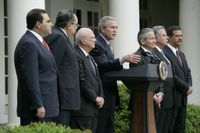 | THE PRESIDENT: Good morning, thank you for coming. Welcome to the White House, and welcome to the Rose Garden. I want to thank the six Presidents who have joined me today. We've just had a constructive dialogue in the Cabinet Room about our mutual interests. |
We're here today, as well, because the best way to achieve peace and prosperity for our hemisphere is by strengthening democracy and continuing the economic transformation of Central America and the Dominican Republic. And all of us agree that the Central American and Dominican Republic Free Trade Agreement presents us with an historic opportunity to advance our common goals in an important part of our neighborhood.
CAFTA brings benefits to all sides. For the newly emerging democracies of Central America, CAFTA would bring new investment that means good jobs and higher labor standards for their workers. Central American consumers would have better access to more U.S. goods at better prices. And by passing this agreement, we would signal that the world's leading trading nation was committed to a closer partnership with countries in our own backyard, countries which share our values.
For American farmers, businesses, and workers, CAFTA would create a more level playing field. Under existing rules, most of Central America's exports already enter the United States duty free. But our products still face hefty tariffs there. By passing CAFTA, we would open up a market of 44 million consumers who already import more of our goods and services than Australia or Brazil. And we would create incentives for factories to stay in Central America and use American materials rather than relocate to Asia where they are more likely to use Asian materials.
Finally, for the Western hemisphere, CAFTA would bring the stability and security that can only come from freedom. Today a part of the world that was once characterized by oppression and military dictatorship now sees its future in free elections and free trade. And we must not take these gains for granted. These are small nations, but they're making big and brave commitments, and America needs to continue to support them as they walk down the road of openness and accountability. By transforming our hemisphere into a powerful free trade area, we will promote democratic governance, human rights, and economic liberty for everyone.
The United States was built on freedom -- and the more of it we have in our backyard, the freer and safer and more prosperous all of the Americas will be. I applaud these leaders for their vision. I thank them for working with members of Congress from both political parties to persuade those members about the importance of this piece of legislation. I assured them I will join in the efforts to get this bill passed. This bill is good for Central American countries, it is good for America.
I want to thank you all for being here. Que dios les bendiga.
END 11:44 A.M. EDT For Immediate Release, Office of the Press Secretary, May 12, 2005
0
comments
||
||
President Bush will welcome Nelson Mandela
President to Welcome Former President Nelson Mandela to the White House
President Bush will welcome former South African President Nelson Mandela to the White House on May 17. This meeting provides the two leaders an opportunity to discuss their common concern for fighting HIV/AIDS in Africa. President Bush looks forward to discussing the efforts being undertaken by the Nelson Mandela Foundation to promote universal education in Africa and enhance the social development of African youth and children.
# # # For Immediate Release Office of the Press Secretary May 12, 2005
0
comments
||
||
President Bush will welcome President Hamid Karzai of Afghanistan
President to Welcome President Karzai of Afghanistan to the White House
President Bush will welcome President Hamid Karzai of Afghanistan to the White House on May 23. President Karzai was elected last October in the first presidential election in Afghan history. President Karzai and President Bush last met in September 2004 in New York during the opening of the U.N. General Assembly. The two Presidents will discuss progress in the global war on terror, the Afghan people's achievements in building democracy, and ongoing cooperation on a range of bilateral, regional and international issues.
# # # For Immediate Release Office of the Press Secretary May 12, 2005
0
comments
||
||
President Bush will welcome Prime Minister Nazif of the Arab Republic of Egypt
Visit by Prime Minister of the Arab Republic of Egypt Ahmed Mohamed Nazif
President Bush will welcome Prime Minister Nazif of the Arab Republic of Egypt to Washington on May 18, 2005. The President looks forward to discussing with Prime Minister Nazif a wide range of key bilateral and regional issues, including the President's efforts to promote democratic reform, achieve peace in the Middle East, and advance the war on terrorism.
# # # For Immediate Release, Office of the Press Secretary, May 12, 2005 Statement by the Press Secretary
0
comments
||
||
President Bush will welcome Prime Minister Anders Fogh Rasmussen of Denmark
President Bush will welcome Prime Minister Anders Fogh Rasmussen to the White House on May 20, 2005. Denmark is a close friend and ally of the United States, and Prime Minister Rasmussen is a strong proponent of effective transatlantic cooperation. Under his leadership, Denmark has been a key partner in advancing freedom and democracy around the world. President Bush looks forward to discussing with the Prime Minster how Denmark and the United States can continue to support freedom and democracy, particularly in Iraq, Afghanistan, the Broader Middle East North Africa Initiative, NATO and U.S.-EU issues, as well as the President's current trip to Europe.
# # # For Immediate Release Office of the Press Secretary May 12, 2005 Statement by the Press Secretary
0
comments
||
||
World Trade Week, 2005
World Trade Week, 2005, A Proclamation by the President of the United States of America
Free and fair trade creates jobs, raises living standards, and lowers prices for families throughout America. It also strengthens our relationships with other countries, helping us to forge new partnerships based on a commitment to generate new prosperity and a better way of life for people in America and throughout the world. This year, as we mark the tenth anniversary of the World Trade Organization, World Trade Week provides an opportunity to recognize the many benefits of free and fair trade in strengthening economies and improving lives.
Because 95 percent of the world's population resides outside of our borders, trade creates opportunities for American farmers, small businesses, and manufacturers to sell their products to consumers across the world. Trade also raises up the world's poor, bringing hope to those in despair.
Millions of American jobs depend on exports, and my Administration is committed to opening markets around the world for American products. Since 2001, we have completed free trade agreements with 12 nations, representing a combined market of 124 million consumers for American products, goods, and services. These agreements will create millions of new consumers for America's farmers, manufacturers, and small business owners, and deepen our friendships with countries in other parts of the world.
As we open up new markets to trade, we must always ensure that American workers are treated fairly. Our workers can compete with anyone, anywhere, so long as the rules are fair. My Administration will continue to enforce trade agreements and insist upon a level playing field for America's workers.
NOW, THEREFORE, I, GEORGE W. BUSH, President of the United States of America, by virtue of the authority vested in me by the Constitution and laws of the United States, do hereby proclaim May 15 through May 21, 2005, as World Trade Week. I encourage all Americans to observe this week with events, trade shows, and educational programs that celebrate the benefits of trade to our Nation and the global economy.
IN WITNESS WHEREOF, I have hereunto set my hand this twelfth day of May, in the year of our Lord two thousand five, and of the Independence of the United States of America the two hundred and twenty ninth.
GEORGE W. BUSH # # # For Immediate Release Office of the Press Secretary May 12, 2005
0
comments
||
||
Emergency Supplemental Appropriations Act
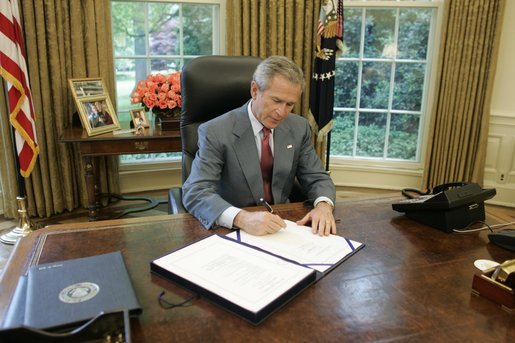 | Statement on H.R. 1268, the "Emergency Supplemental Appropriations Act for Defense, the Global War on Terror, and Tsunami Relief, 2005" On Wednesday, May 11 2005, the President signed into law: |
# # # For Immediate Release Office of the Press Secretary May 11, 2005
RELATED:
- Statement on H.R. 1268 - Today, I have signed into law H.R. 1268, the "Emergency Supplemental Appropriations Act for Defense, the Global War on Terror, and Tsunami Relief Act, 2005" (the "Act").
0
comments
||
||
Statement on H.R. 1268
President's Statement on H.R. 1268
Today, I have signed into law H.R. 1268, the "Emergency Supplemental Appropriations Act for Defense, the Global War on Terror, and Tsunami Relief Act, 2005" (the "Act"). The Act provides funds for ongoing military and intelligence operations in Iraq and Afghanistan and selected other international activities, including tsunami relief and reconstruction. The Act supports new benefits for service members who have suffered traumatic injury and for survivors of fallen service members. The Act also provides additional border enforcement resources, which will strengthen the Nation's ability to prevent foreign terrorists from operating in the United States.
The executive branch shall construe subsection 1025(d) of the Act, which purports to determine the command relationships among certain elements of the U.S. Navy forces, as advisory, as any other construction would conflict with the President's constitutional authority as Commander in Chief.
Provisions of the Act, such as sections 2104 and 6024, purport to require congressional committee approval prior to certain obligations or expenditures of funds appropriated by the Act. The executive branch shall construe such provisions to require only prior notification to congressional committees, as any other construction would be contrary to the constitutional principles set forth by the Supreme Court of the United States in 1983 in INS v. Chadha.
Section 6025 purports to regulate the content of the President's annual budget submission, which is a proposal for enactment of legislation to appropriate funds. In addition, section 301 calls for submission of legislative recommendations by an executive branch official to the Congress. The executive branch shall construe these and any other similar provisions in a manner consistent with the Constitution's commitment to the President of exclusive authority to supervise the unitary executive branch and to recommend for the consideration of the Congress such measures as the President shall judge necessary and expedient.
Several provisions of the Act, including sections 6041, 6042, 6043, 6052, 6053, 6069, 6070, 6071, and 6072 make specified changes in statements of managers of the House Senate conference committees that accompanied various bills reported from conference that ultimately became laws. As with other committee materials, statements of managers accompanying a conference report do not have the force of law. Accordingly, although changes to these statements are directed by the terms of the Act, the statements themselves are not legally binding.
GEORGE W. BUSH THE WHITE HOUSE, May 11, 2005. # # # For Immediate Release Office of the Press Secretary May 11, 2005
0
comments
||
||
Vice President, A Nation Honors Nancy Reagan
Vice President's Remarks at "A Nation Honors Nancy Reagan" The Ronald Reagan Building and International Trade Center Washington, D.C. 8:08 P.M. EDT
THE VICE PRESIDENT: Thank you very much. Thank you, Diane. And I'd like to respond to Diane's introduction. (Laughter.) But Lynne is here tonight, and I'd better not. (Laughter.)
But I'm delighted to be with all of you this evening on a very special occasion for Lynne and me to pay tribute to a great and beloved American, Nancy Reagan.
We're pleased as well to be joined by the congressional leadership; by members of the Reagan administration; current and former members of the Cabinet; and President Reagan's first appointee to the Supreme Court of the United States, Justice Sandra Day O'Connor. (Applause.)
So many of you here this evening have worked at the White House, or have been guests there from time to time. And you'll recall that one of the first rooms that visitors see is called the Vermeil Room, just off the corridor on the Ground Floor. If you go into the room, you see Aaron Shikler's portrait of Jacqueline Kennedy -- a painting that calls to mind a period of elegance and renewal in the White House. And just a few steps away you see another portrait -- equally stunning, painted by the same artist -- of a lady in red. She is Nancy Davis Reagan, and she, also, defined the beauty and the style of an entire era. (Applause.)
To this day our whole nation admires the wife of our 40th President for her graciousness and good taste, for the respect she held for the presidency and for the symbols of that office, for the causes she has served so generously and, above all, for the personal courage she has displayed in all the seasons of her life.
Nancy Reagan has never been one to speak of her own accomplishments, but her entire life is a story of great talent, of persevering character, and many successes. She is a graduate of Smith College who decided to become an actress, then made her own way in show business. The woman we honor this evening has appeared on Broadway, performed with touring companies, and starred in motion pictures with Gary Cooper, Ava Gardner, Barbara Stanwyck, Fredric March, Gene Kelly, and Ronald Reagan.
In fact, long before she ever met her husband, Nancy Davis had a contract with Metro-Goldwyn-Mayer, and her beautiful face was familiar to millions of Americans.
Nancy had extraordinary, loving parents, and they both lived long enough to see their only daughter become a movie star, a devoted wife and mother, First Lady of California, and First Lady of the United States.
Her father, Loyal Davis, M.D., was chairman of the department of surgery at Northwestern University Medical School. For many decades, Dr. Davis was one of the most respected physicians in the United States, and he is remembered, professionally and personally, as the finest of men.
Nancy's mother was Edith Luckett Davis -- also a beautiful and kind-hearted woman, a former actress, and by all accounts a person of unlimited warmth and humor. A Catholic priest once told Nancy about the day he introduced Nancy's mother to the Bishop of Phoenix. He said he very cordially presented Mrs. Davis to the Bishop, and she curtsied in a very proper fashion. Then she turned to the priest and said, "Well, aren't you and I going to kiss? -- we always do that when the bishop isn't here." (Laughter.)
The Davis family included a devoted son-in-law. And every year on his wife's birthday, Ronald Reagan sent Edith Davis a bouquet of flowers, to thank her for giving birth to Nancy -- the woman who, in his words, "made my life complete."
The future President and First Lady of the United States were married at the Little Brown Church in Los Angeles. And ever after, both Nancy and Ronald Reagan would refer to the 4th of March, 1952 as the day their lives truly began.
For 52 years Nancy Reagan was at the side of this great man -- and she has shared with us so many wonderful stories of their life together. In her memoir Nancy explains that Ronald Reagan was not an early riser. She tells of the time in 1980 when her husband complained about campaign events being scheduled way too early in the day. A member of the staff said, "You'd better get used to it, Governor. If you become President, that fellow from the NSC is going to come in to brief you at 7:30 a.m. each morning." Reagan said, "Yeah, then he's going to have a hell of a long wait." (Laughter.)
As the Reagan presidency unfolded, our leader and his wife faced many challenges -- among them, of course, the shooting of the President and serious illnesses for both of them. Yet, perhaps because of the great strength they gained from each other, neither the President nor Nancy seemed to get older. Once somebody asked Ronald Reagan, "How come when I keep seeing new pictures of you on horseback, you always look younger?" The President replied, "That's easy, I just keep riding older horses." (Laughter.)
To think back on the Reagan years is to recall a time of rising prosperity in our country, and rising hopes for freedom in our world. In that era our national confidence was revived, our faith in the presidency was renewed, and the White House itself never looked better.
For eight years as First Lady of our land, Nancy Reagan was the very ideal of grace, and loyalty, and compassion. It wasn't just Ronald Reagan that she helped. She is the First Lady who gave new life to the Foster Grandparents Program, which has meant so much to older Americans and to children in need. She is the First Lady who enlisted herself in the fight against drugs and kept at it year after year, and without a doubt deserves a lot of the credit for a serious decline in drug use among teenagers. She now brings that same spirit to the cause of defeating Alzheimer's Disease -- not for any gain that could come to her, but because she is a woman of deep understanding and feeling.
I am very fortunate to know Mrs. Reagan, and to have known her husband. It has always seemed to me that no photograph could ever capture the true closeness of the Reagans. But if you spent any amount of time in their company, you could sense just how much Nancy meant to him, and how proud she made him every day. She once wrote, "I have never doubted for one single instant that Ronnie and I belong together." Our whole nation has always felt the same way. When we think of President Reagan, we always see Nancy beside him, and our respect for their service to America only grows with time.
Nearly a quarter century has passed since this remarkable woman stepped into American history as First Lady. Yet Nancy Reagan is still giving to our country, and still bringing happiness into the lives of others. She is a warm and familiar presence in American life. She remains one of the most admired women of our time. And we are joyful to be in her presence this evening.
Thank you very much. (Applause.)
END 8:18 P.M. EDT For Immediate Release Office of the Vice President May 11, 2005
0
comments
||
||
Pamela E. Bridgewater, William Alan Eaton, Henrietta Holsman Fore, Mark AL Limbaugh
Nominations Sent to the Senate
Pamela E. Bridgewater, of Virginia, a Career Member of The Senior Foreign Service, Class of Minister-Counselor, to be Ambassador Extraordinary and Plenipotentiary of the United States of America To the Republic of Ghana.
William Alan Eaton, of Virginia, a Career Member of the Senior Foreign Service, Class of Minister-Counselor, to be Ambassador Extraordinary and Plenipotentiary of the United States of America To the Republic of Panama.
Henrietta Holsman Fore, of Nevada, to be An Under Secretary Of State , Vice Grant S. Green, Jr., Resigned.
Mark AL Limbaugh, of Idaho, to be An Assistant Secretary of The Interior, Vice Bennett William Raley, Resigned.
# # # For Immediate Release, Office of the Press Secretary, May 11, 2005
0
comments
||
||
Pamela E. Bridgewater, Tamala Lynne Longaberger
President George W. Bush today announced his intention to nominate one individual and appoint one individual to serve in his Administration:
The President intends to nominate Pamela E. Bridgewater, of Virginia, to be Ambassador Extraordinary and Plenipotentiary of the United States of America to the Republic of Ghana. A career member of the Senior Foreign Service, Ambassador Bridgewater currently serves as Diplomat in Residence at Howard University. Most recently, she served as Deputy Assistant Secretary of State in the Bureau of African Affairs. She previously served as Chief of Mission in Cotonou, Benin. Earlier in her career, Ambassador Bridgewater served as Deputy Chief of Mission in Nassau, Principal Officer in Durban, and Political Officer in Pretoria. She earned her bachelor's degree from Virginia State University and her master's degree from the University of Cincinnati.
The President intends to appoint Tamala Lynne Longaberger, of Ohio, to be Chairperson of the National Women's Business Council. Ms. Longaberger currently serves as Chief Executive Officer of The Longaberger Company in Newark, Ohio. She began her career at The Longaberger Company over twenty years ago, and was President for ten years. Ms. Longaberger earned her bachelor's degree from the Ohio State University.
# # # Personnel Announcement For Immediate Release Office of the Press Secretary May 11, 2005
0
comments
||
||


