Saturday, May 07, 2005

President, Baltic State Presidents Discuss Strong Relationship

President, Baltic State Presidents Discuss Strong Relationship, Latvian Society House Riga, Latvia, 2:40 P.M. (Local)

PRESIDENT VIKE-FREIBERGA: Ladies and gentlemen, thank you for coming to this joint press conference of the three Baltic Presidents and the President of the United States of America.
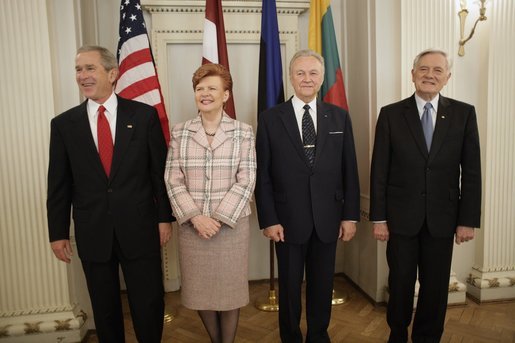
We have just had a meeting together and the most fruitful discussion about our transatlantic relationships, and also on the relationship between the two institutions of which Latvia, Estonia and Lithuania have become members since the past year -- the relationship between NATO and the European Union.
We are honored and pleased to have this opportunity to have a great leader from a great and powerful country come to our region, and show interest in what happens here, and to have this open and very frank debate with the three Baltic Presidents. With this, I pass the floor to the President of Lithuania, President Valdas Adamkus.

PRESIDENT ADAMKUS: Mr. President, ladies and gentlemen, this was an extremely good meeting, and at a very good time, while welcoming the President of the United States here, as I said, welcome back to the source of the Baltic Sea. And it was during the discussions we really touched on vital issues: the relationship between the United States and the European continent as -- (inaudible) --. We touched on issues concerning directly the relationship between Baltic states, and of course, on the global issues.

On the part of Lithuania, I have reassured the President that we are staunch allies in a fight against terrorism. We will be standing shoulder-to-shoulder on general global issues concerning the humanity, and especially when we are celebrating the end of World War II against -- the victory against Nazism, and at the same time, standing for the principles which are dear to the rest of the world community -- principles of democracy, protection of human rights, principles of free expression. And there was total agreement, and I can reassure the President of the United States that we will be standing and defending the rights of the people, even those neighbors who are still, for them, democracy is a dream. And by standing and speaking freely, and I would say, introducing some kind of a dose of oxygen into the resistance and opposition which is striving for those same rights we are enjoying, we will definitely defend and make a better world, looking into the future.

And I am grateful to the President for his presence here in the Baltic states, his inspiration and strength for all of us to continue our commitments. Thank you, Mr. President.

PRESIDENT VIKE-FREIBERGA: President Ruutel.

PRESIDENT RUUTEL: Honored colleagues, esteemed press, I'm very happy about today's meeting and the high-level contacts between our countries have produced very essential and fruitful cooperation. The will and desire with which the United States has supported the endeavors of our people have proven to be very fruitful.

It has already been a year since we have become members of NATO and the European Union. Today's meeting once again reaffirms the deep friendship and the strong relationship between our countries.

We were talking about the means with which we can help democracy, peace and welfare to other countries, which some countries do not enjoy, even in the 21st century. We reassure you that Estonia is willing to share its experiences with these countries that are going towards these goals.

I want to thank those soldiers from Estonia and the United States who are now fighting in Iraq, Afghanistan and Kosovo. Estonia is very satisfied with the progress made in Ukraine and Georgia, and is prepared to continue supporting their endeavors.

We also talked about our relationship with Russia in our discussions. Not only Estonia, but in the interests of all countries, it is best to have as a partner a stable and democratic Russia who shares our values and is open for constructive cooperation.

Although we talk primarily of the future, we must realize that the analysis of the past is essential for future relationships between countries. We are celebrating the passing of 60 years from the end of the second world war, and the defeat of Nazism. But this victory did not bring freedom and democracy to many people and, of course, I mean the Baltic states, who lost their independence for a long period of time. And I would especially like to emphasize the United States' role, who never recognized the occupation of the Baltic states.

The efforts of the United States and the Baltics allow us here in Riga today to celebrate the victory of freedom. Our people are working together in the transatlantic sphere and throughout the world. Thank you for your attention.

PRESIDENT VIKE-FREIBERGA: Questions? No. First, we have President Bush, who would like to make a statement. (Laughter.) I think maybe company from across the ocean should be given a chance to make a statement, as well. (Laughter.)

PRESIDENT BUSH: It's kind of dangerous -- as you know, I'm a little long-winded. But thank you, Madam President. Thank you for hosting Laura and me and my delegation here to Latvia. The hospitality has been tremendous, and we really thank you.

And it's such an honor to be standing here with the leaders of three close allies and friends, such incredibly important symbols of what freedom can mean to this neighborhood and to countries in the world. And so we -- we're proud to be here with you all, fellow members of NATO. One objective of my trip is to honor the memories of those who sacrificed 60 years ago in the struggle against Nazism and fascism. Tomorrow I'll be in the cemetery in the Netherlands to pay tribute to a generation that was willing to sacrifice for freedom and peace. But I recognize that in the West, the end of the second world war meant peace, but in the Baltics, it brought occupation and communist oppression. And the American people will never forget the occupation and communist oppression of the people of the Baltics. We recognize your painful history.

I want to congratulate our friends and allies who stand here with me on the progress you've made in the past decade. You see, one of the important examples of these three countries is that not only have they become free societies, but they learn to adapt to the conditions of a free society. It's not easy to go from communism to democracy, and yet, these three nations have shown the world how to do so, and we congratulate you on your good, hard work. Your economies are flourishing; people are allowed to express their opinions. As a result, you've been readily accepted into NATO, and now the EU. And the world is better off because of the hard decisions your governments have made.

I also want to thank you for your hard work in helping democracy spread in the neighborhood. We had a really good discussion today about Belarus. We talked about the Ukraine and Georgia and Moldova. We talked about Russia and the relationship between the Baltics and Russia. These three nations have also recognized that those of who are free have a responsibility to help others be free outside of our neighborhoods. And I want to thank you for your contributions in Iraq and Afghanistan. To this end, I discussed my request for the U.S. Solidarity Fund -- my request to the Congress for the U.S. Solidarity Fund, to help these nations who have deployed troops to be able to better afford those deployments.

We talked about bilateral relations, as well. As you can imagine, one topic that came up with all three leaders was visa policy. I talked about the way forward to make sure our visa policy works well with our friends and allies. Part of the issue, of course, is that in the past -- we've looked to past history to determine future visa policy, and now we've begun to change looking at the past. In other words, the over-stays during occupation must be viewed differently now that the three countries have been freed. And we look forward to working with you on the way forward to reasonable and fair visa policy.

There are thousands of people in my country who have come from your countries; they send best regards. And I say to you, thank for being such good friends and colleagues, and thank you for your hospitality again, Madam President. Now, if you'd like to do something -- (laughter.)

PRESIDENT VIKE-FREIBERGA: Thank you for that statement, Mr. President.

We do have a limited time at our disposal, and I understand that the framework is to be one question to each President. So we'll start with a question to President Adamkus.

PRESIDENT BUSH: Or you have four Presidents to me -- questions to me, if that's what you would like.

PRESIDENT VIKE-FREIBERGA: There's a question out there.

Q Yes -- from Lithuanian Television. Actually, I have a question to President Bush.

PRESIDENT BUSH: Yes, I thought that might be the case. (Laughter.)

Q Regarding what you said recently, that democratic Belarus is also in Russia's interest, can there be a deal between Washington and Moscow whereby Russia would make sure that President Lukashenko is not reelected next year, and in return, Washington would encourage, or would hail the democracy there, but turn a blind eye on the continued Russia's influence there? Or are you prepared to go all the way?

PRESIDENT BUSH: No, that's an interesting question, can you make a deal to determine somebody else's fate. I think that's what we're lamenting here today, about what happened to the Baltics -- you know, kind of one of those secret deals amongst large powers that consigns people to a way of government. No, we don't make secret deals. The only deal that I think is a necessary deal for people is the deal of freedom. They should be allowed to express themselves in free and open and fair elections in Belarus.

And that's -- and as to whether or not it's in Russia's interest that democracies be on her border, absolutely, it's in Russia's interest that she have friends and have neighbors who are democracies. We're used to that in America. We've got democracies on our border. And it's a blessing to have democracies on our border. We don't always agree, by the way, with our friends on our borders, but we are able to settle disputes peacefully because we are democracies. And so I will continue to speak as clearly as I can to President Putin that it's in his country's interests that there be democracies on his borders. I mean, after all, look at the three nations here. These are peaceful, prosperous nations that are good neighbors with Russia, and good neighbors with each other and good neighbors elsewhere, as well.

Q A question from the Estonian side.

Q I have a question to Mr. President Bush, but it's in Estonia language.

PRESIDENT BUSH: All right, I need the English translation. Start over.

Q For Estonia, it's very important to have good relations with the United States, and right now the relation has been very good. Which ranking would the relations of Estonia have in American foreign policy today, and also in the future? Thank you.

THE PRESIDENT: Say that again. I'm getting kind of old and I'm having trouble hearing.

Q I would like to know what is the ranking today and in the future in American foreign policy, the relations with Estonia? What is the ranking?

THE PRESIDENT: With the President standing here, very important. No -- (laughter.) Look, I don't think a President can rank, but a President can praise, and I praise Estonia for being an open market economy that is a free society. And, therefore, if you're a free society that embraces market economies, you'll rank very high with me and the United States.

The example of the Baltics is so vital for countries who are emerging from tyrannies to -- and oppressive governments to free societies. It's really important. And that's why the active participation of the three leaders here in helping NGOs and civil societies develop in new democracies is vital, because who has got more credibility with leaders in new democracies than the three leaders here who have had the experience of helping a democracy emerge.

And so you rank very high, as far as I'm concerned, as participants in the freedom movement, the ability to inspire by example and lend expertise because of the experience you've had.

PRESIDENT VIKE-FREIBERGA: Thank you very much. A question from the Latvian side.

Q My question goes to Mr. Bush. Today, during negotiations, you talked about the relationship with Russia. Did you talk about the possibility of asking Mr. Putin to recognize occupation of the Baltic states in Moscow? You have, of late, so strongly supported the attempts of the Baltic states to explain the history. Do you expect anything to come of it? Thank you.

PRESIDENT BUSH: My position on that issue is very clear, and has been clear, about the occupation. And the position of my country has been clear about the occupation, ever since the occupation took place. We proudly flew the flags of independent nations above your embassies in Washington, D.C., and the statement was clear: we never recognized, nor accepted the occupation that did take place.

I think this moment -- this moment in history will be -- give everybody a chance to recognize what took place in the past and move on. And, look, I fully understand there's a lot of anger and frustration involved in the three Baltic countries about the occupation. I expressed that to President Putin. But he didn't need me to tell him, he fully understands there's a lot of frustrations and anger about what took place.

My hope is that we're now able to move beyond that phase of history into a phase that is embracing democracy and free societies. These are extraordinary times that we're living in, and the three Baltic countries are capable of helping Russia and other countries in this part of the world see the benefits of what it means to live in a free society. And so we have a great opportunity to move beyond the past. Again, I repeat to you, I recognize the painful history, and my hope is that -- is that we're able to learn the lessons from that painful history, that tyranny is evil and people deserve to live in a free society.

As I'm going to say in my speech a little later on here, I'm going to say, never again should we allow Jews and gypsies to be exterminated and the world not pay close attention to it. Never again should we let -- shall we tolerate tyranny and subjugating people to incredible death. We have an obligation as free societies never to forget that history, and to do something about the possibility of that arising again.

And so, I am inspired by the example of the Baltic nations. I'm inspired by your courage of the past and your determination to move forward in a free society.

Jennifer.

Q Russia has expressed some displeasure with your travel itinerary, stopping here --

PRESIDENT BUSH: With what, now?

Q Russia has expressed some displeasure with your travel itinerary on this trip, stopping here in Latvia and going to Georgia --

PRESIDENT BUSH: Yes.

Q There's also some criticism that the U.S. is behind the revolutionary change in Georgia, Ukraine and Kyrgyzstan. What do you say to talk that the U.S. is inappropriately meddling in the neighborhood? PRESIDENT BUSH: Oh, no, I thank you for that. First of all, this is not my first trip to the Baltics, and hopefully, it will not be my last trip to the Baltics. We've got good friends here. And as I travel around the world I like to touch base with our friends.

Revolution -- I think you said the word, "revolution" -- freedom is universal. Freedom is etched in everybody's soul. And the idea of countries helping others become free, I would hope that would be viewed as not revolutionary, but rational foreign policy, as decent foreign policy, as humane foreign policy.

I repeat to you that I think countries ought to feel comfortable with having democracies on their borders. After all, democracies are peaceful countries. Democracies don't fight each other, and democracies are good neighbors. You know, it's amazing how far this continent has come because of the freedom movement. Sixty years ago -- it's really not all that long ago in the march of history, is it? It's pretty long if you're 30 years old, like you are, but -- but 60 is not all that long for an old guy like President Adamkus. (Laughter.) But now we're standing here talking about other parts of the world taking for granted that Europe is whole, free, and at peace. It shows how much life has changed as a result of people embracing an ideology that encourages peace.

And we now have the same opportunity, this generation has the same opportunity to leave behind lasting peace for the next generation, by working on the spread of freedom and democracy. And the United States has got great partners in doing what I think is our duty to spread democracy and freedom with the three nations represented here.

And so my trip here, Jennifer, is to say as clearly as I can to the people of these three great countries, thank you for your sacrifices; thank you for your courage; and thank you for your willingness to elect people who are willing to spread freedom and peace around the world.

May God bless your countries, and may God continue to bless mine. Thank you very much. (Applause.)

END 3:00 P.M. (Local) For Immediate Release Office of the Press Secretary May 7, 2005

President Discusses Freedom and Democracy in Latvia

President Discusses Freedom and Democracy in Latvia The Small Guild Hall Riga, Latvia 5:09 P.M. (Local)

PRESIDENT BUSH: Sveiki Draugi. (Applause.) Ladies and gentlemen, thank you for the warm welcome. Madam President, Laura and I thank you for your kind words of introduction, we thank you for your principled leadership, and I thank you for your friendship, and we thank you for the hospitality that you and Dr. Freibergs have shown us.

I want to thank the people of the Republic of Latvia for being such gracious hosts for my visit here. And I want to also thank the Prime Minister for joining us, and members of the government. Thank you, Mr. Prime Minister. Laura and I are so pleased to make this second journey to the Baltic States, and our first visit to the great land of Latvia. We're honored, as well, to be in the company of President Ruutel of Estonia, and President Adamkus of Lithuania -- thank you both for coming. These are good friends to Latvia, and good friends to America.

The Baltic countries have seen one of the most dramatic transformations in modern history, from captive nations to NATO allies and EU members in little more than a decade. The Latvian, Estonian, and Lithuanian people showed that the love of liberty is stronger than the will of an empire. And today you're standing for liberty beyond your borders, so that others do not suffer the injustices you have known. The American people admire your moral courage in the cause of freedom.

This week, nations on both sides of the Atlantic observe the 60th anniversary of Hitler's defeat. The evil that seized power in Germany brought war to all of Europe, and waged war against morality, itself. What began as a movement of thugs became a government without conscience, and then an empire of bottomless cruelty. The Third Reich exalted the strong over the weak, overran and humiliated peaceful countries, undertook a mad quest for racial purity, coldly planned and carried out the murder of millions, and defined evil for the ages. Brave men and women of many countries faced that evil, and fought through dark and desperate years for their families and their homelands. In the end, a dictator who worshiped power was confined to four walls of a bunker, and the fall of his squalid tyranny is a day to remember and to celebrate.

Causes can be judged by the monuments they leave behind. The Nazi terror is remembered today in places like Auschwitz, Dachau, Rumbula Forest, where we still hear the cries of the innocent, and pledge to God and history: Never again. The alliance that won the war is remembered today in carefully tended cemeteries in Normandy, Margraten, St. Petersburg, and other places across Europe, where we recall brief lives of great honor, and we offer this pledge: We will always be grateful.

The Baltic states had no role in starting World War II. The battle came here because of a secret pact between dictators. And when the war came, many in this region showed their courage. After a puppet government ordered the Latvian fleet to return to port, sailors on eight freighters chose to remain at sea under the flag of free Latvia, assisting the United States Merchant Marine in carrying supplies across the Atlantic. A newspaper in the state of South Carolina described the Latvian crew this way: "They all have beards and dressed so differently... They are ... exhausted, but full of fighting spirit."

By the end of the war, six of the Latvian ships had been sunk, and more than half the sailors had been lost. Nearly all of the survivors settled in America, and became citizens we were proud to call our own. One American town renamed a street Ciltvaira -- to honor a sunken ship that sailed under a free Latvian flag. My country has always been thankful for Latvia's friendship, and Latvia will always have the friendship of America.

As we mark a victory of six days ago -- six decades ago, we are mindful of a paradox. For much of Germany, defeat led to freedom. For much of Eastern and Central Europe, victory brought the iron rule of another empire. V-E Day marked the end of fascism, but it did not end oppression. The agreement at Yalta followed in the unjust tradition of Munich and the Molotov-Ribbentrop Pact. Once again, when powerful governments negotiated, the freedom of small nations was somehow expendable. Yet this attempt to sacrifice freedom for the sake of stability left a continent divided and unstable. The captivity of millions in Central and Eastern Europe will be remembered as one of the greatest wrongs of history.

The end of World War II raised unavoidable questions for my country: Had we fought and sacrificed only to achieve the permanent division of Europe into armed camps? Or did the cause of freedom and the rights of nations require more of us? Eventually, America and our strong allies made a decision: We would not be content with the liberation of half of Europe -- and we would not forget our friends behind an Iron Curtain. We defended the freedom of Greece and Turkey, and airlifted supplies to Berlin, and broadcast the message of liberty by radio. We spoke up for dissenters, and challenged an empire to tear down a hated wall. Eventually, communism began to collapse under external pressure, and under the weight of its own contradictions. And we set the vision of a Europe whole, free, and at peace -- so dictators could no longer rise up and feed ancient grievances, and conflict would not be repeated again and again.

In these decades of struggle and purpose, the Baltic peoples kept a long vigil of suffering and hope. Though you lived in isolation, you were not alone. The United States refused to recognize your occupation by an empire. The flags of free Latvia, Estonia, and Lithuania -- illegal at home -- flew proudly over diplomatic missions in the United States. And when you joined hands in protest and the empire fell away, the legacy of Yalta was finally buried, once and for all. The security and freedom of the Baltic nations is now more than a noble aspiration; it is the binding pledge of the alliance we share. The defense of your freedom -- in defense of your freedom you will never stand alone.

From the vantage point of this new century, we recognize the end of the Cold War as part of an even broader movement in our world. From Germany and Japan after World War II, to Latin America, to Asia, and Central and Eastern Europe, and now to the broader Middle East, the advance of freedom is the great story of our age. And in this history, there are important lessons. We have learned that free nations grow stronger with time, because they rise on the creativity and enterprise of their people. We have learned that governments accountable to citizens are peaceful, while dictatorships stir resentments and hatred to cover their own failings. We have learned that the skeptics and pessimists are often wrong, because men and women in every culture, when given the chance, will choose liberty. We have learned that even after a long wait in the darkness of tyranny, freedom can arrive suddenly, like the break of day. And we have learned that the demand for self-government is often driven and sustained by patriotism, by the traditions and heroes and language of a native land.

Yet we've also learned that sovereignty and majority rule are only the beginnings of freedom. The promise of democracy starts with national pride, and independence, and elections. But it does not end there. The promise of democracy is fulfilled by minority rights, and equal justice under the rule of law, and an inclusive society in which every person belongs. A country that divides into factions and dwells on old grievances cannot move forward, and risks sliding back into tyranny. A country that unites all its people behind common ideals will multiply in strength and confidence. The successful democracies of the 21st century will not be defined by blood and soil. Successful democracies will be defined by a broader ideal of citizenship -- based on shared principles, shared responsibilities, and respect for all. For my own country, the process of becoming a mature, multi-ethnic democracy was lengthy and violent. Our journey from national independence to equal injustice [sic] included the enslavement of millions, and a four-year civil war. Even after slavery ended, a century passed before an oppressed minority was guaranteed equal rights. Americans found that racial division almost destroyed us, and the false doctrine of "separate but equal" was no basis for a strong and unified country. The only way we found to rise above the injustices of our history was to reject segregation, to move beyond mere tolerance, and to affirm the brotherhood of everyone in our land.

Latvia is facing the challenges that come with ethnic diversity, and it's addressing these challenges in a uniformly peaceful way. Whatever the historical causes, yours is now a multi-ethnic society -- as I have seen on my visit. No wrongs of the past should ever be allowed to divide you, or to slow your remarkable progress. While keeping your Latvian identity and language, you have a responsibility to reach out to all who share the future of Latvia. A welcoming and tolerant spirit will assure the unity and strength of your country. Minorities here have a responsibility as well -- to be citizens who seek the good of the country in which they live. As inclusive, peaceful societies, all of the Baltic nations can be models to every nation that follows the path of freedom and democracy.

In recent months, the Baltic governments gave assistance during the election in Ukraine, and the people of that country chose a wise and visionary leader. As President Yushchenko works to strengthen the rule of law and open Ukraine's economy, the United States will help that nation join the institutions that bind our democracies. Later on this trip I'll travel to Georgia, another country that is taking a democratic path and deserves support on its journey. My country will stand by Georgian leaders who respect minority rights and work to peacefully unify their country, and grow closer to the free nations in Europe. We're also committed to democratic progress in Moldova, where leaders have pledged to expand freedom of the press, to protect minority rights, and to make government institutions more accountable.

All of us are committed to the advance of freedom in Belarus. The people of that country live under Europe's last dictatorship, and they deserve better. The governments of Latvia and Lithuania have worked to build support for democracy in Belarus, and to deliver truthful information by radio and newspapers. Together we have set a firm and confident standard: Repression has no place on this continent. The people of Minsk deserve the same freedom you have in Tallinn, and Vilnius, and Riga.

All the nations that border Russia will benefit from the spread of democratic values -- and so will Russia, itself. Stable, prosperous democracies are good neighbors, trading in freedom, and posing no threat to anyone. The United States has free and peaceful nations to the north and south of us. We do not consider ourselves to be encircled; we consider ourselves to be blessed. No good purpose is served by stirring up fears and exploiting old rivalries in this region. The interests of Russia and all nations are served by the growth of freedom that leads to prosperity and peace. Inside Russia, leaders have made great progress over the last 15 years. President Putin recently stated that Russia's future lies within Europe -- and America agrees. He also stated that Russia's democratic future will not be determined by outsiders -- and America agrees, as well. That nation will follow its own course, according to its own history. Yet all free and successful countries have some common characteristics: freedom of worship, freedom of the press, economic liberty, the rule of law, and the limitation of power through checks and balances. In the long run, it is the strength of Russian democracy that will determine the greatness of Russia. And I believe the Russian people value their freedom, and will settle for nothing less.

For all the problems that remain, it is a miracle of history that this young century finds us speaking about the consolidation of freedom throughout Europe. And the stunning democratic gains of the last several decades are only the beginning. Freedom is not tired. The ideal of human dignity is not weary. And the next stage of the world democratic movement is already unfolding in the broader Middle East.

We seek democracy in that region for the same reasons we spent decades working for democracy in Europe -- because freedom is the only reliable path to peace. If the Middle East continues to simmer in anger and resentment and hopelessness, caught in a cycle of repression and radicalism, it will produce terrorism of even greater audacity and destructive power. But if the peoples of that region gain the right of self-government, and find hopes to replace their hatreds, then the security of all free nations will be strengthened. We will not repeat the mistakes of other generations, appeasing or excusing tyranny, and sacrificing freedom in the vain pursuit of stability. We have learned our lesson; no one's liberty is expendable. In the long run, our security and true stability depend on the freedom of others. And so, with confidence and resolve, we will stand for freedom across the broader Middle East.

In this great objective, we need a realism that understands the difficulties. But we must turn away from a pessimism that abandons the goal and consigns millions to endless tyranny. And we have reason for optimism. When the people of Afghanistan were finally given the vote, they chose humane rulers and a future of freedom. When the people of the Palestinian Territories went to the polls, they chose a leader committed to negotiation instead of violence. When Iraqi voters turned out by the millions, they repudiated the killers who hate and attack their liberty. There's much work ahead, but the direction of events is clear in the broader Middle East: Freedom is on the march.

Recent elections have brought a tremendous catalyst for change, and more are on the way. Elections are set to start at the end of this month in Lebanon, and those elections must go forward with no outside interference. The people of Lebanon now have the opportunity to bridge old divides and build an independent government. Egypt will hold a presidential election this fall. That election should proceed with international monitors, and with rules that allow for a real campaign.

As in other parts of the world, the work of democracy is larger than holding a fair election; it requires building the structures that sustain freedom. Selective liberalization -- the easing of oppressive laws - is progress, but it is not enough. Successful democracies that effectively protect individual rights require viable political parties, an independent judiciary, a diverse media, and limits on executive power. There is no modernization without democracy. Ultimately, human rights and human development depend on human liberty.

As in other parts of the world, successful democracies in the broader Middle East must also bridge old racial and religious divides -- and democracy is the only force capable of doing so. In Iraq, the new Cabinet includes members of all of Iraq's leading ethnic and religious groups, who, despite their differences, share a commitment to democracy, freedom, and the rule of law. The new President of Iraq is a member of a minority group that was attacked with poison gas by the former regime. Democracy is fostering internal peace by protecting individual rights, while giving every minority a role in the nation's future. Iraq's free government is showing the way for others, and is winning the respect of a watching world.

In the Middle East, we are seeing the rule of law -- the rule of fear give way to the hope of change. And brave reformers in that region deserve more than our praise. The established democracies have a duty to help emerging democracies of the broader Middle East. They need our help, because freedom has deadly enemies in that region -- men who celebrate murder, incite suicide, and thirst for absolute power. By aiding democratic transitions, we will isolate the forces of hatred and terror and defeat them before violence spreads.

The Baltic states are members of a global coalition, and each is making essential contributions every day. Lithuania is preparing to deploy a reconstruction team to western Afghanistan, and has troops in Iraq conducting patrols and aiding in reconstruction. Estonians are serving in Afghanistan, they're detecting and removing explosives, and Estonian troops serve side-by-side with Americans in Baghdad. Latvia has a team in Kabul, Afghanistan, clearing mines, and soldiers in Iraq providing convoy security and patrols. Your commitment to freedom has brought sacrifice. We remember Lieutenant Olafs Baumanis, who was killed in Iraq. We ask for God's blessings for his family, and we're honored that his wife, Vita, is here with us today.

It's no surprise that Afghanistan and Iraq find strong allies in the Baltic nations. Because you've recently known tyranny, you are offended by the oppression of others. The men and women under my command are proud to serve with you. Today I'm honored to deliver the thanks of the American people.

Sixty years ago, on the 7th of May, the world reacted with joy and relief at the defeat of fascism in Europe. The next day, General Dwight D. Eisenhower announced that "history's mightiest machine of conquest has been utterly destroyed." Yet the great democracies soon found that a new mission had come to us -- not merely to defeat a single dictator, but to defeat the idea of dictatorship on this continent. Through the decades of that struggle, some endured the rule of tyrants; all lived in the frightening shadow of war. Yet because we lifted our sights and held firm to our principles, freedom prevailed.

Now, ladies and gentlemen, the freedom of Europe, won by courage, must be secured by effort and goodwill. In our time, as well, we must raise our sights. In the distance we can see another great goal -- not merely the absence of tyranny on this continent, but the end of tyranny in our world. Once again, we're asked to hold firm to our principles, and to value the liberty of others. And once again, if we do our part, freedom will prevail.

Thank you, and God bless. (Applause.)

END 5:35 P.M. (Local)For Immediate Release Office of the Press Secretary May 7, 2005

Freedom Calendar 05/07/05 - 05/14/05

May 7, 1990, President George H. W. Bush proclaims first Asian/Pacific American Heritage Month.

Mother’s Day May 8, 2003, Speaker Dennis Hastert, Senate Majority Leader Bill Frist, and other Republican leaders gather at Frederick Douglass National Historic Site, announce $1 million restoration effort

May 9, 2001, President George W. Bush nominates Miguel Estrada to be first Hispanic to serve on U.S. Court of Appeals for D.C. Circuit; Democrats in Senate successfully filibuster nomination.

May 10, 1866, U.S. House passes Republicans’ 14th Amendment guaranteeing due process and equal protection of the laws to all citizens; 100% of Democrats vote no.

May 11, 1949, Birth of African-American Republican and sharecropper’s daughter Janice Rogers Brown, nominated by President George W. Bush as Judge of the U.S. Court of Appeals.

May 12, 1850, Birth of U.S. Senator Henry Cabot Lodge (R-MA), whose 1890 Federal Elections Bill enforcing African-American voting rights passed House on party-line vote but was defeated in Senate by a Democrat filibuster.

May 13, 1983, President Ronald Reagan designates first national observance of American Indian Day.

May 14, 1971, Republican Senators Jacob Javits (NY) and Charles Percy (IL) appoint the first female pages in U.S. Senate.

“No man is above the law, and no man is below it.”

Theodore Roosevelt, 26th President of the United States

SOURCE:
2005 Republican Freedom Calendar

bush radio address 05/07/05 full audio, text transcript

bush radio address 05/07/05 full audio, text transcript

President's Radio Address

THE PRESIDENT: Good morning. On Sunday and Monday, I will attend ceremonies in The Netherlands and Russia, to commemorate the 60th anniversary of V-E Day.

These events will celebrate a great triumph of good over evil. We will never forget the acts of courage that made possible the liberation of a continent, or the heroes who fought in the cause of freedom. And we honor the brave Americans and allied troops who humbled tyrants, defended the innocent, and liberated the oppressed. By their courage and sacrifice, they showed the world that there is no power like the power of freedom -- and no soldier as strong as a soldier who fights for that freedom.

The defeat of Nazi Germany brought an end to the armed conflict in Europe. Unfortunately, for millions of people on that continent, tyranny remained -- in a different uniform. In Latvia, where I'm also visiting on this trip, free people were taken captive by another totalitarian empire. Germany was split into free and un-free halves. And countries like Poland, Czechoslovakia and Hungary were cut off from liberty by an Iron Curtain. The people of these countries survived the Cold War through great courage, and then they took history into their own hands and reclaimed their freedom.

The result is the continent of Europe, wounded by decades of conflict and oppression, is today whole, free and at peace for the first time in its history. The wave of democracy that swept Central and Eastern Europe in 1989 has now swept to nations like Georgia and Ukraine. And the victory for freedom represented by V-E Day has become a reality for millions of people.

On my trip, I will visit Freedom Square in Tbilisi, Georgia, to applaud the people there for the Rose Revolution that advanced democracy in their land. Georgia has survived oppression, fought for liberty and taken its place among free nations. America is proud to call Georgia our partner in freedom, and we will help the people of that country enhance prosperity, improve security and spread liberty at home and abroad.

The new democracies of Europe still have much work to do. Free elections are a significant achievement, yet they are only part of a fully functioning democracy. Democratic governments must be committed to providing full and equal rights for minorities, resolving conflicts peacefully, encouraging a vibrant political opposition, and ensuring the rule of law. As the nations of Central and Eastern Europe work to build up the institutions necessary for a free society, America will stand by their side.

Today, these nations are standing with us as we defend liberty abroad. Freedom has no better friends than those with a fresh memory of tyranny. That is why countries like Latvia, Lithuania, Estonia and Georgia have been partners in our coalition in Iraq and Afghanistan. We're grateful for their contributions, and especially for the example they are setting for other aspiring democracies.

America and these new democracies are bound together by history, by the universal rights we have defended together, and by our deepest convictions. All of us understand that the advance of freedom is the concentrated work of generations -- from the brave Americans who fought against Nazi Germany sixty years ago to those who struggle for liberty today. And by working together, we will ensure that the promise of liberty and democracy won on V-E Day will one day reach every person and every nation in the 21st century.

Thank you for listening.

END For Immediate Release May 7, 2005

President Presented the Order of Three Stars, First-Class in Latvia

President Presented the Order of Three Stars, First-Class in Latvia, Riga Castle, Riga, Latvia, 9:55 A.M. (Local)

PRESIDENT BUSH: Madam President, I gratefully accept. I am so honored and so thrilled to be here in your beautiful country.

I was telling the President that it's such a joy to come to a country that loves and values freedom, and to be in the presence of a President who speaks so clearly about the need for people to be free, and her recognition that a free world will yield peace.

And so Madam President, thank you for your hospitality, and thank you so much for this great honor. Appreciate it.

END 9:55 A.M. (Local) For Immediate Release, Office of the Press Secretary, May 7, 2005

Location:
CIA MAP Eastern Europe, bordering the Baltic Sea, between Estonia and Lithuania.

Background: After a brief period of independence between the two World Wars, Latvia was annexed by the USSR in 1940. It reestablished its independence in 1991 following the breakup of the Soviet Union. Although the last Russian troops left in 1994, the status of the Russian minority (some 30% of the population) remains of concern to Moscow. Latvia joined both NATO and the EU in the spring of 2004. SOURCE:
CIA - The World Factbook

President Welcomed by President Vike-Freiberga to Latvia

President Welcomed by President Vike-Freiberga to Latvia, Riga Castle, Riga, Latvia 1:10 A.M. (Local)

PRESIDENT VIKE-FREIBERGA: We are, of course, very gratified for this sudden interest in Latvia that we're seeing among the journalists. (Laughter.) And it's truly a great pleasure to see these wonderful journalists coming to my country and having a look around. And, Mr. President, I think that you have something to do with that. (Laughter.)

PRESIDENT BUSH: Well, thank you for having us, Madam President. It's been a trip I've really been anxious to fulfill. I admire your leadership; I admire your country's courage. I love the fact that you're a free nation and willing to speak out so clearly for freedom. So, thanks for the hospitality.

PRESIDENT VIKE-FREIBERGA: And we're pleased that the cameras are now turned on Latvia while you are here. (Laughter.)

PRESIDENT BUSH: That's right.

Q Mr. President --

PRESIDENT BUSH: Thank you all. We'll have ample opportunity in an open press conference. And I certainly wouldn't want you to fire your best question here. (Laughter.)

END 11:11 A.M. (Local) For Immediate Release Office of the Press Secretary May 7, 2005

Location: CIA MAP Eastern Europe, bordering the Baltic Sea, between Estonia and Lithuania.

Background: After a brief period of independence between the two World Wars, Latvia was annexed by the USSR in 1940. It reestablished its independence in 1991 following the breakup of the Soviet Union. Although the last Russian troops left in 1994, the status of the Russian minority (some 30% of the population) remains of concern to Moscow. Latvia joined both NATO and the EU in the spring of 2004. SOURCE: CIA - The World Factbook

Friday, May 06, 2005

transition from Neandertals to modern humans

Neandertal femur suggests competition with hyenas and a shift in landscape use
Analysis of approximately 41,000-year-old human remains found in France suggests that Neandertals may have become regionally mobile earlier than scientists once thought.

Cédric Beauval and colleagues from Université Bordeaux 1 in France, Max Planck Institute in Germany, and Washington University in St. Louis, conclude that the human femur fragment found in 2002 in the cave of the Rochers-de-Villeneuve comes from a Neandertal, based on its shape and mitochondrial DNA. Its age places it at the end of the Middle Paleolithic archeological period, just before modern humans arrived in Europe.

The research will be published in the PNAS online early edition the week of May2-6.

"In Europe, with the transition from Neandertals to modern humans, anthropologists have long argued that major behavioral changes and major improvements in adaptation began to take shape with modern humans," said Erik Trinkaus, Ph.D., Mary Tileston Hemenway Professor of Anthropology at Washington University and co-author of the paper.

"One of the changes that has been documented with the transition from Neandertals to modern humans was that people became more mobile and their territories became much larger. They became less locally focused and more regionally focused," Trinkaus said.

It's been assumed that this happened in the Upper Paleolithic which is associated with some very late Neandertals and early modern humans. However, this is a femur bone from a Middle Paleolithic Neandertal. It shows in the shape of the femur that a shift to greater mobility had already begun prior to the transition to the Upper Paleolithic, prior to any appearance of modern humans in Europe.

In addition, the cave was a hyena den at about the same time that the humans lived in it, the authors say. Archeological evidence indicates that humans processed carcasses of the same animals as the hyenas, with some animal bones showing both cut marks from human tools and tooth marks from hyenas. Additionally, the human femur was gnawed by carnivores, probably hyenas. This shows that close competition for food and space persisted through the Middle Paleolithic among these Neandertals. ###

Late Neandertal Femur from Les Rochers-de-Villeneuve, France by Cédric Beauval, Bruno Maureille, François Lacrampe-Cuyaubère, David Serre, David Peressinotto, Jean-Guillaume Bordes, David Cochard, Isabelle Couchoud, David Dubrasquet, Véronique Laroulandie, Arnaud Lenoble, Jean-Baptiste Mallye, Sylvain Pasty, Jérôme Primault, Nadin Rohland, Svante Pääbo & Erik Trinkaus

SOURCE:
EurekAlert! MEDIA CONTACTS:

Dr. Cédric BeauvalInstitut de Préhistoire et de Géologie du Quaternaire, Université de Bordeaux 1, Avenue des Facultés, 33405 Talence, FranceE-mail :
c.beauval@ipgq.u-bordeaux1.frTel (lab): (33) 5 40 00 29 83Tel (mobile) : (33) 6 72 27 96 28

Dr. Bruno MaureilleLaboratoire d'Anthropologie des Populations du Passé, Université de Bordeaux 1, Avenue des Facultés, 33405 Talence Cedex, FranceEmail :
b.maureille@anthropologie.u-bordeaux1.frTel : (33).5.40.00.89.36Mobile (Cell Phone): (33)-6-66-82-14-57Fax : 33.5.40.00.25.45

Prof. Erik TrinkausDepartment of Anthropology, Washington University, St. Louis, MO 63130tel. (day): (314) 935-5207fax (314) 935-5207E-mail:
trinkaus@artsci.wustl.edu

Contact: Neil Schoenherr
nschoenherr@wustl.edu 314-935-5235 Washington University in St. Louis

President to Welcome President of Indonesia

President to Welcome President of Indonesia to the White House

President Bush will welcome President Susilo Bambang Yudhoyono of Indonesia to the White House on May 25. President Yudhoyono came to office last October in Indonesia's first direct presidential election, an event that capped a series of impressive democratic reforms in recent years. This will be President Yudhoyono's first visit to Washington in his current capacity, though the two leaders met on the margins of the Asia-Pacific Economic Cooperation Summit in Santiago last November. The two Presidents will discuss tsunami relief and reconstruction, as well as ways to strengthen further our cooperation on a range of bilateral, regional, and international issues.

# # # For Immediate Release Office of the Press Secretary May 6, 2005

President intends to nominate, Hawley, Sigal, Derham, Dieter, Vallee,

President George W. Bush today announced his intention to nominate five individuals to serve in his Administration:

The President intends to nominate Edmund S. Hawley, of California, to be an Assistant Secretary of Homeland Security (Transportation Security Administration). Mr. Hawley currently serves as a supply chain technology consultant. He is also a member of the Federal Aviation Administration Air Traffic Services Committee. Mr. Hawley previously served as Vice President of Transportation Services for Union Pacific Railroad in Omaha, Nebraska. Earlier in his career, he was Deputy Assistant Secretary and Executive Director of Governmental Affairs for the Department of Transportation. Mr. Hawley earned his bachelor's degree from Brown University and his J.D. from the University of Virginia Law School.

The President intends to nominate Jill L. Sigal, of Wyoming, to be an Assistant Secretary of Energy (Congressional and Intergovernmental Affairs). Ms. Sigal currently serves as Acting Assistant Secretary of Energy in the Office of Congressional and Intergovernmental Affairs. She previously served as President of Jill Sigal Associates, developing and implementing legislative strategies on environmental issues. Earlier in her career, Ms. Sigal worked in the Office of General Counsel at the Department of Energy. She received her bachelor's degree from the University of Vermont and her J.D. from The George Washington University.

The President intends to nominate James M. Derham, of Virginia, to be Ambassador Extraordinary and Plenipotentiary of the United States of America to the Republic of Guatemala. A career member of the Senior Foreign Service, Mr. Derham currently serves as Principal Deputy Assistant Secretary of State in the Bureau of Western Hemisphere Affairs. He previously served as Deputy Chief of Mission in Mexico City, Mexico and in Brasilia, Brazil. Earlier in his career, Mr. Derham was Director of the Office of Bilateral Trade at the Department of State. He earned his bachelor's degree from Fordham University, his first master's degree from The George Washington University and his second master's degree from Harvard University.

The President intends to nominate Robert Johann Dieter, of Colorado, to be Ambassador Extraordinary and Plenipotentiary of the United States of America to Belize. Mr. Dieter currently serves as Director of Clinical Programs and Clinical Professor of Law at the University of Colorado School of Law. He previously served as the Director of the University's Legal Aid and Defender Program. Earlier in his career, Mr. Dieter was Deputy District Attorney for the 7th Judicial District, Colorado. He received his bachelor's degree from Yale University and his J.D. from the University of Denver School of Law.

The President intends to nominate Rodolphe M. Vallee, of Vermont, to be Ambassador Extraordinary and Plenipotentiary of the United States of America to the Slovak Republic. Mr. Vallee has served as Chairman and CEO of R. L. Vallee, Inc. in Colchester, Vermont since 1989. He is also a former member of the Advisory Committee for Trade Policy and Negotiations. Mr. Vallee previously served as Vice President of Catalyst Waste-to-Energy Corporation. Earlier in his career, he worked for U.S. Senator Robert Stafford. He received his bachelor's degree from Williams College and his master's degree from the Wharton School of Business, University of Pennsylvania.

# # # For Immediate Release Office of the Press Secretary May 6, 2005 Personnel Announcement

Jewish Heritage Week, 2005

Jewish Heritage Week, 2005, A Proclamation by the President of the United States of America

During Jewish Heritage Week, we celebrate and honor Jewish Americans for their contributions to this country and for helping to shape our national character.

The story of the Jewish people reflects the triumph of faith, the importance of family, and the power of hope. Through inspiring stories of personal sacrifice and survival, the Jewish people have demonstrated unyielding trust in a loving God and enduring faith in human freedom.

America is stronger and more hopeful because of the industry, talent, and imagination of Jewish Americans from around the world. Their commitment to excellence in science, public service, law, athletics, literature, and countless other fields has enriched our Nation and enhanced our culture. Through strong ties to family and community, Jewish Americans reflect a compassionate spirit and set a positive example for others.

We are also grateful for their legacy of selfless service to our country. As our troops defend liberty and justice abroad, we recognize Jewish Americans who have answered the call to help keep our Nation secure and build a more peaceful world. Their personal courage, love of country, and devotion to duty are helping to bring freedom and hope to millions who had previously lived under tyranny.

NOW, THEREFORE, I, GEORGE W. BUSH, President of the United States of America, by virtue of the authority vested in me by the Constitution and laws of the United States, do hereby proclaim May 8 through May 15, 2005, as Jewish Heritage Week.

I urge all Americans to celebrate the contributions of Jewish Americans to our Nation and observe this week with appropriate programs and activities.

IN WITNESS WHEREOF, I have hereunto set my hand this fifth day of May, in the year of our Lord two thousand five, and of the Independence of the United States of America the two hundred and twenty ninth.

GEORGE W. BUSH

# # # For Immediate Release Office of the Press Secretary May 5, 2005

Director of the Office of Personnel Management

Memorandum for the Director of the Office of Personnel Management

SUBJECT: Designation of Officers of the Office of Personnel Management to Act as Director of the Office of Personnel Management

By the authority vested in me as President under the Constitution and laws of the United States of America and pursuant to the Federal Vacancies Reform Act of 1998, 5 U.S.C. 3345 et seq., I hereby order that:

Section 1. Order of Succession.

During any period when the Director of the Office of Personnel Management (Director), or the Deputy Director of the Office of Personnel Management, has died, resigned, or otherwise become unable to perform the functions and duties of the office of Director, the following officers of the Office of Personnel Management, in the order listed, shall perform the functions and duties of the office of Director, if they are eligible to act as Director under the provisions of the Federal Vacancies Reform Act of 1998, until such time as at least one of the officers mentioned above is able to perform the functions and duties of the office of Director:

General Counsel; Chief of Staff; Director, Office of Communications and Public Liaison; Director, Office of Congressional Relations; Associate Director, Human Resources Products and Services; Associate Director for Management; Associate Director, Strategic Human Resources Policy; Chief Financial Officer; Associate Director, Human Capital Leadership and Merit Systems Accountability; Deputy Associate Director, Center for Investigations Services; and Director, Federal Executive Institute.

Sec. 2. Exceptions.

a) No individual who is serving in an office listed in section 1 in an acting capacity, by virtue of so serving, shall act as Director pursuant to this memorandum.

b) Notwithstanding the provisions of this memorandum, the President retains discretion, to the extent permitted by the Federal Vacancies Reform Act of 1998, 5 U.S.C. 3345-3349d, to depart from this memorandum in designating an acting Director.

Sec. 3. Prior Memorandum Superceded.

This memorandum supercedes the Presidential Memorandum of March 11, 2003, entitled, "Designation of Officers of the Office of Personnel Management to Act as Director of the Office of Personnel Management."

Sec. 4. Publication.

You are authorized and directed to publish this memorandum in the Federal Register.

GEORGE W. BUSH # # # For Immediate Release Office of the Press Secretary May 5, 2005

Syria Accountability and Lebanese Sovereignty Restoration Act of 2003 (Public Law 108 175)

Notice: Continuation of the National Emergency Blocking Property of Certain Persons and Prohibiting the Export of Certain Goods to Syria

On May 11, 2004, pursuant to my authority under the International Emergency Economic Powers Act (50 U.S.C. 1701 1706) and the Syria Accountability and Lebanese Sovereignty Restoration Act of 2003 (Public Law 108 175), I issued Executive Order 13338 in which I declared a national emergency blocking the property of certain persons and prohibiting the exportation or reexportation of certain goods to Syria. I took this action to deal with the unusual and extraordinary threat to the national security, foreign policy, and economy of the United States constituted by the actions of the Government of Syria in supporting terrorism, continuing its occupation of Lebanon, pursuing weapons of mass destruction and missile programs, and undermining United States and international efforts with respect to the stabilization and reconstruction of Iraq.

Because the actions and policies of the Government of Syria continue to pose an unusual and extraordinary threat to the national security, foreign policy, and economy of the United States, the national emergency declared on May 11, 2004, and the measures adopted on that date to deal with that emergency, must continue in effect beyond May 11, 2005.

Therefore, in accordance with section 202(d) of the National Emergencies Act (50 U.S.C. 1622(d)), I am continuing for 1 year the national emergency blocking the property of certain persons and prohibiting the exportation or reexportation of certain goods to Syria.

This notice shall be published in the Federal Register and transmitted to the Congress.

GEORGE W. BUSH THE WHITE HOUSE, May 5, 2005. # # # For Immediate Release Office of the Press Secretary

FY 2006 budget amendments

Text of a Letter from the President to the Speaker of the House of Representatives

Dear Mr. Speaker:

I ask the Congress to consider the enclosed FY 2006 budget amendments for the Departments of Agriculture, Education, Health and Human Services, Justice, and the Treasury; and the United States-Canada Alaska Rail Commission. Overall, the discretionary budget authority proposed in my FY 2006 Budget would not be increased by these requests.

This transmittal also contains FY 2006 budget amendments and an FY 2005 proposal for the legislative branch. As a matter of comity, appropriations requests of the legislative branch are commonly transmitted without change.

The details of these proposals are set forth in the enclosed letter from the Director of the Office of Management and Budget.

Sincerely, GEORGE W. BUSH

# # # For Immediate Release Office of the Press Secretary May 5, 2005

National Emergencies Act Syria sanctions

Text of a Letter from the President to the Speaker of the House of Representatives and the President of the Senate

Dear Mr. Speaker: (Dear Mr. President:)

Section 202(d) of the National Emergencies Act (50 U.S.C. 1622(d)) provides for the automatic termination of a national emergency unless, prior to the anniversary date of its declaration, the President publishes in the Federal Register and transmits to the Congress a notice stating that the emergency is to continue in effect beyond the anniversary date. In accordance with this provision, I have sent the enclosed notice, stating that the national emergency declared in Executive Order 13338 of May 11, 2004, blocking property of certain persons and prohibiting the exportation and reexportation of certain goods to Syria, is to continue in effect beyond May 11, 2005, to the Federal Register for publication.

The actions of the Government of Syria in supporting terrorism, pursuing weapons of mass destruction and missile programs, undermining United States and international efforts with respect to the stabilization and reconstruction of Iraq, and with respect to Lebanon pose a continuing, unusual, and extraordinary threat to the national security, foreign policy, and economy of the United States. For these reasons, I have determined that it is necessary to continue in effect the national emergency authorizing the blocking of property of certain persons and prohibiting the exportation and reexportation of certain goods to Syria, and to maintain in force the sanctions to respond to this threat.

Sincerely, GEORGE W. BUSH

# # # For Immediate Release Office of the Press Secretary May 5, 2005

LETTER TO ZARQAWI

LETTER TO ZARQAWI SEIZED IN RAID

BAGHDAD, Iraq – During an April 28 raid in Baghdad, forces from Multi-National Forces - Iraq seized a letter written by Abu Asim al-Qusaymi al-Yemeni, a member of Qa’idat al-Jihad Fi Bilad Al-Rafidayn, or QJBR, addressed to “the Sheik.” Analysts believe the letter, dated April 27, 2005, was meant for Abu Musab al-Zarqawi, because many of his close followers refer to him as “the Sheik.”

While the letter advocates Jihad and praises “the Sheik” for being “a thorn in the mouth of the Americans,” the main purpose of the letter is to address low morale, weakening support for the Jihad, and the incompetence of many of the Mujahideen leaders. The author also admonishes the “the Sheik” for abandoning his followers since Fallujah. The letter written by Abu Asim al-Qusaymi al-Yemeni is attached.

Along with the letter, an undated document was found listing targeting information and sketch maps for kidnappings and bombings.

Due to the continuous pressure by Iraqi and Coalition forces, Zarqawi relies on his cell leaders to conduct operations while he is forced to evade being killed or captured.

During the raid, MNF-I forces also killed five terrorists and captured three. Abu Rayyan, one of the five terrorists killed by Coalition forces, was the Saudi leader of a Baghdad-based vehicle borne improvised explosive device cell. Abu Rayyan also served as the lieutenant to the terrorist, Abu al Abbas, who is allegedly responsible for planning the attack on Abu Ghraib in early April.

Documents, weapons, ammunition and fake identification cards were found in the possession of the cell members as well as inside the buildings in which the terrorists were operating. Those captured in this raid are providing information on the composition and intentions of a significant support and operations cell associated with Abu Musab al-Zarqawi.

No Coalition forces were injured or killed during this raid.

The English translation of this letter can be viewed in .DOC (word) format at: English translation of this letter

The PDF of the letter in Arabic can be viewed at:
PDF of the letter in Arabic

For further information, please contact Lt. Col. Michael Caldwell, MNF-I, at e-mail Michael.caldwell@iraq.centcom.mil or 703-343-8645.

-30- NEWS RELEASE HEADQUARTERS UNITED STATES CENTRAL COMMAND 7115 South Boundary Boulevard MacDill AFB, Fla. 33621-5101 Phone: (813) 827-5894; FAX: (813) 827-2211; DSN 651-5894 May 3, 2005 Release Number: 05-05-02 FOR IMMEDIATE RELEASE

Thursday, May 05, 2005

20 percent increase lifespan, protecting against free radicals

Researchers extend mouse lifespan by protecting against free radicals

Scientists at the University of Washington and their colleagues at other research centers have found a way to significantly extend the lifespan of mice while reducing the impact of the aging process. Their study, which will be published online by the journal Science on May 5, lends more credence to the free-radical theory of aging.
The theory suggests that very reactive chemicals, called "free radicals," can be damaging to the body at the cellular level. Those reactive chemicals can take part in unnecessary chemical reactions that can damage the cell components, including DNA. Some researchers believe that free radicals could contribute to or hasten heart disease, cancer, and other age-related diseases. The theory also suggests that if the body could be protected from those free radicals, then age-related diseases could be tamed and organisms – and ultimately people – may be able to live longer.

Scientists have previously been able to extend the lifespan of mice in lab experiments by managing their diets and reducing their caloric intake. Another method relied on the restriction of a growth factor, but a side effect was that the mice suffered from dwarfism. However, neither of those methods of elongating the mouse lifespan was clearly connected to the free-radical theory of aging.

A group of scientists led by Dr. Peter Rabinovitch, professor of pathology at the UW School of Medicine, examined a method that was closely connected to the free-radical theory. He and his colleagues focused their study on catalase, an enzyme in the body that helps convert hydrogen peroxide into water and oxygen. Hydrogen peroxide is a waste product of metabolism and it can be a the precursor of free radicals that can damage the cell. The damage can in turn lead to more flaws in the cell's chemical processes, making a vicious cycle that leads to more free radicals, more cellular damage, and so on.

The researchers studied mice with a genetic variation that made them produce more human catalase, the enzyme that breaks down hydrogen peroxide. They targeted delivery of the catalase to different areas of the cell: the cytoplasm, where catalase normally goes to decompose hydrogen peroxide; the nucleus, the DNA-containing "control center" for the cell; and the mitochondrion, the cell's power plant that converts organic matter into energy.

They compared the different groups of mice to a control group and found that increased production of catalase could affect the mouse lifespan. The mice with higher catalase levels in the mitochondria, dubbed the MCAT group, had about a 20 percent increase in average and maximum lifespan, or about four and a half months. The mice with increased catalase levels in the nucleus and cytoplasm saw only modest increases in lifespan. These results fit with the theory that mitochondria can be an important source of free radicals created as a byproduct of energy production. Removing hydrogen peroxide "at the source" seems to be the most effective strategy for enhancing lifespan, Rabinovitch said.

The scientists also found that the mitochondrion-targeted catalase mice had healthier heart muscle tissue, indicating that the catalase helped protect from age-related heart problems seen in wild-type mice. The MCAT mitochondria also had fewer mutations, and the MCAT nuclear DNA had fewer oxidized components.

"This study is very supportive of the free-radical theory of aging," said Rabinovitch. "It shows the significance of free radicals, and of reactive oxygen species in particular, in the aging process."

This study and others that are able to extend animal lifespan beyond the normal limits are very powerful in that they most clearly demonstrate the important steps and pathways in the aging process, Rabinovitch said. By identifying these steps and pathways, scientists could pave the way for future development of drugs or other treatments that protect the body from free radicals and possibly some age-related conditions.

"People used to only focus on specific age-related diseases, because it was believed that the aging process itself could not be affected," Rabinovitch explained. "What we're realizing now is that by intervening in the underlying aging process, we may be able to produce very significant increases in 'healthspan,' or healthy lifespan." ###

The study was funded by the National Institute on Aging. In addition to other researchers from the UW School of Medicine, the project also included researchers from the University of California, Irvine, and the University of Texas Health Sciences Center at San Antonio.

SOURCE:
EurekAlert! Public release date: 5-May-2005 Contact: Justin Reedy jreedy@u.washington.edu 206-685-0382 University of Washington

Togo: Call for Government of National Unity and an End to Violence

Togo: Call for Government of National Unity and an End to Violence

The United States calls on Togo to form a government of national unity. President Gnassingbé, who was sworn in on 4 May, has stated that he aims to form a national unity government and to advance democratic reforms. The Secretary and President Obasanjo of Nigeria in their discussion this morning agreed that a unity government was an essential step for Togo to move forward. We urge Togo’s two principal political forces to enter into a dialogue leading to a genuine power-sharing government. We strongly support efforts by the Economic Community of West African States (ECOWAS) to promote this. Reforming Togo’s electoral laws and institutions must be a top priority of that government. Togo cannot afford to lose another opportunity for peaceful national reconciliation. We stand ready to support the people of Togo and efforts to foster national unity.

The United States urges President Gnassingbé to end violence against opposition supporters that has led over 20,000 Togolese to seek refuge in neighboring Benin and Ghana. We regret that national reconciliation in Togo suffered a setback from the flawed electoral process, the resort to violence by both sides and the failure of the election authority to act in a politically neutral fashion. Brutality by security forces and ruling party militia, and the rejection of dialog by some opposition leaders, further set back reconciliation.

SOURCE:
state.gov 2005/475 Released on May 5, 2005 Press Statement Richard Boucher, Spokesman Washington, DC May 5, 2005

Vietnam Religious Freedom Agreement

United States -Vietnam Religious Freedom Agreement

We are pleased to announce that we have concluded an agreement with the Government of Vietnam that addresses a number of important religious freedom concerns. Vietnam's progress on these issues and the outstanding work to be done will be topics of discussion during Deputy Secretary Zoellick's visit to Hanoi on Friday, May 6.

This achievement advances a key component of the President's freedom agenda. Working with Congress under the International Religious Freedom Act, the Bush Administration has secured continuing cooperation with Vietnam on our religious freedom concerns. The commitments made by the Government of Vietnam result from our work over the past several years to advance religious freedom in that country.

In recent weeks, Vietnam banned the practice of forced or coerced renunciations of faith, released a number of prominent prisoners of concern, and has begun to register and to permit the reopening of churches that had previously been closed. Most importantly, Vietnam has also enacted significant legislative reforms that hold the promise of major improvements in religious freedom in the near future. A new Ordinance on Religion took effect on November 15, 2004, and the crucial implementation regulations for this ordinance were just released in early March. These new laws and policies provide increased latitude and protection for religious belief and practice. In addition, the Prime Minister issued special instructions in February aimed at alleviating restrictions on religious practice faced by many Vietnamese Protestants.

To build on these first steps, the Vietnamese have made a significant number of commitments. The Government of Vietnam has committed to fully implement the new legislation on religious freedom and to render previous contradictory regulations obsolete. They have also committed to instruct local authorities to strictly and completely adhere to the new legislation and ensure their compliance. The Government of Vietnam will also facilitate the process by which religious congregations are able to open houses of worship, and give special consideration to prisoners and cases of concern raised by the United States during the granting of prisoner amnesties. While these commitments offer a strong foundation, other important public steps remain to be taken, and the United States will continue to monitor developments in Vietnam closely.

SOURCE:
state.gov 2005/473 Released on May 5, 2005 Press Statement Richard Boucher, Spokesman Washington, DC May 5, 2005

Industry Advisory Panel Overseas Building Operations

Industry Advisory Panel of the Overseas Building Operations Meeting, Thursday, June 2, 2005

The Industry Advisory Panel of the Overseas Building Operations will meet on Thursday, June 2, 2005, from 9:45 a.m. until 3:30 p.m. EDT. The meeting will be held at the U.S. Department of State, 2201 C Street, NW, Room 1107, Washington, D.C. (Entrance on 23rd Street.)

The purpose of the meeting is to discuss new technologies and successful management practices for design, construction, security, property management, emergency operations, the environment, and planning and development. An agenda will be available before the meeting.

The meeting will be open to the public but there will be limited seating.

Prior notification and a valid photo ID are mandatory for entry into the State Department building. Register by e-mailing:
IAPR@state.gov no later than Monday, May 23, 2005. Your e-mail should include, name, date of birth, social security number and company affiliation.

Contacts: Gina Pinzino, Overseas Building Operations, (703) 875-6872, Michael Sprague, Overseas Building Operations, (703) 875-7173

SOURCE:
state.gov 2005/477 Released on May 5, 2005 Media Note Office of the Spokesman Washington, DC May 5, 2005

U.S. Signs Open Skies Aviation Agreement With Maldives

U.S. Signs Open Skies Aviation Agreement With Maldives

The United States is pleased to announce the signing of an Open Skies air transport agreement with Maldives. U.S. Transportation Secretary Norman Y. Mineta and Maldives Ambassador to the United States Mohamed Latheef today inaugurated aviation relations between their two countries, signing an Open Skies agreement that will permit U.S. and Maldivian airlines to operate air services between the two countries without restriction.

This agreement modernizes U.S.-Maldives aviation relations by allowing airlines to make commercial decisions with minimal government intervention. It provides for open routes, capacity, frequencies, designations, and pricing, as well as opportunities for cooperative marketing arrangements, including code-sharing. It also includes all-cargo seventh freedom rights, allowing airlines to perform international cargo operations without a connection to their homeland.

Establishing Open Skies as the basis of U.S.-Maldives aviation relations is an important step toward spurring trade, investment, tourism, and cultural exchange between the two nations. The agreement with the Maldives follows the U.S. Open Skies pact signed last month with neighboring India, as well as previous Open Skies agreements with other South Asian nations, including Sri Lanka and Pakistan. With this signing, Maldives is the 69th country with which the United States has negotiated a bilateral Open Skies agreement.

SOURCE:
state.gov 2005/476 Released on May 5, 2005 Media Note Office of the Spokesman Washington, DC May 5, 2005

Location: Southern Asia, group of atolls in the Indian Ocean, south-southwest of India

Background: The Maldives was long a sultanate, first under Dutch and then under British protection. It became a republic in 1968, three years after independence. Since 1978, President Maumoon Abdul GAYOOM - currently in his sixth term in office - has dominated the islands' political scene. Following riots in the capital Male in August 2004, the president and his government have pledged to embark upon democratic reforms, including a more representative political system and expanded political freedoms. Tourism and fishing are being developed on the archipelago. SOURCE:
CIA - The World Factbook

Detention of U.S. Soldiers in Colombia

Detention of U.S. Soldiers in Colombia (Taken Question)

Question: Any comment on reports that two U.S. soldiers were detained by Colombian authorities for selling weapons to the United Self Defense Forces of Colombia?

Answer: Two U.S. soldiers were detained by Colombian authorities on the afternoon of May 3. We are discussing the circumstances of their detention with Colombian authorities, but do not have any additional information to provide at this time.

2005/470 Released on May 4, 2005 Taken Question Richard Boucher, Spokesman Washington, DC May 4, 2005
Question Taken from the Daily Press Briefing of May 4, 2005

President Commemorates National Day of Prayer

President Commemorates National Day of Prayer at the White House FULL STREAMING VIDEO The East Room, President's Remarks 9:26 A.M. EDT

THE PRESIDENT: Good morning, and welcome to the White House. Laura and I are honored to join you on this important occasion.

I want to thank Shirley Dobson, the chairman of the National Day of Prayer. Thank you for organizing this event and thank you for your wonderful comments. I'm glad to see you brought your husband, Jim, with you. (Laughter.) It's good to have Vonette Bright with us, welcome. I appreciate my fellow Texan, Max Lucado, for his wonderful prayer. Thank you very much; welcome. I'm glad you and Denalyn are with us. Rabbi, thank you for your reading of the psalm. It's good to have your family here; welcome. I appreciate Father Charles Pope, pastor of St. Thomas More Catholic Church, here in D.C. Kind of sounded more like a Baptist preacher to me. (Laughter and applause.)

Laura and I are proud Methodists and we're pleased to be here with Bishop Peter Weaver, who is the president of the Council of Methodist Bishops, who will deliver the closing prayer. Thank you.

It's such an honor to be here with the St. Olaf Choir led by Anton Armstrong. You've got such beautiful music, thank you for sharing with us. (Applause.) I'm sure they're having a prayerful moment right now -- (laughter) -- praying that I hurry up and finish because they have been standing for quite a while. (Laughter.)

The National Day of Prayer is an annual event established in 1952 by an Act of the United States Congress. Yet, this day is part of a broader tradition that reaches back to the beginnings of America. From the landing of the pilgrims at Plymouth Rock, to the launch of the American Revolution, the men and women who founded this nation in freedom relied on prayer to protect and preserve it.

Today, prayer continues to play an important part in the personal lives of many Americans. Every day, millions of us turn to the Almighty in reverence and humility. Every day, our churches and synagogues and mosques and temples are filled with men and women who pray to our Maker. And almost every day, I am given a special reminder of this great generosity of spirit when someone comes up and says, Mr. President, I'm praying for you.

Prayer has been an important part of American public life, as well. Many of our forefathers came to these shores seeking the freedom to worship. The first Continental Congress began by asking the Almighty for the wisdom that would enable them to settle things on the best and surest foundation. And when our Founders provided that sure foundation in the Declaration of Independence, they declared it a self-evident truth that our right to liberty comes from God.

And so we pray as a nation for three main reasons. We pray to give thanks for our freedom. Freedom is our birthright because the Creator wrote it into our common human nature. No government can ever take a gift from God away. And in our great country, among the freedoms we celebrate is the freedom to pray as you wish, or not at all. And when we offer thanks to our Creator for the gift of freedom, we acknowledge that it was meant for all men and women, and for all times.

Second, we pray for help in defending the gift of freedom from those who seek to destroy it. Washington prayed at Valley Forge. Franklin Roosevelt sent American troops off to liberate a continent with his D-Day prayer. Today, we pray for the troops who are defending our freedom against determined enemies around the globe. We seek God's blessing for the families they have left behind, and we commit to Heaven's care those brave men and women he has called home.

AUDIENCE: Amen.

THE PRESIDENT: Finally, we pray to acknowledge our dependence on the Almighty. Prayerful people understand the limits of human strength. We recognize that our plans are not always God's plans. Yet, we know that a God who created us for freedom is not indifferent to injustice or cruelty or evil. So we ask that our hearts may be aligned with His, and that we may be given the strength to do what is right and help those in need. We who ask for God's help for ourselves, have a particular obligation to care for the least of our brothers and sisters within our midst.

During the funeral for Abraham Lincoln, Bishop Matthew Simpson relayed a story about a minister who told our 16th President that he hoped the Lord was on his side. Lincoln wisely replied that he was more concerned that he was on the side of the Lord, because the Lord was always on the side of right.

Freedom is a divine gift that carries with it a tremendous human responsibility. The National Day of Prayer is a day that we ask that our nation, our leaders and our people use the freedom we have been given wisely. And so we pray as Americans have always prayed: with confidence in God's purpose, with hope for the future, and with the humility to ask God's help to do what is right.

Thank you for coming. May God bless. (Applause.)

END 9:32 A.M. EDT For Immediate Release Office of the Press Secretary May 5, 2005

Shirley Ann Jackson, Robert P. Kogod Regents of the Smithsonian Institution

Statement on H.J.Res 19 and H.J.Res 20

On Thursday, May 5, 2005, the President has signed into law;

H.J.Res. 19, which appoints Shirley Ann Jackson as a citizen regent of the Board of Regents of the Smithsonian Institution.

H.J.Res. 20, which appoints Robert P. Kogod as a citizen regent of the Board of Regents of the Smithsonian Institution.

# # # For Immediate Release Office of the Press Secretary May 5, 2005

Mother's Day, 2005

Mother's Day, 2005, A Proclamation by the President of the United States of America

On Mother's Day, we pay tribute to the extraordinary women whose guidance and unconditional love shape our lives and our future. Motherhood often allows little time for rest. As President Theodore Roosevelt said of the American mother in 1905, "Upon her time and strength, demands are made not only every hour of the day but often every hour of the night." President Roosevelt's words ring as true today as they did 100 years ago.

The hard, perpetual work of motherhood shows us that a single soul can make a difference in a young person's future. As sources of hope, stability, and love, mothers teach young people to honor the values that sustain a free society. By raising children to be responsible citizens, mothers serve a cause larger than themselves and strengthen communities across our great Nation.

Mothers are tireless advocates for children. In our schools, mothers help to ensure that every child reaches his or her full potential. In our communities, they set an example by reaching out to those who are lost and offering love to those who hurt. A mother's caring presence helps children to resist peer pressure, focus on making the right choices, and realize their promise and potential.

In an hour of testing, one person can show the compassion and character of a whole country. In supporting their sons and daughters as they grow and learn, mothers bring care and hope into others' lives and make our Nation a more just, compassionate, and loving place.

The Congress, by a joint resolution approved May 8, 1914, as amended (38 Stat. 770), has designated the second Sunday in May each year as "Mother's Day" and has requested the President to call for its appropriate observance. It is my honor to do so. May God bless mothers across our great land on this special day.

NOW, THEREFORE, I, GEORGE W. BUSH, President of the United States of America, do hereby proclaim May 8, 2005, as Mother's Day. I encourage all Americans to express their love, appreciation, and admiration to mothers for making a difference in the lives of their children, families, and communities. I also call upon citizens to observe this day with appropriate programs, ceremonies, and activities.

IN WITNESS WHEREOF, I have hereunto set my hand this fifth day of May, in the year of our Lord two thousand five, and of the Independence of the United States of America the two hundred and twenty ninth.

GEORGE W. BUSH

# # # For Immediate Release Office of the Press Secretary May 5, 2005

President Celebrates Cinco de Mayo, 2005

President Celebrates Cinco de Mayo, The Rose Garden 8:01 P.M. EDT

THE PRESIDENT: Bienvenidos. (Applause.) Laura and I are honored to host so many distinguished Hispanic Americans, and Mexican leaders here in the Jardin de Rosa. (Laughter.) Welcome to the White House. The way I see it is mi casa es su casa. (Laughter and applause.) I always look forward to Cinco de Mayo, especially because it gives me a chance to practice my Spanish. My only problem this year is I scheduled the dinner on quatro de Mayo. (Laughter.) Next year I'm going to have to work on my math. (Laughter.)

I want to thank you all for coming. I particularly want to thank the Attorney General of the United States, Alberto Gonzales, for joining us. (Applause.) The Secretary of Commerce, Carlos Gutierrez, and Edi. (Applause.) SBA Administrator Hector Barreto, and his wife Robin. (Applause.) Anna Cabral, and Victor. Anna Cabral is the Treasurer of the United States. Welcome, Anna. (Applause.) Eduardo Aguirre, who is the Director of the U.S. Citizenship and Immigration Services. (Applause.)

These guys said they want to get to know you, Eduardo. (Laughter.) By the way, Eduardo has been announced, and upon Senate confirmation will become the U.S. Ambassador to Spain. (Applause.)

Mi amigo y Juez -- de Texas, Ricardo Hinojosa. (Applause.) U.S. Surgeon General, and his wife Diane, Dr. Richard Carmona. (Applause.) El Embajador de Mexico. Welcome. (Applause.) El Embajador de Estados Unidos a Mexico, Tony Garza. (Applause.) Y su esposa nueva, Maria. Welcome. (Applause.)

I want to thank Congressman Henry Bonilla and Sheryl for joining us today. Welcome, Congressman. (Applause.) Congressman Henry Cuellar, de Texas. Welcome. (Applause.) Josefina Vasquez Mota, Mexico's Secretary for Social Development, welcome. (Applause.)

I want to thank Christian Castro, recording artist who is going to perform tonight. I appreciate Jaci Velasquez -- where's Jaci? Jackie is somewhere. (Applause.) There she is. Thanks. She's going to emcee. I want to thank Mariachi Sol de Mexico. (Applause.)

Cinco de Mayo commemorates a joyful moment in Mexican history. Tonight we're proud to celebrate that moment together. The United States and Mexico are united by ties of family, faith in God, and a deep love for freedom.

More than 25 million men and women of Mexican origin now make their homes in the United States. And they're making our nation more vibrant and more hopeful every day. Mexican Americans have enriched the American experience with contributions to music and dancing and the arts. Latino entrepreneurs are starting their own businesses all across America, and are creating jobs and trading in freedom with businesses across borders. More Hispanic Americans own their own homes today than ever before. And Mexican Americans are firmly committed to leaving no child behind in America.

Mexican Americans are also strengthening our country with their patriotism and service. Thousands of Mexican Americans have sacrificed in the Armed Services for our freedom. And more than 8,700 men and women born in Mexico now wear the uniform of the United States military. (Applause.) These dedicated men and women are making America safer, and they're making the world safer. And they're carrying on the courage and devotion that inspired an outnumbered band of Mexican soldiers to victory in the Battle of Pueblo on the cinco de Mayo, 1862.

Here at the White House, the triumph of Cinco de Mayo was recognized by President Abraham Lincoln. And through the generations, Americans have continued to look on our neighbor to the south with fondness and deep respect. Tonight we look to the future with confidence in our warm and growing friendship. And so now it is my pleasure to offer a toast: May God bless the people of Mexico, and all the sons and daughters of Mexico who call America home. Que Dios los bendiga.

(A toast is offered.) (Applause.)

END 8:07 P.M. EDT For Immediate Release Office of the Press Secretary May 4, 2005

Wednesday, May 04, 2005

POSTAL SERVICE INVITES CUSTOMER COMMENT

POSTAL SERVICE INVITES CUSTOMER COMMENT ABOUT FUTURE DIRECTION

Washington, D.C. — The U.S. Postal Service is seeking input from customers as it moves into the second phase of its Strategic Transformation Plan 2006-2010, the organization's blueprint that will outline its goals, targets and strategies through 2010.

The first phase of the plan was critical to the Postal Service achieving success in managing costs, delivering record service performance and customer satisfaction, providing quick, easy and convenient access to services and information, developing innovative products and services, and enhancing a performance-based culture. Several key achievements in the last three years include debt reduction of $9.5 billion, net income of $6.3 billion, productivity gains of 5.2 percent, and the elimination of accumulated deficits. The Postal Service is on track to achieve or exceed the 2006 target in the Transformation Plan of $16 billion cumulative and $5 billion incremental annual savings earlier than was planned.

"One of the reasons the Transformation Plan has been so successful is that it was based on the input of so many with an interest in the mail," said Postmaster General John E. Potter adding, "As we develop the Strategic Transformation Plan 2006-2010, we're asking our customers for help once again. Customer comment will help us create a plan that guides the Postal Service through a constantly evolving market environment as we work to meet our customers changing needs."

The plan will combine key elements of the agency's Five-Year Strategic Plan, the Annual Performance Plan, the original Transformation Plan, and the Transformation Progress Reports. "We're transforming the Postal Service for one simple reason: to continue to provide customers with products, services and performance they need at affordable prices," said Potter.

"If we have a vision," he said, "we make it happen."

Customers can submit comments through May 15, 2005 to:

USPS Office of Strategic Planning
Stakeholder Feedback
Room 5142
475 L'Enfant Plaza SW
Washington, DC 20260-5142

Or, email
transform@usps.gov. For more information, see usps.com/strategicplanning/.

FOR IMMEDIATE RELEASE Contact: Media Relations 202-268-2155 May 3, 2005 News Release No. 05-037 www.usps.com

HHS Secretary Leavitt, Older Americans Month

HHS Secretary Leavitt Kicks Off Older Americans Month

HHS Secretary Mike Leavitt, Acting Deputy Secretary Alex Azar, and Assistant Secretary for Aging Josefina G. Carbonell are encouraging seniors to engage in healthful physical activities as Older Americans Month is celebrated across the nation. To kick off the celebration, the Fourth Annual Physical Fitness Event will include a 30-minute walk on the National Mall in Washington, D.C. This year’s theme for Older Americans Month is “Celebrate Long-Term Living!”

“By incorporating physical activity into their daily lives, seniors can help ensure the blessing of improved length and quality of life,” Secretary Leavitt said. “We continue to see how the miracles of modern medicine can improve and sustain life, but nothing can take the place of physical activity for maintaining muscle strength and balance. Just by walking or swimming or lifting weights, seniors can see a significant improvement in their overall health.”

More than 200 local seniors will be in attendance at the fourth annual physical fitness event that will highlight and provide educational materials on topics, such as health promotion, disease prevention and management, and the new and expanded benefits under Medicare.

“We can do more, and our best weapons are literally in our own hands: the food we choose to eat, and the activities that get us moving,” said Assistant Secretary Carbonell. “Older adults tend to be healthier, feel better, and maintain their mobility and independence longer when they take simple steps.”

“Local organizations and groups are sponsoring physical fitness events across the country,” Acting Deputy Secretary Azar said. “Our efforts are to make sure that we heighten awareness and promote increased physical activity and healthy lifestyles for older Americans everywhere.”

Since 1963, Older Americans Month has allowed for the opportunity to acknowledge and appreciate the contributions of all of our nation’s seniors -- past and present -- especially those who contributed in the service or defense of our nation.

For more information on Older Americans Month or to sponsor a local physical fitness event in your local area, visit the Administration on Aging’s Web site at aoa.gov. ### SOURCE: United States Department of Health and Human Services.News Release FOR IMMEDIATE RELEASE Wednesday, May 4, 2005 Contact: AoA Press Office (202) 357-3507