Tuesday, May 10, 2005

President and President Saakashvili Discuss NATO, Democracy

President and President Saakashvili Discuss NATO, Democracy Parliament Building Tbilisi, Georgia 10:27 A.M. (Local)
PRESIDENT SAAKASHVILI: I'll say a few words in English. I want to welcome you, Mr. President, for this historic occasion. You know, right now we have in the streets of Tbilisi, as they are telling me, more than 150,000 people assembled, and I can tell you, no event in the history of this country has ever assembled anything close to these numbers. It shows the importance of this visit.
I can tell you, and you were seeing, yesterday crowds -- unfortunately, I didn't see them on the networks -- I mean, there were CNN and the others -- but they were there and we could see them, the crowds along the airport. And of course, it was very genuine. This is not North Korea here; you cannot tell people to go out unless -- if they don't feel like it. (Laughter.) And it was a very -- I mean, for me, it was something very emotional. The posters they made were very emotional.

You know, outside this building, 18 months ago, also 100,000 Georgians came in defense of democracy with a dream of living free. And in the weeks and months after the Rose Revolution, no country stood closer to Georgia than the United States, whether it was diplomatic support, economic aid, security assistance, or --, the United States was there. For this support, the Georgian people will be eternally grateful.

So I once again, want to welcome Mr. President to Georgia. The partnership between the U.S. and Georgia is about more, and we should make it very clear the strategic interests -- more than oil pipelines, more than any kind of economic or military cooperation; it's about shared values and our shared belief in freedom and in democracy.

And President Bush is a man of vision who believes in the triumph of liberty over forces of tyranny. I know he was also inspired by our journey toward democracy. President Bush is in Georgia because we agree that free people cannot rest while tyranny exists. We know that our liberty must be defended from those who seek to extinguish it. And of course, when we are together, that's much more hopeful and much more efficient.

That's why over 800 troops are in Iraq -- Georgian troops side-by-side with the Americans, and Iraqis and many others, to defeat those who live only to kill, to enslave, to frighten people. That is why Georgians are in Afghanistan, and NATO-led missions, and that is why we appreciate the U.S. support for our NATO aspirations, just like the U.S. supported Ukraine on its NATO aspirations.

The United States supports the total integrity of Georgia within its internationally recognized borders. We appreciate this support and recognize our responsibilities. We will peacefully resolve our disputes with our long-suffering South Ossetian and Abkhaz citizens and the territories. We will widen and deepen our democratic reforms to better the lives of Georgians. And we seek friendly relations with all our neighbors. And we know we can count on the support of the United States in all these vital tasks.

Mr. President, you are a decisive and visionary leader. Georgia is humbled and honored that you have come to visit our small country, but great land. We Georgians have a belief that guests are a gift from God, and you are a most treasured guest. Mr. President, welcome.

PRESIDENT BUSH: Thank you, Mr. President. I'm -- first, I'm so grateful for your hospitality. Laura and I really enjoyed our time last night. I learned firsthand what it means to be fed by a Georgian. I'm really full. (Laughter.) And the food was great. I should have eaten my meal first, and then danced. (Laughter.)

The cultural dancing and singing was spectacular. It was really impressive. And I want to thank those who put on the performance last night.

I also appreciate our visit today. We had a very frank discussion. That's what I like about the President. He speaks his mind. If he's got something on his mind, he'll tell you. What I find on his mind is very refreshing; he loves democracy and loves freedom, and he loves the people of Georgia.

The Rose Revolution was a powerful moment in modern history. It not only inspired the people of Georgia, it inspired others around the world that want to live in a free society. I think people will look back at this moment in history and be -- and marvel at the courage of people who have said, I want generations to grow up in a hopeful world.

And so, Mr. President, thank you for setting such a good example, you and your people. I appreciate the reforms you have put in place here. Georgia has come a long way very quickly. The President recognizes there's a lot of work to be done to leave the foundations, institutional foundations in place, so that no one will ever be able to overturn democracy. That's an independent judiciary, rule of law, free media. He was complaining about the media, which is a good sign. (Laughter.) It means you're free. I sometimes complain about ours, but not too publicly, of course.

I'm looking forward to the meeting with members of the civil society. The President kindly set up a meeting where I will remind people that a truly democratic society is one that honors and respects minorities. This is a very diverse country. You've had a great tradition of honoring minorities in this country, and your democracy will continue to do so.

We talked about NATO. The President is very clear about his intentions to meet the obligations to join NATO. And, Mr. President, we look forward to working with you to meet those obligations. NATO is a very important alliance for the United States of America. It's a place where we have our strategic conversations with our transatlantic friends, and we want to help you achieve your objective there.

I thank the President again; I want to thank the people of Georgia for contributing troops to Iraq and Afghanistan. You've got a fine group of people that are helping serve the cause of freedom. We discussed the way forward in Iraq, discussed the importance of a democracy in the greater Middle East in order to leave behind a peaceful tomorrow. We talked about the peaceful resolution of regional issues. And I look forward to working with the President on his request, if he so chooses, to help deal with some of these issues, like stuff he says here --*. But one of the things that I was most appreciative of is his full understanding of the need and the desire to settle these issues peacefully. And I'm confident, with good work and cooperation, we can solve them peacefully. He can solve them peacefully, with our help.

This has been a visit I've really been looking forward to. I look forward to going into Freedom Square -- think about that -- Freedom Square -- to represent my country and to give our thanks to the Georgian people for the example they've set, and the pledge to the Georgian people that you've got a solid friend in America.

Thank you, Mr. President.

PRESIDENT SAAKASHVILI: Thank you, Mr. President. So we'll have, like, two questions each. First, I guess, Georgian journalists, and then whoever.

Q Shall I ask the question in Georgian?

PRESIDENT BUSH: You can ask anybody you want. You can ask me --

Q I have a question to President Bush. Did you have a conversation with Putin regarding the military bases, with old military bases from Georgia? Do you think this question and this issue will be the decision of the OSCE Summit?

PRESIDENT BUSH: This question was about the presence of military troops -- Russian troops in Georgia. We discussed this at the meeting with President Putin at his house. He knew that I was coming to Georgia, of course. I said I was looking forward to talking to my friend, President Saakashvili, and was confident that the issue of military bases would come up. After all, we discussed this -- (inaudible) -- and I've discussed this issue with the Russians before, as well. So this isn't the first time I've had this conversation with President Putin on this issue. -- (inaudible) -- an agreement in place -- (inaudible) -- said to the Russians, we want to work with the government to fulfill -- (inaudible) -- and I think that is a commitment, an important commitment for the people of Georgia to hear, and it's a -- it shows there's grounds for work to get this issue resolved.

Jennifer.

Q Sir, how important is it for the United States to step into issues like that troop issue, to ensure democratic progress? And also, does your commitment to democracy mean that separatist regions deserve independence -- deserve independence if they want it?

PRESIDENT BUSH: Two points to that question. One, my commitment to democracy means that democracies can solve their problems in peaceful ways. And in terms of separatist movements within a -- within Georgia, that, one, the issue can be resolved peacefully; secondly, it will be resolved in a transparent way. The President has put a way forward that encourages autonomy and self-government, but does not encourage dividing up this great country. It would seem like to me to be a very reasonable proposition. But his commitment, and an important commitment, is one that this issue will be resolved peacefully.

And secondly, it's always important for the United States to stand strongly for democracy and freedom. That's what we believe in. And so standing with the President of Georgia should send a message that we embrace freedom movements and we stand with young democracies and we want to help where we can help build the institutions that outlast the moment, so that future generations of Georgians can grow up in a free society. And we've got a great partner in President Saakashvili. He is a strong believer in democracy. And I appreciate his leadership on the issue.

PRESIDENT SAAKASHVILI: Well, just to add one thing, that certainly I believe that -- I believe in strong self-government. I myself came to this -- to my office from self-government. I know what self-government means. I know how people can feel strongly about their identities. Georgia's strength is its diversity. It's not its weakness, it's our strength.

Now, the problem with those regions are, especially with Abkhazia, that they're throughout almost whole populations.* So we are talking about democratic choice. First, those people should be able to regain their property, to regain their right to there, to regain their right to be safe, and rules for their self-government, rules for autonomy, rules for all kind of arrangement that would materialize their rights. It's not like this, that you throw out the people and then you hold elections with ten percent of the population to decide, and you call it democracy. It's not democracy, it's something else. And that's why it's so important to speak about peace, about peaceful settlements, about democratic choices within the framework of peace, because when guns speak, then people cannot materialize their rights. That's obvious for us. And we suffered a lot, and this region suffered enough from the conflicts and we don't want any more of them. And this is our very strong position.

Q Question to Mr. Bush. You discussed the settlement -- in Georgia, and United States will play an active role in this process. In specific, what kind of help United States can offer to Georgia for conflict resolution? Because Georgian government has a position to settle this resolution peacefully and this conflict peaceful. Do you think that the main problem is outside force?

PRESIDENT BUSH: -- (inaudible) -- disputes. And first, I'm confident that the government of Georgia has got a good society go move forward to resolve the disputes. And obviously, if the President were to call and want me to make a phone call or two, I'd be more than happy to do so. But this is a dispute that is going to be resolved by the Georgian government and by the folks in the separatist regions.

The United States cannot impose a solution, nor would you want us to. But what we can do is we can help. We can work with international bodies and work with the U.N., for example. We can work with other groups, all aimed at helping resolve this issue peacefully. But this is an issue that will be resolved by the duly-elected government of Georgia in a peaceful way. And the President has, as just mentioned, reached out in a constructive way, suggested autonomy and self-government, but he doesn't want to -- he wants the country to remain intact. And we're more than willing. And, listen, we talk quite often. When he calls, if he's got some suggestions where I can -- where he thinks I can help and I think it makes sense, I will be glad to do so.

Q Did you get President Putin to see the importance of democracies on his border? And you've also complimented a recent speech he gave on democracy. But has he taken any concrete steps to satisfy your concerns?

PRESIDENT BUSH: Well, he gave the speech, I think, three days ago, and it was -- or maybe four or five days ago -- it was a very constructive speech, I thought, where he did talk about the benefits of democracy for his people. And democracies are peaceful countries. And when you have peaceful countries on your border, it -- you benefit. And Georgia is a peaceful country. Georgia is a democracy. The people here are trying to right the wrongs of the past and move forward. The President spends a lot of time talking to me about economic improvements, entrepreneurship and small businesses, and vitality of the economy so people can make a living. And when you have countries focused on the needs of the people, it tends to make them peaceful neighbors.

And so, over time, any country will recognize the benefits of democracy on her border. And I'm confident Russia will recognize the benefits of having democracies on her border. And Georgia is a great example of a peaceful democracy, that wants to resolve whatever lingering disputes there may be in a peaceful fashion.

And so I want to, one, again thank the President for his hospitality and for setting such a vivid example of what is possible when the people speak. And it's this democratic movement that took place here in Georgia that is going to help transform the greater Middle East. And that's important for people in Georgia and around the world to understand, that democracies in the greater Middle East will make the world a more peaceful place. A democracy in Iraq will send such a strong and vivid example to others about what is possible. And democracies are peaceful societies. And one of the things that we all long for -- at least I long for, I'm confident the President does, as well -- is to leave behind a more peaceful world for our children and grandchildren.

So, thank you, Mr. President. Thank you all for the press conference.

PRESIDENT SAAKASHVILI: Thank you.

END 10:46 A.M. (Local) For Immediate Release Office of the Press Secretary May 10, 2005

Russian Victory Day Parade, Video, Photos

Russian Victory Day Parade FULL STREAMING VIDEO, more like this EuroNews, Russian soldiers march through Moscow's Red Square, Monday, May 9, 2005, during a parade commemorating the 60th Anniversary of the end of World War II. White House photo by Eric Draper
More Public Domain Photos like this Russian Victory Day Parade - Veterans of Russia's military hold up flowers as they ride through Moscow's Red Square in a parade held to commemorate the 60th Anniversary of the end of World War II Monday, May 9, 2005. White House photo by Eric Draper

President and Saakashvili Participate in Roundtable with Society Leaders

President and Saakashvili Participate in Roundtable with Society Leaders, Parliament Building, Tbilisi, Georgia 10:50 A.M. (Local)

PRESIDENT BUSH: Thank you for having me. I'm anxious to hear from you. There is -- one of the great things about, and one of the most important things about democracy is to honor minority rights, is to recognize the rights of minorities. In my own country, we have struggled with this issue throughout our history, and yet, we're constantly reminding ourselves of the need to respect minorities.

And I want to thank you for giving me the chance to come and visit with you. You've got a great country. It's a hopeful example, and to the extent that -- as you move forward, I know you will honor your country, but at the same time, the heritage of those who live in the country.

So thank you for giving me a chance to come by and visit with you. I look forward to hearing from you. I'm honored to be here. It's an exciting moment for me and my wife, Laura, to be in this -- in this beautiful country. Thank you.

PRESIDENT SAAKASHVILI: Well, I'll just say maybe one or two words. You know, we are -- I've always been impressed and excited to see how people of all different ethnic origins -- Hispanics and Russians and all the others, speaking to American system of democracy and rule of law, and how all of them are proud to be Americans by also preserving their identity.

And we strongly believe that Georgia is not weak because it's diverse. On the contrary; our diversities are our strength. So this is our firm belief. You see all different people here, Mr. President. In fact, you saw yesterday comprised elements of all different ethnic groups. You went to the area where all the different ethnic groups have lived for generations and for thousands of years.

And again, thank you very much for coming. And thank you for sharing this conversation with all of us.

PRESIDENT BUSH: Okay, thanks.

END 10:52 A.M. (Local) For Immediate Release Office of the Press Secretary May 10, 2005

Monday, May 09, 2005

President Welcomed to Russia by President Vladimir Putin

President Welcomed to Russia by President Vladimir Putin, Putin Residence, Moscow, Russia


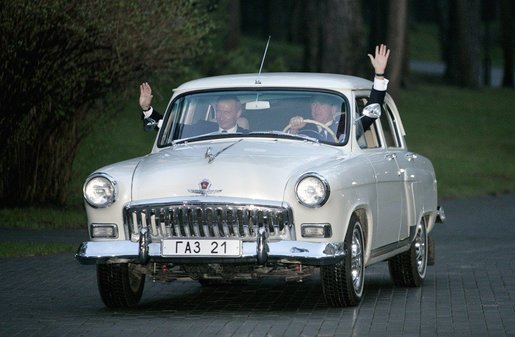
1956 Volga
PRESIDENT PUTIN: Mr. President, allow me to cordially welcome you to Moscow. I'd like to thank you for having decided to visit Moscow to participate in the celebration of the 60th anniversary of the end of World War II,
giving confirmation by that fact to the immense role played by the United States, Soviet Union and Russian Federation in the victory over Nazism.

Tomorrow we'll be pleased to receive our guests of ours. But the visit by the President of the United States is of special importance. On top of that, even today, we've enjoyed a very large volume of cooperation between our countries. And I hope that this cooperation will be helpful to us in addressing our domestic problems in both countries.

And I'm aware of the fact that you currently are confronted with immense tasks with respect to social sphere. (Laughter.) So if we are very positive in addressing those energy-related and security-related questions, that will be very helpful in addressing the problems which are confronted by people in the street in our countries. Besides, I recently visited the Middle East. Therefore, I'd like in this conversation with you today, to compare the notes regarding the current state of the Middle East.

PRESIDENT BUSH: Vladimir, thank you for having me. It's such an honor to be here. This locale where we are is a place where the President welcomed me and Laura two years ago. And it's great to be back here. I am looking forward to the celebration tomorrow. It is a moment where the world will recognize the great bravery and sacrifice the Russian people made in the defeat of Nazism. The people of Russia suffered incredible hardship, and yet the Russian spirit never died out.

I'm equally grateful that you would take -- invite me and Laura for dinner tonight. And having had one of your meals before, I'm looking forward to this one a lot.

PRESIDENT PUTIN: Recently I took a look at the coverage of your meeting with the press corps. Well, I could see how Laura attacked you sometimes, so at today's dinner we will have a chance to protect you. (Laughter.)

PRESIDENT BUSH: She was quite the comedian. But I'm looking forward to -- Russia is a great nation, and I'm looking forward to working on -- together on big problems. And I want to thank you for your work on Iran and the Middle East. And there's a lot we can do together. And so thank you for having us.

END For Immediate Release Office of the Press Secretary May 8, 2005

Statement on United States and Russian Cooperation

Statement on United States and Russian Cooperation

During the past few days, American and Russian negotiators have made significant progress on a common approach to resolving soon the question of liability protections for important cooperative programs. This agreement will help put these programs on solid ground for the long haul and enable us to strengthen and extend our cooperation, including on reducing the risks of proliferation of weapons and materials of mass destruction.

### For Immediate Release Office of the Press Secretary May 9, 2005

Interview of the President by Rustavi 2, Georgia TV

Interview of the President by Rustavi 2, Georgia TV, The Map Room, 10:07 A.M. EDT

Q Mr. President, let me thank you very much for this opportunity to interview you. And on behalf of Georgian people, let me welcome you to Georgia.

Why have you decided to visit Georgia? None of the American Presidents have visited this country before.

THE PRESIDENT: You know, I got to know your President, and I can remember him urging me to come to Georgia. He's got such enthusiasm about life and about the future of Georgia. And I have been most impressed by the aftermath of the Rose Revolution, that I said I want to go, I want to see -- I want to feel the sense of a new democracy. I want to be there to thank the Georgian people for setting such a good example for other countries that have followed. And so I'm really looking forward to the trip.

Q Mr. President, Georgia faces a lot of problems; among them, two unresolved conflicts, quite difficult -- the economic situation, Russia military presence in the country. How do you see resolving all those problems?

THE PRESIDENT: Peacefully. And I think they will be resolved peacefully. But you're right, it's difficult to go from a country of -- a communist country to a free country. It's not easy. I think the President understands that and his government understands that.

On the economic front, there's a lot of work to be done, but by routing out corruption and insisting upon rule of law and transparency, that will help attract investment and capital.

Secondly, in terms of the regional disputes or the bases, I can help some. But the best way to do this -- deal with this issue is to do it peacefully between Russia and Georgia. And I think we've got a very good chance of seeing these issues resolved in a peaceful way. It just takes time sometimes to deal with old disputes.

Q The latest developments of Eastern Europe and the region, I mean, the Georgia's Rose Revolution and Orange Revolution in Ukraine, and elections in Moldova and revolution in Kyrgyzstan caused Russia's negative reaction. And relations between Moscow and these countries are getting worse. So how is U.S. going to support these transitional democracies in the future?

THE PRESIDENT: No, that's a great question, and the first thing is, is that when I see President Putin, I will remind him again that democracies on his border will make it easier for Russia to grow in a peaceful way. Democracies are peaceful. Democracies don't like war. And democracies are the best form of government to deal with animosities and concerns.

And so I will remind him that this is not a plot by anybody or any nation. This is just the inevitable course of humankind because all humans want to be free. And as Georgia's economy begins to grow and pick up, Russia will have a trading partner, Russia will realize that a prosperous democracy in her south is good for the people of Russia.

Q U.S. Department's annual report on terrorism raised some questions about the stability in Pankisi Gorge. But Georgian government, with support of U.S., was successful in clearing this gorge of military elements. So how will relations -- I mean, military cooperation between Georgia and the United States in the future?

THE PRESIDENT: Well, I appreciate that. No, it's going to be very close, obviously at the request of the Georgian government. And I -- the Georgian government asked for help in routing out the terrorists who had lodged themselves in the Pankisi Gore -- training help. We were more than happy to provide it. But remember, what was interesting about some of those operations is there was close cooperation with the Russians, and I thought that was very helpful and very instructive about what can happen, because it's in Russia's interest, it's in the United States' interest, and more importantly, it's in Georgia's interest to make sure the Pankisi Gorge is clear of terrorist traffic or terrorist safe haven. No country wants terrorists who are willing to cause harm living within their border. And so I found this to be a very instructive and interesting cooperative arrangement.

Q Georgia is seeking NATO membership.

THE PRESIDENT: Yes.

Q How big is chance?

THE PRESIDENT: It's good. But remember, this is a performance-based criterion. In other words, there's a way to get into NATO. And I will tell President Saakashvili that there's -- to look at the countries that have recently been admitted and see what decisions they made and how they -- what they did. And I would hope it's good. But just remember, it's a process. It just doesn't happen overnight. And that's not only what I have told your President, but I've told the President of Ukraine and other countries that are interested in joining NATO.

Q Thanks for your precious time, Mr. President.

THE PRESIDENT: Glad you're here. Looking forward to going to Georgia. It's going to be an exciting trip.

Q I wish you a successful and safest trip.

THE PRESIDENT: Thank you, sir.

Q Thank you so much.

END 10:12 A.M. EDT

For Immediate Release, Office of the Press Secretary, May 5, 2005

Interview of the President by NTV, Russian Television

Interview of the President by NTV, Russian Television, The Map Room, 9:58 A.M. EDT

Q Good morning, Mr. President, although it's good evening for Russian audience because of the time change. (Laughter.) Your father is a World War II hero, the youngest Navy pilot. So how important the D-Day is for you, personally, and for your family?

THE PRESIDENT: Well, thank you for asking about my dad. He is -- he was a, like many in America and in Russia,that were called upon to defend the world against Nazism. And, fortunately, he came home.

And today, the celebration in Russia will remind us all about the sacrifices of, in my case, an individual I love, but also a generation -- a generation of men and women who made extraordinary efforts, in Russia's case, to defend the homeland; in America's case, to work with allies to defeat Adolf Hitler, as well as the Japanese.

And so it's a special day for me, personally, because it reminds me of the willingness of a young kid to go fight. But it also reminds me of the duty of my generation to work together to make the world a better place.

Q The after-war Europe has been reshaped according to the Yalta Conference of 1943, by the decision of three very important personalities of this time, Mr. Roosevelt, Mr. Churchill, and Mr. Stalin. How fair is it to hold only Russia responsible for all the misfortunes of Eastern Europe and Baltic states over the last --

THE PRESIDENT: That's a very fair question. Obviously, it was a decision made at the end of the war. I think that the main complaint would be that the form of government that the Baltics had to live under was not of their choosing. But, no, there's no question three leaders made the decision.

Q So not only Russia the bad guy of history?

THE PRESIDENT: Well, I think everybody ought to bear the -- as historians look back at Yalta -- got to recognize that it was -- you're rightly so in pointing it out -- it was not only the Russian leader, but the British and American leader were at the table and agreed on the agreement.

Q In Russia, we're very concerned on the rise of neo-Nazism in Baltic states, when Russian war veterans are humiliated publicly, when monuments to Russian soldiers are vandalized, and at the same time, where, on May 8th, there is a plan to open the monument to Nazi Brigade, that is well-known only for fighting -- not only for fighting against Russians, but also for quite ugly things that were common for SS troops.

THE PRESIDENT: Yes. Well, look, there is -- I've got a message when I go to the Baltics, and that is, it's important to respect democracy, but also the respect of democracy is respect for minority rights. In other words, a true democracy is one that says, minorities are important and that the will of the majority can't trample the minority.

And as to whether or not nations are honoring Nazism, of course that should be rejected. Nazism was defeated. We're celebrating the defeat of Nazism. We don't want to see Nazism return. It's an extremist point of view that believes that you should be able to trample the rights of minorities. It was the Nazis who annihilated millions of Jews, for example and there's a classic example of the rights of minorities being trampled. And we must never forget the lessons of why we fought together in World War II. And so I'm looking forward to delivering that message of tolerance.

Q There is a question that has nothing to do with your visit to Russia, but is very important to our country as an oil-producing country. Once you mentioned that you'll be happy to find a magic wand and to cut the price on oil. So what oil price will be acceptable for the United States, and what do you think is the chance of finding this magic wand?

THE PRESIDENT: Well, I appreciate -- no, there is no magic wand. A soldier asked me, he said, why don't you lower gasoline prices, as if the government controlled price. And in our country, the government doesn't control price. And I told him, I said, if I had a magic wand, I would wave it and lower your price, but I -- that's not the way it works. This is a world based -- the price based upon supply and demand. And demand has been going up relative to supply, which has been beneficial for oil-producing countries, like Russia.

And I don't know what the right price is. Obviously, the lower the better, for our economy, because every time the money -- the dollars go up on the gasoline price, money leaves the pocketbooks of the working people. But that's the way the economy works. Hopefully, higher price will stimulate more production. More production will then help the price reach an equilibrium.

And the market is what it is. That's -- the markets decide, not governments. I would hope that Russia would encourage a lot of investment, to open up the vast reserves she has. We need to do more exploration here. I spoke to the Crown Prince of Saudi Arabia who assured me that he is trying to put more -- to find more oil. And that's what high prices do. But people who have got oil have got to understand if the price gets too high, it could wreck economies, which will mean there's less purchasing power for the product.

Q Thank you, Mr. President, and welcome to Moscow.

THE PRESIDENT: Looking forward to it. Thank you, sir.

END 10:04 A.M. EDT

For Immediate Release, Office of the Press Secretary, May 5, 2005

Interview of the President by Dutch TV Nos

Interview of the President by Dutch TV Nos The Map Room 9:48 A.M. EDT

Q Mr. President, thank you very much for giving us the opportunity to talk to you. You're going to Europe, commemorating 60 years of liberation in Europe. You could have gone to many countries, why did you choose to go to Holland?

THE PRESIDENT: First of all, Holland was a stalwart, and the people of Holland were brave and courageous when it came to resisting tyranny. And a lot of people paid a heavy price for standing for freedom in the face of fascism. As well, many Americans lost their lives on Dutch soil. And it's an opportunity to praise those who fought, honor those who died, and remind people that there's more work to be done to make the world more free.

Q About that, more work to be done, do you see any similarities about what happened 60 years ago, the Americans, among others, liberating Europe, and what you are doing now, in the Middle East, for example?

THE PRESIDENT: Well, it's a different situation, but there is evil in the world. There's always been evil. I believe that those who kill in the name of a great religion are evil people; people who are willing to destroy innocent life or bury people in mass graves, or starve people to death are evil. And I think the free world must confront evil. The last choice is to use the military. On the other hand, sometimes you have to.

And as you know, I made a difficult decision. Some in Europe didn't agree, some in Holland didn't agree, and I can understand that. But now we have an obligation, and a duty, it seems like to me, to work together to help others become free. Freedom is universal -- freedom shouldn't be just -- people shouldn't view freedom as only the purview of Americans or the Dutch or Europeans. Everybody deserves to be free.

Q But the interesting thing is, Mr. President, that we all agree, also in Europe, about your goals -- democracy, freedom, safety in the world.

THE PRESIDENT: Sure.

Q Does it frustrate you sometimes that -- for example, in The Netherlands they did a poll before you are coming now that vast part of the population does not agree with the way you're handling world affairs, for example.

THE PRESIDENT: Well, you know --

Q Is it frustrating?

THE PRESIDENT: No, it doesn't. I mean, I --

Q It must be a little, though.

THE PRESIDENT: No, it doesn't; it doesn't frustrate me. I make decisions on what I think is right. That's what leaders do. The other day in a press conference I was asked about polls here in America. I said, a leader who tries to lead based upon polls is like a dog chasing his tail. That's not how you lead. No, I feel comfortable with the decisions I've made.

Q Is it maybe, then, a communication problem?

THE PRESIDENT: I don't know, I don't follow the Dutch media, don't know what's being said in Holland.

Q Well, when people are being asked about you, or America, they admire, again, your goals, but when you talk about -- for example -- about the war on terror, and you see freedom and democracy, the Dutch see that, as well, but they also see, for example, prisoner abuse in Abu Ghraib prison; or Guantanamo Bay, where prisoners are being held without charge; or the Americans who do not want their soldiers in The Hague for the tribunal, to be accountable.

THE PRESIDENT: Well, we have different --

Q So they see that problem.

THE PRESIDENT: Well, first of all, all Americans, including me, reject Abu Ghraib. That was an aberration. That's not what America stands for. And if people are concerned about the tactics, I understand that. But the goal is peace. And now is the time to work together to achieve peace.

Q How do you want to do that? What do you want to tell the Dutch people?

THE PRESIDENT: Let me finish. But you asked me, do I worry about polls -- I don't, that's not what leaders do. Leaders who sit around and read polls all the time are leaders that don't lead.

Q But the Dutch people are interested in --

THE PRESIDENT: Let me finish, please. And I have an obligation to lead. And we're making progress. You saw eight-and-a-half million people voted in Iraq. They defied the terrorists, they defied the suicide bombers, because they desire to be free. And now we have an obligation to work to help that country develop into a democracy, because the lesson of Europe, of working together as democracies, has yielded peace.

You know, 60 years ago, people would sit around and wonder whether or not peace was possible. And as a result of the good work of many in Holland and around Europe, and the United States working collaborative, the world is a peaceful place. And that's what we have a chance to do today. And that's why I thank the Dutch government, for helping train Iraqis, for example, helping Iraq become stable. And it's in our long-term interest that that happen.

Q One last question about something completely different.

THE PRESIDENT: Sure.

Q You're the President in the United States known for coming up for moral values, moral issues, also; Terri Schiavo, for example. The Dutch government is completely on the other side of the spectrum when it comes to abortion or euthanasia, gay marriages, drugs even. Politicians from your party weren't even -- Americans don't go -- don't want to go to the direction of Holland. Do you share that concern?

THE PRESIDENT: No, I -- first of all, Holland is a free country. It's a country where the people get to decide the policy. The government just reflects the will of the people. That's what democracies are all about. And that's what -- that's why we should continue to work for common interest to support government of the people, not government that dictates to people. And so if that's what the people of Holland want, that's what the government should reflect.

Q No special message from the President of America?

THE PRESIDENT: No. I mean, people are allowed to make -- I have a different view, and many Americans have a different view. I've always worked to promote a culture of life. I think that a civil society is one that protects the most vulnerable among us. But you asked me whether or not I have a message for the people of Holland. The message is: keep free, be free, support democracy and liberty, not only within your country, but continue to work with free nations to help people be free around the world, and the world will be a more peaceful place.

Q One final question if I may, please.

THE PRESIDENT: Sure, sure.

Q I think maybe Europeans feel that you're also their President, but they do not get to vote for you. How do you feel that responsibility?

THE PRESIDENT: I really -- I appreciate that. I'm perplexed by that attitude, because Europeans have got very good leaders.

Q But your decisions influence our lives.

THE PRESIDENT: Well, sometimes they do, and sometimes European decisions influence American lives. But the best way to influence the world is to work together in a collaborative spirit. And I appreciate the leadership in The Netherlands. I get along very well with the leadership. And I am -- my pledge is to continue to work as closely as we possibly can.

Listen, there's going to be differences of opinion. You mentioned the International Criminal Court -- we're not going to join it. And there's a reason why we're not going to join it: We don't want our soldiers being brought up in front of unelected judges. But that doesn't mean that we're not going to hold people to account, which we're doing now in America. And nor does it mean that even though we may disagree on the court, that we can't work for other big goals in the world.

Again, on my second trip to Europe since I've been the President, I'm going to continue to emphasize my desire to work with others to achieve peace.

Q Okay, Mr. President.

THE PRESIDENT: Welcome.

Q Thank you again.

THE PRESIDENT: Thanks for coming.

Q And enjoy your stay in The Netherlands.

THE PRESIDENT: I'm looking forward to it.

END 9:56 A.M. EDT

For Immediate Release Office of the Press Secretary May 5, 2005

Interview of the President by Lithuanian State Television

Interview of the President by Lithuanian State Television, The Map Room, 2:14 P.M. EDT

Q Mr. President, you thanked President Valdas Adamkus for his efforts spreading the freedom in neighboring countries. What else could Lithuania do spreading the freedom in this region?

THE PRESIDENT: Well, first, I did thank the President for his good work in the Ukraine. I thought it was a really great moment when the head of Lithuania got involved and encouraged the whole world to take notice of the freedom movement in the Ukraine. And by the way, that's a -- the second election was a really important moment in the liberty movement. And I thanked him for that, genuinely so. And I want to say it again: I thank him for that.

Lithuania serves as a great example of what is possible. After years of being subjugated to harsh rule, the Lithuanians are now free, and they're showing they can grow the economy, and that people have a chance to express themselves, and there's a vibrant society when you're free. And it has been hard. The transition from communism to a free democracy is a hard transition. And it's very important for the Lithuanians and the government to share that experience with others who will be going through the same thing. And so I am very proud of Lithuania, and I'm proud to call her "friend."

Q Mr. President, you showed a strong support for democracy cause in Belarus. And what is your administration planning to do, given the fact that Belarus presidential election is planned next year?

THE PRESIDENT: Well, first of all, we'll work with you, countries in the neighborhood, countries around -- the free countries of the world, to insist there be free elections, and make sure there's free elections. This is the last remaining dictatorship in Europe. And Condi Rice was in the neighborhood recently, as you know, Secretary of State Rice, and she brought up the subject. She met with people who are embracing the freedom movement in Belarus. I did, as well, when I was in Slovakia.

And so one of the roles that the United States can play is to speak clearly about the need for Belarus to be free, and to work with people to insist that Belarus be free. And when the elections come, make sure the elections are free, and have monitors and international observers. As you know, that made a big difference in the Ukraine, for example. No, it's -- and I think -- listen, I believe everybody wants to be free, and I believe if the world works together to achieve that, many people will be free.

Q Lithuania is taking a concrete role in the reconstructing of Afghanistan.

THE PRESIDENT: Yes.

Q What kind of specific support do you ask -- offer Lithuania?

THE PRESIDENT: Well, as you know, we've got for our partners in Iraq and -- we've got some solidarity funds. We want to work through the foreign aid money to help Lithuania in her efforts to help build a better world. Again, I applaud the President. I thank the people of Lithuania for the support in Afghanistan.

It's important that Afghanistan be free and peaceful; it will serve as an example for others. Again, I keep saying this to people, but you've just got to -- the people of Lithuania have got to know how I feel. I believe everybody desires to be free, and I believe everybody deserves to be free. Societies will grow up around different customs and habits. I don't expect people to look like American form of government, but I do believe the world ought to work together to enable people to live free lives, and then help countries, once they've become liberated from a tyrant, in the case of Afghanistan.

And that's what Lithuania is doing. And I'm confident the President is doing so because -- for the same reason I am, because he understands that free societies, in the long-run, will make the world peaceful. And that's what we want for our children and our grandchildren; we want there to be peace.

Q You're going to meet Mr. Putin. Will you repeat your words to him that the Second World War has brought the Soviet occupation to the Baltic states?

THE PRESIDENT: Yes, of course I'll remind him of that. I told him in Slovakia that I felt it was important for him to understand that my friends, the leaders of the Baltics, are upset; in other words, they don't view the end of World War II as a great moment of celebration. And there's a reason why. He took it in. Your President has decided not to go to Moscow. I respect him for that decision. Each leader in the Baltics has to make the decision they're comfortable with. And it was a very difficult period, and so this is a hard decision. And I respect the decisions of the three leaders.

But I did make it clear to President Putin that there is great angst, and people don't view this as a liberating moment, and hopefully that he will work with the Baltics in a cooperative way, because it really is in Russia's interests to have free countries and democracies on her border. The more democracies on the border of a country, the more peaceful a country will be.

And so this is a bittersweet moment for a lot of people in America who are from the Baltics. A lot of Lithuanian Americans here, by the way, who, on the one hand, are really happy the United States defeated Nazism, on the other hand saw their homeland taken over by a repressive, communist regime.

Q Mr. President, thank you. It was a pleasure.

THE PRESIDENT: Great. And listen, I want to say one other thing: I want to thank the people of Lithuania for the warm reception Laura and I received the last time we were there. It was one of the great visits of my presidency. I remember sitting in the town -- standing in the town square, and it was very interesting, seeing a lot of older Lithuanians with tears in their eyes. I guess they never thought they'd see the day where the American President came. It touched my heart a lot. And then I saw a lot of young Lithuanians wondering what the heck the American President was all about -- you know, they kind of -- so it was a very touching visit.

Thank you.

Q Thank you.

END 2:21 P.M. EDT

For Immediate Release Office of the Press Secretary May 4, 2005

Interview of the President by Estonian TV

Interview of the President by Estonian TV The Map Room 2:23 P.M. EDT

Q Thank you very much, Mr. President, for joining our viewers. Mr. President, do you understand and accept the reasons and explanations that two Baltic presidents are not attending the celebrations in Moscow, 9th May?

THE PRESIDENT: Yes, absolutely. First of all, I can understand the decision by your President and the President of Lithuania, as well as the President of Latvia. These are difficult decisions because -- and they reflect the difficult times. And I honor those decisions. But I understand.

There's a lot of Americans who came -- whose families were in the Baltics. And this is a bittersweet moment for them when you think about it. On the one hand, our country helped defeat fascism, and upon the defeat of fascism, they saw their homelands be taken over by a repressive ideology. And so I fully understand, and matter of fact, understood it to the point where I brought it up to President Putin when I saw him in Slovakia, and just said, you got to understand this is going to create some sensitivities among our friends, among America's friends -- Estonia and Lithuania and Latvia.

Q It's quite strange situation now. The war is over for 60 years, and it's not still over. Whose fault is it --

THE PRESIDENT: No, I appreciate that. Look, it's -- I think it's time to move beyond fault and focus on the future. Now, that's easy for me to say because I didn't have any family members that were repressed or families divided. I didn't have to live under the yoke of communism. But I do believe that time will help heal the wounds.

And, listen, the Baltics are doing great. Their economies are growing. They're getting stronger. Freedom is working. People are able to express themselves in the public square. Independent media can come and interview the President in the White House. I mean, it is a -- these are exciting times. But I readily understand why it takes time to heal the wounds of the past.

Q Democracy and the human rights situation in Russia is quite worrying. Are you going to discuss this item during your visit to Moscow?

THE PRESIDENT: Oh, of course. I have -- first of all, I've got a relationship with President Putin that enables me to be able to have a frank discussion. He gave an interesting speech the other day -- the press tend to focus on the comment about the Soviet times, and of course, that obviously riled emotions in the Baltics. I understand that. But he also went on to talk about democracy. I thought it was interesting that he spent a lot of time on his big speech to the nation on democracy. I believe Russia's interests lie to her west. I believe that Russia, by embracing the values that we share, will be able to deal with the many problems that she has. Russia has got enormous problems.

And so, yes, of course, I'll talk to President Putin about that. And I will do so in a cooperative way, in a cooperative spirit. This is not an antagonistic relationship. And I don't think you want the relationship to be antagonistic. After all, Russia is your neighbor. I think you would want your friend, the United States, to be in a position where I can go in and have a constructive, direct dialogue. And I think one people -- one thing people have learned about me is I'm a pretty direct person; I say what's on my mind -- I try to do so diplomatically. But, yes, I will. And I do so for the interests of the United States, and for our friends, and for the world.

Q Mr. President, I can't let you go from here without a question of terrorism.

THE PRESIDENT: Sure.

Q Latest surveys show that the numbers of terrorism are increasing, not decreasing.

THE PRESIDENT: Yes.

Q Why is that?

THE PRESIDENT: Well --

Q You have made a lot of efforts.

THE PRESIDENT: Yes, that's why. If we weren't trying to find the enemy and bring him to justice, the world would look relatively peaceful. But we're on the offense. And so when you engage the enemy, when you try to bring them to justice, they don't like to be brought to justice.

I've always told the American people here, it's best to find them where they try to hide so that we don't have to deal with them here at home. And so part of the reasons why activity is up is because we're chasing them down. As a matter of fact, today, a big news report came out that I would say one of the top al Qaeda leaders, a person very close to Osama bin Laden, was brought to justice in Pakistan by the Pak government, with our help -- but, nevertheless, the Pak government did the hard work

-- Abu Faraj Al-Libbi. That's a very important part of defeating the al Qaeda.

But, no, we'll stay on the offense. And we'll be relentless and tireless in doing so. The best way to defeat terrorism in the long run, though, is by spreading freedom, is by giving people a chance to live in a free society.

Q How long it takes to curb, finally?

THE PRESIDENT: Yes, that's a good question. However long -- it takes as long as necessary. I just don't know. I don't have a -- I can't give you a timetable. But whatever it takes, so long as I'm the President and there's a threat to the United States of America and to our people -- you see, a lot of people in Europe, for them, September the 11th was a date, a passing moment. No question they expressed deep sympathy, for which the United States is grateful. But for us, it was a change of attitude. It was a change of foreign policy. And I told the people when I ran for office the second time, I said, if you put me in office every day I'm in office, I'll be relentless in chasing down the enemy. And so -- for however long it takes.

It takes a while for freedom to take hold. I know that. Look at Iraq. Iraq is going from a tyranny to a free society. And it's not easy. But they're getting there. This country is beginning to -- it's getting on its feet. The security forces are beginning to work better. The terrorists are more desperate. But that free society will be an important part of sending a message to others. And free societies are peaceful societies. And that's the great example of Estonia, for which the United States is grateful, and we're proud to call you friend.

Q Thank you very much, Mr. President.

THE PRESIDENT: My honor.

Q Very much, indeed.

THE PRESIDENT: Thanks for coming.

END 2:30 P.M. EDT For Immediate Release Office of the Press Secretary May 4, 2005

Interview of the President by Latvian National Television

Interview of the President by Latvian National Television, The Map Room, 2:06 P.M. EDT

Q So that is no secret that you were a jet pilot, so how would you describe, in a couple of sentences, where is Latvia on your radar?

THE PRESIDENT: Very interesting. Latvia is a country that has made a big difference in important alliances to the United States, like NATO. I remember when the moment came when the countries -- the new countries admitted to NATO came into the room that I was sitting in and I turned to the person I was sitting next to and said, it's going to be so important for NATO to have these fresh -- these new countries, because they bring a fresh outlook to freedom; these are people that have recently lived under, in this case, communism, and realized what it means to be free and it's going to be very important.

And so Latvia is very high on my radar screen. Plus, I'm very close to the President.

Q How come you've become such good friends?

THE PRESIDENT: Well, first of all, she's a straightforward person. I like straightforward people. You know, sometimes in politics you get people who say one thing and don't mean it. When she tells me something, she means it. She's a very engaging and very intelligent woman. And I admire her courage. And so I'm fond of her.

Q You're good friends with President Putin of Russia. Do you think you could encourage him to admit historical justice and admit the fact that Baltic states were occupied in 1940?

THE PRESIDENT: Well, yes, I've talked to him about this issue when I was in Slovakia. I said, do you understand, friend, that you've got problems in the Baltics? You've got problems with Latvia because people don't like -- the remembrances of the time of communism are unpleasant remembrances and you need to work with these young democracies. I explained to him that it's best that there be democracies on his border -- free countries, because free countries don't attack people; free countries listen to the hopes and aspirations of people.

I don't know if I made any progress with him or not, but I have made my position clear. I understand there's a lot of people in the Baltics who are -- you know, don't view the celebration in Russia as a day of liberation. Frankly, it's the beginning of a difficult period, and I can understand why some leaders of countries aren't going and some others are. That's a decision each leader must make, and I respect the decision of each leader.

But I'm going to continue to speak very forcefully on freedom and liberty and the Baltics are a great example of free countries.

Q But you are pretty certain that Russia is at least on the right path of development and it does not pose any threat to its smaller neighbors?

THE PRESIDENT: Well, I certainly hope not. And one of the reasons a relationship with the United States and Latvia is important is, is that we will stand with Latvia if a larger country tries to intimidate the people. That's the great thing about Latvia joining NATO, is that the security is now guaranteed by not only the United States, but all members of NATO.

Listen, the President and I speak about relations between Russia and Latvia quite frequently. And my job at times is to send a message that says, look, treat your neighbors with respect; free nations, democracies on your border are good for you -- whether that be, by the way, in the Baltics or in Ukraine, I've sent that same message -- or Georgia. In other words, countries that are free countries are countries that will be good neighbors.

Q What can we do about Belarus, because a couple of hundred miles from where you're going to be visiting there sits the last dictator of Europe. What can we do about it?

THE PRESIDENT: The "last dictator of Europe" is right, and we'll continue to pressure Belarus and call upon the world, the rest of the world, the free world -- not the whole world, but the free world -- to work to give the people of Belarus a chance to live in a free society.

When I was in Slovakia I met with people of the Freedom Movement. I know when Condoleezza Rice, Secretary of State, was in your part of the world, she met leaders of the Freedom Movement, too. And we'll continue to press forward. President Putin must understand that a free Belarus is in his country's interest.

Q The sentiment of anti-Americanism, as I'm sure you know, is quite widespread in Europe, and in my country, as well. Do you think there is any degree of your own fault in the fact that this sentiment is on the rise or --

THE PRESIDENT: I made some hard decisions. You know, going into Iraq was a hard decision and I can understand people not liking that. But I would hope people in Europe would understand that freedom is not owned only by Europeans, that people around the world deserve to be free. And as we act in our self-interest to fight terrorists, as we work to make sure terrorists can't get weapons of mass destruction to cause great harm, that we will also work to free people. After all, the people of Latvia, of all people, ought to understand what it means to live under the subjugation of a doctrine that doesn't allow for freedom -- communism. And here people are living in the Middle East, for example, under the brutal reign of tyrants: huge mass graves, massive death, people tortured. And now they're living free. And when 8.5 million people went to vote in Iraq, that sent a clear message that said: We will not let the terrorists intimidate us; we want to be free -- just like people in the Balkans [sic] used to speak, we want to be free.

You know, our country had a great history with the Baltics, that we said, your embassies will remain little havens for freedom. We never recognized the lack of independence in the Baltics. We always believed that you should be free. And I hope over time the young people of Latvia understand that that's what we stand for in America. We stand for freedom. We don't believe freedom is America's gift. We believe there's universal desire to be free. And the world will be more peaceful.

The hard decisions I've made I am confident will make this world a more peaceful place.

Q Thanks very much, Mr. Bush.

THE PRESIDENT: Welcome.

Q I hope it's a good visit.

THE PRESIDENT: I'm confident it will be. I'm looking forward to it.

END 2:13 P.M. EDT

For Immediate Release Office of the Press Secretary May 4, 2005

Sunday, May 08, 2005

President Participates in Youth Roundtable in the Netherlands

President Participates in Youth Roundtable in the Netherlands, Selys de Fanson Zaal-Schatkaner Building, Maastricht, The Netherlands 9:15 A.M. (Local)

PRIME MINISTER BALKENENDE: Well, ladies and gentlemen, good morning. It's very good that you're here. But in the first place, I would like to say to the President of the United States, be welcome in The Netherlands. We really enjoy that you're here. It's an important day that you're in The Netherlands today, because on the 6th of May -- that's what we call our Liberation Day -- and we always think about our freedom. And at your last event, you said a lot about importance of freedom and democracy, and you realize what Americans meant for the European countries after the second world war. During the second world war, your people were here, but after, you helped us.

And it's very important that you're here today and that you'll have the meeting in Margraten. It's so important to be there, and also for us to show our respect and to say thanks for what all the Americans have done for The Netherlands.

We already had a breakfast meeting. We talked about some very important issues. We talked about the Middle East peace process. We talked about the struggle against terrorism because we are -- we have the same position. It's a threat to world society. We have to work together. We talked about the situation in Iraq and Afghanistan. We talked about China and some other issues. We talked about political situation in The Netherlands and the United States. It was a very fruitful and interesting meeting.

Mr. President, it's great that you're in The Netherlands. We appreciate very much that you're here today and that we have the meeting in Margraten. But also today, we have a meeting with students and we thank you for being here and be willing to have a discussion with these young people. It's very important, always challenging and encouraging if you have the meeting with the students.

And now, Mr. President, I give you the floor.

PRESIDENT BUSH: Thank you, Mr. Prime Minister. It's an honor to be in The Netherlands. Laura and I have been really looking forward to coming to your beautiful country. I want to thank you for the meeting we just had. It was a fruitful discussion. I appreciate your leadership, appreciate your friendship.

You know, I will be honoring a generation that made enormous sacrifices so that my generation could grow up in a free world. I'm really looking forward to going to the cemetery and paying homage to those who fought for freedom. It will be a solemn occasion, but an important moment to reflect upon. And I look forward to talking to the next generation about the responsibilities that you'll have to make sure the communities in which you grow up are hopeful communities and this country in which you love is a free country.

I want to thank you all for coming. I'm honored that you took time out of your life to come and have a visit with me. There's nothing like a young generation of Americans to keep an old guy -- I mean, young generation of citizens to keep an old guy like me feeling young.

But, Mr. Prime Minister, again, thanks for your hospitality. I want to thank Her Majesty, as well, for joining Laura and me today. It's awfully -- awfully kind of her to do so. Thank you.

PRIME MINISTER BALKENENDE: Thank you, Mr. President. Now the time is for the students. Looking to the relationship between the United States and The Netherlands, it's good to say that many things are uniting us, but also sometimes you have some decisions that's also possible and that's also good for the debate. And maybe it's good now to give the floor to you, and maybe it's good to start with Miss Madeline Hoffmeister (phonetic).

Q Thank you, very much. Mr. President, I have a question relating of concerning the terrorism. And you made many laws after 9/11, many -- many laws and many measures. And I'm wondering, will there be a time when you drop those laws and when you decrease the measures?

PRESIDENT BUSH: No, I appreciate that question. Look, a free society such as ours, obviously, must balance the government's most important duty, which is to protect the American people from harm with the civil liberties of our citizens. And every law we passed that was aimed to protect us in this new era of threats from abroad and the willingness for people to kill without mercy has been scrutinized and, of course, balanced by our Constitution. But the question really is, can a transparent society openly deal with a debate about civil liberty versus the tension of protecting ourselves. And I believe we have done so in good balance in America. But we're constantly reevaluating law.

The Patriot Act was passed. It was a very important measure to enable our law enforcement officials to share information which they weren't able to do at times, to be able to protect ourselves. And yet, Congress is now evaluating certain aspects of that law. That's what happens in democracies, and stands in stark contrast, by the way, to societies that are closed and non-transparent, where people don't get to determine the course of action.

And so, to answer your question, it depends upon what Congress says and whether or not I agree with it, because I have the right to veto any law, as well. Of course, they have the right to override my veto. But I feel comfortable in telling you that we've been able to successfully balance the civil liberties of our citizens with the necessary -- the necessity to protect ourselves.

Listen, one of the interesting things about September the 11th that I want you to understand as we have this discussion is that I fully understand that for some, September the 11th was an important moment and a terrible moment -- and we appreciate the condolences of the people of The Netherlands -- but for us it was a change of attitude. I mean, it changed a lot about how I looked at the world, and a lot of Americans, it changed how they looked at the world. I mean, it was more than just an attack; it was a whole mind-set. And that's why your question is really relevant -- did that mind-set, did that change of attitude cause us to then begin to take away certain civil liberties, and I would argue, it did not.

PRIME MINISTER BALKENENDE: You're convinced by the President? (Laughter.)

PRESIDENT BUSH: Don't put her on the spot. (Laughter.) That's a little rough question, Mr. Prime Minister.

Q I've a question about the reason you are here. We are honoring the soldiers who died in the second world war. In the years later, America was involved in a lot of conflicts, in a lot of wars. What's the benefit when you can ask to your people -- you are, in the first place, President of America, you're responsible for your own people --

PRESIDENT BUSH: Right --

Q -- what can you ask from your people, not only the dead and the wounded, but also economic consequences? Last week I received a brochure about raise funding for U.S. aid for poor people. So what --

PRESIDENT BUSH: You received -- I beg your pardon -- received a brochure for?

Q -- raise funding for poor people --

PRESIDENT BUSH: Oh, to raise funding, yes.

Q -- the economic consequences of all this involvement in conflicts, what's the balance between the responsibility to the world and the responsibility to your own people?

PRESIDENT BUSH: I think we have a responsibility to both. And at home, of course, economic vitality is really important, and to make sure the entrepreneurial spirit is alive and well. Seventy percent of new jobs in America are created by small business owners, which is -- it speaks to our -- the environment of encouraging entrepreneurship, which means less lawsuits and good tax policy and less regulations. A vibrant, growing economy is one which we collect more revenues, and therefore, we're more capable of helping and doing our duty to those who can't help themselves.

And that's the interesting balance of a free society, by the way, is the extent to which the welfare state is prevalent. And I believe we -- government has a role to help those who cannot help themselves, and then encourage people who can help themselves to realize dreams to good education and good policy.

Abroad, we have a responsibility, as well. First, let me just tell you, the hardest decision a President makes is war. Nobody wants to be at war. Nobody. Now the question is, how do we spread peace. And one way you spread peace is spread democracy. That's the lesson of World War II. If that thought troubles you we can discuss this a little more. But the lesson of World War II, at least, was that by spreading democracy throughout Europe, that Europe at last became whole, peace -- free, whole and at peace. That's the lesson that people at least ought to take away from the experience of the last 60 years. I believe it applies to the next 60, as well.

But we have other duties, as well -- HIV/AIDS, for example, in the continent of Africa is a pandemic that has got to be appalling to the free world. And my government is spending $15 billion as part of a global effort to help -- help defeat HIV/AIDS. We feed more of the hungry than any nation, and it's an obligation we readily accept. But, as well, as we work to help those who hurt, we also have got to put practical policies in place.

And that's why I'm such a believer in free trade, because trade ultimately -- the benefits of trade, the benefits of economy, the benefits of growing businesses far exceed the capacity of governments to hand out aid to people. And so, in Africa, for example, we've got a policy of feeding the hungry and providing money for help, but we've also got a free trade policy with Africa, which is helping these economies grow, which provides opportunity and hope for people that are living in those countries. So we have a balanced obligation at home and abroad.

Thank you, sir.

PRIME MINISTER BALKENENDE: We'll give the press a minute to do other things, and we can go on with our discussion.

END 9:25 A.M. (Local) For Immediate Release Office of the Press Secretary May 8, 2005

President Honors and Commemorates Veterans in the Netherlands

President Honors and Commemorates Veterans in the Netherlands, Margraten, The Netherlands 11:09 A.M. (Local)

PRESIDENT BUSH: Your Majesty; Mr. Prime Minister; Mr. Mayor; distinguished officials of The Netherlands; veterans and their families, including the 104th Infantry Division, known as the Timberwolves; the unit of Harold B. Welch -- my father-in-law, the father of First Lady Laura Bush -- Congressman Hoekstra; General Jones, General Franks; Superintendent Schwind; fellow Americans and friends:

On this peaceful May morning we commemorate a great victory for liberty, and the thousands of white marble crosses and Stars of David underscore the terrible price we pay for that victory. For the Americans who rest here, Dutch soil provides a fitting home. It was from a Dutch port that many of our pilgrim fathers first sailed for America. It was a Dutch port that gave the American flag its first gun salute. It was the Dutch who became one of the first foreign nations to recognize the independence of the new United States of America. And when American soldiers returned to this continent to fight for freedom, they were led by a President who owed his family name to this great land -- Roosevelt.

Some of those brave troops are here with us today, and we welcome you and we honor you. And they're here with their Dutch comrades. They share a love of liberty. In the war that came to an end 60 years ago this day, all those who fought for freedom made sacrifice, and many gave their lives.

In the Voice of America's radio broadcast from London on the first V-E Day, the announcer asked Europe to "think of these Americans as your dead, too." In Dutch hearts, they already were. The Americans saw the Dutch spirit in action within weeks of liberation, when this new cemetery marked its first Memorial Day. It was still a time of hardship and want and depravation; yet Dutch citizens from 60 local villages collected 20 truckloads of flowers so that every American grave here would be decorated when the sun came up on Memorial Day.

And in the six decades since, the Dutch have continued this wonderful tradition by adopting and attending to the graves of the people they never met. Your kindness has brought comfort to thousands of American families separated from their loved ones here by an ocean. And on behalf of a grateful America, I thank you for treating our men and women as your sons and daughters.

Today we join them at this hallowed ground. We come first to remember the young Americans who did not live to comb gray hair. Each man or woman buried here is more than a headstone and a serial number; each person here has a name that is precious to some family. And in faded black and white photographs, each one here looks back at us in the full glow of youth: the fresh-faced American in uniform; the newly minted officer with a smiling sweetheart on his or her arm; or the young dad traveling, holding a baby son or daughter on his knee. Every one of these Americans added his own unique contribution to the story of freedom.

In this cemetery lies Willy F. James, Jr., one of seven African American soldiers from the second world war to win the Medal of Honor. On this memorial wall is inscribed the name, Raymond Kelly, a young man studying to be a priest in Detroit, who could have sat out the war, but gave up his exemption to serve his country. And in this ground rests Maurice Rose, the brilliant division commander who led the first Allied troops into Germany. Here they rest in honored glory with thousands of their comrades in arms, and here we come to affirm the great debt we owe them.

We come to this ground to recall the evil these Americans fought against. For Holland, the war began with the bombing of Rotterdam. The destruction of Rotterdam would be a signpost to the terror and humanity that the Nazi lie would impose on this continent. Like so much of Europe, over the next years of occupation, Holland would come to know curfews, and oppression, and armed bands with yellow stars, and deportation for its Jewish citizens.

The winter just before liberation was the worst. When Dutch railway workers went on strike to make it harder for the German army to reinforce their troops, the Nazis responded with a blockade that made fuel and food even more scarce. Amsterdam would wait for liberation longer than almost any other city in Europe. Before it came, more than 20,000 Dutch men and women and children would perish in what was called the "hongerwinter," and many others were reduced to eating tulip bulbs to stay alive.

For some, V-E Day brought hope for normalcy, after almost five long years of occupation. For many others, including a Jewish girl named Anne Frank, hiding in an attic, V-E Day would come too late, two months after the institutionalized evil of Bergen-Belsen took her young life. And for still others, V-E Day would bring a lasting sense of solidarity with those who fought. One resistance leader put it well: "We are one because, together, we believed in something."

And so we come to this ground to remember the cause for which these soldiers fought and triumphed. At the outset of the war, there were those who believed that democracy was too soft to survive, especially against a Nazi Germany, that boasted the most professional, well-equipped and highly-trained military forces in the world. Yet, this military would be brought down by a coalition of armies from our democratic allies and freedom fighters from occupied lands and underground resistance leaders. They fought side-by-side with American GIs, who, only months before, had been farmers and bank clerks and factory hands. And the world's tyrants learned a lesson: There is no power like the power of freedom, and no soldier as strong as a soldier who fights for that freedom.

Private Robert Lee Rutledge was one of those soldiers. He gave his life fighting against a brutal attack by two Nazi divisions. Weeks before he died, he wrote a letter to his daughter on her fifth birthday. The letter was addressed to little Ginger Rutledge in Lumpkin, Georgia. Private Rutledge told his daughter, "You're too young to understand it now, but you will later. It's all for your benefit. You came into a free world, and I want you to finish in one."

Sixty years later, Ginger is still free, and she does understand. And so do her three children and eight grandchildren. Private Rutledge did his job well, and the men who fought and bled and died here with him accomplished what they came for. The free America that Ginger grew up in was saved by their courage. The free Europe where many of them lie buried was built on their sacrifice. And the free and peaceful world that we hope to leave to our own children is inspired by their example.

On this day, we celebrate the victory they won, and we recommit ourselves to the great truth that they defended, that freedom is the birthright of all mankind. Because of their sacrifice and the help of brave allies, that truth prevailed at the close of the 20th century.

As the 21st century unfolds before us, Americans and Europeans are continuing to work together and are bringing freedom and hope to places where it has long been denied: in Afghanistan, in Iraq, in Lebanon, and across the broader Middle East. Freedom is a permanent hope of mankind; and when that hope is made real for all people, it will be because of the sacrifices of a new generation of men and women as selfless and dedicated to liberty as those we honor today.

May God bless you all. (Applause.)

END 11:22 A.M. (Local) For Immediate Release Office of the Press Secretary May 8, 2005

Center for Nanoscale Materials

Energy Secretary Bodman's Remarks at Nanoscale Materials Center Dedication

ARGONNE, ILL., -- Today Energy Secretary Samuel Bodman and Illinois Governor Rod Blagojevich participated in a dedication ceremony for the new Center for Nanoscale Materials, under construction at the U.S Department of Energy’s Argonne National Laboratory.

Bodman Nanoscale Center Dedication Number: R-05-112 May 6, 2005

Los Alamos Lab Leadership Changes

Energy Secretary's Statement on Los Alamos Lab Leadership Changes

WASHINGTON, D.C. - The following is a statement from Secretary of Energy Samuel Bodman on leadership changes at the department’s Los Alamos National Laboratory (LANL). The University of California today announced that LANL director Dr. Pete Nanos will be stepping down and that Dr. Robert Kuckuck will serve as interim director.

"Dr. Pete Nanos has led Los Alamos National Lab during a challenging time. He instituted a number of sound business practices that have helped Los Alamos remain one of the premier labs in the world. While serving as director, Dr. Nanos demonstrated vigor and resourcefulness learned during his many years in the U.S. Navy. I thank him for his service to our department and our Nation, and I wish him the best of luck in his new responsibilities at the Defense Threat Reduction Agency.

Bob Kuckuck brings an enormous wealth of experience to this task, having served at DOE’s Lawrence Livermore National Laboratory and in Washington at the National Nuclear Security Administration. I look forward to working with him in his role as interim director.”

SOURCE:
energy.gov : DOE Media contact: Anne Womack Kolton, 202/586-4940 Number: R-05-111 May 6, 2005

No Child Left Behind Act, Quiet Revolution

Spellings Says Americans Serious About Education Reform, Points to "Quiet Revolution" Sparked by No Child Left Behind Act

ST. PETERSBURG—U.S. Education Secretary Margaret Spellings today called the movement toward high standards and accountability in our nation's schools a "quiet revolution" made possible by the passage of the No Child Left Behind Act.

In a speech to the Education Writers Association in St. Petersburg, Fla., Secretary Spellings cited the underlying aim of the law, asking, "Are we really serious about educating every child in America?" The vast majority of states, Spellings maintained, have answered in the affirmative.

"They are hard at work, helping students achieve. It's a 'quiet revolution'-an underreported revolution, I would add," Spellings said. "We have shed old attitudes and behaviors, confronted the truth, rolled up our sleeves and gotten down to work.

"And the work is paying off: in states such as North Carolina, Wisconsin, Massachusetts, Georgia, Illinois and New Mexico, to name just a few, students are achieving and the achievement gap is closing."

The decision by some to challenge the law and put classroom funds at risk, Spellings said, must be viewed in that light.

"The contrary actions of a couple of states and one union do not constitute a 'grassroots rebellion,'" Spellings said. "All 50 states-including, I would add, those now challenging the law-have accountability plans in place that have laid the foundation for continuous school improvement and real student achievement.

"The bottom line is that most respected, national education organizations are working with us to continue the unprecedented national progress that No Child Left Behind has begun. So are most states, 15,000 school districts and 96,000 schools across the nation."

Noting the historic nature of the law, which was passed over three years ago, Spellings said, "Never before in the 229-year history of our nation has the United States made a promise to provide all children with a high quality education."

She also reminded the writers of the declining student achievement levels and growing achievement gaps that have plagued many schools. "You've covered the studies," she said. "For too many students, a high school diploma has become little more than a 'certificate of attendance.' Millions of children have been given a seat in the classroom but not a meaningful and useful education.

"We must give them all a chance. It is the moral imperative of the 21st century."

Spellings argued that the achievement gap hurts all Americans, not just a few, by undercutting our leadership in the world.

"Students in this country lose interest in science and math as they advance through the educational system," Spellings said, while economic competitors such as China and India increasingly fill the gap.

"We must turn this around. I am optimistic after seeing the nation's governors and respected business leaders such as Bill Gates come together and call for reform of our nation's high schools," Spellings said. "It's urgently needed, and it's something in which the president and I strongly believe."

SOURCE: U.S. Department of Education The complete text of the Secretary's prepared remarks can be found at:
ed.gov/news/speeches/

### FOR RELEASE: May 5, 2005 Contact: Chad Colby, (202) 401-4401 Sarah Sauber, (202) 205-3807

Ghassan Muhammad Amin

Key Zarqawi aide captured

BAGHDAD, Iraq – Multi-national forces conducted a raid in western Iraq capturing the Qa’idat al-Jihad Fi Bilad Al-Rafidayn (QJBR) Amir of Rawah, Ghassan Muhammad Amin Husayn Al-Rawi Apr. 26. Ghassan Amin was one of Abu Musab al-Zarqawi’s key associates; he served to coordinate meetings for other senior QJBR members, facilitated movement and meetings for Zarqawi in the Rawah region, facilitated movement of foreign fighters, and allegedly was responsible for terrorist activity resulting in the murder of innocent Iraqis.

Multi-national forces conducted three consecutive raids in late April to capture Ghassan Amin and his followers. In the first raid, multi-national forces discovered a car bomb factory three kilometers west of Rawah linked to Ghassan Amin.

Four vehicles being prepared as car bombs, approximately 200 bags of ammonium phosphate, two DSKH 38/46 12.7mm machine guns and ammunition were found inside the warehouse. Coalition forces destroyed the warehouse and its contents to prevent their use in manufacturing a variety of bombs to be used by the terrorists. As reported just three days later, AMZ's network claimed responsibility for the multiple car bombs that were detonated throughout Iraq Apr 29.

In the second raid, two of Ghassan Amin’s associates were captured. The third raid of the morning netted Ghassan Amin.

According to statements provided by Iraqi residents of Rawah, Ghassan Amin and his network terrorized the local citizens by stealing cars to convert into bombs and allegedly kidnapping Iraqis for profit to further support the purchase of weapons and ammunition. One male who was temporarily detained due to his proximity with Ghassan Amin during the third raid claimed, “Ghassan Amin runs Rawah and nobody does anything without Ghassan Amin’s approval. Ghassan Amin is well known in Rawah and it is well known that he is part of the mujahideen. Ghassan Amin destroyed the police station and the Headquarters of the Islamic party of Rawah.”

In a raid days prior to capture of the Rawah Amir, forces found several weapons caches buried near a farm belonging to Ghassan Amin. Due to the large amount discovered, the weapons and ammunition were destroyed in place.

Ghassan admitted to meeting Zarqawi once in January and allowed Zarqawi to reside with one of Ghassan’s relatives for approximately five days.

Iraqi Security and Coalition forces continue to capture or kill high level terrorists associated with Zarqawi, seize and destroy large amounts of bomb making material, and prevent terrorist attacks on a regular basis. The capture of Ghassan Amin removes a significant leader of terrorism from the now safer streets of Rawah. -30-

SOURCE:
United States Central Command THE MULTI-NATIONAL FORCES - IRAQ CONSOLIDATED PRESS INFORMATION CENTER PROVIDED EDITORIAL SERVICE FOR THIS RELEASE, AND SHOULD BE CONSIDERED THE PRIMARY POINT OF CONTACT. FOR QUESTIONS OR FURTHER INFORMATION, E-MAIL THE MNF-I CPIC AT cpicpressdesk@iraq.centcom.mil .

May 7, 2005 Release Number: 05-05-09 FOR IMMEDIATE RELEASE Key Zarqawi aide captured MULTI-NATIONAL FORCE-IRAQ COMBINED PRESS INFORMATION CENTER BAGHDAD, Iraq May 7, 2005 Release A050507d

NEWS RELEASE HEADQUARTERS UNITED STATES CENTRAL COMMAND 7115 South Boundary Boulevard MacDill AFB, Fla. 33621-5101 Phone: (813) 827-5894; FAX: (813) 827-2211; DSN 651-5894

Two Plead Guilty in Scheme to Export Sensitive Electronics to China

Two Plead Guilty in Scheme to Export Sensitive Electronics to China -- Technology had military radar and communications applications --

MILWAUKEE, WI –S Steven M. Biskupic, United States Attorney for the Eastern District of Wisconsin, today announced that two Chinese citizens pleaded guilty Monday to criminal charges in connection with a conspiracy to illegally export restricted electronic components with potential uses in a wide variety of military radar and communications applications to the People’s Republic of China (PRC).

Jian Guo Qu, (dob 9/30/59) a male citizen of the PRC and owner of the Beijing Rich Linscience Electronic Company in China, pled guilty in federal district court in Green Bay to one count of violating Title 18 U.S.C. Section 371 -- conspiracy to illegally export dual-use semi-conductors and other electronic components from the United States to China without the proper export licenses from the U.S. Department of Commerce. Qu is scheduled to be sentenced July 25, 2005 and could face up to four years in prison.

Ruo Ling Wang, (dob 5/14/64), the wife of Qu, and a citizen of the PRC employed at the Beijing Rich Linscience Electronic Company in China, also pled guilty in federal district court in Green Bay to one count of violating Title 50 U.S.C. Section 1705 (b) in relation to falsifying and undervaluing a shipment of illegally exported electronics valued at $11,000 from the United States to China in an attempt to avoid scrutiny or inspection.

Wang was sentenced to time served (six and a half months) and a $1,500 fine.

Qu and Wang were among four defendants arrested on September 30, 2004 in Milwaukee and Manitowoc by a task force that included agents from the U.S. Department of Commerce, Office of Export Enforcement, the U.S. Department of Homeland Security, U.S. Immigration and Customs Enforcement (ICE), the Federal Bureau of Investigation (FBI), and the Internal Revenue Service (IRS), Criminal Investigation Division. The Manitowoc Police Department also provided assistance.

The other two defendants arrested last September were Ning Wen, (dob 4/12/49) a male U.S. citizen residing at 402 Wild Oak Drive in Manitowoc, and Hailin Lin, (dob 4/28/49), the wife of Wen and also a U.S. citizen residing at 402 Wild Oak Drive in Manitowoc. Trial for Wen and Lin is scheduled for September 14, 2005 in federal court in Green Bay.

A criminal complaint filed against the four defendants in September 2004 alleged that, since at least 2001, Wen and Lin used a business called “Wen Enterprises,” which they operated from their home in Manitowoc, to ship restricted parts to Qu and Wang at Beijing Rich Linscience Electronic Company in China.

The complaint alleged that for most of these transactions, Lin obtained the restricted technology from a U.S. manufacturer or supplier based upon a request from Wang or Qu; falsified shipping documents by concealing the true nature of the shipments and stating that a license was not required for the shipments at the direction of Qu; and then shipped the product to Wang and/or Qu in the PRC, without receiving, or even applying for, the requisite export license from the U.S. Department of Commerce.

The complaint also alleged that the China National Packaging Base Construction Company or an individual in Hong Kong wire transferred money to a Wisconsin bank account of Wen Enterprises to pay for the shipments. The complaint further alleged that Wen was once a Chinese citizen employed at the Chinese Consulates in San Francisco and Los Angeles. The complaint also alleged that Wen “was recruited and worked for the FBI as an informant” during the 1990s and during some of the time period of the illegal export scheme.

In addition to being charged with conspiring to violate the International Emergency Economic Powers Act and Export Administration Regulations, the defendants were charged with money laundering. Wen and Lin each face up to 25 years in prison and substantial fines if convicted of these charges at trial.

The lead prosecutors in the case are Assistant U.S. Attorney Erica N. O’Neil and Assistant U.S. Attorney Michelle Jacobs.

U. S. Bureau of Industry and Security For Immediate Release: May 5, 2005 Contact - BIS Public Affairs 202-482-2721

Laser Shows if Fruit's Beauty is Only Skin Deep

Laser Shows if Fruit's Beauty is Only Skin Deep

The produce industry is working with the Agricultural Research Service (
ARS) to make sure that fruits and vegetables taste as good as they look. They're counting on "machine vision" tools that can predict the quality of fruit or vegetable flavor--right after picking and in the packing plant--without ever touching the product. Machine vision uses optical sensors to inspect objects.

Today, batches of fruits and vegetables are judged by sample tastings, but there is no guarantee that all of the produce in the batch will taste the same. Samples are also tested for firmness by mechanically stabbing them with a thick, steel probe. With both methods, the tested produce has to be thrown away.

While there are machine vision tools that can check skin-deep traits like size, color and bruising, it is difficult to judge deep, internal qualities like taste and texture of apples and many other fruits. Now
Renfu Lu, an agricultural engineer with the ARS Sugar Beet and Bean Research Unit in East Lansing, Mich., has developed machine vision prototypes that "taste" every single piece of produce from right after harvest to when it passes by on the packing line.

Lu and ARS colleagues on the campus of
Michigan State University have tested their laser prototype on apples and peaches. It should work with any produce that is at least as large as an apple or peach. The detector focuses four laser beams, each a different light wavelength, into one sharp beam that shines into individual fruits.

Laser light photons momentarily scatter all the way to the fruit's core and back. The amount of light bounced back after interacting with tissue reflects firmness. Peaches and apples are separated by whether they are soft, firm or hard.

Since scattered light also indicates the amount of light absorbed by the fruit, and that absorption is affected by sugar levels in the fruit, this technology can be used to predict flavors, such as sweetness in apples.

Read more about the research in the May 2005 issue of Agricultural Research magazine.

ARS is the
U.S. Department of Agriculture's chief scientific research agency. By Don Comis May 6, 2005

Saturday, May 07, 2005

Animal study: Compounds in cranberries may have heart-healthy effects

Animal study: Compounds in cranberries may have heart-healthy effects

MADISON - Compounds that occur naturally in cranberries may be good for the heart, researchers at the University of Wisconsin-Madison have found.
Early results from studies indicate that feeding cranberry juice powder seems to relax and open blood vessels in pigs that are genetically susceptible to developing atherosclerosis, or clogged arteries. Kris Kruse-Elliott, a veterinary anesthesiologist at the UW-Madison School of Veterinary Medicine, presented her results at the American Physiological Society's annual meeting in San Diego in April.

She and co-researcher Jess Reed, a nutritionist in the Department of Animal Sciences, set out to evaluate various whole foods that contain antioxidants, flavonoids and polyphenols, all compounds that may protect against heart disease. Cranberries contain all three, so they fed cranberry juice powder to pigs that were genetically predisposed to develop high cholesterol and atherosclerosis, just as some humans are.

"When these pigs were fed cranberry juice powder made from whole cranberries for six months, their vessels acted more like normal pigs," Kruse-Elliott says, meaning that the pigs' blood vessels relaxed and opened more.

Abnormal blood vessel function is an important component of heart disease. Finding ways to improve vessel function in patients with high cholesterol and atherosclerosis is critical to helping protect these patients from consequences such as heart attack or stroke.

"The next step is to determine what specific components of cranberries are most important to the improvements in vascular function that we observed, exactly how they modify blood vessel relaxation, and how they can be most easily consumed as part of the diet," Kruse-Elliott says. That last factor may be key. While pigs may not mind the intense tartness of concentrated cranberries, someone will need to make cranberry juice powder palatable to people before the next "heart-protection" diet is born. ###

SOURCE:
EurekAlert! Contact: Tania Banak banakt@svm.vetmed.wisc.edu 608-263-6914 University of Wisconsin-Madison

Foreign Relations Volume XI, South Asia Crisis, 1971

Release of Foreign Relations Volume XI, South Asia Crisis, 1971

The Department of State released today Foreign Relations of the United States, 1969-1976, Volume XI, South Asia Crisis, 1971. This volume, part of the ongoing official record of U.S. foreign policy, presents key documentation on the Nixon Administration's policy immediately prior to and during the Indo-Pakistan War of 1971. Included in this volume is full coverage of the "tilt" toward Pakistan by President Richard Nixon and his Assistant for National Security Affairs, Henry Kissinger.

The volume begins with the political crisis triggered by the electoral success of Bengali nationalists in East Pakistan, led by Sheik Mujibur Rahman and his Awami League, and the announcement by President Yahya Khan on March 1, 1971, that the scheduled meetings of the newly elected National Assembly would be postponed indefinitely. The announcement was met initially by popular demonstrations by the Awami League and the dispatch of additional troops to Dacca by Pakistan’s martial-law government. On March 15, Rahman announced that he was taking over the administration of East Pakistan. Ten days later the army arrested him and moved to suppress what it viewed as a secessionist movement. The United States was loath to intervene in Pakistan’s internal affairs, especially since Pakistan was Nixon’s secret conduit for a diplomatic opening to the People’s Republic of China.

The Pakistani army’s campaign against Bengali dissidents eventually led the U.S. Consulate in Dacca to send a "dissent channel" message to Washington, which called for the United States to condemn the "indiscriminate killing." However, the Nixon Administration was not prepared to involve itself in a civil war on the Indian subcontinent. Nor did the Nixon Administration pay much attention to Indian concerns about "the carnage in East Pakistan" and the problems of refugees in West Bengal. When Indian officials such as Foreign Minister Swaran Singh and Prime Minister Indira Gandhi came to Washington, the Nixon Administration counseled non-intervention, but assumed that India planned to go to war.

The signing of the India-Soviet Union Treaty of Peace, Friendship, and Cooperation in August 1971, while not a mutual security treaty, was viewed in Washington as a blank check to India in its confrontation with Pakistan. President Nixon warned Soviet officials not to encourage India and informed India that if it started a war with Pakistan, the United States would cut off aid.

On November 22, India launched an offensive against East Pakistan. The Nixon Administration cut off economic aid to India, and Nixon himself decided to "tilt" toward Pakistan. This pro-Pakistan policy included support of Pakistan in the United Nations and pressure on the Soviets to discourage India, with accompanying hints that U.S.-Soviet détente would be in jeopardy if Moscow did not comply. When Nixon learned that Indian war plans were designed to liberate "Bangladesh" and southern Kashmir, and to destroy Pakistan’s military armored and air strength, he ordered the U.S. carrier Enterprise and its escorts into the Bay of Bengal. At the President’s instruction, Kissinger met with People's Republic of China Ambassador to the United Nations Huang Hua to brief him on the crisis and U.S. actions, and to suggest that China make coordinated military moves in support of Pakistan. The implication conveyed by Kissinger was that if the Soviet Union responded militarily, the United States would support China in any confrontation with the Soviet Union.

When the Chinese asked to meet with Kissinger in New York 2 days later, the White House assumed the worst and concluded that China had already decided to take military action against India. There was serious contemplation in the White House that the crisis might lead to nuclear war, but the general conclusion was that a regional conventional war in South Asia pitting India and the Soviet Union against China, the United States, and Pakistan was more likely. When the meeting took place, the Nixon White House learned that China’s message had nothing to do with military moves in support of Pakistan. For his part, President Nixon correctly realized that "Russia and China aren’t going to war." In mid-December, Pakistani military forces surrendered in East Pakistan. With U.S. encouragement, Pakistan accepted an Indian cease-fire offer that would dramatically alter the Indian subcontinent.

The text of the volume, the summary, and this press release are available at the Office of the Historian website (
state.gov/nixon/xi). Copies of this volume can be purchased from the U.S. Government Printing Office at bookstore.gpo.gov/. For further information contact Edward Keefer, General Editor of the Foreign Relations series, at (202) 663-1131; fax (202) 663-1289; e-mail history@state.gov. 2005/483 Released on May 6, 2005

Notice to the Press Office of the Spokesman Washington, DC May 6, 2005

Cambodia, Christopher R. Hill, Kem Sokha

Cambodia - Assistant Secretary Hill Meets Human Rights Activist Kem Sokha

On May 3, Assistant Secretary for East Asian and Pacific Affairs Christopher R. Hill met with Mr. Kem Sokha, a prominent Cambodian human rights activist and President of the Cambodian Center for Human Rights. Assistant Secretary Hill and Mr. Kem discussed recent developments in Cambodia, including challenges to freedom of expression and freedom of assembly as well as concerns over growing political intimidation. Assistant Secretary Hill expressed support for Mr. Kem’s efforts to promote democracy and the rule of law in Cambodia.

SOURCE:
state.gov 2005/474 Released on May 5, 2005 Press Statement Richard Boucher, Spokesman Washington, DC May 5, 2005