


Message to the Congress of the United States
To the Congress of the Unites States:
Section 202(d) of the National Emergencies Act (50 U.S.C. 1622(d)) provides for the automatic termination of a national emergency unless, prior to the anniversary date of its declaration, the President publishes in the Federal Register and transmits to the Congress a notice stating that the emergency is to continue in effect beyond the anniversary date. In accordance with this provision, I have sent the enclosed notice to the Federal Register for publication. This notice states that the national emergency declared in Executive Order 13303 of May 22, 2003, as expanded in scope by Executive Order 13315 of August 28, 2003, modified in Executive Order 13350 of July 29, 2004, and further modified in Executive Order 13364 of November 29, 2004, is to continue in effect beyond May 22, 2005. The most recent notice continuing this emergency was published in the Federal Register on May 21, 2004 (69 FR 29409).
The threats of attachment or other judicial process against (i) the Development Fund for Iraq, (ii) Iraqi petroleum and petroleum products, and interests therein, and proceeds, obligations, or any financial instruments of any nature whatsoever arising from or related to the sale or marketing thereof, or (iii) any accounts, assets, investments, or any other property of any kind owned by, belonging to, or held by, on behalf of, or otherwise for the Central Bank of Iraq create obstacles to the orderly reconstruction of Iraq, the restoration and maintenance of peace and security in the country, and the development of political, administrative, and economic institutions in Iraq. Accordingly, these obstacles continue to pose an unusual and extraordinary threat to the national security and foreign policy of the United States. For these reasons, I have determined that it is necessary to continue the national emergency protecting the Development Fund for Iraq, certain other property in which Iraq has an interest, and the Central Bank of Iraq, and to maintain in force the sanctions to respond to this threat.
GEORGE W. BUSH THE WHITE HOUSE, May 19, 2005. # # # For Immediate Release Office of the Press Secretary May 19, 2005
RELATED:
Friday, May 20, 2005
National Emergencies Act (50 U.S.C. 1622(d))
0
comments
||
||

African Growth and Opportunity Act
Message to the Congress of the United States
To the Congress of the United States:
Consistent with title I of the Trade and Development Act of 2000, I am providing a report prepared by my Administration, the "2005 Comprehensive Report on U.S. Trade and Investment Policy Toward Sub-Saharan Africa and Implementation of the African Growth and Opportunity Act."
GEORGE W. BUSH THE WHITE HOUSE, May 19, 2005. # # # For Immediate Release Office of the Press Secretary May 19, 2005
RELATED:
0
comments
||
||
Thursday, May 19, 2005
National Safe Boating Week, 2005
National Safe Boating Week, 2005 by the President of the United States of America a Proclamation
Recreational boating has grown into one of our Nation's most popular pastimes, and as the summer approaches, millions of Americans will enjoy our country's beautiful waters. During National Safe Boating Week, we highlight our Nation's commitment to making recreational boating safer.
The number of boating fatalities has decreased over the last decade. By promoting the use of appropriate safety measures, we can save more lives and further reduce the number of injuries caused by boating accidents. The U.S. Coast Guard and others recommend four guidelines for safe boating: wear properly fitted life jackets; get vessels checked for safety; never boat under the influence of alcohol or drugs; and get proper training about the safe operation of boats. By adhering to these simple suggestions, boaters can keep themselves and others safe as they enjoy our Nation's waterways.
In recognition of the importance of safe boating practices, the Congress, by joint resolution approved June 4, 1958 (36 U.S.C. 131), as amended, has authorized and requested the President to proclaim annually the 7 day period prior to Memorial Day weekend as "National Safe Boating Week."
NOW, THEREFORE, I, GEORGE W. BUSH, President of the United States of America, do hereby proclaim May 21 through May 27, 2005, as National Safe Boating Week. I encourage the Governors of the 50 States and the Commonwealth of Puerto Rico, and officials of other areas subject to the jurisdiction of the United States, to join in observing this week. I also urge all Americans to learn more about safe boating practices, wear life jackets, take advantage of boating safety programs throughout the year, and always engage in proper and responsible conduct while on the water.
IN WITNESS WHEREOF, I have hereunto set my hand this nineteenth day of May, in the year of our Lord two thousand five, and of the Independence of the United States of America the two hundred and twenty ninth.
GEORGE W. BUSH # # # For Immediate Release Office of the Press Secretary May 19, 2005
0
comments
||
||
National Maritime Day, 2005
National Maritime Day, 2005 by the President of the United States of America a Proclamation
America's merchant mariners make our Nation more secure and our economy stronger. Throughout our history, they have promoted commerce and protected our freedom. On National Maritime Day, we honor the dedicated service of the United States Merchant Marine.
Each year, the men and women of the U.S. maritime transportation system move more than 2 billion tons of cargo along our waterways and across the open seas. Many of the raw materials Americans purchase are transported by merchant vessels, and merchant mariners ship agricultural products and finished goods in and out of the United States every day.
Merchant mariners have also served in every conflict in our Nation's history. The U.S. Merchant Marine helps provide our Nation's Armed Forces with crucial supplies and equipment. These brave men and women demonstrate courage, love of country, and devotion to duty, and we especially honor those who have made the ultimate sacrifice in defense of our Nation. The United States is safer and the world is more peaceful because of the work of our merchant mariners, and we are grateful for their service.
In recognition of the importance of the U.S. Merchant Marine, the Congress, by joint resolution approved on May 20, 1933, as amended, has designated May 22 of each year as "National Maritime Day," and has authorized and requested that the President issue an annual proclamation calling for its appropriate observance.
NOW, THEREFORE, I, GEORGE W. BUSH, President of the United States of America, do hereby proclaim May 22, 2005, as National Maritime Day. I call upon the people of the United States to celebrate this observance and to display the flag of the United States at their homes and in their communities. I also request that all ships sailing under the American flag dress ship on that day.
IN WITNESS WHEREOF, I have hereunto set my hand this nineteenth day of May, in the year of our Lord two thousand five, and of the Independence of the United States of America the two hundred and twenty ninth.
GEORGE W. BUSH # # # For Immediate Release Office of the Press Secretary May 19, 2005
0
comments
||
||
Standing Rules of The Senate RULE XXII
Standing Rules of The Senate RULE XXII PRECEDENCE OF MOTIONS
1. When a question is pending, no motion shall be received but
To adjourn.
To adjourn to a day certain, or that when the Senate adjourn it shall be to a day certain.
To take a recess.
To proceed to the consideration of executive business.
To lay on the table.
To postpone indefinitely.
To postpone to a day certain.
To commit.
To amend.
Which several motions shall have precedence as they stand arranged; and the motions relating to adjournment, to take a recess, to proceed to the consideration of executive business, to lay on the table, shall be decided without debate.
2. Notwithstanding the provisions of rule II or rule IV or any other rule of the Senate, at any time a motion signed by sixteen Senators, to bring to a close the debate upon any measure, motion, other matter pending before the Senate, or the unfinished business, is presented to the Senate, the Presiding Officer, or clerk at the direction of the Presiding Officer, shall at once state the motion to the Senate, and one hour after the Senate meets on the following calendar day but one, he shall lay the motion before the Senate and direct that the clerk call the roll, and upon the ascertainment that a quorum is present, the Presiding Officer shall, without debate, submit to the Senate by a yea-and-nay vote the question:
"Is it the sense of the Senate that the debate shall be brought to a close?" And if that question shall be decided in the affirmative by three-fifths of the Senators duly chosen and sworn -- except on a measure or motion to amend the Senate rules, in which case the necessary affirmative vote shall be two-thirds of the Senators present and voting -- then said measure, motion, or other matter pending before the Senate, or the unfinished business, shall be the unfinished business to the exclusion of all other business until disposed of.
Thereafter no Senator shall be entitled to speak in all more than one hour on the measure, motion, or other matter pending before the Senate, or the unfinished business, the amendments thereto, and motions affecting the same, and it shall be the duty of the Presiding Officer to keep the time of each Senator who speaks. Except by unanimous consent, no amendment shall be proposed after the vote to bring the debate to a close, unless it had been submitted in writing to the Journal Clerk by 1 o'clock p.m. on the day following the filing of the cloture motion if an amendment in the first degree, and unless it had been so submitted at least one hour prior to the beginning of the cloture vote if an amendment in the second degree. No dilatory motion, or dilatory amendment, or amendment not germane shall be in order. Points of order, including questions of relevancy, and appeals from the decision of the Presiding Officer, shall be decided without debate.
After no more than thirty hours of consideration of the measure, motion, or other matter on which cloture has been invoked, the Senate shall proceed, without any further debate on any question, to vote on the final disposition thereof to the exclusion of all amendments not then actually pending before the Senate at that time and to the exclusion of all motions, except a motion to table, or to reconsider and one quorum call on demand to establish the presence of a quorum (and motions required to establish a quorum) immediately before the final vote begins. The thirty hours may be increased by the adoption of a motion, decided without debate, by a threefifths affirmative vote of the Senators duly chosen and sworn, and any such time thus agreed upon shall be equally divided between and controlled by the Majority and Minority Leaders or their designees. However, only one motion to extend time, specified above, may be made in any one calendar day.
If, for any reason, a measure or matter is reprinted after cloture has been invoked, amendments which were in order prior to the reprinting of the measure or matter will continue to be in order and may be conformed and reprinted at the request of the amendment's sponsor. The conforming changes must be limited to lineation and pagination.
No Senator shall call up more than two amendments until every other Senator shall have had the opportunity to do likewise.
Notwithstanding other provisions of this rule, a Senator may yield all or part of his one hour to the majority or minority floor managers of the measure, motion, or matter or to the Majority or Minority Leader, but each Senator specified shall not have more than two hours so yielded to him and may in turn yield such time to other Senators.
Notwithstanding any other provision of this rule, any Senator who has not used or yielded at least ten minutes, is, if he seeks recognition, guaranteed up to ten minutes, inclusive, to speak only.
After cloture is invoked, the reading of any amendment, including House amendments, shall be dispensed with when the proposed amendment has been identified and has been available in printed form at the desk of the Members for not less than twenty four hours. SOURCE: Rules Committee- U.S. Senator Trent Lott- Committee Chairman
0
comments
||
||
Edmund S. Hawley
Edmund S. Hawley, of California, to be an Assistant Secretary of Homeland Security, vice David M. Stone, resigned.
# # # Nomination Sent to the Senate For Immediate Release Office of the Press Secretary May 19, 2005
0
comments
||
||
President Bush to Attend 2005 Group of Eight (G-8) Summit
Statement by the Deputy Press Secretary Regarding 2005 G-8 Summit, President Bush to Attend 2005 Group of Eight (G-8) Summit
President Bush will travel to the United Kingdom to attend the G-8 Summit in Gleneagles, Scotland on July 6-8. The G-8 Summits bring together Leaders of the world's major industrial democracies: Canada, France, Germany, Italy, Japan, Russia, the United Kingdom, and the United States. The European Union is also represented at the G-8 Summits. At previous G-8 Summits, Leaders have discussed a wide range of international economic, political, and security issues.
# # # For Immediate Release Office of the Press Secretary May 19, 2005
0
comments
||
||
Ambassador John Negroponte, General Mike Hayden
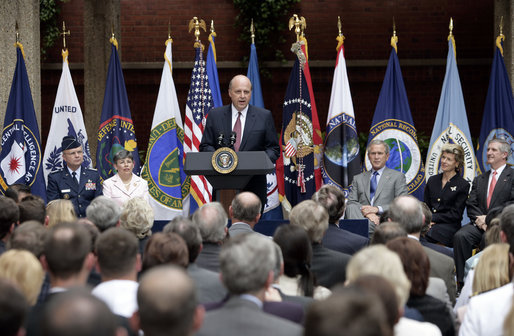 | President Congratulates America's First Director and Deputy Director of National Intelligence FULL STREAMING VIDEO New Executive Office Building Courtyard Washington, D.C. President's Remarks 1:18 P.M. EDT |
I want to thank Secretary of State Condi Rice and Secretary of Defense Don Rumsfeld for joining us today. I appreciate Porter Goss, head of the Central Intelligence Agency, for joining us; Robert Mueller, Director of the FBI. I appreciate Senator Ted Stevens, Senate President Pro-Tem joining us today, along with Senator Jay Rockefeller. Thank you both for being here.
I want to thank Congressman Peter Hoekstra, Chairman of the House Permanent Select Committee on Intelligence, along with Congresswoman Jane Harman, ranking member. Thank you both for coming. I appreciate Chuck Robb, Co-Chairman of the WMD Commission, for joining us today. I want to thank members of the intelligence community who have joined us. I thank the rest of you for coming, too. (Laughter.)
Ambassador Negroponte's position is one of the newest in the government, and one of the most demanding. Our nation is at war, and John is making sure that those whose duty it is to defend America have the information we need to make the right decisions. He's ensuring that our intelligence agencies work as a single, unified enterprise. And he's serving as my principal intelligence advisor. These are vital and urgent responsibilities, and John has what it takes to fulfill them all.
In his distinguished career, John has represented America in eight nations on three continents. He's served every President since Dwight Eisenhower. Over the past four years, I've come to know John's wisdom, intellect and integrity. I've relied on his candid judgment to help solve complicated problems. I have witnessed his unique ability to bring people together, most recently in his historic achievements as ambassador to a free Iraq. I'm grateful to John for answering his nation's call. I thank his family for joining us today.
John is fortunate to count on an experienced and capable deputy in General Mike Hayden. General Hayden understands the intelligence community from the ground up. He has a long record of wise and effective reform. Mike also has a clear understanding of our enemies in the war on terror. He'll be a superb deputy to Ambassador Negroponte. I thank Mike for his willingness to serve, and I'm glad to see his family, as well.
As John Negroponte and Mike Hayden carry out their new duties, they're relying on the thousands of dedicated professionals working in our intelligence community. These men and women serve America with a wide variety of talents and expertise. They all report to work everyday with the same goal: to protect our fellow citizens from harm. Intelligence officers work in secret, and often at great risk to their lives. Their vigilance and bravery are vital to America's security. And on behalf of all Americans, I thank them and their families for their service in the cause of freedom.
As Director of National Intelligence, John is taking action to help all who serve in the intelligence community to do their jobs more effectively. He has assembled a strong leadership team that reflects a wide range of skills and intelligence experience. He's visited a number of intelligence agencies, he's listened to experts in a variety of fields and he's made reforms in the daily intelligence briefing. John recognizes and values the contributions of all who collect and analyze intelligence. He will ensure that they have access to the tools and information their missions demand.
In the days ahead, Ambassador Negroponte and General Hayden will continue the structural reforms of our intelligence community that began after September the 11th, 2001. We've now implemented the vast majority of the 9/11 Commission's recommendations through executive orders, and the intelligence reform bill I signed last December.
My administration is also reviewing all the recommendations made by the Silberman-Robb Commission on weapons of mass destruction. We have already begun to implement a number of their recommendations. We will continue to evaluate and act on the commission's useful blueprint to improve the quality and quantity of intelligence we collect, and to be able to analyze that information more thoroughly.
John Negroponte will also ensure the sharing of information among agencies and establish common standards for the intelligence community's personnel. I have confidence in John Negroponte and Mike Hayden to carry out these vital missions. Well-integrated, effective intelligence efforts are America's first line of defense against the threats of the 21st century.
I thank the Congress for creating the Director of National Intelligence position and for swiftly confirming two talented, dedicated Americans to lead our intelligence community. I look forward to working with this team to improve our intelligence capabilities, and to use those capabilities to win the war on terror.
Congratulations to both men. May God bless you and your families, and may God continue to bless our country. (Applause.)
DIRECTOR NEGROPONTE: Thank you, Mr. President; members of the Cabinet who are here today, members of the Congress, to my own family, dear friends and colleagues -- especially my new colleagues in the intelligence community.
I've always felt that the greatest honor that could be bestowed on me by my country is the opportunity to serve it. I felt this way as a junior Foreign Service officer; I feel this way today as the Director of National Intelligence. I can truthfully say that I've never really wanted to do anything else -- whether I was stationed in Vietnam, in Greece, in Iraq, in Mexico or here in Washington. Why? Because the United States represents freedom, the United States represents peace, and the United States represents opportunity. What greater privilege could any American enjoy than to pursue a career representing a great nation based on values such as these.
As parents, Diana and I want our five children to have as much freedom, peace and opportunity as we, ourselves, have had. We know every other American parent feels the same way. So I view the position of Director of National Intelligence as a challenge, yes, but I'm grateful to you, Mr. President, for asking me to accept it. In so doing, I am reassured by the fact that I will be supported by tens of thousands of patriotic professionals in the intelligence community who have dedicated their lives, often at great personal risk, to the defense of our country and all that it stands for.
I want to thank each and every one of you for being here today. Thank you very much. (Applause.)
END 1:25 P.M. EST For Immediate Release Office of the Press Secretary May 18, 2005
0
comments
||
||
Fibromyalgia, Dextromethorphan
Fibromyalgia patients may benefit from cough remedy, UF study finds
GAINESVILLE, Fla. - Dextromethorphan, an over-the-counter medication that silences coughs, may help fibromyalgia patients quiet over-reacting nerves that amplify ordinary touches into agony.
A University of Florida study documents, for the first time, that dextromethorphan temporarily reduces the intensity of fibromyalgia "wind-up," a snowballing pain response to minor, repetitive physical contact. The discovery, described in the May issue of The Journal of Pain, also enables researchers to rule out one suspected cause of the phenomenon.
Fibromyalgia is an incurable illness that causes widespread muscle aches, stiffness, fatigue and sleep disturbances, according to the National Fibromyalgia Association. An estimated 10 million Americans suffer from the condition, most of them women. Current treatment strategies include pain medication, exercise, stretching, sleep management and psychological support.
Though the UF study did not establish guidelines for using dextromethorphan clinically, it suggests the drug may eventually be an option for treating fibromyalgia and other conditions involving heightened pain sensitivity, said rheumatology expert Roland Staud, M.D., a UF associate professor of medicine and the study's principal author.
"I think it's one piece of the mosaic," Staud said. "We currently have no single therapy in chronic pain that has a big effect. So what this really means for chronic pain patients is that they need to use a whole host of different interventions to decrease the pain they have. And in this, dextromethorphan may have a role in the future."
Dextromethorphan is popular in cold remedies because it elevates the threshold for the coughing reflex but does not cause physical addiction, according to the U.S. Drug Enforcement Administration.
But fibromyalgia patients should not resort to self-medicating by taking cough syrups for pain, Staud cautioned.
"Like every medication, dextromethorphan has side effects," he said. "At high doses, patients can have problems related to memory and confusion."
The underlying cause of fibromyalgia remains unknown, but in the past 25 years substantial progress has been made toward understanding the mechanisms behind specific features of fibromyalgia, Staud said. One is central sensitization, a feature of many chronic pain conditions in which the central nervous system - the brain and spinal cord - somehow magnifies pain signals to abnormally high levels, said Staud, who is affiliated with UF's McKnight Brain Institute.
Central sensitization is associated with wind-up, a phenomenon in which repeated touches - even handshakes or pats on the back - generate lingering pain that increases with each new contact, he said. A normal form of achy, lingering pain known as secondary pain affects anyone who suffers an injury.
The UF researchers - Staud, neuroscientist Charles Vierck, Ph.D., psychologist Michael Robinson, Ph.D., and Donald Price, Ph.D. - were surprised to learn that dextromethorphan eased fibromyalgia patients' wind-up pain to the same degree it soothed secondary pain induced in healthy volunteers, Staud said. The results indicate a long-suspected cause of wind-up may not exist.
Previous studies at other institutions had shown that dextromethorphan blocks the action of a chemical messenger called N-methyl-D-aspartate, or NMDA, which relays pain impulses in the spinal cord. Many fibromyalgia researchers have theorized that wind-up is caused by abnormalities in the spinal-cord structures that process NMDA.
The UF results suggest those structures function normally but that pain impulses are more amplified in fibromyalgia than in healthy participants, Staud said.
"This has refocused much of our research now," he said. Future UF studies will attempt to pinpoint where the pain impulses are originating.
In the current study, researchers worked with 14 women with fibromyalgia and 10 women who did not have the disease, using mechanical devices that tapped the participants' hands repeatedly. One part of the study involved contact with a heated probe, the other used a small rubber-tipped peg. The intensity of the heat or pressure of the stimulation was individually adjusted so that all participants reported feeling the same degree of pain.
Researchers then gave each participant a capsule containing 60 milligrams of dextromethorphan, 90 milligrams of dextromethorphan or a placebo containing none of the drug, and asked them to rate the amount of pain they experienced when the stimulation was repeated.
With the heat stimulus, 90 milligrams of dextromethorphan reduced wind-up pain, but 60 milligrams was no more effective than the placebo. With the pressure stimulus, 90 milligram and 60 milligram doses were equally effective, reducing wind-up pain.
The UF study indicates the need for further research on dextromethorphan, said fibromyalgia expert Laurence Bradley, Ph.D., a professor of medicine with the University of Alabama at Birmingham's division of clinical rheumatology and immunology.
"This is a topic that's actually received very little attention so far in the literature," Bradley said. "It would be a disservice to start to recommend that either patients or physicians begin experimenting right away with dextromethorphan, because I think there's some important questions about how to minimize the side effects with this agent."
### Contact: Melanie Ross ufcardiac@aol.com 352-392-2621 University of Florida
1 comments
||
||
Belarus Expulsion of Polish Diplomat
Belarus Expulsion of Polish Diplomat
Question: It has been reported that Belarus officials expelled a Polish diplomat? What is the US reaction?
Answer: We would refer you to the Polish government for information on the details of this case. We would note that the Belarusian authorities’ accusations against this Polish diplomat appear to fit a pattern of false claims that the United States and other Western countries are attempting to destabilize Belarus. The United States encourages and promotes democracy in Belarus and stands behind the Belarusian people in their quest for freedom.
Released on May 19, 2005 Taken Question Office of the Spokesman Washington, DC May 19, 2005 Question Taken at May 18, 2005 Daily Press Briefing
0
comments
||
||
new Democratic Republic of the Congo (DRC) constitution
Democratic Republic of the Congo: New Constitution Adopted by Parliament
The United States welcomes the adoption May 13 of the new Democratic Republic of the Congo (DRC) constitution that establishes a balance of powers between the branches of government, ensures protection and development of minorities, and provides for a limit of two presidential terms. We note the flexibility shown by all members of the transitional Congolese government in reaching this agreement.
The United States hopes the national constitutional referendum will take place as soon as feasible, followed by national elections within the time frame mandated in the Sun City Accords of 2003.
SOURCE: state.gov 2005/532 Released on May 19, 2005 Press Statement, Richard Boucher, Spokesman, Washington, DC, May 19, 2005
0
comments
||
||
G-8/Broader Middle East and North Africa Initiative
First G-8/Broader Middle East and North Africa Initiative Education Ministerial to Meet
The first meeting of education ministers from the countries of the G-8 and the Broader Middle East and North Africa initiative will meet at the Dead Sea, Jordan from May 22-23, 2005. U. S. Secretary of Education Margaret Spellings will head the U.S. delegation comprised of Deputy Assistant Secretary of State for Educational and Cultural Affairs, Thomas Farrell; Director, Office of the Middle East Partnership Initiative; Alina Romanowski, USAID Assistant Administrator for the Asia and Near East Bureau, James Kunder; and Director of Middle East Regional Initiatives for the National Security Council, Farah Pandith. Thirty countries have been invited to participate by the host Government of Jordan as well as representatives from civil society and the private sector throughout the region.
The United States views education reform and increased access to quality and relevant education as the fundamental basis on which political and economic reforms are based and supports the role of the education ministerial meeting in advancing the region’s education reform. The goal of the conference is to ensure that all citizens, including women and girls, receive education relevant to the needs of modern economies and democratic societies.
On June 9, 2004, the G-8 countries responded to the calls for reform from the Broader Middle East and North Africa region and announced a Partnership for Progress and a Common Future and a Plan of Support for Reform. Ministers from more than 20 G-8 and Broader Middle East and North Africa nations met in Rabat, December 10-11, 2004 at the first Forum for the Future. The Forum is the centerpiece of the partnership and provides a collaborative vehicle at ministerial level for expanding G-8 engagement in support of the region’s political, economic and educational reform efforts, in particular toward the enhancement of democracy and civic participation, rule of law, human rights, open market economies, and quality educational systems of excellence. Civil society and private sector representatives also meet in separate dialogues and then participate in plenary sessions of the Forum as well as in separate Ministerial events.
SOURCE: state.gov 2005/531 Released on May 19, 2005 Media Note Office of the Spokesman Washington, DC May 19, 2005
0
comments
||
||
Afghanistan: Killing of Contract Personnel
Afghanistan: Killing of Contract Personnel (Taken Question)
Question: Can you confirm that five Afghans were killed today who worked for a U.S. contractor?
Answer: We can confirm that five Afghans were killed during a shooting attack today at an alternative livelihood project in Lashkar Gah, in southern Helmand province. Two of the five victims were Afghan employees of Chemonics, a U.S. Agency for International Development contractor that provides training and alternatives to poppy growing for Afghan farmers in areas where poppy cultivation is widespread.
We extend our condolences to the families and friends of the victims, and to their colleagues at Chemonics. An investigation by Afghan authorities into this incident is underway. Our Embassy in Kabul will monitor the progress of the investigation.
2005/529 Released on May 18, 2005 Taken Question Richard Boucher, Spokesman Washington, DC May 18, 2005 Question Taken at May 18, 2005 Daily Press Briefing
0
comments
||
||
Estonia-Russia Border Treaty
Estonia-Russia Border Treaty
We welcome the signing by Russia and Estonia of a treaty to demarcate the border between their two nations. The United States sees this as a welcome step that will be constructive for regional relations and will help Estonia and Russia move ahead from their painful past. We believe that Estonia, which the United States has continuously recognized since 1922, has taken an important step in ensuring the integrity of its borders. We look forward to completion of the process of ratification by the parliaments of both countries to bring the treaty signed today into force.
SOURCE: state.gov 2005/527 (Revised) Press Statement (Revised) Richard Boucher, Spokesman Washington, DC May 18, 2005
0
comments
||
||
Wednesday, May 18, 2005
U.S.-Denmark-Greenland Joint Committee, May 19-20, 2005
U.S.-Denmark-Greenland Joint Committee, May 19-20, 2005
Assistant Secretary for European and Eurasian Affairs Daniel Fried will deliver remarks at the opening plenary session of the U.S.-Demark Greenland Joint Committee on Thursday, May 19 at 10:00 a.m. in the Loy Henderson Auditorium. This event is open to the press. Set up time for cameras is 9:15 a.m. Final access time for press is 9:30 a.m.
Undersecretary of State for Political Affairs Nicholas Burns will deliver remarks at the closing plenary session of the U.S.-Denmark-Greenland Joint Committee on Friday, May 20 at 4:15 p.m. in the Exhibit Hall. This event is open to the press. Set up time for cameras is 3:30 p.m. Final access time for press is 3:45 p.m.
For further information on these events, please contact the Bureau of European and Eurasian Affairs, Office of Public Affairs and Public Diplomacy at (202) 647-6291.
The Joint Committee is the result of Declarations signed in Greenland last August with Danish Foreign Minister Per Stig Moeller and Greenland Deputy Premier Josef Motzfeldt. The Declarations broaden relations between the U.S. and Greenland to include cooperation in energy and environmental research, trade, tourism, and educational and cultural exchange.
Media representatives may attend this briefing upon presentation of one of the following: (1) a U.S. Government-issued identification card (Department of State, White House, Congress, Department of Defense, or Foreign Press Center), (2) a media-issued photo identification card, or (3) a letter from their employer on letterhead verifying their employment as a journalist, accompanied by an official photo identification (driver’s license or passport).
Other events: Danish Prime Minister Anders Fogh Rasmussen will launch the “Festival of Greenland” program at the Smithsonian Museum of Natural History, sponsored by the Greenland Home Rule Government and the Danish Embassy. This event is open to press. Media contacts at the Smithsonian are Michele Urie or Randal Kremer at 202-633-2950.
SOURCE: state.gov 2005/528 Released on May 18, 2005 Notice to the Press Office of the Spokesman Washington, DC May 18, 2005
0
comments
||
||
CitizenConnect Program in Cambodia
“CitizenConnect” to Commence with Program in Cambodia on Volunteerism and Grassroots Activism
The U.S. Department of State is pleased to inaugurate its new CitizenConnect Program. The first participant in the new program is grassroots luminary Judith Olton Mueller, who will travel to Phnom Penh, Cambodia, to work with local NGOs, hold a seminar for school administrators, and participate in a fair with local students and organizations to promote volunteerism May 18-22, 2005. Mueller, President and CEO of the Advisory Network, a global consulting firm that works on gender equity issues, has been recognized for her achievements in this field by The Washington Post, A&E Biography, and Washingtonian magazine.
The CitizenConnect program, which is administered by the Department of State’s Bureau of Educational and Cultural Affairs, will feature community leaders and experts in specific fields or issues. They will travel to selected U.S. embassies and posts for up to a week to promote the development of grassroots activism and advocacy focused on solving concrete problems at the local community level.
For more information on this new program or other exchange programs managed by the Bureau of Educational and Cultural Affairs programs, please contact Adam Meier at (202) 203-7026.
SOURCE: state.gov 2005/526 Media Note Office of the Spokesman Washington, DC May 18, 2005
0
comments
||
||
Burundi Cease-Fire Agreement
Burundi Cease-Fire Agreement
The United States welcomes the May 15 agreement on an immediate cease-fire between the Government of Burundi and the Party for the Liberation of the Hutu People-National Liberation Front (PALIPEHUTU-FNL). This is a positive step in support of the peace process.
We congratulate the Government of Tanzania, and in particular President Mkapa and Foreign Minister Kikwete, for their success in achieving this cease-fire. We reiterate our support for the Regional Peace Initiative on Burundi, as chaired by Ugandan President Museveni and facilitated by South African Deputy President Zuma.
SOURCE: state.gov 2005/521 Released on May 17, 2005 Press Statement Richard Boucher, Spokesman Washington, DC May 17, 2005
0
comments
||
||
Buying Property in Northern Cyprus
Buying Property in Northern Cyprus
Question: What is the U.S. position on U.S. citizens buying property in northern Cyprus?
Answer: Our consular information sheet cautions that American citizens who buy or lease property, particularly in northern Cyprus, may find their ownership challenged by people displaced in 1974, and advises that prospective buyers seek legal advice before buying.
2005/524 Released on May 17, 2005
Taken Question Office of the Spokesman Washington, DC May 17, 2005 Question Taken at May 17, 2005 Daily Press Briefing
0
comments
||
||
Togo: U.S. Concern Over Continuing Violence
Togo: U.S. Concern Over Continuing Violence
The United States is concerned by the continuing violence in Togo since the Presidential election. We call on the security forces, government and political parties to exercise control and seek peaceful resolution of conflict. Detainees should be placed on trial or released.
The United States welcomes the initiative of Nigerian President Obasanjo, as Chairman of the African Union, with the support of President Bongo of Gabon and the Economic Community of West African States, to bring all parties together in Abuja, Nigeria, on May 19. This is a major step toward reducing the tensions caused by a disputed election and should initiate a political dialogue leading to a government of national union.
SOURCE: state.gov 2005/520 Released on May 17, 2005 Press Statement Richard Boucher, Spokesman Washington, DC May 17, 2005
0
comments
||
||
U.S. Interests Section, Havana and the Cuban Protest March
U.S. Interests Section, Havana and the Cuban Protest March
Question: Was the U.S. Interests Section in Havana open during the Cuban protest march today?
Answer: Yes, the U.S. Interests Section was open today.
2005/519 Released on May 17, 2005
Taken Question Richard Boucher, Spokesman Washington, DC May 17, 2005 Question Taken at May 17, 2005 Daily Press Briefing
0
comments
||
||
Open Skies Aviation Agreement with Ethiopia
U.S. Signs Open Skies Aviation Agreement with Ethiopia
The United States is pleased to announce the signing of an Open Skies air transport agreement with Ethiopia. U.S. Department of Transportation Deputy Secretary Maria Cino and Ethiopian State Minister of Infrastructure Haile Asegide signed the agreement today, May 17, 2005 in Washington, D.C.
This is the first air services agreement between the United States and Ethiopia. It allows airlines to make commercial decisions with minimal government intervention. It provides for open routes, capacity, frequencies, designations, and pricing, as well as opportunities for cooperative marketing arrangements, including code sharing. It also includes all-cargo seventh freedom rights, allowing airlines to perform international cargo operations without connecting to their homeland.
Establishing Open Skies as the basis of U.S.-Ethiopian aviation relations is an important step toward spurring trade, investment, tourism, and cultural exchange between the two nations.
With this signing, Ethiopia is the 70th country with which the United States has negotiated a bilateral Open Skies agreement.
SOURCE: state.gov 2005/522 Released on May 17, 2005 Media Note Office of the Spokesman Washington, DC May 17, 2005
0
comments
||
||
Repatriation and Reintegration of Sudanese Refugees
United States Support for Repatriation and Reintegration of Sudanese Refugees
The United States is contributing an additional $18 million to the United Nations High Commissioner for Refugees (UNHCR) to support the repatriation and reintegration of Sudanese refugees from Kenya to southern Sudan. This assistance is part of the United States’ commitment to Sudan announced by Deputy Secretary Robert Zoellick at the April 2005 Oslo Donors’ Conference.
Organized returns of Sudanese refugees are expected to begin this fall. This contribution will allow UNHCR to address the immediate needs of returning refugees while in transit and after arrival at their final destination. UNHCR will also rehabilitate basic social and economic infrastructure and provide essential services in areas of return. Some 150,000 Sudanese refugees will be assisted by UNHCR in the first 18 months of this repatriation and reintegration program.
During fiscal years 2003 – 2005, the United States has committed over $1.6 billion to Sudan for humanitarian assistance, conflict resolution in Darfur, reconstruction and development, and support for implementation of the Comprehensive Peace Agreement. The United States urges other donors to strengthen their efforts in support of the Sudanese people.
SOURCE: state.gov 2005/523 Released on May 17, 2005 Press Statement Richard Boucher, Spokesman Washington, DC May 17, 2005
0
comments
||
||
Filibuster and Cloture
Filibuster and Cloture
Using the filibuster to delay or block legislative action has a long history. The term filibuster -- from a Dutch word meaning "pirate" -- became popular in the 1850s, when it was applied to efforts to hold the Senate floor in order to prevent a vote on a bill.
In the early years of Congress, representatives as well as senators could filibuster. As the House of Representatives grew in numbers, however, revisions to the House rules limited debate. In the smaller Senate, unlimited debate continued on the grounds that any senator should have the right to speak as long as necessary on any issue.
In 1841, when the Democratic minority hoped to block a bank bill promoted by Kentucky Senator Henry Clay, he threatened to change Senate rules to allow the majority to close debate. Missouri Senator Thomas Hart Benton rebuked Clay for trying to stifle the Senate's right to unlimited debate.
Three quarters of a century later, in 1917, senators adopted a rule (Rule 22), at the urging President Woodrow Wilson, that allowed the Senate to end a debate with a two-thirds majority vote, a device known as "cloture." The new Senate rule was first put to the test in 1919, when the Senate invoked cloture to end a filibuster against the Treaty of Versailles. Even with the new cloture rule, filibusters remained an effective means to block legislation, since a two-thirds vote is difficult to obtain. Over the next five decades, the Senate occasionally tried to invoke cloture, but usually failed to gain the necessary two-thirds vote. Filibusters were particularly useful to Southern senators who sought to block civil rights legislation, until cloture was invoked after a fifty-seven day filibuster against the Civil Right Act of 1964. In 1975, the Senate reduced the number of votes required for cloture from two-thirds to three-fifths, or sixty of the current one hundred senators.
Many Americans are familiar with the filibuster conducted by Jimmy Stewart, playing Senator Jefferson Smith in Frank Capra's film Mr. Smith Goes to Washington, but there have been some famous filibusters in the real-life Senate as well. During the 1930s, Senator Huey P. Long effectively used the filibuster against bills that he thought favored the rich over the poor. The Louisiana senator frustrated his colleagues while entertaining spectators with his recitations of Shakespeare and his reading of recipes for "pot-likkers." Long once held the Senate floor for fifteen hours. The record for the longest individual speech goes to South Carolina's J. Strom Thurmond who filibustered for 24 hours and 18 minutes against the Civil Rights Act of 1957.
SOURCE: Senate.gov
0
comments
||
||
Priscilla R. Owen Biography
Priscilla R. Owen Biography
Priscilla Richman Owen is currently a Justice on the Supreme Court of Texas. Prior to her election to that court in 1994, she was a partner in the Houston office of Andrews & Kurth L.L.P. where she practiced commercial litigation for seventeen years. She received a bachelor of arts degree, cum laude, from Baylor University, and graduated in the top of her class from Baylor Law School in 1977, receiving a juris doctor, cum laude. She was a member of the Baylor law review.
In private practice, Owen handled a broad range of civil matters at the trial and appellate levels. She was admitted to practice before various state and federal trial courts, and the United States Courts of Appeals for the Fourth, Fifth, Eight, and Eleventh Circuits. She is a member of the American Law Institute, the American Judicature Society, the American Bar Association, and a Fellow of the American and Houston Bar Foundations.
Justice Owen served as the liaison to the Supreme Court of Texas’ Court-Annexed Mediation Task Force and to statewide committees regarding legal services to the poor and pro bono legal services. She was part of a committee that successfully encouraged the Texas Legislature to enact legislation that has resulted in millions of dollars per year in additional funds for providers of legal services to the poor. Justice Owen also serves as a member of the board of the A.A. White Dispute Resolution Institute and is on the boards of advisors of the Houston and Austin Chapters of the Federalist Society. Owen was instrumental in organizing a group known as Family Law 2000 that seeks to find ways to educate parents about the effect the dissolution of a marriage can have on their children and to lessen the adversarial nature of legal proceedings when a marriage is dissolved.
Justice Owen has been honored as Baylor Young Lawyer of the Year and as a Baylor University Outstanding Young Alumna. Among her community activities, Justice Owen serves on the board of Texas Hearing & Service Dogs. She is a member of St. Barnabas Episcopal Mission in Austin, Texas where she teaches Sunday School and serves as the head of the altar guild.
In her successful re-election bid to the Supreme Court of Texas in 2000, every major newspaper in Texas endorsed Owen.
SOURCE: USDOJ: Office of Legal Policy
0
comments
||
||
Janice R. Brown, Support, Resumé
Janice R. Brown, Support
Gerald F. Uelmen, Professor, Santa Clara University School of Law
"Too often, the best advice for those who want to rise in today’s judiciary is “keep your head down.” Unfortunately, the surest path to confirmation in this climate is anonymity. Judges who have compiled a track record of strong positions on controversial issues will be passed over. They shouldn’t be, because a willingness to stick your neck out and accept criticism is often the hallmark of a great judge. A president or a governor should be willing to occasionally risk a bruising confirmation battle to elevate a jurist with great potential to make a difference.
"That’s precisely what President George W. Bush has done in nominating California Supreme Court Justice Janice Rogers Brown to the D.C. Circuit U.S. Court of Appeals. He should be applauded for this appointment, and she should be promptly confirmed. But that’s unlikely to happen. The judicial confirmation process has become mired in “payback” and special interest politics. Justice Brown will be targeted by liberal because of the opinions she authored in controversial abortion and affirmative action cases. On both of these issues, she voted the same way as Stanley Mosk, a great “liberal” jurist with whom Justice Brown had a lot in common.
"Although I frequently find myself in disagreement with Justice Brown’s opinions, I have come to greatly admire her independence, her tenacity, her intellect and her wit. It’s time to refocus the judicial confirmation process on the personal qualities of the candidates, rather than the “hot button” issues of the past. We have no way of predicting where the hot buttons will be in years to come, and our goal should be to have judges in place with a reverence for our Constitution, who will approach these issues with independence, an open mind, a lot of common sense, a willingness to work hard and an ability to communicate clearly and effectively.
"Janice Rogers Brown has demonstrated all these qualities in abundance." Op-Ed The Record, August 9, 2003, page 5.
SOURCE: USDOJ: Office of Legal Policy For further information please contact Barbara Comstock in the Office of Public Affairs at (202) 514-2007.
Janice R. Brown Resumé
Birth: May 11, 1949 Greenville, Alabama
Legal Residence: California
Education: 1967 - 1969 California State University
1972 - 1974 B.A. degree
1974 - 1977 University of California School of Law
J.D. degree
2002 - 2004 University of Virginia School of Law
LL.M. degree
Bar Admittance: 1977 California
Military: 1977 - 1979 Legislative Counsel Bureau
Deputy Legislative Counsel
Experience: 1979 - 1987 California Department of Justice
Attorney General’s Office
Deputy Attorney General
1987 - 1990 State of California
Business, Transportation & Housing Agency
Deputy Secretary & General Counsel
1990 - 1991 Nielsen, Merksamer, Parinello, Mueller & Naylor
Senior Associate
1991 - 1994 Governor Pete Wilson’s Office
Legal Affairs Secretary
1994 - 1996 California Court of Appeals for the Third District
Associate Justice
1998 - 1999 University of the Pacific McGeorge School of Law
Adjunct Professor
1996 - present California Supreme Court Associate Justice
0
comments
||
||
National Emergencies Act and Burma
Message to the Congress of the United States Regarding the National Emergencies Act and Burma
TO THE CONGRESS OF THE UNITED STATES:
Section 202(d) of the National Emergencies Act (50 U.S.C. 1622(d)) provides for the automatic termination of a national emergency unless, prior to the anniversary date of its declaration, the President publishes in the Federal Register and transmits to the Congress a notice stating that the emergency is to continue in effect beyond the anniversary date. I have sent the enclosed notice to the Federal Register for publication, which states that the Burma emergency is to continue beyond May 20, 2005. The most recent notice continuing this emergency was published in the Federal Register on May 19, 2004 (69 FR 29041).
The crisis between the United States and Burma arising from the actions and policies of the Government of Burma that led to the declaration of a national emergency on May 20, 1997, has not been resolved. These actions and policies, including its policies of committing large scale repression of the democratic opposition in Burma, are hostile to U.S. interests and pose a continuing unusual and extraordinary threat to the national security and foreign policy of the United States. For this reason, I have determined that it is necessary to continue the national emergency with respect to Burma and maintain in force the sanctions against Burma to respond to this threat.
GEORGE W. BUSH THE WHITE HOUSE, May 17, 2005. # # # For Immediate Release Office of the Press Secretary May 17, 2005
0
comments
||
||
National Emergency with Respect to Burma
Notice of Continuation of the National Emergency with Respect to Burma
On May 20, 1997, the President issued Executive Order 13047, certifying to the Congress under section 570(b) of the Foreign Operations, Export Financing, and Related Programs Appropriations Act, 1997 (Public Law 104 208), that the Government of Burma has committed large scale repression of the democratic opposition in Burma after September 30, 1996, thereby invoking the prohibition on new investment in Burma by United States persons contained in that section. The President also declared a national emergency to deal with the threat posed to the national security and foreign policy of the United States by the actions and policies of the Government of Burma, invoking the authority, inter alia, of the International Emergency Economic Powers Act, 50 U.S.C. 1701 et seq. On July 28, 2003, I issued Executive Order 13310 taking additional steps with respect to that national emergency by putting in place an import ban required by the Burmese Freedom and Democracy Act of 2003 and prohibiting exports of financial serv
Because the actions and policies of the Government of Burma continue to pose an unusual and extraordinary threat to the national security and foreign policy of the United States, the national emergency declared on May 20, 1997, and the measures adopted on that date to deal with that emergency must continue in effect beyond May 20, 2005. Therefore, in accordance with section 202(d) of the National Emergencies Act (50 U.S.C. 1622(d)), I am continuing for 1 year the national emergency with respect to Burma. This notice shall be published in the Federal Register and transmitted to the Congress.
GEORGE W. BUSH THE WHITE HOUSE, May 17, 2005. # # # For Immediate Release Office of the Press Secretary May 17, 2005
0
comments
||
||
Tuesday, May 17, 2005
Maladapted children change goals during conflicts
Maladapted children change goals during conflicts
Although they may only look like they're arguing over a video game, when children conflict with their peers they are often trying to achieve a wide variety of goals. For instance, a goal could be instrumental (getting to use the video game), relationship-oriented (trying to stay friends with the other kid), self-protection oriented (trying to avoid getting hurt in the conflict) or even retaliation-oriented.
Now researchers from North Dakota State and Duke universities report in the May/June issue of the journal Child Development that children's goals change significantly if they face obstacles to resolving a conflict on a first or second try, and that children who already have problems with their peers show antisocial changes to their goals.
Previous research on goals found that highly aggressive or highly submissive children rejected by their peer group tend to select goals that work against maintaining good relationships with other children. In this study, the researchers explored whether these poorly adjusted children might initially start out in a conflict situation with a healthy goal orientation, but change to negative goals when they have trouble resolving the conflict.
To test their theory, the researchers asked 252 fourth- and fifth-grade children how they would react in hypothetical conflicts involving a same-sex peer. After providing their initial strategy, children were asked to rate their efforts to achieve certain goals with that strategy. Then researchers asked the children what they would do if their first strategy didn't work. After the children provided a second strategy, they were again asked to rate their efforts to reach certain goals with that strategy. Finally, the children were asked what strategies and goals they'd follow if their second strategy didn't work.
The researchers found that aggressive and submissive children who had problems with their peers exhibited several antisocial changes to their goals, including an increased desire to retaliate and a decreased desire to attain relationship-oriented objectives.
They were also less likely than more-accepted children to forgo instrumental goals (e.g., getting to have a book that both children wanted). Additionally, children who exhibited antisocial changes to their goals were more likely to use aggression, assertion and manipulation to resolve conflicts.
"These findings highlight the important role that ongoing changes in children's goals have for their social adjustment," said first author Wendy Troop-Gordon, PhD, assistant professor at North Dakota State University in Fargo. "One implication is that peer-rejected children may need social skills interventions that focus on maintaining adaptive combinations of goals during challenging social interactions, such as conflicts with peers." ###
Summarized from Child Development, Vol. 76, Issue 3, Modifications in Children's Goals When Encountering Obstacles to Conflict Resolution by Troop-Gordon W (North Dakota State University) and Asher SR (Duke University). Copyright 2005 The Society for Research in Child Development, Inc. All rights reserved.
Contact: Andrea Browning abrowning@apa.org 202-336-5926 Society for Research in Child Development
0
comments
||
||
Charles S. Ciccolella, Reuben Jeffery III, Linda Jewell, James A. Rispoli, John F. Tefft
Nominations Sent to the Senate
Charles S. Ciccolella, of Virginia, to be Assistant Secretary of Labor for Veterans' Employment and Training, vice Frederico Juarbe, Jr., resigned.
Reuben Jeffery III, of the District of Columbia, to be Chairman of the Commodity Futures Trading Commission, vice James E. Newsome, resigned.
Reuben Jeffery III, of the District of Columbia, to be a Commissioner of the Commodity Futures Trading Commission for a term expiring April 13, 2007, vice Barbara Pedersen Holum, term expired.
Linda Jewell, of the District of Columbia, a Career Member of the Senior Foreign Service, Class of Minister-Counselor, to be Ambassador Extraordinary and Plenipotentiary of the United States of America to the Republic of Ecuador.
James A. Rispoli, of Virginia, to be an Assistant Secretary of Energy (Environmental Management), vice Jessie Hill Roberson, resigned.
John F. Tefft, of Virginia, a Career Member of the Senior Foreign Service, Class of Minister-Counselor, to be Ambassador Extraordinary and Plenipotentiary of the United States of America to Georgia.
# # # For Immediate Release Office of the Press Secretary May 17, 2005
0
comments
||
||
President to nominate six individuals, appoint eleven 05/17/05
President George W. Bush today announced his intention to nominate six individuals and appoint eleven individuals to serve in his Administration:
The President intends to nominate Charles S. Ciccolella, of Virginia, to be Assistant Secretary of Labor for Veterans' Employment and Training. Mr. Ciccolella currently serves as Deputy Assistant Secretary for Veterans Employment and Training at the Department of Labor. He previously served in the United States Senate Rules Committee as Director of Information Technology Policy. Prior to his service in the Senate, Mr. Ciccolella served for twenty-eight years in the United States Army. He earned his bachelor's degree from Auburn University and his master's degree from Central Michigan University.
The President intends to nominate Reuben Jeffery III, of the District of Columbia, to be Commissioner of the Commodity Futures Trading Commission, for the remainder of a five year term expiring April 13, 2007, and as Chairman. Mr. Jeffery currently serves as Special Assistant to the President and Senior Director for International Economic Affairs at the National Secretary Council. He previously served at the Department of Defense as Representative and Executive Director of the Washington, DC Office of the Coalition Provisional Authority. Earlier in his career, Mr. Jeffery worked for Goldman, Sachs & Company in Paris, France, London, England, and New York, New York. He earned his bachelor's degree from Yale University and his master's degree and J.D. from Stanford University.
The President intends to nominate James A. Rispoli, of Virginia, to be Assistant Secretary of Energy (Environmental Management). Mr. Rispoli currently serves as Director of the Office of Engineering and Construction Management at the Department of Energy. He previously served as Principal Deputy Director of the Office of Engineering and Construction Management at the Department of Energy. Earlier in his career, Mr. Rispoli served as Vice President and Managing Principal for Pacific Ocean Area at Dames & Moore. Having served in the United States Navy and Air Force, Mr. Rispoli earned his bachelor's degree from Manhattan College, his first master's degree from the University of New Hampshire and his second master's degree from Central Michigan University.
The President intends to nominate Linda Jewell, of the District of Columbia, to be Ambassador Extraordinary and Plenipotentiary of the United States of America to the Republic of Ecuador. A career member of the Senior Foreign Service, Ms. Jewell currently serves as Deputy Assistant Secretary of the Bureau of Western Hemisphere Affairs at the Department of State. She previously served as Director of the Office of Policy Planning and Coordination for Western Hemisphere Affairs at the Department of State. Prior to this position, Ms. Jewell served as Deputy Chief of Mission in San Jose, Costa Rica. She earned her bachelor's degree from Yale University and her master's degree from Johns Hopkins University.
The President intends to nominate John F. Tefft, of Virginia, to be Ambassador Extraordinary and Plenipotentiary of the United States of America to Georgia. A career member of the Senior Foreign Service, he currently serves as Deputy Assistant Secretary of State for European and Eurasian Affairs at the Department of State. Ambassador Tefft previously served as the International Affairs Advisor (Deputy Commandant) at the National War College. Earlier in his career, he served as Ambassador to Lithuania. Ambassador Tefft earned his bachelor's degree from Marquette University and his master's degree from Georgetown University.
The President intends to appoint Daniel H. Stone, of Pennsylvania, to be a Member of the Committee for Purchase from People Who Are Blind or Severely Disabled (Navy).
The President intends to appoint the following individuals to be Members of the President's Commission on White House Fellowships:
Richard A. Bennett of Maine
Terry E. Branstad of Iowa
Archie W. Dunham of Texas
P. Robert Fannin of Arizona
Cathy Gillespie of Virginia
Anne Heiligenstein of Texas
Carol Jean Jordan of Florida
David M. Roederer of Iowa
Judy Baar Topinka of Illinois
William L. Webb, III of Alabama
# # # For Immediate Release Office of the Press Secretary May 17, 2005 Personnel Announcement
0
comments
||
||
Palestinian Authority President Mahmoud Abbas to Washington
Visit by Palestinian Authority President Mahmoud Abbas to Washington
President Bush will welcome Palestinian Authority President Mahmoud Abbas to the White House on May 26, 2005. The United States remains committed to the vision of two states, Israel and Palestine, living side by side in peace and security. President Bush looks forward to discussing with President Abbas a range of bilateral and regional issues, including Gaza Disengagement and efforts to move ahead on the roadmap toward a peace settlement between Israelis and Palestinians.
# # # For Immediate Release Office of the Press Secretary May 17, 2005 Statement by the Press Secretary
0
comments
||
||
Deputy Secretary Zoellick to Travel to Jordan
Deputy Secretary Zoellick to Travel to Jordan
Deputy Secretary of State Robert B. Zoellick will travel to Jordan from May 18 through May 20 to meet with senior Jordanian officials and to participate in the World Economic Forum at the Dead Sea, where he will discuss President Bush’s efforts to promote peace, prosperity, and security in the broader Middle East.
In addition to making a special public address at the World Economic Forum gathering on Friday, May 20, Deputy Secretary Zoellick will meet with senior government officials from throughout the region, as well as business and civil society leaders, to discuss the process of reform.
SOURCE: state.gov 2005/518 Released on May 17, 2005 Press Statement Richard Boucher, Spokesman Washington, DC May 17, 2005
0
comments
||
||
U.S. Mexican Relations, Ambassador Antonio Garza
U.S. Mexican Relations: Comments by U.S. Ambassador Antonio Garza
Question: What is the Department’s view of issues raised in remarks last week by U.S. Ambassador to Mexico Antonio Garza?
Answer: We have a strong partnership and multi-faceted relationship with Mexico. As Ambassador Garza said, we believe as friends and partners we should speak cordially and frankly about the issues that affect both Mexico and the United States. Clearly our economic partnership is a vital element of our bilateral relationship and the Ambassador was carrying out his responsibilities in addressing these issues.
2005/515 Released on May 16, 2005 Taken Question Office of the Spokesman Washington, DC May 16, 2005 Question Taken at the May 16, 2005 Daily Press Briefing
0
comments
||
||
Women's Suffrage in Kuwait
Women's Suffrage in Kuwait
We offer our congratulations to the leadership of Kuwait, the Kuwait National Assembly, and to the people of Kuwait on the passage today of full political rights for Kuwaiti women. The ability of women to play a full role in the political life of Kuwait adds a welcome and necessary element to the vibrant and critical roles they already play in numerous spheres of Kuwaiti society. We are confident that women will further strengthen Kuwait's democracy, and the U.S. strongly supports today's development.
SOURCE: state.gov 2005/514 Released on May 16, 2005 Press Statement, Richard Boucher, Spokesman, Washington, DC, May 16, 2005
FRIST APPLAUDS WOMEN'S SUFFRAGE IN KUWAIT
U.S. Senate Majority Leader Bill Frist, M.D (R-TN) today made the following statement on the Kuwait parliament’s passage of a law granting women the right to vote and run in elections for the first time:
“I'm pleased with the Kuwait parliament’s decision to move closer to universal suffrage and allow women to vote and run for public office. In January, when I met with the Speaker of Kuwait’s parliament, Jassim al-Khorafi, we spoke of the need for women’s suffrage and the positive example it would set for Kuwait’s neighbors on their path to democracy. The right to participate in one’s government is universal, and I'm confident that women will play a vital role in the spread of democracy throughout the Middle East.”
SOURCE: Bill Frist, M.D ### Senator Bill Frist, M.D. May 17th, 2005 -
0
comments
||
||
FRIST STATEMENT ON JUDICIAL NOMINATIONS
FRIST STATEMENT ON JUDICIAL NOMINATIONS
US Senator William H. Frist, M.D.
 | “Republicans believe in the regular order of fair up and down votes and letting the Senate decide yes or no on judicial confirmations free from procedural gimmicks like the filibuster, and I hope Senator Reid and others know our door is always open to reasonable proposals for fair up or down votes for judicial nominees.” |
0
comments
||
||
Rob Portman Swearing-In Trade Representative
Remarks by the President at Swearing-In Ceremony for the United States Trade Representative FULL STREAMING VIDEO
Presidential Hall Dwight D. Eisenhower Executive Office Building 2:34 P.M. EDT
THE PRESIDENT: Thank you all for coming. I'm pleased to congratulate a distinguished public servant, Rob Portman, on becoming our new United States Trade Representative.
It's an honor to be with Rob's dad, as well as Jane and Jed and Will and Sally. Glad you all are here. It's always great when our Trade Representative has teenagers in the house. (Laughter.) It helps him become a skilled negotiator. (Laughter.) I appreciate the other members of the Portman family who have joined us.
I thank members of my Cabinet who are here -- Josh Bolten, thank you for coming. I appreciate Peter Allgeier, who is the Deputy U.S. Trade Minister. Peter, good to see you, sir. I want to thank the members of Congress who came -- David Camp from Michigan, Paul Ryan from Wisconsin -- and Janna. I appreciate -- I'm not through yet. (Laughter.) And Melissa Hart. Rick Lazio, former member, thank you for coming.
I want to thank the ambassadors who are here, Diplomatic Corps -- embajadores de Central America, as well as other ambassadors -- welcome.
Ambassador Portman will be carrying on the superb work done by Bob Zoellick. Under Ambassador Zoellick's outstanding leadership, the U.S. Trade Representative's Office has worked with Congress to pass trade promotion authority. We've completed free trade agreements with twelve nations on five continents. And those agreements will open a combined market of 124 million consumers for America's farmers, small businesses and manufacturers. I want to thank all the men and women at the USTR for the good work they have done.
Ambassador Portman is the right man to carry on this important work. He has a great record as a champion of free and fair trade. In his early days as an attorney, he specialized in international trade law. Throughout his time in Congress, he built a reputation as a steadfast proponent of the power of open markets to spread hope and prosperity around the world. As an Ohioan, Rob knows how much American farmers and workers depend on our export markets and how the expansion of agreements around the world can contribute to our economy here at home.
To advance our trade agenda, we have three priorities in the months ahead. Our first trade priority is to pass the Central American and Dominican Republic Free Trade Agreement, known as CAFTA. That is an important priority of this administration, and it should be an important priority of the United States Congress. Last week I met with the six Presidents from the nations. We all share an interest in prosperity for our people and peace in the region, and CAFTA gives us an historic opportunity to advance these common goals.
The agreement does four key things: It will level the playing field for American farmers and businesses. It will help our economy. It will make the region more competitive with Asia. And it will strengthen democracy in our backyard. At the moment, about 80 percent of imports from the region already enter the United States duty-free. Our market is open to the goods from CAFTA nations. CAFTA will open the region's markets of 44 million consumers to our goods and our services and our crops. CAFTA will also lower barriers in key segments like textiles. This would put CAFTA countries and America in a better position to compete with low-cost producers in Asia.
As it opens the Western Hemisphere markets, CAFTA will also bring the stability and security that can only come from freedom. Today, a part of the world that was once characterized by unrest and dictatorship now sees its future in free elections and free trade, and we must not take these gains for granted. These are small nations, but they are making big and brave commitments, and America needs to continue to support them as they walk down the road of openness and accountability. By transforming our hemisphere into a powerful free trade area, we will promote democratic governance and human rights and the economic liberty for everyone. CAFTA is a really important piece of legislation.
Our second trade priority is to encourage the Doha Development Agenda now being pursued by the World Trade Organization. This new framework is the largest negotiation of its kind in history, and it would reduce and eliminate terrorists in key industry sectors, and unfair agricultural subsidies, and open the global market in services.
Finally, our third trade priority is to ensure that those who sign trade agreements live up to their terms. China's membership in the World Trade Organization has been a good thing for America. Our exports to China have increased 81 percent since China's entry into the WTO. When it joined the WTO, China also agreed to the rules of international trade, and it's in the interest of both China and the United States for China to abide by them.
One reason I selected Ambassador Portman for this job is because I know he'll work to see that our farmers and our workers and service providers are treated fairly. Ambassador Portman will work to ensure that China stops the piracy of U.S. intellectual property, lifts the barriers that are keeping our goods and services out of China, and demonstrates its commitment to transparency and distribution rights for our products.
America is a nation founded on the idea of open exchange, and free and fair trade is a win-win for all sides. By opening new markets, we'll increase prosperity for our small businesses and farmers and manufacturers, and create jobs for American workers. By enforcing trade laws and agreements, we will ensure a level playing field for America's workers. American workers can compete with anybody, any time, anywhere when the rules are fair.
Rob Portman is America's Trade Representative; he's also my friend. I know his integrity and his wisdom and his dedication. And I know he's the right man to carry out our bold agenda at this important moment for world trade.
I want to thank you all again for coming. Congratulations, Rob. (Applause.)
AMBASSADOR PORTMAN: Thank you all. And thank you, Mr. President, for those remarks, and for the extraordinary opportunity that you've given me to be able to make a positive difference in people's lives through promoting that very ambitious trade agenda you just outlined. And I want to thank Andy Card, my dear friend and the Chief of Staff, for being willing to swear me in today. In the first Bush administration, I had the pleasure of working under Mr. Card, and I now have the opportunity to work with him again, and I look forward to it.
I'm so glad that so many friends and family are able to be here today, Mr. President. This is a neat opportunity for me to be able to say thank you to so many of them. I'm particularly grateful, of course, to my family -- my wife Jane, our three kids, Jed, Will and Sally. And per your comments about negotiations, let me tell you, these three are superb negotiators. (Laughter.) I just hope I'm half as good at negotiating access for U.S. products as I am, and have become, on allowances and curfews. (Laughter.) If I'm that good, I'll do a good job for you.
I'm grateful to my family because they have allowed me to pursue the privilege of public service, despite the sacrifices, but even more grateful that they've encouraged me and supported me in this. They've all given this job their blessing. Will Portman has taken to calling me TROTUS -- Trade Representative of the United States. (Laughter.) Jane has become the First Lady of Trade. And I'm very, very proud of them.
I'm also glad my dad was able to be here today. He's also been very encouraging of my work in public service even though he's a small business guy. He started a business from scratch and taught us the values of hard work and ethics. And I'm delighted he's here today. And, of course, the same is true of my brother, Win, who's here, and my sister, Jenna, and their wonderful families who have also joined us.
I also see I've got some constituents here from back home, Mr. President, and it's great to have them here. My friends from Ohio who have gathered for this special day are the people who gave me the opportunity to serve in Congress, and gave me the opportunity now to be able to serve our nation in this capacity. I will be forever grateful to them.
Finally, I want to acknowledge my congressional staff -- the most incredible staff, the best on the Hill -- and my colleagues who are here. I see these three colleagues that you mentioned earlier -- all three of them. (Laughter.) And there are others who are going to join us at the reception. They're from both Houses and both parties, and they are good friends. And I will be seeing lots of them, because, as this last couple of weeks has taught me, I'll be spending a lot of time on Capitol Hill, and I look forward to that.
In the last two weeks, in fact, Mr. President, my team and I have been very busy. In fact, the day after I was confirmed, you sent me on a plane for Europe where I met with trade ministers from all around the world. And there, I worked with our trade partners to rejuvenate the ongoing global negotiations you just talked about, called the Doha Development Agenda. By reducing barriers to trade across the board, Doha has the potential to substantially expand U.S. exports and also to spread hope and opportunity to the developing world. And when we were in Europe 10 days ago, we were able to make a major breakthrough to be sure that that Doha Development Agenda continues on track.
Doha talks are one part of a more comprehensive trade agenda that I will pursue, as the President has laid out: First, to expand export opportunities by opening markets around the world; second, to be sure that we are enforcing our trade agreements and our trade laws; and third, to spread economic and political freedom. By opening new markets for American workers and farmers, we create more and better-paying jobs right here at home. In fact, over 12 million American jobs now are supported by exports, and those jobs pay about 15 percent higher than the average wage. One in every three acres of American farmland is planted for export, and one in every five manufacturing jobs in this country is dependent on the export of our products.
Our first opportunity to open new markets is the Central American and Dominican Republic Free Trade Agreement. It's a classic win-win situation. We have the opportunity here to open new markets for our workers, for our farmers, for our service providers, while, at the same time, leveling the playing field with a region that already enjoys mostly duty-free access to the United States. At the same time, we can help lift people out of poverty in Central America and the Dominican Republic, and we can help solidify those fragile democracies and staunch allies.
This is a situation where the Congress should have an incentive to move, and move quickly, to approve the agreement, because it's good for our workers and farmers, service providers, and it's also good for those countries. If we turn down this agreement, we are taking away opportunities for our workers, and we are turning our backs on good neighbors who need our help.
Opening new markets is critical, but we must also ensure that our trading partners play by the rules. To ensure that, I will use all the tools available to us. This includes consultation and negotiation, but, when appropriate, it also means taking legal action to enforce our rights and to defend American interests.
A top priority of mine will be China. The President already mentioned this and I concur with him that China's entry into the WTO was, and remains, in the best interests of the United States. It brought China into a rules-based system, which is very important. It also allowed us to significantly expand U.S. exports, good and services. But our trade relationship with China also presents challenges. We face a trade deficit that is too high, in part because the Chinese do not always play by the rules. I have already begun a top-to-bottom review of China trade issues, and I will work closely with Congress to see that American workers, farmers and businesses are treated fairly.
Finally, Mr. President, as you articulate better than anyone, trade is central to our freedom agenda. Freer trade means more open, transparent markets, undercuts corruption and cronyism, promotes prosperity. In doing so, it deepens the roots of democracy.
As a former congressman, I know that economic change and foreign competition can be difficult for people. We cannot ignore these concerns. But we also cannot retreat to economic isolationism. The evidence is overwhelming that free and fair trade is in the best interest of our economy and makes Americans better off. I believe the right way forward is smart economic engagement, opening markets, tough enforcement, and using trade as a powerful weapon to spread freedom.
Mr. President, you have a great team of dedicated professionals as USTR, some of whom are here today, and I am very proud to follow my friend, Bob Zoellick, in joining them to promote your ambitious agenda.
I thank you for the trust you've show in me and for this opportunity to serve. I will give you and the American people my very best. Thank you.
END 2:49 P.M. EDT For Immediate Release Office of the Press Secretary May 17, 2005 REMARKS BY THE PRESIDENT AT SWEARING-IN CEREMONY FOR THE UNITED STATES TRADE REPRESENTATIVE
0
comments
||
||
Regarding Antigua Convention
Message to the United States Senate Regarding Antigua Convention, TO THE SENATE OF THE UNITED STATES:
With a view to receiving the advice and consent of the Senate to ratification, I transmit herewith the Convention for the Strengthening of the Inter-American Tropical Tuna Commission established by the 1949 Convention between the United States of America and the Republic of Costa Rica, with Annexes, (the "Antigua Convention"), which was adopted on June 27, 2003, in Antigua, Guatemala, by the Parties to the 1949 Convention. The United States signed the Antigua Convention on November 14, 2003. I also transmit, for the information of the Senate, the report of the Secretary of State with respect to the Antigua Convention, with an enclosure.
The Antigua Convention sets forth the legal obligations and establishes the cooperative mechanisms necessary for the long term conservation and sustainable use of the highly migratory fish stocks (such as tuna and swordfish) of the Eastern Pacific Ocean that range across extensive areas of the high seas as well as through waters under the fisheries jurisdiction of numerous coastal States. Once in force, the Antigua Convention will replace the original 1949 Convention establishing the Inter-American Tropical Tuna Commission (IATTC). Revisions to the 1949 Convention will strengthen the mandate of the IATTC to reflect changes in the law governing living marine resources since the adoption of the original Convention more than 50 years ago.
The highly migratory fish stocks governed by the Antigua Convention constitute an important economic resource for the countries of the region and vital components of the marine ecosystem of the Eastern Pacific Ocean requiring careful conservation and management. Early entry into force and implementation of the Antigua Convention will offer the opportunity to strengthen conservation and management of these resources in important ways, including through enhanced efforts to ensure compliance and enforcement of agreed conservation and management measures.
The Antigua Convention draws upon relevant provisions of the 1982 United Nations Convention on the Law of the Sea (the "LOS Convention") and the 1995 United Nations Agreement on the Conservation and Management of Straddling Fish Stocks and Highly Migratory Fish Stocks (the "U.N. Fish Stocks Agreement"). The Antigua Convention gives effect to the provisions of the LOS Convention and U.N. Fish Stocks Agreement that recognize as essential, and require cooperation to conserve highly migratory fish stocks through regional fishery management organizations, by those with direct interests in them - coastal States with authority to manage fishing in waters under their jurisdiction and those nations and entities whose vessels fish for these stocks.
The United States, which played an instrumental role in negotiation of the revised Convention, has direct and important interests in the Antigua Convention and its early and effective implementation. United States fishing concerns, including the U.S. tuna industry, U.S. conservation organizations, and U.S. consumers, as well as those people who reside in those U.S. States bordering the Convention Area, have crucial stakes in the health of the oceans and their resources as promoted by the Antigua Convention.
I recommend that the Senate give early and favorable consideration to the Antigua Convention and give its advice and consent to ratification.
GEORGE W. BUSH THE WHITE HOUSE, May 16, 2005. # # # For Immediate Release Office of the Press Secretary May 16, 2005
0
comments
||
||
Regarding WCPF Convention
Message to the United States Senate Regarding WCPF Convention, TO THE SENATE OF THE UNITED STATES:
With a view to receiving the advice and consent of the Senate to ratification, I transmit herewith the Convention on the Conservation and Management of the Highly Migratory Fish Stocks in the Western and Central Pacific Ocean, with Annexes (the "WCPF Convention"), which was adopted at Honolulu on September 5, 2000, by the Multilateral High Level Conference on the Highly Migratory Fish Stocks in the Western and Central Pacific Ocean. The United States signed the Convention on that date. I also transmit, for the information of the Senate, the report of the Secretary of State with respect to the WCPF Convention.
The WCPF Convention sets forth legal obligations and establishes cooperative mechanisms that are needed in order to ensure the long term conservation and sustainable use of highly migratory fish stocks (such as tuna, swordfish, and marlin) that range across extensive areas of the high seas as well as through waters under the fisheries jurisdiction of numerous coastal States. These constitute resources of worldwide importance, with the fisheries for tuna in the Western and Central Pacific being the largest and most valuable in the world. Implementation of the WCPF Convention will offer the opportunity to conserve and manage these resources responsibly before they become subject to the pressures of overfishing and over capacity that are so evident elsewhere in the world's oceans.
The WCPF Convention builds upon the 1982 United Nations Convention on the Law of the Sea and the 1995 United Nations Agreement on the Conservation and Management of Straddling Fish Stocks and Highly Migratory Fish Stocks. The WCPF Convention gives effect to the provisions of these two instruments, which recognize cooperation to conserve highly migratory fish stocks as essential, and require those with direct interests in them -- coastal States with authority to manage fishing in waters under their jurisdiction and nations whose vessels fish for these stocks -- to engage in such cooperation through regional fishery management organizations.
The WCPF Convention balances in an equitable fashion the interests of coastal States, notably the island States that comprise the Forum Fisheries Agency (FFA), in protecting important fishery resources off their shores, and the interests of distant water fishing States, notably Asian fishing nations and entities (Japan, Republic of Korea, China, and Taiwan), whose fishing vessels range far from their own shores.
The United States, which played an instrumental role in achieving this balance, has direct and important interests in the WCPF Convention and its early and effective implementation. The United States is both a major distant water fishing nation (with the fourth-largest catch in the region) and an important coastal State with significant Exclusive Economic Zone waters in the region (including the waters around Hawaii, American Samoa, Guam, and the Northern Mariana Islands).
United States fishing concerns, including the U.S. tuna industry, U.S. conservation organizations, and U.S. consumers, as well as those residents of Hawaii and the U.S. Flag Pacific island areas of Guam, American Samoa, and the Northern Mariana Islands, all have a crucial stake in the health of the oceans and their resources as promoted by the WCPF Convention.
I recommend that the Senate give early and favorable consideration to the WCPF Convention and give its advice and consent to its ratification.
GEORGE W. BUSH THE WHITE HOUSE, May 16, 2005. # # # For Immediate Release Office of the Press Secretary May 16, 2005
0
comments
||
||


