Thursday, May 26, 2005

President Welcomes Palestinian President Abbas

President Welcomes Palestinian President Abbas to the White House The Rose Garden 11:31 A.M. EDT

PRESIDENT BUSH: Thank you. Mr. President, it is my honor to welcome the democratically elected leader of the Palestinian people to the White House.

We meet at a time when a great achievement of history is within reach, the creation of a peaceful, democratic Palestinian state. President Abbas is seeking that goal by rejecting violence and working for democratic reform.
I believe the Palestinian people are fully capable of justly governing themselves, in peace with their neighbors. I believe the interests of the Israeli people would be served by a peaceful Palestinian state. And I believe that now is the time for all parties of this conflict to move beyond old grievances and act forcefully in the cause of peace.

President Abbas's election four months ago was a tribute to the power and appeal of democracy, and an inspiration to the people across the region. Palestinians voted against violence, and for sovereignty, because only the defeat of violence will lead to sovereignty.

Mr. President, the United States and the international community applaud your rejection of terrorism. All who engage in terror are the enemies of a Palestinian state, and must be held to account. We will stand with you, Mr. President, as you combat corruption, reform the Palestinian security services and your justice system, and revive your economy. Mr. President, you have made a new start on a difficult journey, requiring courage and leadership each day -- and we will take that journey together.

As we work for peace, other countries must step up to their responsibilities. Arab states must take concrete measures to create a regional environment conducive to peace. They must offer financial assistance to all -- to support the peaceful efforts of President Abbas, his government and the Palestinian people. And they must refuse to assist or harbor terrorists.

Israel must continue to take steps toward a peaceful future, and work with the Palestinian leadership to improve the daily lives of Palestinians, especially their humanitarian situation. Israel should not undertake any activity that contravenes road map obligations or prejudice final status negotiations with regard to Gaza, the West Bank and Jerusalem.

Therefore, Israel must remove unauthorized outposts and stop settlement expansion. The barrier being erected by Israel as a part of its security effort must be a security, rather than political, barrier. And its route should take into account, consistent with security needs, its impact on Palestinians not engaged in terrorist activities. As we make progress toward security, and in accordance with the road map, Israeli forces should withdraw to their positions on September the 28th, 2000.

Any final status agreement must be reached between the two parties, and changes to the 1949 Armistice lines must be mutually agreed to. A viable two-state solution must ensure contiguity of the West Bank, and a state of scattered territories will not work. There must also be meaningful linkages between the West Bank and Gaza. This is the position of the United States today, it will be the position of the United States at the time of final status negotiations.

The imminent Israeli disengagement from Gaza, parts of the West Bank, presents an opportunity to lay the groundwork for a return to the road map. All parties have a responsibility to make this hopeful moment in the region a new and peaceful beginning. That is why I assigned General Kip Ward, who is with us today, to support your efforts, Mr. President, to reform the Palestinian security services and to coordinate the efforts of the international community to make that crucial task a success. The United States also strongly supports the mission of the Quartet's special envoy, Jim Wolfensohn, to make sure that the Gaza disengagement brings Palestinians a better life.

To help ensure that the Gaza disengagement is a success, the United States will provide to the Palestinian Authority $50 million to be used for new housing and infrastructure projects in the Gaza. These funds will be used to improve the quality of life of the Palestinians living in Gaza, where poverty and unemployment are very high. I've also asked Secretary Rice to travel to Jerusalem and Ramallah before the beginning of the Israeli withdrawal. Secretary Rice will consult with Israelis and Palestinians on the disengagement, their shared commitments and the way back on the road map.

As we work to make the disengagement succeed, we must not lose sight of the path ahead. The United States remains committed to the road map as the only way to realize the vision of two democratic states living side-by-side in peace and security. It is through the road map that the parties can achieve a final permanent status agreement through direct negotiations.

The people of the Middle East have endured a long period of challenge, and now, we have reached a moment of hope. Leaders from around the world have made a moral commitment: We will not stand by as another generation in the Holy Land grows up in an atmosphere of violence and hopelessness. With concrete actions by the United States, the Palestinians, Israel, and other nations, we can transform this opportunity into real momentum.

Mr. President, we will work with you to help realize the dream of a free and democratic Palestine, to bring greater freedom, security and prosperity to all peoples in the region, and to achieve the lasting peace we all seek.

Welcome back to the White House.

PRESIDENT ABBAS: (As translated.) Thank you, very much, Mr. President. I'd like to thank you for this warm welcome and express my view in order to strengthen the relationship between Palestine and the United States. The Palestinian people share with the American people the same values of peace, freedom and democracy. We are confident that the two peoples will benefit from continuing and developing this relationship.

Today, we have conducted very intensive and constructive discussions with you, Mr. President, and with your senior administration officials. We discussed ways to support the opportunities to revive and resume the peace process in the Middle East. These discussions afford us with the opportunity to emphasize the central and essential role played by you, Mr. President, and by your administration, in supporting and advancing the peace process toward the realization of your vision of ending the Israeli occupation that started in 1967 and the establishment of a democratic, free and independent Palestine to live side-by-side with the state of Israel in order to create a better future for the peoples of the region. We have reiterated again to you, Mr. President, our strong commitment to the peace option, and through negotiations, we can achieve, the two sides can achieve their objectives.

We also discussed the efforts that have been undertaken by the Palestinian Authority throughout the past few months to bring about calm. These efforts have brought about the reduction of violence to the lowest level in four years, and once again reopened the window of hope for progress toward peace.

We emphasized our determination to maintain and preserve this calm. The Palestinian Authority exerts a great deal of efforts in reforming our security organizations, and the truth is, our efforts are fully supported by our own people who repeatedly reaffirmed their commitment to peace and negotiations.

In our talks we also discussed the ongoing democratic process in Palestine. This process has successfully presented, through the presidential elections and the local municipal elections, that the Palestinians have succeeded in carrying out transparent and fair elections under very difficult circumstances, another example of the capability of our people and their ability to build an independent democratic state once we achieve our freedom and our independence.

We expect that our people will be helped and supported to make their democratic experiment a successful one. We look forward to the free movement and the freedom of movement and the removal of Israeli roadblock and check points, and the Israeli withdrawal to positions prior to September 28th, 2000, and as well as implementing the various understanding that we have reached with the Israeli government in Sharm el-Sheikh. We stress that democracy cannot flourish under occupation and in the absence of freedom.

In this regard, we expressed our deep concern over the continuous Israeli settlement activities and the construction of the wall on our land, particularly in the area of Jerusalem. These settlement activities, in addition to undermining President Bush's vision in establishing a Palestinian and contiguous state, that it is a viable state that can live side-by-side by the state of Israel, it also contributes to the feeling of frustration and despair and the loss of hope. Stopping this is one of the requirements of the road map. Time is becoming our greatest enemy. We should end this conflict before it is too late.

We are extending our hands to the Israeli people in good intention. We are saying that peace and dialogue and the recognition of the other side's rights is what will create a good neighborhood and achieve security and prosperity for our people and the peoples of the region.

We have assured the President that the Palestinian Authority is ready to coordinate with the Israeli side in order to ensure the success of its withdrawal from Gaza and the West Bank upon the Israeli evacuation. We see this evacuation as a part of ending the occupation, and it should not be at the expense of the West Bank. We must then immediately move to permanent status negotiations to deal with the issues of Al-Quds, East Jerusalem as a capital of the future state of Palestine, the issues of refugees, settlements, borders, security, and water, on the basis of President Bush's vision, and on the basis of U.N. resolutions, and the basis of the Arab Initiative.

It is time for the Palestinian-Israeli conflict to end, right now. It is time for our people, after many decades of suffering and dispossessions, to enjoy living in freedom and independence on their own land. And we should accelerate the freedom of our prisoners in order to be a part of peace-making.

Mr. President, we end our discussions in Washington and we are more determined to move forward in the path of freedom, reform, and democracy. We depart Washington, we are more confident about the role that you will play and the role that your administration will play in order to move the process forward and achieve lasting peace.

Mr. President, at the end I would like to thank you very much for your hospitality and expressing the American -- and demonstrating the American support to the Palestinian administration and the Palestinian people. We continue to look forward to work with you ahead in order to achieve our common objectives of peace, security and democracy and freedom.

Thank you very much, Mr. President.

PRESIDENT BUSH: Good job, good job. Two questions a side, starting with Terry.

Q Thank you, Mr. President. Mr. President, you just spoke about the rejection of terror. Are you satisfied that President Abbas is moving aggressively enough, doing everything he can to shut down terror groups? And do you think that he should, for example, close Hamas or remove from positions of power associates of Yasser Arafat?

PRESIDENT BUSH: I believe that -- and I know the President is committed to democracy. After all, he ran on a platform that said, vote for me, I'm for peace, and I believe in democracy. That's what he told the Palestinian people when he ran. And he won with 62 percent of the vote, I think it was. So in other words, he's committed; that's what he said he was going to do and he's now fulfilling it.

Our position on Hamas is very clear, it's a well-known position and it hasn't changed about Hamas: Hamas is a terrorist group, it's on a terrorist list for a reason. As the elections go forward, of course, we want everybody to participate in the vote. There is something healthy about people campaigning, saying, this is what I'm for. The President ran on a peace platform; you know, maybe somebody will run on a war platform -- you know, vote for me, I promise violence. I don't think they're going to get elected, because I think Palestinian moms want their children to grow up in peace just like American moms want their children to grow up in peace. As a matter of fact, I think the people that campaign for peace will win.

The goal of a -- is, of course, a Palestinian state based upon rule of law, and you cannot have a democracy based upon rule of law if you have armed bands of people who will use their weapons to try to achieve a political outcome. We discussed this with the President. He can give you his own views. I will just tell you, he is -- he believes strongly in democracy and understands that aspect of democracy.

And so I'm -- I think there's something healing about asking people to vote. And hopefully, as more people participate and more people see progress on the ground, in terms of real tangible benefits when it comes to democracy -- like being able to make a living, or being able to send your child to a school that works, or being able to get good quality health care -- that more and more people will reject the notion that the only state based upon violence is a positive state.

Q President Abbas, regarding settlements and the erection of the wall, your positions before that you gave to your voters among the Palestinian public? And the question to President Bush, we heard your remarks. You talked about clear American position about the issue of settlements. But Israel continues to build settlements and continues to seize Palestinian territories. What is your position, Mr. President?

PRESIDENT BUSH: Well, I told you what my position was. And it's exactly what I said when I was in Crawford, by the way, when Prime Minister Sharon was there, as well. I mean, when you say you're going to accept the road map, you accept the road map. And part of the obligations of the road map is not the expansion of settlements. And we continue to remind our friends, the Israelis, about their obligations under the road map, just like we remind President Abbas about the obligations under the road map that the Palestinians have accepted. So nothing has changed.

Adam, yes.

PRESIDENT BUSH: Oh, I'm sorry. I beg your pardon.

PRESIDENT ABBAS: The first one.

PRESIDENT BUSH: I beg your -- sorry, yes. Just trying to cut you off. (Laughter.) It's an old Rose Garden trick.

PRESIDENT ABBAS: Regarding the issue of settlements and the wall, our position is very clear from the beginning. When we talk about two states, we are talking about a Palestinian state within the boundaries of 1967. That means that those boundaries, in our views, should go back to the Palestinian people. This is what the road map states, and this is what is in various U.N. Security Council resolutions.

Also President Bush talked about ending the occupation that started in 1967. In our views, the wall -- there is no justification for the wall, and it is illegitimate, as well as settlements, it is illegitimate and should not allow. We heard from the President that these activities should stop. I believe this is an important step in order to get to the permanent status negotiations. During the permanent status negotiations, we will put all these issues on the table. And we express our views that does not contradict international legitimacy.

PRESIDENT BUSH: Now Adam.

Q Mr. President, President Bush, the First Lady under the Egyptian pyramids this week enthusiastically endorsed Mubarak's first steps towards direct presidential elections. Two days later, Mubarak supporters attacked the opposition in the streets. Was it premature to back Mubarak? What's your message to Mubarak now?

PRESIDENT BUSH: I also embraced President Mubarak's first steps and said that those first steps must include people's ability to have access to TV, and candidates ought to be allowed to run freely in an election and that there ought to be international monitors. That's -- and the idea of people expressing themselves in opposition in government, then getting a beating, is not our view of how a democracy ought to work. It's not the way that you have free elections. People ought to be allowed to express themselves, and I'm hopeful that the President will have open elections that everybody can have trust in.

Final question here. Oh, sorry. That's what happens when you don't get called on.

Q To President Bush, Mr. President, Israel insists on controlling the Gaza airspace, as well as the port, after its unilateral withdrawal. What practical steps are you prepared to take, sir, to deter Israel from doing so and ensuring that the Gaza disengagement remains an integral part of the road map?

And to President Abbas, in the article that was published in the Wall Street Journal today, you emphasized the link between democracy and freedom. Do you feel concerned that the new Palestinian democracy could go back under the occupation and under the lack of freedom? Thank you.

PRESIDENT BUSH: Actually, my answer kind of ties into the question you asked the President. You know, one of the things when you are in the position I'm in, I'm able to observe attitudes and opinions, and clearly there's a lot of mistrust, and you can understand why. There's been war, violence, bloodshed. The only way to achieve all the objectives is for there to be a democracy living side-by-side with a democracy. And the best way to see -- to solve problems that seem insoluble now is for there to be a society which evolves based upon democratic principles.

And so there's going to be a lot of issues that come up as this process evolves that are going to be difficult issues. But as -- as more people trust each other, then those issues become easier to solve. And so one of my cautions to both sides in this very important problem is to make sure that we stay focused on getting things right initially, and what needs to happen is that Palestinians, with the world's help, fill the void created by the withdraw from Gaza with a society which is hopeful. And that means people can find work, and people can send their kids to school, the health care system functions well.

I told the -- I told the President, there's a lot of international help that will be available, particularly as his government earns the trust of the donors. And the best way to earn the trust of the donors is to work to develop this -- to take advantage of this opportunity and develop a state. Israel has obligations to help. You noticed in my statement, I said, help improve the humanitarian situation on the ground. And America wants to help.

Now as a democracy evolves and people see that this is a government fully capable of sustaining democratic institutions and adhering to rule of law and transparency and puts strong anti-corruption devices in place, answers to the will of the people, that it becomes easier to deal with issues such as airspace. The West Bank will become an easier issue for everybody to meet obligations. We've got a fantastic opportunity now.

When I -- I told the President, there's no doubt in my mind we can succeed. President Abbas is a man of courage. Part of the success is going to require courageous decision by the President. And I take great faith in not only his personal character, but the fact that he campaigned on a platform of peace -- he said, vote for me, I am for peace. And the Palestinians voted overwhelmingly to support him.

And so there will be a series of issues that come up -- you know, how do we deal with this issue, or, how do you deal with that issue, all of which will become easier to deal with as the government succeeds in Gaza. And the United States stands with the government to help them succeed.

PRESIDENT ABBAS: Thank you. Regarding the democracy and freedom, I am saying that when we have chosen democracy as a way of life. This was not an adventure; this was a determination and a strategy that democracy is the only way to move forward and for life among different nations. But democracy is like a coin; it has two sides. On one side is democracy; on the other side of the coin is freedom.

It's true, now we lack freedom and we are in dire need to have freedom. We do not live in freedom in our homeland. This will weaken the hope to continue this democracy, and will weaken the democratic march. But we will not go back. Our strategy is clear and we are determined to achieve our freedom in order to complete and achieve both sides of the coin, and we can live a normal life.

END 11:57 A.M. EDT For Immediate Release Office of the Press Secretary May 26, 2005

President Applauds Confirmation Priscilla Owen

President Applauds Senate Confirmation of Justice Priscilla Owen

I applaud the Senate for voting to confirm Justice Priscilla Owen. She has served with distinction on the Supreme Court of Texas, has demonstrated that she strictly interprets the law, and brings a wealth of experience and expertise to the United States Court of Appeals for the Fifth Circuit. I urge the Senate to build on this progress and provide my judicial nominees the up or down votes they deserve.

# # # For Immediate Release Office of the Press Secretary May 25, 2005

Joint Statement, America, Republic of Indonesia

Joint Statement Between the United States of America and the Republic of Indonesia

President George W. Bush and President Susilo Bambang Yudhoyono today reaffirmed the longstanding friendship between the United States of America and the Republic of Indonesia and committed to expand and deepen their cooperation based on partnership and our shared values of democracy and pluralism. The two leaders held productive discussions on issues of mutual concern at the bilateral, regional, and global levels.

President Bush and President Yudhoyono exchanged congratulations on the successful conduct of their respective elections last year. President Bush applauded Indonesia's enormous strides in building a durable democracy and noted that these successes truly reflect the determination and democratic spirit of the Indonesian people. Mindful of the importance of rule of law in building democracy and prosperity, the two Presidents agreed to establish a joint interagency working group to share experience and enhance cooperation on various justice-sector issues and related issues of mutual interest.

On behalf of the American people, President Bush once again expressed his sympathy to the Indonesian people and their government over the catastrophic loss of life and the material destruction caused by recent earthquakes and the December 2004 tsunami. He reiterated the commitment of the American people to stand by those affected as they rebuild, and he announced that Indonesia will receive $400 million of the total $857 million earmarked by the U.S. Government for earthquake and tsunami relief and reconstruction. The United States has offered to rebuild the Banda Aceh-Meulaboh highway – a 240-kilometer road with over 110 bridges that serves as a lifeline for much of the west coast of Aceh province – setting aside $245 million for the effort. The United States will also work with local and national authorities to rebuild homes, schools, and clinics and re-establish the means for the people of Aceh to return to work. The two Presidents pledged to work together to develop a Disaster Preparedness and Mitigation Action Plan to increase Indonesia’s capacity to respond to disasters of all kind. While stressing that the primary responsibility for dealing with the tsunami disaster and its consequences lies with the government and people of Indonesia, President Yudhoyono expressed deep appreciation for the outpouring of sympathy and generous financial assistance from the government of the United States and private American citizens. Recognizing the achievement of private U.S. citizens and companies in raising more than $1.4 billion for relief and reconstruction of the affected areas, the two Presidents welcomed the outcome of the Private Sector Summit held in Washington, D.C., on 12 May 2005. They commended the efforts of the private sector, led by former Presidents George Bush and Bill Clinton, in generating such generous contributions for the tsunami victims.

President Bush emphasized his government's support for Indonesia's territorial integrity and reiterated that the United States opposes secessionist movements in any part of Indonesia. He noted that a strong, united, democratic, and prosperous Indonesia will serve as a force for stability and progress in Asia and beyond. The President noted that reconstruction offers the opportunity for a new beginning in Aceh and gave his full support for President Yudhoyono's strong efforts to promote peace. He welcomed the ongoing talks to achieve a peaceful and lasting solution to the conflict, based on special autonomy within the framework of a united Indonesia.

President Bush and President Yudhoyono underscored their strong commitment to fight terrorism, which threatens the people of both nations and undermines international peace and security. The two leaders rejected any link between terrorism and religion and pledged to continue to work closely at the bilateral, regional, and global levels to combat terror.

President Bush and President Yudhoyono endorsed cultural and educational exchange visits and interfaith dialogue as means for promoting tolerance, mutual respect and mutual understanding. The two Presidents pledged to work together to support such initiatives. President Bush welcomed President Yudhoyono's intention to send prominent Indonesian Islamic scholars to the United States to promote inter-faith dialogue.

President Bush and President Yudhoyono agreed that normal military relations would be in the interest of both countries and undertook to continue working toward that objective. The two Presidents welcomed the resumption of Indonesia’s participation in International Military Education and Training (IMET) as an important step. They also looked forward to the convening of the Third Indonesia-United States Security Dialogue in Jakarta in mid-2005 and called for further meetings of the Bilateral Defense Dialogue. They also praised the excellent humanitarian cooperation between the U.S. military and the Indonesian military during the tsunami emergency relief operations in Aceh. President Yudhoyono reaffirmed his commitment to further strengthen military reform, civilian control, and accountability. President Bush pledged his full support in these efforts. Encouraged by progress in the investigation of the 2002 incident in Timika, President Yudhoyono reaffirmed that he would intensify efforts to ensure that the suspect indicted by a U.S. Federal court for the 2002 Timika killings is apprehended and that all those responsible for these crimes are brought to justice.

The two Presidents discussed ways to strengthen U.S.-Indonesia economic cooperation and trade relations. President Yudhoyono briefed President Bush on his approach to Indonesia’s development, which he termed “pro-growth, pro-job, and pro-poor.” He also noted the urgent need to improve Indonesia’s infrastructure and he invited Americans to participate in that undertaking. President Bush welcomed President Yudhoyono’s determination to further economic reform, to combat corruption, and to improve the business and investment climate. Accordingly, the Presidents welcomed the $10 million G-8 pilot project to assist Indonesia in its efforts to improve the business climate. Stressing the benefits of an open trading system, the two Presidents welcomed the resumption of Trade and Investment Council (TIC) talks, after a five-year hiatus, under the U.S.-Indonesia Trade and Investment Framework Agreement (TIFA). The two Presidents encouraged their delegations to continue to make further progress in resolving outstanding trade issues, with the aim of broadening and deepening our economic relationship.

President Bush and President Yudhoyono discussed the state of the world's energy situation and stressed the importance of strengthening cooperation and investment in the field of energy. To this end, they announced the resumption of bilateral energy consultations, the first round of which will be held on May 26, 2005, in Washington after an eight-year hiatus, and called on participants to report back on progress to the two Presidents before the APEC summit meeting later this year.

President Bush and President Yudhoyono reaffirmed the importance of education in U.S.-Indonesia relations and agreed to continue placing a high priority on cooperation in this field. President Yudhoyono recalled with appreciation President Bush's initiative during his visit to Bali in October 2003 to provide US$157 million to fund a six-year program designed to strengthen Indonesia's basic education capacity. The two leaders hailed the initial success of this program in enriching the educational experience of Indonesian children. They also agreed to expand opportunities and improve the quality of higher education for Indonesian students, including by increasing the number of Indonesian students studying in the United States.

President Bush and President Yudhoyono exchanged views on international developments, particularly those in the Asia-Pacific region. President Bush expressed appreciation for Indonesia's role in strengthening the Association of Southeast Asian Nations (ASEAN) and for efforts to achieve an ASEAN Security Community. The two Presidents exchanged views on Iraq and on prospects for peace in the Middle East, and they expressed support for two democratic states living side by side in peace and security. President Bush welcomed the intention of President Yudhoyono to help promote peace in the Middle East. President Bush congratulated President Yudhoyono on the successful convening of the Second Asian-African Summit in Jakarta, 23-24 April 2004.

The two Presidents welcomed the development in the Asia-Pacific region of an open and inclusive institutional architecture that reinforces peace and stability and contributes to economic development and prosperity. They welcomed the contributions of the Asia-Pacific Economic Cooperation (APEC) forum in supporting trade and investment liberalization and for its cooperative efforts to combat threats to regional security. The two leaders underlined the importance of multilateral cooperation and, in this context, agreed on the need to pursue reform of the United Nations as a means to improving its effectiveness.

The two leaders affirmed that the United States of America and Indonesia, two of the world's largest democracies, are bound by an abiding friendship and a common appreciation of diversity, tolerance, and freedom as a source of enduring strength.

# # # For Immediate Release Office of the Press Secretary May 25, 2005

National Homeownership Month, 2005

National Homeownership Month, 2005, A Proclamation by the President of the United States of America

For millions of individuals and families, the American Dream starts with owning a home. When families move into a home of their own, they gain independence and confidence, and their faith in the future grows. The spread of ownership and opportunity helps give our citizens a vital stake in the future of America and the chance to realize the great promise of our country.

From the earliest days of our Nation, homeownership has embodied the core American values of individual freedom, personal responsibility, and self-reliance. A home provides children with a safe environment in which to grow and learn. A home is also a tangible asset that provides owners with borrowing power and allows our citizens to build wealth that they can pass on to their children and grandchildren.

The benefits of homeownership extend to our communities. Families who own their own homes have a strong interest in maintaining the value of their investments, the safety of their neighborhoods, and the quality of their schools. Homeownership is also a bedrock of the American economy, helping to increase jobs, boost demand for goods and services, and build prosperity.

More Americans than ever own their own homes, but we must continue to work hard so that every family has an opportunity to realize the American Dream. In 2002, I announced a goal to add 5.5 million new minority homeowners by the end of the decade. Since then, we have added 2.3 million new minority households. My Administration has also set a goal of adding 7 million new affordable homes to the market within the next 10 years. In my FY 2006 budget, I proposed a single family housing tax credit and two mortgage programs the Zero Downpayment mortgage and the Payment Incentives program to help more families achieve homeownership. In 2003, I signed the American Dream Downpayment Act, and I have proposed more than $200 million to continue the American Dream Downpayment Initiative to provide downpayment assistance to thousands of American families. By promoting initiatives such as financial literacy, tax incentives for building affordable homes, voucher programs, and Individual Development Accou

NOW, THEREFORE, I, GEORGE W. BUSH, President of the United States of America, by virtue of the authority vested in me by the Constitution and laws of the United States, do hereby proclaim June 2005 as National Homeownership Month. I call upon the people of the United States to observe this month with appropriate ceremonies and activities recognizing the importance of homeownership.

IN WITNESS WHEREOF, I have hereunto set my hand this twenty-fifth day of May, in the year of our Lord two thousand five, and of the Independence of the United States of America the two hundred and twenty ninth.

GEORGE W. BUSH

# # # For Immediate Release Office of the Press Secretary May 25, 2005

Nominations Sent to the Senate 05/26/05

Nominations Sent to the Senate

Jan E. Boyer, of Texas, to be United States Alternate Executive Director of the Inter-American Development Bank, Vice Hector E. Morales.

William Alan Jeffrey, of Virginia, to be Director of The National Institute of Standards and Technology, Vice Arden Bement, Jr.

Ashok G. Kaveeshwar, of Maryland, to be Administrator of The Research and Innovative Technology Administration, Department Of Transportation, Vice Ellen G. Engleman, Resigned.
Walter Lukken, of Indiana, to be a Commissioner of the Commodity Futures Trading Commission for a Term Expiring April 13, 2010.

Kathie L. Olsen, of Oregon, to be Deputy Director of The National Science Foundation, Vice Joseph Bordogna.

John M. Reich, of Virginia, to be Director of the Office Of Thrift Supervision for a Term Expiring October 23, 2007, Vice James Gilleran, Term Expired.

# # # For Immediate Release Office of the Press Secretary May 25, 2005

Juan Carlos Zarate Deputy National Security Advisor

President George W. Bush today announced that he has named Juan Carlos Zarate Deputy Assistant to the President and Deputy National Security Advisor for Combating Terrorism. Mr. Zarate currently serves as Assistant Secretary of the Treasury for Terrorist Financing and Financial Crimes. He previously served as the Deputy Assistant Secretary for Terrorist Financing and Financial Crimes.

Prior to working at the Department of Treasury, Mr. Zarate served as a prosecutor in the Department of Justice Terrorism and Violent Crime Section, where he worked on terrorism cases, such as the USS Cole investigation. Mr. Zarate previously worked as a federal law clerk for Chief Judge Judith Keep in the Southern District of California. Mr. Zarate received his bachelor's degree and J.D. from Harvard University.

# # # For Immediate Release Office of the Press Secretary May 25, 2005 Personnel Announcement

Rhonda Keenum Director of Public Liaison

President George W. Bush today announced that he has named Rhonda Keenum Deputy Assistant to the President and Director of Public Liaison. Ms. Keenum recently served as Assistant Secretary for Trade Promotion and Director General of the United States and Foreign Commercial Service, where she managed operations dedicated to assisting American companies to export and succeed in global markets.

Prior to joining the Administration, Ms. Keenum served as Senior Vice President of Edelman Public Relations. Earlier in her career, she worked for Congressman Roger Wicker as his Administrative Assistant and Press Secretary. Ms. Keenum also served as Deputy Director of Convention and Meetings at the Republican National Committee. She received her bachelor's degree from Mississippi State University.

# # # For Immediate Release Office of the Press Secretary May 25, 2005 Personnel Announcement

Wednesday, May 25, 2005

Syria-Iraq Border

Syria-Iraq Border (Taken Question)

Question: When was the last time the Syrians and US met to discuss the border military cooperation?

Answer: Extensive Tripartite border security conversations were held in September 2004. Since that time, our Embassy in Damascus has maintained an ongoing dialogue with Syria about what actions must be taken to prevent the use of Syrian territory by those supporting the Iraqi insurgency.

We would also refer you to the Pentagon for information on its dialogue with the Government of Syria on border security.

2005/556 Released on May 24, 2005 Taken Question Office of the Spokesman Washington, DC May 24, 2005
Question Taken at the May 24, 2005 Daily Press Briefing

United States Officials in Andijan, Uzbekistan

United States Officials in Andijan, Uzbekistan (Taken Question)

Question: You referred to the U.S. Ambassador touring Andijan. Have other U.S. officials been to the area?

Answer: Diplomats assigned to Embassy Tashkent were in Andijan starting May 15 and maintained a continuous presence in the region for the next week. Embassy officials have had regular access to Andijan since then.

2005/549 Released on May 24, 2005 Taken Question Office of the Spokesman Washington, DC May 24, 2005
Question Taken at the May 24, 2005 Daily Press Briefing

President Tours Hydrogen Fueling Station

President Tours Hydrogen Fueling Station, Discusses Research Shell Service Station
Washington, D.C. President's Remarks 10:15 A.M. EDT

THE PRESIDENT: This is the beginning of some fantastic technology. And thanks for having us out here. We're going to look at some other vehicles here in a minute, but, you know, hydrogen is the wave of the future.
And this country is going to have to use technology to diversify away from hydrocarbons. We're too dependent on foreign sources of energy today, and one way to diversify away from hydrocarbons is to use hydrogen, the byproduct of which will be water and not exhausts which pollute the air.

So I'm excited to be part of a technological revolution that's going to change the country. It won't happen overnight. It's going to take a fair amount of research and development to make sure hydrogen is attractive and reasonable -- is able to be manufactured at reasonable price, distributed in a wide way for consumer satisfaction.

But it's coming. We're spending about $1.2 billion on hydrogen research. America leads the world in hydrogen research. It's a part of our efforts to help diversify away from hydrocarbons. And the problem we face today at the gas pump is we're too dependent on foreign sources of energy.

So thanks for showing us this. It's exciting. It's the early stages of what will be available to a lot of Americans. Thank you.

Q How is the energy bill coming?

THE PRESIDENT: Energy bill? What was your question?

Q How is the energy bill coming along?

THE PRESIDENT: Yes, working hard in the Senate to get a good energy bill out. They need to get it to my desk. I appreciate you asking about the energy bill. Part of the hydrogen initiative and part of the diversification away from hydrocarbons is a part of an energy bill. And Congress has been talking too long about the energy bill. And now is the time to get it to my desk.

And so we're working with the senators. Senator Domenici is intent upon getting an energy bill out. Once they get out of the Senate, they've got to work out their differences with the House. And I think the American people are tired of waiting; I know they are. And I submitted a plan to the Congress four years ago, and I'm getting a little tired of waiting on an energy bill. For the sake of energy independence, they've got to get me a bill.

And it's a comprehensive bill. It talks about encouraging conservation, environmentally-friendly ways to explore for hydrocarbons, money to diversify away from the hydrocarbon economy we live in, and ways to modernize the electricity grid. I'm hopeful they'll get it done. But we're going to push hard to make sure they do.

Thank you.

Q Did you sign any bills yesterday? Do you sense a new bipartisanship?

THE PRESIDENT: We'll see. It's all going to be in the results. I'm a results-oriented person. I want to see the bill to my desk. That's the definition of people committing themselves to get something done. The American people expect them to get something done; I do, too, because we're too dependent on foreign sources of energy.

Go ahead, what was your question?

Q How much did you fill up with, and how much did it cost?

MR. SCOTT: Yes, sir, we filled up .183 kilograms, because it's a gas. Now the cost factor -- right now it's a demonstration mode, so when it rains, I jack up the cost, and when it's sunny I bring it back down. (Laughter.) Today, with the --

THE PRESIDENT: How is -- what is the -- what he really wants to know is the equivalency.

MR. SCOTT: Right now, the cost is $4.75, and what we're looking at is --

THE PRESIDENT: But what's the equivalency to the normal tank --

MR. SCOTT: It's twice as much as premium, because the car is two times more efficient in its energy, and it's a quality fuel.

THE PRESIDENT: It's also the beginning of technology. In other words, a new product generally is more expensive, and, you know, there's more volume, more distribution. Part of the reasons we're spending money is to see if we can't encourage technology to enable the industry to extract hydrocarbon at more reasonable -- I mean, hydrogen at more reasonable price.

A couple of bottlenecks, it seems like to me -- and you can help me out here. One, obviously, is the manufacturing of vehicles that use hydrogen. Secondly, it is the ability to produce hydrogen. It requires energy to produce hydrogen, and therefore, trying to use our research dollars to figure out how best to do that in efficient ways. And, finally, to make sure that the infrastructure is such that consumers can buy hydrogen in a convenient way.

But we've got work to do. No one thinks this technology is going to overwhelm our society in the immediate term. This is a 10-year project, as I -- when I announced it to the United States Congress. The key is, is that we're now putting things in place today, making investments today, encouraging development of alternative sources of energy today, that will help transform our energy mix for tomorrow so that ten years from now, hopefully, we can look back and say, thankfully, Congress finally acted, and President Bush led, so that we're able to diversify away from oil and gas. And we need to do it for the sake of our energy security and national security.

Thank you all.

END 10:22 A.M. EDT For Immediate Release Office of the Press Secretary May 25, 2005

President Welcomes Indonesia President Yudhoyono

President Welcomes President Yudhoyono to the White House The Oval Office 3:36 P.M. EDT

PRESIDENT BUSH: Mr. President, welcome to the Oval Office. It's an honor to meet with you again. Last time I was with you, I congratulated you on winning a hard-fought presidential campaign. Now I had a chance to congratulate you on fulfilling your campaign promises. I want to thank you for your impressive record.

I also want to thank you for the strength and the leadership you showed during what must have been an incredibly difficult period for the government and the people of Indonesia during the catastrophe after the tsunami. You showed good -- great courage. And it's been our honor to work with you to help save lives and to bring people -- order out of the chaos that ensued after the terrible disaster.

We had a very good conversation today. We talked about a variety of subjects, all aimed about making our countries more peaceful and more prosperous, and the world more peaceful. Indonesia will play a large role, and a significant role, in helping us understand that great religions should co-exist in a peaceful way.

Mr. President, thank you for coming and welcome to the Oval Office.

PRESIDENT YUDHOYONO: Mr. President, I'm also pleased to have the opportunity to meet you again after we met in Chile during the APEC meeting.

As I have said during this meeting, that I do hope that our cooperation can be strengthened from time to time. And as we discussed on many subjects -- the education, the economic cooperations, the counter-terrorism, regional situation and others -- I extremely hope that Indonesia can continue its reforms, democratizations and economic reconstruction. And I do hope that you could maintain your contribution and support to us in continuing our reforms and democratizations.

PRESIDENT BUSH: Thank you, sir. We'll answer two questions a side. We'll start with the American person, Jennifer.

Q Thank you, sir. With 400,000 frozen embryos in this country unlikely to all get adopted, why do you think that either storing them or even discarding them is better than using them for research?

PRESIDENT BUSH: She's asking about a very delicate subject called embryonic stem cell research. I have made my position very clear on that issue. I believe that the use of federal monies that end up destroying life is not -- is not positive, is not good. And so, therefore, I'm against the extension of the research of using more federal dollars on new embryonic stem cell lines.

As you know, I made the decision that existing lines should receive federal dollars. And we've had about 600 different experiments, maybe 3,000 more to go. And so you asked about frozen embryos -- that would entail the destruction of life, and the use of federal dollars to destroy life is something I simply do not support.

Q How about goodwill for relation of our military?

PRESIDENT YUDHOYONO: Yes, we discussed with President Bush on the effort in normalizing our military-to-military relations. Of course, Indonesia has to be thankful for the resumptions of IMET program. And we have to do more along with the reforms of the military that is conducted in Indonesia. I do hope that in the future we -- we are moving ahead for fully normalizations of the military-to-military relations.

Actually, the atmosphere is positive that of course in part of Indonesia we have to continue our reform to many things -- toward the normalization of our military-to-military relations.

PRESIDENT BUSH: The President did mention that we're revitalizing the military education training program. It makes sense that we have mil-to-mil exchanges, military-to-military exchanges. We want young officers from Indonesia coming to the United States. We want there to be exchanges between our military corps -- that will help lead to better understandings. And so I -- the President told me he's in the process of reforming the military, and I believe him. So this is a first step toward what will be fuller mil-to-mil cooperation.

Cameron.

Q Again on stem cells, Mr. President. If I understood you correctly, the embryos put together for in vitro fertilization do contain life. And if that's the case, do you believe that those people who create those embryos for in vitro fertilization have an obligation to ensure that they are brought to term if they are, in fact, not needed by the original --

PRESIDENT BUSH: No, the issue that involves the federal government is whether or not we use taxpayers' money that would end up destroying that life. That's the issue at hand. And as you know, I'm the first President to say we could use federal dollars on embryonic stem cells, but those stem cells had already -- had been created, so that -- it's from the moment I made the declaration forward that we would not use federal taxpayers' money to destroy life. That's the issue. And the Congress has made its position clear, and I've made my position clear. And I will be vetoing the bill they send to me if it were to pass the United States Senate.

Now, there is research going on in the private sector, there's a lot of research on adult stem cells that appears to be very promising. And my government strongly supports stem cells. There must be a balance -- strongly supports adult stem cell research. But there must be a balance between science and ethics. And I've made my decision as to how best achieve that balance.

Q We understand that United States has pledged a commitment -- a lot have pledged a commitment to the tsunami relief reconstruction and effort. I would like to ask, how is it going to be realized, the commitment?

PRESIDENT BUSH: Well, the commitment was first realized when we moved an aircraft carrier with a lot of equipment in the neighborhood. And many of our Navy officers and Marine officers and Marine enlisted, Navy enlisted personnel were the first people on the ground to start helping, in coordination with the Indonesian government.

That commitment is further being met by expenditures out of the United States Congress. Plus, I put together kind of an interesting group of private citizens to help raise money for the tsunami relief -- that would be my father and President Clinton, number 41 and 42. And they have worked hard to convince our fellow citizens to contribute -- these are private-sector citizens -- to contribute to help provide relief, as well. I'm proud of my government's -- more importantly, my country's commitment to help the people who suffer. And the President and I talked a lot about the ongoing relief efforts. We thanked the government for their hard work, and I told him the American people will stand with these folks.

Thank you all very much.

END 3:45 P.M. EDT For Immediate Release Office of the Press Secretary May 25, 2005

President Bush will welcome South African President Thabo Mbeki

President to Welcome South African President to the White House

President Bush will welcome South African President Thabo Mbeki to the White House on June 1, 2005. President Bush looks forward to discussing their common concern for global security, conflict resolution in Africa, economic development, trade and investment, and fighting HIV/AIDS in Africa.

# # # For Immediate Release Office of the Press Secretary May 25, 2005

President Bush to Visit Denmark

President Bush to Visit Denmark

President Bush will travel to Denmark prior to his participation in the Group of Eight (G-8) Summit in Gleneagles, Scotland in the United Kingdom. The President's bilateral program in Denmark will take place on July 6, 2005. Denmark is a close friend and ally of the United States, and Prime Minister Rasmussen is a strong proponent of effective transatlantic cooperation.

President Bush's visit, his fourth to Europe since his second inauguration, underscores the President's commitment to working with our European partners to advance freedom and prosperity in the world.

# # # For Immediate Release Office of the Press Secretary May 25, 2005 President to Travel to Denmark STATEMENT BY THE PRESS SECRETARY

President Welcomes Judge Priscilla Owen

President Welcomes Judge Owen, FULL STREAMING VIDEO Encourages Senate Confirmation The Oval Office President's Remarks 4:51 P.M. EDT

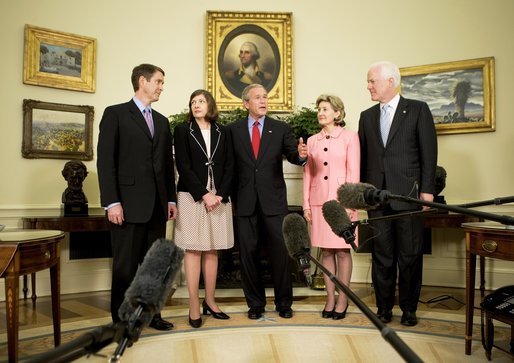
THE PRESIDENT: I'm proud to welcome Judge Priscilla Owen to the Oval Office, along with Leader Frist and my two buddies from the great state of Texas, Senator Hutchison and Senator Cornyn.
Over four years ago I put Judge Owen's name up to the Senate for confirmation to the 5th Court of Appeals. Thanks to the good work of the Leader, whose work cleared the way, Judge Owen is finally going to get an up or down vote on the Senate floor. She is my friend, and more importantly, she's a great judge.

I want to thank the Texas Senators who have been so strong, standing beside Priscilla. There was never any doubt in the Senators' minds that Priscilla Owen is well-qualified to honorably serve on the federal bench. And it's such a -- it's a great day for our friend, to see our friend finally get a just due, after a long, long wait.

So, welcome and congratulations. Perhaps you'd like to say something.

JUDGE OWEN: Mr. President, first of all, thank you for nominating me. I was very humbled by that, and I will remember what -- that you expect judges to follow the law. And I want to thank both of my Senators, Senator Hutchison and Senator Cornyn. Your support was tremendous throughout all of this. I really appreciate it, and thank you so much for all the time and effort you put in to responding tirelessly for months and months. And Senator Frist, thank you for your leadership. I appreciate that, and I appreciate the fact that I'm finally going to get a vote, thanks to your efforts.

Thank you.

THE PRESIDENT: Thank you all for coming.

END 4:54 P.M. EDT For Immediate Release Office of the Press Secretary May 24, 2005

Bush to nominate six individuals 05/25/05

President George W. Bush today announced his intention to nominate six individuals to serve in his Administration:

The President intends to nominate Jan E. Boyer, of Texas, to be United States Alternate Executive Director of the Inter-American Development Bank. Mr. Boyer currently serves as a Visiting Fellow in International Finance and Emerging Markets at the Institute for International Economics. He previously served at the Overseas Private Investment Corporation as Senior Advisor to the President. Earlier in his career, Mr. Boyer worked in private equity investment banking, during which he launched and led three private equity initiatives in emerging markets. He received his bachelor's degree from Stanford University and his master's degree from Harvard University.

The President intends to nominate Timothy E. Flanigan, of Virginia, to be Deputy Attorney General at the Department of Justice. Mr. Flanigan currently serves as Senior Vice President and General Counsel - Corporate and International for Tyco International. He previously served as Deputy Assistant to the President and Deputy Counsel at the White House. Prior to joining the Administration, Mr. Flanigan was a partner in the law firm of White & Case, LLP. Earlier in his career, he served as Assistant Attorney General in the Office of Legal Counsel at the Department of Justice. Mr. Flanigan received his bachelor's degree from Brigham Young University and his J.D. from the University of Virginia.

The President intends to nominate William Alan Jeffrey, of Virginia, to be Director of the National Institute of Standards and Technology at the Department of Commerce. He currently serves as Senior Director for Homeland and National Security and Assistant Director for Space and Aeronautics in the Office of Science and Technology Policy at the White House. Earlier in his career, he was Deputy Director of the Advanced Technology Office of the Defense Advanced Research Projects Office Agency. Mr. Jeffrey also served as Assistant Deputy Director for Technology in the Defense Airborne Reconnaissance Office. He earned his bachelor's degree from the Massachusetts Institute of Technology as well as his master's degree and Ph.D. from Harvard University.

The President intends to nominate Ashok G. Kaveeshwar, of Maryland, to be Administrator of the Research and Innovative Technology Administration at the Department of Transportation. He currently serves as President of Orange Technologies, Inc., a small business that provides information technology to government and commercial customers. He previously served as Senior Vice President of Raytheon Technical Services Company. Earlier in his career, Dr. Kaveeshwar was President and CEO of Hughes STX Corporation, a subsidiary of Hughes Electronics Corporation. He received his bachelor's degree from the University of Ujjain, India and his Ph.D. from the State University of New York at Buffalo.

The President intends to nominate Walter Lukken, of Indiana, to be a Commissioner of the Commodity Futures Trading Commission, for the remainder of a five-year term expiring April 13, 2010. He currently serves as Commissioner of the Commodity Futures Trading Commission. Mr. Lukken previously served on the U.S. Senate Agriculture Committee as a professional staff member. Prior to that, he was a Legislative Assistant to Senator Richard Lugar. Mr. Lukken received his bachelor's degree from Indiana University and his J.D. from Lewis and Clark College.

The President intends to nominate Kathie L. Olsen, of Oregon, to be Deputy Director of the National Science Foundation. She currently serves as Associate Director of Science in the Office of Science and Technology Policy at the White House. Dr. Olsen previously served as Chief Scientist at the National Aeronautics and Space Administration. Earlier in her career, she worked in the Office of Integrative Activities at the National Science Foundation overseeing NSF's science and technology centers as a Senior Staff Associate. Dr. Olsen received her bachelor's degree from Chatham College and her Ph.D. from the University of California at Irvine.

# # # For Immediate Release Office of the Press Secretary May 24, 2005 Personnel Announcement

Roll Call Vote Confirmation Priscilla Richman Owen

U.S. Senate Roll Call Votes 109th Congress - 1st Session as compiled through Senate LIS by the Senate Bill Clerk under the direction of the Secretary of the Senate

Vote Summary

Question: On the Nomination (Confirmation Priscilla Richman Owen, to be U.S. Circuit Judge)

Vote Number: 128 Vote Date: May 25, 2005, 11:58 AM

Required For Majority: 1/2 Vote Result: Nomination Confirmed

Nomination Number: PN194

Nomination Description: Priscilla Richman Owen, of Texas, to be United States Circuit Judge for the Fifth Circuit

Vote Counts: YEAs 56 NAYs 43 Not Voting 1

By Senator NameBy Vote PositionBy Home State

H.R.1815 National Defense Authorization Act for Fiscal Year 2006

National Defense Authorization Act for Fiscal Year 2006 - Authorizes appropriations for the Department of Defense (DOD) for FY 2006.

Authorizes appropriations to DOD for: (1) procurement, including for aircraft, missiles, weapons and tracked combat vehicles, ammunition, and shipbuilding and conversion; (2) research, development, test, and evaluation; (3) operation and maintenance, including for defense working capital funds, the Armed Forces Retirement Home, the Defense Health Program, and chemical agents and munitions destruction; and (4) active and reserve military personnel, including end strengths.

Extends certain bonus, special, and incentive pay authorities. Provides bonus repayment requirements with respect to unserved periods.

Sets forth provisions or requirements concerning: (1) active and reserve military personnel, including a special pay incentive for Selected Reserve personnel qualified in a critical military skill or unit, and bonuses for certain military medical officers; (2) military justice, including establishing an unlimited period for prosecution of murder or rape, extending the period for prosecution of child abuse cases, and establishing the offense of stalking; (3) acquisition policy and management, including the revitalization of DOD laboratories; (4) DOD organization and management, including exempting operational files of the Defense Intelligence Agency from public disclosure laws; (5) budget and financial matters; (6) transportation-related matters, including authority to transport family members incident to the repatriation of military personnel or civilians held captive, and a reserve civilian mariners pilot program; (7) DOD civilian personnel, including a science, mathematics, and research for transformation (SMART) defense education program, and a priority placement program for displaced civilian employees; and (8) matters relating to other nations, including Iraq, Afghanistan, and the Global War on Terrorism.

Authorizes U.S. military personnel and DOD civilian employees to provide assistance relating to the detection and clearance of landmines and explosive remnants of war.

Military Construction Authorization Act for Fiscal Year 2006 - Authorizes the Secretaries of Defense and the military departments to acquire real property and carry out specified military construction projects. Authorizes appropriations for: (1) military construction, land acquisition, and military family housing functions; (2) the North Atlantic Treaty Organization (NATO) Security Investment Program; and (3) National Guard and reserve forces facilities.
Bill Summary & Status for the 109th Congress SUMMARY AS OF: 4/26/2005--Introduced.

Tuesday, May 24, 2005

Mongolian military Al Hillah, Iraq

Doctors from the Mongolian military examine x-rays belonging to Iraqi Civilians living in an impoverished neighborhood during a joint patrol and humanitarian aid mission in Al Hillah, Iraq, on May 14, 2005. (U.S. Army photo by Sgt. Arthur Hamilton)
SOURCE: centcom.mil/

pseudoneglect phenomenon

The lopsided brain: Attention bias is shared by humans and birds

When it comes to the world laid before us, our mind's eye has a bias. For reasons that are not entirely clear, during some tasks humans have a tendency to devote more visual attention to the left side of the visual world than the right side, a phenomenon known as pseudoneglect. Researchers now report that pseudoneglect is not restricted to humans but is shared by birds, suggesting not only that brain structures thought to play a requisite role in pseudoneglect may not actually be essential for this phenomenon, but also that pseudoneglect may reflect evolutionary adaptations that allow animals to devote attention to multiple aspects of their environment.

The findings are reported in the May 24 issue of Current Biology by Bettina Diekamp (now at Johns Hopkins University) and colleagues at Ruhr University, Bochum, Germany; the University of Padova, Italy; and The University of Trieste, Italy.

It has been known for some time that human patients who have suffered injury to the brain's right hemisphere can experience a much more severe bias in their spatial attention--spatial hemineglect--in which the entire left side of the visual world seems nonexistent as the brain performs spatial tasks. In a classic example, a patient asked to draw a daisy can only manage to put petals on the right side of her drawing.

The more subtle leftward bias in attention present in healthy humans likely has to do with asymmetries in the wiring of the brain's attention in the two hemispheres; the new finding in birds offers some insight into how and why this might be.

In the new work, researchers tested two bird species, the domestic chick and the pigeon, for their performance on a task in which they were allowed to freely peck at grains of food that were spread evenly in an area before them. Though the birds' bodies were positioned at the midline of the search area, both chicks and pigeons showed a considerable leftward bias in pecking. The experiment is similar in concept to those that reveal pseudoneglect in humans--so-called cancellation tasks in which subjects are asked to "cancel-out" evenly distributed visual targets on a sheet of paper placed before them.

The finding that birds also exhibit spatial pseudoneglect is somewhat surprising, given that birds lack a corpus collosum, the structure in human brains that is thought to facilitate rapid communication between the two hemispheres. In the past, such communication via the corpus collosum has been thought to form the basis for asymmetries in human spatial attention, but the new observations suggest that this view warrants reconsideration.

It isn't clear why humans or birds should benefit from biased spatial attention, but past work has suggested that brain organization underlying attention asymmetries may offer benefits in spatial learning and in performing simultaneous spatial tasks, such as looking for food while being vigilant for predators. ###

The researchers include Bettina Diekamp and Onur Güntürkün of the Ruhr-Universität Bochum, Germany; Lucia Regolin of University of Padova, Italy; and Giorgio Vallortigara of the University of Trieste, Italy

Bettina Diekamp, Lucia Regolin, Onur Güntürkün and Giorgio Vallortigara: "A left-sided visuospatial bias in birds." Current Biology, Vol. 15, R372–R373, May 24, 2005.
current-biology.com

Contact: Heidi Hardman
hhardman@cell.com 1-617-397-2879 Cell Press

Remains of American MIAS Found in North Korea

Remains of American MIAS Found in North Korea

Specialists from the Joint POW/MIA Accounting Command (JPAC) have recovered remains believed to be those of American soldiers missing in action from the Korean War. The remains will be repatriated to U.S. control at Yongsan Military Compound in Seoul on May 26.

From Seoul, the remains will be flown to Hickam Air Force Base, Hawaii, where the forensic identification process will take place in the JPAC laboratory to determine the precise number of recovered American soldiers. This is the first repatriation of remains from this year’s recovery operations in North Korea, and marks the beginning of the 10th consecutive year for the mission there.

Since 1996, 33 joint operations have been conducted in North Korea, during which remains believed to be those of more than 220 soldiers have been recovered. Of the 88,000 U.S. servicemembers missing in action from all conflicts, more than 8,100 are from the Korean War.

The JPAC specialists’ consisted of a 27-man U.S. element divided into two recovery teams. The first team operated near the Chosin Reservoir where the 1st Marine Division and the Army’s 7th Infantry Division fought Chinese forces November-December 1950. Approximately 1,000 Americans are missing in action from battles of the Chosin campaign.

The second team recovered remains in Unsan County about 60 miles north of Pyongyang. This area was the site of battles between communist forces and the U.S. Army’s 1st Cavalry and 25th Infantry divisions in November 1950.

The joint remains recovery work resulted from negotiations with North Korea led by the Defense POW/Missing Personnel Office.

For additional information about POW/MIA recoveries, visit
dtic.mil/dpmo or call the Defense POW/Missing Personnel Office at (703) 699-1169.

U.S. Department of DefenseOffice of the Assistant Secretary of Defense (Public Affairs)News Release On the Web:
defenselink.mil/releases/ Media contact: +1 (703) 697-5131 Public contact:dod.mil/faq/comment or +1 (703) 428-0711 No. 506-05 IMMEDIATE RELEASE May 24, 2005

Medicare & Medicaid Services (CMS)

PRESCRIPTION DRUG PURCHASING SIMPLIFIED THROUGH NEW TECHNOLOGIES, CMS AWARDS CONTRACT FOR NEW SYSTEMS TO COORDINATE BENEFICIARY COVERAGE

The Centers for Medicare & Medicaid Services (CMS) has taken another step to make it easier for Medicare beneficiaries to get prescription drugs from their local pharmacies. This action will allow pharmacists to use their existing computer systems to determine which Medicare drug plan to bill and whether the beneficiary has other drug coverage, all while the beneficiary is at the counter. Medicare beneficiaries will begin to receive their prescription drugs under the new benefit starting January 1, 2006.

“This new system will help beneficiaries take advantage of their coverage even if they don’t have their benefit card; it will help make sure beneficiaries get charged the right amount; and it will combine drug payments from Medicare with payments from other sources without the need for paper – no matter which pharmacy a beneficiary chooses to use," said CMS Administrator Mark B. McClellan, M.D., Ph.D. "We’ve worked with pharmacists and other stakeholders to develop an approach that simplifies life for the beneficiary.”

The new process includes the coordination of other programs beneficiaries may enroll in, such as state pharmacy or retiree programs, to make it easy to combine the Medicare benefit with these other sources of coverage and to protect beneficiaries from being charged more than they should.

CMS awarded a contract to NDCHealth, based in Atlanta , GA , to provide the electronic services as part of a system for calculating beneficiaries’ True Out-Of-Pocket costs. NDCHealth is required to provide routing of claims for benefits paid by entities other than Medicare back to the prescription drug plans to ensure that what seniors pay at pharmacy counters takes into account the proper level of their Medicare coverage. The $416,700, one-year contract with three one-year extensions requires NDCHealth to develop an electronic system similar to systems that pharmacists already use to bill insurance plans for prescription drug claims. The contract also includes up to $3.9 million for processing transactions during a single year.

“We will continue to work with the individuals and organizations that have the expertise with these transaction systems to ensure the successful implementation of the prescription drug benefit,” said Dr. McClellan. “Part of that success means that pharmacists will be able to spend more time helping patients and less time resolving insurance matters.”

Medicare’s drug coverage will provide help with drug costs for all Medicare beneficiaries, regardless of how they pay for their drugs today. The standard drug benefit will pay 75 percent of a beneficiary’s drug costs up to $2,250 a year after a $250 deductible is met. If out-of-pocket costs rise above $3600, the Medicare drug benefit pays 95 percent of all further drug costs for the year.

Almost one-third of Medicare beneficiaries with limited means will receive comprehensive benefits with no gaps in coverage and pay little or no premiums for drug plans that submit bids to Medicare, which are no higher than the average plan. The Medicare drug benefit is also designed to work with other coverage: millions of beneficiaries will get additional assistance with drug costs from a former employer, a state, a charity, supplemental coverage that they purchase themselves, and other sources. The new Coordination of Benefits system provides a straightforward way to combine these multiple sources of coverage, making it easier for beneficiaries to get even more help with their drug costs. # # #

Medicare News For Immediate Release: Contact: Monday, May 23, 2005 CMS Office of Public Affairs202-690-6145 For questions about Medicare please call 1-800-MEDICARE or visit
medicare.gov .

Uzbekistan Refugee Situation

Uzbekistan Refugee Situation (Taken Question)

Question: Is the United States aware of press reports that Kyrgyzstan is forcing refugees from Uzbekistan to return to their country? Are these reports accurate?

Answer: We have seen these press reports, but have not received confirmation of them from either the Office of the United Nations High Commissioner for Refugees or from the U.S. embassies in Kyrgyzstan and Uzbekistan. We are following this issue closely and have indicated to both Kyrgyzstan and Uzbekistan that we expect them to follow international standards.

The United States is confident that Kyrgyzstan will continue to honor its commitments as a party to the 1951 Convention Relating to the Status of Refugees and its 1967 Protocol to ensure that refugees and asylum seekers are protected from forced return to Uzbekistan. Uzbekistan has stated that it is not putting pressure on Kyrgyzstan on this issue.

2005/546 Released on May 23, 2005 Taken Question Office of the Spokesman Washington, DC May 23, 2005
Question Taken at May 23, 2005 Daily Press Briefing

H.R.810 human embryonic stem cell research

To amend the Public Health Service Act to provide for human embryonic stem cell research SUMMARY AS OF: 2/15/2005--Introduced.

Stem Cell Research Enhancement Act of 2005 - Amends the Public Health Service Act to require the Secretary of Health and Human Services to conduct and support research that utilizes human embryonic stem cells, regardless of the date on which the stem cells were derived from a human embryo. Limits such research to stem cells that meet the following ethical requirements: (1) the stem cells were derived from human embryos donated from in vitro fertilization clinics for the purpose of fertility treatment and were in excess of the needs of the individuals seeking such treatment; (2) the embryos would never be implanted in a woman and would otherwise be discarded; and (3) such individuals donate the embryos with written informed consent and receive no financial or other inducements.

H.R.810 Bill Summary & Status for the 109th Congress

Roll Call Vote Cloture Motion Priscilla Owen

U.S. Senate Roll Call Votes 109th Congress - 1st Session, as compiled through Senate LIS by the Senate Bill Clerk under the direction of the Secretary of the Senate

Vote Summary

Question: On the Cloture Motion (Motion To Invoke Cloture on the Nomination of Priscilla Richman Owen, of Texas, to be U.S. Circuit Judge )

Vote Number: 127 Vote Date: May 24, 2005, 12:00 PM

Required For Majority: 3/5 Vote Result: Cloture Motion Agreed to

Nomination Number: PN194

Nomination Description: Priscilla Richman Owen, of Texas, to be United States Circuit Judge for the Fifth Circuit

Vote Counts: YEAs 81 NAYs 18 Not Voting 1

By Senator NameBy Vote PositionBy Home State

President Bush to Welcome South Korean President

President to Welcome South Korean President Roh to the White House

The President will welcome Republic of Korea President Roh Moo-hyun to the White House for a meeting and working lunch on June 10, 2005. The Republic of Korea has been a strong ally and partner in advancing freedom and promoting prosperity in Asia and beyond. The Republic of Korea has played a leading role in the international effort to assist the Iraqi people with security, training, and reconstruction, and now maintains the third largest contingent of forces in Iraq. The two leaders intend to discuss bilateral alliance issues and the way forward on North Korea.

# # # For Immediate Release Office of the Press Secretary May 24, 2005

President Bush to Welcome Turkish Prime Minister

President to Welcome Turkish Prime Minister to the White House

President Bush will welcome Turkish Prime Minister Recep Tayyip Erdogan to the White House on June 8, 2005. This meeting will provide an opportunity to invigorate U.S.-Turkish cooperation with respect to Turkey's European Union aspirations, and to strengthen our work together to advance freedom in Iraq and the Broader Middle East, Central Asia, and the Caucasus.

# # # For Immediate Release Office of the Press Secretary May 24, 2005

Monday, May 23, 2005

Mongolia -- Nambariin Enkhbayar Elected President

Mongolia -- Nambariin Enkhbayar Elected President

We congratulate the people of Mongolia on their successful Presidential election. We also congratulate the Speaker of the Parliament, Nambariin Enkhbayar, on his election to the presidency and look forward to working with him to further promote democracy and economic reform.

The U.S. Embassy fielded nine teams of poll watchers and the International Republican Institute fielded seven more. Those teams together observed more than 100 polling stations in Ulaanbaatar and in rural areas around Mongolia. The election represents another positive step in Mongolia's developing democracy.

SOURCE:
state.gov 2005/545 Press Statement Richard Boucher, Spokesman Washington, DC May 23, 2005 Released on May 23, 2005

FEDERAL COURT PERMANENTLY BARS TAX-SCAM PROMOTER

FEDERAL COURT PERMANENTLY BARS WASHINGTON STATE TAX-SCAM PROMOTER

Sham Trusts, False Claims Of Tax-Exempt Status Used To Hide Income And Assets

WASHINGTON, D.C.-The Justice Department announced today that a federal court has permanently barred Raymond Leo Bell of Yelm, Washington, from promoting two tax-fraud schemes. In entering the permanent injunction order, Judge Robert J. Bryan of the U.S. District Court for the Western District of Washington also barred Bell’s two businesses, American Beauty Rose and Best Way, Inc., from selling the same schemes. The court also directed the defendants to notify their customers of the injunction and to give the Justice Department their customers’ names, mailing and e-mail addresses, Social Security and telephone numbers.

The court found that the defendants’ first scheme used sham trusts and unincorporated business organizations as a means of attempting to conceal income from the IRS. In a second scheme, the defendants helped customers falsely claim tax-exempt status for their businesses and assisted customers in fabricating and inflating deductions in a fraudulent attempt to evade income and employment taxes. The court prohibited the defendants from selling any type of plan or arrangement that advocates or facilitates tax evasion or noncompliance with the tax laws.

“People who buy into tax-fraud schemes are sending good money after bad prospects: past due tax bills with interest and penalties, along with the possibility of criminal prosecution,” said Eileen J. O’Connor, Assistant Attorney General for the Tax Division. “The Justice Department and the IRS are committed to stopping the promotion of tax fraud.”

Misuse of trusts tops the IRS's list of “Dirty Dozen” tax schemes, the full list of which is available at:
irs.gov/newsroom/. More information about this case is available at: usdoj.gov/tax/ and . usdoj.gov/tax/tx. More information about the Justice Department's efforts against tax-scam promoters can be found at: usdoj.gov/tax/taxpress2005. Information about the Justice Department's Tax Division can be found at:usdoj.gov/tax. ### 05-286

FOR IMMEDIATE RELEASE MONDAY, MAY 23, 2005 WWW.USDOJ.GOV TAX (202) 514-2007 TDD (202) 514-1888

Strengthening and Sustaining Medicaid

HHS Secretary Leavitt Establishes Commission to Work on Strengthening and Sustaining Medicaid

HHS Secretary Mike Leavitt today established an advisory commission that will help identify the reforms necessary to stabilize and strengthen Medicaid so it can continue to serve our most vulnerable citizens.

“For generations, Medicaid has served the health care needs of the truly needy in America, but today the program is no longer meeting its potential,” Secretary Leavitt said. “It is rigidly inflexible and inefficient, and worst of all, it is not financially sustainable. I look forward to working with this commission in an open and bipartisan manner to reform and modernize Medicaid. The time to reform Medicaid is now, and this commission will help the Administration, Congress and the states create a plan to ensure Medicaid can meet its goal of providing quality health care in a financially sustainable way.”

The Medicaid commission must submit two reports to Secretary Leavitt. The first, due Sept. 1, will outline recommendations for Medicaid to achieve $10 billion in savings during the next five years as well as ways to begin meaningful long-term enhancements that can better serve beneficiaries. The commission, for its first report, also will consider potential performance goals for Medicaid.

The second report, due Dec. 31, 2006, will provide recommendations to help ensure the long-term sustainability of Medicaid. The proposals will address key issues such as:

How to expand coverage to more Americans while still being fiscally responsible;

Ways to provide long-term care to those who need it;

A review of eligibility, benefits design, and delivery; and

Improved quality of care, choice and beneficiary satisfaction.

The second report will also consider how to address the major issues affecting Medicaid under three different scenarios: an assumption that federal and state spending continues at current paces, an assumption that Congress chooses to lower the rate of growth in the program, and an assumption that Congress may increase spending for coverage. The report will assume that the basic federal-state match for Medicaid will continue.

The Secretary will appoint up to 15 voting members to the commission, including at least three representatives of public policy organizations involved in health care policy for families, individuals with disabilities, individuals with limited incomes, and the elderly. The commission may also have, among others, former or current governors, former or current state Medicaid directors, and other individuals with expertise in health, finance or administration. In addition to the voting members, the commission will have up to 23 non-voting members including advisors with specific health care expertise or interest in Medicaid, and as many as eight policy experts designated by various Congressional leaders.

A full copy of the commission’s charter is available at
cms.hhs.gov/faca/ ### News Release FOR IMMEDIATE RELEASE Friday, May 20, 2005 Contact: HHS Press Office (202) 690-6343

Bodman in Moscow, Bratislava Agreement

Energy Secretary Bodman in Moscow to Pursue Cooperation in Energy and Nuclear Security Matters

Moving Forward on "Bratislava Agreement," Crafted by Presidents Bush and Putin Earlier This Year

WASHINGTON, DC -- Secretary of Energy Samuel Bodman today arrived in Moscow, to advance energy and nuclear security cooperation between the United States and Russia as part of the Bratislava initiatives outlined by Presidents Bush and Putin during their summit in February of 2005.

"Russia is a critical partner of the United States in both energy security and nuclear security. I look forward to advancing the Bratislava agenda with my Russian counterparts by increasing energy trade and investment and strengthening our cooperative nuclear security efforts to benefit both our nations,” said Secretary Bodman

During his trip, Secretary Bodman will meet with Russian Prime Minister Mikhail Fradkov, and will hold discussions with Alexander Rumyantsev, Director of the Federal Atomic Energy Agency; Viktor Khristenko, Minister of Industry and Energy; Sergey Lavrov, Minister of Foreign Affairs; and German Gref, Minister of Economic Development and Trade.

Secretary Bodman's visit to Moscow is the first leg of a trip that will also take him to Baku, Azerbaijan and Kiev, Ukraine. In both countries, he will hold discussions with senior officials on a variety of energy and nuclear safety issues, including encouraging the development of diverse energy resources, promoting market transparency and investment, and advancing nuclear nonproliferation.

SOURCE:
energy.gov/ Anne Womack Kolton, 202/586-4940, Drew Malcomb, 202/586-5806, Number: R-05-117 May 23, 2005

Samuel Bodman, Victor Khristenko

US Energy Secretary Bodman Meets with Russian Federation Minister of Industry and Energy Victor Khristenko

MOSCOW, RUSSIA -- US Secretary of Energy Samuel Bodman (Right) and Russian Federation Minister of Industry and Energy Victor Khristenko meet to discuss progress in achieving the Bratislava Initiatives during Sec. Bodman's visit to Moscow, Monday, May 23, 2005.
The Bratislava agreement was struck by Presidents Bush and Putin during their February 2005 meeting and directed the US and Russian Ministers of Energy and Commerce to improve and expand US/Russia energy cooperation in trade and investment opportunities for US and Russian firms, including in support of Russia's pipeline and liquefied natural gas (LNG) development, and increased Russian oil and gas imports to US markets. (Official Dept. of Energy photo)

SOURCE:
energy.gov/ Media contacts: Anne Womack Kolton, 202/586-4940 Drew Malcomb, 202/586-5806, May 23, 2005

Margaret Spellings, North Africa Initiative in Jordan

Spellings Leads U.S. Delegation to First Meeting on Education Between World's Leading Industrialized Nations and Middle East Countries

G8 Countries and Broader Middle East North Africa Initiative hold education ministerial in Jordan

AMMAN, Jordan—U.S. Secretary of Education Margaret Spellings led the United States delegation to the first-ever meeting of education ministers from the countries of the G8 and the Broader Middle East and North Africa Initiative (BMENA), held at Dead Sea, Jordan from May 22 to 23.

Jordan, the host country, invited education officials and civil- and private-sector representatives from 30 countries to participate. The goal of the ministerial is to ensure that all citizens, including women and girls, receive an education relevant to the needs of modern economies and democratic societies. The participants of this first education ministerial meeting discussed their role in helping to establish education reform as a priority item on the full agenda of the Broader Middle East and North Africa Initiative. The meeting is a follow-up to the G8 meeting last year at Sea Island, Ga., where the United States joined its G8 partners in committing to help the countries of the BMENA region implement education reforms and expand the reach of literacy to 20 million more people over the next decade.

In addition to the participation in the ministerial, Spellings met with Jordan's Queen Rania Al-Abdullah and Minister of Education Khaled Toukan. During her trip, Spellings will visit the Iskan Al-Jamiaa Discovery School and a U.S. Agency for International Development (AID)-funded public kindergarten, and will meet with Junior Achievement graduates and early childhood education stakeholders.

"I am pleased and honored to be the first U.S. secretary of education to travel to Jordan," said Spellings in her keynote address at the ministerial today. "I believe today's meaningful dialogue is a first step toward greater cooperation and progress in achieving educational opportunity for all. Although we come from many nations, we share some things in common, namely, a passion for education and an understanding of its importance. In the words of the Arab proverb, 'What is learned in youth is carved in stone.' Education is a shared value among all our nations. And it is the key to progress and development—the development of a region, a nation and an individual life. We all want the very best future for our children and ourselves, and the very best way to do that is through literacy and education.

"Decades ago, education might have been viewed as a luxury or a privilege. Today, it is an imperative. Learning and literacy are critical to fostering cultural understanding among nations, and they are critical to economic growth and trade among nations. Together, we are addressing the critical success factors for reform on a broad scale, focusing on literacy and access, promoting equity and social inclusion, and ensuring education's quality and relevance."

According to the 2003 United Nations Arab Human Development Report on education, the Arab region faces challenges related to the "deficits in knowledge, freedom and women's empowerment" that threaten the region. According to some estimates, 65 million adults are illiterate, two-thirds of them women. Ten million children in the region do not attend school, according to the United Nations; that figure is projected to increase by 40 percent by the year 2015. Spellings noted that the United States also faces some education challenges. "In my own country, over one-third of American fourth-graders, and one-quarter of our eighth-graders are not reading at what we have defined as the basic level on our most recent National Assessment of Educational Progress (NAEP). We also face a large educational achievement gap between the 'haves' and the 'have-nots.' It's a challenge we all face in the global community."

During the meeting, four roundtables addressed issues of: critical success factors for education; literacy and access; equity and social inclusion; and quality and relevance. Ministers of education and other high-ranking officials from the countries of Jordan, Egypt, Pakistan, France and the United Kingdom also made remarks at the G8-BMENA Education Ministerial.

Other members of the U.S. delegation include Deputy Assistant Secretary of State for Educational and Cultural Affairs Thomas Farrell; Director of the Office of the Middle East Partnership Initiative/U.S. Department of State's Alina Romanowski; and U.S. Agency for International Development Assistant Administrator James Kunder.

"This must be a region-led effort, with each individual nation determining its own priorities and needs," stressed Spellings. "We are here at this ministerial to share ideas and set goals. We share more than just a respect for the transforming power of education. We also share a common purpose and values—the values of human dignity, democracy, economic opportunity and social justice. By this work we are paying tribute to the rich literary, intellectual and cultural history of this region—its extraordinary inheritance of poetry, philosophy and the sciences, venerable history and sacred scripture."

SOURCE:
ED.gov ### FOR RELEASE: May 23, 2005 Contact: Sonya Sanchez or Susan Aspey (202) 401-1576

Vietnam, Missing in Action, Robert Harry Schuler, Jr

Vietnam War Missing in Action Serviceman Identified

The Department of Defense POW/Missing Personnel Office (DPMO) announced today that the remains of a U.S. serviceman, missing in action from the Vietnam War, have been identified and returned to his family for burial with full military honors.

He is Air Force Maj. Robert Harry Schuler, Jr., of Wellsburg, N.Y. His interrment is scheduled for Saturday in Franklindale, Pa.

On Oct. 15, 1965, Shuler was flying his F-105 Thunderchief as part of a four-ship flight north of Hanoi when the lead aircraft was hit by enemy fire. Shuler remained in the area to provide support to the downed pilot while the two other aircraft departed for aerial refueling. When they returned, Shuler was no longer in the area and they could not establish radio contact with him. An extensive aerial search of the entire flight route met with negative results.

Between 1993 and 1998, joint U.S. and Vietnamese teams conducted seven investigations, including unilateral archival research by Vietnamese officials. The final investigation in Nov. 1998 led the teams to a Vietnamese army officer who recounted his unit shooting down an F-105 on the date and in the area where Schuler went down. That team surveyed the crash area, found fragments of an F-105, and recommended the area for excavation.

Teams led by the Joint POW/MIA Accounting Command (JPAC) excavated the site on four occasions between Sept. 1999 and Mar. 2001, recovering more wreckage as well as human remains. In addition to other forensic tools, JPAC scientists used mitochondrial DNA comparisons to confirm the identification of Schuler’s remains.

Of the 88,000 Americans missing in action from WWII, the Korean War, the Cold War, the Vietnam War and Desert Storm, 1,833 are from the Vietnam War, with 1,397 of those within the country of Vietnam. Another 750 Americans have been accounted for since the end of the Vietnam War, with 524 of those from the country of Vietnam.

For additional information on the Defense Department’s mission to account for missing Americans, visit the DPMO website at
dtic.mil/dpmo or call 703-699-1169.

U.S. Department of DefenseOffice of the Assistant Secretary of Defense (Public Affairs)News Release On the Web:
defenselink.mil/releases/ Media contact: +1 (703) 697-5131 Public contact: dod.mil/faq/comment or +1 (703) 428-0711, No. 499-05 IMMEDIATE RELEASE May 20, 2005

Alternate Producer Member Named To Hass Avocado Board

Alternate Producer Member Named To Hass Avocado Board

WASHINGTON, May 23, 2005 -- Agriculture Secretary Mike Johanns today appointed one alternate producer member to serve on the Hass Avocado Board.

"I am pleased that Carol Steed has agreed to serve on the Hass Avocado Board," said Johanns. "Her knowledge and experience will greatly assist the program."

Appointed as the new alternate producer member of the board is Carol A. Steed of Coto de Caza, Calif. The term begins immediately and will end Dec. 31, 2007.

Authorized under the Hass Avocado Promotion, Research, and Information Act of 2000, the board administers a national promotion, research, and consumer information program to maintain and expand markets for Hass avocados.

USDA's Agricultural Marketing Service monitors the operations of the board. More information about research and promotion programs is at
ams.usda.gov/fv/rpb.
Last Modified: 05/23/2005

Release No. 0178.05 Contact: George Chartier (202) 720-8998, Billy Cox (202) 720-8998

Members And Alternates Named To National Peanut Board

Members And Alternates Named To National Peanut Board

WASHINGTON, D.C., May 23, 2005-Agriculture Secretary Mike Johanns today announced that one member and two alternate members have been appointed to the National Peanut Board.

"I am pleased that these individuals have agreed to serve on this important board," Johanns said. "The National Peanut Board will be well served by their expertise."

Newly appointed to the board is Gilbert O. Harris of Prague, Okla., alternate member; Charles T. Edens of Sumter, S.C., member; and Edward M. Rast Jr., Cameron, S.C., alternate member. Their terms began on Jan. 1 of this year and will end on Dec. 31, 2007.

The 10-member board is composed of eligible peanut producers. The nominees were appointed from nominations submitted by certified peanut producer organizations.

USDA's Agricultural Marketing Service monitors the operations of the board. More information about research and promotion programs is at
ams.usda.gov/fv/rpb. Last Modified: 05/23/2005

Release No. 0177.05 Contact: George Chartier (202) 720-8998, Billy Cox (202) 720-8998