


Under Secretary Burns Travel to Europe June 6-9, 2005
Under Secretary of State Nicholas Burns will travel to London on June 6, 2005, for a meeting of G-8 political directors and for consultations with other European partners. Among the topics to be discussed are the June 23rd G-8 foreign ministers meeting in London, the July G-8 summit in Gleneagles, and developments in Iran, Sudan, and Iraq.
From June 7-9 Under Secretary Burns will travel to the Balkans, with stops in Sarajevo, Pristina and Belgrade. He will meet with local leaders and representatives of international organizations, including NATO, the Organization for Security and Cooperation in Europe, and the UN. He will discuss U.S. efforts to ensure long-term stability in the Balkans and integration into Euro-Atlantic institutions, including support of the work of the International Criminal Tribunal for the Former Yugoslavia, notably the importance of apprehending and transferring Radovan Karadzic and Ratko Mladic to The Hague. Under Secretary Burns will also discuss our vision of Kosovo’s future and cooperation with the Contact Group on Kosovo.
Under Secretary Burns will return to Washington, D.C., on June 9.
SOURCE: state.gov 2005/585 Released on June 3, 2005 Press Statement, Sean McCormack, Spokesman, Washington, DC, June 3, 2005
Saturday, June 04, 2005
Under Secretary Burns, Europe June 6-9, 2005
0
comments
||
||

U.S.- India Economic Dialogue
U.S.- India Economic Dialogue
Allan Hubbard, Assistant to the President for Economic Policy and Director of the National Economic Council (NEC) and Montek Singh Ahluwalia, Deputy Chairman, Planning Commission of India met in Washington June 1 to launch a reinvigorated U.S.-India Economic Dialogue. Ambassador of India Ronen Sen and Interim Under Secretary of State for Economic, Business and Agricultural Affairs, E. Anthony Wayne, who serves as the Interim U.S. Executive Secretary of the Economic Dialogue, also participated in the meeting.
NEC Director Hubbard and Deputy Chairman Ahluwalia, who chair the Dialogue, agreed that they should focus on making progress on key issues that will promote bilateral trade and investment. They agreed to continue to coordinate closely on the four tracks in the Economic Dialogue (Trade, Commerce, Finance, and Environment), and welcomed the inauguration earlier this week of the Energy Dialogue chaired by Deputy Chairman Ahluwalia and Secretary of Energy Samuel Bodman.
They also agreed to explore adding an expanded information and communications technology component to the dialogue and to seek ways to involve senior members of the U.S. and Indian business communities to provide private sector input to the government-to-government discussions.
SOURCE: state.gov 2005/586 Released on June 3, 2005 Media Note, Office of the Spokesman, Washington, DC June 3, 2005
0
comments
||
||
Freedom Calendar 06/04/05 - 06/11/05
June 4, 1860, Republican U.S. Senator Charles Sumner (R-MA) delivers his classic address, The Barbarism of Slavery.
June 5, 1956, Republican federal judge Frank Johnson rules in favor of Rosa Parks in decision striking down “blacks in the back of the bus” law.
June 6, 2001, President George W. Bush issues Executive Order enhancing federal employment opportunities for Asian-Americans and Pacific Islanders.
June 7, 1892, In a first for a major U.S. political party, two women – Theresa Jenkins and Cora Carleton – attend Republican National Convention in an official capacity, as alternate delegates.
June 8, 1866, U.S. Senate passes Republicans’ 14th Amendment guaranteeing due process and equal protection of the law to all citizens; 94% of Republicans vote yes and 100% of Democrats vote no.
June 9, 1964, Republicans condemn 14-hour filibuster against 1964 Civil Rights Act by U.S. Senator and former Ku Klux Klansman Robert Byrd (D-WV), who still serves in the Senate.
June 10, 1964, Senate Minority Leader Everett Dirksen (R-IL) criticizes Democrat filibuster against 1964 Civil Rights Act, calls on Democrats to stop opposing racial equality.
June 11, 1924, African-American Henry Lincoln Johnson leads Georgia delegation to Republican National Convention, a first for a major U.S. political party.
"Believing that the spirit of our institutions as well as the Constitution of our country, guarantees liberty of conscience and equality of rights among citizens, we oppose all legislation impairing their security.”
1856 Republican Party national platform
SOURCE: 2005 Republican Freedom Calendar
0
comments
||
||
bush radio address 06/04/05 full audio, text transcript
bush radio address 06/04/05 full audio, text transcript
President's Radio Address
THE PRESIDENT: Good morning. America's economy is on the right track. Over the past two years, we've added more than 3.5 million new jobs. More Americans are working today than ever before. Home ownership is at an all time high. Small businesses are flourishing. Factory output is growing. And families are taking home more of what they earn.
These are hopeful signs for our economy, and we must work hard to sustain that prosperity. When members of Congress return next week, they need to take action on four key priorities for the American people.
First, Congress needs to complete an energy bill. America is growing more dependent on foreign oil, and that is driving up the price of gasoline across the country. For the past four years, I've called on Congress to pass legislation that encourages energy conservation, promotes domestic production in environmentally friendly ways, funds research into new technologies to help us diversify away from foreign oil, and modernizes the electricity grid. I applaud the House for passing an energy bill. Now the American people expect the Senate to act, so I can sign a good energy bill into law by August.
Second, Americans expect Congress to be wise with their money. I proposed a disciplined federal budget that makes tax relief permanent, holds the growth in discretionary spending below the rate of inflation and reduces discretionary spending for non-security programs. The House and the Senate have worked together to pass a responsible budget resolution that keeps us on track to cut the deficit in half by 2009. Now Congress must keep its promise to exercise restraint on spending bills and to rein in mandatory spending. The principle is clear: Every taxpayer dollar must be spent wisely or not at all.
Third, Congress needs to ratify the Central American and Dominican Republic Free Trade Agreement, known as CAFTA. On Monday, I will travel to Florida to discuss CAFTA with leaders throughout the hemisphere. I look forward to telling them that CAFTA is a good deal for workers, farmers and small businesses in the United States and throughout the hemisphere. About 80 percent of products from Central America and the Dominican Republic now enter the United States duty free. Yet, American exports to those countries face hefty tariffs. CAFTA will level the playing field by making about 80 percent of American exports to Central America and the Dominican Republic duty free. CAFTA will lower barriers in key sectors like textiles, which will make American manufacturers more competitive in the global market. And CAFTA will make our neighborhood more secure by strengthening young democracies. CAFTA is a practical, pro-jobs piece of legislation. And Congress needs to pass it soon.
Finally, Congress needs to move forward with Social Security reform. This past week, I traveled to Kentucky to talk about Social Security. Next Wednesday, I will discuss Social Security with builders and contractors in Washington, D.C. At each stop, I remind seniors they will continue to receive their Social Security checks every month. I also remind everyone that Social Security is in serious trouble for our children and grandchildren. Americans of all ages have made it clear they expect their leaders in Washington to strengthen Social Security for future generations.
By taking action on all these priorities, Congress will strengthen the long-term economic security of the American people. Americans expect members of both parties to set aside partisan differences and get things done. I look forward to working with Congress to achieve results in the days ahead.
Thank you for listening.
END For Immediate Release Office of the Press Secretary June 4, 2005
0
comments
||
||
Friday, June 03, 2005
DOE JGI sequences DNA from extinct cave bear
DOE JGI sequences DNA from extinct cave bear, Method blazes trails for characterizing human predecessors
WALNUT CREEK, CA--The genomic DNA sequencing of an extinct Pleistocene cave bear species--the kind of stuff once reserved for science fiction--has been logged into scientific literature thanks to investigators from the U.S. Department of Energy (DOE) Joint Genome Institute (JGI). This study, published in the June 2 online edition of the journal Science, has set the research community's sights on traveling back in time through the vehicle DNA sequencing to reveal the story of other extinct species including our nearest relatives, the Neandertals.
Until now, researchers have been stymied in attempts to sequence genomes of extinct species. The DOE JGI scientists overcame many of the difficulties normally associated with recovery of DNA from ancient samples. DNA starts degrading at death while microbes attack the decaying carcass to utilize the nutrients present in the dead organism as an energy source. What remains and confounds the efforts to sequence and characterize these artifacts is an overabundance of microbial contaminants along with the occasional DNA fingerprints contributed unwittingly by the modern fossil hunters or lab workers.
"Among the limitations of previous ancient DNA studies was that they were restricted to mitochondrial DNA sequences," said Eddy Rubin, DOE JGI director, in whose laboratory the work was conducted. "While mitochondria are great for learning about evolutionary relationships between species, to understand the functional differences between extinct and modern species we really need genomic DNA, and nobody has been able to purify and sequence large quantities of DNA from these old samples.
"We applied the standard techniques that we normally use for modern genome projects to ancient DNA specimens, a brute force high throughput sequencing approach. With this strategy, we weren't terribly concerned that much of what we were sequencing were microbial contaminants but hoped that among the large amounts of sequence that we were generating would be some of the ancient DNA we really were interested in. We were looking for the proverbial needle in the haystack," Rubin said. "It worked--among the expected lion's share of contaminants we recovered reasonable amounts of 40,000-year-old cave bear DNA and useful information from it. We were lucky in that we had a very powerful magnet in the form of industrial strength computing to tease out the interesting data from a hodgepodge of different DNAs."
It turned out that about 6 percent of the sequence from the sample yielded cave bear sequence -- the rest represented a mosaic of microbial contaminants. Nevertheless within that fraction, there was a range of genomic sequence types, including fragments of 21 genes, identified by comparing the cave bear sample to the complete dog genome sequence that exists in the public databases. Dogs and bears, which diverged some 50 million years ago, are 92 percent similar on the sequence level.
The samples of cave bear bones and teeth from the study were collected from two cave locations in Austria. Extinct for more than 10,000 years, these particular cave bears, Ursus spelaeus, whose remains are found in abundance, were related to the ancestors of modern brown bears and polar bears. Fossil and cave-painting evidence supports that ancient humans interacted with the cave bears.
"When people hear about our success, they immediately think about how this strategy could work for dinosaurs," Rubin said. Barring some fundamental misunderstanding about the nature of DNA decay, he says it is highly unlikely viable DNA will be recovered from 150 to 200 million year old Jurassic age samples.
Currently, the theoretical limit is about 100,000 years old for samples preserved in the same conditions that the cave bear specimens where found -- relatively dry, high altitude, with moderate temperatures--or if frozen, perhaps longer.
"We picked cave bear as an initial test case ancient DNA target because the samples we used in the study are roughly the same age as Neandertals," Rubin said. "Our real interest is in hominids which include humans and the extinct Neandertal--the only other hominid species that we have to compare with humans. Our nearest living relative is the chimp and that's five million years of divergence. Although we are very similar on a sequence level, there are obvious phenotypic differences. Next, we would like to access and evaluate genomic information about other hominid species, Neandertals in particular, as they represent probably our closest prehistoric relative."
Another possibility is to apply these techniques to the remains found recently in Indonesia of the Flores Man, nicknamed "the hobbit." Although younger, at 18,000 years old, the tropical environment where the skeletons were found may have accelerated the DNA degradation process. The Flores Man is believed to have derived from a more ancient hominid lineage, Homo erectus, which diverged from modern humans some two million years ago, as compared to Neandertal, which diverged 500,000 years ago.
The notion would be to optimize the protocols that succeeded in the cave bear project to extract useful quantities of DNA from Neandertal and Flores Man, so that two hominid species could be compared to humans. Then, if you include chimps in that comparison, Rubin said, you would gain insight into the genomic changes between chimps and hominids and help describe the chain of evolutionary events that led to humans.
"This research represents the merging of two previously unrelated fields -- ancient species investigations and powerful high throughput DNA sequencing technology, DOE JGI's forte," said Dr. Aristides Patrinos, associate director of science for Biological and Environmental Research, whose office supported the published work. "This is yet another of the many advances enabled by the original investment made by DOE in the Human Genome Project."
First author on the Science paper was Lawrence Berkeley National Laboratory postdoctoral fellow James Noonan, who joined DOE JGI's Chris Detter and Doug Smith, and collaborators at the Max Planck Institute for Evolutionary Anthropology, Leipzig, Germany and the Institute of Paleontology, University of Vienna, Vienna, Austria.
The DOE Joint Genome Institute, supported primarily by the Department of Energy Office of Biological and Environmental Research in the DOE Office of Science, is among the world leaders in whole-genome sequencing projects devoted to microbes and microbial communities, model system vertebrates, aquatic organisms, and plants. Established in 1997, JGI now unites the expertise of four national laboratories, Lawrence Berkeley, Lawrence Livermore, Los Alamos, and Oak Ridge, along with the Stanford Human Genome Center to advance the frontiers of genome sequencing and related biology. Additional information about JGI can be found at jgi.doe.gov/
### Contact: David E. Gilbert mailto:gilbert21@llnl.gov925-296-5643 925-296-5643 DOE/Joint Genome Institute
0
comments
||
||
Hydroxyl Terminated Polybutadiene resin
Text of a Letter from the President to the Speaker of the House of Representatives and the President of the Senate June 2, 2005
Dear Mr. Speaker: (Dear Mr. President:)
In accordance with the provisions of section 1512 of the Strom Thurmond National Defense Authorization Act for Fiscal Year 1999 (Public Law 105 261), I hereby certify that the export to the People's Republic of China of the following items is not detrimental to the United States space launch industry, and that the material and equipment, including any indirect technical benefit that could be derived from such exports, will not measurably improve the missile or space launch capabilities of the People's Republic of China.
1. Three kilograms of Hydroxyl Terminated Polybutadiene resin, for the Shaanxi Hengtong Intelligent Machine Company, Limited, located in Xian, People's Republic of China, to be used for a research and development effort to produce a photo curable resin for stereolithography equipment;
2. One combined thermal chamber and vibration test system, for the Yongji Electric Machine Factory, located in Yongji, People's Republic of China, to be used for thermal and vibration testing of locomotive engines;
3. One computer controlled three axes filament winding machine, for the Wave Cyber (Shanghai) Company Limited, located in Shanghai, People's Republic of China, to be used for production of small residential and light commercial pressure composite tanks and low pressure fiberglass water softener tanks; and
4. One 40 gallon double planetary vacuum mixer, for the Indium Corporation (Suzhou) Company Limited, located in Suzhou, People's Republic of China, to produce specialty materials for electronics assemblies, including solder paste.
Sincerely, GEORGE W. BUSH
# # # For Immediate Release Office of the Press Secretary June 3, 2005
0
comments
||
||
President to Welcome Prime Minister Singh of India
President to Welcome Prime Minister Singh of India to the White House
President Bush will welcome Prime Minister Manmohan Singh to the White House on July 18. The visit marks the next stage in the expanding and deepening U.S.-India relationship, building on the recent high-level exchanges and initiatives between the two governments. The two leaders will touch on all aspects of U.S.-India cooperation including economic, energy, and strategic elements.
# # # For Immediate Release, Office of the Press Secretary, June 3, 2005
0
comments
||
||
National Child's Day, 2005
National Child's Day, 2005, A Proclamation by the President of the United States of America
Children are the future of our country and America's next generation of leaders. All of us -- parents, families, teachers, mentors, and community members -- have a responsibility to children to honor and pass along the values that sustain a free society. By spending time with a young person, adults can help our Nation's youth to make the right choices. On National Child's Day, we underscore our commitment to supporting children and to helping them realize a bright and hopeful future.
Family is the most important influence in a child's life. Parents are teachers, disciplinarians, advisors, and role models. By providing hope and stability, parents help children to understand the consequences of their actions and to recognize that the decisions they make today can affect the rest of their lives. Through initiatives that promote healthy marriages, responsible fatherhood, and adoption and foster care programs, my Administration is helping to ensure that more young people have a foundation of love and support.
Teachers also make a real difference in children's lives. America's educators help our students build character and acquire the skills and knowledge they need to succeed as adults. My Administration is insisting upon accountability in our public schools. We want every child to have an opportunity to realize the great promise of our country.
By mentoring children and helping them to achieve their dreams, Americans can fill their own lives with greater purpose and help make our country a better place. Our children benefit from a sense of community, and each of us has the power to make a difference in a child's life. I have introduced the Helping America's Youth initiative, led by First Lady Laura Bush, so that every child can grow up with a caring adult in his or her life -- whether that adult is a parent, a teacher, a coach, or a mentor. I encourage all Americans to volunteer their time and talents to benefit our Nation's youth.
NOW, THEREFORE, I, GEORGE W. BUSH, President of the United States of America, by virtue of the authority vested in me by the Constitution and laws of the United States, do hereby proclaim June 5, 2005, as National Child's Day, and I call upon citizens to observe this day with appropriate ceremonies and activities. I also urge all Americans to dedicate their time and talents toward helping our Nation's young people so that all children may reach as far as their vision and character can take them.
IN WITNESS WHEREOF, I have hereunto set my hand this third day of June, in the year of our Lord two thousand five, and of the Independence of the United States of America the two hundred and twenty-ninth.
GEORGE W. BUSH # # # For Immediate Release, Office of the Press Secretary, June 3, 2005
1 comments
||
||
President announced his intention to nominate five, and appoint three 06/03/05
President George W. Bush today announced his intention to nominate five individuals and appoint three individuals to serve in his Administration:
The President intends to nominate Kevin I. Fromer, of Virginia, to be an Assistant Secretary of the Treasury (Legislative Affairs). Mr. Fromer currently serves as Assistant to the Speaker for Policy, Budget and Appropriations in the Office of the Speaker of the U.S. House of Representatives. He previously served as Chief of Staff to Congressman Harold Rogers. Earlier in his career, Mr. Fromer served as associate staff to the U.S. House Committee on Appropriations. He earned his bachelor's degree from the University of Virginia.
The President intends to nominate John R. Beyrle, of Michigan, to be Ambassador Extraordinary and Plenipotentiary of the United States of America to the Republic of Bulgaria. A career member of the Senior Foreign Service, Mr. Beyrle currently serves as Deputy Chief of Mission in Moscow. Prior to this assignment, he was Senior Advisor to the Office of the New Independent States at the Department of State. Earlier in his career, Mr. Beyrle served as Counselor for Political Affairs in the U.S. Embassy in Prague. He earned his bachelor's degree from Grand Valley State College and his master's degree from the National Defense University.
The President intends to nominate Charles A. Ford, of Virginia, to be Ambassador Extraordinary and Plenipotentiary of the United States of America to the Republic of Honduras. A Career Minister in the Senior Foreign Service of the U.S. Department of Commerce, Mr. Ford currently serves as Senior Advisor to the Assistant Secretary of Commerce for the U.S. and Foreign Commercial Service. He previously served as Special Advisor to the Assistant Secretary of State for Economic and Business Affairs. Earlier in his career, he served as Deputy Assistant Secretary for International Operations for the Foreign Commercial Service and as Senior Commercial Officer at the U.S. Mission to the European Union. He earned his bachelor's degree from the College of William and Mary and his master's degree from The George Washington University.
The President intends to nominate Katherine Hubay Peterson, of California, to be Ambassador Extraordinary and Plenipotentiary of the United States of America to the Republic of Botswana. A career member of the Senior Foreign Service, Ms. Peterson currently serves as Director of the Foreign Service Institute at the Department of State. She previously served as U.S. Ambassador to the Kingdom of Lesotho. Prior to that, Ambassador Peterson was Managing Director of the Office of Overseas Citizen Services in the Bureau of Consular Affairs at the Department of State. She received her bachelor's degree from the University of California at Santa Cruz.
The President intends to nominate Marie L. Yovanovitch, of Connecticut, to be Ambassador Extraordinary and Plenipotentiary of the United States of America to the Kyrgyz Republic. A career member of the Senior Foreign Service, Ms. Yovanovitch most recently served as Senior Advisor to the Under Secretary of State for Political Affairs. Prior to that assignment, she served as Deputy Chief of Mission in Kiev. Ms. Yovanovitch has also served as Deputy Director of the Russia Desk at the Department of State and as a political officer in Moscow. She earned her bachelor's degree from Princeton University.
The President intends to appoint the following individuals to be Members of the Board of Directors of the Presidio Trust, for the remainder of a four-year term expiring May 4, 2009:
T. Robert Burke of California
Nancy Rowe Conner of California
Curtis Frederick Feeny of California
# # # For Immediate Release, Office of the Press Secretary, June 3, 2005 Personnel Announcement
0
comments
||
||
Republic of Croatia Proliferation Security Initiative
The United States and the Republic of Croatia Proliferation Security Initiative Shipboarding Agreement
On Wednesday, June 1, 2005, the United States and the Republic of Croatia signed a reciprocal Proliferation Security Initiative (PSI) Shipboarding Agreement. Croatian Ministry of Foreign Affairs Assistant Minister, Division for Multilateral Affairs & International Organizations Tomislav Vidoševiæ signed the agreement on behalf of Croatia. Assistant Secretary of State for Arms Control Stephen G. Rademaker signed on behalf of the United States.
The Proliferation Security Initiative was announced by President Bush on May 31, 2003, and is aimed at establishing cooperative partnerships worldwide to prevent the flow of weapons of mass destruction, their delivery systems, and related materials to and from states and non-state actors of proliferation concern. Proliferation Security Initiative partners marked the second anniversary of the Initiative through a series of recent activities, including an ongoing exercise in Poland and an event hosted by Secretary Rice on May 31 for the Washington diplomatic corps.
The shipboarding agreement signed by the U.S. and Croatia will facilitate cooperation between the two countries to prevent the maritime transfer of proliferation-related shipments by establishing points of contact and procedures to expedite requests to board and search suspect vessels in international waters. If a U.S.- or Croatian-flagged vessel is suspected of carrying proliferation-related cargo, either Party to this agreement can request the other to confirm the nationality of the ship in question and, if needed, to authorize the boarding, search, and possible detention of the vessel and its cargo.
Croatia is the fourth state – following Liberia, Panama, and the Marshall Islands – to sign a Proliferation Security Initiative Shipboarding Agreement with the U.S. Signing the shipboarding agreement demonstrates the commitment of Croatia and the United States to ensuring the highest standards of security for their flag registries. Furthermore, the agreement recognizes Croatia’s ability and willingness to suppress proliferation in the Adriatic Sea. This reciprocal agreement also sends a clear message to proliferators that neither the U.S. nor Croatia will tolerate the involvement of their vessels in the trade of proliferation-related cargoes. We believe that Proliferation Security Initiative shipboarding agreements simultaneously deter proliferators and attract legitimate commercial shipping interests that want to ensure their goods are transported under a reputable and responsible flag, which is not "misused" to transport illicit proliferation-related shipments.
For additional information on the Proliferation Security Initiative, please see state.gov/t/np/c10390 2005/576 Released on June 1, 2005 Joint Statement Richard Boucher, Spokesman Washington, DC June 1, 2005
0
comments
||
||
Belarusian: Mikhail Marinich, Valeriy Levonevsky, Aleksandr Vasilyev, Sergey Skrebets, and Andrey Klimov
Conviction of Belarusian Opposition Figures
On May 31, a Belarusian court convicted opposition leaders Nikolai Statkevich and Pavel Severinets of "violating public order" and sentenced them to three years of compulsory labor that they are to perform outside of prison. Both the sentence and the charge are outrageous. Statkevich and Severinets already served prison sentences in connection with the same peaceful demonstration against last year’s fraudulent parliamentary elections and referendum eliminating presidential term limits.
The United States is very disturbed by the Government of Belarus’ persistent abuse of the legal system to suppress peaceful dissents and to prevent Belarusians from exercising internationally recognized human rights. The number of prominent Belarusians who have been imprisoned for expressing dissent with the Lukashenko regime continues to increase, and includes Mikhail Marinich, Valeriy Levonevsky, Aleksandr Vasilyev, Sergey Skrebets, and Andrey Klimov. Such repression is an assault on democracy and the Belarusian people, and is in flagrant contravention of Belarus’ OSCE commitments.
We call on the Belarusian authorities to release all political prisoners and to take immediate steps to uphold their international human rights commitments. The people of Belarus deserve nothing less.
SOURCE: state.gov 2005/582 Released on June 2, 2005 Press Statement, Sean McCormack, Spokesman, Washington, DC, June 2, 2005
0
comments
||
||
Fifth Annual Trafficking in Persons Report
Release of the Fifth Annual Department of State Trafficking in Persons Report
Secretary Condoleezza Rice, Washington, DC, June 3, 2005 (12:00 p.m. EDT
 | SECRETARY RICE: Good afternoon. I'm pleased to join Under Secretary for Global Affairs, Paula Dobriansky, and the Director of the Office for Monitoring and Combating Trafficking in Persons, |
Trafficking in human beings is nothing less than a modern form of slavery. And President Bush has called upon all countries to confront this evil. As the President has said, "human life is the gift of our Creator and it should never be for sale." The United States has a particular duty to fight this scourge because trafficking in persons is an affront to the principles of human dignity and liberty, upon which this nation was founded.
We estimate that up to 800,000 people are trafficked across international borders every year. And millions more are trafficked internally. Victims of trafficking, most of them women and children, are forced, defrauded or coerced into inhumane conditions. They are made to toil on farms and in work camps, in brothels and in sweatshops. Children are even forced to become soldiers. Whatever cruel form of servitude they may take, trafficking victims live in fear and misery. And wherever the trafficking trade flourishes, the rule of law erodes, corruption thrives, public health suffers and organized crime threatens the security of entire communities.
To confront the abomination of human trafficking, a modern day abolitionist movement has emerged. Concerned citizens, students, faith-based organizations, feminists and other nongovernmental groups are doing courageous and compassionate work to end this trade in human degradation.
The United States Government is proud to stand with them at the forefront of this international anti-trafficking campaign. We provided more than $96 million in foreign aid last year to help other countries strengthen their anti-trafficking efforts. We are helping them develop legislation to combat abuse, create special law enforcement units to investigate trafficking cases and rescue victims, build emergency shelters and develop long-term rehabilitation and vocational training programs. We trust that this year's report will raise international awareness of the crime of trafficking and spur governments across the globe to take determined actions against it.
All states must work together to close down trafficking routes, prosecute and convict traffickers, and protect and reintegrate victims into society. The responsibility does not rest only with developing countries, whose citizens are vulnerable to trafficking because of poverty or corruption or lack of education. Destination or demand countries, like the United States and other prosperous nations, whose citizens create the marketplace for trafficking, also bear a heavy responsibility.
As President Bush has said, "nearly two centuries after the abolition of the transatlantic slave trade and more than a century after slavery was officially ended in its last strongholds, the trade in human beings for any purpose must not be allowed to thrive in our times. We must all work to end this terrible tragedy."
Now, my senior advisor on trafficking in persons, Ambassador John Miller, will give a brief presentation on the report and he will answer your questions.
John.
QUESTION: May we ask you a question, Madame Secretary?
SECRETARY RICE: Ambassador Miller is going to do the report and he'll answer your questions.
2005/583 Released on June 3, 2005
0
comments
||
||
Statement by the United States, European Union and Iraq
Announcement of International Conference on Iraq: Statement by the United States, European Union and Iraq
Following is the text of a joint statement by the United States, the European Union and Iraq. BEGIN TEXT:
Representatives from Iraq, the United States, the European Union, joined by their colleagues and counterparts from the Arab Republic of Egypt, Japan, the Russian Federation and the United Nations, met in Cairo today to discuss arrangements for the International Conference on Iraq, to be held in Brussels on June 21-22, 2005.
The purpose of the Brussels International Conference on Iraq, which will be co-hosted by the US and the EU at the request of the government of Iraq, will be two-fold: first, the Iraqi delegation will enunciate and articulate their vision and priorities for the transition period leading up to the next round of elections along three different, but interconnected themes outlined in UN Security Council Resolution 1546: the continuation of the political process (including the drafting of a new Iraqi constitution), meeting economic challenges and reconstruction needs, as well as strengthening public order and the rule of law). The Iraqi representatives will present their national priorities in an effort to better coordinate and rationalize international efforts in support of the work of the Iraqi Transitional Government and its institutions.
Second, delegations from over 80 nations will respond by presenting their views on the future of Iraq and enunciating their expectations about the country’s forward progress towards good governance, a reform agenda and inclusiveness in the political process.
The preparatory meeting that took place today was a productive discussion that covered the organizational, logistical and operational aspects of the Brussels International Conference.
Today’s Iraqi-led discussions with the U.S., EU and others demonstrates our mutual commitment to achieving the objectives outlined in the three themes articulated above. The Brussels Conference will be a positive step in meeting those objectives.
SOURCE: state.gov END TEXT 2005/581 Released on June 2, 2005 Media Note (Revised) Office of the Spokesman Cairo, Egypt June 2, 2005
0
comments
||
||
Thursday, June 02, 2005
OSCE Conference Cordoba, Spain
U.S. Non-Governmental Advisors at the OSCE Conference on Anti-Semitism and Other Forms of Intolerance June 8-9, 2005 in Cordoba, Spain
The following non-governmental organization representatives have been named as advisors to the United States delegation to the Organization for Security and Cooperation in Europe’s Conference on Anti-Semitism and Other Forms of Intolerance, June 8-9, in Cordoba, Spain:
• Rabbi Andrew Baker, American Jewish Committee
• Stacy Burdett, Anti-Defamation League
• Michael Cromartie, U.S. Commission on International Religious Freedom
• Betty Ehrenberg, Orthodox Union
• Daniel Mariaschin, B’nai B’rith
• Nina Shea, U.S. Commission on International Religious Freedom
• Lesley Weiss, National Conference on Soviet Jewry
The U.S. delegation is led by New York Governor George E. Pataki. Other U.S. delegates are Jennette Bradley, Ohio Treasurer of State; the Most Reverend Charles Chaput, Archbishop of Denver and Commissionerof the U.S. Commission on International Religious Freedom; Sander Gerber, Member of the National Board of Directors of the American Israel Public Affairs Committee; Rabbi Marvin Hier, Dean and Founder of the Simon Wiesenthal Center; Ambassador Stephan Minikes, U.S. Ambassador to the Organization for Security and Cooperation in Europe; Kamal Nawash, President of the Free Muslim Coalition against Terrorism; Ambassador Edward O'Donnell, U.S. Special Envoy on Holocaust Issues; and Rabbi David Zwiebel, Executive Vice President of Government Affairs at Agudath Israel of America.
The Cordoba conference will focus on practical steps to combat intolerance, building upon last year's Organization for Security and Cooperation in Europe Conference on Anti-Semitism in Berlin and the Conference on Racism, Xenophobia and Discrimination in Brussels. The Organization for Security and Cooperation in Europe consists of 55 nations, including the nations of Europe and Eurasia, and the United States and Canada.
SOURCE: state.gov 2005/580 Released on June 2, 2005 Media Note Office of the Spokesman Washington, DC June 2, 2005
0
comments
||
||
Trafficking in Persons Report
Public Release of the 2005 "Trafficking in Persons Report"
Secretary of State Condoleezza Rice will release the fifth annual Department of State Trafficking in Persons Report on Friday, June 3, at 11:45 a.m. in the State Department’s Press Briefing Room (Room 2209). Following Secretary Rice’s opening remarks, Ambassador John R. Miller, the Secretary’s Senior Advisor on Trafficking in Persons, will brief the press on the report and respond to questions.
The 150-country report is the most comprehensive worldwide report on the efforts of governments to combat severe forms of trafficking in persons, or modern-day slavery. Its findings will raise global awareness and spur countries to take effective actions to counter trafficking in persons. The assessment includes reports on countries determined to have a significant number of victims of severe forms of human trafficking.
This year, there will be an added focus on forced labor trafficking including involuntary servitude and debt bondage. This type of slavery, involving millions of people every year, happens most frequently in an individual’s own country and is often based on culture, heritage or economic well-being.
This on-the-record, on-camera briefing is open for press coverage. Members of the press who do not have a State Department building pass should arrive at the 23rd Street entrance by 11:30 a.m. for clearance through security and access to the briefing room.
Media representatives may attend this briefing upon presentation of one of the following: (1) a U.S. Government-issued identification card (Department of State, White House, Congress, Department of Defense, or Foreign Press Center), (2) a media-issued photo identification card, or (3) a letter from their employer on letterhead verifying their employment as a journalist, accompanied by an official photo identification (driver’s license or passport).
Advance Copies of the Embargoed Report
Embargoed copies of the report will be available on Friday, June 3 at 9:00 a.m. in the State Department Press Office (Room 2109). The report will be distributed in hard copy and CD-ROM format on a first-come, first-served basis – one copy per media organization. Copies will not be reserved, mailed, faxed or delivered to a building entrance. The entire report is EMBARGOED until the end of the press briefing at approximately 12:30 a.m. on June 3.
Electronic Access to the Report via Internet
The full text of the report will be available for downloading from the State Department website at state.gov at the conclusion of the press briefing.
Reporters who wish to schedule an interview with Ambassador Miller after the report is released may contact Public Affairs Specialist Caroline Tetschner at (202) 312-9648.
2005/577 Released on June 1, 2005 Notice to the Press Office of the Spokesman Washington, DC June 1, 2005
0
comments
||
||
Memorandum for the Heads of Executive Departments and Agencies
Memorandum for the Heads of Executive Departments and Agencies
SUBJECT: Strengthening Information Sharing, Access, and Integration B Organizational, Management, and Policy Development Structures for Creating the Terrorism Information Sharing Environment
The Federal Government collects information pursuant to law for many purposes, including to protect the Nation against international terrorism and other threats to the Nation's safety and well-being. The Federal Government faces great challenges in ensuring timely, effective, and lawful collection, processing, analysis, and dissemi-nation of such information. It is of particular importance to ensure that Federal agencies have appropriate access to the information they need to perform their homeland security, diplomatic, defense, foreign intelligence, and law enforcement functions, and that State, local, and tribal authorities have appropriate access to the information they need to perform their homeland security functions. Ensuring appropriate sharing and integration of and access to information, while protecting information privacy rights and other legal rights of Americans, remains a high priority for the United States and a necessity for winning the war on terror.
Section 1016 of the Intelligence Reform and Terrorism Prevention Act of 2004 (Public Law 108-458) (IRTPA) calls for the creation of an "Information Sharing Environment" to provide for Federal, State, local, and tribal access as appropriate to terrorism infor-mation and for the designation of a program manager "responsible for information sharing across the Federal Government." Section 1016 supplements section 892 of the Homeland Security Act of 2002 (Public Law 107-296), and Executive Orders 13311 of July 29, 2003, and 13356 of August 27, 2004, and other Presidential guidance, which address various aspects of information access. On April 15, 2005, I designated the program manager (PM) consistent with section 1016(f) of IRTPA, and on April 21, 2005, my memorandum entitled "Effective Dates of Provisions in Title I of the Intelligence Reform and Terrorism Prevention Act of 2004" placed section 1016 in effect.
The Commission on the Intelligence Capabilities of the United States Regarding Weapons of Mass Destruction (Commission), in its report of March 31, 2005 (Chapter 9), stated that "[t]he confused lines of authority over information sharing created by the intelligence reform act should be resolved." To that end, the Commission recom-mended that "[t]he overlapping authorities of the [Director of National Intelligence (DNI)] and the Program Manager should be reconciled and coordinated -- a result most likely to be achieved by requiring the program manager to report to the DNI."
Consistent with the Constitution and the laws of the United States, including section 103 of the National Security Act of 1947 and sections 1016 and 1018 of IRTPA, and taking appropriate account of the recommendations of the Commission, I hereby direct as follows:
1. The DNI shall promptly designate the PM, and all personnel, funds, and other resources assigned to the PM, as part of the Office of the Director of National Intelligence (ODNI) pursuant to section 103(c)(9) of the National Security Act of 1947 and shall administer the PM and related resources as part of the ODNI throughout the initial 2-year term of the PM's office.
2. During the initial 2-year term of the PM's office, the DNI:
(a) shall exercise authority, direction, and control over the PM;
(b) shall ensure that the PM carries out the functions of the PM under section 1016 of IRTPA and this memorandum --
(i) in a manner that facilitates the effective accomplishment of Federal homeland security, diplomatic, defense, foreign intelligence, and law enforcement functions and that facilitates provision to State, local, and tribal authorities of appropriate access to information they need to perform their homeland security functions; and
(ii) consistent with applicable law and Presidential guidance relating to information access, including Executive Orders 13311 and 13356; and
(c) shall ensure that the PM has employed by, or assigned or detailed to his office personnel with substantial information sharing experience relating to homeland security, national defense, law enforcement, and State and local governments to the maximum extent possible;
3. Heads of executive departments and agencies shall, to the extent permitted by law and pursuant to section 1016(i) of IRTPA, provide assistance and information to the DNI and the PM in the implementation of this memorandum.
4. This memorandum:
(a) shall be implemented in a manner consistent with applicable law, including Federal law protecting the information privacy and other legal rights of Americans, and subject to the availability of appropriations;
(b) shall be implemented in a manner consistent with the statutory authority of the principal officers of departments and agencies as heads of their respective departments or agencies;
(c) shall not be construed to impair or otherwise affect the functions of the Director of the Office of Management and Budget relating to budget, administrative, and legislative proposals; and
(d) is intended only to improve the internal management of the Federal Government and is not intended to, and does not, create any rights or benefits, substantive or procedural, enforceable at law or in equity by a party against the United States, its departments, agencies, or entities, its officers, employees, or agencies, or any other person.
GEORGE W. BUSH
# # # For Immediate Release Office of the Press Secretary June 2, 2005
0
comments
||
||
President Nominates Congressman Chris Cox as SEC Chairman
President Nominates Congressman Chris Cox as SEC Chairman, FULL STREAMING VIDEO The Roosevelt Room President's Remarks 10:24 A.M. EDT
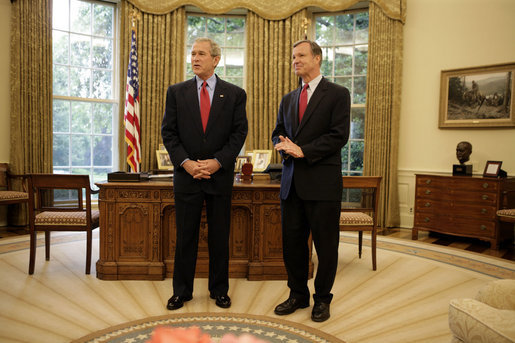 | THE PRESIDENT: Good morning. I'm pleased to announce my nomination of Congressman Chris Cox of California as our next Chairman of the Securities and Exchange Commission. As a champion of the free enterprise system in Congress, |
| Chris Cox knows that a free economy is built on trust. In the years ahead, Chris will vigorously enforce the rules and laws that guarantee honesty and transparency in our markets and corporate boardrooms. He will be an outstanding leader of the SEC. |  |
The Securities and Exchange Commission is the primary federal agency that performs this essential function. The SEC investigates corporate fraud and holds guilty parties responsible when they mislead shareholders and employees.
For more than two years, Bill Donaldson has done an exceptional job as SEC Chairman. Bill took this post at a time when our economy was faced with a crisis in investor confidence. Under his leadership, the SEC vigorously responded to corporate corruption. The commission filed more than 1,700 enforcement actions under Bill Donaldson's chairmanship -- a significant increase from previous years. And the SEC has helped implement the Sarbanes-Oxley Act -- the most far-reaching reform of American business practices since the time of Franklin Roosevelt. The agency also responded swiftly to the mutual fund abuses that came to light nearly two years ago, enhancing disclosure to mutual fund shareholders.
Bill Donaldson has set high standards for American business and the SEC, and Chris Cox is the right man to carry on this important work.
For more than a decade and a half, Chris has been a superb representative for the 48th district of California. His achievements range from national security to tax reform. As the first Chairman of the House Committee on Homeland Security, Chris Cox helped coordinate efforts between the federal agencies and Congress to better protect our country against terrorist attacks. He worked effectively with members of both parties to get more than a dozen of his bills passed into law, including a law protecting investors from abusive lawsuits and a ban on Internet commerce taxes. Four years ago, I signed into law a bill that helps American families by phasing out the death tax. The drive to end the death tax was the product of an effort that Chris Cox helped lead for nearly a decade.
Chris understands how markets work, and he knows the need for transparency in financial exchanges and in the halls of business. He proved that he can bring people together of diverse opinions to get things done. That kind of leadership will be invaluable as the chairman of the SEC.
I've given Chris a clear mission: To continue to strengthen public trust in our markets so the American economy can continue to grow and create jobs. The nation is increasingly a nation of stock holders. A generation ago, only a small percentage of American families invested in stocks and bonds. Today, more than half of households are investing -- for their families and for their futures. Now more than ever, we must make sure Americans can rely upon the integrity of our markets.
Chris Cox is a good man to have taken on this job, and he'll do a fine job on behalf of the American people. He brings with him a unique combination of skills and expertise: He graduated with honors from Harvard Law School and Harvard Business School, he worked as a security lawyer for nearly a decade, he taught tax law, he served in President Reagan's White House, and was elected to Congress.
I thank Chris for his willingness to serve our country in another important position at an important time for our nation. I am grateful to his wife, Rebecca, and their three children, Charles, Katie and Kevin. I call on the Senate to confirm his nomination at the earliest possible date. Congratulations.
CONGRESSMAN COX: Thank you, Mr. President. Thank you very much.
Mr. President, I want to thank you very much on behalf of my wife, Rebecca, and Charles, Katie and Kevin, who you were so nice to acknowledge. This is a big day because Charles, Katie and Kevin don't have to go to school this morning. (Laughter.) As we were walking into the Cabinet Room, I told my six-year-old son, Kevin, that the President of the United States used to own -- and he said, the Texas Rangers. (Laughter.)
Mr. President, should the United States Senate confirm me, I will be deeply honored to serve our country as the Chairman of the Securities and Exchange Commission. It will be a special honor, if confirmed, to follow in the footsteps of Bill Donaldson, who has served the Commission and our country with honor and distinction.
The rule of law that the SEC enforces has given America the most dynamic and vibrant capital markets in the world. The unprecedented sharing of information about every productive part of our free enterprise economy is only made possible by clear and consistently enforced rules. And those rules have to govern every market participant equally -- big and small. In this amazing world of instant global communications, the free and efficient movement of capital is helping to create the greatest prosperity in human history. The natural enemies of this economic marvel are fraud and unfair dealing. Congress and your administration, Mr. President, have both done their part to strengthen the laws that protect investors and our financial markets. And if confirmed, I look forward to carrying out that mandate in the special role occupied by the Securities and Exchange Commission.
The SEC is one of the best run agencies in the federal government, and has been so for years. During my time as a securities practitioner, I was consistently impressed by the high caliber of professionals who regulate corporate finance and our markets. It will be an honor, if confirmed, to join this exceptional team.
As you know, my most recent assignment in Congress has been to chair the Homeland Security Committee, where I've seen from another vantage point the critical role that America's financial markets play in our society. The attacks of 9/11 were aimed very deliberately at the financial heart of America's economy. The Wall Street analysts, traders, accountants and bankers who were the victims of al Qaeda in the Twin Towers that day represented America's best and brightest. Their compatriots who still go to work each day in Manhattan and in Los Angeles and across the country are the men and women whose creativity, energy and leadership are powering our free enterprise system. The SEC will work with all of them as together we help to build a better America.
It's been a pleasure to work with you, Mr. President, as a member of the congressional leadership during these last five years of your administration. If confirmed, I look forward to the opportunity to serve our nation now in this new role as Chairman of the SEC. Thank you, sir.
THE PRESIDENT: Congratulations. Thanks for taking it on.
Thank you all.
END 10:33 A.M. EDT For Immediate Release, Office of the Press Secretary, June 2, 2005
0
comments
||
||
Social Security for Rural America
Fact Sheet: Strengthening Social Security for Rural America
Today's Presidential Action:
Today, The President Visited Hopkinsville, Kentucky, Where He Discussed The Importance Of Social Security Reform For Rural America. President Bush stressed the need to reform Social Security to ensure its fundamental promise is kept and no American who works a full lifetime retires into poverty.
Background: Strengthening The Social Security Safety Net For Rural America
Low-Wage Rural Workers And Farmers Need Social Security Reform That Offers Higher Rates Of Return, Ownership, And Inheritability.
Social Security Reform Should Protect Farmers. Many farmers are self-employed small-business owners who are responsible for both the employer and employee portions of the 12.4 percent payroll tax. Increasing the payroll tax rate in a misguided effort to fix the Social Security system would hit them the hardest.
Farmers Will Benefit From The Inheritability Of Voluntary Personal Retirement Accounts. Because many farms are family owned and operated, voluntary personal retirement accounts will be of special benefit to farmers and their families. Unlike current Social Security benefits, voluntary personal retirement accounts within the Social Security system are inheritable. So if someone passes away with money left in a personal account, that money can go to that individual's spouse or children, which will help keep the farm running and keep control within the family.
The President's Proposal Will Protect Future Generations Who Depend On Social Security The Most And Will Provide Higher Benefits Than The Current System Can Afford To Pay.
Tomorrow's Seniors Will Get More Than Today's Seniors Receive. Under the President's Social Security proposal, future benefits will continue to grow. The benefits of low- and middle-income retirees will grow faster than inflation while the benefits of the highest-income retirees will grow no faster than the rate of inflation.
Doing Nothing Means Lower Benefits For Low-Income Workers. By adopting progressive indexing and allowing young workers to create voluntary personal retirement accounts within the Social Security system, the President's plan provides younger workers with real money instead of the current system's empty promises. Without Social Security reform, benefits for younger workers will have to be cut 30 percent across-the-board.
Progressive Indexing Offers Greater Benefits To Those Most In Need. A progressive indexing approach, such as Robert Pozen's, would give a low-income 20-year-old who retires in 2050 annual benefits of $12,900, or $3,500 more than the current system can pay. A middle-income 20-year-old would get $17,300 under Pozen's approach, or $1,800 more than the current system can pay. These figures exclude income from voluntary personal retirement accounts. Expected benefits for account holders would be even higher.
Voluntary Personal Retirement Accounts Offer Low-Wage Americans Higher Rates Of Return. With a voluntary personal retirement account, a 21-year old single mom earning eight dollars an hour over her lifetime could build a nest egg of more than $100,000 when she retires. This is in addition to the traditional Social Security benefit she will receive. Besides a no-risk option of investing in U.S. Treasury bonds, the accounts could be invested only in secure bond and stock-index funds, including a life-cycle fund designed to protect workers from sudden market changes on the eve of their retirement.
Progressive Indexing Would Put Social Security On The Path To Fiscal Balance. By adjusting how benefits are calculated, progressive indexing would eliminate nearly 70 percent of Social Security's shortfalls.
# # # For Immediate Release Office of the Press Secretary June 2, 2005
0
comments
||
||
Order of Succession of Officers to Act as Secretary of Defense
Memorandum for the Secretary of Defense
SUBJECT: Order of Succession of Officers to Act as Secretary of Defense
Pursuant to the Constitution and laws of the United States, including section 3345(a) of title 5, United States Code, and notwithstanding Executive Order 13000 of April 24, 1996, I direct as follows:
(1) In the event of the death, permanent disability, or resignation of the Secretary of Defense, the Secretary of the Navy shall act for and perform the duties of the Secretary of Defense as Acting Secretary of Defense.
(2) In the event of the temporary absence or temporary disability of the Secretary of Defense, the Secretary of the Navy shall act for and perform the duties of the Secretary of Defense as Acting Secretary of Defense. In these instances, the designation as Acting Secretary of Defense applies only for the duration of the Secretary's absence or disability, and does not affect the authority of the Secretary to exercise during the absence, or to resume when the disability no longer exists, the powers of his office.
(3) In all other respects, Executive Order 13000 of April 24, 1996, shall remain in effect.
(4) This memorandum shall expire upon the appointment of a Deputy Secretary of Defense, unless sooner terminated by operation of law or by the President.
(5) You are authorized and directed to publish this memorandum in the Federal Register.
GEORGE W. BUSH # # # For Immediate Release Office of the Press Secretary June 2, 2005
0
comments
||
||
Foreign Narcotics Kingpin Designation Act
Fact Sheet: Overview of the Foreign Narcotics Kingpin Designation Act, Introduction
The Administration has released the names of one entity and eight individuals against whom the President decided to impose sanctions pursuant to the Foreign Narcotics Kingpin Designation Act (21 U.S.C. 1901-1908). The Foreign Narcotics Kingpin Designation Act (the "Kingpin Act") targets, on a worldwide basis, significant foreign narcotics traffickers, their organizations, and operatives.
Background
The purpose of the Kingpin Act is to deny significant foreign narcotics traffickers, their related businesses, and their operatives access to the U.S. financial system and all trade and transactions involving U.S. companies and individuals. The Kingpin Act authorizes the President to take these actions when he determines that a foreign narcotics trafficker presents a threat to the national security, foreign policy, or economy of the United States. Congress modeled the Kingpin Act after the effective sanctions program that the Department of the Treasury's Office of Foreign Assets Control ("OFAC") administers against the Colombian drug cartels pursuant to Executive Order 12978 issued in October 1995 under authority of the International Emergency Economic Powers Act ("IEEPA").
Implementation
The Kingpin Act requires that the Departments of the Treasury, Justice, State, and Defense; and the Central Intelligence Agency, coordinate the identification of proposed kingpins (individuals and entities) for designation by the President. Although not required by statute, the Department of Homeland Security is also included in the process. By June 1 each year, the Act calls for the President to report to specified congressional committees those "foreign persons [he] determines are appropriate for sanctions" and stating his intent to impose sanctions upon those foreign persons pursuant to the Act. While this is a recurring annual requirement, the President may designate significant foreign narcotics traffickers at any time.
The long-term effectiveness of the Kingpin Act is enhanced by the Department of the Treasury's authority (in consultation with appropriate government agencies and departments) to make derivative designations of foreign individuals and entities providing specified types of support or assistance to designated traffickers. This authority broadens the scope of application of the economic sanctions against designated kingpins to include their businesses and operatives. To date, the President has designated 57 Kingpins and the Department of the Treasury has announced a total of 116 derivative designations, 34 entities and 82 individuals, pursuant to section 805(b) of the Kingpin Act. These entities and individuals are subject to the same sanctions that apply to kingpins. In addition, designated individuals and immediate family members who have knowingly benefited from the designated individuals' illicit activity will be denied visas to the United States under 8 U.S.C. section 1182(a)(2)(C).
The Kingpin Act provides for criminal penalties of up to 10 years imprisonment for individuals and up to a $10 million fine for entities for violations, as well as a maximum of 30 years imprisonment and/or a $5 million fine for officers, directors or agents of entities who knowingly participate in violations. The Kingpin Act also provides for civil penalties of up to $1 million.
Designations
The entity and foreign persons that the President has designated as appropriate for sanctions pursuant to the Kingpin Act are:
Arriola Marquez Organization (Mexico)
Oscar Arturo Arriola Marquez (Mexico)
Miguel Angel Arriola Marquez (Mexico)
Ignacio Coronel Villareal (Mexico)
Rigoberto Gaxiola Medina (Mexico)
Marco Marino Diodato del Gallo (Bolivia)
Otto Roberto Herrera Garcia (Guatemala)
Haji Baz Mohammad (Afghanistan)
Wong Moon Chi (China)
These names are being added to the designations first announced in June 2000, and every year since then. A complete list of individuals and entities designated can be found at treasury.gov/ofac
# # # For Immediate Release Office of the Press Secretary June 2, 2005
0
comments
||
||
(the "Kingpin Act")
Text of a Letter from the President
This report to the Congress, under section 804(b) of the Foreign Narcotics Kingpin Designation Act, 21 U.S.C. 1901-1908 (the "Kingpin Act"), transmits my designation of the following eight foreign persons and one foreign entity as appropriate for sanctions under the Kingpin Act, and reports my direction of sanctions against them under that Act:
Arriola Marquez Organization
Oscar Arturo Arriola Marquez
Miguel Angel Arriola Marquez
Ignacio Coronel Villareal
Rigoberto Gaxiola Medina
Marco Marino Diodato del Gallo
Otto Roberto Herrera Garcia
Haji Baz Mohammad
Wong Moon Chi
Sincerely, GEORGE W. BUSH # # # For Immediate Release Office of the Press Secretary June 2, 2005
0
comments
||
||
Black Music Month, 2005
Black Music Month, 2005, A Proclamation by the President of the United States of America
During Black Music Month, we pay tribute to a rich musical tradition and honor the many contributions African-American musicians, singers, and composers have made to the culture of our Nation and to the world. This powerful, moving, and soulful music speaks to every heart, lifting us in times of sorrow and helping us celebrate in times of joy.
Black music's origins are found in the work songs and spirituals that bore witness to the cruelty of bondage and the strength of faith. In the strains of those songs, we hear the voice of hope in the face of injustice. From those roots, black music has grown into a diverse collection of styles, and it continues to evolve today. Black music captures a part of the American spirit and continues to have a profound impact on our country.
This month is an opportunity to reflect upon the achievements of African-American artists and to look forward to the future. We remember Robert Johnson, Bessie Smith, Louis Armstrong, Nat King Cole, Ray Charles, Ella Fitzgerald, Billie Holiday, and countless others for their love of music and their pioneering and passionate spirit. We celebrate today's musicians who continue to build upon the rich and vital heritage of black music.
NOW, THEREFORE, I, GEORGE W. BUSH, President of the United States of America, by virtue of the authority vested in me by the Constitution and laws of the United States, do hereby proclaim June 2005 as Black Music Month. I encourage all Americans to learn more about the history of black music and to enjoy the great contributions of African-American musicians.
IN WITNESS WHEREOF, I have hereunto set my hand this first day of June, in the year of our Lord two thousand five, and of the Independence of the United States of America the two hundred and twenty-ninth.
GEORGE W. BUSH # # # For Immediate Release Office of the Press Secretary June 2, 2005
0
comments
||
||
Great Outdoors Month, 2005
Great Outdoors Month, 2005, A Proclamation by the President of the United States of America
During Great Outdoors Month, we celebrate our Nation's natural heritage, reaffirm our commitment to conserve our environment, and recognize the many volunteers who help maintain our natural spaces.
Americans are blessed by our country's expansive landscapes, diverse wildlife, and beautiful public lands. Outdoor recreation provides an opportunity to enjoy the splendor of our Nation's remarkable natural treasures and reminds us of our responsibility to be good stewards of the environment.
Across our great Nation, Americans are taking that responsibility seriously and volunteering to help keep our natural areas beautiful for future generations. I commend these citizens for helping to protect our public lands, and I encourage all Americans to do their part. The Department of the Interior's Take Pride in America website and the USA Freedom Corps website offer examples of ways to participate in environmental stewardship projects.
We have an obligation to protect the Earth, and my Administration is pursuing responsible initiatives to make our air cleaner, our water purer, and our land better protected. In doing so, we are demonstrating the important principle that environmental protection and economic prosperity are both vital parts of being good stewards in the land we call home. Through these and other efforts, we will continue to build a cleaner, safer, and healthier environment for all Americans.
NOW, THEREFORE, I, GEORGE W. BUSH, President of the United States of America, by virtue of the authority vested in me by the Constitution and laws of the United States, do hereby proclaim June 2005 as Great Outdoors Month. I call on all Americans to observe this month with appropriate programs and activities and to enjoy safe outdoor recreational activities.
IN WITNESS WHEREOF, I have hereunto set my hand this first day of June, in the year of our Lord two thousand five, and of the Independence of the United States of America the two hundred and twenty-ninth.
GEORGE W. BUSH # # # For Immediate Release Office of the Press Secretary June 2, 2005
0
comments
||
||
Christopher Cox, to be Commissioner of the Securities and Exchange Commission
President George W. Bush today announced his intention to nominate Christopher Cox, of California, to be Commissioner of the Securities and Exchange Commission and upon confirmation designate Chairman. He currently serves as Member of the U.S. House of Representatives. Throughout his nearly two decades in Congress, he has served as a senior Member on the Financial Services Committee, the Energy and Commerce Committee, the Government Reform Committee, the Budget Committee and the Joint Economic Committee, and as Chairman of the House Policy Committee. Congressman Cox currently serves as Chairman of the Homeland Security Committee.
Prior to his service in the U.S. House of Representatives, Congressman Cox worked at the White House as Senior Associate Counsel to the President from 1986 to 1988. He also served as a Partner in the international law firm of Latham & Watkins, in Washington, D.C. Earlier in his career, Congressman Cox served as a Clerk for the U.S. Court of Appeals.
Congressman Cox received his bachelor’s degree from the University of Southern California. He later earned his master’s degree from Harvard Business School and his J.D. from Harvard Law School.
# # # For Immediate Release Office of the Press Secretary June 2, 2005 Personnel Announcement
0
comments
||
||
President's Statement on Bill Donaldson
President's Statement on Bill Donaldson
Bill Donaldson took on a tough job at a tough time, and he delivered for the American people. He vigorously and fairly enforced our Nation's securities laws and helped rebuild the public trust in corporate America that has been important to our economic recovery. I am grateful for his dedicated service, and Laura and I wish him and Jane all the best.
# # # For Immediate Release Office of the Press Secretary June 1, 2005
0
comments
||
||
Wednesday, June 01, 2005
President to nominate three, designate one, appoint five 06/01/05
President George W. Bush today announced his intention to nominate three individuals, designate one individual and appoint five individuals to serve in his Administration:
The President intends to nominate Henry Louis Johnson, of Mississippi, to be Assistant Secretary of Education for Elementary and Secondary Education. Dr. Johnson currently serves as State Superintendent of Education for the Mississippi Department of Education. He previously served as Associate State Superintendent for the North Carolina Department of Public Instruction. Throughout his more than 30-year career as a professional educator, Dr. Johnson has served as a public school teacher, a principal and a middle school director. He also worked as Director of Policy Development and Research for the North Carolina School Boards Association. Dr. Johnson received his bachelor’s degree from Livingstone College, his master’s degree from the University of North Carolina at Chapel Hill and his Ed.D. from North Carolina State University.
The President intends to nominate Marcus A. Peacock, of Minnesota, to be Deputy Administrator of the Environmental Protection Agency. Mr. Peacock currently serves as Associate Director for Natural Resource Programs for the Office of Management and Budget at the White House. He previously served as Subcommittee Staff Director for the U.S. House of Representatives Oversight and Emergency Response Subcommittee of the Committee on Transportation and Infrastructure. Earlier in his career, Mr. Peacock worked at Jellinek, Schwartz & Connolly, managing the firm’s environmental policy analysis and forecasting division. He received his bachelor’s degree from the University of Southern California and his master’s degree from Harvard University.
The President intends to nominate Alan Walter Eastham, Jr., of Arkansas, to be Ambassador Extraordinary and Plenipotentiary of the United States of America to the Republic of Malawi. A career member of the Senior Foreign Service, Mr. Eastham currently serves as Country Director for Central African Affairs at the Department of State. He previously served as Special Negotiator for Conflict Diamonds in the Bureau of Economic and Business Affairs. Earlier in his career, Mr. Eastham served overseas as Deputy Chief of Mission in Islamabad, Pakistan and as Counselor of Embassy for Political Affairs in New Delhi, India. He received his bachelor’s degree from Hendrix College and his J.D. from Georgetown University.
The President intends to designate Richard A. Wannemacher, of New York, to be Acting Under Secretary of Veterans Affairs for Memorial Affairs.
The President intends to appoint Osborne Day, of the District of Columbia, to be a Member of the Committee for Purchase from People Who Are Blind or Severely Disabled, for the remainder of a four-year term expiring December 21, 2008.
The President intends to appoint the following individuals to be Members of the J. William Fulbright Foreign Scholarship Board, for the remainder of three-year terms expiring September 22, 2007:
John Willard Johnson of Texas
Jan Donnelly O’Neill of Texas
Steven Joel Uhlfelder of Florida
Donald Edward Vermeil of California
# # # For Immediate Release Office of the Press Secretary June 1, 2005 Personnel Announcement
0
comments
||
||
President and South African President Mbeki
President and South African President Mbeki FULL STREAMING VIDEO Discuss Bilateral Relations The Oval Office President's Remarks 12:03 P.M. EDT
PRESIDENT BUSH: Mr. President, welcome back.
 | We've just had a wide-ranging discussion on very important issues. We spent time talking about our bilateral relations. I would characterize our bilateral relations as strong. We spent time talking about the continent of Africa. |
| And, Mr. President, I want to thank you for your leadership. South Africa is a great country. The President uses his position to not only better the lives of his own people, but to work to bring stability and peace to the region and to the continent. |  |
Later on today I'll be meeting with the head of NATO, who has agreed to help the AU position troops so that humanitarian aid can reach these poor folks, as well as giving -- bringing stability and hopefully some breathing room so there can be a political agreement. But the President gave me some good advice on that situation, and I want to thank you for that.
As well, we'll discuss, later on, ways to cooperate to make the world a more peaceful place. But, Mr. President, again, I really appreciate you coming. It's great to see you.
PRESIDENT MBEKI: Thank you very much, President. I must say thank you very much, Mr. President, for asking us to come. And again I must say I agree very much with the President about the state of the relations between our two governments and the two countries. It is very strong. And, Mr. President, I appreciate it very much the commitment you have demonstrated now for some years with regard to helping us to meet our own domestic South African challenges, as well as the challenges on the African continent.
They are -- I'm afraid you have -- I'm going to create more problems for you, President -- (laughter) -- because I'm going to ask for even more support.
PRESIDENT BUSH: That's all right. (Laughter.)
PRESIDENT MBEKI: Because the contribution of the United States to helping us solve the issues that lead to peace and security on the continent, that contribution is very vital. The contribution, President, to helping us in terms of the economic recovery and development of the continent, particularly via NEPAD, is very important.
And I -- we believe very strongly, President, that the upcoming G8 summit in Gleneagles in Scotland has the possibility to communicate a very strong, positive message about movement on the African continent away from poverty and the development -- these conflicts. And clearly, your presence, Mr. President, in terms of the practical outcomes, your contribution to the practical outcomes of the G8 summit is critically important.
But thanks very much.
PRESIDENT BUSH: Thanks.
We'll answer a couple of questions, if that's all right. April.
Q Yes, Mr. President. First, for you -- what are your thoughts about the fact that Deep Throat has been outed --
PRESIDENT BUSH: Yes -- (laughter.)
Q -- and also the fact, Mr. President, is he a hero in your mind?
And, Mr. President, on the issue of Darfur, Sudan, a new survey came out by the Zogby International Poll that finds 84 percent of Americans polled feel that the U.S. should not tolerate an extremist government committing such attacks and should use its military assets, short of using military combat troops on the ground to protect civilians there.
PRESIDENT BUSH: Let me first say something. We are working with NATO to make sure that we are able to help the AU put combat troops there. And as a part of that, I believe a transport plane of ours, for example, will be a part of this mission.
I think later on today I'm going to speak to the Prime Minister of Canada, who has also been very strong about dealing with Darfur, and I will thank him for his contributions.
You know, there was an interesting revelation yesterday, Mr. President, about a news story -- a massive news story that took place when I was a pretty young guy. And to those of us who grew up in the late -- got out of college in the late '60s, the Watergate story was a relevant story, and a lot of us have always wondered who Deep Throat might have been. And the mystery was solved yesterday.
Q Is he a hero?
PRESIDENT BUSH: He was -- it's hard for me to judge. I'm learning more about the situation. All I can tell you is, is that it's -- it was a revelation that caught me by surprise, and I thought it very interesting. I'm looking forward to reading about it, reading about his relationship with the news media. It's a brand-new story for a lot of us who have been wondering a long time who it was. I knew it wasn't you. (Laughter.) You weren't even born during that period.
Q I was, I was born. I was old enough.
PRESIDENT BUSH: Barely. That's a compliment, Mr. President. (Laughter.)
PRESIDENT MBEKI: No, we -- our view has been that it's critically important that the African continent should deal with these conflict situations on the continent. And that includes Darfur. And therefore, indeed, you will notice that we have not asked for anybody outside of the African continent to deploy troops in Darfur. It's an African responsibility and we can do it.
So what we've asked for is the necessary logistical and other support to be able to ensure that we discharge our responsibilities. I should say that. Even the first troops deployed in Darfur were from Rwanda and Nigeria. The U.S. military forces sent the planes that actually did the airlift of those forces to Darfur. That's the kind of support I would ask for, and indeed, as the President has indicated, we even went to NATO, who also agreed to support.
So I don't think it's -- certainly from the African perspective, we wouldn't say we want deployment of U.S. troops in Darfur -- on the continent. We've got the people to do this -- military, police, other -- so long as we get this necessary logistical support. I think that's what's critically important.
PRESIDENT BUSH: Do you want to call on somebody from your press corps?
PRESIDENT MBEKI: Anybody?
Q President Bush, with about four weeks left to go to the G8 summit, do you still -- do you have any reservations about British Prime Minister Tony Blair's Commission for Africa report, especially with reference to the international finance facility?
PRESIDENT BUSH: We have made our position pretty clear on that, that it doesn't fit our budgetary process. On the other hand, I've also made it clear to the Prime Minister I look forward to working with Great Britain and other countries to advance the African agenda that has been on the G8's agenda for -- ever since I've been the President.
And the President and I were talking about the positive steps that have been taken. The NEPAD agreement was presented as a result of G8 meetings; commitment to trade, as well as humanitarian help have all emerged as a result of the conversations through the G8, and commitments as a result of the G8. And I hope to advance the agenda, what I call the compassion agenda.
And by the way, the thing I appreciate about the President is he understands it's a two-way street we're talking about. I mean, countries such as ours are not going to want to give aid to countries that are corrupt, or don't hold true to democratic principles, such as rule of law and transparency and human rights and human decency. That's where the President has played such a vital role, because South Africa has been a stalwart when it comes to democratic institutions.
But, no, we've got more work to do. I'm looking forward to sitting down not only at the table with the leaders from the G8 countries, but, as well, with leaders from the continent of Africa -- and other countries are coming. So it's going to be quite a meeting.
Keil.
Q Mr. President, looking back over the last year, you talked an awful lot about the importance of free and fair elections in Iraq, which most international observers now believe is what took place. Given the lesson that you say that that leaves for the region, do you think that Egypt is now on pace for the same free and fair elections? And, if not, what do they need to do to get there?
PRESIDENT BUSH: That's an interesting question. I spoke to President Mubarak today, and I -- he talked to me, by the way, about him calling his attorney general to -- calling upon his attorney general to investigate the disturbance around one of the polling sites. And I urged him once again to have as free and fair election as possible, because it will be a great legacy for his country. It will be a -- he's publicly stated he's for free and fair elections, and now is the time for him to show the world that his great country can set an example for others. He assured me that that's just exactly what he wants to do. And I will, to the best of my ability, continue to try to convince him that it's in not only Egypt's interest, but the world's interest, to see Egypt have free and fair elections.
Listen, the definition of free and fair, there's international standards, of course, but people ought to be allowed to vote without being intimidated; people ought to be allowed to be on TV, and if the government owns the TV, they need to allow the opposition on TV; people ought to be allowed to carry signs and express their displeasure or pleasure; people ought to have every vote count. And those seem like reasonable standards.
Q My colleague will ask the question.
PRESIDENT BUSH: It's a relay. (Laughter.)
Q Mr. President, does your administration still regard Zimbabwe as an "outpost of tyranny"?
And, President Mbeki, do you still regard that as an unhelpful characterization?
PRESIDENT BUSH: I brought up Zimbabwe. It's -- obviously, we are concerned about a leadership that does not adhere to democratic principles, and, obviously, concerned about a country that was able to, for example, feed herself, now has to import food, as an example of the consequence of not adhering to democrat principles.
The President, who has been very much involved in this issue, gave me a briefing on, for example, different ways that the people are trying to reconcile their difference of opinion within Zimbabwe. But it's a problem.
PRESIDENT MBEKI: Yes, you see, the critical challenge, as I'm sure you are aware, is to assist the people of Zimbabwe to overcome their political problems, their economic problems. There's problems even now of food shortages because of the drought.
And so what is really critically important is to see in what ways we can support the opposition party, the ruling party in Zimbabwe to overcome these problems. And, clearly, one of the critically important things to do is to make sure that you have the political arrangements that address matters of rule of law, matters that address issues of the freedom of the press, issues that address questions of freedom of assembly; a whole range of matters which require that the Zimbabweans have a look at the constitution and look at the legislation.
And this is a direction in which we're trying to encourage them to move, so that they create this political basis where everybody is comfortable that you've got a stable, democratic system in the country, which is critically fundamental to addressing these other major challenges of ensuring the recovery of the economy of Zimbabwe, and really improving the lives of the people. So that's the direction we're taking.
PRESIDENT BUSH: Well, thank you all for coming. I owe the President a lunch.
END 12:17 P.M. EDT For Immediate Release Office of the Press Secretary June 1, 2005
0
comments
||
||
President Welcomes NATO Secretary General
President Welcomes NATO Secretary General FULL STREAMING VIDEO to the White House, The Oval Office President's Remarks 1:57 P.M. EDT
PRESIDENT BUSH: Mr. Secretary General, welcome. Thank you for coming.
It's been my pleasure to work with this good man. The Secretary General is a visionary leader of a very important alliance, and that is NATO. America is a proud member of NATO. We view NATO as our link -- our transatlantic link to Europe. NATO is a place where not only do we work to -- work on defensive measures to protect our respective people, but it's a place where we are proud to strategize as to how to promote values of -- universal values of democracy and freedom and human rights and human dignity.
Under the Secretary General's leadership, NATO has been active in places like Afghanistan and training troops in NATO. And today we discussed the NATO mission in Darfur, to help deal with human suffering in that part of the world.
So, Mr. Secretary General, I am proud to call you friend and proud to work with you, as the President of a contributing member of NATO. Welcome.
SECRETARY GENERAL de HOOP SCHEFFER: Mr. President, thank you very much, indeed. I can echo the words you said. NATO has always been, and still is a value-driven organization; it's about values. The same values we have defended in the Cold War we are now defending in Afghanistan, at the Hindu Kush Mountains. We are training the Iraqi security forces, so that that country can stand on its own feet as soon as possible. We are staying the course in Kosovo. We'll have, as the President mentioned, support for the African Union in Darfur. We're having an anti-terrorist operation in the Mediterranean. We'll stay the course; we'll stay the course. We do that with the 26 NATO allies -- of course first and foremost with the United States of America -- and we do it with our partners, as well, with important partner countries of NATO, like the Ukraine, like our partners in the Balkans.
So we'll stay the course, and I'm sure that NATO will also, in the coming time, will be an important political military organization, enhancing political dialogue within NATO. That's what it's all about: staying the course militarily, and staying the course politically.
Mr. President, thank you very much.
PRESIDENT BUSH: Welcome. Thank you for coming. I appreciate it.
END 2:00 P.M. EDT For Immediate Release Office of the Press Secretary June 1, 2005
0
comments
||
||
President to Welcome British Prime Minister Blair
President to Welcome British Prime Minister Blair to the White House
President Bush will host British Prime Minister Tony Blair for a meeting and working dinner at the White House on June 7, 2005. The President looks forward to congratulating Prime Minister Blair personally on his recent re-election.
The United States has no closer ally than the United Kingdom as we work together globally to promote freedom, democracy, security, and economic growth and opportunity. The President and Prime Minister will discuss the full range of challenges before us, including Iraq, Afghanistan, WMD proliferation, terrorism, Africa, development, climate, and building democracy and security throughout the Broader Middle East and North Africa. The visit takes place as Prime Minister Blair prepares to host the G8 Summit in Gleneagles, Scotland, on July 6-8, 2005.
# # # For Immediate Release Office of the Press Secretary May 31, 2005
0
comments
||
||
President to Welcome NATO Secretary General Jaap de Hoop Scheffer
President to Welcome NATO Secretary General Jaap de Hoop Scheffer to the White House
President Bush will meet with NATO Secretary General Jaap de Hoop Scheffer at the White House on June 1, 2005. NATO remains a cornerstone of American security and the foundation of America's alliance with Europe. The President is pleased to have this opportunity to discuss with the leader of the Alliance how the United States and Europe can continue to strengthen their strategic partnership in addressing the major challenges we face at the beginning of the 21st century.
# # # For Immediate Release Office of the Press Secretary May 31, 2005
0
comments
||
||


