


Fact Sheet: Addressing Hunger and Humanitarian Emergencies in Africa
“Through all our efforts to fight disease and hunger, we can spare people in many nations from untold suffering, and Africa especially. Millions are facing great affliction, but with our help, they will not face it alone. America has a special calling to come to their aid, and we will do so with the compassion and generosity that have always defined the United States."
President George W. Bush, February 1, 2003
Today's Action
Today, President Bush announced approximately $674 million of additional resources to respond to humanitarian emergencies in Africa. Together President Bush and Prime Minister Blair called on the international community to increase their funding for the humanitarian emergencies in Africa. They called on the world to provide increased resources for humanitarian relief for emergencies occurring now and for those that might arise in the future. While furthering our efforts with African nations on development, we cannot overlook the urgent humanitarian needs of today.
$414 million of the additional resources will be provided immediately to avert famine in the Horn of Africa. With these resources, the United States will help meet the food needs for the estimated 14-million people at risk in Ethiopia and Eritrea, and provide additional resources to Somalia and Djibouti.
Prime Minister Blair confirmed the UK's commitment to provide $125 million to the Productive Safety Net Program in Ethiopia. The UK and the United States commend this determined effort to change the dynamic from dependence to sustainable livelihoods.
The President and the Prime Minister are taking decisive action now so food and other assistance can be delivered to those in need before famine strikes.
Other interventions are needed in a timely, complementary manner elsewhere in Africa.
The funding announced today includes:
An estimated $674 million from the United States for emergency relief in Africa.
An estimated $250 million for food aid from the Emerson Humanitarian Trust;
$240 million for food aid from the emergency supplemental; and
$184 million for emergency humanitarian assistance from the emergency supplemental.
Humanitarian Emergencies
The United Nations has appealed for $4.5 billion in resources for humanitarian emergencies in Africa to assist approximately 44-million people obtain their basic human requirements of food, water, shelter, health care, and sanitation. The United Nations estimates that $3.5 billion of that request has not been met. The United States has already provided nearly $1.4 billion this fiscal year for humanitarian needs in Africa, some through the United Nations and some directly to non-governmental organizations providing relief in emergency settings. The $674 million announced today would be in addition to the funds already provided by the United States.
The causes of these emergencies are varied, and these resources are intended to meet the basic requirements of those in need. The African nations themselves remain responsible for the well-being of their citizens and must also take the appropriate actions to address the root causes of the crises, as well as support emergency relief needs. We will continue to work with African nations in this regard.
Breaking the Cycle of Famine
The G-8, through its “Breaking the Cycle of Famine” initiative, is engaged with the New Partnership for Africa's Development (NEPAD) and others to improve agricultural productivity in Africa. We will continue to work with NEPAD to support its Comprehensive Agriculture Action Plan, including through more sustainable land and water management, market-oriented agricultural policies, improved infrastructure, access to finance, more developed regional markets, and science and technology.
For Immediate Release Office of the Press Secretary June 7, 2005
Wednesday, June 08, 2005
Addressing Hunger and Humanitarian Emergencies in Africa
0
comments
||
||

Tuesday, June 07, 2005
NHGRI Selects 13 More Organisms for Genome Sequencing
NHGRI Selects 13 More Organisms for Genome Sequencing, Gibbon, Bats, Finch and Mosquito Strains Added to Strategic Mix
Bethesda, Maryland — The National Human Genome Research Institute (NHGRI), one of the National Institutes of Health (NIH), announced today that the Large-Scale Sequencing Research Network will target 13 more organisms as part of its ongoing effort to produce genomic data that will expand biological knowledge and improve human health.
The National Advisory Council for Human Genome Research (NACHGR), which is a federally chartered committee that advises NHGRI on program priorities and goals, recently approved a comprehensive plan that adds two new sets of sequencing targets. The strategy includes a mix of whole genome sequencing, genome mapping and sequencing of genomic regions chosen for their scientific merits.
“We want to set the stage for a greater understanding of the major biological innovations that have occurred throughout evolution, with emphasis on learning more about our own genome. Genomic information from a wide array of species already is proving useful in many areas of biomedical research that may benefit both humans and animals,” said Mark S. Guyer, Ph.D., director of NHGRI’s Division of Extramural Research.
The first group of targets consists of nine mammals. Eight mammals will be sequenced at low-density draft coverage, created by sequencing their genomes two times over. This sequencing strategy, begun last year on another set of mammals, is used primarily to identify features that are similar, or conserved, among the genomes of the human and other mammals. Sequences that have been conserved throughout evolution often reveal important functional regions of the human genome. Initial data show that using low-density sequencing for such comparisons is almost as effective as more costly, high-density sequencing. The eight mammals are: 13-lined ground squirrel (Spermophilis tridecemlineatus), megabat (Cynopterus species), microbat (Microchiroptera species), tree shrew (Tupaia belangeri), bushbaby (Otolemur garnetti), hyrax (Procavia capensis), pangolin (Manis species) and sloth (Bradypus or Choloepus species).
The ninth mammal is the Northern white-cheeked gibbon (Nomascus leucogenys). This non-human primate species belongs to a major evolutionary branch that has not yet had the genome of any of its members sequenced. The gibbon genome is unique because it contains many chromosomal rearrangements, which makes it valuable for studying how such rearrangements have contributed to the evolution and speciation of humans and other non-human primates. To identify chromosomal rearrangements, researchers will need to sequence only small portions of the gibbon genome through a process known as Bacterial Artificial Chromosome (BAC)-end sequencing.
Also selected in the latest round were four non-mammalian organisms. Three of the organisms have been targeted for six-fold, or “high-quality draft,” sequencing. They are: M and S strains of a malaria-carrying mosquito (Anopheles gambiae) and a roundworm (Heterorhabditis bacteriophora). Researchers will also construct a physical map of the zebra finch (Taeniopygia guttata) genome, paving the way for later efforts to sequence selected regions of the songbird’s genome.
“Sequencing the genomes of a diverse set of organisms is a powerful tool to understand the biological processes at work in human health and illness,” said NHGRI Director Francis S. Collins, M.D., Ph.D. “Comparative genomics has proven to be one of the most effective strategies for revealing the important structural and functional elements of the human genome sequence.”
The mosquito, Anopheles gambiae, is medically significant because it can harbor the malaria parasite, Plasmodium falciparum, and is the primary transmitter of the disease in Africa. Approximately 30 of 500 Anopheles species are known vectors of human malaria. Malaria afflicts up to 300 million people and kills more than 1 million people a year. In 2002, Celera Genomics completed a draft genome sequence of a laboratory strain of Anopheles gambiae, a hybrid of two naturally occurring species, known as “M” and “S” strains, that can transmit malaria. Researchers expect that sequencing the genomes of the M and S strains, both of which are insecticide-resistant, will help to further efforts to combat malaria. The sequence data will also provide new insights into key structural and functional elements of the Anopheles genome.
The roundworm genome is important because its sequence will aid in comparative annotation of the genomes of other roundworms that have been sequenced, including that of Caenorhabditis elegans, one of the most important model systems for understanding animal development. In addition, Heterorhabditis bacteriophora is widely used as a biological control agent because it kills agricultural insect pests. Understanding its genome will increase insights into biological control, as well as into basic mechanisms of parasitism that may be applicable to parasites of humans.
The zebra finch was chosen because it is a major model system for understanding brain development, learning and memory. Because it is related to the chicken, whose genome has already been sequenced, it will be possible to leverage the chicken genome to get more insight from the zebra finch map.
It has been shown that most segments of the human genome originated long before humans themselves. Consequently, scientists will use the genome sequences of the non-mammalian animals to learn more about how, when and why the genomes of humans and other mammals came to be composed of certain DNA sequences, as well as to gain new insights into the organization of genomes.
Sequencing efforts will be carried out by the NHGRI-supported Large-Scale Sequencing Research Network, which consists of five centers: Agencourt Bioscience Corp., Beverly, Mass.; Baylor College of Medicine, Houston; the Broad Institute of MIT and Harvard, Cambridge, Mass.; The J. Craig Venter Science Institute, Rockville, Md.; and Washington University School of Medicine, St. Louis. Assignment of each organism to a specific center or centers will be determined at a later date.
NHGRI’s process for selecting sequencing targets begins with two working groups comprised of experts from across the research community. Each of the working groups is responsible for developing a proposal for a set of genomes to sequence that would advance knowledge in one of two important scientific areas: understanding the human genome and understanding the evolutionary biology of genomes. A coordinating committee then reviews the working groups’ proposals, helping to fine-tune the suggestions and integrate them into an overarching set of scientific priorities. The recommendations of the coordinating committee are then reviewed and approved by NHGRI’s advisory council, which in turn forwards its recommendations regarding sequencing strategy to NHGRI leadership.
The genomes of a number of organisms have been or are being sequenced by the large-scale sequencing capacity developed by the Human Genome Project. These include the dog, the mouse, the rat, the chicken, the honey bee, ten fruit flies, the sea urchin, two puffer fish, two sea squirts, two roundworms, over a dozen fungi, baker’s yeast and the bacterium Escherichia coli. Organisms currently in the NHGRI sequencing pipeline include: macaque, orangutan, cow, platypus, red flour beetle, several additional species of fungi and domestic cat. A complete list of organisms and their sequencing status can be viewed at genome.gov/54.
To learn more about the rapidly growing field of comparative genomic analysis, go to: genome.gov/42. For the white papers on other organisms currently in NHGRI’s sequencing pipeline, go to: genome.gov/54. For more on NHGRI’s selection process for large-scale sequencing projects, go to: genome.gov/Sequencing/OrganismSelection.
High-resolution photos of the gibbon, bushbaby, 13-lined ground squirrel and other organisms in the Large-Scale Sequencing Program are available at: genome.gov/41.
NHGRI is one of the 27 institutes and centers at NIH, an agency of the Department of Health and Human Services. The NHGRI Division of Extramural Research supports grants for research and for training and career development at sites nationwide. Additional information about NHGRI can be found at its Web site, http://www.genome.gov/.
CONTACT: Geoff Spencer301-402-0911 FOR IMMEDIATE RELEASE Tuesday, June 7, 2005
0
comments
||
||
VA, Army Sign Walter Reed Training Pact
VA, Army Sign Walter Reed Training Pact
WASHINGTON – Leaders of the Department of Veterans Affairs (VA) and Walter Reed Army Medical Center signed an agreement today giving severely injured service members practical help landing civilian jobs.
"Our newest generation of combat heroes deserves the best this nation can offer," said the Honorable R. James Nicholson, Secretary of Veterans Affairs. "But what they want is a helping hand, not a hand-out."
Under the "Vet IT" agreement signed by Nicholson and the Walter Reed commander, Army Maj. Gen. Kenneth L. Farmer Jr., VA will offer vocational training and temporary jobs at its Washington headquarters to service members recovering at the Army facility from traumatic injuries.
More than 30 Walter Reed patients have already received similar on-the-job experience at VA headquarters since a test of the program began in September 2004. So far, 15 have been hired permanently by VA.
VA is the nation's second-largest Cabinet Department, and one of the nation's largest employers of disabled veterans, with about 20,000 disabled workers among its workforce of more than 230,000.
With a current budget of more than $68 billion, VA gives health care to more than 5.2 million patients yearly and provides monthly disability compensation to nearly 2.7 million veterans, while operating 120 national cemeteries, providing educational assistance to nearly 500,000 and administering insurance programs that cover more than 7.2 million beneficiaries.
"As VA enters its 75th anniversary year, I'm proud that our new Vet IT program continues our long tradition of helping disabled veterans through vocational training and educational benefits," said Secretary Nicholson.
SOURCE: Department of Veterans Affairs # # # June 6, 2005
0
comments
||
||
NASA Announces Update To Shuttle Implementation Plan
NASA Announces Update To Shuttle Implementation Plan
The latest version of "NASA's Implementation Plan for Space Shuttle Return to Flight and Beyond" will be available at 9 a.m. EDT, Thursday, June 9, 2005, on the Web at: nasa.gov/returntoflight
The 10th Edition updates activities completed over the last few months in preparation for the Space Shuttle Return to Flight mission (STS-114). Activities included changing the launch planning window from May to July and adding a new heater on the Shuttle’s external fuel tank.
The implementation plan is periodically updated and demonstrates NASA's progress in safely returning Shuttles to flight. Pervious versions of the plan and the latest information about preparations for STS-114 are available on the above Return to Flight Web site.
For information about NASA and agency programs on the Web, visit: nasa.gov/home/
- end - Allard Beutel/Melissa Mathews, Headquarters, Washington, (Phone: 202/358-4769/1272), June 7, 2005 MEDIA ADVISORY: M05-091
0
comments
||
||
Presentation of Doors to Diplomacy Awards
Presentation of Doors to Diplomacy Awards
Department of State Acting Under Secretary for Management and Director General of the Foreign Service and Director of Human Resources W. Robert Pearson will present awards to the two winning student teams of the Doors to Diplomacy contest on Wednesday, June 8, 2005 at 11 a.m. The ceremony will be held in the Treaty Room of the Harry S Truman Building, 2201 C Street NW, Washington, DC.
The awards recognize the websites that best teach about the importance of international affairs and diplomacy. A total of 293 student teams from 39 countries, ranging in age from 15-18, participated in the contest, which was co-sponsored by the Department of State and Global SchoolNet. Each student member of the winning Doors to Diplomacy Award teams is receiving a $2,000 scholarship and trip to Washington, DC June 6-8, 2005.
The winning sites are:
All the World Is One This site, built by a team of students from Gurgaon, Haryana, India, explores international security by considering global realities and threats while celebrating the mutual cooperation and celebration that support diplomacy.
Vaccinations for Nations This site was built by a team of students from Toledo, Ohio, USA. Their site aims to educate young people about the diseases that ravage innocent children, and also provides ways students can help
This event is open for press coverage.
Pre-set time for cameras is 9:45 a.m. from the 23rd Street entrance.
Final access time for all press is 10:15 a.m. from the 23rd Street entrance.
Media representatives who plan to attend must present one of the following press credentials: (1) a U.S. Government-issued identification card (Department of State, White House, Congress, Department of Defense or Foreign Press Center), (2) a media-issued photo identification card, or (3) a letter from their employer on original letterhead verifying their employment as a journalist, accompanied by an official photo identification (drivers license or passport).
Press Contact: Carolyn Fleming, (202) 647-0001
Source: state.gov 2005/592, Released on June 7, 2005, Notice to the Press, Office of the Spokesman, Washington, DC, June 7, 2005
0
comments
||
||
Peaceful Opposition Rally in Azerbaijan
Peaceful Opposition Rally in Azerbaijan
We welcome the Government of Azerbaijan’s decision to permit the opposition bloc "Success" to hold demonstration in Baku on Saturday, June 4. The political rally went forward peacefully and without incident. We urge the Government of Azerbaijan to continue sanctioning public demonstrations, and to meet its other stated commitment to conduct parliamentary elections this fall that live up to international standards.
Source: state.gov Released on June 6, 2005 Press Statement, Sean McCormack, Spokesman, Washington, DC June 6, 2005
0
comments
||
||
DoD Acquisition, Technology and Logistics Under Secretary Announced
New Acquisition, Technology and Logistics Under Secretary Announced
The Department of Defense today announced Ken Krieg has taken over the duties as the under secretary of defense for acquisition, technology and logistics.
Krieg, who served as special assistant to the secretary and director of the office of Program Analysis & Evaluation, was nominated to be the Pentagon’s acquisition chief by President Bush on April 4, 2005 and confirmed by the Senate on May 26, 2005.
He joined the Department of Defense in July 2001 to serve as the executive secretary of the Senior Executive Council (SEC). The SEC, comprised of the secretary, deputy secretary, service secretaries and under secretary of defense for acquisition, technology and logistics, is responsible for leading initiatives to improve the management and organization of the Department of Defense.
Prior to joining the Department of Defense, he was the vice president and general manager of the Office and Consumer Papers Division for International Paper. Prior to that he was the business manager for the office and consumer paper business.
Before joining International Paper, he worked in a number of defense and foreign policy assignments in Washington, DC, including positions at the White House, on the National Security Council Staff and in Office of the Secretary of Defense.
Krieg received his bachelor’s degree in history from Davidson College and his masters in public policy from the Kennedy School of Government at Harvard University.
No. 561-05 IMMEDIATE RELEASE June 6, 2005 U.S. Department of Defense Office of the Assistant Secretary of Defense (Public Affairs)News Release On the Web: defenselink.mil/releases/ Media contact: +1 (703) 697-5131 Public contact: dod.mil/faq/comment or +1 (703) 428-0711
0
comments
||
||
DoD, Director of Program Analysis And Evaluation Announced
Director of Program Analysis And Evaluation Announced
The Department of Defense today announced that Bradley M. Berkson has assumed the position of director for program analysis and evaluation.
Berkson, who is simultaneously serving as the acting deputy under secretary of defense (logistics and materiel readiness), replaces Ken Krieg, who was sworn in as the under secretary of defense for acquisition, technology and logistics.
The former president of NEW Customer Service Companies Inc., and founder and former CEO of IP-Mill Inc., Berkson joined the Office of the Secretary of Defense in January 2003, serving as director, studies and analysis for the senior executive council.
Prior to his entrepreneurial efforts at IP-Mill Inc, Berkson was a partner at McKinsey & Company Inc., a leading international management consultancy. At McKinsey, he co-led the firm’s corporate strategy and finance, innovation and technology management, and energy practices.
Berkson holds a Bachelor of Science in engineering, cum laude from the University of Tulsa, and graduated with a Master of Business Administration with scholastic honors from Harvard University. He is a pilot and flies as a volunteer for several mercy medical airlift organizations, transporting cancer and other patients, and their relatives for treatment.
As director of program analysis and evaluation, Berkson will provide independent analytic advice to the secretary of defense regarding alternative weapon systems and force structures, the development and evaluation of defense program alternatives, and the cost effectiveness of defense systems. His office conducts analysis and offers advice in a number of related areas, and is responsible for the management of the department’s programming systems.
No. 562-05 IMMEDIATE RELEASE June 6, 2005 U.S. Department of Defense Office of the Assistant Secretary of Defense (Public Affairs)News Release On the Web: defenselink.mil/releases/ Media contact: +1 (703) 697-5131 Public contact: dod.mil/faq/comment or +1 (703) 428-0711
0
comments
||
||
President Celebrates Black Music Month at the White House
President Celebrates Black Music Month at the White House, FULL STREAMING VIDEO The East Room, President's Remarks, 5:37 P.M. EDT
 | THE PRESIDENT: Thank you all. Welcome to the White House. Laura and I are honored to have some of the country's finest entertainers with us tonight. (Applause.) We're here to celebrate Black Music Month, and we thank you all for coming. |
Teresa, thank you very much for emceeing this event. I really thank our entertainers, you were great. Thank you for filling this house -- (applause.) I want to thank the members of my Cabinet who have joined us. I appreciate Senator George Allen from Virginia, and Congressman Bobby Scott, from Virginia, for joining us, as well. (Applause.) A lot of distinguished Americans here, and I'm really glad you're here. Welcome.
Each June, we honor the great contributions that black musicians have made to America and to the world. The music of African American artists has enhanced our lives and created some of the nation's most treasured art forms, and that's why we celebrate this month. From Gospel music to blues to jazz to rock and roll, the songs of America's black musicians have defined their times and have enriched our culture.
It's hard to imagine America without the genius of Louis Armstrong and Dizzy Gillespie, the voices of Lena Horn and Diana Ross and Ella Fitzgerald, and so many others. We just can't envision our country without those voices. Their achievements remind us that our diversity makes our country strong.
The artists we celebrate this month use music to lift the human spirit. Black music in America began with the work songs and spirituals of people held in slavery. Their songs bore witness to cruelty and earthly injustice. And yet in them we hear the voice of faith lifted up to God. That music could have come only from the unique experience of African Americans, yet it speaks a language that all Americans understand.
The Psalms tell us to "make a joyful noise unto the Lord." You lived up to the Psalms. (Laughter and applause.) Smokie, Mary Mary, and Donnie understand that part of the Gospel. (Laughter.) These Gospel artists have found a modern audience for a timeless music, and they have never forgot their purpose. Pastor Donnie likes to say that "if you ever want to get anybody in touch with God, sing to them." He has a whole congregation on Long Island saying "Amen" when he sings -- kind of like he had in the White House. (Laughter.)
At its best, music speaks to every heart -- and some moving performances by black musicians have happened right here at the White House. You just witnessed one. (Applause.)
In 1882, a black choir called the Fisk Jubilee Singers moved President Arthur to tears with their performance of "Safe in the Arms of Jesus." Sissieretta Jones, the daughter of a slave, sang opera here in the White House for President Benjamin Harrison. In 1939, Marian Andersen performed Ave Maria for Franklin Roosevelt -- right here in this room. President Roosevelt said that "music can make us all more vividly aware of the common humanity which is ours." Let history record you had me jumping in my seat. (Laughter and applause.)
Throughout our history, African American artists have created music with the power to change hearts and reshape our national conscience. The songs of black musicians heralded social change. Music like jazz and blues communicated across racial barriers. That music began in America's country churches, and urban clubs of Chicago, New Orleans and Harlem. Today it is cherished here at home, and around the world.
And our black musicians continue to inspire us and bring us together. Across the country, American cities and towns will celebrate Black Music Month with their own festivals. We're just a small part of a larger celebration. From The Chicago Blues Festival to the B.B. King Homecoming Festival in Mississippi to the JVC Jazz Festival in New York City, people of all races and ages and creeds will come together on warm June nights to celebrate these musicians and their music.
Today, African American artists have continued to set standards of originality and creativity. The incredible talents of black musicians keep lifting their art, and lifting the souls of America. We heard that talent today. We're grateful to all the black musicians who have brought such beauty and pride to our country. And we're grateful to you all.
May God bless you all. (Applause.)
END 5:45 P.M. EDT For Immediate Release, Office of the Press Secretary, June 6, 2005
0
comments
||
||
Nominations and Withdrawal Sent to Senate 06/07/05
Nominations and Withdrawal Sent to the Senate
John Ross Beyrle, of Michigan, a Career Member of the Senior Foreign Service, Class of Minister-Counselor, to be Ambassador Extraordinary and Plenipotentiary of the United States of America to the Republic of Bulgaria.
Alan W. Eastham, Jr., of Arkansas, a Career Member of the Senior Foreign Service, Class of Minister-Counselor, to be Ambassador Extraordinary and Plenipotentiary of the United States of America to the Republic of Malawi.
John R. Fisher, of the District of Columbia, to be an Associate Judge of the District of Columbia Court of Appeals for the term of fifteen years, vice Annice M. Wagner, retired.
Charles A. Ford, of Georgia, a Career Member of the Senior Foreign Service, Class of Career Minister, to be Ambassador Extraordinary and Plenipotentiary of the United States of America to the Republic of Honduras.
Kevin I. Fromer, of Virginia, to be a Deputy Under Secretary of the Treasury, vice John M. Duncan.
Henry Louis Johnson, of Mississippi, to be Assistant Secretary for Elementary and Secondary Education, Department of Education, vice Raymond Simon, resigned.
Marcus C. Peacock, of Minnesota, to be Deputy Administrator of the Environmental Protection Agency, vice Stephen L. Johnson, resigned.
Katherine Hubay Peterson, of California, a Career Member of the Senior Foreign Service, Class of Minister-Counselor, to be Ambassador Extraordinary and Plenipotentiary of the United States of America to the Republic of Botswana.
John M. Reich, of Virginia, to be Director of the Office of Thrift Supervision for a term of five years, vice James Gilleran, term expired.
Marie L. Yovanovich, of Connecticut, a Career Member of the Senior Foreign Service, Class of Counselor, to be Ambassador Extraordinary and Plenipotentiary of the United States of America to the Kyrgyz Republic.
WITHDRAWAL SENT TO THE SENATE:
John M. Reich, of Virginia, to be Director of the Office of Thrift Supervision for a term expiring October 23, 2007, vice James Gilleran, term expired, which was sent to the Senate on May 25, 2005.
# # # For Immediate Release, Office of the Press Secretary, June 6, 2005
0
comments
||
||
Monday, June 06, 2005
Ronald Wilson Reagan
Ronald Wilson Reagan February 6, 1911 - June 6, 2004
Lieutenant Ronald Reagan and the U.S. Cavalry History and Hollywood Exhibit, At the Ronald Reagan Presidential Library and Museum; June 18
 | (View Nancy Reagan photo in PDF format)IMI VALLEY, Calif.) – In 1935, an up-and-coming Iowa-based radio sportscaster named Ronald Reagan decided to fulfill a life-long dream of riding horses by joining the 14th Cavalry. Stationed in Des Moines and accepting candidates for officers in the U.S. Army reserves, the Cavalry offered the 24-year old Reagan the best training in horsemanship possible. |
Opening on Saturday, June 18th, Lieutenant Ronald Reagan and the U.S. Cavalry will take an exciting look into the historical and Hollywood version of the horse and horse soldier in the American West, featuring incredible materials from private and public collections, including never-before exhibited artifacts and movie memorabilia. Saddles, uniforms, weapons, personal items, plus costumes, posters, and other film items used by John Wayne, Ronald Reagan, and legions of silver screen horse soldiers will bring alive a colorful chapter in American history.
“The United States Cavalry is an important chapter in the story of our military and how our country evolved,” said R. Duke Blackwood, executive director for the Ronald Reagan Library and Foundation. “This exhibit provides a remarkable educational tool for parents and children to recapture a part of American history.”
Lieutenant Ronald Reagan and the U.S. Cavalry will examine leadership in the military, including looking at the five U.S. presidents who served in the mounted service (Andrew Jackson, James Polk, Abraham Lincoln, Theodore Roosevelt and Ronald Reagan) and other famous U.S. military officers who were cavalrymen, including Robert E. Lee, George Custer, and George Patton, Jr. An interactive discovery area will allow children to climb on riding saddles, try on cavalry uniforms and more.
The Reagan Library is located at 40 Presidential Drive in Simi Valley, California. Public hours are from 10 a.m. to 5 p.m. daily. The Museum admission fees are $7.00 for general admission, $5.00 for seniors 62 and over, $2 for children 11-17 and free for children 10 years of age and under. For more information, call (800) 410-8354.
SOURCE: reaganfoundation.org/ # # # Media Contacts: Melissa Giller, Public Relations;(805) 522-2977 Duke Blackwood, Library Director; (800) 410-8354
0
comments
||
||
Eisenhower D-Day message to the troops
Eisenhower D-Day message to the troops FULL STREAMING AUDIO
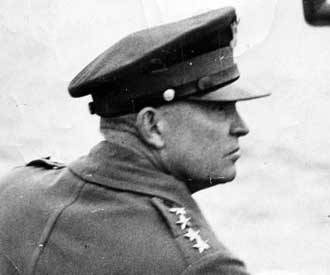 | Soldiers, Sailors and Airmen of the Allied Expeditionary Force! You are about to embark upon a great crusade, toward which we have striven these many months. The eyes of the world are upon you. The hopes and prayers of liberty loving people everywhere march with you. |
Your task will not be an easy one. Your enemy is well trained, well equipped and battle hardened, he will fight savagely.
But this is the year 1944! Much has happened since the Nazi triumphs of 1940-41. The United Nations have inflicted upon the Germans great defeats, in open battle, man to man. Our air offensive has seriously reduced their strength in the air and their capacity to wage war on the ground. Our home fronts have given us an overwhelming superiority in weapons and munitions of war, and placed at our disposal great reserves of trained fighting men. The tide has turned! The free men of the world are marching together to victory!
I have full confidence in your courage, devotion to duty and skill in battle. We will accept nothing less than full victory!
Good Luck! And let us all beseech the blessings of Almighty God upon this great and noble undertaking.
-- Gen. Dwight D. Eisenhower
0
comments
||
||
From a Few Wild Ancestors, a Citrus Cornucopia
From a Few Wild Ancestors, a Citrus Cornucopia By Erin Peabody June 6, 2005
Whether it's a halved grapefruit sprinkled with sugar, mandarin slices tumbled in a green salad, mouth-puckering lemon wedges or a classic navel orange, there are probably enough kinds of citrus to satisfy any personality or taste.
 | But scientists with the Agricultural Research Service (ARS) in Riverside, Calif., who recently assessed their extensive collection of Citrus species from around the world, have found that despite the long list of seemingly distinct and different citrus fruits, the majority of those most familiar to us are hybrids that got their start from just a handful of wild citrus species. |
They wanted to determine the true genetic diversity of the collection by identifying duplicate accessions and linking those that are genetically similar.
The researchers created 13 new molecular markers to help them track the accessions' genetic similarities. Like markers used in forensic cases to determine parental lines, the markers let the scientists draw relationships between the numerous citrus specimens and group together more closely related ones.
Along with Mikeal Roose of the UCR Department of Botany and Plant Sciences and former UCR graduate student Noelle Barkley, Krueger discovered that most of the genetic diversity of the collection's hundreds of citrus accessions was found in only about 50 accessions.
According to ARS research leader Richard Lee, this relatively small subset likely represents much of the diversity of the entire Citrus genome. Using it will help researchers more efficiently pinpoint valuable citrus genes related to pest and disease resistance and high nutrient levels.
In addition to its research function, ARS' citrus collection is a critical resource for safeguarding rare and wild citrus specimens, especially given increasing encroachment pressures facing native citrus stands in Southeast Asia.
Read more about the research in the June 2005 issue of Agricultural Research magazine.
ARS is the U.S. Department of Agriculture's chief scientific research agency.
0
comments
||
||
President Discusses Trade, CAFTA
President Discusses Trade, CAFTA at Organization of American States Greater Fort Lauderdale/Broward County Convention Center, Fort Lauderdale, Florida 11:50 A.M. EDT
 | THE PRESIDENT: Thank you all very much. Welcome to the United States. Thanks for having me. Madam Secretary, thank you for your service; thank you for your friendship; thank you for your short introduction. (Laughter.) |
| Ambassador Maisto, members of the United States Congress -- four members, by the way, of the Florida delegation have joined us today, and I'm grateful that they have come. Secretary General Insulza, thank you; congratulations. | 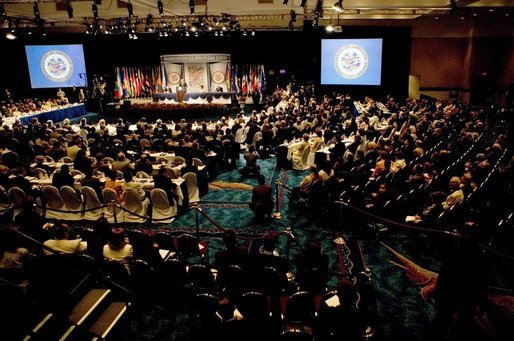 |
The ties that bind the Americas are particularly vivid here in Florida. I mean, if you spend any time in this state, you'll find people from all over our hemisphere who live here. This state has benefited because immigrants from throughout the hemisphere have made their homes here. I know firsthand -- I'm pretty familiar with the state's Governor. (Laughter.) He keeps me abreast of what's taking place in this state.
You know, our ties are represented in different ways. Perhaps you know this, but my brother was lucky enough to marry a fantastic woman from Mexico; the First Lady of Florida is Mexican-born. A United States Senator from Florida, Mel Martinez, was born in Cuba. No, the ties in our hemisphere between America and our hemisphere are particularly strong in Florida. It's a perfect place to have the meeting. Thank you for choosing Florida.
As I look out at the distinguished foreign ministers, I find we have much in common. We're the children of the New World, founded in empire and fulfilled in independence. Our people are united by history and geography. And the United States shares a commitment with you to build an Americas that lives in liberty, trades in freedom, and grows in prosperity.
We come together at a great moment in history, when freedom is on the march around our world. In the last year-and-a-half -- think about this -- we've witnessed a Rose Revolution in Georgia, an Orange Revolution in Ukraine, a Purple Revolution in Iraq, a Tulip Revolution in Kyrgyzstan, a Cedar Revolution in Lebanon -- and these are just the beginnings. Across Central Asia, hope is stirring at the prospect of change -- and change will come. Across the broader Middle East, we are seeing the rise of a new generation whose hearts burn for freedom -- and they will have it.
This love of liberty has long roots in our own hemisphere. Not long after the United States won its independence from Britain, patriots throughout the Americas were inspired to take their own stand. One of them was an Argentine general named Jose de San Martin. During the struggle for independence from Spain, the general declared, "In the last corner of the earth that I might find myself, I will be ready to sacrifice my existence for liberty."
San Martin's dream of liberty has found a home in the Organization of American States. This organization's founding documents calls the Americas to its "historic mission to offer to man a land of liberty, and a favorable environment for the realization of his just aspirations." That mission was given its clear direction in the Inter-American Democratic Charter declaring that "the peoples of the Americas have a right to democracy and their governments have an obligation to promote it and defend it." And today what was once a distant dream is now within our reach: an Americas wholly free and democratic and at peace with ourselves and our neighbors.
In the new Americas of the 21st century, democracy is now the rule, rather than the exception. Think of the dramatic changes we have seen in our lifetime. In 1974, the last time the OAS General Assembly met in the United States, fewer than half its members had democratically elected governments. Today, all 34 countries participating in this General Assembly have democratic, constitutional governments. Only one country in this hemisphere sits outside this society of democratic nations -- and one day the tide of freedom will reach Cuba's shores, as well. (Applause.) The great Cuban patriot Jose Marti said it best: La libertad no es negociable.
The dramatic gains for democracy we have witnessed in our hemisphere must not be taken for granted. Democratic change and free elections are exhilarating events. Yet we know from experience they can be followed by moments of uncertainty. When people risk everything to vote, it can raise expectations that their lives will improve immediately -- but history teaches us that the path to a free and prosperous society is long and not always smooth. Each nation must follow its own course, according to its own history. Yet the old and new democracies of the Americas share a common interest in showing every citizen of our hemisphere that freedom brings not just peace -- it brings a better life for themselves and their families.
In the new Americas of the 21st century, bringing a better life to our people requires choosing between two competing visions. One offers a vision of hope -- it is founded on representative government, integration into the world markets, and a faith in the transformative power of freedom in individual lives. The other seeks to roll back the democratic progress of the past two decades by playing to fear, pitting neighbor against neighbor, and blaming others for their own failures to provide for their people. The choices we make will determine which vision will define the Americas our children inherit -- we must make tough decisions today to ensure a better tomorrow.
To give our children a better tomorrow, our citizens must see that democracy delivers more than promises. They need to see in their daily lives that their hard work and enterprises are rewarded. They need to see that in a democratic society, people can walk in the streets in safety, corruption is punished, and all citizens are equal before the law. And when the people of the Americas see that opportunity and social mobility are real, they will know that in a free and democratic society, the only limit to how far they can go is the size of their dreams.
The United States believes it has an obligation to help build this better tomorrow for all the citizens. Working with our partners in the region, my government has helped the leaders of this hemisphere meet our goal of delivering treatment to 600,000 HIV sufferers across the region. In 2002, the United States launched the Millennium Challenge Account to help poor nations and to revolutionize the concept of development aid. My administration's approach is based on the common sense idea that development aid works best in countries that are proving their commitment to govern justly, to invest in their citizens, and to open up their economies. Under this program, aid will go to those who deliver results for their people.
Next week, Honduras will become the second country to sign a Millennium Challenge compact -- for a $215 million program that will help Honduran farmers grow better crops, as well as money to build highways that will open markets for them around the region and the world.
To advance economic development in the Americas, the U.S. government already makes about $5 billion in loans and grants to the region throughout [sic] the Ex-Im Bank, the Overseas Private Investment Corporation, and the Trade and Development Agency. In preparation for the Summit of the Americas later this year in Argentina, my administration will be looking for new ways to prime the real engines of hope in the Americas: its small businesses and private enterprises and entrepreneurs. When people throughout the Americas see their lives improve and opportunity more abundant, their faith in democracy will grow and our hemisphere will be more secure.
In the new Americas of the 21st century, one of the surest ways to make opportunity real for all our citizens is by opening our doors to trade. My government is pursuing this goal at all levels: at the global level through the Doha Round of the World Trade Organization, at the regional level through Free Trade Area of the Americas, and at the bilateral level with Free Trade Agreements with individual countries like Chile and Mexico and Canada. And the United States Congress is now considering the Central American and Dominican Republic Free Trade Agreement, which offers an historic opportunity to bring prosperity to the citizens of our hemisphere who have not known it.
For the young democracies of Central America, CAFTA would bring new investment, and that means good jobs and higher labor standards for their workers. In these nations, wealthier citizens already enjoy access to goods and services produced abroad. By reducing tariffs on U.S. goods, all consumers in these countries will enjoy better goods at lower prices. These lower prices will also give Central American small businesses and farmers and entrepreneurs less costly access to U.S. machinery and equipment which will make them more competitive and help their economies grow. By bringing economic growth to Central America, CAFTA will contribute to the rise of a vibrant middle class. And that makes us reach -- a step closer to our goal, a goal of the Americas where the opportunities in San Jose, Costa Rica are as real as they are in San Jose, California.
For U.S. farmers and businesses and workers, CAFTA would expand opportunity by creating a more level playing field for our goods and services. Under existing rules, most of Central America's exports already enter the United States duty free -- but U.S. exports still face hefty tariffs. By passing CAFTA, the United States would open up a market of 44 million consumers for our farmers and small business people. CAFTA will replace a system that is often arbitrary with one that is fair and transparent and based on common rules.
For the Western Hemisphere, CAFTA would continue to advance the stability and security that come from freedom. An Americas linked by trade is less likely to be divided by resentment and false ideologies. An Americas where all our people live in prosperity will be more peaceful. And an Americas whose countries have reduced the barriers to trade among ourselves will be a more competitive region in a global economy.
CAFTA is more than just a trade agreement. It is a signal of the U.S. commitment to democracy and prosperity for our neighbors -- and I urge the United States Congress to pass it. (Applause.)
In the last half-century, the nations of the Americas have overcome enormous challenges: colonialism and communism and military dictatorship. At the start of this new century, these divisions have fallen away, and now we have it within our means to eliminate the scourge of poverty from our hemisphere. In this room we still represent many different countries with different traditions and different mother tongues -- but today we can say with pride that we all speak the common language of liberty. And by making the blessings of freedom real in our hemisphere, we will set a shining example for all the world. Thank you for letting me come by. Que Dios los bendiga, may God bless you all. (Applause.)
END 12:03 P.M. EDT Immediate Release, Office of the Press Secretary, June 6, 2005
0
comments
||
||
Sunday, June 05, 2005
DoD Awards Grants to Minority Institutions
DoD Awards Grants to Minority Institutions
The Department of Defense announced today plans to award 37 grants totaling $8.4 million to 30 minority institutions. These grants represent the final phase of the fiscal 2005 DoD Historically Black Colleges and Universities and Minority Institutions Infrastructure Support Program. The grants will enhance programs and capabilities at these institutions in scientific disciplines critical to national security and the DoD.
This announcement is the result of merit competition for infrastructure support funding conducted for the Office of Defense Research and Engineering by the Army Research Office and the Air Force Office of Scientific Research. The fiscal 2005 program solicitation received 162 proposals in response to a broad agency announcement issued in November 2004.
The Army Research Office plans to award 17 equipment grants (ranging from $51,000 to $200,000) and 20 research grants (ranging from $146,000 to $476,000) with performance periods of 12- and 36- months respectively.
Awards will be made only after written agreements are reached between the department and the institutions.
No. 556-05 IMMEDIATE RELEASE June 3, 2005 U.S. Department of DefenseOffice of the Assistant Secretary of Defense (Public Affairs)News Release On the Web: defenselink.mil/releases/2005/ Media contact: +1 (703) 697-5131 Public contact:dod.mil/faq/comment or +1 (703) 428-0711
0
comments
||
||
Raymond Simon Confirmed as Deputy Secretary of Education
Raymond Simon Confirmed as Deputy Secretary of Education
The United States Senate has confirmed Raymond Simon as U.S. Deputy Secretary of Education. Since December 2003, Simon has served as assistant secretary for elementary and secondary education, serving as a principal adviser to the secretary on all matters related to elementary and secondary education.
In his new role, Simon will focus on K-12 policy, including the No Child Left Behind Act, high school reform and special education, and will oversee the offices that coordinate these policies and programs.
"Ray's input and insight in his role as assistant secretary for elementary and secondary education has been invaluable in the ongoing implementation of the No Child Left Behind Act," said U.S. Secretary of Education Margaret Spellings. "I know that he will draw on that experience in his new capacity that will serve us, and the country, very well."
Prior to joining the Department, Simon was director of the Arkansas Department of Education. He also served as assistant superintendent for finance and superintendent of Conway Public Schools in Arkansas and began his career as a high school mathematics teacher in North Little Rock, Arkansas. Simon earned his bachelor's and master's degrees from the University of Central Arkansas and an educational specialist degree from the University of Arkansas.
SOURCE: ed.gov/ ### FOR RELEASE: June 2, 2005 Contact: Susan Aspey, Samara Yudof (202) 401-1576
0
comments
||
||
Nation’s Busiest Seaports Radiation Portal Monitor (RPM)
Nation’s Busiest Seaports to Have Complete Radiation Detection Coverage by End of 2005
Department of Homeland Security (DHS) Secretary Michael Chertoff today announced that the nation’s busiest seaports -- Los Angeles/Long Beach, California -- will have complete Radiation Portal Monitor (RPM) coverage by year’s end.
Three terminal locations, at Piers 400, 300 and Trans Pacific, within the Port of Los Angeles are scheduled to go on-line by the end of June. A total of ninety RPMs, which will screen all international container traffic and vehicles exiting the facility for nuclear materials or hidden sources of radiation, will be operational by December 2005.
RPMs are detection devices that provide U.S. Customs & Border Protection (CBP) officers with a passive, non-intrusive means to screen containers, vessels or vehicles for the presence of nuclear and radiological materials. These systems do not emit radiation but are capable of detecting various types of radiation emanating from nuclear devices, dirty bombs, special nuclear materials, natural sources, and isotopes commonly used in medicine and industry.
“By applying advanced technology, we will soon be able to screen every vehicle and container entering the nation’s busiest seaports for nuclear and radiological materials, without disrupting the free flow of trade. Complete and efficient coverage at the LA/Long Beach Seaports is a major step forward for national security and a model for other ports,” said Secretary Chertoff.
DHS implements a multi-layered strategy for screening cargo shipped to the U.S. One such layer is the installation of RPMs at seaports, land border ports of entry and crossings nationwide, to include rail crossings, international airports, and international mail and express consignment courier facilities, in an effort to screen 100 percent of all incoming goods, people, and conveyances for radiation.
On April 26, 2005, Oakland’s Seaport became the first in the country to have complete coverage. RPMs at the LA/Long Beach Seaports will complement existing cargo security measures to include, five mobile gamma-ray and two X-Ray scanners, personal radiation detectors, and isotope identification devices.
The LA/Long Beach Seaports receive approximately 44 percent of all sea cargo destined for the United States. More than 4.3 million foreign cargo containers arrived at the LA/Long Beach Seaports last year - an average of one container every seven seconds.
SOURCE: dhs.gov/dhspublic/ ### For Immediate Release Office of the Press Secretary Contact: 202-282-8010 June 3, 2005
0
comments
||
||
Oglala Chief Red Cloud
 | WASHINGTON -- On Wednesday, June 15, 2005, at 12:00 p.m., the U.S. Department of the Interior Museum will host a slide presentation by author Frank H. Goodyear, spotlighting the photographic portraits of Oglala Chief Makhpiya-luta, also known as Red Cloud (1821-1909). |
Dr. Goodyear, assistant curator of photographs at the Smithsonian's National Portrait Gallery, asserts the photographic portraits of Chief Red Cloud reveal much about the sitter, the photographers, and their patrons. Red Cloud was photographed more than any other American Indian during the 19th century.
In Goodyear's book, Red Cloud: Photographs of a Lakota Chief, published in 2003 by the University of Nebraska Press, he makes the case that Red Cloud tried to overcome his Indian nation's marginalized status through the portraits. Goodyear uses this as an illustration of how native and non-native aims for the portraits were at odds in some instances, and were in accord at other times. What is clearly demonstrated is that the Chief Red Cloud's photographic portraits, taken during a 37-year period, provide unique insights into this complex American Indian leader.
Frank Goodyear studied at Princeton University as an undergraduate, and then earned his Ph.D. in American Studies from the University of Austin in 1998. In addition to serving on staff at the National Portrait Gallery, he is an affiliated faculty member at George Washington University's Department of American Studies.
The Interior Museum exhibit, "The Power of Context" gathers treasures from the National Park Service's vast collections to underscore the importance of the national park museums that preserve and interpret those artifacts for the public, including the world's first tin foil phonograph created by inventor Thomas Edison, a guitar that poet and author Carl Sandburg once owned along with a first edition copy of his American Songbag.
The exhibit will remain on display through the end of the year. The Interior Museum educates the public and Interior employees about the current missions and programs of the Interior Department, the history of the agency and the art and architecture of its headquarters building.
The museum is at 1849 C Street, N.W., just a block off the National Mall and a few minutes walk from The White House. It is open weekdays except holidays from 8:30 a.m. to 4:30 p.m. and from 1:00 p.m. to 4:00 p.m. the third Saturday of each month. Admission is free; adult visitors must present a form of photo identification (such as a driver's license, student ID, or employment card) when entering the building. Wheelchair access is available at the 18th and E Streets entrance. More information is available by calling (202) 208-4743 or by visiting the museum's Web site at doi.gov/interiormuseum. SOURCE: -DOI-
Office of the Secretary Contact: Anne James, June 1, 2005 202-208-4659, Interior Museum Lecture Spotlights, Oglala Chief Red Cloud
0
comments
||
||
Falsely Labeled 'Indian-Made' Products
Consumers and Artists Can File Complaints Online about Falsely Labeled "Indian-Made" Products
Consumers can now file complaints about products falsely labeled as Indian-made on the U.S. Department of the Interior's Web Site. Complaints can be filed on the updated web page (doi.gov/iacb) of the Indian Arts and Crafts Board.
"To purchase authentic Indian arts and crafts, investigate the background of products," Secretary of the Interior Gale Norton said recently. "A seller with authentic goods will gladly provide information and a written guarantee that the work is Indian- or Native American-made."
The IACB, an agency located in the Interior Department, is in charge of enforcement of the Indian Arts and Crafts Act of 1990. The 1990 Act is a truth-in-advertising law that provides criminal and civil penalties for marketing products as "Indian-made" when such products are not made by Indians.
Under the Act, an Indian is defined as a member of any federally or state- recognized Indian Tribe, or an individual certified as an Indian artisan by an Indian Tribe. It is illegal to offer or display for sale, or sell any art or craft product in a manner that falsely suggests it is Indian produced, an Indian product, or the product of a particular Indian or Indian Tribe or Indian arts and crafts organization, resident within the United States.
For a first time violation of the Act, an individual can face civil or criminal penalties up to a $250,000 fine or a 5-year prison term, or both. If a business violates the Act, it can face civil penalties or can be prosecuted and fined up to $1,000,000.The IACB warns that consumer fraud not only harms the buyers, it also erodes the overall Indian arts and crafts market and the economic and cultural livelihood of Indian artists, craftspeople, and Tribes.
If you become aware of any market activity that you believe may be in violation of the Act, please contact the Indian Arts and Crafts Board either online at doi.gov/iacb/ or at 1-888-ART-FAKE.
-DOI- FOR RELEASE AT WILL CONTACT: Joan Moody June 2, 2005 202-208-6416
0
comments
||
||
Elaine L. Chao On May Employment Numbers
Statement of U.S. Labor Secretary Elaine L. Chao On May Employment Numbers
WASHINGTON—U.S. Secretary of Labor Elaine L. Chao issued the following statement on the May employment situation released today:
“Today's numbers show the economy is continuing its two-year solid streak of job creation, for a total of 3.5 million new jobs created since May 2003.
“More Americans are working than ever before—133.3 million, for an all time record high—and it is gratifying to see the unemployment rate drop to 5.1 percent. This means that employment growth in the United States is outpacing population growth.”
Source: dol.gov/ OPA News Release: [06/03/2005] Contact Name: Lisa Kruska Phone Number: (202) 693-4676 Release Number: 05-985-NAT
0
comments
||
||
John W. Snow on May Employment Report
Statement of Treasury Secretary John W. Snow on May Employment Report
 | Today's labor market report shows that the economy keeps moving in the right direction. The unemployment rate has dropped to 5.1%, the lowest since September 2001, and 78,000 jobs were created in May. The number of payroll jobs is up by 3.5 million in the past two years and up by 900,000 in the past five months. |
President Bush is committed to keeping the economy on the path of healthy growth by making his tax cuts permanent, reducing the burden of frivolous lawsuits, passing a national energy policy, and strengthening Social Security.
SOURCE: treas.gov/ FROM THE OFFICE OF PUBLIC AFFAIRS June 3, 2005 JS-2483
0
comments
||
||
Treasury, IRS Announce New Rules On Donations Of Automobiles To Charity
Treasury and IRS Announce New Rules On Tax Treatment Of Donations Of Automobiles To Charity
WASHINGTON, DC -- Today the Treasury Department and IRS released guidance on charitable deductions for donated vehicles. The American Jobs Creation Act (AJCA) generally limits the deduction for vehicles to the actual sales price of the vehicle when sold by the charity, and requires donors to get a timely acknowledgment from the charity in order to claim the deduction
The AJCA does provide some limited exceptions under which a donor may claim a fair market value deduction. Under the AJCA, if the charity makes a significant intervening use of a vehicle--such as regular use to deliver meals on wheels-- the donor may deduct the full fair market value. The guidance issued today explains what a significant intervening use may include. For example, driving a vehicle a total of 10,000 miles over a one year period to deliver meals is a significant intervening use.
The AJCA also allows a donor to claim a fair market value deduction if the charity makes a material improvement to the vehicle. Under the guidance, a material improvement means major repairs that significantly increase the value of a vehicle, and not mere painting or cleaning.
The guidance announced today also provides an additional exception to the sale price limit that was not included in the AJCA. Today's guidance permits a donor to claim a deduction for the fair market value of a donated vehicle if the charity gives or sells the vehicle at a significantly below-market price to a needy individual, as long as the transfer furthers the charitable purpose of helping a poor person in need of a means of transportation.
The guidance also explains how to determine fair market value if one of these three exceptions applies. Generally, vehicle pricing guidelines and publications differentiate between trade-in, private-party, and dealer retail prices. The guidance provides that the fair market value for vehicle donation purposes will be no higher than the private-party price.
The AJCA also requires a donor to substantiate a deduction with an acknowledgement from the charity that the deduction either reflects the sale price or that one of the three exceptions applies. The AJCA imposes a penalty on the charity for failure to provide a proper acknowledgement. The guidance also explains the requirements for the content and the due dates for acknowledgements.
The Treasury Department and IRS request comments on the guidance and suggestions for future guidance. The comment period will be open for the next 90 days.
SOURCE: treas.gov/ A copy of the guidance is attached. REPORTS in PDF format: Notice 2005-44 June 3, 2005 JS-2484
0
comments
||
||
VA Gives $10 Million Grant for Texas Veterans Home
VA Gives $10 Million Grant for Texas Veterans Home
WASHINGTON – Veterans in Texas will have greater access to long-term health care, thanks to a $10 million grant from the Department of Veterans Affairs (VA) to build a state nursing home in Amarillo.
“This grant honors our commitment to care for the men and women who have served in uniform,” said Secretary of Veterans Affairs Jim Nicholson. “Our federal-state partnership will provide a comfortable home for Texas’s veterans in a time of great personal need.”
The $10 million grant will pay up to 65 percent of the cost to construct and equip a 120-bed state nursing home in Amarillo. Overall cost of the project is estimated at $15.8 million.
In fiscal year 2004, the Department of Veterans Affairs spent more than $4.9 billion in Texas to serve 1.6 million state veterans. VA operates 10 major medical centers, with outpatient clinics and Vet Centers in many communities.
Texas also operates state veterans homes in Big Spring, Bonham, Floresville and Temple, with two future sites in El Paso and McAllen. The homes are available to veterans who were discharged or released from active military service for a disability incurred or aggravated in the line of duty. Residents must have lived in Texas for at least one year immediately prior to application for admission or been a Texas resident at the time of entry into military service, and have honorable discharges.
Further information about Texas’s veteran’s homes is available on the web at glo.state.tx.us/vlb/vethomes/. # # # June 3, 2005
0
comments
||
||
on feeding young children
Guidelines Help Parents Decide What's Best to Feed Baby By Alfredo Flores
Guidelines to help parents determine what's best to feed their infants and toddlers are being developed by Agricultural Research Service (ARS) scientists and cooperators.
The new guidelines, developed by the Children's Nutrition Research Center (CNRC) in Houston, Texas, the American Dietetic Association and Gerber Foods Products company, fill an information gap. That's because much of the available nutrition information has been intended mainly for children ages 2 years and up, or for infants under 6 months. The new guidelines are meant for toddlers between those ages.
Called the "Start Healthy Feeding Guidelines," the recommendations complement and expand--not replace--early-feeding recommendations from the American Academy of Pediatrics, the Centers for Disease Control and Prevention, and other expert groups. The guidelines provide practical and useful recommendations based on scientifically sound evidence.
Taking the lead for CNRC are Nancy Butte and William Heird, both professors of pediatrics at Baylor College of Medicine and the CNRC. The two were part of the panel of leading pediatric experts who developed the new guidelines, which were prompted in part by the growing problem of childhood obesity. Health care providers need a better foundation for making infant and toddler feeding recommendations, and they need better tools for communicating the importance of establishing healthy habits in early childhood.
The guideline's website, gerber.com/starthealthy, provides content from the expert panel, including a comprehensive brochure with tips and information on feeding young children. Guideline topics include coping with food allergies and sensitivities, how to feed infants and develop children's self-feeding skills, and the importance of physical activity.
The CNRC is operated by Baylor in cooperation with Texas Children's Hospital and ARS, the U.S. Department of Agriculture's chief scientific research agency.
Read more about the research in the June 2005 issue of Agricultural Research magazine
June 3, 2005 Agricultural Research Service, USDA. Communicating news and information about scientific research
0
comments
||
||
Rumsfeld: U.S. Welcomes Chinese Influence in North Korea
Rumsfeld: U.S. Welcomes Chinese Influence in North Korea
By Kathleen T. Rhem, American Forces Press Service
SINGAPORE, June 5, 2005 – Defense Secretary Donald H. Rumsfeld this weekend urged China to become more involved in persuading North Korea to return to six-nation talks -- among the United States, China, Russia, Japan and both Koreas -- and to abandon its nuclear ambitions.
Rumsfeld's comments came during his June 4 keynote speech at the Asia Security Conference sponsored by the International Institute for Security Studies. The event is known as the "Shangri-La Dialogue" because of its location in the Shangri-La Hotel here.
"One nation can make a notable contribution in persuading North Korea to return to the Six-Party Talks, and that is China," Rumsfeld said in his speech. "The United States and many other nations in the region seek to cooperate with China in many fields: diplomacy, economics, global security."
It has been one year since North Korea has participated in the Six-Party Talks. The country announced in February that it had manufactured nuclear weapons and would not participate in the talks for an indefinite period.
"It's no secret that we have attempted to ... encourage the Chinese to find new ways to deal with their North Korean friends," a senior defense official traveling with Rumsfeld said today. "And there is broad consensus among all of the other four parties (of the talks) that China is indeed the party that possesses the greatest amount of leverage over the whole situation."
The official noted that there has been "a significant increase" in economic activity between China and North Korea. "North Korea is probably today much more dependent on the flow of economic benefits across that border with China than it has ever been in the past," the official said.
He attributed this increase in trade with China to "other resource bases drying up" for North Korea as the country continues to further isolate itself from the international community, and specifically its Asian neighbors.
"I think over the years, these controls have had the net result of reducing the pool of revenue flow," the official said. "And so what happens is China ends up having a much higher degree, I think, of control over the economic lifeblood of North Korea."
The official also suggested that China stepping up in the North Korean issue would demonstrate that the Chinese government is interesting in building up international goodwill.
"We have consistently held out to the ... Chinese that if they want to find one subject, one area in which they could demonstrate real strategic partnership and strategic cooperation, it is on the North Korean issue," the official said. "It is low-hanging fruit waiting to be plucked, as far as I am concerned, if China were to be interested in deepening the discussion on North Korea."
Some countries participating in the Six-Party Talks have political disagreements with each other, but North Korea's stance on international relations brings the other countries together, the official said.
North Korea as a nuclear power has "a galvanizing effect" on countries in the region, he said.
Appearing today in a short combined media briefing with Rumsfeld, Australian Defense Minister Robert Hill said that he plans to visit China next week and that he will "be urging China to be more proactive on the issue as well."
"They have considerable influence (over North Korea)," Hill said of the Chinese. "And we would like them to use all of that influence to encourage North Korea to return to the table."
Biography: Donald H. Rumsfeld
Related Site: Shangri-La Dialogue
Related Articles:
0
comments
||
||
Saturday, June 04, 2005
Virus, RNA, Immune System
Virus Uses Tiny RNA to Evade the Immune System
In the latest version of the hide-and-seek game between pathogens and the hosts they infect, researchers have found that a virus appears to cloak itself with a recently discovered gene silencing device to evade detection and destruction by immune cells.
The report by Howard Hughes Medical Institute (HHMI) researchers in an article published in the June 2, 2005, issue of Nature may be the first to show how a virus uses the gene silencing machinery for its own infectious purposes.
“A popular notion is that the whole system of generating small RNAs was designed to be a defense by cells against viruses. Our study shows that a virus can also adapt it to evade the immune response.”
Donald Ganem
In people, plants, and worms, hundreds of tiny RNA molecules can silence specific genes by interfering with larger messenger RNAs (mRNAs). That interference prevents mRNAs from making proteins. Scientists do not know which genes are hushed by the microRNAs in people, but the new study bolsters growing evidence that the little molecules can play important roles not only in normal human cells but in infected cells as well.
“A popular notion is that the whole system of generating small RNAs was designed to be a defense by cells against viruses. Our study shows that a virus can also adapt it to evade the immune response,” said HHMI investigator Don Ganem, who is at University of California, San Francisco.
Ganem studies how viruses infect people and cause disease. When scientists found that RNA interference appeared to be a basic and widespread gene regulatory mechanism, “it became clear that such a fundamental pathway could of course be pirated by a virus,” said postdoctoral fellow Adam Grundhoff, co-first author of the paper.
Thomas Tuschl, a newly selected HHMI investigator at The Rockefeller University, had already reported the existence of several microRNAs encoded by Epstein-Barr virus, although their functions were unknown. Grundhoff and co-first author Christopher Sullivan, a postdoctoral fellow in Ganem's lab, started their search for viral microRNAs with a small virus, known as SV40, in the belief that its diminutive size would make it easier to understand the functions of any microRNAs they found.
SV40 is a relatively harmless monkey virus that can cause kidney infections in its natural simian host. In rodents, however, it can cause cancer. Although the SV40 genome has been found in some human tumors, its role in human cancer has been debated. The virus is better known as a model system that has greatly contributed to major scientific advances about how genes work.
To launch their study, Grundhoff wrote a computer program to screen the SV40 genome for possible microRNA precursors. MicroRNAs are made from messenger RNA molecules with distinctive hairpin folds. The hairpin structure is diced into a microRNA segment that works with another complex to disable other messenger RNAs with complementary sequences.
Among several dozen predicted microRNAs, the top candidate turned out to be abundantly expressed in human cells infected with SV40.
Sullivan soon found the target of the plentiful SV40 microRNA. It effectively targeted the messenger RNA for a protein known as T antigen, leading to its cleavage. “SV40 may be the world's most studied virus,” Sullivan said, “and T antigen is its most studied part.”
When SV40 enters a cell, it produces T antigen, which functions to trigger viral DNA replication. Unfortunately for the virus, T antigen also serves as a target for immune (T) cells, which can destroy infected cells and prevent the virus from spreading.
Conveniently, the microRNA that targets T antigen is made late in the infectious cycle, just when T antigen is no longer essential for virus replication. Further experiments showed that cytotoxic immune cells were more likely to kill cells infected with a mutant virus that cannot make the microRNA than the normal virus. Thus, microRNA-induced reductions in T antigen expression promote escape from antiviral T cells without affecting virus growth.
“Viruses can use the host RNA inference machinery, which is often speculated to have evolved as an antiviral mechanism, to generate small RNAs that serve their own purposes — the latest chapter in the long cat-and-mouse game known to virologists as host-virus coevolution,” the researchers conclude in their Nature article.
SOURCE: HHMI Research News Index
0
comments
||
||
Sixteenth Anniversary of Tiananmen Square
Message on the Sixteenth Anniversary of Tiananmen Square
Sixteen years after the brutal and tragic events of Tiananmen Square, we still remember the many Chinese citizens killed, detained, or missing in connection with the protests. Besides those who died, thousands of Chinese citizens were arrested and sentenced without trial, and as many as 250 still languish in prison for Tiananmen-related activities.
We call on the Chinese Government to fully account for the thousands killed, detained, or missing, and to release those unjustly imprisoned. Moreover, family members of victims, like the Tiananmen mothers, and other citizens who urge their Government to undertake a reassessment of what happened June 4, 1989, should be free from harassment and detention.
It is now time for the Chinese Government to move forward with a reexamination of Tiananmen, and give its citizens the ability to flourish by allowing them to think, speak, assemble and worship freely. We continue to urge China to bring its human rights practices into conformity with international standards and law.
SOURCE: state.gov 2005/589 Released on June 4, 2005, Press Statement. Sean McCormack, Spokesman, Washington, DC, June 4, 2005
0
comments
||
||


