


U.S. Department of State Invites Applications for Fulbright Teacher Exchange Program
The U.S. Department of State's Fulbright Teacher Exchange Program invites applications from U.S. citizen teachers and administrators at K-12 schools and two-year colleges who wish to participate in the Fulbright teacher exchange outside the U.S. during the 2006-2007 academic year.
The Department's Bureau of Educational and Cultural Affairs administers these exchanges under the Fulbright Program, the flagship exchange program of the U.S. Government that promotes mutual understanding between citizens of the United States and other countries. Approximately 267,500 Americans and citizens of other countries have participated as students, scholars, and teachers since the inception of the Fulbright Program in 1946.
The Fulbright Teacher Exchange Program features direct one-to-one exchanges. Schools and communities gain the expertise and perspective of the visiting exchange teacher and, subsequently, share the experiences of their returning U.S. citizen faculty members. Approximately 400 educators take part in the program each year. U.S. and international teachers continue to be paid by their home institutions while exchanging classrooms.
Administrator exchanges consist of reciprocal three- to six-week visits to each administrator's institution. The U.S. administrator works with his or her foreign counterpart as a team in shadowing and sharing information on administrative duties. The program also offers two summer seminars for teachers of Latin, Greek, or the Classics.
Participating countries for the academic year 2006-2007 include Argentina, Brazil, Bulgaria, Canada, Chile, Colombia, Czech Republic, Estonia, Finland, France, Germany, Ghana, Greece, Hungary, India, Italy, Jordan, Latvia, Mexico, Morocco, Oman, Peru, Poland, Romania, Senegal, Slovak Republic, South Africa, Switzerland, Thailand, Turkey, the United Kingdom, and Uruguay.
U.S. educators interested in participating must be U.S. citizens, have a full-time teaching or administrative position, be in at least the third year of full-time employment (for teaching and administrative exchanges) or in the second year of full-time teaching (for summer seminar participation), and be fluent in English. In some countries, demonstrated fluency in the appropriate language is required. The Presidentially-appointed J. William Fulbright Foreign Scholarship Board will select participants.
Applications must be postmarked no later than October 15, 2005. Requests for applications, publicity material, and general information should be directed to Ms. Roberta Croll, Fulbright Teacher Exchange Program, 600 Maryland Avenue, SW, Suite 320, Washington, DC, 20024; phone 800-726-0479; e-mail: fulbright@grad.usda.gov ; Website: fulbrightexchanges.org.
Press Statement Office of the Spokesman Washington, DC June 20, 2005 2005/637 Released on June 20, 2005 Fulbright Teacher Exchange Program
Tuesday, June 21, 2005
Fulbright Teacher Exchange Program
0
comments
||
||

Under Secretary Burns Travel to London
Under Secretary Burns Travel to London and South Asia, June 21-27, 2005
Under Secretary of State Nicholas Burns departs June 21 for meetings in London. On June 22 he will meet counterparts from UN Security Council permanent member states and others to discuss UN reform. He will also meet with his counterparts from Japan and Australia as a part of the U.S.-Japan-Australia strategic dialogue. On June 23rd, Under Secretary Burns will accompany Secretary Rice at the G-8 foreign ministers meetings.
Under Secretary Burns will then travel to India and Bangladesh. In New Delhi, he will meet with senior government officials and political leaders to discuss developments in the U.S.-Indian strategic partnership in advance of Prime Minister Singh’s Washington visit. In Dhaka, he will discuss the political climate and bilateral issues of mutual interest in meetings with government officials, political party leaders and members of civil society.
Under Secretary Burns will return to Washington, D.C., on June 27.
2005/642 Released on June 20, 2005 Media Note Office of the Spokesman Washington, DC
June 20, 2005 Under Secretary Burns London South Asia
0
comments
||
||
World Refugee Day
World Refugee Day
The United States joins the international community in recognizing June 20 as World Refugee Day. The United States is the world leader in providing humanitarian aid to and solutions for people who are forced to live with uncertain futures after being forced to flee their homes and countries. To date, the United States has provided $253 million to the UN High Commissioner for Refugees in fiscal year 2005. We will continue to work with the United Nations and other concerned countries to help ensure the effective care and protection of more than 19 million refugees and other persons of concern throughout the world.
2005/640 Released on June 20, 2005 Press Statement Adam Ereli, Deputy Spokesman Washington, DC June 20, 2005 World Refugee Day
0
comments
||
||
President Welcomes Vietnamese Prime Minister
President Welcomes Vietnamese Prime Minister to the White House
The Oval Office 10:01 A.M. EDT
PRESIDENT BUSH: There will be two opening statements this morning. Mr. Prime Minister, welcome. I want to thank you for the constructive visit we just had. We discussed a wide range of subjects. We discussed our economic relations. And I noted that the Vietnamese economy is growing quite substantially. We talked about our desire for Vietnam to join the WTO. We talked about security issues and a mutual desire to coordinate in the war on terror.
We talked about humanitarian issues. As the Prime Minister noted, the United States is supporting the fight against HIV/AIDS in Vietnam, and he gave me a report on the progress about our mutual desire to help those who suffer with HIV/AIDS. We signed a landmark agreement that will make it easier for people to worship freely in Vietnam.
And finally, I want to thank the Prime Minister for his government's willingness to continue to work on the -- on finding the remains of those who lost their lives in Vietnam. It's very comforting to many families here in America to understand that the government is providing information to help close a sad chapter in their lives.
And finally, the Prime Minister graciously invited me to Vietnam. I will be going in 2006. I'm looking forward to my trip. I'm also looking forward to the APEC Summit that Vietnam will be hosting.
Mr. Prime Minister, welcome.
PRIME MINISTER KHAI: (As translated.) Thank you very much Mr. President, ladies and gentlemen.
At the invitation of President George W. Bush, it gives me the great pleasure and honor as the first Vietnamese Prime Minister to pay an official visit to the United States. And this event, in itself, shows that Vietnam-U.S. relations have in fact entered a new stage of development. My visit to America this time coincides with the 10th anniversary of the establishment of our diplomatic relations.
During the talks that I had with Mr. President, Mr. President and I were pleased to note the significant developments in the two countries' relations, including the good progress made in addressing the various issues left over by the past, as well as the various steps to be taken to expand our relations in the future.
Mr. President and I also shared the view that proceeding from the interest of the two countries, and given the new developments in the region and the world, the two countries' relationship should be enhanced, and we should aim to build a friendly relationship, constructive partnership, a comprehensive cooperation on a long-term and stable basis, as well as on the basis of equality, mutual respect and benefits.
We believe that America can find in Vietnam a potential cooperation partner. We have a population of 80 million people, which means a huge market for American businesses. And these people are also very hard working, creative, and dynamic. And they are now working very hard to achieve the goal of building Vietnam into a strong country with wealthy people and a democratic and advanced society.
Vietnam is also actively integrating itself into the world economy, and wishes to be a friend and reliable partner of all countries in the international community. I also highly appreciate Mr. President's strong support for Vietnam's early WTO accession, and we agreed that Vietnam's accession will be in the benefits of both countries and we agree to continue with our bilateral negotiations with the aim of concluding those very soon.
Mr. President and I also agreed that there remain differences between our two countries due to the different conditions that we have, the different histories and cultures. But we also agreed that we should work together through constructive dialogue based upon mutual respect to reduce those differences in order to improve our bilateral relations.
On international issues, Mr. President and I exchanged views on the recent developments in Asia and the Pacific, which we are both concerned about. And we also agreed on the needs to improve the effectiveness of APEC for which the 2006 APEC summit in Vietnam will be an important milestone.
I am also delighted that President Bush has accepted my invitation to visit Vietnam and to attend the 2006 APEC summit, and we also welcome your support for the organization of this summit.
I am fully confident that my visit to America this time will help uplift the relationship between our two countries to a new height. And may I finally wish America prosperity and happiness to her people.
I thank you, very much, for your time.
PRESIDENT BUSH: Thank you very much.
END 10:11 A.M. EDT For Immediate Release Office of the Press Secretary June 21, 2005
0
comments
||
||
Joint Statement United States, Socialist Republic of Vietnam
Joint Statement Between the United States of America and the Socialist Republic of Vietnam
President George W. Bush welcomed Prime Minister Phan Van Khai to the White House today to discuss ways to strengthen bilateral ties on the occasion of the 10th anniversary of the establishment of diplomatic relations between the United States and Vietnam. The President and Prime Minister expressed satisfaction with progress to date and affirmed that U.S.-Vietnam relations are characterized by mutual respect, growing economic and commercial ties, shared interests in regional peace, prosperity, and security in Southeast Asia and the Asia Pacific region, and increasing cooperation on a range of common concerns. Both leaders reaffirmed their intention to continue dialogue on issues on which differences remain.
The President and Prime Minister underscored the two countries’ common interest in further strengthening bilateral cooperation in the context of a stable and durable partnership. To this end, the President and Prime Minister stated their intention to bring bilateral relations to a higher plane by developing a friendly, constructive, and multi-faceted cooperative partnership on the basis of equality, mutual respect, and mutual benefit. In that spirit, the two leaders agreed to encourage greater contact between their countries’ respective executive and legislative branches, commercial and scientific communities, militaries, and citizens and to encourage more cultural and educational exchanges, in particular through the Vietnam Education Foundation. They further agreed to strengthen bilateral and multilateral cooperation on transnational issues, including the global fight against terrorism, transnational crime, narcotics, and trafficking in persons and to deepen cooperation on health and humanitarian issues, including the prevention of pandemics, especially of HIV/AIDS and Avian Influenza.
The President and Prime Minister applauded the success of our 2001 Bilateral Trade Agreement (BTA) in accelerating two-way trade, and they reaffirmed their governments’ determination to implement fully the commitments made under that agreement. President Bush expressed strong support for Vietnam’s accession to the World Trade Organization. The two leaders welcomed the substantial progress achieved on the complete range of issues in the recent bilateral negotiations regarding the obligations of membership and agreed to intensify efforts to resolve remaining issues. They also agreed to work together to promote favorable conditions for increased U.S. investment in Vietnam.
President Bush expressed appreciation for Vietnam’s ongoing cooperation in our joint humanitarian effort to achieve the fullest possible accounting for Americans who remain missing in action from the war, especially through Joint Field Activities that have identified and repatriated the remains of more than 520 U.S. soldiers. The Prime Minister reaffirmed Vietnam’s willingness to continue its close cooperation on this matter by carrying out newly agreed measures. The two leaders agreed to continue cooperation to address a range of issues that remain from the war.
The Prime Minister briefed the President on Vietnam's determination to further economic, social, and legal reforms. The two leaders agreed on the importance of continuing an open and candid dialogue on issues of common concern, including human-rights practices and conditions for religious believers and ethnic minorities. The President welcomed Vietnam's efforts to date and encouraged further progress.
The Prime Minister briefed the President on Vietnam’s determination to further economic, social, and legal reforms. The two leaders agreed on the importance of continuing an open and candid dialogue on issues of common concern, including human-rights practices and conditions for religious believers and ethnic minorities. The President welcomed Vietnam’s efforts to date and encouraged further progress.
The President and Prime Minister shared a vision of peace, prosperity, and security in Southeast Asia and the Asia-Pacific region, and they agreed to cooperate bilaterally and multilaterally to promote these goals. The President underscored the United States Government’s support for peace, stability, and cooperation in Southeast Asia and for the Association of Southeast Asian Nations (ASEAN), of which Vietnam is an active member. The two leaders noted the central role of the Asia-Pacific Economic Cooperation (APEC) forum in supporting trade and investment liberalization and in promoting cooperative efforts to strengthen regional security. The President congratulated Vietnam on its decision to host the APEC Summit in Hanoi in 2006 and pledged to work closely with Vietnam and other member economies to make the Summit a great success. Prime Minister Phan Van Khai welcomed President Bush’s expression of support and invited the President to pay an official visit to Vietnam in conjunction with his attendance at the 2006 APEC Summit.
# # # For Immediate Release Office of the Press Secretary June 21, 2005
0
comments
||
||
President Congratulates CEA Chairman Ben Bernanke
UPDATE 10/24/05 Appointment Ben Bernanke Federal Reserve (VIDEO)
Remarks by the President at Announcement of the Appointment of Dr. Ben Bernanke for Chairman of the Federal Reserve, FULL STREAMING VIDEO The Oval Office, 1:00 P.M. EDT Biography of Dr. Ben S. Bernanke
President Congratulates CEA Chairman Ben Bernanke Room 450 Dwight D. Eisenhower Executive Office Building 10:26 A.M. EDT
THE PRESIDENT: Good morning. Thank you all for coming. I'm pleased to congratulate a distinguished economist and public servant, Ben Bernanke, on becoming the new Chairman of the Council of Economic Advisers. Congratulations. I'm also honored to have Ben's wife, Anna, and his two children, Alyssa and Joel, with us; thank you all for coming. Ben has taught advanced economics at some of our nation's top universities for over two decades. And for nearly three years, he has done an outstanding work as a member of the Federal Reserve Board of Governors. He's a talented and visionary thinker -- I'll look forward to his advice, I'll look forward to his counsel, and there's no doubt in my mind he will be an outstanding chairman of the CEA.
Ben follows three others who have done a superb job as chairmen of my Council of Economic Advisers: Harvey Rosen -- there he is -- (laughter), Greg Mankiw, and Glenn Hubbard. I'm grateful to have had such able and dedicated counselors. I thank them for their service.
I appreciate the Director of the OMB and member of my Cabinet has joined us today, Josh Bolten. I want to thank my friend, Al Hubbard, the Director of the National Economic Council, with whom Ben will be working closely. I'm most grateful, and I know Ben is, as well, is that the Chairman of the Federal Reserve, Mr. Alan Greenspan has joined us today. Welcome. As well as Roger Ferguson, the Vice Chairman of the Fed. I appreciate you all coming.
I want to thank Ned Gramlich, a governor of the Federal Reserve; Susan Bies, a governor of the Federal Reserve. I want to thank the staff of the Council of Economic Advisers who have joined us today. You're fixing to work for a good man.
Ben will lead the CEA at an important time for our economy. Today, Americans have many reasons to be optimistic about our economic future. After all, our economy is growing faster than that of any other major industrialized nation. Over the last two years, we've added more than 3.5 million new jobs. The unemployment rate is down to 5.1 percent -- that is lower than the average rate of the 1970s, the 1980s, and the 1990s. More Americans are working today than ever before; small businesses are flourishing; families are taking home more of what they earn; and more people own their homes than ever before.
We've got to build on those achievements to make sure we have lasting prosperity in America. I look forward to Ben's advice as we continue to advance a pro-growth, pro-jobs agenda. By making our economy more flexible, more innovative, and more competitive, we'll keep America the economic leader of the world.
Our agenda for a stronger economy begins with allowing families to keep more of the money they earn. To get the economy growing again after the September the 11th attacks we enacted the largest tax relief in a generation. In order to make sure that that tax relief continues to work on behalf of entrepreneurs and small businesses and families, Congress needs to make that tax relief permanent. We also need a reform tax code that is simple and fair and easy to understand. I'm looking forward to Ben's advice on the definition of a good, reformed tax code.
To keep America the economic leader of the world we must recognize that the money we spend belongs to the taxpayers, not to the government. We'll insist on a budget that tames the spending appetite of the federal government and stays on track to cut the deficit in half by 2009.
To keep America the economic leader of the world, we must free our small businesses from needless regulations and protect honest job creators from junk lawsuits. Congress needs to pass the asbestos liability bill now. And this year we also need to pass medical liability. To keep health care more affordable and accessible we've got to work to pass association health plans and continue to expand health savings accounts. To ensure America's future prosperity, we'll continue to insist upon high results and measuring achievements so that every child can learn to read and write and add and subtract.
To keep America the economic leader of the world, we will strengthen the institutions that underpin our society. Americans need to know that if they work hard their whole lives, they'll be able to retire with confidence and peace of mind -- so we're working to save Social Security for a younger generation of workers. We want to make sure the next generation of retirees will be as secure in their retirement as today's retirees.
Americans will require a reliable and affordable energy supply if we want to be the leader of the world, and so that's why I proposed a comprehensive energy policy four years ago to reduce our dependence upon foreign oil. Now is the time for the United States Congress to get an energy bill on my desk that will allow us to diversify away from the hydrocarbon society in which we live.
In this new century, American prosperity will increasingly depend on our ability to sell our goods and services overseas. We need to pass CAFTA, the Central American-Dominican Republic Free Trade Agreement to show the world our commitment to free and fair trade, and to stand squarely with those young democracies in our own hemisphere.
A vibrant economy requires a strong and confident economic leadership, and I am happy to have Ben's experience. I want to thank Ben for agreeing to serve at an important time for our economy, and I look forward to his wise counsel. Congratulations. (Applause.)
CHAIRMAN BERNANKE: Thank you. I'd like to thank the President for the confidence he's shown in me in allowing me to lead his Council of Economic Advisers. America faces a host of economic challenges, some of which the President has just outlined. This administration is addressing those challenges with vision and courage.
As Chairman of the Council, I'll do everything I can to help develop policies that will strengthen the American economy. Several of my Federal Reserve colleagues are in attendance, including Chairman Greenspan. I'd like to thank them for nearly three years of collegiality and friendship. My time at the Fed was a wonderful experience that I'll never forget. Many staff members of the Council of Economic Advisers are also here. I'd like to thank you all for the service you've already provided your country. And I look forward to working with each one of you.
And, finally, I would like to thank my family in attendance, especially my wife, Anna; my son, Joel; and my daughter, Alyssa, whose birthday is today, 19. (Laughter.)
THE PRESIDENT: Hold off on a happy birthday for a minute. (Laughter.)
CHAIRMAN BERNANKE: They've supported me through the ups and downs of public service, and I'm very grateful for that support. And I hope they'll bear with me for just a few more years.
Thank you all very, very much for coming. Thank you.
THE PRESIDENT: Good job, Ben. (Applause.) Thanks for coming. (Applause.)
END 10:33 A.M. EDT For Immediate Release Office of the Press Secretary June 21, 2005
0
comments
||
||
Monday, June 20, 2005
European Union Summit
President Hosts United States - European Union Summit The East Room
President's Remarks 1:11 P.M. EDT
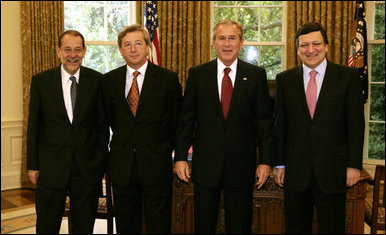 | PRESIDENT BUSH: Thank you all, please be seated. Thanks for coming. There will be opening statements from the three leaders and then we'll take two questions from the American side, two questions from the European side. |
During the conversation our talks reminded me about the importance of our partnership and the fact that this partnership is based on common values and shared aspirations; a partnership that really has helped build a Europe that is whole, free and at peace. The United States continues to support a strong European Union as a partner in spreading freedom and democracy and security and prosperity throughout the world. My message to these leaders and these friends was that we want Europe strong so we can work together to achieve important objectives and important goals.
One of those important objectives and important goals is the advance of freedom in order to spread peace. We talked about the Middle East. We support the vision of two democratic states, Israel and Palestinian living side by side in peace. We talked about Iraq. This week in Brussels, the EU and the U.S. are co-hosting a conference of over 80 countries and international organizations to build support for a free and prosperous Iraq. And I want to thank the leaders for that important initiative. I think it's an important signal for people to hear loud and clear, that there may have been past differences over Iraq, but as we move forward there is a need for the world to work together so that Iraq's democracy will succeed.
We talked about Afghanistan, and I appreciate the contributions of EU member nations to efforts of -- within Afghanistan. After all, 23 members of the EU are contributing troops in Afghanistan, and 12 members of the EU are contributing troops in Iraq, and we appreciate those contributions.
We talked about the broader Middle East. We talked about the need for us to continually support democratic movements. We talked about the Ukraine and Georgia, as well as the Balkans. The point is, is that we understand that democratic nations are nations that are -- will answer to the hopes and aspirations of their people, and democratic nations are nations that will help us keep the peace.
We talked about terrorism. We talked about visas. We talked about the need to continue to share information to make sure that we cut off money flows to terrorist groups and prevent terrorist organizations from obtaining weapons of mass destruction. We talked about Iran, and I complimented the EU, complimented Mr. Solana, as well as the foreign ministers from Great Britain and Germany and France for sending a clear message to the leadership in Iran that we're not going to tolerate the development of a nuclear weapon.
We talked about our collaborative efforts in Darfur. The EU and NATO are working together to help deploy AU peacekeepers in Darfur. And I want to thank the leadership here.
We talked about our economies. There's about a trillion dollars' worth of trade that takes place on an annual basis between the EU and the United States. And that's important. It's important for people working here in the United States, and people working in Europe to understand that trade helps keep -- people keep a job. And I recognize that -- that when there's that much trade, there's going to be disputes. But we'll work those disputes out for the sake of our respective countries.
We're committed to the Doha round of the WTO. We're committed to trade that is fair and free. We spent a lot of time talking about China and how to make sure that China understands there are WTO rules that must be adhered to, and that China should work to do something with her currency so that the trade between our respective countries is fair. That's all we want. We just want there to be a level playing field. The people in Europe can compete, and the people in the United States can compete if we have fair rules and fair trade. And so we talked about how we can work together to make sure that the world trades more freely and more fairly for the sake of our -- for the sake of our peoples.
All in all, we've had a great discussion. And I'm proud to welcome these two men here to the podium here in the East Room of the White House. I want to thank you for coming. I want to thank you for your friendship.
Which one wants to go first? The oldest guy. (Laughter.)
PRESIDENT JUNCKER: As the commission -- as the commission is slow in decisions, I'll take the floor immediately. (Laughter.)
President Barroso and myself, we were pleased with the meeting we had with President Bush, the Vice President and a certain number of Secretaries. We informed our strongest ally of recent developments and events in the European Union. We explained in detail what the real meaning of the French "no" and the Dutch "no" in the recent constitution referenda really are about. We were informing the President on the budgetary issue. As you know, we were unable during the recent European summit to agree on the so-called financial prospectus for the period 2007-2013.
We made clear in our frank and open and friendly talks with the President that the European is not at its knees, but that the European Union is playing the role it has on the international scene; that we feel strongly committed to the relations we have established with partners throughout the world, and mainly with the U.S. -- the U.S. being not only a strategic partner, but the most important partner we have, not only as far political strength relations are concerned, but also as far as heart relations are concerned; that the European Union will table its decisions after the next coming months and probably years on the Nice treaty, which is in place and which allows the European Union to function in a proper way and not as proper way as the constitution would have allowed us to do, but the European Union is there.
We were discussing, which was of quite huge importance, economic reform in the European Union. We adopted a few months ago, in March, the midterm review, the Lisbon strategy. This is a huge program of economic and social reforms. It's clearly paving the way for a more competitive Europe, for a Europe taking its part in the world's economic development. We were discussing a certain number of monetary issues concerning both the U.S. and the European Union, discussing our relations with other trade partners in the world and with other monetary players in the world.
In fact, the visit we paid to President Bush at the end of the Luxembourg's presidency of the Council is a happy conclusion of the six months Luxembourg's period. In Europe, we had the pleasure for having President Bush with us in Europe on the 22nd of February. This was a huge signal the President was sending to Europe. It was because of that meeting that, in fact, both the President and myself, we decided to call for this Iraq conference, which will take place the other day in Brussels.
Although some of us had some differences and divergences with U.S. when it came to Iraq, this -- the fact that we are co-organizing and co-sharing this very important Iraq conference is showing that when it comes to substance, when it comes to progress, when it comes to democracy, to freedom and to liberty, both U.S. and the European Union are cooperating closely together and working in the same direction.
So it was an excellent moment.
PRESIDENT BUSH: Thank you, sir. Mr. President.
PRESIDENT BARROSO: Thank you, thank you very much. It was indeed a pleasure for me, for President Juncker, for all the European Union team to be here. We remember the very successful visit of President Bush to Brussels recently, to the European institutions. We really believe the world is a better place when Europe and the United States work well together, and we can show results. We have been together promoting democracy, first in Ukraine, and in Lebanon. Co-hosting now the international conference on Iraq, we will continue our close cooperation on Iran and the Middle East, and we will make sure that the Doha round is a success.
Today we also adopted important decisions concerning, for instance, the economic cooperation. We have decided to go even further in our economic relations. Let me tell you that, per day, our trade is around $1.8 billion. It shows how important our relation is. We will act together decisively to enhance our economic integration, namely in the field of regulatory environment. We believe a regulatory environment, as much as close as possible, is good for the economy of our space.
The European Union is, and will remain, a very strong and reliable partner for the United States. It's true that we have complex systems in Europe. We are now 25 countries; very soon we will be 27, about 500 million of people. And we went through a very important enlargement, that it was, indeed, the reunification of Europe, 25, and very soon 27, countries that were very recently divided and now are together, sharing their sovereignty.
So it's no surprise that in this process, some problems may occur. But the opinion is there. We are on business. We are deciding. We are taking decisions every day, internally and externally, and we are committed to this very close relation with United States.
Let me just underline two points that are very important also in our relation that we will be going on discussing in Gleneagles in the next G8 summit in Scotland, is the cooperation in terms of environment. We are looking forward -- our dialogue in United States about climate change, new technologies to face those challenges, energy efficiency, energy security -- we adopted an important statement on that -- and also development, what we can do together for Africa and for the developing world. We also adopted a common statement on Africa that shows our commitment.
I think this is a real problem and this is a task of a generation. We are, together, promoting democracy and freedom, but every day, 25,000 people die because they don't have enough to eat or they don't have clean water to drink. This is really a shame for our generation. And you cannot accept it as a kind of natural order of things. It's not natural. Now nobody thinks that slavery is natural, but it was natural for centuries. We could live with slavery. How can we go on living with people dying because they don't have the basic needs? There are enough resources in the world. There are enough resources in the world. What we need is political will and good organization.
And when I say good organization, I say good organization on the donors community, but also on them, on the African leaders, on the third world leaders, that they can also work with us for better governance, for the rule of law, for accountability in their societies, and transparency in their societies. And I hope that this year we can take all advantage of this year with a high-level event in September in New York, with all -- the Gleneagles summit and other occasions so that the United States and Europe will be in front running this battle against absolute poverty, and also for freedom and democracy around the world.
Thank you.
PRESIDENT BUSH: Thank you, Jose.
Couple of questions. Tom.
Q Mr. President, by all accounts, the votes just aren't there to end the filibuster against your nomination of John Bolton to go to the U.N. Your Secretary of State, Condoleezza Rice, wouldn't rule out a recess appointment. There is a recess coming up. Where do you go from here? And would a recess appointment give Mr. Bolton enough time to do the kind of changes at the U.N. that you are looking for?
PRESIDENT BUSH: I think Mr. Bolton ought to get an up or down vote on the Senate floor. That's my call to the Senate. I nominated John Bolton to be the ambassador to the United Nations for a reason. I'm sharing this now with my friends here. The American people know why I nominated him, because the U.N. needs reform, and I thought it made sense to send a reformer to the United Nations. The U.N. is an important organization, and the American people, I think, will take -- will understand how important it is when the U.N. is reformed and is held to account. And so we want more accountability and transparency and less bureaucracy. And John Bolton will help achieve that mission. And so I think it's time for the Senate to give him an up or down vote, now. And I'm not sure if they've made the decision to have that vote. I think tomorrow there is going to be an up or down vote, if I'm not mistaken, Tom.
Q Tonight.
PRESIDENT BUSH: Tonight? Yes. Well, put him in. If they're interested in reforming the United Nations, they ought to approve John Bolton.
Do you want to call on somebody?
Q Mr. President, you spoke of common values were with Europe and the United States, and a strong Europe. Would you say that today, after the two summits between European Union and the United States, that the partnership has even become again a friendship between Europe and United States, and how you see the role of the Luxembourg presidency in that issue?
PRESIDENT BUSH: Well, I appreciate that. First, the relations with Europe are important relations, and they've -- because we do share values. And they're universal values -- they're not American values or European values, they're universal values. And those values, being universal, ought to be applied everywhere. And that's human rights, human dignity, rule of law, transparency when it comes to government, decency. And, obviously, if the EU and the U.S. speak with one voice on these issues, it's more likely to hear -- people will hear it.
I think the friendship between our respective countries in the EU are strong. Obviously, there's been a difference of opinion recently on certain issues, but that doesn't prevent the American people from holding the good folks of Luxembourg or Portugal in high esteem. There's a lot of traffic between our country, a lot of tourism, a lot of trade, a lot of commerce between individual countries within the EU and the United States. And that's because of mutual respect and the desire for people to get to know the world better.
In terms of your Prime Minister, he's an interesting guy. (Laughter.) He's a lot of fun to be around. He promotes serious business in a way that endears himself to people. And so I think his presidency has been an important presidency for the EU during difficult times, and he's handled it well. And I was going to say he's a piece of work, but that might not translate too well. Is that all right, if I call you a "piece of work"? (Laughter.)
PRESIDENT JUNCKER: Okay.
PRESIDENT BUSH: He's done a good job, and I value his friendship. I know it's really important for people at our -- when we sit down at the table, to have a friendship, so we can discuss things in a frank way, in an honest way, without fear of being able to tell people what's on our mind. That's the best way to get things done, and Jean-Claude certainly has been that way, as has Jose.
Adam.
Q Mr. President, we were told that you planned to sharpen your focus on Iraq. Why did this become necessary? And given the recent surge in violence, do you agree with Vice President Dick Cheney's assessment that the insurgency is in its last throes?
PRESIDENT BUSH: Adam, I think about Iraq every day -- every single day -- because I understand we have troops in harm's way, and I understand how dangerous it is there. And the reason it's dangerous is because there's these cold-blooded killers that will kill Americans or kill innocent Iraqis in order to try to drive us out of Iraq. I spoke to our commanders today -- Commander Abizaid today, and will be speaking to General Casey here this week, getting an assessment as to how we're proceeding. We're making progress toward the goal, which is, on the one hand, a political process moving forward in Iraq, and on the other hand, the Iraqis capable of defending themselves. And the report from the field is that while it's tough, more and more Iraqis are becoming battle-hardened and trained to defend themselves. And that's exactly the strategy that's going to work. And it is going to work. And we will -- we will complete this mission for the sake of world peace.
And you just heard the EU is willing to host this conference with the United States in order to help this new democracy move forward. And the reason why is many countries understand that freedom in the heart of the Middle East will make this world more peaceful.
And so, you know, I think about this every day, every single day, and will continue thinking about it, because I understand we've got kids in harm's way. And I worry about their families; and I obviously, any time there's a death, I grieve. But I want those families to know, one, we're not going to leave them -- not going to allow their mission to go in vain; and, two, we will complete the mission and the world will be better off for it.
Q Mr. President, many in Europe --
PRESIDENT BUSH: You're offending people here, we got two other --
Q Mr. President, many in Europe are worrying that with the fight against terrorism the commitment of the United States to human rights is not as big as it used to be -- that is not only to do with Guantanamo, but also with the secret prisons where the CIA holds terror suspects. My question is, what will happen to these people who are held in these secret prisons by the CIA? Will they ever see a judge? Or is your thinking that with some terror suspects, the rule of law should not apply or does not have to have applied.
PRESIDENT BUSH: First of all, I appreciate that question, and I understand we -- those of us who espouse freedom have an obligation, and those who espouse human rights have an obligation to live that to those -- live up to those words. And I believe we are, in Guantanamo. I mean, after all, there's 24 hour inspections by the International Red Cross. You're welcome to go down yourself -- maybe you have -- and taking a look at the conditions. I urge members of our press corps to go down to Guantanamo and see how they're treated and to see -- and to see -- and to look at the facts. That's all I ask people to do. There have been, I think, about 800 or so that have been detained there. These are people picked up off the battlefield in Afghanistan. They weren't wearing uniforms, they weren't state sponsored, but they were there to kill.
And so the fundamental question facing our government was, what do you do with these people? And so we said that they don't apply under the Geneva Convention, but they'll be treated in accord with the Geneva Convention.
And so I would urge you to go down and take a look at Guantanamo. About 200 or so have been released back to their countries. There needs to be a way forward on the other 500 that are there. We're now waiting for a federal court to decide whether or not they can be tried in a military court, where they'll have rights, of course, or in the civilian courts. We're just waiting for our judicial process to move -- to move the process along.
Make no mistake, however, that many of those folks being detained -- in humane conditions, I might add -- are dangerous people. Some have been released to their previous countries, and they got out and they went on to the battlefield again. And I have an obligation, as do all of us who are holding office, to protect our people. That's a solemn obligation we all have. And I believe we're meeting that obligation in a humane way.
As well, as we've got some in custody -- Khalid Shaykh Muhammad is a classic example, the mastermind of the September the 11th attack that killed over 3,000 of our citizens. And he is being detained because we think he could possibly give us information that might not only protect us, but protect citizens in Europe. And at some point in time, he'll be dealt with, but right now, we think it's best that he be -- he be kept in custody.
We want to learn as much as we can in this new kind of war about the intention, and about the methods, and about how these people operate. And they're dangerous, and they're still around, and they'll kill in a moment's notice.
In the long run, the best way to protect ourselves is to spread freedom and human rights and democracy. And -- but if you've got questions about Guantanamo, I seriously suggest you go down there and take a look. And -- seriously, take an objective look as to how these folks are treated, and what has happened to them in the past, and when the courts make the decision they make, we'll act accordingly.
Thank you. I appreciate that. Thank you all very much for coming.
END 1:35 P.M. EDT For Immediate Release Office of the Press Secretary June 20, 2005
0
comments
||
||
Sunday, June 19, 2005
Border Environment Cooperation Commission and North American Development Bank
Executive Order Implementing Amendments to Agreement on Border Environment Cooperation Commission and North American Development Bank
By the authority vested in me as President by the Constitution and the laws of the United States of America, including section 533 of the North American Free Trade Agreement Implementation Act (19 U.S.C. 3473), it is hereby ordered as follows:
Section 1. Executive Order 12916 of May 13, 1994, is amended as follows:
(a) in section 1, by inserting ", as amended by the Protocol of Amendment done at Washington and Mexico City, November 25 and 26, 2002" after "North American Development Bank";
(b) by striking section 2 and inserting in lieu thereof the following:
"Sec. 2. (a) The Secretary of State, the Secretary of the Treasury, and the Administrator of the Environmental Protection Agency shall be members of the Board of Directors of the Border Environment Cooperation Commission and the North American Development Bank ("Board") as provided in clauses (1), (3), and (5) of article II in chapter III of the Agreement.
(b) Appointments to the Board under clauses (7) and (9) of article II in chapter III of the Agreement shall be made by the President. Individuals so appointed shall serve at the pleasure of the President.
(c) The Secretary of the Treasury is selected to be the Chairperson of the Board during any period in which the United States is to select the Chairperson under article III in chapter III of the Agreement.
(d) Except with respect to functions assigned by section 4, 5, 6, or 7 of this order, the Secretary of the Treasury shall coordinate with the Secretary of State, the Administrator of the Environmental Protection Agency, such other agencies and officers as may be appropriate, and the individuals appointed under subsection 2(b) as may be appropriate, the development of the policies and positions of the United States with respect to matters coming before the Board.";
(c) in section 3, by striking subsections (a), (b), and (c), striking "(d)", and striking "representatives" and inserting in lieu thereof "members of the Board listed in subsections 2(a) and (b)";
(d) in section 6, by striking "Advisory Committee" and inserting in lieu thereof "Community Adjustment and Investment Program Advisory Committee ("Advisory Committee") established pursuant to section 543(b) of the NAFTA Implementation Act"; and
(e) in section 7(c), by striking "Members" and inserting in lieu thereof "members".
Sec. 2. This order is intended only to improve the internal management of the executive branch and is not intended to, and does not, create any right or benefit, substantive or procedural, enforceable at law or in equity by any party against the United States, its departments, agencies, entities, officers, employees, or agents, or any other person.
GEORGE W. BUSH THE WHITE HOUSE, June 17, 2005. # # # For Immediate Release Office of the Press Secretary June 17, 2005
0
comments
||
||
Robert M. La Follette, Sr. Post Office Building
Designation of Robert M. La Follette, Sr. Post Office Building
On Friday, June 17 2005, the President signed into law:
H.R. 1760, which designates the facility of the United States Postal Service located at 215 Martin Luther King Jr. Boulevard in Madison, Wisconsin, as the Robert M. La Follette, Sr. Post Office Building.
# # # For Immediate Release Office of the Press Secretary June 17, 2005
0
comments
||
||
Birthday Wishes to Daw Aung San Suu Kyi of Burma
President Sends Birthday Wishes to Daw Aung San Suu Kyi of Burma
I send my best wishes to Daw Aung San Suu Kyi for her 60th birthday, June 19. Her strength, courage, and personal sacrifice in standing up for the oppressed people of Burma have inspired those who stand for freedom. Only a return to democracy and reintegration with the international community can bring the freedom and prosperity that the people of Burma deserve. The United States looks forward to the time when Burma is democratic and free.
# # # For Immediate Release Office of the Press Secretary June 17, 2005
0
comments
||
||
Achieving the President's Nonproliferation Proposals
Statement on Progress in Achieving the President's Nonproliferation Proposals
The United States welcomes today's action by the 35 nation International Atomic Energy (IAEA) Board of Governors to create a Special Committee on Safeguards and Verification, as proposed by the President. The creation of this special committee will aid efforts to counter the proliferation of nuclear weapons and will strengthen the IAEA's ability to monitor and enforce compliance with the Nuclear Nonproliferation Treaty and related agreements.
The creation of this special committee is one of the proposals the President made in February 2004 to address nuclear proliferation. Since that time, substantial progress has been made in achieving the President's other nonproliferation proposals; including:
Expansion of the Proliferation Security Initiative to include more nations, and development of new approaches for interdicting weapons of mass destruction and related material. We recently commemorated the second anniversary of PSI with representatives from over 100 nations.
Adoption of United Nations Security Council Resolution 1540 on April 28, 2004, that requires all states to criminalize proliferation by nonstate actors, enact strict export controls, and secure sensitive materials within their borders.
Expansion of the G-8 Global Partnership to include not only the G-8 but thirteen other donor countries. Ukraine has joined as both a donor and recipient and additional countries are also being considered.
Agreement by the G-8 to limit transfers of enrichment and reprocessing capabilities while examining options to permanently restrict these technologies at the Nuclear Suppliers Group.
# # # For Immediate Release Office of the Press Secretary June 17, 2005
0
comments
||
||
Russian nuclear weapons control and disarmament
Text of a Letter to the Congress of the United States
Section 202(d) of the National Emergencies Act (50 U.S.C. 1622(d)) provides for the automatic termination of a national emergency unless, prior to the anniversary date of its declaration, the President publishes in the Federal Register and transmits to the Congress a notice stating that the emergency is to continue in effect beyond the anniversary date. In accordance with this provision, I have sent the enclosed notice to the Federal Register for publication, stating that the emergency declared with respect to the accumulation of a large volume of weapons-usable fissile material in the territory of the Russian Federation is to continue beyond June 21, 2005. The most recent notice continuing this emergency was published in the Federal Register on June 18, 2004 (69 FR 34047).
It remains a major national security goal of the United States to ensure that fissile material removed from Russian nuclear weapons pursuant to various arms control and disarmament agreements is dedicated to peaceful uses, subject to transparency measures, and protected from diversion to activities of proliferation concern. The accumulation of a large volume of weapons-usable fissile material in the territory of the Russian Federation continues to pose an unusual and extraordinary threat to the national security and foreign policy of the United States. For this reason, I have determined that it is necessary to continue the national emergency declared with respect to the accumulation of a large volume of weapons-usable fissile material in the territory of the Russian Federation and maintain in force these emergency authorities to respond to this threat.
GEORGE W. BUSH THE WHITE HOUSE, June 17, 2005. # # # For Immediate Release Office of the Press Secretary
0
comments
||
||
Weapons-Usable Fissile Material Territory Russian Federation
Notice: Continuation of the National Emergency with Respect to the Risk of Nuclear Proliferation Created by the Accumulation of Weapons-Usable Fissile Material in the Territory of the Russian Federation
On June 21, 2000, the President issued Executive Order 13159 (the "Order") blocking property and interests in property of the Government of the Russian Federation that are in the United States, that hereafter come within the United States, or that are or hereinafter come within the possession or control of United States persons that are directly related to the implementation of the Agreement Between the Government of the United States of America and the Government of the Russian Federation Concerning the Disposition of Highly Enriched Uranium Extracted from Nuclear Weapons, dated February 18, 1993, and related contracts and agreements (collectively, the "HEU Agreements"). The HEU Agreements allow for the downblending of highly enriched uranium derived from nuclear weapons to low enriched uranium for peaceful commercial purposes. The Order invoked the authority, inter alia, of the International Emergency Economic Powers Act, 50 U.S.C. 1701 et seq., and declared a national emergency to deal with the unusual
The national emergency declared on June 21, 2000, must continue beyond June 21, 2005, to provide continued protection from attachment, judgment, decree, lien, execution, garnishment, or other judicial process for the property and interests in property of the Government of the Russian Federation that are directly related to the implementation of the HEU Agreements and subject to U.S. jurisdiction. Therefore, in accordance with section 202(d) of the National Emergencies Act (50 U.S.C. 1622(d)), I am continuing for 1 year the national emergency with respect to weapons-usable fissile material in the territory of the Russian Federation. This notice shall be published in the Federal Register and transmitted to the Congress.
GEORGE W. BUSH THE WHITE HOUSE, June 17, 2005. # # #For Immediate Release Office of the Press Secretary June 17, 2005
0
comments
||
||
Saturday, June 18, 2005
bush radio address 06/18/05 full audio, text transcript
bush radio address 06/18/05 full audio, text transcript
President's Radio Address
THE PRESIDENT: Good morning.
Today we face two issues of vital importance for all Americans: growing our economy and protecting our citizens from those who wish to do us harm. So in the weeks ahead, I will continue to focus on ways to ensure that our government takes the side of working families, and that America prevails in the war on terror. As we take the steps necessary to achieve these goals, we will make our future one of peace and prosperity.
Today we have good reason to be optimistic about our economy. More Americans are working today than at any time in our history. More Americans own their homes than at any time in our history. More Americans are going to college and own their own businesses than at any time in our history -- and a new economic report shows that inflation is in check. Our policies have put us on the track to growth, but leaders in Washington must not become complacent. We need to work together to ensure that opportunity reaches every corner of our great country.
Delivering opportunity means allowing families to keep more of the money they earn. So we enacted the largest tax relief in a generation. That is only a beginning. You need a reformed tax code that is simple, fair, and easy to understand, and rewards your hard work and entrepreneurial spirit. And Congress needs to do its part by making the tax relief we passed permanent and burying the death tax forever.
Delivering opportunity also means adapting to the needs of a new century. In this new century, American prosperity will increasingly depend on our ability to sell our goods and services overseas, so we need to pass initiatives like the Central American Dominican Republic Free Trade Agreement to create a level playing field for American farmers and small businesses. In this new century, Americans require a reliable and affordable supply of energy. I proposed a comprehensive energy policy to reduce our dependence on foreign oil. In this new century, Americans need to know that if they work hard their whole lives, they will retire with dignity, so we're working to save Social Security to ensure that the next generation of retirees will be as secure in their retirement as today's generation.
As we work to deliver opportunity at home, we're also keeping you safe from threats from abroad. We went to war because we were attacked, and we are at war today because there are still people out there who want to harm our country and hurt our citizens. Some may disagree with my decision to remove Saddam Hussein from power, but all of us can agree that the world's terrorists have now made Iraq a central front in the war on terror. These foreign terrorists violently oppose the rise of a free and democratic Iraq, because they know that when we replace despair and hatred with liberty and hope, they lose their recruiting grounds for terror.
Our troops are fighting these terrorists in Iraq so you will not have to face them here at home. We mourn every one of these brave men and women who have given his or her life for our liberty. The terrorists know they cannot defeat our troops, so they seek to weaken our nation's resolve. They know there is no room for them in a free and democratic Middle East, so the terrorists and insurgents are trying to get us to retreat. Their goal is to get us to leave before Iraqis have had a chance to show the region what a government that is elected and truly accountable to its citizens can do for its people.
Time and again, the Iraqi people have defied the skeptics who claim they are not up to the job of building a free society. Nearly a year ago, Iraqis showed they were ready to resume sovereignty. A few months ago, Iraqis showed they could hold free elections. This week, Iraqis have worked on an agreement to expand their constitutional drafting committee to ensure that all communities are represented in the process. I am confident that Iraqis will continue to defy the skeptics as they build a new Iraq that represents the diversity of their nation and assumes greater responsibility for their own security. And when they do, our troops can come home with the honor they have earned.
This mission isn't easy, and it will not be accomplished overnight. We're fighting a ruthless enemy that relishes the killing of innocent men, women, and children. By making their stand in Iraq, the terrorists have made Iraq a vital test for the future security of our country and the free world. We will settle for nothing less than victory.
I'll continue to act to keep our people safe from harm and our future bright. Together we will do what Americans have always done: build a better and more peaceful world for our children and grandchildren.
Thank you for listening.
END For Immediate Release June 18, 2005
0
comments
||
||
Freedom Calendar 06/18/05 - 06/25/05
June 18, 1912, African-American Robert Church, founder of Lincoln Leagues to register black voters in Tennessee, attends 1912 Republican National Convention as delegate; eventually serves as delegate at 8 conventions.
19 Father’s Day, June 19, 1865, On “Juneteenth,” U.S. troops land in Galveston, TX to enforce ban on slavery that had been declared more than two years before by the Emancipation Proclamation.
June 20, 1964, The Chicago Defender, renowned African-American newspaper, praises Senate Republican Leader Everett Dirksen (R-IL) for leading passage of 1964 Civil Rights Act.
June 21, 1832, Birth of U.S. Rep. Joseph Rainey (R-SC), former slave who in 1870 became first African-American member of U.S. House.
June 22, 1870, Republican Congress creates U.S. Department of Justice, to safeguard the civil rights of African-Americans against Democrats in the South.
June 23, 1958, President Dwight Eisenhower meets with Martin Luther King and other African-American leaders to discuss plans to advance civil rights.
June 24, 1940, Republican Party platform calls for integration of the armed forces; for the balance of his terms in office, FDR fails to order it.
June 25, 1996, Death of U.S. Court of Appeals Judge Elbert Tuttle, appointed by President Dwight Eisenhower; eulogized for ensuring that Brown v. Board of Education became “a broad mandate for racial justice”.
“Slavery is a violation of the rights of a man; that the law of nature which is the law of liberty, gives to no man rights superior to those of another; that God and nature have secured to each individual the inalienable right of equality - Upon a hatred of slavery, and the desire for an accountable, fiscally responsible, government, the above resolution was overwhelmingly adopted in its entirety.”
The first Republican state party platform, Michigan, 1854
SOURCE: 2005 Republican Freedom Calendar
0
comments
||
||
Thursday, June 09, 2005
Korea – Six-Party Talks
Korea – Six-Party Talks (Taken Question)
Question: Have we heard back from the Chinese or North Koreans or other countries regarding the resumption of Six-Party talks in the next few weeks? If not, has a specific date been given? Have we heard that the next round of talks will be in Beijing?
Answer: We have not heard confirmation from any source that North Korea has agreed to any date or timeframe for the resumption of Six Party Talks, nor have specific arrangements been made at this point for the next round.
2005/596 Released on June 8, 2005 Taken Question Office of the Spokesman Washington, DC June 8, 2005 Question Taken at the June 8, 2005 Press Briefing
0
comments
||
||
Meeting with Carter Center Representatives
Meeting with Carter Center Representatives (Taken Question)
Question: Did representatives of the Carter Center meet with State Department officials today regarding Guantanamo?
Answer: No. A representative of the Carter Center, along with a delegation of human rights activists, met today with Under Secretary for Global Affairs Paula Dobriansky. The individuals involved are in Washington to take part in a conference hosted by the Carter Center and Human Rights First. They discussed how the United States and organizations such as the Carter Center can assist in the promotion of human rights, democratic principles, and the rule of law. They did not discuss Guantanamo.
2005/597 Released on June 8, 2004 Taken Question Office of the Spokesman Washington, DC June 8, 2005 Question Taken at the June 8, 2005 Daily Press Briefing
0
comments
||
||
Wednesday, June 08, 2005
President Welcomes Turkish Prime Minister Erdogan
President Welcomes Turkish Prime Minister Erdogan FULL STREAMING VIDEO to the White House, The Oval Office, President's Remarks, 11:25 A.M. EDT
THE PRESIDENT: Mr. Prime Minister, welcome to the Oval Office. We've had an extensive visit about a lot of issues. And the reason why is because Turkey and the United States has an important strategic relationship. I told the Prime Minister how grateful I was that he was a -- is a strong supporter of the broader Middle Eastern initiative. Turkey's democracy is an important example for the people in the broader Middle East, and I want to thank you for your leadership.
Along these lines, I thanked the Prime Minister for Turkey's leadership role in Afghanistan. I was most impressed by his report from his trip to Afghanistan and his deep concern for the conditions of the people there and his desire to work with the United States and NATO countries to help improve the lives of the children, for example, in Afghanistan.
We discussed a lot of foreign policy and shared interests between our countries. And one of the most important foreign policy initiatives of my administration -- and I know the Prime Minister shares the same desire -- is to work with the Palestinians so they can have their own state, their own democracy, living side-by-side in peace with Israel.
And, finally, we discussed the domestic issues. We discussed our economies. And the Prime Minister reminded me that the -- in his judgment, Turkey is a good place for U.S. investment. I listened very carefully to what he had to say, but we spent -- all in all, it was a very rich and important discussion.
Mr. Prime Minister, thank you for coming.
PRIME MINISTER ERDOGAN: Thank you, Mr. President. In our meeting with the President, we discussed and evaluated the political partnership that we have with the United States and we looked into the future with regard to our relations. I can summarize the main titles of our discussion as freedom, democracy, rule of law, fight against terrorism, security and human rights.
We also had an opportunity to talk about the broader Middle East initiative, with regard to regional developments. We also discussed the Cyprus issue. And we were able to discuss with some depth the issues with regard to Israel, Palestine, the situation in Iraq, Afghanistan.
We discussed, and I'm confident that we will continue to have the same kind of solidarity we've had in Turkish-U.S. relations in the past, in the future, as well.
I also mentioned to the President that Turkey is open to any new investment as a country now of stability and security. And we were very happy to see that the President agreed and he had a positive view on investments.
And we're happy that we were able to confirm that our strategic relationship will move and take place in the future, as it has been done in the past.
Thank you.
PRESIDENT BUSH: Thank you, sir. Thank you.
END 11:31 A.M. EDT
0
comments
||
||
President to Welcome Presidents Mogae, Kufuor, Guebuza, Pohamba, and Tandja
President to Welcome Presidents Mogae, Kufuor, Guebuza, Pohamba, and Tandja to the White House
President Bush will welcome President Festus Mogae of Botswana, President John Kufuor of Ghana, President Armando Guebuza of Mozambique, President Hifikepunye Pohamba of Namibia, and President Mamadou Tandja of Niger to the White House on June 13, 2005. This meeting will highlight the value that the United States places on supporting democracy across Africa. President Bush looks forward to recognizing these countries' successes at holding free and fair elections last year and discussing the issues of democracy, trade and economic development, HIV/AIDS, the upcoming G-8 summit, as well as peace and security in Africa.
# # #For Immediate Release, Office of the Press Secretary, June 8, 2005
0
comments
||
||
President Welcomes British Prime Minister Blair to the White House
 | President Welcomes British Prime Minister Blair to the White House, FULL STREAMING VIDEO The East Room, President's Remarks. 4:46 PRESIDENT BUSH: Thank you all. Good afternoon. Laura and I are really honored to welcome the Prime Minister and Cherie back to the White House. Welcome, Tony. Glad you're here. |
| Our alliance with Great Britain is strong, and it's essential to peace and security. Together our two nations worked to liberate Europe from fascism; together we defended freedom during the Cold War. Today we're standing together again to fight the war on terror, |  |
Prime Minister Blair and I share a common vision of a world that is free, prosperous, and at peace. When men and women are free to choose their own governments, to speak their minds, and to pursue a good life for their families, they build a strong, prosperous and just society.
This is the vision chosen by Iraqis in elections in January. And the United States and Britain will stand with the Iraqi people as they continue their journey toward freedom and democracy. We'll support Iraqis as they take the lead in providing their own security. Our strategy is clear: We're training Iraqi forces so they can take the fight to the enemy, so they can defend their country. And then our troops will come home with the honor they have earned.
By spreading freedom throughout the broader Middle East we'll end the bitterness and hatred that feed the ideology of terror. We're working together to help build the democratic institutions of a future Palestinian state. We support Israel's disengagement from Gaza and parts of the West Bank. We're advancing the vision of two states, Israel and Palestine, living side by side in peace and security.
We also share a commitment to help the people of Africa build strong democratic institutions and healthy economies. The Prime Minister has made the promotion of reform and development in Africa a centerpiece of the G8 summit that the United Kingdom will be hosting next month. And I'm grateful for your vision and I'm grateful for your leadership on this important subject.
Helping those who suffer and preventing the senseless death of millions of people in Africa is a central commitment of my administration's foreign policy. We're making historic progress and helping the poorest countries in Africa gain a fresh start, and to build a future of greater opportunity and prosperity. America will continue to lead the world to meet our duty in helping the world's most vulnerable people.
Over the past four years, we have tripled our assistance to Sub-Sahara Africa, and now America accounts for nearly a quarter of all the aid in the region. And we're committed to doing more in the future. We also agree that highly indebted developing countries that are on the path to reform should not be burdened by mountains of debt. Our countries are developing a proposal for the G8 that will eliminate a hundred percent of that debt, and that, by providing additional resources, will preserve the financial integrity of the World Bank and the African Development Bank.
As we work with African nations to develop democratic institutions and vibrant economies that will provide greater opportunity for all Africans, we must also address emergency needs. I'm pleased to announce the United States will provide approximately $674 million of additional resources to respond to humanitarian emergencies in Africa. One of those emergencies is the growing hunger crisis in the Horn of Africa. In response to this need, $414 million of those additional resources will be provided immediately to avert famine there. We urge the international community to join us in committing greater resources to the humanitarian needs in Africa.
I also look forward to working with the Prime Minister through the G8 to forge a new strategy for the 21st century that helps countries achieve economic prosperity, energy security, and a clean environment, to improve public health by cutting air -- public air pollution and to address global change -- subjects which I look forward to discussing at the G8, Mr. Prime Minister. To develop and make available clean and efficient technologies that will help attain these goals has got to be part of our dialogue at the G8.
I look forward to also continuing our discussion to support freedom and democracy in the broader Middle East.
The United States congratulates the United Kingdom as it takes over the presidency of the EU on July the 1st. The United States has a wide-ranging and active agenda with Europe, and we're determined to work together to meet the global challenges common to us all. The Prime Minister and I believe a strong Europe that acts in partnership with the United States is important for world peace.
I appreciate your leadership, Tony Blair. I appreciate your friendship. I appreciate your courage, and I appreciate your vision. Welcome back to America.
PRIME MINISTER BLAIR: Thank you very much, indeed, Mr. President, and I say how delighted we are to be back here in the White House and to say thank you for your warm welcome.
And we've also got a busy agenda ahead of us in the international community over the coming months. We've obviously discussed, as the President has just indicated, the issues to do with the G8 summit. And on Africa, I think there is a real and common desire to help that troubled continent come out of the poverty and deprivation that so many millions of its people suffer. In a situation where literally thousands of children die from preventable diseases every day, it's our duty to act, and we will.
But we know that there are two things very clear about Africa today. The first is that, though it is important that we commit the resources to Africa that are necessary, it's not just about resources. It's also about debt; it's about trade; it's about making sure that we deal with these diseases -- HIV/AIDS, malaria, TB, polio -- that are killing so many people. It's about conflict resolution and having the proper peacekeeping and peace enforcement mechanisms.
And it's about making sure that, in doing this, that it's not a something-for-nothing deal. We also need to make sure that there is a commitment on the part of the African leadership to proper governance, to action against corruption, to making sure that the aid and the resources that we're prepared to commit actually go to the people that need it and do the job that it's supposed to do.
So we are trying to create a framework in which we deal not just with one of the issues to do with Africa, but all of them together -- and deal with it on a basis of a partnership with the African leadership that's prepared to embrace the same values of democracy and freedom that we embrace.
In respect of debt and debt cancellation, I'm pleased at the progress that we're making. And I think we are well on the way -- I hope we can, if we're able to, conclude a deal at the finance ministers' meeting this weekend -- but one that will involve a hundred-percent debt cancellation and also the commitment of the additional funding necessary to make sure that the institutions aren't penalized as a result of that. And if that substantial funding is added also to the debt cancellation, I think it will make a real difference to those African countries.
But we know there's a lot more to do. And over the coming weeks, in the run-up to the summit that will take place in Scotland, we want to carry on working on the specific programs in relation to things like education and infrastructure and dealing with the killer diseases, that allow us to make the commitment that we need.
On climate change, I think everyone knows there are different perspectives on this issue. But I also think that it's increasingly obvious, whatever perspective people have and whatever -- from whatever angle they come at this issue, there is a common commitment and desire to tackle the challenges of climate change, of energy security and energy supply. And we need to make sure that we do that. And again, I hope over the coming weeks we will work closely on this.
On the Middle East and the Middle East peace process -- of course, we had a discussion about this. I would just like to emphasize again the vital necessity of making sure that democracy succeeds in Iraq. Our troops work together very, very closely there, and I would like to pay tribute not just to the bravery of the British troops that work there, and other coalition troops, but to the United States forces that do such a magnificent job there, and often in very, very difficult circumstances. And yet it is absolutely vital, for the security not just of that country and of that region, but of the world, that we succeed in Iraq. And the reason it's tough is because people know what's at stake. And what's at stake is the ability of Iraq, finally, to function properly as a democracy, run for the good of its people. And our help in ensuring that Iraq can attain that goal is of vital importance, not just to our countries, but to the future of the world.
In addition, of course, the progress that's being made in respect to the Middle East peace process is very welcome. Mr. President, I'd like to thank you for your leadership on that issue, which has been extremely important.
We also had an opportunity to discuss issues to do with Iran and Libya and Afghanistan and a range of different matters. But once again, let me thank you very much for inviting me here, and to come back after my reelection. Thank you for the kind words about that. And I look forward to working not just on the issues to do with the G8, but on the full range of the international agenda with you. It's a good alliance and a good partnership for our two countries, and I believe for the wider world.
PRESIDENT BUSH: Thank you, sir.
PRIME MINISTER BLAIR: Thank you, Mr. President.
PRESIDENT BUSH: We'll answer two questions aside. Jennifer.
Q Thank you, Mr. President. Prime Minister Blair has been pushing for wealthy nations to double aid to Africa. With American aid levels among the lowest in the G8 as per portion of national income, and the problems on the continent so dire, why isn't doubling U.S. aid a good idea?
PRESIDENT BUSH: Well, first, as I said in my statement, we've tripled aid to Africa. Africa is an important part of my foreign policy. I remember when I first talked to Condi when I was trying to convince her to become the National Security Advisor, she said, are you going to pay attention to the continent of Africa? I said, you bet. And I've fulfilled that commitment. We've convinced Congress to triple aid. We've got a significant HIV/AIDS initiative that we're undertaking. We started what's called the Millennium Challenge Account. And we'll do more down the road.
Now, in terms of whether or not the formula that you commented upon are the right way to analyze the United States commitment to her, I don't think it is. I mean, I don't think -- there's a lot of things that aren't counted in our desire to spread compassion. But our country is -- has taken the lead in Africa, and we'll stay there. It's the right thing to do. It's important to help Africa get on her feet.
And by the way, I think one of things that many African nations have come to discover is that through trade, they can develop a more hopeful society rather than through aid. I mean, aid helps, but we passed what's called AGOA -- the African Growth and Opportunity Act -- and have extended it. It passed during President Clinton's period; my administration extended it with Congress, and it's made an enormous difference to young economies. When you open up your market to entrepreneurs and small businesses, it helps spread wealth. And that's, after all, what we're trying to achieve.
So I'm proud of our accomplishments, and we'll continue to take the lead on the issue.
PRIME MINISTER BLAIR: Okay -- Andy.
PRESIDENT BUSH: Andy is still with you.
PRIME MINISTER BLAIR: He is.
Q For a brief period, Mr. President. I'm from BBC. Could I ask both leaders -- I understand from what you say that you're pretty close to cracking the differences between you about how to pay for debt cancellation for the poorest countries. Is that the case, and can you tell us any more about that?
And also, if I may, to the President, Mr. Blair's Africa Commission has really raised the ante quite a lot in Africa, talking about this big historic moment for the world and the continent. Do you see it that way, too?
PRESIDENT BUSH: I do. That's why we tripled aid. I see we have got a fantastic opportunity -- presuming that the countries in Africa make the right decisions. Nobody wants to give money to a country that's corrupt, where leaders take money and put it in their pocket. No developed nation is going to want to support a government that doesn't take an interest in her people, that doesn't focus on education and health care. We're really not interested in supporting a government that doesn't have open economies and open markets. We expect there to be a reciprocation -- that's what the Prime Minister talked about.
But, absolutely; it's a great opportunity. And I'm honored to be working with the Prime Minister on this important subject.
PRIME MINISTER BLAIR: I think in relation to the debt cancellation, yes, I think we're well on the way to agreement on that. But it's important to realize we need, obviously, America and the UK to be in agreement, but then we need to get the agreement of the others. So we've got to watch how we manage that process and bring everyone into it.
But, yes, I think there is a real desire to make sure that we cancel the debt, and cancel the debt in such a way that it doesn't inhibit or disadvantage the international institutions.
I think, in relation to Africa more generally, it's important -- in respect to the Africa Commission report -- we set out a figure of the doubling of aid, and $25 billion extra is effectively what that would mean. But the important thing is not to take the figure out of the air, but to realize the Commission for Africa reached that figure on the basis of an analysis of what Africa needs. And I think that this is what we can do over the coming weeks.
In relation to specific areas where we accept there is a real need and we can act, and we can act in a way, what is more, that is not going to waste the money given, but is going to put it to the use to which it's supposed to be put -- on education, on malaria, on HIV/AIDS, on things like water sanitation, on the peacekeeping, peace enforcement aspect of conflict resolution in Africa -- we have got the chance over the next period of time to make a definitive commitment, but it is a two-way commitment. We require the African leadership -- this is what the President is saying -- we require the African leadership also to be prepared to make the commitment on governance, against corruption, in favor of democracy, in favor of the rule of law.
Now, there are African nations that are prepared to make that commitment today. They're going to get help. What we're not going to do is waste our country's money. So that is the nature of what we are trying to put together. Obviously, there's going to be a lot of discussions over the next few weeks to -- because it's at Gleneagles that we will get the final package there. But I'm hopeful after the discussions that we've had today that we can get there.
PRESIDENT BUSH: Steve.
Q Thank you, sir. On Iraq, the so-called Downing Street memo from July 2002 says intelligence and facts were being fixed around the policy of removing Saddam through military action. Is this an accurate reflection of what happened? Could both of you respond?
PRIME MINISTER BLAIR: Well, I can respond to that very easily. No, the facts were not being fixed in any shape or form at all. And let me remind you that that memorandum was written before we then went to the United Nations. Now, no one knows more intimately the discussions that we were conducting as two countries at the time than me. And the fact is we decided to go to the United Nations and went through that process, which resulted in the November 2002 United Nations resolution, to give a final chance to Saddam Hussein to comply with international law. He didn't do so. And that was the reason why we had to take military action.
But all the way through that period of time, we were trying to look for a way of managing to resolve this without conflict. As it happened, we weren't able to do that because -- as I think was very clear -- there was no way that Saddam Hussein was ever going to change the way that he worked, or the way that he acted.
PRESIDENT BUSH: Well, I -- you know, I read kind of the characterizations of the memo, particularly when they dropped it out in the middle of his race. I'm not sure who "they dropped it out" is, but -- I'm not suggesting that you all dropped it out there. (Laughter.) And somebody said, well, you know, we had made up our mind to go to use military force to deal with Saddam. There's nothing farther from the truth.
My conversation with the Prime Minister was, how could we do this peacefully, what could we do. And this meeting, evidently, that took place in London happened before we even went to the United Nations -- or I went to the United Nations. And so it's -- look, both us of didn't want to use our military. Nobody wants to commit military into combat. It's the last option. The consequences of committing the military are -- are very difficult. The hardest things I do as the President is to try to comfort families who've lost a loved one in combat. It's the last option that the President must have -- and it's the last option I know my friend had, as well.
And so we worked hard to see if we could figure out how to do this peacefully, take a -- put a united front up to Saddam Hussein, and say, the world speaks, and he ignored the world. Remember, 1441 passed the Security Council unanimously. He made the decision. And the world is better off without Saddam Hussein in power.
PRIME MINISTER BLAIR: Nick.
Q You've talked of what you've hoped to do for Africa. Do you regard the phrase "make poverty history" as rhetoric from rock stars? Or do you really believe in your gut that this the year it could happen?
And, Mr. President, if I may, as well, on climate change -- you didn't talk about climate change -- do you believe that climate change is manmade and that you, personally, as the leader of the richest country in the world, have a responsibility to reverse that change?
PRESIDENT BUSH: Let me address your first question. Talk about -- you said, I'm willing to talk about what we're going to do -- I want you to focus on what we have done, for starters. I mean, part of the -- part of this world, we've got a lot of big talkers. What I like to say is my administration actually does what we say we're going to do -- and we have. When I say we're going to make a commitment to triple aid in Africa, I meant it, and we did. When I said we're going to lead an initiative, an HIV/AIDS initiative, the likes of which the world has never seen before on the continent of Africa, we have done that, and we're following through. And so when I say we're going to do more, I think you can take that to the bank, as we say, because of what we have done. We have taken a leadership role.
Second question -- do I believe in my gut we can eradicate poverty? I do believe we can eradicate poverty. And, by the way, Bono has come to see me. I admire him. He is a man of depth and a great heart who cares deeply about the impoverished folks on the continent of Africa, and I admire his leadership on the issue. And so I do believe -- I don't view -- I can't remember how you characterized the rock stars, but I don't characterize them that way, having met the man.
In terms of climate change, I've always said it's a serious long-term issue that needs to be dealt with. And my administration isn't waiting around to deal with the issue, we're acting. I don't know if you're aware of this, but we lead the world when it comes to dollars spent, millions of dollars spent on research about climate change. We want to know more about it. It's easier to solve a problem when you know a lot about it. And if you look at the statistics, you'll find the United States has taken the lead on this research.
Secondly, we're spending a lot of money on developing ways to diversify away from a hydrocarbon society. America must do that, for national security reasons and economic security reasons. And that's why I laid out the hydrogen fuel cell initiative, with the understanding that our country is going to have to diversify away from the type of automobiles we drive.
And it's beginning to happen here. We'll have more fuel cells -- cars driven by fuel cells on the road next year than we had the past year, and more after that. We're beginning to change. Technology is changing how we can approach energy, and the technology -- mating technology and energy independence from hydrocarbon also will produce a cleaner environment.
We're spending a lot of money on clean coal technology. That's going to be very important for a country like ours, and a country like China. And one of the issues we've got to deal -- figure out how to deal with is how we share that technology with developing nations. You cannot leave developing nations out of the mix if you expect to have a cleaner world.
I strongly believe that the world needs to share technologies on nuclear power. I don't see how you can be -- diversify away from hydrocarbons unless you use clean nuke. And so we need to work together on developing technologies that will not only ensure people that nuclear power will be safe, but that we can dispose of it in a safe way.
I'll tell you an interesting opportunity for not only here, but for the rest of the world, is biodiesel. That is a fuel developed from soybeans. I kind of, in jest, like to travel our country, saying, wouldn't it be wonderful if someday the President sat down and looked at the crop report, and said, man, we've got a lot of soybeans; it means we're less dependent on foreign sources of energy. We're spending money to figure out how best to refine soy into diesel.
See, there's a lot of things we're doing in America, and I believe that not only can we solve greenhouse gas, I believe we will. And I appreciate the Prime Minister bringing this issue up. I look forward to sharing that which we know here in America with not only the G8 members, but equally importantly, with developing countries. And not only that, I'm convinced that we can use technology to help keep the air cleaner and the water purer, and develop economies around the world at the same time. That's going to be one of the great advances in technology in the coming years.
Thank you for your question. Good to see you all.
END 5:11 P.M. EDT For Immediate Release, Office of the Press Secretary, June 7, 2005
0
comments
||
||
Fighting Hunger and Addressing Humanitarian Needs in Africa
Statement on Fighting Hunger and Addressing Humanitarian Needs in Africa
The United States and the United Kingdom announced today that they will meet the remaining food needs and help provide shelter, water, and health care to millions of people in the Horn of Africa to avert famine, as well as provide additional resources to humanitarian emergencies throughout Africa.
This cooperation complements the ongoing work leading up to the G8 Summit on the longer term challenges of helping Africa to make faster progress towards the Millennium Goals, and on a comprehensive and sustained program to support Africa's own efforts. The results of these discussions will be announced at Gleneagles.
The United States today is announcing that it will provide an additional $674 million for humanitarian emergencies in Africa this year, in addition to the approximately $1.4 billion the United States has already committed. The United Kingdom expects to contribute some $300 million this year in response to humanitarian needs in Africa, including $50 million for Ethiopia.
The United Kingdom and the United States call jointly on the rest of the donor community to commit to working with African nations to address the remaining urgent humanitarian needs, as well as the underlying causes, which the UN estimates to have an unfunded need of more than $3.5 billion.
While responding to urgent needs, the U.S. and the UK are taking forward the G8 initiative launched at Sea Island on "Ending the Cycle of Famine" which aims to work with the New Partnership for Africa's Development (NEPAD) and individual countries to improve agricultural productivity. Under this initiative, the United States and the United Kingdom, together with other donors, are investing in longer term support to increase food security in Africa as a whole. For example, both nations support the Productive Safety Nets Program in Ethiopia to move millions of people from aid dependence to sustainable livelihoods. The United Kingdom, United States, and other G-8 members have pledged their support for the Comprehensive African Agriculture Development Plan, launched last month in Accra, Ghana.
The United States and the United Kingdom also commit to working with the United Nations Secretary General to strengthen the international humanitarian response system.
# # #, For Immediate Release, Office of the Press Secretary, June 7, 2005
0
comments
||
||


