


Albanian Elections
On July 3, Albanian voters will go to the polls. This election represents one of the most important events in Albania since the fall of communism. Elections that meet international standards will be seen by the United States and the international community as evidence that Albania is making clear progress on the road to becoming a full member of the Euro-Atlantic community.
Recently, the leaders of all Albania's political parties signed a code of conduct for the elections. We commend this gesture and believe it is an indicator of how well Albania's political leaders can work together to ensure these elections meet international standards. We are pleased that Albania's political leaders have committed to a democratic, civil, and peaceful campaign. It is essential that all parties and political leaders respect and adhere to the provisions of the code of conduct, a key part of which is acceptance by party leaders and supporters of the results of a free and fair election.
The United States and Albania enjoy excellent relations. We also share common values based on our belief in democracy and the central role played by the rule of law in safeguarding democracy. We urge Albanians and their political parties to use the opportunity presented by the election to demonstrate further Albania's democratic credentials, and keep Albania firmly on the path of entry into Euro-Atlantic Institutions.
2005/647 Released on June 23, 2005 Press Statement Adam Ereli, Deputy Spokesman Washington, DC June 23, 2005 Source: State.gov
Saturday, June 25, 2005
Albanian Elections
0
comments
||
||

President to Welcome Prime Minister Sabah of Kuwait
President to Welcome Prime Minister Sabah of Kuwait to the White House
President Bush will welcome Prime Minister Sabah of Kuwait to the White House on July 1, 2005. The United States appreciates Kuwait's friendship and values our strong partnership in the region. President Bush looks forward to discussing with Prime Minister Sabah a range of bilateral and regional issues and congratulating the Prime Minister on Kuwaiti women achieving full political rights.
# # # For Immediate Release, Office of the Press Secretary, June 24, 2005
0
comments
||
||
Freedom Calendar 06/25/05 - 07/02/05
June 25, 1996, Death of U.S. Court of Appeals Judge Elbert Tuttle, appointed by President Dwight Eisenhower; eulogized for ensuring that Brown v. Board of Education became “a broad mandate for racial justice”.
June 26, 1857, Abraham Lincoln declares Republican position that slavery is “cruelly wrong,” while Democrats “cultivate and excite hatred” for blacks.
June 27, 1940, Charles Anderson (R-KY), first African-American state legislator from a southern state in the 20th century, serves as delegate to the 1940 Republican National Convention.
June 28, 1864, Republican majority in Congress repeals Fugitive Slave Acts.
June 29, 1982, President Ronald Reagan signs 25-year extension of 1965 Voting Rights Act.
June 30, 1910, Estelle Reel (R-WY), first woman in nation elected to statewide office and first woman confirmed by U.S. Senate to a federal post, retires after 12 years as U.S. Superintendent of Indian Schools
July 1, 1991, President George H. W. Bush appoints Clarence Thomas to U.S.Supreme Court; previously served on U.S. Court of Appeals and as Chairman of U.S. Equal Employment Opportunity Commission.
July 2, 1862, U.S. Rep. Justin Morrill (R-VT) wins passage of Land Grant Act, establishing colleges open to African-Americans, including such students as George Washington Carver.
“Neither slavery nor involuntary servitude, except as a punishment for crime whereof the party shall have been duly convicted, shall exist within the United States, or any place
subject to their jurisdiction.”
Section 1 of the 13th Amendment, written in 1865 by Senator Lyman Trumbull (R-IL), author of much of the Republican Party’s civil rights legislation after the Civil War
SOURCE: 2005 Republican Freedom Calendar
0
comments
||
||
bush radio address 06/25/05 full audio, text transcript
bush radio address 06/18/05 full audio, text transcript
President's Radio Address
THE PRESIDENT: Good morning. This past week, I had the honor of hosting Prime Minister Jaafari -- the leader of Iraq's first democratically-elected government in more than a half century.
Prime Minister Jaafari and I discussed our strong partnership, and the dramatic progress his nation has made over the past year. Next Tuesday is the first anniversary of the moment the Iraqi people reclaimed their free and sovereign nation. To mark that historic date, I will travel to Fort Bragg, North Carolina, to speak to our troops and the American people about our mission in Iraq, why it remains important to our safety here at home, and our two-track strategy for victory.
The military track of our strategy is to defeat the terrorists and continue helping Iraqis take greater responsibility for defending their freedom. The images we see on television are a grim reminder that the enemies of freedom in Iraq are ruthless killers with no regard for human life. The killers include members of Saddam Hussein's regime, criminal elements and foreign terrorists. The terrorists know that Iraq is a central front in the war on terror, because they know that a stable and democratic Iraq will deal a severe blow to their ideology of oppression and fear.
The terrorists' objective is to break the will of America and of the Iraqi people before democracy can take root. Insurgents have tried to achieve that goal before. Two years ago, they tried to intimidate the Iraqi Governing Council -- and failed. Last year, they tried to delay the transfer of sovereignty to Iraq -- and failed. This year, they tried to stop the free Iraqi elections -- and failed. Now the terrorists are trying to undermine the new government and intimidate Iraqis from joining the growing Iraqi security forces.
Yet democracy is moving forward, and more and more Iraqis are defying the terrorists by joining the democratic process. Our military strategy is clear: We will train Iraqi security forces so they can defend their freedom and protect their people, and then our troops will return home with the honor they have earned.
The political track of our strategy is to continue helping Iraqis build the institutions of a stable democracy. The Iraqi people have taken landmark steps by voting in free elections and forming a representative government. Prime Minister Jaafari has assured me that his government is committed to meeting its deadline to draft a new constitution for a free Iraq. Then the constitution will be submitted to the Iraqi people for approval, and new elections will be held to choose a fully constitutional government.
These are monumental tasks for the new democracy of Iraq -- and the free world will continue to stand behind the Iraqi people. This past week, more than 80 countries and international organizations came together in Brussels to discuss how to help Iraqis provide for their security and rebuild their country. And next month, donor countries will meet in Jordan to discuss Iraqi reconstruction.
Our nation's mission in Iraq is difficult, and we can expect more tough fighting in the weeks and months ahead. Yet I am confident in the outcome. The Iraqi people are growing in optimism and hope. They understand that the violence is only a part of the reality in Iraq. Each day, Iraqis are exercising new freedoms that they were denied for decades. Schools, hospitals, roads, and post offices are being built to serve the needs of all Iraqis. Increasing numbers of Iraqis are overcoming their fears and working actively to defeat the insurgents. And every Iraqi who chooses the side of freedom has chosen the winning side.
Americans can be proud of all that we and our coalition partners have accomplished in Iraq. Our country has been tested before, and we have a long history of resolve and faith in the cause of freedom. Now we will see that cause to victory in Iraq. A democratic Iraq will be a powerful setback to the terrorists who seek to harm our nation. A democratic Iraq will be a great triumph in the history of liberty. And a democratic Iraq will be a source of peace for our children and grandchildren.
Thank you for listening.
For Immediate Release June 25, 2005
0
comments
||
||
Friday, June 24, 2005
KELO ET AL. v. CITY OF NEW LONDON ET AL.
Syllabus NOTE: Where it is feasible, a syllabus (headnote) will be released, as is being done in connection with this case, at the time the opinion is issued. The syllabus constitutes no part of the opinion of the Court but has been prepared by the Reporter of Decisions for the convenience of the reader. See United States v. Detroit Timber and Lumber Co., 200 U. S. 321, 337.
SUPREME COURT OF THE UNITED STATES Syllabus
CERTIORARI TO THE SUPREME COURT OF CONNECTICUT No. 04–108. Argued February 22, 2005—Decided June 23, 2005
No. 04–108. Argued February 22, 2005—Decided June 23, 2005
After approving an integrated development plan designed to revitalize its ailing economy, respondent city, through its development agent, purchased most of the property earmarked for the project from willing sellers, but initiated condemnation proceedings when petitioners, the owners of the rest of the property, refused to sell. Petitioners brought this state-court action claiming, inter alia, that the taking of their properties would violate the “public use” restriction in the Fifth Amendment’s Takings Clause. The trial court granted a permanent restraining order prohibiting the taking of the some of the properties, but denying relief as to others. Relying on cases such as Hawaii Housing Authority v. Midkiff, 467 U. S. 229, and Berman v. Parker, 348 U. S. 26, the Connecticut Supreme Court affirmed in part and reversed in part, upholding all of the proposed takings.
Held: The city’s proposed disposition of petitioners’ property qualifies as
a “public use” within the meaning of the Takings Clause. Pp. 6–20.(a) Though the city could not take petitioners’ land simply to confer a private benefit on a particular private party, see, e.g., Midkiff, 467 U. S., at 245, the takings at issue here would be executed pursuant to a carefully considered development plan, which was not adopted “to benefit a particular class of identifiable individuals,” ibid. Moreover, while the city is not planning to open the condemned land—at least not in its entirety—to use by the general public, this “Court long ago rejected any literal requirement that condemned property be put into use for the . . . public.” Id., at 244. Rather, it has embraced the broader and more natural interpretation of public use as “public purpose.”See, e.g., Fallbrook Irrigation Dist. v. Bradley, 164 U. S. 112, 158–164. Without exception, the Court has defined that concept broadly, reflecting its longstanding policy of deference to legislative judgments as to what public needs justify the use of the takings power. Berman, 348 U. S. 26; Midkiff, 467 U. S. 229; Ruckelshaus v. Monsanto Co., 467 U. S. 986. Pp. 6–13.
(b) The city’s determination that the area at issue was sufficiently distressed to justify a program of economic rejuvenation is entitled to deference. The city has carefully formulated a development plan that it believes will provide appreciable benefits to the community, including, but not limited to, new jobs and increased tax revenue. As with other exercises in urban planning and development, the city is trying to coordinate a variety of commercial, residential, and recreational land uses, with the hope that they will form a whole greater than the sum of its parts. To effectuate this plan, the city has invoked a state statute that specifically authorizes the use of eminent domain to promote economic development. Given the plan’s comprehensive character, the thorough deliberation that preceded its adoption, and the limited scope of this Court’s review in such cases, it is appropriate here, as it was in Berman, to resolve the challenges of the individual owners, not on a piecemeal basis, but rather in light of the entire plan. Because that plan unquestionably serves a public purpose, the takings challenged here satisfy the Fifth Amendment. P. 13.
(c) Petitioners’ proposal that the Court adopt a new bright-line rule that economic development does not qualify as a public use is supported by neither precedent nor logic. Promoting economic development is a traditional and long accepted governmental function, and there is no principled way of distinguishing it from the other public purposes the Court has recognized. See, e.g., Berman, 348 U. S., at 24. Also rejected is petitioners’ argument that for takings of this kind the Court should require a “reasonable certainty” that the expected public benefits will actually accrue. Such a rule would represent an even greater departure from the Court’s precedent. E.g., Midkiff, 467 U. S., at 242. The disadvantages of a heightened form of review are especially pronounced in this type of case, where orderly implementation of a comprehensive plan requires all interested parties’ legal rights to be established before new construction can commence. The Court declines to second-guess the wisdom of the means the city has selected to effectuate its plan. Berman, 348 U. S., at 26. Pp. 13–20.
268 Conn. 1, 843 A. 2d 500, affirmed.
STEVENS, J., delivered the opinion of the Court, in which KENNEDY, SOUTER, GINSBURG, and BREYER, JJ., joined. KENNEDY, J., filed a concurring opinion. O’CONNOR, J., filed a dissenting opinion, in which REHNQUIST, C. J., and SCALIA and THOMAS, JJ., joined. THOMAS, J., filed a dissenting opinion.
Full Opinion of the Court KELO ET AL. v. CITY OF NEW LONDON ET AL. In PDF Format
1 Brief for Respondents in Kelo et al. v. City of New London et al., 04-108
Summary: iii RULE 29.6 DISCLOSURE STATEMENT The New London Development Corporation is a non- stock, non-profit development corporation designated by the City of New London, pursuant to Conn. Gen. Stat. §8- 188, as the official development agency for the Fort Trum- bull Municipal Development Project. A city may then authorize the development corporation to acquire real property through eminent domain in the project area in the city’s name. See Conn. Gen. Stat. §8-193. Pursuant to this statutory ... Brief for Respondents in PGF Format Size: 475 KB, Date: Monday, February 28, 2005 05:02:12 Pm
2 Brief of Petitioners in Kelo et al. v. City of New London et al., 04-108
Summary: The NLDC prepared the Fort Trumbull Municipal Development Plan (“development plan”) that sought to create economic development complementing the facility that Pfizer was planning to build. 6; J.A. 3 (map showing Petitioners’ homes); J.A. 4 (map showing development parcels in the development plan). When it adopted the development plan in January 2000, the City delegated to the NLDC the power of emi- nent domain to acquire properties within the development plan.
Brief of Petitioners in PDF Format Size: 253 KB, Date: Thursday, December 09, 2004 09:35:05 Am
3 Petitioners' Reply brief in Kelo et al. v. City of New London et al., 04-108
Summary: 4 B. Even If This Court Finds That Trickle- Down Benefits Can, Facially, Be A Public Use, These Condemnations Are Still Not For Public Use .......................................... Even if this Court were to conclude that economic development could be a “public use,” economic development condemnations are notably less “public” than conventional condemnations Brown, 35 Mich. And in fact courts from states with judicial decisions forbidding condemnation for economic development have had no ... Petitioners' Reply Brief in PDF Format Size: 100 KB, Date: Wednesday, February 23, 2005 02:29:34 Pm
0
comments
||
||
President to Welcome Australian Prime Minister Howard
President to Welcome Australian Prime Minister Howard to the White House
President Bush will welcome Prime Minister John Howard to the White House on July 19th. A critical ally and partner, Australia continues to work with the United States to combat terrorism, stop the proliferation of weapons of mass destruction, and promote peace and freedom. President Bush looks forward to discussing with Prime Minister Howard important regional and international issues and ways to further deepen and broaden bilateral relations between the United States and Australia.
# # # For Immediate Release Office of the Press Secretary June 24, 2005
0
comments
||
||
President Welcomes Iraqi Prime Minister Jaafari
President Welcomes Iraqi Prime Minister Jaafari to the White House The East Room
President's Remarks Full Streaming Video 11:31 A.M. EDT
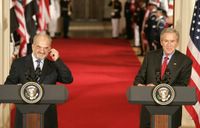 | THE PRESIDENT: Thank you very much. Mr. Prime Minister, I am honored to welcome you to the White House. As the leader of Iraq's first democratically elected government in more than 50 years, |
I told the Prime Minister that the American people share his democratic vision for Iraq. I told him of our nation's deep and abiding respect for Islam, for the people of Iraq, and for the potential of the nation that now belongs to them.
Today we meet at a critical moment in the history of this proud nation. In just a few days, we will mark the first anniversary of the return of Iraq to its people. In the year since then, the Iraqis can take credit from [sic] some extraordinary achievements in the face of tremendous challenge.
Seven months after resuming sovereignty over their nation, the Iraqi people defied the car bombers and assassins to hold their first free elections in a half century. In April, the newly elected Transitional National Assembly formed a government and appointed Dr. Jaafari as the Prime Minister. This month, after a spirited debate, the Iraqis reached an agreement to expand their constitutional drafting committee to include more Sunni Arabs, so that this important community also has a strong voice in shaping the future of their country.
The Prime Minister and I discussed the important work the Iraqis have before them in the months ahead. This work includes drafting a permanent constitution for a free Iraq, submitting it to the Iraqi people for approval, and then holding new elections to choose a constitutional government. These are monumental tasks -- yet at every step of the way so far, the Iraqi people have met their strategic objectives -- and the terrorists have failed to stop them. I commend Prime Minister Jaafari and his fellow Iraqis for their hard work and courage. And I'm confident that the Iraqi people will continue to defy the skeptics as they assume greater responsibility for their security and build a new Iraq that represents their diversity.
The way ahead is not going to be easy. The killings and roadside bombings that we see underscore that freedom in Iraq is opposed by a violent and ruthless enemy with no regard for human life. The enemy includes former members of Saddam Hussein's regime, the enemy includes criminal elements, and the enemy includes foreign terrorists. The terrorists are fighting in Iraq because they know a free Iraq in the heart of the Middle East will deal a severe blow to an ideology that lives on oppression and fear. By securing Iraqi democracy, we will make America and our friends and allies around the world safer.
The enemy's goal is to drive us out of Iraq before the Iraqis have established a secure, democratic government. They will not succeed. Our goal is clear: a democratic and peaceful Iraq that represents all Iraqis. Our troops will continue to train Iraqi security forces so these forces can defend their country and to protect their people from terror. And as Iraqis become more capable in defending their nation, our troops will eventually return home with the honor they have earned.
As the Iraqi people stand up for their freedom, they know that the free world is now standing with them. Earlier this week, more than 80 countries and international organizations came together in Brussels to discuss how to help Iraq provide for its security and rebuild its country. And next month, donor countries will meet in Jordan to discuss Iraqi reconstruction.
I appreciate Prime Minister Jaafari's brave leadership. Prime Minister Jaafari is a bold man. I've enjoyed my discussions with the Prime Minister. He is a frank, open fellow who is willing to tell me what's on his mind. And what is on his mind is peace and security for the people of Iraq, and what is on his mind is a democratic future that is hopeful.
I want to thank you for your courage. I want to thank you for your understanding about the nature of free societies. I want to thank you for helping Iraq become a beacon of freedom.
Prime Minister Jaafari's visit comes at an important time. I want to thank you for coming.
PRIME MINISTER JAAFARI: Thank you very much.
PRESIDENT BUSH: Welcome.
PRIME MINISTER JAAFARI: Thank you very much. I want to thank the United States people for their courage and commitment against terrorism, and for democracy in our country.
I visited hospitals in the past month in Turkey, Muthanna, and yesterday in Washington, D.C. There were Iraqis and American; they had suffered side by side; and they were on a common enemy -- terrorism. They were fighting for the security of Iraq, but also of Americans. This is not the time to fall back -- to fall back. We owe to those who have made sacrifices to continue toward the goals they fought for.
I see from up close what's happening in Iraq, and I know we are making steady and substantial progress. People said Saddam would not fall, and he did. They say the election would not happen, and they did. They say the constitution will not be written, but it will. And the political process is worth a thousand tanks. Including the Sunni Arabs will further undermine the terrorists. They have joined the parliamentary committee and the government, and they will take part in the next elections.
(As translated.) Another time I would like to thank and commend Mr. President for his hospitality and his receiving me here, and for the subjects we discussed together. And also he was frank and transparent and he gave me very good feelings towards the people in Iraq. I would also like to thank the American people for standing beside the Iraqi people, going through these difficult times. No doubt our people will never forget those who stand beside Iraq, particularly at these terrible times. We do appreciate the assistance given by America during the present period of time in particular. There is a great achievement in Iraq, there is democracy in Iraq, and the people in Iraq defied terrorism and they refused to accept any dictatorship.
There is about 30 percent of women participating, and this is an example of democracy in Iraq and in the region, even in the whole world. There are six women Ministers in my government, and it is my intention to add one more woman to be deputy to the Prime Minister.
In the new Iraq, there is progress on more than one aspect, even though, again, it's all the challenges we have, particularly in security. Even though there is a lot of infiltration from the countries adjacent to Iraq, moving from inside Iraq itself, but there is a will in Iraq to secure security. And so the bombing in Iraq has been reduced a lot. And we are making great progress, and we depend on our security forces, multi-national forces also who work with us support us, but the responsibility in the front line is for the Iraqis and everything is making progress quantitatively and qualitatively.
We want to secure love instead of hatred in our country, coexistence and cooperation in Iraq instead of cursing each other. The whole people of Iraq would like to continue the democracy in Iraq and they will fight for achieving it. So many people said that democracy will never stand in Iraq, said that elections will never be held in Iraq, and they said also that the government will never be established in Iraq, and they said there would be no constitution -- but everything will be there and the whole world will see that changes in Iraq happen because of the great will of the people of Iraq and the countries that are assisting us.
We want fraternal relations with all the countries of the world and the adjacent countries keeping our sovereignty against all infiltration from the borders of Iraq. We want goodness for all countries of the world and wish you all the best for the American people. Thank you, very much. Thank you, very much.
PRESIDENT BUSH: Thank you, Mr. Prime Minister. What we'll do now is we'll ask a question -- answer a question from the American side and then one from the Iraqi side. Thank you, we'll be there in a minute. And then -- we'll have two a side, in other words.
I will start with Kelly O'Donnell.
Q Thank you, Mr. President. On Iraq, sir, the Vice President has described the conditions there, regarding the insurgency as being in its last throes. General Abizaid said there has been no significant change over the last six months. Your spokesman said you agreed with the Vice President's assessment. Can you help the American people understand these two different views that are coming forward -- one from the administration, one from top commanders -- when your spokesman tells us every day you get your information directly from those top commanders?
PRESIDENT BUSH: I do get briefed by our top commanders, as does the Vice President. As a matter of fact, about two hours ago, General Abizaid briefed the Vice President and myself and the Secretary of Defense about what is taking place on the ground. And there's no question there's an enemy that still wants to shake our will and get us to leave. And they're willing to use any means necessary. They try to kill -- and they do kill innocent Iraqi people, women and children, because they know that they're -- the carnage that they wreak will be on TV. And they know that they are -- they know that it bothers people to see death -- and it does, it bothers me, it bothers American citizens, it bothers Iraqis. They're trying to shake our will. That's what they're trying to do. And so of course we understand the nature of that enemy.
We also understand that there is reason to be optimist -- optimistic about what's taking place. The very same commanders that say that these folks are terrible killers are also reminding us that we're making good progress. On the one hand, you just heard the Prime Minister talk about a new democracy. Remember, the killers tried to intimidate everybody so that they wouldn't vote. That was their tactic. If you look back at the history of our involvement in Iraq, there was a lot of bombings and killings prior to the elections. What they were trying to do is say, let's shake the will of not only the Americans, but the Iraqi citizens. And -- but nevertheless, the Iraqi citizens wouldn't have their will shaken.
So we're optimistic. We're optimistic that more and more Iraqi troops are becoming better trained to fight the terrorists. We're optimistic about the constitutional process. There is a political track that's moving forward in parallel with the security track. No question about -- it's difficult. I mean, we hear it every day, of course. So do you, you report it every day. It's tough work. And it's hard. The hardest part of my job is to comfort the family members who have lost a loved one, which I intend to do when I go down to North Carolina on Tuesday.
But nevertheless, progress is being made, and the defeat of the enemy -- and they will be defeated -- will be accelerated by the progress on the ground in Iraq that -- the establishment of a democratic state that listens to the hopes and aspirations of all the people in Iraq will lead to the defeat of this enemy. And so that's what this administration believes, and we firmly believe it is going to happen.
Would you like to call on somebody from the Iraq press?
PRIME MINISTER JAAFARI: Yes, yes.
PRESIDENT BUSH: Who would you like to call on? Better pick one.
Q My first question is, Mr. Bush, we heard here that there are members of the Congress and the Senate, they are asking for a schedule for withdrawing your troops from Iraq. Have you discussed this with the government of Iraq or will it be left to the government to decide?
Mr. Jaafari, it was said in the streets of Iraq that the administration of America is pressurizing your government through the visit of Ms. Rice in Iraq. Is there a reaction to that with President Bush?
PRESIDENT BUSH: Thank you. You've picked up a good American trick, which is to ask two questions. (Laughter.) Congratulations. There's not going to be any timetables. I mean, I've told this to the Prime Minister. We are there to complete a mission, and it's an important mission. A democratic Iraq is in the interest of the United States of America, and it's in the interest of laying the foundation for peace. And if that's the mission, then why would you -- why would you say to the enemy, you know, here's a timetable, just go ahead and wait us out? It doesn't make any sense to have a timetable. You know, if you give a timetable, you're -- you're conceding too much to the enemy.
This is an enemy that will be defeated. And it's -- so I'm not exactly sure who made that proposition, but I would -- you don't have to worry, Mr. Prime Minister, about timetables. And we want to work with you to continue to build up the Iraqi forces. See, success will happen in Iraq when the political process moves forward, like it is. Again, I remind you all, maybe four months -- anyway, the beginning of the winter, there was a lot of people here in the country that never thought the elections would go forward. They thought the enemy had the upper hand because of the death and destruction that we saw on our TV screens. They said, well, can't possibly be elections. The Iraqi people don't want to be free. And, you know, these killers are going to stop the elections. And sure enough, over 8 million people voted because they do want to be free. And so success will occur as this political process continues to move forward. And we spent time talking about making sure that Sunnis were a part of the process.
We made sure we talked about making sure that people's points of view are represented, making sure that we stay on -- the only timetable that I think is going to -- that I know is out there is the timetable that says let's have the constitution written by a certain date, and let's have it ratified by a certain date, and let's have the election by a certain date. That's the timetable. And we're going to stay on that timetable. And it's important for the Iraqi people to know we are.
And the second track is to have Iraqis take the fight to the enemy. And we're slowly but surely getting this training completed. And so we spent time today not only hearing about the conditions on the ground and the nature of the enemy from Generals Abizaid and General Casey, but we also talked about progress in the training mission. And we are making good progress when it comes training Iraqis. One of the interesting statistics as to whether or not the Iraqis want to join the fight is whether or not they're able to recruit Iraqis to join the army. And recruitment is high. In other words, Iraqis do want to be a part of the process.
And so part of the coalition's job is to give these Iraqi units the training necessary to be able to fight the terrorists. That's our strategy. And it is working and it is going to work, for the good of the country.
Now, he asked you a question, and it's a very intelligent --
PRIME MINISTER JAAFARI: As for the second question on the visit of Ms. Rice, Condoleezza Rice to Iraq, the general impression of that visit was a general review for the situation there. It was a time for us that so that -- that gave support at Brussels, and I think they played a great role that the greater opportunity for the Iraqis as a big party. And as for the program and the ministers who attended, they all spoke in the interests of Iraq, and we thanked her very much for the efforts she made. And I spoke about the preparation for her and what she can present us of services to Iraq. And I believe she played a great role and will play a great role in Brussels, and I hope the recommendations will reflect on the donor countries so that we get the interest to the Iraqi people, particularly for the services. Thank you.
Q Thank you, Mr. President. Declining public support for the mission in Iraq and the lack of progress on some of your domestic priorities has prompted suggestions that you're in something of a second term slump. Do you worry --
PRESIDENT BUSH: A quagmire, perhaps. (Laughter.)
Q You can choose the word, sir. Do you worry at all about losing some of your ability to drive the agenda, both internationally and domestically?
And Mr. Prime Minister, if I may, does the decline in American support for the mission in Iraq have any impact on your government and the people of your country?
PRESIDENT BUSH: No, I appreciate the polls, the question about the polls. Look, this is a time of testing. And it's a critical time. We're asking Congress to do -- to take on some big tasks domestically. I fully understood when I went into the Social Security debate that there would be a lot of people that wished we hadn't have brought it up. I knew that. I mean, after all, there are some who, in Congress, that would rather not take on the tough issue, make -- they're afraid if you take on a tough issue, it will make it harder to get reelected.
And so I'm not surprised that there is a, kind of a reaction, the do-nothing reaction in Congress toward Social Security, and I'm not surprised the American people are saying, I wonder why nothing is getting done. You know, they see a problem and they're wondering why people won't step up and solve the problem. So I'm not surprised about -- that there's a -- people are balking at doing big things. I do think we'll get an energy bill that will be good, and show the American people finally we're willing to put an energy strategy in law that will help us conserve more and diversify away from hydrocarbons and develop technologies that will enable us to burn coal cleanly, for example.
Overseas, the idea of helping a country that had been devastated by a tyrant become a democracy is also a difficult chore, and it's hard work, particularly since there's an enemy that is willing to use suicide bombers to kill. It's hard to stop suicide bombers, and it's hard to stop these people that, in many cases, are being smuggled into Iraq from outside Iraq. It's hard to stop them. And yet they're able to do incredible damage. They're damaging not only -- you know, they're obviously killing Americans, but they're killing a lot more Iraqis. And their whole attempt is to frighten the people of both our countries. That's what they're trying to do.
In other words, they figure if they can shake our will and affect public opinion, then politicians will give up on the mission. I'm not giving up on the mission. We're doing the right thing, which is to set the foundation for peace and freedom. And I understand why the al Qaeda network, for example, is to terrified about democracy, because democracy is the opposite of what they believe. Their ideology is one of oppression and hate. Democracy is one that lifts up people and is based upon hope.
I think I said at this press conference here in the East Room, you know, it's like -- following polls is like a dog chasing his tail. I'm not sure how that translates. But my job is to set an agenda and to lead toward that agenda. And we're laying the foundation for peace around the world.
Iraq is a part of the agenda. There's going to be -- there were elections in Lebanon. We hope Egypt has free and open elections. My dream is that there be a Palestinian state living side by side in peace with Iraq. I noticed our former ambassador to Afghanistan is with us, who is now going to be the ambassador to Iraq. Afghanistan is a hopeful story. It's still difficult because, again, there are terrorists there associated with this -- the likes of -- or are a part of the al Qaeda network that is interested in stopping the advance of democracy because democracy is -- will be a part of their defeat and demise.
PRIME MINISTER JAAFARI: Thank you very much. As for the question on the reduction of support, Iraq's -- the Iraqi people had a specific request which is toppling down Saddam Hussein for reasons relating to their dignity and their policy -- their politics. And after Saddam Hussein was removed, through the different efforts of international efforts and Iraqis, this was achieved. Right now we have another danger, which is terrorism, which is against not only the Iraqi people but all the world of the country -- of the world, and at any time, doesn't have any particular land, but it works everywhere. Geography of terrorism is the human beings, themselves. And those people who are doing it are the enemies of humanity.
Once they do it in Washington, once in Spain, once in Iraq, so fighting the terrorism, and limiting their impact and in order to keep the human dignity and civilization requires that we all act together. It's not only the duty of Iraqi people but other countries, as well. As you know, Iraq is rich in oil, in water, in cultivation, as strategy and (inaudible), and also -- but because of the exception of circumstances of Iraq, now it has become a poor country, so we have to have the impact and the support from other countries.
The success of our Iraqi people is your own success. The people of Iraq is civilized. I look forward to support from all other countries of the world. You have given us something more than money -- you have given us a lot of your sons, your children that were killed beside our own children in Iraq. Of course this is more precious than any other kind of support we receive. You have to be proud before your own people that you presented us for the maintenance of democracy in Iraq and to remove the dictatorship. We do not forget those who stood beside us at hard times, and they are decided to go forward. And there is a lot of difference between one month and another, between one week and another. Iraqi people are insistent on going along the path for their economy and their security, but we do need the help of other countries who will help us, to stand beside us.
Thank you.
PRESIDENT BUSH: Final question, Mr. Prime Minister. Would you --
Q Mr. Prime Minister, I am a presenter on radio in Iraq. My question is for you. For more than two years we've started a change in Iraq, but the process of building is very slow. There are secure cities in Iraq, Samarra and Kurdistan. When will you begin the reconstruction in Iraq? When do we begin to establish the first bases of reconstruction? And you know that if you started reconstruction in Iraq it will mean that young people will have something to do, and they will leave terrorist activities. So the question is for Mr. Prime Minister. There were discussions held with the President Bush, and the most important thing you discussed with him we want to know about it.
PRESIDENT BUSH: Sometimes we don't tell you things, you know. (Laughter.) No, we discussed a lot of important things. We discussed democracy, we discussed having the constitution there, and we discussed security, we discussed reconstruction.
We are spending reconstruction money, but, you know, you need to ask that to the government. They're in charge. It's your government, not ours. This is the government that is -- that has got the ministries in place that spends the money. We're willing to help, and we have helped. And I want to thank the Congress and the American people for their generosity in helping Iraq rebuild. And we're spending money.
But, remember, your question kind of made it seem like -- that we're in charge. We're not. You had elections; 8.5 million people voted, and this good man is now in charge of the government. I don't want to be passing the buck, as we say, but we're more than willing to help reconstruction efforts, but this is a sovereign government --
PRIME MINISTER JAAFARI: Thank you, very much.
PRESIDENT BUSH: -- with an elected Prime Minister by the people of Iraq. And so we want to look forward to working with the government. Our role is to help. His role is to govern and lead. And we've got the money allocated. Obviously, it's important to get electricity to the Iraqi citizens and clean water to the Iraqi citizens. And, you know, I was pleased to see the other day when I was reading that there's a lot of air traffic in and out of the airport now, quite a lot of air traffic. In other words, there's commerce beginning to develop. We want to be helpful. But the responsibility rests with the people who the Iraqi people elected. And that's you, Mr. Prime Minister.
PRIME MINISTER JAAFARI: Thank you, Mr. President. Of course, there were many points discussed with the President, Mr. Bush, in our special meeting, and we talked about so many facts. It was the first meeting between us, so we talked directly about the democracy in Iraq and the constitution, the achievement of the constitution, and we decided to continue the case of security until everything is well established.
And at the same time, we thought that there is a Marshall project after the Second World War that contributed -- the U.S. contributed in that and in the Truman's government when they presented assistance to the German people. German people had selected Hitler in a democratic process that had a 98 percent result, however, we are quite happy with this hospitality of the U.S. So Germany was able to work.
The Iraqi people did not elect Saddam Hussein. In fact, they suffered a lot from Saddam Hussein before he attacked the geographical adjacent countries. He took their money before he took the money of Kuwait. He occupied Kuwait, in fact, as he did, and there is a lot of indications to tell us that the Iraqi people are innocent of all that had happened. They have to pay off their -- so many debts, and we hope that all countries will stand beside us to correct this unexceptional [sic] situation. They did not commit any crime against any people, they are peaceful. But it was Saddam Hussein who committed the crimes. And he brought about so many debts and losses to the Iraqi people.
We look forward to the international community to stand beside us, and we believe that this is a humanitarian stance. And we hope that Mr. Bush will try to redo a Marshall Plan, calling it the Bush Plan, to help Iraq, to help the Iraqi people. And this would be a very wonderful step that they stand beside us.
PRESIDENT BUSH: Thank you, Mr. Prime Minister. Thank you all. Thank you.
END 12:04 P.M. EDT Office of the Press Secretary June 24, 2005 For Immediate Release
0
comments
||
||
SVBIED hits Marine convoy in Fallujah
SVBIED hits Marine convoy in Fallujah
CAMP FALLUJAH, Iraq – A convoy carrying Marines assigned to II Marine Expeditionary Force (Forward) was attacked with a suicide vehicle-borne improvised explosive device last night in Fallujah, Iraq.
A number of casualties were sustained.
More information will be released when it becomes available. -30-
For more information, contact Multi-National Force-West public affairs at mnfwcepaowo@cemnf-wiraq.usmc.mil . Source: MNFI June 24, 2005 Release A050624b
0
comments
||
||
NAZI GUARD JOHN DEMJANJUK IS RULED REMOVABLE
FORMER NAZI GUARD JOHN DEMJANJUK IS RULED REMOVABLE FROM THE UNITED STATES
WASHINGTON, D.C. - Acting Assistant Attorney General John C. Richter of the Criminal Division announced today that Chief U.S. Immigration Judge Michael J. Creppy has found John Demjanjuk, 85, removable from the United States on the basis of his service during World War II as an armed guard at a Nazi extermination camp and two concentration camps in German-occupied Poland and his subsequent concealment of that service when he immigrated to the United States.
As a former guard at the Sobibor extermination camp, Demjanjuk - a retired auto-worker from Cleveland, Ohio - is only the second person ever brought to court in the United States for having served at one of the four Nazi camps constructed solely to murder people.
Chief Judge Creppy’s decision last week follows the government’s successful prosecution of its denaturalization case against John Demjanjuk in federal court. In 2002, following trial, Chief Judge Paul R. Matia of the U.S. District Court for the Northern District of Ohio ruled that the government had proved that Demjanjuk was an armed guard at Sobibor, where 250,000 men, women, and children were murdered; at the Majdanek concentration camp, where at least 170,000 civilians died; at the Flossenbürg concentration camp, where some 30,000 civilians perished; and a member of a unit trained at the Trawniki Training Camp to implement “Operation Reinhard,” the Nazi program to dispossess, exploit, and murder Jews in Poland. Judge Matia specifically found that Demjanjuk participated in “the process by which thousands of Jews were murdered by asphyxiation with carbon monoxide” in the camp gas chambers at Sobibor. Judge Matia’s decision to revoke Demjanjuk’s U.S. citizenship was upheld by a federal appeals court last year, and the government commenced removal (deportation) proceedings on Dec. 17, 2004.
In his 16-page decision, Chief Judge Creppy, citing Judge Matia’s conclusive findings, noted that Demjanjuk’s actions “prevented the escape of the prisoners being held captive and who were left at the disposition of the Nazis,” thus subjecting them to “terrible abuse and almost certain death.” He ruled that Demjanjuk was therefore removable from the United States as an alien who participated in Nazi-sponsored persecution on the basis of race, religion, national origin, or political opinion. Still to be decided by Chief Judge Creppy is the country to which Demjanjuk is to be removed. He will also rule on any application that Demjanjuk may file for deferral of removal, which he ordered must be filed prior to the next hearing in the case, scheduled for June 30, 2005 in the U.S. immigration court in Cleveland.
“John Demjanjuk’s role in helping to doom thousands of Jews to annihilation in Sobibor’s gas chambers renders him singularly unworthy of continued residence in this country,” said Eli M. Rosenbaum, Director of the Justice Department’s Office of Special Investigations (OSI), which investigated and prosecuted the case. “His participation in the ghastly crimes of the Holocaust renders him unfit to remain here, and the government will seek to remove him as expeditiously as possible.”
The deportation case was litigated by OSI Senior Trial Attorney Stephen Paskey. Since OSI began operations in 1979, it has won cases against 100 individuals who assisted in Nazi persecution. In addition, more than 170 individuals who sought to enter the United States in recent years have been blocked from doing so as a result of OSI's “Watch List” program, which is enforced in cooperation with the Department of Homeland Security
### FOR IMMEDIATE RELEASE MONDAY, JUNE 20, 2005 Source: USDOJ.GOV CRM(202) 514-2008 TDD (202) 514-1888 05-326
0
comments
||
||
Temporary Foreign Worker Visa Program
Department of Labor Finds Tennessee Doctor Guilty Of Violating Temporary Foreign Worker Visa Program, Required to Pay Over $1 Million in Back Wages
WASHINGTON - The U.S. Department of Labor's Administrative Review Board (ARB) has ruled that 17 physicians, hired to work in rural Tennessee clinics under the Immigration and Nationality Act's H-1B visa program, are due over $1 million in back wages. The ARB also upheld the assessment of over $100,000 in civil money penalties for “willful” violations of the law.
“The Department of Labor is committed to ensuring that workers are protected,” said Secretary of Labor Elaine L. Chao. “As this case shows, abuse of the temporary foreign worker program will not be tolerated and violators will be aggressively pursued.”
The ARB also ruled that Dr. Mohan Kutty, corporate owner of the now-defunct medical clinics where the doctors worked, was personally liable for the back wages and civil money penalties. The review board determined that Kutty could not hide behind the clinics' corporate status to avoid liability. In addition, Kutty was ordered to reimburse the doctors for certain business expenses they incurred as a part of the visa hiring process.
The department also found that Kutty violated the statute's anti-retaliation provision by refusing to pay physicians who complained about wage violations and firing seven physicians on the same day that an investigator from the department's Wage and Hour Division arrived at the office to examine records. The ARB debarred Kutty from participating in the visa program for two years.
The H-1B visa program permits employers to temporarily hire nonimmigrants to fill specialized jobs in the United States. An employer must pay an H-1B worker at least the same wage it pays other employees who perform the same type of work or the prevailing wage in the area.
Information about the H-1B visa program's worker protection provisions may be obtained by calling the Department of Labor's toll-free helpline at 1-866-4USWAGE (1-866-487-9243). Information is also available on the Internet at wagehour.dol.gov. more at Temporary Foreign Worker Visa Program ESA News Release: [06/22/2005] Contact Name: Dolline Hatchet, Phone Number: 202-693-4650, Release Number: 05-1072-NAT
0
comments
||
||
Highway, Transit Spending Bill
Mineta Says Nation Needs Action on Highway, Transit Spending Bill; Proclaims Overnight Developments in Congress Encouraging
News this morning from Washington that Congress may be making progress on a new six-year highway and transit spending bill is encouraging, U.S. Transportation Secretary Norman Y. Mineta said today during a visit to a factory that builds rail locomotives in Boise, ID.
“It’s time to send a fiscally responsible bill to the President and get the country’s highway, transit and safety projects on track and moving,” Mineta said. The seventh extension of the last spending bill expires June 30th at midnight.
Mineta spoke to reporters following a visit to Boise’s MotivePower plant, where workers build and refurbish locomotives used to pull freight and commuter trains.
He said the massive six-year surface transportation bill provides record amounts of funding for highway, transit and safety programs, and pushed Congress to end the uncertainty caused by almost two years of delay in approving a new plan.
“There is no telling how many long-term projects have been affected … or how many potential orders for locomotives produced here in Boise have been missed,” he said.
Mineta said at least two transit agencies have had to spend hundreds of thousands of dollars to support interest payments on loans to cover construction costs while waiting for passage of a bill.
“I am hopeful that today’s news means we are close,” Mineta said. “That would be encouraging because the President is tired of waiting. I am tired of waiting. And the American people are tired of waiting,” Mineta said. ###
Source; DOT 90-05 Friday, June 24, 2005, Contact: Robert Johnson, Tel.: (202) 366-4570
0
comments
||
||
Treasury and IRS Issue Draft Version of 2005 Schedule M-3 and Instructions for Corporate Tax Returns
Treasury and IRS Issue Draft Version of 2005 Schedule M-3 and
Instructions for Corporate Tax Returns
Today, the Treasury Department and Internal Revenue Service released a draft version of the 2005 Schedule M-3, Net Income (Loss) Reconciliation for Corporations with Total Assets of $10 Million or More, and related instructions for use by certain corporate taxpayers filing Form 1120, U.S. Corporation Income Tax Return. The 2005 Form 1120 Schedule M-3 is for use with Form 1120 returns filed for calendar year 2005, fiscal years that begin in 2005 and end in 2006, and tax years of less than twelve months that begin and end in 2006.
The draft 2005 Schedule M-3 includes two new line items – one line for the new domestic production activities deduction and another line for interest expense. The draft 2005 Schedule M-3 also reflects other minor modifications to the 2004 Schedule M-3 that are described in the "What's New" section of the draft 2005 Schedule M-3 instructions. The draft 2005 Schedule M-3 instructions reflect the Schedule M-3 Frequently Asked Questions that are posted weekly on irs.gov.
The Treasury Department and IRS do not anticipate any further changes to the draft 2005 Schedule M-3 and instructions and expect that the final version of the form and instructions will be available this fall and posted on irs.gov.
Comments are requested regarding the draft 2005 Schedule M-3 and instructions. Comments should be submitted by August 31, 2005, to:
Judy McNamara Internal Revenue Service 860 E. Algonquin Road Schaumburg, IL 60173 Email address: PFTG2@irs.gov (Preferred) Telephone number: 312-566-2001, Ext. 9380
The Schedule M-3 and related instructions are attached and may be accessed on irs.gov or irs.gov/businesses/corporations/.
REPORTS In PDF Format
Draft 2005 Schedule M-3
Draft 2005 Schedule M-3 instructions
FROM THE OFFICE OF PUBLIC AFFAIRS, June 23, 2005, JS-2506
0
comments
||
||
President Discusses CAFTA-DR with Bipartisan Leaders
President Discusses CAFTA-DR with Bipartisan Leaders, Dwight D. Eisenhower Executive Office Building Room 450
President's Remarks Full Streaming Video 1:43 P.M. EDT
 | THE PRESIDENT: Thank you all for coming. Please be seated. (Laughter.) I want to thank the Democratic and Republican leaders who have come here today to support the Central American- Dominican Republic Free Trade Agreement, known as CAFTA. |
| As you can see, there are former Cabinet members of both Republican and Democrat Presidents, former staff members of Republican and Democrat Presidents, people who have said it is time to set aside political differences and focus on this very important trade agreement for the good of our country. |  |
I particularly want to say thanks to Ambassador Rob Portman, who is the U.S. Trade Representative. He is the point person in the Bush administration to get this bill passed. He's working hard, he's working smart, and with your help and the help of those on the stage, I'm confident that Congress will do the right thing.
The reason we're here is because we share an interest in promoting opportunity and prosperity here at home. All of us understand that strengthening our economic ties with our democratic neighbors is a vital issue of national importance. All of us urge Congress to pass the agreement, because America has an interest in strengthening democracy and advancing prosperity in our hemisphere.
One of the surest ways to strengthen democracy and advance prosperity is by establish a trading system based on clear rules. My predecessors from both parties, former Presidents from both political parties, pursued this goal at all levels -- at the global level, at the bilateral level, and at the regional level.
Today, CAFTA presents us with an historic opportunity to advance a free and fair trading system that will bring benefits to all sides. I want to thank the members of the Diplomatic Corps from Central America who have joined us today, los embajadores. Bienvenidos. Thank you for coming.
These ambassadors understand what I just said. I said, this trade agreement benefits both sides. It's a good deal for the CAFTA countries and it's a good deal for America, as well. It's a good deal for America because CAFTA will help level the playing field for our goods and services. Under existing rules, nearly 80 percent of imports from Central America and the Dominican Republic already enter the United States duty free. But U.S. exports into the region face heavy tariffs. Let me repeat that: 80 percent of goods produced in Central America come into our country, come into the United States, duty free, yet the same isn't -- it's not the same for American products.
By passing CAFTA, the United States would open up a market of 44 million consumers for our farmers and small business people and entrepreneurs. By lowering barriers in key segments like textiles, CAFTA will put our region in a better position to compete with low-cost producers in Asia.
For the young democracies of Central America and the Dominican Republic, CAFTA would continue the current trade benefits. That means good jobs and higher labor standards for their workers. And because of reduced tariffs on U.S. goods, consumers in these countries would have access to better goods at lower prices. And that brings us a step closer to our goal of an Americas where the opportunities in San Jos , Costa Rica are as real as they are in San Jose, California.
People have got to understand that by promoting policy that will help generate wealth in Central America, we're promoting policy that will mean someone is less -- more likely to stay at home to find a job. If you're concerned about immigration to this country, then you must understand that CAFTA and the benefits of CAFTA will help create new opportunity in Central American countries, which will mean someone will be able to find good work at home, somebody will be able to provide for their family at home, as opposed to having to make the long trip to the United States. CAFTA is good immigration policy, as well as good trade policy.
And it's good geopolitics, as well. For the western hemisphere, CAFTA would bring the stability and security that can only come from freedom. That's what we're interested in -- we're interested in spreading freedom. Today, a part of the world that was once characterized by oppression and military dictatorship sees its future in democratic elections and free and fair trade, and we cannot take these gains for granted. These small nations are making big and brave commitments, and America must continue to support them. And CAFTA is a good way to support them. CAFTA is good for our workers, it's good for our farmers, it's good for our small business people -- but it's equally as good for the folks in Central America.
By transforming our hemisphere into a powerful trading area, CAFTA will help promote democracy, security and prosperity. The United States was built on freedom, and the more of it we have in our own backyard, the freer and safer and more prosperous America will be. The leaders from both parties here today share this vision.
These folks, who toiled in the vineyards of good international politics and worked in the White House know exactly what I'm talking about. That's why they're standing up here, and saying with a common voice to the United States Congress, let's get this bill passed. See, CAFTA is more than a trade agreement, it is a signal of our nation's commitment to democracy and prosperity for the entire Western Hemisphere. And I urge and we urge the United States Congress to pass CAFTA.
Thanks for coming. (Applause.)
END 1:49 P.M. EDT For Immediate Release Office of the Press Secretary June 23, 2005
0
comments
||
||
7 Nominations Sent to the Senate 06/23/05
Nominations Sent to the Senate
Steven G. Bradbury, of Maryland, to be an Assistant Attorney General, vice Jack Landman Goldsmith III, resigned.
Kent R. Hill, of Virginia, to be an Assistant Administrator of the United States Agency for International Development, vice E. Anne Peterson, resigned.
Colleen Duffy Kiko, of Virginia, to be General Counsel of the Federal Labor Relations Authority for a term of five years, vice Peter Eide.
Stephanie Johnson Monroe, of Virginia, to be Assistant Secretary for Civil Rights, Department of Education, vice Gerald Reynolds.
Granta Y. Nakayama, of Virginia, to be an Assistant Administrator of the Environmental Protection Agency, vice John Peter Suarez, resigned.
Mary M. Rose, of North Carolina, to be a Member of the Merit Systems Protection Board for the term of seven years expiring March 1, 2011, vice Susanne T. Marshall, term expired.
Peter Manson Swaim, of Indiana, to be United States Marshal for the Southern District of Indiana for the term of four years, vice James Lorne Kennedy, resigned.
# # # For Immediate Release Office of the Press Secretary June 23, 2005
0
comments
||
||
Thursday, June 23, 2005
next generation of secure wireless networks
Sandia develops secure wireless technology, Project considered milestone for next generation of secure wireless networks
ALBUQUERQUE, N.M. - Sandia National Laboratories in cooperation with Time Domain Corporation and KoolSpan Inc. has developed a secure wireless Ultra Wideband (UWB) data communication network that can be used to help sensors monitor U.S. Air Force bases and DOE nuclear facilities and wirelessly control remotely operated weapon systems.
The new wireless technology also promises to be a gateway for a new generation of advanced sensors created by fusing UWB communication with UWB radar and used to detect intrusion of adversaries or insurgents for the protection of tactical forces and forward bases such as those deployed in the Middle East or Iraq. This is of particular value to the U.S. Air Force Electronic Systems Center (ESC) whose mission is to provide the latest in command, control, and information systems for the Air Force and who sponsored the work.
This secure form of wireless communication developed for practical use leverages UWB with the unyielding encryption protection of the 256-bit Advanced Encryption Standard (AES) to form UWB/AES. In an age of electromagnetic warfare and increasing threat from malevolent radio frequency (RF) attacks from high-tech adversaries, UWB is of strategic value providing stealth for covert operation by hiding within the noise floor to prevent detection and where other forms of RF communication find it virtually impossible to operate. UWB's probability of survival increases in a toxic RF battlefield when compared to many other forms of RF.
UWB, also known as "impulse radio," is different because it does not use a carrier as do other forms of RF for wireless networking or communication technologies. Instead UWB transmits a flood of ultra-short microwave pulses of energy on the order of 100 pico-seconds (one pico-second is one-millionth of one-millionth or 10-12 second) in duration that extend over an extremely wide band of energy covering several Gigahertz of frequency.
"With the spreading of impulse energy over such wide frequency spectrum, the signal power falls near or within the noise floor making these signals extremely difficult to detect, intercept or jam and, when combined with AES, virtually impossible to crack," says H. Timothy Cooley, senior scientific engineer at Sandia. "Utilizing the immense available spectrum of UWB also improves wireless performance to accommodate the increased data rate needed by advanced sensors."
Among the key wireless features of the UWB/AES are its IP network compatibility and its "per-packet" rotating 256-bit encryption keys for even greater crypto-protection. The UWB/AES network architecture requires no computing infrastructure, provides real-time (hardware) encryption, and requires zero maintenance for complete self-recovery if interrupted or when a sensor goes down.
Based on tests conducted at the KoolSpan Encryption Laboratory in Santa Clara, Calif. this spring, Sandia with KoolSpan demonstrated a wireless UWB network bridge with real-time 256-bit AES encryption for live-streaming video images generated from a surveillance camera or thermal imager. The tests used only microwatts of transmitted power approximately 1000 times less power than typically used by conventional wireless IEEE 802.11b or Wi-Fi. ###
Sandia is a multiprogram laboratory operated by Sandia Corporation, a Lockheed Martin company, for the U.S. Department of Energy's National Nuclear Security Administration. Sandia has major R&D responsibilities in national security, energy and environmental technologies, and economic competitiveness.
Release and images are available at: sandia.gov/wireless-security
Sandia media contact: Michael Padilla, mjpadil@sandia.gov, (505) 284-5325
Sandia technical contact: H. Timothy Cooley, htcoole@sandia.gov (505) 844-2077
Sandia National Laboratories' World Wide Web home page is located at sandia.gov/ . Sandia news releases, news tips, science photo gallery, and periodicals can be found at the News Center button. Contact: Michael Padilla mjpadil@sandia.gov 505-284-532 Sandia National Laboratories more at secure wireless networks or Wi-Fi.
0
comments
||
||
Air Force Officer MIA from Vietnam War Identified
Air Force Officer MIA from Vietnam War Identified
The Department of Defense POW/Missing Personnel Office (DPMO) announced today that the remains of a U.S. serviceman, missing in action from the Vietnam War, have been identified and returned to his family for burial on July 3 at Savannah Ga.
He is Air Force Capt. David J. Phillips Jr. of Miami Beach, Fla.
On July 3, 1966, Phillips was attacking enemy targets over Kien Giang Province, South Vietnam, when his F-5 “Freedom Fighter” was hit by enemy ground fire and crashed. Phillips was unable to eject from his aircraft before the crash, and radio contact was lost. Heavy enemy ground fire precluded a search at the time.
From 1993 to 2000, joint U.S.-Vietnamese teams conducted four investigations for information on Phillips’ disappearance. Interviews of 10 villagers over seven years led to the probable location of the crash site. One of the teams found fiberglass pieces that were consistent with the survival kit from the ejection seat on an F-5 aircraft.
During two excavations in 2003 and 2004, human remains, as well as aircrew-related artifacts and personal effects, were recovered by teams from the Joint POW/MIA Accounting Command (JPAC). Laboratory analysis of the remains by forensic scientists at JPAC led to Phillips’ identification.
Of the 88,000 Americans missing from World War II, the Korean War, the Cold War, the Vietnam War, and Desert Storm, 1,833 are from the Vietnam War, with 1,397 of those within the country of Vietnam. Another 750 Americans have been accounted for in Southeast Asia since the end of the Vietnam War. Of the Americans identified, 524 are from within Vietnam.
For additional information on the Defense Department’s mission to account for missing Americans, visit the DPMO website at http://www.dtic.mil/dpmo or call (703) 699-1169.
U.S. Department of DefenseOffice of the Assistant Secretary of Defense (Public Affairs)News Release On the Web: defenselink.mil/releases/2005/Media contact: +1 (703) 697-5131
Public contact: dod.mil/faq/comment or +1 (703) 428-0711 No. 632-05 IMMEDIATE RELEASE June 22, 2005 more at MIA or Vietnam War
0
comments
||
||
U.S.-Vietnam business and operating license agreements
COMMERCE SECRETARY CARLOS GUTIERREZ WITNESSES SIGNINGS OF BUSINESS AGREEMENTS BETWEEN U.S. AND VIETNAMESE COMPANIES
WASHINGTON , D.C. – Commerce Secretary Carlos M. Gutierrez and Vietnam Prime Minister Phan Van Khai today witnessed the signings of U.S.-Vietnam business and operating license agreements worth hundreds of millions of dollars, creating more than 5,000 jobs. The ceremony also marked the first U.S. visit by a Vietnamese Prime Minister in 30 years.
“These agreements demonstrate the enormous potential in our commercial relationship and highlight the growing economic partnership between the U.S. and Vietnam,” said Secretary Gutierrez. “The negotiations and contracts that these companies have undertaken are a historic occasion.”
Today’s event included signings of the following U.S. company business agreements and business operating licenses:
Prime Minister Khai presented -separately -to ACE INA International Holdings, Ltd. (PA) and to New York Life International (NY) a license for each to establish a wholly owned life insurance company in Vietnam.
The Boeing Company (IL) and Vietnam Airlines Corporation signed the Board and Government Approval Confirmation validating the final purchase agreement of four Boeing 787-8 Dreamliners.
Fluor Corporation (CA), Unocal International Corporation (CA) and Vietnam Oil and Gas Corporation (PetroVietnam) signed an Amendment to Contract, implementing the start of a major feasibility study on the development of a gas pipeline from the Gulf of Thailand to Vietnam. The study is being jointly funded by the U.S. Trade and Development Agency and Unocal.
Motorola Inc. (IL) signed a contract with Vietnam Post and Telecommunications Trading Joint Stock Company for telecommunications equipment to upgrade base stations in eight southern provinces in Vietnam.
### FOR IMMEDIATE RELEASE Tuesday, June 21, 2005 more at Carlos Gutierrez or Vietnam
0
comments
||
||
JOHANNS MAKES HUMANITARIAN FOOD RELIEF AVAILABLE FOR AFRICA
JOHANNS MAKES HUMANITARIAN FOOD RELIEF AVAILABLE FOR AFRICA
WASHINGTON, June 22, 2005 - Agriculture Secretary Mike Johanns today announced that USDA is releasing up to 500,000 metric tons of wheat from the Bill Emerson Humanitarian Trust as part of President Bush's Hunger Initiative to address the emergency food situation in Africa.
"I am pleased that USDA can be part of the compassionate and generous response of Americans in this time of need," said Johanns. "We have a long tradition of supporting the developing world. Through all our efforts to fight hunger and avert famine, we can spare people in many nations from suffering."
Agriculture Deputy Secretary Chuck Conner made the announcement in remarks to the 2005 U.S.-Africa Business Summit of the Corporate Council on Africa in Baltimore, Md. The United States will make available up to 500,000 metric tons of wheat from the Emerson Trust to relieve suffering and avert famine in Africa, especially in Ethiopia and Eritrea. USDA is taking this action as part of President Bush's pledge on June 7 to provide approximately $674 million of additional resources to respond to humanitarian emergencies in Africa, of which $414 million of those additional resources will be provided immediately to avert famine.
"Helping those who suffer and preventing the senseless deaths of millions of people in Africa is a central commitment of my administration's foreign policy," said President Bush at the White House announcement of the Hunger Initiative on June 7. "We're making historic progress and helping the poorest countries in Africa gain a fresh start, and to build a future of greater opportunity and prosperity. America will continue to lead the world to meet our duty in helping the world's most vulnerable people."
The wheat from the Emerson Trust will be shipped as emergency food relief under P.L. 480, Title II, a program administered by the U.S. Agency for International Development. It will be distributed mainly through the World Food Program and private voluntary organizations and is expected to arrive over the next few months.
The wheat, which will be provided in combination with vegetable oil, pulses and corn soy blend from the Title II account, will help to prevent famine and will feed 14.2 million people in Ethiopia and Eritrea. In these countries, rains have been insufficient, crops are poor and many people, particularly the young and the elderly, are suffering.
The Emerson Trust is an emergency food reserve available for humanitarian relief in developing countries and administered under the authority of the secretary of agriculture. The trust was reauthorized through 2007 by the Farm Security and Rural Investment Act of 2002. Prior to this release, the reserve held 1.4 million tons of wheat.
Last December, USDA allocated 200,000 tons of wheat from the trust to provide food to relieve suffering and avert famine in Sudan.
Release No. 0225.05 Contact: Ed Loyd (202) 720-4623 Lynn Goldsbrough (202) 720-3930 more at Mike Johanns and Hunger Initiative, or Africa
0
comments
||
||
North Korea -- U.S. Humanitarian Assistance
North Korea -- U.S. Humanitarian Assistance
The United States will donate agricultural commodities through the World Food Program and separately is prepared to support health and food security programs for the people of North Korea. Our objective is to help relieve the suffering of the North Korean people, despite our concerns about the North Korean government's policies.
The agricultural commodities will be 50,000 metric tons donated through the World Food Program’s 2005 emergency feeding operation. Funding for the 50,000 metric ton donation will come from the U.S. Agency for International Development's PL-480 Title II program. The mix of commodities for the donation will be determined in consultation with the World Food Program.
The United States is prepared to support targeted health interventions for children and small-scale food security projects in North Korea. We will be working with UN agencies and non-governmental organizations with activities in North Korea to identify targeted programs that will meet the needs of vulnerable groups.
U.S. decisions on humanitarian contributions are based on three criteria: demonstrated need, competing needs elsewhere, and humanitarian organizations’ ability to have access to all vulnerable groups and monitor the assistance. The World Food Program has informed us that it is attempting to implement a new food monitoring system to reduce the risk of diversion. However, even if this system is successfully implemented, North Korea would still fall short of meeting international standards of humanitarian access.
The United States again calls upon the North Korean government to improve humanitarian monitoring and access conditions in the country. Current restrictions imposed by the government continue to severely limit the ability of the international community to accurately determine the extent of humanitarian needs in the country and the locations of the most vulnerable populations. We will continue to work with the World Food Program and donor countries to urge North Korea to allow improved monitoring and access.
2005/645 Press Statement Adam Ereli, Deputy Spokesman Washington, DC June 22, 2005 Released on June 22, 2005 more at North Korea, or U.S. Humanitarian Assistance
0
comments
||
||
Wednesday, June 22, 2005
Lawrence Scott Charbo, Sue Ellen Wooldridge
President George W. Bush today announced his intention to nominate one individual and appoint one individual to serve in his Administration:
The President intends to appoint Lawrence Scott Charbo, of Virginia, to be Chief Information Officer at the Department of Homeland Security. Mr. Charbo currently serves as Chief Information Officer at the Department of Agriculture. Prior to that, he served as Director of the Office of Business and Program Integration at USDA. Before joining the Administration, Mr. Charbo was President of mPOWER3/Emerge in Greeley, Colorado. Earlier in his career, he was Director of Environmental and Regulatory Services for Tri-State Delta Chemicals, Inc. in Memphis, Tennessee. Mr. Charbo received his bachelor's degree from the University of Tampa and his master's degree from the University of Nevada, Reno.
The President intends to nominate Sue Ellen Wooldridge, of Virginia, to be Assistant Attorney General (Environment and Natural Resources Division) at the Department of Justice. Ms. Wooldridge currently serves as Solicitor for the Department of the Interior. Prior to that, she was Deputy Chief of Staff and Counselor to the Secretary at the Department of the Interior. Before joining the Administration, Ms. Wooldridge was General Counsel for the California Fair Political Practices Commission. Earlier in her career, she served as Special Assistant Attorney General, in the Office of the Attorney General at the California Department of Justice. Ms. Wooldridge received her bachelor's degree from the University of California, Davis and her J.D. from Harvard Law School.
Personnel Announcement # # # For Immediate Release, Office of the Press Secretary, June 20, 2005 more at Sue Ellen Wooldridge or Lawrence Scott Charbo
0
comments
||
||
Six Months after the South Asian Tsunami
Briefing on U.S. Assistance and Reconstruction Efforts Six Months after the South Asian Tsunami
U.S. Agency for International Development (USAID) Administrator Andrew Natsios will brief journalists on U.S. assistance and reconstruction efforts six months after the South Asian tsunami in the State Department Briefing Room (2209) on Thursday, June 23 at 9:45 a.m. This briefing is ON-THE-RECORD and ON-CAMERA.
Media representatives who plan to attend this briefing but do not have a State Department building pass must enter through the 23rd Street entrance of the State Department building by 9:00 a.m.
Attendees must present one of the following press credentials: (1) a U.S. Government-issued identification card (Department of State, White House, Congress, Department of Defense or Foreign Press Center), (2) a media-issued photo identification card, or (3) a letter from their employer on letterhead verifying their employment as a journalist, accompanied by an official photo identification (driver’s license or passport).
2005/644 Notice to the Press Office of the Spokesman Washington, DC June 22, 2005 Released on June 22, 2005 more at South Asian Tsunami
0
comments
||
||
Robert Zoellick American Foreign Service Association
Remarks at the American Foreign Service Association Annual Awards Ceremony
Robert Zoellick, Deputy Secretary of State, Benjamin Franklin Room
Washington, DC, June 21, 2005. (4:30 p.m. EDT)
DEPUTY SECRETARY ZOELLICK: Well first, let me thank AFSA and everyone at the State Department for the process of these awards and taking a moment out of what I know are very busy days to stop and recognize some very important achievements because all the people at the State Department do something very important: They represent the United States in every corner of the globe. And so whether it's actions with communities, whether it's actions with families in the post, whether it's offering dissent, whether constructive or not, makes it lively. You know, I think it's a very important aspect of what the State Department is about. And it's so easy amidst everything that people are doing and the hustle and bustle not to pause and to stop and thank and to recognize good performance, so let me just start again by offering, on behalf of the Secretary, a round of applause for all the people that have won these awards. (Applause.) So thank you.
It's a particular honor for me to be here today because of the next award winner is someone who started his public service career very, very early. So even though I feel I'm getting up a little bit in age now, he's someone who I've watched from the very start with a lot of admiration and respect. Senator Lugar, as probably most of you know, actually started as a young Naval officer, shortly after being a Rhodes Scholar, working for a very important CNO, as I recall, and that started a pattern of his service, which has been a combination of, I think, the best that America has to offer. He still has a farm. He's still got very much his "Midwestern roots," as we say, being from -- a neighbor of Illinois. He was a very, very successful mayor in Indianapolis, had some achievements not only in his tenure but structurally for Indianapolis that have set a model for many others. And, obviously, he's served in the Senate since 1976.
Now, in the Senate as well, he's mixed a number of different careers together. All of you obviously know about the critical role and interests that he's had in foreign policy. He's also been a key player in the world of agriculture, being Chairman of the Agricultural Committee and, frankly, where foreign policy and agricultural policy come together, trying to promote some free trade in agriculture, some better farming practices. And it's a dimension that I've actually had the opportunity to talk about Senator Lugar many, many times overseas because many people, as all of you know, when they think about the United States, they tend to think the international sort of corners of the country tend to be more on the coasts, and I've had to put out, actually, if you look at some of the great internationalists and people who are really pushing our agenda, they're often from the Midwest. And Senator Lugar is the model of the models. And that's in part because there's a view, particularly from the American agriculture community about connecting with the world, we have to keep pushing that and promoting that. So it's wonderful for me to have had a long friendship and association with someone who understands the need to connect our domestic and international policies in so many different ways.
Senator Lugar, obviously, has had a very strong interest in foreign affairs and foreign relations, but he's also been able to combine diplomatic missions. I remember one in the Reagan Administration, a critical one he did in the case of the Philippines. There's been others that he's been asked to do and I'm sure will be asked to do -- some even discussed today.
But also, he's combined that with something very valuable, which is working across the aisle to reach out to set some major policy decisions through the legislative process in his own very constructive way, the most notable one being Nunn-Lugar and its evolutions in terms of how we deal with proliferation at the end of the Cold War.
Another sort of personal sense, I've attended a number of meetings with Senator Lugar over the years overseas and one area in which we all have a form of thanks is that he is somebody who on so many occasions, when people overseas are interested to know how the Congress thinks about our foreign policy and whether the Congress has an interest in our foreign policy, has been ready to go, to talk, to engage with people, to try to explain some of the domestic aspects of foreign policy and to listen, which is a very important dimension of what we need to try to do abroad.
So, frankly, you picked the very best person I can imagine for this. It's my good fortune and honor to be part of the association of presenting the award. And as I think about Senator Lugar's role going forward, I want to add one other dimension, which I've seen in my professional career and I've seen with many others around Washington.
Because he's somebody that cares a lot about our country and cares about foreign policy, he also cares about the people that help develop it, and that's one of the reasons he's been a strong supporter of the State Department, strong supporter of the Foreign Service. There's people all around Washington in different capacities that have benefited from his mentorship and attention and basic human decency. So, in addition to being someone who's got a good policy view and is good at execution, and as we all know, there are sometimes people are good at that but maybe not so good at watching out for others. He's a person that combines all those.
So it's my great honor, Senator, to have a chance to be able to present this to you.
(Applause.)
2005/643 Released on June 21, 2005 more at American Foreign Service Association or Robert Zoellick
0
comments
||
||
Acts of Terrorism
Acts of Terrorism
We strongly condemn the terror actions of the last several days directed at taking the lives of Israelis and sabotaging efforts for peace. Now is the time for the Palestinian Authority to act against terrorists.
2005/636 Released on June 20, 2005 Press Statement Sean McCormack, Spokesman Washington, DC June 20, 2005 more at Terrorism, or Palestinian Authority
0
comments
||
||
North Korea – Six-Party Talks
North Korea – Six-Party Talks (Taken Question)
Question: Has the U.S. heard directly from North Korea, either through the New York channel or otherwise, anything more regarding their possible return to Six-Party Talks?
Answer: No.
2005/641 Released on June 20, 2005
Taken Question Office of the Spokesman Washington, DC June 20, 2005 Question Taken at the June 20, 2005 Daily Press Briefing , more at Six-Party Talks or North Korea
0
comments
||
||


