


Ljiljana Karadzic’s Call for Radovan Karadzic to Surrender
We welcome and echo the statements of Mrs. Ljiljana Karadzic calling on her husband, Radovan Karadzic, to surrender to the International Criminal Tribunal for the former Yugoslavia in The Hague. We admire Mrs. Karadzic’s courage to call for what is right and what is needed for both the Karadzic family and all the people of Bosnia and Herzegovina, Serbia and Montenegro, and throughout the entire Balkans region.
We urge politicians in the region to support and echo this call to surrender. We urge Radovan Karadzic to heed these calls and surrender. We also call upon Ratko Mladic and Ante Gotovina to do the same.
Source: state.gov 2005/741 Press Statement, Sean McCormack, Spokesman, Washington, DC, July 29, 2005, Released on July 29, 2005 Radovan Karadzic or Ratko Mladic and Ante Gotovina or Montenegro and Serbia
Saturday, July 30, 2005
Call for Radovan Karadzic to Surrender
0
comments
||
||

Under Secretary for Democracy and Global Affairs
Secretary of State Condoleezza Rice has asked Under Secretary of State for Global Affairs Paula Dobriansky to play a leading role in U.S. efforts to foster and strengthen democracy. To reflect the importance that the Administration attaches to this goal, the title of Dr. Dobriansky’s position has been changed to Under Secretary of State for Democracy and Global Affairs.
2005/748
Source: state.gov Released on July 29, 2005 Media Note, Office of the Spokesman, Washington, DC, July 29, 2005
more at Condoleeza Rice and State Department or Department of State and Paula Dobriansky
0
comments
||
||
Japan: Secretary's Meeting with Foreign Minister Machimura
Japan: Secretary's Meeting with Foreign Minister Machimura
Question: Can you provide a readout on the Secretary’s meeting today with Japanese Foreign Minister Machimura?
Answer: Secretary Rice and Foreign Minister Machimura met this morning for thirty minutes. Under Secretary of State for Political Affairs Nicholas Burns and Japanese Vice Foreign Minister Tsuneo Nishida also attended. The primary topic of discussion was Japan’s goal of obtaining a permanent seat on the UN Security Council. The Secretary emphasized again that the U.S. strongly supports Japan for a permanent seat, but that changes to the Security Council must be viewed as one element of an overall agenda for UN reform.
The BSE issue also was discussed at the meeting. The Secretary stressed to the Foreign Minister that it is important to achieve the resumption of U.S. exports of beef to Japan soon.
2005/736, Released on July 28, 2005
Taken Question Office of the Spokesman Washington, DC July 28, 2005 Question Taken at the July 28, 2005 Daily Press Briefing
more at BSE or Japan and Politics or Condoleeza Rice and State Department or Department of State
0
comments
||
||
bush radio address 07/30/05 full audio, text transcript
bush radio address 07/30/05 full audio, text transcript
President's Radio Address
THE PRESIDENT: Good morning. This year Congress and I have addressed many key priorities of the American people and we're making great progress.
At the start of the year, I urged Congress to ease the burden of junk lawsuits on American workers, businesses and families, so Congress passed, and I signed, bipartisan class-action reform. We called for restoring integrity to the bankruptcy process, so Congress passed, and I signed common-sense reform of our nation's bankruptcy laws. I requested vital funds for our men and women in uniform, so Congress passed, and I proudly signed, critical legislation to give our troops the resources they need to fight and win the war on terror.
This past week has brought even more progress, with four major achievements. First, I signed into law a patient safety bill that will improve our health care system by reducing medical errors. Second, Congress came to an agreement on a highway bill that will improve safety, modernize our roads and bridges, and create jobs. Third, Congress passed the Central American-Dominican Republic Free Trade Agreement. This historic agreement will reduce barriers to American goods, services and crops, and make our nation more secure by strengthening the young democracies in our neighborhood.
Finally, after years of debate, Republicans and Democrats in Congress came together to pass a comprehensive energy plan that will reduce America's dependence on foreign sources of energy. This bill will encourage conservation and efficiency, increase domestic production, promote alternative and renewable resources, and modernize the electricity grid. I thank the members of Congress who worked so hard on this vital legislation and I look forward to signing it into law.
As members of Congress return home for their August recess, I plan to travel to seven states around the country. I will talk to Americans about our growing economy. Thanks to the tax relief we passed and the spending restraint, our economy today is growing faster than any other major industrialized country. The unemployment rate is down to 5 percent, lower than the average of the 1970s, 1980s, and 1990s. We created more than 2 million jobs in the past 12 months; more Americans are working today than ever before in our nation's history.
The 2005 deficit is projected to be $94 billion less than previously expected, and we're now ahead of the pace needed to meet my goal of cutting the deficit in half by 2009.
We have more to do, and I will not be satisfied until every American who wants to work can find a job. I look forward to talking to the American people about our plans to continue strengthening the economic security of America's seniors and working families.
During August, I will also meet with our troops and their families, and update the American people on the latest developments in the war on terror. We have a comprehensive strategy in place; we're improving our homeland security and intelligence. The House renewed the key provisions of the Patriot Act that were set to expire at the end of this year. And I call on the Senate to do the same.
We're also spreading freedom, because free countries are peaceful. And we're staying on the offensive against the terrorists, fighting them abroad so we do not have to face them here at home.
I also urge members of the Senate to use August to prepare to act on my nomination of Judge John Roberts to serve on the Supreme Court. This talented and capable man will fairly interpret the Constitution and laws, not legislate from the bench. Judge Roberts' time on the D.C. Circuit Court, his service at the Department of Justice and at the White House in two administrations, his impressive career as a top attorney in private practice, and his stellar academic and legal background demonstrate why Americans of all points of view have expressed their support for him.
One of the highest honors for any lawyer is to argue a case before the Supreme Court. In his extraordinary career, Judge Roberts has argued a remarkable 39 cases before the nation's highest court. I look forward to working with the Senate in the weeks ahead so that Judge Roberts can receive a timely and dignified hearing and be confirmed before the Court reconvenes on October 3rd.
Our achievements so far this year show how much can be done when we come together to do what is right for the American people. When Congress returns in September, I will continue to work with the Republicans and Democrats to build on this good progress for all Americans.
Thank you for listening.
For Immediate Release, July 30, 2005
more at John Roberts and Supreme Court or President Bush and Congress
0
comments
||
||
Freedom Calendar 07/30/05 - 08/06/05
July 30, 1866, Democrat-controlled City of New Orleans orders police to storm racially-integrated Republican meeting; raid kills 40 and wounds more than 150.
July 31, 2000, African-American U.S. Rep. J. C. Watts (R-OK) presides over Republican National Convention in Philadelphia.
August 1, 1916, Republican presidential candidate Charles Evans Hughes, former New York Governor and U.S. Supreme Court Justice, endorses women’s suffrage.
constitutional amendment; he would become Secretary of State and Chief Justice 2
August 2, 1810, Birth of anti-slavery activist and New Hampshire U.S. Rep. Amos Tuck, co-founder of the Republican Party.
August 3, 1990, President George H. W. Bush declares first National American Indian Heritage Month.
August 4, 1965, Senate Republican Leader Everett Dirksen (R-IL) overcomes Democrat attempts to block 1965 Voting Rights Act; 94% of Senate Republicans vote for landmark civil right legislation, while 27% of Democrats oppose.
August 5, 1964, Hispanic-American Republican Lt. Everett Alvarez, USN, is shot down in Vietnam; becomes first U.S. prisoner of North Vietnamese and longest-serving POW in U.S. history.
August 6, 1965, Voting Rights Act of 1965, abolishing literacy tests and other measures devised by Democrats to prevent African-Americans from voting, signed into law; higher percentage of Republicans than Democrats vote in favor.
“Every one who shoots down negroes in the streets, burns negro school-houses and meeting-houses, and murders women and children by the light of their own flaming dwellings, calls himself a Democrat. Every New York rioter in 1863 who burned up little children in colored asylums, who robbed, ravished, and murdered indiscriminately in the midst of a blazing city for three days and nights, calls himself a Democrat.”
Governor Oliver Morton (R-IN), whose statue is in Statuary Hall in the U.S. Capitol and also at the entrance to the Indiana State Capitol Building, 1866.
SOURCE: 2005 Republican Freedom Calendar more at Freedom Calendar or Republican and Republicans
0
comments
||
||
Friday, July 29, 2005
Patient Safety and Quality Improvement Act, VIDEO
President Signs Patient Safety and Quality Improvement Act FULL DTREAMING VIDEO of 2005, Eisenhower Executive Office Building, Room 450 10:09 A.M. EDT
THE PRESIDENT: Welcome. Good morning. (Laughter.) In a few moments, I'll have the honor of signing the Patient Safety and Quality Improvement Act of 2005 (S.544). This bill is a critical step toward our goal of ensuring top-quality, patient-driven health care for all Americans.
With this law, we'll be able to obtain more accurate information about medical treatments. And by providing doctors with information about what treatments work and what treatments cause problems, we will reduce medical errors that injure and cause the deaths of thousands of Americans each year.
I commend the members of Congress for their hard work in passing this piece of legislation. This has been a productive week for the United States Senate and the House of Representatives. I'm looking forward to signing an energy bill that will encourage conservation, increase domestic production, and help reduce our dependence on foreign oil. I'm looking forward to signing a highway bill that will strengthen our transportation infrastructure and improve the safety of our roads and create jobs.
I appreciate the House and the Senate for passing the Central American Dominican Republic Free Trade Agreement that will level the playing field for America's goods, as well as promote democracy in our hemisphere. All these bills are good bills. They're good for the people of this country. And I appreciate their hard work in getting them to my desk.
I want to thank the Secretary of Health and Human Services for joining us, Mike Leavitt. I appreciate Senator Bill Frist, the Majority Leader -- Dr. Bill Frist. (Laughter.) I want to thank Committee Chairman Mike Enzi, Senator Judd Gregg and Ted Kennedy and Jim Jeffords for their good work in the United States Senate on this piece of legislation. I appreciate my friend from Texas, Joe Barton -- Congressman Joe Barton, and Nathan Deal and Mike Bilirakis for joining me here today as I sign this piece of legislation.
I want to thank Dr. Edward Hill, who is the President of the American Medical Association, straight out of Mississippi. (Laughter.) I appreciate Dr. Sophia Smith, who is the Children's National Medical Center; Dr. Janis Orlowski, who is the Senior Vice President of the Washington Hospital Center; and Susan Mintz -- Suzanne Mintz, the President of the National Family Caregivers Association. Thank you all for coming. I also want to welcome our professionals who are here with us today.
The Patient Safety and Quality Improvement Act will help ensure that Americans continue to benefit from the greatest medical system in the world. To maintain the highest standards of care, doctors and nurses must be able to exchange information about problems and solutions. Yet in recent years, many doctors have grown afraid to discuss their practices because they worry that the information they provide will be used against them in a lawsuit.
This bill will help solve that problem. This is a common-sense law that gives legal protections to health professionals who report their practices to patient safety organizations. By providing critical information about medical procedures, doctors and nurses can help others learn from their experiences. That's why I said it's a common-sense law. By making essential information more available across America, we will help ensure that patients benefit from the best medical treatment, no matter where they live. That seems to make sense to me.
This bill builds on other common-sense reforms we're making to the American health care system. By providing a new Medicare prescription drug benefit, we're giving seniors more choices and helping them get the medicine they need. By making health savings accounts more broadly available, we're helping more Americans own and control their own health coverage. By increasing funding for community health centers, we're helping the poor and the uninsured get the quality health care they deserve and need.
We'll continue working to improve our health care system. To make it easier for employers to offer coverage to their workers, we must allow small businesses to join together to buy insurance at the same discounts that big businesses can do. To reduce costs and improve care, we must harness the power of information technology to computerize health records.
And we've got to stop the frivolous lawsuits that are running up the cost of medicine and driving good professionals out of this important profession. We need medical liability reform now. (Applause.) The bill I sign today is an example of people coming together to do what's right for the country.
Again, I want to thank the members of Congress who are here. It is now my honor to sign this good bill into law. (Applause.)
(The bill is signed.) (Applause.)
END 10:15 A.M. EDT For Immediate Release, Office of the Press Secretary, July 29, 2005
more at Patient Safety and Quality Improvement Act or President Bush and S.544
0
comments
||
||
FRIST COMMENTS ON STEM CELL RESEARCH
FRIST COMMENTS ON STEM CELL RESEARCH
Floor Statement -- Remarks As Prepared For Delivery
 | July 29th, 2005 - Since 2001 when stem cell research first captured our nation’s attention, I’ve said many times the issue will have to be reviewed on an ongoing basis -- and not just because the science holds tremendous promise, or because it’s developing with breathtaking speed. |
In this age of unprecedented discovery, challenges that arise from the nexus of advancing science and ethical considerations will come with increasing frequency. How can they not? Every day we unlock more of the mysteries of human life and more ways to promote and enhance our health. This compels profound questions -- moral questions that we understandably struggle with both as individuals and as a body politic.
How we answer these questions today -- and whether, in the end, we get them right -- impacts the promise not only of current research, but of future research, as well. It will define us as a civilized and ethical society forever in the eyes of history. We are, after all, laying the foundation of an age in human history that will touch our individual lives far more intimately than the Information Age and even the Industrial Age before it.
Answering fundamental questions about human life is seldom easy. For example, to realize the promise of my own field of heart transplantation and at the same time address moral concerns introduced by new science, we had to ask the question: How do we define “death?” With time, careful thought, and a lot of courage from people who believed in the promise of transplant medicine, but also understood the absolute necessity for a proper ethical framework, we answered that question, allowed the science to advance, and have since saved tens of thousands of lives.
So when I remove the human heart from someone who is brain dead, and I place it in the chest of someone whose heart is failing to give them new life, I do so within an ethical construct that honors dignity of life and respect for the individual.
Like transplantation, if we can answer the moral and ethical questions about stem cell research, I believe we will have the opportunity to save many lives and make countless other lives more fulfilling. That’s why we must get our stem cell policy right -- scientifically and ethically. And that’s why I stand on the floor of the United States Senate today.
*
Four years ago, I came to this floor and laid out a comprehensive proposal to promote stem cell research within a thorough framework of ethics. I proposed 10 specific interdependent principles. They dealt with all types of stem cell research, including adult and embryonic stem cells.
As we know, adult stem cell research is not controversial on ethical grounds -- while embryonic stem cell research is. Right now, to derive embryonic stem cells, an embryo -- which many, including myself, consider nascent human life -- must be destroyed. But I also strongly believe -- as do countless other scientists, clinicians, and doctors -- that embryonic stem cells uniquely hold specific promise for some therapies and potential cures that adult stem cells cannot provide.
I’ll come back to that later. Right now, though, let me say this: I believe today -- as I believed and stated in 2001, prior to the establishment of current policy -- that the federal government should fund embryonic stem cell research. And as I said four years ago, we should federally fund research only on embryonic stem cells derived from blastocysts leftover from fertility therapy, which will not be implanted or adopted but instead are otherwise destined by the parents with absolute certainty to be discarded and destroyed.
Let me read to you my 5th principle as I presented it on this floor four years ago:
No. 5. Provide funding for embryonic stem cell research only from blastocysts that would otherwise be discarded. We need to allow Federal funding for research using only those embryonic stem cells derived from blastocysts that are left over after in vitro fertilization and would otherwise be discarded (Cong. Rec. 18 July 2001: S7847).
I made it clear at the time, and do so again today, that such funding should only be provided within a system of comprehensive ethical oversight. Federally funded embryonic research should be allowed only with transparent and fully informed consent of the parents. And that consent should be granted under a careful and thorough federal regulatory system, which considers both science and ethics. Such a comprehensive ethical system, I believe, is absolutely essential. Only with strict safeguards, public accountability, and complete transparency will we ensure that this new, evolving research unfolds within accepted ethical bounds.
My comprehensive set of 10 principles, as outlined in 2001 (Cong. Rec. 18 July 2001: S7846-S7851) are as follows:
1. Ban Embryo Creation for Research;
2. Continue Funding Ban on Derivation;
3. Ban Human Cloning;
4. Increase Adult Stem Cell Research Funding;
5. Provide Funding for Embryonic Stem Cell Research Only From Blastocysts That Would Otherwise Be Discarded;
6. Require a Rigorous Informed Consent Process;
7. Limit Number of Stem Cell Lines;
8. Establish A Strong Public Research Oversight System;
9. Require Ongoing, Independent Scientific and Ethical Review;
10. Strengthen and Harmonize Fetal Tissue Research Restrictions.
That is what I said four years ago, and that is what I believe today. After all, principles are meant to stand the test of time -- even when applied to a field changing as rapidly as stem cell research.
*
I’m a physician. My profession is healing. I’ve devoted my life to attending to the needs of the sick and suffering and to promoting health and well being. For the past several years, I’ve temporarily set aside the profession of medicine to participate in public policy with a continued commitment to heal.
In all forms of stem cell research, I see today, just as I saw in 2001, great promise to heal. Whether it’s diabetes, Parkinson’s disease, heart disease, Lou Gehrig’s disease, or spinal cord injuries, stem cells offer hope for treatment that other lines of research cannot offer.
Embryonic stem cells have specific properties that make them uniquely powerful and deserving of special attention in the realm of medical science. These special properties explain why scientists and physicians feel so strongly about support of embryonic as well as adult stem cell research.
Unlike other stem cells, embryonic stem cells are “pluripotent.” That means they have the capacity to become any type of tissue in the human body. Moreover, they are capable of renewing themselves and replicating themselves over and over again -- indefinitely.
Adult stem cells meet certain medical needs. But embryonic stem cells -- because of these unique characteristics -- meet other medical needs that simply cannot be met today by adult stem cells. They especially offer hope for treating a range of diseases that require tissue to regenerate or restore function.
*
On August 9, 2001, shortly after I outlined my principles (Cong. Rec. 18 July 2001: S7846-S7851), President Bush announced his policy on embryonic stem cell research. His policy was fully consistent with my ten principles, so I strongly supported it. It federally funded embryonic stem cell research for the first time. It did so within an ethical framework. And it showed respect for human life.
But this policy restricted embryonic stem cell funding only to those cell lines that had been derived from embryos before the date of his announcement. In my policy I, too, proposed restricting number of cell lines, but I did not propose a specific cutoff date. Over time, with a limited number of cell lines, would we be able to realize the full promise of embryonic stem cell research?
When the President announced his policy, it was widely believed that 78 embryonic stem cell lines would be available for federal funding. That has proven not to be the case. Today only 22 lines are eligible. Moreover, those lines unexpectedly after several generations are starting to become less stable and less replicative than initially thought (they are acquiring and losing chromosomes, losing the normal karyotype, and potentially losing growth control). They also were grown on mouse feeder cells, which we have learned since, will likely limit their future potential for clinical therapy in humans (e.g., potential of viral contamination).
While human embryonic stem cell research is still at a very early stage, the limitations put in place in 2001 will, over time, slow our ability to bring potential new treatments for certain diseases. Therefore, I believe the President’s policy should be modified. We should expand federal funding (and thus NIH oversight) and current guidelines governing stem cell research, carefully and thoughtfully staying within ethical bounds.
*
During the past several weeks, I’ve made considerable effort to bring the debate on stem cell research to the Senate floor, in a way that provided colleagues with an opportunity to express their views on this issue and vote on proposals that reflected those views. While we have not yet reached consensus on how to proceed, the Senate will likely consider the Stem Cell Research Enhancement Act, which passed the House in May by a vote of 238 to 194, at some point this Congress. This bill would allow federal funding of embryonic stem cell research for cells derived from human embryos that:
1. are created for the purpose of fertility treatments;
2. are no longer needed by those who received the treatments;
3. would otherwise be discarded and destroyed;
4. are donated for research with the written, informed consent of those who received the fertility treatments, but do not receive financial or other incentives for their donations.
The bill, as written, has significant shortcomings, which I believe must be addressed.
First, it lacks a strong ethical and scientific oversight mechanism. One example we should look to is the Recombinant DNA Advisory Committee (RAC) that oversees DNA research. The RAC was established 25 years ago in response to public concerns about the safety of manipulation of genetic material through recombinant DNA techniques. Compliance with the guidelines (developed and reviewed by this oversight board of scientists, ethicists, and public representatives) is mandatory for investigators receiving NIH funds for research involving recombinant DNA.
Because most embryonic stem cell research today is being performed by the private sector (without NIH federal funding), there is today a lack of ethical and scientific oversight that routinely accompanies NIH-(federal) funded research.
Second, the bill doesn’t prohibit financial or other incentives between scientists and fertility clinics. Could such incentives, in the end, influence the decisions of parents seeking fertility treatments? This bill could seriously undermine the sanctity of the informed consent process.
Third, the bill doesn’t specify whether the patients or clinic staff or anyone else has the final say about whether an embryo will be implanted or will be discarded. Obviously, any decision about the destiny of an embryo must clearly and ultimately rest with the parents.
These shortcomings merit a thoughtful and thorough rewrite of the bill. But as insufficient as the bill is, it is fundamentally consistent with the principles I laid out more than four years ago. Thus, with appropriate reservations, I will support the Stem Cell Research Enhancement Act.
*
I am pro-life. I believe human life begins at conception. It is at this moment that the organism is complete -- yes, immature -- but complete. An embryo is nascent human life. It’s genetically distinct. And it’s biologically human. It’s living. This position is consistent with my faith. But, to me, it isn’t just a matter of faith. It’s a fact of science.
Our development is a continuous process -- gradual and chronological. We were all once embryos. The embryo is human life at its earliest stage of development. And accordingly, the human embryo has moral significance and moral worth. It deserves to be treated with the utmost dignity and respect.
I also believe that embryonic stem cell research should be encouraged and supported. But, just as I said in 2001, it should advance in a manner that affords all human life dignity and respect -- the same dignity and respect we bring to the table as we work with children and adults to advance the frontiers of medicine and health.
*
Congress must have the ability to fully exercise its oversight authority on an ongoing basis. And policymakers, I believe, have a responsibility to re-examine stem cell research policy in the future and, if necessary, make adjustments.
This is essential, in no small part, because of promising research not even imagined four years ago. Exciting techniques are now emerging that may make it unnecessary to destroy embryos (even those that will be discarded anyway) to obtain cells with the same unique “pluripotential” properties as embryonic stem cells.
For example, an adult stem cell could be “reprogrammed” back to an earlier embryonic stage. This, in particular, may prove to be the best way, both scientifically and ethically, to overcome rejection and other barriers to effective stem cell therapies. To me -- and I would hope to every member of this body -- that’s research worth supporting. Shouldn’t we want to discover therapies and cures -- given a choice -- through the most ethical and moral means?
So let me make it crystal clear: I strongly support newer, alternative means of deriving, creating, and isolating pluripotent stem cells -- whether they’re true embryonic stem cells or stem cells that have all of the unique properties of embryonic stem cells.
With more federal support and emphasis, these newer methods, though still preliminary today, may offer huge scientific and clinical pay-offs. And just as important, they may bridge moral and ethical differences among people who now hold very different views on stem cell research because they totally avoid destruction of any human embryos.
These alternative methods of potentially deriving pluripotent cells include:
1. Extraction from embryos that are no longer living;
2. Non-lethal and non-harmful extraction from embryos;
3. Extraction from artificially created organisms that are not embryos, but embryo-like;
4. Reprogramming adult cells to a pluripotent state through fusion with embryonic cell lines.
*
Now, to date, adult stem cell research is the only type of stem cell research that has resulted in proven treatments for human patients. For example, the multi-organ and multi-tissue transplant center that I founded and directed at Vanderbilt University Medical Center performed scores of life-saving bone marrow transplants every year to treat fatal cancers with adult stem cells.
And stem cells taken from cord blood have shown great promise in treating leukemia, myeloproliferative disorders and congenital immune system disorders. Recently, cord blood cells have shown some ability to become neural cells, which could lead to treatments for Parkinson’s disease and heart disease.
Thus, we should also strongly support increased funding for adult stem cell research. I’m a cosponsor of a bill that will make it much easier for patients to receive cord blood cell treatments.
*
Adult stem cells are powerful. They’ve effectively treated many diseases and are theoretically promising for others. But embryonic stem cells -- because they can become almost any human tissue (“pluripotent”) and renew and replicate themselves infinitely -- are uniquely necessary for potentially treating other diseases.
No doubt, the ethical questions over embryonic stem cell research are profound. They’re challenging. They merit serious debate. And not just on the Senate floor, but across America -- at our dining room tables, in our community centers, on our town squares.
We simply cannot flinch from the need to talk with each other, again and again, as biomedical progress unfolds and breakthroughs are made in the coming years and generations. The promise of the Biomedical Age is too profound for us to fail.
*
That’s why I believe it’s only fair, on an issue of such magnitude, that senators be given the respect and courtesy of having their ideas in this arena considered separately and cleanly, instead of in a whirl of amendments and complicated parliamentary maneuvers. I’ve been working to bring this about for the last few months. I’ll continue to do so.
And when we are able to bring this to the floor, we will certainly have a serious and thoughtful debate in the Senate. There are many conflicting points of view. And I recognize these differing views more than ever in my service as majority leader: I’ve had so many individual and private conversations with my colleagues that reflect the diversity and complexity of thought on this issue.
So how do we reconcile these differing views? As individuals, each of us holds views shaped by factors of intellect, of emotion, of spirit. If your daughter has diabetes, if your father has Parkinson’s, if your sister has a spinal cord injury, your views will be swayed more powerfully than you can imagine by the hope that cure will be found in those magnificent cells, recently discovered, that today originate only in an embryo.
As a physician, one should give hope -- but never false hope. Policy makers, similarly, should not overpromise and give false hope to those suffering from disease. And we must be careful to always stay within clear and comprehensive ethical and moral guidelines -- the soul of our civilization and the conscience of our nation demand it.
Cure today may be just a theory, a hope, a dream. But the promise is powerful enough that I believe this research deserves our increased energy and focus. Embryonic stem cell research must be supported. It’s time for a modified policy -- the right policy for this moment in time. Source: Bill Frist, M.D.
more at Bill Frist or Stem Cell Research and Embryonic Stem Cells or Politics and stem cells
0
comments
||
||
Space Shuttle Discovery STS-114 External Tank Images
 | STS114-E-5008 (26 July 2005) ---- Handheld still images taken by Discovery's crew of the external fuel tank as it was jettisoned after launch on July 26 were transmitted to the ground early July 27. + Hi-res (329 Kb) + Low-res (26 Kb) |
 + Hi-res (192 Kb) + Low-res (13 Kb) |  + Hi-res (252 Kb) + Low-res (13 Kb) |
 | S114-E-5002 (26 July 2005) --- Handheld still image taken by Discovery's crew of the external fuel tank as it was jettisoned after launch on July 26 were transmitted to the ground early July 27. + Hi-res (329 Kb) + Low-res (24 Kb) |
 + Low-res (47 Kb) |  + Low-res (52 Kb) |
 + Hi-res (1.5 Mb) + Low-res (71 Kb) |  + Low-res (109 Kb) |
more at Space Shuttle Discovery or Space Shuttle and STS-114 or Discovery
0
comments
||
||
London, Five suspects arrested - 29/07/05
Five suspects arrested - 29/07/05
Police have today, 29 July 2005, conducted operations at two residential addresses in west London in connection with the ongoing investigations into attempted bomb attacks on the London transport network on 21 July.
Officers are now in the process of securing those two premises which are being treated as crime scenes.
Police have arrested two men at one address and a third man has been arrested at the second address. They are being taken to a central London police station for further questioning.
Two women were arrested under the Terrorism Act 2000 at Liverpool Street Station earlier today. They remain in custody.
Source: Metropolitan Police Service Bulletin 0000000245 29 July 2005
more at London or London Explosion or London bombing and London bomb or London Bombings
0
comments
||
||
Nine arrested in Tooting, London
Nine arrested in Tooting
MPS officers this July 23th executed search warrants obtained under the Terrorism Act (TACT) 2000 at two addresses in the Tooting area.
Nine men have been arrested under TACT 2000. All men have been taken to a central London police station where they will be interviewed.
Six were arrested at one address and three at the second.
Searches of the addresses are ongoing.
Bulletin 0000000242 28 July 2005
Source: Metropolitan Police Service more at London or London Explosion or London bombing and London bomb or London Bombings
0
comments
||
||
Four men arrested in West Midlands
Four men arrested in West Midlands
At approximately 4.30am this morning, Wednesday 27 July 2005, following a joint operation which involved officers from West Midlands Police and the Metropolitan Police Anti-Terrorist Branch and the Security Services, officers executed a warrant obtained under the Terrorism Act 2000 at an address in Hay Mills, Birmingham.
One man was arrested under the Terrorism Act 2000.
The man was tasered during the operation. No firearms were discharged.
He has been taken into custody to a Central London police station.
A suspect package was found and as a precautionary measure some residents have been evacuated from the area and explosives officers are in attendance.
Shortly afterwards a second search warrant was executed at an address in Washwood Heath, Birmingham.
Three men were arrested at this address under the Terrorism Act 2000. They have been taken into custody in the West Midlands Police Force area.
Forensic examinations are being conducted at both addresses.
These operations are in connection with the incidents in London on 21 July 2005.
Source: Metropolitan Police Service more at London or London Explosion or London bombing and London bomb or London Bombings
0
comments
||
||
H.R.5 Medical Liability Reform
President Pleased by House Passage of Medical Liability Reform H.R.5
I am pleased that the House of Representatives has again passed medical liability reform legislation. The Nation's medical liability system is badly broken, as frivolous lawsuits are threatening access to quality health care and raising health care costs for all Americans. The medical liability crisis is driving up health care costs through higher insurance premiums, higher medical bills, and the practice of defensive medicine. This crisis also is imposing substantial costs on the Federal government and all taxpayers who bear the cost of Medicare and Medicaid. The liability crisis is driving good doctors out of medicine and leaving patients in many communities without access to both basic and specialty medical services. This is a national problem that deserves a national solution. For the sake of all Americans, it is time for the Senate to pass meaningful medical liability reform legislation.
# # # For Immediate Release Office of the Press Secretary July 28, 2005
more at H.R.5 or Medical Liability Reform and House of Representatives or health care
0
comments
||
||
Thursday, July 28, 2005
Killing of Algerian Diplomats to Iraq
Killing of Algerian Diplomats to Iraq Ali Belaroussi and Assendine Belkadi
The United States condemns the brutal murders of Algerian Envoy Ali Belaroussi and Assedine Belkadi, the Embassy’s diplomatic attaché.
We express our thoughts and prayers to their families and colleagues as well as to the government and people of Algeria.
Such attacks will not deter us from our commitment to assist the Iraqi people in their transition towards a peaceful and prosperous Iraq.
We will continue to work with the Iraqi government and Iraqi security officials to bring those responsible to justice and to eliminate the network behind them.
2005/733
Released on July 28, 2005 Press Statement, Sean McCormack, Spokesman, Washington, DC, July 28, 2005
more at Algeria or Iraq and Ali Belaroussi or Assendine Belkadi
0
comments
||
||
Romania Accepts Uzbek Asylum Seekers
Romania Accepts Uzbek Asylum Seekers
The Department of State welcomes the July 28 decision by the Romanian Cabinet to accept approximately 450 Uzbek asylum seekers on a temporary basis for resettlement processing. The asylum seekers, who had sought initial refuge in the Kyrgyz Republic, will be accommodated in quarters under the auspices of the United Nations High Commission for Refugees (UNHCR), which along with the International Organization for Migration will pay for the costs associated with this temporary relocation. The UNHCR will then process the asylum seekers for permanent resettlement outside of Romania.
By agreeing to this temporary relocation on an urgent basis, Romania has once again demonstrated its commitment to support international efforts to assist individuals who seek protection from persecution. Romania deserves the thanks of all those in the international community who are committed to the U.N.’s humanitarian principles.
2005/731 Press Statement, Sean McCormack, Spokesman, Washington, DC, July 28, 2005
nore at Romania and Uzbekistan or United Nations and Kyrgystan and State Department or Department of State
0
comments
||
||
H.R. 3453, the Surface Transportation Extension Act of 2005
Statement on Surface Transportation Extension Act of 2005
Today the President signed the following bill into law:
H.R. 3453, the Surface Transportation Extension Act of 2005, Part V, which provides an extension of highway, highway safety, motor carrier, transit, and other programs funded out of the Highway Trust Fund.
# # # For Immediate Release, Office of the Press Secretary July 28, 2005
more at Surface Transportation Extension Act of 2005 or H.R. 3453 and President Bush
0
comments
||
||
H.R.3045 CAFTA-DR
H.R.3045 CAFTA-DR Dominican Republic-Central America-United States Free Trade Agreement Implementation Act - Approves the Dominican Republic-Central America-United States-Free Trade Agreement entered into with the Governments of Costa Rica, the Dominican Republic, El Salvador, Guatemala, Honduras, and Nicaragua (CAFTA-DR), and the statement of administrative action proposed to implement the Agreement, both submitted to Congress.
Authorizes the President to proclaim such actions, and other appropriate officers of the U.S. Government to issue such regulations, as may be necessary to ensure appropriate implementation of any provision of this Act that takes effect on the date the Agreement enters into force.
Provides for: (1) administration of dispute settlement proceedings; (2) arbitration of claims against the United States covered by the Agreement; and (3) specified tariff modifications.
Directs the Secretary of the Treasury, in certain circumstances, to assess additional duties, calculated according to a specified formula, on agriculture safeguard goods included in the Schedule of the United States to the Agreement that qualify as an originating good under this Act. Excepts from additional duties any good subject to import relief under this Act or to any action to facilitate positive adjustment to import competition
under the Trade Act of 1974.
Prescribes requirements for: (1) enforcement of textile and apparel rules of origin; (2) retroactive application for certain liquidations and reliquidations of textile or apparel goods; (3) reliquidation of certain entries; (3) actions for relief from imports benefiting from the Agreement; (5) certain textile and apparel safeguard measures; (6) presidential actions with regard to U.S. International Trade Commission findings on whether imports of articles from a CAFTA-DR country are a substantial cause of serious injury or threat to U.S. articles and industries; (7) designation of CAFTA-DR countries as beneficiary countries under the Caribbean Basin Economic Recovery Act; and (8) periodic presidential reports to Congress on the implementation of the Agreement, and periodic meetings between the Secretary of Labor and the labor ministers of the CAFTA-DR countries on labor obligations and labor capacity-building.
Amends the Trade Agreements Act of 1979 to make products or services of any foreign country or instrumentality that is a party to the Agreement eligible for U.S. government procurement.
more at CAFTA-DR or CAFTA and Trade or President Bush and H.R.3045
0
comments
||
||
Image of Shepherd's Bush suspect
 | Image of Shepherd's Bush suspect Police are seeking any information regarding this suspect who was involved in attempted bombing at Shepherd's Bush Tube Station 21/07/05. IF SEEN DO NOT APPROACH - IMMEDATELY DIAL 999. |
Source: Metropolitan Police Service Please click the following link for a larger image: Shepherds Bush suspect Bulletin 0000000243
more at London or London Explosion or London bombing and London bomb or London Bombings
0
comments
||
||
House Action to Pass CAFTA-DR Agreement
President Proud of House Action to Pass CAFTA-DR Agreement
I am proud that the House of Representatives has acted to advance America's economic and national security interests by passing the CAFTA-DR agreement. CAFTA helps ensure that free trade is fair trade. By lowering trade barriers to American goods in Central American markets to a level now enjoyed by their goods in the U.S., this agreement will level the playing field and help American workers, farmers, and small businesses. The agreement is more than a trade bill; it is a commitment of freedom-loving nations to advance peace and prosperity throughout the Western hemisphere. We have a moral obligation and a vital national security interest in helping the democracies of Central America and the Dominican Republic succeed, and CAFTA furthers that goal. I look forward to signing this important legislation into law.
# # # For Immediate Release, Office of the Press Secretary, July 28, 2005
more at CAFTA-DR or CAFTA and Trade or President Bush
0
comments
||
||
Discovery, STS-114 Crew Arrive at Space Station
Discovery, STS-114 Crew Arrive at Space Station 07.28.05
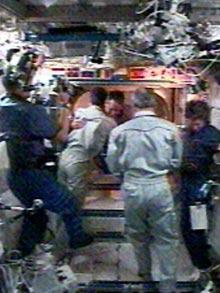 | After completing leak checks, the STS-114 crew entered the International Space Station at 8:50 a.m. EDT today. The seven astronauts ended their two-day chase of the Station when Space Shuttle Discovery docked with the orbital outpost at 7:18 this morning. STS-114 is the first Shuttle mission to visit the Station since STS-113 left in December 2002. |
The two crews conducted a Station safety briefing and began joint operations after they greeted each other.
On the ground, Lead STS-114 Flight Director Paul Hill provided good news today about mission operations during a briefing to reporters. "The orbiter continues to perform beautifully," Hill said. "The crew flew a picture-perfect rendezvous this morning."
One of the tasks scheduled for today involves preparations for possible additional Shuttle heat shield inspections with cameras and a special boom on the orbiter’s robot arm. STS-114 and Expedition 11 crewmembers will use the Station’s arm to attach the sensor boom to the Shuttle arm.
Before docking, STS-114 Commander Eileen Collins and Pilot Jim Kelly guided Discovery through a back-flip, enabling the Station crew to photograph Discovery's heat shield.
Space Shuttle Flight Operations and Integration Manager John Shannon said most of data gathering on the Shuttle is complete.
"The initial report was that it looks extremely good," Shannon said, "and we don’t have anything to worry about on Discovery."
Additional inspections of the orbiter’s heat shield inspections will take place Friday.
Unprecedented imagery of the Shuttle from a variety of sources continues to provide NASA with valuable data for the safety of this flight and future flights. A team of about 200 people across the country is working to analyze these photos. Foam loss from the external tank indicates a need for more improvements to the tank's insulation. Shuttle managers have said they will deal with the problem before flying another mission.
NASA's Mission Management Team Chair Wayne Hale said Wednesday that according to data reviewed so far, Discovery appears to be in good shape for a safe return home. However, more detailed analysis will follow over the next few days to be sure, he added.
During Thursday's briefing, Shannon said data about the external tank has been collected.
Other activities planned for today include preparations for three upcoming spacewalks and the start of cargo transfers to the Station.
more at Space Shuttle Discovery or Space Shuttle and STS-114 or Discovery
0
comments
||
||
Asia-Pacific partnership
President's Statement on U.S. Joining New Asia-Pacific Partnership
The United States has joined with Australia, China, India, Japan, and South Korea to create a new Asia-Pacific partnership on clean development, energy security, and climate change. This new results-oriented partnership will allow our nations to develop and accelerate deployment of cleaner, more efficient energy technologies to meet national pollution reduction, energy security, and climate change concerns in ways that reduce poverty and promote economic development. The six Asia-Pacific partners will build on our strong history of common approaches and demonstrated cooperation on clean energy technologies. I have directed Secretary of State Condoleezza Rice and Secretary of Energy Sam Bodman to meet with their counterparts this fall to carry forward our new partnership and provide direction for our joint work.
# # # For Immediate Release, Office of the Press Secretary, July 27, 2005
Fact Sheet: President Bush and the Asia-Pacific Partnership on Clean Development
more at President Bush or Asia-Pacific partnership and Sam Bodman or Condoleezza Rice
0
comments
||
||
sts-114, Space Shuttle Discovery Foam Shedding From External Tank
Statement on Foam Shedding From External Tank NASA Administrator Michael Griffin
NASA engineers are evaluating the loss of a large piece of insulation foam from the Space Shuttle Discovery’s external fuel tank during Tuesday's launch. Based on initial assessments, the foam -- which appears to measure approximately 24 to 33 inches long, 10 to 13 inches wide and 2-1/2 to 8 inches thick -- was seen by high-resolution camera equipment added to the Shuttle system after the loss of Columbia in 2003. The accident was caused by foam from the external tank hitting the orbiter during launch.
 | Download Full High Resolution Image There was no indication the piece of foam sighted Tuesday caused any damage to Discovery. The Shuttle will undergo further inspection beginning Thursday to check for any significant damage to the orbiter. |
Discovery’s seven crew members are being updated with the latest ground team analysis of the foam loss and are continuing to take part in the inspection process.
Source: nasa.gov July 28, 2005, RELEASE: 05-207
more at Space Shuttle Discovery or Space Shuttle and STS-114 or Discovery
0
comments
||
||
Wednesday, July 27, 2005
Climate Change
Climate Change
Question: What can you tell us about a reported new initiative on climate change being announced on Thursday by Deputy Secretary Zoellick?
Answer: Specifics on this initiative will be announced by the Deputy Secretary. The United States continues to work closely with a number of countries on this issue.
Our focus has been and remains on promoting cost-effective, technology-based approaches to addressing climate change. We are pursuing these voluntary approaches both at home and abroad, through our bilateral climate change partnerships and our multilateral science and technology partnerships -- as well as through the efforts of other bodies such as the G-8.
2005/728
Taken Question Office of the Spokesman Washington, DC July 27, 2005 Question Taken at the July 27, 2005 Daily Press Briefing
more at Climate Change and and State Department or Department of State and G-8
0
comments
||
||
Conviction of Former Nepalese Prime Minister
Conviction of Former Nepalese Prime Minister
The United States is disturbed by the June 26 conviction in Nepal of former Prime Minister Sher Bahadur Deuba and other opposition political leaders by the Royal Corruption Control Commission, an extrajudicial organization appointed by King Gyanendra after he imposed a state of emergency.
Acting outside of the Nepalese judicial system, the Commission served as investigator, prosecutor, and judge in this case, ultimately imposing a harsh sentence on the former Prime Minister for alleged corruption in the Melamchi Water Supply Project. In taking this action, the Commission ignored the findings of the Asian Development Bank, the principal donor to the project, which examined similar allegations and did not find evidence to support them.
The United States continues to call on the King to restore civil liberties to the people of Nepal. Unfortunately, the conviction of the former Prime Minister through an extrajudicial process represents another setback for the restoration of democracy.
2005/727 Press Statement, Sean McCormack, Spokesman, Washington, DC, July 27, 2005
more at Nepal or Sher Bahadur Deuba and Asia and State Department or Department of State
0
comments
||
||
H.R. 3071
Statement on H.R. 3071
On Wednesday, July 27, 2005, the President signed into law:
H.R. 3071, which allows certain officers of the legislative branch's Office of Compliance to serve one additional term.
# # # For Immediate Release, Office of the Press Secretary, July 27, 2005
more at H.R. 3071 or Politics and President Bush
0
comments
||
||
FDIC, Martin J. Gruenberg
Nomination Sent to the Senate
Martin J. Gruenberg, of Maryland, to be a Member of the Board Of Directors of the Federal Deposit Insurance Corporation for a Term Expiring December 27, 2012.
For Immediate Release, Office of the Press Secretary, July 25, 2005
More at: FDIC or Martin J. Gruenberg and President Bush
0
comments
||
||
President Bush to nominate seven 07/27/05
President George W. Bush today announced his intention to nominate seven individuals to serve in his Administration:
The President intends to nominate Keith E. Gottfried, of California, to be General Counsel of the Department of Housing and Urban Development. Mr. Gottfried recently served as Senior Vice President of Corporate Affairs and Special Advisor to the Chief Executive Officer of Borland Software Corporation. Prior to that, he served as the company's Senior Vice President, General Counsel, Corporate Secretary and Chief Legal Officer. Earlier in his career, Mr. Gottfried was a Corporate Associate with Skadden, Arps, Slate, Meagher and Flom LLP in New York, NY. He received his bachelor's degree from the University of Pennsylvania. He later received his J.D. and master's degree from Boston University.
The President intends to nominate Bertha K. Madras, of Massachusetts, to be Deputy Director for Demand Reduction at the Office of National Drug Control Policy. Dr. Madras is currently a Professor of Psychobiology in the Department of Psychiatry at Harvard Medical School and Massachusetts General Hospital. She also chairs the Division of Neurochemistry at the New England Primate Research Center. Dr. Madras previously served as Assistant Professor of Pharmacology in the Department of Psychiatry at the University of Toronto. She received her bachelor's degree and her PhD from McGill University.
The President intends to nominate Mark S. Schneider, of the District of Columbia, to be Commissioner of Education Statistics at the Department of Education, for the remainder of a six-year term expiring June 20, 2009. Dr. Schneider currently serves as Deputy Commissioner of the National Center for Education Research, the Institute of Education Sciences at the Department of Education. He previously served as Professor and Chairman of the Department of Political Science at the State University of New York at Stony Brook. Earlier in his career, Dr. Schneider served as Vice President of the American Political Science Association. He received his bachelor's degree from City University of New York and his PhD from the University of North Carolina. He later served as a Fulbright Hays Senior Fellow at Osmania University in Hyderabad, India.
The President intends to nominate Alfred Hoffman, Jr., of Florida, to be Ambassador Extraordinary and Plenipotentiary of the United States of America to Portugal. Mr. Hoffman is founder and Chairman of the Board of WCI Communities, Inc, a company serving primary, retirement and second-home buyers. He previously served as Chairman of the Florida Education Foundation and Chairman of the Florida Council on Economic Education. Mr. Hoffman received his bachelor's degree from the United States Military Academy at West Point. After serving four years in the United States Air Force, he received his master's degree from Harvard University.
The President intends to nominate the following individuals to be Members of the National Commission on Libraries and Information Science for the remainder of five-year terms expiring July 19, 2009:
Sandra Frances Ashworth of Idaho, Jan Cellucci of Massachusetts, Diane Rivers of Arkansas
# # # For Immediate Release, Office of the Press Secretary, July 27, 2005, Personnel Announcement
more at HUD or Bertha K. Madras and Mark S. Schneider or Portugal and President Bush or National Commission on Libraries and Information Science
0
comments
||
||
H.R.525 Small Business Health Fairness Act
President Applauds House Passage of Small Business Health Fairness Act
I applaud the House of Representatives for passing the Small Business Health Fairness Act, which will increase the availability of Association Health Plans. AHPs are a fair, innovative, and commonsense approach to make health insurance more affordable and accessible, one of my top domestic priorities. By letting small businesses join together to buy insurance at the same discounts big companies get, this bill will help workers and their families have more health care choices and obtain greater savings. This change is overdue, and I urge the Senate to follow the House's lead and pass this good legislation this year.
# # # For Immediate Release, Office of the Press Secretary, July 26, 2005
more at President Bush or H.R. 525 and Small Business Health Fairness Act
0
comments
||
||


