Tuesday, August 02, 2005

President Signs CAFTA-DR VIDEO

President Signs CAFTA-DR, FULL STREAMING VIDEO The East Room, 11:15 A.M. EDT

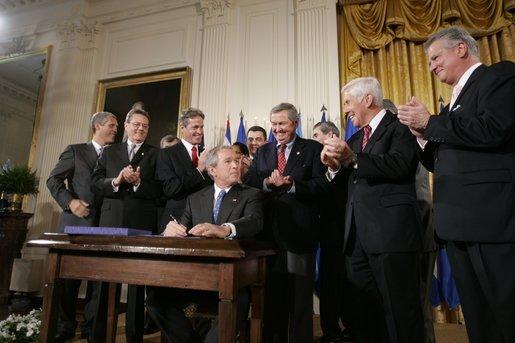
President George W. Bush acknowledges the applause of legislators and administration officials Tuesday, Aug. 2. 2005 in the East room of the White House, as he signs the CAFTA Implementation Act. White House photo by Paul MorsePresident George W. Bush acknowledges the applause of legislators and administration officials Tuesday, Aug. 2. 2005 in the East room of the White House, as he signs the CAFTA Implementation Act. White House photo by Paul Morse
THE PRESIDENT: Thanks for the warm welcome. Welcome to the White House. Last week, Congress passed the Central American-Dominican Republic Free Trade Agreement. I want to thank the Republicans and Democrats who came together to support this important agreement. The bill I'm about to sign is good for America. I'm pleased that Congress has taken a step to eliminate the barriers to America's goods and crops to 44 million customers.

I welcome the opportunity to make our nation more secure by strengthening our ties with democracies that share our belief in free markets and free government. I appreciate the vision and leadership of Bob Zoellick and Rob Portman and the many others who worked hard to get this agreement passed. I want to thank the Secretary of State, Condi Rice, for the outstanding job she's doing on behalf of the American people. I want to thank Secretary Mike Johanns from the Department of Agriculture for joining us. And, Stephanie, thank you for being here. I appreciate Secretary Carlos Gutierrez of the Department of Commerce for his good work.

We're honored to be joined by the Chairman of the Senate Foreign Relations Committee, Dick Lugar. I appreciate you coming, Senator. I'm honored you're here. Senator Norm Coleman, who is the Chairman of the Foreign Relations Committee, Western Hemisphere Subcommittee. I appreciate Congressman Clay Shaw, who is the Chairman of the House Ways and Means Trade Subcommittee -- I'm honored that these three members of Congress are standing with us today.

I appreciate los Embajadores from the Central American countries: Ambassador Duenas, Ambassador Stadthagen, Ambassador Espinal, Ambassador Castillo de Guatemala. By the way, Espinal is Dominican Republic; Ambassador Stadthagen is from Nicaragua; Duenas is from Costa Rica. I appreciate Ambassador Leon from El Salvador, who is with us. I want to thank the Special Envoy Garcia from Honduras. I appreciate Ana Escobar, who is the Vice President of El Salvador, for joining us. Bienvenidos. And I want to thank Jose Insulza, who is the Secretary General of the Organization of American States, for joining us. Welcome.

All of us in this room understand that to keep our economy growing and creating jobs, we need to open markets for American products overseas. All of us understand that strengthening our economic ties with our democratic neighbors is vital to America's economic and national security interests. And all of us understand that by strengthening ties with democracies in our hemisphere, we are advancing the stability that comes from freedom.

Right now, Central American goods face almost no tariffs when they enter the United States. By contrast, U.S. exports to Central America still face hefty tariffs there. CAFTA will end these unfair tariffs against American products and help ensure that free trade is fair trade.

By leveling the playing field for our products, CAFTA will help create jobs and opportunities for our citizens. As CAFTA helps create jobs and opportunity in the United States, it will help the democracies of Central America and the Dominican Republic deliver a better life for their citizens. By further opening up their markets, CAFTA will help those democracies attract the trade and investment needed for economic growth.

This economic growth will boost demand for U.S. goods and reduce poverty and contribute to the rise of a vibrant middle class. This economic growth will raise working standards and will deliver hope and opportunity to people who have made the choice for freedom. The more opportunity that Central Americans have at home to provide for themselves and their families means it's less likely that someone looking for a job will try to come to this country illegally.

By strengthening the democracies in the region, CAFTA will enhance our nation's security. Two decades ago, many of the CAFTA nations struggled with poverty and dictatorship and civil strife. Today, they're working democracies, and we must not take these gains for granted. These nations still face forces that oppose democracy, seek to limit economic freedom, and want to drive a wedge between the United States and the rest of the Americas. The small nations of CAFTA are making big and brave commitments, and CAFTA is a signal that the United States will stand with them and support them. By helping the CAFTA nations build free societies, we'll help them eliminate the lawlessness and instability that terrorists and criminals and drug traffickers feed on. And this will make our country safer.

CAFTA is more than a trade bill; it is a commitment among freedom-loving nations to advance peace and prosperity throughout the region. As the oldest democracy in the Western Hemisphere, the United States has a moral obligation and a vital national security interest in helping democracies in our neighborhood succeed, and CAFTA advances this goal.

And to ensure that the 21st century is one of prosperity and freedom and security, my administration will continue to work to strengthen democracy and open markets for American exports all across the world.

And now it's my honor to invite the members of the Congress to join me as I sign the legislation that will implement the Central American Dominican Republic Free Trade Agreement. (Applause.)

(The bill is signed.) (Applause.)

END 11:21 A.M. EDT For Immediate Release, Office of the Press Secretary, August 2, 2005

more at
and or and

President Calls Space Shuttle Discovery VIDEO

President George W. Bush smiles as he waves goodbye to the crew of the Space Shuttle Discovery Tuesday, Aug. 2, 2005, during a phone call from the Roosevelt Room of the White House. Before bidding the crew Godspeed and telling them to President George W. Bush smiles as he waves goodbye to the crew of the Space Shuttle Discovery Tuesday, Aug. 2, 2005, during a phone call from the Roosevelt Room of the White House.
President Calls Crew Members of Space Shuttle Discovery, FULL STREAMING VIDEO Via Telephone, 10:23 A.M. EDT

THE PRESIDENT: Commander Collins, can you hear me?

COMMANDER COLLINS: Yes, sir, we hear you loud and clear. Good morning.

THE PRESIDENT: Good morning. Thank you for taking my phone call. I just wanted to tell you all how proud the American people are of our astronauts. I want to thank you for being risk-takers for the sake of exploration. I want to welcome our Japanese and Australian and Russian friends. And I wish you Godspeed in your mission. I know you've got very important work to do ahead of you. We look forward to seeing the successful completion of this mission. And, obviously, as you prepare to come back, a lot of Americans will be praying for a safe return.

So it's great talking to you. Thanks for being such great examples of courage for a lot of our fellow citizens.

COMMANDER COLLINS: Thank you very much, Mr. President. We want to tell you that we really enjoy what we're doing, we really believe in our mission, and we believe in space exploration and getting people off the planet and seeing what's out there. So the steps that we're taking right now are really worth it, and we want everybody to know that. And thank you very much for taking the time out of your busy schedule to talk to us.

THE PRESIDENT: Well, listen, I want to thank you, Commander, and thank your fellow astronauts there. I agree with you -- I think what you're doing is really important. And you've got a strong supporter for your mission here in the White House. I will tell you Laura went down and watched the launch in Florida, with my little brother, Jeb, and came back all excited about the energy that -- there on the East Coast of Florida. But we're with you, and wish you all the very best. Thanks for taking my phone call. Now get back to work.

COMMANDER COLLINS: Thank you very much, sir. We did fly over Texas today and had a good look at it. It was beautiful. Have a good day.

THE PRESIDENT: Thank you. (Laughter.)

END 10:27 A.M. EDT For Immediate Release, Office of the Press Secretary, August 2, 2005

more at
or and or and

Monday, August 01, 2005

Memorandum for the Director of OMB

Memorandum for the Director of OMB July 30, 2005

SUBJECT: Assignment of Functions Relating to Certain Funding for Unanticipated Needs

By virtue of the authority vested in me by the Constitution and the laws of the United States, including section 301 of title 3, United States Code, the functions of the President with respect to appropriations made under the heading "Unanticipated Needs" in the Military Construction Appropriations and Emergency Hurricane Supplemental Appropriations Act, 2005 (Public Law 108-324) are assigned to the Director of the Office of Management and Budget and the Director shall administer such funds as provided under that heading.

You are authorized and directed to publish this memorandum in the Federal Register.

GEORGE W. BUSH

# # # For Immediate Release, Office of the Press Secretary, August 1, 2005

more at
or and and

30th Anniversary of the Helsinki Final Act

Statement on the 30th Anniversary of the Helsinki Final Act

Today, we celebrate the 30th anniversary of the Helsinki Final Act, an agreement of principles by Cold War adversaries which helped lift the Iron Curtain by undermining despotism with the simple ideals of freedom and human rights.

Signed at a time when security was defined by the strength of a nation's arsenal, the Helsinki Final Act was premised on the revolutionary belief that security should also be defined by the ways that countries treat their own citizens and cooperate with their neighbors. In the 15 years since the fall of the Berlin Wall, the Helsinki process and the Organization for Security and Cooperation in Europe (OSCE), which grew out of this historic process, have made a vital contribution toward achieving a Europe whole, free, and at peace.

President Bush believes that peace depends upon the expansion of freedom, and during the past 30 years, 54 nations have joined the United States in this fundamental belief as members of the OSCE. Despite tremendous progress, much remains to be done to achieve a democratic, prosperous, and secure Euro-Atlantic community. The men and women who have dedicated themselves to promoting the work of the OSCE are on the front lines confronting tyranny. They labor to create a better, more peaceful world by promoting free and fair elections, strengthening respect for human rights, building democratic institutions, and enhancing security and economic prosperity. They offer hope to those living under repression.

On behalf of all Americans, the President congratulates the OSCE on this anniversary. The United States stands with this organization dedicated to the cause of freedom.

# # # For Immediate Release, Office of the Press Secretary, August 1, 2005

more at
or and or and

Death of Sudanese First Vice President Dr. John Garang

President's Statement on Death of Sudanese First Vice President Dr. John Garang de Mabior

I was deeply saddened to learn of the death of Sudanese First Vice President Dr. John Garang de Mabior. He was a visionary leader and peacemaker who helped bring about the Comprehensive Peace Agreement, which is a beacon of hope for all Sudanese. The United States is determined to maintain our commitment to the peace process in Sudan. We urge all Sudanese people to refrain from resorting to violence and to continue the implementation of the Comprehensive Peace Agreement. John Garang's vision of peace must be embraced by all the people in Sudan so that they can live in a democratic, peaceful, and united country. On behalf of the people of the United States, Laura and I extend our deepest sympathies to Dr. Garang's wife, Rebecca, his family, and to all the people of Sudan.

# # # For Immediate Release, Office of the Press Secretary, August 1, 2005

more at
or and or

King Abdallah bin Abd

President Congratulates King Abdallah bin Abd on Assuming the Saudi Throne

On behalf of the United States, I congratulate my friend, King Abdallah bin Abd al-Aziz Al Saud, on assuming the Saudi throne and the position of Custodian of the Two Holy Mosques. We wish Saudi Arabia peace and prosperity under his leadership. I have spoken today to the new King, and the United States looks forward to continuing the close partnership between our two countries.

# # # For Immediate Release, Office of the Press Secretary, August 1, 2005


more at or and or

Constitution vs Edward Kennedy

more at or and or and

"The President shall have Power to fill up all Vacancies that may happen during the Recess of the Senate, by granting Commissions which shall expire at the End of their next Session."

Article II, Section 2, Clause 3. of the U.S. Constitution

"The abuse of power and the cloak of secrecy from the White House continues" "It's a devious maneuver that evades the constitutional requirement of Senate consent."

Sen. Edward Kennedy, D-Mass.

Press Briefing by Scott McClellan 08/01/05

Press Briefing by Scott McClellan FULL STREAMUNG VIDEO, James S. Brady Briefing Room, 12:18 P.M. EDT

MR. MCCLELLAN: Good afternoon, everybody. I want to give you a couple of updates. First, on the Supreme Court confirmation process, Judge Roberts, over the last couple of weeks met with 43 senators. Some of those he met with twice. He also talked to additional senators by phone. He met with 23 Democrats in that overall number, and he also met with all 18 members of the Senate Judiciary Committee. He has additional meetings that are already scheduled during August, and he looks forward to continuing to pay those courtesy visits and consult with senators as they move forward on the confirmation process.

We also appreciate Chairman Specter reaching an agreement with the Judiciary Committee that will enable the committee and the Senate to move forward in a timely manner to have an up or down vote on Judge Roberts by the end of September, so that he can be in place come October, when the Court comes back into session.

Secondly, on Ambassador Bolton. Ambassador Bolton is planning on taking the oath of office today and he is also planning on going to New York today to get about doing the important work at the United Nations. The President began thinking about the -- a nomination, a recess appointment of Ambassador Bolton after it became clear that a handful of Democrats were going to continue engaging in partisan delaying tactics and prevent him from having a fair up or down vote on the floor of the Senate. This was despite the fact that he had a clear majority of support from the United States Senate. On two occasions, as Chairman Lugar noted in his statement, the Senate showed a clear majority was in support of his nomination to the United Nations.

And the President, after it became clear that the Senate was -- that the Democrats were going to continue playing politics and blocking the nomination from receiving an up or down vote, the President began thinking seriously about recessing him, and he came to a final decision after the Senate had recessed over the weekend.

Q When did he begin thinking about it?

MR. McCLELLAN: Well, if you go back and look at the votes, there was a vote on, I believe, May 26th, and then a follow-on vote June 20th, and then it was becoming clear that Senate Democrats -- well, even after that time period, I think there was a lot of outreach by Republican senators and Republican leaders in the Senate to find a middle ground to move forward on providing him with a fair up or down vote. But it became increasingly clear during that time that Senate Democrats were simply interested in playing politics and not allowing his vote to go to the floor for an up or down vote, where he would have been approved.

Q Setting aside the question of the merits, or demerits of Ambassador Bolton, just that aside, the reality now is he goes up there without Senate confirmation. Does the President regret this in a sense, and does he feel that Bolton's efficiency up there, his effectiveness is going to be damaged by not having confirmation?

MR. McCLELLAN: Not at all. In fact, he has the full and complete confidence of the President of the United States and Secretary of State Rice. He has their full and complete confidence to get about doing the important work of reform at the United Nations and making sure that the United Nations is a strong and effective organization. Ambassador Bolton is someone who has a long record of working to get things done and bringing people together to move forward on important priorities, and he will take that record of accomplishment to the United Nations with the full confidence of the President of the United States and Secretary of State.

Q So Senate confirmation really makes no difference in how he carries out his job?

MR. McCLELLAN: Well, I think it's clear to everybody that he had the majority support of the United States Senate. But, unfortunately, a handful of Senate Democrats were intent on using partisan tactics to delay the nomination from receiving an up or down vote on the floor of the Senate.

Q How do you square that, Scott, with the opposition from folks like George Voinovich?

MR. McCLELLAN: Let me keep going on the first row, and then I'll come back to you, Carl.

Terry, you had something.

Q A lot of people say that he was very sharp with subordinates and that he was tough and too hard on them. Does he intend to moderate his behavior in this new job?

MR. McCLELLAN: A lot of people that have worked very closely with Ambassador Bolton recognize that he is someone who brings a results-oriented approach to the position. If you go back and look at people who know him well -- like former Secretary of State Baker, former Ambassador to the United Nations Jeanne Kirkpatrick -- they recognize that he will be a strong advocate for the priorities that we want to see at the United Nations.

The American people want to see comprehensive reform at the United Nations. The American -- we spend some $2 billion-plus a year, I think that we send to the United Nations. They want to make sure that those resources are getting real results, and that the United Nations is an effective and strong multilateral organization. And John Bolton is -- shares the President -- John Bolton shares the President's commitment to making sure that the United Nations is a strong and effective multilateral organization.

Q In fact, Scott, what a lot of people accuse Bolton of is being a hard-charging guy, abrasive, abusive. I mean, some of his critics have used all of these words. Even Kofi Annan, Secretary General, saying essentially, hey, take it easy up here; it's good to push, but you've got to work with other ambassadors. Is in fact -- is that, in fact, exactly what the President is looking for?

MR. McCLELLAN: I think the Secretary General actually said he looked forward to working closely with Ambassador Bolton. He put out a statement a short time ago.

Q Right, and what I said is also what he said.

MR. McCLELLAN: Now, Ambassador Bolton is someone who has sometimes used a blunt style, but he is someone who brings passion and experience and a results-oriented approach to the position. That's exactly the kind of person we need at the United Nations during this time of war and time of reform. And that's why the President nominated him to be the ambassador.

Q And the President is a pretty plain-spoken guy, as well, so why don't we be -- why don't you be a little bit more blunt here. (Laughter.) Does, in fact --

MR. McCLELLAN: I try to be diplomatic with you all.

Q Yes. But the rap here is the President has chosen somebody who is quite undiplomatic for a diplomatic post.

MR. McCLELLAN: No.

Q Is that what he wants?

MR. McCLELLAN: He is a strong and proven diplomat who gets things done. And that's the kind of person we need at the United Nations. That's why a majority of the United Sates Senate supported him. He is the right person for this position at this critical time of war and critical time of reform at the United Nations. He is someone who, like the President, wants to make sure that the United Nations is a strong and effective multilateral organization. And if you look at his record, he has worked to get things done whether it's stopping the spread of weapons of mass destruction, or working to repeal a resolution that tried to equate Zionism with racism. John Bolton has a record of getting things done.

Q He's the finger in the eye of Democrats?

Q Scott, some of the Democrats are saying this is abuse of power, and if you'd given over some of the information that you had, he would have gotten a vote. How do you respond to that?

MR. McCLELLAN: It was the -- well, first of all, there was a thorough confirmation process, and Ambassador Bolton spent more than eight hours before the committee answering their questions. He provided a number of additional responses in writing, when they came forward with additional questions. If you'll remember, Senator Roberts and other leaders in the Senate, I think Senator McCain tried to reach out to these Senate Democrats who claimed that they wanted more documents. It wasn't more documents that they wanted; they just wanted to play politics with this position.

And the President believed all along that he deserved a fair up or down vote on the floor of the Senate. I think the American people expect the Senate to do their duty and give people a fair up or down vote. It was Senate Democrats that chose to play politics and prevent him from being confirmed, which he would have been if it had gone to the floor of the Senate.

Q Scott, does the President envision Bolton being in this job for four years? And, if so, would he re-recess appoint him?

MR. McCLELLAN: Well, I'm not going to speculate about things down the road. He has been nominated to -- or been recessed appointed to this position, and he will continue to serve through that recess period. And beyond that, I wouldn't want to speculate, but he is someone --

Q But one of the knocks --

MR. McCLELLAN: -- the President believes in strongly.

Q Right, but one of the knocks on doing a recess appointment is you send someone in with a relatively short time period to actually implement the reforms that he would want. Does he think that you can do it in that short of time frame, or does he envision this being basically a --

MR. McCLELLAN: Well, if you remember, first of all, the United Nations is coming back into session in September, so this is an important time for our ambassador to get in place after months of partisan delay tactics by Senate Democrats. And we want to move forward on major reforms this year. We've outlined a comprehensive reform agenda that includes management reform. It includes the establishment of a peace-building commission. It includes reform of the human rights commission. It includes the establishment of a democracy fund and the adoption of a comprehensive convention on counterterrorism. Those are important priorities.

And we want to move forward this year on major reforms. And that's why it's important to have him in place, in addition to the fact that we remain at war, we remain engaged in a global war on terrorism up against an ideology of hatred.

Q Scott, on Bolton's aggressive and abrasive managerial style, what does this send to --

MR. McCLELLAN: Is that your characterization?

Q Well, no, that's not -- I didn't work for him, but others are saying this, others who testified against him. Scott, basically, what does this send to corporate America, that the President hires someone or appoints someone who has this kind of style -- as you say, results-oriented -- but definitely there were workers who were upset, many workers who were upset. And they feel that he is not qualified to run anything because of his style. What does this send to --

MR. McCLELLAN: The United States Senate confirmed him on four occasions prior to this time. They would have confirmed him again, had not a handful of Democrats used partisan delay tactics to prevent him from receiving a fair up or down vote. And the President makes decisions based on what is right for the American people. The American people want to see reform at the United Nations. John Bolton is committed to reform at the United Nations and committed to making the United Nations a strong organization that is effective in getting real results, based on what its charter establishes.

Q Well, following up on what you just said, you're basically saying that a handful of senators, Democrats, are holding you up. What do you think about Senator Ed Kennedy talking about Bolton misled Congress by denying he had interviewed in the State Department CIA investigation of faulty pre-war intelligence on Iraq?

MR. McCLELLAN: I think the State Department addressed that last week --

Q No, but you're saying that it's a delaying tactic.

MR. McCLELLAN: No, I'm saying Senator Kennedy's views are well known.

Q No, but tell me -- no, but you made a statement; respond to this. You're saying that it's delaying tactics --

MR. McCLELLAN: It's already been responded to.

Q No, you're saying it's a delaying tactic. This is concrete information that Senator Kennedy is throwing out, and that's not delaying tactics, that's something that needs to be addressed.

MR. McCLELLAN: No, I heard your question. It was addressed last week.

Go ahead, Bob.

Q He goes to New York today into an organization where delicacy is oftentimes the watchword. John Bolton has a reputation to live down, as evidenced by the questions you're still getting. What is he going to do to do that?

MR. McCLELLAN: Well, but look at the facts. Look at his record of bringing people together to get things done. Look at his record of resolving the payment issues to the United Nations. Look at his record of rallying the coalition for the Persian Gulf war. Look at his record of getting people to come together within the United Nations and repealing a resolution that tried to equate Zionism with racism. Look at his record of building a coalition of 60-plus nations to stop the spread of weapons of mass destruction, one of the gravest threats we face, if not the gravest threat we face in this day and age.

Q So you're saying that he's going to operate up there as he has before?

MR. McCLELLAN: He's going to continue to focus on getting things done, and addressing the important priorities that we face in the 21st century.

Q Well, if I could belabor it just a little bit, his --

MR. McCLELLAN: You bet he's someone that is committed to getting things done.

Q But do you expect him to -- he is very, very proud of his hard-charging style. Do you anticipate that he's going to continue to operate that way in the United Nations environment?

MR. McCLELLAN: Well, like I said, he's someone who cares passionately about these issues that are of concern to all Americans. And he's someone who brings a lot of experience and expertise to the position, having served for some two decades in various positions within government. And sometimes a blunt style is needed in order to get things done, and he has definitely gotten things done.

Q Scott, some Democrats are saying that this appointment will complicate the confirmation process for Judge Roberts. Did the President consider that? And does he have any strategy for trying to convince Democrats that they should abandon partisanship --

MR. McCLELLAN: I haven't seen any comments to that effect and I really haven't heard much about that from the Senate. I think the Senate -- the Judiciary Committee, as I just pointed out at the beginning, reached an agreement to move forward on the confirmation process in a timely manner. And that's what the President has called for. All indications are that the Senate is committed to moving forward in heeding what the President's call was, which was to move forward in a way that will give him a fair confirmation process in a timely manner so that he can be in place by the time the court comes into session in October.

Q Scott, when was the last time the President spoke to George Voinovich about the nomination of Mr. Bolton? And to what extent do you square the criticism of Democratic stalling and partisanship with the idea that there was some Republican misgivings, led not least by Mr. Voinovich?

MR. McCLELLAN: Well, like I said, he had a clear and strong majority support of the United States Senate. If you go back and look at the votes previously, on May 26th and June 20th, I think his views were expressed, well known. And in terms of the last time the President talked to him, I think it was the last time I informed you all -- I don't recall the specific date. I know our legislative staff reached out to let him know this morning, as well.

Q Scott, has President met with John Bolton, the concern he will be representing the United States at the United Nations during a critical time of reform and the 60th anniversary of the United Nations? As far as the Security Council membership for India is concerned, the Prime Minister (inaudible) with President Bush here at the White House --

MR. McCLELLAN: Right.

Q -- where is the Ambassador John Bolton going to stand on the membership of the United Nations --

MR. McCLELLAN: Well, we haven't made any decisions beyond supporting Japan for being a member of the Security Council at this point. We believe that Security Council reform ought to be criteria-based, that there ought to be some clear criteria for who should be a member of the Security Council. And we believe that Security Council reform ought to be undertaken in the context of broader reform at the United Nations, and that's how we're proceeding.

We have had good discussions with others who have expressed interest, but that's why we believe it's important to outline some criteria and make sure that it is in the context of broader reform at the United Nations.

Connie, go ahead.

Q Thank you. Would it be the President's preference, if he could, to overturn Roe versus Wade? And, also, does he think that embryonic stem cell research should be made illegal?

MR. McCLELLAN: I think that -- two things. One, on the issue of abortion, the President has made it very clear that there are ways -- common sense, practical ways that we can work together to reduce the number of abortions in America. And he has worked to do that, if you look at what we have done, by placing a ban on partial birth abortion, by supporting efforts to increase adoption. The President is strongly committed to finding ways we can work together to reduce the number of abortions in America. He is someone who is pro-life.

Now, in terms of the question you bring up, I think this is trying to bring it up in the context of does the President have a litmus test for the Supreme Court -- no, he does not. And the President has made that very clear. He is not the one who has a litmus test. He believes that a judge ought to interpret our Constitution and our laws and not try to legislate from the bench. A judge is someone who ought to look at the facts and look at the law and look at our Constitution and apply the law. And that's what the President has consistently said.

In terms of -- what was the second part of your question?

Q The legality or illegality of embryonic stem cell research.

MR. McCLELLAN: Well, the President felt that taxpayer dollars should not be going to fund research where human life is created for the sole purpose of destroying it. Now, he believes strongly in advancing medical research, but we also must work to maintain the highest ethical standards. And that's why he came to the policy that he did. It doesn't place any prohibition on the private sector and research done in the private sector. He drew the line at taxpayer dollars because he is President of all the people.

And I think people do appreciate the need to move forward aggressively to advance science, but also look at those ethical considerations that really have far-reaching consequences into the future.

Q Scott, is the White House concerned about the latest moves by Iran to return to some of its nuclear research?

MR. McCLELLAN: Well, I think the Europeans who have been working to negotiate a resolution, diplomatic resolution, to Iran's nuclear programs has expressed their concerns. I just -- yesterday I think they put out a statement saying that they would seek further clarification, but that it would be an unnecessary and damaging step by Iran. Iran made an agreement, the Paris agreement -- they agreed to abide by the Paris agreement, which called for Iran to suspend their uranium enrichment and reprocessing activities while the negotiations were ongoing. The Europeans, along with the United States, believe that Iran should adhere to the Paris agreement and continue to work with the Europeans to resolve this issue.

We've made clear that if Iran is going to violate its agreement and restart uranium reprocessing enrichment activities, then we would have to look to the next step and we would be talking with our European friends about that next step.

Q What would be the next step?

MR. McCLELLAN: Well, I think we've repeatedly said that if they're not going to abide by their agreements and obligations, then we would have to look to the Security Council. And I think the Europeans have expressed that. But right now the Europeans are seeking clarification about what Iran's intentions are.

Q Do you have anything on the -- oh, I'm sorry.

Q Scott, two things. One, is there -- in January 2007, do you expect the Senate to give Bolton and up and down vote? And, also, is there any update to the delegation going to King Fahd's funeral?

MR. McCLELLAN: I'm not going to speculate about things down the road. In terms of the delegation, hopefully, we'll have more for you a little bit later today for the King's funeral. And in terms of -- the President will have a couple of statements out later today regarding the passing of King Fahd, as well as the ascension of King Abdullah to the throne.

Q Thank you, Scott. I have two questions. First -- and by the way, in answer to Carl's question earlier, that was my question to you about when the President spoke to Voinovich. And if you go back to your transcript --

MR. McCLELLAN: I thought you were going to give me the answer to that question.

Q Yes, it was the night before the vote on the foreign relations --

MR. McCLELLAN: Right.

Q -- you should check the date. The CIA reported last week in a story that did not get much attention in the newspapers that the President-elect of Iran was not a hostage-taker, and not the person in the photographs. Does the administration consider the matter closed?

MR. McCLELLAN: No, as I said, we were still looking into whether or not he was explicitly one of the hostage-takers. And what we know, and I think you heard some comments out of Iran, too, that he was a leader of the student organization that oversaw the takeover and the taking of hostages. What we don't know is whether he was explicitly one of the hostage-takers.

Q Well, the CIA --

MR. McCLELLAN: So that's something we continue to look into. Now, in terms of -- you're referring to pictures. I think they were talking -- the intelligence community was talking about their analysis of some of the pictures that we have seen from that time period.

Q So the matter is not closed then?

MR. McCLELLAN: No.

Q Scott, there are some U.N. members, including Security Council members, who are suggesting that Bolton begins as a lame duck, and they would have preferred to have someone, you know, who came with Senate approval. Is this something that the administration had to take into account --

MR. McCLELLAN: I haven't seen any such comments out of any Security Council member. And, secondly, he did have the support of the majority of the United States Senate; most importantly, he has the complete confidence of the President and the Secretary of State. That's what he needs to be able to do his work at the United Nations.

Q And just to go back to April's question, aside from what came out of the State Department last week --

MR. McCLELLAN: And I don't think you've seen any indication out of anyone at the United Nations, other than they look forward to working with him.

Q I think the people are speaking otherwise, quite frankly, but getting back to April's --

MR. McCLELLAN: I'd look at Secretary General Annan's remarks.

Q Getting back to April's question, aside from what came out of the State Department last week, did the President have to -- was there any questions for Mr. Bolton regarding his filling out of that form after -- as the President made the decision this weekend?

MR. McCLELLAN: No, as I said, the State Department addressed that last week, and Ambassador Bolton was the one who addressed that last week, too.

Go ahead, Les.

Q Scott, a two-part. In his 18-minute speech to the Boy Scout National Jamboree last night, the President said not one word about Senate Majority Leader Bill Frist's Support Our Scouts Act of 2005. And my first question: What if Senator Frist decides to say not one word in support of President Bush's nominee to the U.S. Supreme Court?

MR. McCLELLAN: I think that he has said a lot of words about the President's nominee to the United States Supreme Court. And we appreciate -- and we appreciate his commitment to move forward on a floor vote as soon as the Judiciary Committee votes on his nomination.

Q But why didn't he say anything --

MR. McCLELLAN: In terms of the Boy Scouts, the President has always been a strong supporter of the Boy Scouts of America, and he was pleased to go to their Jamboree last night in Virginia.

Go ahead.

Q Today -- wait a minute.

MR. McCLELLAN: No, I've got to keep going. Go ahead.

Q Wait a minute, just two.

MR. McCLELLAN: I've got some interviews I've got to get to.

Q Today 19 members of Congress --

MR. McCLELLAN: Les, one question today. Sorry, go ahead.

Q Okay, thank you, Scott. Do you have anything up to date on the six-party talks?

MR. McCLELLAN: No, I don't have any further update other than what you've heard from Ambassador Hill out of the region. They continue to move forward and have discussions about moving forward on a set of principles. And those -- the meetings continue. As Ambassador Hill said last week, this is going to take some time. But we are committed to seeing real progress. The parties are having good discussions, businesslike discussions. And we are committed to working with all the other parties on the goal of a de-nuclearized peninsula. And we want to see progress toward that goal from these talks.

Q Scott, the oil-for-food scandal happened under Kofi Annan's watch, and he is under investigation for possible involvement in that scandal. Is John Bolton going up to New York to say, hey, the party is over, and possibly, this Secretary General should resign?

MR. McCLELLAN: There are people that are looking into all the allegations in the oil-for-food program. And Paul Volcker has been leading the investigation from the -- independently, from the United Nations standpoint. Congress has been looking into these matters. We want to know what the facts are, and that's something that they continue to look into at this point.
Q What's Bolton's position?

MR. McCLELLAN: His position is that we need to reform the United Nations. In terms of that, people are looking into those matters, and we want to see what the facts are. It's important that it be a transparent and open process, so that we can see what the facts are and get to the bottom of it.

In back, go ahead.

Q According -- is the White House concerned about the growing drug violence in the border with Mexico, and that force already to the temporary closure of the U.S. consulate in Nuevo Laredo?

MR. McCLELLAN: I think the State Department can probably provide you with the latest update. I think you're talking about the Nuevo Laredo region, and the violence there. Certainly, that is something that has been a concern of ours. And it has been something we've had discussions with the government of Mexico about. In terms of specifics, I think the State Department can provide you with additional details.

In the back.

Q Is the President concerned about the disappearance or death of John Garang, the Sudanese Vice President?

MR. McCLELLAN: Yes, we are deeply saddened to learn about the death of Vice President and Chairman of the Sudan People's Liberation Movement, Dr. John Garang. He is someone who will be remembered as a visionary leader and true peacemaker, who was instrumental in ending a 22-year civil war. His legacy of peace and democracy for all the people of Sudan survives in the comprehensive peace agreement. He was someone who was committed to moving forward on the peace process and implementing the agreement. And a way to honor him is to continue to move forward on the comprehensive peace agreement.

The United States remains strongly committed to the peace process in Sudan, and assisting in the implementation of the comprehensive peace agreement, and also working to resolve the situation in Darfur, as well. Secretary Rice, as you're aware, was just out there. But we are deeply saddened to learn of his passing, and we extend our condolences to his family and to the people of Sudan.

Go ahead.

Q Scott, Major League Baseball has just suspended Rafael Palmeiro 10 games for steroid use. He's a friend of the President's, and the President has spoken out about steroids. What is his message to Palmeiro, and what does that do to his friendship with him?

MR. McCLELLAN: This must be breaking news, first I've heard about it.

Q And does the President --

MR. McCLELLAN: So you're asking me his views. I haven't had a chance to talk to him about it, or see the reports. But, obviously, that is an issue that the President took head on and called on Major League Baseball to address. They are taking steps to address it. It is a serious matter, and we appreciate the efforts by Major League Baseball and the representatives of the players to move forward and address it with stronger enforcement and stronger penalties.

Q What does that do to the President's friendship with a player like that?

MR. McCLELLAN: Again, I just heard about this.

Thank you.

END 12:45 P.M. EDT Immediate Release, Office of the Press Secretary, August 1, 2005

more at
or and or

Death of King Fahd bin Abd al-Aziz

President's Statement on Death of King Fahd bin Abd al-Aziz

I was deeply saddened to learn today of the death of King Fahd bin Abd al-Aziz Al Saud, Custodian of the Two Holy Mosques and King of the Kingdom of Saudi Arabia. King Fahd was a man of wisdom and a leader who commanded respect throughout the entire world. He was a friend and strong ally of the United States for decades. As King, he had warm friendships with American Presidents. I send my condolences and those of the American people to King Abdallah, to the late King Fahd's family, and to the Saudi people on the passing of this historic figure. May God bless him.

# # # For Immediate Release, Office of the Press Secretary, August 1, 2005

more at
or and or

President Announcing John Bolton as Ambassador to the United Nations

Remarks by the President in Announcing John Bolton as Ambassador to the United Nations, FULL STREAMING VIDEO The Roosevelt Room, 10:01 A.M. EDT

THE PRESIDENT: Nearly five months ago, I nominated John Bolton to be America's Ambassador to the United Nations. I chose John because of his vast experience in foreign policy, his integrity and his willingness to confront difficult problems head-on. I told the nation that John Bolton would provide clear American leadership for reform at the United Nations. I told them that he would insist upon results.

The United States Senate held thorough confirmation hearings, and a majority of United States senators agree that he is the right man for the job. Yet, because of partisan delaying tactics by a handful of senators, John was unfairly denied the up or down vote that he deserves.

As a result, America has now gone more than six months without a permanent ambassador to the United Nations. This post is too important to leave vacant any longer, especially during a war and a vital debate about U.N. reform. So today I've used my constitutional authority to appoint John Bolton to serve as America's Ambassador to the United Nations. John Bolton will be an important member of my State Department team, led by Condoleezza Rice.

I'm sending Ambassador Bolton to New York with my complete confidence. Ambassador Bolton believes passionately in the goals of the United Nations Charter, to advance peace and liberty and human rights. His mission is now to help the U.N. reform itself to renew its founding promises for the 21st century. He will speak for me on critical issues facing the international community. And he'll make it clear that America values the potential of the United Nations to be a source of hope and dignity and peace.

As he embarks on his new assignment, Ambassador Bolton will bring tremendous wisdom and expertise. Over the past two decades, John Bolton has been one of America's most talented and successful diplomats. He's been a tireless defender of our nation's values, and a persuasive advocate for freedom and peace. As a senior leader at the State Department in the 1980s and 1990s, he brought people together to achieve meaningful results at the United Nations -- from resolving payment issues, to helping rally the coalition in the Persian Gulf War, to repealing a shameful resolution that equated Zionism with racism. And over the past four years as Undersecretary of State, he's shown valuable leadership on one of the most urgent challenges of our time: preventing the spread of weapons of mass destruction.

Ambassador Bolton takes up his duties at a time of opportunity for the United States and the United Nations. America and the U.N. are working to spread democracy, relieve hunger, and assist the victims of disaster. We've delivered hope to millions suffering from HIV/AIDS and other deadly diseases. We've helped to lay the groundwork for two landmark events in the history of liberty: the free elections of Afghanistan and Iraq. Ambassador Bolton will work to build on that progress by helping the U.N. continue to find effective new ways to match its good intentions with good results.

As the newest member of America's diplomatic corps, Ambassador Bolton will defend our nation's interests with character and resolve that were instilled early in life. John's father was a firefighter; his mother was a homemaker who took her son to the public library to show him the value of education. I know that Jack and Virginia Bolton would be proud today to see the boy they raised in Baltimore appointed to serve as our permanent representative to the United Nations.

I'm grateful to John's wife, Gretchen, for being here with us and to the entire Bolton family for their service and sacrifice.

Mr. Ambassador, thank you for agreeing to serve your nation once again, and congratulations.

AMBASSADOR BOLTON: Mr. President; Madam Secretary; my wife, Gretchen; our daughter, J.S, in absentia. I'm profoundly honored, indeed, humbled by the confidence that you have shown by appointing me to serve as the United States Permanent Representative to the United Nations. You have made your directions for U.S. policy at the United Nations clear, and I am prepared to work tirelessly to carry out the agenda and initiatives that you and Secretary Rice direct.

We seek a stronger, more effective organization, true to the ideals of its founders and agile enough to act in the 21st century. It will be a distinct privilege to be an advocate for America's values and interests at the U.N., and, in the words of the U.N. Charter, to help maintain international peace and security.

My deepest thanks to you both for the opportunity to continue to serve America.

THE PRESIDENT: Thanks, John, appreciate you.

All right, thank you all.

END 10:10 A.M. EDT For Immediate Release, Office of the Press Secretary, August 1, 2005

REMARKS BY THE PRESIDENT IN ANNOUNCING JOHN BOLTON AS AMBASSADOR TO THE UNITED NATIONS

more at
or and or and

Sunday, July 31, 2005

Protein 97 Synapse-associated (SAP97)

more at or and or and

Researchers Reveal Secret of Key Protein in Brain and Heart Function

Synapse-associated protein 97The model shows the PDZ domain of the SAP97 protein in a ribbon format, highlighting its structural elements. The intra-cellular portion of the NMDA receptor is shown as ball-and-stick format atoms. SAP97 is a scaffolding protein, facilitating nerve signals.Synapse-associated protein 97The model shows the PDZ domain of the SAP97 protein in a ribbon format, highlighting its structural elements. The intra-cellular portion of the NMDA receptor is shown as ball-and-stick format atoms. SAP97 is a scaffolding protein, facilitating nerve signals.
Brown University researchers have solved the structure of a critical piece of SAP97, a protein used to keep hearts beating and brains learning. Results, reported by Dale Mierke in The Journal of Biological Chemistry, put science a step closer to understanding how this protein aids in brain and heart function.

PROVIDENCE, R.I. — Brown University biologists have solved the structure of a critical piece of synapse-associated protein 97 (SAP97) found in abundance in the heart and head, where it is believed to play a role in everything from cardiac contractions to memory creation. Results are published in The Journal of Biological Chemistry.

Dale Mierke, associate professor of medical science at Brown, said that knowing how a piece of SAP97 is built is an important step. Now that part of the protein’s structure is solved, scientists can create a molecule to disable it. That, in turn, will allow them to fully understand SAP97’s role in the body. And that will point drug makers to targets for developing new ways to treat cardiac or neurological diseases.

“To arrive at a solution, you need to understand the problem,” Mierke said. “Solving protein structures opens doors for effective treatments.”

SAP97 is found mainly in the central nervous system and is known as a “scaffolding” protein. In this role, it serves as a sort of tether, grabbing proteins inside the cell critical to nerve signaling and keeping them close to N-methyl-D-asparate (NMDA) receptors at the cell surface. NMDA receptors help usher in a neurotransmitter called glutamate that is essential for learning and memory and also plays a role in drug addiction. A similar scaffolding mechanism is at work in the heart, where it affects basic functions, including the heartbeat.

SAP97 is a complex protein made up of five “domains” similar to a train comprised of an engine and four boxcars. In their experiments, Mierke, graduate student Lei Wang and postdoctoral research fellow Andrea Piserchio – all colleagues in the Department of Molecular Pharmacology, Physiology and Biotechnology – focused on the engine. This domain, known as PDZ1, is where the protein links to NMDA receptors. The team used high-resolution nuclear magnetic resonance spectroscopy to solve the structure of PDZ1, as well as a small portion of the receptor to which it binds.

Mierke said the group is now developing a molecule that can inhibit PDZ1 as well as PDZ2, the first boxcar on the multi-domain protein.

The National Institutes of Health funded the work.

###### The News Service 38 Brown Street / Box R Providence RI 02912401 863-2476 Fax 863-9595 Distributed July 29, 2005 Contact
Wendy Lawton Source: Srown News Service

cosmic string warps the space-time around it.

Is it a cosmic string we're seeing?

THE case for the existence of cosmic strings has just been boosted. If confirmed, these one-dimensional threads of energy that can span millions of light years could be the first sign of extra dimensions in the universe. Cosmic strings are predicted by string theory. They are gigantic counterparts of the strings that are thought to give rise to the fundamental particles of matter. String theory suggests that our universe may be a three-dimensional island, or "brane", and that the big bang was the result of a collision between our universe and another 3D brane. The collision would have given rise to one-dimensional cosmic strings, and finding such a string would strengthen the theory and support the idea that extra dimensions exist.

The immense energy of a cosmic string would warp the space-time around it. If one existed somewhere between us and a distant galaxy, say, the warped space-time would create two possible paths for the light from the galaxy to reach Earth. This would result in two identical images of the galaxy in our sky, just a whisker apart. Last year, that's exactly what Mikhail Sazhin of Capodimonte Astronomical Observatory in Naples, Italy, and the Sternberg Astronomical Institute in Moscow, Russia, and his colleagues found. They named the pair CSL-1 (New Scientist, 18 December 2004, p 30).

Many astronomers were sceptical of Sazhin's claim that a string was creating the images. Abraham Loeb of the Harvard-Smithsonian Center for Astrophysics in Cambridge, Massachusetts, said that CSL-1 is merely two very similar galaxies that happen to be close together. Now, Sazhin's team has presented more evidence that the two images are of the same galaxy. In March, the team used the European Southern Observatory's Very Large Telescope at Paranal, Chile, to record detailed spectra of the two galaxies and found that they are identical (www.arxiv.org/astro-ph/0506400 ). This adds further weight to the possibility that CSL-1 is an artefact of a string, he says. "We are 99.9 per cent sure of this."

Loeb remains unconvinced. "It is not clear whether the quality of the spectra is sufficient to separate, for example, the Milky Way galaxy from the Andromeda galaxy in the local group of galaxies," he says. "Both the Milky Way and Andromeda might have similar spectra." He adds that if the astronomers could use their technique to tell these neighbours apart, then it would make their case for CSL-1 much stronger. Sazhin believes his team's technique would be precise enough to distinguish the Milky Way from Andromeda, even if they were as far away as CSL-1, but admits more work needs to be done to demonstrate this.

If a string is producing the twin galaxy images, the edges of the images should be extremely sharp, but our turbulent atmosphere prevents telescopes on Earth from detecting this. Now Sazhin has been granted turbulence-free observation time on the Hubble Space Telescope. "The resolution of the HST will allow us to detect the specific signature produced by the cosmic string," he says. "We hope it will reduce the scepticism of other astronomers." ###

"This article is posted on this site to give advance access to other authorised media who may wish to quote extracts as part of fair dealing with this copyrighted material. Full attribution is required, and if publishing online a link to www.newscientist.com is also required. The story below is the EXACT text used in New Scientist, therefore advance permission is required before any and every reproduction of each article in full. Please contact celia.thomas@rbi.co.uk. Please note that all material is copyright of Reed Business Information Limited and we reserve the right to take such action as we consider appropriate to protect such copyright."

THIS ARTICLE APPEARS IN NEW SCIENTIST MAGAZINE ISSUE: 30 JULY 2005

Author: Marcus Chown

IF REPORTING ON THIS STORY, PLEASE MENTION NEW SCIENTIST AS THE SOURCE AND, IF PUBLISHING ONLINE, PLEASE CARRY A HYPERLINK TO:
http://www.newscientist.com

Contact: Claire Bowles (UK)
claire.bowles@rbi.co.uk 44-207-611-1210
Kyre Austin (US)
kyre.austin@reedbusiness.com 1-617-558-4939

more at or and or and

Northeast hot spell Dew point exceeded air-conditioning design

Why Northeast's hot spell was so draining: Dew point exceeded air-conditioning designs, according to Cornell climate experts, By Blaine P. Friedlander Jr.

ITHACA, N.Y. -- During last week's enervating hot spell in the Northeast, the discomfort was not entirely due to the heat or the relative humidity. The real culprit, say Cornell University climatologists, was the high dew point.

The dew point is the day-to-day measure of humidity in the atmosphere. Another critical measure is the "design dew point" -- the maximum humidity level at which air-conditioning systems can operate efficiently in different regions.

According to the Northeast Regional Climate Center (NRCC) at Cornell, in 13 major Northeast cities last week, high dew points exceeded the design dew points -- meaning that the humidity exceeded the engineering specifications of air-conditioning systems, causing them to operate inefficiently, use more energy and lessen their cooling effect.

Boston's design dew point is 72 degrees, but the dew point there on July 18 was 76 degrees. The high temperature that day was a seasonal 86 degrees, but when combined with the high dew point, the heat index (what it felt like) rose to 96 degrees.

Meanwhile, the design dew point in Wilmington, Del., is 75 degrees, but the dew point on July 17 was 78 degrees. When that high dew point mixed with the day's high temperature (87 degrees), the result was a heat index temperature of 99 degrees.

On July 18, Syracuse, N.Y., tied its all-time record high dew point temperature of 77 degrees, set July 4, 1999. That dew point boosted the 91 degrees high temperature to a heat index of 104 degrees.

Not only has the Northeast seen high dew points, but they have persisted for weeks. So far this season, Albany, N.Y., and Pittsburgh have set new records for the number of days with 70-degree or higher dew points: Albany with 20 days, and Pittsburgh with 26 days.

Energy researchers use the design dew point as a convenient and meaningful threshold, explained Dan Graybeal, a research climatologist at the NRCC. Design dew points for U.S. and world cities are published by the American Society of Heating, Refrigeration and Air-Conditioning Engineers. "The Northeast has had high energy demand," he said. "Exceeding the design dew point is an important factor in that high energy demand. The result is that, along with the high temperatures, air conditioning systems -- which are also dehumidifiers -- are being asked to carry quite a heavy load, even beyond their efficiency breakpoint," he said.

"Generally speaking, this is the Northeast's first hot summer in three years, marked by the return of the dominance of the Bermuda High," said Graybeal. The warm humid air flowing into the Northeast from the south has been exacerbated by muggy air created by moisture from decaying tropical storms -- Arlene and Dennis -- as they diminished over the Mississippi and Ohio river valleys. The storm remnants were carried over the region, bringing thunderstorms and high humidity. "These high dew points do not stem from local moisture sources, as much of the region has been drier than normal in rainfall this season," Graybeal said.

Relative humidity expresses the drying power of the air and is a percentage -- the ratio of the air's moisture content to how much moisture the air could sustain at its temperature. Because of this dependence on temperature, the relative humidity varies throughout the day, from high readings in the morning to low readings at midafternoon.

The dew point expresses the day-to-day moisture content of the air in terms of a temperature -- that is the temperature at which condensation occurs. "Dew point can be visualized by considering a beverage container in a muggy room," said Graybeal. "If the beverage is cooler than the dew point of the air in the room, condensation occurs on the container. It's a familiar summertime condition." -30-

Media Contact: Blaine Friedlander Jr.Phone: 607-254-8093E-Mail:
bpf2@cornell.edu Source: Cornell News Service

more at
or and or and

Ancient Tiberias uniqueness as a Jewish center

Ancient Tiberias reveals more of its beauty

Excavations at ancient Tiberias, showing the 'Galilee Street,' and the basilica complex, with the Sea of Galilee in the background. Download Full High Resolution ImageExcavations at ancient Tiberias, showing the 'Galilee Street,' and the basilica complex, with the Sea of Galilee in the background.
One of the 'Jesus coins' found this year in the excavations of ancient Tiberias on the Sea of Galilee. The coin was minted in Constantinople in the 11th century and was probably brought to Tiberias by a Christian pilgrim. The obverse side (shown) bears the likeness of Jesus, and the other an inscription reading 'Jesus Christ King of Kings.'One of the 'Jesus coins' found this year in the excavations of ancient Tiberias on the Sea of Galilee. The coin was minted in Constantinople in the 11th century and was probably brought to Tiberias by a Christian pilgrim.
The obverse side (shown) bears the likeness of Jesus, and the other an inscription reading 'Jesus Christ King of Kings.' Download Full High Resolution Image

Further revelations of the beauty of the ancient city of Tiberias and of its uniqueness as a Jewish center were revealed in this season's excavations there.

The excavations, funded by the Tiberias municipality, are turning the site into a significant archaeological park, according to dig director Prof. Yizhar Hirschfeld of the Hebrew University of Jerusalem and the Israel Antiquities Authority, and Prof. Katharina Galor of Brown University, Providence, RI.

Ancient Tiberias' location, just south of the modern city of Tiberias along route 90, was highly attractive in Roman times: on one side open to the Sea of Galilee (Lake Kinneret) and on the other bounded by Mount Berenice. Two main north-south streets dominated the city plan. One was the cardo, the main commercial thoroughfare of the town. The other was the promenade, which was open on one side to the lake and over which route 90 was built.

Excavations this year focused on the city's basilica complex, which was first discovered several years ago and is identified with the seat of the Sanhedrin, the ancient supreme Jewish religious authority. The eastern wall of the structure was preserved to a height of two meters and was bounded by the promenade.

The structure itself was built in the 4th century C.E. as a gigantic complex of at least 2,000 square meters. It has some 25 rooms with three main components: a colonnaded courtyard, which served as a gathering place for the townspeople, a passageway, and a reception hall with a semi-circular apse. Under the courtyard, excavators found a water cistern, supported by arches, that has survived the centuries unscathed

Beneath the apse hall, remains of an impressive, first-century, marble floor were found. There is no natural marble in Israel, and therefore, this floor must have been part of a grand structure belonging to an individual of extraordinary wealth. The excavators believe it was one of the palaces belonging to Herod Antipas, son of Herod the Great, who founded Tiberias in 20 C.E. A marble floor of this type from the Second Temple period has been found previously in Israel only at the Herodian palaces of Masada, Jericho, and Herodion.

The finds in the remains of the complex's ancient shops this season were extremely rich: complete oil lamps, bronze coins, including more of the "Jesus coins" (a coin from the 11th century bearing the image of Jesus, discovered in earlier excavations there), glass and stone vessels, jewelry and frescoes. On the western façade of the basilica complex, a row of shops was discovered along with a 50-meter section of street paved with basalt stones, which the archaeological team named "Galilee Street."

### Contact: Jerry Barach
jerryb@savion.huji.ac.il 972-2-5882904 The Hebrew University of Jerusalem

more at
or and or and or

BROCCOLI PACKS POWERFUL PUNCH TO BLADDER CANCER CELLS

BROCCOLI PACKS POWERFUL PUNCH TO BLADDER CANCER CELLS

COLUMBUS , Ohio – Researchers have isolated compounds from the vegetable broccoli that they believe may help prevent or slow the progress of bladder cancer.

The current work builds on a major study conducted six years ago by Harvard and Ohio State universities that found that men who ate two or more half-cup servings of broccoli per week had a 44 percent lower incidence of bladder cancer compared to men who ate less than one serving each week.

“We're starting to look at which compounds in broccoli could inhibit or decrease the growth of cancerous cells,” said
Steven Schwartz, a study co-author and a professor of food science and technology at Ohio State University .

“Knowing that could help us create functional foods that benefit health beyond providing just basic nutrition.”

Some 63,000 people will be diagnosed with bladder cancer this year, according to the
American Cancer Society. And more than 13,000 with the disease will die.

The researchers isolated compounds called glucosinolates from broccoli sprouts. During chopping, chewing and digestion, these phytochemicals morph into nutritional powerhouses called
isothiocyanates – compounds that the scientists believed play a role in inhibiting cancer.

Their hunch was right, at least in the laboratory experiments. There, isothiocyanates hindered the growth of bladder cancer cells. And the most profound effect was on the most aggressive form of bladder cancer they studied.

“Cruciferous veggies have an effect on other types of cancer, too. We already know that they contain compounds that help detoxify carcinogens. We're thinking more along the lines of progression and proliferation, such as once cancer starts, is there a way to slow it down?”

The researchers presented their findings on July 18 in New Orleans at the annual
Institute of Food Technologists meeting.

They first extracted and measured the levels of glucosinolates from broccoli sprouts. They then used a process that uses enzymes to convert the glucosinolates to isothiocyanates.

While young sprouts naturally have higher concentrations of these phytochemicals than full-grown broccoli spears, eating the spears also provides health benefits, Schwartz said.

He and his colleagues treated two human bladder cancer cell lines and one mouse cell line with varying amounts of glucosinolates and isothiocyanates. Even though glucosinolates are converted to isothiocyanates, the researchers wanted to know if the former would have any effect on controlling the growth of cancer cells.

It didn't.

However, the isothiocyanates decreased proliferation in all three cell lines. The strongest effect was on the most aggressive of these lines – human invasive transitional cell carcinoma.

The researchers aren't sure what caused this effect, or exactly how these compounds keep cancer cells from proliferating. But they are looking into it.

“There's no reason to believe that this is the only compound in broccoli that has an anti-cancer effect,” said
Steven Clinton, a study co-author and an associate professor of hematology and oncology at Ohio State. “There are at least a dozen interesting compounds in the vegetable.

“We're now studying more of those compounds to determine if they work together or independently, and what kind of effects they have on cancer cells,” he added.

Broccoli isn't the only cruciferous veggie with health benefits, the researchers say. The plant's kin, which include cabbage, cauliflower, Brussels sprouts and kale, may all contain similar disease-fighting phytochemicals.

It's too early to suggest just how much broccoli or other cruciferous vegetables should be eaten to stave off or slow down the progression of bladder cancer. Still, they are an important part of the diet.

“Cruciferous veggies have an effect on other types of cancer, too,” Schwartz said. “We already know that they contain compounds that help detoxify carcinogens. We're thinking more along the lines of progression and proliferation, such as once cancer starts, is there a way to slow it down?”

He and Clinton conducted the study with Ohio State colleagues Robin Rosselot, a graduate student in food science and technology and Qingguo Tian, a research associate also in food science and technology. #

Contact: Steven Schwartz, 614-292-2934;
Schwartz.177@osu.edu
Steven Clinton, 614-293-8396;
Clinton-1@medctr.osu.edu
Written by Holly Wagner, 614-292-8310;
Wagner.235@osu.edu

more at or and or and

Saturday, July 30, 2005

Indonesia -- Developments in Aceh and Papua

Indonesia -- Developments in Aceh and Papua

The Indonesian Government and the Free Aceh Movement (GAM) plan to sign a landmark peace accord on August 15 to end the longstanding conflict that has plagued Aceh. The United States firmly supports this "Memorandum of Understanding" as described in broad outlines by the parties. The United States commends the parties for their commitment to a peaceful resolution, and recognizes the efforts both sides have made to find mutually agreeable terms. We look forward to supporting the implementation of the peace agreement in the coming months.

Likewise, with respect to Papua, the United States reiterates its firm support for the territorial integrity of Indonesia. The United States does not support or condone any efforts to promote the secession of Papua from the Republic of Indonesia. We believe that implementation of political and economic reforms, in the context of Special Autonomy and within a united Indonesia, is the key to addressing longstanding grievances, including human rights concerns.

Source:
state.gov 2005/742 Press Statement, Sean McCormack, Spokesman, Washington, DC, July 29, 2005

more at
or and

International Covenant on Civil and Political Rights

International Covenant on Civil and Political Rights

Question: Will the U.S. be submitting its report on the International Covenant on Civil and Political Rights (ICCPR) to the United Nations Human Rights Committee?

Answer: The United States continues to work on a report of its implementation of the International Covenant on Civil and Political Rights. In May of this year, the United States submitted its report on the implementation of the Convention Against Torture and other Cruel, Inhuman or Degrading Treatment or Punishment. Since that time, we have concentrated our efforts on completing the ICCPR report, which we hope to submit to the Human Rights Committee as soon as possible.

2005/ 747 Released on July 29, 2005

Taken Question Office of the Spokesman Washington, DCJuly 29, 2005
Question Taken at July 29, 2005, Daily Press Briefing

more at
and or

Kyrgyz Republic Uzbek Asylum Seekers

Kyrgyz Republic Facilitates Humanitarian Transfer of Uzbek Asylum Seekers

The Secretary called Kyrgyz President-elect Kurmanbek Bakiyev this morning to express appreciation for the Kyrgyz government’s decision to allow the United Nations High Commissioner for Refugees (UNHCR) to transfer 439 asylum seekers from Kyrgyz Republic to Romania today. The asylum seekers, who had sought initial refuge in the Kyrgyz Republic, will remain in Romania on a temporary basis while the UNHCR arranges permanent resettlement in third countries.

By providing sanctuary for the asylum seekers and allowing today’s humanitarian transfer, the Kyrgyz Republic has demonstrated its commitment to support international efforts to assist individuals who seek protection from persecution. The Kyrgyz Republic deserves the thanks of all those in the international community who are committed to the U.N.’s humanitarian principles.

We and the UNHCR continue to strongly advocate for the transfer of the remaining fifteen Uzbek asylum seekers to a third country for resettlement processing. We hope that the Kyrgyz Republic will take immediate steps to ensure that the remaining asylum seekers’ human rights are fully protected. We welcome the Kyrgyz government’s pledge to consult with UNHCR before taking any action on any one of the Uzbek asylum seekers in the Kyrgyz Republic.

Source:
state.gov 2005/740, Released on July 29, 2005 Press Statement, Sean McCormack, Spokesman, Washington, DC, July 29, 2005

nore at
and or and and or