


40th Anniversary of the Voting Rights Act of 1965, A Proclamation by the President of the United States of America
In America, we believe in the freedom of every individual. This freedom includes the ability to participate in one of the most cherished rights and fundamental responsibilities of citizenship: the right to vote. The Voting Rights Act of 1965 helped ensure that all citizens would have the opportunity to vote, regardless of race. As President Lyndon Johnson said when he signed the Act, "Millions of Americans are denied the right to vote because of their color. This law will ensure them the right to vote. The wrong is one which no American, in his heart, can justify. The right is one which no American, true to our principles, can deny." As we celebrate the 40th anniversary of this historic act, we reaffirm this bedrock commitment to equality and justice for all.
America's history is a story of people working for freedom, justice, and equality. We have made great progress toward achieving these ideals. In the middle of the 20th century, the conscience of America was awakened by the struggles and the courage of those who overcame racial slurs, fire hoses, and burning crosses. Brave men and women held sit-ins at lunch counters, rode buses on Freedom Rides, and marched in our Nation's Capital and throughout our country to demand the full promise of the Declaration of Independence. The work of these courageous Americans led to the Voting Rights Act of 1965, and we remember their heroism on this anniversary.
America is a stronger and better Nation because of the Voting Rights Act of 1965. As President Johnson said upon signing the Act, it is "a triumph for freedom as huge as any victory that has ever been won on any battlefield." The Act was a great step forward in the history of our Nation, and it remains essential as we continue our progress toward a society in which every person of every background can realize the American Dream.
NOW, THEREFORE, I, GEORGE W. BUSH, President of the United States of America, by virtue of the authority vested in me by the Constitution and Laws of the United States, do hereby proclaim August 6, 2005, as a day of celebration in honor of the 40th Anniversary of the Voting Rights Act of 1965. I call upon all Americans to observe this day with appropriate programs, ceremonies, and activities.
IN WITNESS WHEREOF, I have hereunto set my hand this fifth day of August, in the year of our Lord two thousand five, and of the Independence of the United States of America the two hundred and thirtieth.
GEORGE W. BUSH
# # # For Immediate Release, Office of the Press Secretary, August 5, 2005
more at Voting Rights Act of 1965 or Voting Rights Act or President Bush and Politics pr Lyndon Johnson
Saturday, August 06, 2005
40th Anniversary of the Voting Rights Act of 1965
0
comments
||
||

bush radio address 08/06/05 full audio, text transcript
bush radio address 08/06/05 full audio, text transcript
President's Radio Address, Crawford, Texas
THE PRESIDENT: Good morning. As families across the country enjoy the summer, Americans can be optimistic about our economic future. In the past four years, our economy has been through a lot: we faced a stock market decline, a recession, corporate scandals, an attack on our homeland, and the demands of an ongoing war on terror.
To grow the economy and help American families, we acted by passing the largest tax relief in a generation. And today, thanks to the tax relief and the efforts of America's workers and entrepreneurs, our economy is strong and growing stronger.
This past week, we learned that America added over 200,000 new jobs in July. Since May of 2003, we've added nearly 4 million new jobs. The unemployment rate is down to 5 percent, below the average of the 1970s, 1980s and 1990s. And more Americans are working today than ever before in our nation's history.
Recent economic reports show that our economy is growing faster than any other major industrialized nation. Small businesses are flourishing. Workers are taking home more of what they earn. Real disposable personal income has grown by over 12 percent since the end of 2000. Inflation is low and mortgage rates are low. And over the past year, the home ownership rate in America has reached record levels.
The tax relief stimulated economic vitality and growth and it has helped increase revenues to the Treasury. The increased revenues and our spending restraint have led to good progress in reducing the federal deficit. Last month we learned that the deficit is now projected to be $94 billion less than previously expected. I set a goal of cutting the deficit in half by 2009, and we are ahead of pace to meet that goal.
To continue creating jobs and to ensure that our prosperity reaches every corner of America, we're opening markets abroad for our goods and services. This past week, I was proud to sign the Central American-Dominican Republic Free Trade Agreement. This historic agreement will level the playing field for America's workers and farmers, and open up a market of 44 million customers for products made in the United States.
To keep our economy growing we also need affordable, reliable supplies of energy. Next week in New Mexico, I'll sign a bipartisan energy bill that encourages conservation, expands domestic production in environmentally sensitive ways, diversifies our energy supply, modernizes our electricity grid and makes America less dependent on foreign sources of energy. And next Wednesday in Illinois, I'll sign a highway bill that will improve the safety of our roads, strengthen our transportation infrastructure and create good jobs.
Our economy is strong, yet I will not be satisfied until every American who wants to work can find a job. So this coming Tuesday I will meet with my economic team in Texas to discuss our agenda to keep the economy moving forward. As Congress considers appropriations bills this fall, we will work with the House and the Senate to ensure that taxpayer dollars are spent wisely, or not at all.
We need to make the tax relief permanent, end the death tax forever, and make our tax code simpler, fairer and more pro-growth. We'll continue working on Social Security reform. Social Security is sound for today's seniors, but there's a hole in the safety net for our younger workers, so I'll work with the Congress to strengthen Social Security for our children and grandchildren. I'll continue to press for legal reform to protect small businesses, doctors and hospitals from junk lawsuits. And we will work to make health care more affordable and accessible for all Americans.
The American economy is the envy of the world and we will keep it that way. We will continue to unleash the entrepreneurial spirit of America, so more of our citizens can realize the American Dream.
Thank you for listening.
For Immediate Release, August 6, 2005
more at economy or tax relief and federal deficit or CAFTA and CAFTA-DR or President Bush
0
comments
||
||
Operation Quick Strike
Marines and Iraqi Security Forces launch Operation Quick Strike
Aug 5, 2005
CAMP BLUE DIAMOND, AR RAMADI, Iraq -- Approximately 1,000 Iraqi Security Force soldiers and Marines from Regimental Combat Team-2 moved into the city of Haqliniyah and the surrounding area today as part of Operation Quick Strike.
The operation began Aug. 3 with Iraqi soldiers and Marines positioning their units.
The operation’s objective is to interdict and disrupt insurgents and foreign terrorists’ presence in the Haditha, Haqliniyah, and Barwanah area. During recent operations, coalition forces confirmed through gathered intelligence that terrorists are operating in these cities and surrounding areas.
This morning, Iraqi Special Operations Forces directed an air strike on insurgents hiding in buildings outside of Haqliniyah, approximately seven kilometers southwest of Haditha. Marine pilots attacked insurgents who were using these buildings to fire small-arms at the Iraqi forces.
The Iraqi Special Operations Forces are based out of Baghdad and are participating in Operation Quick Strike.
More information on the operation will be released as it becomes available.
-30-
Release # 0805-05-0726, United States Marine Corps, Press Release, Public Affairs Office, 2nd Marine Division; Camp Blue Diamond, Ar Ramadi, Iraq, Capt. Jeffrey S. Pool, Contact: PoolJS@gcemnf-wiraq.usmc.mil Source: marines.mil/
more at Operation Quick Strike or CAMP BLUE DIAMOND and AR RAMADI or Iraq and Marines or US Marines
0
comments
||
||
Freedom Calendar 08/06/05 - 08/13/05
August 6, 1965, Voting Rights Act of 1965, abolishing literacy tests and other measures devised by Democrats to prevent African-Americans from voting, signed into law; higher percentage of Republicans than Democrats vote in favor.
August 7, 1917, Birth of African-American Republican Melvin Evans, first elected Governor of Virgin Islands; also served as Delegate to Congress, Republican National Committeeman, and U.S. Ambassador to Trinidad and Tobago.
August 8, 1878, African-American Republican James Rapier becomes Collector of Internal Revenue; previously served as U.S. Rep. (R-AL).
August 9, 1988, Lauro Cavazos, first Hispanic to serve in Cabinet, nominated by President Ronald Reagan to be Secretary of Education.
August 10, 1988, President Ronald Reagan signs Civil Liberties Act of 1988, compensating Japanese-Americans for deprivation of civil rights and property during World War II internment ordered by FDR.
August 11, 1868, Death of U.S. Rep. Thaddeus Stevens (R-PA), who introduced 14th Amendment; requested burial in a racially-integrated cemetery, with epitaph “Equality of Man before his Creator”.
August 12, 1982, Hispanic Republican Faith Evans, first woman in nation to serve as U.S. Marshal, sworn in following appointment by President Ronald Reagan.
August 13, 1818, Birth of Lucy Stone, Republican anti-slavery and women’s rights activist; founder of American Woman Suffrage Association in 1869.
“Our principles are those of humanity...they are those of equal rights”
Governor Oliver Morton (R-IN), whose statue is in Statuary Hall in the U.S. Capitol and also at the entrance to the Indiana State Capitol Building, 1866
SOURCE: 2005 Republican Freedom Calendar more at Freedom Calendar or Republican and Republicans
0
comments
||
||
Friday, August 05, 2005
U.S. Navy to Assist Russian Sub Rescue Effort
 | In this U.S. Navy file photo of the remotely operated vehicle 'Super Scorpio,' Petty Officer 1st Class Charles Holter (right) directs the Super Scorpio back aboard the submersible support and submarine rescue ship Delores Chouest |
U.S. Navy to Assist Russian Sub Rescue Effort, By Gerry J. Gilmore, American Forces Press Service
WASHINGTON, Aug. 5, 2005 – The U.S. Navy is sending a remotely operated submersible vehicle to assist in rescue efforts for a Russian submarine reportedly caught in a fish net off the eastern Russian coast, according to a statement released by the U.S. Pacific Fleet today.
"At the request of the Russian Navy we are preparing to deploy a team from the Navy's Deep Submergence Unit to assist with the situation," the statement read. The submersible, called a "Super Scorpio," is capable of cutting one-inch-thick steel cable.
The U.S. team and the submersible will be flown from San Diego on a U.S. Air Force C-5 aircraft later today to Petropavlovsk, Russia, the statement continued.
The United States and Russia are participants in the International Submarine Escape and Rescue Liaison Office, the statement said, noting that both countries participated in a submarine rescue exercise Sorbet Royal off the coast of Italy in June 2005.
"We have been in touch with Russian Navy officials, both directly and through ISMERLO, to offer any assistance available," the U.S. Pacific Fleet statement concluded.
Source:defenselink.mil/ Related Sites:U.S. Pacific Fleet and Deep Submergence Unit
more at Russian submarine or submarine and U S Navy or Current Affairs and Super Scorpio and submersible
0
comments
||
||
JULY EMPLOYMENT REPORT
GUTIERREZ STATEMENT ON JULY EMPLOYMENT REPORT
WASHINGTON, D.C. - Commerce Secretary Carlos M. Gutierrez today released the following statement on the July employment report:
“Today’s employment report is very good news that accentuates the positive trend of America’s economic growth. President Bush has created the healthy economic environment that is encouraging businesses to hire, and is raising the standard of living in America.
“President Bush’s ambitious economic agenda has helped more than four million Americans find employment since May 2003.
“America’s economy is on solid ground and remains the strongest developed economy in the world thanks to low inflation, low taxes, good incomes and solid job creation.”
# # # FOR IMMEDIATE RELEASE, Friday, August 5, 2005
Source: commerce.gov/
more at JULY EMPLOYMENT REPORT or labor and department of labor or department of Commerce and Commerce or Carlos Gutierrez
0
comments
||
||
Mike Johanns today appointed six members to serve on the Peanut Standards Board
JOHANNS APPOINTS MEMBERS TO THE PEANUT STANDARDS BOARD
WASHINGTON, Aug. 5, 2005 -- Agriculture Secretary Mike Johanns today appointed six members to serve on the Peanut Standards Board.
The 2002 Farm Bill provided for the establishment of the board and directed USDA to consult with the board before establishing or changing quality and handling standards for domestically produced and imported peanuts.
The Peanut Standards Board consists of 18 members with equal representation by peanut producers and peanut representatives. Three producers and three industry representatives are appointed from each of three regions - the Southeast (Alabama, Georgia and Florida), Southwest (Texas, Oklahoma and New Mexico) and from the Virginia and North Carolina peanut-producing regions. Initial appointments to the board were staggered for 1-, 2- and 3-year terms of office ending June 30, 2003, 2004 and 2005. The new members will replace one producer and one industry member from each peanut-producing region whose terms expired on June 30, 2005.
For the terms of office ending June 30, 2008, the new appointees are:
Southeast Region: producer Martin McLendon of Leary, Ga., and industry representative Dennis R. Finch of Samson, Ala.
Southwest Region: R. Wayne Hardin of Portales, N.M., and industry representative Alan L. Ortloff of Madill, Okla.
Virginia-Carolina Region: James W. Mason of Harrellsville, N.C., and industry representative Stewart Parnell of Lynchburg, Va.
More information on the board is at ams.usda.gov/fv/peanut-farmbil
Release No. 0296.05, Contact: Ed Loyd (202)720-4623, George Chartier (202)720-8998
more at Agriculture or Mike Johanns and Peanut Standards Board or USDA
0
comments
||
||
Thursday, August 04, 2005
Detainee Transfers to Afghanistan
Detainee Transfers to Afghanistan
The following is a joint Statement by the United States and the Islamic Republic of Afghanistan:
During their May 2005 meetings, President Bush and President Karzai expressed a strong desire to return Afghan detainees to Afghanistan as part of the U.S.-Afghanistan Strategic Partnership.
Today, in implementing the Joint Declaration on Strategic Partnership, Afghanistan and the United States reached an understanding that will allow for the gradual transfer of many Afghan detainees to the exclusive custody and control of the Afghan Government.
The Government of Afghanistan has agreed to accept responsibility for the returning Afghan citizens and will work to ensure that they do not pose a continuing threat to Afghanistan, the Coalition, or the international community as a whole. The United States is prepared to assist Afghanistan in capacity building, including infrastructure, and to provide training, as appropriate.
2005/760 Press Statement, Tom Casey, Acting Spokesperson, Washington, DC, August 4, 2005
more at Afghanistan or President Bush and Hamid Karzai or Detainees
0
comments
||
||
UN Security Council Resolution 1617
Adoption of UN Security Council Resolution 1617
The United States welcomes the Security Council’s July 29th unanimous adoption of Resolution 1617, reaffirming and strengthening international sanctions on Al-Qaida, the Taliban, and their associates.
Agreement on this Resolution expresses the shared commitment of the global community in the fight against terrorism. The United States worked closely with other members of the Security Council in the drafting of the Resolution, and looks forward to deepening our partnership with the United Nations and with governments around the world in working to implement its provisions.
Resolution 1617 improves the international community’s efforts to combat terrorism by more clearly identifying terrorists who are subject to UN sanctions, by endorsing an effective set of standards and practices for implementing the financial sanctions imposed on them, and by facilitating cooperation among various counter-terrorism committees and bodies. It also extends the mandate of the Analysis and Monitoring Team, which helps the Council oversee the implementation of these sanctions. Sanctions were initially imposed by Resolution 1267 in 1999, and, among other results, have provided the foundation for multilateral efforts to deny use of the international financial system to designated terrorists.
Resolution 1617 carries forward a consolidated list of terrorists tied to the Taliban, Usama bin Laden, and Al-Qaida. Inclusion on the list triggers international obligations upon all UN member countries, requiring them to freeze the assets and prevent the travel of listed individuals and to block the sale of arms and military equipment.
The State Department and U.S. embassies overseas have played a central role in the United States' efforts to support implementation of these sanctions, and will continue to do so.
2005/758, Released on August 3, 2005, Media Note, Office of the Spokesman, Washington, DC, August 3, 2005
more at UN Security Council Resolution 1617 or Taliban and Usama bin Laden or Al-Qaida and United Nations
0
comments
||
||
Certification of Colombian Government and Armed Forces with Respect to Human Rights
Colombia: Determination and Certification of Colombian Government and Armed Forces with Respect to Human Rights Related Conditions
On August 1, 2005, Secretary of State Condoleezza Rice determined that there is sufficient progress to certify to Congress that the Colombian Government and Armed Forces are meeting statutory criteria related to human rights and severing ties to paramilitary groups.
Promoting respect for human rights is central to our policy in Colombia. While there has been progress, we also recognize that more needs to be done to improve the human rights situation, sever military-paramilitary ties, and end impunity in Colombia. Under Secretary R. Nicholas Burns met with President Uribe and key members of his cabinet and staff during a July 26-27 visit to Bogotá. In those meetings, the Government of Colombia agreed to expedite resolution of the most critical cases of human rights abuses and further demonstrated its commitment through new appointments to its senior leadership.
We expect continued high-level attention to resolving human rights concerns from the government of Colombia. President Uribe and other senior Colombian officials have assured us they are committed to working with us on concrete measures the Government of Colombia should take to achieve these important objectives.
This August’s determination and certification by Secretary Rice, which is effected pursuant to Sections 563 (a) (3) and 556(a) (2) of the FY 2004 and FY 2005 Foreign Operations Appropriations Act (FOAA), permits the final 12.5 percent of withheld FY 2004 funds, and the first 12.5 percent of withheld FY 2005 funds, to be obligated. The last 12.5 percent of withheld FY 2005 funds cannot be obligated until the Secretary makes another certification and determination. Under Section 563(a)(1) of the FY 2004 FOAA and Section 556(a) (1) of the FY 2005 FOAA, 75 percent of assistance to the Colombian Armed Forces has already been obligated without conditions, and the first 12.5 percent of withheld FY 2004 funds were obligated following the Secretary’s certification for Colombia in September 2004.
2005/757
Released on August 3, 2005 Press Statement, Tom Casey, Acting Spokesman, Washington, DC, August 3, 2005
more at Colombia or Condoleezza Rice and Uribe or Foreign Operations Appropriations Act and Department of State or State Department
0
comments
||
||
Coup Attempt in Mauritania
Coup Attempt in Mauritania
The United States joins the African Union in condemning the attempted overthrow of the government of Mauritania. We oppose any attempts by rogue elements to change governments through extra-constitutional or violent means. We call on all members of the military and security forces to avoid violence and the loss of innocent life.
2005/759, Released on August 3, 2005, Press Statement, Tom Casey, Acting Spokesman, Washington, DC, August 3, 2005
more at Mauritania or Africa and African Union and Department of State or State Department
0
comments
||
||
Situation in Sudan
Situation in Sudan
The United States is deeply concerned over reports of violence in Khartoum. We echo the calls of the Government of National Unity, the Sudan People’s Liberation Movement, and Mrs. Rebecca Garang that the Sudanese refrain from violence.
We urge the Government of National Unity to take urgent steps to stop the violence, promote reconciliation, and maintain momentum on implementation of the Comprehensive Peace Agreement. President Bashir recognized the gravity of the situation when he called an emergency cabinet meeting today, and invited the senior Sudan People’s Liberation Movement’s officer in Khartoum to participate. It is our understanding that the Government has deployed additional security forces in Khartoum and other areas to stop the violence. The United States joins the rest of the international community in calling for the Government to urgently take the additional steps that may be necessary and to send a clear message to all the people of Sudan regarding its determination to stop the violence and the steps being taken.
The United States remains firmly committed to the cause of peace in all of Sudan, including implementation of the Comprehensive Peace Agreement and resolution of the humanitarian crisis in Darfur.
We strongly urge all parties to work diligently toward Dr. Garang’s vision of a unified, prosperous, and peaceful Sudan.
2005/756
Released on August 3, 2005, Press Statement, Tom Casey, Acting Spokesman, Washington, DC, August 3, 2005
more at Sudan or Africa and Khartoum or John Garang and State Department
0
comments
||
||
Belarus: Actions Taken Against Union of Belarusian Poles
Belarus: Actions Taken Against Union of Belarusian Poles
The United States condemns the actions taken by the Belarusian government against the Union of Belarusian Poles. The arrest of the Union ’s members, the closure of its newspaper, and use of riot police to seize the Union’s office are part of a continuing pattern of harassment against those seeking to peacefully express their views.
In the past two months Belarus has closed 80 percent of the local offices of three major parties, jailed activists, and levied massive fines against the few remaining independent newspapers. The United States calls on Belarus’ leadership to end these abuses and to respect the rights of the Belarusian people.
2005/754, Released on August 2, 2005, Press Statement, Tom Casey, Acting Spokesman, Washington, DC, August 2, 2005
more at Belarus or Union of Belarusian Poles and Department of State or Eastern Europe
0
comments
||
||
Advisory Committee on Persons with Disabilities
First Public Meeting of the Advisory Committee on Persons with Disabilities
The Department of State will convene its first public meeting of the Advisory Committee on Persons with Disabilities on August 15, 2005 from 11 a.m. to 4 p.m. The meeting will be held in the Harry S Truman Building (2201 C St, NW; Washington, DC) in the Loy Henderson Conference Room.
The Advisory Committee on Persons with Disabilities was established in June 2004 for the purpose of serving the Secretary of State and the Administrator of the U.S. Agency for International Development (USAID) in an advisory capacity with respect to the consideration of the interests of persons with disabilities in the formulation and implementation of U.S. foreign policy and foreign assistance. The Advisory Committee is made up of Secretary of State Condoleezza Rice, USAID Administrator Andrew Natsios and Executive Director Christopher N. Camponovo (all ex officio members); and eight members from outside the United States government: Senda Benaissa, Walter Bollinger, Joni Eareckson Tada, Vail Horton, John Kemp, Albert H. Linden, Jr., Kathleen Martinez, and John Register.
Individuals wishing to attend must provide name, date of birth and social security number (or passport number and country of citizenship) to Robin Lambert via email (lambertRD@state.gov) or telephone (202-657-3358) before 6:00 p.m. on Thursday, August 11, 2005. Attendees must also have valid, government-issued photo-identification in order to enter the building.
2005/753
Media Note, Office of the Spokesman, Washington, DC, August 2, 2005
more at Advisory Committee on Persons with Disabilities or Department of State and Condoleezza Rice or USAID
0
comments
||
||
Presidential Delegation to Juba, Sudan
President George W. Bush today announced the designation of a Presidential Delegation to Juba, Sudan to attend the funeral of First Vice President Garang on August 6, 2005.
The Honorable Andrew S. Natsios, Administrator of the United States Agency for International Development, will lead the delegation.
Members of the Presidential Delegation are:
The Honorable Donald M. Payne, U.S. Representative
The Honorable John Limbert, U.S. Charge d'Affaires to Sudan
The Honorable Constance Berry Newman, Assistant Secretary of State for African Affairs
The Honorable Roger P. Winter, Special Representative of the Deputy Secretary of State for Sudan
### For Immediate Release, Office of the Press Secretary, August 4, 2005, Personnel Announcement
more at John Garang and Sudan or Agency for International Development and President Bush
0
comments
||
||
Wednesday, August 03, 2005
Emergency Regarding Export Control Regulations
Notice: Continuation of Emergency Regarding Export Control Regulations
On August 17, 2001, consistent with the authority provided me under the International Emergency Economic Powers Act (50 U.S.C. 170l et seq.), I issued Executive Order 13222. In that order, I declared a national emergency with respect to the unusual and extraordinary threat to the national security, foreign policy, and economy of the United States in light of the expiration of the Export Administration Act of 1979, as amended (50 U.S.C. App. 2401 et seq.). Because the Export Administration Act has not been renewed by the Congress, the national emergency declared on August 17, 2001, must continue in effect beyond August 17, 2005. Therefore, in accordance with section 202(d) of the National Emergencies Act (50 U.S.C. 1622(d)), I am continuing for 1 year the national emergency declared in Executive Order 13222.
This notice shall be published in the Federal Register and transmitted to the Congress.
GEORGE W. BUSH, THE WHITE HOUSE, August 2, 2005. For Immediate Release, Office of the Press Secretary, August 2, 2005
more as International Emergency Economic Powers Act or Executive Order 13222 and President Bush
0
comments
||
||
Press Briefing by Scott McClellan 08/01/05 VIDEO
Press Briefing by Scott McClellan, James S. Brady Briefing Room
Supreme Court Nomination
Reference B
Bolton AppointmentReference B
Reference C
Reference D
AbortionStem Cell Research
Iran
North Korea
Sudan
12:18 P.M. EDT
MR. MCCLELLAN: Good afternoon, everybody. I want to give you a couple of updates. First, on the Supreme Court confirmation process, Judge Roberts, over the last couple of weeks met with 43 senators. Some of those he met with twice. He also talked to additional senators by phone. He met with 23 Democrats in that overall number, and he also met with all 18 members of
the Senate Judiciary Committee. He has additional meetings that are already scheduled during August, and he looks forward to continuing to pay those courtesy visits and consult with senators as they move forward on the confirmation process.
We also appreciate Chairman Specter reaching an agreement with the Judiciary Committee that will enable the committee and the Senate to move forward in a timely manner to have an up or down vote on Judge Roberts by the end of September, so that he can be in place come October, when the Court comes back into session.
Secondly, on Ambassador Bolton. Ambassador Bolton is planning on taking the oath of office today and he is also planning on going to New York today to get about doing the important work at the United Nations. The President began thinking about the -- a nomination, a recess appointment of Ambassador Bolton after it became clear that a handful of Democrats were
going to continue engaging in partisan delaying tactics and prevent him from having a fair up or down vote on the floor of the Senate. This was despite the fact that he had a clear majority of support from the United States Senate. On two occasions, as Chairman Lugar noted in his statement, the Senate showed a clear majority was in support of his nomination to the United Nations.
And the President, after it became clear that the Senate was -- that the Democrats were going to continue playing politics and blocking the nomination from receiving an up or down vote, the President began thinking seriously about recessing him, and he came to a final decision after the
Senate had recessed over the weekend.
Q When did he begin thinking about it?
MR. McCLELLAN: Well, if you go back and look at the votes, there was a vote on, I believe, May 26th, and then a follow-on vote June 20th, and then it was becoming clear that Senate Democrats -- well, even after that time period, I think there was a lot of outreach by Republican senators and
Republican leaders in the Senate to find a middle ground to move forward on providing him with a fair up or down vote. But it became increasingly clear during that time that Senate Democrats were simply interested in playing politics and not allowing his vote to go to the floor for an up or
down vote, where he would have been approved.
Q Setting aside the question of the merits, or demerits of Ambassador Bolton, just that aside, the reality now is he goes up there without Senate confirmation. Does the President regret this in a sense, and does he feel that Bolton's efficiency up there, his effectiveness is going to be damaged
by not having confirmation?
MR. McCLELLAN: Not at all. In fact, he has the full and complete confidence of the President of the United States and Secretary of State Rice. He has their full and complete confidence to get about doing the important work of reform at the United Nations and making sure that the
United Nations is a strong and effective organization. Ambassador Bolton is someone who has a long record of working to get things done and bringing people together to move forward on important priorities, and he will take that record of accomplishment to the United Nations with the full confidence of the President of the United States and Secretary of State.
Q So Senate confirmation really makes no difference in how he carries out his job?
MR. McCLELLAN: Well, I think it's clear to everybody that he had the majority support of the United States Senate. But, unfortunately, a handful of Senate Democrats were intent on using partisan tactics to delay the nomination from receiving an up or down vote on the floor of the
Senate.
Q How do you square that, Scott, with the opposition from folks like George Voinovich?
MR. McCLELLAN: Let me keep going on the first row, and then I'll come back to you, Carl.
Terry, you had something.
Q A lot of people say that he was very sharp with subordinates and that he was tough and too hard on them. Does he intend to moderate his behavior in this new job?
MR. McCLELLAN: A lot of people that have worked very closely with Ambassador Bolton recognize that he is someone who brings a results-oriented approach to the position. If you go back and look at people who know him well -- like former Secretary of State Baker, former Ambassador to the United Nations Jeanne Kirkpatrick -- they recognize that he will be a strong advocate for the priorities that we want to see at the United Nations.
The American people want to see comprehensive reform at the United Nations. The American -- we spend some $2 billion-plus a year, I think that we send to the United Nations. They want to make sure that those resources are getting real results, and that the United Nations is an effective and strong multilateral organization. And John Bolton is -- shares the President -- John Bolton shares the President's commitment to making sure that the United Nations is a strong and effective multilateral organization.
Q In fact, Scott, what a lot of people accuse Bolton of is being a hard-charging guy, abrasive, abusive. I mean, some of his critics have used all of these words. Even Kofi Annan, Secretary General, saying essentially, hey, take it easy up here; it's good to push, but you've got to work with other ambassadors. Is in fact -- is that, in fact, exactly what the President is looking for?
MR. McCLELLAN: I think the Secretary General actually said he looked forward to working closely with Ambassador Bolton. He put out a statement a short time ago.
Q Right, and what I said is also what he said.
MR. McCLELLAN: Now, Ambassador Bolton is someone who has sometimes used a blunt style, but he is someone who brings passion and experience and a results-oriented approach to the position. That's exactly the kind of person we need at the United Nations during this time of war and time of reform. And that's why the President nominated him to be the ambassador.
Q And the President is a pretty plain-spoken guy, as well, so why don't we be -- why don't you be a little bit more blunt here. (Laughter.) Does, in fact --
MR. McCLELLAN: I try to be diplomatic with you all.
Q Yes. But the rap here is the President has chosen somebody who is quite undiplomatic for a diplomatic post.
MR. McCLELLAN: No.
Q Is that what he wants?
MR. McCLELLAN: He is a strong and proven diplomat who gets things done. And that's the kind of person we need at the United Nations. That's why a majority of the United Sates Senate supported him. He is the right person for this position at this critical time of war and critical time of reform at the United Nations. He is someone who, like the President, wants to make sure that the United Nations is a strong and effective multilateral organization. And if you look at his record, he has worked to get things done whether it's stopping the spread of weapons of mass destruction, or working to repeal a resolution that tried to equate Zionism with racism. John Bolton has a record of getting things done.
Q He's the finger in the eye of Democrats?
Q Scott, some of the Democrats are saying this is abuse of power, and if you'd given over some of the information that you had, he would have gotten a vote. How do you respond to that?
MR. McCLELLAN: It was the -- well, first of all, there was a thorough confirmation process, and Ambassador Bolton spent more than eight hours before the committee answering their questions. He provided a number of additional responses in writing, when they came forward with additional
questions. If you'll remember, Senator Roberts and other leaders in the Senate, I think Senator McCain tried to reach out to these Senate Democrats who claimed that they wanted more documents. It wasn't more documents that they wanted; they just wanted to play politics with this position.
And the President believed all along that he deserved a fair up or down vote on the floor of the Senate. I think the American people expect the Senate to do their duty and give people a fair up or down vote. It was Senate Democrats that chose to play politics and prevent him from being
confirmed, which he would have been if it had gone to the floor of the Senate.
Q Scott, does the President envision Bolton being in this job for four years? And, if so, would he re-recess appoint him?
MR. McCLELLAN: Well, I'm not going to speculate about things down the road. He has been nominated to -- or been recessed appointed to this position, and he will continue to serve through that recess period. And beyond that, I wouldn't want to speculate, but he is someone --
Q But one of the knocks --
MR. McCLELLAN: -- the President believes in strongly.
Q Right, but one of the knocks on doing a recess appointment is you send someone in with a relatively short time period to actually implement the reforms that he would want. Does he think that you can do it in that short of time frame, or does he envision this being basically a --
MR. McCLELLAN: Well, if you remember, first of all, the United Nations is coming back into session in September, so this is an important time for our ambassador to get in place after months of partisan delay tactics by Senate Democrats. And we want to move forward on major reforms this year. We've outlined a comprehensive reform agenda that includes management reform. It
includes the establishment of a peace-building commission. It includes reform of the human rights commission. It includes the establishment of a democracy fund and the adoption of a comprehensive convention on counterterrorism. Those are important priorities.
And we want to move forward this year on major reforms. And that's why it's important to have him in place, in addition to the fact that we remain at war, we remain engaged in a global war on terrorism up against an ideology of hatred.
Q Scott, on Bolton's aggressive and abrasive managerial style, what does this send to --
MR. McCLELLAN: Is that your characterization?
Q Well, no, that's not -- I didn't work for him, but others are saying this, others who testified against him. Scott, basically, what does this send to corporate America, that the President hires someone or appoints someone who has this kind of style -- as you say, results-oriented -- but definitely there were workers who were upset, many workers who were upset. And they feel that he is not qualified to run anything because of his style. What does this send to --
MR. McCLELLAN: The United States Senate confirmed him on four occasions prior to this time. They would have confirmed him again, had not a handful of Democrats used partisan delay tactics to prevent him from receiving a fair up or down vote. And the President makes decisions based on what is right for the American people. The American people want to see reform at the United Nations. John Bolton is committed to reform at the United Nations and committed to making the United Nations a strong organization that is effective in getting real results, based on what its charter establishes.
Q Well, following up on what you just said, you're basically saying that a handful of senators, Democrats, are holding you up. What do you think about Senator Ed Kennedy talking about Bolton misled Congress by denying he had interviewed in the State Department CIA investigation of faulty pre-war intelligence on Iraq?
MR. McCLELLAN: I think the State Department addressed that last week --
Q No, but you're saying that it's a delaying tactic.
MR. McCLELLAN: No, I'm saying Senator Kennedy's views are well known.
Q No, but tell me -- no, but you made a statement; respond to this. You're saying that it's delaying tactics --
MR. McCLELLAN: It's already been responded to.
Q No, you're saying it's a delaying tactic. This is concrete information that Senator Kennedy is throwing out, and that's not delaying tactics, that's something that needs to be addressed.
MR. McCLELLAN: No, I heard your question. It was addressed last week.
Go ahead, Bob.
Q He goes to New York today into an organization where delicacy is oftentimes the watchword. John Bolton has a reputation to live down, as evidenced by the questions you're still getting. What is he going to do to do that?
MR. McCLELLAN: Well, but look at the facts. Look at his record of bringing people together to get things done. Look at his record of resolving the payment issues to the United Nations. Look at his record of rallying the coalition for the Persian Gulf war. Look at his record of getting people to come together within the United Nations and repealing a resolution that tried to equate Zionism with racism. Look at his record of building a coalition of 60-plus nations to stop the spread of weapons of mass destruction, one of the gravest threats we face, if not the gravest threat we face in this day and age.
Q So you're saying that he's going to operate up there as he has before?
MR. McCLELLAN: He's going to continue to focus on getting things done, and addressing the important priorities that we face in the 21st century.
Q Well, if I could belabor it just a little bit, his --
MR. McCLELLAN: You bet he's someone that is committed to getting things done.
Q But do you expect him to -- he is very, very proud of his hard-charging style. Do you anticipate that he's going to continue to operate that way in the United Nations environment?
MR. McCLELLAN: Well, like I said, he's someone who cares passionately about these issues that are of concern to all Americans. And he's someone who brings a lot of experience and expertise to the position, having served for some two decades in various positions within government. And sometimes a blunt style is needed in order to get things done, and he has definitely gotten things done.
Q Scott, some Democrats are saying that this appointment will complicate the confirmation process for Judge Roberts. Did the President consider that? And does he have any strategy for trying to convince Democrats that they should abandon partisanship --
MR. McCLELLAN: I haven't seen any comments to that effect and I really haven't heard much about that from the Senate. I think the Senate -- the Judiciary Committee, as I just pointed out at the beginning, reached an agreement to move forward on the confirmation process in a timely manner. And that's what the President has called for. All indications are that the Senate is committed to moving forward in heeding what the President's call was, which was to move forward in a way that will give him a fair confirmation process in a timely manner so that he can be in place by the
time the court comes into session in October.
Q Scott, when was the last time the President spoke to George Voinovich about the nomination of Mr. Bolton? And to what extent do you square the criticism of Democratic stalling and partisanship with the idea that there was some Republican misgivings, led not least by Mr. Voinovich?
MR. McCLELLAN: Well, like I said, he had a clear and strong majority support of the United States Senate. If you go back and look at the votes previously, on May 26th and June 20th, I think his views were expressed, well known. And in terms of the last time the President talked to him, I think it was the last time I informed you all -- I don't recall the specific date. I know our legislative staff reached out to let him know this morning, as well.
Q Scott, has President met with John Bolton, the concern he will be representing the United States at the United Nations during a critical time of reform and the 60th anniversary of the United Nations? As far as the Security Council membership for India is concerned, the Prime Minister (inaudible) with President Bush here at the White House --
MR. McCLELLAN: Right.
Q -- where is the Ambassador John Bolton going to stand on the membership of the United Nations --
MR. McCLELLAN: Well, we haven't made any decisions beyond supporting Japan for being a member of the Security Council at this point. We believe that Security Council reform ought to be criteria-based, that there ought to be some clear criteria for who should be a member of the Security Council. And we believe that Security Council reform ought to be undertaken in the context of broader reform at the United Nations, and that's how we're proceeding.
We have had good discussions with others who have expressed interest, but that's why we believe it's important to outline some criteria and make sure that it is in the context of broader reform at the United Nations.
Connie, go ahead.
Q Thank you. Would it be the President's preference, if he could, to overturn Roe versus Wade? And, also, does he think that embryonic stem cell research should be made illegal?
MR. McCLELLAN: I think that -- two things. One, on the issue of abortion, the President has made it very clear that there are ways -- common sense, practical ways that we can work together to reduce the number of abortions in America. And he has worked to do that, if you look at what we have done, by placing a ban on partial birth abortion, by supporting efforts to increase adoption. The President is strongly committed to finding ways we can work together to reduce the number of abortions in America. He is someone who is pro-life.
Now, in terms of the question you bring up, I think this is trying to bring it up in the context of does the President have a litmus test for the Supreme Court -- no, he does not. And the President has made that very clear. He is not the one who has a litmus test. He believes that a judge ought to interpret our Constitution and our laws and not try to legislate from the bench. A judge is someone who ought to look at the facts and look at the law and look at our Constitution and apply the law. And that's what the President has consistently said.
In terms of -- what was the second part of your question?
Q The legality or illegality of embryonic stem cell research.
MR. McCLELLAN: Well, the President felt that taxpayer dollars should not be going to fund research where human life is created for the sole purpose of destroying it. Now, he believes strongly in advancing medical research, but we also must work to maintain the highest ethical standards. And that's why he came to the policy that he did. It doesn't place any prohibition on the private sector and research done in the private sector. He drew the line at taxpayer dollars because he is President of all the people.
And I think people do appreciate the need to move forward aggressively to advance science, but also look at those ethical considerations that really have far-reaching consequences into the future.
Q Scott, is the White House concerned about the latest moves by Iran toreturn to some of its nuclear research?
MR. McCLELLAN: Well, I think the Europeans who have been working to negotiate a resolution, diplomatic resolution, to Iran's nuclear programs has expressed their concerns. I just -- yesterday I think they put out a statement saying that they would seek further clarification, but that it would be an unnecessary and damaging step by Iran. Iran made an agreement, the Paris agreement -- they agreed to abide by the Paris agreement, which called for Iran to suspend their uranium enrichment and reprocessing activities while the negotiations were ongoing. The Europeans, along with the United States, believe that Iran should adhere to the Paris agreement
and continue to work with the Europeans to resolve this issue.
We've made clear that if Iran is going to violate its agreement and restart uranium reprocessing enrichment activities, then we would have to look to the next step and we would be talking with our European friends about that next step.
Q What would be the next step?
MR. McCLELLAN: Well, I think we've repeatedly said that if they're not going to abide by their agreements and obligations, then we would have to look to the Security Council. And I think the Europeans have expressed that. But right now the Europeans are seeking clarification about what Iran's intentions are.
Q Do you have anything on the -- oh, I'm sorry.
Q Scott, two things. One, is there -- in January 2007, do you expect the Senate to give Bolton and up and down vote? And, also, is there any update to the delegation going to King Fahd's funeral?
MR. McCLELLAN: I'm not going to speculate about things down the road. In terms of the delegation, hopefully, we'll have more for you a little bit later today for the King's funeral. And in terms of -- the President will have a couple of statements out later today regarding the passing of King Fahd, as well as the ascension of King Abdullah to the throne.
Q Thank you, Scott. I have two questions. First -- and by the way, in answer to Carl's question earlier, that was my question to you about when the President spoke to Voinovich. And if you go back to your transcript --
MR. McCLELLAN: I thought you were going to give me the answer to that question.
Q Yes, it was the night before the vote on the foreign relations --
MR. McCLELLAN: Right.
Q -- you should check the date. The CIA reported last week in a story that did not get much attention in the newspapers that the President-elect of Iran was not a hostage-taker, and not the person in the photographs. Does the administration consider the matter closed?
MR. McCLELLAN: No, as I said, we were still looking into whether or not he was explicitly one of the hostage-takers. And what we know, and I think you heard some comments out of Iran, too, that he was a leader of the student organization that oversaw the takeover and the taking of hostages. What we don't know is whether he was explicitly one of the hostage-takers.
Q Well, the CIA --
MR. McCLELLAN: So that's something we continue to look into. Now, in terms of -- you're referring to pictures. I think they were talking -- the intelligence community was talking about their analysis of some of the pictures that we have seen from that time period.
Q So the matter is not closed then?
MR. McCLELLAN: No.
Q Scott, there are some U.N. members, including Security Council members, who are suggesting that Bolton begins as a lame duck, and they would have preferred to have someone, you know, who came with Senate approval. Is this something that the administration had to take into account --
MR. McCLELLAN: I haven't seen any such comments out of any Security Council member. And, secondly, he did have the support of the majority of the United States Senate; most importantly, he has the complete confidence of the President and the Secretary of State. That's what he needs to be able to do his work at the United Nations.
Q And just to go back to April's question, aside from what came out of the State Department last week --
MR. McCLELLAN: And I don't think you've seen any indication out of anyone at the United Nations, other than they look forward to working with him.
Q I think the people are speaking otherwise, quite frankly, but getting back to April's --
MR. McCLELLAN: I'd look at Secretary General Annan's remarks.
Q Getting back to April's question, aside from what came out of the State Department last week, did the President have to -- was there any questions for Mr. Bolton regarding his filling out of that form after -- as the President made the decision this weekend?
MR. McCLELLAN: No, as I said, the State Department addressed that last week, and Ambassador Bolton was the one who addressed that last week, too.
Go ahead, Les.
Q Scott, a two-part. In his 18-minute speech to the Boy Scout National Jamboree last night, the President said not one word about Senate Majority Leader Bill Frist's Support Our Scouts Act of 2005. And my first question: What if Senator Frist decides to say not one word in support of President Bush's nominee to the U.S. Supreme Court?
MR. McCLELLAN: I think that he has said a lot of words about the President's nominee to the United States Supreme Court. And we appreciate -- and we appreciate his commitment to move forward on a floor vote as soon as the Judiciary Committee votes on his nomination.
Q But why didn't he say anything --
MR. McCLELLAN: In terms of the Boy Scouts, the President has always been a strong supporter of the Boy Scouts of America, and he was pleased to go to their Jamboree last night in Virginia.
Go ahead.
Q Today -- wait a minute.
MR. McCLELLAN: No, I've got to keep going. Go ahead.
Q Wait a minute, just two.
MR. McCLELLAN: I've got some interviews I've got to get to.
Q Today 19 members of Congress --
MR. McCLELLAN: Les, one question today. Sorry, go ahead.
Q Okay, thank you, Scott. Do you have anything up to date on the six-party talks?
MR. McCLELLAN: No, I don't have any further update other than what you've heard from Ambassador Hill out of the region. They continue to move forward and have discussions about moving forward on a set of principles. And those -- the meetings continue. As Ambassador Hill said last week, this is going to take some time. But we are committed to seeing real progress. The parties are having good discussions, businesslike discussions. And we are committed to working with all the other parties on the goal of a de-nuclearized peninsula. And we want to see progress toward that goal from these talks.
Q Scott, the oil-for-food scandal happened under Kofi Annan's watch, and he is under investigation for possible involvement in that scandal. Is John Bolton going up to New York to say, hey, the party is over, and possibly, this Secretary General should resign?
MR. McCLELLAN: There are people that are looking into all the allegations in the oil-for-food program. And Paul Volcker has been leading the investigation from the -- independently, from the United Nations standpoint. Congress has been looking into these matters. We want to know what the facts are, and that's something that they continue to look into at this point.
Q What's Bolton's position?
MR. McCLELLAN: His position is that we need to reform the United Nations. In terms of that, people are looking into those matters, and we want to see what the facts are. It's important that it be a transparent and open process, so that we can see what the facts are and get to the bottom of it.
In back, go ahead.
Q According -- is the White House concerned about the growing drug violence in the border with Mexico, and that force already to the temporary closure of the U.S. consulate in Nuevo Laredo?
MR. McCLELLAN: I think the State Department can probably provide you with the latest update. I think you're talking about the Nuevo Laredo region, and the violence there. Certainly, that is something that has been a concern of ours. And it has been something we've had discussions with the government of Mexico about. In terms of specifics, I think the State Department can provide you with additional details.
In the back.
Q Is the President concerned about the disappearance or death of John Garang, the Sudanese Vice President?
MR. McCLELLAN: Yes, we are deeply saddened to learn about the death of Vice President and Chairman of the Sudan People's Liberation Movement, Dr. John Garang. He is someone who will be remembered as a visionary leader and true peacemaker, who was instrumental in ending a 22-year civil war. His legacy of peace and democracy for all the people of Sudan survives in the comprehensive peace agreement. He was someone who was committed to moving forward on the peace process and implementing the agreement. And a way to honor him is to continue to move forward on the comprehensive peace agreement.
The United States remains strongly committed to the peace process in Sudan, and assisting in the implementation of the comprehensive peace agreement, and also working to resolve the situation in Darfur, as well. Secretary Rice, as you're aware, was just out there. But we are deeply saddened to learn of his passing, and we extend our condolences to his family and to the people of Sudan.
Go ahead.
Q Scott, Major League Baseball has just suspended Rafael Palmeiro 10 games for steroid use. He's a friend of the President's, and the President has spoken out about steroids. What is his message to Palmeiro, and what does that do to his friendship with him?
MR. McCLELLAN: This must be breaking news, first I've heard about it.
Q And does the President --
MR. McCLELLAN: So you're asking me his views. I haven't had a chance to talk to him about it, or see the reports. But, obviously, that is an issue that the President took head on and called on Major League Baseball to address. They are taking steps to address it. It is a serious matter, and we appreciate the efforts by Major League Baseball and the representatives of the players to move forward and address it with stronger enforcement and stronger penalties.
Q What does that do to the President's friendship with a player like that?
MR. McCLELLAN: Again, I just heard about this.
Thank you.
END 12:45 P.M. EDT
more at Supreme Court or john roberts and john Bolton or Stem Cell Research and Iran or North Korea and Sudan
0
comments
||
||
FREE Youth Sports Programs for New York City Kids

City Parks Foundation works in more than 700 parks throughout New York City providing free programs for people of all ages, with a particular focus on children.
City Parks Foundation was founded in 1989 to support the vast majority of New York City parks without access to private resources. By creating arts, sports and educational programs in public parks, and by encouraging community development within public parks as a focal point, they help to revitalize not only parks but also the neighborhoods that surround them.
City Parks Foundation's programs and community-building initiatives now reach more than 600,000 New Yorkers each year, contributing to the renewal of neighborhoods throughout New York City with a particular focus on some of the city's most underserved areas. In all of its programming and activities, City Parks Foundation partners with the New York City Department of Parks & Recreation to improve neighborhood parks and the communities they serve.
City Parks Foundation is the only independent, nonprofit organization to offer park programs throughout the five boroughs of New York City. They work in over 700 parks citywide, presenting a broad range of free arts, sports and education programs and help citizens support their parks on a local level. Copyright Notice
more at City Parks Foundation or New York City and public parks or free programs or free and children or nonprofit organization
0
comments
||
||
Tuesday, August 02, 2005
President Addresses National Boy Scout Jamboree VIDEO
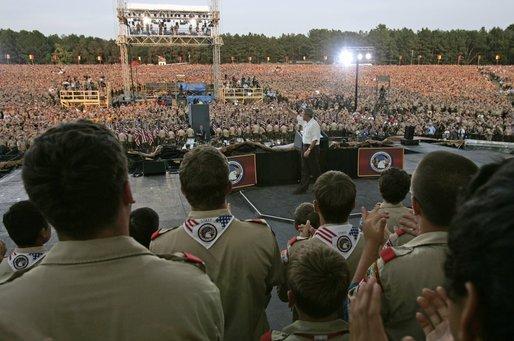 | President George W. Bush addresses tens of thousands of Boy Scouts during the 2005 National Scout Jamboree in Fort A.P. Hill, Va., Sunday, July 31, 2005. White House photo by Paul Morse. |
THE PRESIDENT: Daniel, thank you for your introduction. It's such an honor to be here. Laura and I join Americans across our country in extending our sympathy and prayers to the families of the Scout leaders who lost their lives so tragically earlier this week. The men you lost were models of good citizenship, leaders who stepped forward to serve a good and selfless cause. As Scout leaders they devoted themselves to helping young men develop the character and skills they need to realize their dreams. These men will always be remembered for their leadership and kindness. And you Scouts honor them by living up to the ideals of the scouting they served.
Daniel, I want to thank you for your introduction. I appreciate the Scouts picking a fellow Texan to introduce me. (Applause.)
I want to thank Congresswoman Jo Ann Davis for her leadership. I don't know if you realize this, but she sponsored legislation in the House of Representatives to ensure that the Boy Scouts are granted equal access to public lands. (Applause.)
I want to thank the President of the Boy Scouts, John Cushman; Roy Williams, the Chief Scout Executive; Fran Olmstead, the Chairman of this fantastic jamboree. I also want to thank Major General Jay Yingling, who is the Commander of the -- Fort A.P. Hill. General, thank you and all your troops for making sure this jamboree was a great success. (Applause.)
Here at the 16th National Scout Jamboree, you're carrying on a tradition that dates back almost seven decades. President Franklin Roosevelt came to the first jamboree in 1937. I don't think he rode in the same kind of helicopter I did, though. (Laughter.) You know, I was looking forward to coming last week, but the thunderstorms got in the way. So I appreciate the rain check. (Laughter and applause.) It's a fantastic sight to look out on more than 30,000 young men wearing the uniform of the Boy Scouts. (Applause.)
At this base there are Scouts from all 50 states, plus Puerto Rico, Guam, the Virgin Islands, and countries from all around the world. (Applause.) As a former Cub Scout from Midland, Texas, I'm especially glad to be here with the Texas Scouts. (Applause.) Sounds like you brought a big delegation this year. (Applause.)
Coming to this jamboree gives me great confidence in the future of our nation. For nearly a hundred years, Boy Scouts have set a high standard of service and duty to God and country. Millions of Americans have pledged the Scout oath: On my honor, I'll do my best. And through the generations, Scouts have made America a stronger and better nation. (Applause.)
Scouts have excelled in fields from science to business to education to the arts. Scouts have earned Olympic Gold Medals, Nobel Prizes and Academy Awards. Thousands of Scouts have shown the highest form of patriotism, by going on to wear the uniform of the United States military. (Applause.)
The first Scout Jamboree was held in Washington, D.C. The Scouts have felt at home in the Nation's Capital ever since. More than half of the current members of the United States Congress participated in the Scouts. One of the capital's most famous Scouts is President Gerald Ford. (Applause.) He first saw Washington just a few years after he earned his Eagle badge, and eventually became the first Eagle Scout to call the White House his home. (Applause.)
As President, I have the privilege to work with Scouts every day. When I come to the Oval Office in the morning, the first person I see is a Scout -- my Chief of Staff, Andy Card, from the state of Massachusetts. (Applause.) Down the hall is Vice President Dick Cheney, a Boy Scout from Casper, Wyoming. (Applause.) And across the river at the Pentagon sits an Eagle Scout from Illinois who Americans count on to "be prepared" -- Secretary of Defense Donald Rumsfeld. (Applause.)
These Scouts have a lot of things in common, and one of the most important is that they all benefited from the influence of a caring adult early in their lives. Across America, Scoutmasters and volunteers devote long hours to building the knowledge and integrity of our Scouts. It's not always an easy job. When I was a Cub Scout, my mother was our den mother. It's about the time her hair turned white. (Laughter.) I want to thank the Scoutmasters of America and the volunteer Scouters for taking the time to care. I want to thank you for your leadership, and thank you for setting such a good example for a new generation of Scouts. (Applause.)
When you join a Scout troop and put on the Boy Scout uniform you make a statement. Your uniform is a sign that you're a certain kind of citizen -- trustworthy, loyal, helpful, friendly, courteous, kind, obedient, cheerful, thrifty, brave, clean and reverent. (Applause.) These are the values of scouting, and they're important values for America. By working to live up to them, you're bringing great credit to yourselves and to our nation.
Coming to this jamboree is a great way to practice the values of Scout law. And when you get back home there are a few lessons you might keep in mind. The first one is one you've probably heard before, and it's one of the most valuable lessons I've learned -- listen to your mother. (Applause.) I didn't have much choice -- Mom always has a way of speaking her mind. When I paid attention, I benefited. And that's how it still works. Listen, you may not always agree with your mother, but think of it this way: The first voice you heard is always worth listening to.
Second, always remember where you come from and what you believe. At times, you may come across people who say that moral truth is relative, or call a religious faith a comforting allusion. They may question the values you learn in scouting. But remember, lives of purpose are constructed on the conviction there is right and there is wrong, and we can know the difference. (Applause.)
In the years ahead you will find that indifferent or cynical people accomplish little that makes them proud. You'll find that confronting injustice and evil requires a vision of goodness and truth. You'll find that many in your community, especially those younger than you, look to you as an example of conduct and leadership. For your sake, and for the sake of our country, I hope you'll always strive to be men of conviction and character. (Applause.)
Finally, your life will grow in meaning when you serve a cause greater than yourself. There's a wise saying: We make a living by what we get; we make a life by what we give. (Applause.) That truth is expressed well in the Scout slogan: Do a good turn daily. (Applause.) When you help someone in need, you're making America more hopeful, one heart and one soul at a time. And you're answering the call to love a neighbor just like you'd like to be loved yourself. (Applause.)
Every day, every day Scouts are showing that the greatest strength of America lies in the hearts and souls of our citizens. Through your Good Turn for America initiative, Scouts have given more than 1.4 million hours of volunteer service this year alone. (Applause.) In Nebraska, Scouts have made more than 11,000 pocket-size flags to send to troops serving overseas. (Applause.) In California, Boy Scouts donated money they raised for summer camps to help victims of the tsunami in Asia. (Applause.) In Louisiana, Scouts collected five tons of food to donate to a food bank. (Applause.) In Florida, Boy Scouts and Cub Scouts worked together to clean up the roads before the Super Bowl. (Applause.) And right here at the National Jamboree, Scouts are working with Habitat for Humanity to build a home for a Virginia family in need. (Applause.) On behalf of a grateful nation, I thank the Boy Scouts for serving on the front line of America's armies of compassion. (Applause.)
Another organization devoted to service is USA Freedom Corps. I created the USA Freedom Corps in 2002 to match willing volunteers with opportunities in their communities. If you're interested in serving America, if you're listening to my speech today to the Boy Scouts, call up USAFreedomCorps.gov to find out ways that you can join other kind-hearted Americans across our nation to mentor children, to assist the elderly, to clean up the neighborhoods and perform countless acts of generosity. (Applause.) This year, Laura is going to work with organizations like the Boy Scouts to lead an initiative called Helping America's Youth.
The Boy Scouts are recognizing our call to service with a special honor. I was pleased to accept the Good Turn for America award on behalf of the millions of volunteers all across our country who are helping this country be a hopeful place. (Applause.) By making a commitment to service, to integrity, and to good citizenship, all of you are showing your gratitude for the blessings of freedom.
You also understand that freedom must be defended, and I appreciate the Scouts' long tradition of supporting the men and women of the United States military. (Applause.) Your generation is growing up in an historic time, a time when freedom is on the march, and America is proud to lead the armies of liberation. (Applause.) I believe we're laying the foundations of peace for decades to come.
And that's not the only reason I'm optimistic about the decades ahead, because I'm standing in front of America's future leaders. When you follow your conscience, and the ideals you have sworn as a Scout, there is no limit to what you can achieve for our country. (Applause.) Continue to make right choices in life; continue to set high standards; continue to be a leader.
Thanks for hosting me tonight. May God bless you all, and may God continue to bless the United States of America. (Applause.)
END 7:37 P.M. EDT For Immediate Release, Office of the Press Secretary, July 31, 2005
more at President Bush or Current events amd Boy Scout Jamboree or National Boy Scout Jamboree and Boy Scouts
0
comments
||
||


