


President George W. Bush today announced his intention to nominate one individual and appoint three individuals to serve in his Administration:
The President intends to nominate Orlando J. Cabrera, of Florida, to be an Assistant Secretary of Housing and Urban Development (Public and Indian Housing). Mr. Cabrera currently serves as Executive Director of the Florida Housing Finance Corporation. He also serves on the Board of Directors of the National Council of State Housing Agencies. Earlier in his career, Mr. Cabrera was a Partner with Holland & Knight, LLP. He received his bachelor's degree from the University of Michigan and his J.D. from the University of Wisconsin Law School.
The President intends to appoint Joel M. Geiderman, of California, to be Vice Chairperson of the United States Holocaust Memorial Council, for a five-year term.
The President intends to appoint Michael A. Morris, of Georgia, to be a Member of the United States Holocaust Memorial Council, for the remainder of a five-year term expiring January 15, 2006 and an additional term expiring January 15, 2011.
The President intends to appoint Jay Stein, of Florida, to be a Member of the United States Holocaust Memorial Council, for the remainder of a five-year term expiring January 15, 2009.
# # # For Immediate Release,Office of the Press Secretary, August 18, 2005, Personnel Announcement
more at President Bush and Housing and Urban Development or Holocaust Memorial Council
Thursday, August 18, 2005
President to nominate one appoint three
0
comments
||
||

Airbridge Denial Program
Statement on Presidential Determination Regarding U.S. Assistance to the Government of Colombia Airbridge Denial Program
Presidential Determination Regarding U.S. Assistance to the Government of Colombia Airbridge Denial Program
The President has authorized the Department of State to continue assistance to Colombia in carrying out an "Airbridge Denial Program" against civil aircraft reasonably suspected of trafficking in illicit drugs. In granting this authorization, the President has determined that Colombia has put in place appropriate procedures to protect against loss of innocent life in connection with interdiction operations. The United States Department of State, with the support of other U.S. agencies, has the ability to continue to work with the Government of Colombia to ensure effective counternarcotics operations while observing strict adherence to agreed-upon and well-established safety procedures.
# # # For Immediate Release, Office of the Press Secretary, August 17, 2005
more at Colombia or Drug Interdiction and National Defense Authorization Act or President Bush and Airbridge Denial Program
0
comments
||
||
Drug Interdiction Assistance to Colombia
Memorandum for Secretary of State and Secretary of Defense Presidential Determination No. 2005-32
SUBJECT: Continuation of U.S. Drug Interdiction Assistance to the Government of Colombia
Pursuant to the authority vested in me by section 1012 of the National Defense Authorization Act for Fiscal Year 1995, as amended (22 U.S.C. 2291-4), I hereby certify, with respect to Colombia, that (1) interdiction of aircraft reasonably suspected to be primarily engaged in illicit drug trafficking in that country's airspace is necessary because of the extraordinary threat posed by illicit drug trafficking to the national security of that country; and (2) that country has appropriate procedures in place to protect against innocent loss of life in the air and on the ground in connection with such interdiction, which shall at a minimum include effective means to identify and warn an aircraft before the use of force is directed against the aircraft.
The Secretary of State is authorized and directed to publish this determination in the Federal Register and to notify the Congress of this determination.
GEORGE W. BUSH
# # # For Immediate Release, Office of the Press Secretary, August 17, 2005 more at Colombia or Drug Interdiction and National Defense Authorization Act or Condoleezza Rice and Donald Rumsfeld or Rumsfeld and President Bush
0
comments
||
||
Wednesday, August 17, 2005
PIRRO PICKS UP ENDORSEMENTS
PIRRO PICKS UP ENDORSEMENT OF GOP NATIONAL COMMITTEE MEMBERS August 17, 2005
Treadwell and Saul Yaffa Back Pirro in Bid to Defeat Hillary Clinton
Republican National Committee members Sandy Treadwell and Jennifer Saul Yaffa today announced their endorsement of Westchester County District Attorney Jeanine Pirro for U.S. Senator in her race against Hillary Clinton, joining a growing list of GOP leaders from across the state in supporting Pirro's campaign.
Treadwell said, "Jeanine Pirro is dynamic, articulate and she is going to win in November 2006. New York deserves a full-time Senator who puts our interests first, not someone with a record of shortchanging New York over and over again. I am pleased to support her candidacy and will do all I can to help her defeat Hillary Clinton."
Saul Yaffa said, "Jeanine Pirro is the right candidate for the Republican Party and the right candidate to defeat Hillary Clinton. Jeanine Pirro is a fighter who will work hard in Washington to deliver for New York, and will not be distracted by campaigning in Iowa, New Hampshire and other presidential primary states. Jeanine has my full and enthusiastic support."
Pirro, who announced her candidacy for Senate last week, was urged to join the race by 46 GOP county chairs, including Monroe County Chair Steve Minarik, who also is State Chairman.
Pirro said, "Hillary Clinton has shortchanged New Yorkers long enough, and it will only get worse as she campaigns for president. She should tell New Yorkers the truth about her plans: is she committed to New York or is she running for president? She promised to serve out her full term in February 2000, and New Yorkers deserve the same candor this time around. I am proud to receive these important endorsements today and look forward to working with the growing list of New Yorkers who know that New Yorkers deserve a full-time Senator fighting for them."
Pirro has a successful 30-year record of fighting for a safer, cleaner and healthier New York. As District Attorney, her efforts contributed to a 30 percent decrease in violent crimes in Westchester County, while earning a 98 percent conviction rate in Superior Courts. She has convicted more than 100 made members and associates of the mob, brought home millions of dollars through successful prosecutions of environmental polluters and those who stole taxpayer money. Pirro also headed one of the nation's first domestic violence units to protect women and children, created dedicated units to fight bias crimes and environmental crimes, led the fight against underage drinking and used DNA technology to bring murders and other criminals to justice. She has served three terms as Westchester District Attorney, winning her first term in 1994. Pirro, who in 1990 became the first woman elected to Westchester County Court, has worked in law enforcement for more than 30 years.
### Source: jeaninepirro2006.com more at Jeanine Pirro or HILLARY CLINTON and New York Senate or republican and republicans
1 comments
||
||
ABLE DANGER 9/11 REPORT
WELDON RESPONDS TO OMISSION OF ABLE DANGER FROM 9/11 REPORT
WASHINGTON, D.C., Aug 12 - Today Congressman Curt Weldon (R-PA), Vice Chairman of the House Armed Services and Homeland Security Committees, released the following response to a statement by the former 9/11 Commission regarding the ABLE DANGER operation.
“ABLE DANGER was about linkages and associations of individuals identified with direct links to Al-Qaeda and not about dates and times.
To clarify, ABLE DANGER was a Department of Defense planning effort, tasked to Special Operations Command (SOCOM) by the Chairman of the Joint Chiefs of Staff (JCS). The task assigned to ABLE DANGER was to identify and target Al-Qaeda on a global basis and, through the use of cutting edge technology (data-mining, massive parallel processing, neural networking and human factors analysis) and enhanced visualization and display tools, present options for leaders (national command authority) to manipulate, degrade or destroy the global Al-Qaeda infrastructure.
The 9/11 Commission has released multiple statements over the past week, each of which has significantly changed - from initially denying ever being briefed to acknowledging being briefed on both operation ABLE DANGER and Mohammed Atta. The information was omitted primarily because they found it to be suspect despite having been briefed on it two times by two different military officers on active duty. Additionally, the 9/11 Commission also received documents from the Department of Defense on ABLE DANGER.
Despite their varied statements, two critical questions remain unanswered.
1) Why did the Department of Defense fail to pass critical information obtained through ABLE DANGER to the FBI between the summer and fall of 2000?
2) Why did the 9/11 Commission staff fail to properly follow-up on the three separate occasions when they received information on ABLE DANGER and Mohammed Atta?
I will continue to push for a full accounting of the historical record so that we may preclude these types of failures from happening again.”
Source: curtweldon.house.gov ### more at able danger or Curt Weldon and Mohammed Atta or 9/11 Commission
0
comments
||
||
Start of Gaza Strip evacuation
(Communicated by the IDF Spokesman and Israel Police)
"In accordance with article 22A of the Implementation of the Disengagement Plan Law 2005, the Prime Minister and Minister of Defense have ordered that today, August 17, 2005, the evacuation of the residents of the Gaza Strip will commence.
IDF, Border Police and Israeli Police forces have been operating since the early morning hours in several Israeli communities who have yet to evacuate and are asking of the residents and citizens to act in accordance with the law and evacuate the area via the IDF organized transportation.
The evacuating forces are prepared to meet the citizens' resistance to the evacuation and they will operate with all due sensitivity and determination needed to fully complete the mission.
The IDF and Israeli Police continue to be on high alert in order to provide an immediate response to any security threats or disturbances that may arise."
* * *
"On the first day of enforced evacuation as part of the disengagement, 17 August 2005, IDF and Israel Police forces have been evacuating 6 communities - Neve Dekalim, Ganei Tal, Bedolah, Morag, Tel Katifa and Kerem Atzmona.
The evacuation of the community of Tel Katifa has been completed. In the community of Morag and Bedolah the evacuation of the synagogues has been completed. The forces have begun the evacuation of the synagogue in the community of Kerem Atzmona. It should be noted that residents from 583 houses and public buildings have been evacuated, out of a total of 2206 buildings that exist throughout all Israeli communities in the Gaza Strip."
Source: Israeli Government's Ministry of Foreign Affairs more at Gaza Strip evacuation or Gaza Strip and Gaza and Palestine or Israel
0
comments
||
||
President to nominate four, designate two
President George W. Bush today announced his intention to nominate four individuals and designate two individuals to serve in his Administration:
The President intends to nominate Thomas A. Shannon, Jr., of Virginia, to be Assistant Secretary of State (Western Hemisphere Affairs). A career member of the Senior Foreign Service, Mr. Shannon currently serves as Special Assistant to the President and Senior Director for Western Hemisphere Affairs at the National Security Council. He previously served as Deputy Assistant Secretary of Western Hemisphere Affairs at the Department of State. Prior to that, he was Director of Andean Affairs and as U.S. Deputy Permanent Representative to the Organization of American States (OAS). Mr. Shannon received his bachelor's degree from the College of William and Mary. He later received his M. Phil and D. Phil from Oxford University.
The President intends to nominate Donald C. Winter, of Virginia, to be Secretary of the Navy. Mr. Winter currently serves as Corporate Vice President and President of Northrop Grumman Mission Systems. He previously served as President and Chief Executive Officer of TRW Systems. Earlier in his career, Mr. Winter was awarded the Secretary of Defense medal for meritorious civilian service while working for the Defense Advanced Research Projects Agency. He received his bachelor's degree from the University of Rochester. He later received his master's degree and PhD from the University of Michigan.
The President intends to nominate Michael W. Wynne, of Florida, to be Secretary of the Air Force. Mr. Wynne currently serves as Principal Deputy Under Secretary of Defense for Acquisition, Technology and Logistics at the Department of Defense. He previously served as Under Secretary of Defense for Acquisition, Technology and Logistics. Before that, Mr. Wynne served as Chairman and Chief Executive Officer of Ixata, and as Chairman of Extended Reach Logistics. Mr. Wynne received his bachelor's degree from the United States Military Academy at West Point and served as a Captain in the United States Air Force. He received his first master's degree from the Air Force Institute of Technology, and his second master's degree from the University of Colorado.
The President intends to nominate Brenda La Grange Johnson, of New York, to be Ambassador Extraordinary and Plenipotentiary of the United States of America to Jamaica. Ms. Johnson has served as a Partner of BrenMer Industries for nearly 30 years. Prior to that, she was a supervisor and teacher for Operation Head Start in Brooklyn, New York. Ms. Johnson received her bachelor's degree from Duke University and her master's degree from Columbia University.
The President intends to designate Robert D. McCallum, Jr., of Georgia, to be Acting Deputy Attorney General of the Department of Justice.
The President intends to designate Jerry Paul, of Florida, to be Acting Deputy Administrator for Defense Nuclear Nonproliferation of the National Nuclear Security Administration at the Department of Energy.
# # # For Immediate Release, Office of the Press Secretary, August 16, 2005, Personnel Announcement more at President Bush and Department of State and Navy or Air Force and Jamaica or Department of Justice
0
comments
||
||
Condoleezza Rice, Iraqi National Assembly, Iraqi Constitution
Secretary of State Condoleezza Rice On the Iraqi National Assembly Vote to Extend the Date for the Drafting of the Iraqi Constitution FULL STREAMING VIDEO (6:00 p.m. EDT)
SECRETARY RICE: Good evening. I have a brief statement and then I'll take a few questions.
Iraqis from across the political spectrum -- Sunni, Shia, Kurds and others -- are making substantial progress on their constitution, including on many of the most difficult issues before them. They have achieved a lot and they have generated considerable momentum toward the completion of their constitution. Iraq's leaders have asked for and received from their freely elected national assembly seven more days to finalize their work. This request was in full accordance with the Transitional Administrative Law, which provides the framework for this process. With the January elections, the formation of a new, inclusive government, the establishment of a constitutional process and now their work on a new constitution, Iraqis have continued to demonstrate their commitment to a new Iraq, based on the rule of law and their desire for a common future. We are witnessing democracy at work in Iraq. The new constitution will be the most important document in the history of the new Iraq. We are confident that they will complete this process and continue on the path toward elections for a permanent government at the end of the year.
Thank you and now I'll take a few questions.
Anne.
QUESTION: Madame Secretary, it sounds as if the compromise document that emerged earlier today left out, really, all of the hardest questions facing the Iraqi drafters. Will a week's time be enough to resolve those? And what will the U.S. response be if, in fact, they end up deferring again?
SECRETARY RICE: Well, my understanding, Anne, is that they are working on a comprehensive document; that they have made substantial progress on all of the issues before them. I'm not going to try to second guess or discuss what is going on in that process. I think that's for the Iraqis to do. But they are considering all of the difficult issues before them and they felt that they needed more time. We have to remember that this is an enormously important document and what you have here is people who are trying to build a common future after decades of tyranny. And so the opportunity to work together, to continue to work together, that's what they went to their assembly with and they got unanimous consent. And I might just mention that there were some 237 of the 275 assembly members were still there, waiting for this process. And so it's my understanding that they are continuing to work on all of the difficult issues and that they believe they need seven days or so to complete that work.
Nick.
QUESTION: Can you tell us what Ambassador Khalilzad is trying to do in the last few days? What issues was he focusing on? What issues does he plan to focus in the next week? And also, there have been suggestions that the Embassy got really involved after that -- Ambassador Khalilzad got to Baghdad and that perhaps his predecessor, Ambassador Negroponte, was too hands-off and wasn't helping the Iraqis as well as he could have. Would you tell us whether that might be true?
SECRETARY RICE: Well, I think that the United States has been very involved with the Iraqis every step of the way. But this is an Iraqi process; this is not an American process. And I know that Zal, as John Negroponte before him, tried to help in any way that they were asked to do. Sometimes they were asked to facilitate, to hold discussions, but I want to be very clear that this is an Iraqi process and I think you saw today that Iraqis are in control of this process. They decided that they were responsible officials who needed more time to look at the very difficult issues that were in the text. And so they took that time in accordance with a process that was set up. And so, yes, Zal has been active. Our people have been active. Others have been active in helping them, but this is by all means an Iraqi process.
Yeah. Joel.
QUESTION: Some of the people involved in Iraq are saying that if they cannot reach agreement within a week, then they will call for new elections, which is what the basic law says they must do. How will the United States feel about that and do you think new elections would perhaps with more involvement of more Iraqis would produce a government more likely to approve the kinds of things the United States is concerned about?
SECRETARY RICE: Well, Joel, what struck me is that they didn't take that option, that in fact they -- those who are the drafters of the constitution, as well as the leadership, because you should know the leaders have been very involved in this process -- decided that they had made substantial progress, they made enough progress that what they wanted was a little more time. And so they availed themselves of this option to go to the national assembly. Again, they got that unanimously. I believe they're going to finish this. I've heard expressions from the Iraqis that they believe that they're going to finish it. I don't think we really do any good by speculating beyond that because I think that they are very much focused on a course that will bring this to conclusion at the end of seven days.
I think we have to step back a little bit here and recognize that, yes, there was an August 15th deadline to complete the constitution; there was also a way for them to avail themselves of a few more days and this is a pretty important process, these people are working very, very hard. They've been working very long hours, but what that says is that they are really committed to putting together a document that they believe in, a document that can be a foundation for a free and democratic Iraq for all Iraqis, and that they're determined to do that. They didn't change the process, they didn't walk out of the process, they didn't try to go around the process as some of the news reporting suggested this morning. Instead, they have remained committed to a process to bring this together for all Iraqis and I think it's pretty impressive what they've achieved thus far.
Yes.
QUESTION: In the long term, does it concern you that the Kurds, for example, are still asking for the eventual right of secession? And also, especially as a woman, are you concerned that the questions over women's rights are still outstanding?
SECRETARY RICE: Well, on women's rights, I think we've been very clear that a modern Iraq will be an Iraq in which women are recognized as full and equal citizens and I have every confidence that that is how Iraqis feel. And the important phrasing in the constitution, how that will be represented, of course they're going to continue to work on. But the United States has been very clear about the importance of women's rights and the interesting thing is, of course, there have been a number of women's groups that have been bringing a lot of pressure for the full acknowledgement of women's rights. This is truly a democratic process.
Now, when it comes to various groups, including the Kurds, that have particular interests at stake, it's not surprising in a democratic process that people continue to press for certain outcomes, but ultimately, these documents are, by their very nature, documents that embody compromises. And they are continuing to work together and to work together until the 11th hour in the way that they have, suggests that they fully understand the importance of compromise.
MR. MCCORMACK: Last question.
SECRETARY RICE: Yeah. Peter.
QUESTION: Yeah, Madame Secretary, how confident are you that the Sunnis are being fully included in this process, since there had been some reports that maybe the Shiites and Kurds were trying to ram through a solution?
SECRETARY RICE: Well, I think what this shows is that in fact they continue to hold together and they continue to pull together, using an established vehicle that was there for them to get a little bit more time. They didn't go around the process. They went to the national assembly, they got unanimous consent of the national assembly to continue their work. That suggests that that's how they want this process to work, not to go around some particular group.
I also, having been in Iraq just a couple of months ago, I think it's quite remarkable how much the process has become more inclusive over the last couple of months. Of course, the Sunnis did not fully participate in the elections for a number of reasons, were therefore not very represented in the transitional national assembly. They went out of their way, nonetheless, to have a government that was inclusive of Sunnis. They then went out of their way to have a constitutional process that was more inclusive of the Sunnis, a committee that was more inclusive of Sunnis than the original committee.
And now, the Sunnis seem to me to be very much a part of this process and I think that it is a very good sign that when it came to it today, when they -- as responsible officials, responsible elected officials believed that they needed a little more time, that they availed themselves of the vehicle that was there to go to the national assembly, ask that time -- President Talabani to say, we've made substantial progress, we'd like to have a little more time, that's the way that this process is working, it's working in an orderly fashion and I think the Iraqis have a lot to be proud of. They've got a lot of work to do, but this is really democracy at work in Iraq and given where they were just a few years ago, having lived in tyranny for all those decades, this is an extraordinary achievement for the Iraqi people.
Thank you very much.
QUESTION: One more?
SECRETARY RICE: Okay, Robin. (Laughter).
QUESTION: What role are you playing? Have you had any contact in the recent days or do you intend to have any contact with any Iraqis during this last critical week?
SECRETARY RICE: I've largely stayed in touch with Ambassador Khalilzad and also with the President a couple of times today and will continue to do that. Obviously, if my help is needed or anybody's help is needed, we'll do that. But this is an Iraqi process. This is a moment for the Iraqi people. And when they went into that assembly today and so many of them were still there and they got the vote unanimously to continue the process so that they could finish their work over the next seven days and they broke into applause, it says something about what they all have at stake and understand that have at stake on behalf of the Iraqi people.
Thank you.
Source: Video, c-span.org, Text, state.gov, 2005/783, Released on August 15, 2005, Secretary Condoleezza Rice, Washington, DC, August 15, 2005 more at Condoleezza Rice and Iraqi Constitution or Iraqi National Assembly or Middle East and Iraqi Draft Constitution or Iraq
2
comments
||
||
Tuesday, August 16, 2005
Zalmay Khalilzad, U.S. Ambassador to Iraq,
Zalmay Khalilzad, U.S. Ambassador to Iraq, Interview on Fox and Friends, Baghdad, Iraq, August 16, 2005
QUESTION: U.S. Ambassador to Iraq Zalmay Khalilzad joins us from Baghdad. It's great to have you back with us. Thank you.
AMBASSADOR KHALILZAD: Good to be with you. Good morning.
QUESTION: Good morning. What exactly happened at the last moment? What were the sticking points?
AMBASSADOR KHALILZAD: Well, there were a couple of sticking points. I have to say first that Iraq is in the middle of a war by terrorists against them, are trying to put a national compact together, bringing various communities to agree on a roadmap for the future. That is absolutely necessary for the success of this nation.
Tough issues on the table. They had agreement on most things. A couple of issues that remain, one having to do with the powers between the president and the prime minister. That's the system that they are going for. Another having to deal with the issue of resources in a federal structure, how much central control, how much regional control. And there was also some procedural issues about the quality of the writing and the document. They needed more time. They could have declared prematurely that they have an agreement. They decided not to do that. The option was available to them to ask for more time, a legal option and exercise it. It's perfectly understandable they have lost some time in any case because of the sandstorm here.
I think the system has worked. It followed the right process and procedures. We are disappointed but, you know, it's an important thing for the Iraqis to get this right. We don't do constitutions every day. And they will succeed. They need a few more days. Perfectly, perfectly understandable.
QUESTION: Do the committee members understand what the reaction will be in the United States if they adopt Sharia Law as the law of the land?
AMBASSADOR KHALILZAD: They will not adopt Sharia as the law of the land. That issue has been resolved. There is no dispute about that.
QUESTION: So women will have equal rights?
AMBASSADOR KHALILZAD: Iraqis -- women will have equal rights. That issue has been resolved.
QUESTION: Okay, I was unaware of that because all the reports that we had gotten was that that was still something that had to be worked out. But you say that it has been done.
All right. What about the status of Shiite clerics? That was another thing that people had said had not been worked out, that the Shiites wanted a special status for clerics. What does that mean and is that issue still on the table?
AMBASSADOR KHALILZAD: As of now, that issue has also been resolved. There will be no reference to a special status for the Shiite clerics or for any other clerics. So it was part of the discussion, it did exist in one of the earlier drafts, but as of now that issue has been resolved as well.
QUESTION: What about the autonomy that the Kurds want? There had been a suggestion that they stay within this federation for eight years and then, at the end of eight years, have the option of becoming its own entity. Is that something that would be possibly viable?
AMBASSADOR KHALILZAD: I don't believe that there is a clause in the current draft with regard to independence for the Kurds. The Kurds want to be part of Iraq but they want to be part of a federal and democratic and pluralistic Iraq with specified powers exercised by the Kurdish government and legislature. And there is broad agreement among the people who are writing the constitution here, the draft. There is one issue that remains, and that is the resource issue. How much of the oil resources of the Kurdish area should be controlled by the local government in terms of contracting, management and revenues, and how much by the central government? There is an agreement that with regard to the currently known reserves that it will be managed by the central government resources.
There is more of a discussion about potential oil discoveries with regard to the future. There is a good discussion going on now as to what the options are. We couldn't help them bridge that. We are thinking about options to help them. But, you know, these are very difficult, complicated issues with regard to the future because new reserves, who knows when they will be discovered, when they will be developed, and it's perfectly -- I have been with them for many, many hours and I know how difficult it is, what the arguments are.
So we should be pleased that these issues are being engaged in this fashion rather than what used to be the traditional method in Iraq where, you know, one dictator got up and said this is the way we are going to do things.
QUESTION: Ambassador Zalmay Khalilzad, thank you very much for your time this morning.
AMBASSADOR KHALILZAD: Well, thank you.
Source; state.gov 2005/785 more at Iraqi Constitution or Iraq and Zalmay Khalilzad or Middle East and Iraqi Draft Constitution
2
comments
||
||
Spanish/NATO Helicopter Crash in Afghanistan
Spanish/NATO Helicopter Crash in Afghanistan
The U.S. is deeply saddened by the tragic loss of 17 Spanish soldiers and crew in a helicopter crash in Afghanistan today. Secretary Rice called Spanish Foreign Minister Moratinos to express our deepest condolences to the families of the victims and to the government and people of Spain. The Spanish soldiers serving in the NATO mission in Afghanistan are part of a humanitarian mission to bring peace and stability to the Afghan people. The United States salutes their sacrifice and values their partnership. Together, we remain committed to supporting Afghanistan.
2005/787 Press Statement, Sean McCormack, Spokesman, Washington, DC, August 16, 2005
more at Afghanistan and Spain or NATO and Spanish soldiers or Department of State and State Department
0
comments
||
||
President's Statement Iraqi Draft Constitution
President's Statement on Iraqi Draft Constitution
Iraqi leaders have announced that they have made substantial progress toward a draft constitution. They have indicated that their deliberations will continue beyond today to refine the text and build an enduring consensus. I applaud the heroic efforts of Iraqi negotiators and appreciate their work to resolve remaining issues through continued negotiation and dialogue. Their efforts are a tribute to democracy and an example that difficult problems can be solved peacefully through debate, negotiation, and compromise. We wish the Iraqi leaders and the Iraqi people well as the negotiators complete the constitutional drafting process.
# # # For Immediate Release, Office of the Press Secretary, August 15, 2005
more at Iraqi Draft Constitution and Iraqi Constitution or Iraqi and Iraq or President Bush
0
comments
||
||
Ed Cox Launches Twelve County Tour
Ed Cox continuing with his summer travel schedule. Continuing with his summer travel schedule in advance of the formal launch of his U.S. Senate bid, Ed Cox began a new twelve county tour of upstate New York with his visit to Jefferson County on Sunday.
“It is vital in the formative stages of a campaign to build strong relationships. The more the voters learn about my values and my positions on the issues, the more they will agree that I’m the best candidate to challenge Sen. Clinton,” stated Cox who will be meeting with Republican and Conservative Party leaders in each county during the trip.
Cox’s schedule will be a combination of private meetings with party leaders, as well as appearances at public and political events for the Republican and Conservative Parties. He will also be taking time to meet with local media in each location.
In addition to Jefferson County, Cox is slated to visit Wayne, Livingston, Wyoming, Erie, Broome, Ontario, Onondaga, Monroe, Steuben, Genesee and New York counties as well. By the end of the week he will have visited nearly half of New York’s 62 counties this summer.
“I am moving forward. My message continues to be greeted enthusiastically by party leaders, elected officials and residents who want to win in 2006,” stated Cox. “New Yorkers deserve results. I have a record serving three presidents and two governors that makes me the most qualified candidate to challenge Sen. Clinton. We are going to prove that one county at a time,” he concluded.
August 15th 2005 Source: edcoxforny more at Ed Cox or Jeanine Pirro or HILLARY CLINTON and New York Senate or republican and republicans
0
comments
||
||
National Airborne Day, 2005
National Airborne Day, 2005, A Proclamation by the President of the United States of America
Americans live in freedom because of the extraordinary bravery, sacrifice, and dedication to duty of the members of our Armed Forces. From the first official Army parachute jump 65 years ago, our country's Airborne troops have played a crucial role in the defense of our Nation and our liberty. On National Airborne Day, we pay special tribute to these courageous soldiers who served with honor and integrity.
On August 16, 1940, the successful first jump of the Army Parachute Test Platoon laid the foundation for a new and innovative method of combat that helped contribute to an Allied victory in World War II. These bold pioneers answered the call of duty and set an example for future generations to follow. Since the designation of the Army's first Airborne division, the 82nd Airborne, on August 15, 1942, our Airborne troops have performed with valor. The brave men and women of our Airborne forces have worked to defeat tyranny, advance the cause of liberty, and build a safer world.
Today a new generation of Airborne forces is fighting a war against an enemy that threatens the peace and stability of the world. At this critical time, Airborne forces of the Army, Navy, Marines, and Air Force are continuing the noble tradition of the first sky soldiers. Americans are grateful for the service of our Airborne forces and all our troops, and we are inspired by the strength and sacrifice of our military members and their families.
NOW, THEREFORE, I, GEORGE W. BUSH, President of the United States of America, by virtue of the authority vested in me by the Constitution and laws of the United States, do hereby proclaim August 16, 2005, as National Airborne Day. I encourage all Americans to honor those who have served in the Airborne forces, and I also call upon all citizens to observe this day with appropriate programs, ceremonies, and activities.
IN WITNESS WHEREOF, I have hereunto set my hand this fifteenth day of August, in the year of our Lord two thousand five, and of the Independence of the United States of America the two hundred and thirtieth.
GEORGE W. BUSH
# # # For Immediate Release, Office of the Press Secretary, August 15, 2005 National Airborne Day and Airborne or World War II and Army or President Bush
0
comments
||
||
Monday, August 15, 2005
U.S. Support for Women in Iraq
U.S. Support for Women in Iraq
"Human rights are defined by a constitution; they're defended by an impartial rule of law; they're secured in a pluralistic society. The advance of women's rights and the advance of liberty are ultimately inseparable."
~ President George W. Bush,
Efforts to Globally Promote Women's Human Rights, March 12, 2004
Background
Since Iraq’s liberation, the United States has actively supported the needs and interests of Iraqi women, seeking to provide them with the necessary tools to permit their full participation in their country’s political, social, and economic future. With support from Congress, the Administration has worked closely with the representatives of the Interim and Transitional governments of Iraq, as well as local Iraqi civic partners, to establish programs designed to promote the equal participation of women and protection of women’s rights.
Of the 40 Cabinet-level Ministerial positions, six are held by women.
Of the 275 seats in the Transitional National Assembly (TNA), 87 seats (or 31 percent) are held by women.
Under Article 31 of the Transitional Administrative Law (TAL), electoral laws aimed to achieve the goal of having women constitute no less than one-quarter of the TNA.
Of the 71 members of the TNA’s Constitutional Drafting Committee, 11 are women.
The United States funds government initiatives and NGOs that support Iraqi women, such as a public education campaign on the constitution, Fulbright scholarships, and assistance in the economic, social and political spheres.
Iraqi Women’s Democracy Initiative
The Department’s $10-million Iraqi Women’s Democracy Initiative (IWDI) was announced in March 2004 and provides skills in key areas, including education for democracy, leadership training, political training, teaching, coalition-building, organizational management, entrepreneurship, and media training.
The Office of International Women’s Issues (G/IWI) and the Bureau of Democracy, Human Rights, and Labor (DRL) are responsible for the IWDI. Since last September, seven major grantees have been conducting extensive training programs in Iraq, thus far training some 2,000 women.
With IWDI funds, the new Minister of State for Women's Affairs, Dr. Azhar al-Sheikhly, who has a Ph.D. in constitutional law, received training under a U.S. grant and was recently able to lead a delegation of Iraqi women lawyers to the United States for a week of focused training on legal and constitutional issues and meetings with the Executive Branch and Members of Congress.
In February and March of 2005, IWDI funds were used to support a delegation of Iraqi women leaders, led by the former Minister for Women's Affairs, Narmeen Othman, to participate in the proceedings of the UN’s Commission on the Status of Women and in the events of International Women's Day events with the First Lady and the Secretary of State.
In June 2005, IWDI funds supported the participation of seven Iraqi women leaders in the Global Summit for Women in Mexico.
The U.S.-Iraq Women's Network and the Iraqi Women’s Gift fund, which are public/private partnerships, have been created to build more support for Iraqi women in the U.S.
Economic and Social Support
The USAID Private Sector Development Office reaches out to women in the business and agriculture communities by providing both capacity building training and financial resources. A vocational training and employment services project has been started with women as a primary focus. A new business grants program began in February 2005, with the goal of awarding 30 percent of its grants to women.
USAID’s Iraq Civil Society Program (ICSP), which provides technical assistance to Iraqi NGOs, has provided specific support to Iraqi NGOs working in support of women’s rights. In March 2005, the ICSP conducted training sessions for Iraqi NGOs to educate them about the UN Convention for the Elimination of All Forms of Discrimination Against Women (CEDAW) and its applicability in Iraq.
The American Bar Association (ABA), under the USAID Consortium for Elections and Political Process Strengthening, conducts training programs and foreign study visits to increase the knowledge and capacity of NGOs and government officials regarding gender-related legislation. In March 2005, ABA held a conference in Jordan to facilitate a dialogue between NGOs and the Minister of State for Women’s Affairs on the role of gender in the Iraqi constitution and law.
Thus far, the USAID’s Women’s Party Advancement Program, supported by the National Endowment for Democracy (NED), has provided leadership training for more than 180 women from several political parties. This training has included sessions on how to promote internal transparency, overcome lack of experience in politics, and how to operate effectively within a political party.
Educational Support
The Bureau of Educational and Cultural Affairs has funded 17 Iraqi women on Fulbright Scholarships in the social sciences, public administration, law, business, and public health fields over the past two years and selected six young Iraqi women to participate in the Bureau’s "YES" Youth Exchange Program to attend a U.S. high school and live with an American host family in the 2005/6 academic year.
60 Iraqi women participated in a number of regional, multi-regional, and single country International Visitor Leadership (IVL) and Voluntary Visitor Programs in English language teaching, civic education, civil society development, democracy and governance, women’s leadership, NGO management, education and journalism fields. An additional eight women are scheduled to take part in the IVL program before the end of this fiscal year.
"There are those who say that democracy is for men alone. In fact, the opposite is true: Half a democracy is not a democracy. As one Muslim woman leader has said, "Society is like a bird. It has two wings. And a bird cannot fly if one wing is broken."
~Secretary of State Condoleezza Rice, Remarks at the American University in Cairo,
Cairo, Egypt, June 20, 2005
Fact Sheet, Office of International Women's Issues, Washington, DC, August 15, 2005
Source: state.gov/ motr at Iraq or Middle East and Condoleezza Rice or Human Rights and Iraqi women or Iraqi Transitional National Assembly
0
comments
||
||
Iraq Draft Constitution
U.S. Ambassador to Iraq Optimistic About Draft Constitution, Khalilzad says role of Islam, federalism most important remaining issues, August 14, 2005
By Bernie Chabel, Washington File Special Correspondent
Washington -- Stating that "failure is not an option for the Iraqis or for us," U.S. Ambassador to Iraq Zalmay Khalilzad says Iraqi leaders are optimistic about meeting the August 15 deadline for completing a draft constitution for their country.
In interviews on four news programs August 14, Khalilzad said the drafting committee for Iraq's constitution has resolved most of the key issues. However, he said, there are two major unresolved issues: federalism, or the role of the central government versus that of regional or state government entities, and the role of Islam.
"I think the differences on federalism have narrowed considerably," the ambassador said on ABC's This Week.
The role Islam will play beyond its recognition as the official state religion is the most important of the outstanding issues, according to Khalilzad. A key unresolved point in this debate, he said, is whether Islam will be recognized as "the" source or "a" source of the underpinnings of the Iraqi constitution. Speaking on CNN’s Late Edition, Khalilzad said the Iraqi constitution should recognize the principles of democracy and the principles of human rights as sources, as well as Islam.
The United States "does not want to see a hierarchy of sources," he said.
Speaking on NBC’s Meet the Press, Khalilzad said he expects the Iraqi constitution to grant equal rights to men and women.
"Any country that wants to be successful and discriminates against more than half of its population will not succeed," he said. Khalilzad added that "to tie the hands of half its population behind their backs or to move forward without the full energies of all Iraqis, that would be a terrible mistake."
Khalilzad also said the process of drafting the constitution provides an opportunity to decide on a national compact "in which all communities, including Sunnis, will participate, and thus isolate the insurgency, which is strong in the Sunni Arab area. The insurgents are trying to derail this process, but they will fail."
Based on discussions with Sunni leaders, the ambassador said, most Sunnis are likely to support the draft constitution now under consideration. "They are prepared, for the most part, to participate in the political process. They think it was a mistake for them to have boycotted the elections that took place last year," he said.
Khalilzad warned that neighboring states in the region -- particularly Iran and Syria -- should not view Iraq’s difficulties as an opportunity to advance their own agendas, but should cooperate with the new government.
"The states of the area have to understand that Iraq will succeed," he said on Fox News Sunday. "They can delay that success, make it harder, but we are committed, the Iraqis are committed to success. It behooves them to be helpful to this new Iraq because when Iraq succeeds, it will remember who helped and who opposed their success."
Khalilzad said his role in the drafting of Iraq's constitution has been one of providing options, when asked, for bridging differences among the parties.
"Clearly, the choices are theirs, the decisions are theirs, but my role is to help," he said. "I’m happy if they don’t need me, but failure is not an option, and if they need my help, I’ve told them I’m available at any time, and I have provided them some help when they needed it."
If a draft constitution emerges by the August 15 deadline, it will be submitted to the Iraqi electorate for ratification on October 15. If ratified, elections for a permanent government would be scheduled for December 15. If the draft constitution is not ratified, December 15 would be the date for elections for a new National Assembly.
If the August 15 deadline for the draft is not met there are two options. The assembly, by three-fourths vote, could extend the deadline, or, if this does not happen, the current government would be dissolved and new elections for the National Assembly would be held.
Source: iraq.usembassy.gov/ more at Iraqi Constitution or Iraq and Zalmay Khalilzad or Middle East
0
comments
||
||
Gaza Withdrawal
Gaza Withdrawal
Spokesman Sean McCormick (Aug 15): "There's a lot of support to make this withdrawal a success...the key to it is the Israelis and the Palestinians working together over this next several weeks so that we do have a successful withdrawal, so that the two sides can make progress and re-energize the roadmap, and ultimately have a better life for the Palestinian people as well as the Israeli people."
Source: state.gov more at Gaza Withdrawal or Gaza and Israel or Palestine
0
comments
||
||
The Great Raid on Cabanatuan
Great Raid on Cabanatuan depicts Warrior Ethos, By Col. Randy Pullen
 | Lt. Col. Henry A. Mucci (left), commander of the 6th Ranger Battalion, confers with his personnel officer, Capt. Vaughn Moss. Mucci led the Jan. 30, 1945 raid on the Cabanatuan POW camp featured in the film which opens Aug. 12. |
The 1945 raid by the U.S. Army’s 6th Ranger Battalion to rescue Americans held at the Japanese POW camp near Cabanatuan in the Philippines is the subject of “The Great Raid,” a movie opening nationally Aug. 12.
The same raid was depicted in the opening scenes of an earlier movie, the 1945 “Back to Bataan,” starring John Wayne and Anthony Quinn.
Regardless of how accurately either movie depicts the raid and those who lived through it, the real-life story is one worthy of study. It is noteworthy as an example of a well-planned and expertly-conducted small-unit mission.
It may be even more valuable, however, as a reminder that the Warrior Ethos and Soldiers Creed that American Soldiers live by today are neither new nor exclusive to the men and women on the front lines in Iraq, Afghanistan and elsewhere around the world.
Great Soldiers of the past lived and fought by those values. There are few better examples of this than what was done by the men of the 6th Ranger Battalion answering the call to duty in late January 1945.
‘I will always place the mission first’
The more than 500 Americans inside the barbed wire of the Cabanatuan POW camp in early 1945 were survivors from America’s darkest days, the fall of the Philippines in 1942. They were the lucky ones – if “lucky” means staying alive to be continually starved and mistreated by their captors.
Somehow these Soldiers, Marines, Sailors and Airmen, as well as American civilians and some allies, had survived the valiant but doomed battles of Bataan and Corregidor. Somehow many of them had survived the Bataan Death March which followed Bataan’s surrender on April 9, 1942 (Corregidor surrendered on May 6.)
‘I will never quit’
Somehow they had survived almost three years of starvation, mistreatment, minimal medical care and executions for various offenses proscribed by their guards. Somehow, they had missed the fate of thousands of their comrades who had died when American planes and submarines attacked and sank Japanese ships transporting them from the Philippines. The ships bore no indication of the human cargo they were carrying, so they were routinely attacked by the U.S. Navy and Army Air Force in the campaign to cut the enemy’s supply lines.
As U.S. forces returned to the Philippines on Oct. 20, 1944, with the landing at Leyte, followed on Jan. 9, 1945, by landing on Luzon, the question became whether the POWs would be liberated before time ran out for them. It wasn’t only a matter of malnutrition and disease catching up to the prisoners or their being moved farther away from the advancing American forces; it was whether they would be murdered before they could be freed.
This was a very real possibility. About 150 American prisoners at a POW camp on the Philippine island of Palawan had been killed by their guards on Dec. 14, 1944. A survivor of this massacre had reached friendly forces and what had happened was known to U.S. Army intelligence by the time of the Luzon invasion. A similar fate for any captive Americans on Luzon could not be overlooked.
Rescuers: ‘I will never accept defeat’
The U.S. Army was determined those who had upheld America’s honor in the opening days of the war would not suffer so ignoble a fate.
To that end, the commanding general of Sixth U.S. Army, Lt. Gen. Walter Krueger, called on the commander of a unique unit under his command, the 6th Ranger Battalion, the only Ranger battalion in the Pacific theater (During World War II, the Army had six Ranger battalions. The 1st through the 5th fought in either the Mediterranean or European theaters; the 6th fought in the Philippines.)
Lt. Col. Henry A. Mucci, a 1936 graduate of West Point, commanded the 6th Ranger Battalion. He had taken command of it in April 1944 in New Guinea when it was the 98th Field Artillery Battalion and led it through its re-designation and transformation into the 6th Ranger Battalion, putting its members through a demanding training program and weeding out those who couldn’t or wouldn’t measure up to Ranger standards.
By January 1945, his men were all volunteers and ready for a mission. The 6th Rangers landed on three islands in Leyte Gulf Oct. 17 and performed some commando-type missions. Now they were called upon to raid the Cabanatuan POW camp. Specifically, Mucci was to infiltrate about 30 miles behind enemy lines, reach the camp, overcome the guard force, liberate the prisoners and return them safely to friendly lines before the Japanese could react.
The ground to be covered was open and great care would have to be taken to avoid being spotted enroute to the camp. In addition to the camp’s guard force to be overcome, there were numerous other enemy forces in the area. Because of its proximity to major roadways, the camp often played host to Japanese units in transit. Due to American aircraft, the Japanese made troop movements at night.
A Japanese battalion regularly bivouacked about a mile from the camp and a division-sized unit was believed to be around Cabanatuan City, three to four miles from the camp. These Japanese units had tanks and tanks were also known to be included in the nocturnal movements around the camp.
To accomplish the mission, which he would personally lead, Mucci chose one company of the 6th Rangers, Company C, commanded by Capt. Robert W. Prince. Company C would be reinforced by the 2nd Platoon of Company F, led by 1st Lt. John F. Murphy. The Ranger force would also include four combat photographers from the 832nd Signal Service Battalion and two teams of Sixth Army’s elite recon unit, the Alamo Scouts. Counting a few additions from elsewhere in the battalion, the Ranger force consisted of about 120 men.
The Rangers would receive invaluable support from several hundred Filipino guerrillas under the commands of Captains Eduardo Joson and Juan Pajota. The guerrillas would provide intelligence, carry out security along the route to and from the camp, and interface with the civilian population for needed support for the Rangers and the liberated prisoners. The guerrillas would also play a critical role during the assault on the camp.
‘I will never leave a fallen comrade’
When Mucci briefed them on the mission, the Rangers immediately knew just how important it was and how difficult it was going to be to pull it off. Each was given the opportunity to stay back. None took it.
It was clear to all of them that they were the only hope to bring out the survivors of Bataan and Corregidor before the Japanese killed them. Mucci ordered them to take an oath to die fighting before letting any harm come to those they were to rescue.
The Raid
The Rangers moved out early on Jan. 28 and soon linked up with guerillas commanded by Joson. By dark, the combined Ranger-guerilla force was inside enemy territory.
At the village of Balincarin, the Rangers were provided the latest intelligence from the Alamo Scouts who had started their recon duties a day earlier. They were also joined there by Pajota’s guerilla force. Working with Pajota, Prince coordinated for the guerillas to provide security, collect enough carabao carts to transport liberated POWs too weak to walk back and prepare enough food for several hundred men.
Mucci delayed the raid for a day in order to gather additional intelligence and to allow a large force of Japanese transiting the area to move away from the camp. The delay also allowed the Rangers to gather detailed information on the camp and its defenders.
The plan for the night-time assault on the compound gave the two guerilla forces the vital mission of stopping any enemy reaction forces coming from nearby Cabanatuan City and Cabu. A Ranger bazooka section would be attached to the guerillas to deal with expected Japanese tanks. The other Rangers would hit the camp from two sides, with Murphy’s 2nd Platoon of Company F assaulting the rear entrance and Prince’s Company C storming through the front of the camp. To distract the guards while the Rangers positioned themselves for the assault, a P-61 night fighter would fly overhead just prior to the attack.
The Rangers and guerillas moved into position at twilight on Jan. 30. The force attacking the front of the camp had to crawl a mile across open ground to reach their jump-off position. The overflight by the night flyer worked as planned, drawing the attention of both guards and prisoners to the sky.
At 7:45 p.m., Murphy on the rear side of the compound fired the first shot, the signal for the attack to commence. The Rangers hit the Japanese soldiers with overwhelming ferocity, using every weapon they had. They concentrated initially on the guard towers, pillboxes and all Japanese in the open. When all enemy positions had been neutralized, the Rangers stormed into the compound and continued to eliminate enemy soldiers and interior defensive positions.
Meanwhile the guerillas at the blocking positions had their own battle to fight. Pajota’s men opened fire on the Japanese battalion in the bivouac next to Cabu Creek. Guerilla machine gunners stopped the Japanese counterattacks at the Cabu Creek bridge while the Ranger bazooka teams knocked out two tanks and a truck.
The other roadblock under Joson was not attacked, thanks to attacks by P-61 night fighters on a Japanese convoy headed toward Joson’s position.
In less than 15 minutes, all serious resistance inside the POW compound had been eliminated, though a final trio of mortar rounds wounded six men and mortally wounded the battalion surgeon, one of only two Rangers to die in the attack. A total of seven were injured.
Within half an hour from the opening shot by Murphy, Prince had completed two searches of the camp and had determined all the prisoners had been found and removed from the camp. Although no prisoners were killed during the fighting, one weakened man suffered a fatal heart attack while leaving the camp.
One British POW who hid in the latrines during the raid wasn’t found by the Rangers, but he was picked up the next day by Filipino guerrillas.
The Rangers and liberated prisoners made their withdrawal while Pajota continued to stop all Japanese attempts to pursue. By the time Pajota’s men disengaged, they had essentially destroyed an enemy battalion while suffering no fatalities or serious wounds themselves.
Filipino citizens provided food and water to the liberated prisoners on the route back. Additional carabao carts arrived to transport former prisoners too weak to walk. The guerillas continued to provide all-around security.
About 12 hours after the assault on the camp, radio contact was made with Sixth Army. Trucks were requested to meet the force. A couple of hours later, the Rangers and prisoners returned to friendly lines and shortly thereafter, the heroes of Bataan and Corregidor were undergoing medical examination at the 92nd Evacuation Hospital.
The mission, which rescued 511 American and Allied POWs and killed or wounded some 520 Japanese at the cost of two Rangers killed, was completed.
The Cabanatuan raid rescuers and rescued may not have been able to recite the Warrior Ethos of today’s Army, but they lived it.
more at the great raid or Cabanatuan and Philippines or Bataan and Bataan Death March or World War II
Source: Army News Servuce
0
comments
||
||
70th Anniversary of Social Security
President's Statement on 70th Anniversary of Social Security
For 70 years, Social Security has been a vital program and helped millions of America's seniors in retirement. The Social Security system is sound for today's seniors, but there is a hole in the safety net for younger workers. On this 70th anniversary, we renew our commitment to save and strengthen Social Security for our children and grandchildren, and keep the promise of Social Security for future generations.
# # # For Immediate Release, Office of the Press Secretary, August 14, 2005
more at Social Security or President Bush
0
comments
||
||
Little League Regional Championship
President Attends Little League Baseball Southwest Regional Championship, Marvin Norcross Stadium, Waco, Texas, 7:45 P.M. CDT
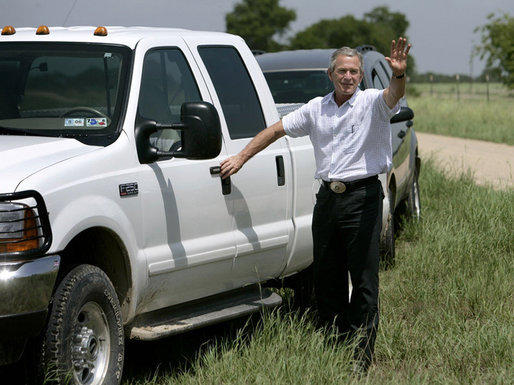 | THE PRESIDENT: Thank you all for the warm welcome. Welcome to Texas. Steve, thank you very much for inviting me. Mayor DuPuy, thank you very much for being such a gracious host for this important regional tournament. It's great to see you. |
Before I say something about the families here, I do want to thank the Pride of the Blue, the Robinson High School Band, for being here. (Applause.) I particularly want to say to the coaches of both teams, thanks for setting such a good example, thanks for taking time out of your lives to help these young men understand the importance of teamwork and sportsmanship and hard work.
To the families who are here, thank you very much for supporting your Little Leaguer. Thanks for taking time out of your life to set such a good example for them and show them the love and compassion that is necessary. And to the players, congratulations to you. You've worked hard to get here. Laura and I and Condi are looking forward to seeing a great game. We wish you all the very best.
Play hard, play fair, play to win. God bless you all and may God continue to bless our great country. Thank you very much. (Applause.)
END 7:47 P.M. CDT For Immediate Release, Office of the Press Secretary, August 13, 2005
more at Little League or baseball and President Bush
0
comments
||
||
Sunday, August 14, 2005
Mars Mission Successfully Launched
NASA's Multipurpose Mars Mission Successfully Launched
 | A seven-month flight to Mars began this morning for NASA's Mars Reconnaissance Orbiter (MRO). It will inspect the red planet in fine detail and assist future landers. |
"We have a healthy spacecraft on its way to Mars and a lot of happy people who made this possible," said James Graf, project manager for MRO at NASA's Jet Propulsion Laboratory (JPL), Pasadena, Calif.
MRO established radio contact with controllers 61 minutes after launch and within four minutes of separation from the upper stage. Initial contact came through an antenna at the Japan Aerospace Exploration Agency's Uchinoura Space Center in southern Japan.
Health and status information about the orbiter's subsystems were received through Uchinoura and the Goldstone, Calif., antenna station of NASA's Deep Space Network. By 14 minutes after separation, the craft's solar panels finished unfolding, enabling the MRO to start recharging batteries and operate as a fully functional spacecraft.
The orbiter carries six scientific instruments for examining the surface, atmosphere and subsurface of Mars in unprecedented detail from low orbit. For example, its high-resolution camera will reveal features as small as a dishwasher. NASA expects to get several times more data about Mars from MRO than from all previous Martian missions combined.
Researchers will use the instruments to learn more about the history and distribution of Mars' water. That information will improve understanding of planetary climate change and will help guide the quest to answer whether Mars ever supported life. The orbiter will also evaluate potential landing sites for future missions. MRO will use its high-data-rate communications system to relay information between Mars surface missions and Earth.
Mars is 72 million miles from Earth today, but the spacecraft will travel more than four times that distance on its outbound-arc trajectory to intercept the red planet on March 10, 2006. The cruise period will be busy with checkups, calibrations and trajectory adjustments.
On arrival day, the spacecraft will fire its engines and slow itself enough for Martian gravity to capture it into a very elongated orbit. The spacecraft will spend half a year gradually shrinking and shaping its orbit by "aerobraking," a technique using the friction of carefully calculated dips into the upper atmosphere to slow the vehicle. The mission's main science phase is scheduled to begin in November 2006.
The launch was originally scheduled for August 10, but was delayed first due to a gyroscope issue on a different Atlas V, and the next day because of a software glitch.
The mission is managed by JPL, a division of the California Institute of Technology, Pasadena, for the NASA Science Mission Directorate. Lockheed Martin Space Systems, Denver, prime contractor for the project, built both the spacecraft and the launch vehicle.
NASA's Launch Services Program at the Kennedy Space Center is responsible for government engineering oversight of the Atlas V, spacecraft/launch vehicle integration and launch day countdown management.
For more information about MRO on the Web, visit: nasa.gov/mro
Dolores Beasley, Headquarters, Washington, (Phone: 202/358-1753), George Diller, Kennedy Space Center, Fla., (Phone: 202/867-2468), Guy Webster, Jet Propulsion Laboratory, Pasadena, Calif.,(Phone: 818/354-6278), August 12, 2005, RELEASE: 05-218
more at Mars and NASA or Mars Reconnaissance Orbiter and MRO or Space
0
comments
||
||
Sea-Based X-Band Radar
Sea-Based X-Band Radar Completes First Phase of Sea Trials
 | Lieutenant General Henry “Trey” Obering, Missile Defense Agency Director, announced today that the Sea-Based X-Band Radar (SBX-1) has successfully completed 12 days of at-sea testing and returned to Kiewit Offshore Services in Corpus Christi, Texas, on July 21, 2005. Tests included speed, maneuverability, personnel and cargo transfer, and verification of mission payloads |
The Missile Defense Agency is developing SBX-1 to serve as a primary radar for the Ballistic Missile Defense System. It will track ballistic missiles for testing and defensive operations.
SBX-1 stands 282 feet high and displaces more than 50,000 tons. Its on-board propulsion system allows it to self-deploy throughout the world’s oceans. It will home-port at Adak Island in Alaska’s Aleutian Island chain, but it also will have the capability to support both testing and operations throughout the entire Pacific Ocean region.
Source: The Missile Defense Agency 05-FYI-0057 Contact: Pam Rogers, Missile Defense Agency – 256-955-2952
more at Missile Defense or X-Band Radar and Radar or SBX-1 and defence
0
comments
||
||
Saturday, August 13, 2005
National Threat Level Mass Transit Sector
Statement by Homeland Security Secretary Michael Chertoff on Lowering the National Threat Level for the Mass Transit Sector
Since raising the threat level for mass transit systems on July 7, the Department of Homeland Security has been working closely with our federal, state and local partners to develop and implement sustainable mass transit security measures tailored to the unique design of each region’s transit system. In light of these increased long-term measures, DHS is lowering the national threat level for the mass transit portion of the transportation sector from Code Orange, or “high,” to Code Yellow, or “elevated.”
These changes will be effective at 8:00 p.m. local time on Friday, August 12, following local rush hours across the country, at the discretion of state and local authorities. Concurrently, the Coast Guard will lower the Maritime Security level for large passenger ferries from level two to level one, which corresponds with Code Yellow.
Although the overall national threat level is being lowered for mass transit systems, many transit systems, particularly the larger systems, will maintain a strengthened baseline level of preparedness beyond what existed before the London attacks, including a number of the security enhancements that were put into place for the July alert. Additionally, individual transit systems should vary these security measures at any given time in order to make it more difficult to predict the security regime at any given location.
The Department of Homeland Security will continue to closely coordinate with our federal, state, local and private sector partners and we will share any information developing from the London bombing investigation to continue to address potential vulnerabilities in the mass transit sector. At this time, there is no specific, credible intelligence information indicating that an attack in the United States is imminent. However, we are also aware that the London and Madrid bombings were conducted without warning. Therefore, we will continue to closely monitor and analyze threat information and share that information, together with guidance for protective measures, with state, local and private sector authorities as well as the general public as part of the sustained national effort to prevent terrorist attacks and protect our homeland.
While we are changing the threat level at this time, we continue to urge state and local officials, transportation authorities and the general public to remain alert. Public vigilance is very important, and we encourage all citizens to keep a watchful eye for items left unattended or suspicious behavior and report any incidents to local authorities immediately.
### For Immediate Release, Office of the Press Secretary, Contact: 202-282-8010, August 12, 2005
Homeland Security or Michael Chertoff and Mass Transit or National Threat Level
0
comments
||
||


