Thursday, September 15, 2005

President's Remarks Jewish Life in America

President's Remarks at National Dinner Celebrating Jewish Life in America, National Building Museum, Washington, D.C., 6:55 P.M. EDT
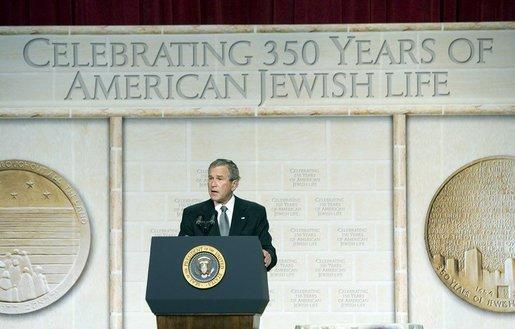
President George W. Bush makes remarks at the National Dinner Celebrating 350 Years of Jewish Life in America on Wednesday September 14, 2005. White House photo by Paul Morse THE PRESIDENT: Thank you all very much. (Applause.) Thanks for the warm welcome. Thanks for the invitation to be here. My only regret is Laura is not with me -- I left her behind to do some diplomacy in New York City. (Laughter.)
Bob, I want to thank you for your kind introduction. I'm honored to accept this medal commemorating three and a half centuries of Jewish life in America. I consider it a high honor to have been invited to celebrate with you.

Back in 1790, the Jewish congregation of Newport, Rhode Island, wrote to congratulate George Washington on his election as the country's first President. Some say he was the first George W. (Laughter.) In his reply, President Washington thanked the congregation and pledged to defend vigorously the principle of religious liberty for all. (Applause.) Here's what he said. He said, the United States "gives bigotry no sanction; to persecution, no assistance." And he expressed his hope that the "stock of Abraham" would thrive in America.

In the centuries that followed, the stock of Abraham has thrived here like nowhere else. We're better and stronger -- (applause) -- and we're a better and stronger and freer nation because so many Jews from countries all over the world have chosen to become American citizens. (Applause.)

I want to thank Rabbi Gary Zola, who is the Chairman of the Commission for Commemorating 350 Years of American Jewish History. I want to thank Ken Bialkin, who is the Chairman of the Board of the American Jewish Historical Society. I want to thank members of Congress who are here. I want to thank members of the Diplomatic Corps, especially the Ambassador from Israel, Danny Ayalon. (Applause.)

I want to thank two members of my Cabinet who've joined us -- Secretary Alphonso Jackson, of the Department of Housing and Urban Affairs, and his wife Marcia -- (applause) -- and Josh Bolten, who is the Director of the Office of Management and Budget. (Applause.)

I appreciate the Archivist of the United States who has joined us today, Allen Weinstein; Dr. Jim Billington, who is the Librarian of Congress. I can't help but notice and welcome Ed Koch, the former mayor of New York City. (Applause.) I want to thank my friend, Fred Zeidman, from Houston, Texas, who's the Chairman of the U.S. Holocaust Memorial Council. (Applause.) I want to pay my respects to Lynn Schusterman, who's the President of the Charles and Lynn Schusterman Family Foundation. (Applause.) And Sid Lapidus, who's the President of the American Jewish Historical Society. (Applause.)

This may sound a little odd for a Methodist from Texas saying this, but I just came from shul. (Applause.) I was just given the grand tour of the great American landmark, the 6th and I Historic Synagogue. I want to thank Shelton Zuckerman and Abe Pollin for taking it upon themselves to restore this important historical -- (applause.) If you haven't been there, you ought to go. It is a -- there's a wonderfully warm feeling. I saw the devotion that has gone into restoring this jewel, which was built nearly a century ago -- a jewel that houses three Torah scrolls rescued from the Holocaust. We're proud to have this great synagogue in the heart of our Nation's Capital, and we're glad a new generation is revitalizing this house of God. (Applause.)

The story of the Jewish people in America is a story of America, itself. The pilgrims considered this nation a new Israel, a refuge from persecution in Europe. Early Americans named many of their cities after places in Hebrew Scripture: Bethel and New Canaan, Shiloh and Salem. And when the first Jews arrived here, the children of Israel saw America as the land of promise, a golden land where they could practice their faith in freedom and live in liberty. (Applause.)

When the first Jewish settlers came to our shores 350 years ago, they were not immediately welcomed. Yet, from the onset, the Jews who arrived here demonstrated a deep commitment to their new land. An immigrant named Asser Levy volunteered to serve in the New Amsterdam Citizens Guard, which, unfortunately, had a policy of refusing to admit Jews. That didn't bother Levy. He was determined, like many others who have followed him, to break down the barriers of discrimination. Within two years, he took his rightful spot alongside his fellow citizens in the Guard. He was the first of many Jewish Americans who have proudly worn the uniform of the United States.

And one of the greatest Jewish soldiers America has ever known is Tibor Rubin. After surviving the Holocaust and the Nazi death camp, this young man came to America. He enlisted in the United States Army and fought in the Korean War. He was severely wounded and was later captured by the enemy. For two-and-a-half years, he survived in a POW camp. He risked his life for his fellow soldiers nearly every night by smuggling extra food for those who were ill -- it was a skill he had learned in the Nazi camps -- and because of his daring, as many as 40 American lives were saved.

This evening, I'm happy to announce that next week, I will bestow upon this great patriot our nation's highest award for bravery, the Medal of Honor. (Applause.)

Jewish Americans have made countless contributions to our land. The prophet, Jeremiah, once called out to this -- to his nation, "...seek the welfare of the city where I have sent you into exile, and pray to the Lord on its behalf." For 350 years, American Jews have heeded these words, and you've prayed and worked for peace and freedom in America. Freedom to worship is why Jews came to America three-and-a-half centuries ago; it's why the Jews settled in Israel over five decades ago.

Our two nations have a lot in common, when you think about it. We were both founded by immigrants escaping religious persecution in other lands. We both have built vibrant democracies. Both our countries are founded on certain basic beliefs, that there is an Almighty God who watches over the affairs of men and values every life. These ties have made us natural allies, and these ties will never be broken. (Applause.)

Earlier today, I met in New York with Prime Minister Sharon and the Ambassador. I admire Prime Minister Sharon. He's a man of courage; he's a man of peace. (Applause.) Once again, I expressed this nation's commitment to defending the security and well-being of Israel. (Applause.) I also assured him that I will not waver when it comes to spreading freedom around the world. I understand -- (applause) -- I understand this, that freedom is not America's gift to the world; freedom is an Almighty God's gift to each man and woman and child in this world. (Applause.)

Religious freedom is a foundation of fundamental human and civil rights. And when the United States promotes religious freedom, it is promoting the spread of democracy. And when we promote the spread of democracy, we are promoting the cause of peace. (Applause.)

Religious freedom is more than the freedom to practice one's faith. It is also the obligation to respect the faith of others. (Applause.) So to stand for religious freedom, we must expose and confront the ancient hatred of anti-Semitism, wherever it is found. (Applause.) When we find anti-Semitism at home, we will confront it. When we find anti-Semitism abroad, we will condemn it. (Applause.) And we condemn the desecration of synagogues in Gaza that followed Israel's withdrawal. (Applause.)

Under America's system of religious freedom, church and state are separate. (Applause.) Still, we have learned that faith is not solely a private matter. Men and women throughout our history have acted on the words of Scripture and they have made America a better, more hopeful place. When Rabbi Abraham Heschel marched with Martin Luther King, we saw modern-day prophets calling on America to honor its promises. We must allow people of faith to act on their convictions without facing discrimination.

And that's why my administration has started a faith-based and community initiative, to call on the armies of compassion to help heal broken hearts. A few years ago in New York, the Metropolitan Council on Jewish Poverty was discouraged from even applying for federal funds because it had the word "Jewish" in its name. We must end this kind of discrimination if we want America to be a hopeful place. (Applause.)

At this moment, volunteers from all walks of life, across our great land, are helping the good folks of Alabama and Mississippi and Louisiana recover from one of the worst natural disasters in our nation's history. The outpouring of compassion is phenomenal. American Jewish organizations have already raised over $10 million, plus the $50,000 tonight, for the victims of Hurricane Katrina. (Applause.)

About half of the 10,000 Jewish Americans who call New Orleans home found refuge in Houston. Rabbi Barry Gelman. of the United Orthodox Synagogues of Houston, immediately helped organize a task force to aid the evacuees. Five major Israeli universities with study abroad programs are opening their doors to college students whose schools have been shut down by the storm.

These are the good works of good people relying on the wisdom of the Good Book, a book that tells us how God rescued life from the flood waters. And like Noah and his family, we have faith that as the waters recede, we will see life begin again.

I want to thank you for your patriotism. I want to thank you for compassion. I want to thank you for your love for the United States of America. All of America is grateful to the Jewish people for the treasures you have given us over the past 350 years. May God bless you, and may God continue to bless our country. (Applause.)

END 7:08 P.M. EDT For Immediate Release, Office of the Press Secretary, September 14, 2005

more at
or and or and or and

Wednesday, September 14, 2005

John Roberts Confirmation Hearings (VIDEO)

Nomination of John G. Roberts, Hearing before the Senate Judiciary Committee on The Nomination of John G. Roberts to be Chief Justice of the United States. Senate Judiciary Committee Full Committee.

Files are c-span real media, created by cable. Offered as a public service.

John Roberts Opening Statement Before Senate Judiciary Cmte. (09/12/2005), John Roberts Chief Justice Confirmation Hearings - Day 1 (09/12/2005), John Roberts Chief Justice Confirmation Hearings - Day 2, Morning Session (09/13/2005), John Roberts Chief Justice Confirmation Hearings - Day 2, Afternoon Session (09/13/2005), John Roberts Chief Justice Confirmation Hearings - Day 2, Evening Session (09/13/2005), John Roberts Chief Justice Confirmation Hearings - Day 3, Morning Session (09/14/2005)

more at
or and or and

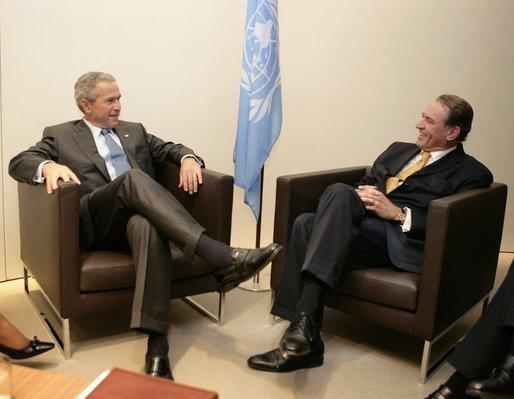
President Meets with Prime Minister Sharon

President Meets with Prime Minister Sharon of Israel at United Nations, United Nations Headquarters, New York, New York, 10:22 A.M. EDT

PRESIDENT BUSH: Mr. Prime Minister, thank you. I'm looking forward to our meeting. I've said several times publicly that I am inspired by your courageous decision to give peace a chance. And I know it was hard, but I admire your courage. And I look forward to talking to you about how we can get on the road map.

One thing is essential, and the world must hear, that now is the time for Palestinians to come together and establish a government that will be peaceful with Israel. And the Gaza is a good chance to start, and I know that the Israeli government wants to see that happen, as well.

The world needs to help the Palestinians. The Arab neighbors need to help the Palestinians develop an economy. Now is the time for people to step up. It's an opportunity that was created by a bold decision, and I want to work together to see the vision of peace come to be.

So, Mr. Prime Minister, thank you for being here.

PRIME MINISTER SHARON: Thank you. Mr. President, I'm glad to meet with you again. I'm glad that we are working together in order to achieve peace in the region.

PRESIDENT BUSH: Thank you.

END 10:24 A.M. EDT

more at more at
or and or and or

President Addresses United Nations Security Council

President Addresses United Nations Security Council, United Nations Headquarters, New York, New York, 11:50 A.M. EDT

THE PRESIDENT: Thank you, Madam President. I appreciate all the members of the Security Council for participating in this Summit. Our presence here reaffirms the seriousness of the challenges we face, and our determined -- determination to confront them.

We meet just over two months after the terror attacks in London, one year after the terrorist massacre of schoolchildren in Beslan, and four years after the terrorist attack in this city. Acts of terrorism like these emerge from a radical ideology that tolerates no dissent, and justifies the murder of innocent people as the best way to achieve its goals.

Today we support a resolution sponsored by the United Kingdom that condemns the incitement of terrorist acts, and calls on all states to take appropriate steps to end such incitement. I want to thank the Prime Minister and his government for their hard work on this issue. The United States of America strongly supports the implementation of this resolution.

We have a solemn obligation -- we have a solemn obligation to stop terrorism at its early stages. We have a solemn obligation to defend our citizens against terrorism, to attack terrorist networks and deprive them of any safe haven, to promote an ideology of freedom and tolerance that will refute the dark vision of the terrorists.

We must do all we can to disrupt each stage of planning and support for terrorist acts. Each of us must act, consistent with past Security Council resolutions, to freeze terrorists' assets; to deny terrorists freedom of movement by using effective border controls and secure travel documents; to prevent terrorists from acquiring weapons, including weapons of mass destruction. Each of us must act to share information to prevent a terrorist attack before they happen. The United States will continue to work with and through the Security Council to help all nations meet these commitments.

The United States also reaffirms its commitment to support the prevention of unjust armed conflict, particularly in Africa -- which is why we have joined Algeria, Benin, and Tanzania in co-sponsoring today's second important resolution. We support the need to improve the ability of the African Union and sub-regional organizations to deploy both civilian and military assets to prevent such conflicts. Over the next five years, the United States will provide training for more than 40,000 African peacekeepers as part of a broader initiative by the G-8 countries. We will help train African forces to preserve justice and order in Africa.

Terrorism and armed conflict are not only threats to our security, they're the enemies of development and freedom for millions. To help ensure the 21st century is one of freedom, security, and prosperity -- I want to thank the members of the Security Council for supporting today's resolutions.

END 11:54 A.M. EDT, For Immediate Release, Office of the Press Secretary, September 14, 2005

more at
or and or and

President Addresses UN (VIDEO)

President Addresses United Nations High-Level Plenary Meeting, FULL STREAMING VIDEO, United Nations Headquarters, New York, New York, 9:48 A.M. EDT

President George W. Bush meets with Jan Eliasson of Sweden, President of the U.N. General Assembly, Tuesday, Sept. 13, 2005, at the United Nations in New York. White House photo by Eric Draper THE PRESIDENT: Mr. Secretary General, Mr. President, distinguished guests, ladies and gentlemen: Thank you for the privilege of being here for the 60th anniversary of the United Nations. Thank you for your dedication to the vital work and great ideals of this institution.
We meet at a time of great challenge for America and the world. At this moment, men and women along my country's Gulf Coast are recovering from one of the worst natural disasters in American history. Many have lost homes, and loved ones, and all their earthly possessions. In Alabama and Mississippi and Louisiana, whole neighborhoods have been lifted from their foundations and sent crashing into the streets. A great American city is working to turn the flood waters and reclaim its future.

We have witnessed the awesome power of nature -- and the greater power of human compassion. Americans have responded to their neighbors in need, and so have many of the nations represented in this chamber. All together, more than 115 countries and nearly a dozen international organizations have stepped forward with offers of assistance. To every nation, every province, and every community across the world that is standing with the American people in this hour of need, I offer the thanks of my nation.

Your response, like the response to last year's tsunami, has shown once again that the world is more compassionate and hopeful when we act together. This truth was the inspiration for the United Nations. The U.N.'s founding members laid out great and honorable goals in the charter they drafted six decades ago. That document commits this organization to work to "save succeeding generations from the scourge of war," "reaffirm faith in fundamental human rights," and "promote social progress and better standards of life in larger freedom." We remain committed to those noble ideals. As we respond to great humanitarian needs, we must actively respond to the other great challenges of our time. We must continue to work to ease suffering, and to spread freedom, and to lay the foundations of lasting peace for our children and grandchildren.

In this young century, the far corners of the world are linked more closely than ever before -- and no nation can remain isolated and indifferent to the struggles of others. When a country, or a region is filled with despair, and resentment and vulnerable to violent and aggressive ideologies, the threat passes easily across oceans and borders, and could threaten the security of any peaceful country.

Terrorism fed by anger and despair has come to Tunisia, to Indonesia, to Kenya, to Tanzania, to Morocco, to Israel, to Saudi Arabia, to the United States, to Turkey, to Spain, to Russia, to Egypt, to Iraq, and the United Kingdom. And those who have not seen attacks on their own soil have still shared in the sorrow -- from Australians killed in Bali, to Italians killed in Egypt, to the citizens of dozens of nations who were killed on September the 11th, 2001, here in the city where we meet. The lesson is clear: There can be no safety in looking away, or seeking the quiet life by ignoring the hardship and oppression of others. Either hope will spread, or violence will spread -- and we must take the side of hope.

Sometimes our security will require confronting threats directly, and so a great coalition of nations has come together to fight the terrorists across the world. We've worked together to help break up terrorist networks that cross borders, and rout out radical cells within our own borders. We've eliminated terrorist sanctuaries. We're using our diplomatic and financial tools to cut off their financing and drain them of support. And as we fight, the terrorists must know that the world stands united against them. We must complete the Comprehensive Convention on International Terrorism that will put every nation on record: The targeting and deliberate killing by terrorists of civilians and non-combatants cannot be justified or legitimized by any cause or grievance.

And the world's free nations are determined to stop the terrorists and their allies from acquiring the terrible weapons that would allow them to kill on a scale equal to their hatred. For that reason, more than 60 countries are supporting the Proliferation Security Initiative to intercept shipments of weapons of mass destruction on land, on sea, and in air. The terrorists must know that wherever they go, they cannot escape justice.

Later today, the Security Council has an opportunity to put the terrorists on notice when it votes on a resolution that condemns the incitement of terrorist acts -- the resolution that calls upon all states to take appropriate steps to end such incitement. We also need to sign and implement the International Convention for the Suppression of Acts of Nuclear Terrorism, so that all those who seek radioactive materials or nuclear devices are prosecuted and extradited, wherever they are. We must send a clear message to the rulers of outlaw regimes that sponsor terror and pursue weapons of mass murder: You will not be allowed to threaten the peace and stability of the world.

Confronting our enemies is essential, and so civilized nations will continue to take the fight to the terrorists. Yet we know that this war will not be won by force of arms alone. We must defeat the terrorists on the battlefield, and we must also defeat them in the battle of ideas. We must change the conditions that allow terrorists to flourish and recruit, by spreading the hope of freedom to millions who've never known it. We must help raise up the failing states and stagnant societies that provide fertile ground for the terrorists. We must defend and extend a vision of human dignity, and opportunity, and prosperity -- a vision far stronger than the dark appeal of resentment and murder.

To spread a vision of hope, the United States is determined to help nations that are struggling with poverty. We are committed to the Millennium Development goals. This is an ambitious agenda that includes cutting poverty and hunger in half, ensuring that every boy and girl in the world has access to primary education, and halting the spread of AIDS -- all by 2015.

We have a moral obligation to help others -- and a moral duty to make sure our actions are effective. At Monterrey in 2002, we agreed to a new vision for the way we fight poverty, and curb corruption, and provide aid in this new millennium. Developing countries agreed to take responsibility for their own economic progress through good governance and sound policies and the rule of law. Developed countries agreed to support those efforts, including increased aid to nations that undertake necessary reforms. My own country has sought to implement the Monterrey Consensus by establishing the new Millennium Challenge Account. This account is increasing U.S. aid for countries that govern justly, invest in their people, and promote economic freedom.

More needs to be done. I call on all the world's nations to implement the Monterrey Consensus. Implementing the Monterrey Consensus means continuing on the long, hard road to reform. Implementing the Monterrey Consensus means creating a genuine partnership between developed and developing countries to replace the donor-client relationship of the past. And implementing the Monterrey Consensus means welcoming all developing countries as full participants to the global economy, with all the requisite benefits and responsibilities.

Tying aid to reform is essential to eliminating poverty, but our work doesn't end there. For many countries, AIDS, malaria, and other diseases are both humanitarian tragedies and significant obstacles to development. We must give poor countries access to the emergency lifesaving drugs they need to fight these infectious epidemics. Through our bilateral programs and the Global Fund, the United States will continue to lead the world in providing the resources to defeat the plague of HIV-AIDS.

Today America is working with local authorities and organizations in the largest initiative in history to combat a specific disease. Across Africa, we're helping local health officials expand AIDS testing facilities, train and support doctors and nurses and counselors, and upgrade clinics and hospitals. Working with our African partners, we have now delivered lifesaving treatment to more than 230,000 people in sub-Sahara Africa. We are ahead of schedule to meet an important objective: providing HIV-AIDS treatment for nearly two million adults and children in Africa. At the G-8 Summit at Gleneagles, Scotland, we set a clear goal: an AIDS-free generation in Africa. And I challenge every member of the United Nations to take concrete steps to achieve that goal.

We're also working to fight malaria. This preventable disease kills more than a million people around the world every year -- and leaves poverty and grief in every land it touches. The United States has set a goal of cutting the malaria death rate in half in at least 15 highly endemic African countries. To achieve that goal, we've pledged to increase our funding for malaria treatment and prevention by more than $1.2 billion over the next five years. We invite other nations to join us in this effort by committing specific aid to the dozens of other African nations in need of it. Together we can fight malaria and save hundreds of thousands of lives, and bring new hope to countries that have been devastated by this terrible disease.

As we strengthen our commitments to fighting malaria and AIDS, we must also remain on the offensive against new threats to public health such as the Avian Influenza. If left unchallenged, this virus could become the first pandemic of the 21st century. We must not allow that to happen. Today I am announcing a new International Partnership on Avian and Pandemic Influenza. The Partnership requires countries that face an outbreak to immediately share information and provide samples to the World Health Organization. By requiring transparency, we can respond more rapidly to dangerous outbreaks and stop them on time. Many nations have already joined this partnership; we invite all nations to participate. It's essential we work together, and as we do so, we will fulfill a moral duty to protect our citizens, and heal the sick, and comfort the afflicted.

Even with increased aid to fight disease and reform economies, many nations are held back by another heavy challenge: the burden of debt. So America and many nations have also acted to lift this burden that limits the growth of developing economies, and holds millions of people in poverty. Today poor countries with the heaviest debt burdens are receiving more than $30 billion in debt relief. And to prevent the build-up of future debt, my country and other nations have agreed that international financial institutions should increasingly provide new aid in the form of grants, rather than loans. The G-8 agreed at Gleneagles to go further. To break the lend-and-forgive cycle permanently, we agreed to cancel 100 percent of the debt for the world's most heavily indebted nations. I call upon the World Bank and the IMF to finalize this historic agreement as soon as possible.

We will fight to lift the burden of poverty from places of suffering -- not just for the moment, but permanently. And the surest path to greater wealth is greater trade. In a letter he wrote to me in August, the Secretary General commended the G-8's work, but told me that aid and debt relief are not enough. The Secretary General said that we also need to reduce trade barriers and subsidies that are holding developing countries back. I agree with the Secretary General: The Doha Round is "the most promising way" to achieve this goal.

A successful Doha Round will reduce and eliminate tariffs and other barriers on farm and industrial goods. It will end unfair agricultural subsidies. It will open up global markets for services. Under Doha, every nation will gain, and the developing world stands to gain the most. Historically, developing nations that open themselves up to trade grow at several times the rate of other countries. The elimination of trade barriers could lift hundreds of millions of people out of poverty over the next 15 years. The stakes are high. The lives and futures of millions of the world's poorest citizens hang in the balance -- and so we must bring the Doha trade talks to a successful conclusion.

Doha is an important step toward a larger goal: We must tear down the walls that separate the developed and developing worlds. We need to give the citizens of the poorest nations the same ability to access the world economy that the people of wealthy nations have, so they can offer their goods and talents on the world market alongside everyone else. We need to ensure that they have the same opportunities to pursue their dreams, provide for their families, and live lives of dignity and self-reliance.

And the greatest obstacles to achieving these goals are the tariffs and subsidies and barriers that isolate people of developing nations from the great opportunities of the 21st century. Today, I reiterate the challenge I have made before: We must work together in the Doha negotiations to eliminate agricultural subsidies that distort trade and stunt development, and to eliminate tariffs and other barriers to open markets for farmers around the world. Today I broaden the challenge by making this pledge: The United States is ready to eliminate all tariffs, subsidies and other barriers to free flow of goods and services as other nations do the same. This is key to overcoming poverty in the world's poorest nations. It's essential we promote prosperity and opportunity for all nations.

By expanding trade, we spread hope and opportunity to the corners of the world, and we strike a blow against the terrorists who feed on anger and resentment. Our agenda for freer trade is part of our agenda for a freer world, where people can live and worship and raise their children as they choose. In the long run, the best way to protect the religious freedom, and the rights of women and minorities, is through institutions of self-rule, which allow people to assert and defend their own rights. All who stand for human rights must also stand for human freedom.

This is a moment of great opportunity in the cause of freedom. Across the world, hearts and minds are opening to the message of human liberty as never before. In the last two years alone, tens of millions have voted in free elections in Afghanistan and Iraq, in Lebanon and the Palestinian territories, in Kyrgyzstan, in Ukraine, and Georgia. And as they claim their freedom, they are inspiring millions more across the broader Middle East. We must encourage their aspirations. We must nurture freedom's progress. And the United Nations has a vital role to play.

Through the new U.N. Democracy Fund, the democratic members of the U.N. will work to help others who want to join the democratic world. It is fitting that the world's largest democracy, India, has taken a leadership role in this effort, pledging $10 million to get the fund started. Every free nation has an interest in the success of this fund -- and every free nation has a responsibility in advancing the cause of liberty.

The work of democracy is larger than holding a fair election; it requires building the institutions that sustain freedom. Democracy takes different forms in different cultures, yet all free societies have certain things in common. Democratic nations uphold the rule of law, impose limits on the power of the state, treat women and minorities as full citizens. Democratic nations protect private property, free speech and religious expression. Democratic nations grow in strength because they reward and respect the creative gifts of their people. And democratic nations contribute to peace and stability because they seek national greatness in the achievements of their citizens, not the conquest of their neighbors.

For these reasons, the whole world has a vital interest in the success of a free Iraq -- and no civilized nation has an interest in seeing a new terror state emerge in that country. So the free world is working together to help the Iraqi people to establish a new nation that can govern itself, sustain itself, and defend itself. It's an exciting opportunity for all of us in this chamber. And the United Nations has played a vital role in the success of the January elections, where eight and a half million Iraqis defied the terrorists and cast their ballots. And since then, the United Nations has supported Iraq's elected leaders as they drafted a new constitution.

The United Nations and its member states must continue to stand by the Iraqi people as they complete the journey to a fully constitutional government. And when Iraqis complete their journey, their success will inspire others to claim their freedom, the Middle East will grow in peace and hope and liberty, and all of us will live in a safer world.

The advance of freedom and security is the calling of our time. It is the mission of the United Nations. The United Nations was created to spread the hope of liberty, and to fight poverty and disease, and to help secure human rights and human dignity for all the world's people. To help make these promises real, the United Nations must be strong and efficient, free of corruption, and accountable to the people it serves. The United Nations must stand for integrity, and live by the high standards it sets for others. And meaningful institutional reforms must include measures to improve internal oversight, identify cost savings, and ensure that precious resources are used for their intended purpose.

The United Nations has taken the first steps toward reform. The process will continue in the General Assembly this fall, and the United States will join with others to lead the effort. And the process of reform begins with members taking our responsibilities seriously. When this great institution's member states choose notorious abusers of human rights to sit on the U.N. Human Rights Commission, they discredit a noble effort, and undermine the credibility of the whole organization. If member countries want the United Nations to be respected -- respected and effective, they should begin by making sure it is worthy of respect.

At the start of a new century, the world needs the United Nations to live up to its ideals and fulfill its mission. The founding members of this organization knew that the security of the world would increasingly depend on advancing the rights of mankind, and this would require the work of many hands. After committing America to the idea of the U.N. in 1945, President Franklin Roosevelt declared: "The structure of world peace cannot be the work of one man, or one party, or one nation." Peace is the responsibility of every nation and every generation.

In each era of history, the human spirit has been challenged by the forces of darkness and chaos. Some challenges are the acts of nature; others are the works of men. This organization was convened to meet these challenges by harnessing the best instincts of humankind, the strength of the world united in common purpose. With courage and conscience, we will meet our responsibilities to protect the lives and rights of others. And when we do, we will help fulfill the promise of the United Nations, and ensure that every human being enjoys the peace and the freedom and the dignity our Creator intended for all.

Thank you. (Applause.)

END 10:13 A.M. EDT

For Immediate Release, Office of the Press Secretary, September 14, 2005

more at
or and or and or and or and or

Tuesday, September 13, 2005

Statement by Michael D. Brown

Statement by Michael D. Brown, Under Secretary of Department of Homeland Security, Emergency Preparedness & Response and Director of the Federal Emergency Management Agency:

Release Date: September 12, 2005, Release Number: HQ-05-MBR

"Today I resigned as Director of the Federal Emergency Management Agency. As I told the President, it is important that I leave now to avoid further distraction from the ongoing mission of FEMA.

"It has been an honor and a privilege to serve this President and to work shoulder to shoulder with the hard working men and women of FEMA. They carry out an unusually difficult task under the harshest of circumstances. My respect for these dedicated professionals and this organization is unyielding.

"There is no other government agency that reaches people in a more direct way. It has been the best job in the world to help Americans in their darkest hours."

-- Under Secretary Michael D. Brown

more at
and or and or and or

Bush, Talabani (VIDEO)

President George W. Bush and President Jalal Talabani of Iraq walk to the East Room of the White House Tuesday, Sept. 13, 2005, for a joint press availability. The President called Iraq 'America's ally in the war against terrorism,' and added, 'freedom will win in Iraq.' White House photo by Shealah CraigheadPresident Welcomes President Talabani of Iraq to the White House, The East Room

11:35 A.M. EDT

PRESIDENT BUSH: Thank you all. It's an honor to welcome the first democratically elected President of Iraq to the White House. I'm proud to stand with a brave leader of the Iraqi people, a friend of the United States, and a testament to the power of human freedom.
Mr. President, thank you for your leadership; thank you for your courage.

President Talabani has dedicated his life to the cause of liberty in Iraq. As a lawyer, a journalist, and a political leader in Northern Iraq, he stood up to a brutal dictator, because he believes that every Iraqi deserves the be free. The dictator destroyed Kurdish villages, ordered poison gas attacks on a Kurdish city, and violently repressed other religious and ethnic groups. For President Talibani and his fellow citizens, the day Saddam was removed from power was a day of deliverance. And America will always be proud that we led the armies of liberation.

In the past two years, the Iraqi people have made their vision of their future clear. This past January, more than 8 million Iraqis defied the car bombers and the assassins and voted in free elections. It is an inspiring act of unity when 80 percent of the elected National Assembly chose the President, a member of Iraq's Kurdish minority, to lead the free nation.

In our meeting today, I congratulated the President on his election, and I thanked him for his leadership on Iraq's draft constitution. The draft constitution is an historic milestone. It protects fundamental freedoms, including religion, assembly, conscience and expression. It calls for a federal system of government, which is essential to preserving the unity of a diverse nation like Iraq. It declares that all Iraqis are equal before the law, without regard to gender, ethnicity, and religion.

The Iraqi people can be proud of the draft constitution, and when an election to ratify that constitution is held next month, they will have a chance to vote their conscience at the polls.

As the Iraqi people continue on the path to democracy, the enemies of freedom remain brutal and determined. The killers in Iraq are the followers of the same ideology as those who attacked America four years ago. Their vision is for an Iraq that looks like Afghanistan under the Taliban; a society where freedom is crushed, girls are denied schooling, and terrorists have a safe haven to plot attacks on America and other free people.

To impose their hateful vision, our enemies know they must drive America out of Iraq before the Iraqi people can secure their own freedom. They believe we will retreat in the face of violence, so they're committing acts of staggering brutality, murdering Iraqi children receiving candy, or hospital workers treating the wounded. We have no doubt that our enemies will continue to kill. Yet we also know they cannot achieve their aims unless we lose our resolve.

Today, Mr. President, I pledge that we will not waver. And I appreciate your same pledge. Iraq will take its place among the world's democracies. The enemies of freedom will be defeated.

President Talabani and I discussed our strategy for the months ahead. America will stand with the Iraqi people as they move forward with the democratic process. We're seeing hopeful developments in places like Fallujah and Ramadi and Mosul, where Iraqis are registering to vote, many for the first time -- well, obviously, for the first time.

At the same time, American troops will stay on the offensive, alongside Iraqi security forces, to hunt down our common enemies. At this hour, American and Iraqi forces are conducting joint operations to rout out terrorists and insurgents in Tall Afar. Our objective is to defeat the enemies of a free Iraq, and we're working to prepare more Iraqi forces to join the fight. As Iraqis stand up, Americans will stand down. And when the mission is complete, our troops will come home, with the honor they have earned.

Tomorrow, President Talabani and I will take our seats at the United Nations in New York. The session will mark the first time in a half-century that Iraq is represented by a freely elected government.

Securing freedom in Iraq has required great sacrifice, Mr. President. You know that better than anybody. And there's going to be difficult days ahead. Yet I have no doubt about the impact of a democratic Iraq on the rest of the world. As Iraq becomes a federal, unified democracy, people throughout the broader Middle East will demand their own liberty. The Middle East will become more peaceful, and America and the world become more secure.

We're proud to call you, friend, Mr. President, and proud to have you as an ally in the war on terror. On behalf of the American people, I want to thank you for Iraq's generous pledge of aid to the victims of Hurricane Katrina. Welcome to the United States.

PRESIDENT TALABANI: Thank you. Thank you, Mr. President, for your kind remarks. It is honor for me to stand here today as a representative of free Iraq. It is an honor to present the world's youngest democracy.

In the name of Iraqi people, I say to you, Mr. President, and to the glorious American people, thank you, thank you. Thank you, because you liberated us from the worst kind of dictatorship. Our people suffered too much from this worst kind of dictatorship. The -- (inaudible)

-- was hundred thousand of Iraqi innocent children and women, young and old men. Thank you, and thanks to the United States, there are now 15 million Muslims in Afghanistan and Iraq liberated by your courageous leadership and decision to liberate us, Mr. President.

We agree with Mr. President Bush that democracy is the solution to the problems of the Middle East. Mr. President, you are a visionary, great statesman. We salute you. We are grateful to you. We will never forget what you have done for our people.

PRESIDENT BUSH: Thank you, sir.

PRESIDENT TALABANI: We have had a good discussion with Mr. President. We are partners. We are proud to say openly and to repeat it that we are partners of the United States of America in fighting against tyranny, terrorism, and for democracy. It is something we are not shy to say and will repeat it everywhere, here and in Iraq, and the United Nations and everywhere.

Iraq is America's ally in the war against terrorism. Our soldiers are now fighting side-by-side with your brave soldiers, now and every day. We have captured many senior elements of al Qaeda. We killed many of them, and we have also many of them in our prisons.

With your support, we could create a society enjoying democracy for the first time, obviously. Now Iraq is a free country. We have all kinds of democracy, all kinds of freedom of expression of parties, groups, civil society, organizations -- that we can say that our democracy is unique in the Middle East.

Our strategy is solvent. We build democracy and defend democracy. We talk about how we could improve our tactics. There is progress in security in our country. The number of the -- (inaudible) -- reduced; the traces which were under the full control of the terrorists are now liberated, and they're now registering their names for the new election.

In the areas which were known that there was any of al Qaeda now became the area of Iraq. And two important signals appeared in that area -- the people started to -- (inaudible) -- and to fight terrorists. Now we have Iraqi Arab tribes, Sunni tribes fighting terrorism and al Qaeda. We have also people who are in -- (inaudible) -- who are cooperating with Iraqi forces, and with American forces against terrorism. It is a good signal that our people start to understand that terrorism is the enemy of Iraqi people before becoming enemy of Americans. They are killing our civilians, or innocent children. They are destroying our mosques -- church, everywhere, regardless of what may happen to the people.

And we are now progressing gradually. Last year, for example -- (inaudible) -- a year ago, Najaf was a battlefield. Najaf is a holy city of Shiites, the Vatican of the Shiites. Now Najaf is being rebuilt, is free, and ruled by the elected committee, elected government.

There are still important security challenges we are neglecting. But we are fighting al Qaeda. Now our fight in Tall Afar proved that the enemy is going to be weakened and low morale. The fighting in Tall Afar was easy to defeat the terrorists and to liberate the town.

The so-called jihadists want to impose oppression and dictatorship and worst kind of society on our people. For that they are not only -- so they are not only the enemy of Iraq, but they are the enemy of humanity, the enemy of real Islam, and the enemy of all Middle East peoples. Together with our American friends and partners, we will defeat them.

Today, American and international presence in Iraq is vital. The American and international presence in Iraq is vital for democracy in Iraq and in the Middle East, and also for prevent foreign interference in the internal affairs of Iraq.

We will set no timetable for withdrawal, Mr. President. A timetable will help the terrorists, will encourage them that they could defeat a superpower of the world and the Iraqi people. We hope that by the end of 2006, our security forces are up to the level of taking responsibility from many American troops with complete agreement with Americans. We don't want to do anything without the agreement with the Americans because we don't want to give any signal to the terrorists that our will to defeat them is weakened, or they can defeat us.

We are proud that one day will come -- as soon as possible, of course, we hope -- that American troops can proudly return home, and we tell them, thank you, dear friends, and you are faithful to friendship. Of course, we are sorry for the sacrifices of American people in Iraq, but I think a great people like America has a mission in the history -- they have sacrificed hundreds of thousands of their sons in the war -- first world war, second world war, and in liberating people in Afghanistan, Kurdistan. And the great leader, Mr. George W. Bush is continuing the same mission of the American people. We are grateful. We are grateful for American generosity, and we honor -- we honor -- sacrifices of America in Iraq -- and everywhere, not only in Iraq.

We also need our neighbors, at least some of them, to stop attacking Iraqi democracy. We want them to join us in fighting against terrorism. We want our Arab brothers -- (inaudible) -- media, at least the official media, to support terrorism. We want them to stand with us against terrorism, because terrorism is the enemy of all Arab and Muslim countries in the world.

But we will proceed, and we will remember those who helped us in our struggle to establish a democracy in Iraq. And you are first those people who supported us for this noble mission.

There is, in Iraq, political progress. We are talking taking the gun out of Iraqi politics, for the first time. Iraqis will have -- speak in peaceful dialogue, not with arms. The majority of Iraqis are committed to political process. Iraq is a diverse country. They are mostly settling -- (inaudible) -- peacefully.

We have agreed a draft constitution. Of course, it is not perfect document, but I think it is one of the best constitutions in the Middle East. Of course, we didn't solve all problems, we have some problems. We are still suffering from many problems. But we are achieving progress on all fields -- economic, trade, education, political life. And we hope that we will remain having the support of the United States, and yourself, Mr. President, and other friends in Arab world and in Europe.

It is true we are a young democracy, but our draft constitution has a bill of rights, ensures the equality of all Iraqis -- regardless of their gender, creed, religion, or ethnicity. It enshrines the separation of powers, and involves many checks and balances on the exercise of power. It is the best constitution in the entire region, as we claim. We hope it will be correct.

We are reaching out to some other Iraqi citizens who were not able to participate in the election -- I mean our Arab Sunni brothers. We tried to be involved with them in the process. When the result of the election was announced, the two main lists of alliance -- the Kurdistan Alliance and the United Front of Iraq Shiite Alliance -- we got 238 votes, and the Assembly was 275. But, nevertheless, we tried to bring our Sunni Arabs to the government, to participate. We elected a vice president, an Arab Sunni; two deputy prime ministers; the Speaker of the House is a Sunni; and six ministers, among them, two main posts, the Minister of Defense and Minister of Industry.

It means that we are anxious to have all Iraqis united, and to solve all our problems through dialogue. We are calling all Iraqis to come to participate in the democratic process and to say what they want, and they are free to decide the government -- decide the President of Iraq, the Prime Minister, the ministers, and they are able to say what they want through democratic process, they can say their -- and demands.

This, of course, constitution is not perfect, but it can be amended in the future, if the Iraqi people want this. But now, compared with others, we are proud to have such a kind of constitution. Some of our brothers, Sunni Arabs, are under the threat of terrorism. We will try our best to liberate them from terrorism and from the violence.

To those in America, in other countries, still ask of war of liberation in Iraq, if it was right -- the right decision. I say, please, please, come to Iraq, to visit the mass graves, to see what happened to the Iraqi people, and to see what now is going on in Iraq. To those who talk of stability, I say, Saddam imposed the stability of the mass graves. To the terrorists, I say, you will never win; freedom will win in Iraq.

Thank you, Mr. President. (Applause.)

PRESIDENT BUSH: Thank you.

A couple of questions. Two a side. Nedra.

Q Mr. President, given what happened with Katrina, shouldn't Americans be concerned if their government isn't prepared to respond to another disaster or even a terrorist attack?

PRESIDENT BUSH: Katrina exposed serious problems in our response capability at all levels of government. And to the extent that the federal government didn't fully do its job right, I take responsibility. I want to know what went right and what went wrong. I want to know how to better cooperate with state and local government, to be able to answer that very question that you asked: Are we capable of dealing with a severe attack or another severe storm. And that's a very important question. And it's in our national interest that we find out exactly what went on and -- so that we can better respond.

One thing for certain; having been down there three times and have seen how hard people are working, I'm not going to defend the process going in, but I am going to defend the people who are on the front line of saving lives. Those Coast Guard kids pulling people out of the -- out of the floods are -- did heroic work. The first responders on the ground, whether they be state folks or local folks, did everything they could. There's a lot of people that are -- have done a lot of hard work to save lives.

And so I want to know what went right and what went wrong to address those. But I also want people in America to understand how hard people are working to save lives down there in not only New Orleans, but surrounding parishes and along the Gulf Coast.

Mr. President, you want to call on somebody?

Q (Question is asked in Arabic.)

If I may, Mr. President, it's been a scathing attack from top officials of your administration on Syria yesterday for allowing foreign fighters to cross the border. We heard yesterday from Ambassador Khalilizad. Is this an escalation on the pressure that you're putting on Syria? And what more can you do when you say that all options are open?

PRESIDENT TALABANI: May I?

PRESIDENT BUSH: Please, yes. You might want to try it English. (Laughter.)

PRESIDENT TALABANI: Well, I say it in Iraqi because the question was in Arabic. (Answers the question in Arabic.)

PRESIDENT BUSH: Oops. (Laughter.)

PRESIDENT TALABANI: (Continues answering in Arabic.)

THE PRESIDENT: I'm not sure if I agree, or not, but

-- (laughter.) The Ambassador did speak strongly about Syria because he understands that the Syrian government can do a lot more to prevent the flow of foreign fighters into Iraq. These people are coming from Syria into Iraq and killing a lot of innocent people. They're killing -- they're trying to kill our folks, as well. And so, of course, he's speaking strongly about that.

And the Syrian leader must understand we take his lack of action seriously. And the government is going to become more and more isolated as a result of two things: one, not being cooperative with the Iraqi government, in terms of securing Iraq; and two, not being fully transparent about what they did in Lebanon.

And so we're going to work with our friends. And this is a subject of conversation, of course, I'll have with allies in places like New York and other times I communicate with our allies, that Syria must be a focus of getting them to change their behavior, particularly as it regards to democracy and trying to prevent democracies from emerging.

Toby.

Q Mr. President, do you believe at this point that Iran will be referred to the U.N. Security Council to face possible sanctions over its nuclear program? And how will you convince reluctant members like China that this is the way forward?

PRESIDENT BUSH: There is still an IAEA process to go forward. And we will work with our Ambassador at the IAEA, Ambassador Schulte, to continue to press forward with a full disclosure about Iranian intentions so that then the Security Council can make a -- determine the right policy to go forward.

I will bring the subject up with leaders whom I'll be meeting with today and tomorrow and later on this week. I will be speaking candidly about Iran with the -- Hu Jintao, as well as with President Putin, for example. Just had a conversation with Tony Blair and the subject came up.

It is very important for the world to understand that Iran with a nuclear weapon will be incredibly destabilizing. And, therefore, we must work together to prevent them from having the wherewithal to develop a nuclear weapon. It should be a warning to all of us that they have -- in the past, didn't fully disclose their programs, their programs aimed at helping them develop a weapon. They have insisted that they have a civilian nuclear program, and I thought a rational approach to that would be to allow them to receive enriched uranium from a third party under the guise of international inspections that will enable them to have civilian nuclear power without learning how to make a bomb.

Some of us are wondering why they need civilian nuclear power anyway. They're awash with hydrocarbons. Nevertheless, it's a right of a government to want to have a civilian nuclear program. And -- but there ought to be guidelines in which they be allowed to have that civilian nuclear program. And one such guideline would be in such a way that they don't gain the expertise necessary to be able to enrich.

This is a subject of grave concern, and it's something that we're spending a lot of time on in this administration. I want to applaud the Germans and the French and the British for sticking together in developing a common message to the Iranians. And now we'll see how the Iranians respond here on their visit to the United States.

Final question, Mr. President.

Q Mr. President, I hope you will excuse me, since you've never had Kurdish -- spoken Kurdish. I put my question in Kurdish. (Question asked in Kurdish.)

PRESIDENT TALABANI: With your permission, Mr. President, he's from America and his voice, American voice in Kurdish -- I must answer in Kurdish.

PRESIDENT BUSH: Yes. Answer his question -- perfect.

PRESIDENT TALABANI: (Question answered in Kurdish.)

THE PRESIDENT: On that cheery note, the press conference is over. (Laughter.)

Thank you, Mr. President, good job.

END 12:05 P.M. EDT

more at
and or and or and or

For Immediate Release, Office of the Press Secretary, September 13, 2005

Nominations Sent to the Senate 09/13/05

Shana L. Dale, of Georgia, to be Deputy Administrator of the National Aeronautics and Space Administration, vice Frederick D. Gregory.

Donald A. Gambatesa, of Virginia, to be Inspector General, United States Agency for International Development, vice Everett L. Mosley.

Carmen Maria Martinez, of Florida, a Career Member of the Senior Foreign Service, Class of Minister-Counselor, to be Ambassador Extraordinary and Plenipotentiary of the United States of America to the Republic of Zambia.

Gregory F. Van Tatenhove, of Kentucky, to be United States District Judge for the Eastern District of Kentucky, vice Karl S. Forester, retired.

# # # For Immediate Release, Office of the Press Secretary, September 13, 2005, Nominations Sent to the Senate

and or and or

Monday, September 12, 2005

R. David Paulison, Biography

The President intends to designate R. David Paulison, of Florida, to be Acting Under Secretary for Emergency Preparedness and ResponseR. David Paulison was appointed by President George W. Bush and confirmed by the United States Senate as the Administrator for the U.S. Fire Administration in December 2001. As U.S. Fire Administrator, Mr. Paulison heads the U.S. Fire Administration, part of the Emergency Preparedness and Response Directorate/FEMA,
supports State and local fire service programs, and oversee programs to reduce life and economic losses due to fire and related emergencies, in partnership with fire protection and emergency service communities.

Mr. Paulison served as the Director of the Preparedness Division of the Emergency Preparedness and Response Directorate/FEMA, in the newly created Department of Homeland Security, from 2003-2004. During his tenure, Mr. Paulison administered a broad range of programs designed to strengthen State and community emergency preparedness in order to reduce loss of life and property due to disaster; administered first responder grant programs totaling more than $1 billion; and oversaw more than 350 employees. He was also responsible for training Federal, State, and local emergency managers and first responders, and for conducting a nationwide program of exercises.

Before joining FEMA, Mr. Paulison, who has 30 years of fire/rescue services experience, was chief of the Miami-Dade Fire Rescue Department. In that position, he oversaw 1,900 personnel with a $200 million operating budget and a $70 million capital budget. He also oversaw the Dade County Emergency Management office.

He began his career as a rescue firefighter and rose through the ranks of rescue lieutenant commander, district chief of operations, division chief, assistant chief and then deputy director for administration before becoming the Miami-Dade Fire Chief. He is a certified paramedic and, as fire chief, oversaw the Miami-Dade Urban Search and Rescue Task Force. His emergency management experience includes Hurricane Andrew and the crash of ValuJet Flight 592. He is also past president of the International Association of Fire Chiefs.

A native of Miami, Florida, Mr. Paulison earned a bachelor of arts from Florida Atlantic University and completed the Program for Senior Executives in State and Local Government at Harvard University's John F. Kennedy School of Government. In 2004, he received the Mason Lankford Fire Service Leadership Award from the Congressional Fire Service Institute. Additionally, he has received the LeRoy Collins Distinguished Alumni Award and has been inducted into the Miami-Dade Community College Hall of Fame. Mr. Paulison was selected as Fire Chief of the Year by his colleagues from the State of Florida in 1993 and holds positions in several professional associations.

Articles by Administrator Paulison
After a Serious Fire: Maximizing Media Attention to Promote Safety or Everyone Goes Home: The Firefighter Life Safety Summit

Source:
U.S. Fire Administration

more at
and or and or and or

R. David Paulison, designate

President George W. Bush today announced his intention to designate one individual to serve in his Administration:

The President intends to designate R. David Paulison, of Florida, to be Acting Under Secretary for Emergency Preparedness and Response.

# # # For Immediate Release Office of the Press Secretary, September 12, 2005 Personnel Announcement

more at
and or and or and or

the President and Lieutenant General Russell Honore

Remarks by the President and Lieutenant General Russell Honore to the Travel Pool, North Claiborne and Cleveland Streets New Orleans, Louisiana 9:29 A.M. CDT

THE PRESIDENT: I want to thank the Governor for joining us today and thank the Mayor for joining us. My impression of New Orleans is this, that there is a recovery on the way, there's progress being made, but there's a lot of serious and hard work that's yet to be done.

I was briefed today about the search and rescue that continues. I was also briefed about the different projects that are taking place. There's a containment of an oil spill; the electricity is beginning to be turned back on. The Mayor is anxious, of course, to get parts of the city up and running, but he's also mindful that there's a lot of work to be done for that to happen.

General Honore and Admiral Allen briefed us, as well, about the close coordination between the federal government, state government and local government, all aimed at solving problems. And we just came through an area that had had substantial water in it, and the dewatering is an indication that the city is moving forward. But I'll repeat, we got a lot of work to do, a whole lot of work to do. And my pledge again to the Governor and the Mayor is the federal government will work closely in coordination with their authorities.

You know, one of the things that the people are beginning to think about is the long-term revival of New Orleans, for example, or the surrounding parishes. My attitude is this: The people of New Orleans can design the vision; the people of New Orleans can lay out what New Orleans ought to look like in the future; and the federal government will help. The people of Louisiana can lay out their vision of what Louisiana will look like, and the federal government can help. I think the best policy is one in which the federal government doesn't come down and say, here's what your city will look like. The best policy is one where the local folks say, here's what we want our city to look like and let's work together to achieve that vision.

And so I -- as we're beginning to get through this recovery phase, and the rescue phase, and the transitional phase -- recovery phase -- we're beginning to think through the -- how to reconstitute this really important state, as well as along the Mississippi coast, as well.

At any rate, again, I want to thank you all for being here. I appreciate you taking time out.

I'll answer a couple of questions. Yes.

Q Sir, what do you make of some of the comments that have been made by quite a number of people that there was a racial component to some of the people that were left behind and left without help?

THE PRESIDENT: My attitude is this: The storm didn't discriminate, and neither will the recovery effort. When those Coast Guard choppers, many of whom were first on the scene, were pulling people off roofs, they didn't check the color of a person's skin. They wanted to save lives.

I can assure people from the -- and I know from the state and local level, as well, that this recovery is going to be comprehensive. The rescue efforts were comprehensive, and the recovery will be comprehensive.

Q Mr. President, does the federal government need the authority to come in earlier, or even in advance of a storm that threatening?

THE PRESIDENT: I think that's one of the interesting issues that Congress needs to take a look at. And it's really important that as we take a step back and learn lessons, that we are in a position to adequately answer the question, are we prepared for major catastrophes, that the system is such that we're able to work closely together and that --

Q Do you recommend that Congress consider allowing the federal government to act more quickly?

THE PRESIDENT: I think it's very important for Congress to take a good, close look at what went on, what didn't go on, and come up with a series of recommendations. And my attitude is, is that we need to learn everything we possibly can; we need to make sure that this country is knitted up as well as it can be, in order to deal with significant problems and disasters. Meantime, we've got to keep moving forward.

And I know there's been a lot of second-guessing. I can assure you I'm not interested in that. What I'm interested in is solving problems. And there will be time to take a step back and to take a sober look at what went right and what didn't go right. There's a lot of information floating around that will be analyzed in an objective way, and that's important. And it's important for the people of this country to understand that all of us want to learn lessons. If there were to be a biological attack of some kind, we've got to make sure we understand the lessons learned to be able to deal with catastrophe.

Q Will what is needed to get this area back on its feet have any impact on the timing of troop withdrawals in Iraq?

THE PRESIDENT: In Iraq?

Q Yes.

THE PRESIDENT: We've got plenty of troops to do both. Let me just -- let me just talk about that again. I've answered this question before, and you can speak to General Honore if you care to. He's the military man on the ground. It is preposterous to claim that the engagement in Iraq meant there wasn't enough troops here, just pure and simple.

Do you care to comment on that?

GENERAL HONORE: Well, we have about 90,000 members of the Reserve and National Guard deployed, of a total force of approximately 400,000. So 90,000 are deployed. We've got the capability. We're here, we're demonstrating in deed every day. We're performing the mission with the great support of the National Guard from multiple states. The response is here. The troops are getting the job done under the conditions that you see here today, and they're making America proud that we have that capability.

We have capability. We're applying it -- air, land and sea -- our federal forces in support of the Governors of Louisiana and Mississippi under the direction of the Adjutant General. The system is working. We've got the capability, and we're looking forward to get the job done and get the job completed, until the Governors tell us otherwise.

THE PRESIDENT: The troop levels in Iraq will be decided by commanders on the ground. One, we're going to -- our mission is to defeat the terrorists, is to win. Secondly, the strategy is, as Iraqis stand up, we will stand down. And so, to answer your question about the decisions made on the ground in Iraq, they will be made based upon the ability of the Iraqis to take the fight. And more and more Iraqi units are getting more and more qualified.

There's still a lot of work to be done there. Obviously, we're going to make sure we have a troop presence to help this political process go forward. There's an election -- the ratification of the constitution -- election will be coming up, and, of course, there will be elections this -- later on this year. And we will have the troop levels necessary to make sure those elections go forward.

After all, the enemy wants to stop democracy. See, that's what they want to do. They want to kill enough people so that -- in the hopes that democracy won't go forward. They tried that prior to -- more than eight million Iraqis voting. They were unable to stop Iraqis from voting, because people want to be free. Deep in everybody's soul, regardless of your religion or where you live, is a desire to be free. And they can't stop it. And what we're going to do is help -- and they can't stop democracy from moving. And so what we're going to do is help make sure those elections are accessible to the Iraqi people.

Q Mr. President, there is a belief that we've been hearing for two weeks now on the ground that FEMA let the people here on the ground down. And perhaps, in turn, if you look at the evidence of what it's done to your popularity, FEMA let you down. Do you think that your management style of sort of relying on the advice that you got in this particular scenario let you down? And do you think that plays at all --

THE PRESIDENT: Look, there will be plenty of time to play the blame game. That's what you're trying to do.

Q No, I'm trying to --

THE PRESIDENT: You're trying to say somebody is at fault. Look -- and I want to know. I want to know exactly what went on and how it went on. And we'll continually assess inside my administration. I sent Mike Chertoff down here to make an assessment of how best to do the job. He made a decision; I accepted his decision. But we're moving on. We're going to solve these problems. And there will be ample time for people to look back and see the facts.

Now, as far as my own personal popularity goes, I don't make decisions based upon polls. I hope the American people appreciate that. You can't make difficult decisions if you have to take a poll. That's been my style ever since I've been the President. And, of course, I rely upon good people. Of course, you got to as the President of the United States. You set the space, you set the strategy, you hold people to account. But yeah, I'm relying upon good people. That's why Admiral Allen is here. He's good man. He can do the job. That's why General Honore is here. And so when I come into a briefing, I don't tell them what to do. They tell me the facts on the ground, and my question to them is, do you have what you need.

Q Did they misinform you when you said that no one anticipated the breach of the levees?

THE PRESIDENT: No, what I was referring to is this. When that storm came by, a lot of people said we dodged a bullet. When that storm came through at first, people said, whew. There was a sense of relaxation, and that's what I was referring to. And I, myself, thought we had dodged a bullet. You know why? Because I was listening to people, probably over the airways, say, the bullet has been dodged. And that was what I was referring to.

Of course, there were plans in case the levee had been breached. There was a sense of relaxation in the moment, a critical moment. And thank you for giving me a chance to clarify that.

Q Mr. President, where were you when you realized the severity of the storm?

THE PRESIDENT: I was -- I knew that a big storm was coming on Monday, so I spoke to the country on Monday* morning about it. I said, there's a big storm coming. I had pre-signed emergency declarations in anticipation of a big storm coming.

Q Mr. President --

THE PRESIDENT: -- which is, by the way, extraordinary. Most emergencies the President signs after the storm has hit. It's a rare occasion for the President to anticipate the severity of a storm and sign the documentation prior to the storm hitting. So, in other words, we anticipated a serious storm coming. But as the man's question said, basically implied, wasn't there a moment where everybody said, well, gosh, we dodged the bullet, and yet the bullet hadn't been dodged.

Q Mr. President --

THE PRESIDENT: Last question.

Q This is two weeks in. You must have developed a clear image at this point of one critical thing that failed, one thing that went wrong in the first five days.

THE PRESIDENT: Oh, I think there will be plenty of time to analyze, particularly the structure of the relationship between government levels. But, again, there's -- what I think Congress needs to do -- I know Congress needs to do -- and we're doing this internally, as well -- is to take a sober look at the decision-making that went on.

And what I want the people of this state and the state of Mississippi to understand is that we're moving forward with relief plans. And we're going to move forward with reconstruction plans, and we're going to do so in a coordinated way. And it's very important for the folks of New Orleans to understand that, at least as far as I'm concerned, this great city has got ample talent and ample genius to set the strategy and set the vision. And our role at the federal government is -- obviously, within the law -- is to help them realize that vision. And that's what I wanted to assure the Mayor.

Thank you all.

END 9:42 A.M. CDT, For Immediate Release, Office of the Press Secretary, September 12, 2005

more at
and or and or and or

Sunday, September 11, 2005

Television Katrina psychological effects on children

Television viewing of Katrina will have psychological effects on children around the country

NYU Child Study Center provides advice to help children cope with the tragedy
The devastating effects of Hurricane Katrina have been felt across the country during the past weeks. Thousands of children are survivors of Katrina, while millions of others around the country have observed horrific sights via media coverage. Although they were not directly involved with the tragedy, repeated television viewing of the disaster puts these children at high risk for developing Post Traumatic Stress Disorder (PTSD), anxiety and depression.

"Research on the impact of the World Trade Center attack indicates that children who viewed more television news of the attack were two times as likely to develop symptoms of PTSD than children with lower TV exposure," said Harold S. Koplewicz, M.D., Director of the NYU Child Study Center. "Our job as parents is to protect our kids from unnecessary media coverage of this event. Good parents will stop the television."

The NYU Child Study Center recommends that parents limit television viewing of the disaster for children under 12 years of age, and eliminate all viewing when possible. For teenagers ages 12-17 it can be harder to completely eliminate television. Parents should take this opportunity to start a dialogue about the events, making sure kids understand what has occurred and know that they can continue the conversation if future questions or concerns arise.

Kids' questions and concerns are likely to be tough to answer, but as with all important discussions, keeping communication lines open is critical and honesty is essential. Some concerns don't get settled quickly, and more than one conversation may be necessary as events unfold.

"The effects of witnessing or being a victim of Katrina will vary for children depending on their age, how they experienced the event and their ability to understand what has happened," said Marylene Cloitre, Ph.D., Director of the NYU Child Study Center Institute for Trauma and Stress. "Parents should allow children to express themselves, give them a sense of security, and be open and available to discuss various issues."

The NYU Child Study Center suggests the following advice for parents, family or teachers to help their children cope with the recent tragedy:

Limit both your own and your children's exposure to television reports of the event.

Discuss the tragedy, but start by finding out what your child understands about the event. Be available for more than one conversation; children's understanding of events and their questions will change over time.

Reassure your child of their current safety, and remind them of all the different resources in your community that provide them with safety.

Maintain as usual a routine as possible. Maintaining normal bedtimes and participating in familiar activities provides children with a sense of normalcy.

When children receive news of a sad and shocking event it is normal for them to have some fluctuations in mood and irritability. Some children will become more clingy and may seek and need more reassurance and contact with caregivers.

Help your child regain a sense of control. Let them be proactive by taking them to purchase a toy or other needed goods for a child who was affected by the hurricane.

If you are concerned about your child's reactions to Hurricane Katrina, listen to your parental intuition. A child who has an intense or prolonged reaction, or begins having difficulties at school, with their peers, or at home may need help from a counselor or other mental health professional.

For more information and resources on how to help your child deal with Hurricane Katrina or other traumatic events, visit
AboutOurKids.org. ###

About the NYU Child Study CenterThe NYU Child Study Center is dedicated to the understanding, prevention and treatment of child and adolescent mental health problems. The Center offers expert psychiatric services for children and families with emphasis on early diagnosis and intervention. The Center's mission is to bridge the gap between science and practice, integrating the finest research with patient care and state-of-the-art training, utilizing an extraordinary new facility and the resources of the world-class New York University School of Medicine. For more information, contact the NYU Child Study Center at (212) 263-6622 or visit
AboutOurKids.org.

Contact: Danielle Grillo
danielle.grillo@med.nyu.edu 212-263-2479 New York University Child Study Center

more at
and or and or and