


Constitution Day and Citizenship Day, Constitution Week, 2005, A Proclamation by the President of the United States of America
More than two centuries after our Founding Fathers gathered in 1787 in Philadelphia, our Nation continues to be guided by the Constitution they drafted.
The Constitution of the United States reflects our ideals and establishes a practical system of government. It provides for three separate branches -- the legislative, the executive, and the judicial -- with defined responsibilities and with checks and balances among the branches. Under our Constitution, both the Federal Government and the State governments advance the will of the people through the people's representatives. To protect the rights of our citizens and maintain the rule of law, Article III of the Constitution provides for a judiciary of independent judges who have life tenure.
These fundamental principles -- separation of powers, federalism, and an independent judiciary -- have endured, and they have been essential to our Nation's progress toward equal justice and liberty for all. On Constitution Day and Citizenship Day and during Constitution Week, we celebrate the genius of our Constitution and reaffirm our commitment to its stated purposes: "to form a more perfect Union, establish Justice, insure domestic Tranquility, provide for the common defence, promote the general Welfare, and secure the Blessings of Liberty to ourselves and our Posterity."
In remembrance of the signing of the Constitution and in recognition of the Americans who strive to uphold the duties and responsibilities of citizenship, the Congress, by joint resolution of February 29, 1952 (36 U.S.C. 106, as amended), designated September 17 as "Constitution Day and Citizenship Day," and by joint resolution of August 2, 1956 (36 U.S.C. 108, as amended), requested that the President proclaim the week beginning September 17 and ending September 23 of each year as "Constitution Week."
NOW, THEREFORE, I, GEORGE W. BUSH, President of the United States of America, do hereby proclaim September 17, 2005, as Constitution Day and Citizenship Day, and September 17 through September 23, 2005, as Constitution Week. I encourage Federal, State, and local officials, as well as leaders of civic, social, and educational organizations, to conduct ceremonies and programs that celebrate our Constitution and reaffirm our rights and obligations as citizens of our great Nation.
IN WITNESS WHEREOF, I have hereunto set my hand this sixteenth day of September, in the year of our Lord two thousand five, and of the Independence of the United States of America the two hundred and thirtieth.
GEORGE W. BUSH
# # # For Immediate Release, Office of the Press Secretary, September 16, 2005
more at President Bush and Constitution Day or Citizenship Day and Constitution Week or Independence
Sunday, September 18, 2005
Constitution Day and Citizenship Day, Constitution Week
0
comments
||
||

National Farm Safety and Health Week
National Farm Safety and Health Week, 2005, A Proclamation by the President of the United States of America
As stewards of our natural resources, farmers and ranchers play a crucial role in keeping our Nation strong. This year's theme for National Farm Safety and Health Week, "Harvesting Safety and Health," encourages those in the agriculture industry to practice and promote safe working conditions and reminds all Americans of the vital contributions of farmers and ranchers to our country.
Our farming communities embody the American values of hard work, faith, love of family, and love of country. Their skill and dedication feed, clothe, and provide energy for Americans and others around the world.
Agricultural workers face one of the most hazardous work environments in America. Farmers and ranchers operate heavy machinery, work in inclement weather, and tend livestock. Because of these risks, taking safety precautions is vital for agricultural workers. By implementing preventive measures and increasing our knowledge of first aid, we can greatly reduce many hazards of farm and ranch labor. Utilizing safety features and keeping children from working or playing in potentially hazardous areas also can limit injuries and help farmers and ranchers protect their families.
Our farmers and ranchers help keep our Nation strong and advance the opportunities that come from freedom. During National Farm Safety and Health Week, we recognize the significant contributions of farmers and ranchers to our Nation and encourage the further development of work environments that will ensure their safety.
NOW, THEREFORE, I, GEORGE W. BUSH, President of the United States of America, by virtue of the authority vested in me by the Constitution and laws of the United States, do hereby proclaim September 18 through September 24, 2005, as National Farm Safety and Health Week. I call upon the agencies, organizations, and businesses that serve America's agricultural workers to continue strengthening their commitment to promoting farm safety and health programs. I also urge all Americans to recognize the men and women cultivating our land who contribute to the vitality and prosperity of our Nation.
IN WITNESS WHEREOF, I have hereunto set my hand this sixteenth day of September, in the year of our Lord two thousand five, and of the Independence of the United States of America the two hundred and thirtieth.
GEORGE W. BUSH
# # # For Immediate Release, Office of the Press Secretary, September 16, 2005
more at President Bush and National Farm Safety and Health Week or Farm and Safety or Health
0
comments
||
||
Family Day, 2005
Family Day, 2005, A Proclamation by the President of the United States of America
Families are a source of hope, stability, and love. On Family Day, we celebrate the special bonds that link children and parents, and we recognize the importance of parental involvement in the lives of their children. By providing guidance, support, and unconditional love, families help shape the character and future of our Nation.
In a free and compassionate society, the public good depends upon the private character of our citizens. That character is formed and shaped from a child's earliest days through the love and guidance of family. Families help children understand the difference between right and wrong and the importance of making good choices. Regular family activities allow parents to be actively involved in the lives of their children and instill important values of honesty, compassion, and respect for others. By raising young people in a loving and secure environment, parents help them develop into successful adults and responsible citizens.
Parents and family are a bedrock of love and support, and my Administration is committed to strengthening families. My 2006 budget proposes $240 million for initiatives that promote responsible fatherhood and encourage healthy marriages. Through competitive grants to State-based programs and faith-based and community organizations, we are helping support their good work. As parents continue to raise healthy children, we can all help young people realize a bright and promising future.
Strong families are the cornerstone of a strong America, and the well-being of families is a shared priority for all Americans. As we support families, we help build a Nation of opportunity and hope.
NOW, THEREFORE, I, GEORGE W. BUSH, President of the United States of America, by virtue of the authority vested in me by the Constitution and laws of the United States, do hereby proclaim September 26, 2005, as Family Day. I call on the people of the United States to observe this day by spending time with family members and reaffirming the important relationship between parents and children and the vital role that families play in our society.
IN WITNESS WHEREOF, I have hereunto set my hand this sixteenth day of September, in the year of our Lord two thousand five, and of the Independence of the United States of America the two hundred and thirtieth.
GEORGE W. BUSH
# # # For Immediate Release, Office of the Press Secretary, September 16, 2005
more at President Bush and Family Day or Family and Parents or families
0
comments
||
||
Saturday, September 17, 2005
Bush Putin (VIDEO)
President Welcomes Russian President Putin to the White House, FULL STREAMING VIDEO, The East Room, 2:59 P.M. EDT
 | PRESIDENT BUSH: Thank you all. Please be seated. I'm pleased to welcome my friend, Vladimir Putin, back to the White House. We just had a constructive meeting and a candid conversation. |
I also thanked President Putin -- Vladimir -- for Russia's offers of assistance in the wake of Hurricane Katrina. It meant a lot to know that you cared enough to send critical supplies, and our country really appreciates it. People are going through some tough times down there, and I think it lifts their spirits to know that not only Americans, but Russians care about their future.
We've got a strong ally in Russia in fighting the war on terror. You know, it was about four years ago that our country got attacked; one year ago, there was Beslan, both of them brutal attacks, both of them attacks by people who have no regard for innocent life. And we understand we have a duty to protect our citizens, and to work together and to do everything we can to stop the killing. That's why we hold office.
And I appreciate you very much, and your understanding of this war on terror. We also understand that we've got to work to stop the spread of weapons of mass destruction. We understand the stakes that people who kill in cold blood, if they have weapons of mass destruction, will kill in cold blood on a massive scale. And I want to appreciate you for your understanding, and thank you for your understanding of that.
We both signed the International Convention on the Suppression of Acts of Nuclear Terrorism, which was a positive statement by the world. We discussed our efforts to work together in Iran and North Korea. We both -- we have the same goal: We don't want the Iranians to have nuclear weapons and we don't want the North Koreans to have nuclear weapons. We talked about ways to achieve those goals.
We talked about the need to improve nuclear security. This year we reached a milestone in nonproliferation cooperation by completing the conversion of 10,000 Russian nuclear warheads into peaceful fuel for U.S. power reactors. And I appreciate very much that sense of cooperation. That's good for the world to see.
We talked about our economic relationship. Russia has got a growing economy. We have products that they want, and they've got products that we want -- like energy. And it's necessary for us to have a good economic relationship, one where we resolve our differences in a wise way. I told Vladimir that I'm very interested in seeing if we can't get -- complete the negotiations for Russia's entry into the WTO, the World Trade Organization, by the end of this year.
As we strengthen our economic ties we'll work to advance freedom and democracy in our respective countries and around the world. Russia has been a strong partner of the United States, and will be an even stronger partner as the reforms that President Vladimir Putin has talked about are implemented -- rule of law, and the ability for people to express themselves in an open way in Russia.
I don't know how many visits we've had. I haven't been counting them because I've run out of fingers on my hands, but there's been a lot. And every time I visit and talk with President Putin I -- our relationship becomes stronger. And I want to thank you for that. Thank you for coming to the White House to visit. Welcome.
PRESIDENT PUTIN: (As translated.) Thank you very much. Distinguished ladies and gentlemen, first and foremost, I'd like to thank the President for the invitation to visit the White House. And at the outset, allow me to relate the words of most sincere compassion and support to the American people with regards to the strikes of Mother Nature that's Katrine Hurricane, which caused the death of many human lives, and caused serious destruction. Believe us, we are sincerely and genuinely having the feeling of compassion with that tragedy, with you.
Russia, in the very first hours after the tragedy, proposed its support. Of course, this aid is in no comparison with the scale -- the plan which was laid down yesterday by the President of U.S. to restore that part of the ct. But that was sincere support, and we wanted to shore up morally the people which they currently need most -- that's medications, that's the first need objects. And I must say, these events, to the entire world, have become a serious lesson not only for the U.S. It's not an accident that we have paid a lot of attention today and while we had meetings in New York, since it's a global catastrophe. Global, absolutely global catastrophe, which must make us think.
And today I told it to George, to ourselves in Russia, we, too, will draw our conclusions regarding organization activities of services related to averting such catastrophes with efficient response to the similar catastrophes which are, indeed, of a global nature. This is precisely why we've discussed these tragic events and our cooperation as regards averting of this -- catastrophe -- infectious disease, and so forth. I'm sure if we pool our effort, then our activities will become more efficient.
In general, the qualitative new level of interaction between our two countries allows to efficiently address these breakthrough strategic tasks in many spheres of our interaction. And today's meeting was another confirmation of that. The traditional, high priority subjects of our interaction is anti-terrorist cooperation of U.S. and Russia. We have agreed to enhance the bilateral coordination, including on the level of the working group to combat terrorism.
Hereby, we believe that special attention should be paid to a joint effort to avert terrorist activities, generally, and of course, with the possible use by terrorists of weapons of mass destruction. You know that a relevant decision has been adopted in New York, in the United Nations organization.
Significant attention was paid to the subject of nonproliferation, and here we have discussed the North Korean problem and the Iranian nuclear dossier. And I must say that our positions are very close with the American partners here. We will continue to coordinate our work. On our part, I'd like to point out, that the potential of diplomatic solutions to all these questions is far from being exhausted, and we'll undertake all the steps necessary to settle all these problems and issues, not to aggravate them, not to bring them to extremalities.
We have in detail discussed other crisis-related situations in the world, and I must say that on all these issues, our foreign policy agencies are in touch constantly.
We have discussed also the upcoming meeting of the G8 group, and I'm thankful to George for some of his recommendations. We will continue with our partners to be in touch, closely coordinating preparation of this event and working out the agenda, so that the meeting of G8 in the Russian Federation be organized at high level quality, but also would take the torch and uphold it, and also bring some fresh breath as regards the relevance of all the subjects as they are considered by our countries and the entire world.
We also discussed today the situation of the post-Soviet Union space. Our countries have joint interests in maintaining stability and economic prosperity of this vast territory. The position of Russia is well known. We come out for the consistent advancement of integrational process within the frameworks of this community of independent states, with respect to sovereignty of all our neighbors, their own right, without pressure from outside, to choose their mode of national development. And we will coordinate our activities with all our partners on that one.
In the course of negotiations, we have also assessed the course of fulfillment of all -- of instructions given on Russia-U.S. relations, and I'd like to point out the economic ties and this development President just mentioned, the fact that we have mutual interest towards each other, including as regards the growing Russia economy and in the sector of energy. We have discussed that in detail.
Basically, this is always the subjects of our bilateral meetings. We have vast reserves to further develop our economic interaction, and, first and foremost, as regards energy dialogue, high technologies, space research, and you know that over the past years a lot has been done both by U.S. and the Russian Federation in this area jointly.
We have discussed the possibility of accession of WTO by Russia. We discussed that in further detail, and I'm very thankful to the President of the U.S. for understanding of our interests during the negotiation process, and I hope that at the expert level, too, our specialists will be able to ultimately find some practical solutions. Even if the questions they have to coordinate are quite a few, but the positive dynamics is there, and I would like to express the hope that it will result in specific outcomes.
And in conclusion, I'd like to underscore one more time that we are convinced with the President that the firm basis of the Russia-U.S. partnership should be based on the broad ties of our societies, citizens, civil societies. And after this meeting in the White House we will have a chance to talk with the leaders of the American companies. And I hope that those meetings will also be of help and be useful, since we will discuss specific projects of participation of major U.S. companies in the Russian economy, first and foremost, in the energy sphere.
And I'd like to thank, one more time, the U.S. President that even if very difficult situation is known right now, where Mother Nature has revealed itself, well, he has found it possible to materialize our agreements and this meeting has occurred, even if it was clear that constantly with his mind he is out there, with his thoughts, with those people, with those problems. But, still, it was possible to run through the entire agenda. We have discussed all the questions there. We have agreed on the immediate steps in future, as regards to interaction between U.S. and Russian Federation. And I hope this will be a good impulse for our cooperation in all those spheres I have just enumerated.
Thank you very much.
PRESIDENT BUSH: We'll take two questions a side, starting with Terry.
Q Mr. President, with billions of dollars flowing out of Washington for hurricane relief, some Republicans are worried that you're writing a blank check that will have to be paid by future generations. Who is going to have to pay for this recovery, and what's it going to do to the national debt?
PRESIDENT BUSH: First of all, for our citizens who haven't seen what I've seen -- you've seen what I've seen -- it's -- we lost a lot of life and a lot of property. I mean, the area destroyed by the storm is the size of Great Britain. And we've got whole towns just completely flattened, just wiped out. And one of our great cities, New Orleans, is -- a lot of it is underwater. And by "underwater," I mean water over the rooftops. And those homes will be destroyed. Thousands of people won't have homes. And so this is an enormous task to help the region start growing again.
One of the commitments that I made last night is for the federal government to fund a significant portion of the infrastructure repair and rebuilding; in other words, our bridges and our roads. Our schools, the water systems are ruined, the sewer system is ruined. And I meant that when I said we will do that. Part of the recovery is to make sure there's an infrastructure that works.
Yesterday in New Orleans, for example, the Mayor was so thrilled that a portion of New Orleans, the French Quarter, for example, has got lights and sewers -- you can't drink the water, but the sewer system works. In other words, he's beginning to see some life. And it just reminded me that as we can get the infrastructure up and running as quickly as possible, get the debris cleared, get the infrastructure up and running, then life will begin.
And so, you bet, it's going to cost money. But I'm confident we can handle it and I'm confident we can handle our other priorities. It's going to mean that we're going to have to make sure we cut unnecessary spending. It's going to mean we don't do -- we've got to maintain economic growth, and therefore we should not raise taxes. Working people have had to pay a tax, in essence, by higher gasoline prices. And we don't need to be taking more money out of their pocket. And as we spend the money, we got to make sure we spend it wisely. And so we're going to have inspectors general overseeing the expenditure of the money.
Our OMB will work with Congress to figure out where we need to offset when we need to offset, so that we can manage not only to maintain economic growth and vitality, but to be able to spend that which is necessary to help this region get back on its feet. So it's a big role for the federal government.
There's a big role for private sector. And that's why I call for economic growth zones, an economic enterprise zone. Look, there's not going to be any revenues coming out of that area for a while anyway, so we might as well give them good tax relief in order to get jobs there and investment there. It makes sense. The entrepreneurial spirit is what's going to help lift this part of the world up. So we've got a -- I started laying out the outlines of a plan, and it's one that we want to work with Congress on.
Q What will it cost?
PRESIDENT BUSH: Well, it's going to cost whatever it costs. We're going to be wise about the money we spend. I mean, you're -- we haven't totaled up all the bridges and highways, but I said we'll make a commitment to rebuild the infrastructure, and to help rebuild the infrastructure. We're also spending money on -- $2,000 a family to help these people get back on their feet. There's a variety of programs. The key question is to make sure the costs are wisely spent, and that we work with Congress to make sure that we are able to manage our budget in a wise way. And that is going to mean cutting other programs.
Do you want to call on somebody?
Q The Russian-U.S. relationship largely is based on your good personal relations. In year 2008, you both will cease to be Presidents. So have you laid any guarantees so that U.S.-Russia relationship could go on not worse than it does right now?
PRESIDENT BUSH: That's a good question.
PRESIDENT PUTIN: Are they already firing us? We still want to work. (Laughter.) To be serious, well, I might say that guarantees of the positive development of the U.S.-Russia relations are based on the mutual interests to develop such relations between the two countries, with their steps, leaders can either help such an objective process of development, or be an impediment. We try to do whatever it takes to support this process. So far, we are responsible, and will continue to do so.
PRESIDENT BUSH: For example, we will leave behind some legacies -- the Moscow Treaty, which commits both countries to reducing our nuclear warheads; trade. In other words, as our countries and different companies begin to invest -- companies begin to invest in both countries, that leaves behind a legacy that will be hard for future governments to undo. There's kind of a strategic dialogue, we get in habits sometimes and the idea of setting a way for governments to talk to each other at different levels of government is a good legacy.
And so, we do have three more years, which I found out is a long period of time. And we'll be able to do more together that people -- that future governments will view as a way to move forward to keep the peace, and to be -- to deal with big issues in a complex world.
Steve.
Q Last night you said that greater federal involvement and troops may be required in future disasters. Could you elaborate on that a little bit? And were you able to convince President Putin on the need to send Iran to the Security Council? Sorry to do a two-part.
PRESIDENT BUSH: No, that's -- hit me with a two-part question.
First, on Iran, we agree that the Iranians should not have a nuclear weapon. That's important for people to understand. When you share the same goal, it means, as you work diplomatically, you're working toward that goal.
Secondly, I am confident that the world will see to it that Iran goes to the U.N. Security Council if it does not live up to its agreements. And when that referral will happen is a matter of diplomacy. And that's what we talked about. We talked about how to deal with this situation diplomatically.
The first part of the question was -- oh, was how to deal with disasters.
Q Federal involvement in disasters.
PRESIDENT BUSH: Yes. I don't want to prejudge the commission's -- what do they call it, the bipartisan commission that is set up in Congress. I don't want to prejudge their findings. But I do think they ought to seriously consider the fact that there are -- a storm, for example, of a certain category, which will require an overwhelming response by government that can only be provided by, say, the United States military through NORTHCOM, because of its ability to muster logistical -- logistics and supplies so quickly. And that's what I want Congress to consider. And I think it's very important that Congress consider this.
It's important for us to learn from the storm what could have been done better, for example, and apply that to other types of situations -- such as a pandemic. At the U.N. I talked about avian flu; we need to take it seriously. I talked to Vladimir about avian flu; I talked to other world leaders about the potential outbreak of avian flu: If avian flu were to hit this country, do we have the proper response mechanisms? Does the federal government have the authorities necessary to make certain decisions? And this storm will give us an opportunity to review all different types of circumstance to make sure that the President has the capacity to react. And that's what I was referring to. I wasn't drawing any conclusions; I was just suggesting that this be a matter of debate and discussion with the bipartisan commission that is going to be set up there, with Democrats and Republican senators and congressmen.
PRESIDENT PUTIN: With regards to the Iranian subject, I might as well say that the our position is very clear and understandable. We support all of the agreements on non-proliferation, which includes Iran and others, fully, and we've always, in this regard, been open with our partners, transparent completely. And yesterday in the meeting with the President of Iran, we directly told him so. And, of course, we are against the fact that Iran would become a nuclear power, and we'll continue to do so in future, under any circumstances.
Now, as regards as to how we can control the situation, there are many ways and means to do so. We wouldn't like our -- steps could bring us to a situation similar to that one in the Korean Peninsula. We're in touch with all the partners in the process with the European-3, with the U.S. We have understanding of what we need to do, and I hope that our activities will be coordinated and will bring positive results.
Once again, yesterday I heard from the Iranian leader a statement that Iran does not seek to acquire nuclear weapons. That's the first thing I wanted to share with you.
Now -- and if you allow me, today, this way or the other, still we'll come back -- and for quite a while, I guess, in future, too -- to the fact of this horrible catastrophe, which was passed on to the soil of the U.S., having to do with this Hurricane Katrine. If, George, you don't mind, I would come back to this first question, which relates to the fact that we are taking away money from the future generation pockets. In the Soviet Union, for many decades, we lived under the motto, we need to think about the future generation. But we never thought about the existing, current, present generations. And at the end of the day, we have destroyed the country, not thinking about the people living today.
Therefore, of course, yes, we need to spend money. There is no two ways about it. And I believe that both U.S. and we in Russia, and in other countries of the world, we've been analyzing, all of us, what has transpired, how the state and the bodies responded to the current events. Many of us will draw their conclusions as regards restructuring the activities of the relevant services and bodies of the state which ought to minimize the repercussions of such catastrophes.
PRESIDENT BUSH: Final question.
Q The question to Mr. President of the United States. Mr. President, while talking in the United Nations organization, you, probably conscientiously -- talking about the strive for the road to democracy -- mentioned such countries as Afghanistan, Iran, Georgia, Ukraine, and Iraq. Do you believe the situation politically in this country is similar?
And to you, Mr. President, since we're talking about it, what is your assessment, in Iraq and in Ukraine, please? Thank you.
PRESIDENT BUSH: Let me make sure I understand your question. Do I believe the country in -- the situation in our country is similar to their countries?
Q You spoke at the United Nations about the strive for democracy --
PRESIDENT BUSH: Right.
Q -- and you --
PRESIDENT BUSH: I remember that.
Q And you mentioned Georgia, Ukraine, Iraq, Afghanistan -- just do you think the situation in these countries is similar?
PRESIDENT BUSH: Oh. Well, no, I think they're all different. I think, as a matter of fact, democracy tends to reflect the cultures and histories of each different country. I do think, though, they're bound by some common principles -- one that governments that are elected by the people tend to respond to the people; that they've got minority rights and rule of law. But they're all on different stages of the development of democracy.
Democracy just doesn't happen; it grows, it takes a while. It's the experience of our country. It's the experience of the Russian Federation. I mean, democracies take on the customs and habits of the particular people, and they mature. And so they're at different stages. I mean, clearly, Iraq is a struggling democracy. But one thing is for certain: the people have made their mind about what they want. They want democracy: 8.5 million Iraqis went to the polls, see, and they've got a constitution that's been written. It wasn't written under bayonet or under the barrel of a gun -- it was written by people from different factions of the society that have come together. And it will be voted on soon. And then there will be another election. So this is an emerging democracy and it's different from a more mature democracy.
Q Can I follow up?
PRESIDENT BUSH: No. (Laughter.) Got to keep order and discipline. Right, Steve?
PRESIDENT PUTIN: On the last question about Iraq and Ukraine -- on Iraq, we are aware of the situation in Iraq. Unfortunately, we are facing constant violence, and that relates to known factors having to do with the upcoming referendum on constitution there. I believe that if it will be possible to get constitution, this will be a good, strong step forward to achieve stability in that country.
In my opinion, it will be only possible if the main political forces, ethnic groups, will get a sense that it's their own constitution. If this document will be confirmed, agreed upon by the overwhelming segments of the population, if the current leadership makes a strong case and convinces population that this constitution is satisfactory to all, if it will maintain territorial integrity, will take into account the interests of major minority groups, then it will be a real step forward in settlement. And we hope very much that will occur.
Now, as regards Ukraine, well, what can be said here? The political crisis, as I said recently in Berlin, the situation is under control of the President.
PRESIDENT BUSH: Good job. Thank you. Good job.
END 3:29 P.M. EDT For Immediate Release, Office of the Press Secretary, September 16, 2005
more at President Bush and Vladimir Putin or Russia and Russian and Whitehouse or international and Politics or Current Affairs
0
comments
||
||
Freedom Calendar 09/17/05 - 09/24/05
September 17, 1971, Former Ku Klux Klan member and Democrat U.S. Senator Hugo Black (D-AL) retires from U.S. Supreme Court; appointed by FDR in 1937, he had defended Klansmen for racial murders.
September 18, 1895, Republican civil rights activist Booker T. Washington tells white audience in Atlanta: “There is no defense or security for any of us except in the highest intelligence and development of all”.
September 19, 1881, Tuskegee Institute, under leadership of African-American Republican Booker T. Washington, opens for classes.
September 20, 1876, Former state Attorney General Robert Ingersoll (R-IL) tells veterans: “Every man that loved slavery better than liberty was a Democrat… I am a Republican because it is the only free party that ever existed”.
September 21, 1872, Nominated by African-American U.S. Rep. Robert B. Elliott (R-SC), South Carolina’s James Conyers becomes first African-American midshipman at U.S. Naval Academy.
September 22, 1862, Republican President Abraham Lincoln issues Emancipation Proclamation.
September 23, 1816, Birth of U.S. Rep. and Secretary of State Elihu Washburne (R-IL), a founder of the Republican Party and early advocate for the civil rights of African-Americans.
September 24, 1957, Sparking criticism from Democrats such as Senators John Kennedy and Lyndon Johnson, President Dwight Eisenhower deploys U.S. troops to Little Rock, AR to force Democrat Governor Orval Faubus to integrate public schools.
“For 150 years, Republicans have worked to secure the civil rights of African-Americans, Hispanics, Asian-Americans, and every individual from every background and walk of life. We believe that every person contributes to America's rich cultural heritage. Americans of all races and creeds share the Republican commitment to creating job opportunities for all, giving children equal access to a quality education, and strengthening families and faith. This is the Republican agenda; this is the American agenda."
U.S. Rep. Dennis Hastert (R-IL) Speaker of the House
SOURCE: 2005 Republican Freedom Calendar more at Freedom Calendar or Republican and Republicans or Ku Klux Klan and Booker T. Washington or civil rights and African-American
0
comments
||
||
bush radio address 09/17/05 full audio, text transcript
bush radio address 09/17/05 full audio, text transcript
President's Radio Address
THE PRESIDENT: Good morning. This week I visited Mississippi and Louisiana, and reported to the nation on our strategy to help our neighbors in these devastated areas recover and rebuild. In the aftermath of Katrina, we have seen our fellow citizens uprooted from their homes, searching for loved ones, and grieving for the dead. These scenes have touched our hearts and moved our whole nation to action. And the outpouring of compassion has sent a clear message to the victims of this storm: Our whole nation cares about you; you are not alone.
The recovery of the Gulf Coast region will be one of the largest reconstruction efforts the world has ever seen. And I have made a pledge of the American people: Throughout the area hit by the hurricane, we will help our citizens rebuild their communities and their lives.
Our strategy rests on three commitments. Our first commitment is to meet the immediate needs of those who had to flee their homes and leave all their possessions behind. As of this week, more than 500,000 evacuee families have gotten emergency help to pay for food, clothing and other essentials, and they will receive broader help in the future. I've asked for, and the Congress has provided more than $60 billion, an unprecedented response to an unprecedented crisis.
Our second commitment is to help the citizens of the Gulf Coast put their lives back together and rebuild their communities. Our goal is to get people out of shelters by the middle of October. So we're providing direct assistance to evacuees that will allow them to rent apartments, and we're beginning to bring in mobile homes and trailers for temporary use in affected areas. We'll also help provide housing for the many workers who will rebuild cities in the region, so that reconstruction can move forward quickly.
To relieve the burden on local health care facilities in the disaster areas, we're sending extra doctors and nurses, and setting up well-supplied temporary community health centers. A number of states have taken in evacuees and shown them great compassion, admitting children to school and providing health care. So I'll work with Congress to ensure the states are reimbursed for these extra expenses.
Our third commitment is to ensure that the communities we rebuild emerge better and stronger. Out of this tragedy comes an opportunity to harness the good and gracious spirit of America, and deliver new hope to neighborhoods that were suffering before the storm. Our reconstruction efforts will be guided by certain principles: When cities are rebuilt, those cities should have many new businesses, including minority-owned businesses. When houses are rebuilt, more families should own, not rent, those houses.
To achieve these aims I've proposed the creation of a Gulf Opportunity Zone in the disaster area, with immediate tax relief and other incentives for job-creating investment. And to encourage home ownership, I have proposed a new urban homesteading act, which would identify property in the region owned by the federal government, and provide lots to low-income citizens free of charge, through a lottery. In return, they would pledge to build on the lot with either a mortgage or help from a charitable organization like Habitat For Humanity.
As we rebuild homes and businesses we will renew our promise to be the land of equality and decency. And one day Americans will look back at the response to Hurricane Katrina and say that our country grew not only in prosperity, but also in character and justice.
Our citizens have responded to this tragedy with action and prayer. We ask God's comfort for the men and women who have suffered so much. We pray that the missing find safe return, and those who were lost find holy rest. And we sought the strength of the Almighty for the difficult work that lies ahead.
In the life of our nation we have seen that wondrous things are possible when we act with God's grace. From the rubble of destroyed homes we can see the beginnings of vibrant new neighborhoods. From the despair of lives torn asunder we can see the hope of rebirth. And from the depth of darkness we can see a bright dawn emerging over the Gulf Coast and the great city of New Orleans.
Thank you for listening.
END For Immediate Release, Office of the Press Secretary, September 17, 2005
more at President Bush and Hurricane Katrina and Katrina or hurricane and Katrina relief
0
comments
||
||
Friday, September 16, 2005
President Addresses the Nation (VIDEO)
President Discusses Hurricane Relief in Address to the Nation, FULL STREAMING VIDEO, Jackson Square, New Orleans, Louisiana, 8:02 P.M. CDT
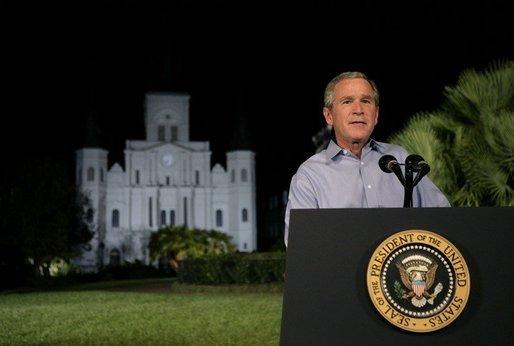 | THE PRESIDENT: Good evening. I'm speaking to you from the city of New Orleans -- nearly empty, still partly under water, and waiting for life and hope to return. Eastward from Lake Pontchartrain, across the Mississippi coast, |
In the aftermath, we have seen fellow citizens left stunned and uprooted, searching for loved ones, and grieving for the dead, and looking for meaning in a tragedy that seems so blind and random. We've also witnessed the kind of desperation no citizen of this great and generous nation should ever have to know -- fellow Americans calling out for food and water, vulnerable people left at the mercy of criminals who had no mercy, and the bodies of the dead lying uncovered and untended in the street.
These days of sorrow and outrage have also been marked by acts of courage and kindness that make all Americans proud. Coast Guard and other personnel rescued tens of thousands of people from flooded neighborhoods. Religious congregations and families have welcomed strangers as brothers and sisters and neighbors. In the community of Chalmette, when two men tried to break into a home, the owner invited them to stay -- and took in 15 other people who had no place to go. At Tulane Hospital for Children, doctors and nurses did not eat for days so patients could have food, and eventually carried the patients on their backs up eight flights of stairs to helicopters.
Many first responders were victims themselves, wounded healers, with a sense of duty greater than their own suffering. When I met Steve Scott of the Biloxi Fire Department, he and his colleagues were conducting a house-to-house search for survivors. Steve told me this: "I lost my house and I lost my cars, but I still got my family ... and I still got my spirit."
Across the Gulf Coast, among people who have lost much, and suffered much, and given to the limit of their power, we are seeing that same spirit -- a core of strength that survives all hurt, a faith in God no storm can take away, and a powerful American determination to clear the ruins and build better than before.
Tonight so many victims of the hurricane and the flood are far from home and friends and familiar things. You need to know that our whole nation cares about you, and in the journey ahead you're not alone. To all who carry a burden of loss, I extend the deepest sympathy of our country. To every person who has served and sacrificed in this emergency, I offer the gratitude of our country. And tonight I also offer this pledge of the American people: Throughout the area hit by the hurricane, we will do what it takes, we will stay as long as it takes, to help citizens rebuild their communities and their lives. And all who question the future of the Crescent City need to know there is no way to imagine America without New Orleans, and this great city will rise again.
The work of rescue is largely finished; the work of recovery is moving forward. In nearly all of Mississippi, electric power has been restored. Trade is starting to return to the Port of New Orleans, and agricultural shipments are moving down the Mississippi River. All major gasoline pipelines are now in operation, preventing the supply disruptions that many feared. The breaks in the levees have been closed, the pumps are running, and the water here in New Orleans is receding by the hour. Environmental officials are on the ground, taking water samples, identifying and dealing with hazardous debris, and working to get drinking water and waste water treatment systems operating again. And some very sad duties are being carried out by professionals who gather the dead, treat them with respect, and prepare them for their rest.
In the task of recovery and rebuilding, some of the hardest work is still ahead, and it will require the creative skill and generosity of a united country.
Our first commitment is to meet the immediate needs of those who had to flee their homes and leave all their possessions behind. For these Americans, every night brings uncertainty, every day requires new courage, and in the months to come will bring more than their fair share of struggles.
The Department of Homeland Security is registering evacuees who are now in shelters and churches, or private homes, whether in the Gulf region or far away. I have signed an order providing immediate assistance to people from the disaster area. As of today, more than 500,000 evacuee families have gotten emergency help to pay for food, clothing, and other essentials. Evacuees who have not yet registered should contact FEMA or the Red Cross. We need to know who you are, because many of you will be eligible for broader assistance in the future. Many families were separated during the evacuation, and we are working to help you reunite. Please call this number: 1-877-568-3317 -- that's 1-877-568-3317 -- and we will work to bring your family back together, and pay for your travel to reach them.
In addition, we're taking steps to ensure that evacuees do not have to travel great distances or navigate bureaucracies to get the benefits that are there for them. The Department of Health and Human Services has sent more than 1,500 health professionals, along with over 50 tons of medical supplies -- including vaccines and antibiotics and medicines for people with chronic conditions such as diabetes. The Social Security Administration is delivering checks. The Department of Labor is helping displaced persons apply for temporary jobs and unemployment benefits. And the Postal Service is registering new addresses so that people can get their mail.
To carry out the first stages of the relief effort and begin rebuilding at once, I have asked for, and the Congress has provided, more than $60 billion. This is an unprecedented response to an unprecedented crisis, which demonstrates the compassion and resolve of our nation.
Our second commitment is to help the citizens of the Gulf Coast to overcome this disaster, put their lives back together, and rebuild their communities. Along this coast, for mile after mile, the wind and water swept the land clean. In Mississippi, many thousands of houses were damaged or destroyed. In New Orleans and surrounding parishes, more than a quarter-million houses are no longer safe to live in. Hundreds of thousands of people from across this region will need to find longer-term housing.
Our goal is to get people out of the shelters by the middle of October. So we're providing direct assistance to evacuees that allows them to rent apartments, and many already are moving into places of their own. A number of states have taken in evacuees and shown them great compassion -- admitting children to school, and providing health care. So I will work with the Congress to ensure that states are reimbursed for these extra expenses.
In the disaster area, and in cities that have received huge numbers of displaced people, we're beginning to bring in mobile homes and trailers for temporary use. To relieve the burden on local health care facilities in the region, we're sending extra doctors and nurses to these areas. We're also providing money that can be used to cover overtime pay for police and fire departments while the cities and towns rebuild.
Near New Orleans, and Biloxi, and other cities, housing is urgently needed for police and firefighters, other service providers, and the many workers who are going to rebuild these cities. Right now, many are sleeping on ships we have brought to the Port of New Orleans -- and more ships are on their way to the region. And we'll provide mobile homes, and supply them with basic services, as close to construction areas as possible, so the rebuilding process can go forward as quickly as possible.
And the federal government will undertake a close partnership with the states of Louisiana and Mississippi, the city of New Orleans, and other Gulf Coast cities, so they can rebuild in a sensible, well-planned way. Federal funds will cover the great majority of the costs of repairing public infrastructure in the disaster zone, from roads and bridges to schools and water systems. Our goal is to get the work done quickly. And taxpayers expect this work to be done honestly and wisely -- so we'll have a team of inspectors general reviewing all expenditures.
In the rebuilding process, there will be many important decisions and many details to resolve, yet we're moving forward according to some clear principles. The federal government will be fully engaged in the mission, but Governor Barbour, Governor Blanco, Mayor Nagin, and other state and local leaders will have the primary role in planning for their own future. Clearly, communities will need to move decisively to change zoning laws and building codes, in order to avoid a repeat of what we've seen. And in the work of rebuilding, as many jobs as possible should go to the men and women who live in Louisiana, Mississippi, and Alabama.
Our third commitment is this: When communities are rebuilt, they must be even better and stronger than before the storm. Within the Gulf region are some of the most beautiful and historic places in America. As all of us saw on television, there's also some deep, persistent poverty in this region, as well. That poverty has roots in a history of racial discrimination, which cut off generations from the opportunity of America. We have a duty to confront this poverty with bold action. So let us restore all that we have cherished from yesterday, and let us rise above the legacy of inequality. When the streets are rebuilt, there should be many new businesses, including minority-owned businesses, along those streets. When the houses are rebuilt, more families should own, not rent, those houses. When the regional economy revives, local people should be prepared for the jobs being created.
Americans want the Gulf Coast not just to survive, but to thrive; not just to cope, but to overcome. We want evacuees to come home, for the best of reasons -- because they have a real chance at a better life in a place they love.
When one resident of this city who lost his home was asked by a reporter if he would relocate, he said, "Naw, I will rebuild -- but I will build higher." That is our vision for the future, in this city and beyond: We'll not just rebuild, we'll build higher and better. To meet this goal, I will listen to good ideas from Congress, and state and local officials, and the private sector. I believe we should start with three initiatives that the Congress should pass.
Tonight I propose the creation of a Gulf Opportunity Zone, encompassing the region of the disaster in Louisiana and Mississippi and Alabama. Within this zone, we should provide immediate incentives for job-creating investment, tax relief for small businesses, incentives to companies that create jobs, and loans and loan guarantees for small businesses, including minority-owned enterprises, to get them up and running again. It is entrepreneurship that creates jobs and opportunity; it is entrepreneurship that helps break the cycle of poverty; and we will take the side of entrepreneurs as they lead the economic revival of the Gulf region.
I propose the creation of Worker Recovery Accounts to help those evacuees who need extra help finding work. Under this plan, the federal government would provide accounts of up to $5,000, which these evacuees could draw upon for job training and education to help them get a good job, and for child care expenses during their job search.
And to help lower-income citizens in the hurricane region build new and better lives, I also propose that Congress pass an Urban Homesteading Act. Under this approach, we will identify property in the region owned by the federal government, and provide building sites to low-income citizens free of charge, through a lottery. In return, they would pledge to build on the lot, with either a mortgage or help from a charitable organization like Habitat for Humanity. Home ownership is one of the great strengths of any community, and it must be a central part of our vision for the revival of this region.
In the long run, the New Orleans area has a particular challenge, because much of the city lies below sea level. The people who call it home need to have reassurance that their lives will be safer in the years to come. Protecting a city that sits lower than the water around it is not easy, but it can, and has been done. City and parish officials in New Orleans, and state officials in Louisiana will have a large part in the engineering decisions to come. And the Army Corps of Engineers will work at their side to make the flood protection system stronger than it has ever been.
The work that has begun in the Gulf Coast region will be one of the largest reconstruction efforts the world has ever seen. When that job is done, all Americans will have something to be very proud of -- and all Americans are needed in this common effort. It is the armies of compassion -- charities and houses of worship, and idealistic men and women -- that give our reconstruction effort its humanity. They offer to those who hurt a friendly face, an arm around the shoulder, and the reassurance that in hard times, they can count on someone who cares. By land, by sea, and by air, good people wanting to make a difference deployed to the Gulf Coast, and they've been working around the clock ever since.
The cash needed to support the armies of compassion is great, and Americans have given generously. For example, the private fundraising effort led by former Presidents Bush and Clinton has already received pledges of more than $100 million. Some of that money is going to the Governors to be used for immediate needs within their states. A portion will also be sent to local houses of worship to help reimburse them for the expense of helping others. This evening the need is still urgent, and I ask the American people to continue donating to the Salvation Army, the Red Cross, other good charities, and religious congregations in the region.
It's also essential for the many organizations of our country to reach out to your fellow citizens in the Gulf area. So I've asked USA Freedom Corps to create an information clearinghouse, available at usafreedomcorps.gov, so that families anywhere in the country can find opportunities to help families in the region, or a school can support a school. And I challenge existing organizations -- churches, and Scout troops, or labor union locals to get in touch with their counterparts in Mississippi, Louisiana, or Alabama, and learn what they can do to help. In this great national enterprise, important work can be done by everyone, and everyone should find their role and do their part.
The government of this nation will do its part, as well. Our cities must have clear and up-to-date plans for responding to natural disasters, and disease outbreaks, or a terrorist attack, for evacuating large numbers of people in an emergency, and for providing the food and water and security they would need. In a time of terror threats and weapons of mass destruction, the danger to our citizens reaches much wider than a fault line or a flood plain. I consider detailed emergency planning to be a national security priority, and therefore, I've ordered the Department of Homeland Security to undertake an immediate review, in cooperation with local counterparts, of emergency plans in every major city in America.
I also want to know all the facts about the government response to Hurricane Katrina. The storm involved a massive flood, a major supply and security operation, and an evacuation order affecting more than a million people. It was not a normal hurricane -- and the normal disaster relief system was not equal to it. Many of the men and women of the Coast Guard, the Federal Emergency Management Agency, the United States military, the National Guard, Homeland Security, and state and local governments performed skillfully under the worst conditions. Yet the system, at every level of government, was not well-coordinated, and was overwhelmed in the first few days. It is now clear that a challenge on this scale requires greater federal authority and a broader role for the armed forces -- the institution of our government most capable of massive logistical operations on a moment's notice.
Four years after the frightening experience of September the 11th, Americans have every right to expect a more effective response in a time of emergency. When the federal government fails to meet such an obligation, I, as President, am responsible for the problem, and for the solution. So I've ordered every Cabinet Secretary to participate in a comprehensive review of the government response to the hurricane. This government will learn the lessons of Hurricane Katrina. We're going to review every action and make necessary changes, so that we are better prepared for any challenge of nature, or act of evil men, that could threaten our people.
The United States Congress also has an important oversight function to perform. Congress is preparing an investigation, and I will work with members of both parties to make sure this effort is thorough.
In the life of this nation, we have often been reminded that nature is an awesome force, and that all life is fragile. We're the heirs of men and women who lived through those first terrible winters at Jamestown and Plymouth, who rebuilt Chicago after a great fire, and San Francisco after a great earthquake, who reclaimed the prairie from the Dust Bowl of the 1930s. Every time, the people of this land have come back from fire, flood, and storm to build anew -- and to build better than what we had before. Americans have never left our destiny to the whims of nature -- and we will not start now.
These trials have also reminded us that we are often stronger than we know -- with the help of grace and one another. They remind us of a hope beyond all pain and death, a God who welcomes the lost to a house not made with hands. And they remind us that we're tied together in this life, in this nation -- and that the despair of any touches us all.
I know that when you sit on the steps of a porch where a home once stood, or sleep on a cot in a crowded shelter, it is hard to imagine a bright future. But that future will come. The streets of Biloxi and Gulfport will again be filled with lovely homes and the sound of children playing. The churches of Alabama will have their broken steeples mended and their congregations whole. And here in New Orleans, the street cars will once again rumble down St. Charles, and the passionate soul of a great city will return.
In this place, there's a custom for the funerals of jazz musicians. The funeral procession parades slowly through the streets, followed by a band playing a mournful dirge as it moves to the cemetery. Once the casket has been laid in place, the band breaks into a joyful "second line" -- symbolizing the triumph of the spirit over death. Tonight the Gulf Coast is still coming through the dirge -- yet we will live to see the second line.
Thank you, and may God bless America.
END 8:28 P.M. CDT, For Immediate Release, Office of the Press Secretary, September 15, 2005
more at Hurricane Katrina and Katrina or hurricane and Katrina relief or President Bush and video
Related: Keyword Katrina, Monday, August 29, 2005 President, Hurricane Katrina, Iraqis Draft Constitution, Monday, August 29, 2005 Hurricane Katrina Update (real time loop), Monday, August 29, 2005 Hurricane Katrina Homeland Security Media Advisory, Tuesday, August 30, 2005 FEMA Responding to Hurricane Katrina (real time loop), Tuesday, August 30, 2005 Disaster Medical Deployed For Hurricane Katrina (real time loop), Tuesday, August 30, 2005 KATRINA Advisory (NOAA RSS FEED) (real time loop), Wednesday, August 31, 2005 Ask the White House Michael Chertoff Hurricane Katrina, Wednesday, August 31, 2005 Samuel W. Bodman, Hurricane Katrina, Strategic Petroleum Reserve, Thursday, September 01, 2005 President Outlines Hurricane Katrina Relief (VIDEO), Thursday, September 01, 2005 W Asks Poppi and Bubba for Hurricane Relief (VIDEO), Thursday, September 01, 2005 well isn't that special, Friday, September 02, 2005 President Heads to Katrina Affected Areas (VIDEO), Friday, September 02, 2005 FEMA News Release Number: HQ-05-193, Saturday, September 03, 2005 Navy Personnel, Family Helpline, Pentagon Briefing (VIDEO), Saturday, September 03, 2005 President Addresses Nation, Katrina Relief (VIDEO)
0
comments
||
||
National Hispanic Heritage Month, 2005
National Hispanic Heritage Month, 2005, A Proclamation by the President of the United States of America
Throughout our history, America has been a land of diversity and has benefitted from the contributions of people of different backgrounds brought together by a love of liberty. During National Hispanic Heritage Month, we celebrate the achievements of Hispanic Americans and the significant role they have played in making our Nation strong, prosperous, and free.
The contributions of Hispanic Americans have made a positive impact on every part of our society. Americans of Hispanic descent are astronauts and athletes, doctors and teachers, lawyers and scientists. The vibrancy of our Nation's Hispanic performers enriches music, dancing, and the arts. Hispanic Americans serve at every level of government, including as Attorney General of the United States and Secretary of Commerce. Latino entrepreneurs are starting and growing businesses all across America, creating jobs and opportunities. The hard work and determination of Hispanic Americans continue to inspire all those who dream of a better life for themselves and their families.
Our Nation's Hispanic community has contributed to the advance of freedom abroad and to the defense of freedom at home. In every generation, Hispanic Americans have served valiantly in the United States military. Today there are more than 200,000 Hispanic Americans serving in the Armed Forces, and our Nation is grateful for their courage and sacrifice. In addition, thousands of Hispanic Americans are helping to defend and protect our homeland by serving as police officers and firefighters. All Americans are thankful for their daily work in helping to keep our Nation safe.
During National Hispanic Heritage Month, we join together to recognize the proud history and rich culture of Hispanic Americans. To honor the achievements of Hispanic Americans, the Congress, by Public Law 100 402, as amended, has authorized and requested the President to issue annually a proclamation designating September 15 through October 15 as "National Hispanic Heritage Month."
NOW, THEREFORE, I, GEORGE W. BUSH, President of the United States of America, do hereby proclaim September 15 through October 15, 2005, as National Hispanic Heritage Month. I call upon public officials, educators, librarians, and all the people of the United States to observe this month with appropriate ceremonies, activities, and programs.
IN WITNESS WHEREOF, I have hereunto set my hand this sixteenth day of September, in the year of our Lord two thousand five, and of the Independence of the United States of America the two hundred and thirtieth.
GEORGE W. BUSH
# # # For Immediate Release, Office of the Press Secretary, September 16, 2005
more at President Bush and National Hispanic Heritage Month or Hispanic Heritage Month and Hispanic Heritage or Hispanic
0
comments
||
||
President to Welcome King Abdullah of Jordan
President to Welcome King Abdullah of Jordan to the White House
President Bush will welcome King Abdullah of Jordan to the White House on September 22, 2005. The United States appreciates Jordan's friendship and values our strong partnership in the region. The President looks forward to discussing with the King his initiative in promoting moderate Islam, the progress of reform in Jordan, and other bilateral and regional issues.
# # # For Immediate Release, Office of the Press Secretary, September 16, 2005
more at President Bush and King Abdullah or Jordan and Whitehouse or Islam
0
comments
||
||
President to Welcome Prime Minister of Thailand
President to Welcome Prime Minister of Thailand to the White House
President Bush will welcome Prime Minister Thaksin to the White House on September 19, 2005. Thailand is a long-standing ally and a democratic partner. The two leaders will discuss regional issues, economic cooperation, and ways to further strengthen the alliance.
# # # For Immediate Release, Office of the Press Secretary, September 16, 2005
more at President Bush and Thailand or Prime Minister Thaksin and White House
0
comments
||
||
POW/MIA Day, 2005
more at President Bush and National POW/MIA Recognition Day or POW/MIA and MIA or Armed Forces and Veterans Affairs or POW
National POW/MIA Recognition Day, 2005, By the President of the United States of America, A Proclamation
In every generation, members of our Armed Forces have answered the call of service in our Nation's hour of need. These patriots have defended our freedom and way of life, triumphed over brutal enemies, and answered the prayers of millions. On National POW/MIA Recognition Day, we honor the Americans who have been prisoners of war and recognize them for enduring unimaginable hardships while serving in military conflicts around the globe. We also remember those who are still missing in action, and we renew our commitment to keep searching until we have accounted for every Soldier, Sailor, Airman, and Marine missing in the line of duty.
On National POW/MIA Recognition Day, the flag of the National League of Families of American Prisoners and Missing in Southeast Asia is flown over the White House, the Capitol, the Departments of State, Defense, and Veterans Affairs, the Selective Service System Headquarters, the National Vietnam Veterans and Korean War Veterans Memorials, U.S. Military Installations, national cemeteries, and other locations across our country. The flag is a reminder of our continued commitment to those brave patriots imprisoned while serving in conflicts around the world and of our pledge to continue to achieve the fullest possible accounting for all our men and women in uniform who are still missing. Americans are blessed with the freedom made possible by the service and sacrifice of so many. On National POW/MIA Recognition Day, our entire Nation honors and pays special tribute to our prisoners of war and those who remain missing.
NOW, THEREFORE, I, GEORGE W. BUSH, President of the United States of America, by virtue of the authority vested in me by the Constitution and laws of the United States, do hereby proclaim Friday, September 16, 2005, as National POW/MIA Recognition Day. I call upon the people of the United States to join me in saluting all American POWs and those missing in action who valiantly served our country. I call upon Federal, State, and local government officials and private organizations to observe this day with appropriate ceremonies and activities.
IN WITNESS WHEREOF, I have hereunto set my hand this sixteenth day of September, in the year of our Lord two thousand five, and of the Independence of the United States of America the two hundred and thirtieth.
GEORGE W. BUSH
# # # For Immediate Release, Office of the Press Secretary, September 16, 2005
0
comments
||
||
President's Remarks at National Day of Prayer and Remembrance Service
President's Remarks at National Day of Prayer and Remembrance Service, Washington National Cathedral, Washington, D.C. 11:58 A.M. EDT
THE PRESIDENT: On this Day of Prayer and Remembrance, our nation remains in the shadow of a storm that departed two weeks ago. We're humbled by the vast and indifferent might of nature, and feel small beside its power. We commend the departed to God. We mourn with those who mourn, and we ask for strength in the work ahead.
The destruction is immense, covering a city, a coastline, a region. Yet the hurt always comes down to one life, one family. We've seen the panic of loved ones separated from each other, the lonely pain of people whose earthly possessions were swept away, and the uncertainty of men and women and children driven away from the lives they knew. Many did not survive the fury of the storm. Many who did ask, why -- and wonder, what comes next.
In this hour of suffering, we're prayerful. In a wounded region, so many placed their faith in a God who hears and helps. And so many are bringing their grief to a Savior acquainted with grief. Our nation joins with them to pray for comfort and sorrow, for the reunion of separated families, and a holy rest for the ones who died.
Through prayer we look for ways to understand the arbitrary harm left by this storm, and the mystery of undeserved suffering. And in our search we're reminded that God's purposes are sometimes impossible to know here on Earth. Yet even as we're humbled by forces we cannot explain, we take comfort in the knowledge that no one is ever stranded beyond God's care. The Creator of wind and water is also the source of even a greater power -- a love that can redeem the worst tragedy, a love that is stronger than death.
In this hour of suffering, our nation is thankful. We have been inspired by acts of courage and goodness: Coast Guardsmen and military personnel reaching out of helicopters and lifting victims from rooftops; firefighters wading through mud and debris to search for victims and survivors; doctors and nurses defying danger so their patients might live. Many of those who saved others lost their own homes and were separated from their own families. And many stories of heroism and rescue will never be told because they are known to God alone.
We're thankful for a spirit seen across the Gulf Coast that faces the worst and chooses to hope. We're thankful, as well, for the many ordinary citizens who heard the cries of neighbors and answered them. Across the country, Americans saw the hungry and gave them something to eat; saw the thirsty and gave them something to drink; saw strangers and invited them in. One man who was rescued and given shelter after the storm said, "I didn't think there was so much love in the world."
In this hour of suffering, our nation is also mindful of the work ahead. Through this tragedy great duties have come to our nation. The destruction of this hurricane was beyond any human power to control, but the restoration of broken communities and disrupted lives now rests in our hands. And we accept this responsibility not as a burden or a chore, but as an opportunity to serve our fellow Americans, as they would do for us.
This task will measure our unity as a people. Americans of every race and religion were touched by this storm; yet some of the greatest hardship fell upon citizens already facing lives of struggle -- the elderly, the vulnerable, and the poor. And this poverty has roots in generations of segregation and discrimination that closed many doors of opportunity. As we clear away the debris of a hurricane, let us also clear away the legacy of inequality. Let us deliver new hope to communities that were suffering before the storm. As we rebuild homes and businesses, we will renew our promise as a land of equality and decency. And one day, Americans will look back at the response to Hurricane Katrina and say that our country grew not only in prosperity, but in character and justice.
On this National Day of Prayer and Remembrance, we pledge ourselves to the demanding work of revival, and renew the faith and hope that will carry that work to completion. In the worst of storms, and in the rush of flood waters, even the strongest faith can be tested. Yet the Scriptures assure us, "many waters cannot quench love; neither can the floods drown it."
So now we go forward, confident in the good heart of America, and trusting that even among the ruins, the love of God remains at work.
May God bless and keep the souls of the lost. May His love touch all those in need, and may He always watch over the United States of America. God bless.
END 12:03 P.M. EDT For Immediate Release, Office of the Press Secretary, September 16, 2005
more at Hurricane Katrina and Katrina or hurricane and Katrina relief or President Bush and National Day of Prayer and Remembrance Service
0
comments
||
||
Thursday, September 15, 2005
How To Register For FEMA Assistance By Phone
How To Register For FEMA Assistance By Phone
BATON ROUGE, La. -- Individuals and families who suffered losses as a result of Hurricane Katrina are encouraged to call the U.S. Department of Homeland Security's Federal Emergency Management Agency (FEMA) toll-free registration number at 1-800-621-FEMA (3362) . People who are speech- or hearing-impaired should call TTY 1-800-462-7585 . Phone lines are open 24 hours a day, seven days a week until further notice.
More than 3,000 employees are taking calls to help meet the surge in applications following Hurricane Katrina. If information is gathered prior to starting the application, the process should take approximately 20 minutes. Applicants should be prepared to provide some basic information when calling, including their social security number, telephone number where they may be reached, address of the damaged property, insurance information and bank account information. If applicants do not know the necessary information to sign up for a direct deposit (bank account number and routing number), they should contact their banks to get this information before starting an application. FEMA strongly encourages people to sign up for direct deposit because many residents are relocating following Hurricane Katrina, and mailed checks may not reach them.
Disaster recovery officials are aware people may not be able to access all the necessary information. For this reason, FEMA staff is trained to work around missing information. Missing information should not make those in need miss out on help. If applicants' telephones are not working well, they should inform the call center staff when they give them their contact details.
Registration Tips
If possible, people may call an out-of-state friend or relative and have that individual apply for assistance via the Internet on their behalf. FEMA can accept an application from any person but will only provide follow-up information to the individual needing assistance. Applicants should share personal information only with trusted individuals .
Those who cannot provide direct deposit details may have their assistance check mailed to someone living outside the disaster area. Applicants may give the address of an out-of-area contact who can get the funds to them.
Applicants who evacuated before the disaster and who have not returned home should report that there was damage, even if they are unsure of the details. It will be presumed the damage resulted from the storm. Do not say damages are unknown.
If staying in a hotel, it is acceptable to give the name and city of the hotel if applicants do not have a telephone. Call center staff will work with people's varied living situations.
Register now . It is not necessary to wait until the water has receded or returning home to begin the recovery process.
Even if insured, apply for assistance with FEMA. If insurance does not cover all losses, FEMA may be able to help out.
Those who experienced minor damage might consider waiting awhile before applying for disaster assistance and allowing those in serious need to register first.
Alternatively, anyone who can access the Internet may register online at fema.gov .
FEMA prepares the nation for all hazards and manages federal response and recovery efforts following any national incident. FEMA also initiates mitigation activities, trains first responders, works with state and local emergency managers, and manages the National Flood Insurance Program and the U.S. Fire Administration. FEMA became part of the U.S. Department of Homeland Security on March 1, 2003 .
more at Hurricane Katrina and Katrina or hurricane and Katrina relief or FEMA and Department of Homeland Security
Release Date: September 15, 2005, Release Number: 1603-002
0
comments
||
||


