Monday, September 26, 2005

President Discusses Hurricane Effects on Energy Supply (VIDEO)

President Discusses Hurricane Effects on Energy Supply, U.S. Department of Energy, FULL STREAMING VIDEO, Washington, D.C. 10:59 A.M. EDT

President George W. Bush, appearing at the U.S. Department of Energy, Monday, Sept. 26, 2005 in Washington, talks about the effects of Hurricane Rita on the energy situation in the Gulf of Mexico. President Bush is joined by U.S. Energy Secretary Samuel W. Bodman and U.S. Interior Secretary Gale Norton. White House photo by Paul Morse.President George W. Bush, appearing at the U.S. Department of Energy, Monday, Sept. 26, 2005 in Washington, talks about the effects of Hurricane Rita on the energy situation in the Gulf of Mexico.
President Bush is joined by U.S. Energy Secretary Samuel W. Bodman and U.S. Interior Secretary Gale Norton. White House photo by Paul Morse.

THE PRESIDENT: I want to thank Secretary Bodman for welcoming us here at the Energy Department; Secretary Norton. We've just had a full briefing on what we know thus far about the effects of Hurricane Rita on the energy situation in the Gulf of Mexico.

A lot of our production comes from the Gulf, and when you have a Hurricane Katrina followed by a Hurricane Rita, it's natural, unfortunately, that it's going to affect supply. There's about 1.56 million barrels of oil that is shut in. And before Rita, just to put that in perspective, that was approximately 880,000 barrels a day that were shut in due to Katrina. So that when you really look on a map you have, if you follow the path of Katrina and the path of Rita, it pretty much covers a lot of production in the Gulf of Mexico.

Right now the producing companies are assessing damage to the platforms and rigs. It's important for our people to know that we understand the situation and that we're willing to use the Strategic Petroleum Reserve to mitigate any shortfalls in crude oil that could affect our consumers. I've instructed the Secretary of Energy to be mindful once again about the effects of the SPRO, and how it can help settle price. He did a fine job after Katrina, and we're paying close attention to the markets as we speak.

Secondly, gasoline prices, obviously, are on our mind, and so we've watched very carefully the assessments done on the refining -- the refineries there on the Gulf Coast. There are a lot of -- a lot of gasoline refineries in the Houston area, in the Beaumont area, in the Port Arthur area, as well as Lake Charles, and the Louisiana area. There was about 5.4 million barrels per day that were shut in as a result of Rita and Katrina. A million of it is back up already, and we expect another 1.8 million barrels a day to get back on line relatively quickly because the storm missed a lot of refining capacity down the Texas coast.

We don't know yet about 1.7 million barrels a day that were located right in the path of Rita. And the Secretary has got his people in contact with the energy companies to find out exactly what we have to deal with. About 900,000 barrels a day are still shutdown as a result of Katrina. For those of you who went with me to the Chevron plant in Pascagoula, Mississippi, you might remember the size of that facility and the scope of the damage it had sustained. They're working hard to bring these plants back up.

The other thing that's going to affect the ability for people to get gasoline is, of course, the pipelines. In other words, you manufacture the gasoline in a refinery and you have to ship it across the country. There's three of the four major gasoline pipelines -- three of the four pipelines in the affected area are major gasoline pipelines that supply the Midwest and the East Coast. The Plantation Pipeline, which is an East Coast pipeline, is at 100 percent capacity. That's one of the real success stories of this storm. In other words, it didn't go down at all.

Colonial, which sends gasoline up to the Midwest, is at 52 percent capacity. It will soon be about 70 percent, and should be at 100 percent by the end of the week. The Explorer in the Midwest, sending gas to the Midwest, is at 67 percent capacity, should be at 100 percent next week. The Capline, which sends gasoline to the Midwest, as well -- it's a major crude pipeline, by the way, that sends crude to be refined in the Midwest -- will be at about 75 percent capacity now, and obviously they're going to do everything they can to get it up to capacity.

My point is, is that the storm affected the ability to get gasoline to markets. I know the governors of Florida and Georgia have done some creative things to try to anticipate what will be a temporary problem. Governor Perdue of Georgia I thought did a -- showed some leadership by saying we've got to -- anticipating a problem, here's what we need to do to correct it.

There's going to be some -- by the way, and here's what we have done and will continue to do. We have suspended certain EPA winter blend rules so that it makes it easier to import gasoline from overseas. In other words, there's a supply of gasoline in Europe, and by suspending these rules, it's a lot more likely to be able to get gasoline into our markets. And so while there's a shortfall because of down refining capacity, we will work with -- we have instructed EPA to leave the rules in place, or to suspend the rules that were in place, keep the suspension in place, which would make it easier to increase supply, and continue to get supply of gasoline here. And that's important for our consumers to know.

In Houston, the challenge in Houston, as I understand it, is to get drivers and trucks into Houston so they can deliver gasoline to the retailers. And the Secretary is working with the local authorities there to help do anything we can to help get that done so that people in that big city will be able to get some gasoline. Beaumont and Port Arthur are still under assessment, we're not sure yet the full extent of the damage. I'll be going down there in the area tomorrow, and by then there will be a pretty clear assessment. I look forward to dealing with local -- talking to local leaders about what -- the situation and the problems they face.

Let me repeat, we'll use the Strategic Petroleum Reserve to help refineries with crude oil. We will continue the waivers to allow the winter blends of fuel to be used throughout the country. We will continue to waiver that -- to allow broader use of diesel fuel. Because we understand there's been a disruption in supply and we want to make sure that we do everything we can to help with the supply disruption.

The Homeland Security waived the Jones Act on restrictions on fuel transportation. We're allowing foreign flag ships to temporarily transport fuel from one U.S. port to another. That's going to be important for expediting supply to deal with bottlenecks. We will continue that waiver. The Treasury and IRS announced that dyed diesel fuel for off-road use would be allowed on on-road use without penalty. In other words, we're taking action to help deal with the shortfall caused by Katrina and Rita.

Two other points I want to make is, one, we can all pitch in by using -- by being better conservers of energy. I mean, people just need to recognize that the storms have caused disruption and that if they're able to maybe not drive when they -- on a trip that's not essential, that would helpful. The federal government can help, and I've directed the federal agencies nationwide -- and here's some ways we can help. We can curtail nonessential travel. If it makes sense for the citizen out there to curtail nonessential travel, it darn sure makes sense for federal employees. We can encourage employees to carpool or use mass transit. And we can shift peak electricity use to off-peak hours. There's ways for the federal government to lead when it comes to conservation.

And, finally, these storms show that we need additional capacity in -- we need additional refining capacity, for example, to be able to meet the needs of the American people. The storms have shown how fragile the balance is between supply and demand in America. I've often said one of the worst problems we have is that we're dependent on foreign sources of crude oil, and we are. But it's clear, as well, that we're also really dependent on the capacity of our country to refine product, and we need more refining capacity. And I look forward to working with Congress, as we analyze the energy situation, to expedite the capacity of our refiners to expand and/or build new refineries.

It is clear that when you're dependent upon natural gas and/or hydrocarbons to fuel your economy and that supply gets disrupted, we need alternative sources of energy. And that's why I believe so strongly in nuclear power. And so we've got a chance, once again, to assess where we are as a country when it comes to energy and do something about it. And I look forward to working with Congress to do just that.

I'll be glad to answer a couple of questions. Nedra.

Q Thank you, Mr. President. I want to ask you about a different result of these storms, and that is the racial divide that's been exposed in this country. Blacks and whites feel very differently about what happened. We all recognize that the response to Rita was much better than the response to Katrina, but there are some strong feelings in the black community that that difference had a racial component to it, that the white, you know, rural residents got taken care of better than the black urban residents did. How do you respond to that?

THE PRESIDENT: Well, I think about Houston, my old hometown of Houston, which is an incredibly diverse city. And we had what looked like a category five hurricane headed right for Houston, and the federal, state and local officials worked together to warn the citizens of the impending storm. The message wasn't sent to one group of people; it was sent to the entire city. I mean, Texas is a diverse state. The rural part of Texas you're talking about has got a significant African American component to it. But I can assure you that the response efforts, and now the recovery efforts, are aimed at -- aimed at saving everybody. And the response was directed toward everybody.

I think that what a lot of Americans saw was a -- some poverty that they had never imagined before. And we need to address that, whether it be rural or urban. And I have done that as the President. I have said that education systems that simply shuffle children through are -- can be discriminatory in nature. And, therefore, we've got to have high standards and high expectations and focus money on Title I children to teach -- so that they -- so that children can learn to read. And we're beginning to make progress.

I have said that ownership is a way to counter poverty and being stuck in impoverished situations, and so homeownership is up. And business ownership is up amongst minorities. I have said that the faith-based programs are more likely able to address some of the hopelessness of people, and therefore have empowered faith-based programs to interface with people. We've promoted mentoring programs for children whose parents might be in prison, as a way to help provide hope for people.

But this is an issue that this country must continue to address. Poverty is an issue that's an important issue. And poverty exists in New Orleans, Louisiana, and it exists in rural Texas, and it needs to be addressed in a significant way.

Toby.

Q Mr. President, now that Judge Roberts is heading for confirmation, how close are you to choosing your second nominee for the Supreme Court? And how much of a factor is diversity going to be?

THE PRESIDENT: First of all, I will -- I'm cautiously optimistic about Judge Roberts' vote in the Senate. I will -- he's done a fantastic job of showing the Senate and the American people he's not only a brilliant person, but a decent person with a great heart. And so I await confirmation and I hope it goes well. It looks like it might.

Your question indicated that it looked like it was headed in the right direction. I will withhold judgment until the Senate exercises their consent part of the advice and consent relationship with the White House.

I have interviewed people in the past, and thought about people from all walks of life. And I will put the person in to do the job. But I am mindful that diversity is one of the strengths of the country.

Any other questions? Yes.

Q Thank you. In suggesting that the Department of Defense might become the first responder in catastrophic disasters, are you not conceding that the Department of Homeland Security is not up to the task?

THE PRESIDENT: Oh, no, no let me -- I appreciate you asking that question. One of the reasons I went out to NORTHCOM was to see the operations there, to look at how well organized NORTHCOM is, to listen to them talk about lessons learned from a major storm like Katrina, to think about ways for our country to properly respond to a catastrophic event, whether it be a natural catastrophic event or perhaps a terrorist attack.

And what I want the discussion to -- I want there to be a robust discussion about the best way for the federal government, in certain extreme circumstances, to be able to rally assets for the good of the people. I don't want to prejudge the Congress's discussion on this issue, because it may require change of law.

But I do want them to think about a circumstance that requires a lot of planning and a lot of assets immediately on the scene in order to stabilize. And so what I was speculating about was a scenario which would require federal assets to stabilize the situation, primarily DOD assets -- DOD assets, and then hand back over to Department of Homeland Security, for example. And I think it's very important for us as we look at the lessons of Katrina to think about other scenarios that might require a well-planned significant federal response right off the bat to provide stability. That's what I was talking about.

Q Mr. President, you had mentioned refining capacity. I'd like to ask you about an offer from the Kuwaiti oil minister, who has said that he is willing to offer to build a capacity -- a refining capacity in the U.S.; it would be the first time in about 30 years. Says he's asked for White House assistance -- assistance -- assistance getting permits and fed support and so forth. What do you think of a proposal like that?

THE PRESIDENT: I am for increasing supply, because I understand when the more supply there is of a product, that will take pressure off of price. I haven't seen this specific proposal. But I've also talked to U.S. refiners who have said, we'd like to expand onsite, but the amount of paperwork necessary to do so is staggering. The issue of new source review, for example, is one that we've reviewed and said that, for the sake of, in this case, the expeditious expansion -- and wise and careful expansion -- of refining capacity, we ought to look at those rules and regulations. And yet we're back in court.

And so I think if you take a good look at what it means to build a refinery, or expand a refinery, you'll find there's a lot of regulations and paperwork that are required, thereby delaying the capacity for more product to come on to the market and discouraging people from doing -- building refineries. That's why we haven't had one since 1970-something.

So it's an interesting offer, and we'll, of course, look at it. The first thing we need to look at is how to encourage people to do just that without getting -- without all kinds of time being taken up through the bureaucratic hurdles.

Okay, thank you -- yes, ma'am.

Q Some have called for the continued idea of the reconstruction czar. Has your administration reconsidered having someone in charge, a federal person of the --

THE PRESIDENT: Yes, "reconsidered" means we've ruled it out. I never have; I'm considering. "Reconsidered" means at some point in time I decided not to have that. But I think the idea of having a federal interface with local folks might be -- might be a good idea.

First things first, however. Remember in my speech in New Orleans, I strongly said that this reconstruction vision ought to be a local vision. And if you might remember, the other day I went down to Mississippi and was with Governor Barbour and Jim Barksdale -- he was the founder of Netscape, a local business guy who has put together a group of distinguished citizenry to help plan what south Mississippi ought to look like. And we'll see what else emerges -- comes from that idea in Louisiana.

But the idea is once these groups get up and running, they're going to have to interface with the federal government. And so I'm considering how best to balance the need for local vision and federal involvement.

Now, there's going to be a lot of federal involvement because we're going to spend money -- wisely, I might add. And so it's an idea that I'm still considering. And I want to watch -- because the reason why I'm comfortable about saying "still considering" is because we're still recovering. And we've got a lot of work to do to recover. I mean, when I go down to Mississippi, I appreciate the vision that they're beginning to think about, but my first priority was to help those local folks remove debris. And then the next question is, what do we do with the debris once it's removed. And there's a lot of immediate needs.

If I were to go down to New Orleans today -- I'm not -- if I were, I'd be talking to the Mayor, I'd be interested in the vision -- but I'd be more interested in how we're going to get that water out of the 9th ward. And so I'm now interested -- the next step of the recovery is how to get temporary housing in place to get workers back so that jobs can get cranked up again.

In terms of Texas, when it comes to where my thought process is now, I'm interested in getting electricity to people, and gasoline to people. But the vision element of reconstruction is just beginning, and there may be a need for an interface with a particular person to help make sure that the vision becomes reality. It's a long answer to a short question.

Thank you all, appreciate it.

END 11:20 A.M. EDT, For Immediate Release, Office of the Press Secretary, September 26, 2005

more at
and or and or and and or

President, Louisiana Governor Briefed on Hurricane Rita

President, Louisiana Governor Briefed on Hurricane Rita in Baton Rouge, FEMA Joint Field Office, Baton Rouge, Louisiana 12:08 P.M. CDT

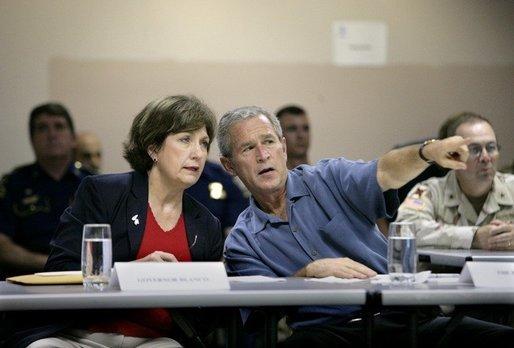
President George W. Bush and Louisiana Governor Kathleen Blanco participate in a briefing on Hurricane Rita at the FEMA Joint Field Office in Baton Rouge, Louisiana, Sunday, Sept. 25, 2005. White House photo by Eric DraperPresident George W. Bush and Louisiana Governor Kathleen Blanco participate in a briefing on Hurricane Rita at the FEMA Joint Field Office in Baton Rouge, Louisiana, Sunday, Sept. 25, 2005. White House photo by Eric Draper
THE PRESIDENT: Thank you all. The Governor and I just got briefed by Admiral Allen on the progress here in Louisiana. There's still assessment on the damage of Hurricane Rita. One of the things that is important for the citizens of this state to do is to listen to the Governor about when it is okay to return back to your homes. I know a lot of people want to get back home. It's important that there be an orderly process. It's important there be an assessment done of infrastructure. And it's important for the people of the affected areas of Louisiana to listen carefully to the Governor and local authorities about the proper timing of return home.

We also got briefed on the levees in New Orleans. There is flooding, obviously, in the 9th Ward. The Corps of Engineers gave us a briefing about the building -- repairing levees, and then, once again, pumping the water out of that part of New Orleans. It's -- I would say it's an optimistic appraisal, in the sense that work has started now, and they can start to -- draining that part of the city again.

But I'm here to really thank the people in the Operations Center for their hard work and their dedication to helping the people of Louisiana recover from a second major storm in a very quick period of time.

Governor, thank you for your hospitality. I know you've been through a lot, and I know the people of this state have been through a lot. We ask for God's blessings on them and their families.

GOVERNOR BLANCO: Well, we want to welcome you back. I'm sorry that we brought you back under another stressful event. But we do appreciate your support. And I do want to tell you how much we appreciated watching all of the integrated forces at work as one. And as we talked, I know that it was possible to do it quickly, and to move in as one, with federal, state and local folks working all together.

We talked about what happens next here, and how quickly we could marshal the right kind of forces again. And I think that, together, we're going to work out some very important plans that citizens of the United States can feel will work very effectively and efficiently.

GOVERNOR BLANCO: Thank you.

THE PRESIDENT: Thank you all. (Applause.)

END 12:11 P.M. CDT, For Immediate Release, Office of the Press Secretary, September 25, 2005

more at
and or and or and and or

Statement on Vice President Cheney's Medical Procedure

Statement on Vice President Cheney's Medical Procedure

This morning (09/24/05), at George Washington Hospital, the Vice President underwent successful, elective, minimally invasive, endovascular repair of arterial aneurysms behind his right and left knees. Small aneurysms were identified behind both knees during the Vice President's annual physical examination in July.

The procedure was performed by a multidisciplinary team led by Dr. Anthony Venbrux, Director of Interventional Radiology, Dr. Jonathan Reiner, Director of the Cardiac Catheterization Laboratory, and Dr. Joseph Giordano, Chairman of Surgery. Joining the team were Dr. Barry Katzen, Director of the Baptist Cardiac and Vascular Institute at Baptist Hospital in Miami and Dr. Peter Gloviczki, Chair of Vascular Surgery at Mayo Clinic.

Using local anesthesia, two overlapping Viabahn stent grafts were implanted in the right popliteal artery. The implanted device consists of a flexible, self-expanding stent covering a thin walled graft composed of polytetrafluoroethylene. Placement of the device in the right knee artery went exceedingly smoothly, and an intraoperative decision was made to repair the aneurysm behind the left knee using a similar technique. The procedure lasted six hours and there were no complications.

Presently, the Vice President is awake, alert, and comfortable. Later this afternoon, the Vice President will be briefed on the impact of Hurricane Rita in Louisiana and Texas, as well as the ongoing federal, state and local response. He will remain in the hospital for up to 48 hours to monitor his recovery and is expected to resume his regular schedule when he is released to home.

# # # For Immediate Release, Office of the Vice President, September 24, 2005

more at
or and or and or

Sunday, September 25, 2005

The world's best clock, NIST-F1

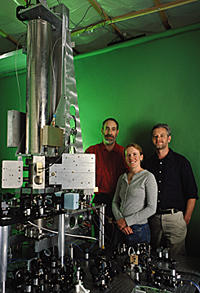
NIST researchers (left to right) Steven Jefferts, Elizabeth Donley, and Tom Heavner with NIST F1, the world's best clock (as of Sept. 2005). The clock uses a fountain-like movement of cesium atoms to determine the length of the second so accurately that—if it were to run continuously—it would neither lose nor gain one second in 60 million years. © 05 Geoffrey Wheeler PhotographyNIST researchers (left to right) Steven Jefferts, Elizabeth Donley, and Tom Heavner with NIST F1, the world's best clock (as of Sept. 2005). The clock uses a fountain-like movement of cesium atoms to determine the length of the second so accurately that—if it were to run continuously—it would neither lose nor gain one second in 60 million years. © 05 Geoffrey Wheeler Photography
The world's best clock, NIST-F1, has been improved over the past few years and now measures time and frequency more than twice as accurately as it did in 1999 when first used as a national standard, physicists at the National Institute of Standards and Technology (NIST) report.

The improved version of NIST-F1 would neither gain nor lose one second in 60 million years, according to a paper published online Sept. 13 by the journal Metrologia.* NIST-F1 uses a fountain-like movement of cesium atoms to determine the length of the second. The clock measures the natural oscillations of the atoms to produce more than 9 billion "ticks" per second. These results then contribute to the international group of atomic clocks that define the official world time. NIST-F1 has been formally evaluated 15 times since 1999; in its record performance, it measured the second with an uncertainty of 0.53 × 10⁻¹⁵

The improved accuracy is due largely to three factors, according to Tom Parker, leader of the NIST atomic standards research group. First, better lasers, software and other components have made the entire NIST-F1 system much more reliable and able to operate for longer periods of time. Second, the atoms in the cesium vapor are now spread out over a much larger volume of space, reducing the frequency shifts caused by interactions among the atoms. (The formerly round cloud of atoms is now shaped like a short cigar.) Third, scientists are now better able to control magnetic fields within the clock and quantify the corrections needed to compensate for their effects on the atoms.

Improved time and frequency standards have many applications. For instance, ultraprecise clocks can be used to improve synchronization in precision navigation and positioning systems, telecommunications networks, and wireless and deep-space communications. Better frequency standards can be used to improve probes of magnetic and gravitational fields for security and medical applications, and to measure whether "fundamental constants" used in scientific research might be varying over time--a question that has enormous implications for understanding the origins and ultimate fate of the universe. ###

* T.P. Heavner, S.R. Jefferts, E.A. Donley, J.H. Shirley, T.E. Parker. 2005. NIST-F1: Recent improvements and accuracy evaluations. Metrologia (October 2005). Posted online Sept. 13.

Contact: Laura Ost
laura.ost@nist.gov 301-975-4034 National Institute of Standards and Technology (NIST) For a high-resolution version of this photo contact inquiries@nist.gov. An additional version of this photo showing just the F1 atomic clock is also available.

more at
or and or and or

Behind the scenes of disaster aid

What the news and the movies leave out: Behind the scenes of disaster aid

The hurricane that devastated the Gulf Coast and the tsunami that ravaged southeast Asia was the stuff one expects to see in overblown movies, not on the nightly news. In a policy briefing paper, Peter Walker, PhD, director of the Feinstein International Famine Center at Tufts' Friedman School of Nutrition Science and Policy, critically assesses what the movies skip over: the behind the scenes workings of disaster relief. The insight he offers on how well tsunami aid was distributed and used will be helpful in the months to come as the Gulf Coast begins to rebuild.

"There was an unparalleled level of initial giving after the tsunami, and the Internet has made donations even easier," Walker said. "But the donations are only as valuable as their use: aid agencies need to be able to account for how efficiently and effectively they use donations, and for how timely their response is."

Walker reports that any evaluation of disaster response must ask four questions:

How well did agencies adapt to the reality of each country/area?

Is the community involved in rehabilitation or was the aid benevolently imposed or a cynically imposed state option?

Who is gaining and who may be losing in the rehabilitation?

Was a livelihood analysis conducted to inform rehabilitation efforts?

"This analysis is essential to rebuilding household economies as well as policy and institutional change in the region. If you don't understand what makes a local community tick, and you don't involve them in the rebuilding, you are just asking for failure."

A specific example, Walker points out, is Sri Lanka: "there was a perception of vast inequalities in terms of what specific populations received as assistance. Other critical issues emerged: the forcing of whole communities to construct new livelihoods, the unabashed disregard for peoples' civil, economic and human rights….all need to be seriously examined." Another example Walker notes is the appropriation of land. One community leader in Thailand is noted, in the policy briefing, as calling it "a second tsunami of corporate globalization and militarization."

Calling into question the perception that aid is driven by need, Walker notes that it is driven by competing realities that can pull aid agencies off course. "It is driven by the wishes and emotions of the general public that provide financial support and political mindspace. It is driven by the media which shapes the disaster in the mind of the public, and the agencies. It is driven by the local political and military agendas, and of course by the global political and economic agendas. And, finally, it is driven by the needs and aspirations of the disaster survivors."

Aid agencies, according to Walker, must examine both disaster response and the business of funding, planning and delivering global aid which is inextricably linked to the media, international trade and political agendas.

In a related article from British Medical Journal, Walker and his colleagues elaborate on deficiencies and challenges of disaster funding. "The headlines rightly applaud the compassionate outpouring of the public around the world but fail to question the logic of promoting one-off giving from individuals rather than sustained involvement by governments. Disasters are part of normality, and if we are to have a long-lasting effect we need to rethink the way aid is delivered and invest in development to help minimize the effects of natural phenomena." ###

"Disaster globalization: evaluating the impact of tsunami aid" Policy Briefing Paper, Feinstein International Famine Center, Friedman School of Nutrition Science and Policy, Tufts University, Medford MA. July 2005.

Walker, P., Wisner, B., Leaning J., Minear, L. British Medical Journal, 29 Jan 2005, 330:247-250. "Smoke and mirrors: deficiencies in disaster funding."

Contact: Siobhan Gallagher 617-636-6586
Tufts University

more at and or and or and

Squeezing out dune plants

"Coastal erosion, global sea-level rise, and the loss of sand dune plant habitats"

Researchers from Texas A&M University created a model to better understand the impacts of development and coastal erosion on plant communities, including plants that grow in the ever-shrinking strip of habitat between land and the ocean. Rusty Feagin, Douglas Sherman, and William Grant simulated varying levels of sea-level rise to understand the effects of erosion and development on sand dune plants. Their research appears in the September issue of Frontiers in Ecology and the Environment.

In most circumstances, as coastlines erode, plant communities are displaced away from the ocean, unless blocked by a barrier, such as a cliff. In areas like Galveston Island, natural cliffs are not the issue, but development and non-native lawns block the plants' migration.

Creating models to explore low, medium, and high increases in sea levels for Galveston Island, Feagin and colleagues found that the combination of human-created barriers and sea level rise trapped plants in a small zone, altering the plant population as well as the dune structure.

Larger, sturdier plants – late-succession species – are the most important to preserve, yet these are the most likely species to be lost. These plants are critical in the formation of dunes, binding sediments, and reducing erosion, both in the long term and during events such as hurricanes. They also provide critical habitat for endangered animals such as the Kemp's ridley sea turtle (Lepidochelys kempii).

According to the scientists, in a low sea-rise scenario, plant communities fully developed over five years, but in cases of moderate and high sea level rise, plant communities were too stressed to grow in many areas, leading to smaller dunes and an eventual breakdown of dune formation. In the higher water scenarios, the plant populations no longer provided windblocks, elevated dune structures, or added to the sand and soil fertility.

On Galveston Island, "the loss of such species is already occurring, where sea oats (Uniola paniculata) have disappeared due to a combination of human-induced disturbance and climate change," say the researchers.

All this means faster erosion and less protection for the people, animals, and buildings on Galveston Island.

### Also appearing in the September issue of Frontiers:

- Researchers from the United States propose a way to encourage the growth and size of Everglades tree islands in the review, "Maintaining tree islands in the Florida Everglades: nutrient distribution is the key."

- Scientists discuss the Endangered Species Act in "Recovery of imperiled species under the Endangered Species Act: the need for a new approach."

Contact: Annie Drinkard
annie@esa.org On rhe Web: Ecological Society of America

more at
and or and or and or

Etiology, Pathogenesis and Treatment of Parkinson's Disease

Neurologix announces positive results of gene therapy clinical trial in Parkinson's disease

Investigators report safety findings and statistically significant improvements in clinical measures of movement, PET Scans at 19th Annual Symposia on the Etiology, Pathogenesis and Treatment of Parkinson's Disease and Other Movement Disorders

Neurologix's Phase I trial showed positive interim results in patients with Parkinson's disease. One year following treatment, patients exhibited a statistically significant improvement in motor function on the side of their body correlating to the treated part of the brain. Further, PET scans at one year revealed that the treated side of the brain exhibited a statistically significant decrease in abnormal metabolism, results considered similar to those achieved with STN Deep Brain Stimulation.

FORT LEE, N.J., Sept. 26, 2005 -- Neurologix, Inc. (OTCBB:NRGX) today announced positive interim results of its landmark gene therapy clinical trial for patients with Parkinson's disease. Neurologix's 12-patient, dose-escalating Phase I trial is the world's first study to use a viral vector (the non-pathogenic adeno-associated virus, or AAV) for the treatment of an adult neurological disease. In the Neurologix-funded trial, the vector was injected into a specific target site in the brain in order to transfer a gene to treat Parkinson's disease. The gene encodes glutamic acid decarboxylase (GAD), an enzyme which synthesizes the major inhibitory neurotransmitter in the brain, (gamma)-aminobutyric acid (GABA).

Under the FDA-sanctioned trial protocol, patients with advanced Parkinson's disease received unilateral (one side of the brain) infusion of AAV-GAD via a hair-thin catheter into the subthalamic nucleus (STN), a deep brain structure known to function abnormally in Parkinson's patients. According to the interim findings, Neurologix's STN AAV-GAD treatment appears to be safe and well-tolerated in advanced Parkinson's disease, with no evidence of adverse effects or immunologic reaction related to the study treatment. Furthermore, patients in the trial, at one year, exhibited a statistically significant improvement (27%, p = .04) in motor function on the side of their body correlating to the treated part of the brain, as measured by the Unified Parkinson Disease Rating Scale (UPDRS). In contrast, the untreated side evidenced no significant improvement in the UPDRS score. Also, activities of daily living (ADL), another standard measure of Parkinson's severity which is recorded by the patients themselves, showed a strong trend toward statistical improvement (p= .06).

In addition, fluorodeoxyglucose (FDG)-PET scans at one year revealed that the treated side of the brain exhibited a statistically significant decrease in abnormal metabolism, while the untreated side showed a further increase in abnormal metabolism. The imaging results were considered similar to those achieved with STN Deep Brain Stimulation, an FDA-approved treatment which currently represents the preferred surgical approach for advanced Parkinson's disease. This data provides solid biological support for the observed clinical improvements.

Twelve subjects in total have undergone gene transfer, four in each of three dose cohorts. Seven of the eight patients representing the low and mid-dose cohorts have now been evaluated one year following treatment. Three of the remaining five subjects have been followed for six months and the remaining two for more than four months.

The trial results were presented by Andrew Feigin, M.D., Associate Director, Movement Disorders Center of the North Shore - Long Island Jewish Health System at the 19th Annual Symposia on the Etiology, Pathogenesis and Treatment of Parkinson's Disease and Other Movement Disorders. Dr. Feigin and his colleague David Eidelberg, M.D., Head of the Neurosciences Research Center at North Shore, have been responsible for monitoring, evaluating and conducting neurological reviews of the trial participants before and for one year following treatment.

The gene therapy procedures were performed at NewYork-Presbyterian Hospital/Weill Cornell Medical Center by Michael G. Kaplitt, M.D., Ph.D., the Tara and Victor Menezes Clinical Scholar in Neurosurgery at Weill Cornell Medical College and Director of Stereotactic and Functional Neurosurgery at NewYork-Presbyterian/Weill Cornell, and Dr. Matthew J. During, Professor of Molecular Medicine at the University of Auckland. Drs. Kaplitt and During are the co-founders of Neurologix and are consultants to the company. In a joint statement, Drs. Kaplitt and During commented: "While the primary objective of any Phase I trial is to demonstrate safety, the FDA's requirement of unilateral infusion of AAV-GAD allowed us the unique opportunity to compare treated and untreated sides of the brain. In essence, the untreated side acted as a control. The combined clinical and imaging data provide powerful evidence that this treatment appears to be efficacious, as well as safe, at the current dose levels."

This Phase I trial is the culmination of more than 10 years of basic research. In 1994, Dr. Kaplitt was the first author of a paper published in Nature Genetics, along with Dr. During as senior author, which demonstrated, for the first time in a preclinical model, that AAV could be a safe and effective vehicle for gene therapy in the brain. Most importantly, AAV has never been associated with any human disease.

According to Drs. Kaplitt and During, "The goal of this research is to determine whether we can 're-set' a specific group of cells that have become overactive, causing the characteristic impaired movements associated with Parkinson's disease. The interim UPDRS scores are highly promising and, if they are borne out with additional data, would be comparable to results seen with STN Deep Brain Stimulation. Unlike deep brain stimulation, however, our gene therapy approach is much simpler, can be carried out entirely under local anesthesia, and avoids leaving any devices in the body. We look forward to the completion of the patient evaluations and the final analysis of these findings." Under the clinical protocols, the last cohort of patients was treated this past spring and will complete evaluations by mid-2006. Pending the final results, Neurologix intends to formulate and submit to the FDA a pivotal trial protocol for the use of STN AAV-GAD in the treatment of Parkinson's disease.

"The results of the trial are highly encouraging, in terms of both safety and efficacy," stated Eric J. Nestler, M.D., Ph.D., member of the Neurologix Scientific Advisory Board and Professor and Chairman, Lou and Ellen McGinley Distinguished Chair in Psychiatric Research, The University of Texas Southwestern Medical Center at Dallas. "These are very exciting findings. If the efficacy demonstrated here is replicated in a definitive trial, it would represent a fundamentally new platform for the treatment, not only of Parkinson's disease, but of a large number of neurological and psychiatric disorders as well. Such a replication would make viral-mediated gene therapy for brain diseases a reality."

Dr. Paul Greengard, Nobel Laureate, Vincent Astor Professor and Head of the Laboratory of Molecular and Cellular Neuroscience at Rockefeller University, and Chairman of the Neurologix Scientific Advisory Board, commented, "The initial results of the trial are very encouraging. To achieve, in a phase I study, statistically significant improvement in both motor scores and PET scans at one year is impressive, particularly given the absence of these changes on the untreated side of the brain. We look forward, now, to a pivotal trial to even more vigorously test and corroborate these important results."

About the Neurologix Phase I Clinical Trial

The Phase I trial, which is the first FDA-approved clinical trial to test gene therapy to treat Parkinson's disease, is an open-label dose-escalation study with four patients in each of three escalating dose cohorts. The third cohort of four patients received 10 times the dose of the first cohort. The 12 patients participating in the trial were diagnosed with severe Parkinson's disease of at least five years' duration and no longer adequately responded to current medical therapies.

Following treatment, patients were evaluated at 1, 3, 6 and 12 months. These evaluations included scoring via the UPDRS, neuropsychological testing, videotaped examinations and timed motor tasks. PET scans were also taken at baseline, 6 and 12 months.

The Gene Therapy Procedure

The surgery entailed a stereotactic neurosurgical procedure performed under local anesthesia with the patient awake. First, MRI was used to image the target subthalamic nucleus (STN) region of the brain. The STN was mapped using microelectrodes by recording from single neurons as the electrode was slowly moved towards the STN. Once a signature firing pattern was obtained confirming that the electrode was in the STN, the fine-wire electrode was removed, leaving only the microelectrode sheath through which a hair-thin (165 micron) hollow tube was inserted. Thirty-five microliters containing 3.5, 10 or 35 billion particles (depending upon dose cohort) of the AAV (adeno-associated virus) viral vector with a human GAD gene (cDNA) were then infused at 0.5 microliters/minute, together with 15 microliters of 25% mannitol. After the 100-minute infusion period, the delivery catheter was withdrawn and the incision closed. No hardware was left behind following this procedure, and all patients were discharged within 48 hours of the procedure.

About Neurologix

Neurologix, Inc. is a development-stage company, which through its subsidiary, Neurologix Research, Inc., is engaged in the research and development of proprietary treatments for disorders of the brain and central nervous system, primarily utilizing gene therapies. The Company's initial development efforts are focused on gene therapy for treating Parkinson's disease and epilepsy and its core technology, which it refers to as "NLX," is currently being tested in a Company-sponsored Phase I human clinical trial to treat Parkinson's disease. ###

Cautionary statement regarding forward-looking statements

This news release includes certain statements of the Company that may constitute "forward-looking statements" within the meaning of Section 27A of the Securities Act of 1933, as amended, and Section 21E of the Securities Exchange Act of 1934, as amended, and which are made pursuant to the Private Securities Litigation Reform Act of 1995. These forward-looking statements and other information relating to the Company are based upon the beliefs of management and assumptions made by and information currently available to the Company. Forward-looking statements include statements concerning plans, objectives, goals, strategies, future events, or performance, as well as underlying assumptions and statements that are other than statements of historical fact. When used in this document, the words "expects," "promises," "anticipates," "estimates," "plans," "intends," "projects," "predicts," "believes," "may" or "should," and similar expressions, are intended to identify forward-looking statements. These statements reflect the current view of the Company's management with respect to future events. Many factors could cause the actual results, performance or achievements of the Company to be materially different from any future results, performance or achievements that may be expressed or implied by such forward-looking statements, including, but not limited to, the following:

-- The Company is still in the development stage and has not generated any revenues. From inception through June 30, 2005, it has incurred net losses and negative cash flows from operating activities of $10,993,000 and $9,704,000 respectively. Management believes that the Company will continue to incur net losses and cash flow deficiencies from operating activities for the foreseeable future. Because it may take years to develop, test and obtain regulatory approval for a gene-based therapy product before it can be sold, the Company likely will continue to incur significant losses for the foreseeable future. Accordingly, it may never be profitable and, if it does become profitable, it may be unable to sustain profitability.
-- The ongoing Phase I clinical trial for treatment of Parkinson's disease using the Company's NLX technology is not complete, and the results will require analysis. If the trial proves unsuccessful, future operations and the potential for profitability will be significantly adversely affected and the business may not succeed.

-- Since the Company's existing resources will not be sufficient to enable the Company to obtain the regulatory approvals necessary to commercialize its current or future product candidates, it will need to raise additional funds through public or private equity offerings, debt financings or additional corporate collaboration and licensing arrangements. Availability of financing depends upon a number of factors beyond the Company's control, including market conditions and interest rates. The Company does not know whether additional financing will be available when needed, or if available, will be on acceptable or favorable terms to it or its stockholders.

-- There is no assurance as to when, or if, the Company will be able to successfully complete the required preclinical testing of its gene therapy for the treatment of epilepsy to enable it to file an Investigational New Drug Application with the FDA for permission to begin a Phase I safety trial or that, if filed, such permission will be granted.

Other factors and assumptions not identified above could also cause the actual results to differ materially from those set forth in the forward-looking statements. Additional information regarding factors that could cause results to differ materially from management's expectations is found in the section entitled "Risk Factors" in the Company's 2004 Annual Report on Form 10-KSB. Although the Company believes these assumptions are reasonable, no assurance can be given that they will prove correct.

Accordingly, you should not rely upon forward-looking statements as a prediction of actual results. Further, the Company undertakes no obligation to update forward-looking statements after the date they are made or to conform the statements to actual results or changes in the Company's expectations.

Contact: Justin Jackson
jjackson@burnsmc.com 212-213-0006 Burns McClellan

more at
and or and or and or and or

President Signs 'Flexibility for Displaced Workers Act' and 'Katrina Emergency Tax Relief Act of 2005'

President Signs "Flexibility for Displaced Workers Act" and "Katrina Emergency Tax Relief Act of 2005"

On Friday, September 23, 2005, the President signed into law:

H.R. 3761, the "Flexibility for Displaced Workers Act," which expands disaster relief employment under the Workforce Investment Act of 1998 for individuals displaced by Hurricane Katrina.

H.R. 3768, the "Katrina Emergency Tax Relief Act of 2005," which provides tax relief for victims of Hurricane Katrina and for employers in the affected region, and provides tax incentives for charitable giving.

# # # For Immediate Release, Office of the Press Secretary, September 23, 2005

more at
and or and or and or

President to designate Andrew von Eschenbach Commissioner of Food and Drugs

President George W. Bush today announced his intention to designate one individual to serve in his Administration:

The President intends to designate Andrew von Eschenbach, of Texas, to be Acting Commissioner of Food and Drugs at the Food and Drug Administration at the Department of Health and Human Services.

# # # For Immediate Release Office of the Press Secretary September 23, 2005 Personnel Announcement

more at
or and or and or

Saturday, September 24, 2005

Republican National Webring

President Presents Medal of Honor to Corporal Tibor "Ted" Rubin (VIDEO

UPDATE: JUNE 22, 2006, FULL STREAMING VIDEO, President's Remarks to the People of Hungary - "Here is the time, now or never! Shall we be slaves or free? This is the question, answer! By the God of the Hungarians we swear, We swear to be slaves no more!"

President Presents Medal of Honor to Corporal Tibor "Ted" Rubin, FULL STREAMING VIDEO, The East Room 2:45 P.M. EDT.

Korean War era veteran Corporal Tibor Korean War era veteran Corporal Tibor "Ted" Rubin, wears the Medal of Honor, Friday, Sept. 23, 2005 at cermonies at the White House in Washington. Rubin was honored for his actions under fire, and his bravery while in captivity at a Chinese POW camp. White House photo by Paul Morse
THE PRESIDENT: Laura and I welcome you to the White House. This is a special occasion for our nation. We're here to pay tribute to a soldier with an extraordinary devotion to his brothers in arms, and an unshakeable love for his adopted homeland of America.

Corporal Tibor "Ted" Rubin's many acts of courage during the Korean War saved the lives of hundreds of his fellow soldiers. In the heat of battle, he inspired his comrades with his fearlessness. And amid the inhumanity of a Chinese prisoner of war camp, he gave them hope. Some of those soldiers are here today, and they have never forgotten what they owe this man. And by awarding the Medal of Honor to Corporal Rubin today, the United States acknowledges a debt that time has not diminished.

It's our honor to welcome Ted's wife, Yvonne; daughter, Rosie -- a 2nd grade teacher, I might add -- (laughter) -- Frank and Lai, welcome. Glad you all are here.

Mr. Vice President, thank you for coming. Mr. Secretary, we're proud you're here. I appreciate Senator John Warner, the Chairman of the Armed Services Committee; Congressman Robert Wexler, of Florida -- welcome. Thank you for being here. Former Congressman Ben Gilman and Georgia are with us. Secretary of the Army Francis Harvey; Pete Geren, acting Secretary of the Air Force; "Admiral G," Vice Chairman of the Joint Chiefs is with us. General Pete Schoomaker, Chief of Staff of the United States Army. And, Rabbi, thank you very much for your blessings.

I want to thank Ambassador Andras Simonyi, the Ambassador of Hungary to the United States, for joining us -- proud you're here. Yes. (Laughter.)

So honored to have the four Medal of Honor recipients with us: Barney Barnum, with the United States Marines; Al Rascon, the Army; Bob Foley, the Army; and Jack Jacobs, of the Army. Proud you're here. Thanks for being here.

The Medal of Honor is the highest award for bravery that a President can bestow. It is given for acts of valor that no superior could rightly order a soldier to perform. And that is what we mean by "above and beyond the call of duty." By repeatedly risking his own life to save others, Corporal Rubin exemplified the highest ideals of military service and fulfilled a pledge to give something back to the country that had given him his freedom.

Born in Hungary in 1929, Ted and his family were rounded up by the Nazis and taken to concentration camps when he was just 13 years old. He was taken to Mauthausen Camp in Austria, where an SS officer told the prisoner, "You, Jews, none of you will ever make it out of here alive." And many did not. Before the war was over, both of Ted's parents and one of his sisters were lost in the Holocaust. Ted Rubin survived the camp for 14 months, long enough to be liberated by U.S. Army troops on May the 5th, 1945.

These American GIs gave Ted his first real taste of freedom. Their compassion for the people in the camp made a deep impression on this teenage survivor. It was his first experience with soldiers who were fighting to protect human life. That day Ted made a promise to himself, if he ever made it to America, he would show his appreciation to this great land by enlisting in the United States Army. He did move to America after the war, and the young immigrant made good on his pledge. Even though he was not yet a citizen, he volunteered to serve his new nation in uniform, and seven months after taking the oath of a U.S. soldier, he was sent to Korea.

The conditions were brutal, the fighting was intense, and the bitter cold was unrelenting. And it was in these grueling circumstances that Corporal Rubin impressed his fellow soldiers in the 1st Cav Division as one of the best ever to wear our nation's uniform.

Those who served with Ted speak of him as a soldier of great skill and courage. One night near the Pusan Perimeter, Corporal Rubin had been assigned to hold a hill that was essential to the 3rd Battalion safe withdrawal. For 24 hours this lone rifleman would defend the hill against an overwhelming number of North Korean forces. By his actions Corporal Rubin inflicted heavy casualties on the enemy, saved the lives of countless soldiers, and gave the unit time to withdraw.

Those who served with Ted speak of him as a soldier who gladly risked his own life for others. When Corporal Rubin's battalion found itself ambushed by thousands of Chinese troops, the Americans' firepower soon dwindled to a single machine gun. The weapon was in an exposed position and three soldiers had already died manning it. That was when Corporal Rubin stepped forward. He fought until his ammunition was gone. He was badly wounded, captured and sent to a POW camp. He risked his life that day to protect his fellow American soldiers, and his heroism helped many of them escape.

Those who served with Ted speak of him as a soldier whose many acts of compassion helped his fellow GIs survive the nightmare of imprisonment. As a teenager, Ted had taught himself how to survive the horrors of a Nazi death camp. He was resourceful, courageous, and unusually strong. And in Korea, he drew on these qualities to help keep many of his POWs alive. Whenever he could, at the risk of certain execution, Corporal Rubin would sneak out and steal food rations from the guards, and then he shared them with his fellow soldiers. Throughout this ordeal he nursed those who were sick back to health, and said the Kaddish prayers for those he buried.


And when his captives offered to release him to Communist Hungary, with the guarantee of a good job and nice clothes and plenty of food, Corporal Rubin refused. He said, "I was in the U.S. Army, and I wouldn't leave my American brothers because they need me here." Ted's decision was in character.

As a Jew and non-citizen serving in uniform, he had experienced prejudice in the Army. And he knew that the America he fought for did not always live up to its highest ideals. Yet he had enough trust in America's promise to see his commitment through. He saw it as his personal duty to live up to our nation's promise, and by doing so he set an example of what it means to be an American.

Many heroes are remembered in monuments of stone. The monuments to Corporal Rubin are a legacy of life. We see his legacy in the many American families whose husbands, fathers, and sons returned home safely because of his efforts. We see his legacy in the free and democratic South Korea that grew on the soil of his sacrifice. And we see his legacy in a new generation of American men and women in uniform who were inspired to their own acts of courage and compassion.

Today, we remember the mother, father and sister that Corporal Rubin lost to an unspeakable evil. We admire the determination of a young man who sought to repay his American liberators by following in their footsteps, and we recall the selfless acts that gave his comrades strength and hope in their darkest hours.

In the years since Abraham Lincoln signed into law the bill establishing the Medal of Honor, we have had many eloquent tributes to what this medal represents. I like Ted's description. He calls it "the highest honor of the best country in the world." And today, a grateful America bestows this award on a true son of liberty.

I now ask the Military Aide to read the citation. (Applause.)

(The citation is read. The medal is presented.) (Applause.)

END 2:58 P.M. EDT, For Immediate Release, Office of the Press Secretary, September 23, 2005

more at
and or and or and or and

War on Terror and Hurricane Preparation (VIDEO)

President Discusses War on Terror and Hurricane Preparation, FULL STREAMING VIDEO, The Pentagon, 11:57 A.M. EDT

President George W. Bush delivers a statement on the War on Terror during his visit Thursday, Sept. 22, 2005, to the Pentagon. The President also took the time to thank the leadership at the Pentagon for their help in the aftermath of Hurricane Katrina. White House photo by Shealah CraigheadPresident George W. Bush delivers a statement on the War on Terror during his visit Thursday, Sept. 22, 2005, to the Pentagon. The President also took the time to thank the leadership at the Pentagon for their help in the aftermath of Hurricane Katrina. White House photo by Shealah Craighead
THE PRESIDENT: I appreciate being back at the Pentagon. I just finished a briefing with Secretary Rumsfeld and General Myers, and, obviously, members of my national security team, along with Generals Abizaid and Casey and Ambassador Khalilzad from the Middle East, via videoconferencing. We got an update on the wide range of missions being carried out by our Armed Forces.

Before we talk about the briefings and our war on terror, I do want to thank the leadership here in the Pentagon, Secretary Rumsfeld and others, as well as all our folks who wear the uniform for their help in the aftermath of Katrina. We have more than 50,000 soldiers, sailors, airmen and Marines, including thousands of National Guardsmen and Reservists, all on the ground helping the people there. These good folks showed great capacity and compassion for our fellow citizens who hurt. They saved a lot of lives. On behalf of a grateful nation, I thank them for their service.

We now got another hurricane coming, Hurricane Rita. This morning I met with Secretary Chertoff about Rita. I talked to Governor Perry again. I talked to him last night, I talked to him this morning. This is a big storm, and it's really important for our citizens there on the Texas coast to follow the instructions of the local authorities. Officials at every level of government are preparing for the worst. Our Armed Forces have prepositioned troops. We have resources there to help the federal, state and local officials to respond swiftly and effectively.

As we meet our responsibilities in dealing with these two significant storms, Katrina and Rita, our focus on defending our country remains undiminished. Today General Abizaid delivered a detailed brief on the global war on terror, with particular attention on the major battlefronts in Afghanistan and Iraq.

In Afghanistan, we have nearly 18,000 American troops who continue to serve as part of a coalition that has made extraordinary progress in delivering freedom and security to the people of that proud nation. This past Sunday, the Afghan people took another vital step toward democracy by electing representatives to their provincial councils and the National Assembly. President Karzai described the moment this way: "After 30 years of wars and interventions and occupation and misery, today Afghanistan is moving forward." And that's positive news for the world.

I mention Afghanistan is not yet complete. The international community is helping Afghanistan become a lasting democracy. There's still terrorists who seek to overthrow the young government. See, they want to return Afghanistan to what it was under the Taliban, a miserable place, a place where citizens have no rights, women are oppressed, and the terrorists have a safe haven to plan and plot attacks. And that's why coalition forces and our special forces and Afghan forces are conducting precision raids against high-value targets in southeastern Afghanistan. Our country will stand with the Afghan people as they secure their freedom and become an ally in the war on terror.

As we work to help defeat the enemies of a democratic Afghanistan we're also working to defeat the enemies of a democratic Iraq. General Casey briefed us about a comprehensive strategy to achieve victory in Iraq. We're going to deny the terrorists a safe haven to plot their attacks. We'll continue to train more Iraqi forces to assume increasing responsibility for basic security operations. Our forces will focus on hunting down high-value targets like the terrorist, Zarqawi. We'll continue working with Iraqis to bring all communities into the political process. Together we'll help Iraq become a strong democracy that protects the rights of its people and is a key ally in the war on terror.

General Abizaid and General Casey extensively talked about how we're going to achieve this victory. The terrorists are concentrated in four of Iraq's 18 provinces. Over the last several months, terrorists have continued to launch suicide attacks and assassinate Iraqis who are working to improve their country. The number of attacks has increased, particularly in the last week, as the terrorists have begun their campaign to stop a referendum on the constitution.

See, they don't care who they kill; they just kill. They kill innocent people. They kill women. They kill children. They kill election workers. And they've had a history of this before. They've had a history of escalating their attacks before Iraq's major political milestones, like the handover of sovereignty in 2004, the free elections this past January, and the drafting of the constitution over the summer.

Recently, Zarqawi, the terrorist, the killer, has called for a total war on Shia Iraqis. His hope is to set off a civil war that will divide the country and derail its march to democracy. Today our commanders made it clear, as Iraqis prepare to vote on their constitution in October and elect a permanent government in December, we must be prepared for more violence.

To defeat the terrorists, we're constantly adapting to their changing tactics and conducting aggressive counterterrorism operations in the areas where they're concentrated. As more and more Iraqi security forces complete their training, they're taking on greater responsibilities in these efforts. Iraqi troops are increasingly taking the lead in joint operations. They're conducting independent operations and expanding the reach and effectiveness of American forces. The growing size and increasing capabilities of the Iraqi security forces are helping our coalition deal with a challenge we have faced since the beginning of the war. It used to be that after we cleared out a city, there were not enough qualified Iraqi troops to maintain control. And so what would happen is, is that the terrorists would wait for us to leave, and then they'd try to move back in. And sometimes, with success. Now the increasing number of more capable Iraqi troops has allowed us to hold on to the cities we have taken from the terrorists. The Iraqi troops know their people, they know their language, and they know who the terrorists are. By leaving Iraqi units in the cities we've cleaned out, we can keep the cities safe, while we move on to hunt down the terrorists in other parts of the country.

We saw the value of large and more capable Iraqi security forces in Najaf and Fallujah last year, when America and Iraqi forces conducted joint operations to clean out terrorist strongholds. We followed up these successful efforts by working with the Iraqi government to ensure that Iraqi forces were able to maintain law and order. We worked with local leaders to improve infrastructure and create jobs and provide hope. As a result, the people of Najaf and Fallujah are safer, and their cities are moving ahead with vital reconstruction. And that's part of our strategy to help develop a secure, safe democracy in Iraq.

We're seeking to repeat this success elsewhere in Iraq, most recently in the country's northwest region. This area was the main route of foreign terrorists entering Iraq from Syria and a major concern of coalition forces. During operations in the key town of Tal Afar, Iraqi security forces outnumbered U.S. forces for the first time in a major offensive operation. Our joint efforts killed, captured or flushed out hundreds of terrorists. As a part of General Casey's strategy, Iraqi forces remain in Tal Afar to ensure that the terrorists are not allowed to return, regroup and hold hostage the innocent residents of that city.

Thanks to these operations we're making it more difficult for foreign terrorists to enter through the northwest part of Iraq. Coalition and Iraqi troops are now focusing their efforts in western Iraq where we're trying to stop foreign terrorists from entering through Syria and prevent al Qaeda from establishing a safe haven in the Anbar province.

General Casey is working with his Iraqi counterparts to restore Iraqi control of this region. And when we have completed this task, elements of the Iraqi military will remain to protect Iraq's border and ensure that the enemy does not return to dominate this region and intimidate its citizens.

To ensure that we can maintain this aggressive pace the military operations through the election period, we have temporarily increased our troop levels, just as we have before other major political events. As the Iraqi security forces establish control over more and more of their country, American troops will support these forces and continue to hunt down the terrorists in the remaining problem areas.

Iraqi forces are showing the vital difference they can make. They are now in control of more parts of Iraq than at any time in the past two years. Significant areas of Baghdad and Mosul, once violent and volatile, are now more stable because Iraqi forces are helping to keep the peace.

Iraqis are providing security in Najaf and parts of Diyala province. In all these areas, the Iraqis are gathering useful intelligence. They're forging alliances with civic and religious leaders. As the Iraqi security forces show they're capable of keeping the terrorists out, they're earning the confidence of the Iraqi people and ensuring the success of a free and democratic Iraq.

Listen, there are differences of opinion about the way forward; I understand that. Some Americans want us to withdraw our troops so that we can escape the violence. I recognize their good intentions, but their position is wrong. Withdrawing our troops would make the world more dangerous, and make America less safe. To leave Iraq now would be to repeat the costly mistakes of the past that led to the attacks of September the 11th, 2001. The terrorists saw our response to the hostage crisis in Iran, the bombings in the Marine barracks in Lebanon, the first World Trade Center attack, the killing of American soldiers in Somalia, the destruction of two U.S. embassies in Africa, and the attack on the USS Cole. The terrorists concluded that we lacked the courage and character to defend ourselves, and so they attacked us.

Now the terrorists are testing our will and resolve in Iraq. If we fail that test, the consequences for the safety and security of the American people would be enormous. Our withdrawal from Iraq would allow the terrorists to claim an historic victory over the United States. It would leave our enemies emboldened and allow men like Zarqawi and bin Laden to dominate the Middle East and launch more attacks on America and other free nations. The battle lines are drawn, and there is no middle ground: either we defeat the terrorists and help the Iraqis build a working democracy, or the terrorists will impose their dark ideology on the Iraqi people and make that country a source of terror and instability to come for decades.

The only way the terrorists can win is if we lose our nerve and abandon the mission. For the security of the American people, that's not going to happen on my watch. We'll do our duty. We'll defeat our enemies in Iraq and other fronts in the war on terror. We'll lay the foundation of peace for our children and grandchildren.

Since our country was attacked on the morning of September the 11th, 2001, we have known that the war on terror would require tremendous sacrifice and commitment. Across the world, the brave men and women of our Armed Forces are taking on dangerous and difficult work. Some have given their lives in battle; they did so in a cause that is just and necessary for the security of this country. We're grateful for their service. We pray for their families they left behind. We'll honor their sacrifice by completing their mission and winning the war on terror.

I'll take a couple of questions. Nedra.

Q Mr. President --

THE PRESIDENT: Nedra.

Q Mr. President, what are you doing differently with Hurricane Rita approaching the coast that you didn't do with Hurricane Katrina, to make sure there aren't those catastrophic results?

THE PRESIDENT: Yes. Well, I think one thing that's different is people understand the need to evacuate more clearly. I saw the Mayor of Galveston, Texas on TV, and she said that the people of her city seemed to have learned one of the lessons, and that is, take the evacuation orders very seriously. And so there appears to be a significant evacuation from parts of the Texas coast to get out of harm's way.

Secondly, we've got Admiral Hereth on the ground; he's a Coast Guard Admiral. He'll be Admiral Allen's counterpart in Texas. He's there in Texas ready to go.

Like Katrina, we're moving federal assets to be in position to move in. For example, the USS Iwo Jima, where we were the other day, has left New Orleans and is now tracking in behind the storm ready to bring Marines and choppers into place. But that's not really that different from Katrina. We had choppers moving very quickly. In this case, though, we're able to come in behind the storm.

As you might remember, we had equipment that was -- had to come across the land to fight through the storm to get there. This time we're going to be able to bring some assets around behind it, which I -- will help get people -- get some rescue missions there as quickly as possible.

But I think the biggest difference is people are aware of the danger of these storms, and people are responding at all levels of government.

Q Mr. President --

THE PRESIDENT: Hold on for a minute, please. Toby. I'll get you in a minute. You seem anxious to ask a question.

Q I am, sir.

THE PRESIDENT: Okay, well, just take your time.

Q Why has it been so difficult to catch bin Laden and Zarqawi? And can you really say that you are making progress in the war on terrorism when these people have been, you know, able to stay free for so long?

THE PRESIDENT: Yes, I can say we're making progress in the war on terror. If you look at the organizational structure of al Qaeda right after September the 11th and look at it today, you'll see a lot of people have been brought to justice -- Khalid Shaykh Muhammad, al Libbi. I mean, there's a series of these folks that had been plotting and planning and ordering attacks. And we have found them -- we being a coalition. So step one is there is a coalition. A lot of people around the world understand the stakes, that this is global war against people who've got a dark vision and a strategy to achieve that vision.

Look, let me take a step back. People have got to understand that there is a global network of terrorists who desire to dominate a part of the world. They would like to see a Taliban-type relationships in countries around the world. They want to be in a position to impose their philosophy. The best way for me to describe what life would be like is to remind people what life was like for those poor Afghan citizens under the Taliban. That's what -- in other words, they have a strategy. We understand that. And we have a strategy. And part of the strategy is to call free nations together to form a coalition, to share information and to find people before they hurt.

Now, look, they've been successful on attacks. They were successful here. They've been successful in London and Madrid. In other words, they have had attacks.

On the other hand, we've been successful at bringing them to justice and finding some of the killers before they were able to strike again. And so there has been success at bringing awareness to the international community about what we need to do. There's been success about bringing people to justice. No question that some of their leaders are still at large, isolated, however, kind of in remote parts the world. But make no mistake about it, we're doing everything we can to find them. And when we do, we'll bring them to justice.

We're now -- a part of that global war on terror is in Iraq. And the reason why is because these killers and these terrorists understand that the spread of democracy is their worst nightmare. See, democracy trumps their view of the world. Democracy trumps Taliban-type regimes, because it's free. Because when you live in a free world, you have hope.

And so that's why you're seeing him -- a guy like Zarqawi, who has become a top al Qaeda fighter -- using every tool at his disposal, primarily the ability to get on TV screens with a massive suicide bombing, the killing of innocent people. And he does so because they want us to retreat. I mean, the strategy is clear. And we're not going to let him get away with it. We will work for democracy in Iraq, we'll hunt them down, we will train Iraqi forces so they can deal with those who are disgruntled with the march to democracy.

But the war is beyond Iraq, that's what I'm trying to say to you. This is a global war. Afghanistan is a good example of progress being made. You might remember Afghanistan was the home base for the Taliban, as well as al Qaeda. And now we've got a democracy in Afghanistan and the world is better for it and safer for it.

You bet we're making progress. We've got a lot of work. And this is a long struggle. To defeat this enemy, the United States of America must understand that it's going to take -- it's going to take time, just like it took time to defeat other struggles we had, other -- to succeed in other struggles we've had, like communism, and it's going to take a while.

But what will accelerate the ability for the enemy to succeed is for the United States to lose its nerve, that's what I'm telling you.

You got a question, sir?

Q Yes, sir, thank you.

THE PRESIDENT: What might it be?

Q There is concern about the country's ability to pay for these hurricanes in the time ahead. Have you prioritized what may need to be cut?

THE PRESIDENT: I'm going to work with Congress to prioritize what may need to be cut. The other day I said that we're open-minded about offsets. What's a priority for me is to win this war on terror and secure the country, and to help the people down there to the extent that the law allows.

Q Mr. President.

THE PRESIDENT: Joseph.

Q Why is it taking so long to secure the border at Syria? And do you really think that the Iraqis can secure it if the U.S. troops have been unsuccessful to do it so far?

THE PRESIDENT: It takes a while to secure the border with Syria because it is a long border that has had smuggling routes in existence for decades. In order to secure a border, it requires cooperation on both sides of the border, and we're getting limited cooperation from Syria. We've made it clear to Syria we expect them to help us secure their border and to stop the transit of suiciders coming from other countries through Syria into Iraq. Their response hasn't been very satisfactory to date. I continue to remind them of their obligation.

And so it's a long border. One of the things is that we need to continue to train the Iraqis to be better controllers of the border, and that's one of the missions that General Casey briefed us on today.

Bianca. Nobody named Bianca? Well, sorry Bianca's not here. I'll be glad to answer her question.

Q I'll follow up.

THE PRESIDENT: No, that's fine. (Laughter.) Thank you though, appreciate it. Just trying to spread around the joy of asking a question.

Q How is the strategy outlined today by General Casey different from what the United States was doing in the past? What lessons would you say have been incorporated in it? And based on that, how much closer do you think we are to being able to turn over full control of the security situation?

THE PRESIDENT: It's going to be a while to turn over full control. Full control says that the Iraqis are capable of moving around the country and sharing intelligence and they got a command control system that works like ours, and that's going to be a while. Turning over some control to Iraqis is now taking place. As I told you, there are more Iraqis in the lead -- Iraqis are in the lead in this mission for the first time on a major operation.

What General Casey briefed us on was how our strategy of cleaning out the terrorists out of a city and being able to fill in behind, or leave behind Iraqi forces, is beginning to pay off. And what hadn't happened in the past was the capacity to fill that void with a capable force that would prevent the terrorists from coming back in.

Q Mr. President, could we talk more about --

THE PRESIDENT: Are you Bianca?

Q No, I'm not. Anita -- Fox News.

THE PRESIDENT: Okay.

Q Just a quick question --

THE PRESIDENT: Okay. I was looking for Bianca. I'm sorry.

Q -- more about the funding for -- with the devastation of Katrina, and so forth, and just more on -- I know you're going to meet with Congress, to talk about maybe offsets in spending.

THE PRESIDENT: Yes.

Q Can you talk a little bit more about --

THE PRESIDENT: The first thing is, we're in the process of understanding how much cost the federal government is responsible for, for Katrina, and possibly Rita. For example, we're obligated for at least -- by law, obligated for at least 75 percent of infrastructure repairs. So in order for us to be able to understand what needs to be offset, or how we work with Congress on reducing expenditures in other areas, we first have to understand the scope of the request. And so step one is to understand -- is to take inventory of the roads that we'll be responsible for repairing, the bridges we'll be responsible for repairing, the waste water sewage systems we'll be responsible for repairing, the schools we'll be responsible for repairing. And we're now in the process of inventorying the costs.

We have made a decision, for example, to send a $2,000 check to each family that has been evacuated. We're getting a pretty good handle on the extent of that, so when we speak to Congress -- say, that's a pretty fixed amount. We understand how much that's going to be. And so what I'm telling you is, we're in the process of understanding the size and scope of the federal response, so that we can then say to Congress, here is what we anticipate over the next several years the cost will be, and here is our expectations in how we can pay for it, and here are some offsets. And we're beginning to make those kinds of suggestions.

But you have got to understand it takes a while to understand the amount of federal -- the size of the federal tab in this process. It just doesn't happen overnight. You just don't go down and look and say, oh, this is what it's going to cost. It requires an assessment, an inventorying of potential costs. And that's exactly what we're doing right now.

Another area of cost, for example, is debris removal. See, we know what our obligations are. We just, by the way, cut through a lot of red tape to allow for federal debris removal from private property if the mayors were to sign a form basically designating parts of their city to be cleared by -- private property to be cleared by the federal government. Now, we're beginning to understand what that -- how much of that territory will be cleared by the government and what our cost obligation is. And when we get those costs up, we'll be happy to share those with the United States Congress, and then work through how we can pay for all this.

Thank you all very much.

Q Mr. President, when you look at expenditures, do you have the list on the offset side?

THE PRESIDENT: No, let me make sure you understand where we're headed. It's hard to work with Congress until we fully understand the size and scope of what is going to be expected for us to pay. And so we're in the process of now gathering that information, so that when we sit at a table not guessing -- it's not going to be perfect, but it's going to have some size -- some size and scope of what we're dealing with.

Now we're going to have, by the way, have to calculate in the effects of Rita. And once we do that -- but it doesn't happen -- see, you seem to think that somehow you go down there and overnight it's clear what we owe. But it requires assessment and inventorying of -- like, for example, sewage treatment facilities. It takes a while to understand how many of those need to be repaired and what the cost will be. And that's what we're in the process of doing.

Q --without targeting expenditures, how about targeting offsets?

THE PRESIDENT: We'll work with Congress on that, of course, and -- but the point is, is that we're going to work together and come up with a solution that will, obviously, help deal with the budget and -- but first and foremost, the federal government has got obligations by law, and I want to understand those obligations and the extent of those obligations, and as best we can, estimate the cost of those obligations.

Thank you all very much.

END 12:25 P.M. EDT, For Immediate Release, Office of the Press Secretary, September 22, 2005

more at more at
and or and or and or and

President Welcomes King Abdullah (VIDEO)

President Welcomes King Abdullah of Jordan to the White House, FULL STREAMING VIDEO, The Oval Office The Oval Office, 1:48 P.M. EDT

President George W. Bush visits with King Abdullah of Jordan, Thursday, Sept. 22, 2005 in the Oval Office at the White House in Washington. White House photo by Eric DraperPresident George W. Bush visits with King Abdullah of Jordan, Thursday, Sept. 22, 2005 in the Oval Office at the White House in Washington. White House photo by Eric Draper
PRESIDENT BUSH: Your Majesty, welcome back. We have just had a wide-ranging and fruitful discussion about the Middle East. I want to thank you very much for your vision of a peaceful world, one in which people are able to practice their religion freely and one in which women are empowered. Your Majesty is a leader and the United States of America respects his leadership a lot.

One of the things I asked His Majesty to do was to go to visit with Prime Minister Sharon and President Abbas, to help in the peace process there, and he's graciously agreed to go. I want to thank you, sir, for taking a leadership role; it will be very helpful to have your voice of reason there to talk to both leaders.

Relations between Jordan and America are strong and important and vital. And, again, I want to welcome you and thank you very much for your advice and counsel on a lot of different subjects.

KING ABDULLAH: Thank you, Mr. President; always a pleasure to be back. And thank you very much for always the kind support that you've given me and all Jordanians.

As you said so, we've had some very fruitful discussions on the peace process and Iraq. And I want to thank you again for the support that we have gotten from you for so many years on giving hope to Israelis and Palestinians. And I know that you want to find a solution that Israelis and Palestinians can meet in peace and harmony and I hope that if we can help in that respect, that is a great honor for us.

Thank you for allowing us to see you again, sir.

PRESIDENT BUSH: Thank you.

END 1:50 P.M. EDT, For Immediate Release, Office of the Press Secretary, September 22, 2005

more at more at more at
or and or and or and or