


National Domestic Violence Awareness Month, 2005, A Proclamation by the President of the United States of America
Domestic violence is a great evil and an offense against human dignity that shatters lives and robs children of their innocence. Where it occurs, homes are transformed into places of danger and despair. During National Domestic Violence Awareness Month, we renew our commitment to preventing domestic violence.
We are making progress in the fight against violence in the home. Over the past decade, the domestic violence rate has declined by an estimated 59 percent. But much work remains to be done. My Administration remains committed to preventing domestic abuse by supporting victims and punishing offenders. We have secured historic levels of funding for the Violence Against Women programs at the Department of Justice, presided over an increase in Federal prosecutions for crimes of violence against women, and implemented a program to help fund transitional housing for victims fleeing domestic abuse.
To increase access to comprehensive support and services for victims of domestic violence, in 2003 I announced the creation of the Family Justice Center Initiative. These centers bring together police officers, attorneys, counselors, doctors, victims' advocates, chaplains, and others so that domestic violence victims can more easily find the help and support they need. The Department of Justice has awarded over $20 million to support the creation of 15 Family Justice Centers across the country, and several of these centers have already opened their doors and are making a difference in victims' lives.
Faith based and community organizations are also making vital contributions in the effort to combat domestic violence. These organizations are fostering an environment where victims can step out of the shadows and get the help and care they need. Through initiatives like the Faith Based and Community Organization Rural Pilot Program and the Safe and Bright Futures for Children Initiative, the Departments of Justice and Health and Human Services are providing funding to support these organizations in their life changing work.
I appreciate all those who work to end domestic violence and to protect vulnerable members of our society. By working together, we continue to build a society that respects the life and dignity of every person.
NOW, THEREFORE, I, GEORGE W. BUSH, President of the United States of America, by virtue of the authority vested in me by the Constitution and laws of the United States, do hereby proclaim October 2005 as National Domestic Violence Awareness Month. I urge all Americans to reach out to help victims of domestic violence and help to make ending domestic violence a national priority.
IN WITNESS WHEREOF, I have hereunto set my hand this thirtieth day of September, in the year of our Lord two thousand five, and of the Independence of the United States of America the two hundred and thirtieth.
GEORGE W. BUSH
# # # For Immediate Release, Office of the Press Secretary, September 30, 2005
more at President Bush and National Domestic Violence Awareness Month or Domestic Violence Awareness and Domestic Violence or domestic abuse and Violence Against Women
Saturday, October 01, 2005
National Domestic Violence Awareness Month, 2005
0
comments
||
||

National Disability Employment Awareness Month, 2005
National Disability Employment Awareness Month, 2005, A Proclamation by the President of the United States of America
Across America, individuals with disabilities are making important contributions in the workplace. This month, we celebrate their accomplishments and reaffirm our commitment to ensuring that the opportunities of America are available and accessible to every citizen.
Fifteen years ago, President George H. W. Bush signed into law the Americans with Disabilities Act of 1990 (ADA), reducing barriers for millions of Americans with disabilities and providing a mandate for the elimination of discrimination in the workplace and in the community. Since the ADA was enacted, people with disabilities have been able to participate more fully in the workforce, and our Nation has become stronger and more just. Yet more work remains, and we continue our efforts to enable Americans with disabilities to live and work with greater freedom.
In the spirit of the ADA, my Administration's New Freedom Initiative has expanded access to assistive technologies, education, and opportunities for people with disabilities to integrate into the workforce. I signed into law legislation that improves the Individuals with Disabilities Education Act to ensure that our young people with disabilities are prepared for the many opportunities ahead. Through these and other efforts, we are working to ensure that Americans with disabilities can realize the promise of America.
To recognize the contributions of Americans with disabilities and to encourage all citizens to ensure equal opportunity in the workforce, the Congress, by joint resolution approved as amended (36 U.S.C. 121), has designated October of each year as "National Disability Employment Awareness Month."
NOW, THEREFORE, I, GEORGE W. BUSH, President of the United States of America, do hereby proclaim October 2005 as National Disability Employment Awareness Month. I call upon Government officials, labor leaders, employers, and the people of the United States to observe this month with appropriate programs, ceremonies, and activities.
IN WITNESS WHEREOF, I have hereunto set my hand this thirtieth day of September, in the year of our Lord two thousand five, and of the Independence of the United States of America the two hundred and thirtieth.
GEORGE W. BUSH
# # # For Immediate Release, Office of the Press Secretary, September 30, 2005
more at President Bush and National Disability Employment Awareness Month or Disability Awareness and Disability and Americans with Disabilities Act or Employment
1 comments
||
||
National Breast Cancer Awareness Month, 2005
National Breast Cancer Awareness Month, 2005, A Proclamation by the President of the United States of America
Breast cancer is the second most common kind of cancer and the second leading cause of cancer deaths among women in the United States. During National Breast Cancer Awareness Month, we renew our commitment to making progress in the fight to prevent, detect, treat, and cure this deadly disease.
Although we do not yet know the exact causes of breast cancer, researchers have discovered several factors that can increase a person's risk of developing the disease, including age, characteristics of certain genes, and a family history of breast cancer. It is important for individuals to seek medical advice about risk factors and screening methods.
Because treatment is more likely to be successful when breast cancer is detected early, regular screening is vital. The National Cancer Institute (NCI) and the United States Preventive Services Task Force recommend that women age 40 and over have a mammogram every 1 to 2 years. Women with an increased risk of breast cancer should talk to their doctors about getting mammograms even before the age of 40. To increase awareness about the importance of regular screening, the NCI's Cancer Information Service Partnership Program collaborates with nonprofit, private, and government agencies across the country to provide information to people most in need.
America leads the world in medical research, and we are committed to continuing progress in the search for a cure for breast cancer. The National Institute of Environmental Health Sciences and the NCI are conducting research into genetic and environmental factors that may increase breast cancer risk. The NCI is also sponsoring one of the largest studies ever conducted on breast cancer prevention, enrolling more than 19,000 women. This year alone, the National Institutes of Health, the CDC, and the Department of Defense will collectively spend more than $850 million on breast cancer research.
This month, we recognize breast cancer survivors, those battling the disease, and the family members and friends who are a tireless source of love and encouragement for these individuals. Their courage, hope, and faith are an inspiration to all of us. We appreciate the efforts of medical professionals and researchers who work to find a cure for this deadly disease, and I urge all Americans to talk with friends and loved ones about the importance of breast cancer screening and early detection. By working together, we can raise awareness and help people live longer and healthier lives.
NOW, THEREFORE, I, GEORGE W. BUSH, President of the United States of America, by virtue of the authority vested in me by the Constitution and laws of the United States, do hereby proclaim October 2005 as National Breast Cancer Awareness Month. I call upon Government officials, businesses, communities, health care professionals, educators, volunteers, and all the people of the United States to continue our Nation's strong commitment to preventing and treating breast cancer and to finding a cure for this disease.
IN WITNESS WHEREOF, I have hereunto set my hand this thirtieth day of September, in the year of our Lord two thousand five, and of the Independence of the United States of America the two hundred and thirtieth.
GEORGE W. BUSH
# # #, For Immediate Release, Office of the Press Secretary, September 30, 2005
more at President Bush and National Breast Cancer Awareness Month or Breast Cancer Awareness and Breast Cancer or Cancer and Health
0
comments
||
||
Child Health Day, 2005
Child Health Day, 2005, A Proclamation by the President of the United States of America
Children are a precious gift, and we have a responsibility to help them realize a hopeful and promising future. On Child Health Day, we underscore the importance of healthy and active lifestyles for our Nation's young people, and we reaffirm our commitment to helping them use their gifts to work toward a successful future.
We have high aspirations for all our Nation's children. Parents play the central role in ensuring the health and well being of their children and in creating a safe and nurturing environment. Schools, communities, and government leaders can support the work of parents by helping to build a society based on the fundamental values of respect, honesty, self restraint, fairness, and compassion. We must all continue to promote a culture of responsibility in which families and communities teach young people to understand that their decisions affect their health now and in the future.
My Administration remains committed to giving parents, teachers, mentors, and communities the resources they need to help children avoid drugs, alcohol, violence, early sexual activity, and other dangerous behaviors. Through the Helping America's Youth initiative, led by First Lady Laura Bush, we are helping children to overcome the challenges they may face so they can lead healthy lives and realize their full potential.
Young people are America's future leaders, and we can all work to instill the values that sustain a free society. On this day and throughout the year, I urge our citizens to give their time and talents to benefit our Nation's youth.
The Congress, by a joint resolution approved May 18, 1928, as amended (36 U.S.C. 105), has called for the designation of the first Monday in October as "Child Health Day" and has requested the President to issue a proclamation in observance of this day.
NOW, THEREFORE, I, GEORGE W. BUSH, President of the United States of America, do hereby proclaim Monday, October 3, 2005, as Child Health Day. I call upon families, schools, child health professionals, faith-based and community organizations, and governments to help all our children discover the rewards of good health and wellness.
IN WITNESS WHEREOF, I have hereunto set my hand this thirtieth day of September, in the year of our Lord two thousand five, and of the Independence of the United States of America the two hundred and thirtieth.
GEORGE W. BUSH
# # # For Immediate Release, Office of the Press Secretary, September 30, 2005
more at President Bush and Child Health Day or Children and Parenting or Health and family
0
comments
||
||
Freedom Calendar 10/01/05 - 10/08/05
October 1, 1973, Richard Cavazos promoted by President Richard Nixon to be first Hispanic Brigadier General in U.S. Army; in 1982, President Ronald Reagan made him first Hispanic four–star General.
October 2, 1983, President Ronald Ronald Reagan proclaims first Minority Enterprise Development Week.
October 3, 1924, Republicans denounce three-time Democrat presidential nominee William Jennings Bryan for defending the Ku Klux Klan at 1924 Democratic National Convention.
October 4, 1954 , Birth of Texas Supreme Court Justice Priscilla Owen, advocate for legal services to the poor; her nomination by President George W. Bush to U.S. Court of Appeals was blocked by Democrats in Senate.
October 5, 1861, Death of Michigan anti-slavery activist Kinsley Bingham, elected in 1854 as nation’s first Republican Governor.
October 6, 1914, Birth of women’s rights advocate Mary Louise Smith, elected Chair of the Republican National Committee in 1974.
October 7, 1868, Republicans denounce Democratic Party’s national campaign theme: “This is a white man’s country: Let white men rule”.
October 8, 1898, Republican Joseph Simon (R-OR) elected as first Jewish U.S. Senator outside the former Confederacy.
"With courage, born of success achieved in the past, with a keen sense of the responsibility which we shall continue to assume, we look forward to a future large with promise and hope. Seeking no favors because of our color, nor patronage because of our needs, we knock at the bar of justice, asking an equal chance.”
Mary Terrell, African-American Republican and co-founder of the NAACP
SOURCE: 2005 Republican Freedom Calendar more at Freedom Calendar or Republican and Republicans or Ronald Reagan and African-Americans or Priscilla Owen
0
comments
||
||
bush radio address 10/01/05 full audio, text transcript
bush radio address 10/01/05 full audio, text transcript
President's Radio Address
THE PRESIDENT: Good morning. This week I met with the generals who are overseeing our efforts in Iraq -- Generals Abizaid and Casey -- to discuss our strategy for victory. They updated me on the operations in Baghdad last weekend in which Iraqi and coalition forces tracked down and killed the second most wanted al Qaeda leader in Iraq. This brutal killer was a top lieutenant of the terrorist Zarqawi. He was also one of the terrorists responsible for the recent wave of attacks in the Iraqi capital, which is part of the terrorist campaign to halt political progress in Iraq, by stopping this month's referendum on the Iraqi constitution.
Our strategy in Iraq is clear: We're hunting down deadly terrorist leaders. We're conducting aggressive counterterrorism operations in the areas where the terrorists are concentrated. We are constantly adapting our tactics to the changing tactics of the terrorists, and we're training more Iraqi forces to assume increasing responsibility for their country's security.
The growing size and increasing capability of the Iraqi security forces are helping our coalition address a challenge we have faced since the beginning of the war. It used to be that after we cleared the terrorists out of a city there were not enough qualified Iraqi troops to maintain control, so if we left to conduct missions in other areas of Iraq, the terrorists would try to move back in. Now the increasing number of more capable Iraqi troops has allowed us to keep a better hold on the cities we have taken from the terrorists. The Iraqi troops know their people and their language, and they know who the terrorists are. By leaving Iraqi units in the cities we have cleared out, we can keep those cities safe, while moving on to hunt down the terrorists in other parts of the country.
We used this approach recently in Iraq's northwest region where Iraqi and coalition forces targeted an area that was one of the main routes for foreign terrorists entering Iraq from Syria. During operations in the key town of Tal Afar, Iraqi security forces outnumbered coalition forces for the first time in a major offensive operation. Because of our joint efforts, hundreds of insurgents and terrorists have been killed, or captured, or flushed out, and our continued efforts will make it more difficult for foreign terrorists to enter Iraq.
As part of our strategy, Iraqi forces have stayed behind in Tal Afar to ensure that the terrorists cannot return and regroup. And coalition and Iraqi troops are pursuing the terrorists in western Iraq, working to deny al Qaeda a safe haven there, and to stop terrorists from crossing into the country through Syria.
I'm encouraged by the increasing size and capability of the Iraqi security forces. Today they have more than 100 battalions operating throughout the country, and our commanders report that the Iraqi forces are serving with increasing effectiveness. In fact, this week coalition forces were able to turn over security responsibility for one of Iraq's largest cities, Karbala, to Iraqi soldiers. As Iraqi forces show they're capable of fighting the terrorists, they are earning the trust and confidence of the Iraqi people, which will ensure the success of a free and democratic Iraq.
More difficult and dangerous work still lies ahead. The terrorists have a history of escalating their attacks before Iraq's major political milestones, and two elections are fast approaching. In two weeks, Iraqis will vote on a democratic constitution, and if that constitution is approved, they will return to the polls later this year to elect a fully constitutional government.
As Iraqis take these next steps on the path to freedom and democracy, the terrorists will do everything they can to stop this progress and try to break our will. They will fail. Defeating the terrorists in Iraq will require more time and more sacrifice. Yet all Americans can have confidence in the military commanders who are leading the effort in Iraq, and in the troops under their command. They have made important gains in recent weeks and months; they are adapting our strategy to meet the needs on the ground; and they're helping us to bring victory in the war on terror.
Thank you for listening.
END, For Immediate Release, Office of the Press Secretary, October 1, 2005
more at President Bush and Iraq or General Abizaid and General Casey or al Qaeda and Tal Afar
0
comments
||
||
Friday, September 30, 2005
White House Fall Garden Tour
White House Fall Garden Tour
Washington, D.C. -- The Annual White House Fall Garden Tour will be held on two dates: Saturday, October 22 from 10 a.m. - 4 p.m. and Sunday, October 23 from 12 p.m. - 4 p.m.
The tours have been an annual tradition since 1972 when Pat Nixon first opened the gardens to the public. Visitors are invited to view the Jacqueline Kennedy Garden, Rose Garden, Children's Garden and South Lawn of the White House while military bands perform from a White House balcony.
The event is open to the public; however, a ticket is required for all attendees, including small children. The National Park Service will distribute free, timed tickets at the Ellipse Visitor Pavilion located at 15th and E Streets on both tour days beginning at 7:30 a.m. Tickets will be distributed -- one ticket per person -- on a first-come, first-served basis.
Entry for the Garden Tours will begin on the Ellipse at Sherman Park, just south of the US Treasury Building. Guests will be escorted to the South Lawn per their designated ticket time. In order to facilitate entry into the grounds, carry-in items will be limited. Strollers, wheelchairs and cameras are permitted.
For more information on the Garden Tours, please call the White House Visitor Center at
(202) 208-1631.
In case of inclement weather, the Garden Tours will be cancelled.
# # # For Immediate Release, OFFICE OF THE FIRST LADY, September 28, 2005
more at White House and National Park Service or FIRST LADY and Garden or South Lawn and Tours
1 comments
||
||
CENTCOM
 | USCENTCOM |
| A command of the US Department of Defense, responsible for U.S security interests in25 Middle Eastern and Arab nations. Includes a profile, news, multimedia, exercises and library. | |
0
comments
||
||
Thursday, September 29, 2005
Swearing-In Ceremony of Chief Justice Roberts (VIDEO)
President's Remarks at Swearing-In Ceremony of Chief Justice Roberts, FULL STREAMING VIDEO, The East Room 2:54 P.M. EDT
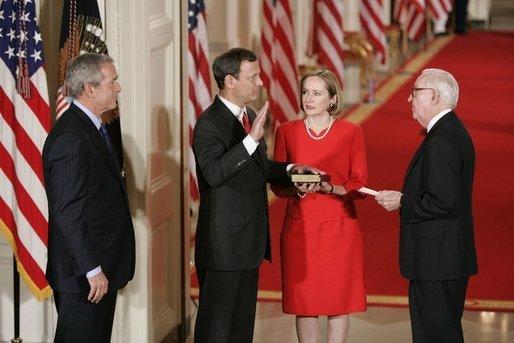 | President George W. Bush watches Thursday, Sept. 29, 2005 in the East Room of the White House in Washington, as Judge John G. Roberts is sworn-in as the 17th Chief Justice of the United States by Associated Supreme Court Justice John Paul Stevens. |
THE PRESIDENT: Good afternoon and welcome to the White House. Laura and I are pleased that all of you could join us in witnessing a very meaningful event in the life of our nation. It's a rare privilege to welcome seven current Justices of the Supreme Court. Thank you all for coming. We also welcome Mrs. Thurgood Marshall and Mrs. Potter Stewart.
It was 19-years-ago, almost to the day, that Chief Justice William Rehnquist took the oath of office in this very room with President Ronald Reagan as a witness. Each gathering of this kind is an historic occasion for our country, and gives eloquent testimony to the wisdom and continuity of the system created by the framers.
In a few moments, John Roberts will take his place in a distinguished line that began in 1789, when President Washington appointed Chief Justice John Jay. This is a proud day for John Roberts' family. We extend a special welcome to his wife Jane, their daughter Josie, and son Jack. (Laughter.) A fellow who is comfortable with the cameras. (Laughter.) Also with us are the Judge's mom and dad, Rosemary and Jack Roberts; two of his sisters, Peggy and Barbara, as well as other members of the Roberts family. We're so pleased you could be with us today.
I appreciate the Vice President being here, Attorney General Al Gonzales. I thank Harriet Miers, Counsel to the President, and members of my administration who worked on the nomination and confirmation. I particularly want to thank former Senator Fred Thompson for his leadership. I thank the members of my Cabinet who are here.
I appreciate the members of the United States Senate who are here -- Majority Leader Bill Frist, Senate President Pro Tem Ted Stevens, and Majority Whip Mitch McConnell. Thank you all for coming. I thank the members of the Judiciary Committee who are here, starting with the Chairman, Arlen Specter, Ranking Member Pat Leahy. Thank you all for coming. I appreciate Senators Grassley, Hatch, Brownback, Kyl, Sessions, Cornyn, and Graham. I also want to thank all the other senators who are here with us. I really want to say something about Senator Dick Lugar from Indiana, who introduced the Chief to the Senate. I appreciate very much all of you taking time out of your day to witness this historic event.
Today we complete a process set forth in Article II of the Constitution, which provides that the President shall nominate, and by and with the advice and consent of the Senate, shall appoint the judges of the Supreme Court. The nomination power is one of the most serious responsibilities of a President. When a President chooses a Supreme Court justice he is placing in human hands the full authority and majesty of the law.
Each member of our highest court holds a position of extraordinary influence and respect, and can hold it for a lifetime. The office of Chief Justice has added responsibilities as leader of the Court, and as presiding officer of the Judicial Conference of the United States. To carry out all these duties, I submitted to the Senate a nominee of integrity, deep humility, and uncommon talent.
During the confirmation hearings this month, members of the Senate and American people saw far more than the intellectual gifts and broad experience of Judge John Roberts. They witnessed, as well, the character of the man; his reverence for the Constitution and laws of our country; his impartiality and devotion to justice; his modesty and great personal decency.
Across the nation, Americans have grown in respect and admiration for this good man. From the day of Judge Roberts' nomination, the Judiciary Committee and senators of both parties have received him with courtesy and fair mindedness. The civility of the confirmation process has served the interests of the nation, and reflected very well on the United States Senate.
And I appreciate the Majority Leader and the Chairman and their colleagues for setting a tone of dignity and goodwill. The Senate has confirmed a man with an astute mind and kind heart. As a member of the federal judiciary, John Roberts has carried out his duties with discernment and humanity and without fear or favor.
As Judge Roberts prepares to lead the judicial branch of government, all Americans can be confident that the 17th Chief Justice of the United States will be prudent in exercising judicial power, firm in defending judicial independence, and above all, a faithful guardian of the Constitution.
With these qualities, the incoming Chief Justice will carry on in the tradition of his mentor and friend, the late William H. Rehnquist. I know that Chief Justice Rehnquist had hoped to welcome his former law clerk as a colleague. Although that was not meant to be, we are thinking of William Rehnquist today. The nation honors his memory, and we remain grateful for his example of integrity and service.
In welcoming an exceptional new leader as Chief Justice, we also honor the Supreme Court itself, and we mark a day of renewal for one of the noblest institutions in our land. Judge Roberts, thank you for agreeing to serve our country and for accepting this new call to duty.
And now I ask Senior Associate Justice of the Court, Justice John Paul Stevens, to please step forward and administer the oath.
(The oath is administered.) (Applause.)
CHIEF JUSTICE ROBERTS: Thank you very much. Let me begin by thanking Justice John Paul Stevens for being here today. In December, Justice Stevens will mark 30 years of service on the Court. It's a great honor to take the oath from him, and it will be a great privilege for me to sit next to him on the bench on Monday.
Thank you, Mr. President, for nominating me. There is no way to repay the confidence you have shown in me, other than to do the best job I possibly can do, and I will try to do that every day. And thank you for the remarkable team that you assembled to assist me throughout this process. I benefited greatly from the wisdom, judgment and plain hard work of Ed Gillespie, Senator Thompson, Harriet Miers, Bill Kelley, and everyone on the team. I am very grateful to each and every one of them.
Chairman Specter, Senator Leahy, all the members of the Judiciary Committee, with this nomination, the Committee faced a very special challenge. And yet, working together, we met that challenge. We found a way to get Jack into the Committee room -- (laughter) -- introduced -- introduced to the Committee and back out again without any serious crisis. (Laughter.)
More seriously, thank you, very much, for the conduct of the hearings, conducting them in a civil and dignified manner as the President requested on the night of the nomination. I appreciate it, very much.
Senator Frist, other members of the Senate, I view the vote this morning as confirmation of what is for me a bedrock principle, that judging is different from politics. And I appreciate the vote, very much.
The process we have just completed epitomizes the separation of powers that is enshrined in our Constitution. My nomination was announced some 10 weeks ago here in the White House, the home of the executive branch. This morning, further up Pennsylvania Avenue, it was approved in the Capitol, the home of the executive [sic] branch. And tomorrow, I will go into the Supreme Court building to join my colleagues, the home of the judicial branch, to undertake my duties. The executive and the legislature have carried out their constitutional responsibilities and ensured the succession of authority and responsibility in the judicial branch.
What Daniel Webster termed, "the miracle of our Constitution" is not something that happens every generation. But every generation in its turn must accept the responsibility of supporting and defending the Constitution, and bearing true faith and allegiance to it. That is the oath that I just took. I will try to ensure, in the discharge of my responsibilities, that with the help of my colleagues, I can pass on to my children's generation a charter of self-government as strong and as vibrant as the one that Chief Justice Rehnquist passed on to us.
Over the past ten weeks, many people who I did not know came up to me and offered encouragement and support. Many of them told me that I and my family was in their prayers and in their hopes. I want to thank all of those people. I will need in the months and years ahead that encouragement and those prayers.
Thank you, Mr. President. Thank you, members of the Senate. And thank you, colleagues, for being here to share this special moment. Thank you. (Applause.)
END 3:06 P.M. EDT For Immediate Release, Office of the Press Secretary, September 29, 2005
more at John Roberts or Supreme Court and SCOTUS or Judge John Roberts and President Bush
0
comments
||
||
The Opelousas Massacre
An item from a Saturday, September 24, 2005 post Freedom Calendar 09/24/05 - 10/01/05 "September 28, 1868, Democrats in Opelousas, Louisiana murder nearly 300 African-Americans who tried to prevent an assault against a Republican newspaper editor. " Drew the following comment from a self described "liberal" friend.
Jonathan Whittle-Utter said..."democrats" murdered 300 African Americans? Who did what now? I don't think there's anything wrong with pointing out how members of a group have done terrible things, not in accord with that group's principles - but I think posting statements like this is destructive, and begs further detail. Slander and Geneneralization are two of the chief reasons we're in this God Awful bi-partisan mess to begin with. If you want to tell a story about some people who killed some African Americans, and make some meaningful observations about how that action is somehow related to the democratic party, actually take the time to do it. This kind of sound-bite doesn't help anyone.
Mon Sep 26, 12:49:19 AM
To these questions of who, what, where, when and why? we will add that which we can.
Very little of the incident beyond "This kind of sound-bite" is generally posted as evidenced by these representative of Google's 135 and Yahoo's 123 quoted sources.
1868, In Louisiana, 200-300 African Americans are killed in the "Opelousas Massacre."
pbs.org
28 1868 The Opelousas Massacre occurred in Louisiana in which an estimated 200 to 300 black Americans were killed louisiana101
- Massacre in Louisiana. The Opelousas Massacre occurred in Louisiana on September 28, in which an estimated 200 to 300 black Americans were killed. washington.edu
September 28, 1868 Opelousas Massacre at St Landry Parish Louisiana (200 African Americans killed) uh.edu
More to the WHAT, WHERE and WHEN, point this from The African American Registry® which is a 501(c) (3) non-profit education organization. Their Mailing address is P.O. Box 19441 Minneapolis, MN 55419 Fax: (612) 825-0598 Email Them at info@aaregistry.com. The African American Registry®Copyright 2005September 28 *On this date in 1868, the Opelousas massacre occurred. That city in Louisiana, was the site of a massacre of local blacks by violent whites (many of them Confederate veterans and prominent citizens).
The slaughter started when three local whites beat up an eighteen year old man named Emerson Bentley, a white editor (and non-Louisianan) of the local Republican newspaper and a teacher with the Freedmen's Bureau. Reacting to Bentley's beating, local blacks came to his rescue. Twelve were arrested by the sheriff, taken from jail and hung that night.
In the next few days bands of armed whites scoured the countryside and killed blacks in what was described as a “Negro hunt” similar to one which had occurred outside of Shreveport, Louisiana, a short time before. It is estimated that two hundred blacks were killed in the fields and swamps surrounding Opelousas Louisiana.
* Reference: Slavery in America
As to a specific "WHO and WHY" we present the Records of the Assistant Commissioner for the State of Louisiana Bureau of Refugees, Freedmen and Abandoned Lands, 1865 - 1869. National Archives Microfilm Publication M1027 Roll 34 "Miscellaneous Reports and Lists Relating to Murders and Outrages Mar. 1867 - Nov. 1868"
Synopsis of Murders Committed in Parish of St. Landry, September and October 1868, Parish of St. LandryUnder date of Sept. 16th information has been received that several freedmen who had located land in parish under the Homestead Act had been driven from their homes and one of them William Johnson had been killed by the Arcadians. The others were compelled to take refuge with their neighbors.
Unsigned Source: freedmensbureau.com ©Copyright 2000 Christine's Genealogy Websites
Regarding the riot which originated at Opelousas on the 28th of Sept. in which various and conflicting accounts of the casualties are reported,
The first reliable account of same states 2 white men and 20 or 30 Negroes were killed, more definite information afterwards received gave the following result, 2 whites killed, 19 blacks killed and wounded as follows, 2 whites and 2 Negroes seriously, and others slightly, that other Negroes are reported and may be killed in isolated places, but no positive evidence of the same----
Other estimates place these casualties at a much larger number and in some instances are reported as high as 2 or 3 hundred, but these highest figures are doubtless greatly exaggerated having their origin in the excited minds of personal imagination. From other parties residents of the parish is stated that 6 Indians had been killed by the people for refusing to join Democratic Clubs that Victor Dauphan, c, was killed in Washington on the night of October 1st, that a man "Republican" was killed in Opelousas on night of Monday October 19th, that a large number of Republicans have been killed in Grand Prairie since September 27th and that men had to be detailed from Washington to bury them.
Still later advices from reliable authority state that a freedman was found murdered 3 miles from Opelousas on the 20 Oct. 20th and reports are current of freedmen killed in various portions of the parish.
This we hope will answer to WHO, WHAT, WHERE, WHEN and WHY as well as any question of "slander".
As to "Geneneralization" and "related" we offer this abbreviated (size and time constraints)list from the first six months of the aforementioned item from a Saturday, September 24, 2005 post Freedom Calendar 09/24/05 - 10/01/05 for context.
January 5, 1903, President Theodore Roosevelt nominates African-American physician William D. Crum as Collector of Customs, over racist objections from Senate Democrats
January 8, 1867, Republicans override Democrat President Andrew Johnson’s veto of law granting voting rights to African-Americans in D.C.
January 10, 1878, U.S. Senator Aaron Sargent (R-CA) introduces Susan B. Anthony amendment for women’s suffrage; Democrat-controlled Senate defeated it 4 times before election of Republican House and Senate guaranteed its approval in 1919
January 15, 1901, Republican Booker T. Washington protests Alabama Democratic Party’s refusal to permit voting by African-Americans
January 17, 1874, Armed Democrats seize Texas state government, ending Republican efforts to racially integrate government
January 18, 1815, Birth of Republican Gov. Richard Yates (R-IL), who prevented Democrat-controlled legislature from withdrawing state troops from the Union Army
January 19, 1818, Birth of anti-slavery activist Alvan Bovay, who organized first meeting of Republican Party in 1854, to oppose Democrats’ pro-slavery policies
January 26, 1922, House passes bill authored by U.S. Rep. Leonidas Dyer (R-MO) making lynching a federal crime; Senate Democrats block it with filibuster
January 31, 1865, 13th Amendment banning slavery passed by U.S. House with unanimous Republican support, intense Democrat opposition
February 2, 1856, After leaving Democratic Party because of its pro-slavery policies, U.S. Rep. Nathaniel Banks (R-MA) becomes first Republican Speaker of the U.S. House of Representatives
February 3, 1870, After passing House with 98% Republican support and 97% Democrat opposition, Republicans’ 15th Amendment is ratified, granting vote to all Americans regardless of race
February 4, 1959, President Eisenhower informs Republican leaders of his plan to introduce 1960 Civil Rights Act, despite staunch opposition from many Democrats.
February 5, 1866, U.S. Rep. Thaddeus Stevens (R-PA) introduces legislation, successfully opposed by Democrat President Andrew Johnson, to implement “40 acres and a mule” relief by distributing land to former slaves
February 8, 1894, Democrat Congress and Democrat President Grover Cleveland join to repeal Republicans’ Enforcement Act, which had enabled African-Americans to vote
February 22, 1856, First national meeting of the Republican Party, in Pittsburgh, to coordinate opposition to Democrats’ pro-slavery policies
March 6, 1857, Republican Supreme Court Justice John McLean issues strenuous dissent from decision by 7 Democrats in infamous Dred Scott case that African-Americans had no rights “which any white man was bound to respect”
March 7, 1965, Police under the command of Democrat Governor George Wallace attack African-Americans demonstrating for voting rights in Selma, AL
March 12, 1956, Ninety-seven Democrats in Congress condemn Supreme Court’s decision in Brown v. Board of Education, and pledge to continue segregation
March 14, 1920, Death of U.S. Senator Henry Blair (R-NH); his bill to aid public schools in the South passed three times in Republican-controlled Senate, but was repeatedly blocked by Democrat Speaker of the House
March 20, 1854, Opponents of Democrats’ pro-slavery policies meet in Ripon, Wisconsin to establish the Republican Party
March 21, 1965, Republican federal judge Frank Johnson authorizes Martin Luther King’s protest march from Selma to Montgomery, overruling Democrat Governor George Wallace
March 27, 1856, First meeting of Republican National Committee in Washington, DC to oppose Democrats’ pro-slavery policies.
April 3, 1944, U.S. Supreme Court strikes down Texas Democratic Party’s “whites only” primary election system
April 8, 1865, 13th Amendment banning slavery passed by U.S. Senate with 100% Republican support, 63% Democrat opposition
April 9, 1866, Republican Congress overrides Democrat President Johnson’s veto; Civil Rights Act of 1866, conferring rights of citizenship on African-Americans, becomes law.
April 16, 1862, President Lincoln signs bill abolishing slavery in District of Columbia; in Congress, 99% of Republicans vote yes, 83% of Democrats vote no
April 20, 1871, Republican Congress enacts the Ku Klux Klan Act, outlawing Democratic Party-affiliated terrorist groups which oppressed African-Americans
May 2, 1963, Republicans condemn Democrat sheriff of Birmingham, AL for arresting over 2,000 African-American schoolchildren marching for their civil rights
May 6, 1960, President Dwight Eisenhower signs Republicans’ Civil Rights Act of 1960, overcoming 125-hour, around-the-clock filibuster by 18 Senate Democrats
May 9, 2001, President George W. Bush nominates Miguel Estrada to be first Hispanic to serve on U.S. Court of Appeals for D.C. Circuit; Democrats in Senate successfully filibuster nomination.
May 10, 1866, U.S. House passes Republicans’ 14th Amendment guaranteeing due process and equal protection of the laws to all citizens; 100% of Democrats vote no
May 12, 1850, Birth of U.S. Senator Henry Cabot Lodge (R-MA), whose 1890 Federal Elections Bill enforcing African-American voting rights passed House on party-line vote but was defeated in Senate by a Democrat filibuster
May 21, 1919, Republican House passes constitutional amendment granting women the vote with 85% of Republicans in favor, but only 54% of Democrats; in Senate, 80% of Republicans would vote yes, but almost half of Democrats no.
May 22, 1856, For denouncing Democrats’ pro-slavery policy, Republican U.S. Senator Charles Sumner (R-MA) is beaten nearly to death on floor of Senate by U.S. Rep. Preston Brooks (D-SC).
May 29, 1902, Virginia Democrats implement new state constitution, condemned by Republicans as illegal, reducing African-American voter registration by 86%.
May 30, 1854, Democrat President Franklin Pierce signs Democrats’ Kansas-Nebraska Act, expanding slavery into U.S. territories; opponents unite to form the Republican Party.
June 1, 1963, Democrat Governor George Wallace announces defiance of court order issued by Republican federal judge Frank Johnson to integrate University of Alabama.
June 8, 1866, U.S. Senate passes Republicans’ 14th Amendment guaranteeing due process and equal protection of the law to all citizens; 94% of Republicans vote yes and 100% of Democrats vote no.
June 10, 1964 Senate Minority Leader Everett Dirksen (R-IL) criticizes Democrat filibuster against 1964 Civil Rights Act, calls on Democrats to stop opposing racial equality.
June 12, 1929, First Lady Lou Hoover invites wife of U.S. Rep. Oscar De Priest (R-IL), an African-American, to tea at the White House, sparking protests by Democrats across the country.
June 22, 1870, Republican Congress creates U.S. Department of Justice, to safeguard the civil rights of African-Americans against Democrats in the South.
June 26, 1857, Abraham Lincoln declares Republican position that slavery is “cruelly wrong,” while Democrats “cultivate and excite hatred” for blacks.
Do we believe that the average rank and file member or the democratic party of today is racist? NO.
Do we believe that some race-baiting democratic leaders of today are? Rep. Charles Rangel, comparison of President Bush to the late Theophilus "Bull" Connor, the Birmingham, Ala., police commissioner who came to symbolize Southern racism in the 1960s. The Reverend Al Sharpton, "Clearly Bush has become that, especially after Katrina,"
Rev. Sharpton said. "We've gone from fire hoses to levees." Senior member of the Congressional Black Caucus and of New York's congressional delegation, Mr. Owens, "Bull Connor didn't even pretend that he cared about African- Americans,"
Mr. Owens said. "You have to give it to George Bush for being even more diabolical." "With his faith-based initiatives," Mr. Owens added, "he made it appear that he cared about black Americans. Katrina has exposed that as a big lie." As a result, Mr. Rangel "is on the right track," Mr. Owens said. "This is worse than Bull Connor," he added.
A Democrat who represents Brooklyn on New York's City Council, Charles Barron, concurred with that sentiment. "I think that's an insult to Connor," he said of Mr. Rangel's statement. "George Bush is worse, because he has more power and he's more destructive to our people than Bull Connor will ever be." For example, Mr. Barron said, "A KKK without power is not as bad as a George Bush with power."
"To be a racist in the richest, most powerful country in the world is lethal," Mr. Barron added. "Look what he's doing to communities of color all over the world," the council member said of Mr. Bush. "He's a lethal racist."
"What he did in New Orleans -- I mean, that's worse than what Bull Connor did in his entire career as a racist in the South," Mr. Barron said. "Look at these neighborhoods before Katrina hit. Bush made that community what it is. Katrina did the rest, in partnership with Bush, to deliver the final blow."
Democratic National Committee Chairman Howard Dean remains mum.
Tell that to Lt. General Russell L. Honoré Charlie, Al, Major and Howard
more at Opelousas Massacre and republicans or democrats and Politics or News and Charles Rangel or african american and civil rights
2
comments
||
||
Wednesday, September 28, 2005
DELAY STATEMENT ON TODAY'S ANNOUNCEMENT
DELAY STATEMENT ON TODAY'S ANNOUNCEMENT
(WASHINGTON)- Rep. Tom DeLay (R-TX) today released the following statement in response to the announcement out of the Travis County, Texas:
"I have notified the Speaker that I will temporarily step aside from my position as majority leader pursuant to rules of the House Republican Conference and the actions of the Travis County District Attorney today."
###
Wednesday, September 28, 2005, Statement By RNC Chairman Ken Mehlman, Contact: Tracey Schmitt, 202-863-8614
WASHINGTON –RNC Chairman Ken Mehlman issued the following statement today:
"Tom DeLay is a tremendous public servant. It is our sincere hope that justice will remain blind to politics. As Tom DeLay clearly stated today, House Republicans will continue to focus on the business of the American people. "
###
House Majority Leader Tom Delay Indicted Texas v. Colyandro, et al.
U.S. House Majority Leader Tom Delay is indicted by a Texas grand jury on criminal conspiracy charges relating to a campaign finance probe.
delayind92805ind1.jpg page 2, delayind92805ind2.jpg page 3, delayind92805ind3.jpg page 4 delayind92805ind4.jpg Indictment courtesy of CNN
more at Tom DeLay and DeLay or Politics and News or Republicans and Congress
0
comments
||
||
President, Generals Abizaid, Casey, Discusses War on Terror (VIDEO)
President Meets with Generals Abizaid and Casey, Discusses War on Terror, FULL STREAMING VIDEO, The Rose Garden 10:26 A.M. EDT
 | President George W. Bush issues a statement, Wednesday, Sept. 28, 2005 in the Rose Garden at the White House in Washington, on the war on terror following his meeting with U.S. Army Generals John Abizaid and George W. Casey. |
I asked the Generals to go up to Capitol Hill to brief members of the House and Senate on our strategy for victory, on our operations in Iraq. They updated me on what recently took place in Baghdad, in which Iraqi and coalition forces tracked down and killed Abu Azzam, the second most wanted al Qaeda leader in Iraq. This guy is a brutal killer. He was one of Zarqawi's top lieutenants. He was reported to be the top operational commander of al Qaeda in Baghdad. He is one of the terrorists responsible for the recent upsurge in attacks in the Iraqi capital, which is part of their campaign to stop a referendum on the Iraqi constitution, and is part of their efforts to break the will of the American people and the will of our coalition.
Our strategy is clear in Iraq. We are hunting down high value targets like Azzam and Zarqawi. We're coordinating aggressive counterterrorism operations in the areas where the terrorists are concentrated. We're constantly adapting our tactics to the changing tactics of the terrorists. We're training more Iraqi forces to assume increasing responsibility for their country's security.
The growing size and increasing capability of the Iraqi security forces are helping our coalition address a challenge we have faced since the beginning of the war. And General Casey discussed this with us in the Oval Office.
See, it used to be after we cleared the terrorists out of a city, there wasn't enough qualified Iraqi troops to maintain control -- so when we left to conduct other missions, the terrorists would move back in. Now, the increasing number of more capable Iraqi troops has allowed us to better hold on to the cities we have taken from the terrorists. The Iraqi troops know their people, they know their language, and they know who the terrorists are. By leaving Iraqi units in the cities we've cleared out, we can keep the cities safe while we move on to hunt down the terrorists in other parts of the country.
We saw such success in the country's northwest region, where Iraqi and coalition forces recently targeted an area that was one of the main routes that foreign terrorists use to enter Iraq from Syria. During the operations in the key town of Tal Afar, Iraqi security forces outnumbered coalition forces for the first time in a major offensive operation. General Casey brought us up to date on that operation. Because of our joint efforts, hundreds of terrorists have been killed or captured or flushed, which makes it more difficult for the foreign terrorists to enter Iraq through the northwest route.
As part of General Casey's strategy, Iraqi forces remain in Tal Afar to ensure that the terrorists are not allowed to return and regroup. Coalition and Iraqi troops are on the hunt for terrorists in western Iraq. We're on the offense. We have a plan to win. We're working to stop those terrorists from crossing into the country through Syria, and we're denying safe haven to al Qaeda in the Anbar province.
Members of Congress will get the latest information about our strategy. And I want to thank them for taking time out of their schedules to listen to these two -- to these two Generals. They will hear about the strategy and the progress in increasing the size and capability of the Iraqi security forces. At this moment, more than a dozen Iraqi battalions have completed training and are conducting anti-terrorist operations in Ramadi and Fallujah. More than 20 battalions are operating in Baghdad. And some have taken the lead in operations in major sectors of the city.
In total, more than 100 battalions are operating throughout Iraq. Our commanders report that the Iraqi forces are operating with increasing effectiveness. As Iraqi forces show they're capable of keeping the terrorists out, they're earning the trust and confidence of the Iraqi people, which ensures the success of a free and democratic Iraq.
The terrorists have a history of escalating their attacks before Iraq's major political milestones. Two key elections are fast approaching. As these milestones approach, we can expect there to be increasing violence from the terrorists. They can't stand elections. The thought of people voting is an anathema to them. You see, democracy and freedom are the exact opposite of what's in their mind, in their vision.
Next month the Iraqis will vote on a democratic constitution. If that constitution is approved, they will return to polls later this year to elect a fully constitutional government. The terrorists will fail. See, the Iraqis want to be free. They proved that last January when over 8 million citizens, in the face of violence and threats, voted. And the terrorists are going to fail this time. But we can expect they'll do everything in their power to try to stop the march of freedom. And our troops are ready for it.
I urge the members of Congress to attend the briefings with Generals Abizaid and Casey. I urge them to ask questions about our efforts in Iraq and to listen carefully about the type of war we fight. The support of Congress for our troops and our mission is important, and Americans need to know about the gains we've made in recent weeks and months. They need to know the way we're adopting our tactics and the way we're changing our strategy to meet the needs on the ground.
As members of Congress speak with Generals Abizaid and Casey, I'm confident they'll see what I see -- our leaders, these two Generals are men of vision and determination, and it is their leadership that is helping bring victory in the war on terror.
Thank you, very much.
END 10:33 A.M. EDT, For Immediate Release, Office of the Press Secretary, September 28, 2005
more at President Bush and General Abizaid or General Casey and War on Terror or Iraq and al Qaeda or Abu Azzam
0
comments
||
||
President to Welcome Polish President Kwasniewski
President to Welcome Polish President Kwasniewski to the White House
President Bush will host Polish President Aleksander Kwasniewski at the White House for a farewell meeting and lunch on October 12, 2005. President Kwasniewski will conclude his second term as President this December. Poland remains among America's closest friends and allies. Under President Kwasniewski's leadership, Poland has emerged as a leading partner in the cause of freedom working with the United States to support reform in Ukraine, promote democracy in Belarus, strengthen transatlantic relations, and bring liberty to the people of Iraq and Afghanistan.
# # # For Immediate Release, Office of the Press Secretary, September 28, 2005
more at President Bush and Polish or Poland and Aleksander Kwasniewski or White House
0
comments
||
||
Tuesday, September 27, 2005
Opening of NATO Training Center in Iraq
Opening of NATO Training Center in Iraq
The United States congratulates Iraq and NATO on the opening of the NATO-run Joint Staff Center - Training Academy at Rustamiyah outside of Baghdad.
The United States and NATO are committed to supporting democracy, human rights and the rule of law in Iraq. Since last year, NATO has helped train hundreds of Iraqi officers who lead Iraq’s security forces. This new center, which will train the next generation of Iraq’s military leaders, demonstrates the important role the Alliance can play in support of this goal.
2005/900, Released on September 27, 2005, Press Statement, Adam Ereli, Deputy Spokesman, Washington, DC, September 27, 2005
more at Department of State or State Department and NATO or Iraq and Rustamiyah or Baghdad
0
comments
||
||
Global Business Coalition on HIV/AIDS 2005 Awards
Secretary of State Condoleezza Rice to Speak at The Global Business Coalition on HIV/AIDS 2005 Awards for Business Excellence Gala
Secretary of State Condoleezza Rice will deliver remarks on Wednesday, September 28, 2005 at the John F. Kennedy Center for the Performing Arts. She will speak at approximately 7:30 p.m. in South Gallery (Roof Terrace level). Senator Hillary Rodham Clinton and UN High Commissioner for Refugees Goodwill Ambassador Angelina Jolie will also deliver remarks.
This event is open for press coverage. Media interested in covering the event should contact Christine Countryman at (202) 326-1741.
2005/899
Released on September 27, 2005,Notice to the Press, Office of the Spokesman, Washington, DC, September 27, 2005
more at Condoleezza Rice and Department of State or State Department and HIV/AIDS or HIV and AIDS or Hillary Clinton and Angelina Jolie
0
comments
||
||
Center of Excellence for Stability Police Units
U.S. Support to the New Center of Excellence for Stability Police Units (COESPU)
The United States and Italy signed an agreement on September 23, 2005 formalizing U.S. support to the newly established international Center of Excellence for Stability Police Units (COESPU), located in Vicenza, Italy.
U.S. support to COESPU is a key element of the President’s Global Peace Operations Initiative (GPOI) and affirms U.S. commitment to the G-8 Action Plan "Expanding Global Capability for Peace Support Operations" endorsed by G-8 partners at Sea Island in June 2004. G-8 partners agreed to support the Italian initiative to establish an international training center to train the Stability Police (i.e. Carabinieri/Gendarmerie-like units) of interested nations, including those in Africa, for peace support operations.
Stability Police can help fill the security gap between military forces and civilian police in peace support operations by relieving some of the burden on military units and by establishing a stable environment in which civilian police can operate effectively. A greater number of similarly trained and equipped Stability Police units are needed to participate in a growing number of international peace support operations and related activities.
COESPU’s first classes will commence on November 7 with students from Cameroon, India, Jordan, Kazakhstan, Kenya, Morocco, and Senegal.
Questions may be directed to Jason Greer, Director, Congressional and Public Affairs, Bureau of Political-Military Affairs, U.S. Department of State, phone: (202) 647-7878.
2005/898 Media Note, Office of the Spokesman, Washington, DC, September 27, 2005
more at G-8 and Italy or Cameroon and India or Jordan and Kazakhstan or Kenya and Morocco or Senegal
0
comments
||
||
Journalist Attack in Lebanon
Journalist Attack in Lebanon
The United States condemns the brutal attack on Lebanese journalist May Chediac, who was wounded in a car bombing on September 25, 2005. Ms. Chediac is a voice for dialogue and free expression. The United States joins her family and friends in wishing her a speedy recovery.
Those who attacked Ms. Chediac want to impede Lebanon’s steady progress towards full independence and sovereignty. The United States stands with the courageous people of Lebanon as they emerge from decades of foreign occupation and chart their own democratic future.
2005/897, Released on September 26, 2005, Press Statement, Sean McCormack, Spokesman
Washington, DC, September 26, 2005
more at Lebanon and Lebanese or May Chediac and State Department or Department of State
0
comments
||
||
Condoleezza Rice’s Travel to Haiti
Secretary of State Condoleezza Rice’s Travel to Haiti
Secretary of State Condoleezza Rice will travel to Haiti on September 27, 2005. She will meet with leaders of Haiti’s interim government, as well as with representatives of the United Nations Stabilization Mission In Haiti (MINUSTAH). Her visit will underscore U.S. support for Haiti’s upcoming elections and its ongoing process of political and economic reform.
2005/896, Released on September 26, 2005 Press Statement, Sean McCormack, Spokesman, Washington, DC, September 26, 2005
more at Condoleezza Rice and Haiti or United Nations and Department of State or State Department
0
comments
||
||
U.S. Response to IRA Statement on Decommissioning
U.S. Response to IRA Statement on Decommissioning
We welcome today's statement by the Independent International Commission on Decommissioning (IICD) that the Provisional Irish Republican Army (IRA) has comprehensively and verifiably disarmed. This announcement marks an historic day for Northern Ireland and is extremely encouraging for all those who support the peace process, the rule of law, and a Northern Ireland free from sectarian violence. It also marks an opportunity for all parties to renew efforts to reach a sustainable political settlement in Northern Ireland.
President Bush commends the efforts of General John de Chastelain and his fellow IICD commissioners, and applauds the efforts of Sinn Fein in bringing the republican community to this moment.
The United States calls on all other paramilitary groups in Northern Ireland, whether loyalist or republican, to engage with the IICD to bring about total decommissioning at the earliest possible date.
The IRA's decommissioning is a critical first step in fulfilling the terms of the IRA's July 28 statement to pursue its goals through exclusively peaceful and democratic means. The IRA's laudable decommissioning must be followed by actions demonstrating the republican movement's unequivocal commitment to the rule of law and to the renunciation of all paramilitary and criminal activities. The United States further calls on Sinn Fein, the IRA, and all republicans to fully support the police service.
The United States remains steadfast in its support for the peace process and the work of the British and Irish Governments to achieve lasting peace and reconciliation for the people of Northern Ireland under the principles of the Good Friday Agreement.
White House Press Release, Office of the Press Secretary, Washington, DC, September 26, 2005
more at IRA or Irish Republican Army and Northern Ireland or Irish and Good Friday Agreement or IICD
0
comments
||
||
Karen Hughes, Remarks with Dr. Ali El Samman, Cairo, Egypt
Remarks with Dr. Ali El Samman, Karen Hughes, Under Secretary of State for Public Diplomacy and Public Affairs, Cairo, Egypt, September 25, 2005, (3:00 p.m. local time)
UNDER SECRETARY HUGHES: I just had a wonderful meeting with His Eminence Sheikh Tantawi and I'm deeply honored to visit Al-Azhar, which has such a proud, 1,000-plus year tradition of scholarship and enlightenment and learning. It is one of the world's most influential centers of scholarship and theology and jurisprudence and Sheikh al Tantawi and I had a wonderful meeting. I thanked him because Al-Azhar, under his leadership, was among the first -- and he said the first -- religious institutions in the world to formally condemn the September 11 attacks and this great institution with its proud, 1,000 year tradition he told me, is built on tolerance, and enlightenment, and education for all, boys and girls, both students and faculty. The Sheikh also made the point that all divine religions are built on a spirit of love and it is important that all of us work together to fight extremism, to fight terrorism and I know this institution has been at the forefront of interfaith dialogue. One of the things that President Bush and Secretary Rice asked me to emphasize on this trip is interfaith dialogue, which is the reason that I chose this meeting as my first meeting on my first trip to the Middle East, was to talk about the courage of this institution. I praised the Sheikh for his courage and he said "Well it's not courage because it is doing the right thing…
DR. ALI EL SAMMAN: Yes, yes it is --
UNDER SECRETARY HUGHES: -- to speak out against terrorism and extremism." I think that's a very important message for all of us. I also told the Sheikh that many people around the world do not understand the important role that faith plays in Americans' lives. We have freedom of religion guaranteed in our constitution and we have many people in America for whom faith is a very important part of their lives. People go to churches, and to mosques, and to synagogues, and people are also free not to practice or have faith at all in our country. The Sheikh told me -- and I was glad to hear -- that on his two visits to the United States previously, he had witnessed the important role that faith does play in the lives of so many Americans. So it was a wonderful visit, I thank you so much for your warm hospitality and look forward to it being the beginning of a very constructive dialogue. Thank you all very much.
QUESTION: What did you learn today that you didn't know this morning?
UNDER SECRETARY HUGHES: Well, I think I was able to have a wonderful meeting with His Eminence to talk with him about the common language of the heart, we said, about the common language of the heart and that people --
DR. ALI EL SAMMAN: common values --
UNDER SECRETARY HUGHES: -- common values, that people of different faiths and different countries, the people of America, the people of Egypt. We talked about generosity, I thanked him for the generosity of the Egyptian people in responding to the hurricane and he told me that the American people had set a great example of generosity throughout our history in responding to crises, whether in the Middle East or in Africa or throughout the world and the tsunami last year. So, we really, I think, talked about the things that we have in common, our need for education and enlightenment, the importance of faith in the lives of our nations, and so it was a wonderful meeting I thought.
DR ALI EL SAMMAN: Exactly.
UNDER SECRETARY HUGHES: I'm so proud and honored that you could have me here.
QUESTION: Did the Sheikh have any complaint about the distorted image of Islam in the States?
DR. ALI EL SAMMAN: No, he hadn't touched this. He was counting the wise people shall finally have the last word to say.
QUESTION: Could you ask the Sheikh to do more to encourage the moderate voices in the Middle East?
UNDER SECRETARY HUGHES: Well, the Sheikh has been a leader in that effort and this institution has been a leader in speaking out against extremism, against terrorism, and saying that that is not in keeping with the tenets of Islam or the tenets of any of the divine religions. He made a point to me to say that all divine religions are based on love, and tolerance, and respect for one another.
DR. ALI EL SAMMAN: Thank you all.
UNDER SECRETARY HUGHES: Thank you all very much.
2005/886
more at Karen Hughes or Dr. Ali El Samman and Sheikh Tantawi or Al-Azhar and Cairo or Egypt and Middle East or State Department and State Department or Department of State
0
comments
||
||


