


bush radio address 10/08/05 full audio, text transcript
President's Radio Address
THE PRESIDENT: Good morning. This week, I nominated an exceptional individual to replace retiring Justice Sandra Day O'Connor on the Supreme Court of the United States. Harriet Miers is a remarkable woman and an accomplished attorney. She has wide experience in the courtroom and at the highest levels of government. And she will be an outstanding addition to our nation's highest court.
Harriet Miers was born and raised in Dallas, Texas, where she attended the public schools. When illness struck her family, Harriet went to work to help pay for her own college education. She stayed close to home in Dallas to attend Southern Methodist University, and received a Bachelor's Degree in mathematics.
She remained at SMU for law school and earned a place on the law review. After graduation, she was hired for a prestigious two-year clerkship for a federal trial judge. From there, she went on to an extraordinary career in private practice and public service and became a pioneer for women lawyers.
She was the first woman to be hired at her law firm, the first woman to become president of that firm, the first woman to lead a large law firm in the state of Texas, the first woman head of the Dallas Bar Association, and the first woman elected as president of the State Bar of Texas.
In her law practice, Ms. Miers handled hundreds of cases in state and federal courts, from massive commercial litigation to criminal cases to civil disputes. She served in local government on the Dallas City Council, and later held office in state government, as well.
As Ms. Miers rose through the legal ranks, she also put in long hours of volunteer legal work on behalf of the poor and underprivileged, and served as a leader for more than a dozen community groups and charities. Beginning in the 1990s, Harriet Miers was regularly rated one of the top 100 lawyers in America, and one of the top 50 women lawyers in the country.
Because of her skill and record of remarkable achievement, in 2001, I asked her to work in my administration. For the past five years, Harriet Miers has served our nation in critical roles, including White House Counsel, one of the most important legal positions in the country. As counsel, Ms. Miers addresses complex matters of constitutional law, serves as the chief legal advisor during regular meetings of the National Security Council, and handles sensitive issues of executive-congressional relations, among many other essential duties. She has led the effort to help nominate outstanding judges for the federal judiciary. She was in charge of the process that resulted in the appointment of Chief Justice John Roberts.
Harriet Miers would come to the Supreme Court with a background in private practice and high-government service, and this puts her in strong company. Indeed, since 1933, 10 of the 34 justices came to the Supreme Court directly from positions in the executive branch, such as the one Ms. Miers now holds. And no Supreme Court nominee in the last 35 years has exceeded Harriet Miers' overall range of experience in courtroom litigation, service in federal, state and local government, leadership in local, state and national bar associations, and pro bono and charitable activities.
Throughout her life, Ms. Miers has excelled at everything she has done. She's been a leader and a trailblazer for women lawyers, and her work has earned the respect of attorneys across the nation. I chose Harriet Miers for the Court both because of her accomplishments, and because I know her character and her judicial philosophy. Harriet Miers will be the type of judge I said I would nominate: a good conservative judge.
She shares my belief that judges should strictly interpret the Constitution and laws, not legislate from the bench. She understands that the role of a judge is to interpret the text of the Constitution and statutes as written, not as he or she might wish they were written. And she knows that judges should have a restrained and modest role in our constitutional democracy. Like Justice William Rehnquist and Justice Byron White, who were also nominated to the Supreme Court directly from legal positions in the executive branch, Harriet Miers will be prudent in exercising judicial power and firm in defending judicial independence.
When she goes before the Senate, I am confident that all Americans will see what I see every day: Harriet Miers is a woman of intelligence, strength, and conviction. And when she is confirmed by the Senate, I am confident that she will leave a lasting mark on the Supreme Court and will be a justice who makes all Americans proud.
Thank you for listening.
END For Immediate Release, October 8, 2005
more at President Bush and Supreme Court or SCOTUS and harriet miers or SMU and Dallas or Texas
Saturday, October 08, 2005
bush radio address 10/08/05 full audio, text transcript
0
comments
||
||

Friday, October 07, 2005
President Celebrates Hispanic Heritage Month (VIDEO)
President Celebrates Hispanic Heritage Month, FULL STREAMING VIDEO, The East Room, 2:46 A.M. EDT
THE PRESIDENT: Gracias, y bienvenidos a la Casa Blanca. Thank you for coming. It is such an honor to have you here to help celebrate Hispanic Heritage Month. It's a month in which we can recognize the contributions that Hispanic Americans make to our great land.
The Hispanic community is known for its strong commitment to the familia y fe, and a great love of our country. Here's what I think: I think Hispanic Americans -- I don't think, I know Hispanic Americans have helped build our country and shape our culture, and the United States is better off because of the Hispanic influence. (Applause.)
I appreciate so very much that members of my administration have come. I told them they could take a little time off from work. (Laughter.) Carlos Gutierrez, the Secretary of Commerce, and his wife, Edi, thank you for coming. (Applause.) El Juez, the Attorney General of the United States, Al Gonzales, and his wife, Becky. (Applause.) Hector Barreto, head of the SBA. Newly confirmed as the Assistant Secretary of Commerce, Israel Hernandez. Congratulations. (Applause.)
We've got members of the Congress who are here -- Wayne Allard, thank you for coming. Ileana Ros-Lehtinen, Marilyn Musgrave, Henry Cuellar, Luis Fortuno, thank you all for being here. It's such an honor you're here. Hans Hertell, an Ambassador to the Dominican Republic, members of the diplomatic corps, thank you for all for coming. It's nice of you to join us today. Los Embajadores.
It is good to see my friend, Emilio Estefan. Thank you for coming, Emilio. Hector Gomez, Major League Soccer player from the L.A. Galaxy is with us. Christian Gomez, Major League Soccer player from D.C. United. Strong right-hander from the Washington Nats, Esteban Loaiza. Gracias, thank you all for coming. We're proud you're here. I appreciate members of the Latino organizations who are here today. Thank you for working on behalf of Latino citizens around the country.
As we celebrate Hispanic Heritage Month, we honor the promise of freedom and opportunity that brought either you or your ancestors to America. That's what we're honoring. We're honoring the fact that this is a free society, and we recognize our responsibility to ensure that everyone in this country has a chance to realize their God-given talents and to realize their dreams. That's what America is all about. America must always be a land of dreamers, and people will have a chance to realize those dreams.
The 21st century opportunity begins with a quality education. You can't be a land of dreams if you don't educate your kids. One of my biggest concerns was that sometimes in our public schools, if your parents didn't speak English, for example, you just got shuffled through. And that was unacceptable to me, and unacceptable to many members of the United States Congress.
I came together for the -- with the Congress to challenge what I've called the soft bigotry of low expectations, to encourage school systems all around America to raise standards and raise the bar and measure to make sure that every child is learning to read and write and add and subtract. And if not, if they find they're not learning to read and write and add and subtract, do something about it early before it's too late.
And so the No Child Left Behind Act became the law. And that law is beginning to make an enormous difference in the lives of Latino youngsters. And I can tell you how I know: it's because we measure. We know. People are learning to read and write and add and subtract, and that's going to make America a better place for generations to come.
Secondly, we've got to make sure that this is a country where work is respected and work is rewarded; where people who want to work hard to own their own business are able to do so. I believe it's important to keep taxes low in order to make sure entrepreneurs are able to get their business started and keep their businesses running.
I know it's important to have legal reform and regulatory reform to make sure the environment is such that entrepreneurs of all walks of life have a chance to flourish. I am proud to report to you that Latino-owned businesses are on the rise in the United States of America. And America is better for it when people are able to create jobs and own their own business.
I mentioned Hector Barreto being here. The Small Business Administration has more than doubled the number of loans to Hispanic-owned businesses since 2001. Our goal is to get people a chance to realize their dream of owning their own business. And one of the reasons why we're creating jobs in America, that Carlos talked about, is because the small business sector is strong. Any strong economy must have a strong business sector. And the strong -- the business sector is going to be even stronger because of Latino-owned businesses. (Applause.)
I set a goal of 5.5 million new minority homeowners by the end of this decade. I'm proud to report the number of minority homeowners has increased by 2.2 million since I set the goal. See, I love the fact that more and more people from all walks of life are opening up the door of their home and saying, welcome to my home. Welcome to my piece of property. Welcome to a place where I can raise my family. There's nothing better than home ownership in America, and this administration is dedicated to make sure more and more people from all walks of life are able to open up the door where they live and say, come on in to my house.
As we celebrate Hispanic Heritage Month, we're also going to honor the strong tradition of service in the Hispanic community. Hispanic Americans have fought in every war since our founding. Forty-two Hispanic Americans have earned our nation's highest military decoration: the Medal of Honor.
At this hour, men and women of Hispanic heritage of bringing freedom to people of other lands. They are laying the foundation of peace for generations to come. They are making sacrifices to bring justice to the terrorists, and at the same time, giving people a chance to live in a free society.
More than 127,000 Hispanic Americans wear the uniform of the United States of America. I'm proud to be their Commander-in-Chief, and I want to welcome those who wear the uniform to this event today. Thank you all for coming. (Applause.)
The strength of this country is the fact that every day, thousands of citizens, millions of citizens, volunteer to make somebody's life better. And that includes thousands and millions of Hispanic Americans who are volunteering in their community, people who use their time and their talent to make a difference in the lives of others, people who have heard the universal call to love a neighbor just like you'd like to be loved yourself.
In the wake of Hurricanes Katrina and Rita, Hispanic groups around this country provided critical services and much-needed love to people whose lives were affected by those storms. In Texas, the League of United Latin American Citizens -- we call them LULAC -- served food at shelters and teamed up with the Hispanic Chamber of Commerce to help people find housing, as well. In Arizona, Latino groups sent truckloads of water and food and medical supplies to Mississippi. The National Council of La Raza established a relief fund to provide emergency financial aid and housing assistance to hurricane victims. Acts of generosity from Hispanic Americans gave many people a lot of hope, and our nation honors the compassion of Latinos today in this celebration.
The President's Volunteer Service Award that I'm about to give to six citizens is the highest level of commendation a President can give in recognition of those who have contributed their time and energy to helping others.
Today, I'm going to talk about -- you'll hear the stories of six folks who have served as such a wonderful example. I mean, not only have these people helped somebody, but they served as an example for others. They're true leaders in their own quiet way and their own humble way: Junior Salazar of Bradenton, Florida, Marie Arcos of Houston, Texas, Manuel Fonseca of Nashville, Tennessee, Elmer Carreno of Silver Spring, Maryland, Maria Hines of Albuquerque, New Mexico, and John Diaz of Crowley, Colorado.
Their efforts are helping children to learn to read, improving fire safety in schools and communities, and helping more Hispanics achieve the dream of a college education. In the wake of the hurricanes, they've helped set up emergency clinics, provided spiritual counseling to the displaced, just simple acts, such as reading stories to children whose families had lost their homes. Today, we're here to honor your service, and we appreciate so very much what you have done to help lift the spirit of the country.
As we celebrate Hispanic Heritage Month, we thank the Hispanic community that has helped build and shape our country in so many ways. America is a better place because of your contributions. I join all Americans in celebrating the accomplishments and wishing our Hispanic communities all across the country continued success.
I want to thank you all for coming. And now, I'm going to ask the Military Aide to please announce the Volunteer Service Awards. Y por fin, que Dios les bendiga. (Applause.)
(The awards are presented.)
THE PRESIDENT: I hope you can tell why I was so looking forward to this event. There's nothing like being able to thank six quiet heroes, helping to improve somebody's life, and at the same time, improving the spirit of the country. What a joyous occasion. Thank you all for coming. May God bless you all. (Applause.)
END 3:04 P.M. EDT For Immediate Release, Office of the Press Secretary, October 7, 2005
more at President Bush or Hispanic Heritage Month and Hispanic Heritage or Hispanic and Hispanic Americans
0
comments
||
||
President Meets with Prime Minister Gyurcsány of Hungary (VIDEO)
President Meets with Prime Minister Gyurcsány of Hungary, FULL STREAMING VIDEO, The Oval Office, 10:50 A.M. EDT
 | 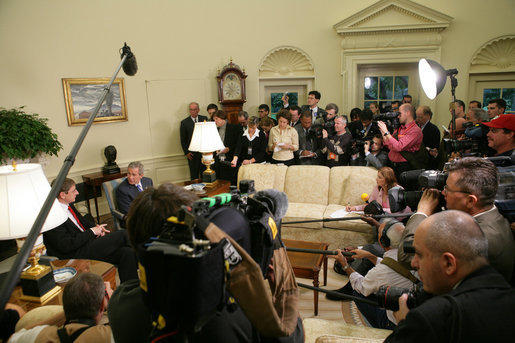 |
Mr. Prime Minister, welcome. I thank you for coming. We have just had a very lengthy discussion -- and it should be a lengthy discussion, after all, we're friends and allies. I appreciate very much your understanding of the importance of democracy and freedom. I want to thank you for your leadership.
I am pleased with the economic progress that you've made. I say "pleased" because there is a lot of U.S. investment in Hungary. People have chosen to invest in Hungary because it's a place that honors rule of law, it's got reasonable taxation and reasonable regulation. I'm not surprised that the country has got a good economic environment. After all, the Prime Minister is somebody who understands economics and business. And so congratulations on setting an environment that people -- in which people feel comfortable about investing.
We talked about the world. And, again, I want to thank Hungary for its contributions in Afghanistan and Iraq.
The Prime Minister also brought up some issues of concern to the people of Hungary, one of which, of course, is visa policy. He understands that his job, when talking to the President, is to -- is to say, the people of my country -- which he did -- are concerned about the visa policy. And I told him that we recognize that we need to move forward and work with our friend. We have set up a road map, a way forward, to make sure our visa policy works for the people of Hungary.
Mr. Prime Minister, thank you for bringing up the issue. I assured him that I will continue to work with Secretary Rice to put a plan in place, to cooperate with Hungary and to have a plan in place that is a fair and reasonable plan for the people of Hungary.
All in all, I found it to be a great visit. The visit, by the way, started yesterday when his good wife and my wife visit -- had a -- had a strong visit. She laid the groundwork for this diplomacy that's being conducted today, and she did a great job. So welcome to you and your wife, here to America.
PRIME MINISTER GYURCS NY: Mr. President, ladies and gentlemen, let me use my mother tongue, mainly because I would like all the Hungarian people understand what I'm saying here in the Oval Office. Please understand, just -- Hungarian sometimes is very hard.
(As translated.) So we came to the United States to strengthen our friendship and our ally. We came to emphasize once again that we understand that we have joined matters, joined affairs in this world to do. And maybe the two countries have different possibilities, but we have equal responsibility to sustain stability and peace in the world and to represent the case of democracy.
Now in these matters, the United States and Hungary are not just allies but are also good, understanding friends. We did reinforce our former agreement about our presence in Iraq and Afghanistan, we did not introduce any new elements to that field.
I think we also would like to see that besides security elements the cooperation, the partnership between the United States and Hungary are more and more about business and good relations. And, also, American investors, the largest American businesses, have played a key role in making sure that Hungary has reached a record high in terms of (inaudible) capital influx over the past year.
Many similarities and some differences between our two countries, but there is one thing where we are completely identical in our ideas. Both President Bush and myself want to make sure that our people in the -- in the United States and in Hungary live in security, that they have peaceful lives, prosperity, democracy. And these are the key issues, really.
Many thanks, Mr. President.
THE PRESIDENT: Thank you. Thanks for coming. A couple of questions.
Jennifer.
Q Thank you, sir. The criticism from some conservatives of Harriet Miers is continuing and getting rather sharp, as you know. Are you willing to rule out ever letting her nomination be withdrawn?
PRESIDENT BUSH: Harriet Miers is an extraordinary nominee. She is a very bright woman. She is a pioneer in the law in Texas. In other words, she was the first woman hire of her firm, first partner of the firm, she's the first head of the Texas Bar Association. I mean, she has got a record of accomplishment that is extraordinary, in my judgment. She is a woman of deep character and strength. She is -- she didn't come from the bench, but so did -- you know, a lot of other people didn't come from the bench when they were named for the Supreme Court. I would ask people to look at Byron White, for example, or Judge Rehnquist, himself.
And I'm confident she's going to be a Supreme Court Judge who will not legislate from the bench, and will strictly interpret the Constitution. I am incredibly proud of my friend being willing to take on this task. She's going to be a great judge.
Q So are you ruling it out, any withdrawal?
PRESIDENT BUSH: No, she is going to be on the bench, she'll be confirmed -- and when she's on the bench people will see a fantastic woman who is honest, open, humble and capable of being a great Supreme Court Judge.
Q Have you set a deadline for the visa issue to be solved?
PRIME MINISTER GYURCS NY: (As translated.) We agreed on a road map which makes sure that Hungarian people can really perceive that it's easier and more equitable to have access to American visas. I could feel that Mr. President has a very clear understanding about why this is important for Hungarians. And I was completely sure that we will achieve the fastest possible progress which is allowed by legislative background and laws here in the United States.
PRESIDENT BUSH: Good answer. Steve.
Q How significant was the threat against New York yesterday, and did New York overreact?
PRESIDENT BUSH: I'm getting a little older, Steve, I can't hear you. (Laughter.)
Q Sorry. Did New York City overreact to the threat yesterday? And how significant was that threat, and are there any suspects?
PRESIDENT BUSH: Well, our job is to gather intelligence and pass them on to local authorities. And they make the judgments necessary to respond. The level of cooperation between the federal government and the local government is getting better and better. And part of that level of cooperation is the ability to pass information on. And we did, and they responded.
Q So you don't think they overreacted?
PRESIDENT BUSH: I think they took the information that we gave and made the judgments they thought were necessary. And the American people have got to know that, one, that we're collecting information and sharing it with local authorities on a timely basis, and that's important.
Q I would like to raise the question to President Bush, as well, if, as far as you know, you've got an invitation from the Hungarian government for next year for the 50th anniversary of the 1956 revolution? So would you accept this invitation?
PRIME MINISTER GYURCS NY: (As translated.) We certainly spoke about the invitation; 1956 is a huge achievement for the Hungarian nation. And the impact of that goes far beyond the borders of Hungary. We certainly want to make sure that our friends, friends of democracy are there next year in Hungary. Therefore, I extended an invitation to the President for next year to Hungary, and I'm completely certain that he will come. (Laughter.)
PRESIDENT BUSH: Well, he did extend the invitation, and I appreciate the invitation, because 1956 means a lot to a lot of Americans. A lot of Americans came from Hungary to live here after the '56 incidents. They can trace their history to our country because of those -- of what took place in Hungary. Plus, a lot of Americans followed the incidents in 1956, and appreciated and respected the courage of folks who were willing to stand up for freedom and liberty.
See, 1956 says to us, there are key moments in history when ordinary citizens are willing to defend the right for all to be free. And so it's an important event. I told the Prime Minister, I'm not my own scheduler. I will pass the word on how important this event is, and I will look very carefully at the invitation.
Listen, thank you all. Mr. Prime Minister, thanks for coming, appreciate it.
END 11:01 A.M. EDT For Immediate Release, Office of the Press Secretary, October 7, 2005
more at President Bush and Prime Minister Gyurcsány or Hungary and Afghanistan or Iraq and Hungarian or Harriet Miers and Supreme Court or New York City
0
comments
||
||
National School Lunch Week
National School Lunch Week, 2005 by the President of the United States of America a Proclamation
Since 1946, the National School Lunch Program has contributed to the welfare of our Nation's youth and the academic mission of our schools. Each year during National School Lunch Week, we recognize this valuable program and highlight the continuing importance of providing America's children with access to nutritious meals.
Today, nearly 100,000 public and private schools and residential child care institutions are implementing the National School Lunch Program, providing fresh fruits and vegetables, milk, and other nutritious food choices to an average of 29 million children each school day. The School Breakfast Program and the availability of after-school snacks as part of the School Lunch Program give children additional opportunities to receive a more wholesome diet.
Through the National School Lunch Program, school officials and food service professionals continue to demonstrate their dedication to our Nation's youth. To support these efforts, the U.S. Department of Agriculture's Team Nutrition provides important nutrition education programs for children and technical training programs for food service professionals to assist them in preparing healthy school lunches. The National School Lunch Program also supports the HealthierUS School Challenge, an initiative that recognizes schools and local communities for actively promoting healthy lifestyles. By encouraging healthy eating habits and access to nutritious food, we are helping America's young people succeed in school, and we are helping protect them against childhood obesity, diabetes, and the risk of other serious health problems later in life.
In recognition of the contributions of the National School Lunch Program to the health, education, and well-being of America's children, the Congress, by joint resolution of October 9, 1962 (Public Law 87-780), as amended, has designated the week beginning on the second Sunday in October of each year as "National School Lunch Week," and has requested the President to issue a proclamation in observance of this week.
NOW, THEREFORE, I, GEORGE W. BUSH, President of the United States of America, do hereby proclaim October 9 through October 15, 2005, as National School Lunch Week. I call upon all Americans to join the dedicated individuals who administer the National School Lunch Program in appropriate activities that support the health and well-being of our Nation's children.
IN WITNESS WHEREOF, I have hereunto set my hand this seventh day of October, in the year of our Lord two thousand five, and of the Independence of the United States of America the two hundred and thirtieth.
GEORGE W. BUSH
# # # For Immediate Release, Office of the Press Secretary, October 7, 2005
more at President Bush and National School Lunch Program or National School Lunch Week and School Breakfast Program or HealthierUS School Challenge and nutrition
0
comments
||
||
President Honors Buckley at 50th Anniversary of National Review (VIDEO)
President Honors Buckley at 50th Anniversary of National Review,FULL STREAMING VIDEO, Eisenhower Executive Office Building, Room 450, 11:40 A.M. EDT
 |  |
I also do want to throw a little bouquet to him, and let him know that all I've learned about the English language -- (laughter) -- at any rate, it's good to welcome the Buckley family. Thank you all for coming. It's such an honor to have you all here. You've got a great family, and you're a family of public service and a family that has stood strong for what you believe, without wavering. I appreciate Dr. Kissinger, and Dusty Rhodes and Ed Capano, as well. It's good to see you all.
The interesting thing about Bill Buckley's career is he's a -- obviously, not idle. He likes to do a lot of different things. He was an author, an editor, a spy, a novelist, a sailor and a conductor. The most important thing he did was to contribute to the realm of ideas for America. He was an entrepreneur. He kind of gathered up some dreamers and decided to do something. A lot of times dreamers don't do anything, they just sit there and dream. He decided to do something, and he formed a magazine that helped move conservatism from the margins of American society into the Oval Office. That's a significant contribution.
The amazing thing is, is that sometimes it's hard to be a leader because you hear all kinds of voices. He's certainly heard different voices when he formed the National Review. He had an eclectic group of people. That's a Yale word. (Laughter.) He had voices that included ex-communists who knew better than most the threat posed to America by the Soviet Union. He had voices such as free marketers who knew that markets could deliver better results than bureaucracies. He had voices from the traditionalists who understood that a government by -- of and by and for the people could not stand unless it stood on moral ground. They all different -- represented a different strand of conservative thought. Yet, when they came together under the conductor's baton, they made beautiful music. Congratulations for being a leader. (Applause.)
I'm sure it's hard for some of the youngsters -- unfortunately, that doesn't include me anymore -- (laughter) -- to imagine the day when the only conservative game in Washington, D.C. was Bill Buckley and the National Review. And today, we've got, of course, an abundance of conservative columnists and radio hosts and television shows and think tanks and all kinds of organizations. I guess in an intellectual sense, you could say these are all Bill's children. And like children, they grow up and go their own way. But I'm confident that the faithful advocates of the free enterprise system, like those at the National Review, regard the competition they have created as a good thing. I certainly hope so.
It's hard to believe that in 1955, the Soviet Union was in full power, that Ronald Reagan was a Democrat -- and the truth of the matter is, Bill, I was more interested in Willie Mays than I was in you. (Laughter.) But a lot has changed in a brief period of time, when you think about it. Many of the more important changes of the 20th century happened because the National Review stood strong, and that's a fact -- that's a fact of history.
I'm glad to know that the people of National Review aren't resting on their laurels. A sign of a good leader is somebody who can lay the foundation so that people are able to carry on. I think that's going to be a legacy of Bill Buckley. He just didn't show up and create something that cratered, he created something that stood the test of time and grew.
The people of the National Review are determined to leave their mark on this new century, and we appreciate it. You got a lot of readers here in the West Wing. My admonition is to keep thinking, to keep writing, and keep working.
I found another Buckley quote interesting -- when he wrote, with characteristic modesty, that did National Review not exist, no one would have invented it. (Laughter.) I think it's more accurate to say that only Bill Buckley could have invented National Review. And that's a tremendous influence on American life that can be explained only by its unwavering trust and appeal of human freedom -- this great understanding of the power of freedom to change societies and to lift up people's lives.
It is an honor to be here to thank you for your service. I want to thank you for leaving us a magazine and a group of thinkers that will help make the advance of liberty over the last 50 years look like a dress rehearsal for the next 50 years.
May God bless the Buckley family. Thank you for coming. (Applause.)
END 11:47 A.M. EDT, For Immediate Release, Office of the Press Secretary, October 6, 2005
more at President Bush or William F. Buckley and National Review
0
comments
||
||
Thursday, October 06, 2005
President Discusses War on Terror (VIDEO)
President Discusses War on Terror at National Endowment for Democracy, FULL STREAMING VIDEO, Ronald Reagan Building and International Trade Center, Washington, D.C. 10:07 A.M. EDT
 |  | 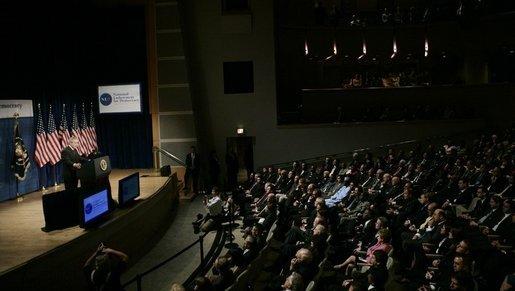 |  |
THE PRESIDENT: Thank you all. (Applause.) Thank you all. Please be seated. (Applause.) Thank you for the warm welcome. I'm honored once again to be with the supporters of the National Endowment for Democracy. Since the day President Ronald Reagan set out the vision for this Endowment, the world has seen the swiftest advance of democratic institutions in history. And Americans are proud to have played our role in this great story.
Our nation stood guard on tense borders; we spoke for the rights of dissidents and the hopes of exile; we aided the rise of new democracies on the ruins of tyranny. And all the cost and sacrifice of that struggle has been worth it, because, from Latin America to Europe to Asia, we've gained the peace that freedom brings.
In this new century, freedom is once again assaulted by enemies determined to roll back generations of democratic progress. Once again, we're responding to a global campaign of fear with a global campaign of freedom. And once again, we will see freedom's victory. (Applause.)
Vin, I want to thank you for inviting me back. And thank you for the short introduction. (Laughter.) I appreciate Carl Gershman. I want to welcome former Congressman Dick Gephardt, who is a board member of the National Endowment for Democracy. It's good to see you, Dick. And I appreciate Chris Cox, who is the Chairman of the U.S. Securities and Exchange Commission, and a board member for the National Endowment of Democracy, for being here, as well. I want to thank all the other board members.
I appreciate the Secretary of State, Condi Rice, who has joined us -- alongside her, Secretary of Defense Don Rumsfeld. Thank you all for being here. I'm proud, as well, that the newly sworn-in Chairman of the Joint Chiefs, the first Marine ever to hold that position, is with us today -- General Peter Pace. (Applause.) I thank the members of the Diplomatic Corps who are here, as well.
Recently our country observed the fourth anniversary of a great evil, and looked back on a great turning point in our history. We still remember a proud city covered in smoke and ashes, a fire across the Potomac, and passengers who spent their final moments on Earth fighting the enemy. We still remember the men who rejoiced in every death, and Americans in uniform rising to duty. And we remember the calling that came to us on that day, and continues to this hour: We will confront this mortal danger to all humanity. We will not tire, or rest, until the war on terror is won. (Applause.)
The images and experience of September the 11th are unique for Americans. Yet the evil of that morning has reappeared on other days, in other places -- in Mombasa, and Casablanca, and Riyadh, and Jakarta, and Istanbul, and Madrid, and Beslan, and Taba, and Netanya, and Baghdad, and elsewhere. In the past few months, we've seen a new terror offensive with attacks on London, and Sharm el-Sheikh, and a deadly bombing in Bali once again. All these separate images of destruction and suffering that we see on the news can seem like random and isolated acts of madness; innocent men and women and children have died simply because they boarded the wrong train, or worked in the wrong building, or checked into the wrong hotel. Yet while the killers choose their victims indiscriminately, their attacks serve a clear and focused ideology, a set of beliefs and goals that are evil, but not insane.
Some call this evil Islamic radicalism; others, militant Jihadism; still others, Islamo-fascism. Whatever it's called, this ideology is very different from the religion of Islam. This form of radicalism exploits Islam to serve a violent, political vision: the establishment, by terrorism and subversion and insurgency, of a totalitarian empire that denies all political and religious freedom. These extremists distort the idea of jihad into a call for terrorist murder against Christians and Jews and Hindus -- and also against Muslims from other traditions, who they regard as heretics.
Many militants are part of global, borderless terrorist organizations like al Qaeda, which spreads propaganda, and provides financing and technical assistance to local extremists, and conducts dramatic and brutal operations like September the 11th. Other militants are found in regional groups, often associated with al Qaeda -- paramilitary insurgencies and separatist movements in places like Somalia, and the Philippines, and Pakistan, and Chechnya, and Kashmir, and Algeria. Still others spring up in local cells, inspired by Islamic radicalism, but not centrally directed. Islamic radicalism is more like a loose network with many branches than an army under a single command. Yet these operatives, fighting on scattered battlefields, share a similar ideology and vision for our world.
We know the vision of the radicals because they've openly stated it -- in videos, and audiotapes, and letters, and declarations, and websites. First, these extremists want to end American and Western influence in the broader Middle East, because we stand for democracy and peace, and stand in the way of their ambitions. Al Qaeda's leader, Osama bin Laden, has called on Muslims to dedicate, quote, their "resources, sons and money to driving the infidels out of their lands." Their tactic to meet this goal has been consistent for a quarter-century: They hit us, and expect us to run. They want us to repeat the sad history of Beirut in 1983, and Mogadishu in 1993 -- only this time on a larger scale, with greater consequences.
Second, the militant network wants to use the vacuum created by an American retreat to gain control of a country, a base from which to launch attacks and conduct their war against non-radical Muslim governments. Over the past few decades, radicals have specifically targeted Egypt, and Saudi Arabia, and Pakistan, and Jordan for potential takeover. They achieved their goal, for a time, in Afghanistan. Now they've set their sights on Iraq. Bin Laden has stated: "The whole world is watching this war and the two adversaries. It's either victory and glory, or misery and humiliation." The terrorists regard Iraq as the central front in their war against humanity. And we must recognize Iraq as the central front in our war on terror.
Third, the militants believe that controlling one country will rally the Muslim masses, enabling them to overthrow all moderate governments in the region, and establish a radical Islamic empire that spans from Spain to Indonesia. With greater economic and military and political power, the terrorists would be able to advance their stated agenda: to develop weapons of mass destruction, to destroy Israel, to intimidate Europe, to assault the American people, and to blackmail our government into isolation.
Some might be tempted to dismiss these goals as fanatical or extreme. Well, they are fanatical and extreme -- and they should not be dismissed. Our enemy is utterly committed. As Zarqawi has vowed, "We will either achieve victory over the human race or we will pass to the eternal life." And the civilized world knows very well that other fanatics in history, from Hitler to Stalin to Pol Pot, consumed whole nations in war and genocide before leaving the stage of history. Evil men, obsessed with ambition and unburdened by conscience, must be taken very seriously -- and we must stop them before their crimes can multiply.
Defeating the militant network is difficult, because it thrives, like a parasite, on the suffering and frustration of others. The radicals exploit local conflicts to build a culture of victimization, in which someone else is always to blame and violence is always the solution. They exploit resentful and disillusioned young men and women, recruiting them through radical mosques as the pawns of terror. And they exploit modern technology to multiply their destructive power. Instead of attending faraway training camps, recruits can now access online training libraries to learn how to build a roadside bomb, or fire a rocket-propelled grenade -- and this further spreads the threat of violence, even within peaceful democratic societies.
The influence of Islamic radicalism is also magnified by helpers and enablers. They have been sheltered by authoritarian regimes, allies of convenience like Syria and Iran, that share the goal of hurting America and moderate Muslim governments, and use terrorist propaganda to blame their own failures on the West and America, and on the Jews. These radicals depend on front operations, such as corrupted charities, which direct money to terrorist activity. They're strengthened by those who aggressively fund the spread of radical, intolerant versions of Islam in unstable parts of the world. The militants are aided, as well, by elements of the Arab news media that incite hatred and anti-Semitism, that feed conspiracy theories and speak of a so-called American "war on Islam" -- with seldom a word about American action to protect Muslims in Afghanistan, and Bosnia, Somalia, Kosovo, Kuwait, and Iraq.
Some have also argued that extremism has been strengthened by the actions of our coalition in Iraq, claiming that our presence in that country has somehow caused or triggered the rage of radicals. I would remind them that we were not in Iraq on September the 11th, 2001 -- and al Qaeda attacked us anyway. The hatred of the radicals existed before Iraq was an issue, and it will exist after Iraq is no longer an excuse. The government of Russia did not support Operation Iraqi Freedom, and yet the militants killed more than 180 Russian schoolchildren in Beslan.
Over the years these extremists have used a litany of excuses for violence -- the Israeli presence on the West Bank, or the U.S. military presence in Saudi Arabia, or the defeat of the Taliban, or the Crusades of a thousand years ago. In fact, we're not facing a set of grievances that can be soothed and addressed. We're facing a radical ideology with inalterable objectives: to enslave whole nations and intimidate the world. No act of ours invited the rage of the killers -- and no concession, bribe, or act of appeasement would change or limit their plans for murder.
On the contrary: They target nations whose behavior they believe they can change through violence. Against such an enemy, there is only one effective response: We will never back down, never give in, and never accept anything less than complete victory. (Applause.)
The murderous ideology of the Islamic radicals is the great challenge of our new century. Yet, in many ways, this fight resembles the struggle against communism in the last century. Like the ideology of communism, Islamic radicalism is elitist, led by a self-appointed vanguard that presumes to speak for the Muslim masses. Bin Laden says his own role is to tell Muslims, quote, "what is good for them and what is not." And what this man who grew up in wealth and privilege considers good for poor Muslims is that they become killers and suicide bombers. He assures them that his -- that this is the road to paradise -- though he never offers to go along for the ride.
Like the ideology of communism, our new enemy teaches that innocent individuals can be sacrificed to serve a political vision. And this explains their cold-blooded contempt for human life. We've seen it in the murders of Daniel Pearl, Nicholas Berg, and Margaret Hassan, and many others. In a courtroom in the Netherlands, the killer of Theo Van Gogh turned to the victim's grieving mother and said, "I do not feel your pain -- because I believe you are an infidel." And in spite of this veneer of religious rhetoric, most of the victims claimed by the militants are fellow Muslims.
When 25 Iraqi children are killed in a bombing, or Iraqi teachers are executed at their school, or hospital workers are killed caring for the wounded, this is murder, pure and simple -- the total rejection of justice and honor and morality and religion. These militants are not just the enemies of America, or the enemies of Iraq, they are the enemies of Islam and the enemies of humanity. (Applause.) We have seen this kind of shameless cruelty before, in the heartless zealotry that led to the gulags, and the Cultural Revolution, and the killing fields.
Like the ideology of communism, our new enemy pursues totalitarian aims. Its leaders pretend to be an aggrieved party, representing the powerless against imperial enemies. In truth they have endless ambitions of imperial domination, and they wish to make everyone powerless except themselves. Under their rule, they have banned books, and desecrated historical monuments, and brutalized women. They seek to end dissent in every form, and to control every aspect of life, and to rule the soul, itself. While promising a future of justice and holiness, the terrorists are preparing for a future of oppression and misery.
Like the ideology of communism, our new enemy is dismissive of free peoples, claiming that men and women who live in liberty are weak and decadent. Zarqawi has said that Americans are, quote, "the most cowardly of God's creatures." But let's be clear: It is cowardice that seeks to kill children and the elderly with car bombs, and cuts the throat of a bound captive, and targets worshipers leaving a mosque. It is courage that liberated more than 50 million people. It is courage that keeps an untiring vigil against the enemies of a rising democracy. And it is courage in the cause of freedom that once again will destroy the enemies of freedom. (Applause.)
And Islamic radicalism, like the ideology of communism, contains inherent contradictions that doom it to failure. By fearing freedom -- by distrusting human creativity, and punishing change, and limiting the contributions of half the population -- this ideology undermines the very qualities that make human progress possible, and human societies successful. The only thing modern about the militants' vision is the weapons they want to use against us. The rest of their grim vision is defined by a warped image of the past -- a declaration of war on the idea of progress, itself. And whatever lies ahead in the war against this ideology, the outcome is not in doubt: Those who despise freedom and progress have condemned themselves to isolation, decline, and collapse. Because free peoples believe in the future, free peoples will own the future. (Applause.)
We didn't ask for this global struggle, but we're answering history's call with confidence, and a comprehensive strategy. Defeating a broad and adaptive network requires patience, constant pressure, and strong partners in Europe, the Middle East, North Africa, Asia and beyond. Working with these partners, we're disrupting militant conspiracies, destroying their ability to make war, and working to give millions in a troubled region of the world a hopeful alternative to resentment and violence.
First, we're determined to prevent the attacks of terrorist networks before they occur. We're reorganizing our government to give this nation a broad and coordinated homeland defense. We're reforming our intelligence agencies for the incredibly difficult task of tracking enemy activity, based on information that often comes in small fragments from widely scattered sources, here and abroad. We're acting, along with the governments from many countries, to destroy the terrorist networks and incapacitate their leaders. Together, we've killed or captured nearly all of those directly responsible for the September the 11th attacks; as well as some of bin Laden's most senior deputies; al Qaeda managers and operatives in more than 24 countries; the mastermind of the USS Cole bombing, who was chief of al Qaeda operations in the Persian Gulf; the mastermind of the Jakarta and the first Bali bombings; a senior Zarqawi terrorist planner, who was planning attacks in Turkey; and many of al Qaeda's senior leaders in Saudi Arabia.
Overall, the United States and our partners have disrupted at least ten serious al Qaeda terrorist plots since September the 11th, including three al Qaeda plots to attack inside the United States. We've stopped at least five more al Qaeda efforts to case targets in the United States, or infiltrate operatives into our country. Because of this steady progress, the enemy is wounded -- but the enemy is still capable of global operations. Our commitment is clear: We will not relent until the organized international terror networks are exposed and broken, and their leaders held to account for their acts of murder.
Second, we're determined to deny weapons of mass destruction to outlaw regimes, and to their terrorist allies who would use them without hesitation. The United States, working with Great Britain, Pakistan, and other nations, has exposed and disrupted a major black-market operation in nuclear technology led by A.Q. Khan. Libya has abandoned its chemical and nuclear weapons programs, as well as long-range ballistic missiles. And in the last year, America and our partners in the Proliferation Security Initiative have stopped more than a dozen shipments of suspected weapons technology, including equipment for Iran's ballistic missile program.
This progress has reduced the danger to free nations, but has not removed it. Evil men who want to use horrendous weapons against us are working in deadly earnest to gain them. And we're working urgently to keep weapons of mass destruction out of their hands.
Third, we're determined to deny radical groups the support and sanctuary of outlaw regimes. State sponsors like Syria and Iran have a long history of collaboration with terrorists, and they deserve no patience from the victims of terror. The United States makes no distinction between those who commit acts of terror and those who support and harbor them, because they're equally as guilty of murder. (Applause.) Any government that chooses to be an ally of terror has also chosen to be an enemy of civilization. And the civilized world must hold those regimes to account.
Fourth, we're determined to deny the militants control of any nation, which they would use as a home base and a launching pad for terror. For this reason, we're fighting beside our Afghan partners against remnants of the Taliban and their al Qaeda allies. For this reason, we're working with President Musharraf to oppose and isolate the militants in Pakistan. And for this reason, we're fighting the regime remnants and terrorists in Iraq. The terrorist goal is to overthrow a rising democracy, claim a strategic country as a haven for terror, destabilize the Middle East, and strike America and other free nations with ever-increasing violence. Our goal is to defeat the terrorists and their allies at the heart of their power -- and so we will defeat the enemy in Iraq.
Our coalition, along with our Iraqi allies, is moving forward with a comprehensive, specific military plan. Area by area, city by city, we're conducting offensive operations to clear out enemy forces, and leaving behind Iraqi units to prevent the enemy from returning. Within these areas, we're working for tangible improvements in the lives of Iraqi citizens. And we're aiding the rise of an elected government that unites the Iraqi people against extremism and violence. This work involves great risk for Iraqis, and for Americans and coalition forces. Wars are not won without sacrifice -- and this war will require more sacrifice, more time, and more resolve.
The terrorists are as brutal an enemy as we've ever faced. They're unconstrained by any notion of our common humanity, or by the rules of warfare. No one should underestimate the difficulties ahead, nor should they overlook the advantages we bring to this fight.
Some observers look at the job ahead and adopt a self-defeating pessimism. It is not justified. With every random bombing and with every funeral of a child, it becomes more clear that the extremists are not patriots, or resistance fighters -- they are murderers at war with the Iraqi people, themselves.
In contrast, the elected leaders of Iraq are proving to be strong and steadfast. By any standard or precedent of history, Iraq has made incredible political progress -- from tyranny, to liberation, to national elections, to the writing of a constitution, in the space of two-and-a-half years. With our help, the Iraqi military is gaining new capabilities and new confidence with every passing month. At the time of our Fallujah operations 11 months ago, there were only a few Iraqi army battalions in combat. Today there are more than 80 Iraqi army battalions fighting the insurgency alongside our forces. Progress isn't easy, but it is steady. And no fair-minded person should ignore, deny, or dismiss the achievements of the Iraqi people.
Some observers question the durability of democracy in Iraq. They underestimate the power and appeal of freedom. We've heard it suggested that Iraq's democracy must be on shaky ground because Iraqis are arguing with each other. But that's the essence of democracy: making your case, debating with those who you disagree -- who disagree, building consensus by persuasion, and answering to the will of the people. We've heard it said that the Shia, Sunnis and Kurds of Iraq are too divided to form a lasting democracy. In fact, democratic federalism is the best hope for unifying a diverse population, because a federal constitutional system respects the rights and religious traditions of all citizens, while giving all minorities, including the Sunnis, a stake and a voice in the future of their country. It is true that the seeds of freedom have only recently been planted in Iraq -- but democracy, when it grows, is not a fragile flower; it is a healthy, sturdy tree. (Applause.)
As Americans, we believe that people everywhere -- everywhere -- prefer freedom to slavery, and that liberty, once chosen, improves the lives of all. And so we're confident, as our coalition and the Iraqi people each do their part, Iraqi democracy will succeed.
Some observers also claim that America would be better off by cutting our losses and leaving Iraq now. This is a dangerous illusion, refuted with a simple question: Would the United States and other free nations be more safe, or less safe, with Zarqawi and bin Laden in control of Iraq, its people, and its resources? Having removed a dictator who hated free peoples, we will not stand by as a new set of killers, dedicated to the destruction of our own country, seizes control of Iraq by violence.
There's always a temptation, in the middle of a long struggle, to seek the quiet life, to escape the duties and problems of the world, and to hope the enemy grows weary of fanaticism and tired of murder. This would be a pleasant world, but it's not the world we live in. The enemy is never tired, never sated, never content with yesterday's brutality. This enemy considers every retreat of the civilized world as an invitation to greater violence. In Iraq, there is no peace without victory. We will keep our nerve and we will win that victory. (Applause.)
The fifth element of our strategy in the war on terror is to deny the militants future recruits by replacing hatred and resentment with democracy and hope across the broader Middle East. This is a difficult and long-term project, yet there's no alternative to it. Our future and the future of that region are linked. If the broader Middle East is left to grow in bitterness, if countries remain in misery, while radicals stir the resentments of millions, then that part of the world will be a source of endless conflict and mounting danger, and for our generation and the next. If the peoples of that region are permitted to choose their own destiny, and advance by their own energy and by their participation as free men and women, then the extremists will be marginalized, and the flow of violent radicalism to the rest of the world will slow, and eventually end. By standing for the hope and freedom of others, we make our own freedom more secure.
America is making this stand in practical ways. We're encouraging our friends in the Middle East, including Egypt and Saudi Arabia, to take the path of reform, to strengthen their own societies in the fight against terror by respecting the rights and choices of their own people. We're standing with dissidents and exiles against oppressive regimes, because we know that the dissidents of today will be the democratic leaders of tomorrow. We're making our case through public diplomacy, stating clearly and confidently our belief in self-determination, and the rule of law, and religious freedom, and equal rights for women, beliefs that are right and true in every land, and in every culture. (Applause.)
As we do our part to confront radicalism, we know that the most vital work will be done within the Islamic world, itself. And this work has begun. Many Muslim scholars have already publicly condemned terrorism, often citing Chapter 5, Verse 32 of the Koran, which states that killing an innocent human being is like killing all humanity, and saving the life of one person is like saving all of humanity. After the attacks in London on July the 7th, an imam in the United Arab Emirates declared, "Whoever does such a thing is not a Muslim, nor a religious person." The time has come for all responsible Islamic leaders to join in denouncing an ideology that exploits Islam for political ends, and defiles a noble faith.
Many people of the Muslim faith are proving their commitment at great personal risk. Everywhere we have engaged the fight against extremism, Muslim allies have stood up and joined the fight, becoming partners in a vital cause. Afghan troops are in combat against Taliban remnants. Iraqi soldiers are sacrificing to defeat al Qaeda in their own country. These brave citizens know the stakes -- the survival of their own liberty, the future of their own region, the justice and humanity of their own tradition -- and that United States of America is proud to stand beside them. (Applause.)
With the rise of a deadly enemy and the unfolding of a global ideological struggle, our time in history will be remembered for new challenges and unprecedented dangers. And yet the fight we have joined is also the current expression of an ancient struggle, between those who put their faith in dictators, and those who put their faith in the people. Throughout history, tyrants and would-be tyrants have always claimed that murder is justified to serve their grand vision -- and they end up alienating decent people across the globe. Tyrants and would-be tyrants have always claimed that regimented societies are strong and pure -- until those societies collapse in corruption and decay. Tyrants and would-be tyrants have always claimed that free men and women are weak and decadent -- until the day that free men and women defeat them.
We don't know the course of our own struggle -- the course our own struggle will take -- or the sacrifices that might lie ahead. We do know, however, that the defense of freedom is worth our sacrifice. We do know the love of freedom is the mightiest force of history. And we do know the cause of freedom will once again prevail.
May God bless you. (Applause.)
END 10:47 A.M. EDT, For Immediate Release, Office of the Press Secretary, October 6, 2005
more at President Bush and National Endowment for Democracy or Ronald Reagan and War on Terror or Condoleezza Rice and Rumsfeld or al Qaeda and Osama bin Laden or terrorists and Iraq
0
comments
||
||
German-American Day, 2005
German-American Day, 2005, A Proclamation by the President of the United States of America
German Americans have played an important role in establishing America as a land where liberty is protected for all of its citizens. Each year on German-American Day, we celebrate the contributions the millions of Americans of German descent have made to our great Nation.
Among the early German immigrants, many saw America as a beacon of religious freedom and an opportunity for an improved standard of living. German immigrants helped pioneer the first American colony at Jamestown. Frederick Augustus Muhlenberg served as the first Speaker of the House of Representatives; in this role, he certified the final version of the Bill of Rights.
Throughout our country's history, men and women of German descent have worn the uniform of the United States military to defend our country's freedom. Among these were Admiral Chester Nimitz, Commander in Chief of the United States Pacific Fleet during World War II, and General Dwight D. Eisenhower, who went on to become one of America's Presidents of German ancestry. Today, German-American troops continue to serve proudly in our Nation's Armed Forces.
German Americans have enriched many other aspects of American life. Albert Einstein's advancements in the field of physics help define our understanding of the universe. Theodor Seuss Geisel, more commonly known as Dr. Seuss, has captivated the imaginations of children for generations with his timeless classics. Baseball great Lou Gehrig's courage on and off the field continues to inspire the American spirit more than 60 years after his death.
On German-American Day, we also honor the important friendship between the United States and Germany. Our nations share beliefs in human rights and dignity, and on this day, I join all Americans in celebrating the bonds that tie our two nations and in reaffirming the importance of our continuing friendship.
NOW, THEREFORE, I, GEORGE W. BUSH, President of the United States of America, by virtue of the authority vested in me by the Constitution and laws of the United States, do hereby proclaim October 6, 2005, as German-American Day. I encourage all Americans to celebrate the many contributions German Americans have made to our Nation's liberty and prosperity.
IN WITNESS WHEREOF, I have hereunto set my hand this sixth day of October, in the year of our Lord two thousand five, and of the Independence of the United States of America the two hundred and thirtieth.
GEORGE W. BUSH
# # # For Immediate Release, Office of the Press Secretary, October 6, 2005
more at President Bush or German-American Day and German-American or German and Frederick Augustus Muhlenberg or Albert Einstein and Dr. Seuss or Lou Gehrig
0
comments
||
||
President Visits Soldiers at Walter Reed Army Medical Center
President Visits Soldiers at Walter Reed Army Medical Center, Walter Reed Army Medical Center, Washington, D.C., 3:32 P.M. EDT
 | 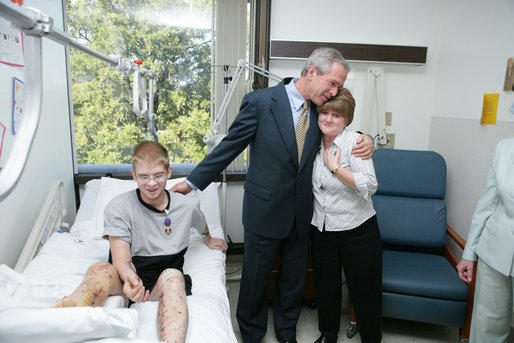 |  | 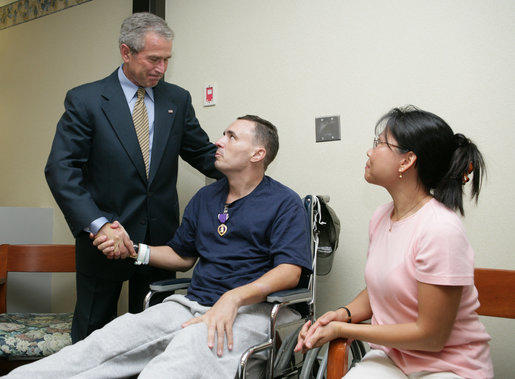 |
Every time I come here I'm amazed by the courage and decency and strength of those who wear the nation's uniform. It is such an honor to be the Commander-in-Chief of such fine men and women.
I ask for God's blessings on them and their families as they recover from their sacrifice and service.
Thank you all.
END 3:33 P.M. EDT For Immediate Release, Office of the Press Secretary, October 5, 2005
more at President Bush or Walter Reed Army Medical Center and Walter Reed or Army Medical Center and Purple Heart or Army and Military
0
comments
||
||
President to nominate three to Administration
President George W. Bush today announced his intention to nominate three individuals to serve in his Administration:
The President intends to nominate Jeffrey Thomas Bergner, of Virginia, to be Assistant Secretary of State for Legislative Affairs. Dr. Bergner is a Senior Transatlantic Fellow with the German Marshall Fund of the United States. He also serves as adjunct professor of national security studies at Georgetown University. Prior to this, Dr. Bergner served as the Founding President and Managing Partner of Bergner, Bockorny, Castagnetti, Hawkins and Brain. Earlier in his career, he served as Staff Director for the Senate Committee on Foreign Relations. He also served as Chief of Staff and Legislative Director to Senator Richard Lugar. Dr. Bergner received his bachelor's degree from Carleton College and his master's degree and PhD from Princeton University.
The President intends to nominate Susan McCaw, of Washington, to be Ambassador Extraordinary and Plenipotentiary of the United States of America to the Republic of Austria. Mrs. McCaw is President of COM Investments and Managing Partner of Eagle Creek Capital. Previously, she was a Principal at Robertson Stephens & Company, a San Francisco-based investment bank. Prior to that, Mrs. McCaw was the Director of Corporate Development at Resna Industries. Earlier in her career, she served as a Business Analyst for McKinsey & Company in New York and Hong Kong. Mrs. McCaw received her bachelor's degree from Stanford University and her master's degree from Harvard Business School.
The President intends to nominate Nicholas F. Taubman, of Virginia, to be Ambassador Extraordinary and Plenipotentiary of the United States of America to Romania. Mr. Taubman is President of Mozart Investments. He previously served as Chairman of Advanced Auto Parts. Mr. Taubman held a number of other positions, including Chief Executive Officer and President, throughout his over 45 years with the company. Mr. Taubman received his bachelor's degree from the University of Pennsylvania.
### For Immediate Release, Office of the Press Secretary, October 5, 2005, Personnel Announcement
more at President Bush and Jeffrey Thomas Bergner or Legislative Affairs and Susan McCaw or Austria and Nicholas F. Taubman or Romania
0
comments
||
||
Wednesday, October 05, 2005
Bush, Rumsfeld, Generals Pace and Petraeus, Discuss Iraq (VIDEO)
President Meets with Secretary Rumsfeld, Generals Pace and Petraeus to Discuss Progress in Iraq, FULL STREAMING VIDEO, The Rose Garden, 10:43 A.M. EDT
 | 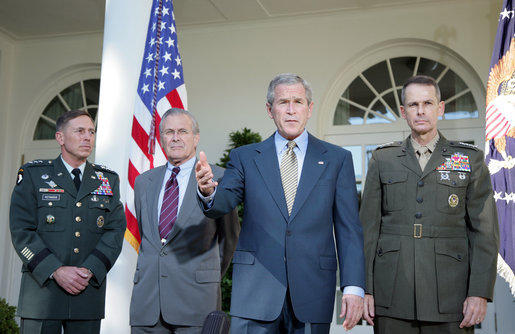 |
I was also pleased to hear there are 3,000 Iraqi forces in the fight; that they're doing a fine job out there, that they're -- they make a difference on the battlefield.
We also have General Petraeus with us, who has served incredibly well in Iraq. His job was to help U.S. forces and coalition forces train the Iraqis so they can take the fight to the enemy. He briefed me, and will be briefing the country at the Pentagon here a little later on, about the strong progress that we're making; that we've recruited a lot of folks, but we've got more than just recruitment going on. We've got a quality control program in place to make sure that the troops we train are capable of taking the fight to the enemy. Over 30 percent of the Iraqi troops are in the lead on these offensive operations. We've got troops embedded with them and it's important for the training mission.
But, nevertheless, the Iraqis are showing more and more capability to take the fight to the enemy. And that's how we're going to succeed in helping democracy become established in Iraq. I've told the American people all along our troops will stay there as long as necessary. We'll do the job, we'll train these folks, and as they become more capable, we will be able to bring folks home with the honor they've earned.
And we're seeing progress on the ground. And we're also seeing political progress on the ground. The constitution has been written; folks will have a chance to vote it up or down here this month. And then there will be elections, if the constitution is approved, for a permanent government.
So on the one hand, we're making progress when it comes to training Iraqis to take the fight to the enemy, we're bringing the enemy to justice, we're on the offense. On the other hand, democracy is moving forward in a part of the world that is so desperate for democracy and so desperate for freedom.
And so, General, I want to thank you for your service -- General Petreaus.
GENERAL PETREAUS: Thank you, sir.
THE PRESIDENT: Thank you for your service, too. But thank you for your service. You've done a fine job.
GENERAL PETREAUS: Thank you, sir.
THE PRESIDENT: I'm proud of you. Thank you all, very much.
END 10:46 A.M. EDT, For Immediate Release, Office of the Press Secretary, October 5, 2005
more at President Bush or Rumsfeld and General Pace or Iraq and General Petraeus or Pentagon
0
comments
||
||
President to Attend Summit of the Americas
President to Attend Summit of the Americas and Travel to Brazil and Panama
President Bush will travel to Mar del Plata, Argentina on November 3-5 to participate in the Summit of the Americas and to meet with Argentine President Nestor Carlos Kirchner. This will be the President's third Summit of the Americas. This visit will allow the President to continue his dialogue with the Hemisphere's democratically-elected leaders, highlight our engagement in the region, and promote the consolidation of democracy and the expansion of economic opportunity and prosperity through open markets and free trade.
Following the Summit, the President will visit Brazil on November 5-6 at the invitation of President Luiz Inacio Lula da Silva. He will then travel to Panama on November 6-7 to meet with President Martin Torrijos Espino.
# # # For Immediate Release, Office of the Press Secretary, October 5, 2005
more at President Bush or Summit of the Americas and Argentina or Nestor Carlos Kirchner and Brazil or Luiz Inacio Lula da Silva and Panama or Martin Torrijos Espino
0
comments
||
||
Statement on H.R. 3667 and H.R. 3767
Statement on H.R. 3667 and H.R. 3767
On Tuesday, October 04, 2005, the President has signed into law:
H.R. 3667, which designates a facility of the United States Postal Service located in Los Angeles, California, as the Karl Malden Station.
H.R. 3767, which designates a facility of the United States Postal Service located in St. Charles, Illinois, as the Jacob L. Frazier Post Office Building.
# # # For Immediate Release, Office of the Press Secretary, October 4, 2005
more at President Bush or H.R. 3667 and H.R. 3767 or Postal Service and Karl Malden or Jacob L. Frazier
0
comments
||
||
African Burial Ground, New York City
Memorandum for the Secretary of the Interior, SUBJECT: African Burial Ground, New York City
The African Burial Ground, located in New York City, is a National Historic Landmark administered by the General Services Administration (GSA). This site includes objects of historic and scientific significance that may be appropriate for Federal protection through designation as a National Monument under the Antiquities Act of 1906 (16 U.S.C. 431).
The GSA's archaeological research has identified over 400 human remains, along with associated artifacts dating back to the 18th century. Further exploration at the discovered site may provide research on the experience of the African population in Colonial New York.
Accordingly, please provide me with an assessment of the historic and scientific significance of the African Burial Ground and whether it may warrant permanent Federal protection through designation as a National Monument.
GEORGE W. BUSH
# # # For Immediate Release, Office of the Press Secretary, October 4, 2005
more at African Burial Ground and New York City or African and National Historic Landmark or Antiquities Act of 1906 and President Bush or African American
0
comments
||
||


