Monday, December 05, 2005

Rice war on terror (Audio MP3)

Secretary Condoleezza Rice, Remarks Upon Her Departure for Europe, As-Aired, Andrews Air Force Base, December 5, 2005 (7:15 a.m. EST)

Secretary Rice speaks with reporters before traveling to Europe from Andrews Air Force Base, Md., Monday, Dec. 5, 2005. Secretary Rice is traveling to Germany, Romania, Ukraine and Belgium December 5-9, 2005 AP/Wide World photoSecretary Rice speaks with reporters before traveling to Europe from Andrews Air Force Base, Md., Monday, Dec. 5, 2005. Secretary Rice is traveling to Germany, Romania, Ukraine and Belgium December 5-9, 2005 AP/Wide World photo
Good morning. We have received inquiries from the European Union, the Council of Europe, and from several individual countries about media reports concerning U.S. conduct in the war on terror. I am going to respond now to those inquiries, as I depart today for Europe. And this will also essentially form the text of the letter that I will send to Secretary Straw, who wrote on behalf of the European Union as the European Union President.

The United States and many other countries are waging a war against terrorism. For our country this war often takes the form of conventional military operations in places like Afghanistan and Iraq. Sometimes this is a political struggle, a war of ideas. It is a struggle waged also by our law enforcement agencies. Often we engage the enemy through the cooperation of our intelligence services with their foreign counterparts.

We must track down terrorists who seek refuge in areas where governments cannot take effective action, including where the terrorists cannot in practice be reached by the ordinary processes of law. In such places terrorists have planned the killings of thousands of innocents – in New York City or Nairobi, in Bali or London, in Madrid or Beslan, in Casablanca or Istanbul. Just two weeks ago I also visited a hotel ballroom in Amman, viewing the silent, shattered aftermath of one of those attacks.

The United States, and those countries that share the commitment to defend their citizens, will use every lawful weapon to defeat these terrorists. Protecting citizens is the first and oldest duty of any government. Sometimes these efforts are misunderstood. I want to help all of you understand the hard choices involved, and some of the responsibilities that go with them.

One of the difficult issues in this new kind of conflict is what to do with captured individuals who we know or believe to be terrorists. The individuals come from many countries and are often captured far from their original homes. Among them are those who are effectively stateless, owing allegiance only to the extremist cause of transnational terrorism. Many are extremely dangerous. And some have information that may save lives, perhaps even thousands of lives.

The captured terrorists of the 21st century do not fit easily into traditional systems of criminal or military justice, which were designed for different needs. We have to adapt. Other governments are now also facing this challenge.

We consider the captured members of al-Qaida and its affiliates to be unlawful combatants who may be held, in accordance with the law of war, to keep them from killing innocents. We must treat them in accordance with our laws, which reflect the values of the American people. We must question them to gather potentially significant, life-saving, intelligence. We must bring terrorists to justice wherever possible.

For decades, the United States and other countries have used "renditions" to transport terrorist suspects from the country where they were captured to their home country or to other countries where they can be questioned, held, or brought to justice.

In some situations a terrorist suspect can be extradited according to traditional judicial procedures. But there have long been many other cases where, for some reason, the local government cannot detain or prosecute a suspect, and traditional extradition is not a good option. In those cases the local government can make the sovereign choice to cooperate in a rendition. Such renditions are permissible under international law and are consistent with the responsibilities of those governments to protect their citizens.

Rendition is a vital tool in combating transnational terrorism. Its use is not unique to the United States, or to the current administration. Last year, then Director of Central Intelligence George Tenet recalled that our earlier counterterrorism successes included "the rendition of many dozens of terrorists prior to September 11, 2001."

-- Ramzi Youssef masterminded the 1993 bombing of the World Trade Center and plotted to blow up airlines over the Pacific Ocean, killing a Japanese airline passenger in a test of one of his bombs. Once tracked down, a rendition brought him to the United States, where he now serves a life sentence.

-- One of history’s most infamous terrorists, best known as "Carlos the Jackal," had participated in murders in Europe and the Middle East. He was finally captured in Sudan in 1994. A rendition by the French government brought him to justice in France, where he is now imprisoned. Indeed, the European Commission of Human Rights rejected Carlos’ claim that his rendition from Sudan was unlawful.

Renditions take terrorists out of action, and save lives.

In conducting such renditions, it is the policy of the United States, and I presume of any other democracies who use this procedure, to comply with its laws and comply with its treaty obligations, including those under the Convention Against Torture. Torture is a term that is defined by law. We rely on our law to govern our operations. The United States does not permit, tolerate, or condone torture under any circumstances. Moreover, in accordance with the policy of this administration:

-- The United States has respected -- and will continue to respect -- the sovereignty of other countries.

-- The United States does not transport, and has not transported, detainees from one country to another for the purpose of interrogation using torture.

-- The United States does not use the airspace or the airports of any country for the purpose of transporting a detainee to a country where he or she will be tortured.

-- The United States has not transported anyone, and will not transport anyone, to a country when we believe he will be tortured. Where appropriate, the United States seeks assurances that transferred persons will not be tortured.

International law allows a state to detain enemy combatants for the duration of hostilities. Detainees may only be held for an extended period if the intelligence or other evidence against them has been carefully evaluated and supports a determination that detention is lawful. The U.S. does not seek to hold anyone for a period beyond what is necessary to evaluate the intelligence or other evidence against them, prevent further acts of terrorism, or hold them for legal proceedings.

With respect to detainees, the United States Government complies with its Constitution, its laws, and its treaty obligations. Acts of physical or mental torture are expressly prohibited. The United States Government does not authorize or condone torture of detainees. Torture, and conspiracy to commit torture, are crimes under U.S. law, wherever they may occur in the world.

Violations of these and other detention standards have been investigated and punished. There have been cases of unlawful treatment of detainees, such as the abuse of a detainee by an intelligence agency contractor in Afghanistan or the horrible mistreatment of some prisoners at Abu Ghraib that sickened us all and which arose under the different legal framework that applies to armed conflict in Iraq. In such casesthe United States has vigorously investigated, and where appropriate, prosecuted and punished those responsible. Some individuals have already been sentenced to lengthy terms in prison; others have been demoted or reprimanded.

As CIA Director Goss recently stated, our intelligence agencies have handled the gathering of intelligence from a very small number of extremely dangerous detainees, including the individuals who planned the 9/11 attacks in the United States, the attack on the U.S.S. Cole, and many other murders and attempted murders. It is the policy of the United States that this questioning is to be conducted within U.S. law and treaty obligations, without using torture. It is also U.S. policy that authorized interrogation will be consistent with U.S. obligations under the Convention Against Torture, which prohibit cruel, inhuman, or degrading treatment. The intelligence so gathered has stopped terrorist attacks and saved innocent lives – in Europe as well as in the United States and other countries. The United States has fully respected the sovereignty of other countries that cooperate in these matters.

Because this war on terrorism challenges traditional norms and precedents of previous conflicts, our citizens have been discussing and debating the proper legal standards that should apply. President Bush is working with the U.S. Congress to come up with good solutions. I want to emphasize a few key points.

-- The United States is a country of laws. My colleagues and I have sworn to support and
defend the Constitution of the United States. We believe in the rule of law.

-- The United States Government must protect its citizens. We and our friends around the world have the responsibility to work together in finding practical ways to defend ourselves against ruthless enemies. And these terrorists are some of the most ruthless enemies we face.

-- We cannot discuss information that would compromise the success of intelligence, law enforcement, and military operations. We expect that other nations share this view.

Some governments choose to cooperate with the United States in intelligence, law enforcement, or military matters. That cooperation is a two-way street. We share intelligence that has helped protect European countries from attack, helping save European lives.

It is up to those governments and their citizens to decide if they wish to work with us to prevent terrorist attacks against their own country or other countries, and decide how much sensitive information they can make public. They have a sovereign right to make that choice.

Debate in and among democracies is natural and healthy. I hope that that debate also includes a healthy regard for the responsibilities of governments to protect their citizens.

Four years after September 11, most of our populations are asking us if we are doing all that we can to protect them. I know what it is like to face an inquiry into whether everything was done that could have been done. So now, before the next attack, we should all consider the hard choices that democratic governments must face. And we can all best meet this danger if we work together.

Thank you.

2005/1130 (FINAL), Released on December 5, 2005

more at
and or and or and or and or and

Related: Keywords Secretary Condoleezza Rice, Friday, January 28, 2005
Secretary of State Rice at Swearing-In Ceremony, Friday, February 04, 2005 Condoleezza Rice Tony Blair Jack Straw Gerhard Schroeder, Sunday, February 06, 2005 Secretary Condoleezza Rice, Polish Prime Minister Marek Belka, Friday, February 18, 2005 Condoleezza Rice, Dutch Foreign Minister Bot video, Saturday, February 26, 2005 Bombing in Tel Aviv, Secretary Rice, Tuesday, March 01, 2005 Secretary Condoleezza Rice London Meeting Supporting the Palestinian Authority, Tuesday, March 01, 2005 Secretary of State Condi Rice, Secretary General Kofi Annan, Tuesday, March 01, 2005 Secretary Condoleezza Rice, French Foreign Minister Michel Barnier, Saturday, March 12, 2005 Condoleezza Rice, Ukrainian Minister of Foreign Affairs Boris Tarasyuk, Monday, March 14, 2005 Condoleezza Rice, Karen P. Hughes, Thursday, March 17, 2005 Secretary Condoleezza Rice Kabul, Afghanistan, Thursday, March 17, 2005 Secretary Condoleezza Rice, Foreign Minister Khurshid Mahmood Kasuri, Thursday, March 17, 2005 Secretary Condoleezza Rice, Foreign Minister Natwar Singh,

Sunday, December 04, 2005

Poison + water = hydrogen

Poison + water = hydrogen. New microbial genome shows how, From a Russian volcanic island, a hot new find

Rockville, Md.--Take a pot of scalding water, remove all the oxygen, mix in a bit of poisonous carbon monoxide, and add a pinch of hydrogen gas. It sounds like a recipe for a witch's brew. It may be, but it is also the preferred environment for a microbe known as Carboxydothermus hydrogenoformans.

In a paper published in the November 27th issue of PLoS Genetics, a research team led by scientists at The Institute for Genomic Research (TIGR) report the determination and analysis of the complete genome sequence of this organism. Isolated from a hot spring on the Russian volcanic island of Kunashir, this microbe lives almost entirely on carbon monoxide. While consuming this normally poisonous gas, the microbe mixes it with water, producing hydrogen gas as waste.

As the world increasingly considers hydrogen as a potential biofuel, technology could benefit from having the genomes of such microbes. "C. hydrogenoformans is one of the fastest-growing microbes that can convert water and carbon monoxide to hydrogen," remarks TIGR evolutionary biologist Jonathan Eisen, senior author of the PLoS Genetics study. "So if you're interested in making clean fuels, this microbe makes an excellent starting point."

In sequencing the microbe's genome, Eisen and his collaborators discovered why C. hydrogenoformans grows more rapidly on carbon monoxide than other species: The bug boasts at least five different forms of a protein machine, dubbed carbon monoxide deyhydrogenase, that is able to manipulate the poisonous gas. Each form of the machine appears to allow the organism to use carbon monoxide in a different way. Most other organisms that live on carbon monoxide have only one form of this machine. In other words, while other organisms may have the equivalent of a modest mixing bowl to process their supper of carbon monoxide, this species has a veritable food processor, letting it gorge on a hot spring buffet all day.

"The findings show the continued value of microbial genome sequencing for exploring the useful capabilities of the vast realm of microbial life on Earth," says Ari Patrinos, director of the Office of Biological and Environmental Research, part of the U.S. Department of Energy's (DOE) Office of Science. DOE, which funded the study, is pursuing clean fuel technologies.

Little was known about this hydrogen-breathing organism before its genome sequence was determined. By utilizing computational analyses and comparison with the genomes of other organisms, the researchers have discovered several remarkable features. For example, the genome encodes a full suite of genes for making spores, a previously unknown talent of the microbe. Organisms that make spores have attracted great interest recently because this is a process found in the bacterium that causes anthrax. Sporulation allows anthrax to be used as a bioweopon because the spores are resistant to heat, radiation, and other treatments.

By comparing this genome to those of other spore-making species, including the anthrax pathogen, Eisen and colleagues identified what may be the minimal biochemical machinery necessary for any microbe to sporulate. Thus studies of this poison eating microbe may help us better understand the biology of the bacterium that causes anthrax.

Building off this work, TIGR scientists are leveraging the information from the genome of this organism to study the ecology of microbes living in diverse hot springs, such as those in Yellowstone National Park. They want to know what types of microbes are found in different hot springs--and why. To find out, the researchers are dipping into the hot springs of Yellowstone, Russia, and other far-flung locales, to isolate and decipher the genomes of microbes found there.

"What we want to have is a field guide for these microbes, like those available for birds and mammals," Eisen says. "Right now, we can't even answer simple questions. Do similar hot springs, a world apart, share similar microbes? How do microbes move between hot springs? Our new work will help us find out." ###

The Institute for Genomic Research is a not-for-profit center dedicated to deciphering and analyzing genomes. Since 1992, TIGR, based in Rockville, Md., has been a genomics leader, conducting research critical to medicine, agriculture, energy, the environment and biodefense.

Contact: Kathryn Brown, EndPoint Creative
kbrown@endpointcreative.biz 703-549-6641 The Institute for Genomic Research

more at
or and or and or and or and

Related: Keywords Hydrogen Fuel Monday, November 22, 2004
Spencer Abraham Hydrogen Refueling WASH, DC, Sunday, February 20, 2005 Bush Hydrogen Vision, Monday, March 21, 2005 porphyrin tubes may lead to new nanodevices, inexpensive hydrogen fuel, Monday, May 16, 2005 President Discusses Biodiesel and Alternative Fuel Sources, Wednesday, May 25, 2005 President Tours Hydrogen Fueling Station, Tuesday, August 09, 2005 President George W. Bush signs H.R. 6, Wednesday, October 26, 2005 President Outlines Economic Growth Agenda (VIDEO), Sunday, December 04, 2005 Nano-cages 'fill up' with hydrogen,

Nano-cages 'fill up' with hydrogen

Neutron-scattering image reveals where hydrogen molecules (red-green circles) connect to a metal organic framework (MOF), a type of custom-made compound eyed for hydrogen storage applications. The ball-and-stick model of the MOF is superimposed on the neutron image. Image credit: T. Yildirim/NISTNeutron-scattering image reveals where hydrogen molecules (red-green circles) connect to a metal organic framework (MOF), a type of custom-made compound eyed for hydrogen storage applications. The ball-and-stick model of the MOF is superimposed on the neutron image. Image credit: T. Yildirim/NIST
A "cagey" strategy to stack more hydrogen in nanoscale scaffoldings made of zinc-based boxes may yield a viable approach to storing hydrogen and, ultimately, replacing fossil fuels in future automobiles, according to new results from National Institute of Standards and Technology (NIST) researchers.

Using beams of neutrons as probes, NIST scientists determined where hydrogen latches onto the lattice-like arrangement of zinc and oxygen clusters in a custom-made material known as a metal-organic framework, or MOF. Called MOF5, the particular nanoscale material studied by Taner Yildirim and Michael Hartman has four types of docking sites, including a "surprising" three-dimensional network of "nano-cages" that appears to form after other sites load up with hydrogen.

This finding, reported in Physical Review Letters,* suggests that MOF materials might be engineered to optimize both the storage of hydrogen and its release under normal vehicle operating conditions. It also suggests that MOFs might be used as templates for interlinking hydrogen nano-cages, creating materials with unusual properties due to a phenomenon known as quantum confinement. In a sense, this discovery is a bonus.

Yildirim and Hartman found that the two most stable sites in the scaffolding already offer considerable room for storing hydrogen, accounting for the interest MOFs already have attracted. Earlier studies reported that, at about –200 degrees Celsius, MOF5 could hold less than 2 percent of its weight in hydrogen.

The NIST research indicates ample room for improvement. At very low temperatures, hydrogen uptake approached 10 percent of the material's weight. (The FreedomCar and Fuel Partnership involving the Department of Energy and the nation's "Big 3" automakers has set a level of about 6 percent as a minimum capacity for economically viable hydrogen storage.) The bulk of the hydrogen was held in nanometer-scale cavities inside the box-like arrangements of zinc and oxygen clusters.

"Neutron diffraction measurements clearly show that the molecules are packed in a fashion similar to the way apples or oranges fill a bowl," Yildirim explains. The unexpected nano-cages introduce the potential for spillover capacity, so to speak.

Hydrogen storage levels of 10 percent are encouraging, but these results were achieved at impractically low temperatures. Yildirim and Hartman say they hope better understanding of how hydrogen molecules tether to MOFs will ultimately lead to improved materials suitable for practical applications. ###

The research was carried out at the NIST Center for Neutron Research and partially supported by the U.S. Department of Energy. More information can be obtained at
ncnr.nist.gov/staff/taner/h2.

*T. Yildirim and M.R. Hartman, Direct observation of hydrogen adsorption sites and nano-cage formation in metal-organic frameworks (MOF). Phys. Rev. Lett., 95, 215504 (2005).

Contact: Mark Bello
mark.bello@nist.gov 301-975-3776 National Institute of Standards and Technology (NIST)

more at
or and or and or and or and or and or

Related: Keyword Nanotech Sunday, November 13, 2005
Testing toxicity of nanomaterials, Sunday, October 23, 2005 single-molecule car, 'Nanocar', Sunday, August 28, 2005 Writing at the nanoscale, Thursday, May 26, 2005 discontinuous palladium, siloxane self-assembled monolayer, Sunday, May 08, 2005 Center for Nanoscale Materials, Monday, April 25, 2005 Nanomagnets, Nanocomposite, Monday, March 21, 2005 porphyrin tubes may lead to new nanodevices, inexpensive hydrogen fuel

Presidential Podcast 12/03/05

Presidential Podcast 12/03/05

Subscribe to My Odeo Channel Subscribe to Our Odeo Podcast Channel and receive the Presidential Radio Address each week. Featuring real audio amd full text transcript

more at and or and or and or

Related: Keywords radio address, Saturday, November 26, 2005
Presidential Podcast 11/26/05, Saturday, November 26, 2005 bush radio address 11/26/05 full audio, text transcript, Saturday, November 19, 2005 Presidential Podcast 11/19/05, Saturday, November 19, 2005 Freedom Calendar 11/19/05 - 11/26/05, Saturday, November 12, 2005 Presidential Podcast 11/12/05, Saturday, November 12, 2005 bush radio address 11/12/05 full audio, text transcript, Saturday, November 05, 2005 Presidential Podcast 11/05/05, Saturday, November 05, 2005 bush radio address 11/05/05 full audio, text transcript, Saturday, October 29, 2005 bush radio address 10/29/05 full audio, text transcript, Saturday, October 22, 2005 Presidential Podcast 10/22/05, Saturday, October 15, 2005 Presidential Podcast 10/15/05, Saturday, October 08, 2005 bush radio address 10/08/05 full audio, text transcript, Saturday, October 01, 2005 bush radio address 10/01/05 full audio, text transcript, Saturday, September 24, 2005 bush radio address 09/24/05 full audio, text transcript, Saturday, September 17, 2005 bush radio address 09/17/05 full audio, text transcript

Saturday, December 03, 2005

Freedom Calendar 12/03/05 - 12/10/05

December 3, 2002, Jewish Republican Linda Lingle (R-HI) inaugurated as state’s first woman governor.

December 4, 1886, Death of Republican George Ruffin, first African-American graduate of Harvard Law School and first African-American state judge in the North 5

December 5, 2000, Kay Bailey Hutchison (R-TX) becomes first woman elected to U.S. Senate Leadership.

December 6, 1865, Republican Party’s 13th Amendment, banning slavery, is ratified.

December 7, 1928, Republican Octaviano Larrazolo of New Mexico becomes first Hispanic to serve in U.S. Senate.

December 8, 1953, Eisenhower administration Asst. Attorney General Lee Rankin argues for plaintiffs in Brown v. Board of Education; 1924 Democratic presidential candidate John W. Davis argues in favor of “separate but equal”.

December 9, 1872, Republican Pinckney Pinchback (R-LA) becomes nation’s first African-American governor.

December 10, 1869, Republican Gov. John Campbell of Wyoming Territory signs first-in-nation law granting women right to vote and to hold public office.

“Our commitment to fairness means that we must assure legal and economic equity for women, and eliminate, once and for all, all traces of unjust discrimination against women from the United States Code.”

Ronald Reagan, 40th President of the United States

SOURCE:
2005 Republican Freedom Calendar more at or and or and or and

Related: Keywords Freedom Calendar, Saturday, November 26, 2005
Freedom Calendar 11/26/05 - 12/03/05, Saturday, November 19, 2005 Freedom Calendar 11/19/05 - 11/26/05, Saturday, November 12, 2005 Freedom Calendar 11/12/05 - 11/19/05, Saturday, November 05, 2005 Freedom Calendar 11/05/05 - 11/12/05, Saturday, October 29, 2005 Freedom Calendar 10/29/05 - 11/05/05, Saturday, October 22, 2005 Freedom Calendar 10/22/05 - 10/028/05, Saturday, October 15, 2005 Freedom Calendar 10/15/05 - 10/022/05, Thursday, September 29, 2005 The Opelousas Massacre, Saturday, October 08, 2005 Freedom Calendar 10/08/05 - 10/015/05 , Saturday, October 01, 2005 Freedom Calendar 10/01/05 - 10/08/05, Saturday, September 24, 2005 Freedom Calendar 09/24/05 - 10/01/05, Saturday, September 17, 2005 Freedom Calendar 09/17/05 - 09/24/05, Saturday, September 10, 2005 Freedom Calendar 09/10/05 - 09/17/05

bush radio address 12/03/05 full audio, text transcript

bush radio address 12/03/05 full audio, text transcript PODCAST

President's Radio Address

THE PRESIDENT: Good morning. Earlier this week I visited Arizona and Texas to observe firsthand our efforts to protect our southwest border. And I met with customs and border protection agents who are working tirelessly to enforce our laws and keep our borders secure.

Illegal immigration and border security are issues that concern Americans. We're a nation built on the rule of law, and those who enter the country illegally break the law. In communities near our border illegal immigration strains the resources of schools, hospitals, and law enforcement. And it involves smugglers and gangs that bring crime to our neighborhoods. Faced with this serious challenge our government's responsibility is clear. We're going to protect our borders.

Since I took office we've increased funding for border security by 60 percent, and our border agents have caught and sent home more than 4.5 million illegal immigrants, including more than 350,000 with criminal records. Yet we must do more to build on this progress.

This week I outlined my comprehensive strategy to reform our immigration system. The strategy begins with a three-part plan to protect our borders. First we will promptly return every illegal entrant we catch at our border, with no exceptions. For illegal immigrants from Mexico, we are working to expand an innovative program called interior repatriation, in which those caught at the border are returned to their hometowns, far from the border, making it more difficult for them to attempt another crossing. For non-Mexican illegal immigrants, we're changing the unwise policy of catch and release to a policy of catch and return, and we're speeding up the removal process.

Second, we must fix weak and unnecessary provisions in our immigration laws, including senseless rules that require us to release illegal immigrants if their home countries do not take them back in a set period of time.

Third, we must stop people from crossing the border illegally in the first place. So we're hiring thousands more Border Patrol agents, we're deploying new technology to expand their reach and effectiveness, and we're constructing physical barriers to entry.

Comprehensive immigration reform also requires us to improve enforcement of our laws in the interior of our country, because border security and interior enforcement go hand-in-hand. In October, I signed legislation that more than doubled the resources for interior enforcement, so we'll increase the number of immigration enforcement agents and criminal investigators, enhance work site enforcement, and continue to go after smugglers, gang members, and human traffickers. Our immigration laws apply across all of America, and we will enforce those laws throughout our land.

Finally, comprehensive immigration reform requires us to create a new temporary worker program that relieves pressure on the border, but rejects amnesty. By creating a legal channel for willing employers to hire willing workers we will reduce the number of workers trying to sneak across the border, and that would free up law enforcement officers to focus on criminals, drug dealers, terrorists, and others who mean us harm.

This program would not create an automatic path to citizenship, and it would not provide amnesty. I oppose amnesty. Rewarding law-breakers would encourage others to break the law and keep pressure on our border. A temporary worker program will relieve pressure on the border and help us more effectively enforce our immigration laws.

Our nation has been strengthened by generations of immigrants who became Americans through patience, hard work, and assimilation. In this new century we must continue to welcome legal immigrants and help them learn the customs and values that unite all Americans, including liberty and civic responsibility, equality under God, tolerance for others, and the English language. In the coming months, I look forward to working with Congress on comprehensive immigration reform that will enforce our laws, secure our border, and uphold our deepest values.

Thank you for listening.

END For Immediate Release, December 3, 2005

more at
and or and or and or

Related: Keywords radio address, Saturday, November 26, 2005
Presidential Podcast 11/26/05, Saturday, November 26, 2005 bush radio address 11/26/05 full audio, text transcript, Saturday, November 19, 2005 Presidential Podcast 11/19/05, Saturday, November 19, 2005 Freedom Calendar 11/19/05 - 11/26/05, Saturday, November 12, 2005 Presidential Podcast 11/12/05, Saturday, November 12, 2005 bush radio address 11/12/05 full audio, text transcript, Saturday, November 05, 2005 Presidential Podcast 11/05/05, Saturday, November 05, 2005 bush radio address 11/05/05 full audio, text transcript, Saturday, October 29, 2005 bush radio address 10/29/05 full audio, text transcript, Saturday, October 22, 2005 Presidential Podcast 10/22/05, Saturday, October 15, 2005 Presidential Podcast 10/15/05, Saturday, October 08, 2005 bush radio address 10/08/05 full audio, text transcript, Saturday, October 01, 2005 bush radio address 10/01/05 full audio, text transcript, Saturday, September 24, 2005 bush radio address 09/24/05 full audio, text transcript, Saturday, September 17, 2005 bush radio address 09/17/05 full audio, text transcript

Friday, December 02, 2005

President Discusses Economy and Jobs (VIDEO)

President Discusses Strong Economic Growth and Job Creation, FULL STREAMING VIDEO, The Rose Garden 10:45 A.M. EST

President George W. Bush is seen in the Rose Garden of the White House, Friday, Dec. 2, 2005, as he speaks on the growth of the economy with news of 215,000 jobs added for the month of November and third-quarter growth this year was 4.3 percent. White House photo by Paul MorsePresident George W. Bush is seen in the Rose Garden of the White House, Friday, Dec. 2, 2005, as he speaks on the growth of the economy with news of 215,000 jobs added for the month of November and third-quarter growth this year was 4.3 percent. White House photo by Paul Morse.
THE PRESIDENT: Thanks to good, old-fashioned American hard work and productivity, innovation, and sound economic policies of cutting taxes and restraining spending, our economy continues to gain strength and momentum.

Our economy added 215,000 jobs for the month of November. We've added nearly 4.5 million new jobs in the last two-and-a-half years. Third-quarter growth of this year was 4.3 percent. That's in spite of the fact that we had hurricanes and high gasoline prices. The unemployment rate is 5 percent. And that's lower than the average for the 1970s, 1980s, and 1990s.

We have every reason to be optimistic about our economic future. I mean, when you think about the news that's come in, the jobs report, the recent report on strong economic growth, low inflation, strong productivity, lower gasoline prices, a strong housing market, increases in consumer confidence and business investment, our economic horizon is as bright as it's been in a long time.

The foundation for growth is strong. It's based upon low taxes and restrained government spending, legal reform, incentives for saving and investment.

The small business sector is vibrant. Most new jobs in America are created by the small business sector, and our entrepreneurs are doing well. We got the best work force in America -- in the world. People are productive, they're hardworking. Our ingenuity and know-how and -- is vibrant. This economy is in good shape.

We're not going to rest until every American who wants a job can find one. We're going to continue to work for good policies for our workers and our entrepreneurs. I'll continue to push for pro-growth economic policies, all aimed at making sure every American can realize the American Dream.

Thank you very much.

END 10:48 A.M. EST, For Immediate Release, Office of the Press Secretary, December 2, 2005

more at
and or and or and

Related: Keyword VIDEO, Thursday, September 01, 2005
W Asks Poppi and Bubba for Hurricane Relief (VIDEO), Friday, September 02, 2005 President Heads to Katrina Affected Areas (VIDEO), Saturday, September 03, 2005 Navy Personnel, Family Helpline, Pentagon Briefing (VIDEO), Saturday, September 03, 2005 President Addresses Nation, Katrina Relief (VIDEO), Saturday, September 03, 2005 FEMA Afternoon Operational Briefing (VIDEO), Monday, September 05, 2005 William Rehnquist (VIDEO), Monday, September 05, 2005 American Red Cross (VIDEO), Monday, September 05, 2005 Roberts Chief Justice (VIDEO), Tuesday, September 06, 2005 President Meets with Cabinet (VIDEO), Tuesday, September 06, 2005 Press Briefing Scott McClellan (VIDEO) 09/06/05, Wednesday, September 07, 2005 Bush-Clinton Katrina Fund. (VIDEO), Wednesday, September 07, 2005 President, Voluntary Organizations (VIDEO), Wednesday, September 07, 2005 Students and School Districts (VIDEO),

President Lights National Christmas Tree (VIDEO)

President Bush Lights National Christmas Tree at Pageant of Peace, The Ellipse, Washington, D.C. 5:55 P.M. EST

Santa goes into the audience to sing a song , Thursday evening, Dec. 1, 2005, during the Pageant of Peace and the lighting of the National Christmas Tree on the Ellipse in Washington. White House photo by Paul MorseSanta goes into the audience to sing a song , Thursday evening, Dec. 1, 2005, during the Pageant of Peace and the lighting of the National Christmas Tree on the Ellipse in Washington. White House photo by Paul Morse
THE PRESIDENT: Thank you all very much. Welcome to the Christmas Pageant of Peace. Laura and I are so honored to join you all. The lighting of the National Christmas tree is one of the great traditions in our Nation's Capital. Each year, we gather here to celebrate the season of hope and joy -- and to remember the story of one humble life that lifted the sights of humanity.

Santa, thanks for coming. (Laughter.) Glad you made it. I know you've got a lot of commitments this time of year. By the way, we have a lot of chimneys at the White House -- (laughter) -- if you're looking for something to do. I appreciate all our entertainers. Thanks for being here. This is a fantastic evening.

I want to thank Peter Nostrand, who is the Chairman of the Christmas Pageant of Peace, and John Betchkal, all the members of the board. I appreciate Secretary of the Interior Gale Norton, other members of my Cabinet who are here. I appreciate the members of Congress who have come.

I particularly want to give a special thanks to the National Parks Service Director Fran Mainella and all the good folks who work for the National Parks Service. (Applause.) Reverend Martin, thank you very much as well.

Christmas is a time to rejoice, and to give thanks for the blessings of the season and for the blessings that surround us every day of the year. We also remember that we have a responsibility to help those in need. America is a compassionate and generous land. And acts of kindness toward others fulfill the spirit of the season.

As we approach Christmas in this time of war, we pray for freedom, and justice, and peace on Earth. In his Christmas Eve address to the nation in 1941, Franklin Roosevelt said that "Against enemies who preach the principles of hate and practice them, we set our faith in human love, and in God's care for us and all men everywhere." We ask for God to watch over our men and women in uniform who are serving overseas.Their families miss them -- hold a seat open for them -- and pray for their safe return. America's military men and women stand for freedom -- and they serve the cause of peace. Many of them are serving in distant lands tonight, but they are close to our hearts.

As an expression of our hope for peace and happiness in this Christmas season, we light the national Christmas tree. Jackie, Melissa, and Jenna Kantor of Bethesda are with us here. They started "Project Backpack," to help give children displaced by Hurricane Katrina new backpacks filled with books, and toys and school supplies. These girls are an example of the compassion that is found in the hearts and souls of Americans everywhere, and they have shown how much good can be done when we reach out to help a neighbor in need. And so Laura and I now invite them to join us to turn on the lights.

And would you help turn on these lights, as well, by counting down. Five ... Four ... Three ... Two ... One. (Applause.)

END 5:59 P.M. EST, For Immediate Release, Office of the Press Secretary, December 1, 2005

more at
and or and or

Related: Saturday, November 20, 2004
Remarks by the First Lady, Saturday, November 20, 2004 Fact Sheet: White House Holiday Decorations, Monday, November 29, 2004 Laura Bush White House Christmas tree, Thursday, December 02, 2004 White House 2004 Holiday christmas, Friday, December 03, 2004 National Christmas Tree, Friday, December 24, 2004 Secretary Rumsfeld Holiday Visit to Iraq, Friday, December 24, 2004 Presidential Christmas Message, 2004, Saturday, December 25, 2004 How Does NORAD Track Santa?, Saturday, December 25, 2004 barney whitehouse christmas,

Thursday, December 01, 2005

HIV/AIDS Initiatives World AIDS Day (VIDEO)

President and Mrs. Bush Discuss HIV/AIDS Initiatives on World AIDS Day, FULL STREAMUNG VIDEO, Room 450, Dwight D. Eisenhower Executive Office Building 10:08 A.M. EST

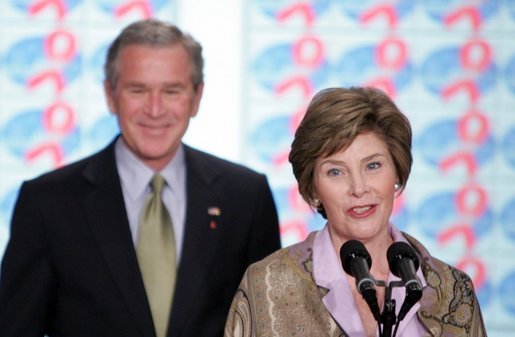
President George W. Bush stands by as he listens to remarks by Mrs. Bush on World AIDS Day before being introduced to the audience at the Dwight D. Eisenhower Executive Office Building Thursday, Dec. 1, 2005. White House photo by Paul MorsePresident George W. Bush stands by as he listens to remarks by Mrs. Bush on World AIDS Day before being introduced to the audience at the Dwight D. Eisenhower Executive Office Building Thursday, Dec. 1, 2005. White House photo by Paul Morse.
MRS. BUSH: Good morning, everyone. Good morning and thank you all very, very much for joining us on this important day, World AIDS Day. World AIDS Day highlights the work that is going on around the world to prevent and treat HIV/AIDS.

The people of the United States are making an important contribution to this effort, through medical expertise, funding, research, and the compassion of our people. Through President Bush's Emergency Plan for AIDS Relief, America is keeping its promise to help hundreds of thousands of people prevent, treat, and live with HIV/AIDS.

In July I visited three countries in Africa, and there I met people whose lives are better, thanks to the President's Emergency Relief Plan. In South Africa, women at the Mothers To Mothers-To-Be Clinic are working to prevent the transmission of HIV from mothers to their unborn children. Mothers who have been through the program help HIV-positive mothers who are now pregnant and need guidance and strength from someone who has walked in their shoes. The President's Emergency Plan supports this work, and all Americans can be very proud of that.

The women and staff at Mothers To Mothers-To-Be, including Robin Smalley, who is here with us today, are -- were a wonderful host to me. Where is Robin? Oh, good -- right on the very front row. Hey, Robin. (Laughter.) I'm also really pleased to announce that I'll host them, welcome them to the White House this spring.

On World AIDS Day we make the commitment to one day see a generation free from HIV/AIDS.

It's now my pleasure to introduce a leader in the global effort to prevent HIV/AIDS -- my husband, President George Bush. (Applause.)

THE PRESIDENT: Thank you all. How about my line of work, where you get introduced by your wife? (Laughter.) And I'm glad I got introduced by Laura, because she deeply cares about the issue of HIV/AIDS. She's a great First Lady with a compassionate heart. In her travels, she's carried a message of hope for the suffering -- and a message that the empowerment of women is essential to the prevention of AIDS. I thank you for your introduction. More importantly, I thank you for your love.

I want to thank you all for coming, and for joining the government, and more importantly, the armies of compassion in challenging -- in the challenge of fighting AIDS. I want to thank Secretary Rice for being here, Secretary of State. The Secretary of Defense is with us, Secretary Rumsfeld. Carlos Gutierrez, Secretary of Commerce; Secretary of Labor Elaine Chao; Mike Leavitt, who is the Secretary of Health and Human Services; USAID Director Andrew Natsios is with us.

Ambassador Randy Tobias, who is the U.S. Global AIDS Coordinator, and has done a heck of a job. Thank you for being here. (Applause.) CDC Director Dr. Julie Gerberding; Tony Fauci is with us as well; Elias Zerhouni of the NIH -- thank you all for being here. Thanks for being -- making sure the scientific community stays on the leading edge of research to help save lives.

I appreciate the Peace Corps Director Gaddi Vasquez for joining us. I'm proud that two United States Senators have taken time out of their busy schedules to join us -- Senator Dick Lugar and Senator Mike Enzi. Thank you all for being here. It means a lot. (Applause.)

Finally, I want to thank the diplomatic corps for joining us. You're going to hear a strong message of support, and I know you'll relay this message back to your governments, along with a message that in order to deal with HIV/AIDS we must confront it honestly. We're glad you're here, your Excellencies. Thank you for joining us.

Today, with people around the world, not just here in America, but all around the world, 40 million -- we turn our thoughts to the more than 40 million men, women, and children who are living with HIV. That's what World AIDS Day is all about. And on World AIDS Day, we renew our commitment to turn the tide against this disease.

HIV/AIDS is a global health crisis -- it is also a daily burden for many of our families and neighbors and friends. Across Africa, this pandemic threatens the stability and the future of whole societies. In Asia, HIV/AIDS is a challenge that grows daily and must be confronted directly. Here in the United States, over a million of our citizens face this chronic condition. At the start of this century, AIDS causes suffering from remote villages of Africa to the heart of America's big cities. This danger is multiplied by indifference and complacency. This danger will be overcome by compassion, honesty, and decisive action.

I believe America has a unique ability, and a special calling, to fight this disease. We are blessed with great scientific knowledge. We're a generous country that has always reached out to feed the hungry, and rescue captives, and care for the sick. We are guided by the conviction of our founding -- that the Author of Life has endowed every life with matchless value.

Here in America, some of our fellow citizens have now lived 15 years or more with HIV/AIDS. The federal government provides more than $17 billion a year to help people in America living with HIV/AIDS -- including funding that brings life-saving drugs and treatment to hundreds of thousands of low-income Americans. With the help of medicine, and their own daily courage, many people are managing a condition that was once uniformly fatal -- and proving that HIV/AIDS is a long-term illness like heart disease or diabetes.

Yet America still sees an estimated 40,000 new infections each year. This is not inevitable -- and it's not acceptable. HIV/AIDS remains a special concern in the gay community, which has effectively fought this disease for decades through education and prevention. And the demographics of this disease continue to change. AIDS is increasingly found among women and minorities. Nearly half of the new infections are found in the African-American community.

We're determined to make voluntary HIV testing a routine part of health care in America -- so people can know the truth about their status, tell others, and get the treatment they need. We're determined to end mother-to-child transmission of HIV in America -- because medicine makes it possible, and conscience demands it. We're determined to improve care for minorities and citizens in the greatest need, and so I urge the Congress to reauthorize the Ryan White Care Act. (Applause.)

Our concern about HIV/AIDS does not stop at our borders. Other nations face greater challenges, yet they are moving forward with courage and determination that inspires our respect, and deserves our support. Nations like Uganda and Kenya have demonstrated that leadership and honesty can overcome stigma and reduce rates of infection. Nations like Botswana and Namibia have shown that anti-retroviral treatments can be widely delivered and highly successful. These countries, and many others, are fighting for the lives of their citizens -- and America is now their strongest partner in that fight, and we're proud to be so.

We're supporting our partners through the Global Fund, which is helping nations purchase medicines and treat tuberculosis, the deadly infection that often accompanies AIDS.

We are also supporting our partners through the Emergency Plan for AIDS Relief, the largest initiative in history to combat a specific disease. This effort is designed to support and strengthen the AIDS-fighting strategies of many nations, including 15 heavily afflicted nations in Africa, Asia, and the Caribbean. In May 2003, we committed $15 billion over five years to meet specific goals: to support treatment for 2 million people; support prevention for 7 million people; support care for 10 million people.

We're working with our partners to provide treatment because the lives of people already infected should never be written off, because the best way to help a child in need is to help their parents live, and because people who know they can be treated are more likely to seek testing. We're working with our partners to expand prevention efforts that emphasize abstinence, being faithful in marriage, and using condoms correctly. This strategy -- pioneered by Africans -- has proven its effectiveness, and America stands behind the ABC approach to prevention. (Applause.)

And we're working with our partners to expand compassionate care -- especially for the millions of children made orphans by this cruel disease.

The United States Congress and the American people have been generous in this effort, and Americans can know that their generosity is making a significant difference. Before the Emergency Plan for AIDS Relief, only 50,000 people of the more than 4 million people in sub-Saharan Africa needing immediate AIDS treatment were getting medicine -- think about that, only 50,000 people. After two years of sustained effort, approximately 400,000 sub-Saharan Africans are receiving the treatment they need. (Applause.)

Today I'm proud to welcome Thandazile Darby and her two children, Lewis and Emily. Lewis, by the way, is age 4; Emily, age 5 -- and their doctor, Dr. Helga Holst. They're from South Africa. Welcome to America. (Applause.)

It's the effects of a long speech. (Laughter.) Two years ago, she took Emily to the hospital for what she thought was the mumps -- later they found that Emily, and the rest of the family, were HIV-positive. Thandazile's late husband's relatives tried to support her treatment for as long as they could, but the cost was too high. Thanks to the Emergency Plan funds, the Darbys began to get the treatment they desperately needed. Soon these children will start school -- and now their mom dreams that someday they will attend college. Here is what Thandazile says: "The medicine used to be very expensive. I used to have to decide between taking our medicine and putting food in our bellies. It was difficult, because we needed to have food in our bellies so that we could take the pills. Now I can afford to buy food for my family and we can keep taking our medicine to stay healthy."

I want to thank you for joining us today, and I want to thank for your strong example of courage. (Applause.)

This example is repeated across Africa and beyond. In Northern Namibia, Emergency Plan funds helped a Lutheran hospital build a new HIV treatment center and hire 12 doctors, and nurses, and other staff. As a result, this clinic has been able to put 1,475 people on treatment in less than a year. In Botswana, Emergency fund -- Plan funds are supporting two clinics to launch a peer counseling program for mothers to provide emotional support and prevent mother-to-child transmission of HIV/AIDS. In Uganda, Emergency Plan funds helped Dr. Peter Mujenyi expand from one site serving those with AIDS to 25 sites in a single year. Today, there are 35 sites -- many of them in remote rural areas -- that provide treatment to 35,000 of his countrymen. I first met Peter more than two years ago. This man is an incredible leader. He's an incredibly compassionate soul. I want to thank you for being a lifesaver and thank you for joining us. (Applause.)

We're making good progress, and none of it would be possible without the devotion and professionalism of our partners on the ground: courageous leaders of African nations who care about their people and who tell the truth; doctors and pharmacists who work without rest in overcrowded wards; health workers, often with HIV themselves, who visit homes and make sure people are taking their medicine; people who run youth groups and clubs that encourage abstinence and help children with HIV face the challenges of life. Many of these good people who serve others are also motivated by their deep faith. And we want to expand these partnerships.

So today I am pleased to announce the New Partners Initiative. Through this initiative, which is part of the Emergency Plan, we will further reach out to our faith-based and community organizations that provide much of the health care in the developing world, and make sure they have access to an American assistance. By identifying and supporting these organizations, we will reach more people, more effectively, and save more lives. (Applause.)

Americans have always stood for human dignity when history calls. When the nations of Europe lay in rubble after World War II, America helped build a brighter future with the Marshall Plan. When the developing world looked for help and inspiration, we sent the Peace Corps to lay new foundations for friendship. And now, as millions afflicted with AIDS reach out for help, the American people are once again responding. On this World AIDS Day, we are proud to stand with our friends and partners in this urgent struggle. And every life we help to save makes us proud to be Americans.

I want to thank you all for your good work; thank you for joining us today. May God bless those who suffer, and may God continue to bless our country. (Applause.)

END 10:26 A.M. EST, For Immediate Release, Office of the Press Secretary, December 1, 2005

more at
or and or and or

President Bush to Welcome German Chancellor Merkel

President Bush to Welcome German Chancellor Merkel to the White House

The President will welcome German Chancellor Angela Merkel to the White House on January 11, 2006. This visit will be Angela Merkel's first visit to Washington since becoming Chancellor on November 22. The two leaders look forward to discussing how the United States and Germany can intensify our partnership, strengthen transatlantic ties, and work together to advance freedom and prosperity around the world. Germany is a strong ally of the United States and a critical partner in advancing U.S.-European efforts to promote democracy in Eastern Europe, Afghanistan and the broader Middle East; strengthen the NATO Alliance; and foster global economic growth.

# # # For Immediate Release, Office of the Press Secretary, November 30, 2005

more at
and or and and and or

Related: Keyword Germany, Tuesday, December 21, 2004
President to Germany, Slovak Republic, Friday, February 04, 2005 Condoleezza Rice Tony Blair Jack Straw Gerhard Schroeder, Saturday, February 05, 2005 Secretary Rice Europe and the Middle East, Wednesday, February 23, 2005 Bush Schröder Exchange Toasts, Wednesday, March 02, 2005 Sale of U.S. Military Equipment from Germany to Greece, Tuesday, March 08, 2005 Nazi Medical Experiments, Friday, March 18, 2005 GERMANY PARTNERS WITH IRAQ, UNITED ARAB EMIRATES FOR TRAINING, Sunday, May 08, 2005 President Honors and Commemorates Veterans in the Netherlands, Friday, May 20, 2005 President to Welcome German Chancellor Schroeder, Tuesday, May 24, 2005 pseudoneglect phenomenon, Monday, June 27, 2005 President Welcomes German Chancellor, Thursday, July 21, 2005 William Robert Timken, Jr Ambassador to Germany, Tuesday, September 20, 2005 Simon Wiesenthal - A Short Biography, Thursday, October 06, 2005 German-American Day, 2005