Wednesday, January 11, 2006

No Child Left Behind fourth anniversary (VIDEO)

President Discusses Education, Celebrates NCLB's 4th Anniversary, FULL STREAMING VIDEO, North Glen Elementary School, Glen Burnie, Maryland 10:26 A.M. EST

Laura Bush and President Bush discuss 'No Child Left Behind,' at North Glen Elementary School in Glen Burnie, Md., Monday, Jan. 9, 2006. 'Interestingly enough, in 2003, 45 percent of the African American students in this school rated proficient in reading; in 2005, 84 percent are proficient. In other words, this is a school that believes every child can learn. Not just certain children, every child,' said the President. White House photo by Kimberlee HewittLaura Bush and President Bush discuss 'No Child Left Behind,' at North Glen Elementary School in Glen Burnie, Md., Monday, Jan. 9, 2006. 'Interestingly enough, in 2003, 45 percent of the African American students in this school rated proficient in reading;
in 2005, 84 percent are proficient. In other words, this is a school that believes every child can learn. Not just certain children, every child,' said the President. White House photo by Kimberlee Hewitt.

MRS. BUSH: Thanks, everybody. I'm so happy to be here today with the President and with our Secretary of Education, Margaret Spellings. Kendel Ehrlich, thank you. So glad you've joined us today.

We're here today because today we're celebrating the fourth anniversary of the signing of the No Child Left Behind Act. And we're at this school because they've taken advantage of all the aspects of the No Child Left Behind law and they've been able to raise their scores and make sure that no child is left behind in their school.

Over the last year I've spent a lot of time on the road with an initiative called Helping America's Youth. Through the Helping America's Youth initiative, we're encouraging communities to work to make sure that children and teens get the help that they need so they can grow into successful adults. We want every young American to be surrounded by caring adults who provide love, advice, encouragement, and who can serve as good role models for children. And, of course, all of us know that America's schools are at the heart of helping America's youth, because every child must have a great education so he or she can have a bright future.

Today our schools are improving, thanks to the No Child Left Behind law, and through the teachers and the principals who bring out the best in our children every day. I especially want to thank, now, the teachers and the principals here at this school. (Applause.)

As a former teacher, myself, and as a mother, I'm proud to be married to a man who cares deeply about the future of every child. Ladies and gentlemen, my husband, the President of the United States, George W. Bush. (Applause.)

THE PRESIDENT: Thank you all. Please be seated. Thanks for the warm introduction. It's great to be here with Laura. She is a fantastic mom. She understands something that's very interesting -- all education begins at home. I can remember her reading to our little girls all the time. Occasionally, I did, too, but stumbled over a few of the words and might have confused them. (Laughter.) Laura cares deeply about education, as do I.

Thank you all for coming. We're here at North Glen Elementary School because it is a center of educational excellence. That's why we're here. We're here to herald success. We're here to say -- (applause.)

It so happens this is the fourth anniversary of when I signed the No Child Left Behind Act. I think the No Child Left Behind Act is one of the most significant accomplishments in education in a long, long time. I want to thank both the Republicans and Democrats who worked together back then to get this piece of legislation passed. It is a really important piece of legislation that is working. And I'm here today to talk about the spirit of the No Child Left Behind Act, the evidence that says it's working, and my deep desire to work with Congress to make sure it continues to have the desired effect on children all across the country.

First, I want to welcome our Secretary of Education, Margaret Spellings. I've known her for a long time. She is a dear friend of mine who also happens to be a significant warrior when it comes to leaving no children behind in our society. She believes that I believe -- like I believe, that every single child can learn, and we've got to make sure that every child does learn.

I want to thank you for your leadership, Margaret. You're doing a heck of a job as the Secretary of Education. I want to thank the First Lady, as well, for being here -- Kendel, thanks for coming. Tell that old husband of yours it's okay to sleep in occasionally. (Laughter.) Dutch, I want to thank you for being here -- Congressman Ruppersberger's district -- real proud you took time out of your life to be here. Thanks for coming. I also want to thank Congressman Wayne Gilchrest for being here, as well. Wayne, appreciate you taking time.

I want to thank all the local and state officials who've joined us. I want to thank Nancy Mann, the superintendent of schools for this school district. Julie, thank you -- the principal, Julie Little-McVearry, who is the -- listen, let me say something -- and by the way, Maurine Larkin, who is the former principal here.

One of the things that's interesting, that when you look at public schools, when you find centers of excellence, you always find a principal that is capable of setting high standards, working with teachers, demanding results and following through to make sure that the schools achieve the results. Every school requires a dedicated educational entrepreneur, someone willing to challenge the status quo if there's failure, and being imaginative about how to achieve results. And you've got such principals here. Again, I want to congratulate Julie and Maurine for leading this school. You've done a heck of a job, and we're proud -- we're proud to honor you. (Applause.)

We went to Laneie Taylor's 5th grade class. I see that they're here. Laneie, thank you -- second-year teacher. Listen, schools succeed because they've got teachers that care. And I want to thank all the teachers who are here.

One of my predecessors as the governor of Texas was Sam Houston. You may have heard of him, may not have heard of him. (Laughter.) Interesting old guy. He was the President of the Republic of Texas. He was a United States senator. He was a congressman from Tennessee. He was the governor of Texas. He had done a lot of things. He led the battle of San Jacinto. I mean, he was a heck of a guy. They asked him, of all the things you've done in your life, what is the most important job? He said, "Teacher." And so, all the teachers here, thanks for teaching. It is really an important job, and we appreciate your dedication in the classroom.

And to the parents of the students who come here, thanks for caring. Schools that succeed have got parents who are involved at the school. And so, whatever is working here in terms of parental involvement is -- needs to be duplicated around this state and around the country, because parental involvement is a very important part of the success of schools around America.

So the No Child Left Behind Act -- we got here to Washington, and I decided to make sure that the public school system in America met the promise of -- and the hopes of our country. I understand how important it is to have a public school system work really well. A vibrant America is one in which the public schools provide a avenue for success. And it's really important we have a good public school system. It's been important in the past that the public school system function well, and it's going to be really important in the future.

Secondly, we have a moral obligation to make sure every child gets a good education. That's how I -- it's a moral obligation to make sure that we herald success and challenge failure. It's not right to have a system that quits on kids. I mean, some schools may not think they're quitting on kids, but when you shuffle kids through the schools without determining whether or not they can read and write and add and subtract, I view that as quitting on kids. I called it the soft bigotry of low expectations. In other words, you believe certain children can't learn, so, therefore, just move them through. It's kind of a process world, isn't it? It's more important that somebody be shuffled through than it is to determine whether or not they're capable of meeting certain standards in certain grades.

And it troubled me to realize that in my own state of Texas, as well as other states, there wasn't that sense of urgency, there wasn't that sense of focus on results. It was kind of a process world we lived in. And we were beginning to realize that as a result of a process world, the kids were coming out of the school system that were illiterate. And it wasn't right. It was morally wrong, in my judgment, not to challenge a system that wasn't achieving great national goals such as an illiterate -- a literate workforce. See, we live in a competitive world. And we'd better make sure the future of this country has the got the capacity to compete in that world.

And the best place to start is to make sure every child can read and write and add and subtract. And so that was the spirit behind proposing the No Child Left Behind Act. And as I mentioned, there was a lot of non-partisan cooperation -- kind of a rare thing in Washington. But it made sense when it come [sic] to public schools.

The No Child Left Behind Act embodied these principles: First, there is a role for the federal government, a funding role. In other words, the federal government has committed, and should be committed, to helping Title I students, for example. As a matter of fact, Title I program spending has increased 45 percent since 2001. There is what's called the elementary and secondary school program; that's up by 41 percent. In other words, there is a federal dollar commitment. Certainly not as big as the state government or as local government, nor should it be. I don't think you want the federal government funding all public schools. But I do think you want the federal government focusing money on certain aspects of public education.

I also believe that sometimes you can have so many goals there are no goals. In other words, there's just this kind of long list of goals and so nothing gets accomplished. I'm the kind of person that believes that we ought to set specific goals, and one of the most specific goals we've set is that every child should be reading at grade level by the 3rd grade, and remain at grade level. That's a clear goal; it's easy to understand, there's no ambiguity with it. It says every child -- not just some children, every child -- ought to be reading at grade level by the 3rd grade -- no doubt it's not the 2nd or 10th, it's 3rd -- and remain there.

And so we back that goal up. And by the way, it's the understanding that if you can't figure out -- if you can't read, you can't do math or science. Reading is the gateway to educational excellence. That's why I asked the kids in your classroom whether or not they read more than they watched TV. I was pleased to see a lot of hands went up. It's kind of a hard question to ask in this day and age, isn't it, particularly since we've got too many TV channels to begin with. (Laughter.)

And so we quadrupled the amount of money available for what's called the Reading First Program. In other words, we set the goal and the federal government has provided the money for certain parts of the education system around the country. We're not going to fund it all, but we're going to make targeted funding. And it's a good use of money, in my judgment.

On the other hand, it seems like to me if we're going to spend money, we ought to be asking the question, is it -- are we getting the results for the money. In other words, once there's a commitment, a logical follow-up to that commitment is, why don't you show us -- why don't you show us whether or not we're meeting goals. So, in other words, let's measure, finally.

And so the No Child Left Behind Act has said that in return for federal money, we'll test 3 through 8. Children will be tested in grades 3 through 8. And why do we do that? Well, one is to figure out whether or not kids are learning. It's an interesting way to determine whether or not the curriculum you're using works.

I remember when I was the governor of Texas, there was a lot of debate about different types of curriculum, different ways to teach reading. You might remember those debates. They were full of all kinds of politics. The best way to cut through the political debate is to measure. The best way to say, the program I'm using is working, is because you're able to measure to determine whether or not it's working. That's what this school has done. They said, we welcome accountability because we believe our teachers are great and the system we use can work.

Another reason to measure is so that the parents stay involved. You know, there's a lot of anecdotal evidence about parents believing that the schools their kids go to is doing just fine. That's what you would hope if you were a parent. I mean, it's a natural inclination to say, gosh, my kid goes to a really good school. I like the principal, I like the teachers. But sure enough, in some cases, the performance might not have been up to par.

And so making sure there's an accountability system that the parents get to see is one that says to a parent, you know, if things aren't going so well, get involved with the school and help. Or if things are going well, make sure you thank the teachers. Make sure you take time out of your day to thank the person whose soul is invested in the future of your child. It's like the teachers right here in this school have invested their time and efforts to make sure the children learn to read. I bet there's nothing better than a teacher to have a thankful parent come up and say, thank you for making sure my daughter or my son has got the capacity to be able to succeed in this great country.

Measurement also is a way to let schools understand how they're doing relative to other schools, or school districts to see how they're doing relative to other school districts. In other words, if you're living in the school district here, and one school like this was doing fine, another one is not, it should provide an opportunity for the principal of that school or the parents of that school to say, wait a minute, look at this school over here, it's doing fine; how come we're not? You can't solve a problem until you diagnose it, is what I'm telling you. And our accountability system helps us all diagnose problems and solve them early, before it's too late.

One of the interesting parts of the No Child Left Behind Act was what's called supplemental service money. I don't know if you've used it here, or not -- bet you have to a certain extent. It basically says, if a child is falling behind, here is extra money from the federal government to help you catch up. If a child needs help in reading, we've diagnosed a problem early and said, let's make sure this child is not left behind. That's what it says.

This is a bill that says, in return for federal money, we will measure, we'll adjust, we'll change to achieve the most important objective of all, to make sure every single child in America can read by the 3rd grade and stay at grade level, that children can read and write and add and subtract.

Listen, I've been through this debate about testing. Again, I remember when I was the governor of Texas, there was a lot of people saying, how can you be for testing? My answer is, how can you not be for testing? They said it was discriminatory to test. I said it's discriminatory not to test. If you can't know what a child -- whether a child can read and write, how can you solve the problem? I've heard people say, oh, all you're doing is teaching to test. My answer is, if you teach a child how to read, they will pass the test. Accountability is crucial, in my judgment, for making sure the public school system meets the important goals of our society.

Having said all that, an important part of the No Child Left Behind Act is the understanding that one size does not fit all when it comes to public schools, and that the governance ought to be local. If you've noticed, I've never said the federal government is going to tell you how to teach. That would be the worst thing that could happen to the public school system. The worst possible thing is we're sending you money and now we're going to tell you how to use it, and how to teach and what curriculum to use. That's the opposite of the spirit of the No Child Left Behind Act. The No Child Left Behind Act understands there needs to be flexibility and local control of schools.

We did not design a federal test. There was great pressure to say, let's have a federal test. All that would mean, that once you have a federal test it could lead to local prescriptions for that test. We said the states ought to develop their own accountability systems, and that local people ought to have input into the design of the state at the -- of local accountability systems. And so for those of you who think, well, the federal government has reached too far into the governance issue, it's just not true. It's not the case. As a matter of fact, quite the contrary; it makes sure that there was local control of schools. It made sure that the state had the option and opportunity to say to the local superintendent and principals, design your program that works. You're closest to the people, you listen to the parents, you see the issues firsthand in the neighborhood in which you live; come up with a curriculum that meets your own needs.

The system is working. That's what's important for people to understand. And by the way, any attempt to roll back the accountability in Washington, D.C. will be -- I'll fight any attempt to do that. I'm just not going to let it happen. We're making too much progress. There's an achievement gap in America that's closing. We don't need achievement gaps in this country. It's not good for us to have achievement gaps where certain kids can read in 4th grade better than others. One of our goals has got to be to achieve that -- close that achievement gap. And we're doing it. How do we know? Because we're measuring.

There's what they called the nation's report card -- it's the National Assessment of Educational Process, NAEP. It's a way to kind of norm testing scores across states, without having a national test. It's a way to determine whether or not the great state of Maryland is doing okay relative to your neighboring states, for example. It's a way for us to kind of get a glimpse about whether or not we're making progress toward achieving certain goals. In 2005, America's 4th graders posted the best scores in reading and math in the history of the test. That's positive. Ever since the test has been issued, 2005 was the best scores. If we didn't test, by the way, you could never say -- I could never stand up and say this. I'd just be guessing, wouldn't I? It could be that we're doing fine, maybe not, maybe so.

African American 4th graders set records in reading and math in 2005. Hispanic 4th graders set records in reading and math. That's really good. It's important for our country that all children from all walks of life have the ability to realize the great promise of the country. The NAEP also showed that 8th graders earned the best math scores ever recorded; 8th grade Hispanic and African American students achieved the highest math scores ever.

As I said, there's an achievement gap -- we know because we measure -- and it's closing, and that's positive. And our goal has got to be to continue to work to make sure there is no achievement gap in America.

Now, let me talk about North Glen Elementary School. I don't know if you -- those of you interested in this school have paid attention to these results, but I would like to share -- (applause) -- if I might, I'd like to share some statistics with you, and perhaps this will give you an indication about why Laura and I came here.

In 2003, 50 percent -- 57 percent of North Glen students scored proficient in reading -- 57 percent -- and 46 percent were proficient in math. Now, that's unacceptable. Fifty-seven percent is a lousy number. Forty-six percent, obviously, is even worse. But it was unacceptable to the principals and the superintendent and the teachers -- that's most important. And so they got after it and they figured out how to make sure that goals were met.

I didn't spend a lot of time talking today to the principal about the different analysis that went on, but I bet it was pretty in-depth. But one thing for certain is, the test in '03 said, we better do something different. When we find out something is going right, let's stay on it, and if something is going wrong, let's change. That's what happened here, because, guess what -- in 2005, 82 percent of North Glen students were ranked proficient in reading, and 84 percent were ranked proficient in math. (Applause.)

It's great news, isn't it? It's a system that says, why don't we show everybody whether or not we can succeed. And if we're not, we'll change; and if we are, we now have a chance to have the old President come by and say, thanks, you know. (Laughter.)

Interestingly enough, in 2003, 45 percent of the African American students in this school rated proficient in reading; in 2005, 84 percent are proficient. In other words, this is a school that believes every child can learn. Not just certain children, every child. And then they work to see to it that it happens. This -- the statistics I just announced -- oh, by the way, in 2003, 35 percent of African American students rated proficient in math. You've got to know math if you're going to compete in this 21st-century world. It's really important that math and science become a focal point of our high schools, for example. But it's not going to work if kids coming out of elementary school can't do math. Thirty-five percent of the African American students rated proficient in math; now it's 82 percent. It's a good score. (Applause.)

This is a fine school. We're here to herald excellence. We're here to praise the law that is working. I'm here to thank the teachers, not only here, but around the state of Maryland and around the country, who are dedicating their lives to providing hope for our future. I want to thank the members of Congress for working together on this vital piece of legislation, a piece of legislation that's laying the cornerstone for a hopeful tomorrow.

Laura and I's [sic] spirits are uplifted any time we go to a school that's working, because we understand the importance of public education in the future of our country. We also believe, strongly believe, that every child can learn. And with the right focus and right energy, every child will learn. And as every child learns, the future of this country will never have been brighter.

Thanks for a job well done. God bless the teachers here, and the principal. God bless the parents. And may God bless the students, as well. Thank you. (Applause.)

END 10:51 A.M. EST For Immediate Release, Office of the Press Secretary, January 9, 2006

more at
and or and , or and , or , and ,

Related: Keyword VIDEO, Monday, January 09, 2006
Nomination of Samuel A. Alito, Jr. (VIDEO), Monday, January 09, 2006 President Discusses Confirmation Hearing of Judge Alito, Friday, January 06, 2006 Vice President's Remarks on Iraq and the War on Terror (VIDEO), Friday, January 06, 2006 President's Remarks on International Education (VIDEO), Wednesday, January 04, 2006 President Discusses War on Terror Following Pentagon Briefing (VIDEO, Monday, December 19, 2005 President's Address to the Nation (VIDEO) 12/18/05, Wednesday, December 14, 2005 Iraqi Elections, Victory in the War on Terror (VIDEO), Monday, December 12, 2005 President Discusses War on Terror and Upcoming Iraqi Elections (VIDEO), Friday, December 09, 2005 Democrats’ Plan For Iraq, “Retreat and Defeat" (VIDEO), Thursday, December 08, 2005 President and Mrs. Bush Menorah Lighting (VIDEO), Thursday, December 08, 2005 A Very Beazley Christmas (VIDEO), Thursday, September 01, 2005 W Asks Poppi and Bubba for Hurricane Relief (VIDEO), Friday, September 02, 2005 President Heads to Katrina Affected Areas (VIDEO), Saturday, September 03, 2005 Navy Personnel, Family Helpline, Pentagon Briefing (VIDEO), Saturday, September 03, 2005 President Addresses Nation, Katrina Relief (VIDEO), Saturday, September 03, 2005 FEMA Afternoon Operational Briefing (VIDEO), Monday, September 05, 2005 William Rehnquist (VIDEO), Monday, September 05, 2005 American Red Cross (VIDEO), Monday, September 05, 2005 Roberts Chief Justice (VIDEO), Tuesday, September 06, 2005 President Meets with Cabinet (VIDEO), Tuesday, September 06, 2005 Press Briefing Scott McClellan (VIDEO) 09/06/05, Wednesday, September 07, 2005 Bush-Clinton Katrina Fund. (VIDEO), Wednesday, September 07, 2005 President, Voluntary Organizations (VIDEO), Wednesday, September 07, 2005 Students and School Districts (VIDEO),

Presidential Message: Eid Al-Adha

Presidential Message: Eid Al-Adha

I send greetings to Muslims around the world as you celebrate Eid al-Adha.

When God asked Abraham to sacrifice his son, Abraham placed his faith in God above all else. During Eid al-Adha, Muslims celebrate Abraham's devotion and give thanks for God's mercy and many blessings. Eid is also a time for demonstrating charity and reaching out to family, friends, and those in need.

America is blessed to have people of many religious beliefs who contribute to the diverse makeup of this country. Through generosity, compassion, and a commitment to faith, Muslim Americans have helped make our country stronger.

Laura and I send our best wishes for a joyous celebration. Eid Mubarak.

GEORGE W. BUSH

# # # For Immediate Release, Office of the Press Secretary, January 9, 2006

more at
and or and or and or

Related: Keyword Muslims, Friday, November 04, 2005
Eid Al-Fitr Presidential Message, Tuesday, October 18, 2005 President Hosts Iftaar Dinner (VIDEO), Tuesday, October 04, 2005 Presidential Message: Ramadan, Sunday, May 15, 2005 On Respect for the Holy Koran Secretary Condoleezza Rice, Saturday, January 22, 2005 Presidential Message: Eid Al-Adha,

Monday, January 09, 2006

Nomination of Samuel A. Alito, Jr. (VIDEO)

"Nomination of Samuel A. Alito, Jr. to be an Associate Justice of the Supreme Court of the United States", FULL STREAMING VIDEO, Senate Judiciary Committee, Full Committee

DATE: January 9, 2006 TIME: 12:00 PM, ROOM: Hart 216, OFFICIAL HEARING NOTICE / WITNESS LIST:

December 12, 2005, NOTICE OF COMMITTEE HEARING

The Senate Committee on the Judiciary has scheduled a hearing on the nomination of Samuel A. Alito, Jr. to be an Associate Justice of the Supreme Court of the United States for Monday, January 9, 2006 at 12:00 p.m. in the Senate Hart Office Building Room 216.

Chairman Specter will preside. Witness List Hearing before the Senate Judiciary Committee on The Nomination of Samuel A. Alito, Jr. to be an Associate Justice of the Supreme Court

Monday, January 9, 2006, Hart Senate Office Building Room 216 12:00 p.m.

PANEL I, The Honorable Frank R. Lautenberg, United States Senator [D-NJ], The Honorable Christine Todd Whitman, Former Governor of New Jersey, Former Administrator Environmental Protection Agency.

PANEL II, The Honorable Samuel A. Alito, Jr.

SCOTUS Nomination (FILES IN REAL MEDIA FORMAT)
1.
Samuel Alito Suprme Court Justice Confirmation Hearings - Day 1, Part 1 (1/9/2006)
2.
Samuel Alito Suprme Court Justice Confirmation Hearings - Day 1, Part 2 (1/9/2006)

SCOTUS Nomination Information (FILES IN PDF FORMAT)
1.
Media Guidelines for the upcoming Nomination Hearing of Samuel A. Alito, Jr., of New Jersey, to the Supreme Court of the United States
2.
Public Guidelines for the upcoming Nomination Hearing of Samuel A. Alito, Jr., of New Jersey, to the Supreme Court of the United States
3.
Questionnaire of Samuel A. Alito, Jr., of New Jersey, Nominee to the Supreme Court of the United States

more at
and or and or and or

Related: Keywords Judge Alito, Monday, January 09, 2006
President Discusses Confirmation Hearing of Judge Alito, Monday, October 31, 2005 President Nominates Judge Samuel A. Alito (VIDEO), Thursday, September 29, 2005 Swearing-In Ceremony of Chief Justice Roberts (VIDEO, Wednesday, September 21, 2005 Leahy, YES on Roberts, Monday, September 05, 2005 Roberts Chief Justice (VIDEO), Wednesday, July 20, 2005 President After Meeting with Judge Roberts, Wednesday, July 20, 2005 John Roberts, Supreme Court, George Bush,

President Discusses Confirmation Hearing of Judge Alito

President Discusses Confirmation Hearing of Judge Alito with Press, FULL STREAMING VIDEO, The Rose Garden, 7:52 A.M. EST.

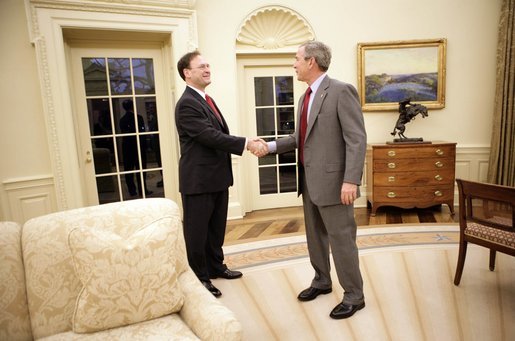
President George W. Bush and Judge Samuel A. Alito shake hands in the Oval Office of the White House Monday, Jan. 9, 2006, before breakfast in the Private Dining Room. Confirmation hearings for Judge Alito, President Bush's nominee for Associate Justice of the Supreme Court, were scheduled to begin today in Washington. White House photo by Eric Draper.President George W. Bush and Judge Samuel A. Alito shake hands in the Oval Office of the White House Monday, Jan. 9, 2006, before breakfast in the Private Dining Room. Confirmation hearings for Judge Alito,
President Bush's nominee for Associate Justice of the Supreme Court, were scheduled to begin today in Washington. White House photo by Eric Draper.

THE PRESIDENT: Good morning. I just had breakfast with Judge Alito. I told him I think he conducted himself with such dignity and class in the weeks leading up to the confirmation process, which begins today. Sam Alito is eminently qualified to be a member of the bench. I'm not the only person who feels that way -- the American Bar Association looked at his record, looked at his opinions, looked at his temperament, and came to the same conclusion, that he is well qualified to be a Supreme Court judge.

Sam's got the intellect necessary to bring a lot of class to that Court. He's got a judicial temperament necessary to make sure that the Court is a body that interprets the law and doesn't try to write the law. And so I'm looking forward to your hearings. I know the American people will be impressed, just like I have been impressed and a lot of other members of the Senate have been impressed.

And my hope, of course, is that the American people will be impressed by the process. It's very important that members of the Senate conduct a dignified hearing. The Supreme Court is a dignified body; Sam is a dignified person. And my hope, of course, is that the Senate bring dignity to the process and give this man a fair hearing and an up or down vote on the Senate floor.

Sam, good luck to you. Thanks for your agreement to serve. I appreciate you. Thank you.

END 7:53 A.M. EST, For Immediate Release, Office of the Press Secretary, January 9, 2006

more at
and or and or and

Related: Keywords Judge Alito, Monday, October 31, 2005
President Nominates Judge Samuel A. Alito (VIDEO), Thursday, September 29, 2005 Swearing-In Ceremony of Chief Justice Roberts (VIDEO, Wednesday, September 21, 2005 Leahy, YES on Roberts, Monday, September 05, 2005 Roberts Chief Justice (VIDEO), Wednesday, July 20, 2005 President After Meeting with Judge Roberts, Wednesday, July 20, 2005 John Roberts, Supreme Court, George Bush,

Sunday, January 08, 2006

Risky Sexual Behaviors in Miami, and Racial Influences on Children’s Care

New Research into Risky Sexual Behaviors in Miami, and Racial Influences on Children’s Care, in Journal of Urban Health: Bulletin of The New York Academy of Medicine, New issue of Journal also includes research into use by African Americans of the Internet to find health information.

NEW YORK CITY, Jan. 6 — The newest issue of the Journal of Urban Health: Bulletin of The New York Academy of Medicine includes a host of compelling research findings regarding risky sexual behavior in the vacation hotspot of Miami, racial influences on the quality of children's medical care, and willingness of African Americans to use the Internet to manage their diabetes. These studies are summarized below.

*As the winter vacation scene in South Florida heats up, new research in the Journal shows that risky sexual behaviors among gay men who live and vacation there is quite prevalent and that interventions are needed. South Florida annually hosts over 1.8 million gay and bisexual visitors and is home approximately 145,000 men who have sex with men (MSM).

Researchers conducted a cross-sectional study of recreational drug use and risky sexual behaviors among more than 400 MSM who live in or were vacationing in ten diverse locations in Miami-Dade and Broward counties in winter of 2004. They were approached on weekends and asked to complete a questionnaire. One-third of the men surveyed reported using one or more "club drugs" in the past year, a habit highly associated with unprotected anal intercourse. MSM who live outside of south Florida most often reported using cocaine and ketamine (a date rape drug also known as “Special K”) and engaging in unprotected receptive anal intercourse in the past month.

“Tourists may be even more likely than residents to engage in risky sexual behaviors and use certain recreational drugs,” said lead author William W. Darrow, PhD, of the Robert R. Stempel School of Public Health at Florida International University. “Interventions must be developed, implemented, and evaluated that take into account the unique characteristics of international resort areas.”

*Children whose pediatricians are of a different race/ethnicity do not receive lesser quality care, according to a new study in the current issue of the Journal. What is most important is that the child has a regular doctor, and this study finds that more than half of all young children do not. Past research has shown that adults receive better-quality care when their physicians are of the same race/ethnicity, but it was unknown whether this held true for children. The authors found the answer by examining data from the 2000 National Survey of Early Childhood Health, a telephone survey of about 2,000 Latino, white and African-American parents of children ages 4 months to 35 months.

No statistically significant difference was found in the basic preventive services received by children and their parents based on whether their pediatrician did, or did not, hail from the same racial/ethnic background. However, children who lacked a regular care provider had less “family-centered care,” in which a physician has a continuous relationship with the child and parents and therefore knows and understands them. African Americans and Latinos were most likely to lack a family pediatrician, the researchers found.

“Efforts to improve these aspects of well-child care might focus less on linking children with a pediatrician of the same race/ethnicity, and more on changing the social, cultural, and linguistic factors that keep children from having a regular provider,” said lead author Gregory D. Stevens, PhD, MHS, of the Division of Community Health at the University of Southern California Keck School of Medicine. “Without continuity of care, there may be more potential for parents and providers to rely on stereotypes and snap judgments during well-child care visits.”

Interestingly, African Americans and Latinos were found to be significantly less likely than whites to see a pediatrician from their racial/ethnic background, in part because of availability. Only 10 percent of pediatricians nationally were African American or Latino as of 2004.

*Although African Americans have been shown to use the Internet much less frequently than whites, a new study in the Journal documents that those with no computer skills are quite willing to learn. Those with Type 2 diabetes say they would be eager to use a computer program to manage their diabetes if it were provided free. This is an important finding because African Americans suffer disproportionately from Type 2 diabetes, which usually strikes in adulthood and can cause severe disabilities and even death if not properly controlled.

Researchers surveyed 457 African American adults with Type 2 diabetes (predominantly low-income women) via telephone to determine their frequency of Internet use. Forty percent of the participants reported having a computer at home and 46 percent reported knowing how to use one. The research team found that participants with less than a high school education were less likely to have a computer. Older participants, men, and non-high-school-graduates were least likely to know how to use a computer.

The good news is that two-thirds of those with no computer skills said they are willing to learn, and nearly all participants (89 percent) said they would use a computer program to manage their diabetes if it were offered free of charge. In addition, 82 percent of non-users reported that they had friends or family in the neighborhood who would probably let them use a computer. Furthermore, 38 percent of non-users said they would feel comfortable using a computer in a community center to search for health information. This suggests that adding computers in community settings can help reduce the digital divide between minorities and whites, said senior author Tiffany L. Gary, PhD, Assistant Professor in the Department of Epidemiology at Johns Hopkins University’s Bloomberg School of Public Health.

“The health status of Americans with chronic diseases such as Type 2 diabetes will depend upon the self-management capability of the patient, not solely the care of their doctors,” Gary said. “These data show promise for the willingness of African-Americans, an underserved population, to use computers and access health information using the Internet.”

(The Academy partners with several East Harlem community centers to teach consumers how to search online for health information. Contact the Academy Communications Office at 212.822.7285 for more information).

The New York Academy of Medicine, the country’s premier urban health policy and intervention center, focuses on enhancing the health of people living in cities through research, education, advocacy, and prevention. It is home to the second largest medical collection open to the general public in the United States.

Source:
The New York Academy of Medicine Posted on 01/05/2006.

Contact: Kathryn Cervino, Associate Director of Communications, 212.822.7285.

more at
or and or and or or and or

Related: Keyword biology, Tuesday, January 04, 2005
The Cassini-Huygens mission to Saturn, Sunday, March 20, 2005 Agriculture Secretary Mike Johanns, bovine spongiform encephalopathy (BSE), Thursday, March 24, 2005 Fish Oil Holds Promise in Alzheimer's Fight, Sunday, April 10, 2005 National Human Genome Research Institute (NHGRI), Friday, April 15, 2005 Study uncovers bacteria's worst enemy, Sunday, May 01, 2005 Yes, it is an exoplanet 2M1207 system, Friday, May 20, 2005 a polysaccharide called hyaluronan, Tuesday, May 24, 2005 pseudoneglect phenomenon, Friday, June 03, 2005 DOE JGI sequences DNA from extinct cave bear, Monday, June 06, 2005 From a Few Wild Ancestors, a Citrus Cornucopia, Tuesday, June 07, 2005 NHGRI Selects 13 More Organisms for Genome Sequencing, Sunday, July 24, 2005 Prehistoric Native Americans maize cultivation, Sunday, July 31, 2005 Protein 97 Synapse-associated (SAP97), Sunday, August 07, 2005 universal flu vaccine, Sunday, August 07, 2005 Smoking gun for Alzheimer's disease, Sunday, August 07, 2005 placental tissue, embryonic stem cells, Sunday, August 21, 2005 female senior faculty are still rare, Sunday, September 18, 2005 more rain would benefit New Orleans,

Saturday, January 07, 2006

Presidential Podcast 01/07/06

Presidential Podcast 01/07/06

Subscribe to My Odeo Channel Subscribe to Our Odeo Podcast Channel and receive the Presidential Radio Address each week. Featuring real audio and full text transcript

more at and or and , or and , or , and ,

Related: Keywords radio address, podxast, Saturday, December 31, 2005
Presidential Podcast 12/31/05, Saturday, December 17, 2005 bush radio address 12/17/05 full VIDEO, text transcript, Sunday, December 04, 2005 Presidential Podcast 12/03/05, Saturday, December 03, 2005 bush radio address 12/03/05 full audio, text transcript, November 26, 2005 Presidential Podcast 11/26/05, Saturday, November 26, 2005 bush radio address 11/26/05 full audio, text transcript, Saturday, November 19, 2005 Presidential Podcast 11/19/05, Saturday, November 19, 2005 Freedom Calendar 11/19/05 - 11/26/05, Saturday, November 12, 2005 Presidential Podcast 11/12/05, Saturday, November 12, 2005 bush radio address 11/12/05 full audio, text transcript, Saturday, November 05, 2005 Presidential Podcast 11/05/05, Saturday, November 05, 2005 bush radio address 11/05/05 full audio, text transcript, Saturday, October 29, 2005 bush radio address 10/29/05 full audio, text transcript, Saturday, October 22, 2005 Presidential Podcast 10/22/05, Saturday, October 15, 2005 Presidential Podcast 10/15/05, Saturday, October 08, 2005 bush radio address 10/08/05 full audio, text transcript, Saturday, October 01, 2005 bush radio address 10/01/05 full audio, text transcript, Saturday, September 24, 2005 bush radio address 09/24/05 full audio, text transcript, Saturday, September 17, 2005 bush radio address 09/17/05 full audio, text transcript

bush radio address 01/07/06 full audio, text transcript

bush radio address 01/07/06 full audio, text transcript PODCAST

President's Radio Address

THE PRESIDENT: Good morning. As we begin 2006, we are hearing more good news about the American economy. This week we learned that our economy added 108,000 jobs in December and has added over 400,000 jobs in the last two months. Our unemployment rate is now 4.9 percent, lower than the average rate of the 1970s, 1980s, and 1990s. Our economy grew at more than 4 percent in the third quarter of 2005, and it has been growing at nearly that rate for two years. Productivity is high, consumers are confident, and more Americans now own their homes than at any time in our Nation's history.

To keep our economy strong and secure the American Dream for future generations, leaders in Washington must make sound decisions. And one of the best decisions we made since I took office was to cut your taxes, so you could keep more of your hard-earned money to save and spend as you see fit. We lowered tax rates to let workers keep more of their paychecks. We doubled the child credit. We reduced the marriage penalty. We also cut taxes on dividends and capital gains, and we created incentives for small businesses to invest in new equipment so they could expand and create new jobs.

Some people in Washington said these tax cuts would hurt the economy. The day the House voted for tax relief in May 2003, one Democratic leader declared it a "reckless and irresponsible tax plan that will undermine opportunity in our country." Since those words were spoken, our economy has added more than 4.6 million new jobs for the American people.

Unfortunately, just as we're seeing new evidence of how our tax cuts have created jobs and opportunity, some people in Washington are saying we need to raise your taxes. They want the tax cuts to expire in a few years, or even repeal the tax cuts now. In either case, they want you to get a big tax hike. If we allow that to happen, a family of four making $50,000 would see their federal income taxes go up by nearly 50 percent.

Inaction by the Congress will mean a tax increase on the American people. When you hear people in Washington say we don't need to make the tax relief permanent, what they're really saying is they're going to raise your taxes. To keep our economy growing, we need to ensure that you keep more of what you earn, and Congress needs to make the tax cuts permanent.

Our economy is also strong because we've been wise with taxpayers' dollars. We've now cut the rate of growth in non-security discretionary spending each year I've been in office. Working with Congress, last year we ended or reduced about 90 low-priority or poorly performing government programs, cut non-security discretionary spending, and stayed on track to meet our goal of cutting the federal deficit in half by 2009.

The bigger challenge to our budget is long-term deficits driven by mandatory spending or entitlements. We can solve this problem: We do not need to cut entitlements, but we do need to slow their growth. When Congress returns from its recess, it has an opportunity to show its commitment to controlling entitlement spending. Before members of the House and Senate left Washington, they agreed to rein in future spending on entitlements by nearly $40 billion. Now Congress needs to finish its work on this important bill. By passing the first reduction in the growth of entitlement spending in nearly a decade, Congress will send a clear signal that the people's representatives can be good stewards of the people's money.

As we work to keep your taxes low and restrain federal spending, we have other challenges to address. A growing economy requires secure and affordable sources of energy, free and fair trade, legal reform and regulatory reform, and a health care system where workers can find affordable care. And we must ensure that all Americans get a good education, so they will have the skills they need for the jobs of the 21st century.

In the months ahead we will work on all these issues. By making choices that reward hard work and enterprise, we will keep the American economy prosperous and strong and guarantee opportunity for generations to come.

Thank you for listening.

END For Immediate Release, Office of the Press Secretary, January 7, 2006

more at
and or and , or and , or , and ,

Related: Keywords radio address, podxast, Saturday, December 31, 2005
bush radio address 12/31/05 full audio, text transcript, Saturday, December 24, 2005 bush radio address 12/24/05 full audio, text transcript, Saturday, December 17, 2005 bush radio address 12/17/05 full VIDEO, text transcript, Sunday, December 04, 2005 Presidential Podcast 12/03/05, Saturday, December 03, 2005 bush radio address 12/03/05 full audio, text transcript, November 26, 2005 Presidential Podcast 11/26/05, Saturday, November 26, 2005 bush radio address 11/26/05 full audio, text transcript, Saturday, November 19, 2005 Presidential Podcast 11/19/05, Saturday, November 19, 2005 Freedom Calendar 11/19/05 - 11/26/05, Saturday, November 12, 2005 Presidential Podcast 11/12/05, Saturday, November 12, 2005 bush radio address 11/12/05 full audio, text transcript, Saturday, November 05, 2005 Presidential Podcast 11/05/05, Saturday, November 05, 2005 bush radio address 11/05/05 full audio, text transcript, Saturday, October 29, 2005 bush radio address 10/29/05 full audio, text transcript, Saturday, October 22, 2005 Presidential Podcast 10/22/05, Saturday, October 15, 2005 Presidential Podcast 10/15/05, Saturday, October 08, 2005 bush radio address 10/08/05 full audio, text transcript, Saturday, October 01, 2005 bush radio address 10/01/05 full audio, text transcript, Saturday, September 24, 2005 bush radio address 09/24/05 full audio, text transcript, Saturday, September 17, 2005 bush radio address 09/17/05 full audio, text transcript

Freedom Calendar 01/07/06 - 01/14/06

January 7, 1922, Death of Republican Jonah Kalanianaole, native Hawaiian who served as Delegate in U.S. Congress for 19 years.

January 8, 1867, Republicans override Democrat President Andrew Johnson’s veto of law granting voting rights to African-Americans in D.C.

January 9, 1890, Death of abolitionist and U.S. Rep. William Kelley (R-PA), outspoken advocate of equality for African-Americans.

January 10, 1878, U.S. Senator Aaron Sargent (R-CA) introduces Susan B. Anthony amendment for women’s suffrage; Democrat-controlled Senate defeated it 4 times before election of Republican House and Senate guaranteed its approval in 1919.

January 11, 2001, Republican Elaine Chao, first Asian-American woman to hold a cabinet position, nominated as U.S. Secretary of Labor.

January 12, 1956, Jewish Republican Simon Sobeloff, who as U.S. Solicitor General argued President Eisenhower’s position against segregation in Brown v. Board of Education, appointed to U.S. Court of Appeals 13

January 13, 2003, Jennette Bradley (R-OH) becomes first African-American woman to be Lt. Governor of a state.

January 14, 1975, Republican William T. Coleman nominated as first African-American to be U.S. Secretary of Transportation.

"I joined for different reasons. I found a party that sees me as an individual, not as part of a group. I found a party that puts family first. I found a party that has love of liberty at its core. And I found a party that believes that peace begins with strength.”

“It’s that expression of the individual and a willingness to put the educational opportunities before me that led to who I am. Who you are is who you are as an individual.”

Condoleezza Rice Secretary of State

SOURCE:
Republican Freedom Calendar more at and or and or and or and or

Related: Keywords Freedom Calendar, Saturday, December 31, 2005
Freedom Calendar 12/31/05 - 01/07/06, Saturday, December 24, 2005 Freedom Calendar 12/24/05 - 12/31/05, Saturday, December 17, 2005 Freedom Calendar 12/17/05 - 12/24/05, Saturday, December 10, 2005 Freedom Calendar 12/10/05 - 12/17/05, December 03, 2005 Freedom Calendar 12/03/05 - 12/10/05, Saturday, November 26, 2005 Freedom Calendar 11/26/05 - 12/03/05, Saturday, November 19, 2005 Freedom Calendar 11/19/05 - 11/26/05, Saturday, November 12, 2005 Freedom Calendar 11/12/05 - 11/19/05, Saturday, November 05, 2005 Freedom Calendar 11/05/05 - 11/12/05, Saturday, October 29, 2005 Freedom Calendar 10/29/05 - 11/05/05, Saturday, October 22, 2005 Freedom Calendar 10/22/05 - 10/028/05, Saturday, October 15, 2005 Freedom Calendar 10/15/05 - 10/022/05, Thursday, September 29, 2005 The Opelousas Massacre, Saturday, October 08, 2005 Freedom Calendar 10/08/05 - 10/015/05 , Saturday, October 01, 2005 Freedom Calendar 10/01/05 - 10/08/05, Saturday, September 24, 2005 Freedom Calendar 09/24/05 - 10/01/05, Saturday, September 17, 2005 Freedom Calendar 09/17/05 - 09/24/05, Saturday, September 10, 2005 Freedom Calendar 09/10/05 - 09/17/05

Friday, January 06, 2006

Vice President's Remarks on Iraq and the War on Terror (VIDEO)

Vice President's Remarks on Iraq and the War on Terror, FULL STREAMING VIDEO, The Heritage Foundation, Washington, D.C. 2:41 P.M. EST

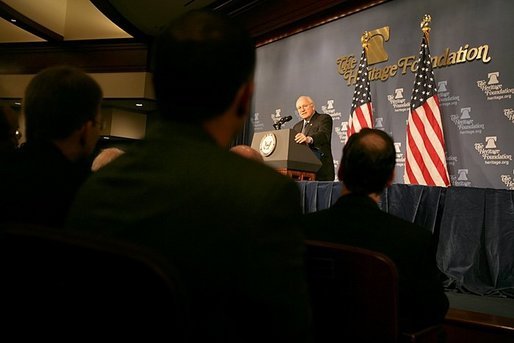
Vice President Dick Cheney remarks on the global war on terror during a speech at the Heritage Foundation in Washington, Wednesday January 4, 2006. White House photo by David BohrerVice President Dick Cheney remarks on the global war on terror during a speech at the Heritage Foundation in Washington, Wednesday January 4, 2006. White House photo by David Bohrer
THE VICE PRESIDENT: Well, thank you all very much. (Applause.) Thank you. Well, thank you very much and thank you for the warm welcome. It's great to be back at Heritage. In 2006 Heritage will mark its 33rd anniversary, and in all these years this has been one of the leading think tanks in the country. The Foundation has been a place of sound ideas, of intellectual leadership, and first-rate scholarship. Your standards have never wavered. You've made a tremendous contribution to the debate in this city and the nation. And you've earned the respect and the appreciation of all of us who are privileged to serve in public office.

As always when I pay a visit, I notice a number of old friends in the room. It's good to see all of you, and it looks like everybody pretty well recovered from their New Year's celebrations.

For my part, I came back to town on Sunday, after spending the holidays back home in Wyoming with Lynne and our family. Just prior to Christmas, as most of you know, I made a trip out to the Middle East, to Iraq, Afghanistan, Pakistan, Oman. Our plan was to make several other stops, as well. And then we got word that the Senate was headed for a close vote on the deficit reduction package, and that I might be needed to break a tie. Since breaking ties is about the only real job given me by the Constitution, I decided I'd better hurry back. (Laughter.) And it was worth it because my vote did turn out to be necessary. And the great thing about it is -- every time I vote, our side wins. (Laughter and applause.)

Even though we had to cut the trip a little short, it was a tremendous experience to go to the broader Middle East and to stand on the ground of two new democracies. In Afghanistan, we witnessed the first full session of their newly elected Parliament -- a significant event in any country, but one that was -- had special meaning in a nation that just over four years ago was in the grip of a cruel dictatorship. I met, as well, with one of the great men of the age, President Hamid Karzai, who has led his country with courage and character from day one. At Bagram Air Base outside Kabul,

I received briefings on the ongoing efforts against the terrorists who still threaten the Afghan people, and had a chance to thank the men and women stationed there. There's still tough fighting going on in Afghanistan, some of it in very rough terrain, high in the mountains and along border areas. Our people are getting the job done, together with coalition partners and an increasingly strong and professional Afghan military. And this young century is turning out to be a time of promise in Afghanistan -- with a stable democracy, a market economy, equality for women, and millions of children going to school for the very first time. It's impossible to overstate all that our coalition has achieved in Afghanistan -- and when our forces return home from that part of the world, they can be proud of the service they've rendered for the rest of their lives.

was pleased to convey that message in person to our troops at Christmastime -- not just in Afghanistan, but in Iraq, as well. And on that leg of the journey, I stopped at Baghdad to see the President and the Prime Minister, went over to Taji Air Base, where Americans are training Iraqis, and finally to Al Asad Air Base, where our military's main staging ground is west of Baghdad. And here again, we see exemplary work by the men and women of our military, within an area of operations the size of Utah. They have scored daily victories -- even hourly victories. In the western Euphrates River valley, all the way up to the Syrian border, they have scored -- they've secured crossing points, destroyed enemy weapons caches, and cleared urban areas of terrorists.

Our coalition has also put tremendous effort into standing up the Iraqi security forces, and we've come a great distance over the past year. More and more, coalition forces have Iraqis at their side, helping to clear out terrorists, and then staying in the area to maintain the peace. We're helping build an Iraqi force that is sharp and well equipped, and this was vital to the success of last month's elections. There are over 100 Iraqi combat battalions fighting the terrorists, along with our forces today. More than a dozen military bases our coalition used to occupy have been turned back to the Iraqis. Gradually, Iraqi forces are taking control of more and more territory, and as they undertake further missions on their own, confidence is growing within the country and more intelligence tips are coming in from the Iraqi people themselves.

As the Iraqi army gains strength and experience, and as the political process advances, we'll be able to decrease troop levels without losing our capacity to defeat the terrorists. And as President Bush has made very clear, any decisions about troop levels will be driven by conditions on the ground and by the judgment of our commanders -- not by artificial timelines set by politicians here in Washington, D.C. (Applause.)

We will stand firmly with Iraq's leaders as they establish the institutions of a unified and a lasting democracy. On the political track, every benchmark has been met successfully -- starting with the turnover of sovereignty a year and a half ago, national elections last January, the drafting of the constitution last summer, and the ratification of that constitution by voters in October, and, of course, most recently, the election of a new government under that constitution in December. The political leaders of Iraq are steady. They're courageous, and the citizens, police and soldiers of that country have proudly stepped forward as active participants and guardians in a new democracy -- running for office, speaking out, voting and sacrificing for their country. When I met with Prime Minister Jaafari in Baghdad, he pointed the voter turnout figures for the national elections, three of them in 2005 -- around 59 percent in January, some 63 percent in October, and approximately 70 percent turnout in December. Iraqi citizens have done all of this despite threats from terrorists who offer no political agenda for Iraq's future, and wage a campaign of mass slaughter against the Iraqi people themselves, the vast majority of whom are fellow Muslims.

Day after day, month after month, Iraqis have proven their determination to live in freedom, to chart their own destiny, and to defend their country. And they can know that the United States will keep our commitment to them. We will continue the work of reconstruction. Our forces will keep going after the terrorists, and continue training the Iraqi military, so that Iraqis can eventually take the lead in their country's security and our men and women can come home. We will succeed in this mission, and when it is concluded, we will be a safer country here in the United States, as well.

As always, the people of our armed forces are the ones at the tip of the spear. And we are not a country that takes its military for granted. We are a democracy, defended by volunteers who deserve all the tools and all the support we can provide them. Americans appreciate every man and woman who goes out on long deployments, endures the hardship of separation from home and family, fellow citizens who wear heavy armor when the thermometer hits 125 degrees, work seven days a week, often 14,16,18 hours a day. We stand in total admiration when we learn of soldiers, airmen, Marines, and Navy corpsmen that expose themselves to heavy fire to assist wounded comrades, or when we learn of a lance corporal who came on a burning vehicle with an unconscious Marine inside -- with his bare hands he tore open the air conditioner assembly so he could pull his comrade to safety. The people in our military today are some of the bravest men and women this nation has ever produced. (Applause.)

Lately our forces in Iraq have been receiving some mixed signals out of Washington, and they might have been wondering whether America has what it takes to stay in the fight. I assured them that the American people do not support a policy of passivity, resignation, or defeatism in the face of terror. If we have learned anything in the last 25 years -- from Beirut, to Somalia, to the USS Cole -- it is that terrorist attacks are not caused by the projection of force; they are invited by the perception of weakness. And this nation made a decision: We will never go back to the false comforts of the world before September 11th, 2001. We will engage these enemies with the goal of victory. And with the American military in the fight, that victory is certain. (Applause.)

The President and I believe that the victory of freedom in Afghanistan and Iraq will be an inspiration to democratic reformers in other lands. In the broader Middle East and beyond, America will continue to encourage free institutions, individual liberty, and tolerance because these are the ideas and the aspirations that overcome ideologies of terror and violence and can turn societies to the pursuit of peace. And as the peoples of that region experience new hope, progress, and control over their own lives, we will see the power of freedom to change our world and a terrible threat will be removed from the lives of our children and our grandchildren.

Wartime conditions are, in every case, a test of military skill and national resolve. But this is especially true in the war on terror. Four years ago, President Bush told Congress and the country that the path ahead would be difficult, that we were heading into a long struggle, unlike any we have ever known. All this has come to pass. We have faced, and are facing today, enemies who hate us, who hate our country, and who hate the liberties for which we stand. They dwell in the shadows, wear no uniform, and have no regard for the laws of warfare, and feel unconstrained by any standard of morality. We've never had a fight like this -- and those of us in positions of responsibility have a duty to wage a broad-scale effort for the sake of the nation's freedom and our security.

That effort includes a home front, with a great deal of urgent and difficult work and needed to persevere. In his speech to Congress after 9/11, President Bush said that the United States would, and I quote, "direct every resource at our command -- every means of diplomacy, every tool of intelligence, every instrument of law enforcement, every financial influence, and every necessary weapon of war -- to the disruption and to the defeat of the global terror network." The Congress of the United States backed him up in full, authorizing the President to defeat an enemy that had already slipped into our country and waged a horrific attack that killed 3,000 innocent, unsuspecting men, women, and children on 9/11.

The President also signed the Patriot Act, which removed the artificial barrier that used to exist between law enforcement and intelligence, and gave federal officials the ability to pursue terrorists with the tools they already use against drug traffickers and other kinds of criminals. There was no need for a tie-breaking vote on the Patriot Act, because the Senate passed it 98 to one. (Applause.)

That law has helped us to disrupt terrorist activity, to break up terror cells within the United States, and to protect the lives of Americans. We look forward to a renewal of the Patriot Act in 2006, because that law has done exactly what it was intended to do, and this country cannot afford to be without its protections.

Another vital step the President took in the days following 9/11 was to authorize the National Security Agency to intercept a certain category of terrorist-linked international communications. There are no communications more important to the safety of the United States than those related to al Qaeda that have one end in the United States. If we'd been able to do this before 9/11, we might have been able to pick up on two hijackers who subsequently flew a jet into the Pentagon. They were in the United States, communicating with al Qaeda associates overseas. But we did not know they were here plotting until it was too late.

If you recall, the report of the 9/11 Commission focused criticism on our inability to cover links between terrorists at home and terrorists abroad. The authorization the President made after September 11th helped address that problem in a manner that is fully consistent with the constitutional responsibilities and legal authority of the President and with the civil liberties of the American people. The activities conducted under this authorization have helped to detect and prevent possible terrorist attacks against the American people. As such, this program is critical to the national security of the United States.

It's important to note that leaders of Congress have been briefed more than a dozen times on the President's authorization, and on activities conducted under it. I have personally presided over most of those briefings. In addition, the entire program undergoes a thorough review within the executive branch approximately every 45 days. After each review, the President determines whether to reauthorize the program. He has done so more than 30 times since September 11th -- and he has indicated his intent to do so as long as our nation faces a continuing threat from al Qaeda and similar organizations.

The existence of this program was highly classified, and information about it was improperly provided to the news media, to the clear detriment of our national security. There will now be a spirited debate about whether this program is necessary and appropriate, and the position of our administration will remain clear and consistent. Number one, these actions taken are necessary. Number two, these actions are totally appropriate and within the President's authority under the Constitution and laws of the country. Number three, this wartime measure is limited in scope to surveillance associated with terrorists; it is carefully conducted; and the information obtained is used strictly for national security purposes. And number four, the civil liberties of the American people are unimpeded by these actions.

Let me dwell on that last point for a minute. I was in Washington in the 1970s, at a time when there was great and legitimate concern about civil liberties and about potential abuses within the executive branch. I had the honor of serving as White House Chief of Staff to President Ford, and that experience shapes my own outlook to this very day.

Serving immediately after a period of turmoil, all of us in the Ford administration worked hard to restore people's confidence in the government. We were adamant about following the law and protecting civil liberties of all Americans, and we did so. Three decades later, I work for a President who shares those same values. He has made clear from the outset, both publicly and privately, that our duty to uphold the law of the land admits no exceptions in wartime. The President himself put it best: He said, "We are in a fight for our principles, and our first responsibility is to live by them."

The American people can be certain that we are upholding those principles. They can be equally certain that our administration will continue to defend this nation to the very best of our ability. As we get farther away from September 11th, some in Washington are yielding to the temptation to downplay the ongoing threat to our country, and to back away from the business at hand. This is perhaps a natural impulse, as time passes and alarms don't sound. All of us are grateful that our nation has gone four years and four months without another 9/11. Obviously, no one can guarantee that we won't be hit again. But neither should anyone say that the relative safety of the last four years was an accident. America has been protected not by luck but by sensible policy decisions, by decisive action at home and abroad, and by round-the-clock efforts on the part of people in law enforcement, intelligence, the military, and homeland security.

The enemy that struck on 9/11 is weakened and fractured yet it is still lethal and trying to hit us again. Either we are serious about fighting this war or we are not. And as long as George W. Bush is President of the United States, we are serious -- and we will not let down our guard. (Applause.)

All of us know that crucial debates lie ahead, just as we know that the New Year will bring its own set of challenges to our nation. And when those challenges come, America will have the resources, the resolve, and the character to meet them all. The more you know about this country, and the more you travel and see what we've been able to achieve in this troubled world, you cannot help but grow in optimism, and, yes, in pride, as well.

On the final day of that trip abroad last month, we visited Pakistan. After meeting with President Musharraf, our delegation boarded the helicopters and headed to the earthquake-stricken area, in the foothills of the Himalayas in northern Pakistan. On the ground below, across some of the most rugged territory you've ever laid eyes on, were the remnants of entire villages that were utterly destroyed in a 7.6 earthquake that killed upwards of 70,000 people. After that quake hit, President Bush ordered units of our military to go in and help, and within 48 hours Americans were on the scene, and had begun airlifting thousands of tons of equipment and supplies.

It was up in those mountains that the U.S. Army set up a MASH unit, a mobile hospital, with sophisticated medical supplies, military physicians, nurses, and physician assistants, and even some volunteer doctors from the United States. Lynne and I went to that tent village. And I can tell you, it's quite a feeling to stand in the remotest hinterlands and see the American flag, and citizens of our country giving aid to the desperate, including medical care to some people who had never seen a doctor before in their entire lives.

These are extraordinary accomplishments -- and yet they are so typical of Americans -- and so very much in the spirit of our country. The United States is a good, a decent and a generous land. We are a nation that believes in ideals, upholds them in our own country, and acts on them in the world beyond. From providing more global food aid, by far, than any other nation, to supporting life-saving treatments for hundreds of thousands of Sub-Saharan Africans living with HIV/AIDS, to standing with freedom-loving peoples in the struggle against tyranny and terror, we are doing great good in this world. And in 2006 and beyond, we will do even more as we serve humanity and justice, individual dignity, the rights of mankind, and the cause of liberty.

Thank you very much. (Applause.)

END 3:03 P.M. EST, For Immediate Release, Office of the Vice President, January 4, 2006

more at
and or and or and or or and or and or and or and or

Relared: Thursday, November 17, 2005
Vice President's Remarks 11/16/05, Monday, October 31, 2005 Vice President appointed David S. Addington chief of staff, Saturday, October 29, 2005 Vice President's Statement on Libby Resignation, Friday, October 28, 2005 Resignation of Scooter Libby (VIDEO, Tuesday, October 04, 2005 Remarks by the Vice President to Second Marine Expeditionary Force, Monday, September 26, 2005 Statement on Vice President Cheney's Medical Procedure, Tuesday, September 06, 2005 President Meets with Cabinet (VIDEO), Thursday, August 11, 2005 President Meets with Defense and Foreign Policy Teams (VIDEO), Tuesday, July 26, 2005 Vice President at Dinner for Vito Fossella, Saturday, July 09, 2005 President, VP Signs Book of Condolence at British Embassy, Thursday, May 12, 2005 Vice President, A Nation Honors Nancy Reagan, Saturday, April 16, 2005 Vice President Dick Cheney and Mrs. Cheney Release 2004 Income Tax Return