Daily Press Briefing, Sean McCormack Spokesman, file is MP3 for PODCAST, running time is 40:44 , Washington, DC, January 23, 2006
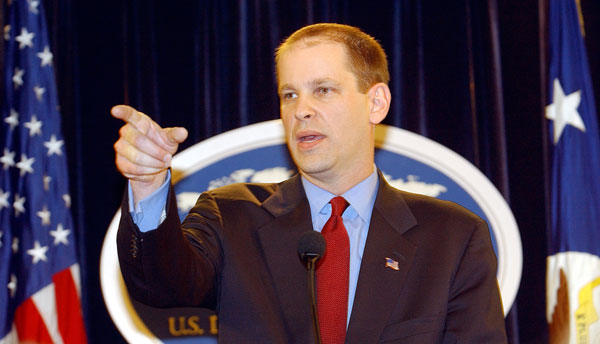 | Department Spokesman Sean McCormack (shown during the Daily Press Briefing) was sworn in as Assistant Secretary for Public Affairs and Department Spokesman on June 2, 2005. Immediately prior to returning to the State Department, |
TRANSCRIPT: 2:27 p.m. EST
MR. MCCORMACK: Good afternoon. How is everybody? How was everybody's weekend? It's all right. Good. Excellent. Sorry, Teri, I don't want to disturb your conversation. (Laughter.) Okay. All right. We'll give you a review later.
I don't have any opening statements, so we can jump right in to Barry Schweid's first question.
QUESTION: Sean, when the Secretary said that Iran, on the one hand, should be referred to the Security Council; on the other hand, she spoke of not acting necessarily right away. What -- could you fill in the space?
MR. MCCORMACK: Well, I think she did when she talked about -- the space that you're talking about, she talked about the fact that we all believe in the international community that there is a possibility for a diplomatic solution to the current situation in which Iran has put itself in the international community. And our hope is that once Iran is referred to the Security Council, that that provides a context in which a diplomatic solution can be found.
Currently, they have rebuffed the attempts of the EU-3 has well as others to find a diplomatic solution to the issue. And the issue very simply is they are trying to build a nuclear weapon under the cover of a civilian nuclear program. So the question before the international community is how to deal with that? And the EU-3 has made an attempt; their negotiations reached a dead end. The IAEA has repeatedly asked Iran for information about its nuclear program. Those requests for information have, time after time after time, been met with silence or obfuscation.
So we now find ourselves in the position of having an emergency IAEA Board of Governors meeting on February 2nd, at which time the Board of Governors will vote to refer Iran to the Security Council. We hope that that next phase of the diplomacy -- Iran finding itself before the Security Council, an action which it has sought to avoid vigorously over the past several years, will provide the needed diplomatic context so that we can arrive at a diplomatic solution. So that's the blank that you were talking about, Barry. But I think if you look back at the transcript, the Secretary did say just that.
On Iran?
QUESTION: Are you -- yeah, it is on Iran. Are you disappointed that the IAEA will not provide a fuller accounting of Iran's nuclear activities at the February 2nd meeting, which is what you were hoping for? And also, secondly, did the Secretary speak to the Chinese and the Russians over the weekend and where do they stand at the moment in terms of referral?
MR. MCCORMACK: Over the weekend, no, on both of those.
QUESTION: Today?
MR. MCCORMACK: No. Nope, did not speak with either of those foreign ministers.
On your first question about the report from Director General ElBaradei or from the IAEA, we asked for a written report. We had hoped that there would be a written report, but I understand that there will be some conveyance of the information to the Board of Governors. I don't know if that's going to be an informal oral briefing or what form it will take, but the important part is that there will be some series of findings as to where we stand right now with Iran for the Board of Governors. I think that's very useful. It will be very helpful in helping the various states on the Board of Governors make their decision about how they'll vote. But as we've said before, we believe we have the votes for a referral.
So while we would have preferred and would have thought appropriate a written report from the IAEA, I think that the Board of Governors will have the benefit of hearing from the IAEA, whether that's from the Director General or one of his assistants about where the IAEA stands now in its investigation.
QUESTION: Do you think that this really amounts to the (inaudible) of holding back on providing full information on Iran? They want to sort of stall any action? Would you perceive that --
MR. MCCORMACK: No, that's not how I'd characterize it.
Yes.
QUESTION: If I could come back to -- go back to Barry's question. If -- do we have to understand that there could be a referral and then a delay of, say, several weeks during which there could be space for negotiation? And then the Security Council would be -- would actually meet, gather on the Iranian issue?
MR. MCCORMACK: Well, at this point, we're not going to lay out any particular timeline as to what might happen once the issue goes to the Security Council. Those are some of the discussions that we're having right now with other members of the IAEA Board of Governors, as well as other members of the Security Council. So as the Secretary talked about, we believe that we have the votes for a referral and we're now talking with other members of the Security Council about what might be the appropriate next steps, so I'm not going to prejudge at this point in time what those next steps might be.
Now, as for some potential diplomatic solution once Iran has arrived at the Security Council, of course that's what we hope for. But quite frankly, the ball is in the Iranians' court on that score. They are the ones that have been found in noncompliance with their IAEA obligations. They are the ones that have broken their promises to the EU-3 in terms of resuming conversion activities, in terms of resuming enrichment-related activities.
So the Iranians, at this point -- the Iranian regime, at this point, has eroded the trust of the international community to the point at which it's barely visible. That is why the Iranian regime finds itself on the verge of being referred to the Security Council, because time after time they have not lived up to their obligations under the Nonproliferation Treaty. They talk about their rights. They talk about their rights to civilian peaceful nuclear purposes. That's not what is the debate here. The debate is whether or not they have lived up to their obligations. And at this point, the judgment of the international community is that they have not.
So as to whether at some future point the regime decides that it is going to in good faith live up to its obligations and provide objective guarantees that it will live up to its obligations, then certainly I think the world will take a look at what is the possible diplomatic solution. But at this point, they have not demonstrated that willingness.
QUESTION: Sean, on Iran.
MR. MCCORMACK: Yes.
QUESTION: Under Secretary Burns was in Delhi. He had discussions with a number of officials, including, I understand, the Prime Minister of India. Where does India stand because India's vote at the IAEA in Vienna is very important as far as Iran's case to the UN Security Council is concerned? So do we know where India stands now at this final vote?
MR. MCCORMACK: Well, you're asking the wrong guy, Goyal. You should be asking the spokesman for the Indian Government as to where they stand on their vote.
QUESTION: They are not commenting.
MR. MCCORMACK: And you're asking me to comment on their behalf when they're not going to comment? That's not fair, Goyal.
QUESTION: I mean, does Secretary have any -- has any kind of assurance from India, let's say, -- during her -- any conversations with (inaudible)?
MR. MCCORMACK: What we understand from the Indian Government is that they take this issue very seriously. You know, we understand that they take it seriously. Under Secretary Burns has heard from the Indian Government. In that regard, Secretary Rice and her conversations over the past months on this topic with the Indian Government has taken away that impression as well.
They did at the last Board of Governors meeting vote to find Iran in noncompliance with its treaty obligations. I think all the members of the Board of Governors who voted in a like manner appreciated India stepping up and voting with them on this issue. It is a serious matter. And but -- as for how India might vote at this Board of Governors meeting or in other fora down the line, I'm not going to speak on behalf of the Indian Government. But we certainly appreciate their willingness to discuss this issue in a serious and forthright manner with us, as well as others.
Teri.
QUESTION: Iran has said this morning that a referral will make it put even more effort into moving forward to a full enrichment program. Does that cause you any concern and do you think that this kind of threat would lead other countries possibly to fall back from completely supporting a referral --
MR. MCCORMACK: Well, this has been the Iranian regime's tactic for quite some time. What they have been -- if you look back at the arc of their diplomatic efforts, say they have attempted to obfuscate the issue and where they can't obfuscate the issue, they attempt to face down the international community with a variety of threats. I think you have heard from every corner of the international community that the time has come for the international community to unite and to speak to Iran in a unified voice, that their actions, the actions of this regime are not acceptable. It is not acceptable to go back on your obligations, international treaty obligations. It is not acceptable to go back on the obligations you have given to your negotiating partners.
If those actions are taken, there will be consequences for those actions in the diplomatic arena. That is what the world is telling Iran. You just heard it from Foreign Minister Fini not two hours ago that Italy, despite the fact that they enjoy very strong trade relations with Iran, they have a lot at stake, but they understand that this issue is serious enough that they support referral to the Security Council because they want to find a diplomatic way out. And that's what the United States, working with the international community, is working on.
But let me just add one more point and that is the Iranian people need to understand that the actions of the international community and the way that we are talking about this issue is not meant to cast the Iranian people in a negative light. The reason why Iran finds itself in the position that it does right now is because this regime has chosen to confront the international community in a way that says we don’t' have to abide by our international obligations. And the international community in good faith has offered a variety of possible solutions. I don't know if the Iranian people are fully aware of what has been offered them. I don't know if the Iranian people know that the EU-3 and the Russian Government have gone to them with ways in which they could realize their desire for peaceful nuclear energy while giving objective guarantees to the international community that those technologies and that know-how won't be used to develop a nuclear weapon. That's what has been offered the Iranian regime, and the Iranian regime has rejected those offers. So we'll see what happens at the next step, and we believe that is going to be referral to the Security Council in early February.
QUESTION: Change of subject?
MR. MCCORMACK: No, I think we have more, more on Iran. Yeah.
QUESTION: The fact that Mohamed ElBaradei is not going to produce his report, isn't that -- I mean, doesn't this give other countries the excuse to say this matter has not been resolved yet, we must wait to see what he says? In other words, give more time. I mean, are you prepared to accept that there will be countries who will ask for more time on this issue, who want to see his final report before making a judgment?
MR. MCCORMACK: Well, I think that the international community has seen plenty enough proof that Iran is attempting to face down the international community. They're betting on the fact that through use of threat that they are going to be able to avoid answering the long list of questions that are before them. And it's not as if these questions have just popped up. These questions have been before the Iranian regime for quite some time, and time after time the Iranian regime has made the conscious decision not to answer those questions. And in fact, in the course of further investigations, more questions have come up as the IAEA digs further and further into what the Iranian Government is really up to in its nuclear programs.
So it's not as though the list of questions here is getting smaller. It's actually getting bigger. So I think that at this point the international community has proof aplenty about the fact that Iran -- it is time to refer Iran to the Security Council based on its actions and based on the fact it hasn't complied with its international obligations, based on the fact that it has not engaged the international community in good faith on this issue.
QUESTION: Secretary Rice earlier today met with the Secretary General of the Turkish National Security Council. How does the United States view Turkey's position on Iran, and what else was discussed?
MR. MCCORMACK: They did touch on the issue of Iran. They talked about a variety of other issues as well. They touched on the Cyprus issue. They touched on Iraq. They touched on Turkey-EU relations. They did talk a little bit about Iran.
I'll let the Turkish Government speak about their views of Iran, but I think that certainly Iran's pursuit of a nuclear weapon is a source of concern to the Turkish Government, as it is as source of concern to all of Iran's neighbors as well as the rest of the world. Introduction of an Iranian nuclear weapon into the region would be a very destabilizing act.
QUESTION: Can I follow up on --
QUESTION: Well --
MR. MCCORMACK: We'll get to you. We'll get to you.
QUESTION: You said the international community has enough proof that it doesn't need this full report to make a decision on February 2nd, but from your conversations with allies on the Board of Governors, for example, do they feel that they have enough proof or is it your assessment that they have --
MR. MCCORMACK: As I said -- look, we will get -- we will, I'm certain, get a more complete report from the Director General at some point down the line, maybe at the scheduled March meeting of the IAEA Board of Governors. But we have said repeatedly, for quite some time, that we have the votes to refer Iran to the Security Council, and that would indicate that those countries, those members of the Board of Governors, are satisfied that they have reason enough at this point, without any further report, to refer Iran to the Security Council.
Anything else on Iran?
QUESTION: Yeah. Do you have the votes at the Security Council to act on Iran?
MR. MCCORMACK: Well, right --
QUESTION: You keep -- you know, the confidence that you have the votes. Will you have the votes --
MR. MCCORMACK: For referral.
QUESTION: -- to discuss it --
MR. MCCORMACK: Right.
QUESTION: That doesn't strike me as -- and delay, that doesn't strike me as a very hard --
MR. MCCORMACK: Well, I'm not using the word "delay," Barry. I've seen that pop up in a lot of news stories. But --
QUESTION: I'm saying delay only because she is saying action may not be taken right away. That to me --
MR. MCCORMACK: Well, what the Secretary of State has said is that -- and I'm paraphrasing here. You can go back and look at the transcript -- previous transcripts -- is that she did not believe that sanctions would be the first action taken. That doesn't mean there would be an absence of action. What that means is that we are currently discussing what action to take, once we get to the Security Council, so that's a matter of diplomacy. I expect that it will be a topic of discussion this week as well as next.
QUESTION: So if we don't -- if there's no decision on what action, I guess, it's not a fair question to ask if you have the votes, right?
MR. MCCORMACK: Well, then, you know --
QUESTION: I'd have to have a specific course of action to know if you have the votes.
MR. MCCORMACK: Well, it's starting to become a tautological conversation here.
QUESTION: Yeah. Exactly.
MR. MCCORMACK: Yeah. Okay.
All right. Joel.
QUESTION: Sean, on Friday, you commented about Sudan's rotation to the AU chair and last week both Kenneth Roth of Human Rights Watch roundly condemn the Sudanese and he also -- yesterday Parade magazine just featured a cover story with the ten worst dictators throughout the world. And Umar al-Bashir led that list out of some twenty. And by contrast, the Iranians are only ninth on that list as the worst. Why are you so lukewarm in your condemnation and not even more stringent?
MR. MCCORMACK: Well, I think in terms of our attempts to get to a solution in Sudan concerning the various issues there, the humanitarian crisis, the security issues, as well as a political solution are well known. Secretary Rice has been there. Deputy Secretary Zoellick has been there numerous times. In terms of who is going to assume the presidency of the AU, that is currently a matter that is under discussion right now among the leaders of the AU who are now meeting in Khartoum. We have talked about the fact that it does seem to be a bit of a contradiction that you have -- you would have a country as president of an organization that is currently in that country in order to prevent violence perpetrated in part, we would believe, by the government. So that's the situation that we think that is worthy of discussion among the leaders of the AU and I understand from reports that we have from Khartoum that it is a matter of discussion among the AU that they take addressing that issue seriously. We'll see what they decide. It's going to be up to them whether they decide Sudan should take the presidency of the AU.
QUESTION: Same subject? Sean, but if they did -- if the AU did decide that Sudan deserved to be head of the organization for now, would it impact the United States cooperation with the AU? You've provided a lot of underwriting for their missions in Sudan. Do you think that would impact your cooperation?
MR. MCCORMACK: We'll see what the AU decides.
QUESTION: Change of subject?
MR. MCCORMACK: Okay. Same subject.
QUESTION: Has the Secretary spoken to the Sudanese at all about this and asked them to drop their bid because there have been several meetings in Khartoum? I just wondered whether she made any sort of personal --
MR. MCCORMACK: She has -- she did talk to the South African Foreign Minister earlier about this issue. Assistant Secretary Frazer is engaged on this issue. She is in the region right now. So we are working with -- well, not working with -- talking to other members of the AU about this issue. But ultimately, we don't have a vote around the table. They're going to have to be the ones who decide how they address the issue.
Okay. All done on Sudan? Okay, yes, ma'am.
QUESTION: Slovenian President Janez Drnovsek visited UN headquarters last week and the initiative about Sudan, so I would like to ask how's the position of your government on that.
MR. MCCORMACK: I'll have to check for you on that. Certainly we appreciate the efforts of the members of the international community to try to contribute to a solution to what is a very, very difficult and tragic situation in Sudan. So, but as to that particular proposal, I'll have to take a look at for you.
Anything else on Sudan? Okay, we'll come back. We'll go in the back here.
QUESTION: Some on Cyprus.
MR. MCCORMACK: How did I know? (Laughter.) How did I know that that was going to be the question?
QUESTION: Anything to say about the new initiative by the U.S., England and the UN on the Cyprus issue for a comprehensive solution? Actually, the British Foreign Minister Jack Straw is undertaking a mission to Cyprus, Greece and Turkey this week and it was announced today by the spokesman of the UN Secretary General.
MR. MCCORMACK: Well, I'll have to check with -- check on the specifics of that for you. I hadn't heard that announcement. But we have been -- it's a topic that we speak with our EU counterparts with. The Secretary spoke with the Turkish National Security Advisor about Cyprus just today.
We support a solution based on the Annan plan. There are a number of different ways to come at that. The previous attempts -- there was a previous attempt to vote on Secretary General Annan's plan. That vote failed. We continue to remain hopeful that a solution can be found and we believe the proper course is a solution that is based on the Annan plan. So we'll continue to be engaged on the topic.
QUESTION: A follow-up to my Turkish --
QUESTION: (Inaudible.)
MR. MCCORMACK: You'll have to ask the Brits about that, Barry.
QUESTION: A follow-up to my Turkish colleague's question. Did Secretary Rice and the Secretary General of the National Security Council of Turkey Yigit Alpogan discuss also the Greek-Turkish relations? And since you told us a few moments ago that they touched Cyprus issue, do you know to which extent?
MR. MCCORMACK: They didn't talk about Greek-Turkish relations.
QUESTION: And to which extent the Cyprus issue? Any particular --
MR. MCCORMACK: It was one among several that came up.
QUESTION: What does the strategic relations with Turkey mean for the United States?
MR. MCCORMACK: Well, Turkey is a good friend. Turkey is a NATO ally. We have worked together with this Turkish Government well on a variety of issues. We have a long and deep history of good relations between the U.S. and Turkey, and there are a lot of important issues that are before both countries and we look forward to working with them on those issues.
Yes, ma'am.
QUESTION: The Government of Slovenia recently decided to send four soldiers in Iraq as instructors against the public opinion, who doesn't favor this decision and in times when some governments are considering pulling out the troops, as Italy. So I wonder what does State Department think about this decision.
And the other question, if I may. I know there are some activities between Slovenia and U.S. Department of State regarding the visit of our Prime Minister to the White House. I was wondering if you had more information on that.
MR. MCCORMACK: On the White House visit, you'll have to talk to my colleagues down the road. They'll have more information for you on that, possibly.
Now, there were four soldiers that were sent as instructors; is that right?
QUESTION: Sent in Iraq, yes.
MR. MCCORMACK: As instructors?
QUESTION: Yes.
MR. MCCORMACK: Okay. Well, certainly -- and again, I hadn't seen the -- I hadn't seen this particular report. But I think as a -- in general, we welcome the contributions of countries around the world to support the Iraqi Government, to support the Iraqi people, as they try to build up their infrastructure. You mentioned some countries are drawing down their combat forces. Well, they have in some cases, but they are also ramping up their contributions in other areas.
So what you see here is as the Iraqis become more capable in certain areas and needs for, for instance, troops in some areas lessen, you're going to see some reductions. But you also see some of those same countries increasing their levels of assistance in other areas, for example, in providing instructors, in providing professional advice about building institutions, governing ministries. Some will provide financial assistance. So there are a lot of different ways to contribute, but we appreciate the contributions of all the governments around the world who desire to help the Iraqi people and the Iraqi Government build a better future for themselves.
QUESTION: You haven't heard about the decision?
MR. MCCORMACK: I hadn't seen that particular report.
Peter.
QUESTION: Change of subject? On the Palestinian elections on Wednesday, I have two questions. One is that we've heard at length just the U.S. analysis of why they think it's not appropriate for Hamas to be in the government as long as they don't recognize Israel. But my question is much simpler, is if that does happen as a result of the elections there, will the United States boycott the government or take any other action against the Palestinian Authority if -- with the Hamas government?
MR. MCCORMACK: Okay. Since you've already put aside the part of the answer that I would give you, I'd give you a simple answer. We'll see what the elections produce. You had a simple question. It's a simple answer.
QUESTION: Are you -- okay, then let me rephrase my simple question, so try it again.
MR. MCCORMACK: Okay. Round two.
QUESTION: Is the United States making any contingency plans for that possibility that -- I mean, because we've all seen the analysis there and I'm sure you're thinking about it?
MR. MCCORMACK: Well, we'll see how the elections turn out.
QUESTION: Well, let me try to go back and try a simpler.
MR. MCCORMACK: Fewer words?
QUESTION: I think I have another question --
MR. MCCORMACK: Does it involve "yes" or "no," Barry?
QUESTION: Does the U.S. support a Palestinian state even if it is led by or Hamas has a dominant position?
MR. MCCORMACK: Look, Barry. You just heard from the Secretary on this issue.
QUESTION: Well, it's not clear to me.
MR. MCCORMACK: I don't have anything to add to what she said.
QUESTION: Well, is she being intentional ambiguous? We know she doesn't like Hamas.
MR. MCCORMACK: I think she was pretty clear. I think she was very clear. Go back and look at the transcript.
QUESTION: On whether the -- no, no, she was clear about negotiating, which I take to mean Israel. It's hard to negotiate with people who want to destroy you.
MR. MCCORMACK: Right.
QUESTION: But I'm asking about U.S. policy, which she wasn't clear about. All I'm clear about is that every occasion you have in --
MR. MCCORMACK: Hamas is a terrorist organization.
QUESTION: You say "good morning" and the answer is, "We support a Palestinian state." You say, I think it's Tuesday and the answer is yes and we support a Palestinian state. But do you support a Palestinian State? (Laughter.) I mean, I get your message.
MR. MCCORMACK: I don't know. I should just put a tape recorder up here or something, right?
QUESTION: It's clear now. Do you support a Palestinian state irrespective of who might run the Palestinian state?
MR. MCCORMACK: Barry, you know, that's a hypothetical question. It is not the set of facts with which we are confronted at the moment. If we are confronted with such a set of facts, I'll provide you an answer about those facts.
QUESTION: Can I ask you a less simple question about that?
MR. MCCORMACK: Okay.
QUESTION: Okay -- about this. Following the reports, I think, in The Washington Post and The New York Times that the United States in the form of USAID has been actually funding projects that seem to be somewhat electioneering on behalf of the Palestinian Authority and Fatah, do you think that's an appropriate role for U.S. funds to be taking because we also know that State Department personnel have been involved in helping, for instance, the Palestinian Authority mount a news center, a press center in Ramallah and we have sort of witnessed ourselves. Is this appropriate for the United States to be contributing towards one side in an election?
MR. MCCORMACK: Well, I think what -- I think it is entirely appropriate is the United States assist those people around the globe who are trying to build democratic institutions, which is what we're doing. It's what we're doing in Gaza. I think if you look at the news reports that somehow put the timeframe of this assistance to the past four weeks, that's incorrect. This is actually going back to the post-Gaza withdrawal period. And we certainly did heighten our engagement in the post-Gaza withdrawal period. I think entirely appropriately is the Palestinian Authority, which was the -- which is the governing institution for the Palestinian people was working on building an infrastructure that those democratic institutions in Gaza that would help them govern more effectively, therefore, help and assist the Palestinian people realize a better way of life. And that's exactly what it is that we were doing in Gaza.
QUESTION: Is it appropriate -- from what I understand -- is that it was USAID-funded projections, but it was not labeled as USAID money going to these. Is that an appropriate process to follow?
MR. MCCORMACK: You'll have to check with USAID whether or not they label every single thing they do. You know, I can't tell you what went into the decision-making process to label some things and not label other things.
QUESTION: So it's not –
QUESTION: Public diplomacy -- I'm sorry (inaudible.)
QUESTION: No, I'm just saying, but it is quite obvious that the United States would favor the Palestinian Authority and Fatah over Hamas which is the main challenger. Do you think that these projects and this money and this whole effort that has been mounted is part of this effort to bolster the Palestinian Authority against the challenge from Hamas or do you deny that that's what's happening?
MR. MCCORMACK: Well, again, I guess I would cast it in a slightly different light. You're casting it in political terms as to who is elected by the Palestinian people. That is up to the Palestinian people. We're not trying to put our finger on the scale on that question. What we are trying to do is we are trying to -- we are trying to help the Palestinian people build democratic institutions that will serve them. They had two decades worth of rule where they were led -- that they were subjected to corrupt institutions that did not respond to their needs.
What we are attempting to do with the Palestinian Authority is to help them build up the capacity to have those democratic institutions that will respond to the needs of the Palestinian people. That's what they want. The Palestinian -- we believe that the Palestinian people want the same thing that everybody else around the world wants. They want to be able to live in peace and security. They want to send their kids to school. They want to be able to go to work without threat of violence. They want to realize a better way of life for their people. That's what these projects are intended to do.
QUESTION: From a public diplomacy angle, though, Sean, wouldn't you want the Palestinian people to see that the United States is providing broad-based support for their election process? Wouldn't that be a good public diplomacy effort?
MR. MCCORMACK: Well, you know, where the -- the success or failure of the Palestinian election process is going to be determined in large part by the Palestinian people and what sort of elections they run for themselves. Now, they're going to have some help from outside groups doing that. But what we want to do in our assistance projects, is we want to do what's effective. We want to do what works. And that's what our people in the field are charged with doing.
QUESTION: Whether or not you get credit for it visibly by the Palestinian people?
MR. MCCORMACK: You know, again, what our people are interested in doing is what's effective on the ground, what helps out the Palestinian people.
QUESTION: Can we come back to Iran just for a moment?
MR. MCCORMACK: Okay.
QUESTION: Are Mr. Joseph and Mr. Burns done with their traveling or are there more places to visit?
MR. MCCORMACK: I think they are --
QUESTION: I think Burns was in Sri Lanka and --
MR. MCCORMACK: Yeah, he was. I think he is going to be on his way back here. I'm not sure how long it's going to take. I think, Wednesday. And Bob is going to be traveling back in the same timeframe. I didn't check, Barry, exactly where they stand. I think Nick is returning tomorrow, was in Sri Lanka most recently.
QUESTION: (Inaudible.)
MR. MCCORMACK: Yeah. And they're on the Board of Governors, so he did raise the Iran issue.
Yeah. We're going to give some other people a try.
Yes, ma'am.
QUESTION: What's the U.S. position on the recent allegation of spying against British Embassy officials and two prominent Russian NGOs , the Eurasia Foundation and the Moscow Helsinki Group.
MR. MCCORMACK: Sounds like an issue for the British Embassy and Russian officials to answer. Don't have anything for you on that.
QUESTION: On Kosovo?
MR. MCCORMACK: Yes.
QUESTION: Okay. Any comment on the death of the moderate Kosovar leader Ibrahim Rugova?
MR. MCCORMACK: You missed the Secretary's statement. You have to check your e-mail.
QUESTION: No, I didn't see anything --
MR. MCCORMACK: Yes, it came out this weekend. Ask Barry. (Laughter.)
QUESTION: But anyway --
MR. MCCORMACK: Barry is very involved with technology. (Laughter.)
QUESTION: Who is going to represent the U.S. Government in his funeral this coming Thursday in Pristina?
MR. MCCORMACK: We'll get back to you on that. We're taking a look at that.
QUESTION: South Asia?
MR. MCCORMACK: Here. Dave.
QUESTION: Sean, anything on this gas supply crisis involving Russia and Georgia?
MR. MCCORMACK: Well, we did talk to the parties that were involved in the issue over the weekend. I understand now that gas is flowing from Azerbaijan to Georgia and I believe that there's electricity going from Turkey into Georgia as well, and there were some disruption to gas flows in Armenia. So Azerbaijani gas is headed into Armenia.*
At this point, we don't know the cause of these explosions. We encourage the Russian authorities to look into it. They have referred to them as terrorist acts. But regardless right now of what the cause of the explosions were, what was important is that Georgia and Armenia's neighbors came together to come to their neighbor's aid in a time of crisis. And you know, we played a role in that, proudly so. And the Russian authorities have said that the gas pipeline should be repaired in two or three days time, and the Georgian people and the Armenian people can look forward to a resumption of gas flows to their countries.
QUESTION: The American role -- can you be a little more specific?
MR. MCCORMACK: There was a lot of phone calls. The Ambassador on the ground in Georgia was working with Georgian officials. Assistant Secretary Fried was involved. Mr. Bryza was involved as well as a lot of other officials. I don't want to leave anybody out, but there were a number of different -- a number of people involved.
Yes, sir.
QUESTION: I'd like to ask about the transformation of alliance with Japan. On Sunday there was a mayoral election in Nago City, Okinawa, Japan, to where U.S. Marine Corps Air Station Futenma is planned to relocation deal to. And new mayor said Monday the current relocation plan to Nago City is unacceptable, he said. And I'm wondering whether -- where the discussion is going. It is unclear. And Japan central government released the comment -- welcome to the new mayor's victory. So that -- in this situation do you have any comment to us on how did you watch this situation?
MR. MCCORMACK: Well, in terms of the mayor's comments, I haven't seen them so I couldn't speak to them. We have been working very well with Japanese authority regarding basing arrangements. As a matter of fact, Deputy Secretary Zoellick, who was most recently in Japan, he met with Prime Minister Koizumi, and while he was in Japan he also signed an agreement with Foreign Minister Aso on the new bilateral special measures agreement extending Japanese support for U.S. forces stationed in Japan. So that's evidence of the fact that we are working very well with the Japanese Government on issues related to our forces stationed in Japan. As for the -- I hadn't seen the mayor's comments so I couldn't offer you anything particular on that.
Yes.
QUESTION: On South Asia, two questions. Thanks.
One, as we mark the 25th anniversary of the release of the 52 U.S. diplomats brutally held by the Iranians and as far as this image, U.S. image abroad is concerned, especially in Pakistan because so many demonstrations were going on, tomorrow the Secretary's meeting with the Prime Minister of Pakistan here at the State Department. So you think she is concerned about this anti-American slogans and demonstrations and if the people of Pakistan are with the U.S. or not, or how she's going to discuss this matter with the Prime Minister of Pakistan tomorrow?
MR. MCCORMACK: Well, we'll wait to see if it comes up in their meetings. Pakistan is a good ally in the war on terror. I hope that the Pakistani people understand that we have a common enemy in fighting the al-Qaida and Taliban. These forces and these individuals are as much a threat to Pakistan as they are to the United States as well as other countries around the world. I hope the Pakistani people also understand that in their hour of need it was the United States leading the way in providing assistance to Pakistan, rescuing people who were victims of that terrible earthquake, helping to provide medical assistance, helping to provide airlift support so those people could be taken out of the danger zone and brought to places where they could get medical attention. So I hope that that's what the Pakistani people understand about America and the American people.
QUESTION: And on Nepal, in a conversation with the Nepali Ambassador here in Washington, he told me that the sanctions against his country as far as military U.S. sanctions are concerned, they are not needed because that is helping the Maoists and Nepal cannot fight against Maoists and insurgents in his country. And violence are taking place. Hundreds of political arrests took place and also thousands of demonstrations in the streets of Nepal's. So where do we stand as far as situation in Nepal is concerned?
MR. MCCORMACK: You have to check your e-mail too, Goyal. I put out a statement -- put out a statement on this, I think it was on Friday.
QUESTION: (Inaudible.)
QUESTION: No, I saw that. I saw that. But what Ambassador is saying, really that's what I'm asking.
MR. MCCORMACK: I don't have anything further for you, Goyal.
Yes, Teri.
QUESTION: On North Korea, apparently the U.S. Treasury Department has now given North Korea one of these briefings on --
MR. MCCORMACK: South Korea.
QUESTION: Sorry, South Korea. You're right. I was thinking that the North Koreans were there.
MR. MCCORMACK: Not that I know of.
QUESTION: Okay. So they're going -- this is a meeting that would predate a briefing to the North Koreans that we have offered them, is that correct, the same kind of information? And is there -- has there been any progress on getting North Korea to come to one of the counterfeiting briefings?
MR. MCCORMACK: Nope. And this is just -- these -- what you're referring to are some Treasury officials that traveled to, I believe, South Korea and also Tokyo as well, and what they did, they provided a briefing on U.S. law and the basis upon which we took the actions that we did.
Yes, sir.
QUESTION: A Turkish court today dropped charges against acclaimed novelist Orhan Pamuk. Any remarks on that?
MR. MCCORMACK: We're pleased that the charges against Mr. Orhan Pamuk have been dropped. We hope that similar cases against other writers and journalists will be dropped as well.
Thank you.
QUESTION: I'm Greek but I have a question. It's very important. The other day, in the Russian parliament, it was said by Mr. Lavrov that Russia and Turkey agreed to create a joint fleet corps Black Sea force to fight international terror in the entire Black Sea area. I'm wondering what is the U.S. position on that since Turkey is a NATO member and a strong ally to the United States.
MR. MCCORMACK: We'll have to check for you on that one.
QUESTION: Thank you.
MR. MCCORMACK: Okay.
(The briefing was concluded at 3:08 p.m.) _____________________________ * So Azerbaijani gas is headed into Georgia. DPB#12
more at Department of State and State Department or Iran and SUDAN, or Russia and PALESTINIAN AUTHORITY or KOSOVO, or TURKEY and NEPAL, or PAKISTAN,
Related: Keywords State Department, Friday, January 20, 2006 State Department Podcast and Text 01/19/06, Thursday, January 19, 2006 Secretary Rice, South Korean Foreign Minister PODCAST 01/19/06, Wednesday, January 18, 2006 State Department Podcast, Text 01/17/05,