


President Honors Dance Theatre of Harlem, FULL STREAMING VIDEO, at the White House, State Dining Room 7:56 P.M. EST
THE PRESIDENT: Good evening. Laura and I welcome you to the White House for what is going to be a very special evening. One of the interesting things about living here is that, on occasion, some of our nation's finest artists come to perform. Nothing like having great performers in your living room. (Laughter.) And tonight we're looking forward to a fantastic performance.
As we gather during African American History Month, tonight we honor the Dance Theatre of Harlem and its unique founder, Arthur Mitchell. America is blessed to have people like Arthur Mitchell in our midst. So, Arthur, thank you for coming, thank you for your care and concern for our nation's youth, and thank you for being dogged in your determination to see that this program flourishes. And we're glad to be a part of seeing that the program does flourish.
Since its creation in 1969, the company has set a new standard for excellence in dance and has won international acclaim. The Dance Theatre of Harlem School has provided thousands of students the opportunity to study dance, some of whom we'll see tonight. The Dance Theatre's community outreach programs are now bringing arts education to people all across America and around the world.
For almost four decades, the Dance Theatre of Harlem has done a lot to enrich countless lives through its brilliant performances and educational efforts. And so tonight I offer a toast to the achievements and continued success of Arthur Mitchell and the Dance Theatre of Harlem.
(A toast is offered.) (Applause.)
END 7:58 P.M. EST, For Immediate Release, Office of the Press Secretary, February 6, 2006
more at President Bush and Dance Theatre of Harlem or Republican and Arthur Mitchell or African-Americans and 15th Amendment or right to vote and Civil Rights or African American History Month and Coretta Scott King or Martin Luther King
Related: Keywords Freedom Calendar,Tuesday, January 31, 2006 Death of Coretta Scott King, Saturday, January 28, 2006 Freedom Calendar 01/28/06 - 02/04/06, Saturday, January 21, 2006 Freedom Calendar 01/21/06 - 01/28/06, Saturday, January 14, 2006 Freedom Calendar 01/14/06 - 01/21/06, Saturday, January 07, 2006 Freedom Calendar 01/07/06 - 01/14/06, Saturday, December 31, 2005 Freedom Calendar 12/31/05 - 01/07/06, Saturday, December 24, 2005 Freedom Calendar 12/24/05 - 12/31/05, Saturday, December 17, 2005 Freedom Calendar 12/17/05 - 12/24/05, Saturday, December 10, 2005 Freedom Calendar 12/10/05 - 12/17/05, December 03, 2005 Freedom Calendar 12/03/05 - 12/10/05, Saturday, November 26, 2005 Freedom Calendar 11/26/05 - 12/03/05, Saturday, November 19, 2005 Freedom Calendar 11/19/05 - 11/26/05, Saturday, November 12, 2005 Freedom Calendar 11/12/05 - 11/19/05, Saturday, November 05, 2005 Freedom Calendar 11/05/05 - 11/12/05, Saturday, October 29, 2005 Freedom Calendar 10/29/05 - 11/05/05, Saturday, October 22, 2005 Freedom Calendar 10/22/05 - 10/028/05, Saturday, October 15, 2005 Freedom Calendar 10/15/05 - 10/022/05, Thursday, September 29, 2005 The Opelousas Massacre, Saturday, October 08, 2005 Freedom Calendar 10/08/05 - 10/015/05 , Saturday, October 01, 2005 Freedom Calendar 10/01/05 - 10/08/05, Saturday, September 24, 2005 Freedom Calendar 09/24/05 - 10/01/05, Saturday, September 17, 2005 Freedom Calendar 09/17/05 - 09/24/05, Saturday, September 10, 2005 Freedom Calendar 09/10/05 - 09/17/05
Tuesday, February 07, 2006
President Honors Dance Theatre of Harlem (VIDEO)
0
comments
||
||

Rebel-in-Chief (PODCAST)
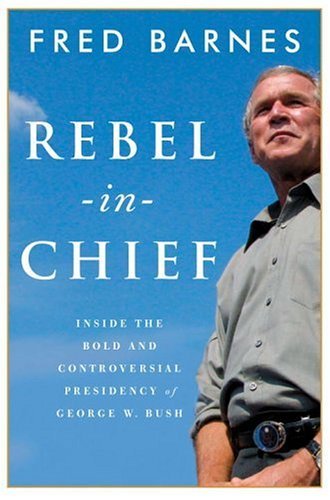 | Bookcast with Fred Barnes - Rebel-in-Chief: How George W. Bush Is Redefining the Conservative Movement and Transforming America. file is MP3 format for PODCAST, running time is 9:28 , Related: Keywords radio address, podcast, Saturday, January 28, 2006 Presidential Podcast 01/28/06, Saturday, January 14, 2006 Presidential Podcast 01/14/06, Saturday, January 07, 2006 Presidential Podcast 01/07/06 |
Highly Recommended, a must read for all on both sides of the political aisle This president is a conservative for the 21st century. Fred Barnes' presentation of 'W' is a concise, informative, and entertaining read. |
0
comments
||
||
Mel Martinez sobre el Estado de la Unión (PODCAST)
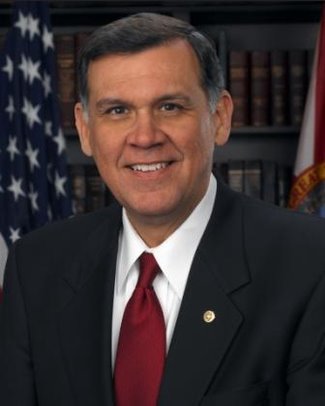 | Declaraciones del Senador Mel Martinez sobre el Estado de la Unión - file is MP3 format for PODCAST, running time is 00:00:45 President Bush Delivers State of the Union Address, FULL STREAMING VIDEO, United States Capitol, Washington, D.C. 9:12 P.M. EST PODCAST MP3 AUDIO |
more at President Bush and White House or Supreme Court and State of the Union Address, or Senate and Congress, or Article II, and U.S. Constitution, or VIDEO, and PODCAST, or Mel Martinez, and Estado de la Unión,
Related: Keywords radio address, podcast, Wednesday, February 01, 2006 State of the Union Address (VIDEO, PODCAST, TEXT), Monday, January 30, 2006 State of the Union, Review and Preview (VIDEO), Saturday, January 21, 2006 bush radio address 01/21/06 full audio, text transcript, Saturday, January 14, 2006 bush radio address 01/14/06 full audio, text transcript, Saturday, January 07, 2006 bush radio address 01/07/06 full audio, text transcript, Saturday, December 31, 2005 bush radio address 12/31/05 full audio, text transcript, Saturday, December 24, 2005 bush radio address 12/24/05 full audio, text transcript, Saturday, December 17, 2005 bush radio address 12/17/05 full VIDEO, text transcript, Sunday, December 04, 2005 Presidential Podcast 12/03/05, Saturday, December 03, 2005 bush radio address 12/03/05 full audio, text transcript, November 26, 2005 Presidential Podcast 11/26/05, Saturday, November 26, 2005 bush radio address 11/26/05 full audio, text transcript, Saturday, November 19, 2005 Presidential Podcast 11/19/05, Saturday, November 19, 2005 Freedom Calendar 11/19/05 - 11/26/05, Saturday, November 12, 2005 Presidential Podcast 11/12/05, Saturday, November 12, 2005 bush radio address 11/12/05 full audio, text transcript, Saturday, November 05, 2005 Presidential Podcast 11/05/05, Saturday, November 05, 2005 bush radio address 11/05/05 full audio, text transcript, Saturday, October 29, 2005 bush radio address 10/29/05 full audio, text transcript, Saturday, October 22, 2005 Presidential Podcast 10/22/05, Saturday, October 15, 2005 Presidential Podcast 10/15/05, Saturday, October 08, 2005 bush radio address 10/08/05 full audio, text transcript, Saturday, October 01, 2005 bush radio address 10/01/05 full audio, text transcript, Saturday, September 24, 2005 bush radio address 09/24/05 full audio, text transcript, Saturday, September 17, 2005 bush radio address 09/17/05 full audio, text transcript
0
comments
||
||
Monday, February 06, 2006
IAEA Board Resolution on Iran
IAEA Board Resolution on Iran, Secretary Condoleezza Rice
I welcome today’s action by the International Atomic Energy Agency Board of Governors to report Iran’s dossier to the United Nations Security Council. The strong majority in favor of the resolution, representing all regions of the world, underscores the concern of the entire international community about Iran’s nuclear program.
We hope the Iranian regime will heed this clear message. The world will not stand by if Iran continues on the path to a nuclear weapons capability. Today’s resolution makes clear the steps Iran’s regime must take. It must suspend enrichment-related and reprocessing activities, cooperate fully with the IAEA, and return to the negotiating process based on the previously agreed terms.
The Iran issue will now be in the domain of the Security Council as well as of the IAEA. We will continue to consult closely with our European allies, Russia, China and many other members of the international community in the coming days and weeks, in this new diplomatic phase.
Washington, DC, 2006/149, Released on February 4, 2006
Related: Keywords State Department, Friday, January 27, 2006 Rice on Palestinian Elections (PODCAST), Tuesday, January 24, 2006 State Department Podcast and Text 01/23/06 , Friday, January 20, 2006 State Department Podcast and Text 01/19/06, Thursday, January 19, 2006 Secretary Rice, South Korean Foreign Minister PODCAST 01/19/06, Wednesday, January 18, 2006 State Department Podcast, Text 01/17/05,
more at Department of State and State Department or IAEA and Iran, or International Atomic Energy Agency and United Nations Security Council or Condoleezza Rice, or nuclear+weapons and international community, or diplomatic,
0
comments
||
||
President Attends Swearing-In Ceremony for Federal Reserve Chairman Ben Bernanke
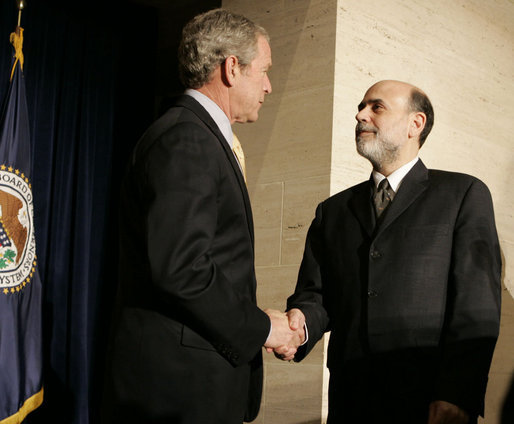 | 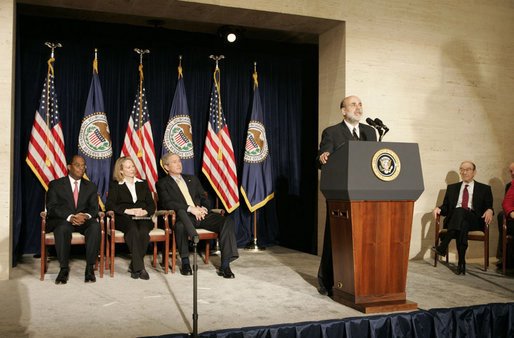 | 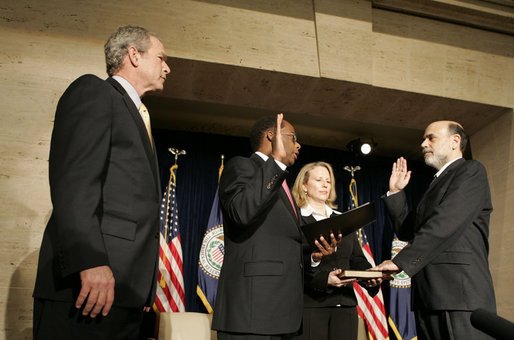 |
THE PRESIDENT: Thank you for the warm welcome here at the Federal Reserve. It is one of our government's most vital institutions. And today I congratulate a fine man and a distinguished public servant, Dr. Ben Bernanke, on becoming the 14th Chairman of the Federal Reserve. (Applause.)
It's good to be with Anna, Ben's wife, Alyssa and Joel, his sister Sharon, and the other members of the Bernanke family. Welcome. Thanks for being here. You probably didn't think your brother was going to amount to much. (Laughter.)
To members of my Cabinet who are here -- Secretary Carlos Gutierrez, Deputy Secretary Bob Kimmitt, members of Congress -- Congressman Oxley, Congressman Frank -- thank you all for coming. It's awfully generous of you both to be here. I appreciate Roger Ferguson, the Vice Chairman; other members of the Board of Governors, thank you for being here, as well. Former Chairman Paul Volcker, thanks for coming today, sir. I've got something to say about the other former Chairman who is here in a minute. (Laughter.)
Since its creation in 1913, the Federal Reserve has helped bring stability and growth to our nation's economy. Around the world the Fed is a symbol of integrity and reliability. Its decisions set our nation's monetary policy, ensure a sound banking system, and help contain the risks that can arrive in our financial markets. The Fed's actions touch the lives of all Americans, and the Chairman of the Federal Reserve must be a leader of unquestionable credentials, sound judgment and impeccable character. Ben Bernanke meets those high standards and he will be an outstanding Chairman of the Federal Reserve.
As Chairman, Ben follows in the footsteps of one of America's most respected public servants. Alan Greenspan is perhaps the only central banker ever to achieve what one publication called, "rock star status." (Laughter and applause.) For almost two decades, Chairman Greenspan's prudence and wise policies have guided this nation through major economic challenges, have kept inflation in check, and contributed to phenomenal economic growth and a better life for all our citizens.
Recently he said, "I have only just realized that I have been on 24-hour call for 18 years." Mr. Chairman, you can rest a little easier and know that a grateful nation thanks you for your extraordinary service. (Applause.)
Ben Bernanke now takes up Alan Greenspan's mantle. When I announced Ben's nomination last October economists and leaders across the political spectrum responded positively. They praised him for his unsurpassed academic credentials, broad policy experience and a reputation for consensus-building. The son of a pharmacist and a school teacher, Ben graduated from Harvard with top honors and earned a doctorate in economics from Massachusetts Institute of Technology. He rose through the academic ranks to become the chairman of the economics department at Princeton.
Ben is one of the most cited economists in the world, and is recognized for his path-breaking work in the field of monetary policy. Ben Bernanke also knows the Federal Reserve System. From 2002 to 2005, he served with distinction on the Fed's Board of Governors. Since last year he has served as the Chairman of the Council of Economic Advisers at the White House. I came to trust his judgment, his calm demeanor, and his sly sense of humor. (Laughter.)
Throughout his distinguished career, Ben has earned a reputation for intellectual rigor, integrity and personal decency. He's earned the respect of the global financial community. Ben is an economist's economist, one of the most esteemed leaders in the field. He understands that economics is more than just crunching numbers. Good economics embraces policies that unleash hope and hard work and the power of free people to be able to fashion and improve their lives. Ben Bernanke will work every day to keep America's economic prospects strong and prosperous. He'll be a superb chairman.
Mr. Chairman, thank you for agreeing to serve. Congratulations. (Applause.)
CHAIRMAN BERNANKE: Good morning. I'd like to begin by thanking President Bush for the confidence he's placed in me, and for his attending the ceremony. This is only the third visit of a President to this building. Franklin Roosevelt dedicated this building in 1937, and President Ford was here in 1975. Mr. President, you do us a great honor. Thank you.
Members of the President's economic team, and the heads of the federal financial regulatory agencies have also joined us this morning. I've greatly enjoyed collaborating with many of you in my time in Washington, and I look forward to working with you in the future. Thank you very much for coming. (Applause.)
I'd like to extend a special welcome to the members of Congress who are here today: Representative Oxley, Representative Frank.
The Federal Reserve was created by Congress in 1913, and it was entrusted with the power granted originally to the Congress by the U.S. Constitution to coin money and regulate the value thereof. Accordingly, it is incumbent on the Federal Reserve to report regularly to, and work closely with, the Congress. I look forward to a strong and constructive relationship with members of both the House and the Senate.
Former Chairmen Paul Volcker and Alan Greenspan also honor us with their attendance. Their leadership and insight have contributed immeasurably to the strength and stability of our economy. The nation and the world owe a debt of gratitude to these two great Americans. (Applause.)
That these distinguished guests have chosen to join us today is a testament to the centrality of this institution in the nation's economic life. Our mission, as set forth by the Congress, is a critical one -- to preserve price stability, to foster maximum sustainable growth and output and employment, and to promote a stable and efficient financial system that serves all Americans well and fairly.
In his remarks in this building in 1937, President Roosevelt described our purpose: "To gain for all of our people the greatest attainable measure of economic well-being, the largest degree of economic security and stability."
As I contemplate taking up the challenge of leading this institution with such weighty responsibilities, I count first on the love and support of my family -- my wife, Anna; son, Joel and daughter, Alyssa, who are here today. I know also that I can rely on the enormous strengths of this institution's excellent leadership on the Board and in the Reserve banks, and unmatched expertise and experience in the staff.
Mr. President, as you probably know, on September 11th, 2001, and in the days that followed, Vice Chairman Roger W. Ferguson, Jr., who just swore me in, and many members of the Federal Reserve staff, here, in New York, and around the country worked inexhaustibly to ensure the continued functioning and the recovery of the American financial system. The dedication and knowledge demonstrated that day by so many people exemplifies why the Federal Reserve, as an institution, is far more than any single individual.
To my Board colleagues and to the staff here today, I would like to say, thank you -- thank you for your service to your country and your service to the world. I'm very happy to be back among you, and I look forward to working with each of you in the days and the years ahead. I'm confident that together we will meet whatever challenges the future will bring.
Thank you very much for coming, and thank you for all your support. Thank you very much. (Applause.)
END 10:14 A.M. EST, For Immediate Release, Office of the Press Secretary, February 6, 2006
Related: Monday, October 24, 2005 Appointment Ben Bernanke Federal Reserve (VIDEO), Monday, October 24, 2005 Biography of Dr. Ben S. Bernanke, Tuesday, June 21, 2005 President Congratulates CEA Chairman Ben Bernanke (VIDEO)
more at President Bush and Dr. Ben S. Bernanke or Ben S. Bernanke and Ben Bernanke or Bernanke and Federal Reserve or Chairman of the Federal Reserve
2
comments
||
||
Sunday, February 05, 2006
Paedocypris progenetica, world's smallest vertebrate
Paedocypris, a new genus of Southeast Asian cyprinid fish with a remarkable sexual dimorphism, comprises the world's smallest vertebrate
Maurice Kottelat1, 2, *, Ralf Britz3, Tan Heok Hui1 & Kai-Erik Witte4
1Raffles Museum of Biodiversity Research, Department of Biological Sciences, National University of Singapore, Lower Kent Ridge Road, Singapore 119260, Singapore
2Route de la Baroche 12, Case Postale 57, 2952 Cornol, Switzerland
3Department of Zoology, The Natural History Museum, Cromwell Road, London SW7 5BD, UK 4Max Planck Institute for Developmental Biology, Spemannstrasse 35/3, 72076 Tübingen, Germany, *Author for correspondence mkottelat@dplanet.ch, Received 20 October 2005; Accepted 21 November 2005.
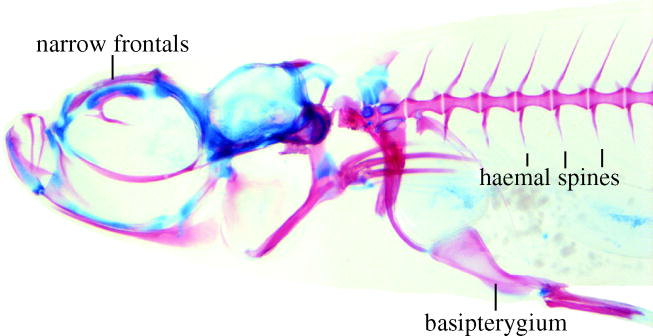 | 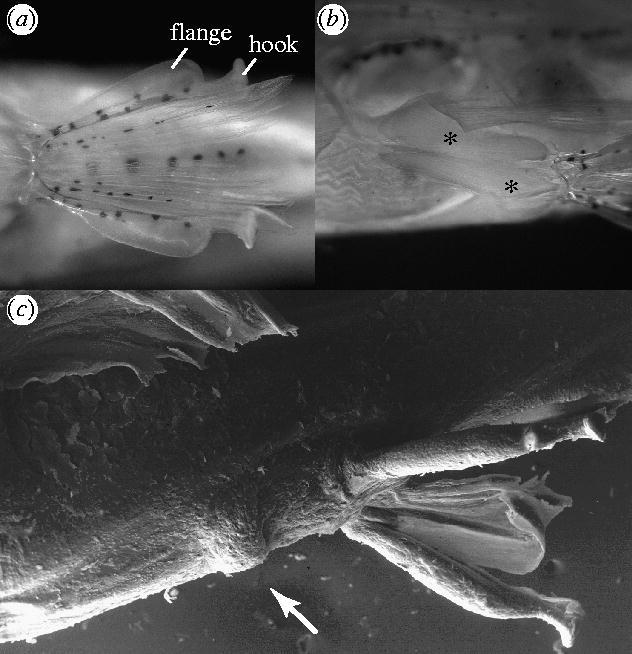 | 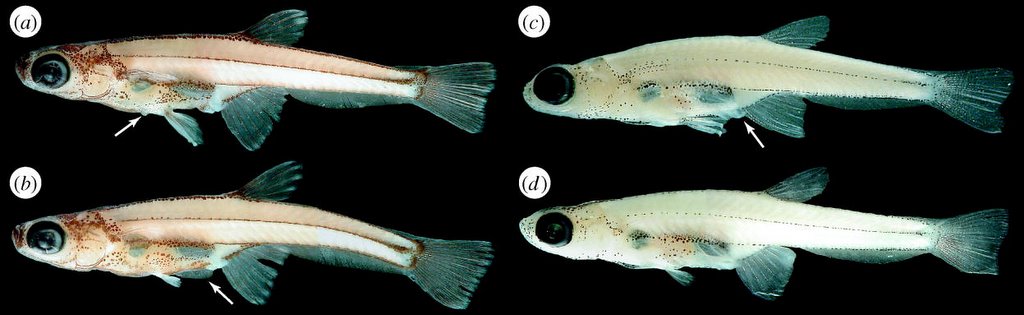 | 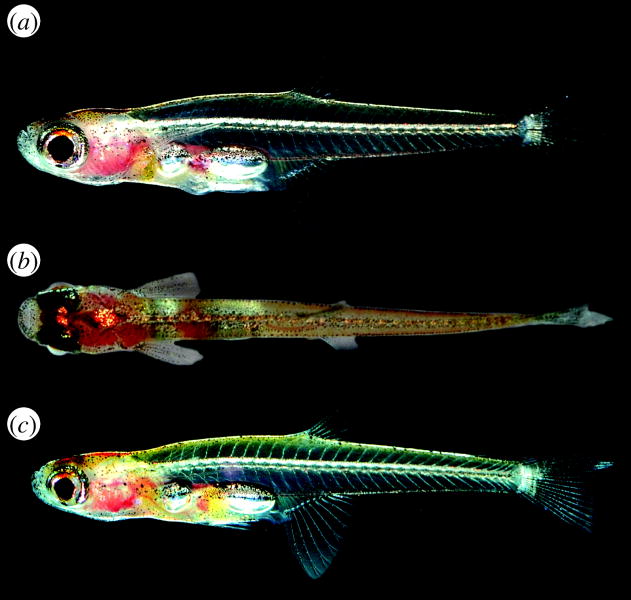 |
Figure 3(a) Paedocypris micromegethes, paratype male, ZRC 49869, 10.4mm; pelvic fins, anteroventral view, showing hook and flange on anterior ray. (b) Paedocypris micromegethes, paratype, male, BMNH 2004.11.16.1-40, 10.9mm, ventrolateral view on hypertrophied pelvic arrector and abductor muscles marked by asterisk symbols. (c) Paedocypris progenetica, paratype male, ZRC 43199, 8.5mm, scanning electronic micrograph of pelvic region in ventrolateral view, arrow points to keratinized prepelvic knob.
Figure 2(a) Paedocypris progenetica holotype male, MZB 5998, 8.6mm; arrow points to keratinized abdominal knob; (b) Paedocypris progenetica paratype female, ZRC 43199, 8.0mm; arrow points to preanal larval-fin-fold; (c) Paedocypris micromegethes holotype male, ZRC 49869, 10.4mm; arrow points to genital papilla; (d) paratype female, BMNH 2004.11.16.1-40, 10.0mm.
Figure 1 Living Paedocypris progenetica, CMK 18496, (a, b) male, ca 9mm; (c) female, ca 8.8mm.
Proceedings of The Royal Society B, ISSN: 0962-8452 (Paper) 1471-2954 (Online), Issue: FirstCite Early Online Publishing, DOI: 10.1098/rspb.2005.3419, Download PDF
Abstract - Paedocypris is a new genus of paedomorphic cyprinid fish from highly acidic blackwater peat swamps in Southeast Asia. It includes two new species, one of which (Paedocypris progenetica) appears to be the smallest fish and vertebrate known, with the smallest mature female measuring a mere 7.9mm. Paedocypris has many 'larval' features typically associated with paedomorphic fish (e.g. narrow frontals that leave the brain unprotected dorsally by bone and a precaudal larval-fin-fold), but, uniquely among fishes, males also possess highly modified pelvic fins with hypertrophied muscles and a keratinized pad in front of the pelvic girdle, which, we hypothesize, function together as a clasping or holding device, thereby suggesting an unusual reproductive mode. Unfortunately, habitat destruction jeopardizes the survival of these fishes and thus opportunities for further research.
Keywords: Paedocypris; Cyprinidae; peat swamps; smallest vertebrate; sexual dimorphism
1. Introduction - Miniaturization is an evolutionary phenomenon observed in all vertebrate lineages, but it is more frequently encountered in fishes. Fish species maturing at sizes under 20mm have been termed 'miniature fishes' by Weitzman & Vari (1988), who observed that miniaturization is commonly accompanied by a reduction of the laterosensory canal system of the head and body and reductions in the number of fin rays and body scales. Often, it is also combined with a poorly ossified, largely cartilaginous skeleton or a complete loss of bones (Johnson & Brothers 1993; Britz & Kottelat 2003).
We here describe two new species representing a new genus of miniature fishes (Paedocypris) from Southeast Asian peat swamp forests. In contrast to the general trend to simplification observed in miniature fishes, Paedocypris has evolved complex structural novelties in the pelvic girdle. Further, one of the new species, Paedocypris progenetica (figure 1), is the smallest recorded vertebrate, with a fully mature female measuring just 7.9mm.
Notes on habitat, food and reproductive biology
The habitat of both Paedocypris species is slow-flowing blackwater streams or pools in peat swamp forests, where they inhabit the deeper, cooler water layers, in the lower half of the water column close to the bottom (but not on the bottom). The two species were observed only in shaded areas, in primary or secondary forest, and were absent from light-exposed open areas.
Gut dissections indicate that Paedocypris feeds mainly on planktonic rotifers and cladocerans (60-500m).
The smallest female with ripe eggs measured 7.9mm in P. progenetica and 8.8mm in P. micromegethes. In a 9.1mm female P. progenetica, the ovaries contained four opaque eggs (diameter 0.3mm) and 53 transparent eggs (diameter less than 0.15mm). A 10.3mm female of P. micromegethes had ovaries with 21 opaque eggs (diameter 0.40-0.45mm (n=5), 0.30-0.40mm (n=16)) and about 30 transparent eggs (0.10-0.20mm diameter). There were no clear-cut size classes in eggs larger than 0.30mm, with all smaller ones of similar sizes. The two ovaries were simultaneously functional. The presence of only few fully developed eggs in the ovaries of both species indicates that eggs are most probably deposited individually.
The smallest male in which modified pelvic fins were unambiguously observed measures 8.2mm in P. progenetica (largest male 9.6mm) and 9.1mm in P. micromegethes (largest male 11.6mm). In P. progenetica, the prepelvic pad appears as a small knob (ca 0.3mm diameter), sometimes with a small groove and fold behind; the space between knob and pelvic-fin base is about equal to the egg size. In some specimens of P. micromegethes, the pad is slightly concave and pieces of unidentifiable tissue are attached.
Discussion, (a) Miniature fishes; Miniature fishes have been defined by Weitzman amd Vari (1988) as those species reaching sexual maturity at a size of under 20mm or, when maturity data are not available, not exceeding 26mm in the wild. A number of fish species discovered over the past few years have maximal known sizes ranging from 8.0 to 15.0mm (Kottelat and Vidthayanon 1993; Britz 2003; Watson and Walker 2004). An Australian marine gobioid fish, Schindleria brevipinguis (family Schindleriidae), was recently presented as 'almost certainly' the world's smallest vertebrate maturing 'by 7mm', at '7-8mm' or '6.5-7mm' on different pages in the paper (Watson and Walker 2004). Of the six known specimens, however, sexual maturity was objectively established only for the single female measuring 8.4mm. Maturity of the smaller males seems to have been inferred from the presence of the genital papilla as specimens were not dissected. Without histological examination, sexual maturity can be objectively established only by the presence of ripe eggs in the female's ovaries. That means, however, that Trimmatom nanus, another marine gobioid (Gobiidae), which has 'fully developed eggs...present from a standard length of 8mm and greater' (largest known individual 10.2mm) (Winterbottom amd Emery 1981), is the smallest previously recorded vertebrate.
Fishes are also the smallest known freshwater vertebrates, the current record being held by the Burmese cyprinid Danionella translucida (12.0mm, size at maturity unknown), followed by the Southeast Asian cobitid Kottelatlimia katik (mature at 13.0mm) and cyprinid Boraras micros (13.3mm, size at maturity unknown) (Kottelat and Lim 1992; Kottelat and Vidthayanon 1993) and the South American characid Xenurobrycon polyancistrus (13.1mm) (Weitzman and Vari 1988).
The discovery of P. progenetica, with a mature female of just 7.9mm and a maximum size of 10.3mm, makes it the smallest recorded vertebrate species, slightly smaller than the marine goby T. nanus. Paedocypris micromegethes, the females of which mature at 8.8mm (maximum 11.6mm), comes a close second as the smallest freshwater vertebrate.
The 7.9mm mature female of P. progenetica is not an unusually small individual. The 1mm mesh size that we use in peat swamps only rarely catches specimens smaller than 7mm and, therefore, introduces a size bias in our samples. Our largest sample contains 56 females (MZB5998, 5999, ZRC 43199), including the 7.9mm one and the individuals unambiguously identifiable as females are 5.9-8.3mm. The largest female is only slightly larger than the smallest mature one.
Typical features of miniature fishes include a tendency to simplify the skeleton and other structures, the production of very few, comparatively large eggs and (in freshwater species) a preference for standing or slow-flowing waters, often in nutrient-poor habitats (Weitzman amd Vari 1988). A number of miniature fishes are paedomorphic and show a truncated development, but accelerated maturation leading to dwarfed adults with larval features (progenetic paedomorphosis).
The conspicuous skin fold along the lower edge of the caudal peduncle of Paedocypris is observed in many fish larvae (Moser et al. 1984), but is normally lost early in ontogeny. Paedocypris is the only known cypriniform fish to retain it as an adult. The long caudal peduncle, the translucent body and the brain not protected by frontals are additional progenetic attributes
Most progenetic fishes tend to lose bones and scales, and to evolve bones that are very thin or perforated and part of the skeleton not ossifying but remaining cartilaginous (Johnson and Brothers 1993; Kottelat amd Lim 1994; Britz and Kottelat 2003). Paedocypris lacks scales and numerous bones and cartilages in the neurocranium (parietals, nasals, vomer, preethmoid, most circumorbitals), lower jaw (angular), hyopalatine arch (ectopterygoid), shoulder girdle (post-temporal) and axial skeleton (supraneural 2, epural); its reduced bones include the very narrow frontals. None of the basi-, cerato-, epi- or pharyngobranchials are ossified, except ceratobranchials 4 and 5. The number of branched dorsal rays is reduced to five (versus at least seven in most Cypriniformes), with that of the branched caudal rays to 14 (versus 17 in most Cyprinidae).
Sharply contradicting this general tendency of miniature fishes to simplification, Paedocypris possesses one feature that is unique among fishes--a complex pelvic girdle, in which the first pelvic-fin ray and its abductor muscles are hypertrophied and highly modified (figures 2-4). These modifications are present only in males and most probably play a role in reproduction.
The structure of the pelvic fin suggests that it forms a clasping device in conjunction with the prepelvic keratinized pad. It might be used to grab the female during mating, analogous to what is observed in the unrelated priapus fishes (family Phallostethidae) that use a modified pelvic girdle to hold the female in position during copulation (Villadolid and Manacop 1934) and transfer sperm to fertilize the eggs internally (Grier and Parenti 1994). Alternatively, the male Paedocypris might use its modified pelvic girdle and fin to keep position at a spawning site or to manipulate spawned eggs, which are almost certainly laid individually. The hypertrophied male genital papilla is most likely part of this functional complex. All these modifications, taken together, point to an unusual reproductive mode. The iridescent spot on top of the head of the male probably plays a role in female/male recognition or male display. The Royal Society - Article FULL HTML TEXT
more at Southeast Asian or biological and biology or Paedocypris and cyprinid or sexual dimorphism or Science and National Parks or animal diversity and fish
Related: Keyword biology, Tuesday, January 04, 2005 The Cassini-Huygens mission to Saturn, Sunday, March 20, 2005 Agriculture Secretary Mike Johanns, bovine spongiform encephalopathy (BSE), Thursday, March 24, 2005 Fish Oil Holds Promise in Alzheimer's Fight, Sunday, April 10, 2005 National Human Genome Research Institute (NHGRI), Friday, April 15, 2005 Study uncovers bacteria's worst enemy, Sunday, May 01, 2005 Yes, it is an exoplanet 2M1207 system, Friday, May 20, 2005 a polysaccharide called hyaluronan, Tuesday, May 24, 2005 pseudoneglect phenomenon, Friday, June 03, 2005 DOE JGI sequences DNA from extinct cave bear, Monday, June 06, 2005 From a Few Wild Ancestors, a Citrus Cornucopia, Tuesday, June 07, 2005 NHGRI Selects 13 More Organisms for Genome Sequencing, Sunday, July 24, 2005 Prehistoric Native Americans maize cultivation, Sunday, July 31, 2005 Protein 97 Synapse-associated (SAP97), Sunday, August 07, 2005 universal flu vaccine, Sunday, August 07, 2005 Smoking gun for Alzheimer's disease, Sunday, August 07, 2005 placental tissue, embryonic stem cells, Sunday, August 21, 2005 female senior faculty are still rare, Sunday, September 18, 2005 more rain would benefit New Orleans, Sunday, October 02, 2005 Rapid evolution of the quagga, Sunday, October 30, 2005 , Sunday, November 27, 2005 Give thanks for the cranberry, say dental researchers, Sunday, December 04, 2005 Poison + water = hydrogen, Sunday, December 11, 2005 40,000-year-old human footprints, Sunday, December 18, 2005 warfare in the Mesopotamian world, Sunday, December 18, 2005 Conditions for slavery, Sunday, December 25, 2005 Why Christmas trees are not extinct, Sunday, January 01, 2006 prostaglandins choreograph perturbations, Sunday, January 01, 2006 Cultural differences may explain variations in home remedy use, Sunday, January 08, 2006 Risky Sexual Behaviors in Miami, and Racial Influences on Children’s Care, Sunday, January 22, 2006 Twenty-seven previously unknown species discovered,
0
comments
||
||
Saturday, February 04, 2006
Presidential Podcast 02/04/06
Presidential Podcast 02/04/06 Subscribe to Our Odeo Podcast Channel and receive the Presidential Radio Address each week. Featuring real audio and full text transcript
more at President Bush and White House or State of the Union address and American Competitiveness Initiative, or nanotechnology and supercomputing, or alternative energy sources, and Math,
Related: Keywords radio address, podcast, Saturday, January 28, 2006 Presidential Podcast 01/28/06, Saturday, January 14, 2006 Presidential Podcast 01/14/06, Saturday, January 07, 2006 Presidential Podcast 01/07/06, Saturday, December 31, 2005 Presidential Podcast 12/31/05, Saturday, December 17, 2005 bush radio address 12/17/05 full VIDEO, text transcript, Sunday, December 04, 2005 Presidential Podcast 12/03/05, Saturday, December 03, 2005 bush radio address 12/03/05 full audio, text transcript, November 26, 2005 Presidential Podcast 11/26/05, Saturday, November 26, 2005 bush radio address 11/26/05 full audio, text transcript, Saturday, November 19, 2005 Presidential Podcast 11/19/05, Saturday, November 19, 2005 Freedom Calendar 11/19/05 - 11/26/05, Saturday, November 12, 2005 Presidential Podcast 11/12/05, Saturday, November 12, 2005 bush radio address 11/12/05 full audio, text transcript, Saturday, November 05, 2005 Presidential Podcast 11/05/05, Saturday, November 05, 2005 bush radio address 11/05/05 full audio, text transcript, Saturday, October 29, 2005 bush radio address 10/29/05 full audio, text transcript, Saturday, October 22, 2005 Presidential Podcast 10/22/05, Saturday, October 15, 2005 Presidential Podcast 10/15/05, Saturday, October 08, 2005 bush radio address 10/08/05 full audio, text transcript, Saturday, October 01, 2005 bush radio address 10/01/05 full audio, text transcript, Saturday, September 24, 2005 bush radio address 09/24/05 full audio, text transcript, Saturday, September 17, 2005 bush radio address 09/17/05 full audio, text transcript
0
comments
||
||
Freedom Calendar 02/04/06 - 02/11/06
February 4, 1959, President Eisenhower informs Republican leaders of his plan to introduce 1960 Civil Rights Act, despite staunch opposition from many Democrats.
February 5, 1866, U.S. Rep. Thaddeus Stevens (R-PA) introduces legislation, successfully opposed by Democrat President Andrew Johnson, to implement “40 acres and a mule” relief by distributing land to former slaves.
February 6, 1981 President Ronald Reagan designates 1981 as the International Year of Disabled Persons.
February 7, 1983, Republican Elizabeth Dole appointed by President Ronald Reagan as first woman to be U.S. Secretary of Transportation; she would later become first woman to represent North Carolina in U.S. Senate.
February 8, 1894, Democrat Congress and Democrat President Grover Cleveland join to repeal Republicans’ Enforcement Act, which had enabled African-Americans to vote.
February 9, 1864, Susan B. Anthony and Elizabeth Cady Stanton deliver over 100,000 signatures to U.S. Senate supporting Republicans’ plans for constitutional amendment to ban slavery.
February 10, 1995, Death of Judge Masaji Marumoto, Japanese-American Republican who served with distinction on Hawaii Supreme Court.
February 11, 1856, Republican Montgomery Blair argues before U.S. Supreme Court on behalf of his client, the slave Dred Scott; later served in President Lincoln’s Cabinet.
"In giving freedom to the slave, we assure freedom to the free —honorable alike in what we give and what we receive.”
Abraham Lincoln, 16th President of the United States
SOURCE: Republican Freedom Calendar more at President Bush and Freedom Calendar or Republican and Republicans or African-Americans and 15th Amendment or right to vote and Civil Rights or Abraham Lincoln and Ronald Reagan or 40 acres and a mule
Related: Keywords Freedom Calendar, Saturday, January 28, 2006 Freedom Calendar 01/28/06 - 02/04/06, Saturday, January 21, 2006 Freedom Calendar 01/21/06 - 01/28/06, Saturday, January 14, 2006 Freedom Calendar 01/14/06 - 01/21/06, Saturday, January 07, 2006 Freedom Calendar 01/07/06 - 01/14/06, Saturday, December 31, 2005 Freedom Calendar 12/31/05 - 01/07/06, Saturday, December 24, 2005 Freedom Calendar 12/24/05 - 12/31/05, Saturday, December 17, 2005 Freedom Calendar 12/17/05 - 12/24/05, Saturday, December 10, 2005 Freedom Calendar 12/10/05 - 12/17/05, December 03, 2005 Freedom Calendar 12/03/05 - 12/10/05, Saturday, November 26, 2005 Freedom Calendar 11/26/05 - 12/03/05, Saturday, November 19, 2005 Freedom Calendar 11/19/05 - 11/26/05, Saturday, November 12, 2005 Freedom Calendar 11/12/05 - 11/19/05, Saturday, November 05, 2005 Freedom Calendar 11/05/05 - 11/12/05, Saturday, October 29, 2005 Freedom Calendar 10/29/05 - 11/05/05, Saturday, October 22, 2005 Freedom Calendar 10/22/05 - 10/028/05, Saturday, October 15, 2005 Freedom Calendar 10/15/05 - 10/022/05, Thursday, September 29, 2005 The Opelousas Massacre, Saturday, October 08, 2005 Freedom Calendar 10/08/05 - 10/015/05 , Saturday, October 01, 2005 Freedom Calendar 10/01/05 - 10/08/05, Saturday, September 24, 2005 Freedom Calendar 09/24/05 - 10/01/05, Saturday, September 17, 2005 Freedom Calendar 09/17/05 - 09/24/05, Saturday, September 10, 2005 Freedom Calendar 09/10/05 - 09/17/05
0
comments
||
||


