Friday, February 10, 2006

President Signs S.1932, Deficit Reduction Act (VIDEO)

President Signs S.1932, Deficit Reduction Act of 2005, FULL STREAMING VIDEO, The East Room 3:31 P.M. EST
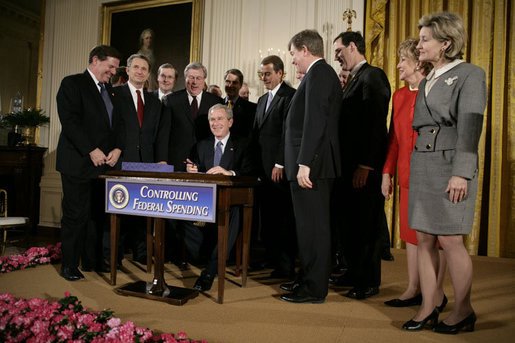
President George W. Bush is joined by legislators Wednesday, Feb. 8, 2006 at the signing ceremony for S. 1932, The Deficit Reduction Act of 2005, in the East Room of the White House. White House photo by Eric Draper.President George W. Bush is joined by legislators Wednesday, Feb. 8, 2006 at the signing ceremony for S. 1932, The Deficit Reduction Act of 2005, in the East Room of the White House. White House photo by Eric Draper.
Fact Sheet: President Bush Signs Deficit Reduction Act
In Focus: 2007 Budget
In Focus: Jobs and Economy

THE PRESIDENT: Thanks for coming. Welcome to the White House. In a few moments, I will sign the Deficit Reduction Act of 2005. This important piece of legislation restrains federal spending -- and it will leave more money in the pockets of those who know how to use it best, the American people.

I appreciate the Vice President being here. Mr. Speaker, welcome. Leader Frist, thank you all for coming. Senator McConnell and Senator Santorum, Senator Judd Gregg, Chairman of the Senate Budget Committee, Congressman John Boehner, the House Majority Leader, Roy Blunt, House Majority Whip, Congressman Nussle, Chairman of the House Budget Committee, I want to thank you all for coming. I appreciate the members of the Cabinet who are here, as well as all the members of the United States Congress and the Senate who have come for this important bill signing.

Our economy is strong and it's getting stronger. We're now entering our fifth year of uninterrupted economic growth, and last year our economy grew at a healthy 3.5 percent. Real after-tax income is up nearly 8 percent per American since 2001. Productivity growth is high, small businesses are thriving. America has added 4.7 million new jobs over the last two-and-a-half years, and the unemployment rate is down to 4.7 percent -- the lowest level since July 2001.

Our economy leads the world, yet we cannot be complacent. To keep our economic momentum, we need to look at the challenges down the road and respond with wise policies now. And one of the most important policies we need to pursue is spending restraint in Washington, D.C.

Earlier this week, I sent Congress a disciplined federal budget for 2007, and this morning, I traveled to New Hampshire with Chairman Gregg, Senator Sununu, Congress Bass and Congressman Bradley to discuss the new budget proposal in detail. The budget strategy begins with keeping taxes low, so that Americans can spend, save, and invest more of their own money -- and that will help keep our economy growing and creating jobs. My budget funds our priorities -- starting with funding the United States military, promoting alternative sources of energy, investing in math and science education and basic research, and helping to care for the poor and the elderly.

At the same time, my budget tightens the belt on government spending. Every American family has to set priorities and live within a budget -- and the American people expect us to do the same right here in Washington, D.C.

The federal budget has two types of spending -- discretionary spending and mandatory spending. Discretionary spending is the kind of spending Congress votes on every year. Last year, Congress met my request and passed bills that cut discretionary spending not related to defense or homeland security -- and this year, my budget again proposes to cut this spending. My budget also proposes again to keep the growth in overall discretionary spending below the rate of inflation, so we can stay on track to cut the deficit in half by 2009.

In the long run, the biggest challenge to our budget is mandatory spending -- or entitlement programs like Medicare and Medicaid and Social Security. Entitlement spending is determined by a specific formula, and it rises automatically year after year unless the Congress intervenes. Together, Medicare, Medicaid, and Social Security are now growing faster than the economy, faster than the population, and nearly three times the rate of inflation. And the retirement of baby boom generation will put even more strains on these programs. By 2030, spending for Medicare, Medicaid, and Social Security alone will be almost 60 percent of the entire federal budget. And that will leave future generations with impossible choices -- staggering tax increases, immense deficits, or deep cuts in every category of spending.

Bringing entitlement spending under control is a critical priority of our government. We need to slow the annual growth of entitlement programs to levels that we can afford -- we do not need to cut those programs. There is an important distinction -- it is the difference between slowing your car down to the speed limit, or putting your car into reverse. By making wise reforms that will reduce the annual growth of mandatory spending, the Deficit Reduction Act will save taxpayers nearly $40 billion over the next five years -- that's about $300 per taxpayer.

The Deficit Reduction Act is estimated to slow the pace of spending growth in both Medicare and Medicaid. Medicare is a federal program that provides health care for older Americans. Medicaid is a program administered in conjunction with the states that provides health care for low-income Americans, family with children, and some seniors. These programs are providing vital services to millions of Americans in need -- yet the costs of Medicare and Medicaid are straining budgets at both the state and federal level. The bill I sign today restrains spending for entitlement programs, while ensuring that Americans who rely on Medicare and Medicaid continue to get the care they need.

The Deficit Reduction Act is estimated to reduce the growth in Medicare spending by more than $6 billion over the next five years. The bill, together with the Medicare act of 2003, requires wealthier citizens to pay higher premiums for their Medicare coverage. The savings created by this reform and others will make it possible to increase federal funding for important areas like kidney dialysis and rural hospitals. With this bill, we're showing that we can keep the promise of Medicare and be good stewards of the taxpayer's money at the same time.

The Deficit Reduction Act will also reduce the growth in Medicaid spending by nearly $5 billion over the next five years. The bill helps restrain Medicaid spending by reducing federal overpayment for prescription drugs. Taxpayers should not have to pay inflated markups for the medicine that the people on Medicaid depend. The bill gives governors more flexibility to design Medicaid benefits that meet the needs of their states efficiently and affordably. The bill tightens the loopholes that allowed people to game the system by transferring assets to their children so they can qualify for Medicaid benefits. Along with governors of both parties, we are sending a clear message: Medicaid will always provide help for those in need, but we will never tolerate waste, fraud, or abuse.

The Deficit Reduction Act's reforms in Medicare and Medicaid are a step on the road to long-term stability for these important programs. Now we need to continue finding ways to make Medicare and Medicaid more efficient. My budget next year proposes another $36 billion in savings on Medicare, and more than a billion dollars in savings on Medicaid. My budget proposals will slow the average annual growth in Medicare over the next five years from 8.1 percent to 7.7 percent. That seems reasonable. And together with the bill I sign today, my budget will slow the average annual growth of Medicaid over the next five years from 6.9 percent a year to 6.6 percent a year. This is progress in the right direction, but these growth rates are still unsustainable.

In the long run, ensuring the stability of Medicare and Medicaid requires structural reform. So I have proposed a bipartisan commission to examine the full impact of baby boomer retirements on Medicare and Medicaid, as well as Social Security. The commission will include members of Congress from both political parties. It will recommend long-term solutions that will keep the promise of these vital programs while addressing their growing costs. I look forward to working with Congress to get this problem solved for generations to come.

As the Deficit Reduction Act delivers savings in mandatory spending, it also shows the compassion of America. This bill provides new resources for programs that serve some of our citizens with the greatest needs -- including hurricane victims, children, and low-income families struggling to pay their heating bills.

The Deficit Reduction Act makes important improvements to federal student loan programs. The bill cuts excess government subsidies to lenders and makes other reforms that will help us reduce overall student loan costs by about $22 billion. With that money, we will save taxpayers $12 billion -- because we intend to increase student aid by 10 additional billion dollars. What I'm telling you is, the students are getting the money, and we're making the program a lot more efficient for the taxpayers.

The Deficit Reduction Act also reauthorizes welfare reform for another five years. Welfare reform has proved a tremendous success over the past decade. By insisting on programs that require work and self-sufficiency in return for federal aid, we have helped cut welfare cases by more than half since 1996. Now we're building on that progress by renewing welfare reform with a billion dollar increase in child care funding, and new grants to support healthy marriage and responsible fatherhood programs.

One of the reasons for the success of welfare reform is a policy called charitable choice -- which allows faith-based groups that provide social services to receive federal funding without changing the way they hire. Ten years ago, Congress made welfare the first federal program to include charitable choice. The bill I sign today will extend charitable choice for another five years, and expand it to the new healthy marriage and responsible fatherhood programs. I appreciate the hard work of all who supported the extension of charitable choice -- including the good-hearted men and women of the faith-based community who are here today. By reauthorizing welfare reform with charitable choice, we will help millions more Americans move from welfare to work -- and find independence, and dignity, and hope.

The message of the bill I sign today is straightforward: By setting priorities and making sure tax dollars are spent wisely, America can be compassionate and responsible at the same time. Spending restraint demands difficult choices -- yet making those choices is what the American people sent us to Washington to do. One of our most important responsibilities is to keep this economy strong and vibrant and secure for our children and our grandchildren. We can be proud that we're helping to meet that responsibility today.

Now I ask the members of Congress to join me as I sign the Deficit Reduction Act of 2005.

(The Act is signed.) (Applause.)

END 3:43 P.M. EST For Immediate Release, Office of the Press Secretary, February 8, 2006

more at
and or and , or and , or , and , or , and , or and or

Related: Keywords H.R. Tuesday, January 03, 2006
President Signs 14 House and Senate Resolutions, Tuesday, October 19, 2004 Provisional Ballots, Early Voting, and 10,000 Lawyers, Monday, December 06, 2004 Bill # H.R.10 intelligence community, Sunday, December 12, 2004 House and Senate Resolutions, Thursday, December 23, 2004 Statement on House and Senate Resolutions, Saturday, January 08, 2005 H.R.241 tax charitable contributions relief tsunami, Tuesday, January 11, 2005 bush H.R. 241 tax deduction tsunami relief, Friday, February 11, 2005 H.R.418 REAL ID Act of 2005, Monday, February 21, 2005 .256 Bankruptcy Reform Bill, Wednesday, March 09, 2005 S.148 United States Boxing Commission, Sunday, March 13, 2005 H.R. 1220 Veterans’ Compensation Cost-of-living Adjustment Act of 2005, Wednesday, March 16, 2005 H.R.1268 Emergency Supplemental Appropriations Act, Friday, March 18, 2005 Protection of Incapacitated Persons Act of 2005 H. R. 1332 Friday, March 25, 2005 H.R. 1160, S. 384, Friday, April 01, 2005 Foreign Operations, Export Financing, and Related Programs Appropriations Act, Friday, April 01, 2005 H.R. 1270, Friday, April 15, 2005 H.R.1134 Internal Revenue Code of 1986, Thursday, April 21, 2005 H. R. 6 Energy Policy Act of 2005, Tuesday, April 26, 2005 House Floor Report 04/26/05, Thursday, April 28, 2005 H.R.748 Child Interstate Abortion Notification Act, Friday, April 29, 2005 H.R. 787

President Bush Welcomes King Abdullah (VIDEO)

President Bush Welcomes King Abdullah of Jordan to the White House, FULL STREAMING VIDEO, The Oval Office, 9:26 A.M. EST In Focus: Global Diplomacy

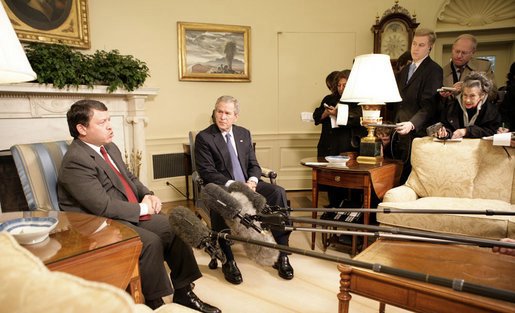
President George W. Bush listens as King Abdullah of Jordan makes remarks Wednesday, Feb. 8, 2006, during a photo opportunity in the Oval Office. The two leaders took the opportunity to urge an end to recent violence over caricatures of the Prophet Mohammed. White House photo by Eric Draper.President George W. Bush listens as King Abdullah of Jordan makes remarks Wednesday, Feb. 8, 2006, during a photo opportunity in the Oval Office. The two leaders took the opportunity to urge an end
to recent violence over caricatures of the Prophet Mohammed. White House photo by Eric Draper.

PRESIDENT BUSH: Your Majesty, welcome back. I have had two good discussions with His Majesty. Last night His Majesty and the Crown Prince came to have dinner with Laura and me and some members of Congress, and we had a really good discussion. We had a little time by ourselves to talk strategically about the world and our deep desire for this world to be peaceful.

Of course we talked about Iraq, Iran, the Palestinian territories. I appreciate your vision and your desire to achieve a better world for the people in your neighborhood.

We also talked about a topic that requires a lot of discussion and a lot of sensitive thought, and that is the reaction to the cartoons. I first want to make it very clear to people around the world that ours is a nation that believes in tolerance and understanding. In America we welcome people of all faiths. One of the great attributes of our country is that you're free to worship however you choose in the United States of America.

Secondly, we believe in a free press. We also recognize that with freedom comes responsibilities. With freedom comes the responsibility to be thoughtful about others. Finally, I have made it clear to His Majesty and he made it clear to me that we reject violence as a way to express discontent with what may be printed in a free press. I call upon the governments around the world to stop the violence, to be respectful, to protect property, protect the lives of innocent diplomats who are serving their countries overseas.

And so, Your Majesty, thank you for coming. I'm proud to share the moment with you.

KING ABDULLAH: Thank you very much for your kind words. And I would just like to echo what the President said. We've had some very fruitful discussions, and we're appreciative of the vision and the desire that the President has for peace and stability in our part of the world. He has always strived to make life better for all of us in the Middle East, and I tremendously appreciate that role.

The issue of the cartoons, again, and with all respect to press freedoms, obviously, anything that vilifies the Prophet Mohammed -- upon him or attacks Muslim sensibilities, I believes needs to be condemned. At the same time, those that want to protest should do it thoughtfully, articulately, express their views peacefully. When we see protests -- when we see destruction, when we see violence, especially if it ends up taking the lives of innocent people, is completely unacceptable. Islam, like Christianity and Judaism, is a religion of peace, tolerance, moderation.

And we have to continue to ask ourselves, what type of world do we want for our children? I too often hear the word used as, tolerance. And tolerance is such an awful word. If we are going to strive to move forward in the future, the word that we should be talking about is acceptance. We need to accept our common humanity and our common values. And I hope that lessons can be learned from this dreadful issue, that we can move forward as humanity, and truly try to strive together, as friends and as neighbors, to bring a better world to all.

PRESIDENT BUSH: Thank you, Your Majesty. I appreciate it.

END 9:31 A.M. EST, For Immediate Release, Office of the Press Secretary, February 8, 2006

Related: Keyword, King Abdullah, Saturday, September 24, 2005
President Welcomes King Abdullah (VIDEO), Friday, September 16, 2005 President to Welcome King Abdullah of Jordan, Tuesday, March 15, 2005 President Bush and King Abdullah, Tuesday, March 08, 2005 King Abdullah of Jordan,

more at
or and or and or and or and

President Honors Coretta Scott King (VIDEO)

President Honors Coretta Scott King at Homegoing Celebration, FULL STREAMING VIDEO, New Birth Missionary Church, Atlanta, Georgia 1:00 P.M. EST Photo Essay: Remembering Coretta Scott King

President George W. Bush and Mrs. Laura Bush are seen during a prayer holding hands with former President Bill Clinton, right, and Rev. Robert Schuller, left, at the homegoing celebration for Coretta Scott King, Tuesday, Feb. 7, 2006 at the New Birth Missionary Church in Atlanta, Ga. White House photo by Eric Draper.President George W. Bush and Mrs. Laura Bush are seen during a prayer holding hands with former President Bill Clinton, right, and Rev. Robert Schuller, left, at the homegoing celebration for Coretta Scott King,
Tuesday, Feb. 7, 2006 at the New Birth Missionary Church in Atlanta, Ga. White House photo by Eric Draper.

THE PRESIDENT: To the King Family, distinguished guests and fellow citizens. We gather in God's house, in God's presence, to honor God's servant, Coretta Scott King. Her journey was long, and only briefly with a hand to hold. But now she leans on everlasting arms. I've come today to offer the sympathy of our entire nation at the passing of a woman who worked to make our nation whole.

Americans knew her husband only as a young man. We knew Mrs. King in all the seasons of her life -- and there was grace and beauty in every season. As a great movement of history took shape, her dignity was a daily rebuke to the pettiness and cruelty of segregation. When she wore a veil at 40 years old, her dignity revealed the deepest trust in God and His purposes. In decades of prominence, her dignity drew others to the unfinished work of justice. In all her years, Coretta Scott King showed that a person of conviction and strength could also be a beautiful soul. This kind and gentle woman became one of the most admired Americans of our time. She is rightly mourned, and she is deeply missed.

Some here today knew her as a girl, and saw something very special long before a young preacher proposed. She once said, "Before I was a King, I was a Scott." And the Scotts were strong, and righteous, and brave in the face of wrong. Coretta eventually took on the duties of a pastor's wife, and a calling that reached far beyond the doors of the Dexter Avenue Baptist Church.

In that calling, Dr. King's family was subjected to vicious words, threatening calls in the night, and a bombing at their house. Coretta had every right to count the cost, and step back from the struggle. But she decided that her children needed more than a safe home -- they needed an America that upheld their equality, and wrote their rights into law. (Applause.) And because this young mother and father were not intimidated, millions of children they would never meet are now living in a better, more welcoming country. (Applause.)

In the critical hours of the civil rights movement, there were always men and women of conscience at the heart of the drama. They knew that old hatreds ran deep. They knew that nonviolence might be answered with violence. They knew that much established authority was against them. Yet they also knew that sheriffs and mayors and governors were not ultimately in control of events; that a greater authority was interested, and very much in charge. (Applause.)

The God of Moses was not neutral about their captivity. The God of Isaiah and the prophets was still impatient with injustice. And they knew that the Son of God would never leave them or forsake them.

But some had to leave before their time -- and Dr. King left behind a grieving widow and little children. Rarely has so much been asked of a pastor's wife, and rarely has so much been taken away. Years later, Mrs. King recalled, "I would wake up in the morning, have my cry, then go in to them. The children saw me going forward." Martin Luther King, Jr. had preached that unmerited suffering could have redemptive power.

Little did he know that this great truth would be proven in the life of the person he loved the most. Others could cause her sorrow, but no one could make her bitter. By going forward with a strong and forgiving heart, Coretta Scott King not only secured her husband's legacy, she built her own. (Applause.) Having loved a leader, she became a leader. And when she spoke, America listened closely, because her voice carried the wisdom and goodness of a life well lived.

In that life, Coretta Scott King knew danger. She knew injustice. She knew sudden and terrible grief. She also knew that her Redeemer lives. She trusted in the name above every name. And today we trust that our sister Coretta is on the other shore -- at peace, at rest, at home. (Applause.) May God bless you, and may God bless our country. (Applause.)

END 1:07 P.M. EST, For Immediate Release, Office of the Press Secretary, February 7, 2006

more at
and or and or and or and or and or

Related: Keywords Freedom Calendar,Tuesday, January 31, 2006
Death of Coretta Scott King, Saturday, January 28, 2006 Freedom Calendar 01/28/06 - 02/04/06, Saturday, January 21, 2006 Freedom Calendar 01/21/06 - 01/28/06, Saturday, January 14, 2006 Freedom Calendar 01/14/06 - 01/21/06, Saturday, January 07, 2006 Freedom Calendar 01/07/06 - 01/14/06, Saturday, December 31, 2005 Freedom Calendar 12/31/05 - 01/07/06, Saturday, December 24, 2005 Freedom Calendar 12/24/05 - 12/31/05, Saturday, December 17, 2005 Freedom Calendar 12/17/05 - 12/24/05, Saturday, December 10, 2005 Freedom Calendar 12/10/05 - 12/17/05, December 03, 2005 Freedom Calendar 12/03/05 - 12/10/05, Saturday, November 26, 2005 Freedom Calendar 11/26/05 - 12/03/05, Saturday, November 19, 2005 Freedom Calendar 11/19/05 - 11/26/05, Saturday, November 12, 2005 Freedom Calendar 11/12/05 - 11/19/05, Saturday, November 05, 2005 Freedom Calendar 11/05/05 - 11/12/05, Saturday, October 29, 2005 Freedom Calendar 10/29/05 - 11/05/05, Saturday, October 22, 2005 Freedom Calendar 10/22/05 - 10/028/05, Saturday, October 15, 2005 Freedom Calendar 10/15/05 - 10/022/05, Thursday, September 29, 2005 The Opelousas Massacre, Saturday, October 08, 2005 Freedom Calendar 10/08/05 - 10/015/05 , Saturday, October 01, 2005 Freedom Calendar 10/01/05 - 10/08/05, Saturday, September 24, 2005 Freedom Calendar 09/24/05 - 10/01/05, Saturday, September 17, 2005 Freedom Calendar 09/17/05 - 09/24/05, Saturday, September 10, 2005 Freedom Calendar 09/10/05 - 09/17/05

Thursday, February 09, 2006

President’s Emergency Plan for AIDS Relief (VIDEO)

Remarks on the Release of the Second Annual Report to Congress on the President’s Emergency Plan for AIDS Relief, FULL STREAMING VIDEO, Secretary Condoleezza Rice, Washington, DC, February 8, 2006 (1:30 p.m.)

SECRETARY RICE: Good afternoon. I have recently spoken about how the men and women of American diplomacy are carrying out the bold mission that President Bush has given us. We are pursuing a strategy of transformational diplomacy which is rooted in partnership, not paternalism, in doing thing with people, not just for them. We are using America's diplomatic power and our development assistance to help foreign citizens to better their own lives, to build their own nations and to transform their own futures.

The President's Emergency Plan for AIDS Relief is a key example of effective foreign assistance and transformational diplomacy in action. Our approach is to empower every nation to take ownership of its own fight against HIV/AIDS through prevention, treatment and care. The Emergency Plan is the largest international initiative ever by one nation to combat a single disease. It complements our multilateral efforts to fight AIDS through the Global Fund, of which America is the largest supporter.

With the release of today's report, we recognize the Emergency Plan's unprecedented contribution over the past two years to help combat one of the worst pandemics in human history. Prevention is the first line of defense, and through the Emergency Plan the United States is promoting several methods that get results. The hallmark of our preventive effort is the ABC approach: Abstain; Be Faithful; and Correct, Consistent Use of Condoms.

In 2005, the Emergency Plan supported ABC programs that reached over 42 million people. Another focus for prevention is helping pregnant women protect their babies from HIV. To date, our partnerships have reached over 3 million pregnant women and prevented an estimated 47,000 infections.

The Emergency Plan is also helping people who are already infected to live with the disease. Two years ago, only 50,000 people in all of Sub-Saharan Africa had access to antiretroviral treatment. By the end of last year, the Emergency Plan had expanded treatment in that region to 400,000 people plus an additional 71,000 individuals worldwide. It is especially worth noting that 60 percent of these new people being treated are women.

As this life-extending treatment is becoming more widely available, the decision to get tested for HIV is changing lives. The Emergency Plan is helping our foreign partners to spread the word and thus far U.S.-supported programs have offered counseling and testing to over 9.4 million people. That is the beginning of a transformation from despair to hope.

The final pillar of our strategy is to provide care for those children that the disease leaves behind. The Emergency Plan is helping to build partnerships with foreign families, communities and nations, and during 2005 these partnerships extended compassion and care to over 1.2 million orphans and vulnerable children, helping them to go to school, to get the food they need; in short, to be children.

This is some of what we are doing today and we are adding to the effect of our present efforts by building a foundation for the future. Over the coming years we will need more local partners who have the skills to help their communities combat HIV/AIDS. The Emergency Plan is helping to prepare these local partners -- over half a million in 2005 alone. And the effects of this training will ripple out for decades.

On this day, as we mark the Emergency Plan's contribution to the fight against HIV/AIDS, we must remind ourselves of the decades of hard work that still lie ahead. The men and women of the State Department are on the front lines of this struggle. We and others in the United States Government will need to draw on the dedication that these people bring for a long, long time to come. We will not defeat this disease in a month or in a year; but if we sustain our commitment, if we match our compassion with action, we will one day bring hope to all who are living in the shadow of HIV/AIDS.

And now I'd like to introduce Randy Tobias, who will have a few words. 2006/160

Highlights [PDF; 740k;] Complete Report [PDF; 2.0MB;] Press briefing with Amb. Randall Tobias and Dr. Mark Dybul - Ambassador Randall Tobias, Global AIDS Coordinator, Dr. Mark Dybul, Deputy Global AIDS Coordinator and Chief Medical Officer, On the Release of the Second Annual Report to Congress on the President’s Emergency Plan for AIDS Relief

more at
and or and , or and or , or and , or ,

Related: Keywords State Department, Thursday, February 09, 2006
State Department Podcast and Text 02/08/06, Friday, January 27, 2006 State Department Podcast and Text 01/25/06, Friday, January 27, 2006 Rice on Palestinian Elections (PODCAST), Tuesday, January 24, 2006 State Department Podcast and Text 01/23/06 , Friday, January 20, 2006 State Department Podcast and Text 01/19/06, Thursday, January 19, 2006 Secretary Rice, South Korean Foreign Minister PODCAST 01/19/06, Wednesday, January 18, 2006 State Department Podcast, Text 01/17/05,

State Department Podcast and Text 02/08/06

Daily Press Briefing, Sean McCormack Spokesman, file is MP3 for PODCAST, running time is 29:06 , Washington, DC, February 8, 2006

Department Spokesman Sean McCormack (shown during the  Daily Press Briefing) was sworn in as Assistant Secretary for Public Affairs and Department Spokesman on June 2, 2005. Immediately prior to returning to the State Department, Mr. McCormack served as Special Assistant to the President, Spokesman for the National Security Council, and Deputy White House Press Secretary for Foreign Policy. State Department Photo by Michael Gross.Department Spokesman Sean McCormack (shown during the Daily Press Briefing) was sworn in as Assistant Secretary for Public Affairs and Department Spokesman on June 2, 2005. Immediately prior to returning to the State Department,
Mr. McCormack served as Special Assistant to the President, Spokesman for the National Security Council, and Deputy White House Press Secretary for Foreign Policy. State Department Photo by Michael Gross. TRANSCRIPT:, 2:40 p.m. EST

MR. MCCORMACK: Good afternoon. Thanks, everybody, for sticking with me. I know this is kind of a late briefing.

QUESTION: We're here for you, Sean.

MR. MCCORMACK: I appreciate that, Peter. I'm here for you.

(Laughter.)

MR. MCCORMACK: I have one opening statement regarding the Nepal Municipal elections. The United States believes Nepal's Municipal elections called by the King today represented a hollow attempt to legitimize power. There was a clear lack of public support for these elections. Voter turnout in the capital is estimated under 25 percent.

Outside Kathmandu, turnout was reportedly half that level in some places. The Government detained large numbers of political activists before the elections, restricted media, and refused to allow independent outside monitors. Maoist intimidation and the killing of candidates during the campaign marred the vote. There is no political cause that justifies the use of violence.

The only effective way to deal with the threat posed by Maoists is to restore democracy in Nepal. We call upon the King to release all political detainees and initiate a dialogue with the political parties. His continuing refusal to take these steps is leading his country further down the path of violence and disorder.

And with that, I'll be happy to take your questions. Barry.

QUESTION: Nothing.

MR. MCCORMACK: You've got nothing? Okay. All right.

We'll go to Matt.

QUESTION: Okay. Just touching on some of the conversations that the Secretary had with Minister Livni, two specific points.

The question was asked this morning and I'd like to be very clear on it, does the United States have a plan with Israel for what they're going to do if Hamas does come to power? That's the first thing. And the second thing is that the Minister Livni said very clearly that Israel has the moral and legal right to withhold customs and remittances from the Palestinians if Hamas should take government.

Does the United States agree with this position?

MR. MCCORMACK: Well, first of all, one point of principle. Each state entity is going to have to make its own decisions if, in fact, a Hamas government comes about. We are waiting to see the outcome of the government formation process, which should begin in -- I believe next week. I think the plan is to have the new Palestinian legislative council be seated and from that point on, the government formation process moves forward.

As the Secretary pointed out, we have -- we retain hope that there will be a government that could be a partner in the peace process. The Quartet has laid out very clearly what those -- what the requirements for that would be. The Secretary repeated them. Foreign Minister Livni alluded to them in her remarks.

Let's be clear. Hamas is a terrorist organization. We don't deal with terrorists. So, at this point in time, it is up to Hamas to make some decisions. We believe that the Palestinian people have voted over the course of the past year not only for good governance and cleaning out corruption, but also for peace. And we would call upon Hamas to meet the requirements of the Palestinian people, and those requirements are for a peaceful solution with two states living side by side in peace and security.

So as for what our assistance to -- what our aid programs might be to a new government, that will be determined upon whether or not the new government fulfills the requirements as outlined by the Quartet. So we'll see. It is up -- at this point, a decision for Hamas to make whether or not it is going to meet the requirements of the international community.

The Secretary emphasized the fact that we call upon the international community to work with this interim government. We have seen that. Israel took the decision to pass along those tax receipts back to the interim government. We welcome that decision but it was a decision made by the Israeli Government and consistent with the call of the Quartet.

Now, as for future actions, again, the Quartet outlines that each state will have to look at its own assistance and aid programs against the backdrop of whether or not the new government has fulfilled the requirements as outlined by the Quartet.

QUESTION: Can I just follow up on that? Because I know the Quartet statement was very clear about aid, but we're talking, I think, about a different entity when we talk about customs and other remittances that are collected on behalf of the Palestinians and that properly belong to the Palestinian entities. So my question is: Does the United States believe that Israel has the legal and moral obligation, as Minister Livni said, to withhold those from a Hamas government?

MR. MCCORMACK: I think she outlined very clearly Israel's position on that matter. And what we believe is up to each state to make its own decisions about its actions based on what Hamas has or has not done to fulfill the requirements of the Quartet.

QUESTION: So you support their right to do that?

MR. MCCORMACK: Again, what we have said very consistently and when this question came up prior to Israel taking this decision, we said that it is up to each individual state to make its decisions about these matters about how it would interact, and part of that would be providing aid -- assistance to a Palestinian Authority. It's up to each individual country to make those decisions. Again, we would call upon them to look at the requirements as outlined in the Quartet statement in making those decisions.

QUESTION: Sean?

MR. MCCORMACK: Yes.

QUESTION: The Minister said that a Hamas-led government not meeting those requirements would in fact become a terrorist state and would be subject to international sanctions. Does the United States agree with this position and is the United States prepared to treat a Hamas-led government as a state sponsor of terrorism with all the penalties that apply under U.S. law?

MR. MCCORMACK: Well, let's see what new government we have to deal with and what policy platform that government decides to pursue. We don't know what the government will look like. We don't know what the policies are that this government will follow. We are hopeful, as the Secretary said, that Hamas, which will likely lead a new Palestinian government, or at least be part of a new Palestinian government, will take the decisions to abide by the requirements as outlined by the international community. So we'll see. We still retain hope that they can make those decisions to follow the call of the international community. So we'll see.

QUESTION: But can -- if I could follow up. But the conditions set forth by the Quartet and the United States, those three requirements, are different than the requirements to designate a state under state sponsors of terrorism. I mean, a state that supports acts of terrorism is different than a state that doesn't necessarily recognize another state. So which will you be guided by? Will you be guided by those requirements or by U.S. obligations under the state sponsor of terrorism statute?

MR. MCCORMACK: Well, of course, if course -- if that does come about, the lawyers will have to take a look at the law and see how the law racks up against the policies and the legal framework under which that authority is constituted. So that, I think, is a question for the lawyers. The state sponsor of terror requirements are outlined under the law so I would assume if that eventuality does come about, the lawyers will take a look at it.

QUESTION: When the United States, as part of the Quartet, outlines the conditions for dealing with Hamas -- there's several, but often, when there's a more shorthand declaration or remarks about those conditions, it boils down to just one. There's more emphasis on Hamas having to recognize Israel. Is it that that's your top condition or your first condition?

MR. MCCORMACK: I think I'll -- I wouldn't put them in any rank order. I think taken collectively, those are the minimum standards that would have to be met; include recognition of the State of Israel, renunciation of the use of terror, turning away from violence. And also, part of that is meeting the obligations that the previous Palestinian Authority had signed up to, which includes the roadmap. That includes, as a subset, the dismantling of terrorist organizations and militias.

QUESTION: Okay. So --

MR. MCCORMACK: I'm not going to -- I wouldn’t try to pick out one of those requirements as solely required. I think you have to look at them collectively.

QUESTION: So, can you explain why there is this emphasis? I ask because the Secretary today seemed to follow the same path as President Bush has, which is, when first outlining the conditions -- she listed them all and then, but when she referred to it later, it was just the one, recognizing Israel.

MR. MCCORMACK: Again, we're -- I don’t think she's trying to single out one as entirely sufficient in its own right. I think that just logically, if you're going to have a partner for peace and a partner that you -- with whom -- with which you might work in implementing the roadmap, you have to logically assume that the entity sitting across the table recognizes your right to exist, so -- you know, if anything, I think that it's just a matter of logic is all. But she's -- we're not trying to single out one particular requirement from them.

QUESTION: Is that requirement considered the easiest one for Hamas to accept?

MR. MCCORMACK: You know, Saul, you would have to ask them what their views are in terms of how easy it would be to meet any of those requirements. Certainly, it requires the will to do so and the will to follow through with actions, but you would have to ask them how they would view those requirements.

QUESTION: So --

MR. MCCORMACK: Yes, Barry.

QUESTION: So, Israel doesn't have a negotiating partner? The U.S. fully understands why Israel can't talk to Hamas. The U.S. doesn't want Israel to do anything unilaterally. I'm talking about her reference to retaining settlements, drawing borders, et cetera. So, I'm kind of wondering, does this mean that the U.S. is settling down for a long period of nothing happening or are there some things which we haven't heard about that could profitably be done in the interim while you wait to see how the Palestinian situation works itself out?

MR. MCCORMACK: Well, I think a couple of things, Barry. One, we'll continue to support the interim -- this interim government and the efforts of President Abbas. We'll make very clear to the Palestinian people that we understand there are certain humanitarian needs. We're going to look at those as -- on a case-by-case basis. I think that what we will -- what we have tried to do and the international community has tried to do is make it clear to Hamas that they face a choice, not only from the international community, but also in fulfilling the aspirations of the Palestinian people and their desire for peace and to -- coming to some sort of peaceful accommodation with the Israeli people and the State of Israel.

We retain the hope that there will be, in fact, a partner for peace on the Palestinian side, once a new government is formed. There currently is, so we’ll see what decisions the Hamas leadership makes in this regard. But what we are concentrating on now is sending as clear and unified a message as possible to the Palestinian people and the leadership of Hamas that there are certain choices that they face.

QUESTION: But you're also making, I think, some security -- you're looking into security. You have a security problem to keep an eye on, don't you? I mean, the U.S. has provided advice, whatever, even maybe suggestions, strong recommendations on security. What troubles me is that I just don't understand, because it's kind of a unique situation.

I mean, how you can -- how the U.S., even in a minimal way, can take steps jointly with a president or the leader of a Palestinian group -- of the Palestinians who is not long for being the leader of the Palestinian group. It doesn't -- the agreement wouldn't have any -- what's the word -- any standing. It would be erased. It would become certainly reviewable.

MR. MCCORMACK: Well, the -- don't want to get into a dissection of Palestinian law, but the Palestinian President does, under Palestinian law, retain some powers and privileges and rights to oversee certain aspects of the Palestinian Authority. We have yet to see what arrangements, what accommodations will be made for a new government. That is an unknown at this point.

But certainly, security is going to be an important issue. I think that that's an issue of concern shared by a number of entities in the region, including the Egyptian Government. So, we're talking to them about those issues. We're also talking to the EU as part of the Gaza Access in Movement Agreement implementation.

You heard the Secretary talk about the fact that we have discussed with the Israeli Government a number of different issues regarding implementation of existing agreements. So, at this point, Barry, the -- what might happen once a new Palestinian government is formed is an open question, only because we don't know what that government's going to look like and what the policies are that they are going to pursue.

Michel?

QUESTION: I'd like to follow up on that.

MR. MCCORMACK: Sure.

QUESTION: I heard the Secretary saying today -- was talking about these requirements for a new Palestinian government. She didn't say this was the requirements for Hamas as a political party or as a party, as an organization to change its charter. Is the U.S. backing off from those calls? Is it enough for just whoever they put in place to renounce violence and do these things or are you still demanding that Hamas, as an organization, change its charter?

MR. MCCORMACK: Well, presumably, this is going forward from the presumption that Hamas would be the government in the Palestinian Authority. I think that that is the likely outcome of the discussions concerning formation of a government. So again, with respect to Hamas, our views are clear. It's a terrorist organization and the requirements that we have outlined apply to whatever Palestinian government comes next.

Charlie.

QUESTION: (Inaudible) general set of issues on security. What's the status of General Dayton? Is he still there? Is he working with Palestinian security? Is he back?

MR. MCCORMACK: He's still -- I'll have to check for you, Charlie, whether he is actually in the States or in the region. I know he was in the region recently. He continues to work on issues related to implementation of the Access in Movement Agreement, specifically on the Rafah crossing and making that work. So, that involves talking to the Egyptians, the Israelis, as well as the Palestinians. I'll check to see what his most recent trip was out there, Charlie, and what -- the most recent set of discussions that he's had and with whom.

QUESTION: And also as a corollary to that, what's the status of Mr. Wolfensohn and whether the Quartet, since you're a member of the Quartet, would expect his role to end if and when there is a Hamas-led government?

MR. MCCORMACK: I'll check on that, Charlie. I'll see what he's done most recently.

Yes, ma'am.

QUESTION: Earlier, you mentioned that the government formation process was going to begin next week with the legislature. Do you have a sense beyond that as to how long it's going to take the Palestinians to form their government?

MR. MCCORMACK: It could begin next week. It depends -- you're going to have the Palestinian Legislative Council seated. And at that point, whether or not a prime minister candidate is put forward and whether or not a platform for a future government is put forward are open questions.

So, the more accurate way that I could put it is, it could -- the government formation process could actually start in earnest next week. It could also start at a later date. You would still have the PLC seated, but the government formation process might actually take a little bit longer. So, it'll depend on decisions on the part of President Abbas, as well as the incoming -- the leadership of the incoming government, which is likely Hamas.

QUESTION: (Inaudible.) Because last week, Jimmy Carter was raising concerns that some of these newly-elected Hamas officials -- that Israel wouldn't let them travel during this new parliament and I wonder if that issue came up today with Foreign Minister Livni.

MR. MCCORMACK: Not that I'm aware of, but the Secretary and the Foreign Minister spent, I would say, the majority portion of their meeting time just one-on-one, just the two of them.

Elise.

QUESTION: New topic?

MR. MCCORMACK: Sure. Wait a minute. Rosen in the back. What are you doing way in the back? You're supposed to be up here.

QUESTION: I defer to my smarter and lovelier colleague and try to spare you from having to see me too closely.

Secretary Rice mentioned in the briefing today that the United States is working hard with the Palestinians' neighbors to support the near-term needs of the caretaker government. And I wondered if we are similarly working with Palestinians' neighbors to have them exert some influence on Hamas in the direction that we would like Hamas to go. Can you tell us anything about that?

MR. MCCORMACK: Well, you've seen the Quartet statement. I think you have seen some statements from the Egyptian Government calling upon Hamas to meet the international requirements that were laid out before it. I don't have -- I can't detail any particular discussions for you, James, but we have encouraged all to look at the Quartet statement and send a clear message to Hamas that they have to meet those requirements.

QUESTION: If you're talking about the unified message from the international community, I wonder if the Arab community is, to our satisfaction, part of that unified message.

MR. MCCORMACK: We've seen some helpful statements thus far, but how they choose to convey this message, I think should be up to the discretion of these governments, whether they do it privately or whether they do it in public. Certainly public statements of support for what the Quartet has asked are, you know, obviously positive, but whether or not the message gets conveyed in public or private, I think at the end of the day is not as important as the fact that it just be conveyed.

QUESTION: It sounds like you want them to do more.

MR. MCCORMACK: We encourage all to do everything they can to send a clear message and to follow the requirements of the Quartet statement.

Okay. Anything else on this? Okay, we'll go to Joel and then we'll come up here. Sure.

QUESTION: Sean, earlier today the international observer mission headquarters in Hebron were attacked by Palestinians, whether it be because of the Danish cartoon crisis, but nonetheless did Foreign Minister Livni discuss this with the Secretary in her meeting? Who has the responsibility to quell that? And foreigners were forced from Hebron.

Also, earlier today a 93,000-ton cargo ship is blocking the Suez Canal. They say it's weather. Have you confirmed with the Egyptian Government indeed was it weather or was this some type of deliberate intention to block the canal?

MR. MCCORMACK: On the first, I don't -- at least in the part of the conversation I was in on, that particular incident didn't come up. I'd be happy to look into and see if there's anything we have to share with you.

On the ship, I hadn't heard about it. I don't have anything for you on it.

Yes.

QUESTION: Do you speak with the neighbors of the Palestinians about the need to maybe fund or help funding the Palestinian Authority in case of a suspension of the Quartet aid?

MR. MCCORMACK: You mean in this interim period?

QUESTION: No, after the interim period.

MR. MCCORMACK: Afterwards?

QUESTION: Do you speak with them about that? They could fill in and maybe avoid Iran to get into --

MR. MCCORMACK: The only conversations about which I'm aware are conversations encouraging other governments and entities to assist this interim government. I'm not aware of any conversations about -- concerning assistance for a new Palestinian government.

Elise.

QUESTION: This is a new topic. There are some reports that you are looking for the Iraqis to handle criminal charges against a U.S. citizen being held in Iraq and suspected of aiding the insurgency named Shawqi Omar.

MR. MCCORMACK: Right.

QUESTION: Can you say anything about this? Are you hoping that the Iraqis will handle this? Is it because they're breaking Iraqi laws and directing attacks against Iraqis or what's the story there?

MR. MCCORMACK: Let me look into it, Elise. I've seen the news reports about this issue. I, frankly, haven't asked the question in-house here. So I'll take a look and see if there's anything we can offer on that.

QUESTION: Thank you.

MR. MCCORMACK: Yes, sir.

QUESTION: Following up on the Secretary's remarks Iran-Syrian cartoon, I mean, can you point to any specifics or any evidence that points to the governments' involvement in any of these inciting violence?

MR. MCCORMACK: Well, a few things. One, in Syria, violent protests don't take place without the assistance of the government. Whether that is just standing aside or active -- or offering active encouragement, at this point I can't tell you. But burning down two embassies in Damascus doesn't happen without the knowledge of the Syrian Government.

With respect to Iran, we also have seen attacks against embassies in Tehran. I would also suggest to you that things like that don't happen without the knowledge and/or assistance of the Iranian Government.

And third, the newspaper that sponsored this so-called contest in Tehran is owned by the municipality of Tehran. I would point out to you that the former mayor of Tehran is now the president of Iran and we've heard his thoughts on the matter, which are disgusting.

So I think what you see here, just those few examples, are indications of and evidence of what the Secretary talked about, and that is the attempt by the governments of Iran and Syria to use the current situation to incite individuals to violence, and we've seen the results of that.

QUESTION: (Inaudible) with all due respect, I mean, are you suggesting demonstrators all over the world take their cue from these two governments?

MR. MCCORMACK: No, I'm differentiating --

QUESTION: Because there's a lot of street action here.

MR. MCCORMACK: I'm differentiating between what has occurred in Damascus and Tehran, which I would suggest to you is different in its character than protests, some of the protests we have seen in other places. I grant you we have seen individual acts of violence or even those involving groups in other areas. Yes, I grant you that. But what I would submit to you is that what we have seen in Damascus and Tehran is qualitatively different than we have seen in other places. That's what I'm saying and I think that's what the Secretary is saying as well.

QUESTION: Thank you. Can you just clarify what you said about the Iranian newspaper? Is it that you think national authorities have requested this newspaper to invent this competition?

MR. MCCORMACK: Well, I'm trying to connect the dots here for you. A few things. One, we know the newspaper is owned by the municipality of Tehran. It's a government entity. Two, we know who the former mayor of Tehran is. Three, we know his thoughts regarding the Holocaust. We've seen disgusting statements coming from him before. And lastly, if you look at our last Human Rights Report, it's a known technique that the Iranian Government uses to direct media how to cover an event or what to say about particular issues. So these things are all knowns, so I don't think it's -- I don't think you have to travel too far a distance to put all those things together.

Lambros.

QUESTION: On Cyprus. Mr. McCormack, I am wondering if you could comment on the (inaudible) editorial by a Turkish Cypriot newspaper of February 6 regarding the new Turkish plan on Cyprus: "What does the new action plan say? If you leave the isolation, we'll open the ports. What is the difference between this demand and a kidnapper asking for ransom? In spite of this, both American and Britain come out and praise this act of piracy and now Germany joined the line. They have no legal ground at all."

MR. MCCORMACK: You said that was an editorial?

QUESTION: Yes.

MR. MCCORMACK: That's somebody's opinion. I don't have anything to say about it.

QUESTION: And also another one on Cyprus. Deputy Assistant Secretary Matt Bryza said yesterday in Europe that he believes that only Greece could not see the better perspective on the Cyprus problem by using this dialogue with the Greek Cypriot side. I am wondering how, since Cyprus is a free and independent country and the Turkish Cypriot side is a victim, Mr. McCormack, of the Turkish invasion and occupation forces and they are taking all this direct from Ankara.

MR. MCCORMACK: I think that Matt's comments are clear and I don't have anything to add to them.

Yes.

QUESTION: I have one (inaudible) question. At the time when the U.S. wants to get its message out more, it seems to be cutting back funding for VOA English service. And some say VOA English service will be gone by October and I wonder what the rationale is by the --

MR. MCCORMACK: I'll look into that for you, Michelle. Yeah.

QUESTION: And Russia, one more?

MR. MCCORMACK: What's that?

QUESTION: On Russia, the last one.

MR. MCCORMACK: The last one.

QUESTION: Before yesterday, February 6, in Athens, during a press conference, the Russian Foreign Minister Sergei Lavrov answering to us, question -- confirm that his country signed an agreement with Turkey of a creation of naval task force, in order to fight international terrorists in the Black Sea.

And he stated further that both countries, also Turkey, agreed not to accept any other country in this joint fleet. I would like to know now the reaction of the U.S. Government on this issue, since my question is pending for a few weeks.

MR. MCCORMACK: Right. And we did -- in fairness, we did look into that. We weren't able to find any information. Given this new set of facts, that you presented to us here --

QUESTION: Yes.

MR. MCCORMACK: Let me look in -- let me --

QUESTION: So, you'll talk with Mr. --

MR. MCCORMACK: -- with Mr. Casey --

QUESTION: -- possibly with Ambassador Ries in Athens? Can you get in touch with Ambassador Ries in Athens?

(Laughter.)

MR. MCCORMACK: Thank you.

(The briefing was concluded at 3:10 p.m.), DPB #22, Released on February 8, 2006

more at
and or and , or and or , or and , or , and , or ,

Related: Keywords State Department, Friday, January 27, 2006
State Department Podcast and Text 01/25/06, Friday, January 27, 2006 Rice on Palestinian Elections (PODCAST), Tuesday, January 24, 2006 State Department Podcast and Text 01/23/06 , Friday, January 20, 2006 State Department Podcast and Text 01/19/06, Thursday, January 19, 2006 Secretary Rice, South Korean Foreign Minister PODCAST 01/19/06, Wednesday, January 18, 2006 State Department Podcast, Text 01/17/05,

Wednesday, February 08, 2006

Letters...They Send Letters: Barack Obama, John McCain

Washington D.C. ­– Today, Senator McCain sent the following letter to Senator Obama regarding ongoing Congressional efforts towards bipartisan lobbying reform. The following is the text from that letter:

February 6, 2006, The Honorable Barack Obama, United States Senate, SH-713, Washington, DC 20510, Dear Senator Obama:

I would like to apologize to you for assuming that your private assurances to me regarding your desire to cooperate in our efforts to negotiate bipartisan lobbying reform legislation were sincere. When you approached me and insisted that despite your leadership’s preference to use the issue to gain a political advantage in the 2006 elections, you were personally committed to achieving a result that would reflect credit on the entire Senate and offer the country a better example of political leadership, I concluded your professed concern for the institution and the public interest was genuine and admirable. Thank you for disabusing me of such notions with your letter to me dated February 2, 2006, which explained your decision to withdraw from our bipartisan discussions. I’m embarrassed to admit that after all these years in politics I failed to interpret your previous assurances as typical rhetorical gloss routinely used in politics to make self-interested partisan posturing appear more noble. Again, sorry for the confusion, but please be assured I won’t make the same mistake again.

As you know, the Majority Leader has asked Chairman Collins to hold hearings and mark up a bill for floor consideration in early March. I fully support such timely action and I am confident that, together with Senator Lieberman, the Committee on Governmental Affairs will report out a meaningful, bipartisan bill.

You commented in your letter about my “interest in creating a task force to further study” this issue, as if to suggest I support delaying the consideration of much-needed reforms rather than allowing the committees of jurisdiction to hold hearings on the matter. Nothing could be further from the truth. The timely findings of a bipartisan working group could be very helpful to the committee in formulating legislation that will be reported to the full Senate. Since you are new to the Senate, you may not be aware of the fact that I have always supported fully the regular committee and legislative process in the Senate, and routinely urge Committee Chairmen to hold hearings on important issues. In fact, I urged Senator Collins to schedule a hearing upon the Senate’s return in January.

Furthermore, I have consistently maintained that any lobbying reform proposal be bipartisan. The bill Senators Joe Lieberman and Bill Nelson and I have introduced is evidence of that commitment as is my insistence that members of both parties be included in meetings to develop the legislation that will ultimately be considered on the Senate floor. As I explained in a recent letter to Senator Reid, and have publicly said many times, the American people do not see this as just a Republican problem or just a Democratic problem. They see it as yet another run-of-the-mill Washington scandal, and they expect it will generate just another round of partisan gamesmanship and posturing. Senator Lieberman and I, and many other members of this body, hope to exceed the public’s low expectations. We view this as an opportunity to bring transparency and accountability to the Congress, and, most importantly, to show the public that both parties will work together to address our failings.

As I noted, I initially believed you shared that goal. But I understand how important the opportunity to lead your party’s effort to exploit this issue must seem to a freshman Senator, and I hold no hard feelings over your earlier disingenuousness. Again, I have been around long enough to appreciate that in politics the public interest isn’t always a priority for every one of us. Good luck to you, Senator., Sincerely,

Senator Obama's Prequel and sequel letters Sen. Obama and Sen. McCain Exchange Letters on Ethics Reform

Senator McCain's Letter from his site.MCCAIN RELEASES LETTER TO OBAMA

*Editors note the seeming cross purpose dialogue on the meaning of "bipartisan" may be quickly resolved by a look at the co-sponsors of the bill favored by each Senator. S.2180 co-sponsored by Senator Obama. S.2128 Sponsored by Senator McCain

Homepage for Sen.Obama
Homepage for Sen.McCain

more at or and or and

Related: Friday, November 18, 2005
H.R.4241 Deficit Reduction Package, Friday, February 11, 2005 H.R.418 REAL ID Act of 2005, Wednesday, March 16, 2005 H.R.1268 Emergency Supplemental Appropriations Act, Friday, March 25, 2005 H.R. 1160, S. 384, Friday, April 01, 2005 H.R. 1270, Friday, April 15, 2005 H.R.1134 Internal Revenue Code of 1986, Thursday, April 21, 2005 H. R. 6 Energy Policy Act of 2005, Thursday, April 28, 2005 H.R.748 Child Interstate Abortion Notification Act, Friday, April 29, 2005 H.R. 787, Tuesday, May 24, 2005 H.R.810 human embryonic stem cell research, Wednesday, May 25, 2005 H.R.1815 National Defense Authorization Act for Fiscal Year 2006, Tuesday, May 31, 2005 Statement on H.R. 2566, Thursday, June 30, 2005 H.R. 483, S. 643