Monday, February 13, 2006

State Department Podcast and Text 02/10/06

Daily Press Briefing, Sean McCormack Spokesman, file is MP3 for PODCAST, running time is 29:26 , Washington, DC, February 10, 2006
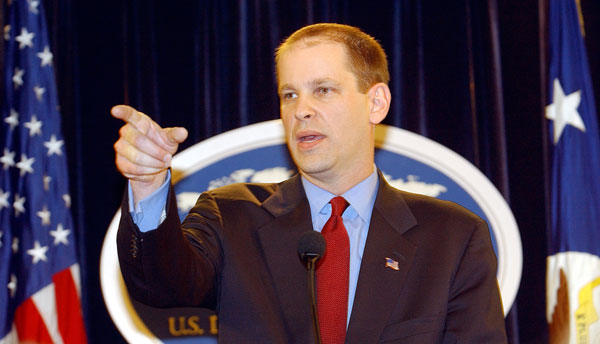
Department Spokesman Sean McCormack (shown during the  Daily Press Briefing) was sworn in as Assistant Secretary for Public Affairs and Department Spokesman on June 2, 2005. Immediately prior to returning to the State Department, Mr. McCormack served as Special Assistant to the President, Spokesman for the National Security Council, and Deputy White House Press Secretary for Foreign Policy. State Department Photo by Michael Gross.Department Spokesman Sean McCormack (shown during the Daily Press Briefing) was sworn in as Assistant Secretary for Public Affairs and Department Spokesman on June 2, 2005. Immediately prior to returning to the State Department,
Mr. McCormack served as Special Assistant to the President, Spokesman for the National Security Council, and Deputy White House Press Secretary for Foreign Policy. State Department Photo by Michael Gross. TRANSCRIPT:, 12:20 p.m. EST

MR. MCCORMACK: We're ready for questions, whoever wants to go first.

QUESTION: Well, the first is, you know, I don't think it deserves a lot of time but Jill Carroll, again there's a tape. Is there any light you can shed on that?

MR. MCCORMACK: Nothing new for you on this, Barry. We continue to make every effort to secure her release, to see that she's back safe and sound with her family and her coworkers. We call upon her captors to release her immediately. But beyond that I don't -- I'm not going to have too much more to say about her particular situation. I think you understand that we certainly don't want to do anything that would, in any way, negatively affect the chances of her being returned safe and sound.

QUESTION: But your remarks suggest that you hold out hope that she's still alive and all.

MR. MCCORMACK: We still very much hope for her release immediately and that she's returned safe and sound with her family.

QUESTION: Okay.

MR. MCCORMACK: Saul.

QUESTION: On Haiti. What will you do to support the new leadership in Haiti?

MR. MCCORMACK: Well, first of all, a couple of things. One, let's congratulate the people of Haiti on holding an election that was mostly free from violence. There were some violent incidents early on in the electoral process. Some of that resulted from polls opening late, some frustration among people who wanted to vote. But the key here is that there was a high turnout, that the Haitian people invested in this electoral process and we're now going to wait to see what the final results are. The Committee on Elections is now tallying all the ballots. They have come out, I think, with some provisional results but they're not yet final. So we're going to wait to see what the final results are, Saul, before we, I think, have some more specific comments about how we might work with a new Haitian Government and the new Prime Minister.

But I will say that we look forward to, as a matter of principle, working with the new Haitian Government. The Haitian people, it would seem through this voter turnout, have chosen to close this particularly dark chapter in their history. We look forward to working with a new Haitian Government on building those democratic institutions that would serve the Haitian people, that would help provide for a better way of life, that would help provide for the prospect of a better future politically, socially, and economically for the Haitian people.

QUESTION: I wonder -- a lot of your work so far has been to get to this stage.

MR. MCCORMACK: Right.

QUESTION: You call it dark chapter and then you close it and they seem to be goals. I wonder if you can elaborate on the "how." Is there more aid going down there? What are you going to be doing to build those democratic institutions?

MR. MCCORMACK: That, I think, is going to be a matter for continuing discussion among the members of the international community, Saul. I would expect that in the wake of the final election results that we are going to be speaking with members of the Core Group, that have formed a core international body that helps support the holding of these elections, both in terms of rhetorical and diplomatic as well as material support. And those discussions are going to continue. I don't have any specific figures for you about aid flows and what is projected. I think once we have the final election results, we can get into a few more specifics in that regard.

QUESTION: Okay. I realize that it's always awkward for you -- uncomfortable -- to speak about the leadership until it's officially announced, although I think we understand that the provisional results are pretty clear and the opposition has already said who they think is winning. What I get from what you're saying is regardless of who wins, whether it's somebody we would have supported or not, we're really prepared to work with them. Is that a fair assessment?

MR. MCCORMACK: Whoever -- in the end -- is elected will be somebody that is elected by the Haitian people in what has been a free and fair election process. We look forward to working with the new government and its ministers, regardless of where they may fall along the political spectrum. Our interest is in seeing that they govern in a democratic manner. And democracy is not just about election day; it is about how you govern. So that will be the focus of our efforts and we look forward to working with the new Haitian Government based on those principles.

QUESTION: Are you saying this was a free and fair election?

MR. MCCORMACK: George, every indication up until this point has been that it was a free and fair election. There were certainly instances of violence along the way; we saw that. There were some questions raised about late opening of some of the polling places. But the reports that we've gotten back from the field have been that those late openings and other problems along the way were largely due to logistical problems. You know, Haiti is a difficult place to hold this kind of nationwide election. Our judgment at this point is then that the Haitian people, the Electoral Commission working with the international community, pulled off a good election.

QUESTION: Will you have a more comprehensive analysis of the election, after all the returns are in?

MR. MCCORMACK: Yeah. I think we’ll be able to do that for you.

QUESTION: One more. Do you think the UN peacekeeping should be extended?

MR. MCCORMACK: The MINUSTAH mission has served an important purpose up to this point. I think we've seen the positive results from their efforts. What we are -- we will continue to talk about MINUSTAH. I suspect that it will be a topic of discussion with the Haitian Government. We're going to have a new sovereign government in place. We're going to have to talk to them about the security situation. A big part of the international community's efforts right now is to work on police training. That effort I believe will continue. The Haitian Government is going to need some assistance in building up a professional police corps presence, which will be very important to ensuring rule of law in a safe and secure environment for the Haitian people. As for MINUSTAH, we'll be talking not only with Secretary General Annan, as well as the international community, but the new Haitian Government about that.

QUESTION: Another subject?

QUESTION: Can I have just one more?

MR. MCCORMACK: Yes.

QUESTION: Aristide cast a shadow over the election. His presence is always sort of in the background. Now in the past you've been categorical saying he's history, there's no need for him to play any part in Haitian politics. Is that still your position or do you think now with this new government or the vote behind us, he can and -- go back to Haiti?

MR. MCCORMACK: He wasn't on the ballot and he left of his own accord. He asked for assistance from the United States in going to South Africa. That was provided. We now will have a new elected government and we look forward to working with that government and the individuals that will be appointed by the prime minister in Haiti -- the new prime minister in Haiti.

QUESTION: But that's not nearly as categorical as you have been.

MR. MCCORMACK: Like I said, Saul, he wasn't on the ballot and he is in South Africa and I would expect that he would stay there.

QUESTION: The candidate who is largely believed to be the winner, didn't have any clear opposition on Aristide and it seems Aristide could come back. Would you support that?

MR. MCCORMACK: Again, he is not in Haiti. He is in South Africa and we believe that the Haitian people have closed the chapter in this most recent part of Haiti's history.

QUESTION: Well -- but he's actually said that -- he's actually said that he believes that Aristide should be able to come back. Is that something you would fight? Would you be discussing that with the Haitian Government about not letting him back or --

MR. MCCORMACK: We think the Haitian Government should be looking forward to their future, not to its past.

Yes.

QUESTION: France has indicated that it supports Russia's plan to meet Hamas. I just wondered, does the U.S. now -- I mean, you've had all night to think about this -- does the U.S. now support a meeting between President Putin and Hamas leaders? And also, this was not something that was agreed on during the Quartet meeting at all. Is there a split now in how you approach Hamas, if you have the Russians who want to speak to them and -- well, you can tell me whether overnight you've changed your position?

MR. MCCORMACK: No, we haven't. Look, the Russians made this decision. They made clear their decision. What we have received in multiple conversations with the Russian Government about this issue is their assurances that if there is contact with Hamas that they will send the very clear, strong signal that is outlined in the Quartet that Hamas has a choice to make and it must meet the conditions as outlined by the Quartet. I believe the French Government is in total accord with that point of view and we have been assured that should the Russian Government meet with Hamas that they would send that -- that the meeting would be with the intent of sending that clear, strong message. Secretary Rice has spoken with Foreign Minister Lavrov about this issue. Ambassador Burns has also had contacts with the Russian Foreign Ministry on it. And that was the message that we received from the Russian Government on this.

QUESTION: When did the Secretary speak to the Russians?

MR. MCCORMACK: This morning. This morning.

QUESTION: And did she give him her blessing for the meeting to go ahead? Did she say that she thinks it's a good idea or a bad idea?

MR. MCCORMACK: This is a Russian decision. The Quartet -- if you look at the Quartet statement, it doesn't specifically address contacts, but there is a principle in there as it relates to review of aid programs. And that principle is that individual countries will make their sovereign decisions about these issues. We consider Hamas a terrorist organization. We have, we do and we will, absent any sort of change in Hamas meeting those conditions. Other countries will have to make their own decisions.

But what we would call upon them to do is if there are contacts, and there have been contacts among other countries in the region -- I'd point out Egypt, for example -- that they be consistent and strong in sending the same message to Hamas. And that's what we've seen. Should the Russian Government follow through and have a meeting with Hamas, have some contact with Hamas, we've been assured that they will send that message that is contained in the Quartet statement.

QUESTION: Can you go a half a step further? I heard the Egyptian last night talking about the virtue of talking to Hamas, as Egypt is doing. So it's sort of a two-part question. The point you just made, can we say the Secretary made that point to Lavrov? And secondly, do you folks see a virtue of that, a positive side, in conversations with Hamas that have the purpose of trying to bring them out of their current position and bring them closer to an acceptable position? In other words, can these interlocutors do some good as well as lecturing them and telling them, you know, renounce terrorism?

MR. MCCORMACK: Well, I guess the way I'd put it, Barry, is should individual countries choose to have contact with Hamas that they send the message that Hamas has a choice to make, and that choice is that they must meet the conditions as outlined in the Quartet statement; if not, then certainly the international community is going to have to look at how it interacts with Hamas if there is a Palestinian Authority government with -- led by Hamas -- we don't know that yet; that based on the principles outlined in the Quartet statement the international community is going to take a close look at aid programs and its contacts with Hamas.

Yes.

QUESTION: Did Secretary Rice receive any assurances from Mr. Lavrov that Russia will inform U.S. on their next step on this matter?

MR. MCCORMACK: I'm sure we'll hear from them if they do, in fact, decide to hold the meeting.

I would also make one further point regarding the Quartet. At the envoy level, I daresay that on any given day David Welch, Assistant Secretary Welch, is in contact with other members of the Quartet, whether that's from the EU or member-states of the EU, on these issues. So we're working very closely with other members of the Quartet, other states, regarding issues of aid. I would expect in the coming weeks that the United States and the EU would be talking about their reviews of their individual aid programs and the different legal standards that would apply and have a general discussion about policy matters concerning aid to any future Palestinian government.

Yes.

QUESTION: I'm trying to see how you see this process that could take place with the Russians. Are you in support of it and coordinating with them, as you do with the EU-3, for instance, with Iran; that you weren't a party to it but you were briefed on it and you kind of coordinated your approach? Or are you saying, you know, although members of the Quartet agree to these certain principles, you know, you're on your own what you want to do and how you want to do it?

MR. MCCORMACK: I wouldn't draw the analogy that you've laid out there. As I responded to Barry, should individual countries make the decision to have contact with Hamas, we have urged them -- and we've done this in public as well as in private --

QUESTION: Is it coordinated? Is this a coordinated approach that you support and endorse? Or are you saying, you know, do what you want, but if you're going to do it, you should stick with --

MR. MCCORMACK: I'm not sure I see the -- I'm not sure -- maybe you're making it a fine distinction here that I am failing to pick up, Elise, but what we have stated very clearly is that this is for -- individual countries will make sovereign decisions about issues related to aid, issues related to contact. What we have stated very clearly is that if they, in fact, do have contact that they should reinforce, underline the principles outlined in the Quartet statement. You know, I don't know if that's -- how I can be more clear more about that.

QUESTION: So you're saying that these countries are talking to them as unilateral actors and not on behalf of the Quartet; is what I'm -- I guess what I'm getting at?

MR. MCCORMACK: I think that's what I've been saying all along.

QUESTION: On the --

QUESTION: Can I --

QUESTION: Are you concerned that Hamas is getting some sort of international standing that you would rather they not get by being -- I'll use the word "courted"? They're being courted to change their position but they are getting an audience -- Egypt, Russia --

MR. MCCORMACK: Again, I would take issue with -- you know, you choose your words, but I would take issue with the word "courted." The way that I would put it, Barry, is that individual states are reinforcing, laying out, what the conditions are and what the requirements are. I wouldn't use the word "courted."

QUESTION: Okay.

MR. MCCORMACK: Yes.

QUESTION: You said if the meeting goes ahead. Is it your understanding that the Russians have not yet finally decided whether they will invite Hamas, that it's still an open question?

MR. MCCORMACK: Well, they haven't set a date. They haven't set a date for a meeting. They haven't, I think, talked yet among themselves about at what level a possible meeting might me. President Putin said there would be a meeting, so I don't have any reason to doubt that. I'm just trying to be specific as to where we find ourselves right now. They haven't set a date as far as we know.

QUESTION: Secretary Rice's conversation with Foreign Minister Lavrov was on the assumption that the meeting will go forward. She was not still urging him to possibly call it off?

MR. MCCORMACK: Right. Right. Well, President Putin made it clear that he was going to make a sovereign decision and so we had no reason to doubt that none of that would be reversed.

Libby.

QUESTION: So just to be clear, if the Russians had the chance to lay out what the Quartet wants in a meeting with Hamas, is this something the Secretary thinks is going to be helpful?

MR. MCCORMACK: We believe that should Russia have -- take the opportunity to have -- choose to have a meeting, they should take it as an opportunity to reinforce the message. Whether or not it has any effect on Hamas is going to be up to Hamas. They're the ones -- the onus is on Hamas to make certain decisions. The international community has laid out very clearly what is required of them. It's up to them to respond to that.

QUESTION: But have you gotten assurances that Russia will send that message?

MR. MCCORMACK: Yes.

QUESTION: Do you think the special links Russia entertains with Iran could help in this matter with Hamas?

MR. MCCORMACK: Russian links with who?

QUESTION: With Iran, with the fact that they have been trying to help in the Iranian nuclear story and even if they don't succeed, they still have special links with Tehran. Do you think it could help?

MR. MCCORMACK: I guess I wouldn't draw that -- I wouldn't conflate the two issues.

QUESTION: Israel's Foreign Minister described this as a sort of a slippery slope, the moment you start meeting with Hamas and it will lead to other countries compromising or meeting with Hamas. Is that your view as well as this is sort of a slippery slope, once you have one meeting, then it's going to give them more credibility and then more countries are going to start meeting with them and then possibly your policy of isolating Hamas will just fall by the wayside?

MR. MCCORMACK: Well, I think what you are seeing the -- what underpins the Quartet's statement is forcing Hamas to make a choice. And absent that choice, the international community is going to have to assess what is currently ongoing with the interim government. So the basic approach here has been to put the onus on Hamas to make a decision. I think we've -- in the context that Hamas has had, they have received the same message from all of their contacts. I know that they are making a tour throughout the region, searching for some sort of affirmation. But I think what they are hearing, at least as far as the reports that we have gotten back, is their interlocutors are sending that Quartet message to them.

Joel.

QUESTION: Sean, are there any understandings with President Abbas which would prevent taking directives directly from Hamas and disrupting the – (inaudible) training or put together a plan to train security in Palestinian areas? Has that now gone by the wayside?

MR. MCCORMACK: Well, the existing efforts that General Dayton has undertaken continue. We continue to have contact with President Abbas on security issues. Certainly, the question of continued assistance in training Palestinian security forces is going to be one that will depend largely upon, it not completely upon, what the arrangements -- what future Palestinian government there is and what powers may or may not be retained by President Abbas. So at this point, I don't think we can answer that question, Joel, because we don't yet know what a future Palestinian government would look like, but we do continue to meet with President Abbas and his officials on issues related to General Dayton's mission.

Yes.

QUESTION: I was at a Carnegie forum last week and there were some speakers who were over there during the elections and one of the speakers made the statement that it seems that the trend, in fact, in the Middle East is not toward democracies like the U.S. is promoting, but is in fact Islamism is on the rise, as reflected in the Hamas victory as well as the Shia conservative majority in Iraq. And he said if free and fair elections, truly free and fair elections were held, Muslim Brotherhood-type governments would come to power in Egypt, Jordan, and so forth. I just would like you to rebut that.

MR. MCCORMACK: I have talked about this many times from the podium here. I think a lot of your colleagues have heard this many times before. You've heard it from the Secretary as well. But I'm happy to review it with you again. We are in the process -- what we are in the midst of is a deep historical change throughout the Middle East. You had 60 years of a freedom deficit in the Middle East where individuals had two choices: One, they could choose to live within the confines of autocratic political systems or they could seek outlets elsewhere through much more radical political groups, oftentimes with terrorists ties.

What President Bush did in his second inaugural is very firmly and clearly stake out a core principle of American foreign policy. And at the core of American foreign policy is the Freedom Agenda, is the advancement of democracy, freedom throughout the Middle East as well as around the world and part of that is elections. But you're going to find different countries at different stages across the Middle East. For example, in Saudi Arabia, you have had municipal elections. In Egypt, you have had now multiparty presidential elections, so just to use two examples. Egypt and Saudi Arabia are at two different stages in the democratic process.

In Kuwait, women will now have the right to vote. It's an important change. You have seen in Lebanon that Syria, as a result of international pressure, has exited Lebanon -- at least their ground forces have -- and the Lebanese people have chosen new leadership through free and fair elections.

So there is a lot of positive change throughout the region. The Palestinian people had free and fair elections, electing a new parliament. And President Bush has made very clear that it is not up to the United States to define how those elections turn out or who the people of the region choose to lead them. That is up to them. We will continue to work to address the freedom agenda, to expand personal freedoms for individuals in the region. We'll continue to work with those governments who are committed to opening up the political process, the political space for their citizens. We believe that that is -- that's important. We believe that our future security and the democracy agenda are inextricably linked; they are mutually reinforcing.

So while the democratic process, the opening of this democratic space in individual countries and through the Middle East writ large, is sometimes going to be bumpy, it will ultimately produce results that are not only in the interests of the people of the region in realizing a better, more free, more prosperous life, but it will also be in the interests of the United States and the rest of the world in producing a more stable, secure Middle East.

Yes, ma'am.

QUESTION: I'm wondering if you can update us on any development or progress with regard to the six-party talks. And if it's not this month, would it be possible to hold the six-party talks next month?

MR. MCCORMACK: We continue to urge the North Korean Government to return to the table at the earliest possible time to engage in serious, constructive negotiations. We're prepared to do so. We're just waiting for a final date to be set. We have not heard back from the Chinese Government, who is the party responsible for convening the talks, that they have an agreed date from all the six parties. So I don't have an update for you with respect to a specific time that the talks might start, but we continue to push to encourage all the parties to get together and meet for the next round of six-party talks, like they said they would do at the end of the last round, at the earliest possible date.

Yes.

QUESTION: The North Koreans yesterday -- I think yesterday said that their consistent policy was to oppose all sorts of illegal acts in the financial field. I wonder if you would welcome this coming from the North Koreans.

MR. MCCORMACK: Well, it's a fine rhetorical commitment, but what we would call upon is the North Korean Government to cease all such activities.

We view the six-party talks and our actions to prevent, stop, illicit activities as completely separate. These are completely separate issues. I think it is absolutely understandable and perfectly reasonable that a sovereign state would take actions to protect itself, in this case to protect its currency, and also to act to stop illicit activities. It's very simple. It is within the power of the North Korean Government to do so. We would call upon them to do so.

In the absence of that cessation, the United States will continue to act in its interests to either prevent or stop these illicit activities from occurring.

Samir.

QUESTION: Can you give us an update on Mr. Wolfensohn, the Quartet envoy? Where is he? What's his future role to be?

MR. MCCORMACK: I think he's back here in Washington or in the U.S. on consultations, so we're talking to him about his mission and what his future mission might be.

QUESTION: Is that in coordination with your review of aid and what you're going to do with the aid programs or --

MR. MCCORMACK: They're coincident. I'm not sure they're specifically tied, but certainly coincident.

QUESTION: Thank you.

MR. MCCORMACK: Thank you.

QUESTION: I still have a question. Yesterday I asked you a question about --

MR. MCCORMACK: Have to be quicker off the trigger.

QUESTION: The thing is your ambassador, he said he --

MR. MCCORMACK: Oh yes, I think we posted it. I think we posted an answer on that. But as I understand it, let's see here, let me get the details for you.

The Venezuelan Ambassador has a number of -- has had a number of contacts with people from our Western Hemisphere Affairs Bureau. The last one was on January 23rd when the Venezuelan Ambassador met with the Director and Deputy Director for the Office of Andean Affairs, which is the responsible office. Our deputy assistant secretaries are always open to meetings with ambassadors, typically on the day-to-day management of affairs between the State Department here and embassies is handled by desk officers and office directors. The Assistant in this case, Tom Shannon, is certainly always ready to schedule meetings. So in terms of diplomatic contact, the Venezuelan Embassy has had no shortage of that, as far as I can tell.

Thanks.

(The briefing was concluded at 12:50 p.m.)

DPB # 24, Released on February 10, 2006

more at
and or and , or and or , or and , or , and , or ,

Related: Keywords State Department, Thursday, February 09, 2006
State Department Podcast and Text 02/08/06, Friday, January 27, 2006 State Department Podcast and Text 01/25/06, Friday, January 27, 2006 Rice on Palestinian Elections (PODCAST), Tuesday, January 24, 2006 State Department Podcast and Text 01/23/06 , Friday, January 20, 2006 State Department Podcast and Text 01/19/06, Thursday, January 19, 2006 Secretary Rice, South Korean Foreign Minister PODCAST 01/19/06, Wednesday, January 18, 2006 State Department Podcast, Text 01/17/05,

Sunday, February 12, 2006

Facial characteristics indicative of personality traits, say experts

Facial characteristics indicative of personality traits, say experts

A new study to examine facial preference, has found that people are attracted to facial characteristics indicative of personality traits similar to their own

Biological scientists at the University of Liverpool launched the study to investigate the reasons why many couples tend to look similar to each other. The team, in collaboration with the University of Durham and the University of St Andrews, asked participants to judge perceived age, attractiveness, and personality traits of real-life married couples. Photographs of female faces were viewed separately to male faces, so that participants were unaware of who was married to whom.

Dr Tony Little, from the University's School of Biological Sciences, explains: "There is widespread belief that couples, particularly those who have been together for many years, look similar to each other. To understand why this happens, we looked at the assumptions that people make about a person's personality, based on facial characteristics. We found that perceptions of age, attractiveness and personality were very similar between male and female couples. For example if the female face was rated as 'sociable' then her partner was also more likely to be rated as 'sociable.'

"We also found that couples who had been married for a long period of time, were perceived as having more similar personalities than those who had not been together very long. This may come from sharing experiences together - affecting how their face appears."

Scientists are now looking for people who are both single and attached to take part in an online study that will include questions about their personality, age and how they rate their own attractiveness. The study will also feature face preference tests, in which participants will be asked to rate the attractiveness of different face types. The online study will examine whether an individual's physical and personality traits influence their face preferences.

Scientists will also investigate whether face perceptions are different between those with and without partners.

Dr Little added: "These tests will allow us to see how particular face types communicate certain personality traits and how perceptions of unfamiliar faces, as well as our own face, influence us in the friends and partners we choose."

###

Members of the public are invited to take part in the online face experiments by logging on to
alittlelab.com

Contact: Samantha Martin
samantha.martin@liv.ac.uk 151-794-2248 University of Liverpool

more at
or and or and or or and or and

Related: Keyword biology, Tuesday, January 04, 2005
The Cassini-Huygens mission to Saturn, Sunday, March 20, 2005 Agriculture Secretary Mike Johanns, bovine spongiform encephalopathy (BSE), Thursday, March 24, 2005 Fish Oil Holds Promise in Alzheimer's Fight, Sunday, April 10, 2005 National Human Genome Research Institute (NHGRI), Friday, April 15, 2005 Study uncovers bacteria's worst enemy, Sunday, May 01, 2005 Yes, it is an exoplanet 2M1207 system, Friday, May 20, 2005 a polysaccharide called hyaluronan, Tuesday, May 24, 2005 pseudoneglect phenomenon, Friday, June 03, 2005 DOE JGI sequences DNA from extinct cave bear, Monday, June 06, 2005 From a Few Wild Ancestors, a Citrus Cornucopia, Tuesday, June 07, 2005 NHGRI Selects 13 More Organisms for Genome Sequencing, Sunday, July 24, 2005 Prehistoric Native Americans maize cultivation, Sunday, July 31, 2005 Protein 97 Synapse-associated (SAP97), Sunday, August 07, 2005 universal flu vaccine, Sunday, August 07, 2005 Smoking gun for Alzheimer's disease, Sunday, August 07, 2005 placental tissue, embryonic stem cells, Sunday, August 21, 2005 female senior faculty are still rare, Sunday, September 18, 2005 more rain would benefit New Orleans, Sunday, October 02, 2005 Rapid evolution of the quagga, Sunday, October 30, 2005 , Sunday, November 27, 2005 Give thanks for the cranberry, say dental researchers, Sunday, December 04, 2005 Poison + water = hydrogen, Sunday, December 11, 2005 40,000-year-old human footprints, Sunday, December 18, 2005 warfare in the Mesopotamian world, Sunday, December 18, 2005 Conditions for slavery, Sunday, December 25, 2005 Why Christmas trees are not extinct, Sunday, January 01, 2006 prostaglandins choreograph perturbations, Sunday, January 01, 2006 Cultural differences may explain variations in home remedy use, Sunday, January 08, 2006 Risky Sexual Behaviors in Miami, and Racial Influences on Children’s Care, Sunday, January 22, 2006 Twenty-seven previously unknown species discovered,

Hormone linked to good hearing as we age

Hormone linked to good hearing as we age

Researchers have linked a hormone known to adjust levels of key brain chemicals to the quality of our hearing as we age. The more of the hormone that older people have in their bloodstream, the better their hearing is, and the less of the hormone, the worse their hearing is.

The hormone, aldosterone, is known to regulate kidney function and also plays a role in controlling levels of two crucial signaling chemicals in the nervous system, potassium and sodium. For nerves to send signals crisply and work properly, potassium and sodium must be in precise proportion, without any disruption in the molecular channels or gates through which they move. Levels of potassium are particularly crucial in the sensitive inner ear, where fluid rich in potassium plays a central role in converting sounds into signals that the nervous system recognizes.

The team of scientists in Rochester, N.Y., put 47 healthy men and women between the ages of 58 and 84 through a battery of sophisticated hearing tests. Scientists also measured their blood levels of aldosterone, which is known to drop as people age. They found that people with severe hearing loss had on average about half as much aldosterone in their bloodstream as their counterparts with normal hearing. The researchers noted, however, that the levels of aldosterone found in all the participants is considered normal, and that no patients or physicians should consider altering aldosterone levels without more research.

The findings come from researchers at the International Center for Hearing and Speech Research (ICHSR), a group funded by the National Institute on Aging that is recognized as a leader in research on age-related hearing loss. The center includes scientists from the National Technical Institute for the Deaf at Rochester Institute of Technology and neuroscientists from the University of Rochester.

"The inner ear is especially sensitive to any disruption in potassium levels," said Robert D. Frisina, Ph.D., professor of Otolaryngology at the University of Rochester Medical Center and an adjunct professor at Rochester Institute of Technology. "We know that potassium levels in the inner ear seem to decrease as we age and that these falling levels play a role in age-related hearing loss, and we also know that blood levels of aldosterone generally decrease with age.

"We found a direct link between blood levels of aldosterone and the ability of people to hear normally as they age. Depressed hormone levels may hurt hearing both in the inner ear and the part of the brain used for hearing. More research is needed, however, to understand the precise role that aldosterone plays – for instance, whether it's a cause of failed hearing, or whether it's symptomatic. Before we understand the issue more fully, people should not worry about their aldosterone levels or look to boost the amount in their bloodstream."

The team led by Frisina published its results in the November issue of the journal Hearing Research. This week at the annual international meeting of the Association for Research in Otolaryngology in Baltimore, the team presented its latest results showing just how important potassium regulation is to age-related hearing loss.

In Baltimore, Otolaryngology medical resident Jared Spencer, M.D., presented results from "knockout" mice whose genes controlling the potassium channels in the inner ear don't function properly, and confirmed that malfunctioning potassium channels are central to age-related hearing loss, or presbycusis. The channels are highly concentrated in a part of the brain that plays an important role providing feedback from the brain to the ears. Frisina's team previously discovered that the feedback system is one of the first things to go wrong in age-related hearing loss, often declining in people who are in their 40s and 50s, usually before they even realize their hearing is declining.

"We are now working out some of the underlying biology about how the decline occurs," said Frisina. "We have evidence that these potassium channels may play an important role in the failure of the feedback system, which is a big part of age-related hearing loss."

Nearly everyone wrestles with failing hearing at some point. While some people suffer from hearing damage as a result of exposure to loud noise, or from other causes such as the side effects of some medications, for many people hearing problems occur with no known cause. Some people notice problems in their 40s and 50s, but the process becomes very noticeable for most people in their 60s and older.

Frisina said that until the biology of the problem is better understood, the best advice for people concerned about hearing loss is to limit exposure to loud, damaging noise and to medications that are toxic to the ears. He also counsels people to eat healthy and to exercise – "all those things you know you should be doing to stay healthy with age," he said.

Meanwhile, his team is looking at the possibility of using gene therapy to try to correct the problem. It may be possible some day to modify a person's inner ear to correct the potassium imbalance that is central to hearing loss. Such an approach might also address the biggest cause of congenital deafness, which involves a genetic mutation that mucks up the potassium balance in the inner ear.

The new findings come from a research group founded by Robert Frisina's father, D. Robert Frisina, Ph.D., founding director of NTID, who heads one of the largest research groups in the world studying age-related hearing loss. The group has attracted top researchers from around the world to come together to study the problem. Members of the group, which numbers more than two dozen, hail from Egypt, Brazil, Russia, China, Korea, India, and the United States.

In addition to Frisina, Frisina and Spencer, the team includes post-doctoral research associate Sherif Tadros, M.D., of both the University and NTID, who is first author of the Hearing Research paper; research nurse Susan Frisina of both NTID and the University; audiologist Frances Mapes of NTID; and otolaryngologist Xiaozia Zhu, M.D., of the University.

###

Contact: Tom Ricke y
tom_rickey@urmc.rochester.edu 585-275-7954 University of Rochester Medical Center

more at
or and or and or or and or and

Related: Keyword biology, Tuesday, January 04, 2005
The Cassini-Huygens mission to Saturn, Sunday, March 20, 2005 Agriculture Secretary Mike Johanns, bovine spongiform encephalopathy (BSE), Thursday, March 24, 2005 Fish Oil Holds Promise in Alzheimer's Fight, Sunday, April 10, 2005 National Human Genome Research Institute (NHGRI), Friday, April 15, 2005 Study uncovers bacteria's worst enemy, Sunday, May 01, 2005 Yes, it is an exoplanet 2M1207 system, Friday, May 20, 2005 a polysaccharide called hyaluronan, Tuesday, May 24, 2005 pseudoneglect phenomenon, Friday, June 03, 2005 DOE JGI sequences DNA from extinct cave bear, Monday, June 06, 2005 From a Few Wild Ancestors, a Citrus Cornucopia, Tuesday, June 07, 2005 NHGRI Selects 13 More Organisms for Genome Sequencing, Sunday, July 24, 2005 Prehistoric Native Americans maize cultivation, Sunday, July 31, 2005 Protein 97 Synapse-associated (SAP97), Sunday, August 07, 2005 universal flu vaccine, Sunday, August 07, 2005 Smoking gun for Alzheimer's disease, Sunday, August 07, 2005 placental tissue, embryonic stem cells, Sunday, August 21, 2005 female senior faculty are still rare, Sunday, September 18, 2005 more rain would benefit New Orleans, Sunday, October 02, 2005 Rapid evolution of the quagga, Sunday, October 30, 2005 , Sunday, November 27, 2005 Give thanks for the cranberry, say dental researchers, Sunday, December 04, 2005 Poison + water = hydrogen, Sunday, December 11, 2005 40,000-year-old human footprints, Sunday, December 18, 2005 warfare in the Mesopotamian world, Sunday, December 18, 2005 Conditions for slavery, Sunday, December 25, 2005 Why Christmas trees are not extinct, Sunday, January 01, 2006 prostaglandins choreograph perturbations, Sunday, January 01, 2006 Cultural differences may explain variations in home remedy use, Sunday, January 08, 2006 Risky Sexual Behaviors in Miami, and Racial Influences on Children’s Care, Sunday, January 22, 2006 Twenty-seven previously unknown species discovered,

Parental Conflict Produces More Than Fleeting Distress for Children

Parental Conflict Produces More Than Fleeting Distress for Children

Six-year-olds whose parents displayed frequent disagreements in their relationship responded to subsequent parental conflicts with elevated distress and negative thoughts, according to a team of researchers from the University of Rochester and the University of Notre Dame.

In the latest issue of the journal Child Development, the team reported examining 223 children twice during a one-year period for their reactions to conflicts between their parents. First, their mothers and fathers participated alone in an exercise in which they attempted to manage and resolve a common point of disagreement. The researchers rated the parents' level of hostility or indifference to capture the characteristic ways that parents managed their conflicts. Then the children observed their parents working through two simulated telephone conversations: a short conflict and a resolution.

Researchers found that the ways parents managed conflicts in the exercise predicted how children responded to the simulated phone conflict—both within a two-week period and one year later. Parents who displayed high levels of discord had children who responded with greater than expected distress to the simulated phone conflict.

"The stressfulness of witnessing several different types of conflict may have long-term implications for children's functioning by directly altering their patterns of responding to those conflicts," says Patrick T. Davies, lead author and professor of psychology at the University of Rochester. "Our results highlight the possibility that several different types of conflict between parents may negatively affect the well-being of children over time," he says.

According to the authors, prior experiences with parental conflicts can alter the way children cope with later conflicts. "Conflict between parents may have distinct meanings and implications for the child and family system even after considering the effects of parenting difficulties," Davies points out.

Although previous work has shown that children don't get used to their parents discord but, instead, become more sensitive to it, Davies and his colleagues wondered if different forms of destructive conflict between parents played different roles in children's reactions. It didn't matter whether the adults disagreed in openly hostile ways or appeared indifferent during the arguments. Both ways of managing conflict were linked with higher than expected distress in children that lasted even one year later.

The primary purpose of the study was to chart stability and change in children's responses to a conflict in the context of interparental and family interactions in the early elementary years. The authors believe that the study lays the foundation for new testing on how children adapt when dealing with interparental conflict.

Co-authors are Melissa L. Sturge-Apple, Marcia Winter, and Deirdre Farrell of the University of Rochester's Department of Clinical and Social Sciences in Psychology at the time of the study, and E. Mark Cummings, professor in the Department of Psychology at the University of Notre Dame. The research was supported by grants and fellowships from the National Institute of Mental Health.

About the University of Rochester: The University of Rochester (
rochester.edu) is one of the nation's leading private universities. Located in Rochester, N.Y., the University's environment gives students exceptional opportunities for interdisciplinary study and close collaboration with faculty. Its College of Arts, Sciences, and Engineering is complemented by the Eastman School of Music, Simon School of Business, Warner School of Education, Laboratory for Laser Energetics, and Schools of Medicine and Nursing. PR 2425, MS 863

MEDIA CONTACT: Sharon Dickman (585) 275-4128,
sdickman@rochester.edu, February 9, 2006

RELATED: Sunday, January 08, 2006
Risky Sexual Behaviors in Miami, and Racial Influences on Children’s Care, Saturday, October 01, 2005 Child Health Day, 2005, Sunday, September 18, 2005 Family Day, 2005, Saturday, July 23, 2005 Parents' Day, 2005, Sunday, June 05, 2005 on feeding young children, Friday, June 03, 2005 National Child's Day, 2005, Thursday, May 12, 2005 black youth twice as likely to die from traumatic injury as white,

more at
and or and , or and , or , and ,

Anti-HIV drug has potential to prevent transmission in women

First study to evaluate antiretroviral as a vaginal microbicide proves safe

Providence, RI – A new study from infectious disease researchers at The Miriam Hospital and Brown Medical School finds that a drug already given orally to treat HIV is also safe when applied as a vaginal microbicide gel. Microbicides are designed to prevent the sexual transmission of HIV and other sexually transmitted diseases and may be formulated as vaginal gels, foams, creams, or suppositories.

"The results of this study may change the way the research community looks at developing safe and effective microbicides," says lead author Kenneth H. Mayer, MD, an infectious disease physician at The Miriam Hospital and professor of medicine and community health at Brown Medical School, both in Providence, RI. "Analyzing the compounds that already have been shown to be successful HIV treatment drugs, and evaluating them for their potential to prevent transmission of infection is an innovative approach that shows great promise."

Published in the Feb. 28 issue of the journal AIDS, currently available online, the multi-site study suggests that as a vaginal gel, tenofovir produced mild or no side effects in both HIV positive and HIV negative women. Tenofovir is the active ingredient in the antiretroviral drug Viread made by Gilead Sciences.

Currently, there is no microbicide available that has been approved for widespread use. The tenofovir study was a safety and product acceptability study and did not evaluate if the microbicide would be effective in preventing the transmission of HIV in women. Expanded safety and effectiveness testing is needed.

"The data will pave the way for further studies that will ultimately evaluate whether the gel protects women from HIV infection," says co-author Lisa A. Maslankowski, MD, medical director of the HIV Prevention Research Division at the University of Pennsylvania School of Medicine. "As the first investigational microbicide to contain an antiretroviral agent, tenofovir gel can prevent HIV from replicating, unlike other microbicides which have been designed to block HIV entry into cells, or have other mechanisms of action."

If HIV cannot replicate, the authors infer, it is unlikely that it will be able to survive in the body long enough to cause infection. Prior research shows that tenofovir, when applied as a vaginal gel in monkeys, can block the transmission of Simian Immunodeficiency Virus (SIV), an animal virus that is very similar to HIV.

Approximately 5 million people will be infected with HIV this year – almost half of them women. Because the majority of new HIV infections occur via heterosexual intercourse, there is a need for new ways to prevent the sexual transmission of HIV. Although condoms can offer protection from HIV, in many societies women's legal and social status is subordinate to men's and they may not be able to negotiate their effective use, the paper states.

"A safe and effective topical microbicide would offer women an HIV prevention method that they could control," Mayer says.

In addition, researchers evaluated a subgroup of women in the study to determine if the active ingredient in tenofovir gel was absorbed into their bloodstream. Approximately half of these women had low tenofovir levels in their plasma at one or more times during the 14-day study. Further evaluation is needed to determine if absorption of tenofovir into the bloodstream could be beneficial in enhancing the gel's effectiveness or could cause adverse long-term side effects.

The study participants included 84 women, 18 to 45 years of age. Of those, 60 were not infected with HIV and 24 were HIV-infected women. All participants used the study product for 14 consecutive days and received frequent safety assessments and pelvic exams during the study at one of four research sites: The Miriam Hospital in Providence, RI; Hospital of the University of Pennsylvania in Philadelphia; Harlem Hospital and Bronx-Lebanon Hospital Center, both in New York.

The most common adverse effects reported by women were mild in nature, mainly itching and increased vaginal discharge. None of the participants experienced significant changes in laboratory tests while using the gel.

Past safety trials of microbicides showed that certain gels caused ulcerations and inflammation in women that could actually facilitate HIV transmission. The favorable findings of the tenofovir gel's Phase I safety and acceptability trial has already led to a larger Phase II safety study in at-risk women due to begin in the spring of 2006.

According to the study, there was a high acceptability rate among participants, as 94 percent of women said they would definitely or probably use the gel if it were available and they wanted protection from HIV transmission.

The Miriam Hospital, established in 1926 in Providence, RI, is a not-for-profit hospital affiliated with Brown Medical School. Nationally recognized as a top hospital in cardiovascular care, The Miriam Hospital (
miriamhospital.org) offers particular expertise in cardiac catheterization, angioplasty and women's cardiac care. One of 20 designated Center for AIDS Research (CFAR) sites, The Miriam is a leader in the treatment, research and prevention of HIV/AIDS, attracting $17 million of the world's HIV/AIDS research dollars. The Miriam Hospital has been awarded Magnet Recognition for Excellence in Nursing Services twice and is committed to excellence in patient care, research and medical education. The Miriam is a founding member of the Lifespan health system.

###

The study was supported by the HIV Prevention Trials Network (HPTN) and sponsored by: the National Institute of Allergy and Infectious Diseases (NIAID); National Institute of Child Health and Human Development; National Institute on Drug Abuse; and National Institute of Mental Health and Office of AIDS Research, of the National Institutes of Health (NIH), U.S. Department of Health and Human Services. Clinical coordination for the study was conducted by Family Health International (Research Triangle, NC), data analysis was performed at the Fred Hutchinson Cancer Center of the University of Washington in Seattle, and HIV resistance testing and pharmacology studies were performed in laboratories at Johns Hopkins University. The Miriam Hospital participates in the HPTN as part of a clinical trial unit coordinated by Fenway Community Health in Boston. The study was also conducted in conjunction with clinical investigators from Women & Infants' Hospital in Providence, RI.

Contact: Megan Martin
mmartin@lifespan.org 401-793-7484 Lifespan

RELATED: Keywords HIV/AIDS, Thursday, February 09, 2006
President’s Emergency Plan for AIDS Relief (VIDEO), Thursday, December 01, 2005 HIV/AIDS Initiatives World AIDS Day (VIDEO), Tuesday, September 27, 2005 Global Business Coalition on HIV/AIDS 2005 Awards, Monday, August 22, 2005 HUD AWARDS $18.8 MILLION HIV/AIDS, Monday, June 27, 2005 National HIV Testing Day, June 27, 2005,

more at
or and or and or and or and

Saturday, February 11, 2006

President Bush Welcomes President of Poland (VIDEO)

President Bush Welcomes President of Poland to the White House, FULL STREAMING VIDEO, The Oval Office 11:57 A.M. EST, In Focus: Global Diplomacy

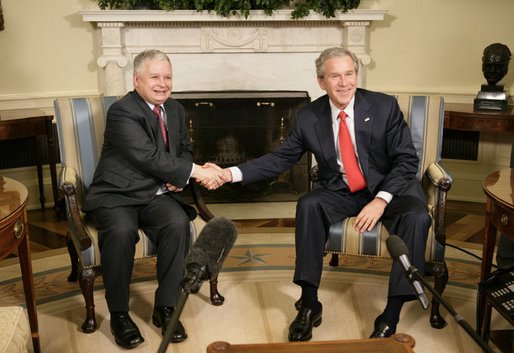
President George W. Bush welcomes Poland's President Lech Kaczynski to the Oval Office at the White House, Thursday, Feb. 9, 2006 in Washington. White House photo by Eric Draper.President George W. Bush welcomes Poland's President Lech Kaczynski to the Oval Office at the White House, Thursday, Feb. 9, 2006 in Washington. White House photo by Eric Draper.
PRESIDENT BUSH: Mr. President, welcome to the Oval Office. It's really good to have you here. We have just had a extensive discussion about important issues. After this press statement we'll go have lunch and continue our discussions. And we've got a lot to discuss, because we're strong allies and friends. We're friends in liberty. We believe in peace.

told the President, it's amazing to be sitting with somebody who knows the difference between living in a society that is not independent, and not free, and one that -- and now he's the President of a free country. I thanked the President and the Polish people for their support of democracy movement in Iraq.

We had a very interesting discussion about NATO and the European Union. You can be an active member of the EU, a loyal member of the EU and a friend of the United States at the same time. I asked the President his advice on Ukraine. That's what friends do -- they share information and share strategic thoughts.

We talked about the importance for commercial ties. We'll continue those discussions over lunch. The President of Poland comes to a country that respects Poland. There's a lot of Polish-Americans that have still got great pride for the homeland. We congratulate you on your victory and welcome you.

Thanks for coming.

PRESIDENT KACZYNSKI: President Bush has spoken of the subject of our talks. The first part has been extended, to a certain extent, and we will continue our discussions during lunch. We have discussed issues relating to NATO, the European Union, Belarus, Ukraine and Russia and Iraq and Afghanistan. In other words, to say very briefly, we've discussed all issues that both countries are interested in.

Mr. President and myself have discussed issues relating to freedom in the Ukraine and Belarus. And the support of the United States for all actions that are leading to freedom in Ukraine and Belarus are very important for Poland, at the same time. There have been certain signals that might lead to an improvement of relations between the Republic of Poland and the Russian Federation. We have no certainty yet, but these signals we have received, and we're hoping for an improvement in relations between Poland and Russia.

We shall continue our talks in a few minutes.

PRESIDENT BUSH: Thank you, sir. Thank you.

END 12:02 P.M. EST, For Immediate Release, Office of the Press Secretary, February 9, 2006

more at
or and and or and or and or and

Related: Keyword Poland, Tuesday, January 17, 2006
President to Welcome Polish President Lech Kaczynski, Thursday, October 13, 2005 President Welcomes Polish President Kwasniewski (VIDEO), Thursday, August 25, 2005 25th Anniversary of the Solidarity Movement, Thursday, February 10, 2005 BUSH KWASNIEWSKI 02/09/05 text, video, Sunday, February 06, 2005 Secretary Condoleezza Rice, Polish Prime Minister Marek Belka,

Presidential Podcast 02/11/06

Presidential Podcast 02/11/06

Subscribe to My Odeo Channel Subscribe to Our Odeo Podcast Channel and receive the Presidential Radio Address each week. Featuring real audio and full text transcript

more at and or and , or and , or , and ,

Related: Keywords radio address, podcast, Saturday, February 04, 2006 Presidential Podcast 02/04/06, Saturday, January 28, 2006 Presidential Podcast 01/28/06, Saturday, January 14, 2006 Presidential Podcast 01/14/06, Saturday, January 07, 2006 Presidential Podcast 01/07/06, Saturday, December 31, 2005 Presidential Podcast 12/31/05, Saturday, December 17, 2005 bush radio address 12/17/05 full VIDEO, text transcript, Sunday, December 04, 2005 Presidential Podcast 12/03/05, Saturday, December 03, 2005 bush radio address 12/03/05 full audio, text transcript, November 26, 2005 Presidential Podcast 11/26/05, Saturday, November 26, 2005 bush radio address 11/26/05 full audio, text transcript, Saturday, November 19, 2005 Presidential Podcast 11/19/05, Saturday, November 19, 2005 Freedom Calendar 11/19/05 - 11/26/05, Saturday, November 12, 2005 Presidential Podcast 11/12/05, Saturday, November 12, 2005 bush radio address 11/12/05 full audio, text transcript, Saturday, November 05, 2005 Presidential Podcast 11/05/05, Saturday, November 05, 2005 bush radio address 11/05/05 full audio, text transcript, Saturday, October 29, 2005 bush radio address 10/29/05 full audio, text transcript, Saturday, October 22, 2005 Presidential Podcast 10/22/05, Saturday, October 15, 2005 Presidential Podcast 10/15/05, Saturday, October 08, 2005 bush radio address 10/08/05 full audio, text transcript

Freedom Calendar 02/11/06 - 02/18/06

February 11, 1856, Republican Montgomery Blair argues before U.S. Supreme Court on behalf of his client, the slave Dred Scott; later served in President Lincoln’s Cabinet.

Abraham Lincoln’s Birthday, February 12, 1909, On 100th anniversary of Abraham Lincoln’s birth, African-American Republicans and women’s suffragists Ida Wells and Mary Terrell co-found the NAACP.

February 13, 1862 Birth of Republican Benigno Hernandez, first Hispanic U.S. Representative from New Mexico (1915-17, 1919-21).

February 14, 1928, Birth of Ben Garrido Blaz, Hispanic Republican and former Brigadier General; served as Delegate from Guam to U.S. Congress, 1985-93.

February 15, 1932, Republican President Herbert Hoover nominates Benjamin Cardozo as second Jewish Justice on U.S. Supreme Court.

February 16, 1812 Birth of Republican civil rights activist and U.S. Senator (R-MA) Henry Wilson, Vice President under Ulysses Grant.

February 17, 1973, Republican Navy Secretary John Warner commissions frigate in honor of first African-American naval aviator, Jesse L. Brown, who died in combat during Korean War.

February 18, 1946, Appointed by Republican President Calvin Coolidge, federal judge Paul McCormick ends segregation of Mexican-American children in California public schools.

“The Republican Party, on the contrary [to the Democrats], holds that this government was instituted to secure the blessings of freedom, and that slavery is an unqualified evil… . [Republicans] will oppose in all its length and breadth the modern Democratic idea that slavery is as good as freedom.”

Abraham Lincoln, 16th President of the United States

SOURCE:
Republican Freedom Calendar more at and or and or and or and or and or

Related: Keywords Freedom Calendar, Saturday, February 04, 2006
Freedom Calendar 02/04/06 - 02/11/06, Saturday, January 28, 2006 Freedom Calendar 01/28/06 - 02/04/06, Saturday, January 21, 2006 Freedom Calendar 01/21/06 - 01/28/06, Saturday, January 14, 2006 Freedom Calendar 01/14/06 - 01/21/06, Saturday, January 07, 2006 Freedom Calendar 01/07/06 - 01/14/06, Saturday, December 31, 2005 Freedom Calendar 12/31/05 - 01/07/06, Saturday, December 24, 2005 Freedom Calendar 12/24/05 - 12/31/05, Saturday, December 17, 2005 Freedom Calendar 12/17/05 - 12/24/05, Saturday, December 10, 2005 Freedom Calendar 12/10/05 - 12/17/05, December 03, 2005 Freedom Calendar 12/03/05 - 12/10/05, Saturday, November 26, 2005 Freedom Calendar 11/26/05 - 12/03/05, Saturday, November 19, 2005 Freedom Calendar 11/19/05 - 11/26/05, Saturday, November 12, 2005 Freedom Calendar 11/12/05 - 11/19/05, Saturday, November 05, 2005 Freedom Calendar 11/05/05 - 11/12/05, Saturday, October 29, 2005 Freedom Calendar 10/29/05 - 11/05/05, Saturday, October 22, 2005 Freedom Calendar 10/22/05 - 10/028/05, Saturday, October 15, 2005 Freedom Calendar 10/15/05 - 10/22/05

bush radio address 02/11/06 full audio, text transcript

bush radio address 02/11/06 full audio, text transcript PODCAST

President's Radio Address

THE PRESIDENT: Good morning. Today I want to talk to you about the new Medicare prescription drug coverage that went into effect on January 1st of this year.

When I came into office, I found a Medicare system that was antiquated and not meeting the needs of America's seniors. The system would pay tens of thousands of dollars for a surgery, but not a few hundred dollars for the prescription drugs that could have prevented the surgery in the first place. So working with Congress, we passed critical legislation that modernizes Medicare, provides seniors with more choices, and gives seniors better access to the prescription drugs they need.

Since the program went into effect six weeks ago, more than 24 million people with Medicare now have prescription drug coverage, and hundreds of thousands more are enrolling each week. The competition in the prescription drug market has been stronger than expected and is lowering costs for taxpayers and seniors alike. This year, the Federal government will spend 20 percent less overall on the Medicare drug benefit than projected just last July. The average premium that seniors pay is a third less than had been expected -- just $25 per month, instead of $37 per month. And the typical senior will end up spending about half of what they used to spend on prescription drugs each year.

Last month in Oklahoma City, a senior named Dorothy Brown signed up for Medicare prescription drug coverage. Dorothy has six prescriptions, and previously she paid about $300 a month for her medicines. A Medicare enrollment counselor at a shopping mall helped Dorothy log on to the Medicare website, where she typed the information on Dorothy's Medicare card and listed Dorothy's prescriptions. When the counselor was finished, the computer showed five different plans that fit Dorothy's needs. Dorothy chose the least-expensive plan -- and now, instead of paying $300 a month, she will pay about $36 a month for her medicines. And as a result, Dorothy will save more than $3,000 this year.

For Dorothy and for the vast majority of our seniors, the new prescription drug program is working well. Still, when you make a big change in a program involving millions of people, there are bound to be some challenges, and this has been the case with the new drug coverage. Some people had trouble the first time they went to the pharmacy after enrolling. Information for some beneficiaries was not transferred smoothly between Medicare, drug plans, and the states. And in the early days of the drug coverage, waiting times were far too long for many customers and pharmacists who called Medicare or their drug plans to seek help.

Secretary of Health and Human Services Mike Leavitt has traveled to 18 states in the past three weeks to meet with governors and make sure the prescription drug program is working for everyone, and we're making good progress. We're ensuring that drug plans have more up-to-date information on their beneficiaries, and we're improving data-sharing among Medicare, health plans, and the states. We have also extended the transition period from 30 days to 90 days, to guarantee that seniors do not go without the medicine they need as they switch to a new drug plan. We have also acted to ensure that phone calls to the Medicare help line are now answered with little or no waiting time, and we're working with insurers to help them do the same on their phone lines.
Despite early challenges, the results so far are clear: The new Medicare prescription drug plan is a good deal for seniors. If you're a Medicare recipient and have not yet signed up for prescription drug coverage, I encourage you to review your options and choose the plan that is right for you. Americans who have parents on Medicare should encourage and help them to sign up. Citizen groups, faith-based organizations, health professionals, and pharmacies across America are working to help answer questions. Seniors can also get information 24 hours a day by calling 1-800-MEDICARE or by visiting the official Medicare website at Medicare.gov.

Prescription drug coverage under Medicare has been available for just a few weeks, but its benefits will last for decades to come. I was proud to sign this Medicare reform into law. And because we acted, millions of American seniors are now saving money, getting the life-saving drugs they need, and receiving the modern health care they deserve.

Thank you for listening.

For Immediate Release, February 11, 2006

more at
and or and , or and , or , and ,

Related: Keywords radio address, podcast, Saturday, February 04, 2006
bush radio address 02/04/06 full audio, text transcript, Saturday, January 28, 2006, bush radio address 01/28/06 full audio, text transcript, Saturday, January 21, 2006 bush radio address 01/21/06 full audio, text transcript, Saturday, January 14, 2006 bush radio address 01/14/06 full audio, text transcript, Saturday, January 07, 2006 bush radio address 01/07/06 full audio, text transcript, Saturday, December 31, 2005 bush radio address 12/31/05 full audio, text transcript, Saturday, December 24, 2005 bush radio address 12/24/05 full audio, text transcript, Saturday, December 17, 2005 bush radio address 12/17/05 full VIDEO, text transcript, Sunday, December 04, 2005 Presidential Podcast 12/03/05, Saturday, December 03, 2005 bush radio address 12/03/05 full audio, text transcript, November 26, 2005 Presidential Podcast 11/26/05, Saturday, November 26, 2005 bush radio address 11/26/05 full audio, text transcript, Saturday, November 19, 2005 Presidential Podcast 11/19/05, Saturday, November 19, 2005 Freedom Calendar 11/19/05 - 11/26/05, Saturday, November 12, 2005 Presidential Podcast 11/12/05, Saturday, November 12, 2005 bush radio address 11/12/05 full audio, text transcript, Saturday, November 05, 2005 Presidential Podcast 11/05/05, Saturday, November 05, 2005 bush radio address 11/05/05 full audio, text transcript, Saturday, October 29, 2005 bush radio address 10/29/05 full audio, text transcript, Saturday, October 22, 2005 Presidential Podcast 10/22/05, Saturday, October 15, 2005 Presidential Podcast 10/15/05, Saturday, October 08, 2005 bush radio address 10/08/05 full audio, text transcript, Saturday, October 01, 2005 bush radio address 10/01/05 full audio, text transcript, Saturday, September 24, 2005 bush radio address 09/24/05 full audio, text transcript, Saturday, September 17, 2005 bush radio address 09/17/05 full audio, text transcript