Tuesday, March 14, 2006

President Discusses Freedom and Democracy in Iraq, 03/13/05 VIDEO

President Discusses Freedom and Democracy in Iraq, 03/13/05, FULL STREAMING VIDEO Dorothy Betts Marvin Theatre, The George Washington University, Washington, D.C. 1:16 P.M. EST
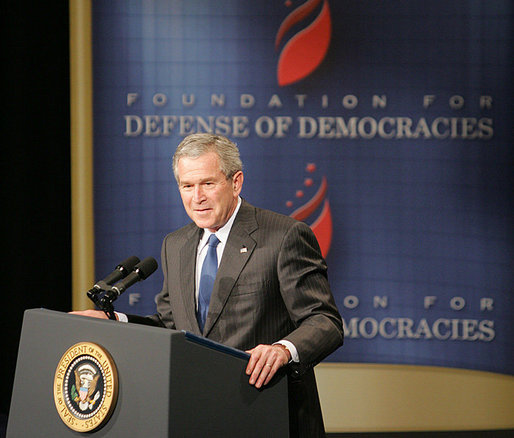
President George W. Bush addresses his remarks on the global war on terror, Monday, March 13, 2006 , before members and guests of the Foundation for the Defense of Democracies at the Dorothy Betts Marvin Theatre at George Washington University in Washington. White House photo by Paul Morse.President George W. Bush addresses his remarks on the global war on terror, Monday, March 13, 2006 , before members and guests of the Foundation for the Defense of Democracies at the Dorothy Betts Marvin Theatre at George Washington University in Washington. White House photo by Paul Morse.
Fact Sheet: Strategy for Victory: Defeating the Terrorists and Training Iraqi Security Forces
In Focus: Renewal in Iraq
In Focus: National Security
en EspaƱol

THE PRESIDENT: Thanks for the warm welcome. Cliff, thanks for the introduction. It's a pleasure to be with the Foundation for the Defense of Democracies. This organization was formed in the wake of the September the 11th attacks to fight the ideologies that drive terrorism. You recognized immediately that the war on terror is a struggle between freedom and tyranny -- and that the path to lasting security is to defeat the hateful vision the terrorists are spreading with the hope of freedom and democracy.

The Foundation is making a difference across the world, and I appreciate the difference you're making. You have trained Iraqi women and Iranian students in the principles and practice of democracy, you've translated "democracy readers" into Arabic for distribution across the broader Middle East, you've helped activists across the region organize effective political movements -- so they can help bring about democratic change and ensure the survival of liberty in new democracies. By promoting democratic ideals, and training a new generation of democratic leaders in the Middle East, you are helping us to bring victory in the war on terror -- and I thank you for your hard work in freedom's cause.

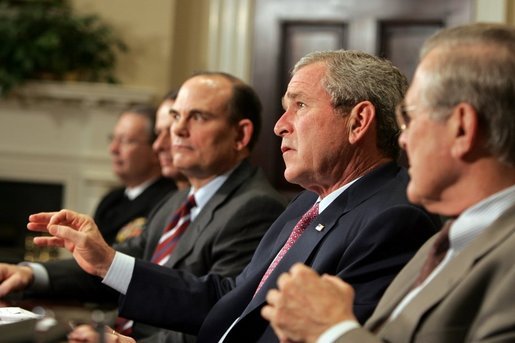
I also want to thank the members of the board of the Foundation for the Defense of the Democracies. I want to thank Steve Trachtenberg, the President of George Washington University, and his wife, Fran, for joining us today. Thanks for letting me come to your campus. I'm honored to be here. He informed me that my dad will be giving the graduation speech this year. (Laughter.) And Mother is getting an honorary degree. (Laughter.) Smart man. (Laughter and applause.) Mr. Secretary, thanks for joining us. I'm proud that Secretary Rumsfeld is with us.

I want to thank Senator Dick Lugar for being with us today. Mr. Chairman, proud you're here. Thanks for coming. I want to thank the members of the United States Congress who have joined us. Congressman Lungren, Adam Schiff, Joe Wilson, Tom Cole and Dan Boren. I appreciate you all taking time to be here today, it means a lot. I want to thank the ambassadors who have joined us. I see two for certain, one from Jordan and one from Israel. Proud you both are here. If there's any ambassadors here, I apologize for not introducing you, and you don't have as good a seat as these two guys. (Laughter.)

The mission of this Foundation is to defeat terror by promoting democracy -- and that is the mission of my administration. Our strategy to protect America is based on a clear premise: the security of our nation depends on the advance of liberty in other nations. On September the 11th, 2001, we saw that problems originating in a failed and oppressive state 7,000 miles away could bring murder and destruction to our country. We saw that dictatorships shelter terrorists, feed resentment and radicalism, and threaten the security of free nations. Democracies replace resentment with hope, democracies respect the rights of their citizens and their neighbors, democracies join the fight against terror. And so America is committed to an historic, long-term goal: To secure the peace of the world, we seek the end of tyranny in our world.

We are making progress in the march of freedom -- and some of the most important progress has taken place in a region that has not known the blessings of liberty: the broader Middle East. Two weeks ago, I got a chance to visit Afghanistan and to see firsthand the transformation that has taken place in that country. Before September the 11th, 2001, Afghanistan was ruled by a cruel regime that oppressed its people, brutalized women, and gave safe haven to the terrorists who attacked America.

Today, the terror camps have been shut down, women are working, boys and girls are going to school, Afghans have voted in free elections -- 25 million people have had the taste of freedom. Taliban and al Qaeda remnants continue to fight Afghanistan's democratic progress. In recent weeks, they have launched new attacks that have killed Afghan civilians and coalition forces. The United States and our allies will stay in the fight against the terrorists, and we'll train Afghan soldiers and police so they can defend their country. The Afghan people are building a vibrant young democracy that is an ally in the war on terror -- and America is proud to have such a determined partner in the cause of freedom. (Applause.)

Next week, we will mark the three-year anniversary of the start of Operation Iraqi Freedom. In less than three years, the Iraqi people have gone from living under the boot of a brutal tyrant, to liberation, to sovereignty, to free elections, to a constitutional referendum, and last December, to elections for a fully constitutional government. In those December elections, over 11 million Iraqis -- more than 75 percent of the Iraqi voting age population -- defied the terrorists to cast their ballots.

Americans were inspired by the images of Iraqis bringing elderly relatives to the polls, holding up purple ink-stained fingers, dancing in the streets and celebrating their freedom. By their courage, the Iraqi people have spoken and made their intentions clear: they want to live in democracy -- and they are determined to shape their own destiny.

The past few weeks, the world has seen very different images from Iraq -- images of violence, and anger, and despair. We have seen a great house of worship -- the Golden Mosque of Samarra -- in ruins after a brutal terrorist attack. We've seen mass protests in response to provocation. We've seen reprisal attacks by armed militias on Sunni mosques -- and random violence that has taken the lives of hundreds of Iraqi citizens.

The terrorists attacked the Golden Mosque for a reason: They know that they lack the military strength to challenge Iraqi and coalition forces directly -- so their only hope is to try and provoke a civil war. So they attacked one of Shia Islam's holiest sites, hoping to incite violence that would drive Iraqis apart and stop their progress on the path to a free society.

Immediately after the attack, I said that Iraq faced a moment of choosing -- and in the days that followed, the Iraqi people made their choice. They looked into the abyss and did not like what they saw. After the bombing, most Iraqis saw what the perpetuators [sic] of this attack were trying to do: The enemy had failed to stop the January 2005 elections, they failed to stop the constitutional referendum, they failed to stop the December elections, and now they're trying to stop the formation of a unity government. By their response over the past two weeks, Iraqis have shown the world they want a future of freedom and peace -- and they will oppose a violent minority that seeks to take that future away from them by tearing their country apart.

The situation in Iraq is still tense and we're still seeing acts of sectarian violence and reprisal. Yet out of this crisis, we've also seen signs of a hopeful future. We saw the restraint of the Iraqi people in the face of massive provocation. Most Iraqis did not turn to violence, and many chose to show their solidarity by coming together in joint Sunni and Shia prayer services. We saw the leadership of Sunni and Shia clerics who joined together to denounce the bombing and call for restraint. Ayatollah Sistani issued a strong statement denouncing what he called "sectarian sedition," and he urged all Iraqis -- in his words -- "not to be dragged into committing acts that would only please the enemies." We saw the capability of the Iraqi security forces, who deployed to protect religious sites, enforce a curfew, and restore civil order. We saw the determination of many of Iraq's leaders, who rose to the moment, came together, and acted decisively to diffuse the crisis.

Iraq's leaders know that this is not the last time they will be called to stand together in the face of an outrageous terrorist attack. Iraq's leaders know that they must put aside their differences, reach out across political, religious, and sectarian lines, and form a unity government that will earn the trust and the confidence of all Iraqis. Iraqis now have a chance to show the world that they have learned the lesson of Samarra: A country that divides into factions and dwells on old grievances risks sliding back into tyranny. The only path to a future of peace is the path of unity.

Soon the new parliament will be seated in Baghdad, and this will begin the process of forming a government. Forming a new government will demand negotiation and compromise by the Iraqis; it will require patience by America and our coalition allies.

In the weeks ahead, Americans will likely see a good deal of political maneuvering in Iraq -- as different factions and leaders advance competing agendas and seek their share of political power. Out of this process, a free government will emerge that represents the will of the Iraqi people -- instead of the will of one cruel dictator.

The work ahead in Iraq is hard -- and there will be more difficult moments. The Samarra attack was a clear attempt to ignite a civil war. And we can expect the enemy will try again -- and they will continue to sow violence and destruction designed to stop the emergence of a free and democratic Iraq.

The enemies of a free Iraq are determined -- yet so are the Iraqi people. And so are America and coalition partners. We will not lose our nerve. We will help the Iraqi people succeed. Our goal in Iraq is victory -- and victory will be achieved when the terrorists and Saddamists can no longer threaten Iraq's democracy, when the Iraqi security forces can provide for the safety of their own citizens, and when Iraq is not a safe haven for terrorists to plot new attacks against our nation.

We have a comprehensive strategy for victory in Iraq -- a strategy I laid out in a series of speeches last year. Our strategy has three elements: On the political side, we are helping Iraqis build a strong democracy, so that old resentments will be eased, and the insurgency marginalized. On the economic side, we are continuing reconstruction efforts and helping Iraqis build a modern economy that will give all its citizens a stake in a free and peaceful Iraq. And on the security side, we are striking terrorist targets and training the Iraqi security forces -- which are taking responsibility for more Iraqi territory and becoming increasingly capable of defeating the enemy.

In the coming weeks, I will update the American people on our strategy -- the progress we are making, the lessons we have learned from our experiences, and how we are fixing what hasn't worked. Today, I will discuss the third element of our strategy -- the progress of our efforts to defeat the terrorists and train the Iraqi security forces so they can take the lead in defending their own democracy.

At the end of last year, I described in detail many of the changes we have made to improve the training of Iraqi security forces -- and we saw the fruits of those changes in recent days in Iraq. After the Samarra bombings, it was the Iraqi security forces -- not coalition forces -- that restored order. In the hours after the attack, Iraqi leaders put the Iraqi security forces on alert -- canceling all leaves, and heightening security around mosques and critical sites. Using security plans developed for the December elections, they deployed Iraqi forces in Baghdad and other trouble spots.

Iraqi police manned checkpoints, increased patrols, and ensured that peaceful demonstrators were protected -- while those who turned to violence were arrested. Public order brigades deployed as rapid reaction forces to areas where violence was reported. The 9th Mechanized Division of the Iraqi Army, which was in the midst of a major training event, regrouped and entered the Baghdad City Gates -- taking up assigned positions throughout the city with T-72 tanks and armored infantry vehicles. During the past two weeks, Iraqi security forces conducted more than 200 independent operations -- each of them Iraqi-planned, Iraqi-conducted, and Iraqi-led.

Having Iraqi forces in the lead has been critical to preventing violence from spinning out of control. For example, on the day of the Samarra bombing, the Iraqi national police responded to an armed demonstration in an area immediately adjacent to Sadr City -- where an angry Shia crowd had surrounded the Sunni Al Quds Mosque. The Iraqi Brigade Commander placed his troops -- who were largely Shia -- between the crowd and the mosque, and talked to the crowd using megaphones, and calling for calm and urging them to disperse. After a two-hour standoff, the crowd eventually left without incident -- and the national police remained in position overnight to guard the Mosque until the threat was over. The fact that Iraqis were in the lead and negotiating with their own countrymen helped diffuse a potential confrontation -- and prevented an escalation of violence.

In another Baghdad neighborhood, a similar situation unfolded: a group of armed militia members had gone in and occupied the Al Nida Mosque. An Iraqi Army brigade quickly arrived on the scene -- and the Brigade Commander negotiated with the group and secured their peaceful departure. Once again, because Iraqi forces spoke their language and understood the culture, they were able to convince the Iraqi militia to leave peacefully.

Not all Iraqi units performed as well as others -- and there were some reports of Iraqi units in Eastern Baghdad allowing militia members to pass through checkpoints. But American commanders are closely watching the situation, and they report these incidents appear to be the exception, not the rule. In the weeks since the bombing, the Iraqi security forces turned in a strong performance. From the outset, Iraqi forces understood that if they failed to stand for national unity, the country would slip into anarchy. And so they have stood their ground, and defended their democracy, and brought their nation through one of its most difficult moments since liberation.

General Marty Dempsey, our top commander responsible for training the Iraqis' security forces, says this about their performance: "They were deliberate, poised, even-handed, and professional. They engaged local tribal, political, and religious leaders. They patiently, but deliberately confronted armed groups to let them know that they had control of the situation." He went on to say, "I'm sure we will find instances where they could have performed better, but in the face of immense pressure, they performed very, very well." As a result of their performance, the Iraqi security forces are gaining the confidence of the Iraqi people. And as the Iraqi security forces make progress against the enemy, their morale continues to increase.

When I reported on the progress of the Iraqi security forces last year, I said that there were over 120 Iraqi and police combat battalions [sic] in the fight against the enemy -- and 40 of those were taking the lead in the fight. Today the number of battalions in the fight has increased to more than 130 -- with more than 60 taking the lead. As more Iraqi battalions come on line, these Iraqi forces are assuming responsibility for more territory. Today, Iraqi units have primary responsibility for more than 30,000 square miles of Iraq -- an increase of roughly 20,000 square miles since the beginning of the year. And Iraqi forces are now conducting more independent operations throughout the country than do coalition forces.

This is real progress, but there is more work to be done this year. Our commanders tell me that the Iraqi police still lag behind the Army in training and capabilities -- so one of our major goals in 2006 is to accelerate the training of the Iraqi police. One problem is that some National Police units have been disproportionately Shia -- and there have been some reports of infiltration of the national police by Shia militias. And so we're taking a number of steps to correct this problem:

First, we have begun implementing a program that has been effective with the Iraqi Army -- partnering U.S. battalions with the Iraqi national police battalions. These U.S. forces are working with their Iraqi counterparts -- giving them tactical training so they can defeat the enemy. And they are also teaching them about the role of a professional police force in a democratic system, so they can serve all Iraqis without discrimination.

Second, we are working with the Iraqi leaders to find and remove any leaders in the national police who show evidence of loyalties to militia. For example, last year there were reports that the Second Public Order Brigade contained members of an illegal militia, who were committing abuses. So last December, the Interior Ministry leadership removed the Second Brigade Commander, and replaced him with a new commander -- who then dismissed more than a hundred men with suspected militia ties. Today, this Iraqi police brigade has been transformed into a capable, professional unit -- and during the recent crisis after the Samarra bombing, they performed with courage and distinction.

Finally, we are working with Iraqis to diversify the ranks of the national police, by recruiting more Sunni Arabs. For example, the basic training class for the National Police Public Order forces that graduated last October was less than one percent Sunni. The class graduating in April will include many, many more Sunnis. By ensuring the Public Order forces reflect the general population, Iraqis are making the National Police a truly national institution -- one that is able to serve, protect, and defend all the Iraqi people.

As more capable Iraqi police and soldiers come on line, they will assume responsibility for more territory -- with the goal of having the Iraqis control more territory than the coalition by the end of 2006. And as Iraqis take over more territory, this frees American and Coalition forces to concentrate on training and on hunting down high-value targets like the terrorist Zarqawi and his associates. As Iraqis stand up, America and our coalition will stand down. And my decisions on troop levels will be made based upon the conditions on the ground, and the recommendations of our military commanders -- not artificial timetables set by politicians here in Washington, D.C.

These terrorists know they cannot defeat us militarily -- so they have turned to the weapon of fear. And one of the most brutal weapons at their disposal are improvised explosive devices, or IEDs.

IEDs are bombs made from artillery shells, explosives, and other munitions that can be hidden and detonated remotely. After the terrorists were defeated in battles in Fallujah and Tall Afar, they saw that they could not confront Iraqi or American forces in pitched battles and survive. And so they turned to IEDs -- a weapon that allows them to attack us from a safe distance, without having to face our forces in battle.

The principal victims of IED attacks are innocent Iraqis. The terrorists and insurgents have used IEDs to kill Iraqi children playing in the streets, shoppers at Iraqi malls, and Iraqis lining up at police and army recruiting stations. They use IEDs to strike terror in the hearts of Iraqis, in an attempt to break their confidence in the free future of their country.

The enemy is also using IEDs in their campaign against U.S. and coalition forces in Iraq -- and we are harnessing every available resource to deal with this threat. My administration has established a new high-level organization at the Department of Defense, led by retired four-star General Montgomery Meigs. On Saturday, General Meigs, along with the Secretary of Defense, briefed me at the White House on our plan to defeat the threat of IEDs. Our plan has three elements: targeting, training, and technology.

The first part of our plan is targeting and eliminating the terrorists and bomb makers. Across Iraq, we are on the hunt for the enemy -- capturing and killing the terrorists before they strike, uncovering and disarming their weapons before they go off, and rooting out and destroying bomb making cells so they can't produce more weapons.

Because the Iraqi people are the targets, primarily the targets of the bombers, Iraqis are increasingly providing critical intelligence to help us find the bomb-makers and stop new attacks. The number of tips from Iraqis has grown from 400 last March to over 4,000 in December. For example, just three weeks ago, acting on tips provided by local citizens, coalition forces uncovered a massive IED arsenal hidden in a location northwest of Baghdad. They found and confiscated more than 3,000 pieces of munitions -- in one of the largest weapons caches discovered in that region to date. Just two weeks ago, acting on intelligence from Iraqis, coalition forces uncovered a bomb-making facility northeast of Fallujah. They captured 61 terrorists at the facility and confiscated large numbers of weapons.

In all, during the past six months, Iraqi and coalition forces have found and cleared nearly 4,000 IEDs, uncovered more than 1,800 weapons caches and bomb-making plants, and killed or detained hundreds of terrorists and bomb-makers. We're on the hunt for the enemy -- and we're not going to rest until they've been defeated.

The second part of our plan is to give our forces specialized training to identify and clear IEDs before they explode. Before arriving in Iraq and Afghanistan, our combat units get training on how to counter the threat of IEDs. And to improve our training, last month we established a new IED Joint Center of Excellence headquartered at Fort Irwin, California -- where we're taking lessons learned from the IED fight in Iraq, and sharing them with our troops in the field and those preparing to deploy. This new initiative will ensure that every Army and Marine combat unit headed to Afghanistan and Iraq is prepared for the challenges that IEDs bring to the battlefield.

Before deploying, our troops will train with the equipment they will use in the IED fight, they'll study enemy tactics, and experience live fire training that closely mirrors what they will see when they arrive in the zone of combat. Our goal with this training is to ensure that when our forces encounter the enemy, that they're ready.

The third part of our plan is to develop new technologies to defend against IEDs. We are putting the best minds in America to work on this effort. The Department of Defense recently gathered some -- gathered 600 leaders from industry and academia, the national laboratories, the National Academy of Sciences, all branches of the military, and every relevant government agency to discuss technology solutions to the IED threat. We now have nearly a hundred projects underway. For security reasons, I'm not going to share the details of the technologies we're developing. The simple reason is, the enemy can use even the smallest details to overcome our defenses.

Earlier this year, a newspaper published details of a new anti-IED technology that was being developed. Within five days of the publication -- using details from that article -- the enemy had posted instructions for defeating this new technology on the Internet. We cannot let the enemy know how we're working to defeat him. But I can assure the American people that my administration is working to put the best technology in the hands of our men and women on the front lines -- and we are mobilizing resources against the IED threat.

I assured General Meigs that he will have the funding and personnel he needs to succeed. In 2004, the administration spent $150 million to fight the IED threat. This year, we're providing $3.3 billion to support our efforts to defeat IEDs. These investments are making a difference. Today, nearly half of the IEDs in Iraq are found and disabled before they can be detonated. In the past 18 months, we've cut the casualty rate per IED attack in half. More work needs to be done. Yet by targeting the bomb-makers, and training our forces, and deploying new technologies, we will stay ahead of the enemy, and that will save Iraqi and American lives.

Some of the most powerful IEDs we're seeing in Iraq today includes components that came from Iran. Our Director of National Intelligence, John Negroponte, told the Congress, "Tehran has been responsible for at least some of the increasing lethality of anti-coalition attacks by providing Shia militia with the capability to build improvised explosive devises" in Iraq. Coalition forces have seized IEDs and components that were clearly produced in Iran. Such actions -- along with Iran's support for terrorism and its pursuit of nuclear weapons -- are increasingly isolating Iran, and America will continue to rally the world to confront these threats. (Applause.)

We still have difficult work ahead in Iraq. I wish I could tell you that the violence is waning and that the road ahead will be smooth. It will not. There will be more tough fighting and more days of struggle -- and we will see more images of chaos and carnage in the days and months to come. The terrorists are losing on the field of battle, so they are fighting this war through the pictures we see on television and in the newspapers every day. They're hoping to shake our resolve and force us to retreat. They are not going to succeed. (Applause.)

The battle lines in Iraq are clearly drawn for the world to see, and there is no middle ground. The enemy will emerge from Iraq one of two ways: emboldened or defeated. The stakes in Iraq are high. By helping Iraqis build a democracy, we will deny the terrorists a safe haven to plan attacks against America. By helping Iraqis build a democracy, we will gain an ally in the war on terror. By helping Iraqis build a democracy, we will inspire reformers across the Middle East. And by helping Iraqis build a democracy, we'll bring hope to a troubled region, and this will make America more secure in the long-term.

Since the morning of September the 11th, we have known that the war on terror would require great sacrifice -- and in this war we have said farewell to some very good men and women. One of those courageous Americans was Sergeant William Scott Kinzer, Jr., who was killed last year by the terrorists while securing polling sites for the Iraqi elections. His mom, Debbie, wrote me a letter. She said: "These words are straight from a shattered but healing mother's heart. ... My son made the decision to join the Army. He believed that what he was involved in would eventually change Iraq and that those changes would be recorded in history books for years to come. ... On his last visit home... I asked him what I would ever do if something happened to him in Iraq. He smiled at me with -- his blue eyes sparkled, as he said, 'Mom, I love my job...If I should die I would die happy, does life get any better than this?'" His mom went on: "Please do not let the voices we hear the loudest change what you and Scott started in Iraq. Please do not... let his dying be in vain. ... Don't let my son have given his all for an unfinished job. ... Please...complete the mission."

I make this promise to Debbie, and all the families of the fallen heroes: We will not let your loved ones dying be in vain. We will finish what we started in Iraq. We will complete the mission. We will leave behind a democracy that can govern itself, sustain itself, and defend itself. (Applause.) And a free Iraq, in the heart of the Middle East, will make the American people more secure for generations to come.

May God bless the families of the fallen. May God bless our troops in the fight. And may God continue to bless the United States of America. (Applause.)

END 1:49 P.M. EST, For Immediate Release, Office of the Press Secretary, March 13, 2006

Technorati Tags:
and or and or and or and or and or and or

Related: Keyword Iraq, Thursday, March 09, 2006
President Signs USA PATRIOT Act (VIDEO), Saturday, February 25, 2006 President Addresses American Legion, Discusses Global War on Terror (VIDEO), Wednesday, January 25, 2006 President Discusses War on Terror at K-State (VIDEO), Wednesday, January 04, 2006 President Discusses War on Terror Following Pentagon Briefing (VIDEO), Monday, December 19, 2005 President's Address to the Nation (VIDEO) 12/18/05, Thursday, December 15, 2005 President, McCain, Warner, Discusses Interrogation, Wednesday, December 14, 2005 Iraqi Elections, Victory in the War on Terror (VIDEO), Monday, December 12, 2005 President Discusses War on Terror and Upcoming Iraqi Elections (VIDEO), Sunday, July 17, 2005 Soldiers charged with assault on suspected insurgents, Sunday, July 24, 2005 Iraqi, American Women Discuss Constitution, Women's Rights, Thursday, July 28, 2005 Killing of Algerian Diplomats to Iraq, Saturday, August 06, 2005 Operation Quick Strike, Monday, August 08, 2005 The Independent Inquiry Committee into the Iraq Oil-for-Food Programme, Thursday, August 11, 2005 President Meets with Defense and Foreign Policy Teams,

Monday, March 13, 2006

State Department Podcast, VIDEO and Text 03/13/06

Daily Press Briefing, Tom Casey, Acting Spokesman, FULL DTREAMING VIDEO, running time is 26:26 PODCAST, file is MP3 for PODCAST, running time is 25:50 Washington, DC, March 13, 2006

TRANSCRIPT: 12:46 p.m. EST

MR. CASEY: Good afternoon, everyone. Welcome to the start of another exciting week at the State Department. I don't have any statements for you so, Barry, why don't we get right to your questions.

QUESTION: Let's see if you can straighten out a little bit the Iran nuclear situation. There are reports that Russia is going to have another round of talks. Have you -- has the U.S. been informed by the Russians? If you have, do you have a view of this? And what do you suppose Russia's intentions are?

MR. CASEY: Well, first of all, let me just make clear that in New York today there have been another round of consultations among the P-5. Obviously Russia has been participating in those. We very much believe that the focus of our activities now should be in the Security Council. We certainly have welcomed in the past Russia's diplomatic efforts with Iran and we've seen press reports that there may, in fact, be another round of consultations coming.

You know, I think I would refer you as well to some of the comments that Russian Foreign Minister Lavrov has made expressing his disappointment with the way Iran has been conducting itself throughout the course of the negotiations and certainly being, you know, absolutely not helpful in any efforts to resolve this situation.

And again, I think we also need to keep the emphasis where it needs to be. The international community has made it abundantly clear to Iran what is required of it and what needs to be done. Russia has been very much part of that consensus and very much helpful in that process. And right now, as we move to the Security Council, again the facts are pretty clear. Iran knows what it needs to do, and what we're waiting to see is whether the Iranians will finally make the decision that's been asked of them and been required of them by the international community for some time.

So certainly we look forward to continuing our work with the Russians on this and expect that we'll be moving forward again through this consultative process in the Security Council.

Yeah, Elise.

QUESTION: No, I wanted -- excuse me.

MR. CASEY: Sorry. Go ahead, Barry.

QUESTION: I wanted to focus on Russia because everything else you said has been said by Rice on the airplane or someplace and it's going on at the UN. We know that. What we don't know, at least I don't know, and you say there are reports of Russia wanting to have them, but those reports have been out there for easily eight hours. Has the U.S. determined whether Russia is offering a new round of talks with Iran? Because that could presumably detract from the focus being at the UN. And if the Russians haven't informed you, do you have -- does the U.S. have a view of whether there should be bilateral talks, I suppose even while the UN is discussing the situation, or would you have the UN put it off for a while to see the outcome of these talks, which may be Russia's aim?

MR. CASEY: Well, Barry, I think if you look at how we have moved about this process, the IAEA has actively worked on and considered the issue of Iran's nuclear program even while negotiations were ongoing with the EU-3. Those efforts were joint and were all part of achieving the same international community objective. The negotiations with the Russians on their proposal, which again we've supported, were done in the same context.

Certainly additional consultations between the Russians and the Iranians is not something that is inconsistent with our efforts in the Security Council to take up this issue, to discuss it among Council members. And as we've said, as an initial starting point, we'd like to see a presidential statement that reaffirms the decisions made by the IAEA and that again calls on Iran to take the necessary steps.

QUESTION: So I hear that and that says more about what you think of the proposition. But if I'm correct, the U.S. hasn't been notified by Russia of further talks.

MR. CASEY: Not that I'm aware of.

QUESTION: Okay.

MR. CASEY: Unless something's happened in New York just in the last couple of hours.

QUESTION: Okay.

QUESTION: If you could just be a little bit more clear about whether you see a potential Russia deal with Iran? Is there still a chance for that before you take any action at the Council, or you kind of made the decision to go ahead and try and get this presidential statement, trying to get action in the Council regardless of what happens with Russia and Iran at this point?

MR. CASEY: Again, the process is driven by Iran's actions. If Iran stands up today and does a complete 180, turns around and says we would now agree to abide by all the international community's requirement as laid out in the February 4 Board of Governors resolution, if it wants to return to the negotiating table and work out a real deal with the Russians, as opposed to some of the delaying tactics that we've seen with them, that would be wonderful. We, however, have no indication that Iran is prepared to accept Russia's proposal or its conditions.

And again, that is why Iran finds itself in the place it is. Iran has repeatedly refused to meet the requirements and demands of the international community. And it really is up to the Iranians to make the determination to do so. What we're doing in the Security Council is again taking that next step in our diplomatic process to try and convince Iran to do exactly that. But if they would like to change their minds, if they would like to come around, if they would like to end their two years of defiance of requirements and requests from the international community, we would certainly like to see it. But unfortunately, we have no indication that that's going to occur.

Yeah.

QUESTION: You mention the negotiating table. Repeatedly we've heard Secretary Rice and others in the State Department say that the report to the Security Council just opens up another forum for diplomatic negotiation. With whom should the Iranians be negotiating if they were of a mind to do so seriously?

MR. CASEY: Well, there's an established process and there's an established requirement in that February 4 Board of Governors resolution, and what it does is it requires Iran to go back to full suspension of all uranium enrichment-related activity, go back to that agreement that they'd made with the EU-3, and then return to negotiations with the EU-3. The Russian proposal has been part of that. If they'd like to pursue that Russian initiative, accept the Russian proposal along the lines acceptable to the international community, that would be fine.

QUESTION: To whom should they be making such indications, if they're of a mind to do so?

MR. CASEY: Well, they certainly have an open and active engagement with the Russians. They've certainly been in consultations with the EU-3. I don't think the Iranians lack for people they can discuss this issue with. I think what they lack is the will to make the decisions necessary to come into requirement with the demands of the international community.

QUESTION: And just a moment ago, you urged us to consult the remarks of Foreign Minister Lavrov. Why did you do that?

MR. CASEY: Well, I think because he made very clear today -- the quote that I saw attributed to him was: We're disappointed with the way Iran has been conducting itself in these negotiations. It's absolutely not helping those who want to provide for finding peaceful ways to resolve the whole situation surrounding the Iranian nuclear program. We couldn't agree more. That's been the actions that Iran has taken. And again, this is about not words, but actions. Iran knows what it needs to do and it needs to go forward with that if it wishes to actually have a resolution of this situation.

QUESTION: Last question from me on this subject. On the P-5 negotiations, or the P-5 discussions I should say, you said there was a third round, I guess, today that's already taken place. What actually can you tell us -- you get a better readout than we do, presumably -- what's been going on at those discussions? What's been -- any practical outcome of them so far?

MR. CASEY: Well, again, as we've said, this was -- as normally happens with a UN discussion, this was part of our efforts to have a preliminary discussion about how we intend to proceed in the Security Council, certainly about what we would like to see in a presidential statement. And it's basically been a discussion focused on that, on these initial steps that we'll be taking in the Security Council to address Iran's nuclear program.

QUESTION: Is it --

MR. CASEY: Go ahead, Elise.

QUESTION: Sorry. Are there drafts floating around at this point? Has anybody introduced -- have you introduced language that you'd like to see, or right now this is just a theoretical discussion of the ingredients --

MR. CASEY: I think they're discussing elements of it. I'm no aware that a text has been circulated at this point.

QUESTION: Are you planning on proposing something? Is the U.S. going to introduce a resolution?

MR. CASEY: I think, again, what we're looking for up front is a presidential statement. I'm not sure exactly who will table the first draft or who will put the first one on the table.

QUESTION: Is it the U.S. expectation to have a presidential statement this week?

MR. CASEY: It's our expectation that the result of the first Security Council meetings on this will be a presidential statement. I don't know that there's -- since it's not on the Council's calendar at this moment, I can't tell you whether that is going to be next two days, next four days, next six days. So I don't want to pin it down on specific timing.

Yes, Saul.

QUESTION: New subject, on Hamas. You have made clear that you're not going to have any contacts with Hamas and you wouldn't give any aid to a Hamas government. It's probable or possible that other parties will join or are considering joining a Hamas government. Do those rules about no contacts, no aid, apply to any parties that would join a Hamas government?

MR. CASEY: Well, you know, as you know, we're conducting a review of our assistance programs to see what we will be able to provide under a Hamas-led government. I honestly can't break it down for you, Saul. I think we need to see what that government looks like, who is in it and what the nature of that participation is. But again, let me just make clear, the United States cannot by law and will not provide any funding that will go to Hamas. It's a Foreign Terrorist Organization; it's been designated as such and we're strictly prohibited from doing so.

Again though, as Secretary Rice has said and said again today, we believe it's important that we take into consideration the humanitarian needs of the Palestinian people. We're committed to supporting those humanitarian needs and we're going to be looking to see how we can do that and, in fact, how we can even step up our assistance for the humanitarian needs of the Palestinian people even while making sure that we do not violate U.S. law and do not provide any financial support for a terrorist organization.

QUESTION: So is there no particular message to another party, let's say Fattah, that's considering joining the government that if they join the government then they would cut themselves off from contacts with the U.S.?

MR. CASEY: Saul, listen, I think the United States is going to leave it up to the Palestinians themselves to determine who will or will not be members of the government. As we've said, the policies of that government, though, are going to have consequences for how we will be able to interact with them and certainly we obviously cannot and will not interact with members of a terrorist organization.

QUESTION: Well, that doesn't answer the question. You say you won't have contacts with members of Hamas. You're not choosing the government, but you've got to tell parties who are joining it or possibly joining the government whether or not you will continue to have contacts with them. Is there a consequence of them joining the government or not?

MR. CASEY: I would need to see what the government was before I could tell you the answer to that question and I'm not prepared to speculate on it, Saul.

QUESTION: But can you just be more clear about whether -- is it a Hamas-led government that you have a problem dealing with or just members of the group?

MR. CASEY: Well, there are two issues --

QUESTION: I mean, feasibly, President Abbas, past this interim period, will still be president. Are you going to --

MR. CASEY: That's correct, and we've said we continue to have contacts with him and I expect we will do so in the future. What we have also said, though, is two things. The first is that we have laws dealing with Foreign Terrorist Organizations and Hamas as a Foreign Terrorist Organization means that there are certain requirements that we have to follow, including not providing any support or funding for them. As we said, as a matter of policy we do not have contact with Hamas; it's a Foreign Terrorist Organization.

The issue of Hamas and the issue of the government that is formed out of this process, we need to see what that government is. We all presume it will be Hamas-led, but maybe it won't be and maybe it will be different. Part of the review of our assistance is designed to determine exactly what we can or cannot support and how we can or cannot engage with such a government. I don't want to try and prejudge either the shape and scope of that government or what our decisions will be coming out of the review.

It is clear, however, that the international community, through the Quartet statement on January 30th, has made it clear exactly what we want to see from that government, including a recognition of Israeli's right to exist, maintenance of all existing agreements that the Palestinian Authority has signed with Israel. And I think it's important that whatever government emerge from this process heeds those requirements and heeds that call.

QUESTION: I think you just said the U.S. Government is looking at the possibility of dealing with a government that has Hamas in it.

MR. CASEY: No. I was asked whether --

QUESTION: You were asked if it's not dominated by Hamas, what about it? And you said that's what we're reviewing. We're reviewing what we should do about dealing with the next Palestinian government, which of course we all know will have Hamas in it, if not in a dominant role. So now you've -- unless I'm mistaken, you've left the door open to dealing with a Palestinian government that has Hamas ministers.

MR. CASEY: No. Barry, what --

QUESTION: I mean, I think now --

MR. CASEY: Barry, let me make it clear. Let me make it clear to you. Our policy is well known; you have it. We are not going to deal with a Hamas-led government. We are not going to have contacts with members of Hamas. That's a standing long policy. I'm not trying to change any aspects of U.S. policy here.

QUESTION: I know policy has a subtle way of evolving, particularly Middle East policy, in this building. I've watched it over many years. You're now talking only in terms of the law prohibiting you from dealing with Hamas.

MR. CASEY: Well, as a --

QUESTION: I don't hear anything else about Hamas being a terrorist organization. I don't hear that you don't like Hamas's way of doing things.

MR. CASEY: Okay, Barry.

QUESTION: You're just sort if hemmed in by some law.

MR. CASEY: Look, Barry, let me make it clear to you --

QUESTION: I don't mean you, Tom.

MR. CASEY: Barry, just in case --

QUESTION: I mean, the guidances that are written by the NEA are fairly transparent.

MR. CASEY: Barry, look, in case there's any question of this, Hamas is a terrorist organization. We do not support terrorism. We believe Hamas needs to change its ways. I can't -- I'm not trying to change U.S. policy. I'm not trying to adjust U.S. policy. I'm not trying to signal anything new in U.S. policy. It remains the same. As to whether we might be able to have a contact with an individual member of a prospective government, that might -- that will emerge from this process, what I can't do is speculate for you on that because I honestly don't know the answer.

QUESTION: Okay. So that's clear that the position of the United States at the moment is there is no decision yet whether the door is open or closed as to maintain -- as to having a contact with X minister, if he's from X party, as long as that's not Hamas, even if it it's in a Hamas-led government. We were led to -- (inaudible) put forward that Hamas-led government, no matter who's in it, we're not having any contact with anyone in that government. This seems to us different.

MR. CASEY: Well, it shouldn't seem to you as different. I'm not changing U.S. policy. And if anything I've said has led you to that conclusion, I would dissuade you from doing so.

QUESTION: Can I take one last stab at this?

MR. CASEY: Yeah. Sure.

QUESTION: You just said --

QUESTION: No, no, not the last.

QUESTION: You just said we're not going to deal with a Hamas-led government. Does that refer to everybody in that government?

MR. CASEY: That refers to a government that does not meet the conditions that the Quartet has laid out. Again, I am not in a position to be able to speculate for you as to who -- what individuals within the Palestinian Authority structure we might or might not have contact with, other than to reaffirm our longstanding position and policy that we do not have contacts or conversations with Hamas.

QUESTION: Listen, there are probably in the Iranian Government perfectly nice guys. I mean, you know, maybe the agriculture minister or maybe the -- I don't know -- the social secretary. But you're not dealing with Iran. You're not dealing with anybody in the Iranian -- as far as we know, who knows, you may be sending them (inaudible) for all I know, but you're not dealing with Iran, as far as we know.

MR. CASEY: Let me make --

QUESTION: Soyou are, Tom -- I don't want to -- it's a pity that you have to be put through all this. But because policy evolves and it's not your doing. It's not your doing and it's like we're hammering you and we're not -- it's nothing personal.

MR. CASEY: Barry --

QUESTION: You're not ruling out dealing with ministers of a Hamas-led government. That's a fact.

MR. CASEY: Barry, I'm ruling out dealing with ministers of a Hamas-led government. I'm ruling out dealing with a Hamas government. I'm not changing our policy. Okay?

Michel.

QUESTION: There was a story today that the Bush Administration intends to curtail contacts with President Mahmoud Abbas Fattah faction if it joins a Hamas-led government.

MR. CASEY: Sorry. Say again?

QUESTION: The Bush Administration intends to curtail contacts with President Mahmoud Abbas Fattah faction if it joins a Hamas-led government.

MR. CASEY: I think we've been through that as much as I can possibly do today, Michel. Don't have anything additional for you, other than the conversation we've already just gone through.

QUESTION: Can we try something easy?

MR. CASEY: Sure. Let's try something easy.

QUESTION: Is the Ambassador of Armenia being -- having his career shortened because he spoke out against genocide in Armenia?

MR. CASEY: Barry, I know we promised you an answer on that one on Friday. Still don't have it and I'll get something for you this afternoon.

QUESTION: You mean his future hasn't been decided yet?

MR. CASEY: Not that I'm aware of.

QUESTION: I think it has.

MR. CASEY: I believe you think it does.

QUESTION: No, I do believe it does and so do -- and I have reason to believe it does and I know there are at least two members of Congress who believe it does. No, I just think the State Department is having difficulty finding words to announce his premature retirement.

MR. CASEY: No. We owe you an answer on that.

QUESTION: Thank you.

MR. CASEY: I'll get it for you. Yes, Saul.

QUESTION: Do you have a readout on the Eritrea-Ethiopia meetings? I know they were in London but I believe there was U.S. representation there. Did they make any progress?

MR. CASEY: Yeah. I did check on that before the briefing, Saul, and don't have a full readout for you and we'll get you something later this afternoon.

Mr. Lambros.

QUESTION: On Slobodan Milosevic.

MR. CASEY: Yeah.

QUESTION: How his death is going to affect the new round of talks March 17th in Vienna for the final status of Kosovo? Do you expect a kind of postponement?

MR. CASEY: Well, I don't -- do we expect a postponement in the next round of discussions?

QUESTION: Mm-hmm.

MR. CASEY: Not that I'm aware of and obviously you know our policies on this issue. We're supporting the efforts of Special Representative Ahtisaari to negotiate a final settlement agreement, a final status agreement. And we look forward to seeing those talks continue.

QUESTION: And on the communication between Secretary Rice and the chief of the tribunal, Carla del Ponte, on Slobodan Milosevic's death?

MR. CASEY: No.

QUESTION: And who is going to be present in the Slobodan Milosevic funeral in Belgrade on behalf of the U.S. Government, since it's a political event? Your Ambassador to Serbia and Montenegro?

MR. CASEY: I'm not aware that there are any state arrangements being made for his funeral and I'm certainly not aware of any U.S. participation in it.

QUESTION: And one on Armenia. Representative Frank Pallone in a strong statement expressed his extreme disappointment with regards of the Department of State decision to rid finally Ambassador John Evans from Armenia as a retaliation for statements he made in recognition of the Armenian genocide in Los Angeles by Ottoman Turks. And it was reported that already you have decided to replace him. Could you please clarify for us what is going on exactly this particular moment of this issue?

MR. CASEY: That was the question Barry asked. We owe you an answer and we'll get you one.

QUESTION: Is the same answer.

MR. CASEY: Yeah. It's the same issue; it will be the same answer.

QUESTION: Is there an ambassador on post in Armenia right now?

MR. CASEY: Yes, there is.

QUESTION: Is his name Evans?

MR. CASEY: Yes, it is.

QUESTION: Does he have suitcase packed?

MR. CASEY: Not that I'm aware of.

QUESTION: But when you do announce this, would you kindly tell us the difference between what happened and genocide?

MR. CASEY: I think --

QUESTION: Because U.S. policy is there was no genocide.

MR. CASEY: Our policy on this issue is well known. It was reported in a presidential statement and, yeah, I don't have anything to add to it.

Let's go over here.

QUESTION: The North Koreans are accusing the U.S. again for creating obstacles for the six-party talks process. And so the South Koreans are sending its top nuclear envoy to Japan trying to jumpstart again for this process. I wonder if U.S. is communicating with them or are you going to join these two countries to make further efforts for this six-party talks process?

MR. CASEY: Well, I think you'll not find it surprising that we're prepared to resume six-party talks without preconditions and to work on the strategy of implementation for the September 19th joint statement. We see no reason for those talks not to start as soon as possible. We certainly encourage the North Koreans to return to the talks. The other five parties are waiting and we're ready to go back at any time. And we certainly encourage all parties that have any influence over the North Koreans to encourage them to do that.

QUESTION: Thank you.

MR. CASEY: I think we'll go back here and then Mr. Lambros and then we'll entertain a thank you.

Yeah, go ahead sir.

QUESTION: Thank you. I would like about the realignment -- military -- U.S. military realignment in Japan. Last summer there was a referendum in western part of Japan, Iwakuni City, where the U.S. Marine Corps base is located. And it has shown the majority, about 90,000 in opposition against the plan to transfer the aircraft to Iwakuni base near to Tokyo. And this result -- and how do you look at this situation?

MR. CASEY: Well, I really don't have much to tell you other than the answer I gave you on this same subject last week. Certainly, we continue to work with the Japanese Government in Tokyo on the implementation of our realignment of forces in the region. We will continue to do so. Certainly, we leave it to the Government of Japan to discuss or talk about anything that's happening on this issue within internal politics. But we continue to work this issue with the Japanese Government and expect to continue to do so.

I think there's one over here.

QUESTION: As you know, the new Canadian Ambassador to the U.S., Michael Wilson, arrived in Washington today. How will this new representative of the new conservative government in Canada affect relations between Washington and Ottawa?

MR. CASEY: Well, we certainly have had long and good standing relations with our neighbors to the north. We look forward to continuing those and deepening and strengthening those ties with him as ambassador as well as with the new government in Canada.

QUESTION: Do you think it will change at all from the previous?

MR. CASEY: Well, we always want to keep on working on the relationship and want to work on strengthening it and make it better.

Yeah, Mr. Lambros, last one.

QUESTION: On Cyprus. The International Crisis Group, in a report released last week, is blaming the Greek Cypriots for the impasse on the island. And Cypriot politicians in Nicosia are reacting, saying that they are the victims of "an Anglo-Saxon American conspiracy and that propaganda tool serves the political interests of the United States and Britain." May we have your comments, since the U.S. Government, as we know very well, is trying very hard for the reunification of the island?

MR. CASEY: Well, you are correct, Mr. Lambros. As you know, our longstanding policy is to ensure a peaceful reunification of the island along the lines of the Annan plan or using the Annan plan as a basis. We're certainly supportive of ongoing discussions on that issue and would like to see a acceptable settlement reached as soon as possible.

QUESTION: Can I follow up on that?

MR. CASEY: Last one.

QUESTION: The same report claims also that the U.S. efforts to establish trade links with the Turkish Cypriots is a move that the Greek Cypriots are as tantamount to diplomatic recognition of the occupied area recognized only by Turkey. How do you respond to this?

MR. CASEY: I respond to you by saying our policy on this is well known and I don't have anything additional for you.

Thanks.

(The briefing was concluded at 1:12 p.m.), DPB # 41, Released on March 13, 2006

Technorati Tags:
and or and , or and or , or and , or , and , or , and ,

Related: Keywords State Department, Wednesday, March 01, 2006
State Department Podcast and Text 02/28/06, Wednesday, February 22, 2006 State Department Podcast and Text 02/21/06, Monday, February 13, 2006 State Department Podcast and Text 02/10/06, Thursday, February 09, 2006 State Department Podcast and Text 02/08/06, Friday, January 27, 2006 State Department Podcast and Text 01/25/06, Friday, January 27, 2006 Rice on Palestinian Elections (PODCAST), Tuesday, January 24, 2006 State Department Podcast and Text 01/23/06 , Friday, January 20, 2006 State Department Podcast and Text 01/19/06, Thursday, January 19, 2006 Secretary Rice, South Korean Foreign Minister PODCAST 01/19/06, Wednesday, January 18, 2006 State Department Podcast, Text 01/17/05,

President Welcomes Prime Minister of Slovakia

President Welcomes Prime Minister of Slovakia to the White House The Oval Office, FULL STREAMING VIDEO, In Focus: Global Diplomacy 10:35 A.M. EST

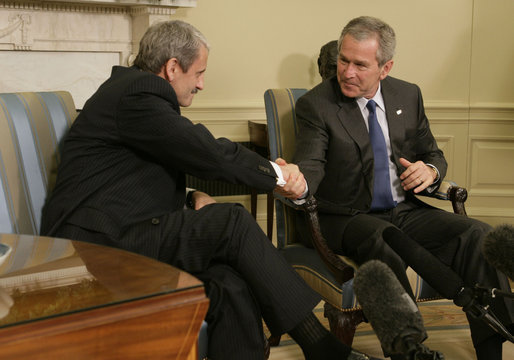
President George W. Bush and Prime Minister Mikulas Dzurinda of Slovakia, exchange handshakes during remarks in the Oval Office of the White House Monday, March 13, 2006. President Bush thanked the Prime Minister for his contributions to helping the young democracies in Afghanistan and Iraq succeed. White House photo by Paul Morse.President George W. Bush and Prime Minister Mikulas Dzurinda of Slovakia, exchange handshakes during remarks in the Oval Office of the White House Monday, March 13, 2006. President Bush thanked the Prime Minister for his contributions
to helping the young democracies in Afghanistan and Iraq succeed. White House photo by Paul Morse.

THE PRESIDENT: Mr. Prime Minister, welcome. Thank you for coming. I always enjoy being with you because you're an optimistic, upbeat believer in the people of your country and the possibilities to work together to achieve peace. And so thanks for coming.

I admire the job you have done, and I admire the record that you have produced. A lot of times in politics, people are pretty good talkers, but they don't follow through. You have followed through.

We discussed a lot of issues. I thank the Prime Minister for his contributions to helping young democracies succeed, democracies in Afghanistan and Iraq. And I want to thank you for that.

We discussed the importance for transatlantic ties between the United States and not only Slovakia, but also between the United States and Europe. And I assured him that those transatlantic ties are an important part of our policies here.

We talked about two issues that I found -- that I know are important. One, of course, is the visa issue. The Prime Minister made it very clear that he expects there to be some progress on the visa issue, that he's -- he represents the good people of Slovakia when he says to me that there needs to be a constant renewal of the process to make sure that it is fair. And I appreciate -- I listened very carefully to my friend and can assure the people of Slovakia that we are working together to make the visa policy work better.

Secondly, he talked about the knowledge-based economy that he envisioned for his country. And I thought, first of all, it's very wise to -- he recognizes the world and the challenges of the world and knows full well that as people gain knowledge, a country is going to end up being more competitive in the 21st century.

And so I -- we strategized about ways to help Slovakia and the United States benefit from exchanges, and particularly student exchanges, so that knowledge becomes a paramount part of our future.

And so Mr. Prime Minister, thanks for your vision. And I also feel sorry for the fact that you broke your leg. This guy's a good runner. And so now I feel comfortable challenging you to a race. (Laughter.) Had you been healthy, I wouldn't even had gotten on the same track with you. But I wish you a speedy recovery, and thanks again for coming to the United States.

PRIME MINISTER DZURINDA: Thank you, Mr. President. My leg is broken, but my heart is happy. (Laughter.) My heart is happy because we are friends and strong allies, America and Slovakia, America and the European Union. I am happy being here because we are good friends. President Bush visited us a year ago, he visited President of Russia, Mr. Putin, in Bratislava, and we remember this fantastic stay of President Bush in Slovakia.

We are good friends, and we share the responsibility for development in the world. I highly appreciate the leadership of President Bush in solving of global issues, the most hot and most complicated issues in the world. And I talked to President Bush that transatlantic cooperation is and must stay the basis of our security. This is something like axis of stability, prosperity and the future of both countries. But also, the future of the democratic world.

As President Bush has already mentioned, we have some bilateral issues. I appreciate especially his State of the Union, during which he announced a new program how to educate people, young generation. We want to do the same. We want to find a new way, thanks to which it would be possible to cooperate with the United States also in the area of science research, and development, innovation, education. And I believe that we will discover these new ways.

Of course we spoke many issues of foreign policy, as usually. And I can only tell that our view is the same and we will continue in this cooperation to advance freedom and democracy in the world. Mr. President, thank you very, very much for being such a good leader.

PRESIDENT BUSH: Thank you, sir.

END 10:40 A.M. EST, For Immediate Release, Office of the Press Secretary, March 13, 2006

Technorati Tags:
and or and or and

RELATED: Keyword, Slovakia, Thursday, February 24, 2005
President Addresses Citizens of Slovakia,

Sunday, March 12, 2006

magnetic phenomenon may improve RAM memories

A new magnetic phenomenon may improve RAM memories and the storage capacity of hard drives

The application of 'displaced vortex states' - small magnetic circular movements of just a few thousandths of a millimetre - may accelerate the arrival of a new type of magnetic memory (MRAM) that does not disappear when a computer is switched offThe application of 'displaced vortex states' - small magnetic circular movements of just a few thousandths of a millimetre - may accelerate the arrival of a new type of magnetic memory (MRAM) that does not disappear when a computer is switched off.
A team of scientists from the Universitat Autònoma de Barcelona, in collaboration with colleagues from the Argonne National Laboratory (USA) and the Spintec laboratory (Grenoble, France), has for the first time produced microscopic magnetic states, known as "displaced vortex states", that will allow an increase in the size of MRAMs (which are not deleted when the computer is switched off). The research has been published in Physical Review Letters and Applied Physics Letters.

In the near future we will turn our computers on and they will be ready to work almost instantaneously; no longer will we have to wait a while for the operating system and certain programs to load into the RAM. At the moment, SRAM and DRAM do not allow this, as they are quick, but they are deleted when the computer is switched off (that is, they are "volatile"); Flash memories, which we use for digital cameras, are not deleted, but they are slow; MRAM, which is still being developed, is fast and non-volatile, but has a relatively low storage capacity. A team of scientists from the UAB Department of Physics, in collaboration with colleagues from the Argonne National Laboratory (USA) and the Spintec laboratory (Grenoble, France), have discovered a magnetic phenomenon that could be useful in the quest for the ideal type of memory: an MRAM with large storage capacity.

The "displaced vortex states", first observed by UAB researchers, are small circular movements of just a few thousandths of a millimetre that form in the tiny zones where the data is stored. The information on hard drives has normally been saved by orientating these zones in specific directions. The zones pointing upwards, for example, codify a 1, and those pointing downwards a 0. The smaller and more compact these zones are, the greater the capacity of the hard drive. But if they are too close together, the magnetic field created by one can affect the neighbouring zone and wipe the data. However, if the field is saved in a whirlpool form, in "vortex state", it does not leave the tiny zone to which it is confined and does not affect the neighbouring data, thus making it possible for a much larger hard drive capacity.

The scientists have achieved these "vortex states" on small, circular structures that are smaller than a micrometre (a thousandth of a millimetre) and combine layers of material with opposing magnetic properties: a layer of ferromagnetic material and a layer of antiferromagnetic material. What makes the configuration of the magnets observed by the UAB scientists new is that the vortex states are "displaced", that is, once the magnetic field is no longer applied, the eye of the whirpool moves off-centre with regard to the circular structure on which it formed. This seemingly insignificant detail is the key to applying the technique to increasing the capacity not only of hard drives but also Magnetic Random Access Memories (MRAMs) that are fast, non-volatile, but until now with small storage capacity.

"The phenomenon observed could also be applied to other fields, such as improving the read heads of hard drives", according to Jordi Sort, a UAB-ICREA physicist and the coordinator of the research. "But the reason that motivated us is even more fundamental: this is a very peculiar physical state that can be observed only in extremely small magnetic structures." ###

Josep Nogués (ICREA researcher) and Maria Dolors Baró, of the UAB Department of Physics, also took part in the research, which was recently published in Physical Review Letters and Applied Physics Letters.

Contact: Octavi Lopez
octavi.lopez@uab.es34-93-581-3301 Universitat Autonoma de Barcelona

more at
or and or and or and or and or and or and or

Related: Keyword Nanotech Sunday, February 26, 2006
Nanoscience study shows that quantum dots 'talk', Sunday, February 26, 2006 Nano-bots to undertake major tasks?, Sunday, February 19, 2006 Nanotech to improve health care delivery, Sunday, February 19, 2006 nano-canary in the nanotoxicology coalmine, Sunday, December 04, 2005 Nano-cages 'fill up' with hydrogen, Sunday, November 13, 2005 Testing toxicity of nanomaterials, Sunday, October 23, 2005 single-molecule car, 'Nanocar', Sunday, August 28, 2005 Writing at the nanoscale, Thursday, May 26, 2005 discontinuous palladium, siloxane self-assembled monolayer, Sunday, May 08, 2005 Center for Nanoscale Materials, Monday, April 25, 2005 Nanomagnets, Nanocomposite, Monday, March 21, 2005 porphyrin tubes may lead to new nanodevices, inexpensive hydrogen fuel

'John Henryism' Health Outcomes in African Americans

'John Henryism' Key to Understanding Coping, Health Outcomes in African Americans

DURHAM, N.C. – John Henry, the figure from American folklore who worked himself to death to beat a steam engine, is a key to understanding the medical reality of African Americans in the 21st century, according to researchers from Duke University Medical Center and their colleagues. African Americans continue to have poorer health than other groups, even though their economic situation has improved significantly, said the researchers.

'John Henryism,' is a coping style that has a clear genetic basis in African Americans and reflects clear personality traits, they reported. The effects of John Henryism (JH) are apparent in clinical and non-clinical settings, can influence emotional reactions and may impact how African Americans function in their everyday lives, the researchers said.

The findings from four studies that examine JH and health outcomes among African Americans were presented on Friday, March 3, 2006, as part of a symposium organized by Duke researchers at the
American Psychosomatic Society's annual meeting in Denver. The studies were funded by the National Institute on Aging.

Psychologists have formally recognized John Henryism as a style of strong coping behaviors used by many African Americans to deal with psychosocial and environmental stressors such as career issues, health problems and even racism. The classic traits of JH are seen among those African Americans who are extremely preoccupied with success, particularly in new environments with which they have little experience. Most commonly, people with JH are extremely goal-oriented but often lack the resources they need for success, such as financial or emotional support, the researchers said.

People with high levels of JH and inadequate resources have a much higher prevalence of health disorders, the researchers added, because they drive themselves toward reaching specific goals at the expense of their health, often without realizing they are doing so.

For example, when coping with a medical crisis like sickle cell anemia, African Americans may display a strong drive toward a successful health outcome but lack the support they need in their job in order to take time off from work, leading them to work during a severe pain episode even though they know their work will suffer or their pain will last longer, said the researchers.

Without adequate resources such as income, social support or psychological and medical care, a person with sickle cell disease would risk increased levels of dysfunction and pain. They also have increased tendencies toward worrying; an increased sensitivity to the comments and reactions of others; increased anxiety and depression; and difficulty trusting other people.

"John Henryism provides one of the more significant and promising models of explaining coping behavior and health outcomes in African Americans for the twenty-first century," said Christopher L. Edwards, Ph.D., a psychiatrist at Duke and lead researcher for one of the studies presented at APS. He is also the medical director of the biofeedback laboratory and director of the Chronic Pain Management Program at Duke.

He further indicated that, "We believe that by better understanding how John Henryism can give rise to health-endangering behaviors by African Americans, we can find new approaches to reducing the health disparities that have led to poorer health among African Americans."

The researchers quantify John Henryism using a questionnaire that reveals a 'single-minded' drive to succeed, even beyond a person's overall self-interest, which is the hallmark of JH, Edwards said.

"People who are so intensely success-oriented and goal-directed, even beyond their resources such as income, education or family support, might seem to succeed at first," said Edwards. "But, long term they are likely to fail because their lack of resources will catch up to them. Add to that the African American situation, which, for many, includes an expectation that failure is inevitable, you find yourself in a most destructive situation.

"They end up compromising their health, with higher rates of cardiovascular disease and death as compared to any other population in the world. We also see evidence of this self-destructive behavior in African Americans with breast cancer, osteoarthritis, and of course, sickle cell disease."
One study, conducted at Pennsylvania State University and Johns Hopkins University, found that as much as 30 percent of active coping behavior in African Americans may be genetically-based, said the researchers. In their study, they examined 180 same-sex twins to glean a better framework for understanding the mechanics of coping behavior. They did this by comparing environmental factors, such as learning and socialization, to genetics factors. The 70 percent of coping that is not accountable to genetics gives hope that modifying the environment and learning how to better apply coping skills may yield solutions to the challenge of reducing the health burden of disease as a function of race, said the researchers.

A Duke-based study found that personality can be linked to measures of JH. In a sample of 233 participants, half of whom were African American and half white, researchers found traits such as 'extroversion' and 'conscientiousness' to be associated with the coping style characterized by JH, as were traits such as dutifulness, achievement-striving, self-discipline and assertiveness.

In a study conducted by researchers at Cleveland State University, Harvard and Duke, researchers found that JH influences how people react emotionally within their environment. The team tested the emotional reactions of 58 healthy black males between the ages of 23 and 47 to various activities. These included public speaking about a racially charged issue, a reading assignment and an anger recall task. They found that the men with lower educational levels who displayed more traits of JH were happier than those who scored high for JH who had higher educational levels.

To test their understanding of John Henryism in a clinical setting, researchers at Duke, North Carolina Central University and Harvard identified the influence of JH on patterns of pain and emotionally-related illness stemming from pain in 50 adult patients with sickle cell disease, an African American population that has not been well-studied. They administered the standard JH questionnaire to those patients, and asked them to report their pain level due to the disease.

That team found that patients with sickle cell disease who exhibited higher levels of JH reported higher incidence of pain and pain-related problems than those with lower levels of JH, they said.

According to Edwards, use of the JH model in research studies has added significantly to the overall understanding of coping in African Americans and will provide even better understanding of the health challenges they face.

"We hope that better understanding coping in African Americans using the John Henryism model will help us develop a better concept of how JH contributes to health problems and how we can reduce their stress and thus enhance their health," Edwards said.

keywords :
African Americans and John Henryism or mental health date : 3/3/2006, media contact : Tracey Koepke , (919) 684-4148 or (919) 660-1301 koepk002@mc.duke.edu

Technorati Tags:
or and or and or or and or and or and or

RELATED: Keyword biology. Sunday, December 18, 2005
Conditions for slavery, Sunday, December 25, 2005 Why Christmas trees are not extinct, Sunday, January 01, 2006 prostaglandins choreograph perturbations, Sunday, January 01, 2006 Cultural differences may explain variations in home remedy use, Sunday, January 08, 2006 Risky Sexual Behaviors in Miami, and Racial Influences on Children’s Care, Sunday, January 22, 2006 Twenty-seven previously unknown species discovered, Sunday, February 12, 2006 Hormone linked to good hearing as we age, Sunday, February 12, 2006 Anti-HIV drug has potential to prevent transmission in women, Sunday, February 12, 2006 Parental Conflict Produces More Than Fleeting Distress for Children, Sunday, February 12, 2006 Facial characteristics indicative of personality traits, say experts, Sunday, February 19, 2006 There's something fishy about human brain evolution, Sunday, February 19, 2006 Marine mammals are on the frontline of failing ocean health, Sunday, February 26, 2006 Study shows that soda consumption increases among adolescent girls as they get older, Sunday, February 26, 2006 Gold's power against autoimmune diseases defined, Sunday, March 05, 2006 People Use Separate Brain Mechanisms to Make Risky Choices,

President Briefed by Joint I E D Task Force

President George W. Bush speaks to the press after participating in a briefing by the Joint Improvised Explosive Device Defeat Task Force in the Roosevelt Room of the White House on Saturday March 11, 2006. White House photo by Paul Morse.President George W. Bush speaks to the press after participating in a briefing by the Joint Improvised Explosive Device Defeat Task Force in the Roosevelt Room of the White House on Saturday March 11, 2006. White House photo by Paul Morse.
President Briefed by Joint Improvised Explosive Device Defeat Task Force, The Roosevelt Room In Focus: Defense 8:46 A.M. EST

THE PRESIDENT: Good morning. I want to thank General Meigs for being here to brief me about tactics on the ground in Iraq. One of the things that the Secretary and General Pace are constantly doing is briefing the Commander-in-Chief as to the nature of the enemy, what the enemy is trying to do to shake our will, and how we're adjusting, how we're constantly adapting our tactics on the ground to achieve a victory.

We face an enemy that will use explosive devices in order to shake our will; in order to foment violence in Iraq; in order to try to convince the American people that we can't win in Iraq. That's what they're trying to do. And the General has spent a lot of time thinking about the enemy's tactics and techniques, and how our military can adjust to them.

So the briefing today was a series of briefing I get from our commanders on the ground, as well as our experts hired by the Pentagon to let me know what we're doing, so I can let the American people know that we recognize the nature of this enemy, we're addressing our tactics to defeat this enemy, for the sake of peace, for the sake of the security of the United States of America and for the sake of peace in the world.

And so, General, thank you for being here. I appreciate your time. I'll answer a couple of questions. Deb.

Q Mr. President, can you tell us your reaction to the arrest of your former Domestic Policy Advisor, Claude Allen?

THE PRESIDENT: If the allegations are true, Claude Allen did not tell my Chief of Staff and legal counsel the truth, and that's deeply disappointing. If the allegations are true, something went wrong in Claude Allen's life, and that is really sad. When I heard the story last night I was shocked. And my first reaction was one of disappointment, deep disappointment that -- if it's true -- that we were not fully informed. But it was also one -- shortly thereafter, I felt really sad for the Allen family. (Editor's Note: more below end of this article)

Caren.

Q Sir, are you concerned about the rift that the Dubai Ports has opened with the Republican Party?

THE PRESIDENT: The Republican Party is united in our efforts to win the war on terror. The Republican Party is united in our efforts to keep this economy strong by keeping taxes low. The Republican Party is united in making us less dependent on foreign sources of oil.

I've read all the stories about this rift, or that rift. That's typical Washington, it seems like to me. I am looking forward to continuing to work with the leadership in the United States Congress to pass an agenda that will keep America the economic leader of the world and will keep this country secure. And next fall I'm looking forward to campaigning with our candidates. I'm convinced ours is the party that has got an agenda for the future, and ours is the party that has preformed.

Stretch.

Q Mr. President, are you concerned, with reference to the IEDs, are you concerned that the sophisticated weaponry our troops are facing now might be coming from foreign, neighboring countries? And if so, what are our courses going about --

THE PRESIDENT: We're constantly gathering intelligence. We're monitoring influence. We are adjusting our tactics. We are -- obviously, if there's any kind of influence from a foreign country that is disruptive, any kind of influence -- if the Iranians are trying to influence the outcome of the political process, or the outcome of the security situation there, we're letting them know our displeasure.

Our call is for those in the neighborhood to allow Iran -- Iraq to develop a democracy. And that includes our call to Iran, as well as to Syria. We have made our concerns known, and we will continue to make our concerns known. It's in the interests of the neighborhood that Iraq develop to be a peaceful democracy. It's important for countries to have stable, peaceful, prosperous countries on their border. Prosperity in one nation will help prosperity in other nations. It's important for our friends in the rest of the Middle East to help this new democracy.

And so, yes, we're interesting in negative influence; we're also interested in positive influence. And we call on people to be a positive influence, to help this new democracy emerge. And I'm optimistic that the Iraqi people will overcome the challenges they face.

And my optimism is based upon reality on the ground. One, there were some people trying to, obviously, foment sectarian violence. Some have called it a civil war. But it didn't work. Secondly, I'm optimistic because the Iraqi security forces preformed, in most cases, really well to provide security. All but two of the provinces of Iraq, after the blowing up of the mosque, were settled. I'm positive and optimistic about the development that the Iraqi forces are achieving.

I know we've got to do more work in the police forces. We have said that very clearly. General Casey has called the year 2006 the year of police training, and we'll continue to work to train the police. I'm optimistic that the leadership recognizes that sectarian violence will undermine the capacity for them to self govern. I believe we'll have a unity government in place that will help move the process forward. I fully recognize that the nature of the enemy is such that they want to convince the world that we cannot succeed in Iraq. I know we're going to succeed if we don't lose our will.

Thank you all.

END 8:53 A.M. EST, For Immediate Release, Office of the Press Secretary, March 11, 2006

Claude A. Allen- former White House adviser and Bush administration nominee to the U.S. Fourth Circuit Court of Appeals has been arrested and charged with theft for receiving phony refunds at department stores.

Technorati Tags:
and or and or and or and or and or

Related: Keyword Iraq, Thursday, March 09, 2006
President Signs USA PATRIOT Act (VIDEO), Saturday, February 25, 2006 President Addresses American Legion, Discusses Global War on Terror (VIDEO), Wednesday, January 25, 2006 President Discusses War on Terror at K-State (VIDEO), Wednesday, January 04, 2006 President Discusses War on Terror Following Pentagon Briefing (VIDEO), Monday, December 19, 2005 President's Address to the Nation (VIDEO) 12/18/05, Thursday, December 15, 2005 President, McCain, Warner, Discusses Interrogation, Wednesday, December 14, 2005 Iraqi Elections, Victory in the War on Terror (VIDEO), Monday, December 12, 2005 President Discusses War on Terror and Upcoming Iraqi Elections (VIDEO), Sunday, July 17, 2005 Soldiers charged with assault on suspected insurgents, Sunday, July 24, 2005 Iraqi, American Women Discuss Constitution, Women's Rights, Thursday, July 28, 2005 Killing of Algerian Diplomats to Iraq, Saturday, August 06, 2005 Operation Quick Strike, Monday, August 08, 2005 The Independent Inquiry Committee into the Iraq Oil-for-Food Programme, Thursday, August 11, 2005 President Meets with Defense and Foreign Policy Teams, Friday, August 12, 2005 Interview of the President by Israeli Television,
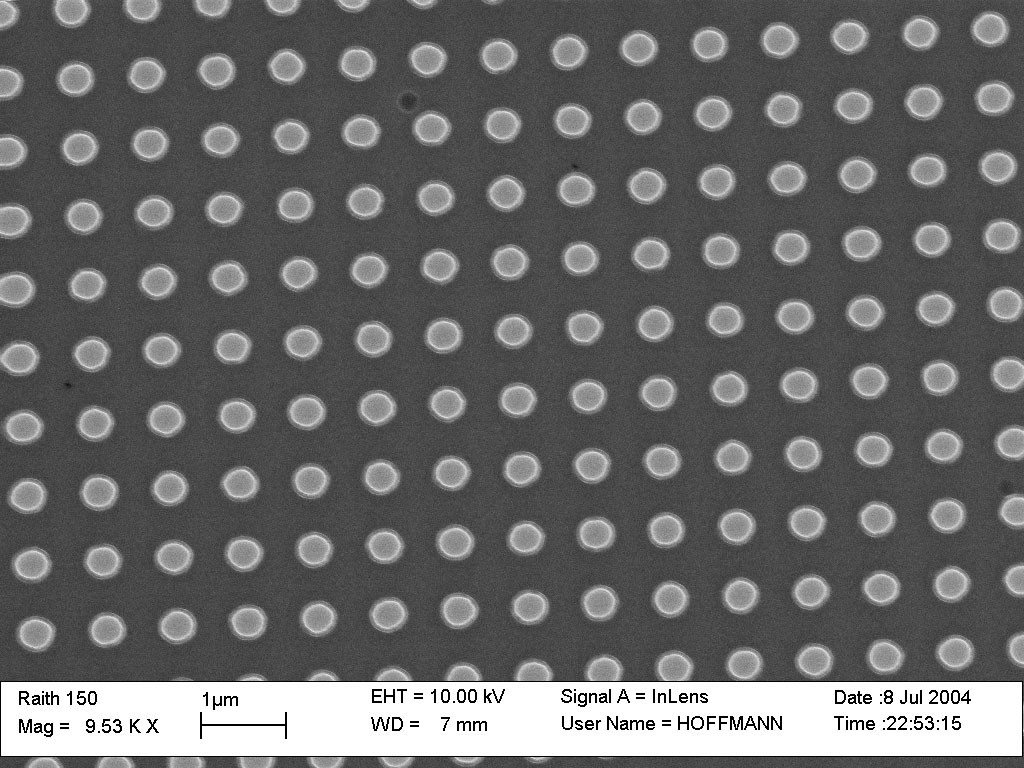
Saturday, March 11, 2006

Presidential Podcast 03/11/06

Presidential Podcast 03/11/06

Subscribe to My Odeo Channel Subscribe to Our Odeo Podcast Channel and receive the Presidential Radio Address each week. Featuring real audio and full text transcript

Technorati Tags: and or and , or and , or , and , or , and ,

Related: Keywords radio address, podcast, Saturday, March 4, 2006
Presidential Podcast 03/04/06, Saturday, February 25, 2006 Presidential Podcast 02/25/06, Saturday, February 18, 2006 Presidential Podcast 02/18/06, Saturday, February 11, 2006 Presidential Podcast 02/11/06, Saturday, February 04, 2006 Presidential Podcast 02/04/06, Saturday, January 28, 2006 Presidential Podcast 01/28/06, Saturday, January 14, 2006 Presidential Podcast 01/14/06, Saturday, January 07, 2006 Presidential Podcast 01/07/06, Saturday, December 31, 2005 Presidential Podcast 12/31/05, Saturday, December 17, 2005 bush radio address 12/17/05 full VIDEO, text transcript, Sunday, December 04, 2005 Presidential Podcast 12/03/05, Saturday, December 03, 2005 bush radio address 12/03/05 full audio, text transcript, November 26, 2005 Presidential Podcast 11/26/05, Saturday, November 26, 2005 bush radio address 11/26/05 full audio, text transcript, Saturday, November 19, 2005 Presidential Podcast 11/19/05, Saturday, November 19, 2005 Freedom Calendar 11/19/05 - 11/26/05, Saturday, November 12, 2005 Presidential Podcast 11/12/05, Saturday, November 12, 2005 bush radio address 11/12/05 full audio, text transcript,