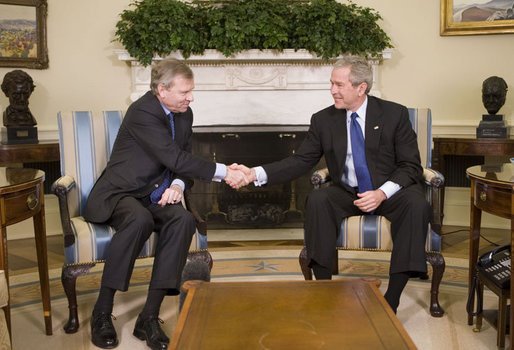
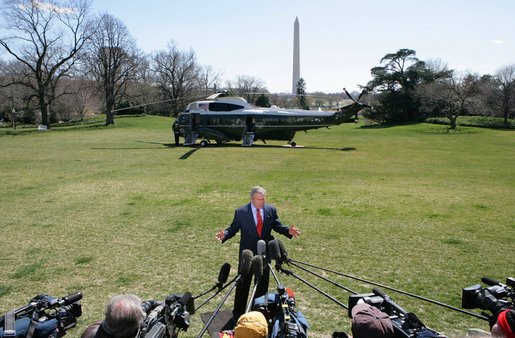
| Press Conference of the President, FULL STREAMING VIDEO, James S. Brady Briefing Room 10:01 A.M. EST, President George W. Bush answers reporters questions, Tuesday morning, March 21, 2006, during a news briefing at the White House. White House photo by Paul Morse |
Yesterday I spoke about an important example of the gains we and the Iraqis have made, and that is in the northern city of Tal Afar. The city was once under al Qaeda control, and thanks to coalition and Iraqi forces, the terrorists have now been driven out of that city. Iraqi security forces are maintaining law and order. We see the outlines of a free and secure Iraq that we and the Iraqi people have been fighting for. As we mark the third anniversary of the launch of Operation Iraqi Freedom, the success we're seeing in Tal Afar gives me confidence in the future of Iraq.
Terrorists haven't given up; they're tough-minded, they like to kill. There's going to be more tough fighting ahead. No question that sectarian violence must be confronted by the Iraqi government and a better-trained police force. Yet we're making progress. And that's important for the American people to understand.
We're making progress because of -- we've got a strategy for victory, and we're making progress because the men and women of the United States military are showing magnificent courage and they're making important sacrifices that have brought Iraq to an historic moment -- the opportunity to build a democracy that reflects its country's diversity, that serves its people, and is an active partner in the fight against the terrorists.
Now Iraq's leaders must take advantage of the opportunity. I was encouraged by the announcement Sunday the Iraqi leaders -- that the Iraqi leaders made -- are making progress toward a council that gives each of the country's main political factions a voice in making security and economic policies. It's an indicator that Iraq's leaders understand the importance of a government of national unity. Our Ambassador to Iraq, Zal Khalilzad, is very much involved in the process and will encourage the Iraqi leaders to put aside their differences, reach out across sectarian lines and form a unity government.
Here at home, I'm also encouraged by the strength of our economy. Last year our economy grew at a healthy 3.5 percent. Over the past two-and-a-half years, the economy has added nearly 5 million new jobs -- that's more than Japan and the 25 nations of the European Union combined. The national unemployment rate is 4.8 percent -- that's lower than the average rate of the 1970s, the 1980s and the 1990s. Productivity is strong. Inflation is contained. Household net worth is at an all-time high. Real after-tax income is up more than 8 percent per person since the beginning of 2001. The growing economy is a result of the hard work of the American people and good policies here in Washington
I believe America prospers when people are allowed to keep more of what they earn so they can make their own decisions about how to spend, save and invest. So I'm going to continue to work with Congress to make the tax relief permanent, continue to work with Congress to restrain federal spending, continue to work with Congress to achieve the goal of cutting the deficit in half by 2009.
We cannot take our growing economy for granted, and so I look forward to working with the Congress to make sure we invest in basic research, and promote math and science education. I'm going to work with Congress to reduce our dependence on foreign oil. I know it came as a surprise to some of you that I would stand up in front of the Congress and say, we got a problem, we're addicted to oil. But it is a problem. And I look forward to working with both Republicans and Democrats to advance an agenda that will make us less dependent on foreign oil; an agenda that includes hybrid cars and advanced ethanol fuels and hydrogen cells. I'm going to look forward to working with Congress to make sure health care is affordable and available.
We're going to work with Congress to make sure we meet our commitments to our fellow citizens who are affected by Katrina. I appreciate the step that the House of Representatives took last week on passing a supplemental appropriations bill that funds Gulf Coast reconstruction and, of course, supports our men and women in uniform. I look forward to working with the Senate to get that supplemental bill passed and to my desk.
Now I'll be glad to take any questions you have, starting with AP person. (Laughter.)
Q Thank you, Mr. President.
THE PRESIDENT: That would be you, Terry.
Q Iraq's Interim Prime Minister said Sunday that violence is killing an average of 50 to 60 people a day, and that, "if this is not civil war, then God knows what civil war is." Do you agree with Mr. Allawi that Iraq has fallen into civil war?
THE PRESIDENT: I do not. There are other voices coming out of Iraq, by the way, other than Mr. Allawi -- who I know, by the way, and like, he's a good fellow. President Talabani has spoken. General Casey, the other day, was quite eloquent on the subject. Zal Khalilzad, who I talk to quite frequently. Listen, we all recognize that there is violence, that there's sectarian violence. But the way I look at the situation is that the Iraqis took a look and decided not to go to civil war.
A couple of indicators are that the army didn't bust up into sectarian divisions. The army stayed united. And as General Casey pointed out, they did, arguably, a good job in helping to make sure the country stayed united.
Secondly, I was pleased to see religious leaders stand up. Ayatollah Sistani, for example, was very clear in his denunciation of violence and the need for the country to remain united. The political leaders who represent different factions of the Iraqi society have committed themselves to moving forward on a unity government.
No question that the enemy has tried to spread sectarian violence. They use violence as a tool to do that. They're willing to kill innocent people. The reports of bound Sunnis that were executed are horrific. And it's obviously something we're going to have to deal. And more importantly, the Iraqis are going to have to deal with it.
But I see progress. I've heard people say, oh, he's just kind of optimistic for the sake of optimism. Well, look, I believe we're going to succeed. And I understand how tough it is -- don't get me wrong -- I mean, you make it abundantly clear how tough it is. I hear it from our troops; I read the reports every night. But I believe -- I believe the Iraqis -- this is a moment where the Iraqis had a chance to fall apart, and they didn't. And that's a positive development.
Steve.
Q Thank you. You describe Iran as a threat, yet, you're close to opening talks with them about Iraq. What would be the objective in these talks if they are not negotiations? And is there a risk of getting drawn into the nuclear issue?
THE PRESIDENT: Thanks for asking that question. A couple of months ago, I gave Zal, our Ambassador in Iraq, permission to explain to the Iraqi -- Iranians what we didn't like about their involvement in Iraq. I thought it was important for them to hear firsthand, other than through press accounts. He asked whether or not it made sense for him to be able to talk to a representative in Baghdad; I said, absolutely. You make it clear to them that attempts to spread sectarian violence, or to maybe move parts that could be used for IEDs is unacceptable to the United States.
It is very important for the Iranians to understand that any relationship between Iraq and Iran will be negotiated between those two countries. Iraq is a sovereign government. They have a foreign policy. And when they get their unity government stepped up, they will be in charge of negotiating with the Iranians their foreign policy arrangement. And so this is a way for us to make it clear to them that -- about what's right or wrong in their activities inside of Iraq.
Secondly, our negotiations with Iran on the nuclear weapons will be led by the EU-3. And that's important because the Iranians must hear there's a unified voice about -- that says that they shall not have a capacity to make a nuclear weapon and/or the knowledge as to how to make a nuclear weapon, for the sake of security of the world.
It's important for our citizens to understand that we have got to deal with this issue diplomatically now. And the reason why is because if the Iranians were to have a nuclear weapon they could blackmail the world. If the Iranians were to have a nuclear weapon they could proliferate. This is a country that's walking away from international accords; they're not heading toward the international accords, they're not welcoming the international inspections -- or safeguards -- safeguard measures that they had agreed to.
And so our policy for the Iranians, in terms of the nuclear program, is to continue to work with the EU-3, as well as Russia and China. Later on this week, there's going to be a P-5 -- that's a diplomatic sloganeering for the permanent members of the Security Council -- plus Germany, and working together to make sure that the message remains unified and concerted.
If you're a non-transparent society, you've got a negotiating advantage over six parties, because all you have to do is kind of try to find a -- the weakest link in the negotiating team. And so our job is to make sure that this international will remains strong and united, so that we can solve this issue diplomatically.
Helen. After that brilliant performance at the Grid Iron, I am -- (laughter.)
Q You're going to be sorry. (Laughter.)
THE PRESIDENT: Well, then, let me take it back. (Laughter.)
Q I'd like to ask you, Mr. President, your decision to invade Iraq has caused the deaths of thousands of Americans and Iraqis, wounds of Americans and Iraqis for a lifetime. Every reason given, publicly at least, has turned out not to be true. My question is, why did you really want to go to war? From the moment you stepped into the White House, from your Cabinet -- your Cabinet officers, intelligence people, and so forth -- what was your real reason? You have said it wasn't oil -- quest for oil, it hasn't been Israel, or anything else. What was it?
THE PRESIDENT: I think your premise -- in all due respect to your question and to you as a lifelong journalist -- is that -- I didn't want war. To assume I wanted war is just flat wrong, Helen, in all due respect --
Q Everything --
THE PRESIDENT: Hold on for a second, please.
Q -- everything I've heard --
THE PRESIDENT: Excuse me, excuse me. No President wants war. Everything you may have heard is that, but it's just simply not true. My attitude about the defense of this country changed on September the 11th. We -- when we got attacked, I vowed then and there to use every asset at my disposal to protect the American people. Our foreign policy changed on that day, Helen. You know, we used to think we were secure because of oceans and previous diplomacy. But we realized on September the 11th, 2001, that killers could destroy innocent life. And I'm never going to forget it. And I'm never going to forget the vow I made to the American people that we will do everything in our power to protect our people.
Part of that meant to make sure that we didn't allow people to provide safe haven to an enemy. And that's why I went into Iraq -- hold on for a second --
Q They didn't do anything to you, or to our country.
THE PRESIDENT: Look -- excuse me for a second, please. Excuse me for a second. They did. The Taliban provided safe haven for al Qaeda. That's where al Qaeda trained --
Q I'm talking about Iraq --
THE PRESIDENT: Helen, excuse me. That's where -- Afghanistan provided safe haven for al Qaeda. That's where they trained. That's where they plotted. That's where they planned the attacks that killed thousands of innocent Americans.
I also saw a threat in Iraq. I was hoping to solve this problem diplomatically. That's why I went to the Security Council; that's why it was important to pass 1441, which was unanimously passed. And the world said, disarm, disclose, or face serious consequences --
Q -- go to war --
THE PRESIDENT: -- and therefore, we worked with the world, we worked to make sure that Saddam Hussein heard the message of the world. And when he chose to deny inspectors, when he chose not to disclose, then I had the difficult decision to make to remove him. And we did, and the world is safer for it.
Q Thank you, sir. Secretary Rumsfeld -- (laughter.)
Q Thank you.
THE PRESIDENT: You're welcome. (Laughter.) I didn't really regret it. I kind of semi-regretted it. (Laughter.)
Q -- have a debate.
THE PRESIDENT: That's right. Anyway, your performance at the Grid Iron was just brilliant -- unlike Holland's, was a little weak, but -- (laughter.)
Sorry.
Q Secretary Rumsfeld has said that if civil war should break out in Iraq, he's hopeful that Iraqi forces can handle it. If they can't, sir, are you willing to sacrifice American lives to keep Iraqis from killing one another?
THE PRESIDENT: I think the first step is to make sure a civil war doesn't break out. And that's why we're working with the leaders there in Baghdad to form a unity government. Obviously, if there is difficulty on the streets, the first line of defense for that difficulty will be the Iraqi forces, which have proved themselves in the face of potential sectarian violence, right after the bombing of the mosque in Samarra. The forces are -- part of our strategy for victory is to get the forces the skills and the tools and the training necessary to defend their own country, whether it be against Zarqawi and the killers, or whether it be those who are trying to spread sectarian violence. And they have proven themselves.
And so our position is, one, get a unity government formed, and secondly, prepare the Iraqi troops, and support Iraqi troops, if need be, to prevent sectarian violence from breaking out.
Yes, sir.
Q Mr. President, I'd like to ask you for your reaction on the latest insurgent attack in Baghdad: 17 police officers killed and a bunch of insurgents freed. I spent a fair amount of time in front of that hotel in Cleveland yesterday, talking to people about the war and saying you were there to talk optimistically. And one woman who said she voted for you, said, "You know what, he's losing me. We've been there too long; he's losing me." What do you say to her?
THE PRESIDENT: I say that I'm talking realistically to people. We have a plan for victory and it's important we achieve that plan. Democracy -- first of all, this is a global war on terror and Iraq is a part of the war on terror. Mr. Zarqawi and al Qaeda, the very same people that attacked the United States, have made it clear that they want to drive us out of Iraq so they can plan, plot, and attack America again. That's what they have said; that's their objective. I think it is very important to have a President who is realistic and listens to what the enemy says.
Secondly, I am confident -- I believe, I'm optimistic we'll succeed. If not, I'd pull our troops out. If I didn't believe we had a plan for victory I wouldn't leave our people in harm's way. And that's important for the woman to understand.
Thirdly, in spite of the bad news on television -- and there is bad news. You brought it up; you said, how do I react to a bombing that took place yesterday -- is precisely what the enemy understands is possible to do. I'm not suggesting you shouldn't talk about it. I'm certainly not being -- please don't take that as criticism. But it also is a realistic assessment of the enemies capability to affect the debate, and they know that. They're capable of blowing up innocent life so it ends up on your TV show. And, therefore, it affects the woman in Cleveland you were talking to. And I can understand how Americans are worried about whether or not we can win.
I think most Americans understand we need to win. But they're concerned about whether or not we can win. So one of the reasons I go around the country, to Cleveland, is to explain why I think we can win. And so I would say, yes, I'm optimistic about being able to achieve a victory, but I'm also realistic. I fully understand the consequences of this war. I understand people's lives are being lost. But I also understand the consequences of not achieving our objective by leaving too early. Iraq would become a place of instability, a place from which the enemy can plot, plan and attack.
I believe that they want to hurt us again. And, therefore, I know we need to stay on the offense against this enemy. They've declared Iraq to be the central front and, therefore, we've got to make sure we win that. And I believe we will.
Q Good morning, sir. Mindful of the frustrations that many Americans are expressing to you, do you believe you need to make any adjustments in how you run the White House? Many of your senior staffers have been with you from the beginning. There are some in Washington who say --
THE PRESIDENT: Wait a minute, is this a personal attack launching over here? (Laughter.)
Q Some say they are tired and even tone-deaf, even within your party who say that maybe you need some changes. Would you benefit from any changes to your staff?
THE PRESIDENT: I've got a staff of people that have, first of all, placed their country above their self-interests. These are good, hardworking, decent people. And we've dealt with a lot. We've dealt with a lot. We've dealt with war, we've dealt with recession, we've dealt with scandal, we've dealt with Katrina. I mean, they had a lot on their plate. And I appreciate their performance and their hard work and they've got my confidence.
And I understand -- Washington is a great town for advice. I get a lot of it -- sometimes in private, from my friends, and sometimes in public. There are those who like to stand up and say to the President, here's what you ought to be doing. And I understand that. This isn't the first time during these five-and-a-half years that people have felt comfortable about standing up, telling me what to do. And that's okay. I take it all in and appreciate the spirit in which it's delivered, most of the time. But -- no, look, I'm satisfied with the people I've surrounded myself with. We've been a remarkably stable administration. And I think that's good for the country.
Obviously, there's some times when government bureaucracies haven't responded the way we wanted them to. And like citizens, I don't like that at all. I mean, I think, for example, of the trailers sitting down in Arkansas. Like many citizens, they're wondering why they're down there. How come we got 11,000? So I've asked Chertoff to find out, what are you going to do with them? The taxpayers aren't interested in 11,000 trailers just sitting there; do something with them.
And so I share that sense of frustration when a big government is unable to -- sends wrong signals to taxpayers. But our people are good, hardworking people.
Elisabeth.
Q Can I just follow up on that?
THE PRESIDENT: Sure.
Q But aside from staff, Mr. President, are you listening to suggestions you bring somebody else into the White House, a wise man, a gray beard, some old-time Washington hand who can steady Congress if they're upset about things, Republicans in Congress?
THE PRESIDENT: I'm listening to all suggestions. I really am. I mean, I'm listening to Congress. We're bringing Congress down here all the time. And it's interesting to hear their observations. They -- they're, obviously, expressing concerns. It's an election year, after all. And it seems like history tends to repeat itself when you're in the White House. I can remember '02 before the elections, there was a certain nervousness. There was a lot of people in Congress who weren't sure I was going to make it in '04, and whether or not I'd drag the ticket down. So there's a certain unease as you head into an election year. I understand that.
My message to them is, please continue to give me advice and suggestions. And I take their advice seriously. But also remember we've got a positive agenda. We've got something to do. It's important for Congress to have confidence in our ability to get things done. We're supporting our troops over the last 12 months. We've got two Supreme Court judges confirmed. We've got the Patriot Act reauthorized over the objections of the Democrat leadership in the Senate. We got some tort reform passed. We passed a budget that cut non-security discretionary spending. There's a series of -- we got an energy bill passed. We worked to get a lot of positive things done. And now we've got an agenda -- continue to keep this economy growing, and keep this nation competitive.
I meant what I said in my speech, we shouldn't fear this future. In other words, we shouldn't allow isolationism and protectionism to overwhelm us. We ought to be confident about our ability to shape the future. And that's why this competitiveness initiative is important. That's why this energy plan that gets us less addicted to oil is important. We got some interesting ideas on health care that we need to continue to press, to make sure consumers are actually a part of the decision-making process when it comes to health care decisions. We've got an aggressive agenda that, by working together, will get passed. But I do, I listen.
Yes, Jim.
Q -- new guy? No new guy?
THE PRESIDENT: Well, I'm not going to announce it right now. Look, they've got some ideas that I like and some I don't like. Put it that way.
Q You've said during your presidency that you don't pay that much attention to the polls, but --
THE PRESIDENT: Correct.
Q -- there is a handful that have come back, and they all say the exact same thing: A growing number of Americans are questioning the trustworthiness of you and this White House. Does that concern you?
THE PRESIDENT: I believe that my job is to go out and explain to people what's on my mind. That's why I'm having this press conference, see. I'm telling you what's on my mind. And what's on my mind is winning the war on terror. And I understand war creates concerns, Jim. Nobody likes war. It creates a sense of -- of uncertainty in the country. The person you talked to in Cleveland is uncertain about our ability to go forward. She's uncertain about whether or not we can succeed, and I understand that. War creates trauma, particularly when you're fighting an enemy that doesn't fight soldier-to-soldier, they fight by using IEDs to kill innocent people. That's what they use. That's the tool they use. And it creates a sense of concern amongst our people. And that makes sense, and I know that.
And one of the reasons why it's important for me to continue to speak out and explain why we have a strategy for victory, why we can succeed. And I'm going to say it again, if I didn't believe we could succeed, I wouldn't be there. I wouldn't put those kids there. I meet with too many families who's lost a loved one to not be able to look them in the eye and say, we're doing the right thing. And we are doing the right thing. A democracy in Iraq is going to affect the neighborhood. A democracy in Iraq is going to inspire reformers in a part of the world that is desperate for reformation.
Our foreign policy up to now was to kind of tolerate what appeared to be calm. And underneath the surface was this swelling sense of anxiety and resentment, out of which came this totalitarian movement that is willing to spread its propaganda through death and destruction, to spread its philosophy. Now, some in this country don't -- I can understand -- don't view the enemy that way. I guess they kind of view it as an isolated group of people that occasionally kill. I just don't see it that way. I see them bound by a philosophy with plans and tactics to impose their will on other countries.
The enemy has said that it's just a matter of time before the United States loses its nerve and withdraws from Iraq. That's what they have said. And their objective for driving us out of Iraq is to have a place from which to launch their campaign to overthrow modern governments -- moderate governments -- in the Middle East, as well as to continue attacking places like the United States. Now, maybe some discount those words as kind of meaningless propaganda. I don't, Jim. I take them really seriously. And I think everybody in government should take them seriously and respond accordingly. And so it's -- I've got to continue to speak as clearly as I possibly can about the consequences of success and the consequences of failure, and why I believe we can succeed.
Q Mr. President, Kathleen Koch, CNN.
THE PRESIDENT: Yes.
Q You said you listen to members of Congress, and there have been growing calls from some of those members for the resignation of Defense Secretary Donald Rumsfeld; also from his own former subordinates like U.S. Army Major General Paul Eaton, who described him in a recent editorial as "incompetent and tactically inept." Do you feel that personally you've ever gotten bad advice in the conduct of the war in Iraq? And do you believe Rumsfeld should resign?
THE PRESIDENT: No, I don't believe he should resign. I think he's done a fine job of not only conducting two battles, Afghanistan and Iraq, but also transforming our military, which has been a very difficult job inside the Pentagon.
Listen, every war plan looks good on paper until you meet the enemy -- not just the war plan we executed in Iraq, but the war plans that have been executed throughout the history of warfare. In other words, the enemy changes tactics, and we've got to change tactics, too.
And no question that we've had to adjust our tactics on the ground. And perhaps the clearest example is in the training of Iraqi security forces. When we got into Iraq, we felt like we needed to train a security force that was capable for defending the country from an outside threat. And then it became apparent that the insurgents and Zarqawi were able to spread their poison and their violence in a ruthless way, and therefore, we had to make sure that the Iraqi forces were able to deal with the internal threat. And we adjusted our tactics and starting spending a lot more time getting the Iraqis up and running, and then embedding our troops with the Iraqis.
And it has been a success. But no question about it, we missed sometime as we adjusted our tactics. We had to change our reconstruction strategy. We were -- we thought it made sense, initially, when we went in there to build big, grand projects, which turned out to be targets for the insurgents to blow up. And a better strategy was to be spending reconstruction money at the local level, so that local leaders committed to a peaceful and unified Iraq would benefit. In other words, people would see tangible benefits from an emerging democracy, and the leaders would be viewed as people helping to improve their lives.
And so this is a war in which we've changed tactics. It's a war in which we've adjusted and learned lessons in the process of the war.
Yes, sir.
Q Just after the 2004 election, you seemed to -- you claimed a really enviable balance of political capital and a strong mandate. Would you make that claim today? Do you still have that?
THE PRESIDENT: I'd say I'm spending that capital on the war.
Q Well, is that costing you elsewhere, then?
THE PRESIDENT: I don't think so. I just named 12 -- I just named an agenda that over the last 12 month was -- would be, I suspect, if looked at objectively, would say, well, they got a lot done. And I'd be glad to repeat them if you like, which is -- (laughter.)
Q -- Social Security --
THE PRESIDENT: Wait a minute. Please no hand gestures. (Laughter.)
Social Security -- it didn't get done. You notice it wasn't on the list. (Laughter.) Let me talk about that, if you don't mind. First of all, Social Security is a really difficult issue for some members of Congress to deal with because it is fraught with all kind of political peril. As a matter of fact, it's been difficult for a lot of Congresses to deal with. The one time in recent memory that it was dealt with was when there was a near crisis -- in other words, when the system was about to fall into the abyss, and people came together and solved it. But they thought it was a fairly long-term fix; it turned out to be a lot shorter fix than they thought.
So I'm disappointed Congress didn't want to go forward with it, but I'm not surprised. Therefore, I tried a new tactic. Last year the tactic was to believe that once the people saw there was a problem they would then demand a solution. And we made progress on describing the problem. I think the American people are now beginning to get the picture that if we don't do something, Social Security and Medicare will bust. If we don't do something, future Congresses -- not this Congress, but future Congresses -- are going to be confronted with some serious decisions about raising taxes enormously, or cutting benefits drastically, or other programs drastically.
And so that issue sunk in. There just wasn't the connection with action inside, in the body of the respective chambers -- although, there were some noble efforts made by some members of Congress to get something started.
So the new tactics to get people involved in this process is to try to take the politics out of it and bring members of both parties, both chambers together. There's quiet consultations going on to get this commission -- committee together of members that could get something put in place that would have a bipartisan appeal to it. Bipartisanship is hard to achieve in Washington these days. I readily concede that. Yet, this issue is one that's going to require a bipartisan approach. It's simply not going to be an issue where one party, without the cooperation of the other party, kind of tries to move a bill. At least, that's how I view it.
But I'm committed to moving the issue. I think it's important. And I'm not deterred by the fact that nothing happened. As a matter of fact, I take great pride in the fact that I was willing to bring up the issue while others might not have. That's the job of the President. The job of the President is not to worry about the short-term attitudes. The job of the President is to confront big issues and to bring them to the front, and to say to people, let's work together to get it solved. And I'm going to continue working on it.
Carl.
Q Thank you, sir. On the subject of the terrorist surveillance program --
THE PRESIDENT: Yes.
Q -- not to change the tone from all this emphasis on bipartisanship, but there have been now three sponsors to a measure to censure you for the implementation of that program. The primary sponsor, Russ Feingold, has suggested that impeachment is not out of the question. And on Sunday, the number two Democrat in the Senate refused to rule that out pending an investigation. What, sir, do you think the impact of the discussion of impeachment and censure does to you and this office, and to the nation during a time of war, and in the context of the election?
THE PRESIDENT: I think during these difficult times -- and they are difficult when we're at war -- the American people expect there to be a honest and open debate without needless partisanship. And that's how I view it. I did notice that nobody from the Democrat Party has actually stood up and called for getting rid of the terrorist surveillance program. You know, if that's what they believe, if people in the party believe that, then they ought to stand up and say it. They ought to stand up and say the tools we're using to protect the American people shouldn't be used. They ought to take their message to the people and say, vote for me, I promise we're not going to have a terrorist surveillance program. That's what they ought to be doing. That's part of what is an open and honest debate.
I did notice that, at one point in time, they didn't think the Patriot Act ought to be reauthorized -- "they" being at least the Minority Leader in the Senate. He openly said, as I understand -- I don't want to misquote him -- something along the lines that, "We killed the Patriot Act." And if that's what the party believes, they ought to go around the country saying we shouldn't give the people on the front line of protecting us the tools necessary to do so. That's a debate I think the country ought to have.
Yes, sir.
Q You mentioned earlier that you were encouraged by some of the discussions going on over a unity government, over the last few days. Do you now have in mind a target date for forming the unity government and --
THE PRESIDENT: As soon as possible. Next question.
Q How much of a factor do you think that will be -- in turning around, or at least improving the situation in the public opinion?
THE PRESIDENT: Here in America?
Q Right.
THE PRESIDENT: That's a trick question, because you want to get me to talk about polls when I don't pay attention to polls.
Q That was one --
THE PRESIDENT: At least that's -- after five-and-a-half years I was able to rout you out. (Laughter.)
First of all, I have no idea whether or not a -- how Americans are going to react to a unity government. There will be a unity government formed, then there could be an attack the next day, and so it's hard for me to predict. I do know a unity government, though, is necessary for us to achieve our objective. I do know that the Iraqi people -- 11 million of them -- voted in an election in December, which was, like, four months ago. And the message I received from that is I hope the same message that those who have been in charge with forming a unity government receive, and that is the people have spoken and they want democracy. That's what they said. Otherwise, they wouldn't have participated. They expect there to be a democracy in place that listens to their demands.
And so I'm -- most importantly, I believe a unity government will begin to affect the attitudes of the Iraqis. And that's important for them to get confidence not only in a government, but in a security force that will provide them security. It's -- confidence amongst the Iraqis is what is going to be a vital part of achieving a victory, which will then enable the American people to understand that victory is possible. In other words, the American people will -- their opinions, I suspect, will be affected by what they see on their TV screens. The unity government will affect, first and foremost, the Iraqi people, and that's a very important part of achieving success.
We do have a plan for victory and victory is clearly stated, and that is that Iraq is not a -- becomes a safe haven. And that's important for the American people, that Iraq not be a safe haven for terrorists. Their stated objective is to turn Iraq into a safe haven from which they can launch attacks.
Secondly, part of the plan for victory is for there to be security forces capable of defending and providing security to the Iraqi citizens. And, thirdly, that democracy, the government take root to the extent that it can't be overturned by those who want to stop democracy from taking hold in Iraq. These are clear objectives and they're achievable objectives.
Okay. Mark.
Q Mr. President, in the upcoming elections I think many Republicans would tell you one of the big things they're worried about is the national debt, which was $5.7 trillion when you took office, and is now nearly $8.2 trillion, and Congress has just voted to raise it to $8.9 trillion. That would be a 58-percent increase. You've yet to veto a single bill, sir -- I assume that means you're satisfied with this.
THE PRESIDENT: No, I'm not satisfied with the rise of mandatory spending. As you know, the President doesn't have the -- doesn't veto mandatory spending increases. And mandatory spending increases are those increases in the budget caused by increases in spending on Medicare and Social Security. And that's why -- back to this man's question right here -- it's important for -- "this man" being Jim -- (laughter) -- sorry, Jim, I've got a lot on my mind these days. That's why it's important for us to modernize and strengthen Social Security and Medicare, in order to be able to deal with the increases in mandatory spending.
Secondly, in terms of discretionary spending, that part of the budget over which Congress has got some control, and over which the President can make suggestions -- we have suggested that the Congress fully fund the troops in harm's way. And they have, and for that the American people should be grateful.
Secondly, we suggested that Congress fund the reconstruction efforts for Katrina. They have spent now a little more than $100 billion, and I think that's money well-spent, a commitment that needed to be keep [sic]. Thirdly, we have said that other than security discretionary spending, that we ought to, last year, actually reduce the amount of discretionary spending, and were able to do so. Ever since I've been the President we have slowed the rate of growth of non-security discretionary spending and actually cut discretionary spending -- non-security discretionary spending. Last year I submitted a budget to the United States Congress. I would hope they would meet the targets of the budget that I submitted, in order to continue to make a commitment to the American people.
But in terms of the debt, mandatory spending increases is driving a lot of that debt. And that's why it's important to get the reforms done.
Q Thank you, sir. For the first time in years, interest rates are rising in the U.S., Europe and Japan at the same time. Is this a concern for you? And how much strain are higher interest rates placing on consumers and companies?
THE PRESIDENT: First of all, interest rates are set by an independent organization, which --
Q -- still, are you concerned about that?
THE PRESIDENT: Well, I'm not quite through with my answer yet.
Q I'm sorry.
THE PRESIDENT: I'm kind of stalling for time here. (Laughter.) Interest rates are set by the independent organization. I can only tell you that the economy of the United States looks very strong. And the reason I say that is that projections for first-quarter growth of this year look pretty decent. That's just projections, that's a guess by some economists, and until the actual numbers come out we won't know. But no question that the job market is strong. When you have 4.8 percent unemployment -- 4.8 percent nationwide unemployment, that indicates a strong job market, and that's very important.
One of the measures as to whether or not this economy will remain strong is productivity. And our productivity of the American worker and productivity of the American business sector is rising. And that's positive, because productivity increases eventually yield -- eventually yield higher standards of living. Home ownership is at an all-time high. And there has been all kinds of speculation about whether or not home ownership would -- home building would remain strong, and it appears to be steady. And that's important.
In other words -- and so to answer your question, I feel -- without getting into kind of the -- kind of micro-economics, from my perch and my perspective, the economy appears to be strong and getting stronger. And the fundamental question that those of us in Washington have to answer is, what do we do to keep it that way. How do we make sure, one, we don't put bad policies in place that will hurt economic growth? A bad policy is to raise taxes -- which some want to do. There are people in the United States Congress, primarily on the Democrat side, that would be anxious to let some of the tax relief expire. Some of them actually want to raise taxes now. I think raising taxes would be wrong. As a matter of fact, that's why -- and I think it's important for us to have certainty in the tax code. That's why I'd like to see the tax relief made permanent.
You know, it's a myth in Washington, for Washington people to go around the country saying, well, we'll balance the budget, just let us raise taxes. That's not how Washington works. Washington works raising taxes and they figure out new ways to spend. There is a huge appetite for spending here. One way to help cure that appetite is to give me the line-item veto. You mentioned vetoing a bill -- one reason why I haven't vetoed any appropriation bills is because they met the benchmarks we've set. They have -- on the discretionary spending, we've said, here is the budget, we've agreed to a number, and they met those numbers.
Now, sometimes I didn't -- I like the size of the pie, sometimes I didn't particularly like the slices within the pie. And so one way to deal with the slices in the pie is to give the President the line-item veto. And I was heartened the other day when members of both parties came down in the Cabinet Room to talk about passage of a line-item veto. I was particularly pleased that my opponent in the 2004 campaign, Senator Kerry, graciously came down and lent his support to a line-item veto, and also made very constructive suggestions about how to get one out of the United States Congress.
Let's see here. They told me what to say. David.
Q Mr. President, you've spoken about Iraq as being a beacon for democracy throughout the Middle East. Yet we've had troubles in Iraq and we've seen aggressiveness from Syria and Iran. Are you concerned that the Iraq experience is going to embolden authoritarian regimes in the Middle East and make it tougher to get democracy there?
THE PRESIDENT: There's no question that if we were to prematurely withdraw and the march to democracy were to fail, the al Qaeda would be emboldened; terrorist groups would be emboldened; the Islamo-fascists would be emboldened. No question about that.
There are a lot of reformers in the Middle East who would like to see Iraq succeed. And I think that if we were to lose our nerve and leave prematurely, those reformers would be let down. So failure in Iraq -- which isn't going to happen -- is -- would send all kinds of terrible signals to an enemy that wants to hurt us and people who are desperate to change the conditions in the broader Middle East.
The -- it's an interesting debate, isn't it, about whether or not this country of ours ought to work to spread liberty. It's -- I find it fascinating that -- to listen to the voices from around the world as to whether or not it is a noble purpose to spread liberty around the world. And it is a -- I think it's -- I think it's -- at least, my position is affected by my belief that there is universality when it comes to liberty. This isn't American liberty, this isn't America's possession. Liberty is universal. People desire to be free. And history has proven that democracies don't war. And so part of the issue is to lay peace, is to give people a chance to live in a peaceful world where mothers can raise their children without fear of violence, or women are free to be able to express themselves.
Q But how about the difficulty --
THE PRESIDENT: Excuse me a second, David. Excuse me for a second, please.
The -- that we ought to pursue liberty. We ought to not be worried about a foreign policy that encourages others to be free. That's why I said in my second inauguration address, the goal of this country ought to be to end tyranny in the 21st century. I meant it. For the sake of -- I said that for the sake of peace.
Now, what is your follow-up yell? (Laughter.)
Q I was wondering -- have the difficulties of the last three years made the job of those reformers more difficult?
THE PRESIDENT: Well, if the United States were to lose its nerve, it would certainly make the job of reformers more difficult. If people in Iran, for example, who desire to have a Iranian-style democracy, Iranian-style freedom, if they see us lose our nerve, it's likely to undermine their boldness and their desire.
What we're doing is difficult work. And one -- the interesting thing that's happening is, is that imagine an enemy that says we will kill innocent people because we're trying to encourage people to be free. What kind of mind-set is it of people who say, we must stop democracy? Democracy is based upon this kind of universal belief that people should be free. And yet, there are people willing to kill innocent life to stop it. To me, that ought to be a warning signal to people all around the world that the enemy we face is an enemy that ascribes to a vision that is dark and one that doesn't agree with the universal rights of men and women. As a matter of fact, when given a chance to govern or to have their parasitical government represent their views, they suppressed women and children. There was no such thing as religious freedom. There was no such thing as being able to express yourself in the public square. There was no such thing as press conferences like this.
They were totalitarian in their view. And that would be -- I'm referring to the Taliban, of course. And that's how they would like to run government. They rule by intimidation and fear, by death and destruction.
And the United States of America must take this threat seriously and must not -- must never forget the natural rights that formed our country. And for people to say, well, the natural rights only exist for one group of people, I would call them -- I would say that they're denying the basic rights to others.
And it is hard work. And it's hard work, David, because we're fighting tradition. We're fighting people that have said, well, wait a minute, the only way to have peace is for there to be tyranny. We're fighting intimidation. We're fighting the fact that people will be thrown in prison if they disagree.
Yes.
Q Sir, you said earlier today that you believe there's a plan for success; if you did not, you would pull the troops out. And so my question is, one, is there a point at which having the American forces in Iraq becomes more a part of the problem than a part of the solution? Can you say that you will not keep American troops in there if they're caught in the cross-fire in a civil war? And can you say to the American people, assure them that there will come a day when there will be no more American forces in Iraq?
THE PRESIDENT: Bob, the decisions about our troop levels will be made by General Casey and the commanders on the ground. They're the ones who can best judge whether or not the presence of coalition troops create more of a problem than a solution -- than be a part of the solution.
Secondly, I've answered the question on civil war. Our job is to make sure the civil war doesn't happen. But there will be -- but if there is sectarian violence, it's the job of the Iraqi forces, with coalition help, to separate those sectarian forces.
Third part of your question?
Q Will there come a day -- and I'm not asking you when, not asking for a timetable -- will there come a day when there will be no more American forces in Iraq?
THE PRESIDENT: That, of course, is an objective, and that will be decided by future Presidents and future governments of Iraq.
Q So it won't happen on your watch?
THE PRESIDENT: You mean a complete withdrawal? That's a timetable. I can only tell you that I will make decisions on force levels based upon what the commanders on the ground say.
Cannon.
Q Mr. President --
THE PRESIDENT: No, you're not Cannon. That's Cannon. You're Ken.
Q Thank you, sir.
THE PRESIDENT: Sorry, Ken. You thought I said Cannon --
Q I thought you said Ken.
THE PRESIDENT: Bazinet. (Laughter.)
Q Mr. President, two years ago, Gavin Newsom, the Mayor of San Francisco, heard your State of the Union address, went back to California, and began authorizing the marriage of gay men and lesbians. Thousands of people got married. The California courts later ruled he had overstepped his bounds. But they were -- we were left with these pictures of thousands of families getting married, and they had these children, thousands of children. Now, that might have changed the debate, but it didn't. In light of that, my question is, are you still confident that society's interest and the interest of those children in gay families are being met by government saying their parents can't marry?
THE PRESIDENT: I believe society's interest are met by saying -- defining marriage as between a man and a woman. That's what I believe.
Q Mr. President, on immigration, yesterday you answered a question from a woman and said, the tough question here is what happens to somebody who has been here since 1987. Will you accept a bill that allows those who have been here a long time to remain in the country permanently --
THE PRESIDENT: I also said that -- let me make sure, Steve, that you -- first of all, I'm impressed that you're actually paying attention to it. The people I saw in the press pool weren't. They were, like, Elisabeth was half-asleep -- (laughter) -- yes, you were. (Laughter.)
Q No, I wasn't.
THE PRESIDENT: Okay. Well, the person next to you was. (Laughter.) They were dozing off. I could see them watching their watches, kind of wondering how long he's going to blow on for. Let's get him out of here so we can go get lunch, is what they were thinking. (Laughter.) So at least you paid attention. Thanks.
I also went on to say that people who have been here need to get in line, like everybody else who is in line legally. My point is that if we were -- first of all, whatever is passed should not say "amnesty." In my judgment, amnesty would be the wrong course of action. We have a way toward legality, in terms of citizenship. In other words, there's a difference between someone who is here legally working and someone who is a citizen. And that's part of the -- I maybe didn't make that distinction perfectly clear.
This is going to be a -- this could be a fractious debate, and I hope it's not. Immigration is a very difficult issue for a lot of members, as you know. It's an emotional issue. And it's one that, if not conducted properly, will send signals that I don't think will befit the nation's history and traditions.
My view is, is that border security starts with a good, solid strategy along the border, itself -- in other words, Border Patrol agents, technology, the capacity to pass information quickly so that Border Patrol agents will be more likely to intercept somebody coming across the border illegally. There needs to be enforcement mechanisms that don't discourage the Border Patrol agents. They work hard, they get somebody coming in from country X; the person says, check back in with us in 30 days -- they don't. In other words, they end up in society. That has created some despondency -- not despondency -- it's got to discourage people who are working hard to do their job down there and realize the fruits of their labor is being undermined by a policy that, on the one hand, releases people, kind of, into society, and on the other, doesn't have enough beds to hold people so that we can repatriate them back to their countries. Chertoff has announced the fact that we're getting rid of this catch-and-release program.
Thirdly, there has to be enforcement, employer enforcement of rules and regulations. The problem there, of course, is that people are showing up with forged documents. I mentioned this onion picker that I met yesterday -- onion grower -- who is worried about labor to pick his onions. But he's not -- I don't think he's in a position to be able to determine whether or not what looks like a valid Social Security card, or whatever they show, is valid or not -- which leads to the fact there's a whole industry that has sprung up around moving laborers to jobs that Americans won't do.
It's kind of -- when you make something illegal that people want, there's a way around it, around the rules and regulations. And so you've got people, coyotes stuffing people in the back of 18-wheelers, or smuggling them across 105-degree desert heat. You've got forgers and tunnel-diggers. You've got a whole industry aimed at using people as a commodity. And it's wrong and it needs to be -- we need to do something about it. And the best way to do something about it is to say that if you're -- if an American won't do a job and you can find somebody who will do the job, they ought to be allowed to do it legally, on a temporary basis.
One of the issues I did talk about -- the man asked me the question about, don't let people get ahead of the line. So I made that clear. But one of the issues is going to be to deal with somebody whose family has been here for a while, raised a family. And that will be an interesting -- interesting debate. My answer is, that person shouldn't get automatic citizenship.
Listen, thank you for your time. I've got lunch with the President of Liberia right now. I'm looking forward to greeting this -- the first woman elected on the continent of Africa. Appreciate the opportunity to visit with you all. Look forward to future occasions.
END 10:58 A.M. EST, For Immediate Release, Office of the Press Secretary, March 21, 2006
Technorati Tags: President Bush and White House or September the 11th and VIDEO and Middle East or War on Terror and Iraq or al Qaeda and terrorists or Afghanistan and Operation Iraqi Freedom or Golden Mosque and unity government or tax relief and hydrogen cells or Zal Khalilzad and Ayatollah Sistani
Related: Keyword Iraq, Monday, March 20, 2006 Third Anniversary of Beginning of Iraq Liberation (VIDEO), Tuesday, March 14, 2006 President Discusses Freedom and Democracy in Iraq, 03/13/05 VIDEO, Thursday, March 09, 2006 President Signs USA PATRIOT Act (VIDEO), Saturday, February 25, 2006 President Addresses American Legion, Discusses Global War on Terror (VIDEO), Wednesday, January 25, 2006 President Discusses War on Terror at K-State (VIDEO), Wednesday, January 04, 2006 President Discusses War on Terror Following Pentagon Briefing (VIDEO), Monday, December 19, 2005 President's Address to the Nation (VIDEO) 12/18/05, Thursday, December 15, 2005 President, McCain, Warner, Discusses Interrogation, Wednesday, December 14, 2005 Iraqi Elections, Victory in the War on Terror (VIDEO), Monday, December 12, 2005 President Discusses War on Terror and Upcoming Iraqi Elections (VIDEO), Sunday, July 17, 2005 Soldiers charged with assault on suspected insurgents, Sunday, July 24, 2005 Iraqi, American Women Discuss Constitution, Women's Rights, Thursday, July 28, 2005 Killing of Algerian Diplomats to Iraq, Saturday, August 06, 2005 Operation Quick Strike, Monday, August 08, 2005 The Independent Inquiry Committee into the Iraq Oil-for-Food Programme,