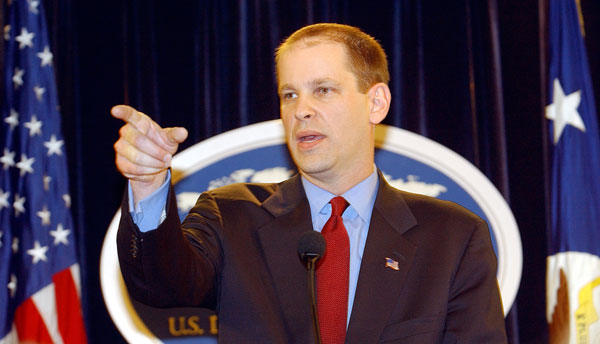
| Press Briefing by Scott McClellan, FULL STREAMING VIDEO, James S. Brady Briefing Room, 12:18 P.M. EST, MR. MCCLELLAN: Good afternoon, everyone, I don't have anything to begin with today. |
Q Let me ask you about that immigration. When he says he doesn't want to pit one group against another, what is he talking about?
MR. McCLELLAN: Well, I think what he was making was the point that this is an important debate, it's a serious debate, and he wanted to remind all of us in the country to elevate the discourse, to proceed forward in a civil and dignified manner. There are a lot of strong feelings on the issue of immigration reform, on all sides of the issue, and we should make sure that we proceed forward in a way where we don't ratchet up the rhetoric, that we don't let that rhetoric become too charged.
We've got an immigration system that is broken, it needs to be fixed. It starts with securing our borders. As the President made very clear earlier today, America is a country of laws and America is also a country of immigrants. And we need to continue to act to strengthen our borders and better secure our borders. That's what we are doing. That's why we've increased the number of Border Patrol agents; that's why we're using new technology to better detect people coming into this country for the wrong reasons. We also need to continue to enhance interior enforcement of our immigration laws.
And that's where it really starts, with those issues. But when you have an immigration system where there's an estimated -- and I stress "estimated" -- some 12 million undocumented illegal immigrants in the country, you have a problem and it needs to be fixed. And that causes great strain on the borders, as well, because our Border Patrol agents are having to go after people who are coming here simply for the reason of feeding their families back home and to fill jobs that Americans aren't filling.
So there's an economic need, and there's also the issue of how do we better secure our borders, and this fits into that. By having a guest worker program, temporary program, you're allowing our Border Patrol agents to focus where they should be on drug smugglers or criminals that are coming -- people that are coming here for the wrong reasons. So that's why the President emphasized his commitment to comprehensive immigration reform.
Q What rivalries, though, is he talking about -- about the groups against one another? I'm just trying to clear that up, that thought.
MR. McCLELLAN: Well, like I said, this is an issue that sometimes the rhetoric becomes heated and charged because of the strong feelings, and the President was just emphasizing that this is a very important issue. It's a top priority. It's been a priority for the President for a long time. And we need to look at all issues involved here in a comprehensive way and work together to move forward.
Q Does he support the Frist bill that is coming up next week, or the one that the Majority Leader wants to bring up?
MR. McCLELLAN: Well, the President is committed to comprehensive immigration reform. We've spelled out very clearly what our views are: We need to continue to take steps to secure our borders, we need to continue to improve interior enforcement, and we need to move forward on a temporary worker program. That's how you address this broken system and fix it in a comprehensive way.
Now, there's a lot of different ideas being expressed. We've been in close contact with leaders both in the House and the Senate, Democrats and Republicans, talking about how we can move forward. The House has moved forward on a bill. It didn't include the temporary worker program. The Senate is now discussing the issue. There are a lot of different ideas. There are a number of people that want to see a guest worker program put in there. And we'll continue to work with them going forward. But they know what our views are and our strong belief in comprehensive reform.
Q By what measure, or what indicators, is the President judging the success of the questions and answers he's been taking over the last several days concerning --
MR. McCLELLAN: I don't think he looks at it that way. I mean, he recognizes that one of his most important responsibilities as Commander-in-Chief is to keep the American people informed when we are at war. And that means playing the role as Educator-in-Chief, as he has talked about over the last few days. So it's important for the President to directly engage the American people and talk to them about our strategy for victory, and talk to them about why he is optimistic about how things are going.
Now, he's also realistic. He talked very clearly in the last few days, as he has over the course of time -- doesn't always necessarily get covered, but throughout the time period we've been in Iraq, he's talked about difficulties that remain, the challenges that remain.
This is a particularly difficult period. This is a tense period. This is a period when the terrorists are trying to do everything they can to derail the transition to democracy. Every step of the way, though, the Iraqi people have shown they are determined to live in freedom, most recently when more than 11 million people showed up at the polls. And now you have the Iraqi leaders, elected political leaders, under a constitutionally approved system, working to move forward on forming a unity government that represents all Iraqis. And that's important that they move forward as quickly as possible.
So the President is continuing to talk about where we are, and continuing to talk about how we've adapted and adjusted to circumstances on the ground to better address some of those circumstances and to change our tactics in order to meet the changing tactics of the enemy, as well. But he also believes it's important to talk about why victory is important in Iraq. And the more the American people can hear from him directly, the better. And so that's the purpose of these discussions.
Q How will he know if his attempt to be persuasive is working?
MR. McCLELLAN: Well, I think that you have to look at circumstances on the ground as they proceed forward. There's been a lot of real progress made. It's not something that always gets the most attention when you're covering events on the ground because you have the dramatic images of violence. And the terrorists know that those car bombings and attacks on innocent civilians will get a lot of attention. And it is newsworthy; it should get attention. The President talked about that over the last few days, as well.
But there's also real progress going on in spite of the violence. Slowly but surely we're seeing steady progress, and we are moving forward toward victory. And it's important that we continue to support our troops. I think the American people want our troops to succeed. And the President is going to continue emphasizing the stakes involved here. The stakes are very high in Iraq. It is a central front in the war on terrorism; it's important that we win because a free Iraq will help inspire reformers in the broader Middle East. It's a troubled region of the world and that ties directly to our own security.
This is about laying the foundations of peace for our children and grandchildren. And the President believes very strongly in what we are doing. I think the American people, in the forums he's participated in over the last few days, have the opportunity to better understand his thinking and better see the principles behind his decisions, the principles that guide his decisions, and why he believes so strongly in what we're doing, and why he's confident that we will succeed.
The terrorists' only weapon is to shake our will and break our resolve. But they cannot. We are determined to win. Our troops are doing a great job, they're making sacrifices, there's tough fighting ahead, there are going to be continued sacrifices ahead, but there's also real progress being made. And it goes directly to our own security here at home.
Q At what point did the President decide that during his watch there would be no major withdrawal from Iraq? And what did he --
MR. McCLELLAN: I don't think that's what he said.
Q What?
MR. McCLELLAN: I don't think that's what he said.
Q Well, he said, future Presidents will have --
MR. McCLELLAN: In fact, a couple of things. First of all, the President was asked a very specific question, when will there be zero or no troops in Iraq. So he was responding to that specific question. But we are already seeing a reduction in our troop levels. Our commanders on the ground -- the President has made it very clear repeatedly that our commanders on the ground will make the determinations about our troop levels, based on conditions. And General Casey, just the other day, talked about how we're in the process of coming down from around 138,000 to 130,000 or so, and he also talked about how he expected, as we move forward into 2006 and then into 2007, that we would continue to see a reduction in -- hang on -- in troop levels.
And now, he said that he would evaluate it based on conditions, and continue to do that. And that's what's important. The President is looking to his commanders, the people who are on the ground, to make those determinations. The other aspect of this is the reason why General Casey was saying he expects those troops to continue to come down, the reason why is because the training and equipping of Iraqi security forces is going well. They are showing that they can help provide for the defense and security of the Iraqi people. They are taking more of the lead in the fight, they're controlling more of the battle space. And so that's why it's so important that we continue to move forward on the training of the Iraqi army, as well as the Iraqi police, which is where a lot of effort is being focused these days, too.
Q Well, my point is at what point -- I mean, what has been the reaction? The headline was that we were going to stay there well into another presidency, possibly.
MR. McCLELLAN: I don't write the headlines, and I think it's wrong for any --
Q This is the impression the President left.
MR. McCLELLAN: No, no --
Q You say no?
MR. McCLELLAN: I disagree. There were some articles that put it in -- in some of the coverage -- that put it in the full context. If you look at exactly what he said and exactly what he was asked --
Q -- future presidencies and new Iraqi --
MR. McCLELLAN: That's what I'm getting to, Helen. It would be wrong to suggest that he was saying that there would still be a substantial number of troops in Iraq after he is out of office. That's not what he was asked. That's not what he was talking about. What he emphasized again was that troop levels will be based on the decisions of our commanders who will look at conditions on the ground.
Q I'm not talking about troop levels. I'm talking about American presence. And we certainly will have troops there, and he certainly indicated that well beyond his own presidency we'd be there.
MR. McCLELLAN: We're in Afghanistan -- we've been in Afghanistan since 2001. There's still troops there, but it's substantially down from where it was initially.
Q The political process has now dragged on for three months in Iraq. Should the President get more personally involved in trying to get a government there?
MR. McCLELLAN: Let me correct you a little bit, first of all. You say it's dragged on for three months. This is a new and emerging democracy. This is a country that has been under the brutal fist of a dictator for some three decades. So this is a country that is learning how to compromise, learning how to engage in politics through a democratic system, and really learning the habits of democracy. This is a new thing for the people of Iraq and so they're learning all those aspects.
Remember, way back, three, four months ago, we said that after the elections take place, that they will move forward on putting a government in place, and that there would be a lot of political debate, there would be a lot of back-and-forth -- we're seeing that go on. But we also said that it's going to require some patience and that it will take some time.
Now, I think in the aftermath of the sectarian strife that we've seen of recent weeks, the Iraqi leaders recognize the importance of coming together, setting aside their political differences, setting aside their religious or ethnic differences, and forming a government that represents all Iraqis. And they recognize the importance of moving forward as quickly as possible. That's what they're working to do. And we are continuing to urge them to move forward as quickly as possible, because as you move forward on the political process, it helps improve the security situation on the ground, as well.
Q Should the President get more personally involved in it?
MR. McCLELLAN: Well, our Ambassador has been very involved in supporting the efforts of the Iraqi political leaders and helping them to come together and discuss how to move forward as quickly as possible. And he's been -- he has expressed how he has been encouraged by the discussions that have been going on over the recent days. And the President has heard directly from him. And that's why you also hear the President here at home continue to urge that the political leaders in Iraq move forward as soon as they can to form that government.
Q But they're not operating under any specific deadline.
MR. McCLELLAN: Well, I think, though, it's important to recognize what they have said. They've talked about how they looked into the abyss and they didn't like what they saw in the aftermath of some of the attacks. And so they recognize the importance of coming together and working to move as quickly as possible to form a government of national unity. And that's what they are doing.
Q You were asked about the President's reaction to the Frist bill. If the Frist bill doesn't have anything about the guest worker program in it, why can't you say he doesn't like that bill, or can you tell me -- or is he moving away from the guest worker program?
MR. McCLELLAN: Well, I think there's some aspects in that -- in what he's proposing that are a good start. But the President, yes, believes that it ought to be comprehensive and that there should be a guest worker program, for one of the key reasons that I stated. One, you meet an economic need; these are jobs that Americans are not filling. And, two, it helps us better secure our borders because it lets our Border Patrol folks focus where they need to, on those who are coming here for the wrong reason. And it really shuts down the industry of illegal activity that is going on, when you have coyotes smuggling people into the country, treating people inhumanely and leaving them in the desert to walk in very hot -- more than 100-degree weather, and leaving them in the back of trucks. And so it helps shut down some of this illegal activity that's going on -- the forgery of documents and stuff, too. And that's why he believes that's an important aspect.
But our most important responsibility is to secure our borders. And that's why the President has acted and taken a number of steps to do so. Secretary Chertoff has talked about our Secure Border Initiative, how we've ramped up the number of Border Patrol agents, how we moved from a -- we are moving from a catch-and-release program to a catch-and-return program, meaning people that come here are not released within our country, but they're returned back to their country of origin.
And so it's important for the American people to know that our top priority and highest priority is enforcing our laws. But we are also a country that has always welcomed immigrants, and we need to be welcoming. And so the President is going to continue pushing for comprehensive reform. There are other senators that are talking about moving forward on legislation that includes comprehensive reform, so we're working with all those leaders on how to move forward.
Q Can I ask one more question?
MR. McCLELLAN: This is part of the legislative process, too. And the President is going to be talking more about this next week, as well.
Q But when the President first proposed this immigration overhaul, he focused on the guest worker program. He wasn't talking about border enforcement. He's changed a lot. Is that because of pressure from Republicans --
MR. McCLELLAN: No, I disagree. I think that he was focusing on all aspects. I'm not sure that all aspects were getting the kind of attention that maybe it should have. And that's probably, from a communication standpoint, probably our fault. We recognize the importance of talking about each aspect and talking about how they all work together to help fix our immigration system. We have a broken immigration system. That's what I talked about at the beginning.
And so the President recognized the importance of talking in greater detail about how we're working to secure our borders, because there are number of steps we've been taking, and he was talking about it, but I think more of the emphasis was being focused on the guest worker program. And some people were not hearing what we are doing to enforce our laws and strengthen our borders.
And if you look at the funding for border security, it's increased some 66 percent since 2001. Since 2001, border agents have apprehended and sent home more 5.9 million people coming into the country illegally. So the Secure Border Initiative is something that we have moved forward on, and he's going to continue to talk about how we need to build upon that, too. There's more we need to do.
Go ahead, Elaine.
Q Scott, in his remarks, the President said a debate over immigration reform needs to be civil. What kind of rhetoric was he cautioning against?
MR. McCLELLAN: Well, Terry brought that question up earlier. I don't know if you were in here at the time, but I talked about that.
Q Specifically, though --
MR. McCLELLAN: I don't think he was trying to --
Q Was there something that he heard --
MR. McCLELLAN: -- single anybody out. I think what he was trying to say is that he recognizes there are a lot of strong feelings on this issue, but that we need to find a way to move forward by working together, and that we need to do so in a civil way. This is a serious issue, and we are a country of laws and we're a country of immigrants, and we need to keep in mind the values that we believe strongly and the values that have been at the bedrock of this country.
Q Is he concerned that perhaps some of the debate might be taking on an anti-immigrant tone?
MR. McCLELLAN: I'll leave it to what he said, and like I said, he wasn't trying to single out any particular people. There are strong feelings on this issue. He's not suggesting that by any means. But he does recognize that sometimes people on each side of this issue, or on the more extreme sides of the issue, tend to get heated in the rhetoric sometimes, and he's just reminding people that we're all committed to securing our borders.
There's some different views when it comes to how we go about fixing the immigration system and moving forward on a guest worker program. The President spelled out very clearly that any guest worker program would not include amnesty. That's his position, that anybody involved in that guest worker program has to -- it's temporary, one; two, they have to get in line just like everybody else. They don't get to go up to the front of the line, they have to get at the back of the line just like anybody else, and that there should be no automatic path to citizenship. This is a temporary worker program to meet some of our economic needs, and also to show the compassion of America and address the issue of treating these people more humanely.
Q On Iraq, can I ask you about -- the President -- has he formed a view on whether or not it might be helpful to get other voices, other countries involved, to impress upon the Iraqis the importance of forming a unity government?
MR. McCLELLAN: Well, I think there are other countries involved. There are a number of countries that have been involved for some time. And I think everybody recognizes the importance of the Iraqi political leaders moving forward to form a government of national unity. But we also recognize that it's been a very short amount of time since the elections took place, and that this was going to take a little bit of time. Now, with the recent violence, it has only increased the sense of urgency for Iraqi leaders to continue moving forward as quickly as they can.
Q Can I just follow up quickly? Elaine said, was he not suggesting anti-immigrant tone. You said, no, he wasn't suggesting that at all. But really, isn't that code for what he was saying? He said this debate has to recognize our own history. The country's history is one of we're all immigrants. So what was he saying? Can we just get to who was he talking about?
MR. McCLELLAN: It's not just we're all immigrants, we're also a country of laws, and that those laws need to be enforced. So the President, again, I stress to you, was not trying to single any group out or single any people out. What he was saying is that this is an issue that is difficult to address; otherwise, we would have solved it a long time ago. Remember, there had been steps taken back in 1986 to address some of these issues. But we still have a system that is broken. We still have a problem with our borders. I think when you have a 3,000-mile border, you're going to -- and you have people from the southern part of our hemisphere wanting to come here to support their families back home, you're going to have some problems there and you need to address that.
But you also have people that are coming here and engaging in a lot of illegal activity. And they're taking advantage of that broken system, and the people who suffer are good people who are coming here for the right reason. And so the President was emphasizing that, look, we can all work together to secure our borders, and we also need to work together to fix this immigration system, but we should do so in a civil and dignified way. If he --
Q Wasn't his warning about don't bash immigrants?
MR. McCLELLAN: No, if he had wanted to single anybody out, I think he would have. That was not at all what he was saying. But sometimes, as you know, covering this issue, the rhetoric can get very charged.
Q Scott, I've seen studies that say we need PhDs from overseas for Silicon Valley, but I've also seen studies that say that the illegals coming across the border are taking jobs from Americans and they're depressing wages in industries like construction. So when you say that there's an economic need, who are you citing?
MR. McCLELLAN: Well, the President met with a very diverse group of people, people from the -- that represent the U.S. Chamber of Commerce, the Hispanic Chamber of Commerce, represent agricultural interests, people that -- religious leaders and faith-based leaders. So he had a diverse group of people he met with earlier today. You've got the list of the people that he met with, and you saw them when he spoke earlier.
But what he's referring to, in terms of a temporary worker program, is jobs that Americans are not filling. That's specifically what he was talking about earlier. These tend to be unskilled or lower-skilled jobs. And that's the economic need that needs to be met -- when there's a willing worker and a willing employer, trying to match those people together.
Q So you don't have a study, you're just citing anecdotal information from interest groups?
MR. McCLELLAN: No, this is actual facts. This is hearing directly from people on the ground. The President was governor of Texas; he knows firsthand the situation when it comes to our borders and people coming here to work and they're illegal. He knows firsthand this issue very well and it's been a top priority for him a long time. But I dispute your characterization, because you can go around the country and talk to people and they'll point out the need that is not being met here.
Q I've talked to contractors; they tell me that the wages in their industry are being depressed by illegal --
MR. McCLELLAN: Well, I would point out to you that we've got a very strong economy because of the policies that we've put in place. This is a growing economy. And there are a lot of high-paying, high-growth jobs that are becoming available. And so --
Q I don't dispute that --
MR. McCLELLAN: No, I know, but I think it's important, if you're going to bring up the economic aspect of this. What we're talking about -- I think we may be talking past each other a little bit here -- what the President is talking about is jobs that Americans are not filling, whether they're jobs in the agricultural sector, the hotel sector, or what have you. That's what the President is referring to.
Q Scott, the Democratic leadership has threatened to do everything possible to stop certain facets of the legislation moving through Congress, relative to immigration reform right now. Yesterday Senator Clinton suggested that she found it hard to understand how a Republican Party that prides itself on talking about values could support legislation that, in her estimation, would criminalize even the assistance of people in need who happen to be illegal. She said that it would essentially criminalize Samaritanism and would effectively make Jesus a criminal, to paraphrase what she said.
Is that the kind -- I mean, a couple questions related to that part of the debate here. Is the Republican Party in jeopardy of being seen as anti-immigrant, and might that be what the President is warning about with his cautions? And how can the administration navigate this multitude of proposals now and ensure that there is a border protection that does not send the message that Clinton is warning about?
MR. McCLELLAN: Well, first of all, the first part of your question. The President is talking about people on all sides of this issue, or both sides of this issue, and he's saying, let's move forward in a civil and dignified way. Let's work together to solve this problem that faces this country and address all aspects. So that's what the President is referring to.
Now, you're talking about the legislative process. There are different ideas that are out there. We have had a number of discussions with Democratic leaders and Republican leaders who are working to move forward on immigration reform. They are good discussions. We continue to have those discussions with them to find a way we can move forward. And it's also an election year, and we should put aside politics and work together to get this done for the American people. And that's another thing the President has been emphasizing.
Now, the second part of your question on -- what was it?
Q Is the President concerned that some of the intense advocacy of stricter border patrols run the risk of making the party appear anti-immigrant?
MR. McCLELLAN: Well, I think that you've seen the President express his views on this issue and emphasize that we are a nation of immigrants and we have been a welcoming country, going back to our founding. And the President believes we should continue to be a country that welcomes people who are coming here for the right reasons. And that's one of the aspects that ties into this comprehensive immigration reform.
You've got a lot of Republican leaders in Congress that are committed to moving forward on comprehensive immigration reform. And there's going to be a lot of back-and-forth on this issue. It is a difficult issue. But the President is committed to getting it done, and that's why he is continuing to raise the profile on this issue.
This is an area where I think a lot of people recognize the system is broken, it needs to be fixed. Now, there are a lot of different ideas about how to go about that. The President has spelled out very clearly what his views are. And we will continue to work with members who are committed to getting this done.
April.
Q Scott, tomorrow, Reverend Jessie Jackson, Bruce Gordon -- and Al Sharpton are holding a press conference basically saying the Justice Department blessed an illegal election, an illegal arrangement, saying that the Justice Department violated Section II in the Voting Rights Act, and Section V, basically that the voting rights extension next year means nothing without voting rights enforcement this year. And what are your thoughts as to his statement from Reverend Jessie Jackson, as this administration is for the extension --
MR. McCLELLAN: Well, by law, Congress made the Justice Department the agency to review these election issues. And the state of Louisiana came through -- came forward with a plan -- this was last week, we've talked about it before -- they presented a plan, and the Justice Department reviewed it and signed off on the plan that leaders in Louisiana came together to develop.
So I think if you have further questions about it, you ought to talk to the Department of Justice, because they looked at these issues to make sure concerns were being addressed and that the elections could proceed forward.
Q This department is under the auspices of this administration where the Justice Department's boss is the President of the United States, who has said that he wants to extend the Voting Rights Act, and not only that, he supports certain sections of it and he wants to tweak it to make it stronger. Now, how can that be -- it seems like it's a conflict within this administration when you have a President saying --
MR. McCLELLAN: No, the President strongly supports reauthorization of the Voting Rights Act, and the Justice Department is committed to the administration's position. This is a specific matter relating to Louisiana. There was a plan that Louisiana -- state of Louisiana brought forward for review by the Department of Justice, and they reviewed it and approved it.
Go ahead.
Q Scott, just to come back to reading the tea leaves on the President's statement, Senator Reid has threatened a filibuster of immigration legislation. Was he referring to that? Would that be something that would not be a civil --
MR. McCLELLAN: He was talking broadly about people on all sides of this issue.
Q Does he think that would uncivil to -- that that would not be civil way to --
MR. McCLELLAN: You're trying to get me to engage and point at specific people. What the President wants to do is get this done. It's an important priority. It's a priority that the American people care about. We've got to continue to do more to secure our borders. We've got to do a better job of enforcing our laws in the interior. And the President believes strongly that we need to have a temporary worker program as part of comprehensive immigration reform. And so he's reaching out to all those who want to get this done, and looking for solutions.
Q So he wasn't referring to anyone specifically then.
MR. McCLELLAN: That's right.
Q And just one last thing. Does he think some of the criticism has been racially motivated of his --
MR. McCLELLAN: This question came up earlier. I think I've addressed these issues.
Go ahead.
Q Well, my question was about immigration, but enough has been said already.
MR. McCLELLAN: There you go. Everybody hear that? (Laughter.)
Q Next question. Will the President continue his meetings with citizens around the country in support of his position on the war? If so, what's next?
MR. McCLELLAN: Well, we remain a nation at war. The President is Commander-in-Chief; he's going to continue to talk directly to the American people and update them on our strategy for victory and talk to them about why victory in Iraq is critical to our overall efforts to win the war on terrorism. The terrorists have made Iraq the central front in the war on terrorism, and they recognize how high the stakes are. We recognize how high the stakes are. And that's why it's critical that we prevail. And we will prevail, because the President has made it very clear the terrorists cannot shake our will or break our resolve. We are going to win. There's real progress being made on the ground, and there's also a lot of difficulties. And we've got to continue to adjust and adapt to the situation on the ground. And that's exactly what we will continue doing, and supporting our troops.
Go ahead.
Q Scott, Bradley Belt resigned or quit from the Pension Benefit Guaranty Corporation. Do you know why? Can you fill us in?
MR. McCLELLAN: No, I don't have any more on that. I mean, I'd be glad to take a look at it, but I imagine it's probably in his letter why he left.
Q Forgive me, I was thinking about what the President said yesterday about the Iraqi government not being formed yet, and listening to your answers to Steve -- I'm still not clear. Yesterday the President said it's time -- it's time these Iraqi politicians come together. Was he not telling us that he's --
MR. McCLELLAN: That's not the first time he's said that, Mark. He's been urging the Iraqi political leaders to move ahead as quickly as possible to form a government of national unity.
Q -- not satisfied with the rate at which they --
MR. McCLELLAN: No, I'm not saying that at all, either. He wants to continue to move as quickly as possible and get this done, but he also recognizes that there's a lot of compromise and back-and-forth that goes on in politics. This is a democratic system. And I think the leaders have expressed their commitment to coming together and setting aside differences and getting a government in place.
Q But Steve has used the words "dragging on," and you disagreed with him.
MR. McCLELLAN: No, I don't think -- yes, I did, because he said for three months it's been dragging on. Three, four months ago, we said this is going to take some time and it's going to require patience, because democracy is new to Iraq, after three decades of a brutal dictator and being repressed. The Iraqi people are still forming the habits of democracy, and they're learning how to compromise through politics rather than through violence. But, I mean, the President wasn't trying to set any timetable. He made that clear, I think, as well. He's saying it's time to get it done and move forward as quickly as possible.
Q Scott, what specific steps have been taken to date on Abdul Rahman in Afghanistan, the Christian?
MR. McCLELLAN: What steps have been taken?
Q Yes.
MR. McCLELLAN: Secretary Rice, earlier today, spoke with President Karzai. She made very clear what our views were in the strongest possible terms. And she stressed the importance of Afghanistan finding a favorable resolution to this matter. The President, yesterday, talked about how deeply troubled he is about this case. This case clearly violates the universal freedoms that democracies around the world hold dear, and we are watching it very closely. We are in very close contact with the government of Afghanistan.
Yesterday the Secretary spoke with the Foreign Minister; today she spoke with President Karzai. And we are going to stay in close contact with them and work with them to make sure that people's religious freedoms are protected. Not only does this violate universal freedoms of democracy, it also clearly violates the Afghan constitution, which, in it, talks about the right of individuals to worship freely. Freedom of worship, tolerance, freedom of expression are at the foundation of democracies.
Q Can you tell us what responses she got from Abdullah Abdullah --
MR. McCLELLAN: I don't have a full readout of her call. I think the State Department is briefing right at the same time I am, and they can probably provide you a little more detail.
Go ahead, Rick.
Q Scott, you're saying that the President's statement on the Iraqi politicians forming their government, that he had said before that patience would be needed because it would take time. Can we, though, read his statement yesterday very much as conveying a sense of frustration on how long it is taking, given the --
MR. McCLELLAN: Well, I think it conveys exactly what he said, that it's time for the government to come together and get this done. We want to see that happen as quickly as possible. That's what we've been emphasizing. That's why our Ambassador on the ground is working very closely with the political leaders in Iraq.
But what I'm doing -- when I referred back to how patience would be required, that was specifically relating to Steve's question, that the President said that months ago. And sometimes that gets lost as we move forward, or people tend to forget about what has been said. So I'm just putting that in perspective and putting it in a context.
Q -- mounting frustration within the administration at the amount of time --
MR. McCLELLAN: We want to see the Iraq leaders move forward as quickly as possible. They've said that they recognize the importance of moving as quickly as possible. That's why we're continuing to urge them to get it done.
Q Thank you, Scott. South Korean Foreign Minister, Mr. Ban, said today North Korea wants and will return to the six-party talks, that is certain. Has the United States any message from North Korea?
MR. McCLELLAN: I don't have any update. We know that they've said that a number of times before and nothing has happened. It's time for North Korea to come back to the talks. All parties are ready to move forward on the six-party talks. There were very clear principles that everybody agreed to at previous rounds of the talks. And we want to move forward in a substantive way based on those principles. And we've said we'll come back with no preconditions, and North Korea needs to come back with no preconditions so that we can move forward to resolve this issue.
Q Scott, you and the President both have said in the past that democracies in other countries, especially in the Middle East, may not have -- may not look like America's democracy. Is that what we're seeing in Afghanistan?
MR. McCLELLAN: Well, there are certain universal values that all democracies have. And the President has talked about that, as well. So I think you're confusing two issues. There are certain universal values that you see in any lasting democracy. And those are ones that I've talked about earlier: freedom of worship, freedom of expression, freedom of the people in this room, tolerance. Those are all universal values of freedom.
And we made it very clear that -- the President did yesterday -- about what our expectations are, that we fought and sacrificed in defense of freedom and to provide freedom to some 25 million people in Afghanistan. Great sacrifices have been made. And we have reminded the Afghan government of that.
Q Is it reasonable, though, for -- to expect that non-Muslims would be treated the same as Muslims in a government that's based on Islamic law?
MR. McCLELLAN: Well, I think you should look at the Afghan constitution. It was a constitution that was widely praised for how forward-looking it was and the values that are enshrined in that constitution. And it's important for the government of Afghanistan to reaffirm the bedrock principles in that constitution, one of which is freedom of religion.
Ken, and then David.
Q This morning, you welcomed the news of the release of the two Canadian and one British hostage in Iraq.
MR. McCLELLAN: Your question, I bet.
Q I am wondering what the administration, what the President thinks of people like these who go over there on missions they feel are important, but, perhaps predictably, become people who require the attention and energy and resources of our military. Do these people serve a legitimate purpose, or do they just get in the way? And would the President discourage Americans who feel these missions are important -- discourage them from going over there?
MR. McCLELLAN: No one's questioning their motives. We question the motives of the terrorists, the terrorists who recognize that kidnappings and car bombings and attacks on innocent civilians can generate a lot of coverage and a lot of attention. And that is designed to try to shake our will. That is designed to intimidate and spread fear and chaos.
Q I understand that, but what does the President --
MR. McCLELLAN: Let me back up. I think, first of all, on the hostages that were rescued, this was a coalition effort, including American forces. It is good news. We are pleased to see that they are safe and that they have been freed. And now there are American hostages that are still held, not only in Iraq, but elsewhere. Those hostages are a top priority for this administration, and they will remain a top priority until their safe return. We want to -- we continue to urge the safe return of all hostages wherever they are, and we continue to stay focused on all the American hostages.
Q What do you urge about Americans who might feel the need to go over there and pursue some mission they feel is important? Do they get in the way, or are they serving a purpose?
MR. McCLELLAN: Well, I don't know that I can make a broad characterization. That's a very broad statement, Ken. So I think if you want to break it down, that's one thing. But there are a lot of people that are providing humanitarian aid to the people of Iraq. The people of Iraq are very grateful for all the assistance that people from countries around the world are providing to help them move forward on building a peaceful and democratic future.
Q When these people start sapping resources from the military and from the effort over there, do they get in the way?
MR. McCLELLAN: I'm sorry? You say "these people" -- I don't know you're -- that's a very broad characterization and I don't want to engage in broad characterizations. I mean, I think there are a lot of people that go there for reasons they believe in.
Q Scott, earlier this week in here the President said that he understood the midterm election year jitters of some in his party. Will he have any reassurance as he hits the campaign coffer trail again tomorrow when he goes to Indiana and Pennsylvania for the party faithful?
MR. McCLELLAN: I want to try to avoid getting too far into the political cycle. We're focused on getting things done for the American people. We've got an agenda that we're pursuing, that builds upon the many accomplishments we have achieved over the last several months. And the President talked about a number of those in the press conference the other day. We've gotten a lot done for the American people. We just recently got the Patriot Act renewed. We've got important priorities that we need to build upon -- the President outlined those in the State of the Union. I'll save you from going back through them --
Q Is that what he's going to tell these people tomorrow?
MR. McCLELLAN: He's going to talk about the agenda that we have, the hopeful agenda that we have to continue to expand our prosperity here at home and continue to extend the peace abroad. So he absolutely will talk about the agenda. That's where his focus is.
Now, it's also an election year and the President is glad to go around the country and help the Republican Party and help individual candidates. And there are a lot of requests for him to do so, and, obviously, we have to prioritize. But there are many Republicans that are very appreciative of him coming in there and helping them raise the kind of resources they need to be able to wage an effective campaign. And I think if you look back, the President has been a great draw to those events.
Q Why is the Santorum event closed?
MR. McCLELLAN: I'm sorry?
Q Why aren't reporters allowed to cover the Santorum event?
MR. McCLELLAN: I don't know. It may be at a private residence. I'll have to check. I don't know the specifics of it, but if it's a private residence, that's the way it's always been.
Q Just to clarify an issue of context in Iraq. What is the specific frustration that the administration -- you, the President -- has with the broadcast coverage of the last couple of weeks?
MR. McCLELLAN: We don't. I don't think the President has suggested that. So I don't know specifically what comments you're referring to.
Q Well, I guess I'm referring to his news conference the other day when he talked about the images -- that the insurgents know that the images end up on TV shows. I mean, clearly, there's a frustration with the process.
MR. McCLELLAN: No, I think the President specifically said that, I'm not saying you should not cover this violence or cover the car bombings or things of that nature. And he said, do not take this as criticism. There are horrific images of violence that we see on our TV screens. Those are newsworthy items to cover, and we have made that clear repeatedly. But there is more to the situation on the ground, and if you're going to have a complete picture it's important to look at the progress that's being made.
There is real violence that is occurring and the situation remains tense. But there's also real progress that is being made toward victory. And I think the President was emphasizing the importance of taking into consideration what the enemy knows and looking at the motivation of the enemy. The enemy knows -- the terrorists, they know that when they carry out these kind of attacks, or car bombings, or kidnappings, or beheadings, that it's going to generate attention. And so as Commander-in-Chief it's important for the President to put it all in context and also to talk about the broader context and talk about the progress that's being made. That's one of his responsibilities.
And that's why he's going around the country talking to people and talking about why victory is important and reminding them that despite the violence, there is a lot of real progress being made, and that a free Iraq is going to help improve our security here for generations to come. A free Iraq will help change a troubled region of the world and inspire reformers throughout the Middle East who want to live in freedom.
And so the President is talking about it in that respect. The President is focused on victory. The Iraqi people have shown that they want to live in freedom and chart their own future. And it's important for the American people to hear about that progress that's being made.
But I've seen some of the coverage try to suggest that there was -- that we were blaming the media; far from it. The President specifically said -- and you heard again from him yesterday -- what the President is saying is that there is real progress in spite of the violence; look at the rest of the story. And that's part of his job, is to talk about the rest of the story and why it is so important.
So sometimes when I see these stories, it makes me think that the media doth protest too much.
Thank you.
END 1:00 P.M. EST
Technorati Tags: President Bush and White House or Iraq and immigration, or Immigration Reform and Speeches on war on terror, or Louisiana/Voting Rights Act, and Afghanistan/religious freedom, or war on terrorism and VIDEO or Hostage release and Media coverage of the war
Related: Keywords Press Briefing Scott McClellan, Sunday, March 19, 2006 Press Briefing Scott McClellan 03/17/06 (VIDEO), Friday, March 17, 2006 Press Briefing Scott McClellan 03/15/06 (VIDEO), Wednesday, March 15, 2006 Press Briefing Scott McClellan 03/13/06 (VIDEO), Friday, March 10, 2006 Press Briefing Scott McClellan 03/09/06 (VIDEO), Tuesday, March 07, 2006 Press Briefing Scott McClellan 03/07/06 (VIDEO), Tuesday, February 28, 2006 Press Briefing Scott McClellan 02/27/06 (VIDEO), Friday, February 17, 2006 Press Briefing Scott McClellan 02/16/06 (VIDEO), Friday, February 17, 2006 Press Briefing Scott McClellan 02/14/06 (VIDEO), Tuesday, February 14, 2006 Press Briefing Scott McClellan 02/13/06 (VIDEO), Thursday, January 19, 2006 Press Briefing Scott McClellan 01/18/06 (VIDEO), Friday, December 16, 2005Press Briefing, Scott McClellan, Levee Reconstruction (VIDEO), Tuesday, December 06, 2005 Press Briefing Scott McClellan (VIDEO) 12/06/05, Thursday, November 10, 2005 Press Briefing by Scott McClellan 11/09/05 (VIDEO, Wednesday, November 09, 2005 Press Briefing by Scott McClellan 11/08/05 , Wednesday, October 26, 2005 Press Briefing Scott McClellan and Zal Khalilzad (VIDEO), Monday, September 19, 2005 09/19/05 Scott McClellan (VIDEO),