Monday, March 27, 2006

President on Comprehensive Immigration Reform (VIDEO)

President Participates in Meeting on Comprehensive Immigration Reform, FULL STREAMING VIDEO, The Roosevelt Room In Focus: Immigration en Español, Declaraciones Del Presidente Después De Reunión Sobre La Reforma Inmigratoria., 10:37 A.M. EST

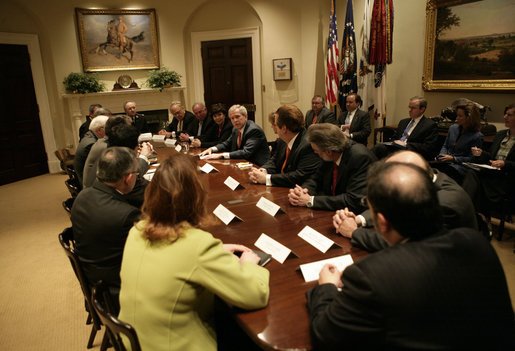
President George W. Bush speaks with participants in a meeting on immigration reform Thursday, March 23, 2006, in the Roosevelt Room of the White House. White House photo by Eric Draper.President George W. Bush speaks with participants in a meeting on immigration reform Thursday, March 23, 2006, in the Roosevelt Room of the White House. White House photo by Eric Draper.
THE PRESIDENT: I've just had a very constructive and important dialogue with members of the agricultural community, the faith community, the concerned citizen community about immigration. Ours is a nation of law and ours is a nation of immigrants, and we believe that we can have rational, important immigration policy that's based upon law and reflects our deep desire to be a compassionate and decent nation.

Our government must enforce our borders; we've got plans in place to do so. But part of enforcing our borders is to have a guest worker program that encourages people to register their presence so that we know who they are, and says to them, if you're doing a job an American won't do, you're welcome here for a period of time to do that job.

The immigration debate is a vital debate for our country. It's important that we have a serious debate, one that discusses the issues. But I urge members of Congress and I urge people who like to comment on this issue to make sure the rhetoric is in accord with our traditions. I look around the table and I recognize that we've got people from different backgrounds, different heritages. We all may have different family histories, but we all sit around this table as Americans.

And, therefore, when we conduct this debate it must be done in a civil way. It must be done in a way that brings dignity to the process. It must be done in a way that doesn't pit one group of people against another. It must be done in a way that recognizes our history. I think now is the time for the United States Congress to act to get an immigration plan that is comprehensive and rational and achieves important objectives.

So I want to welcome you all for being here. I want to thank you very much for your involvement in this vital issue. I've assured folks here at the table that I will continue to speak out on the issue. I feel passionately about the need for our country to conduct themselves with dignity and, at the same time, enforce our border and treat people here with respect.

Thank you all very much. (Applause.)

END 10:40 A.M. EST For Immediate Release, Office of the Press Secretary, March 23, 2006

Technorati Tags:
and or and , or and , or , and ,

Related: Keywords radio address, podcast, Saturday, March 18, 2006
Presidential Podcast 03/18/06, Saturday, March 11, 2006 bush radio address 03/11/06 full audio, text transcript, Saturday, March 04, 2006 bush radio address 03/04/06 full audio, text transcript, Saturday, February 25, 2006 bush radio address 02/25/06 full audio, text transcript, Saturday, February 18, 2006 bush radio address 02/18/06 full audio, text transcript, Saturday, February 04, 2006 bush radio address 02/04/06 full audio, text transcript, Saturday, January 28, 2006, bush radio address 01/28/06 full audio, text transcript, Saturday, January 21, 2006 bush radio address 01/21/06 full audio, text transcript, Saturday, January 14, 2006 bush radio address 01/14/06 full audio, text transcript, Saturday, January 07, 2006 bush radio address 01/07/06 full audio, text transcript, Saturday, December 31, 2005 bush radio address 12/31/05 full audio, text transcript, Saturday, December 24, 2005 bush radio address 12/24/05 full audio, text transcript, Saturday, December 17, 2005 bush radio address 12/17/05 full VIDEO, text transcript, Sunday, December 04, 2005 Presidential Podcast 12/03/05,

Declaraciones Del Presidente Después De Reunión Sobre La Reforma Inmigratoria

Declaraciones Del Presidente Después De Reunión Sobre La Reforma Inmigratoria, El Cuarto De Roosevelt, 10:37 A.M. EST

Presidente George W. Bush habla con los participantes en una reunión sobre la reforma jueves, de marcha la 23 de 2006 de la inmigración, en el cuarto de Roosevelt de la casa blanca. Foto blanca de la casa de Eric Draper.Presidente George W. Bush habla con los participantes en una reunión sobre la reforma jueves, de marcha la 23 de 2006 de la inmigración, en el cuarto de Roosevelt de la casa blanca. Foto blanca de la casa de Eric Draper.
EL PRESIDENTE: Acabo de tener un diálogo muy constructivo e importante acerca de la inmigración con miembros de la comunidad agrícola, la comunidad religiosa, la comunidad de ciudadanos interesados. La nuestra es una nación de derecho y la nuestra es una nación de inmigrantes, y creemos que tenemos una política inmigratoria racional, importante, que se basa en la ley y refleja nuestro profundo deseo de ser una nación compasiva y decente.

Nuestro gobierno debe hacer que se respeten nuestras fronteras; tenemos en vigor planes para hacerlo. Pero parte de velar porque se respeten nuestras fronteras es tener un programa de trabajadores invitados que anime a la gente a hacer constar su presencia para que sepamos quiénes son y que les diga, si están haciendo un trabajo que un estadounidense no quiere hacer, están bienvenidos aquí por un periodo para hacer ese trabajo.

El debate sobre la inmigración es un debate vital para nuestro país. Es importante que tengamos un debate serio, uno que aborda los problemas. Pero insto a los miembros del Congreso e insto a la gente a la que le gusta comentar sobre este asunto a que se asegure de que la retórica esté de acuerdo con nuestras tradiciones. Miro alrededor de la mesa y reconozco que tenemos a gente de diferentes orígenes, diferentes ascendencias. Todos tenemos diferentes antecedentes familiares, pero todos nos sentamos alrededor de esta mesa como estadounidenses.

Y, por lo tanto, cuando realicemos este debate, debe hacerse de una manera cortés. Debe hacerse de una manera que aporte dignidad al proceso. Debe hacerse de una manera que no enfrente a un grupo de gente contra otro. Debe hacerse de manera que reconozca nuestra historia. Creo que éste es el momento de que el Congreso de los Estados Unidos tome medidas para lograr un plan inmigratorio que sea global y racional, y logre objetivos importantes.

Entonces, deseo darles la bienvenida a todos por estar aquí. Deseo darles muchísimas gracias por su participación en este asunto vital. Les he asegurado a las personas sentadas alrededor de la mesa que continuar pronunciándome sobre el tema. Creo fervientemente en la necesidad de que nuestro país actúe con dignidad y, a la vez, vele por nuestra frontera y trate a la gente aquí con respeto.

Muchísimas gracias a todos. (Aplausos.)

EXTREMO 10:40 A.M. EST, para el lanzamiento inmediato, oficina de la secretaria de prensa , 23 de marzo de 2006

Relacionado: Dirección de radio de las palabras claves, podcast, sábado, de marcha la 18 de 2006
Discurso Radial del Presidente a la Nación 03/18/06, Sábado, De Marcha La 25 De 2006 Discurso Radial del Presidente a la Nación 03/25/06,

Etiquetas De Technorati:
, and , or , and , or ,

Sunday, March 26, 2006

Too much or too little sleep increases diabetes risk

Men who sleep too much or too little are at an increased risk of developing Type 2 diabetes, according to a study by the New England Research Institutes in collaboration with Yale School of Medicine researchers.

The data published in the March issue of Diabetes Care were obtained from 1,709 men, 40 to 70 years old. The men were enrolled in the Massachusetts Male Aging Study and were followed for 15 years with home visits, a health questionnaire and blood samples.

Six to eight hours of sleep was found to be most healthy. In contrast, men who reported they slept between five and six hours per night were twice as likely to develop diabetes and men who slept more than eight hours per night were three times as likely to develop diabetes, according to the lead author, H. Klar Yaggi, M.D., professor in Yale's Department of Internal Medicine, pulmonary section. Previous data from the Nurses Health Study have shown similar results in women.

"These elevated risks remained after adjustment for age, hypertension, smoking status, self-rated health status and education," Yaggi said.

He said researchers are just beginning to recognize the hormonal and metabolic implications of too little sleep. Among the documented effects, Yaggi said, are striking alterations in metabolic and endocrine function including decreased carbohydrate tolerance, insulin resistance, and lower levels of the hormone leptin leading to obesity. The mechanisms by which long sleep duration increase diabetes risk requires further investigation.

"There is a lot of interest in determining whether sleep disturbances such as a reduced amount of sleep or disorders like sleep apnea may actually worsen the metabolic syndrome," said Yaggi. Metabolic syndrome is a cluster of risk factors including high blood pressure, obesity, high cholesterol and insulin resistance which increase the risk for heart disease and stroke. ###

Co-authors include Andre Araujo and John McKinlay. The research was supported in part by the National Institute on Aging, the National Institute of Diabetes and Digestive and Kidney Disorders, the Yale Mentored Clinical Research Scholars Program from the National Center for Research Resources, and a career development award from the Veterans Affairs Health Services and Research and Development Service.

Diabetes Care 29: 657-661 (March 2006), Public release date: 24-Mar-2006, Contact: Jacqueline Weaver
jacqueline.weaver@yale.edu 203-432-8555 Yale University

Technorati Tags:
or and or and or or and or and or and or

RELATED: Keyword biology. Sunday, March 19, 2006
Brain-scanning technology reveals how we process brands and products, Sunday, March 12, 2006 'John Henryism' Health Outcomes in African Americans, Sunday, December 18, 2005 Conditions for slavery, Sunday, December 25, 2005 Why Christmas trees are not extinct, Sunday, January 01, 2006 prostaglandins choreograph perturbations, Sunday, January 01, 2006 Cultural differences may explain variations in home remedy use, Sunday, January 08, 2006 Risky Sexual Behaviors in Miami, and Racial Influences on Children’s Care, Sunday, January 22, 2006 Twenty-seven previously unknown species discovered, Sunday, February 12, 2006 Hormone linked to good hearing as we age, Sunday, February 12, 2006 Anti-HIV drug has potential to prevent transmission in women, Sunday, February 12, 2006 Parental Conflict Produces More Than Fleeting Distress for Children, Sunday, February 12, 2006 Facial characteristics indicative of personality traits, say experts, Sunday, February 19, 2006 There's something fishy about human brain evolution, Sunday, February 19, 2006 Marine mammals are on the frontline of failing ocean health,

'Custom' nanoparticles, cancer diagnosis and treatment

'Custom' nanoparticles could improve cancer diagnosis and treatment

ATLANTA, March 26 — Researchers have developed "custom" nanoparticles that show promise of providing a more targeted and effective delivery of anticancer drugs than conventional medications or any of the earlier attempts to fight cancer with nanoparticles. Designed at the molecular level to attack specific types of cancer without affecting healthy cells, the nanoparticles also have the potential to reduce side effects associated with chemotherapy, the researchers say. Their study was described today at the 231st national meeting of the American Chemical Society, the world’s largest scientific society.

The particles, considered the next generation of cancer therapeutics, are the most uniform, shape-specific drug delivery particles developed to date, according to researchers at the University of North Carolina (UNC) in Chapel Hill. Other potential benefits of the tiny uniform particles include enhanced imaging of cancer cells for improved diagnosis and use as delivery vehicles for gene therapy agents, they say.

To date, the UNC researchers have produced a variety of custom nanoparticles from biocompatible organic materials using techniques they adapted from processes used by the electronics industry to make transistors. In cell studies, they have shown that the uniform nanoparticles can attach to specific cell targets, release important chemotherapy drugs inside cells, and hold MRI contrast agents. Animal studies began recently and human studies are anticipated, the researchers say.

"I think this will transform the way one detects and treats disease," says study leader Joseph DeSimone, Ph.D., a chemistry professor at UNC and director of the school’s Institute for Advanced Materials, Nanoscience and Technology. He has co-founded a company, Liquidia Technologies, to develop and produce the nanoparticles.

Researchers have been experimenting with nanoparticles as drug delivery vehicles for years but have had only limited success in cell and animal studies, DeSimone says. Each carrier has drawbacks with regard to stability in the bloodstream or ability to be directed toward a specific cancer site. In addition, there has been no general method available that allows precise control of the particle’s size, shape and composition, which are considered key features for the success of targeted drug delivery, he says.

Now, DeSimone and his associates at UNC have developed a new fabrication technique that allows, for the first time, unprecedented control over the structure and function of drug delivery nanoparticles. Called PRINT (Particle Replication In Non-wetting Templates), the technique is similar to injection molding and uses principles borrowed from the electronics industry for transistor fabrication, they say. The technique was first detailed last June in the online version of the Journal of the American Chemical Society.

The manufacturing process starts with a silicon wafer that is etched with the shape and size of the desired nanoparticle, resulting in a template. Next, nonstick liquid fluoropolymers are poured into the template and cured to form a fixed mold. The finished mold is then injected with organic materials that can contain imaging agents, anticancer drugs, DNA (for gene therapy) and other materials, depending on the intended function, DeSimone says. The new manufacturing technique uses gentler processing methods that are less likely to harm important organic components than traditional nanoparticle manufacturing techniques, he adds.

The resulting nanoparticles can be as small as 20 nanometers, or thousands of times smaller than the width of a single human hair. The shapes of the particles can also be made to mimic the shapes of objects found in nature like red blood cells or virus particles, DeSimone says. ###

Funding for the current study is provided by the National Science Foundation and the National Institutes of Health.

The American Chemical Society — the world’s largest scientific society — is a nonprofit organization chartered by the U.S. Congress and a global leader in providing access to chemistry-related research through its multiple databases, peer-reviewed journals and scientific conferences. Its main offices are in Washington, D.C., and Columbus, Ohio.

The paper on this research, COLL 9, will be presented at 11:35 a.m., Sunday, March 26, OMNI at CNN Center, International Ballroom E, during the symposium "Biomolecular and Polymeric Nanostructures and Interfaces: Fabrication, Characterization, Function, and Applications."

Joseph M DeSimone, Ph.D., is the William R. Kenan, Jr., Distinguished Professor of Chemistry and Chemical Engineering at the University of North Carolina, Chapel Hill.

Public release date: 26-Mar-2006, Contact: Michael Bernstein
m_bernstein@acs.org 202-872-4400 American Chemical Society

Technorati Tags:
or and or and or and or and or and or and or

Related: Keyword Nanotech Sunday, March 26, 2006,
Green nanochemistry, American Chemical Society symposium, Sunday, March 19, 2006 nanotechnologists demonstrate artificial muscles powered by highly energetic fuels, Sunday, Sunday, March 12, 2006 magnetic phenomenon may improve RAM memories, February 26, 2006 Nanoscience study shows that quantum dots 'talk', Sunday, February 26, 2006 Nano-bots to undertake major tasks?, Sunday, February 19, 2006 Nanotech to improve health care delivery, Sunday, February 19, 2006 nano-canary in the nanotoxicology coalmine, Sunday, December 04, 2005 Nano-cages 'fill up' with hydrogen, Sunday, November 13, 2005 Testing toxicity of nanomaterials, Sunday, October 23, 2005 single-molecule car, 'Nanocar', Sunday, August 28, 2005 Writing at the nanoscale, Thursday, May 26, 2005 discontinuous palladium, siloxane self-assembled monolayer, Sunday, May 08, 2005 Center for Nanoscale Materials, Monday, April 25, 2005 Nanomagnets, Nanocomposite, Monday, March 21, 2005 porphyrin tubes may lead to new nanodevices, inexpensive hydrogen fuel

Green nanochemistry, American Chemical Society symposium

Green nanochemistry featured at American Chemical Society symposium, March 26-29 (Public release date: 26-Mar-2006)

PLEASE NOTE: The papers in this tipsheet are presented on different days and times but are all embargoed for the date/time shown above.

ATLANTA, March 26 — Using principles of green chemistry, scientists are designing materials and processes that provide the maximum benefits of nanotechnology while minimizing potential hazards. Green nanochemistry will be featured during a four-day symposium, "Nanotechnology and the Environment," March 26-29, at the 231st national meeting of the American Chemical Society, the world’s largest scientific society. The symposium also will address applications of nanotechnology in medicine, electronics and energy. All presentations in this symposium take place at the Georgia World Congress Center. Selected topics are described below.

Sunday, March 26

EPA scientist addresses “state of the science” of environmental nanotechnology —Barbara Karn, Ph.D., an environmental scientist with the U.S. Environmental Protection Agency’s National Center for Environmental Research, will provide an overview of the current “state of the science” of environmental nanotechnology, including greener processes and new applications of green nanotechnology. She currently is on detail as a Visiting Scientist to The Project on Emerging Nanotechnologies at the Woodrow Wilson International Center for Scholars in Washington, D.C. (Iamp;EC 17, Sunday, March 26, 9:30 a.m., Room B313A)

“Twelve Principles of Green Chemistry” — Paul T. Anastas, Ph.D., director of the ACS Green Chemistry Institute, will discuss how to use the Twelve Principles of Green Chemistry to design the next generation of nanomaterials and the transformations necessary to make them. The principles, which include the prevention of waste and the design and use of safer chemicals, are key to achieving genuine sustainability for the simultaneous benefit of the environment, economy and society, he says. (I&EC 20, Sunday, March 26, 11:45 a.m., Room B313A)

Monday March 27

Surface chemistry called key to designing non-toxic nanomaterials — Surface chemistry, not size and shape, appears to be the key feature governing the biological activity of nanoparticles, says Vicki Colvin, Ph.D., director of the Center for Biological and Environmental Nanotechnology at Rice University in Houston. This finding is being used to guide the development of greener nanomaterials that are less likely to pose health and environmental risks, she says. (I&EC 182, Monday, March 27, 8:35 a.m., Room B313A)

New water-soluble carbon nanotubes could lead to improved electronics, medicine — Researchers at the New Jersey Institute of Technology (NJIT) in Newark say they have developed a simple, quick method — using microwave energy — for developing highly water-soluble carbon nanotubes. Because the new nanotubes are up to 125 times more water soluble than other carbon nanotubes, they also are more functional for a wider variety of potential applications, including thin films, composites, faster computer chips and improved drug delivery, according to study leader Somenath Mitra, Ph.D., a professor at NJIT. (I&EC 183, Monday, March 27, 9:00 a.m., Room B313A)

Tuesday, March 28

Nanomaterials shine spotlight on cheaper, more efficient solar cells — A. Paul Alivisatos, Ph.D., co-editor of the ACS journal Nano Letters and a chemist at the University of California, Berkeley, will discuss recent efforts to develop improved solar cells using nanomaterials, which could lead to greener, cheaper and more efficient ways to generate electricity. (I&EC 228, Tuesday, March 28, 9:00 a.m., Room B313A)

Fuel cells may get efficiency boost with nanomaterials - Joseph M. DeSimone, Ph.D., a chemist at the University of North Carolina in Chapel Hill, is developing new proton exchange membranes patterned at the nanoscale that could lead to better, more efficient fuel cells. The development also may allow methanol to be used directly as a fuel source instead of hydrogen, he says. (I&EC 233, Tuesday, March 28, 11:05 a.m., Room B313A)

Wednesday, March 29

Nanosphere sensors used to detect hazardous materials — Researchers at Oklahoma State University in Stillwater have developed polymer nanospheres that can be used to detect hazardous materials in aquatic environments near parts per billion levels. The sensors, which change their shape and optical properties depending on the chemical that is present, can be read by optical spectroscopic techniques to identify the chemical, the researchers say. (I&EC 285, Wednesday, March 29, 1:35 p.m., Room B313B) ###

The American Chemical Society — the world’s largest scientific society — is a nonprofit organization chartered by the U.S. Congress and a global leader in providing access to chemistry-related research through its multiple databases, peer-reviewed journals and scientific conferences. Its main offices are in Washington, D.C., and Columbus, Ohio.

Contact: Michael Bernstein
m_bernstein@acs.org 202-872-4400 American Chemical Society

Technorati Tags:
or and or and or and or and or and or and or

Related: Keyword Nanotech Sunday, March 19, 2006
nanotechnologists demonstrate artificial muscles powered by highly energetic fuels, Sunday, Sunday, March 12, 2006 magnetic phenomenon may improve RAM memories, February 26, 2006 Nanoscience study shows that quantum dots 'talk', Sunday, February 26, 2006 Nano-bots to undertake major tasks?, Sunday, February 19, 2006 Nanotech to improve health care delivery, Sunday, February 19, 2006 nano-canary in the nanotoxicology coalmine, Sunday, December 04, 2005 Nano-cages 'fill up' with hydrogen, Sunday, November 13, 2005 Testing toxicity of nanomaterials, Sunday, October 23, 2005 single-molecule car, 'Nanocar', Sunday, August 28, 2005 Writing at the nanoscale, Thursday, May 26, 2005 discontinuous palladium, siloxane self-assembled monolayer, Sunday, May 08, 2005 Center for Nanoscale Materials, Monday, April 25, 2005 Nanomagnets, Nanocomposite, Monday, March 21, 2005 porphyrin tubes may lead to new nanodevices, inexpensive hydrogen fuel

Saturday, March 25, 2006

Freedom Calendar 03/25/06 - 04/01/06

March 25, 1864, Death of U.S. Rep. Owen Lovejoy (R-IL), abolitionist and co-founder of Republican Party in Illinois.

March 26, 1910, President Taft appoints Republican William Lewis as first African-American U.S. Asst. Attorney General.

Easter Sunday, March 27, 1856, First meeting of Republican National Committee in Washington, DC to oppose Democrats’ pro-slavery policies.

March 28, 1870, Republican Jonathan Wright of South Carolina becomes first African-American state Supreme Court Justice.

March 29, 1885, Birth of U.S. Rep. Frances Payne Bolton (R-OH), first woman to serve as U.S. Delegate to United Nations General Assembly.

March 30, 1868, Republicans begin impeachment trial of Democrat President Andrew Johnson, who declared: 'This is a country for white men, and by God, as long as I am President, it shall be a government of white men'.

March 31, 1806, Birth of U.S. Senator John Hale (R-NH), early leader of Republicans’ anti-slavery movement in Congress.

April 1, 1846, Born into slavery on this day, Jeremiah Haralson (R-AL) served in state legislature before being elected to U.S. House in 1874.

"Discrimination against the negro race in this country is unjust, is unworthy of a high-minded people whose example should have a salutary influence in the world.”

Rep. Joseph Rainey (R-SC), the first African-American in the U.S. House of Representatives (1870-79)

SOURCE:
Republican Freedom Calendar

Technorati Tags:
and or and or and or and or and or or and or

Related: Keywords Freedom Calendar, Saturday, March 18, 2006
Freedom Calendar 03/18/06 - 03/25/06, Saturday, March 11, 2006 Freedom Calendar 03/11/06 - 03/18/06, Saturday, March 04, 2006 Freedom Calendar 03/04/06 - 03/11/06, Saturday, February 25, 2006 Freedom Calendar 02/18/06 - 03/04/06, Saturday, February 18, 2006 Freedom Calendar 02/18/06 - 02/25/06, Saturday, February 11, 2006 Freedom Calendar 02/11/06 - 02/18/06, Saturday, February 04, 2006 Freedom Calendar 02/04/06 - 02/11/06, Saturday, January 28, 2006 Freedom Calendar 01/28/06 - 02/04/06, Saturday, January 21, 2006 Freedom Calendar 01/21/06 - 01/28/06, Saturday, January 14, 2006 Freedom Calendar 01/14/06 - 01/21/06, Saturday, January 07, 2006 Freedom Calendar 01/07/06 - 01/14/06, Saturday, December 31, 2005 Freedom Calendar 12/31/05 - 01/07/06, Saturday, December 24, 2005 Freedom Calendar 12/24/05 - 12/31/05, Saturday, December 17, 2005 Freedom Calendar 12/17/05 - 12/24/05, Saturday, December 10, 2005 Freedom Calendar 12/10/05 - 12/17/05, December 03, 2005 Freedom Calendar 12/03/05 - 12/10/05, Saturday, November 26, 2005 Freedom Calendar 11/26/05 - 12/03/05,

Presidential Podcast 03/25/06

Presidential Podcast 03/25/06 en Español

Subscribe to My Odeo Channel Subscribe to Our Odeo Podcast Channel and receive the Presidential Radio Address each week. Featuring real audio and full text transcript

Technorati Tags: and or and , or and , or , and ,

Related: Keywords radio address, podcast, Saturday, March 18, 2006
Presidential Podcast 03/18/06, Saturday, March 11, 2006 bush radio address 03/11/06 full audio, text transcript, Saturday, March 04, 2006 bush radio address 03/04/06 full audio, text transcript, Saturday, February 25, 2006 bush radio address 02/25/06 full audio, text transcript, Saturday, February 18, 2006 bush radio address 02/18/06 full audio, text transcript, Saturday, February 04, 2006 bush radio address 02/04/06 full audio, text transcript, Saturday, January 28, 2006, bush radio address 01/28/06 full audio, text transcript, Saturday, January 21, 2006 bush radio address 01/21/06 full audio, text transcript, Saturday, January 14, 2006 bush radio address 01/14/06 full audio, text transcript, Saturday, January 07, 2006 bush radio address 01/07/06 full audio, text transcript, Saturday, December 31, 2005 bush radio address 12/31/05 full audio, text transcript, Saturday, December 24, 2005 bush radio address 12/24/05 full audio, text transcript, Saturday, December 17, 2005 bush radio address 12/17/05 full VIDEO, text transcript, Sunday, December 04, 2005 Presidential Podcast 12/03/05,

bush radio address 03/25/06 full audio, text transcript

President George W. Bush calls troops from his ranch in Crawford, Texas, Thanksgiving Day, Thursday, Nov. 24, 2005. White House photo by Eric Draper.bush radio address 03/25/06 full audio, text transcript PODCAST

President's Radio Address en Español
In Focus: Immigration
THE PRESIDENT: Good morning. On Monday, I will attend a naturalization ceremony here in Washington. It's always inspiring to watch a group of immigrants raise their hands and swear an oath to become citizens of the United States of America. These men and women follow in the footsteps of millions who've come to our shores seeking liberty and opportunity, and America is better off for their hard work and love of freedom.

America is a nation of immigrants, and we're also a nation of laws. And our immigration laws are in need of reform. So at Monday's ceremony, I will discuss my vision for comprehensive immigration reform that will secure our borders, improve enforcement of our immigration laws, and uphold our values.

Comprehensive immigration reform begins with securing our borders. Since I took office, we've increased funding for border security by 66 percent, and the Department of Homeland Security has caught and sent home nearly 6 million illegal immigrants. To improve security at the border, we're hiring thousands more Border Patrol agents. We're deploying new technology, like infrared cameras and unmanned aerial vehicles, to help our agents do their job. And we're installing physical barriers to entry, like fences in urban areas.

We're also working to end the unwise practice of catch-and-release. For decades, many illegal immigrants were released back into society soon after they were caught, because we did not have enough detention space. So we're adding more beds so we can hold the people we catch, and we're reducing the time it takes to send them back home. When illegal immigrants know they will be caught and sent home, they will be less likely to break the rules, and our immigration system will be more orderly and secure. We're making good progress, but we have much more work ahead, and we will not be satisfied until we have control of our border.

Comprehensive immigration reform also includes strengthening the enforcement of our laws in America's interior. Since I took office, we've increased funding for immigration enforcement by 42 percent. We're increasing the number of immigration enforcement agents and criminal investigators, enhancing work site enforcement, and going after smugglers and gang members and human traffickers.

Finally, comprehensive immigration reform requires a temporary worker program that will relieve pressure on our borders. This program would create a legal way to match willing foreign workers with willing American employers to fill jobs that Americans will not do. By reducing the number of people trying to sneak across the border, we would free up our law enforcement officers to focus on criminals and drug dealers and terrorists and others who mean us harm.

One thing the temporary worker program would not do is provide amnesty to those who are in our country illegally. I believe that granting amnesty would be unfair, because it would allow those who break the law to jump ahead of people who play by the rules and wait in the citizenship line. Amnesty would also be unwise, because it would encourage waves of illegal immigration, increase pressure on the border, and make it more difficult for law enforcement to focus on those who mean us harm. For the sake of justice and for the sake of border security, I firmly oppose amnesty.

In the coming days, the United States Senate plans to consider proposals on immigration reform. This is an emotional debate. America does not have to choose between being a welcoming society and being a lawful society. We can be both at the same time. As we debate the immigration issue, we must remember there are hard-working individuals, doing jobs that Americans will not do, who are contributing to the economic vitality of our country.

To keep the promise of America, we must enforce the laws of America. We must also ensure that immigrants assimilate into our society and learn our customs and values -- including the English language. By working together, we can meet our duty to fix our immigration system and deliver a bill that protects our country, upholds our laws, and makes our Nation proud.

Thank you for listening.

END, For Immediate Release, Office of the Press Secretary, March 25, 2006

Technorati Tags:
and or and , or and , or , and ,

Related: Keywords radio address, podcast, Saturday, March 18, 2006
bush radio address 03/18/06 full audio, text transcript, Saturday, March 11, 2006 bush radio address 03/11/06 full audio, text transcript, Saturday, March 04, 2006 bush radio address 03/04/06 full audio, text transcript, Saturday, February 25, 2006 bush radio address 02/25/06 full audio, text transcript, Saturday, February 18, 2006 bush radio address 02/18/06 full audio, text transcript, Saturday, February 04, 2006 bush radio address 02/04/06 full audio, text transcript, Saturday, January 28, 2006, bush radio address 01/28/06 full audio, text transcript, Saturday, January 21, 2006 bush radio address 01/21/06 full audio, text transcript, Saturday, January 14, 2006 bush radio address 01/14/06 full audio, text transcript, Saturday, January 07, 2006 bush radio address 01/07/06 full audio, text transcript, Saturday, December 31, 2005 bush radio address 12/31/05 full audio, text transcript, Saturday, December 24, 2005 bush radio address 12/24/05 full audio, text transcript, Saturday, December 17, 2005 bush radio address 12/17/05 full VIDEO, text transcript, Sunday, December 04, 2005 Presidential Podcast 12/03/05, Saturday, December 03, 2005

Discurso Radial del Presidente a la Nación 03/25/06

Presidente George W. Bush llama a tropas de su rancho en Crawford, Tejas, día de Thanksgiving, jueves, de noviembre el 24 de 2005.  Foto blanca de la casa de Eric Draper.forre el audio de la dirección de radio 03/25/06 por completo, transcripción del texto PODCAST

Discurso Radial del Presidente en Español
En Foco: Inmigración
EL PRESIDENTE: Buenos Días. El próximo lunes asistiré a una ceremonia de naturalización aquí en Washington. Siempre es motivo de inspiración ver a un grupo de inmigrantes alzar sus manos y tomar un juramento para ser ciudadanos de los Estados Unidos de América. Estos hombres y mujeres siguen en los pasos de millones que han venido a nuestras orillas en busca de la libertad y de la oportunidad, y Estados Unidos está mejor como resultado de su dura labor y de su amor por la libertad.

Estados Unidos es un país de inmigrantes - y también somos una nación de leyes. Y nuestras leyes de inmigración necesitan ser reformadas. Por lo tanto, en la ceremonia del lunes, hablaré de mi visión por una reforma migratoria integral que asegure nuestras fronteras... que mejore el cumplimiento de nuestras leyes de inmigración... y que mantenga nuestros valores.

La reforma migratoria integral comienza con la seguridad de nuestras fronteras. Desde que asumí la presidencia, hemos aumentado los fondos destinados a la seguridad fronteriza en un 66 por ciento, y el Departamento de Seguridad Nacional ha capturado y enviado a sus casas a cerca de seis millones de inmigrantes ilegales. Para mejorar la seguridad en la frontera, estamos contratando a miles de agentes más para la Patrulla Fronteriza. Estamos usando nueva tecnología como ser cámaras infrarrojas y vehículos aéreos sin tripulación para ayudar a nuestros agentes a desempeñar su trabajo. Y estamos instalando barreras físicas a la entrada, tales como cercas en zonas urbanas.

También estamos buscando terminar con la práctica errada de "capturar y liberar". Durante décadas, muchos inmigrantes ilegales eran liberados de vuelta a la sociedad poco después de ser capturados, ya que teníamos poco lugar para detenerlos. De modo que estamos añadiendo más camas para poder retener a las personas que capturamos, y estamos reduciendo el tiempo necesario para enviarlos de regreso a sus casas. Cuando los inmigrantes ilegales saben que serán capturados y devueltos a sus casas, será menos probable que violen las reglas - y nuestro sistema de inmigración será más ordenado y seguro. Estamos logrando buen progreso - pero tenemos todavía mucho trabajo por delante, y no estaremos satisfechos hasta tener control completo de nuestra frontera.

Una reforma migratoria integral también incluye fortalecer el cumplimiento de nuestras leyes en el interior de Estados Unidos. Desde que asumí la presidencia, hemos aumentado los fondos para cumplimiento migratorio en un 42 por ciento. Estamos aumentando el número de agentes de cumplimiento migratorio y de investigadores criminales... mejorando el cumplimiento en el lugar de trabajo... y persiguiendo a contrabandistas, miembros de pandillas y traficantes humanos.

Finalmente, la reforma migratoria integral requiere un programa de trabajadores huéspedes que aliviará la presión en nuestras fronteras. Este programa crearía una manera legal de juntar a trabajadores extranjeros que quieran trabajar con empleadores Estadounidenses que quieran llenar empleos que estadounidenses no quieran desempeñar. Al reducir el número de personas que traten de pasarse la frontera, podríamos liberar a nuestras autoridades judiciales y policiales para que se dediquen a criminales, narcotraficantes, terroristas, y otros que nos quieran hacer daño.

Una cosa que el programa de trabajadores huéspedes no haría es dar amnistía a aquellos que están en nuestro país ilegalmente. Yo creo que conceder amnistía sería injusto, ya que permitiría a los que violan la ley a pasar por delante de personas que cumplen con los reglamentos y se ponen en fila para hacerse ciudadano. La amnistía también sería insensata ya que alentaría a olas de inmigración ilegal, aumentaría la presión en la frontera y haría más difícil que autoridades judiciales y policiales se puedan dedicar a aquellas personas que nos quieren hacer daño. Por el bien de la justicia y de la seguridad fronteriza, yo me opongo firmemente a la amnistía.

En los próximos días, el Senado de Estados Unidos piensa considerar propuestas sobre la reforma migratoria. Este es un debate emocional - y debemos conducir el debate en una manera que sea propia de la historia y las tradiciones de Estados Unidos. Estados Unidos no tiene que escoger entre ser una sociedad acogedora o ser una sociedad legítima. Podemos ser ambas cosas a la vez. A medida que debatimos el tema de la inmigración, debemos recordar que hay personas que trabajan duro desempeñando los empleos que estadounidenses no quieren hacer, que están contribuyendo a la vitalidad económica de nuestro país.

Para mantener la promesa de Estados Unidos, debemos hacer cumplir las leyes de Estados Unidos. También debemos asegurarnos que nuestros inmigrantes se asimilen en nuestra sociedad, y aprendan nuestras costumbres y nuestros valores - incluyendo el idioma inglés. Trabajando juntos, podemos cumplir con nuestro deber de arreglar el sistema de inmigración - y proporcionar un proyecto de ley que proteja a nuestro país, haga respetar nuestras leyes, y haga que nuestra Nación sea orgullosa.

Gracias por escuchar.

# # # Para su publicación inmediata, Oficina del Secretario de Prensa, 25 de marzo de 2006


Relacionado: Dirección de radio de las palabras claves, podcast, sábado, de marcha la 18 de 2006 Discurso Radial del Presidente a la Nación 03/18/06,

Etiquetas De Technorati:
, and ,

Friday, March 24, 2006

President Signs Bill to Strengthen Trade with Ukraine (VIDEO)

President Signs Bill to Strengthen Trade Between U.S. and Ukraine, FULL STREAMING VIDEO, Room 350, Dwight D. Eisenhower Executive Office Building In Focus: International Trade, 11:01 A.M. EST

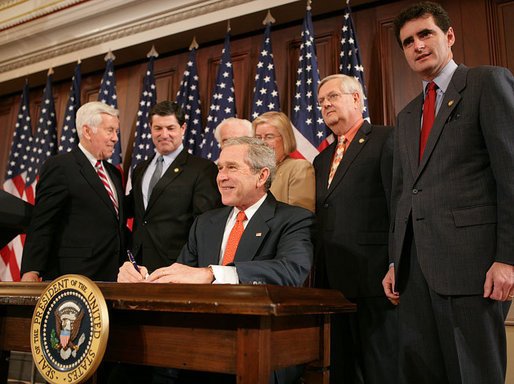
President George W. Bush is joined by members of Congress as he signs H.R. 1053, to authorize the Extension of Nondiscriminatory Treatment to the Products of Ukraine, Thursday, March 23, 2006, in the Eisenhower Executive Office Building in Washington. President Bush is joined by, from left to right, U.S. Sen. Richard Lugar, R- Ind.; U.S. Rep. Jim Gerlach, R-Pa.; U.S. Rep. Tom Lantos, D-Calif.; U.S. Rep. Candice Miller, R-Mich; U.S. Rep. Curt Weldon, R-Pa., and U.S. Rep. Mike Fitzpatrick, R-Pa. White House photo by Kimberlee Hewitt.President George W. Bush is joined by members of Congress as he signs H.R. 1053, to authorize the Extension of Nondiscriminatory Treatment to the Products of Ukraine, Thursday, March 23, 2006, in the Eisenhower Executive Office Building in Washington.
President Bush is joined by, from left to right, U.S. Sen. Richard Lugar, R- Ind.; U.S. Rep. Jim Gerlach, R-Pa.; U.S. Rep. Tom Lantos, D-Calif.; U.S. Rep. Candice Miller, R-Mich; U.S. Rep. Curt Weldon, R-Pa., and U.S. Rep. Mike Fitzpatrick, R-Pa. White House photo by Kimberlee Hewitt.

THE PRESIDENT: Thank you. Pleased be seated. (Applause.) Ambassador, good to see you. Please be seated. Welcome. Appreciate you all coming. In a few minutes I'm going to sign a bill that authorizes permanent normal trade relations between the United States and Ukraine. It's a good bill, and it's going to strengthen our ties with our friend, Ukraine. It's going to create new opportunities, economic opportunities, for both our countries.

I really want to thank the Chairman of the Senate Foreign Relations Committee, a man who knows what he's talking about when it comes to the world, and that's Chairman Lugar from Indiana. Thank you for coming, sir. (Applause.) I thank the bill sponsor, Congressman Jim Gerlach, and his wife Karen is here today. Thank you for coming, Mr. Congressman. Congressman Tom Lantos is with us. He's the Ranking Member of the House International Relations Committee. Congressman Curt Weldon, a cosponsor of the bill, is with us. Congresswoman Candice Miller from Michigan, a cosponsor, is with us, as well as a cosponsor, Congressman Mike Fitzpatrick. Thank you all for being here. (Applause.)

I welcome you all here. I especially welcome the Ambassador from Ukraine, Ambassador Shamshur. Welcome, Mr. Ambassador. Appreciate you coming. (Applause.) This is the third time we've been together in the last 30 days. (Laughter.) I'm better for it. (Laughter.)

The bill I sign today marks the beginning of a new era in our history with Ukraine. During the Cold War, Congress passed the Jackson-Vanik Amendment as a response to widespread communist deprivation of human rights. The law made American trade with communist nations contingent on those countries' respect for the rights of their own people. At the time, the law served an important purpose -- it helped to encourage freedom and the protection of fundamental rights, and penalized nations that denied liberty to their citizens. Times have changed. The Cold War is over, and a free Ukraine is a friend to America and an inspiration to those who love liberty.

The Orange Revolution was a powerful example of democracy for people around the world. The brave citizens who gathered in Kiev's Independence Square demanded the chance to determine their nation's future, and when they got that chance, they chose freedom. In the past two years, Ukraine has held free elections, and the people of Ukraine and its President, Viktor Yushchenko, are deeply committed to democratic reform. On Sunday, the Ukrainian people will again have the chance to cast a ballot in parliamentary elections, and they have a chance to continue to shape their own future.

Ukraine is also working to expand its market economy and produce measurable improvements in the lives of the Ukranian people. America supports these efforts, and this bill is an important step. By eliminating barriers to trade between the United States and Ukraine, the bill will help Ukraine grow in prosperity. As we've seen over the past 50 years, trade has the power to create new wealth for whole nations and new opportunities for people around the world. By expanding trade with Ukraine, this bill will open new markets for American products and help Ukrainians continue to build a free economy that will raise the standard of living for families across their land.

As Ukraine embraces democracy and more open trade, our nation's friendship will grow. President Yushchenko has made reforms to increase transparency and provide intellectual property protection and strengthen the enforcement of the rule of law.

These reforms have taken great conviction. And earlier this month, our two nations signed a bilateral agreement that will establish the terms of trade between our nations when Ukraine joins the World Trade Organization. We support Ukraine's goal of joining the WTO, and we will help resolve the remaining steps required for entry as quickly as possible. As the Ukrainian government continues to build on a record of progress at home, we will help Ukraine joins the institutions that unite free nations and become a part of Europe that is whole, free, and at peace.

The growth of economic freedom and ownership in countries like Ukraine reinforces the habits of liberty and democracy, and gives citizens a stake in the success of their nation. Ukranian people have shown the world they are committed to the ideals of economic freedom and democratic progress and open trade, and that gives them a promising future.

The United States is proud to call Ukraine a friend, and I'm honored to sign this important piece of legislation into law. (Applause.)

(The bill is signed.)

END 11:07 A.M. EST, For Immediate Release, Office of the Press Secretary, March 23, 2006

Technorati Tags:
and or and or and or and or

RELATED: Keyword, Ukraine Tuesday, November 23, 2004
Statement on Ukrainian Elections, Tuesday, November 23, 2004 Ukraine elections Elizabeth Jones Yuriy Ushakov, Thursday, November 25, 2004 Colin Powell Briefing Ukraine full video text, Friday, December 03, 2004 Ukraine Elections Richard Boucher, Saturday, December 04, 2004 Georgia, Ukraine, Uzbekistan, Azerbaijan, and Moldova,