Sunday, April 02, 2006

Quantum dot method rapidly identifies bacteria
Quantum dot method rapidly identifies bacteria

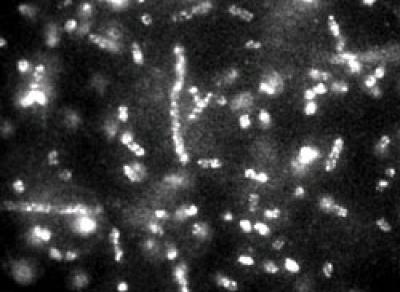
This fluorescence micrograph shows phage-quantum dot complexes (bright spots) bound to E. coli cells (cylindrical shapes). The NCI/NIST method of tagging cells with quantum dots can be used to identify bacteria much faster than conventional methods. The fluorescence signal is strong and stable for hours, enabling scientists to count the number of phage viruses bound to a cell. Credit: NCI/NIST, Usage Restrictions: None.This fluorescence micrograph shows phage-quantum dot complexes (bright spots) bound to E. coli cells (cylindrical shapes). The NCI/NIST method of tagging cells with quantum dots can be used to identify bacteria much faster than conventional methods.
The fluorescence signal is strong and stable for hours, enabling scientists to count the number of phage viruses bound to a cell. Credit: NCI/NIST, Usage Restrictions: None

A rapid method for detecting and identifying very small numbers of diverse bacteria, from anthrax to E. coli, has been developed by scientists from the National Cancer Institute (NCI) and National Institute of Standards and Technology (NIST). Described in the March 28 issue of Proceedings of the National Academy of Sciences,* the work could lead to the development of handheld devices for accelerated identification of biological weapons and antibiotic-resistant or virulent strains of bacteria--situations where speed is essential.

Traditional ways of identifying infectious bacteria and their possible treatments can be time consuming and laborious, requiring the isolation and growth of the bacteria over many hours or even days. The new method speeds up the process by using fast-replicating viruses (called bacteriophages or phages) that infect specific bacteria of interest and are genetically engineered to bind to "quantum dots." Quantum dots are nanoscale semiconductor particles that give off stronger and more intense signals than conventional fluorescent tags and also are more stable when exposed to light. The method detects and identifies 10, or fewer, target bacterial cells per milliliter of sample in only about an hour.

The phages were genetically engineered to produce a specific protein on their surface. When these phages infect bacteria and reproduce, the bacteria burst and release many phage progeny attached to biotin (vitamin H), which is present in all living cells. The biotin-capped phages selectively attract specially treated quantum dots, which absorb light efficiently over a wide frequency range and re-emit it in a single color that depends on particle size. The resulting phage-quantum dot complexes can be detected and counted using microscopy, spectroscopy or flow cytometry, and the results used to identify the bacteria. The new method could be extended to identify multiple bacterial strains simultaneously by pairing different phages with quantum dots that have different emission colors.

The new method is more sensitive than conventional optical methods. It can count how many viruses are infecting a single bacteria cell and how many quantum dots are attached to a single virus. A provisional patent application was filed originally through NIST, and a non-provisional patent application was filed more recently through the National Institutes of Health, the parent agency of NCI. The NIST contributions to the work include experimental design and fluorescence imaging. Other authors are from NCI, NIH, SAIC-Frederick Inc. and the National Cancer Institute at Frederick. ###

The work was funded by NIH, NCI, NIST, and the Center for Cancer Research.

* R. Edgar, M. McKinstry, J. Hwang, A.B. Oppenheim, R.A. Fekete, G. Giulian, C. Merril, K. Nagashima and S. Adhya. 2006. High sensitivity bacterial detection using biotin-tagged phage and quantum-dot nanocomplexes. Proceedings of the National Academy of Sciences. March 28.

Contact: Laura Ost
laura.ost@nist.gov 301-975-4034 National Institute of Standards and Technology (NIST)

Technorati Tags:
or and or and or and or and or and or and or

Related: Keyword Nanotech Sunday, March 26, 2006
'Custom' nanoparticles, cancer diagnosis and treatment, Sunday, March 26, 2006, Green nanochemistry, American Chemical Society symposium, Sunday, March 19, 2006 nanotechnologists demonstrate artificial muscles powered by highly energetic fuels, Sunday, Sunday, March 12, 2006 magnetic phenomenon may improve RAM memories, February 26, 2006 Nanoscience study shows that quantum dots 'talk', Sunday, February 26, 2006 Nano-bots to undertake major tasks?, Sunday, February 19, 2006 Nanotech to improve health care delivery, Sunday, February 19, 2006 nano-canary in the nanotoxicology coalmine, Sunday, December 04, 2005 Nano-cages 'fill up' with hydrogen, Sunday, November 13, 2005 Testing toxicity of nanomaterials, Sunday, October 23, 2005 single-molecule car, 'Nanocar', Sunday, August 28, 2005 Writing at the nanoscale, Thursday, May 26, 2005 discontinuous palladium, siloxane self-assembled monolayer, Sunday, May 08, 2005 Center for Nanoscale Materials, Monday, April 25, 2005 Nanomagnets, Nanocomposite, Monday, March 21, 2005 porphyrin tubes may lead to new nanodevices, inexpensive hydrogen fuel

CELLULAR DRUG DELIVERY, with Mesoporous nanospheres

CELLULAR DRUG DELIVERY FROM THE INSIDE OUT, Mesoporous nanospheres focus of Ames Laboratory research

AMES, IA – Delivering a dose of chemotherapy drugs to specific cancer cells without the risk of side affects to healthy cells may one day be possible thanks to a nanoscale drug delivery system being explored by researchers at the U.S. Department of Energy’s Ames Laboratory.

Using tiny silica particles call mesoporous nanospheres to carry drugs inside living cells, Ames Laboratory chemist Victor Lin is studying different methods to control whether or not the particle delivers its pharmaceutical payload.

“First, the nanospheres are only about 200 nanometers in diameter, roughly the size of a virus, so they won’t trigger an immune response in the body,” Lin said. “They’re also biocompatible so they can be readily absorbed by the cells.”

But it’s the structure of the nanospheres that makes drug delivery possible. The spheres have thousands of parallel channels running completely through them. Through capillary action, the spheres can soak up molecules of the drug to be delivered. When the channels are filled, the ends of channels are “capped” to safely seal the drug inside. Once the caps are in place, the nanospheres are “washed” to remove the drug from the outer surface.

The type of material used for the end caps, how they’re held in place, and how they’re released is the focus of Lin’s work. The caps can be dendrimers, biodegradable polymers, genes, proteins, metallic nanoparticles, or semiconductor nanocrystals – also known as quantum dots – and are held in place by chemical bonds. Once the nanospheres are inside the target cells, a trigger is used to pop the caps off and release the drug.

“We’re looking at two levels of control,” Lin said of the trigger mechanism. “One level is to have the cell control the release and the other would be to control the release externally.”

Lin explained that the chemical bond holding the cap in place can be engineered to be unphased by chemicals present in normal cells. However, in cancer cells these chemicals, such as antioxidants, appear in much higher concentrations and would break the bonds on the caps and release the drugs. In this way, only cancer cells could be targeted with powerful chemotherapy drugs such as Taxol or doxorubicin, while the nanospheres inside the normal cells would remain capped and therefore not cause unwanted side affects by damaging healthy cells.

To achieve external control, Lin is using iron-oxide nanoparticle caps which can be manipulated by a magnetic field. In a simple demonstration of the principle, Lin holds a refrigerator magnet up to a liquid-filled glass vial containing human cervical cancer cells grown in vitro that contain nanospheres capped with iron-oxide particles. The cells slowly migrate and cluster to the side of the vial next to the magnet.

“By using a powerful magnet, we can first concentrate the nanospheres at a particular point, such as a tumor site, and then use the magnetic field to remove the caps and release the drug,” Lin said. “The advantage of using a magnetic trigger as opposed to a ultraviolet light trigger is that there’s no limit to the depth of tissue we are able to probe … think of an MRI.”

Beyond the possibilities for intercellular drug delivery, the nanospheres may provide the key to studying what takes place within a cell. Currently, scientists have difficulty introducing chemicals or genes into cells without either damaging the cell or causing a chain-reaction of events that can’t be tracked.

“With current gene therapy, it’s possible to switch genes on and off, but you don’t really know if you are affecting other parts and processes of the cell as well,” Lin said. “You may be able to get a plant cell to produce a certain desired product, but the yield may drop significantly.”

By using externally controlled nanospheres, Lin explains that it may be possible to sequentially release genes, chemical markers and other materials within cells in order to track what happens and what specific changes take place. This phase of Lin’s research ties into a larger plant metabolomics project at Ames Laboratory.

Lin is also studying use of mesoporous nanoparticles for delivering catalysts in chemical reactions and as a possible mechanism for storing hydrogen fuel for hydrogen-powered vehicles. The drug delivery portion of the work is funded by a grant from the National Science Foundation. The catalyst and hydrogen storage research is supported by the Department of Energy’s Office of Basic Energy Sciences, which is also funding the metabolomics project through its Chemical Sciences, Geosciences and Biosciences Division.

Ames Laboratory is operated for the Department of Energy by Iowa State University. The Lab conducts research into various areas of national concern, including energy resources, high-speed computer design, environmental cleanup and restoration, and the synthesis and study of new materials. ###

Contacts:
Victor Lin, Chemical and Biological Sciences, 515-294-3135 Kerry Gibson, Public Affairs, 515-294-1405

NEWS RELEASE Office of Public Affairs 111 TASF Ames, IA 50011-3020
external.ameslab.gov

Technorati Tags:
or and or and or and or and or and or and or

Related: Keyword Nanotech Sunday, March 26, 2006
'Custom' nanoparticles, cancer diagnosis and treatment, Sunday, March 26, 2006, Green nanochemistry, American Chemical Society symposium, Sunday, March 19, 2006 nanotechnologists demonstrate artificial muscles powered by highly energetic fuels, Sunday, Sunday, March 12, 2006 magnetic phenomenon may improve RAM memories, February 26, 2006 Nanoscience study shows that quantum dots 'talk', Sunday, February 26, 2006 Nano-bots to undertake major tasks?, Sunday, February 19, 2006 Nanotech to improve health care delivery, Sunday, February 19, 2006 nano-canary in the nanotoxicology coalmine, Sunday, December 04, 2005 Nano-cages 'fill up' with hydrogen, Sunday, November 13, 2005 Testing toxicity of nanomaterials, Sunday, October 23, 2005 single-molecule car, 'Nanocar', Sunday, August 28, 2005 Writing at the nanoscale, Thursday, May 26, 2005 discontinuous palladium, siloxane self-assembled monolayer, Sunday, May 08, 2005 Center for Nanoscale Materials, Monday, April 25, 2005 Nanomagnets, Nanocomposite, Monday, March 21, 2005 porphyrin tubes may lead to new nanodevices, inexpensive hydrogen fuel

Saturday, April 01, 2006

Freedom Calendar 04/01/06 - 04/08/06

April 1, 1846, Born into slavery on this day, Jeremiah Haralson (R-AL) served in state legislature before being elected to U.S. House in 1874.

April 2, 1855, Republican John Langston becomes nation’s first African-American elected official, in Brownhelm, OH; later served as U.S. Rep. (R-VA) and as diplomat in Republican administrations.

April 3, 1944, U.S. Supreme Court strikes down Texas Democratic Party’s “whites only” primary election system.

April 4, 1887, Republican Susanna Salter of Argonia, KS is first woman elected mayor in nation.

April 5, 1839, Birth of African-American U.S. Rep. Robert Smalls (R-SC), who escaped slavery by commandeering a Confederate gunboat.

April 6, 1869, Republican Ebenezer Bassett is first African-American presidential appointment, as President Ulysses Grant’s Minister to Haiti.

April 7, 1862, President Lincoln concludes treaty with Britain for suppression of slave trade.

April 8, 1865, 13th Amendment banning slavery passed by U.S. Senate with 100% Republican support, 63% Democrat opposition.

“I believe the time will come when the sense of justice of this nation, when the enlightenment of this century, when the wisdom of our legislators, when the good feeling of the whole people will complete this grand work by lifting up out of degradation a race of men which has served long and faithfully by placing it, so far as the laws are concerned, upon an equal footing with all other classes. I have faith in this country.”

Rep. Joseph Rainey (R-SC), the first African-American in the U.S. House of Representatives (1870-79)

SOURCE:
Republican Freedom Calendar

Technorati Tags:
and or and or and or and or and or or and or

Related: Keywords Freedom Calendar, Saturday, March 25, 2006
Freedom Calendar 03/25/06 - 04/01/06, Saturday, March 18, 2006 Freedom Calendar 03/18/06 - 03/25/06, Saturday, March 11, 2006 Freedom Calendar 03/11/06 - 03/18/06, Saturday, March 04, 2006 Freedom Calendar 03/04/06 - 03/11/06, Saturday, February 25, 2006 Freedom Calendar 02/18/06 - 03/04/06, Saturday, February 18, 2006 Freedom Calendar 02/18/06 - 02/25/06, Saturday, February 11, 2006 Freedom Calendar 02/11/06 - 02/18/06, Saturday, February 04, 2006 Freedom Calendar 02/04/06 - 02/11/06, Saturday, January 28, 2006 Freedom Calendar 01/28/06 - 02/04/06, Saturday, January 21, 2006 Freedom Calendar 01/21/06 - 01/28/06, Saturday, January 14, 2006 Freedom Calendar 01/14/06 - 01/21/06, Saturday, January 07, 2006 Freedom Calendar 01/07/06 - 01/14/06, Saturday, December 31, 2005 Freedom Calendar 12/31/05 - 01/07/06, Saturday, December 24, 2005 Freedom Calendar 12/24/05 - 12/31/05, Saturday, December 17, 2005 Freedom Calendar 12/17/05 - 12/24/05, Saturday, December 10, 2005 Freedom Calendar 12/10/05 - 12/17/05,

Presidential Podcast 04/01/06

Presidential Podcast 04/01/06 en Español

Subscribe to My Odeo Channel Subscribe to Our Odeo Podcast Channel and receive the Presidential Radio Address each week. Featuring real audio and full text transcript

Technorati Tags: and or and , or and , or , and ,

Related: Keywords radio address, podcast, Saturday, March 18, 2006
Presidential Podcast 03/18/06, Saturday, March 11, 2006 bush radio address 03/11/06 full audio, text transcript, Saturday, March 04, 2006 bush radio address 03/04/06 full audio, text transcript, Saturday, February 25, 2006 bush radio address 02/25/06 full audio, text transcript, Saturday, February 18, 2006 bush radio address 02/18/06 full audio, text transcript, Saturday, February 04, 2006 bush radio address 02/04/06 full audio, text transcript, Saturday, January 28, 2006, bush radio address 01/28/06 full audio, text transcript, Saturday, January 21, 2006 bush radio address 01/21/06 full audio, text transcript, Saturday, January 14, 2006 bush radio address 01/14/06 full audio, text transcript, Saturday, January 07, 2006 bush radio address 01/07/06 full audio, text transcript, Saturday, December 31, 2005 bush radio address 12/31/05 full audio, text transcript, Saturday, December 24, 2005 bush radio address 12/24/05 full audio, text transcript, Saturday, December 17, 2005 bush radio address 12/17/05 full VIDEO, text transcript,

bush radio address 04/01/06 full audio, text transcript

President George W. Bush calls troops from his ranch in Crawford, Texas, Thanksgiving Day, Thursday, Nov. 24, 2005. White House photo by Eric Draper.bush radio address 04/01/06 full audio, text transcript PODCAST

President's Radio Address en Español
THE PRESIDENT: Good morning. As tax day approaches later this month, many American families are now finishing their tax returns. And as you do, an important debate is taking place in Washington that will affect the amount you will pay in the years ahead.

I believe our economy grows when you're allowed to keep more of your hard-earned money and make your own decisions about how to save, spend, and invest. So, working with Congress, we've provided tax relief for all Americans who pay income taxes. We lowered tax rates to let workers keep more of their paychecks. We doubled the child tax credit and reduced the marriage penalty, and we put the death tax on the road to extinction. We also cut taxes on dividends and capital gains and expanded incentives for small businesses to invest so they could grow and create new jobs.

Since 2001, the tax relief we delivered has left $880 billion in the hands of American workers, and small businesses, and families like yours, and you used that money to help produce more than four years of uninterrupted economic growth. Last year, our economy grew at a healthy 3.5 percent, faster than any other major industrialized nation.

One politician in Washington said in 2003 that our tax cuts were "ruining our economy and costing us jobs." The truth is that since August 2003, America has added almost 5 million new jobs. Our unemployment rate is now 4.8 percent -- lower than the average of the 1970s, 1980s, and 1990s. Real after-tax income is up 8 percent per person since the beginning of 2001. More Americans now own their own homes than at any time in our history, and minority homeownership is at record levels. Consumer confidence is at its highest level in nearly four years. Productivity has grown strongly over the past five years, and our small business sector is thriving.

The evidence is overwhelming: The opponents of tax cuts were wrong. Tax relief has helped to create jobs and opportunities for American families, and it's helped our economy grow. By maintaining our pro-growth economic policies and practicing spending restraint in Washington, we can keep our economy growing and stay on track to meet our goal of cutting the budget deficit in half by 2009.

The problem is that the tax relief we passed is set to expire over the next few years. Some Democrats in Washington are insisting that we let that happen -- or even repeal the tax cuts now. In either case, that would weaken our economy and would leave American families with a big tax hike that they do not expect and will not welcome. Because America needs more than a temporary economic expansion, we need more than temporary tax relief. To keep our economy growing, to keep our businesses investing, and to keep creating jobs, we need to ensure that you keep more of what you earn -- so Congress needs to make the tax relief permanent.

Making tax relief permanent includes extending the tax cuts on dividends and capital gains. These tax cuts have been vital to our economic growth. By lowering the cost of capital, this tax relief has given businesses an incentive to invest and expand, and that has helped create jobs and opportunity. I urge the Congress to extend these pro-growth tax cuts, so our businesses can plan with confidence and keep creating jobs for American workers.

The debate in Congress over taxes ultimately comes down to this: Who knows best how to use your money -- the politicians in Washington or you? I believe the money we spend in Washington is your money, not the government's money. I trust you to make the best decisions about what to do with your hard-earned dollars, because when you do, your family is better off, our economy grows, and prosperity and opportunity spread throughout our great land.

Thank you for listening.

END For Immediate Release, April 1, 2006

Technorati Tags:
and or and , or and , or , and ,

Related: Keywords radio address, podcast, Saturday, March 25, 2006
bush radio address 03/25/06 full audio, text transcript, Saturday, March 18, 2006 bush radio address 03/18/06 full audio, text transcript, Saturday, March 11, 2006 bush radio address 03/11/06 full audio, text transcript, Saturday, March 04, 2006 bush radio address 03/04/06 full audio, text transcript, Saturday, February 25, 2006 bush radio address 02/25/06 full audio, text transcript, Saturday, February 18, 2006 bush radio address 02/18/06 full audio, text transcript, Saturday, February 04, 2006 bush radio address 02/04/06 full audio, text transcript, Saturday, January 28, 2006, bush radio address 01/28/06 full audio, text transcript, Saturday, January 21, 2006 bush radio address 01/21/06 full audio, text transcript, Saturday, January 14, 2006 bush radio address 01/14/06 full audio, text transcript, Saturday, January 07, 2006 bush radio address 01/07/06 full audio, text transcript, Saturday, December 31, 2005 bush radio address 12/31/05 full audio, text transcript, Saturday, December 24, 2005 bush radio address 12/24/05 full audio, text transcript, Saturday, December 17, 2005 bush radio address 12/17/05 full VIDEO, text transcript,

Discurso Radial del Presidente a la Nación 04/01/06

Presidente George W. Bush llama a tropas de su rancho en Crawford, Tejas, día de Thanksgiving, jueves, de noviembre el 24 de 2005.  Foto blanca de la casa de Eric Draper.forre el audio de la dirección de radio 03/25/06 por completo, transcripción del texto PODCAST

Discurso Radial del Presidente en Español
En Foco: Inmigración
EL PRESIDENTE: Buenos Días. Al acercarse el día de los impuestos más adelante este mes, muchas familias estadounidenses están ahora terminando sus declaraciones de impuestos. Y mientras ustedes lo hacen, se está llevando a cabo un debate importante en Washington que afectará la cantidad que usted pagará en los años venideros.

Yo creo que nuestra economía crece cuando a usted se le permite quedarse con más de su dinero ganado con mucho esfuerzo y tomar sus propias decisiones sobre cómo ahorrar, gastar e invertir. De modo que, colaborando con el Congreso, proporcionamos alivio tributario a todos los estadounidenses que pagan impuestos sobre sus ingresos. Rebajamos las tasas de los impuestos para que los trabajadores puedan quedarse con una mayor parte de sus cheques de pago. doblamos el crédito tributario por hijo(a) menor y redujimos la penalidad por matrimonio. y pusimos al impuesto por defunción en el camino a la extinción. También rebajamos los impuestos sobre dividendos y ganancias de capital, y ampliamos los incentivos a la inversión por los pequeños negocios - para que puedan crecer y crear nuevos empleos.

Desde 2001, el alivio tributario ha dejado 880 mil millones de dólares en manos de trabajadores estadounidenses, pequeños negocios y familias como las suyas - y ustedes han usado ese dinero para ayudar a producir más de cuatro años de crecimiento económico sin interrupción. El año pasado nuestra economía creció a una tasa saludable del 3.5 por ciento - más rápido que cualquier otra nación industrializada. Un político en Washington dijo en 2003 que nuestras reducciones en los impuestos estaban "arruinando nuestra economía y costándonos empleos". La verdad es que desde Agosto del 2003 Estados Unidos ha añadido casi 5 millones de nuevos empleos.

Nuestra tasa de desempleo actualmente es del 4.8 por ciento - más baja que el promedio para los años 1970, 1980 y 1990. Los ingresos reales después de pagar los impuestos han subido en un 8 por ciento por persona desde comienzos de 2001. Más estadounidenses actualmente son dueños de sus propias casas que en cualquier otro momento de nuestra historia, y el número de dueños de casa de grupos minoritarios ha alcanzado niveles jamás vistos. La confianza del consumidor está a su mayor nivel en cerca de cuatro años. La productividad ha crecido de manera importante en los últimos cinco años y nuestro sector de pequeños negocios está floreciendo.

La evidencia es abrumadora: los que se oponían a rebajar los impuestos estaban equivocados. El alivio tributario ha ayudado a crear empleos y oportunidades para las familias estadounidenses, y ha ayudado a nuestra economía a crecer.

Si mantenemos nuestras políticas económicas pro-crecimiento y seguimos practicando moderación en los gastos en Washington, podemos lograr que nuestra economía siga creciendo, y mantenerse en el buen camino para alcanzar nuestra meta de reducir el déficit presupuestario por la mitad hasta el año 2009.

El problema es que el alivio tributario que aprobamos deberá vencer en los próximos años. Algunos Demócratas en Washington están insistiendo que debemos dejar que eso suceda - o inclusive que revoquemos las rebajas tributarias ahora mismo. En cualquier caso, nuestra economía se vería debilitada y dejaría a familias estadounidenses con un aumento tributario considerable que no esperan y que no será bienvenido. Ya que Estados Unidos necesita más que una expansión económica temporal, necesitamos más que un alivio tributario temporal. Para que nuestra economía siga creciendo, para que nuestros negocios sigan invirtiendo, y para seguir creando empleos, necesitamos asegurar que ustedes se quedan con una mayor parte de lo que ganan - por lo cual el Congreso necesita hacer permanente al alivio tributario.

Hacer que el alivio tributario sea permanente incluye extender los cortes tributarios sobre dividendos y ganancias de capital. Esos cortes tributarios han sido fundamentales para nuestro crecimiento económico. Al reducir el costo del capital, este alivio tributario ha dado a los negocios un incentivo para invertir y expandir - y esto ha ayudado a crear empleos y oportunidades para trabajadores estadounidenses. Le pido al Congreso que extienda esos cortes tributarios de índole pro-crecimiento, de modo que nuestros negocios puedan planear con confianza y seguir creando empleos para trabajadores estadounidenses.

En última instancia, el debate en el Congreso sobre los impuestos consiste en lo siguiente: ¿Quién sabe mejor cómo usar su dinero - los políticos en Washington, o usted? Yo considero que el dinero que gastamos en Washington es su dinero, no dinero del gobierno. Yo confío en que ustedes tomarán las mejores decisiones sobre qué hacer con los dólares que han ganado con gran esfuerzo - porque cuando ustedes lo hacen, sus familias se favorecen. nuestra economía crece. y la prosperidad y la oportunidad se extienden a lo largo de nuestro gran país.

Gracias por escuchar.

Para su publicación inmediata, Oficina del Secretario de Prensa, 1 de abril de 2006

Etiquetas De Technorati:
, y , o , y , o ,

Relacionado: Dirección de radio de las palabras claves, podcast, Lunes, De Marcha La 27 De 2006
Declaraciones Del Presidente Después De Reunión Sobre La Reforma Inmigratoria, sábado, de marcha la 25 de 2006 Discurso Radial del Presidente a la Nación 03/18/06, sábado, de marcha la 18 de 2006 Discurso Radial del Presidente a la Nación 03/18/06,

Friday, March 31, 2006

Rice in Berlin To Discuss Iran with P-5 plus 1

Rice in Berlin To Discuss Iran with U.N. Security Council Members, Secretary of State seeking long-term international strategy for dealing with Iran ,By Vince Crawley, Washington File Staff Writer

Chancellor Merkel welcomes Secretary Rice to the Chancery.German Foreign Minister Steinmeier welcomes Secretary Rice to the German Foreign Ministry
Washington -- Secretary of State Condoleezza Rice is meeting in Berlin with permanent members of the U.N. Security Council, plus Germany, to discuss a long-term strategy for dealing with Iran’s nuclear program as well as broader regional concerns.

Rice, speaking to reporters en route to Berlin overnight March 29-30, also discussed U.S. plans to help the Palestinian people directly instead of supporting the newly elected Hamas government. In addition, the secretary of state briefly discussed Afghanistan’s recent release of a man who had been convicted to converting to Christianity.

A presidential statement issued March 29 by the U.N. Security Council “is an international voice to the Iranians that they need to suspend their activities, return to negotiations and that they continue to be isolated,” Rice told reporters.

The Security Council’s presidential statement demands that Iran suspend uranium enrichment and asks that the International Atomic Energy Agency (IAEA) report on Iran’s compliance in 30 days. (See
related article.)

Rice is meeting in Berlin as part of so-called “P-5 plus 1” talks -- the five members of the Security Council: Britain, China, France, Russia and the United States; plus Germany, which has played an important role in negotiating with Iran’s government. The March 29 presidential statement restates a recent resolution of the IAEA Board of Governors “to put the weight of the Security Council behind that resolution, and to give the IAEA the weight of the Security Council,” Rice said. (See
related article.)

AN OPPORTUNITY TO DISCUSS “NEXT STEPS” IN DEALING WITH IRAN

Now that the members of the Security Council have agreed on the wording of the statement on Iran, “we don’t now have to negotiate text,” Rice said. Instead, she told reporters, “[W]e will really have an opportunity to sit and look ahead to what next steps we might wish to take” in dealing with Iran. (See
related article.)

“We also have a chance to look ahead and talk not just about the nuclear program but about the broader concerns about Iran on terrorism,” Rice said. “We can talk about the situation with Iran in the Palestinian Territories, and of course we can talk about the nature of the Iranian regime and the kinds of comments that are coming out of Iran that show that this regime is really -- is a troublesome regime for peace and stability in the Middle East.”

Rice said that Zalmay Khalilzad, the U.S. ambassador to Iraq, has not yet had a chance to meet with Iranian officials because his time is consumed by helping Iraqis form a government. Iran is a neighbor of Iraq, and prominent Iraqis have said they would like Khalilzad to meet with his Iranian counterparts to discuss regional issues. Rice cautioned that “people should not put so much weight on” any such meeting. “At an appropriate time, he’ll meet with them,” Rice said.

The United States also is nearly finished with a review of Palestinian assistance programs following the recent election victory of Hamas.

“We’re not going to fund a Hamas-led government,” Rice said.

“FAVORABLE” OUTCOME IN CASE OF AFGHAN CHRISTIAN

“But we are going to see what we can do to increase humanitarian assistance to the Palestinian people,” Rice said. “We’re trying to be as generous as possible to the Palestinian people, because we know they have severe humanitarian needs.”

Rice also responded to a question about the case of an Afghan citizen who was tried under Afghan law for converting to Christianity. Following an international outcry, Afghanistan recently allowed him to seek asylum in Italy.

The outcome was “favorable in the sense that this man's life has been spared and that the Afghans were able to create conditions in which he was able to leave the country,” Rice said. “This is a young democracy and I suspect that we're going to have to work through the evolution of a lot of these issues with the Afghans.” She noted that the case was “a far cry from the Taliban.”

A
transcript of Rice’s remarks en route to Berlin is available on the State Department Web site.

Technorati Tags:
and or and , or and or , or and ,

Related: Keywords State Department, Friday, March 31, 2006
UNHCR Worker’s Death in Sudan Attack, Friday, March 31, 2006 Statement on China's treatment of Kim Chun-Hee, Thursday, March 30, 2006 State Department Podcast, VIDEO and Text 03/29/06, Thursday, March 23, 2006 State Department Podcast, VIDEO and Text 03/22/06, Monday, March 13, 2006 State Department Podcast, VIDEO and Text 03/13/06, Wednesday, March 01, 2006 State Department Podcast and Text 02/28/06, Wednesday, February 22, 2006 State Department Podcast and Text 02/21/06, Monday, February 13, 2006 State Department Podcast and Text 02/10/06, Thursday, February 09, 2006 State Department Podcast and Text 02/08/06, Friday, January 27, 2006 State Department Podcast and Text 01/25/06, Friday, January 27, 2006 Rice on Palestinian Elections (PODCAST), Tuesday, January 24, 2006 State Department Podcast and Text 01/23/06 , Friday, January 20, 2006 State Department Podcast and Text 01/19/06, Thursday, January 19, 2006 Secretary Rice, South Korean Foreign Minister PODCAST 01/19/06, Wednesday, January 18, 2006 State Department Podcast, Text 01/17/05,

UNHCR Worker’s Death in Sudan Attack

The United States is saddened to learn of the death of Nabil Bahjat Abdulla, the second staff member of the United Nations High Commissioner for Refugees (UNHCR) to die as a result of a recent attack on the UNHCR compound in Yei, Sudan.

We offer our condolences to the families and colleagues of the victims, who were working to assist in the return of refugees to southern Sudan.

These tragic deaths highlight the great dedication and sacrifice of humanitarian workers who strive to help the world’s most vulnerable people in dangerous conditions. Although the perpetrators of this attack are unknown, it follows a string of targeted attacks on humanitarian workers in northern Uganda and southern Sudan. We call on all parties to end assaults on those helping displaced populations in the region.

2006/326, Released on March 30, 2006, Press Statement, Adam Ereli, Deputy Spokesman, Washington, DC, March 30, 2006

Technorati Tags:
and or and , or and or , or and ,

Related: Keywords State Department, Friday, March 31, 2006
Statement on China's treatment of Kim Chun-Hee, Thursday, March 30, 2006 State Department Podcast, VIDEO and Text 03/29/06, Thursday, March 23, 2006 State Department Podcast, VIDEO and Text 03/22/06, Monday, March 13, 2006 State Department Podcast, VIDEO and Text 03/13/06, Wednesday, March 01, 2006 State Department Podcast and Text 02/28/06, Wednesday, February 22, 2006 State Department Podcast and Text 02/21/06, Monday, February 13, 2006 State Department Podcast and Text 02/10/06, Thursday, February 09, 2006 State Department Podcast and Text 02/08/06, Friday, January 27, 2006 State Department Podcast and Text 01/25/06, Friday, January 27, 2006 Rice on Palestinian Elections (PODCAST), Tuesday, January 24, 2006 State Department Podcast and Text 01/23/06 , Friday, January 20, 2006 State Department Podcast and Text 01/19/06, Thursday, January 19, 2006 Secretary Rice, South Korean Foreign Minister PODCAST 01/19/06, Wednesday, January 18, 2006 State Department Podcast, Text 01/17/05,

Statement on China's treatment of Kim Chun-Hee

STATEMENT BY THE PRESS SECRETARY

The United States is gravely concerned about China's treatment of Kim Chun-Hee. Despite U.S., South Korean, and UNHCR attempts to raise this case with the Chinese, Ms. Kim, an asylum seeker in her thirties, was deported to North Korea after being arrested in December for seeking refuge at two Korean schools in China. We are deeply concerned about Ms. Kim's well-being. The United States notes China's obligations as a party to the UN Convention relating to the Status of Refugees and its 1967 Protocol, and believes that China must take those obligations seriously. We also call upon the Government of China not to return North Korean asylum seekers without allowing UNHCR access to these vulnerable individuals.

# # #, For Immediate Release, Office of the Press Secretary, March 30, 2006

Technorati Tags:
and or and , or and or , or and ,

Related: Keywords State Department, Thursday, March 30, 2006
State Department Podcast, VIDEO and Text 03/29/06, Thursday, March 23, 2006 State Department Podcast, VIDEO and Text 03/22/06, Monday, March 13, 2006 State Department Podcast, VIDEO and Text 03/13/06, Wednesday, March 01, 2006 State Department Podcast and Text 02/28/06, Wednesday, February 22, 2006 State Department Podcast and Text 02/21/06, Monday, February 13, 2006 State Department Podcast and Text 02/10/06, Thursday, February 09, 2006 State Department Podcast and Text 02/08/06, Friday, January 27, 2006 State Department Podcast and Text 01/25/06, Friday, January 27, 2006 Rice on Palestinian Elections (PODCAST), Tuesday, January 24, 2006 State Department Podcast and Text 01/23/06 , Friday, January 20, 2006 State Department Podcast and Text 01/19/06, Thursday, January 19, 2006 Secretary Rice, South Korean Foreign Minister PODCAST 01/19/06, Wednesday, January 18, 2006 State Department Podcast, Text 01/17/05,

Thursday, March 30, 2006

Bush Meets with Fox and Harper

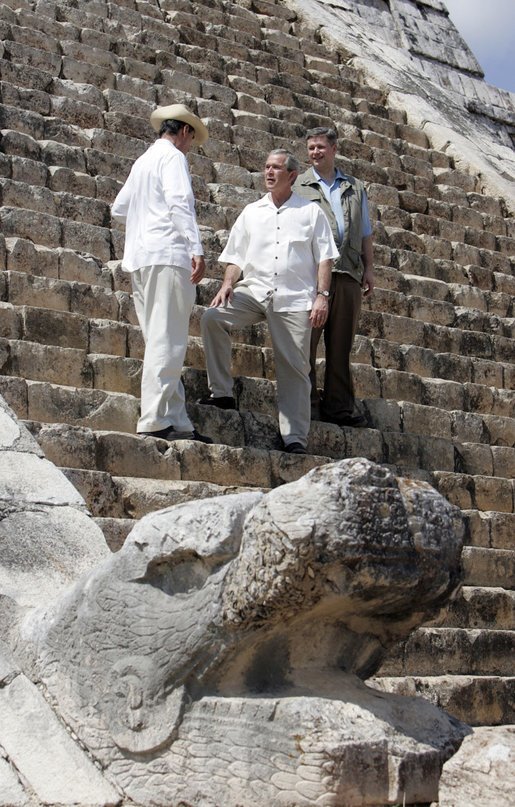
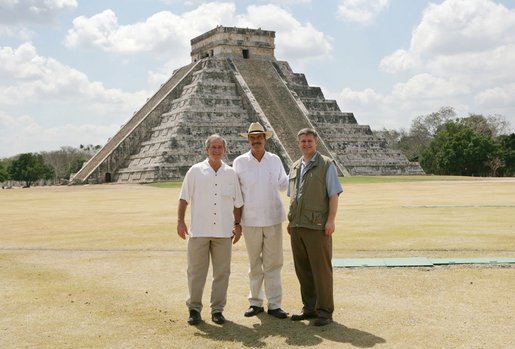
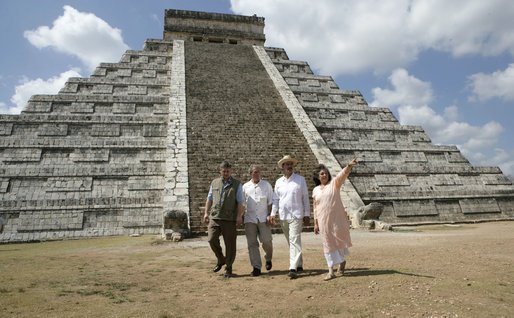
President Bush Meets with President Fox, and Prime Minister Harper, Chichén-Itzá Archaeological Ruins, Chichén-Itzá, Mexico

President George W. Bush stands with President Vicente Fox of Mexico, left, and Canada's Prime Minister Stephen Harper, during a visit Thursday, March 30, 2006, to the Chichen-Itza Archaeological Ruins. White House photo by Kimberlee Hewitt.
President George W. Bush, Mexico's President Vicente Fox and Canada's Prime Minister Stephen Harper, right, stand in front of the Chichen-Itza Archaeological Ruins Thursday, March 30, 2006. White House photo by Kimberlee Hewitt.President George W. Bush is flanked by Canada's Prime Minister Stephen Harper, left, and Mexico's President Vicente Fox as they tour the Chichen-Itza Archaeological Ruins Thursday, March 30, 2006, with Dr. Federica Sodi, Regional Director of National Institute of Anthropology and History. White House photo by Eric Draper.
Technorati Tags: and or and , or and , ,

Related: Keywords State Department,
State Department Podcast, VIDEO and Text 03/29/06, Thursday, March 23, 2006 State Department Podcast, VIDEO and Text 03/22/06, Monday, March 13, 2006 State Department Podcast, VIDEO and Text 03/13/06, Wednesday, March 01, 2006 State Department Podcast and Text 02/28/06, Wednesday, February 22, 2006 State Department Podcast and Text 02/21/06, Monday, February 13, 2006 State Department Podcast and Text 02/10/06, Thursday, February 09, 2006 State Department Podcast and Text 02/08/06, Friday, January 27, 2006 State Department Podcast and Text 01/25/06, Friday, January 27, 2006 Rice on Palestinian Elections (PODCAST), Tuesday, January 24, 2006 State Department Podcast and Text 01/23/06 , Friday, January 20, 2006 State Department Podcast and Text 01/19/06, Thursday, January 19, 2006 Secretary Rice, South Korean Foreign Minister PODCAST 01/19/06, Wednesday, January 18, 2006 State Department Podcast, Text 01/17/05,