Tuesday, April 04, 2006

Tom DeLay Address to the Constituents (VIDEO)

Tom and Christine DeLay have a daughter Danielle and became grandparents in 2002 when she and her husband Steve had their first child. Photo courtesy tomdelay.house.govAddress to the Constituents of the 22nd District of Texas, Washington, Apr 4 - DeLay's Interview With FOX News FULL STREAMING VIDEO
For the past 21 years as your Congressman, it has been an incredible honor to represent the citizens of the 22nd District of this great state of Texas.

What a pair of decades we have lived together.

When I started in politics, I was inspired by the optimism and conservative principles embodied by one of our greatest presidents, Ronald Reagan.

Since I first asked for your votes for Congress back in 1984, America has moved closer to, not further from, the “shining city on a hill” that he so magnificently described.

She has risen from malaise, won a cold war and a few hot ones, and liberated hundreds of millions across Europe and tens of millions of Afghans and Iraqis.

At home, we moved from policies that had long empowered government to finally empowering citizens, taxpayers and communities…initiating sweeping and positive change across all facets of American society.

While in Washington in that first decade of service, I was also privileged to be part of another triumph…finally providing Americans with a strong, competitive two party system at the national level.

Our efforts culminated in the transformational election of 1994 in which voters elected Republican majorities in both Houses of the United States Congress.

I was then honored by my Republican colleagues to be selected as one the top four House leaders as Majority Whip and later Majority Leader.

Together, we put policies in place to renew America’s security, prosperity, and families.

We adopted year after year of tax relief, which led to growth so strong it has not only propelled our economy, but has spurred economic growth across the globe.

We reformed welfare, moving tens of millions of good Americans from poverty to work and opportunity.

We passed litigation reform, to begin freeing our economy from the shackles of frivolous lawsuits.

And, we approved reforms in energy, telecommunications, transportation and other areas as well, all of which had been bogged down and blocked by those who ran Congress for the 40 years before our election.

Today, the war on terror — one-sided for years as we suffered attack after attack from the World Trade Center to the USS Cole — has been joined and is being won around the world.

Unemployment hovers near historic lows. Home ownership at all time highs.

Partial-birth abortion has been banned. Unborn victims of violence are now protected in law.

And the new Supreme Court is home to two of the finest young jurists of their generation.

Here in the district, we have worked hard on and accomplished dozens of major priorities, including creating tens of thousands of new jobs, providing the region with the vision and resources to achieve world class mobility, revitalizing our space program with new vision and priorities.

And we’ve done it all on the enduring strength of our principles and our ideas.

As I reflect on these past two decades of public service, I have enjoyed every minute of it.

I have been proud and privileged both to serve the Texans of the 22nd district in the great institution of the people’s House; and also to serve with some of the most incredible, dedicated, energetic, and thoughtful people in Congress, and in the leadership teams of both the House and Senate.

It has also been an honor to work closely with one of Texas’ favorite sons, a president with great moral integrity and leadership, George W. Bush. His Administration has done much to restore the type of principled leadership that President Reagan demonstrated and that first drew me to seek service in our Nation’s capitol.

In the same vein, I also have been proud to make whatever contribution I could to the conservative movement to which I feel so strongly connected and the enduring national conservative majority that has been transforming our nation for the past decade.

For the opportunity to participate in all of these endeavors, I remain deeply thankful to the voters and constituents of the 22nd District for their faith and their votes.

Now, however, after many weeks of personal prayerful thinking and analysis, I have come to the conclusion that it is time to close this public service chapter of my life.

It’s time to begin opening new chapters and pursuing new opportunities to engage in the important cultural and political battles of our day from outside the arena of the U.S. House of Representatives.

Because I care so deeply about this district and the people in it, I refuse to allow liberal Democrats an opportunity to steal this seat with a negative, personal campaign.

The voters of the 22nd District of Texas deserve a campaign about the vital national issues that they care most about and that affect their lives every day, and not a campaign focused solely as a referendum on me.

So today, I am announcing my intention to resign my seat in the House. I will make that resignation effective sometime before mid-June, but largely dependent on the congressional calendar. I plan to begin focusing on the next phase of my life as a private citizen.

Between now and the date that I leave the House, however, I will continue to focus on and tend to several important legislative priorities for the 22nd District.

Also during this period, I will determine the new ways from various arenas outside of public office that will allow me to continue to contribute to and engage in the policy, political, and cultural issues of national importance to the conservative majority.

With that plan in mind, I also intend to relocate to my Virginia property and reside closer to Washington, so that I can dedicate the necessary time and energy to making a successful transition from the public to private sectors for myself and family.

With the news of my decision, there of course will be great speculation among the political pundits and media about my reasons both for this decision and its timing. I am quite certain most will put forward their opinions and conclusions devoid of, and unencumbered by accuracy, facts, and truth, so I thought I might try to make everyone’s job a little easier.

The people of the 22nd district have been extremely loyal and true to me, and throughout my service to them, I have always done the same. I have always acted solely on my beliefs and convictions, nothing more.

I have no fear whatsoever about any investigation into me or my personal or professional activities.

As one of my colleagues in the House leadership astutely observed a while back, the wheels of justice turn much more slowly than the wheels of allegation.

I will be quite content to be judged when the passage of time has provided both all of the facts and a greater sense of perspective than is possible for most today.

As difficult as this decision has been for me, it’s not going to be a great day for liberal Democrats, either.

My loyalty to the Republican Party — indeed, my love for the Republican Party — has played no small part in this decision.

Having served under Republican and Democrat control in the House, I know first hand how important it is for Republicans to maintain their national majority. A Democrat Congress in 2007 would, without doubt or remorse, raise hundreds of billions of dollars in taxes, summarily cut and run from the war on terror, and immediately initiate an unconstitutional impeachment of President Bush.

However certain such antics might make a Republican resurgence in 2008, the times are too grave to waste even two years in the life of this nation…and allow even one more vote for their agenda of pessimism and failure.

Equally precious to me are the remaining years of my own life, and I look forward with both joy and curiosity to the future God holds for me.

I know for certain that I plan to devote a good deal more of my time and energy to fully completing Rio Bend, the foster care community built by the DeLay Foundation for Kids and opened in 2005.

The community is partially completed and currently providing permanent, loving, stable families to 27 formerly abused and neglected children.

I believe the model we have established here for these children in Fort Bend County can be duplicated elsewhere, and I look forward to working through the Foundation to make that a reality for foster kids around the country.

Eleven years into the Republican Congressional majority and six years into the Bush Administration, our nation has much to show for our leadership.

But as proud as I am of our record over that time, I am fully aware that record is incomplete.

We still need to redesign government.

We still need to chuck our current, broken systems of taxation, regulation, and litigation, which hamstring our economy and health care systems — and replace them with pro-growth, pro-innovation, pro-individual alternatives.

We need to ensure the basic human rights and dignity of the unborn and unwanted are protected under the law, and that judges adhere to their important but limited role in our constitutional framework.

I look forward to traveling the country and listening to conservatives, helping grassroots leaders to develop a unifying agenda and a strategy to enact it, to learn from past setbacks and build on our successes.

Finally, no success in my career could ever match the one truly great success of my life — my marriage.

In the summer before our junior year in high school, I was asked to look after a girl named Christine, and I have ever since, for more than 42 years now. She has done an even greater share of looking after me.

She is the reason I have ever accomplished anything in politics or in life, and the reason I am so looking forward to this next phase in our life.

Thank you Christine.

There are many others to thank as well….a word of heartfelt thanks to my base of many loyal supporters who have stood beside me for more than 20 years and sent me 11 times to represent them in Washington.

In addition, to all of the local elected officials in the 22nd District, and in the greater Houston area, you have been tremendous partners in getting things done for our shared constituents and for the good of those communities. Thank you as well for your support and loyalty.

I also have had incredible support in so many ways – financial, emotional, simple words of encouragement or thoughtful prayers – from so many people all over Texas and all over the country. My sincerest thanks goes to all of them as well.

Finally to the people I work closest with on a daily basis in Washington, the great team of Republicans from all over this country that makes up the House Republican Conference. I am so proud to have been a part of that successful team, and to have so many great memories from hard-fought victories and the personal relationships, friendships and bonds that many of us have shared. Those are some of my greatest treasures.

Today is obviously not an easy one for me, but difficult days always demand the most from us, and, in that sense, are the ones most worth living.

I have no regrets today, and no doubts.

I am proud of the past. I am at peace with the present.

And I am excited about the future, which holds, as always, America’s brightest days… and mine, too.

Thank you, and may God bless you all. He has certainly blessed me.

Contact: Michael Connolly or Shannon Flaherty (202) 225-5951

Technorati Tags:
and or and , or and

RELATED: Keywords Tom DeLay Thursday, April 14, 2005
DeLay, House Sends Bankruptcy Bill to President Bush, Thursday, April 14, 2005 DeLay Congratulates Griffin on NASA Confirmation, Thursday, March 31, 2005 DeLay Statement on death of Terri Schiavo, Sunday, March 20, 2005 Tom DeLay (R-Texas), Statement on Supreme Court’s Denial of Schiavo Appeal, Sunday, November 21, 2004 tom delay

Death of Muhammad al-Maghut

Death of Muhammad al-Maghut, The United States notes with sadness the death on April 3 of the great Syrian poet, playwright and intellectual Muhammad al-Maghut. Al-Maghut was a true original, an uncompromising intellectual and independent voice for freedom and justice in the Arab world. His work and his life were a testimony to the power of the individual and to the creative spirit. We offer our sincere condolences to his family and many admirers.

2006/333, Press Statement, Adam Ereli, Deputy Spokesman, Washington, DC, April 4, 2006

Technorati Tags:
and or and , or and or ,

Related: Keywords State Department, Monday, April 03, 2006
Secretary of State's'Travel to Europe and Iraq, Monday, April 03, 2006 Secretary Rice With Foreign Secretary Straw, Baghdad, Friday, March 31, 2006 Rice in Berlin To Discuss Iran with P-5 plus 1, Friday, March 31, 2006 UNHCR Worker’s Death in Sudan Attack, Friday, March 31, 2006 Statement on China's treatment of Kim Chun-Hee, Thursday, March 30, 2006 State Department Podcast, VIDEO and Text 03/29/06, Thursday, March 23, 2006 State Department Podcast, VIDEO and Text 03/22/06, Monday, March 13, 2006 State Department Podcast, VIDEO and Text 03/13/06, Wednesday, March 01, 2006 State Department Podcast and Text 02/28/06, Wednesday, February 22, 2006 State Department Podcast and Text 02/21/06, Monday, February 13, 2006 State Department Podcast and Text 02/10/06, Thursday, February 09, 2006 State Department Podcast and Text 02/08/06, Friday, January 27, 2006 State Department Podcast and Text 01/25/06, Friday, January 27, 2006 Rice on Palestinian Elections (PODCAST), Tuesday, January 24, 2006 State Department Podcast and Text 01/23/06 , Friday, January 20, 2006 State Department Podcast and Text 01/19/06,

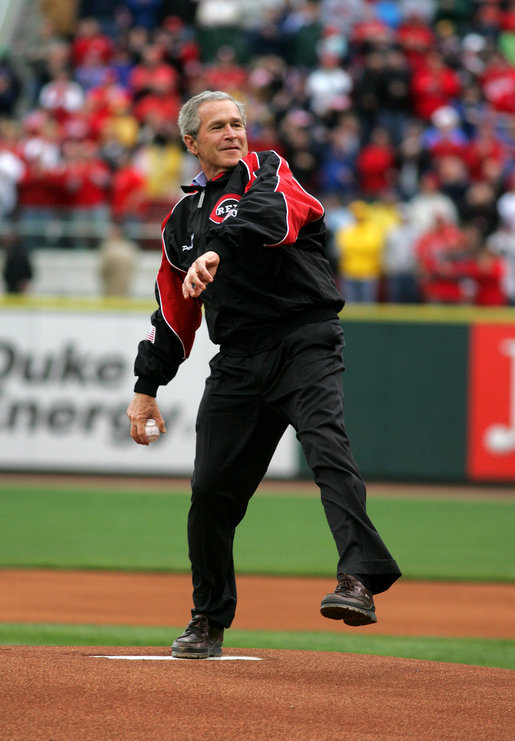
President Bush, Baseball Opening Day 2006

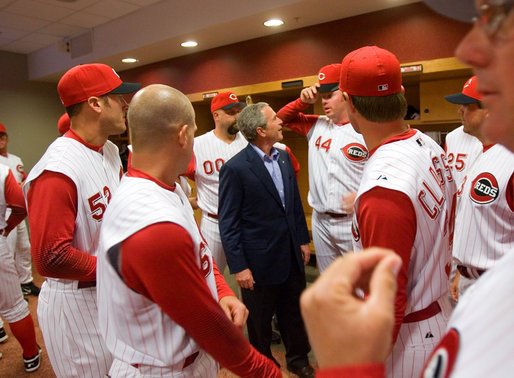
President George W. Bush winds up to throw the first pitch of the 2006 baseball season during the opening game between the Cincinnati Reds and the Chicago Cubs in Cincinnati, Ohio, Monday, April 3, 2006. White House photo by Eric Draper.President Bush, Baseball Opening Day 2006

President George W. Bush winds up to throw the first pitch of the 2006 baseball season during the opening game between the Cincinnati Reds and the Chicago Cubs in Cincinnati, Ohio, Monday, April 3, 2006. White House photo by Eric Draper.
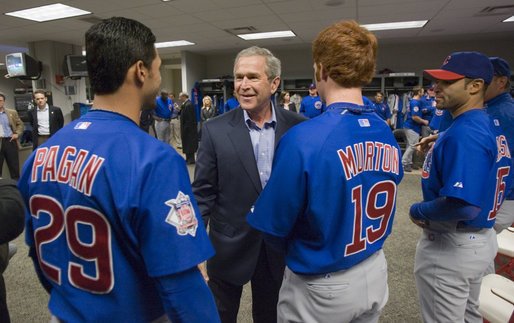
After warming up with a few pitches, President George W. Bush signs a baseball shortly before throwing one over the plate for the opening game between the Cincinnati Reds and the Chicago Cubs in Cincinnati, Ohio, Monday, April 3, 2006. White House photo by Eric Draper.President George W. Bush talks with Reds outfielder and fellow Texan Adam Dunn during a visit with the team before throwing out the first pitch of the opening game between the Cincinnati Reds and the Chicago Cubs in Cincinnati, Ohio, Monday, April 3, 2006. White House photo by Eric Draper.President George W. Bush talks with Cubs outfielders Angel Pagan, left, and Matt Murton before the opening game between the Cincinnati Reds and the Chicago Cubs in Cincinnati, Ohio, Monday, April 3, 2006. White House photo by Eric Draper.
Technorati Tags: and or and , or and

Related: Keywords baseball Wednesday, March 08, 2006
Play Ball! Inaugural World Baseball Classic, Tuesday, November 08, 2005 President Bush delivers a pitch, Monday, August 15, 2005 Little League Regional Championship, Wednesday, July 06, 2005 Washington Nationals Join America Supports You, Monday, June 27, 2005 White House South Lawn Tee Ball,

Monday, April 03, 2006

Rice urge progreso en cuanto a gobierno en Iraq

Rice urge en Bagdad a formación de un gobierno de unidad nacional, Iraquíes deben terminar la percepción de "inacción" política, dice, Por Howard Cincotta, Corresponsal del Servicio Noticioso desde Washington In English

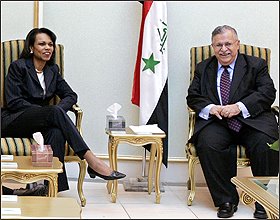
La secretaria de Estado, Condoleezza Rice, con el presidente iraquí Jalal Talbani, en el palacio presidencial ubicado en la fortificada, Zona Verde, en Bagdad, el 2 de abril. Rice urgió a los líderes iraquíes que completen sus negociaciones políticas al escoger a un primer ministro que tenga apoyo suficiente para formar un gobierno de unidad nacional y de base amplia. Más(© AP/WWP)La secretaria de Estado, Condoleezza Rice, con el presidente iraquí Jalal Talbani, en el palacio presidencial ubicado en la fortificada, Zona Verde, en Bagdad, el 2 de abril.
Rice urgió a los líderes iraquíes que completen sus negociaciones políticas al escoger a un primer ministro que tenga apoyo suficiente para formar un gobierno de unidad nacional y de base amplia. Más(© AP/WWP)

Washington -- Durante un viaje de sorpresa que hizo a Bagdad el 2 de abril, la secretaria de Estado Condoleezza Rice se reunió con líderes iraquíes y los instó a completar sus negociaciones políticas eligiendo un primer ministro con suficiente apoyo para formar un gobierno de unidad nacional y de base amplia

Rice viajó a Bagdad con el ministro de Relaciones Exteriores inglés, Jack Straw, con quién visitó el norte de Inglaterra y las ciudades de Blackburn y Liverpool.

Acompañada de Straw y el embajador de Estados Unidos en Iraq, Zalmay Khalilzad, Rice se reunió con el presidente iraquí Jalal Talbani, el vicepresidente, Abdul-Mahdi el primer ministro Ibrahim al-Jafari y otros líderes, según informan los medios noticiosos.

Rice dijo que reconoce las dificultades de formar una coalición de gobierno, especialmente en una época de violencia cuando muchos de los procedimientos y leyes para establecer un nuevo gobierno todavía existen. No obstante, durante una mesa redonda con los periodistas, la secretaria dijo que , "La gente tiene la percepción de inacción en el proceso, en Iraq y fuera de Iraq. Pero, claro, la única manera en que se corrige esa percepción es avanzar y escoger a un primer ministro y proseguir".

Un gobierno de unidad nacional es esencial para enfrentar e "incapacitar" a los insurgentes que tratan desatar una violencia sectaria, dijo.

No hay un plazo fijo para formar el gobierno iraquí

En declaraciones que hizo en ruta a Bagdad, Rice negó que Estados Unidos fuera a imponer una fecha límite para que los iraquíes formen un gobierno. "Yo no creo en fechas límite, ni calendarios. Así no es como esto funciona. Pero debe quedar bien sentado a todos que ha llegado la hora para estas negociaciones para producir un gobierno de unidad nacional, y ese será el mensaje".

La secretaria informó que le alentaba mucho del progreso político menos-visible que ha ocurrido en Iraq, particularmente el "madurar" del liderazgo político sunita.

"Cuando estuve aquí en noviembre", dijo, "era difícil imaginar que ellos serían una voz para el pueblo sunita. No parecía que tuvieran realmente la clase de conexiones que uno ve en el liderazgo político shiíta o el liderazgo político curdo".

Rice hizo hincapié en que Estados Unidos no tiene deseos de intervenir en el proceso en el que los shiítas, cuya Alianza Iraquí Unida es el bloque más grande en el parlamento, tienen la oportunidad de nombrar al primer ministro. Por otro lado, Rice manifestó, que el individuo que se sea escogido primer ministro debe demostrar suficiente apoyo para formar un gobierno.

"Y hasta ahora, Jaafri no ha podido hacerlo", dijo Rice. "Ahora, quizás pueda hacerlo, pero la urgencia es que para quienquiera que sea el candidato a primer ministro es realmente necesario que pueda reunir un número suficiente de otros votos para tener un gobierno de unidad nacional".

Dijo también que el ministro de Relaciones Exteriores Straw, como ministro de gobierno y miembro del parlamento inglés, pudo utilizar sus experiencias para discutir las maneras en las que los partidos pueden negociar uno con el otro y lograr acuerdos en cuanto a cargos en el gabinete y la formación de un nuevo gobierno.

Rice elogia" cohesión interna" del gobierno provisional

Rice elogió lo que llamó "la fuerza interna y la cohesión interna" y el liderazgo del gobierno provisional iraquí en sobreponerse luego del ataque con bombas a la mezquita de Samarra en febrero.

"No sólo se sobrepusieron sino que lo hicieron de maneras muy creativas", dijo Rice. "Realmente me ha asombrado la solidez de este proceso político ante muchas probabilidades difíciles. Pero yo les digo a ellos... no se arriesguen a tener que ser firmes otra vez porque un gobierno de unidad nacional será claramente más firme que un gobierno provisional".

En respuesta a unas preguntas durante su viaje a Bagdad, Rice dijo que Estados Unidos tiene el respeto más grande por el ayatolá Sistani, que "ha sido una voz de la razón en tiempos difíciles para el pueblo iraquí... que ha utilizado su posición de considerable autoridad en la comunidad de shiíta para urgir un Iraq que sea tolerante y que incluya a todos los iraquíes. De modo que tenemos enorme respeto por él".

La secretaria dijo, sin embargo, que los funcionarios de Estados Unidos no se reunirían con Muqtada al-Sadr, sino que únicamente con funcionarios dedicados a un gobierno de unidad nacional que no recurra a la violencia para apoyar sus reclamos.

Etiquetas De Technorati:
, y , o , y , o ,

Relacionado: Dirección de radio de las palabras claves, podcast, Sábado, De Abril El 01 De 2006
Discurso Radial del Presidente a la Nación 04/01/06, Lunes, De Marcha La 27 De 2006 Declaraciones Del Presidente Después De Reunión Sobre La Reforma Inmigratoria, sábado, de marcha la 25 de 2006 Discurso Radial del Presidente a la Nación 03/18/06, sábado, de marcha la 18 de 2006 Discurso Radial del Presidente a la Nación 03/18/06,

Secretary of State's'Travel to Europe and Iraq

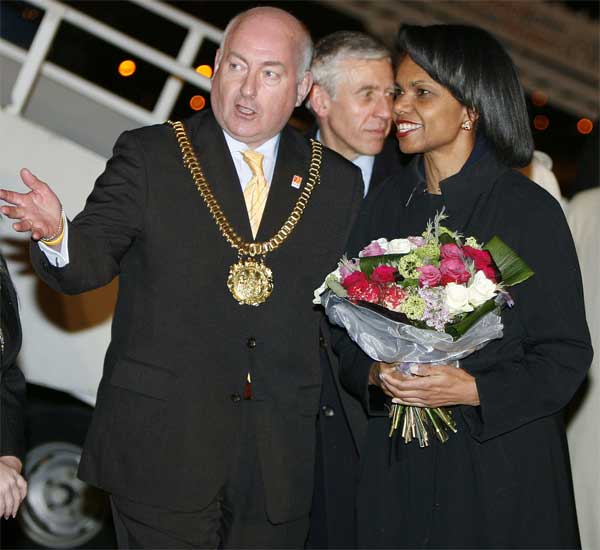
Secretary Rice is greeted by the Lord Mayor of Liverpool, Councilor Alan Dean, on arrival at Liverpool John Lennon Airport. U.S. Embassy photo by Richard Lewis.Secretary Rice is greeted by the Lord Mayor of Liverpool, Councilor Alan Dean, on arrival at Liverpool John Lennon Airport. U.S. Embassy photo by Richard Lewis. Travel to Europe and Iraq, March 29, 2006 to April 3, 2006, Secretary of State Condoleezza Rice traveled to Germany, France, United Kingdom and Iraq from March 29 to April 3, 2006.
During the trip, she consulted with key European allies on the range of common challenges, including Iran, that the United States is addressing with its transatlantic partners.

Secretary Rice’s trip to Berlin and Paris provided an opportunity to continue her dialogue with German Chancellor Angela Merkel and French President Jacques Chirac and other top officials.

Her visit to the United Kingdom took her to Liverpool and Blackburn, where she accompanied Foreign Minister Jack Straw. The trip mirrors that which the Secretary and the Foreign Minister made to Alabama last October, underscoring the shared values and cultural links between the United States and the United Kingdom.

On April 2 Secretary Rice and Foreign Minister Jack Straw made a visit to to Baghdad at what is an important time for Iraq.

See photos from visits to
Germany, France and England.

Remarks by Secretary Rice
04/03/06
Remarks With British Foreign Secretary Jack Straw
04/02/06
Interview With Courtney Kealy of Fox News
04/02/06
Interview With David Kerley of ABC News
04/02/06
Interview With Elise Labott of CNN News
04/02/06
Interview With Kimberly Dozier of CBS News
04/02/06
Interview With Libby Leist of NBC
04/02/06
Roundtable with Traveling Press
04/02/06
Remarks with British Foreign Secretary Jack Straw en route to Baghdad, Iraq
04/01/06
Interview with British Foreign Secretary Jack Straw on the Jonathan Dimbleby Programme ITV1
04/01/06
Interview with British Foreign Secretary Jack Straw by the Liverpool Echo
04/01/06
Remarks With British Foreign Secretary Jack Straw At Blackburn Town Hall
03/31/06
Interview British Foreign Secretary Jack Straw on BBC Radio 4's Today Program
03/31/06
Interview With British Foreign Secretary Jack Straw by Lancashire Evening Telegraph
03/31/06
Interview with British Foreign Secretary Jack Straw by BBC Northwest
03/31/06
Remarks at BBC Today-Chatham House Lecture
03/31/06
Interview on Granada TV
03/31/06
Remarks at the Liverpool Institute for Performing Arts
03/31/06
Remarks at British Aerospace
03/30/06
Press Availability After the P5 +1 Meeting
03/29/06
Remarks En Route To Berlin, Germany
03/29/06
Statement on U.N. Security Council Presidential Statement on Iran

Technorati Tags:
and or and , or and or , or and ,, or ,

Related: Keywords State Department, Monday, April 03, 2006
Secretary Rice With Foreign Secretary Straw, Baghdad, Friday, March 31, 2006 Rice in Berlin To Discuss Iran with P-5 plus 1, Friday, March 31, 2006 UNHCR Worker’s Death in Sudan Attack, Friday, March 31, 2006 Statement on China's treatment of Kim Chun-Hee, Thursday, March 30, 2006 State Department Podcast, VIDEO and Text 03/29/06, Thursday, March 23, 2006 State Department Podcast, VIDEO and Text 03/22/06, Monday, March 13, 2006 State Department Podcast, VIDEO and Text 03/13/06, Wednesday, March 01, 2006 State Department Podcast and Text 02/28/06, Wednesday, February 22, 2006 State Department Podcast and Text 02/21/06, Monday, February 13, 2006 State Department Podcast and Text 02/10/06, Thursday, February 09, 2006 State Department Podcast and Text 02/08/06, Friday, January 27, 2006 State Department Podcast and Text 01/25/06, Friday, January 27, 2006 Rice on Palestinian Elections (PODCAST), Tuesday, January 24, 2006 State Department Podcast and Text 01/23/06 , Friday, January 20, 2006 State Department Podcast and Text 01/19/06, Thursday, January 19, 2006 Secretary Rice, South Korean Foreign Minister PODCAST 01/19/06,

Secretary Rice With Foreign Secretary Straw, Baghdad

Secretary Condoleezza Rice Remarks With British Foreign Secretary Jack Straw, Baghdad, Iraq, April 3, 2006

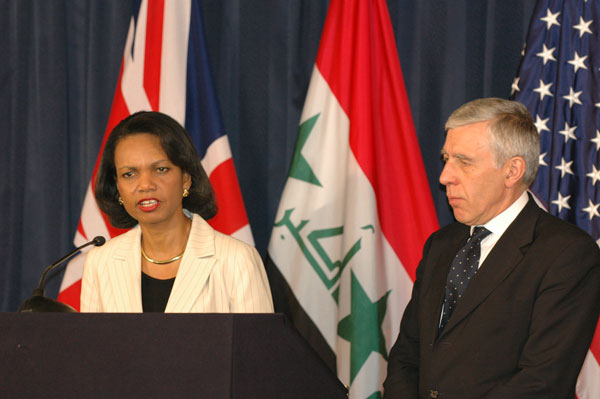
Baghdad, Iraq, April 3, 2006, Secretary Rice and British Foreign Secretary Jack Straw speaking at a press conference in Baghdad, Iraq. DoD photo.Baghdad, Iraq, April 3, 2006, Secretary Rice and British Foreign Secretary Jack Straw speaking at a press conference in Baghdad, Iraq. DoD photo.
FOREIGN SECRETARY STRAW: Ladies and gentlemen, this is the second day of the visit by Secretary Rice and myself to Iraq. As you're aware, we've held a series of meetings with leaders of all the communities in Iraq. What we've said to them is, first of all, we recognize the huge progress that the Iraqi population have made towards establishing a democratic government here in Iraq. And although the news in the last few weeks has been bleak, not least with the attack on the holy shrine in Samarra on February the 22nd and all its aftermath, the fact that the Iraqis last year had one election, then put together a constitution, then had that ratified in a referendum, and then had these elections on December the 15th with a 75 percent turnout, peaceful on the whole, recognized as free and fair, is astonishing against a background of tyranny and oppression and politics entirely by violence, which had dominated this land for almost four decades. But we have also said to those that we have met, that whilst they have made progress -- and in the six weeks that I was here -- I was last here on February the 20th and the 21st -- they've made a lot of progress in putting together the way in which this coalition government should operate.

It is now crucial that they move forward quickly to ensure the nominations of the senior positions, have those agreed and then agree the cabinet, because there is frankly no doubt that the political vacuum that is here at the moment is not assisting the security situation, and the country's got to be able to move forward. We have emphasized, Secretary Rice and myself, time and again that who becomes nominated and then elected to these leadership positions, including the prime minister, is a matter for sovereign decisions by the sovereign parliament, the Council of Representatives of Iraq; but the international community, particularly the United States, whose forces have lost so many brave men and women, and the United Kingdom a similar situation relative to the strength of our forces, that we are entitled to say that whilst it's up to you, the Iraqis, to decide who should fulfill these positions, somebody has to fill these positions and fill them quickly. And we have urged those that we've been speaking to, to do so.

One last thing that we both want to say which is this, that although there have been difficulties, I think we both recognize and people around the world recognize that without the remarkable spiritual guidance shown by His Eminence, the Grand Ayatollah Sistani, this country, for all the problems that it now faces, would not have in its hands the potential of a very much better future. And we salute the guidance and the restraint that Grand Ayatollah Sistani has been able to bring to his people, the majority community. And we also recognize that the United Islamic Alliance, the Shia alliance, given the fact that they represent the largest congressional grouping and the majority of people in this country have a right to nominate the key position, the prime minister.

SECRETARY RICE: Well, thank you very much. It has indeed been a very busy 24 hours or so. And we came here principally to underscore the importance of bringing to a close the negotiations on the formation of a government, the appointment of the most important positions, those who will govern and lead Iraq. I want to emphasize that we do know that the Iraqi leaders have been working very hard. Indeed, they have produced a program for governing. They have produced the institutions and procedures by which they will govern. This has not just been a matter of sitting around talking about who will get what positions, but rather they've done some very important work in this period of time.

That said, it is time to agree on those positions, because the Iraqi people are rightly demanding that they have a government after they braved the threats of terrorists to go to the polls and vote. And indeed the international partners, particularly the United States and Great Britain and others who have forces on the ground and have sacrificed here, have a deep desire and I think a right to expect that this process will keep moving forward, because it is after all the political process that will disable those who wish to engage in violence against the Iraqi people. It is only through a political process in which the Iraqi people have confidence and political leadership in which they have confidence that they can be certain to abandon for all time any resort to violence. You cannot have a circumstance in which there's a political vacuum in a country like this that faces so much threat of violence.

I want to underscore one other thing. It is important to come here and to urge the parties to move forward. It's also important to come here and to acknowledge the extraordinary journey that the Iraqis have been on for this number of years since the liberation of Iraq from Saddam Hussein. It's important to acknowledge that a people who have had a history of solving their problems and their differences by violence and coercion are now trying to do that through a political course. It is important to acknowledge that groups, communities that suffered great violence and great repression, the Shia who suffered enormous acts of repression under Saddam Hussein, who still mourn mass graves here in Iraq simply because they were Shia, that to see these people overcome that terrible history and to be a part of an effort for a national unity government is indeed inspirational to all of us who believe in democracy.

And let me very much underline what Secretary Straw has said. The leadership of the Grand Ayatollah Sistani in this regard, someone who, as I said the other day, we all admire for his wisdom and his courage and his leadership, has been an anchor for that community but also for all Iraqis who want to have a peaceful, and democratic, and unified future. It is also, of course, the case that other communities -- Kurds -- have suffered, and let us not forget that Saddam Hussein repressed Sunnis as well. So this is a country that is trying to overcome a very terrible past and, of course, there are sectarian tensions, and those who would stoke those sectarian tensions. But what I have been amazed at is the resilience of this community, this country, the resilience of their political leaders, and the degree to which they have been able to overcome those efforts of those who would try and tear them apart. The next and most important step in overcoming the efforts of those who would tear them apart is to get a government of national unity, to get one quickly, and to put it to work on behalf of the problems, difficulties, and challenges facing the Iraqi people. Thank you very much.

MR. MCCORMACK: We have time for several questions. Libby Leist from NBC.

QUESTION: Madame Secretary, thank you. You've made clear that President Bush sent you here to Baghdad to deliver a message to the Iraqi leadership that they need to form a government as soon as possible. My question is: With two-thirds of the American public disapproving of President Bush's handling of the war, to what extent was this trip designed to be a political message to the American people that the U.S. is actively involved in setting up an eventual American troop withdrawal? And Foreign Secretary Straw, the same question to you: To what extent is this trip sending a similar signal to the British people? Thank you.

SECRETARY RICE: Well, first and foremost, the reason for this trip is to encourage and urge Iraqis to do what Iraqis must do, because the Iraqi people deserve it. But yes, in fact, the American people, and the British people, and others who have sacrificed need to know that everything is being done to keep progress moving here. Because the goal of our presence here and the goal of having liberated this country from Saddam Hussein is not to leave a job undone. The goal is to leave the foundation for a democratic and stable Iraq, because once that democratic and stable Iraq is in place, you will have the foundations of a different kind of Middle East and our own security will be much stronger.

And so the President has said many times that the presence here is for the purposes that I've just talked about, and it is going to remain the presence that we need until Iraqis are able to secure themselves. And so the only message here is that the process needs to keep moving forward and, yes, I hope that's a message that not just the Iraqis will take but that, in fact, the American people know that it is of great concern to their government that the process keep moving forward.

FOREIGN SECRETARY STRAW: Yes, as the Secretary said, we've come here fundamentally to encourage the political process forward. In my case, this is the fourth visit I've made since November here, so it's a familiar routine. But it's of huge importance for the Iraqis that this process is moved forward. Of course, there's every interest in the United States and the United Kingdom and all those other countries who've had forces here and who have shed blood for Iraq's liberation as well. And the skepticism certainly in my country is understandable as long as there appears to be slower progress than anticipated, so that's a good reason, another reason, for pushing that forward. But also don't forget that whatever the disagreements three years ago, there was international unity enshrined in United Nations Security Council resolutions about this political process and the timetable which Secretary Rice and I are seeking to encourage.

MR. MCCORMACK: Al-Iraqiya.

QUESTION: Al-Iraqiya. A lot of news that says that you support this certain candidate and refuse other candidate. Yesterday some, you know, read from the signs, the signs on the face of Secretary Rice, that you were much happier with Adil Abd al-Mahdi than you were with Al-Jafari. Was this truth? Is this the truth that you are supporting one and not the other?

SECRETARY RICE: You know, I would caution against trying to read my facial expressions. We are here for one purpose and one purpose only, which is to try to help give momentum to a process that is well underway but really now needs to come to conclusion. It is not my responsibility or the responsibility of Secretary Straw to determine who is going to be the prime minister of Iraq; that can only be determined by Iraqis. We know that the largest voting bloc out of the democratic process will nominate that person; that is also only fair in a process like this. But the only question that we have had is how this gets done now. -- how you complete the process of getting a government, how you complete the process -- and in order to do that, you have to have a prime minister named. And that must be somebody who can unify the various blocs, the various groups of voters who also went to the polls and had -- and now represent the interests of their voters. That's what the process of coalition formation is about. It needs to be a strong leader, who's a unifying force and someone who can bring stability and meet the challenges that face the Iraqi people, but it is not our job to say who that person is going to be.

MR. MCCORMACK: Is there an Iraqi journalist?

SECRETARY RICE: I think this woman, this woman all the way in the back.

QUESTION (Via interpreter): Don’t you think that this an interference in the Iraqi affair in determining its fate, then especially that Iraq is supposed to be sovereign and this is against the principles of democracy?

SECRETARY RICE: Okay. The question was whether or not this is interference in Iraqi affairs. Iraq is sovereign. And is it also -- is it democratic to do this, I guess, is the way to put it.

First of all, we've been very clear that Iraq is indeed sovereign. That is indeed what we fought and which -- for what our people died. So let's be very clear that there are Americans and Brits and others who gave their lives so that Iraq could be liberated from a tyrant and Iraq could be sovereign. The transfer of sovereignty took place almost two years ago now and we have done nothing as an international community and as a coalition force but support the process by which the will of the Iraqi people will be made evident.

That process has now resulted in the election of responsible and representative leaders for the Iraqi people. And all we're saying is that the Iraqi people and, indeed, the international community which has supported the Iraqi people, needs to see that process of government formation come to an end. Again, it is not our job to determine who will do that. But as the Secretary said yesterday, we should not say and will not say who the prime minister of Iraq should be, who the president of Iraq should be, who the speaker should be. But that there must be -- and soon -- responsible leaders in those positions is something that I think the international community has a right to expect.

FOREIGN SECRETARY STRAW: And could I just underline, look, we've made it clear from the very start, which is our duty towards a sovereign state, that we will recognize anybody who emerges democratically as the prime minister and vice president, president, and other leaders, whether it's Mr. A, Mr. B, Mr. C. But please, the Americans have lost over 2,000 people. We've lost over 100. There are 140,000 overseas troops here, helping to keep the peace in Iraq and billions -- billions -- of United States dollars, hundreds of millions of British pound sterlings have come into this country. We do have, I think, a right to say that we've got to be able to deal with Mr. A or Mr. B or Mr. C. We can't deal with Mr. Nobody. And that's a problem, okay.

SECRETARY RICE: Jack, I'm sure we'd be all right with Miss A, B or C, too, right? (Laughter.)

FOREIGN SECRETARY STRAW: Yeah, we would.

SECRETARY RICE: Who knows? (Laughter.) Let's leave it open.

FOREIGN SECRETARY STRAW: Yeah, but I was not being gender specific -- (laughter) -- just referring to the realities here on the ground. Don't report me, please. (Laughter.)

MR. MCCORMACK: We'll take the BBC next.

QUESTION: Thank you. A question to both of you. You're saying that there can only be security once there's a government of national unity. But most people feel that there can really only be security once efforts are taken to deal with the militias which, of course, are linked with some of the parties involved in discussions to form a government.

FOREIGN SECRETARY STRAW: Well, look, we're not saying that at the moment there's a government with a prime minister, a magic wand will be waved and all the problems of Iraq will be resolved. But we are saying that getting established a government with a four-year perspective with leaders who feel secure in their position is a fundamental precondition to resolving these others matters, including the issue of militias.

MR. MCCORMACK: We have time for two more questions.

QUESTION: (Off-Microphone inaudible) For both of you, please, Is there anything that you can point to in particular that you heard or learned on this trip that tells you that your message was getting through? How much longer do you think this process can go on? And, Madame Secretary, since you have said that really the goal of whomever becomes prime minister is to form a government and both of you have said that that decision ought to be up to the Iraqis, would it be easier for someone to form a government and for this process to move forward if Jafari stepped aside?

SECRETARY RICE: Well, on the latter point, Anne, it's not for us to say how this will get resolved in terms of the prime minister. The key is that there are two parts to the process. There's a nomination from the largest bloc; and then that nominee, because the largest block is still not large enough to form a government, must bring others on board in order to have a -- in order to become prime minister and therefore lead the formation of the government and ultimately lead the country.

So that process has to take place and it has to take place very quickly, because if you don't have that key position determined, it's going to be difficult to do the other things that you need to form a government. So our purpose was not to say who needs to do what, but to say to every leader, look within yourself and do whatever you have to do to make this process move forward, and I think we said that to each and every person.

As to -- and the second question was about the -- I mean, the beginning of the question was -- I'm sorry, you --

QUESTION: Can you point to anything in particular that your message went through?

SECRETARY RICE: Oh, right. Yeah. Well, I had a very strong sense that the message was indeed getting through. I don't think that the Iraqi leaders were unaware of the importance of getting this government formed. They are looking at the quite considerable and now very free Iraqi press that, as I understand it -- I can't read it -- but as I understand it, is calling repeatedly and sometimes in rather pointed ways that politicians need to stop talking and start governing.

Now I just want to make a point. Three years after the fall of Saddam Hussein that in and of itself is a remarkable fact. That the Iraqi people's views and desire and indeed impatience is being expressed through a free press is already a -- quite a step forward. And I can tell you that these leaders are feeling the pressure from their own people because of that free press, and that's a very good step. So I think that they knew that, but we wanted to simply add our voices. And on behalf of the United States and Great Britain and to a certain extent the coalition with whom we talk all the time with other ministers, that the process needs to get forward.

I think that we heard a very strong acknowledgement of that. We have a better understanding of pieces that are falling into place to make that go forward. They are rightly proud of having finished the ground-work for creating a government, but now understand that the next step is to get the people who will actually govern. And I heard a lot that made me believe that they understand that task very well.

FOREIGN SECRETARY STRAW: Thank you. Yes. As the Secretary said, there's a lot of indication that this message is going through. I think there's a sense by the Iraqi politicians that we met that they recognize the urgency of the matter. And I think they also recognize -- I mean, I certainly recognize and Secretary Rice does -- that if this vacuum continues then the opportunity for the terrorists and the insurgents who are trying to stop democracy, stop the Iraqi people having their own government will bluntly expand. And I'm very conscious of the fact that I was last here on February the 21st. The word that was in my ears as I left was that which a leading Sunni politician had uttered to me that he was quite optimistic about the future. I got back to the UK. I went to bed, I woke up in the morning to the terrible news about the attack on the Holy Shrine, which was not just an attack on the Shia community, but attack on the right of Iraqi people of whatever confessional grouping – Shia, Sunni, whatever ethnic grouping to run their own affairs and this is therefore now urgent. We recognize that coalition building always takes time. It took two months in Germany just before Christmas. But this is now taking more than that and closing decisions is -- becomes important.

QUESTION: A follow-up on the question of militias to Secretary Rice, if I may. There is a lot of concern that particularly since the Samarra mosque -- shrine bombing, the sectarian militias have got out of control, including those run by the SCIRI Ministry of the Interior. In your meetings, which you've had three meetings, I think with SCIRI leaders, have you raised this issue of militias? How urgent do you think it is that these Interior Ministry-run militias are brought under control, and what confidence do you have that they will be?

SECRETARY RICE: Yes. In fact, we have talked with all of the leaders about the importance, once there is a government of national unity. And I want to emphasize you have to have a government of national unity so that a minister of defense, minister of the interior can be appointed for whom the responsibility is to provide security in conjunction with the multinational forces here and then to produce conditions under which people are secure and these militias, of course, can be disbanded. It is not legal going forward to have these and you can't have in a democracy various groups that have arms. You have to have the state with a monopoly on power and that will be represented by the ministry of defense for the army and the ministry of interior for the police.

We have sent very, very strong messages repeatedly, not just in this visit, that one of the first things that the multinational forces and the governments that -- from which they come expect is that there is going to be a reining in of militias. The Iraqi people demand it, and those who are on the ground and helping with security from the multinational forces also demand it.

Now, we have talked about problems as we have seen them over this interim government period with the functioning of the police and the functioning of the Ministry of Interior. We've been very clear about that and sometimes we've made those concerns public. But I'm quite confident that when there is a government of national unity, one of the first issues will be a ministry of defense that will govern in a neutral way, that will be certain that sectarianism is rooted out and that supports -- that will be able to support our efforts to better train the police.

One of the obligations and responsibilities that we have taken on Under General Dempsey is to better train the police so that they are more capable, so that the vetting is more thorough, so that they are properly armed and outfitted to be able to provide local security. So it's a comprehensive program. It's a ministry of defense that -- a ministry of interior that is responsible to the needs of the people, not to sectarian needs. It is going to be to do something about militias and it's going to be to train police that can really carry out those functions. That'll be the comprehensive program. And when the Iraqis have a unity government then that's got to be one of the highest priorities.

Thank you.

2006/T10-20, Released on April 3, 2006

Technorati Tags:
and or and , or and or , or and ,, or ,

Related: Keywords State Department, Friday, March 31, 2006
Rice in Berlin To Discuss Iran with P-5 plus 1, Friday, March 31, 2006 UNHCR Worker’s Death in Sudan Attack, Friday, March 31, 2006 Statement on China's treatment of Kim Chun-Hee, Thursday, March 30, 2006 State Department Podcast, VIDEO and Text 03/29/06, Thursday, March 23, 2006 State Department Podcast, VIDEO and Text 03/22/06, Monday, March 13, 2006 State Department Podcast, VIDEO and Text 03/13/06, Wednesday, March 01, 2006 State Department Podcast and Text 02/28/06, Wednesday, February 22, 2006 State Department Podcast and Text 02/21/06, Monday, February 13, 2006 State Department Podcast and Text 02/10/06, Thursday, February 09, 2006 State Department Podcast and Text 02/08/06, Friday, January 27, 2006 State Department Podcast and Text 01/25/06, Friday, January 27, 2006 Rice on Palestinian Elections (PODCAST), Tuesday, January 24, 2006 State Department Podcast and Text 01/23/06 , Friday, January 20, 2006 State Department Podcast and Text 01/19/06, Thursday, January 19, 2006 Secretary Rice, South Korean Foreign Minister PODCAST 01/19/06, Wednesday, January 18, 2006 State Department Podcast, Text 01/17/05,

Sunday, April 02, 2006

'cave of John the Baptist' in the time of Isaiah.

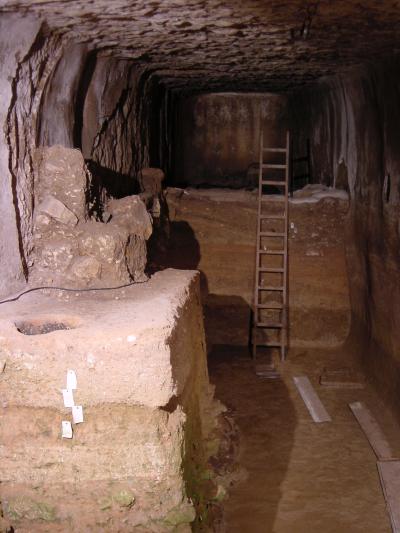
Caption: The interior of Suba Cave, Credit: UNC Charlotte, Usage Restrictions: None.New discoveries point to 'cave of John the Baptist' as important site in the time of Isaiah

New Discoveries Point to "Cave of John the Baptist" as Important Site in the Time of Isaiah Recently completed digging at Israel's Suba Cave, an archaeological site that is possibly connected with John the Baptist, or Jewish groups of his time has revealed features that deepen the mystery of the site's ancient origins,
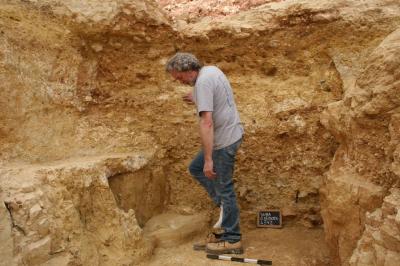
Caption: UNC Charlotte archaeologist James Tabor standing in the partially excavated corridor at the cliff face. Framing him above is what appears to be an archway filled with dirt. Credit: UNC Charlotte, Usage Restrictions: None.according to University of North Carolina at Charlotte archaeologist James D. Tabor, associate director of the excavation.
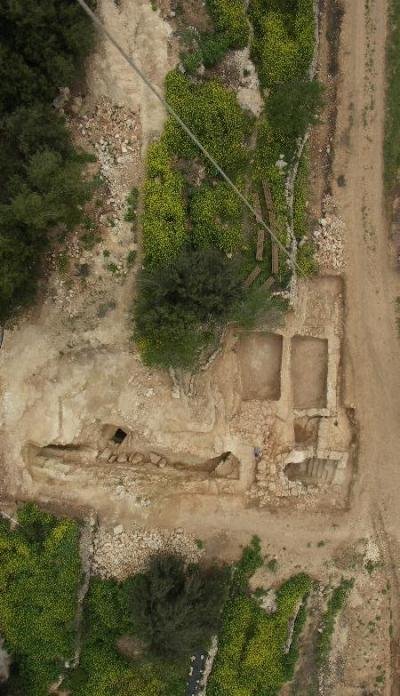
Caption: Aerial view of the Suba Cave excavation, showing cave entry and steps (middle-bottom right), exterior pools (middle right) and exterior corridor (middle center to left). The hillside rises to the left. Credit: UNC Charlotte, Usage Restrictions: None.The site was brought to international attention in 2004 with the publication of The Cave of John the Baptist, a controversial book by Israeli archaeologist Shimon Gibson, the site's director. The initial connection with John the Baptist was based on some of the earliest Christian drawings related to John on the cave walls as well as the location of the cave near Ein Kerem, John's birthplace. In particular, the most recent excavations point to the possible existence of a second,
still unexcavated cave at the site, suggesting that the location may have been a major complex of uncertain function during the Iron Age

In the 2004 book, Gibson discussed discoveries from the cave and underground reservoir at Suba, 15 miles west of Jerusalem, focusing on the finding that it had seen particularly heavy use during the early Roman period, around the time of John the Baptist and Jesus. In particular, the discovery in 1st. Century AD stratigraphic levels of thousands of small pottery vessels, all apparently ritually broken, led Gibson to theorize that the cave had been a site for baptismal rituals, possibly performed by John the Baptist or Jesus, or other Jewish groups of a similar nature who practices ritual water purification rites.

Towards the end of the cave excavation, Gibson also found evidence that the cave's large (24 meters long, 4 meters wide and 5 meters high) plastered reservoir had originally been constructed in the 7th Century BC, near the time of Isaiah. Because the massive cave had been professionally cut from solid rock, Gibson concluded that it must have been a project of the Kingdom of Judah. Because it was not conveniently located in an urban area (the nearest town was Suba, which was more than a kilometer away) and because it contained features that were inconsistent with a storage reservoir or cistern (its unusual shape and broad stairs descending to the water), Gibson theorized that part of its original function might have included ritual rites of water purification.

In the most recent excavations in March, 2006, a University of North Carolina at Charlotte student team, supervised by Gibson and Tabor, uncovered an outside corridor leading to what appears to be another cave. The corridor was filled with deposits that date to the Iron Age (within 100 years of the site's original construction) and leads directly into the steep hillside.

"Just last summer we found new pools outside up above the cave and a corridor, which our most recent dig shows is leading into what we now think is another chamber," said Tabor. "We're almost afraid to continue because it now looks like this is some huge complex, but now that we are into it, we can't stop."

"We're following the corridor on back and taken it up to a wall of fill – it is leading to something – maybe another cave. The corridor narrows as it approaches the cliff face and up above you can see bedrock, maybe a roof, but in front you can just see fill. It could just be a little enclave, but it just keeps going… it's going somewhere."

Tabor notes that if the corridor is leading to a cave, the site was even more extensive during the time of Isaiah than it was during the time of John the Baptist and Jesus. "The entrance, if that's what it is, is blocked with Iron Age fill, so this went out of use quickly after it was built, which is another mystery," Tabor noted. "Why do you build this huge thing and then it goes out of use within a hundred years? You have to wonder."

In the recent excavations, the team also uncovered seven rough stone pillars in the middle of the corridor.

"We have no idea what purpose these pillars served," said Tabor. "They could be quarry stones, but they left them standing in the corridor for some reason."

Tabor sees the new discoveries as further evidence for the past significance and historical importance of the Suba Cave site. If the cave was used for baptismal rituals at the time of John the Baptist, as Gibson has argued, it is a possibility that the site was used because it had ancient significance to John and his followers. Gibson and Tabor have also explored more practical theories, namely that the complex was quarried for some kind of industrial use--perhaps as a clay production facility.

In his 2004 book, Gibson argues that "evidence showed that the cave at Suba was already more than 700 years old at the time of John the Baptist. It was a place, I believe, that must have possessed a hoary Israelite tradition of ritualistic bathing going back into the mists of time." As more evidence has been uncovered Gibson has broadened his theorizing and currently is uncertain of the original function of the facility. There are no precise parallels to this kind of complex from the Iron Age, however, a roughly similar reservoir, but without the external pools and corridor, exists at nearby Bet Shemesh. ###

UNC Charlotte is the academic sponsor of the Suba Cave project. The dig began in March 2000, and student crews from UNC Charlotte continue to be actively involved in the ongoing excavation. A full scholarly publication on the first six years of excavation is now being prepared and will be published in 2007 by the Israel Exploration Society. Other project sponsors are the Jerusalem Historical Society and the Foundation for Biblical Archaeology, with funding from the John C. Whitehead Foundation.

Source: James Tabor, 704-687-2783, Contact: James Hathaway
jbhathaw@email.uncc.edu 704-687-6675 University of North Carolina at Charlotte

Technorati Tags:
or and and or and and and or and or

Related: Keywords anthropology, archaeology, Sunday, December 18, 2005
Conditions for slavery, Sunday, December 18, 2005 warfare in the Mesopotamian world, Sunday, December 11, 2005 40,000-year-old human footprints, Thursday, March 10, 2005 El Salvador's Pre-Columbian Heritage, Friday, May 06, 2005 transition from Neandertals to modern humans, Friday, May 20, 2005 fate of the Neandertals, Friday, June 03, 2005 DOE JGI sequences DNA from extinct cave bear, Sunday, August 07, 2005 extinction of giant ground sloths, Sunday, August 21, 2005 Peru's ancient bureaucrats used knotted-string devices as ledgers, Sunday, October 02, 2005 Rapid evolution of the quagga, Sunday, October 02, 2005 Site Q — found in Guatemala, Sunday, November 20, 2005 Elite women brewed a beer-like drink,