Thursday, April 06, 2006

President Discusses Health Care Initiatives (VIDEO)

President Bush Discusses Health Care Initiatives, FULL STREAMING VIDEO, The Roosevelt Room In Focus: Health Care en EspaƱol 10:19 A.M. EST

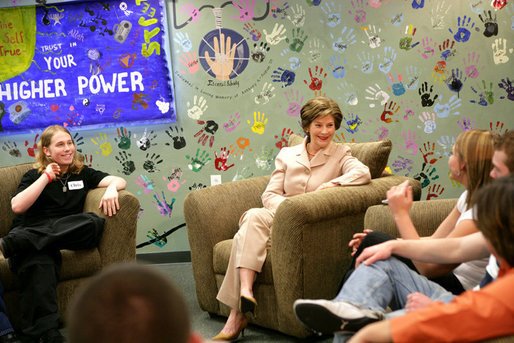
As part of the Helping America’s Youth initiative, Mrs. Laura Bush visits the Preferred Family Healthcare Adolescent Substance Abuse Rehabilitation Center, and talks with 18 year-old Dalton Fox about the progress of her recovery from substance abuse addiction on Tuesday, April 4, 2006, in St. Louis, Mo. PFH specializes in individual customer care, by focusing on strengthening individual skills, attitudes, and behaviors that maximizes the opportunity for each person to achieve and maintain recovery. White House photo by Shealah Craighead.President George W. Bush answers a question from the press as he sits with members of the insurance, banking and business communities Tuesday, April 4, 2006, during a meeting at the White House on Health Care Initiatives. White House photo by Paul Morse.
THE PRESIDENT: America needs a health care system that empowers patients to make rational and smart decisions for themselves and their families, a health care system in which the relationship between the patient and the provider are central, not a health care system where decisions are made by the federal government.

So we've been having a discussion here today about how to make sure our health care system meets certain objectives: one, empowering the patients; two, how do we have a system that helps control rising costs in health care?

And one of the interesting and innovative ways to do that is through health savings accounts. Health savings accounts are good for the uninsured, they're good for small businesses, they're good for larger corporations. And people around the table here have been sharing their experiences with how folks are saving money through health savings accounts. And I would urge the small business owner or the individual who is concerned about his or her health care to take a look at a health savings account.

We talked about the importance of cost savings through these important products, but we also talked about how we can work with the United States Congress to strengthen them; to make them more appealing; to give people more choices in the marketplace, to say to the American people, we trust your judgment, we trust you to make the right decision for you and your families.

And so I want to thank you all for coming for this most interesting discussion. And I'll be glad to take a couple of questions.

Nedra.

Q Yes, sir. Thank you. I'm wondering if we can get your reaction to Tom DeLay's resignation? Do you think it hurts the Republican Party or your ability to get work done in Congress?

THE PRESIDENT: I had a talk last night on my way back from the ball game with Congressman DeLay. He informed me of his decision. My reaction was it had to of been a very difficult decision for someone who loved representing his district in the state of Texas. I wished him all the very best and I know he's looking forward to -- he's looking to the future.

My own judgment is, is that our party will continue to succeed because we're the party of ideas. And one of the most important ideas is to make sure that health care is available and affordable for the citizens of this country. One way to do so is to trust the patients, trust the American people when it comes to making rational decisions for health care for them and their families. And that's exactly what we've been discussing here at the table.

Caren.

Q Thank you, sir. Your new Chief of Staff takes over soon, and I'm wondering, is there likely to be far-reaching changes in the staff at the White House? And is Secretary Snow expected to stay on?

THE PRESIDENT: Secretary Snow is here at the table. He's been a part of this discussion. I'm glad you brought him up. He has been a valuable member of my administration, and I trust his judgment and appreciate his service.

I've, as you know, accepted the resignation of Andrew Card, my long-time friend, a person who will go down in the annals as one -- a really fine Chief of White House in the history of the White House. I've asked Josh Bolten to take his place. Josh has served us very well as the Director of the Office of Management and Budget. I told Josh that he is -- will organize the White House in such a way that he is comfortable with and that meets my needs. And my needs are to have good, crisp information so I can make decisions on behalf of the American people.

And I look forward to Josh's recommendations as to how to get this White House to -- for the last two-and-a-half years of my administration to continue to function in an effective way, and it functioned very effectively under Andy Card, by the way. I'm most proud of his administration and proud of the team that he assembled.

Dick.

Q Mr. President, the situation in Iraq continues to be fraught with violence. You have expressed impatience in recent days of the progress towards forming a coalition government. Do you think, as some people on the ground there are saying in the Iraqi political firmament, that has been very close to the point of no return?

THE PRESIDENT: I believe that people ought to pay attention to the fact that three months ago, or a little over three months ago, 12 million people went to the polls and said, I want to live in a democracy. And there is a group of folks in Iraq that want to stop the advance of democracy, and therefore they're willing to use violence to do so. The one way to help bring confidence to the Iraqi people that those few will not be able to determine the future of that country is for there to be a unity government that steps up and says, I'm willing to lead.

And so I sent Secretary Rice to Iraq with that message. And the message is, is that the people of Iraq have voted, and now it's time for the elected leaders to stand up and do their job. So we look forward to working with them to put together a unity government, a government that will reject the sectarian violence, will reject the militias, reject Zarqawi and the terrorists that are trying to create enough chaos so that America loses nerve. And I'm not going to lose my nerve as the President, because we're doing the right thing in establishing a democracy in that country. And by establishing a democracy, we're laying the foundation for peace.

And that's what we want. We want there to be peace. We want our children not to have to grow up under the threat of violence coming out of the Middle East. And one of the lessons of September the 11th, 2001, is that this sense of -- that tyranny is okay, but underneath the surface there was resentment. And the way -- and anger, that became the breeding grounds for these killers. And the best way to defeat that is with the light and hope of democracy. And you bet it's tough in Iraq. And it's tough because people are trying to stop the advance of democracy. And I'm convinced we're making progress there. But I do urge the folks on the ground to get that unity government in place, so that the Iraqi people have confidence in their future.

Thank you all.

END 10:25 A.M. EDT ,For Immediate Release, Office of the Press Secretary, April 4, 2006

Technorati Tags:
and or and , or and , or , and ,

Related: Keyword Nanotech Sunday, March 26, 2006
'Custom' nanoparticles, cancer diagnosis and treatment, Sunday, March 26, 2006, Green nanochemistry, American Chemical Society symposium, Sunday, March 19, 2006 nanotechnologists demonstrate artificial muscles powered by highly energetic fuels, Sunday, Sunday, March 12, 2006 magnetic phenomenon may improve RAM memories, February 26, 2006 Nanoscience study shows that quantum dots 'talk', Sunday, February 26, 2006 Nano-bots to undertake major tasks?, Sunday, February 19, 2006 Nanotech to improve health care delivery, Sunday, February 19, 2006 nano-canary in the nanotoxicology coalmine, Sunday, December 04, 2005 Nano-cages 'fill up' with hydrogen, Sunday, November 13, 2005 Testing toxicity of nanomaterials, Sunday, October 23, 2005 single-molecule car, 'Nanocar', Sunday, August 28, 2005 Writing at the nanoscale, Thursday, May 26, 2005 discontinuous palladium, siloxane self-assembled monolayer, Sunday, May 08, 2005 Center for Nanoscale Materials, Monday, April 25, 2005 Nanomagnets, Nanocomposite,

Inauguration Thomas Yay Boni of Benin

Presidential Delegation to Attend Inauguration of President Elect Thomas Yay Boni of the Republic of Benin

President Bush today announced the designation of a Presidential Delegation to attend the Presidential Inauguration of President Elect, Thomas Yay Boni of the Republic of Benin on April 6, 2006.

The Honorable Karen P. Hughes, Under Secretary for Public Affairs, will lead the delegation.

Members of the Presidential Delegation are:

The Honorable Wayne E. Neill, United States Ambassador to the Republic of Benin

The Honorable Ruth A. Davis, former United States Ambassador to the Republic of Benin

Mr. Ward Brehm, Chairman of the African Development Foundation

# # #, For Immediate Release, Office of the Press Secretary, April 3, 2006

Technorati Tags:
and or and , or and , or , and ,

Related: Keywords: Africa, Wednesday, March 29, 2006
President Bush Welcomes President Obasanjo of Nigeria, Monday, March 27, 2006 President Bush to Welcome Nigerian President, Thursday, March 23, 2006 President Welcomes President Sirleaf of Liberia (VIDEO), Thursday, March 16, 2006 President to Welcome President of the Republic of Liberia, Wednesday, January 18, 2006 First Lady After Liberia Inauguration,

Wednesday, April 05, 2006

Press Briefing Scott McClellan 04/04/06 (VIDEO)

Press Secretary Scott McClellan responds to a question during his White House press briefing. White House photo by Tina HagerPress Briefing by Scott McClellan, FULL STREAMING VIDEO, James S. Brady Briefing Room, 12:00 P.M. EST, MR. MCCLELLAN: Good afternoon, everyone, Let me begin with previewing tomorrow a little bit.
We have the best health care system in the world here in America, and yet there are still some problems and challenges that we face. We have seen rapidly increasing health care costs, we see small businesses that want to cover their employees not able to afford the coverage, millions of Americans are uninsured.

The President, in his State of the Union, outlined a comprehensive plan for reforming our health care system. It's based on preserving our system of private medicine, strengthening the doctor-patient relationship, and making health care more affordable and accessible for all Americans. And the President has outlined some commonsense, innovative ways to meet those objectives.

Tomorrow the President will be focusing on health savings accounts, which will help make health care more affordable and accessible, and already is helping to making health care more affordable and accessible for more Americans. The President will be traveling to Bridgeport, Connecticut, and he'll be participating in a conversation on health savings accounts. The conversation participants will include a local business owner, a bank official, and individuals who own health savings accounts.

Health savings accounts were first established in the Medicare Modernization Act that was passed in 2003 and signed by the President in December of 2003. Three million Americans now have health savings accounts. This provides Americans with more control over their health care and helps to lower cost. And the President looks forward to going to Bridgeport tomorrow to talk about health savings accounts, and as well, his broader health care agenda in the conversation.

And with that, I'm glad to go to your questions today. Jennifer.

Q Thanks. The President this morning made it sound almost inevitable that there will be more changes once Mr. Bolten comes on board. Obviously, you're not going to talk about what those are.

MR. McCLELLAN: But you'll ask anyway.

Q But I'll ask anyway, if you're going to announce in a week changes that you guys already know are going to happen? And he also talked about that he looks forward to hearing from Mr. Bolten about what changes he would make and about continuing to make the White House more effective. Is he acknowledging a bit of a tin ear on the part of this White House?

MR. McCLELLAN: I think what you heard the President say was that we have accomplished much over the last few years. And he expressed his gratitude to Andy Card for the way he had structured the White House and how effective we have been over the last few years.

And if you go and look at the record, it is a record of results. We passed historic education reforms, we passed Medicare Modernization Act, which provides seniors with more choices and substantial savings on their prescription drug coverage, we lowered taxes to get our economy growing. Our economy is strong and growing with nearly 5 million jobs created in the last -- since the summer of 2003, an unemployment rate down to 4.8 percent, well below the averages of the '70s, '80s and '90s. So this is a White House that has helped the President advance an agenda to make America safer and more prosperous. We are winning the war on terrorism, but that war continues. It is a long struggle.

And I think what the President was saying in his remarks earlier is that he looks forward to working with Josh in his new position as Chief of Staff. Josh, as any Chief of Staff would have, has the authority to look at the White House structure and decide what is best to meet the President's needs, and to help him advance his agenda. And so the President looks forward to talking with him and listening to his recommendations and moving forward from them. He's going to look to Josh for his advice and counsel on important matters like that.

Q But he also said that he needs good, crisp information. And that suggests that he's not getting it.

MR. McCLELLAN: Well, no, I don't think he was suggesting that. In fact, he expressed -- again, he expressed his gratitude for all that Andy has done to help make sure that he is getting the kind of information he needs to make those decisions on behalf of the American people.

Q So why is --

MR. McCLELLAN: But there are always -- we always learn from experience. That is something this White House has always done. And the President pointed out that Andy had helped assemble a very smart, capable and experienced team, and the President appreciates the job that the team is doing.

Q Then why reorganize, which the President implied --

MR. McCLELLAN: Well, for the reasons that Andy --

Q -- strongly is going to happen, if there isn't a need -- if there's no need for change?

MR. McCLELLAN: Well, for the reasons that Andy talked about earlier. I think any White House goes through changes. And we've gone through a lot of change over the last few years, but it's also important to have continuity, so you have to balance that continuity with change. And with a new Chief of Staff coming in, of course the President is going to look to the new Chief of Staff for his recommendations and his thoughts and counsel.

Q But it sounded as though the President was saying that maybe it's time to freshen things up a little bit?

MR. McCLELLAN: Well, I think Andy Card talked about that when he announced his resignation. And that's something that he and Andy had talked about, that it was a time for a change. And the President agreed with Andy's assessment.

Q But the President today seemed to be suggesting that the changes could include, as said, crisper information?

MR. McCLELLAN: Well, what we want to do is build upon what we have accomplished, and continue to focus on getting things done for the American people. And that's what the President was talking about in his remarks.

Go ahead.

Q Could you describe a little how Mr. Bolten is organizing the way in which he will make these recommendations to the President?

MR. McCLELLAN: Well, it's still -- he's in the transition process right now, and he's been reaching out to members of Congress, listening to some of their thoughts. And he's continuing to move forward on that transition. But, no, I'm not going to get into previewing anything at this point. Everything will be announced in due course, if there are any changes to announce.

Q Scott, can you expand a little bit on your statement that we always learn from experience, just what the President feels he's learned through Andy Card's tenure, or what's happened in the past few months and what changes you might like to make in approach? I mean, obviously --

MR. McCLELLAN: No, I mean, that's asking for me to speculate about things. And Josh has the authority to look at the White House structure --

Q No, I asked you what you learned from experience.

MR. McCLELLAN: -- and determine what needs are there.

Q Okay, then let's go to what you learned from experience.

MR. McCLELLAN: Sure. And we've talked about it over the course of this administration. We've learned lessons from responding to catastrophic events like Hurricane Katrina. That's why we came forward with a comprehensive review and outlined more than a hundred recommendations for moving forward, so that we're in better position to respond in the future. We've implemented significant intelligence reforms, and we are continuing to do that to make sure that the President gets the best possible intelligence, so that he can make decisions that are in the best interests of the American people. We have adapted and adjusted to circumstances on the ground in Iraq as needed, and that's what you do in any wartime situation.

So those are examples of how we learn from experience. And that's important for any leader to do. A leader should always be learning from experience and willing to make necessary changes to move forward and continue to do a better job.

Q And given what Mr. Bolten's already done, is it reaching out to Congress, as well? Is that a lesson you've learned, that you need to do that more?

MR. McCLELLAN: Well, we have reached out to Congress over the course of the last few years. But we want to continue to do more, and we want to continue to build upon that. And so Josh, last week, I believe he -- in his first day after the announcement called more than 30 congressional leaders. And he's continued to reach out to members of Congress and listen to their ideas. The President wants to hear their thoughts.

The President has been having a number of meetings with members of Congress. He has another meeting this afternoon with some Republican members from the Senate. Last week he met with a bipartisan group on his competitiveness initiative. This is a bipartisan group of senators that is committed to advancing the initiative the President outlined in his State of the Union to keep America the most competitive economy in the world.

I'll come back to you. Kathleen, go ahead.

Q Scott, the Democrats have reacted to the announcement by Tom DeLay that he's not going to be seeking office again by saying, "Tom DeLay's announcement is just the beginning of the reckoning of the Republican culture of corruption that has gripped Washington for too long." Thoughts about that?

MR. McCLELLAN: Well, first of all, the President talked about his conversation with Congressman DeLay yesterday. The President was coming back from Cincinnati aboard Air Force One when he spoke with Congressman DeLay by phone. And the President wishes Congressman DeLay all the best. He appreciates his service and thanks him for his service to the nation. As he talked about earlier, he knows that this was a difficult decision. We have worked very closely with Congressman DeLay and other leaders on the Hill to get things done for the American people.

And we see that in the results. We see that in an America that is safer, but we are not yet safe, there is more to do. We see that in an America that is expanding prosperity for more Americans, and the number of jobs that are being created. We have a very healthy economy that is continuing to grow strongly.

But we need to do more. We need to build upon that. And so the President is going to continue focusing on his agenda, which is a hopeful agenda for the American people, and advancing that agenda and building upon the great progress we have made.

Now I think what you see from Democrat leaders that you reference in your comment is that they tend to engage more in partisan attacks, because they can't win the debate of ideas, because they have few ideas to offer. And the President is going to continue focusing on our ideas of where he wants to lead this country.

Q Does the White House, though, see this in any way as presenting an opportunity to put this -- some of these clouds, these ethics clouds that have been really hovering over the Republican Party, put this behind you in any way? No opportunity to get things back on track?

MR. McCLELLAN: I don't think that's why Congressman -- I don't think that's the decision that Congressman DeLay -- I don't think he based his decision on that. I mean, go back and look at what he said earlier today, and go back and look at the record of both parties, and stuff.

Q Scott, what's going on with Iran? They've been so in your face. Every day they come out and they brag about a new weapons system. And have American-Iranian talks been underway at all?

MR. McCLELLAN: I'm sorry?

Q Have talks been underway at all, because --

MR. McCLELLAN: I have no update, in terms of any talks, if you're talking about regarding Iraq. But in terms -- are you asking about some of the recent events inside Iran, in terms of their military program?

Q Yes.

MR. McCLELLAN: Well, I think their aggressive military program, and defiant rhetoric are further examples of how the regime is isolating itself and the Iranian people from the rest of the world. It is also a reminder of why the international community is united in its concern about the regime's possible development of nuclear weapons, and why the international community is calling on Iran to comply with its international obligations, or face further isolation.

Last week, the Security Council sent a very clear statement to the regime. It said: Comply with your obligations; come clean. You have 30 days to come clean, make a commitment to come clean and comply with your obligations, or we're going to be back at the Security Council consulting about next steps to take.

Q Do you think sanctions are enough to stop them? I mean, they're really very warlike?

MR. McCLELLAN: I'm not going to speculate about next steps, but, again, there's a very united presidential statement that was released by the Security Council last week spelling out what the regime needs to do. It needs to adhere to its international obligations. It needs to suspend its uranium enrichment and enrichment-related activity and come back to the negotiations and act in good faith.

The International Atomic Energy Agency will be working with the regime. We'll see if the regime is ready to commit to negotiation over confrontation. You can understand why we are skeptical, given their history of hiding their activities and given their willful disregard for adhering to their international obligations.

Q Scott, back to Josh for a second. Can you give us an indication as to how he is getting prepared for any impending reorganization, in terms of who is he working with? Is he working with the Vice President? Is he working with Harriet Miers?

MR. McCLELLAN: No, I'm not going to get into that at this point. It's still very early in this transition period. There will be plenty of time to talk about this as we move forward, and we'll do so in due course.

Q And just if I can, on the subject of the Democrats in Congress and how they've taken a view of Mr. DeLay's departure, is the President -- and their assertion that this election should turn in some way on a culture of corruption, as they put it -- is the President concerned or disappointed that he's been let down by Republicans? And does this, in his view, become legitimate discourse? As a candidate years ago, the President campaigned as a reformer with results. And we've got ethics legislation pending on the Hill and lobbying reform, et cetera, et cetera. Is there not a sense of having been hampered by his own party's activities?

MR. McCLELLAN: Well, we've got a record of results, and we are a party of ideas. And the President looks forward to discussing the differences in ideas and talking about the substantive differences. The Democrats don't want to debate the ideas because they have no ideas to offer, they have no vision of where they want to lead America. The President is going to continue focusing on the hopeful agenda he has outlined, and talking about his vision for where we want to lead America.

This is a country that is seeing strong economic growth. This is a country under the President's leadership that is becoming safer because we are waging a comprehensive war on terrorism. So let's talk about the issues, and let's debate the ideas. The President looks forward to that. We are a party that has outlined very clear ideas and a clear vision for where to lead this country. The Democrats can only engage in attacks because they have nothing to offer.

And what they do offer is a very narrow vision of the global war on terrorism. They offer retreat and withdrawal. They offer a limited view of how we wage and win the war on terrorism. The President recognizes you have to use all tools at your disposal to win the war on terrorism. And that's exactly what we're doing. That's why we're taking the fight to the enemy. We are leading from a position of strength and confidence, not weakness and uncertainty. And that's -- and we're going to continue to talk about these ideas as we move forward. The President looks forward to a healthy debate on the ideas that we have pursued.

Q Understood. But in your answer there wasn't an expression of the President's concern about a reflection on his party by Republicans. And that was the question. So --

MR. McCLELLAN: No, this is a party that has accomplished much for the American people. We have worked very closely with congressional leaders to get things done, and it's a record that is making America more prosperous and safer and providing seniors with prescription drug coverage. They're realizing substantial savings on their prescription drug coverage. One of the things the President will talk about tomorrow is the responsibilities we have at the federal level when it comes to health care. We have a responsibility to make sure that health care is provided to our seniors and low-income Americans. We also have a responsibility to make sure that health care is more affordable and accessible.

And on the first goal, we have already taken significant steps. We're expanding the number of community health centers to meet the needs of the poor and indigent. We are moving forward on the Medicare implementation and providing seniors with substantial savings on prescription drug coverage and more choices. So these are the issues that the American people care about, and that's what they want us to focus on. That's what we'll continue to focus on. And there are very clear differences on those issues.

Q Scott, Tom DeLay is, perhaps, more than any single member of Congress responsible for the President's successes on Capitol Hill. Does the President regret at this point that he's resigning?

MR. McCLELLAN: The President respects his decision. This was a decision that Congressman DeLay made for the reasons that he stated earlier. He called the President to inform him about that decision, and the President is continuing to look toward the future of how we can continue to get things done for the American people. We have a very capable group of leaders when it comes to the Congress, and this is a group that the President has worked very closely with to get a lot of things done. And I encourage you to look at the record.

There's a tendency of people to talk about some of the side issues, but let's look at the results, let's look at the facts. There has been great progress made over the last few years when it comes to strengthening our economy and when it comes to winning the war on terrorism. And we look forward to talking about how we can continue to move forward and build upon that great progress we've made on behalf of the American people.

Q But speaking about -- talking about side issues, my question was, does the President have any regret at this point that this man is leaving? I haven't heard anyone say that he should stay, or that --

MR. McCLELLAN: Well, the President talked about how he recognizes it was a very difficult decision, but the decision has been made, and now it's time to move forward and continue working with congressional leaders to build upon our record.

Q Okay, so no regret. And also on Snow, when the President was asked --

MR. McCLELLAN: I don't think he looks at it that way, Keith. That's what I'm trying to tell you. Maybe you didn't hear.

Q Okay. No, I heard. So Secretary -- the question was asked directly if Secretary Snow was staying, and he didn't say that he was, why didn't he do that?

MR. McCLELLAN: Well, Keith, we never -- we've had a long policy of never speculating about personnel matters. The President appreciates the great job that Secretary Snow is doing, and the rest of his economic team is doing. I talked about the great accomplishments we have made when it comes to our economy. And we need to continue to build upon those policies that we have put in place to create a healthy economic environment where we're creating millions of jobs. But there are still concerns when it comes to rising gas prices, rising health care costs. That's why the President has outlined initiatives to address the root causes of high energy prices. And we encourage Congress to move forward quickly to pass those initiatives.

Q The President has expressed confidence in members of his administration whose tenure has been questioned before --

MR. McCLELLAN: And he expressed appreciation for the job that Secretary Snow is doing, said that he is a valuable member of his team.

Go ahead.

Q I know you don't discuss personnel matters, but there are growing reports/rumors by my brethren that Scott McClellan is going to ride off into the sunset, specifically a story in The Washington Post this morning saying that Scott McClellan is going to leave and be replaced by Dan Senor. As though you were under oath --

MR. McCLELLAN: Must have missed that story.

Q -- as though you were under oath, can you give us a simple "yes" or "no" answer? Is the story correct?

Q Was that in the The Washington Post?

Q No. (Laughter.)

MR. McCLELLAN: I missed that story. I didn't see that one in The Washington Post.

Q But what's your comment?

MR. McCLELLAN: I appreciate the question, and as I've said, I never speculate on personnel matters. Period. Go ahead.

Goyal.

Q Thank you. First of all, I'm really thankful to President Bush. I will never forget the ride of my life on Air Force One. And I've been staying there to review his visit in India, talking to thousands of Indian --

MR. McCLELLAN: Had a great visit to India. Do you have a question?

Q My question -- also, President was covered widely by Zee News in India, and I have a special CD for the President and also am thankful to my friend (inaudible) and others in the community. My question is that, officially, can you state now how President feels or felt, and officially how the visit -- we can view, or the view -- as far as his point of view?

MR. McCLELLAN: The President's point of view? I think he talked about it. He had a very good visit to India, as well as to Pakistan. And we have good relations with both countries. We want to continue to strengthen those relations, and that's what we will do.

Go ahead, Les.

Q And also on this --

MR. McCLELLAN: Let me keep going. Go ahead, Les.

Q Scott, I have a two-part question. (Laughter.) As the nation's chief law enforcement officer, the President fully supports the White House's Uniformed Secret Service and the U.S. Capitol Police when they do their duty to protect him and members of Congress, doesn't he?

MR. McCLELLAN: I'm sorry? Are you bringing up -- are you bringing up an issue over at the Capitol?

Q Yes --

MR. McCLELLAN: Regarding Capitol Police?

Q Yes, that's --

MR. McCLELLAN: I think direct those questions to the Capitol Police.

Q Well, no, I want to ask you a question, if I may. Since there have been so many public statements made in support of Congresswoman McKinney's apparent defiance and cell phone slugging of a Capitol Police Officer who tried to stop her from entering the Capitol when she was wearing no security badge, how long will the President keep silent when this Congresswoman has already held two press conferences, one of which did not allow the media to ask any questions --

MR. McCLELLAN: It's a legal matter; we'll leave it to the appropriate authorities. I have not discussed it with the President.

Q Doesn't the President have any --

MR. McCLELLAN: What's your second question?

Q That was the second one -- (laughter) -- have any statement on this? She's making statements all the time. Surely the President --

MR. McCLELLAN: Well, Les, I just said that I've not discussed it with him. What's your next question?

Q You have discussed it --

MR. McCLELLAN: Was that your second question? Roger, go ahead.

Q Scott, on the meeting this afternoon the President is having with the -- I believe it was Senate Republican leaders, is that right?

MR. McCLELLAN: Yes.

Q How many are there, what time is it, and is it in the Residence?

MR. McCLELLAN: I think it's a little bit before 4:00 p.m. No, I think it's over here -- it's over here in the Oval Office. It's to continue talking about his agenda and talk about legislative priorities and also hear from them.

Q Who are they?

MR. McCLELLAN: We'll see if we can get you additional -- we'll see if we can get you -- I think it's a number of chairmen on some various committees. But this part of the ongoing meetings that the President is having with congressional leaders.

Q Will the President or Josh Bolten -- is he also asking about soliciting their ideas on changes --

MR. McCLELLAN: If there's anything else to provide you from the meeting, I'll let you know. But the purpose of the meeting is to talk about the agenda and legislative priorities. Obviously, the President wants to hear from members, as well, and get their views.

Q Will Mr. Bolten be in the meeting?

MR. McCLELLAN: I'll keep you posted.

Q Scott, Britain's Daily Telegraph has reported that the government over there held secret talks yesterday with defense chiefs to discuss a possible targeted strike against Iran, and the strike would be American-led if, in fact, Iran were to snub the United Nations. Can you tell us if any similar talks have been held here --

MR. McCLELLAN: I don't know about those reports. I haven't seen them.

Q Has the President discussed such a possible strike with --

MR. McCLELLAN: What we're trying to do is achieve a diplomatic solution to the nuclear issue with regards to Iran. That's why we're working with the international community. This, you hear, is about the regime's behavior. I know the regime would like to make it an issue between the United States and itself, but this is an issue that the regime has with the world. This is a concern that the world has about the regime's behavior. We have a number of concerns about the regime's behavior and there appears to be a pattern to its behavior, a pattern of concealing its nuclear activities, a pattern of supporting terrorism, a pattern of threatening rhetoric, and a pattern of disregarding the demands of the international community.

So we're keeping the focus on the regime, which is where it should be, by working with the international community to prevent the regime from developing a nuclear weapons capability. That's what the objective is and that's where the focus is. And we are pursuing it in a diplomatic way.

Iran is not Iraq. We have said that before. And we are working to address this by working with our partners in the international community. We're working through the Security Council, we're working with Germany, and we're working with others to address this growing concern of the international community.

Q If the President had held talks with Mr. Blair, would you tell us if we asked?

MR. McCLELLAN: Well, the President speaks with Prime Minister Blair on a frequent basis. They speak on a weekly or biweekly basis. We don't get into reading out those discussions. I don't know anything about this report, Victoria.

Go ahead.

Q Scott, do you think the resignation of Tom DeLay is a serious blow to the reputation or the image of the Republican Party?

MR. McCLELLAN: No, I don't have -- I haven't heard the President look at it that way at all. In fact, we appreciate the leadership of Congressman DeLay. We also have a number of other leaders on the Hill that we are working closely with, and we will continue to do so. I know there is a tendency sometimes to draw broader conclusions from such an announcement, but again, look at the record, look at the results we're achieving for the American people. We're going to continue focusing on how do we move forward and build upon those results.

Go ahead, John.

Q Thank you.

MR. McCLELLAN: You moved? Did you get kicked out?

Q No. No, I didn't think -- (Laughter.)

MR. McCLELLAN: I would have come to you. (Laughter.)

Q You would -- okay, thank you, Scott. Last week, I asked you whether the President would veto an immigration bill that did not include a guest worker program and only included enforcement. You said it's very early in the game.

Now, the President was asked whether he would sign a measure that has enforcement but not guest worker when he was in Mexico, when he was in CancĆŗn, and he was very unclear in his answer -- did not say yes or no. We've gone on two weeks since you and I first discussed this. Can you say whether the President will sign a bill that is similar to just the House measure, enforcement and no guest worker?

MR. McCLELLAN: What I emphasized was what the President emphasized, too, that we want a comprehensive bill. We believe that if you're going to fix the immigration system, you have to do so in a comprehensive way. And that's what the President is continuing to urge members to move forward on.

Now, the Senate is moving forward and looking at passing a comprehensive bill. We are pleased with the progress that's being made. There's a lot of discussions that are going on. They're debating the issue this week. And today, they restarted those -- restarted the debate yesterday. So we're pleased that there's a lot of discussions going on about how to build broad support for a comprehensive piece of legislation.

We look forward to continuing to work with Congress as it moves forward, as it goes to conference committee. We'll continue to work with members and iron out the details. But the President believes very strongly that we need a comprehensive bill that begins with securing our borders, but it also needs to include a guest worker program because that will help us better control our borders. It will take pressure off the border, and it will allow our Border Patrol agents and law enforcement officials to focus on the criminals, those who seek to come here for the wrong reasons, those who are engaged in smuggling and trafficking, or trying to engage in terrorism. And so that's what the President believes. That's what he's continuing to urge Congress to get passed. The President wants a comprehensive bill.

And now we have taken a number of steps to better secure our borders. We've increased funding I believe some 66 percent since we've been in office. We've expanded the number of Border Patrol agents significantly. We've made use of new technology to deploy along the border so that we can stop people from coming into this country illegally, but there's more we want to do, as well.

And so we appreciate the efforts of those who have put forward initiatives to focus on securing our borders. That's an important part of a comprehensive piece of legislation. But it is still early in the legislative process. And we're going to continue working with members as it moves forward.

Q Now, do you have the hard numbers that you have called for increasing the Border Patrol by?

MR. McCLELLAN: I don't have that. I gave out some of those last week. We're -- in our current budget, it expands at an additional, I believe, 1,200 or 1,500. I think there are some 12,000 Border Patrol agents. We increased it I believe -- and double-check this; I said this last week -- some 1,500 or more over the last year or so. But I'll be glad to double-check those numbers with you.

Q Thank you, Scott.

MR. McCLELLAN: Sure.

Q Scott, we heard again the President urge Iraqi leaders to sort of get their act together and move quickly in forming a unity government. Can you tell us, what's his level of frustration with the pace over there?

MR. McCLELLAN: Well, I think we need to focus on the Iraqi people. The Iraqi people want to see a unity government formed as quickly as possible. The President emphasized again today that it's time for the Iraqi leaders to get a government in place that is representative of all Iraq's communities.

So that's where we're continuing to focus. We're continuing to urge the government to move forward and get that -- excuse me -- let me get a glass of water -- we're continuing to urge the Iraqi leaders to move forward and get a unity government in place. The discussions continue. The discussions are going on, I believe, around the clock between the elected leaders. The Iraqi people showed most recently last December when they went to the polls in large numbers that they want to chart their own future. They want to live in freedom. Nearly 12 million Iraqis showed up and cast their ballots.

Now, the results were, I think, officially certified around February 10th, and the Iraqi leaders have been working since that time to come together and form a unity government. And those discussions continue. We urge them to get it done as quickly as possible. It's important that it move forward -- that they move forward quickly because it will help, as Secretary Rice said, disable those who want to continue to create sectarian strife, those who are trying to foment sectarian violence. And that's why it's important that they move forward quickly.

Q Is the President satisfied with the pace?

MR. McCLELLAN: Well, the President indicated earlier today that it's time to get it done. We recognize that Iraq is a new and emerging democracy, and they are learning to compromise and learning to come together and put in place a government. But again, our focus is on the Iraqi people, and helping them move forward on putting a lasting democracy in place because it will help lay the foundations of peace for generations to come.

A free Iraq will help inspire reformers in the broader Middle East, and the President talked about it earlier today. He talked about the importance of transforming this troubled region of the world. It is a region where for too long we thought we had stability at the expense of democracy. And we're no longer going to accept that. The President recognizes that free societies are peaceful societies and that it is in our long-term interest that we help to support reformers throughout the Middle East as they move forward to expand freedom and democracy.

Go ahead.

Q Scott, you said the President wants comprehensive immigration reform that includes a guest worker program. One compromise would only apply to those workers who have been in the United States for at least five years. Would that approach be acceptable to the White House?

MR. McCLELLAN: Well, the President outlined some principles, Paula. And what we're focused on at this point is working with members to move forward on comprehensive legislation and do so as quickly as possible. There are some difficult choices and compromises that will need to be made as we move forward. But at this point, I think it's important to keep the focus on the fact that it is moving forward. And there will come a time when we will be in position to talk about some of the specific details in greater detail, and iron out some of those details.

But what we want to see is the Senate continuing to move forward, as they are doing, and get a comprehensive bill passed. And then we will work with leaders as it moves into conference.

Q Thank you.

MR. McCLELLAN: Thank you.

END 12:31 P.M. EST

Technorati Tags:
and or and , or and , or , and , or and or and or and or and

Related: Keywords Press Briefing Scott McClellan, Wednesday, March 29, 2006
Press Briefing Scott McClellan 03/28/06 (VIDEO), Friday, March 24, 2006 Press Briefing Scott McClellan 03/23/06 (VIDEO), Sunday, March 19, 2006 Press Briefing Scott McClellan 03/17/06 (VIDEO), Friday, March 17, 2006 Press Briefing Scott McClellan 03/15/06 (VIDEO), Wednesday, March 15, 2006 Press Briefing Scott McClellan 03/13/06 (VIDEO), Friday, March 10, 2006 Press Briefing Scott McClellan 03/09/06 (VIDEO), Tuesday, March 07, 2006 Press Briefing Scott McClellan 03/07/06 (VIDEO), Tuesday, February 28, 2006 Press Briefing Scott McClellan 02/27/06 (VIDEO), Friday, February 17, 2006 Press Briefing Scott McClellan 02/16/06 (VIDEO), Friday, February 17, 2006 Press Briefing Scott McClellan 02/14/06 (VIDEO), Tuesday, February 14, 2006 Press Briefing Scott McClellan 02/13/06 (VIDEO), Thursday, January 19, 2006 Press Briefing Scott McClellan 01/18/06 (VIDEO), Friday, December 16, 2005Press Briefing, Scott McClellan, Levee Reconstruction (VIDEO), Tuesday, December 06, 2005 Press Briefing Scott McClellan (VIDEO) 12/06/05, Thursday, November 10, 2005 Press Briefing by Scott McClellan 11/09/05 (VIDEO, Wednesday, November 09, 2005 Press Briefing by Scott McClellan 11/08/05 ,

State Department Podcast, VIDEO and Text 04/03/06

Daily Press Briefing Adam Ereli, Deputy Spokesman, FULL STREAMING VIDEO, file is real media format, running time is 37:04 PODCAST, file is MP3 for PODCAST, running time is 36:52 Washington, DC, April 03, 2006

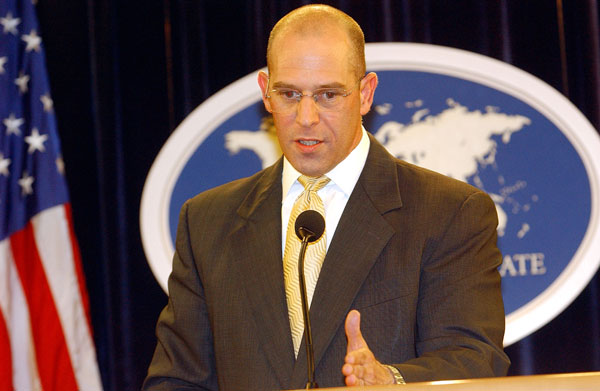
J. Adam Ereli (shown during the July 19th Daily Press Briefing) became Deputy Spokesman of the Department of State on September 2, 2003. In this capacity, he oversees the Office of Press Relations, Office of Regional Media Outreach, the Foreign Press Centers, and the Press Office at USAID.State Department Photo by Michael Gross.J. Adam Ereli (shown during the July 19th Daily Press Briefing) became Deputy Spokesman of the Department of State on September 2, 2003. In this capacity, he oversees the Office of Press Relations,
Office of Regional Media Outreach, the Foreign Press Centers, and the Press Office at USAID.State Department Photo by Michael Gross. TRANSCRIPT: 1:10 p.m. EDT

MR. ERELI: Hello. Let me begin with two statements, if I may. The first one concerns bombings in Turkey over the weekend. The United States condemns bombings by the Kurdistan Workers Party that killed four people in Istanbul over the weekend. We also regret the loss of life as a result of violent protests by Kurdistan Workers Party sympathizers in southeast Turkey and Istanbul over the last week or so.

Turkey is a valued ally and close friend. We call on all parties to exercise restraint and we reiterate our strong condemnation of all terrorist groups, including the PKK. It's important to condemn this violence and stand against terrorists and their supporters.

The second statement is on the harassment of civil society activists in Tunisia. The United States is concerned about recent reports of harassment of activists in civil society organizations in Tunisia. In particular we're concerned about the situation of political activist Neila Chachour Hachicha and her family. She recently delivered remarks on Al Jazeera and at the American Enterprise Institute in Washington on freedom of the press and the need for democratic reform in Tunisia. Her family has been, we believe, unfairly targeted. Her husband was given a ten-month prison sentence for an eight-year-old real estate transaction. Her car was confiscated. Doctored photographs of a family member have been distributed, and she's been subject to long interrogation.

This comes in addition the ongoing imprisonment of the activist lawyer Mohamed Abbou and continued disruptions of civil society organizations, interference in civil society activities, and recent moves to limit the ability of legal opposition parties to express their views. We encourage the Government of Tunisia to take actions consistent with its declared intentions to engage in democratic reform.

That's it for statements.

QUESTION: May I?

MR. ERELI: Sure.

QUESTION: In the statement that you put out on Friday on this, there was an indication that the U.S. Government had actually spoken to Tunisia.

MR. ERELI: We have spoken to -- about this specific case?

QUESTION: About that case. And what did they say?

MR. ERELI: They took our concerns on board but I don't think there was much of a way in response. Let me see if there's more I can share with you on that.

QUESTION: And is it your feeling that things are getting worse there? Is this --

MR. ERELI: I'd say it's a mixed picture. I mean, it's important to note some steps they've taken, particularly improvements in the conditions of Tunisian prisoners, the recent release of over 1,600 prisoners, and some reduction in the restrictions placed on the Tunisian media. That's on the plus side. But on the negative side, there continue to be harass -- there continues to be harassment of civil society activists and organizations which run contrary to the Tunisian Government's professed policy of openness and tolerance for dissent.

QUESTION: And just one more thing. As you know, she spoke on Al Jazeera after she spoke publicly here in the United States as part of an AEI program. And I wondered, you know, what's your sense -- I mean, here's the United States trying to promote democracy in the Middle East, here she comes to an Arab reformers program in Washington, and then only then does she -- is she subject to harassment back in her own country. So what does that tell you about what Tunisia is saying about U.S. policy?

MR. ERELI: As we indicated in our statement, what we're concerned about is a pattern of activity by the Tunisian authorities against well-intentioned reformers and activists who work within the system peacefully to help improve human rights, advance the cause of democracy and political participation by the citizens of Tunisia. Ms. Hachicha is but the latest in a regular series of actions by the government that seem to -- that are contrary to peaceful democratic development, peaceful citizen involvement in the affairs of the country.

So we view it in the context of that as an overall pattern of activity that is of concern to us. And that's why I think in our statement we put it in that broader context. But clearly, you know, there's a cause and effect that is deeply disturbing: you come, you speak out, you speak out publicly and then you're subject to harassment. That needs to be called. They need to be called out on that, and that's why we're putting out the statement.

QUESTION: Were the 1,600 prisoners political prisoners?

MR. ERELI: I'll have to check to see what their status was.

QUESTION: I thought you might want to handicap a little bit how Congress will respond to your India nuclear policy. The Secretary is due tomorrow, isn't she?

MR. ERELI: I believe she's testifying on Wednesday on the India civ-nuke deal.

QUESTION: Is it Wednesday? Well, maybe we can – do a little handicap from you, and ask you a couple of questions.

MR. ERELI: Well, rather than --

QUESTION: You can punt till her testimony.

MR. ERELI: Rather than handicap or speculate, I will tell you that this deal has been the subject, I think, of intensive briefing efforts on the part of the Administration, dating from the framework agreement in July. Under Secretary Burns, Under Secretary Joseph, Assistant Secretary Rademacher, Assistant Secretary Boucher, and other experts from the White House as well have been, I think, beating a well worn path to Capitol Hill over the last several months to explain this deal, to address concerns and, frankly, to build the level of consensus and understanding that we hope will see this bold and positive initiative through to fruition. The Secretary's testimony Wednesday is but the latest in, I think, a fairly intensive effort to work with the members of the Hill, respond to their questions, answer their concerns, and explain why this is a good deal that's in America's interests.

QUESTION: So you said answer their concerns. I mean, this intensive lobbying reflects, doesn't it, some uncertainty, some concern --

MR. ERELI: (Inaudible) intensive lobbying. This intensive program of briefing and consultations reflects, first and foremost, a recognition that Congress has an important and necessary role to play in this initiative. We want to ensure that all their questions are answered and that there is strong support for what the President sees as a major initiative in the area that is both good for nonproliferation and good for the region, good for our partner, and good for American commercial interests as well.

QUESTION: I think you just answered one of my two remaining questions. This contributes to slowing down proliferation. This doesn't --

MR. ERELI: Absolutely.

QUESTION: It doesn't encourage proliferation.

MR. ERELI: It brings --

QUESTION: -- because they come under inspection?

MR. ERELI: It brings Indian civilian facilities under IAEA safeguards, and negotiations or talks with the IAEA is a part of this deal.

QUESTION: One more quick one. How about the notion, tried out in one of the newspapers this morning, that behind this policy is an effort to build up India, albeit a democracy, to build up India as a counterweight to China?

MR. ERELI: Yeah, I think that might have been overplayed a bit. The --

QUESTION: It's Monday morning. You've got to. (Laughter.)

MR. ERELI: I think the driving force behind this was to bring a nuclear program under international safeguards and to help develop -- to help India develop its energy sector in a way that was consistent with both nonproliferations concerns as well as contribute to international stability and international investment, and that’s a good thing. That is the part of the deal that I would emphasize, rather than a sort of blocking or defensive move against other powers. It was really more how can we move India in the right direction and bring India into -- integrate India more fully into the international energy realm as opposed to sort of geo-strategic maneuvering.

Yeah, Teri.

QUESTION: Over the weekend, Venezuela started training civilians to carry and use arms in what's being called as -- a Civilian Territorial Guard that President Chavez is creating to guard against your invasion, or that's what he's saying. Do you have a reaction to that?

MR. ERELI: Not really. I hadn't seen the reports. And you know, our policy is not one of invasion so I think that spreading that kind of rhetoric isn't really helpful.

Yes, Teri.

QUESTION: I wanted to talk about Iran and the torpedo tests over the weekend and today, which follow on the missile tests from last Friday. Can you react to that and do you think that this is showing off a significant new military capability or new military capabilities that Iran has?

MR. ERELI: It certainly is of concern. It is a further reminder of an aggressive program of development of weapons systems and -- development and deployment of weapons systems that many of us see as threatening, I think first and foremost those nations of the Gulf that are most immediately connected to or in most immediate proximity to Iran. The fact that in three days you've had the test of a missile as well as the reported test of a torpedo of new capabilities is -- demonstrates a weaponization program by Iran that does not -- that does nothing to reassure Iran's neighbors or the international community, and when coupled with its support for terror, its clandestine nuclear activity, its repeated failure to respond to the demands of the IAEA and now the Security Council, just goes to show why we're also worried about the policies and actions of the Iranian regime.

QUESTION: It also might go to show that there's a need to negotiate. Hans Blix, who isn't always in agreement with Washington, spoke in Oslo and he said, for one thing, they're five years away from turning out nuclear weapons. It gives you a lot of time to negotiate and that's what you ought to be doing. And he also expressed concern. He said he didn't think the U.S. was about to invade Iran, but he says there's a chance -- his words: The U.S. will use bombs or missiles against several sites in Iran and would increase – this would accelerate terrorism.

How about his five -- I know you don't like to estimate -- engage in estimates, but five years is a long time to approach Iran with negotiations. Do you agree with that sort of scenario?

MR. ERELI: Well, you've thrown a lot of things out there.

QUESTION: Sure.

MR. ERELI: I think that experts can differ about timelines, but what's clear is there is a concerted effort underway, but what's clear to us is there's a concerted effort underway by Iran to develop a nuclear weapon and any time is too soon, as far as we're concerned, which is why our diplomacy is guided by a sense of urgency. The fact of the matter is Iran has broken the seals on its enrichment technology, it is moving forward to develop an enrichment capability which would provide it fissile material for a nuclear weapon, which is a key and some might say critical stage in developing a nuclear weapon. So we've got to act, I think, quickly and unanimously in response to a very real and present danger, and that's why I think you've seen the IAEA speak so -- in such a united fashion in so many Board of Governors resolutions and why the UN Security Council is now -- has now taken up the issue and has in its presidential -- last presidential statement told Iran in no uncertain terms that it needs to suspend this activity and return to negotiations.

Now, you mention the issue about negotiations. Well, it's all well and good, but the fact of the matter is the EU-3 had negotiations with Iran. They walked away. They continue to refuse calls to return to negotiations. So one has to ask oneself: Is the problem the unwillingness of -- is the problem the fact that they're not -- we're not offering Iran enough or Iran isn't even taking what we're offering? I think the answer is the latter.

QUESTION: And the U.S. refuses to participate in the negotiations --

MR. ERELI: No, that's not --

QUESTION: -- even though it participates in similar negotiations with North Korea.

MR. ERELI: U.S. participation in negotiations is not for us or for our partners an issue. The fact of the matter is --

QUESTION: The Germans have said you ought to --

MR. ERELI: No, no, they haven't.

QUESTION: Oh yes, they have.

MR. ERELI: The EU-3 is, I think, comfortable with where things are in the sense that there is a process that has been put in place, and that process should be able to lead to the desired solution, which is objective guarantees that Iran is not using its nuclear program to develop nuclear weapons.

There is not the suggestion that the process is so flawed that the United States needs to jump into it. Rather, I think the issue -- and here again, I think it's very important -- let's put the onus where the onus should be. The reason we're at a standstill is not because the United States isn't in negotiations. The reason we're at a standstill is because Iran, with single-minded purpose, is thumbing its nose at the international community and rejecting the offers of the EU-3 and rejecting the proposals of Russia and moving with apparently great determination to an enrichment capability. So don't try to -- don't suggest that the way to solve this is for the UN -- the U.S. to jump into negotiations. The way to resolve it is to get Iran to cease and desist from its active refusal to be a responsible member of the international community.

QUESTION: I just said -- I just brought it up because there's intransigence, it seems to me, on both sides, not probably equivalent but there is some --

MR. ERELI: Certainly not equivalent --

QUESTION: No. But --

MR. ERELI: And I wouldn't call it intransigence. I would call it multilateral diplomacy with our international partners.

QUESTION: Oh, but a quick one on security assurances. Does security assurances go beyond assurances the U.S. has no intention of invading Iran? Does it go to the kind of things Hans Blix is talking about?

MR. ERELI: The United States has made clear, the Secretary made it clear as recently as yesterday, that we are committed to a diplomatic solution because we believe a diplomatic solution can work.

Carol.

QUESTION: You know, you referred to Iran as a real and present danger, which sets off bells in my mind. And I wondered if you really meant to go that far, because real and present danger usually is a term that is only used when U.S. officials are looking towards some sort of military action.

MR. ERELI: I didn't mean to suggest that. What I meant to suggest is they are moving forward with an enrichment program that has the potential to give them a breakout capability, which is a -- reaching a stage that everyone would find alarming and threatening. And it's that determination and consistency on the part of Iran that we find so disturbing; that despite every offer and every opportunity to meet the concerns of the international community, they steadfastly refuse to do so and proceed forward in their enrichment program, which can lead to a nuclear weapon and which represents a danger for us.

QUESTION: And to join the two issues: Last week there was a report that the Indians had provided some sophisticated naval training to the Iranians. And it seemed to me a rather curious time for India, which the United States sees as its strategic partner going forward, is giving military advice to a country we're --

MR. ERELI: I think those reports were overwritten. We looked into those and our understanding is that there were two ship visits -- or there were ship visits by two ships with naval cadets from Iran into Indian ports. They were not training programs. They were ship visits with naval cadets. That's a much more limited type of event and doesn't suggest Indian training or Indian contribution to Iranian military capabilities.

QUESTION: You're confident?

MR. ERELI: Yes.

Yeah.

QUESTION: But the timing is still sort of awkward, don't you think, at best? I mean, you're trying to get this deal through Congress and India goes off and --

MR. ERELI: Yeah, there are Iranian naval ships that visit a number of countries with whom we have good and close relations. I don't think that one undercuts the other. I don't think that visits by two Indian naval ships should call into question India's (a) firm commitment to nonproliferation; (b) strong record as a responsible international actor and (c) let's remember, who voted to refer India on the Board of Governors to the -- report India's -- sorry, who voted to report Iran's safeguards agreement violations to the UN Security Council? India. So India has a very responsible record in this regard that I don't think should be doubted.

Yes.

QUESTION: Adam, another country years ago was developing nuclear capabilities. That was South Africa. And President Abbas has visited Nelson Mandela. And Nelson Mandela, obviously at the time he was Prime Minister of South Africa, initiated a program to have peaceful relations with Israel as well as with the Palestinian Authority. Now because they disarmed, would that be a model with the South Africans talking to the Iranians --

MR. ERELI: No, I think that the way to deal with the Iranians is as I described at length to your colleague.

QUESTION: On Iran?

QUESTION: Sorry. Are you --

QUESTION: Yes, yes.

MR. ERELI: He who speaks loudest gets --

QUESTION: Just on the -- is there any update at all on the direct talks with Iran over Iraq?

MR. ERELI: No, no.

QUESTION: None at all?

MR. ERELI: No.

QUESTION: Can I segue then to --

MR. ERELI: And again, direct talks makes it sound as if we're negotiating the fate of Iraq. The fact is what these would be, were they to take place, would be Zal [Zalmay] Khalilzad meeting with Iranian officials in Baghdad to convey our concerns about Iranian activities in Iraq. That is, I think, the way to characterize any such potential meeting, the way we did with -- the way Zal did when he was Ambassador in Afghanistan, the way our Ambassador Afghanistan can do, should the need arise, rather than talks because that implies that somehow we are negotiating the future of Iraq, which isn't the case at all.

QUESTION: And can I just segue into Iraq?

QUESTION: No.

QUESTION: No? Okay. Iran?

QUESTION: Iran.

MR. ERELI: Yeah.

QUESTION: On Friday, you -- well, Burns called the Ambassador and offered U.S. aid for the earthquake.

MR. ERELI: Right.

QUESTION: Did you receive any answer?

MR. ERELI: We did. On Saturday, Ambassador Zarif called Under Secretary Burns. He said -- he read a reply from the Iranian Government, said that they were very appreciative of the offer of assistance and the condolences, but that they did not need the assistance at this time.

QUESTION: But they accepted one assistance from Japan. They requested it, apparently.

MR. ERELI: Yeah. They said they did not need our offer of assistance at this time.

QUESTION: Okay.

MR. ERELI: Yes, ma'am.

QUESTION: Back to Iran? The second torpedo.

MR. ERELI: Yeah.

QUESTION: Okay. Iran has tested a sonar-evading missile yesterday, with hundred meters speed per second. And official Iranian media agency controlled by the regime says that the maneuvers were too slow -- sorry, to show Iran's defensive capabilities. My question is: Is it technically feasible to detect and counter a missile with that speed?

MR. ERELI: I'd ask a defense expert on that, not little old me who knows very little about that sort of stuff.

QUESTION: Can I just follow on that though?

MR. ERELI: Yes.

QUESTION: But along those lines, is the Administration actively trying to ascertain whether Iran does have significant new capabilities or if these really don't expand their arsenal that much?

MR. ERELI: Yeah. Well, obviously, we follow Iran's weapons development and deployment very closely -- not only us, but a variety of other nations that have a presence in the Persian Gulf or the Arabian Sea. And it's important to remember that this is, number one, a vital international waterway and, number two, that there are a number of nations that have -- that contribute to multinational forces in the area.

So as I said in response to the earlier question, this reported missile test, or torpedo test, is something that I think we all look at with concern. And we all have a stake in, frankly, a responsible and peaceful Iran, which is why the policies of the present government across the board are so alarming to so many of us.

QUESTION: Regardless of what the actual technical span may be of this missile?

MR. ERELI: Well, I'm not a -- again, I'm not in a position to give you technical details on this latest test. But clearly, it comes in the context of an ongoing and aggressive weapons development program by Iran, whether it be in surface-to-surface missiles, surface-to-air missiles, warhead development, or sea-launch missiles.

QUESTION: Thanks.

MR. ERELI: Yes, sir.

QUESTION: On Sudan. The Sudanese Government has barred today the UN Under Secretary for Humanitarian Affairs Jan Egeland from visiting Darfur. And the same time, the government refused to extend the mandate of a nongovernmental organization, which heads the main refugee camp in Darfur. Do you have any reaction on that?

MR. ERELI: I've seen statements by both the United Nations spokesman and the African Mission -- AU mission in Sudan -- reacting to the Government of Sudan's refusal to allow the Under Secretary for Humanitarian Affairs Jan Egeland to visit Darfur and Khartoum.

We are in contact with or we will be in contact with the UN and with our Embassy and others in Sudan. We view these developments as disturbing -- deeply disturbing, and we view them with serious concern. The fact of the matter is innocent people continue to die in Darfur as a result of violence and as a result of disease and malnourishment that is a consequence of the violence. So there is a crying humanitarian need to address in Darfur, and that's why it's so hard to understand why a government would refuse to allow a senior UN official responsible for providing relief to a region to help its own citizens.

This certainly sends the wrong signal about where the Government of Sudan stands on the issue of humanitarian relief and cooperation with the international community to address the problem of Darfur. It's something we will be discussing with our friends to see what we can do to ensure that the people of Darfur get the assistance they need.

QUESTION: "Our friends," not including the Government of Sudan, , I presume?

MR. ERELI: Well, obviously the Government of Sudan is going to have to play a role since they control access to their territory --

QUESTION: Are they our friends?

MR. ERELI: -- but it certainly would seem to us that if your citizens are dying, you'd want to take steps to help alleviate their suffering.

QUESTION: Well, but how urgently are you addressing this? I mean, Egeland's sitting there trying to get in right now.

MR. ERELI: It's urgent.

QUESTION: Can you update us on calls that may have been made on this?

MR. ERELI: Since I just heard about this report about two hours before coming out here, I don't have any update for calls on . . . you.

QUESTION: But somebody is, you presume?

MR. ERELI: I think that if you look at the intensity with which our senior officials from the President on down have been involved in the situation in Darfur, from promoting peace talks and facilitating peace talks in Abuja to leading the way on international diplomacy to get an African Union mission there to enforce the ceasefire, to leading discussions to getting -- to re-hatting an AU -- the AMIS Mission to a UN force, to pressing the Government of Sudan to let foreign troops in, which they have since there's an AU force there, I think that we've got a very strong and positive record in terms of pushing this issue internationally and with the Government of Sudan.

Have we solved the problem? Have we gotten everything -- gotten the situation to where we want it to be? No. There continues to be violence. There continues to be suffering. There continue to be obstacles erected. But it is something that the senior leadership of this Administration works on every single day and today will be no exception.

Yes.

QUESTION: Adam, in Secretary Rice and Foreign Minister Jack Straw's mission to Baghdad they're talking to settle or to spur the new government of Iraq, obviously, to settle out their political differences. But is there also a contingent that you might be aware of to work with community groups and religious groups at this time to batten down this sectarian violence that's occurring?

MR. ERELI: As the Secretary and Foreign Secretary Straw noted, our message to the government of -- our message to the Iraqi political leadership is let's hurry up and form a government because there's a political vacuum that is necessary to seal in order to address the sectarian violence. Having said that, Iraq's political leadership has, to date, done an admirable job of working with local and community leaders and religious leaders to speak out against sectarianism, to call for calm and to appeal to Iraqis' sense of nation as opposed to sense of community in a bid to restrain the violence. So they are doing their part, but clearly a functioning national unity government that can actively go after those responsible for the violence and those trying to foment the violence would serve all of our interests.

You had a question back here, Mr. Lambros.

QUESTION: Sir, can I stay on Iraq?

QUESTION: Mr. Ereli, on Turkey.

MR. ERELI: All right, let's follow up on Iraq and then we'll go to you.

Yeah.

QUESTION: Bearing in mind that one of the stumbling blocks seems to be Prime Minister Jafari, isn't it time to just jettison support for him and just -- because clearly no progress is being made because he refuses to stand down?

MR. ERELI: Yeah, that's a question best put to the Iraqis. It's their government; they'll decide who they want to head it. It's somebody who, under the terms of the constitution, needs to have the support of two-thirds of the assembly, so they've got to find somebody that can -- around which they can unite. They haven't done that yet, because they still -- obviously, because they still don't have a government, and that's what they're trying to do. So who's going to finally be the person to do that? That's something the Iraqis are going to decide.

Sir.

QUESTION: Mr. Ereli, since according to a series of reports, those bombings activities you mentioned in Turkey earlier are connected with the effort to overthrow the Turkish Government's popular Prime Minister Recep Erdogan in the name of terrorism and they are appointing exactly General Yasar Buyukanit as the dictator-to-be. I'm wondering if you are concerned as the United States about the political stability in Turkey since it’s a strong ally, and remain committed, and to the preservation of democracy.

MR. ERELI: Our concern is that a terrorist group is responsible for setting off bombings which kill innocent Turks and that they are inciting violence in different parts of the country in ways that -- in ways that are contrary to Turkish law and to Turkish interests, and we think it's important that that kind of activity stop.

QUESTION: You mentioned that the Kurdish PKKs are responsible for those activities. Last week, however, your General Pace told the Turkish officials in Ankara that the U.S. Government is not in a position to fight PKK because it's a difficult target. Therefore, I'm wondering are you concerned with the Turkish Government to really make those (inaudible) activities and to which extent you are cooperating to this effect?

MR. ERELI: I didn't see General Pace's remarks. I -- your characterization of them strikes me as taking them a bit out of context. The fact is that we and Turkey have a shared interest in confronting terrorist groups of all stripes and including the PKK. We work together in the areas under our control or in areas where we are and where we have influence. We work against the PKK. We work to confront them. So does Turkey. I think we have a shared goal and a shared interest in confronting them and preventing them from sowing the kind of violence and disorder that we see in Turkey right now.

QUESTION: And the last follow-up to this issue. Since the dictator, the Turkish General Yasar Buyukanit is the only person who organized illegally against the constitution of Turkey special paramilitary groups in order to fight PKK activity in southeast of the country, I'm wondering if you are concerned about this, since these illegal groups undermine democracy in Turkey --

MR. ERELI: I don't know anything about that.

Yes, ma'am.

QUESTION: China and Australia signed today a nuclear agreement, an agreement obviously U.S. didn't support. Do you have any comment?

MR. ERELI: Well, it's not a question of U.S. supporting or not supporting. This is a deal between Australia and China. I would note that it's subject to an agreement on safeguards, which addresses the issue of how the fuel will be used. I would also note that China is a member of the NPT. So this is an agreement that I think meets every reasonable standard and that's how we see it.

QUESTION: Thank you.

MR. ERELI: Thank you.

(The briefing was concluded at 1:50 p.m.), DPB # 55, Released on April 3, 2006

Technorati Tags:
and or and , or and or , or and ,, or ,

Related: Keywords State Department, Thursday, March 30, 2006
State Department Podcast, VIDEO and Text 03/29/06, Monday, April 03, 2006 Secretary Rice With Foreign Secretary Straw, Baghdad, Friday, March 31, 2006 Rice in Berlin To Discuss Iran with P-5 plus 1, Friday, March 31, 2006 UNHCR Worker’s Death in Sudan Attack, Friday, March 31, 2006 Statement on China's treatment of Kim Chun-Hee, Thursday, March 30, 2006 State Department Podcast, VIDEO and Text 03/29/06, Thursday, March 23, 2006 State Department Podcast, VIDEO and Text 03/22/06, Monday, March 13, 2006 State Department Podcast, VIDEO and Text 03/13/06, Wednesday, March 01, 2006 State Department Podcast and Text 02/28/06, Wednesday, February 22, 2006 State Department Podcast and Text 02/21/06, Monday, February 13, 2006 State Department Podcast and Text 02/10/06, Thursday, February 09, 2006 State Department Podcast and Text 02/08/06, Friday, January 27, 2006 State Department Podcast and Text 01/25/06, Friday, January 27, 2006 Rice on Palestinian Elections (PODCAST), Tuesday, January 24, 2006 State Department Podcast and Text 01/23/06 , Friday, January 20, 2006 State Department Podcast and Text 01/19/06,