Friday, April 14, 2006

Medicare Prescription Drug Benefits (VIDEO)

President Participates in a Conversation on Medicare Prescription Drug Benefits in Virginia, FULL STREAMING VIDEO, Richard J. Ernst Community Center, Northern Virginia Community College, Annandale, Virginia, 2:07 P.M. EDT. In Focus: Medicare
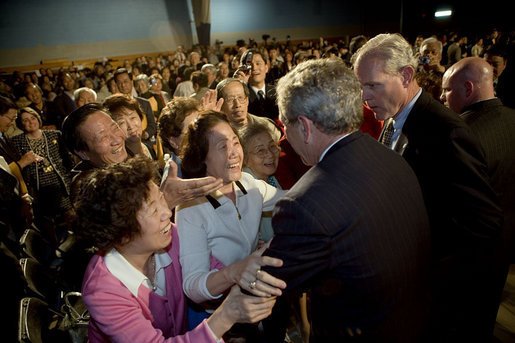
Audience members greet and hug President George W. Bush after his talk about the Medicare prescription drug benefits at the Richard J. Ernst Community Center at Northern Virginia Community College in Annandale, Va., Wednesday, April 12, 2006. President Bush urged senior citizens to participate in the new Medicare program to reduce their drug costs. White House photo by Kimberlee Hewitt.Audience members greet and hug President George W. Bush after his talk about the Medicare prescription drug benefits at the Richard J. Ernst Community Center at Northern Virginia Community College in Annandale, Va.,
Wednesday, April 12, 2006. President Bush urged senior citizens to participate in the new Medicare program to reduce their drug costs. White House photo by Kimberlee Hewitt.

THE PRESIDENT: Thanks for coming. I first want to thank Bob Templin, who is the president of Northern Virginia Community College, for hosting us again. This is a place of educational excellence, and what you're about to watch is a seminar on the new Medicare benefit. And the reason why we've got to conduct seminars on education about what's available is because there is a lot of people who haven't signed up yet for the Medicare benefit, and we want people to pay attention to what's available.

And one of the interesting things about this meeting is I'm trying to show that our government is reaching out to people from all walks of life and all neighborhoods. And so this is my job, I'm the Commander-in-Chief, but I'm sometimes the educator-in-chief, and that's what I am here to do today. So thank you for coming.

As you can see, we've got a different way of doing this -- it's not going to be just a speech, but it's going to be -- I'm going to rely upon our fellow citizens to help share what's available and why you ought to take a look, if you're eligible for the Medicare program. We want everybody around our country who's eligible for Medicare to take a look and see if it will make your life better. What I'm saying is, it will.

So, Bob, thanks for having us. I want to thank Vellie Dietrich-Hall, the commissioner of the President's Advisory Commission on Asian Americans and Pacific Islander. Thank you, Vellie. (Applause.) Clayton Fong, who is with us, he is the National Asian Pacific Center on Aging executive director. (Applause.) I want to thank all the community leaders here.

I particularly want to thank the veterans who are here with us today. We have been joined by a special group of people, the veterans from the 442nd Regimental Combat Team. By the way, Senator Inouye, of Hawaii, was a member of that very important regimental combat team, and I want to thank you all for being here today and thanks for serving our country. Welcome. (Applause.)

I also want to thank the Secretary of Labor, Elaine Chao, who is going to have some remarks here. (Applause.)

So we're talking about Medicare. Our government made a commitment to our seniors to provide health care. My attitude is if government makes a commitment, then we better make sure we make a good commitment. And I was worried that the commitment we made to our seniors was not as good as it could be. And so I went to the United States Congress and said let's work together to make sure the medicine we provide for our seniors is modern and is up to date.

One of the things that we didn't do through the Medicare system prior to this reform was we didn't provide prescription drugs. But prescription drugs was an important part of medicine. I'll give you an example. If you would have ulcer surgery under Medicare, the government would pay about $28,000 -- but the government wouldn't pay one dime for the medicine that would help you prevent the ulcer surgery in the first place. Now that didn't make any sense. It didn't make any sense to not pay $500 to save $28,000.

And so I said, well, we can do better than this. Let's make sure the medicine we deliver to our seniors is modern. Let's make sure the program works as well as it possibly can. And we passed a bill.

And so one of the things that this bill does is it says to seniors, here's a new plan for you to look at. As a matter of fact, in the state of Virginia, there's over 40 plans to look at -- 40 different options for a senior to choose from. I thought that was very important to have available for seniors. Government tends to say, sometimes, I'll choose for you. I believe government ought to say, we trust you with your choice, and here are some options from which to choose.

The problem with that is that can be confusing to some seniors. Some people reach the stage in life where they just simply want a choice. They're happy with the way things are. And I knew that would be the case when we started to bring out the Medicare program. So we put in place, and you'll hear from some people who have been involved with outreach to our senior citizens. That means, we'll go out and explain to people why the different options may make sense to a senior, so a senior can design a program to meet his or her needs that makes the medicine modern. This program helps all seniors with their drug benefits. That's important to know. This program provides choices for seniors. And although that can be somewhat confusing, it's an important part of the program.

As a matter of fact, it's part of my philosophy. My philosophy is, let's trust the consumer, let's trust the taxpayer. Let's give people different options from which to choose. Let them design the program, not have the government design the program for them.

By the way, they estimated the cost at something like $34 per month premium for the drug program for the typical senior, because there are choices. It now costs about $25 a month. In other words, choices mean people are going to compete for your business, and that's an important part of helping to hold the cost down for the people we're trying to help, as well as the taxpayers who are paying the bills.

This program provides what's called stopgap insurance. In other words, when you reach $3,600 for drug costs, the government pays 95 percent of the bills for you. I think that makes sense. It makes sense for a senior to know that he or she doesn't have to worry if something out of the ordinary were to occur, kind of a catastrophic plan would be available to help. It makes sense for a son or daughter who might be worried about his or her parents' finances. And so this new plan has got what we call catastrophic care, or stopgap care, which is very important.

And, finally, if you're a low-income senior -- about a third of the people eligible for Medicare are low-income -- or incomes are such that they qualify, the government will pay over 95 percent of all the costs. If you're a low-income senior, you really need to look at this program. Any senior needs to look at this program. The average cost savings per senior on the Medicare program, on these pharmaceuticals, is one-half. People's drug bills have been cut by half because they have signed up for this program. And that's really important. It's important for peace of mind, it's important for the person's pocketbook.

Now, I know that sounds too good to be true, but it's happening all across the country. As a matter of fact, 29 million people have signed up for this program. There are 42 million seniors eligible for Medicare, and 29 million people have signed up since January. And that's positive.

And by the way, when 29 million people show up for a new program, there's going to be some glitches. And you're about to hear from a man whose job it is to make sure that he takes care of the glitches. That's what Presidents do, they delegate. (Laughter.)

We straighten out problems as they occur. Twenty-nine [sic]* people have signed up. There are 6 million people who have got a job and they don't need the Medicare. I'm about to talk to a good man in that situation. And there's 7 million people who are eligible who have yet to sign up. And so the reason I've come today is to urge every senior here in the room and around the country who might be listening on TV that if you have not signed up for the Medicare Part D program, you really need to do it. That's the seminar part. That's trying to educate people.

And by the way, there's a lot of other people helping. It's not just me. We've got the National Asian Pacific Center on Aging helping. We've got the Organization of Chinese Americans helping. AARP is helping seniors realize what's available. The Federation of Korean Associations is helping to sign up people. Other Asian American groups all around the country are helping. Faith-based programs are helping people realize what's available. If you're a son or a daughter whose parent is eligible for Medicare, you need to do your duty. Be a good -- be a good, loving child and explain to your parents that which is available for them.

And how do you do it? You can get on the computer: Medicare.gov. And look and see whether or not your mom or dad ought to sign up for a program. I'm just telling you what's happening so far. People are saving a lot of money when it comes to their prescription drugs.

By the way, prior to this bill, we had people in this country who had to choose between food and pharmaceuticals, and that wasn't right. We had people who had to choose between paying their utility bill and whether or not they could pay for their prescription drugs. And that's not right.

This bill I signed, and this program we're discussing helps change that. If you're eligible -- and a third of the seniors are eligible -- the government will pay over 95 percent of your pharmaceuticals. We're a compassionate country. We want our program for Medicare to work well for our seniors.

I fully understand some of the seniors say, I don't want any choices. And that's okay. But somebody ought to at least help you look. It doesn't cost a dime to look and see whether or not this program is meant for you. It doesn't cost one penny to see whether or not you can save money -- and I bet you can. So part of the outreach here is to say to those of you who are helping our senior citizens realize what's available, thank you for what you're doing.

We've set a deadline for May 15th for people to sign up in order to get the discounts involved in the program. And so we're going to spend -- "we" being the government and people involved in the government -- are going to spend a lot of time traveling around the country explaining to our senior citizens, the 7 million who have yet to sign up, take a look. It's a good deal.

So I've got with me today some people who are involved in the program. First, Elaine Chao, she just spoke. She's the Secretary of Labor. She's been in my Cabinet since day one; she's doing a fine job, I'm proud to call her friend. Do you have some words of wisdom here?

SECRETARY CHAO: Mr. President, I sure do. Number one, remember -- please remember May 15th is the deadline date for the first enrollment. If you don't take advantage of the benefits by May 15th, your premiums will increase if you register by the second date, which is in November. Please remember May 15th is very important.

Second of all, it's not that difficult to sign up. There are many organizations in your communities that can be of help. Also, call on your children, ask your children to help you sign up. Now, we know that there are many people who speak different languages, so the Department of Health and Human Services has actually toll-free numbers -- now, I'm going to see whether I have them here -- we have booklets and brochures in all different languages, including Chinese, Spanish, Tagalog, Vietnamese, Japanese. And if you are a non-native speaker and you want some help, let me give you some toll-free numbers as well.

If you speak Chinese, that's Cantonese and Mandarin, the toll-free number is 1-800-582-4218. Don't bother taking it down, there will be these numbers available at the desks, but I do want to tell you now just in case. The Korean number is 1-800-582-4259. And the Vietnamese toll-free number is 1-800-582-4336.

So as the President mentioned, this is a good deal. For the majority of people, you're going to save money. So take a look at the Medicare Part D program and please remember, May 15th is the sign up date.

THE PRESIDENT: Thank you, Madam Secretary. Okay, so here's the way this works. You're the President, you say to the Secretary of Health and Human Services, "Make sure the plan gets implemented." That's called "delegation." He then turns to another guy, who happens to be a Texan named Dr. Mark McClellan. He's the administrator of the Centers for Medicare and Medicaid Services. It's a long word for he's in charge of making sure people know what's available.

So when there's not enough operators to answer the phones -- which took place earlier this year, as we said, call 1-800-MEDICARE -- a lot of people called 1-800-MEDICARE and they got a busy signal. So we said, wait a minute, make sure you've got enough operators. We had a problem with dual eligible citizens, and he worked it out with the states. He's a trouble-shooter.

He's also responsible for making sure that enough information gets out so that people can realize what's available. And I want to thank him; I want to congratulate him, even before he talks, for recognizing ours is a diverse nation. And this is an interesting meeting, isn't it, when you think about it. In other words, there are seniors from all walks of life, some of whom require a little special help to learn what's available. Maybe a little assistance with the language. Maybe a special group, they've got confidence in a special group that might represent their heritage and their culture, and that group will help explain.

We're reaching out to everybody. We want every senior eligible for Medicare to realize what's available.

Anyway, McClellan, you're doing a fine job. Why don't you explain to me what your responsibilities have been and what you intend to do to make sure people know what's available.

DR. McCLELLAN: Well, than you, Mr. President. As you said, this is the most important new benefit in the Medicare program in 40 years. And while prescription drug coverage is really important, this is part of making Medicare work in a new way to help people stay well and live longer, and not just pay the bills when they get sick. We can't afford that anymore.

To do that effectively, we need to collaborate. And you talked about delegation, well, what I've done is help, worked together with many partners around the country so that people can find out about what Medicare offers today. We're not just a program to think about when you get sick. Medicare can help you stay well and live much longer through prescription drugs, preventive benefits and other help.

So we've started a new approach of reaching out at the grassroots level, we're partnering with more than 10,000 organizations around the country to reach all of our diverse beneficiaries where they live and work and play and pray.

And that includes groups like the ones represented here, like the National Asian Pacific Center on Aging, Clayton Fong works very closely with me to help provide some of those translation services that you mentioned. It involves many local partners, like the Asian Service Center in Washington, D.C., has worked closely with Qien, who is on my staff at CMS, and many of our other partners to help get the word out locally.

We want to make sure people know about this important new benefit and if they have questions, there are lots of places to go to get the personal information they need to make a good decision and start saving. That includes the Medicare.gov website, which many of the sons and daughters of our beneficiaries are using, as well as the beneficiaries themselves. It includes our 1-800-MEDICARE, 24/7 customer service line, which has around 7,000 trained representatives now and can provide help in multiple languages for people who call in.

And it includes events like this one, that are taking place all over the country, more than 1,000 a week, where people like me, many of your other senior officials are helping to get the word out and helping people find out about how they can take advantage of this new assistance.

THE PRESIDENT: Back me up here on the low income part of the program.

DR. McCLELLAN: Well, the benefit for prescription drugs is important for everyone with Medicare. A typical senior can save about $1,100 compared to not having drug coverage. That's more than half of their drug costs. And for people with limited incomes, that's about one in three of our seniors who are living month-to-month on a fixed income, they can qualify for extra help, they can get their prescriptions for no premium and usually just a few dollars for each drug, paying 95 percent of their drug costs. And that's a very important extra help to sign up for, as well. And we can put you touch with the application process and get you into that program, as well. It's very important extra help. It's worth about $3,700 a year.

So if you're on Medicare, if you've got a parent who is, someone you care about who is, looking into this program between now and May 15th means, literally, $1,100 worth of help, at least; $3,700 worth of coverage if you have a limited income; and protection for the future against those high drug costs that you mentioned earlier, Mr. President.

THE PRESIDENT: Yes, this is a good deal. And it's really worth people looking at. I'm going to repeat: If you're a son or a daughter and your mother or dad is eligible for Medicare, you need to help your parent. You really do. You need to get on the phone or get on the computer, medicare.gov, or 1-800-MEDICARE.

Now, Qien He is with us. Qien, where were you born -- yes, I know where you are. (Laughter.) Where were you born?

DR. HE: I was born in China.

THE PRESIDENT: Isn't that interesting. Now he is a part of making sure that people realize the opportunities of Medicare. Born whereabouts in China?

DR. HE: Okay. First of all, on behalf of Asian --

THE PRESIDENT: No, where were you born in China?

DR. HE: In China, in Beijing.

THE PRESIDENT Beijing. See, I'm asking the questions. (Laughter.)

DR. HE: Okay.

THE PRESIDENT: And you're a doctor?

DR. HE: Yes.

THE PRESIDENT: Of what?

DR. HE: Doctor of Social Linguistics.

THE PRESIDENT: Social Linguistics. And when did you come to the States?

DR. HE: Nineteen-ninety.

THE PRESIDENT: Nineteen-ninety. And here you are sitting on the stage with the President. (Applause.) You're welcome. We're glad you're here.

DR. HE: Thank you.

THE PRESIDENT: And so what is your job?

DR. HE: Okay, I'm a health insurance specialist for the Centers for Medicare/Medicaid Services. My office is in Philadelphia.

THE PRESIDENT: Your office is in Philadelphia?

DR. HE: Yes.

THE PRESIDENT: So you've come all the way from Philadelphia to be here?

DR. HE: Yes, I come here last night. Tomorrow and tonight, I have to come back and organize a similar event tomorrow for seminar for people in Philadelphia. It's called, Market Closure Enrollment event, in Philadelphia. Actually, Secretary Chao will go with --

THE PRESIDENT: Good. So your job -- one of the jobs is to continue to reach out to people in the Asian American community to convince them to pay attention to this program. So are you having any success?

DR. HE: Well, we have a lot of success. But here, I would like to share some successful stories with you.

THE PRESIDENT: Okay, let me hear some.

* * * * *

THE PRESIDENT: See, one of the interesting things about America is that there are thousands of people who work in the grassroots to make the communities in which they live a better place. It's really one of the great things about our country, isn't it, when neighbors help neighbors. And what he's really saying is, his job is to convince a neighbor to help a neighbor. That's called grassroots. That's what -- it's kind of an odd word, maybe, for some to understand. It means at the local level, that people are willing to help somebody who needs help.

And that's what your job is, isn't it?

* * * * *

THE PRESIDENT: Well, thank you. Listen, well, I appreciate it. (Applause.) Hold on, hold on. Thank you. Save your energy. Thank you, very much, for that, Qien; thanks for your kind words.

What Qien is saying is, is that we recognize there are some people out there that sometimes aren't able to get the message like other people. And so we want this message to go throughout all the neighborhoods. Here, we're talking to Asian Americans, but we want people in every neighborhood to hear the message.

So, for example, we're working with the AARP to get the word out. The NAACP has been helpful to make sure that certain seniors who are eligible for this program get the message. That's what we want.

And so if you know somebody, or if you're listening on TV and know somebody who's eligible for Medicare, make sure you -- make sure you call their attention to the program. And, remember, there's a lot of seniors who might be a little confused at first over the number of choices. But convince them to be patient and look at what's available and help them design a plan that meets their needs. And what you will find is there will be savings. People benefit from this program. It's worthwhile to look at.

I'm talking to Dr. Yining Wang. Welcome, Dr. Wang. Thank you for being here, sir. Got to speak into the mic. You're a doc?

DR. WANG: Yes, I'm doctor in the research area.

THE PRESIDENT: Where were you born?

DR. WANG: I'm born in Shanghai.

THE PRESIDENT: Shanghai. And here he sits, as well, talking to the President of the United States. We're glad you're here.

DR. WANG: Yes. Thank you, very much, Mr. President.

THE PRESIDENT: Proud you're here. When did you come to the United States?

DR. WANG: Well, it's 1988.

THE PRESIDENT: Nineteen eighty-eight.

DR. WANG: Yes.

THE PRESIDENT: That's a fine year.

DR. WANG: No.

THE PRESIDENT: Yes, it was. (Laughter.) Well, maybe not for you, but for, you know -- my dad got elected President in '88. Anyway -- (laughter and applause.) So you were a doctor. Where did you work?

DR. WANG: I'm sorry?

THE PRESIDENT: Where did you work?

DR. WANG: I work in the cardiovascular area for the physiology and pathology.

THE PRESIDENT: Oh, fantastic. And you're now retired?

DR. WANG: I'm retired at the end of year 2004.

THE PRESIDENT: That's good.

DR. WANG: That's good. (Laughter.)

THE PRESIDENT: And so what happened? So you hear -- how did you hear about the Medicare program?

* * * * *

THE PRESIDENT: Very good. Interesting story, isn't it? So here's a man, he's a well-educated fellow. The first reaction, however, to the program was: There's so many choices, I don't think I want to get involved. That's a natural reaction, by the way. And yet, nevertheless, as he said it, "patience" was the word I think he used -- but somebody helped you understand. AARP gave you some advice.

DR. WANG: AARP, yes.

THE PRESIDENT: You can get good advice from AARP, you can get good advice from somebody who works for the CMS, you can get good advice from somebody from your church, you can get good advice from your son or daughter. There are all kinds of ways to get good advice.

What we're doing here today is explaining to seniors, there's a lot of people willing to give you advice. And it's worthwhile taking a look. And the reason it's worthwhile taking a look is you just heard the reason. The man said he's going to save about $200 a month. That's good savings. (Applause.)

* * * * *

THE PRESIDENT: That's great. You did a good job, doc. Thank you. Very good job.

DR. WANG: Okay.

THE PRESIDENT: I appreciate you. Thank you. Good job, sir.

DR. WANG: Thank you so much.

THE PRESIDENT: Bob Nakamoto, third generation American. Welcome.

MR. NAKAMOTO: Thank you.

THE PRESIDENT: Look, this is a guy still working. Remember I said there's 6 million people still working who get good health care? He's one of the 6 million. Working strong at age 74, and he's not going to slow down a bit.

MR. NAKAMOTO: That's right.

THE PRESIDENT: Isn't that right? (Applause.) What do you do, Bob?

MR. NAKAMOTO: I'm a chairman of a company called Base Technologies. We do IT consulting work, primarily with the federal and state government; based in McLean, Virginia, and third generation Japanese American.

THE PRESIDENT: Congratulations. And how is your company doing?

MR. NAKAMOTO: We're doing well. We could do better with your help. (Laughter.)

THE PRESIDENT: Give a man a mic, there's no telling what he's going to say. (Laughter.) Give us your experience. You took a look at what was going on, didn't you?

MR. NAKAMOTO: Pardon?

THE PRESIDENT: You took a look at the Medicare.

* * * * *

THE PRESIDENT: See, here's the reason why we've asked Bob -- one, is we like to be around successful people, don't we? Secondly, he is a fellow who is eligible, but has chosen to stay on the current program provided by his company, but recognizes that upon leaving the company, there's a good program available. And that's important for people to understand.

Twenty-nine million people have signed up. Here's one right here. There are 6 million people who have not signed up because they're working -- and that's Bob. I bet there's somebody out there who represents that part of the 7 million people who are eligible, yet who haven't signed up. And it's really important for you to look.

So you've been looking around at these things, taking a look. You find it okay? I mean, you're a computer guy, so it's a little unfair to say whether -- you know, whether or not --

MR. NAKAMOTO: We're okay with that.

THE PRESIDENT: Using friendly -- it's user-friendly.

MR. NAKAMOTO: Right.

THE PRESIDENT: Yes. See, we try to design this program so it's called, "user friendly." That means you can get on there if you're -- you don't have to be a computer genius like Bob, and take a look.

MR. NAKAMOTO: Right.

THE PRESIDENT: Your advice is? Retire and get on it.

MR. NAKAMOTO: Right.

THE PRESIDENT: Well, not retire, but when retire.

MR. NAKAMOTO: Yes. I don't know when that's going to be, but when that time comes, you'll know about it.

THE PRESIDENT: There you go. (Laughter.) Well, listen, I hope you get the feeling for why we're here. We're here to explain a really interesting opportunity for our seniors. If you don't want to sign up, by the way, you don't have to. The government is not making you do anything you don't want, but what the government is doing is giving you a lot of opportunities. In the case of Virginia citizens, over 40 opportunities to choose a program that suits your particular needs.

And by that I mean there's all different kinds of structures for the programs. You might be taking this kind of drug or that kind of drug. You might be taking a lot of drugs a month, or no drugs a month. And, therefore, you can design a program that says, this is best for me.

I strongly urge our fellow citizens to take a look. I want to thank those of you who are helping our seniors see what's available. And keep doing it, up until May 15th. And even after May 15th. I repeat, if you're a son or a daughter and your parent is eligible for Medicare, do them a favor and do your duty by getting on medicare.gov or calling 1-800-MEDICARE and find out what's available. Or just get people to send the forms to you and look. Ask your parents questions, or ask your parents' doctors questions, or ask your parents' pharmacist questions about what program they need. If you're a senior and you're going to your local pharmacy, many of the pharmacists are helping our seniors design a program that meets their needs.

Is it worth it? I really think it is. If you're a poor senior, the government will pay most of your drugs. We really don't want to be a society where seniors have to choose between food and medicine. It's worth it even if you're not in that income category, because you'll save money.

And saving money is good after you retire. It'll help you. If you're a son or a daughter -- again, I repeat -- do your duty. It will give you peace of mind to know that your mom or dad are taken care of.

We worked hard to get this bill passed. It's a good piece of legislation. It's one of those times where people are going to be able to say, well, the government actually did a good thing for us.

And so I want to thank you all for coming. I particularly want to thank our panelists. I want to thank my fellow citizens who've come. I particularly want to, again, thank the vets -- veterans who are here. Bob, thanks for your hospitality. Thank you for paying attention.

May God bless you all. Thank you. (Applause.)

END 2:44 P.M. EST * million

Technorati Tags:
and or and , or and , or , and , or and or and or and or and or

Related: Keywords Press Briefing Scott McClellan, Tuesday, April 11, 2006
Press Briefing Scott McClellan 04/10/06 (VIDEO), Wednesday, April 05, 2006 Press Briefing Scott McClellan 04/04/06 (VIDEO), Wednesday, March 29, 2006 Press Briefing Scott McClellan 03/28/06 (VIDEO), Friday, March 24, 2006 Press Briefing Scott McClellan 03/23/06 (VIDEO), Sunday, March 19, 2006 Press Briefing Scott McClellan 03/17/06 (VIDEO), Friday, March 17, 2006 Press Briefing Scott McClellan 03/15/06 (VIDEO), Wednesday, March 15, 2006 Press Briefing Scott McClellan 03/13/06 (VIDEO), Friday, March 10, 2006 Press Briefing Scott McClellan 03/09/06 (VIDEO), Tuesday, March 07, 2006 Press Briefing Scott McClellan 03/07/06 (VIDEO), Tuesday, February 28, 2006 Press Briefing Scott McClellan 02/27/06 (VIDEO), Friday, February 17, 2006 Press Briefing Scott McClellan 02/16/06 (VIDEO), Friday, February 17, 2006 Press Briefing Scott McClellan 02/14/06 (VIDEO), Tuesday, February 14, 2006 Press Briefing Scott McClellan 02/13/06 (VIDEO), Thursday, January 19, 2006 Press Briefing Scott McClellan 01/18/06 (VIDEO), Friday, December 16, 2005Press Briefing, Scott McClellan, Levee Reconstruction (VIDEO), Tuesday, December 06, 2005 Press Briefing Scott McClellan (VIDEO) 12/06/05,

Thursday, April 13, 2006

Secretary Rice Holds Talks with Equatorial Guinean President

Secretary Rice Holds Talks with Equatorial Guinean President, President Obiang praises his country's relationship with United States, By Charles W. Corey, Washington File Staff Writer

U.S. Secretary of State Condoleezza Rice with President Mbasogo of the Republic of Equatorial Guinea at the State Department, April 12, 2006. (©AP/WWP)U.S. Secretary of State Condoleezza Rice with President Mbasogo of the Republic of Equatorial Guinea at the State Department, April 12, 2006. (©AP/WWP).
Washington -- Secretary of State Condoleezza Rice welcomed President Teodoro Obiang Nguema Mbasogo of Equatorial Guinea to the State Department April 12 for what she called a "full set" of talks about the United States' relationship with his country.

Speaking to reporters at the State Department prior to their meeting, Rice said: "I'm very pleased to welcome the president of Equatorial Guinea, President Obiang. We will have a full set of discussions about our bilateral relationship, about some innovative social programs that USAID [U.S. Agency for International Development] is involved with and about the range of regional issues that we both confront.

"So thank you very much for your presence here. You are a good friend and we welcome you," she told the president.

In his comments, President Obiang thanked Secretary Rice for her words, saying his country has "extremely good relations" with the United States and has enjoyed "good relations with the United States for a very long time."

"My visit here is simply … to consolidate and also to establish further ties of cooperation with your country," the president said.

The Equatorial Guinean leader noted that just one day earlier, he signed a "very important agreement with USAID"-- an agreement for the development of Equatorial Guinea, which will be helped with financing from the United States for social programs so the country's people "may enjoy greater prosperity and are able to combat poverty."

Obiang said the people of Equatorial Guinea are "extremely pleased and hopeful" that their present relationship with the United States "will continue to grow in friendship and cooperation. I thank you very much."

USAID AGREEMENT WILL AID SOCIAL DEVELOPMENT

USAID April 11 entered into a unique memorandum of understanding (MOU) with Equatorial Guinea to establish a social development fund in the country, implementing projects in the areas of health, education, women's affairs and the environment.

Using only its own government revenues, Equatorial Guinea is contributing $15 million to USAID to provide technical assistance to support implementation of the fund, according to a USAID press release.

Those funds, according to USAID, "will be instrumental in fostering transparency and accountability in the design, implementation and evaluation of social needs projects."

USAID Administrator Randall Tobias, who spoke at the signing ceremony, called the MOU a "landmark agreement."

"Equatorial Guinea's decision to use government revenues for social development needs," he said, "demonstrates visionary leadership and the potential of true transformation. This kind of agreement," he told his audience, "can serve as a model for future partnerships around the world, and USAID graciously accepts these resources."

USAID's technical support of the fund will be managed through USAID's West Africa Regional Program in Accra, Ghana.

Cindy Courville, special assistant to the president and senior director for African affairs at the National Security Council, reminded everyone at the ceremony that "the focus of this dialogue is transformation. The rewards for future generations will be great."

Lloyd Pierson, USAID assistant administrator for the Bureau for Africa, acted as master of ceremonies for the event.

ASSISTANT SECRETARY FRAZER TRAVELED TO EQUATORIAL GUINEA

Assistant Secretary of State for African Affairs Jendayi Frazer recently traveled to Equatorial Guinea. While in Malabo, she met with Equatorial Guinean Foreign Minister Micha Ondo Bile.

Frazer also had a series of meetings with other government officials and with the American Chamber of Commerce during her stay in Malabo. In addition, she launched the new consular section at the U.S. Embassy and visited a health clinic involved in anti-malarial efforts, which is supported by a U.S. oil company working in the country.

For more information on U.S. policies, see
U.S. Aid to Africa. Created: 12 Apr 2006 Updated: 12 Apr 2006

Technorati Tags:
and or and , or and or , or and ,, or , and ,

Related: Keywords State Department, Tuesday, April 11, 2006
State Department Podcast, VIDEO and Text 04/10/06, Wednesday, April 05, 2006 State Department Podcast, VIDEO and Text 04/03/06, Thursday, March 30, 2006 State Department Podcast, VIDEO and Text 03/29/06, Monday, April 03, 2006 Secretary Rice With Foreign Secretary Straw, Baghdad, Friday, March 31, 2006 Rice in Berlin To Discuss Iran with P-5 plus 1, Friday, March 31, 2006 UNHCR Worker’s Death in Sudan Attack, Friday, March 31, 2006 Statement on China's treatment of Kim Chun-Hee, Thursday, March 30, 2006 State Department Podcast, VIDEO and Text 03/29/06, Thursday, March 23, 2006 State Department Podcast, VIDEO and Text 03/22/06, Monday, March 13, 2006 State Department Podcast, VIDEO and Text 03/13/06, Wednesday, March 01, 2006 State Department Podcast and Text 02/28/06, Wednesday, February 22, 2006 State Department Podcast and Text 02/21/06, Monday, February 13, 2006 State Department Podcast and Text 02/10/06, Thursday, February 09, 2006 State Department Podcast and Text 02/08/06, Friday, January 27, 2006 State Department Podcast and Text 01/25/06, Friday, January 27, 2006 Rice on Palestinian Elections (PODCAST),

Rumsfeld Dismisses Reports of Plans To Attack Iran

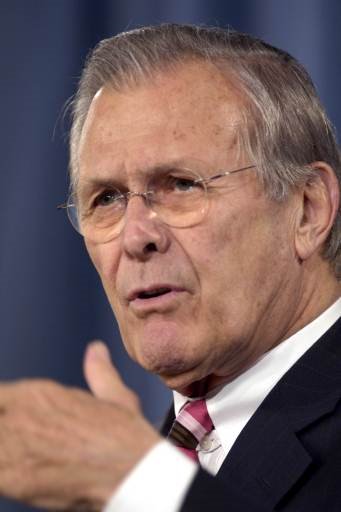
Secretary of Defense Donald H. Rumsfeld responds to a reporter's question during the Pentagon press briefing in Arlington, Va., on April 11, 2006. Rumsfeld and Chairman of the Joint Chiefs of Staff Gen. Peter Pace, U.S. Marine Corps, discussed timelines and prewar planning for Iraq. DoD photo by R. D. Ward. (Released)Rumsfeld Dismisses Reports of Plans To Attack Iran, United States, allies attempting to resolve nuclear standoff diplomatically.

Secretary of Defense Donald H. Rumsfeld responds to a reporter's question during the Pentagon press briefing in Arlington, Va., on April 11, 2006. Rumsfeld and Chairman of the Joint Chiefs of Staff Gen. Peter Pace, U.S. Marine Corps, discussed timelines and prewar planning for Iraq. DoD photo by R. D. Ward. (Released)
Washington – The United States and its allies are working toward a diplomatic solution to resolve the ongoing standoff with Iran over its nuclear program, says Secretary of Defense Donald Rumsfeld.

“The United States of America is on a diplomatic track. That is the president's decision. That's where our European allies are,” Rumsfeld told journalists at an April 11 Pentagon press briefing, where he was joined by Marine General Peter Pace, chairman of the Joint Chiefs of Staff.

Rumsfeld’s comments follow several days of media reports alleging that the Pentagon is planning a military strike against Iran’s nuclear sites if the Iranian government refuses to cooperate with the international community’s demand for full disclosure about its covert nuclear programs. (See
related article.)

Rumsfeld said that the Department of Defense continually develops contingency plans, from military action to humanitarian assistance missions, to meet a host of possible security threats. “I am always thinking that maybe there's something we've not thought of or something we could do better,” he said.

Reporters asked whether the United States would be able to meet emerging security threats, given the sizeable commitment of its troops in Iraq. Pace answered that with 2 million active-duty U.S. troops available in addition to those currently deployed in Iraq, the United States has “sufficient personnel, weapons, equipment, you name it, to handle any adversary that might come along.”

“There is obviously concern about Iran,” Rumsfeld said, “It's a country that supports terrorists. It's a country that has indicated an interest in having weapons of mass destruction.” (See
related article.)

But, referring to reports that the United States has imminent plans to attack Iran, he said that, “it is just simply not useful to get into fantasyland.” (See
related article.)

A
transcript of the briefing is available on the Defense Department’s Web site.

For more information, see
Arms Control and Non-Proliferation and Response to Terrorism. Created: 11 Apr 2006 Updated: 12 Apr 2006

Technorati Tags:
and or and and or and or and or and or

Related: Keyword Iraq, Monday, March 20, 2006
Third Anniversary of Beginning of Iraq Liberation (VIDEO), Tuesday, March 14, 2006 President Discusses Freedom and Democracy in Iraq, 03/13/05 VIDEO, Thursday, March 09, 2006 President Signs USA PATRIOT Act (VIDEO), Saturday, February 25, 2006 President Addresses American Legion, Discusses Global War on Terror (VIDEO), Wednesday, January 25, 2006 President Discusses War on Terror at K-State (VIDEO), Wednesday, January 04, 2006 President Discusses War on Terror Following Pentagon Briefing (VIDEO), Monday, December 19, 2005 President's Address to the Nation (VIDEO) 12/18/05, Thursday, December 15, 2005 President, McCain, Warner, Discusses Interrogation, Wednesday, December 14, 2005 Iraqi Elections, Victory in the War on Terror (VIDEO), Monday, December 12, 2005 President Discusses War on Terror and Upcoming Iraqi Elections (VIDEO), Sunday, July 17, 2005 Soldiers charged with assault on suspected insurgents, Sunday, July 24, 2005 Iraqi, American Women Discuss Constitution, Women's Rights, Thursday, July 28, 2005 Killing of Algerian Diplomats to Iraq, Saturday, August 06, 2005 Operation Quick Strike, Monday, August 08, 2005 The Independent Inquiry Committee into the Iraq Oil-for-Food Programme,

Wednesday, April 12, 2006

President Bush to Welcome German Chancellor Merkel

President Bush will Welcome German Chancellor Merkel to the White House

Chancellor Angela Merkel of Germany, adjusts her earpiece as President George W. Bush begins his remarks during a joint press availability Friday, Jan. 13, 2006, in the East Room of the White House. White House photo by Eric Draperon May 3, 2006. Under Chancellor Merkel's leadership, Germany has worked closely with the United States to strengthen a transatlantic partnership committed to advancing freedom and prosperity around the world.
The two leaders look forward to continuing their discussions on global challenges, including preventing Iran from acquiring the capability to make nuclear weapons, promoting peace and democratic reform in the Middle East, securing Afghanistan's reconstruction, advancing democracy in Eastern Europe and Africa, strengthening NATO, as well as promoting free trade and energy security.

# # # For Immediate Release, Office of the Press Secretary, April 12, 2006

Technorati Tags:
and or and and and or

Related: Keyword Germany, Friday, January 13, 2006
President Bush, German Chancellor Merkel (VIDEO), Friday, February 04, 2005 Condoleezza Rice Tony Blair Jack Straw Gerhard Schroeder, Saturday, February 05, 2005 Secretary Rice Europe and the Middle East, Wednesday, February 23, 2005 Bush Schröder Exchange Toasts, Wednesday, March 02, 2005 Sale of U.S. Military Equipment from Germany to Greece, Tuesday, March 08, 2005 Nazi Medical Experiments, Friday, March 18, 2005 GERMANY PARTNERS WITH IRAQ, UNITED ARAB EMIRATES FOR TRAINING, Sunday, May 08, 2005 President Honors and Commemorates Veterans in the Netherlands, Friday, May 20, 2005 President to Welcome German Chancellor Schroeder, Tuesday, May 24, 2005 pseudoneglect phenomenon, Monday, June 27, 2005 President Welcomes German Chancellor, Thursday, July 21, 2005 William Robert Timken, Jr Ambassador to Germany, Tuesday, September 20, 2005 Simon Wiesenthal - A Short Biography, Thursday, October 06, 2005 German-American Day, 2005,Thursday, December 01, 2005, President Bush to Welcome German Chancellor Merkel, Tuesday, December 21, 2004 President to Germany, Slovak Republic,

President Bush welcomes Ghana President John A. Kufuor

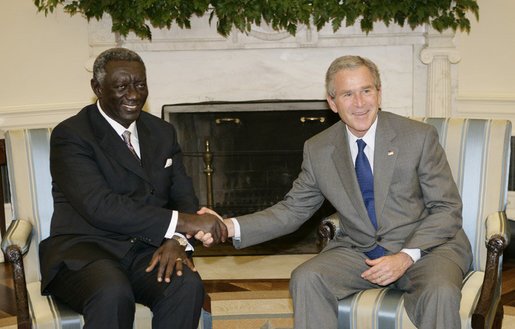
President George W. Bush welcomes Ghana President John A. Kufuor to the Oval Office at the White House, Wednesday, Oct. 26, 2005. President Kufuor arrived in Washington this week to promote trade, investment and tourism in Ghana. White House photo by Eric DraperPresident Bush Welcomes President Kufuor of Ghana to the White House, FULL STREAMING VIDEO, The South Lawn, 11:57 A.M. EDT. In Focus: Africa, In Focus: Global Diplomacy.
PRESIDENT BUSH: Mr. President, welcome. It's good to have you back. We just had a wonderful discussion about our bilateral relations, and a great discussion about the world. I really enjoy talking to a man of vision and strength and character. President Kufuor has done a fantastic job for Ghana. He's told the people of his country he'd bring honesty to government, and he has. He told the people of his country that he would work to create a stable economic platform for -- and he has done that, as well. And he's a man of peace. He cares deeply about peace in the region.

As a result of his leadership and our confidence in his government, we're very happy to work with his country to promote what we've called the Millennium Challenge Account. It's a statement of our respect, and it's a statement for our appreciation for somebody who is willing to invest in his people, is willing to fight corruption, who is willing to help a market economy grow.

Mr. President, congratulations on your record of leadership. Thank you for being a man of peace. Thank you for coming to Washington.

PRESIDENT KUFUOR: I want to thank the President for understanding Africa. His works, for the past five years or so, have done so much in terms of contributing to the fight against HIV/AIDS on two fronts -- the fund you set up, $15 billion fund, some of which has helped to, in a way, save and also make life easier over 400,000 afflicted people.

Then on the education front, I was honored with a visit from Mrs. Bush just about two months ago, during which she launched a program towards linking the messages of the United States and Africa, to work out curriculum for primary and basic education, and also for supplying textbooks and education materials for children, and also helping with education for girls.

And then there's
AGOA(African Growth and Opportunity Act), which Ghana is benefiting from, even though there we need more help. (Laughter.) And then there's the TIFA, Trade and Investment Framework law. I believe this is a President that is helping Africa help itself. And we count on your support.

On the MCA front, everything going to plan, Ghana and the United States will sign a compact by July. And that would enable Ghana pursue modernized agriculture. We are largely an agricultural country, and these projects that would free hundreds of millions of dollars to help modernize our agriculture would affect as many as 3 million people, help reduce poverty, and also push growth for the economy.

So we see the President as a friend of Ghana's, and I can say, of much of Africa. Thank you.

PRESIDENT BUSH: Thank you, Mr. President. Let's go have lunch.

END 12:01 P.M. EDT, For Immediate Release, Office of the Press Secretary, April 12, 2006

Technorati Tags:
and or and , or and , or , and ,

Related: Keywords: Africa, Thursday, April 06, 2006
Inauguration Thomas Yay Boni of Benin, Wednesday, March 29, 2006 President Bush Welcomes President Obasanjo of Nigeria, Monday, March 27, 2006 President Bush to Welcome Nigerian President, Thursday, March 23, 2006 President Welcomes President Sirleaf of Liberia (VIDEO), Thursday, March 16, 2006 President to Welcome President of the Republic of Liberia, Wednesday, January 18, 2006 First Lady After Liberia Inauguration,

Tuesday, April 11, 2006

Press Briefing Scott McClellan 04/10/06 (VIDEO)

Press Secretary Scott McClellan responds to a question during his White House press briefing. White House photo by Tina HagerPress Briefing by Scott McClellan, FULL STREAMING VIDEO, James S. Brady Briefing Room, 12:44 P.M. EST, MR. MCCLELLAN: Good afternoon, everyone, Let me begin by talking about Medicare and some of our efforts that we've got going on this week and this month.
May 15th is the open enrollment deadline for seniors to sign up for the new prescription drug benefit. We're continuing to step up our efforts to educate seniors and encourage them to sign up, if they so choose, to make sure that they get the lowest premiums.

Our goal has been, by the end of the year to have 28 million to 30 million seniors covered. Thus far, you have more than 27.5 million seniors that have enrolled. The estimated average beneficiary will be -- the estimated savings to the -- on average, for the beneficiary will be more than $1,100 this year alone. That's a 50-percent or more in savings. The average premium is now $25 per month, down from the projected $37 per month.

This week the President and 25 members of the administration will -- more than 25 members of the administration will travel across the country to discuss the new drug benefit with Americans. Tomorrow the President will be visiting senior centers in Jefferson City, Missouri, and Des Moines, Iowa, to highlight the new benefit. Wednesday the President will be making remarks in Annandale, Virginia, on Medicare and the new drug benefit.

Also this week, Cabinet members and other officials are spreading out across 25 states to talk with Americans about the prescription drug benefit and help them get enrolled. They are speaking at hospitals, senior centers, businesses, health centers. They are reminding seniors that they must enroll by May 15th to ensure that they get the lowest premiums. And for those seniors who want to get enrolled, they can call 1800-MEDICARE, or go to www.medicare.gov.

And with that, I'll be glad to go to your questions.

Q Scott, can I ask you about the --

MR. McCLELLAN: Let me go to Steve first.

Q Scott, the remarks the President made this morning about the NIE, was that in response to Senator Specter's call for him to tell the American people what happened?

MR. McCLELLAN: Well, I think you heard the President say that there's an ongoing legal proceeding, investigation; it's a serious matter and we don't want to do anything to jeopardize that, so we're not commenting on it. We want to see due process and a fair hearing. But the President did remind people, yes, the President did authorize the declassification of the National Intelligence Estimate. I think you've seen editorials and other comments over the weekend talk about how that was important because it was in the public interest.

And that's -- remember, there was a lot of discussion going on in the summer of 2003 about the prewar intelligence that was used in the lead-up to going into Iraq. The President felt it was important for the American people to know what the executive branch and Congress was using to make their judgments, and what they were basing their public statements on before the war. And the National Intelligence Estimate was the underlying basis for how we viewed Saddam Hussein's weapons programs.

The bottom line is that the previous administration, this administration, members of both parties in Congress, foreign governments all saw that -- all felt that Saddam Hussein had weapons of mass destruction. Now, we know that much of the intelligence was wrong, and that's why the President put in place an independent, bipartisan commission to look at those issues and to recommend reforms. We are moving forward on those reforms and putting them in place. It's important for the President to make sure that he is using the best possible intelligence when making decisions about how to confront the threats that face this country and face this world.

Q Well, Scott, can I go to the war in Iraq? There was a -- Time Magazine is running a piece by Lt. General Gregory Newbold, who is Director of Operations in the Pentagon, which, as you know, is an extremely important position in that building. He said --

MR. McCLELLAN: I will confess I have not read my Time Magazine this week yet.

Q Let me read some of it to you. He said: "The distortion of intelligence in the buildup to the war, McNamara-like micromanagement kept our forces from having enough resources to do the job." He says, "It is my sincere view that the commitment of our forces to this fight was done with the casualness and swagger that are the special province of those who have never had to execute these missions or bury the results." And he's calling for Secretary Rumsfeld to resign. I think this is probably the highest ranking person we've had come out and say these kinds of things about the war. Any reaction to that?

MR. McCLELLAN: Any reaction? Do you have something specific you want to ask me about? I think we've --

Q Yes, I want to -- okay, how about the distortion of intelligence?

MR. McCLELLAN: -- expressed our views on those various issues --

Q He talks about the distortion of intelligence. He was there in the building in the buildup to the war.

MR. McCLELLAN: Well, if you want to talk about the intelligence, that's an issue I just brought up. Let's go back and look. There was an independent commission, the Silberman-Robb Commission, that looked at the intelligence relating to Iraq, and they came back and said that there was no evidence of political pressure, that these were errors, serious errors, and they stemmed from poor trade craft and poor management. That's what the Robb-Silberman Commission stated.

The bipartisan Senate Intelligence Committee report said that they did not find any evidence that administration officials attempted to coerce, influence or pressure analysts to change their judgments. And then there was the British Butler report, as well. So this was intelligence that was shared by countries around the world, with Congress, with the United Nations, and the United States. Now, with that said, we have pointed out that the intelligence was wrong. That's why we have implemented important reforms.

Q Scott, you've got a senior officer here who was there in the buildup to the war, saying it was a mistake, saying this war should never have been fought, resources were taken --

MR. McCLELLAN: The President strongly disagrees. It was the right decision to go into Iraq and remove Saddam Hussein from power. And let me talk about why. Remember, September 11th changed the President's thinking. He talked about this in his remarks earlier today. We are a nation at war, engaged in a global war on terrorism. And the President made the decision after September 11th that we were going to go on the offensive, that we were going to take the fight to the enemy. And that's exactly what we are doing. And the President talked today in his remarks about what we have accomplished. And he talked about why it was the right decision to go in and remove Saddam Hussein from power. The regime --

Q It has nothing to do with 9/11.

MR. McCLELLAN: -- the regime is gone. It is no longer sponsoring terrorism. It is no longer destabilizing the region. It is no longer undermining the credibility of the United Nations. It is no longer threatening the world.

And it's important that we succeed in Iraq, and that's where our focus is now. And I think people understand the importance of succeeding in Iraq, because look at the consequences if you fail. If we fail in Iraq it will embolden the enemy, it will give them a victory in the war on terrorism. It could lead to a safe-haven in Iraq. And that's why it's so important that we continue to work together to support the Iraqi people, who have shown that they want to chart their own future. And that's what we're going to continue to do.

Q But, Scott, what he was saying is this wasn't part of the global war on terrorism. In fact, what he said is the actions taken in Iraq were peripheral to the real threat, al Qaeda.

MR. McCLELLAN: Martha, I haven't read the whole article. The President has expressed his views very clearly about how this is part of the broader war on terrorism. He takes a comprehensive approach when it comes to fighting and winning the war on terrorism. And we will prevail. We are leading from a position of confidence and strength, and we will continue to do so going forward.

Q Can I just follow on the NIE?

MR. McCLELLAN: Bill, go ahead.

Q The President made his decision to declassify and release the NIE at a time when he was fighting the perception that the intelligence leading up to the war was wrong, at a time shortly prior to Mr. Libby's identification of the CIA agent as the wife of someone who was sent there in an effort to discredit the value of the trip. Why should we not believe that the timing of the President's decision was connected to the decision only days later to out the CIA agent?

MR. McCLELLAN: Well, first of all, now you're getting into questions about an ongoing legal proceeding and investigation --

Q No, it's a timing question.

MR. McCLELLAN: -- you know that we've had a policy in place going back to October 2003 that we are not going to comment on it while it's ongoing. It's a very serious matter, and --

Q I'm not asking about the investigation, I'm asking you to talk about the question of the President's timing.

MR. McCLELLAN: -- I would encourage you not to make assumptions that are not based on the facts. I would encourage you to wait for the facts to be known. Mr. Fitzgerald is pursuing this legal proceeding and pursuing the investigation, and we need to let it proceed. We're not going to do anything that would jeopardize an ongoing matter like that.

Q Why did the President choose that particular time to make that intelligence public?

MR. McCLELLAN: I'll go back and reiterate to you what I said on Friday, and let's make clear that there is a distinction between declassifying information that is in the public interest and leaking classified information that could compromise our national security. There was a lot of discussion going on, there were allegations being made against the administration -- I think irresponsible and unfounded accusations -- saying that we had misused or manipulated the intelligence. There's nothing further from the truth. We were basing our decisions based on the intelligence that was provided to members of Congress, that was pulled together --

Q So it sounds like his timing was connected to that.

MR. McCLELLAN: -- by the intelligence community. And I think you've seen numerous people speak out, including major editorial papers speak out and say that it was the right thing to do to provide this information to the public, so that the public could look at the facts and look at the intelligence and see what the statements were based on. And that's what the President talked about earlier today in his remarks.

Q But it was -- the timing was connected to those things which you say were erroneous reports.

MR. McCLELLAN: It was in the public interest because of all the debate that was going on at the time about the intelligence that was used as an underlying basis for going into Iraq.

Q Scott, let me just follow on that point. When the President made the decision to get the NIE out there, to make it public, for the reasons that you stated, was he aware at that point that information would be leaked to a reporter?

MR. McCLELLAN: David, that's getting into this ongoing legal proceeding, and you shouldn't read anything into it one way or the other when I say I just cannot comment on an ongoing legal proceeding. I've seen reports --

Q There's been reports about --

MR. McCLELLAN: Hang on, hang on. I've seen reports, including today, in The New York Times, talking about this very issue that you bring up. I read that story with great interest, just like many of you in this room did. I would say that I cannot speak to whether or not the parts of that National Intelligence Estimate may have been declassified at some point prior to the release of the National Intelligence Estimate that we made on July 18, 2003.

And let me back up. The entire portion of the National Intelligence Estimate that was released on July 18th went through a declassification process. And I spoke to that issue back on July 18, 2003, and I'll stand by the remarks I made at that time. I have had a chance to go back and look further at information from that time period and I will leave it where I did. But again, I cannot speak to whether or not certain parts of it may have been declassified prior to that time.

Q But you're not challenging that report?

MR. McCLELLAN: Well, I just cannot speak to it because of the ongoing legal proceeding.

Q Let me ask this follow-up question. No matter when the information was released from the NIE, why isn't it a fair charge to make against this President that he, frankly, played politics with declassified intelligence in the run-up to the war to defend his case for war?

MR. McCLELLAN: I think a lot of people have disputed that. If you look at the evidence, the intelligence is in the National Intelligence Estimate. The National Intelligence Estimate is the collective judgment of the intelligence community. And it was, as I said, the underlying basis for how we viewed Saddam Hussein's weapons program -- not just us, but the Congress, foreign governments, the previous administration, the United Nations. So this was intelligence shared by many people. Now, the intelligence was wrong. And that's why we took steps to correct it and make sure that we have better intelligence going forward.

Q But that's not quite my question. The President has been outspoken about how dangerous it is for the country to mishandle, to leak classified information. Yet, in this case, nobody challenges his legal authority to do it, but you could make the charge that this was a rather political move on the part of the President to pick and choose what he'd like to --

MR. McCLELLAN: The declassification of the National Intelligence Estimate?

Q Yes.

MR. McCLELLAN: No, actually because -- go ahead.

Q -- for the purpose of, frankly, defending his own judgment. So somebody who has been so clear about the fact that you should not leak classified information made a kind of cherry-picking decision to let this stuff out.

MR. McCLELLAN: First of all, the President has the authority to declassify information as he chooses. He would never declassify anything if he felt it could compromise our nation's security. The National Intelligence Estimate, back in the summer of 2003, was more of a historical document at that point because it was the intelligence which we used as a basis for making the decision to go into Iraq. It was the collective judgment of the intelligence community. So at that point, it was providing good historical context to the American people when there was a serious debate going on in the public about that intelligence. So it was important for the American people, in the President's view, to be able to look at the underlying intelligence that was used for the statements that were made by the administration, and made by Congress in the lead-up to going to going into Iraq.

Nedra, go ahead.

Q Scott, the President was talking today about how this is an important and serious investigation going on, but there are those who are also saying, these are important allegations against the President, and that he needs to come out and explain himself to the American people, including Senator Specter.

MR. McCLELLAN: I don't know that anyone said -- allegations against the President?

Q Well, that he needs to answer about his role in this release. Does he agree with Senator Specter that the American people deserve an explanation?

MR. McCLELLAN: It's not a question of whether or not we would like to talk more about it. The fact of the matter is that this is a legal proceeding and an ongoing investigation involving this administration. It's being headed by a special prosecutor, Mr. Fitzgerald. We don't want to do anything that could jeopardize this ongoing investigation, legal proceeding. We want there to be due process. We want there to be a fair hearing. And that's why we made a policy not to comment on it while it continues.

Q At what point does the President plan to explain himself to the American people then? Is there a point in the investigation -- does the trial have to be completely over?

MR. McCLELLAN: Well, Mr. Fitzgerald has commented on it some, and you can direct questions to him, but we've made it clear that as long as it's an ongoing legal proceeding and investigation, we are not going to comment further on it.

Q Scott, does the President approve of the way the Vice President handled this information during the declassification process, before and after --

MR. McCLELLAN: Now you're getting into a question that's relating to an ongoing legal proceeding, and I'm just not going to go there, Ed.

Q It's more on whether he approves of his own Vice President, whether he stands behind --

MR. McCLELLAN: He's specifically mentioned in a filing by Mr. Fitzgerald. I can't get into commenting on it. It's a policy that I didn't establish, but I'm obligated to adhere to.

Q Okay, one other question on Secretary Rumsfeld, when you were talking before. This is now the second or third retired general to come out in recent weeks and say that he should step down. Does the President still have confidence in Secretary Rumsfeld? And if so, why, given all of these top military officials saying that he mishandled the war?

MR. McCLELLAN: The President thinks Secretary Rumsfeld is doing a great job, having overseen two fronts in the global war on terrorism. We have liberated 25 million people in Afghanistan and 25 million people in Iraq. The Secretary has also been leading a transformation of the military, to make sure that we're better prepared to meet the threats of the 21st century. And the President has great appreciation of the outstanding job he's doing.

Wendell.

Q What's your reaction to Sy Hersh's article over the weekend and the kind of follow-up articles in The Post and The New York Times? Is the President troubled by these indications that the U.S. is considering or looking at or has plans for --

MR. McCLELLAN: I think those kind of media reports are based on wild speculation, and not on the administration's thinking. The President has made it very clear that we're working with the international community to find a diplomatic solution when it comes to the Iranian regime and its pursuit of nuclear weapons. And that's exactly what we're doing.

The international community has spoken very clearly, in a united way, from the United Nations Security Council. It has said to the regime what it needs to do: It needs to make a commitment to comply with its obligations and to suspend all its uranium enrichment and enrichment-related activities, and come back and negotiate in good faith. They have 30 days in which to make that commitment from when the presidential statement was adopted by the Security Council. If they don't, then we're going to be back at the Security Council talking about the next steps to take. This is something that the international community is very concerned about, and that concern is only growing because of the behavior of the regime. This is a regime, by its own actions and statements, is only further isolating itself and the people of Iran from the rest of the world.

Q Is the President concerned by these reports? Does he find them troubling? Are they counterproductive?

MR. McCLELLAN: Well, I think you heard the President's views. We'll let you all critique them. But, I mean, I notice that the one article you brought up was based on a lot of anonymous sources from former administration officials and outside advisors. And it is what we described it.

Q Two questions. One, as far as this immigration is concerned, the debate has been going for the last two weeks in the U.S. Congress and also among the illegal community, and also small business is also worried about what is their future, as far as finding the workers they need and -- now demonstrations been going on for the last two weeks, including today in Washington, thousands are going to march. Where do President stand as far as making them legal here, so they can pay tax and they can come out from the hiding, not to be tortured by their employers and taken advantage of them?

MR. McCLELLAN: Well, the United States Senate came together in an agreement last week, a bipartisan agreement to move forward on comprehensive immigration reform. This is a difficult and complex issue. And it requires letting voices be heard and letting amendments be considered. But the Senate Minority Leader decided to stand in the way and block comprehensive reform from moving forward. Those who are out there peacefully expressing their views for comprehensive reform may want to direct their efforts toward the Senate Minority Leader. He is the one who is standing in the way of comprehensive reform moving forward.

There was a strong bipartisan agreement reached with Senator Frist and Senators Hagel and Martinez, working with Democrats, to come together and move this to the conference committee, where we could continue to move forward on getting it passed. This is a high priority for the President. He believes that if we're going to fix the immigration system, we must do it in a rational and comprehensive way, and that's what he's continuing to advocate.

Q Egyptian President Mubarak has already said that Iraq is in a civil war. Doesn't that create a real problem for the President, who says it is not, and it emboldens the enemy?

MR. McCLELLAN: I think the Iraqi leaders spoke out on that very issue and disputed any such assertion. And the President has talked about it at length, too. The Iraqi people and the Iraqi leaders looked into the abyss and they didn't like what they saw. And so they have been coming together to try to move forward on forming a government of national unity and coming together to continue to move forward to defeat the terrorists and Saddam loyalists who want to return to the past. And we're continuing to support the efforts of the Iraqi leaders. It's time for them to move forward and get a unity government in place. We have made tremendous sacrifices. The American people have made tremendous sacrifices to get to this point, and it's time for the Iraqi leaders to move forward -- that's what the Iraqi people want -- and get their government formed.

Q What if they don't soon?

MR. McCLELLAN: Well, they are moving forward. The President talked about it in his remarks. He talked about how they have already agreed to a 33-point agenda for the new government once its in place. And he talked about how they have agreed to a national security council that would be represented by all branches of government. So they are taking steps to move forward. We believe it's time to get that unity government in place. I think the Iraqi people want that. I know the American people expect that. We have made tremendous sacrifices in Iraq. And it's important to our long-term security. We're laying the foundation of peace for generations to come. And we will continue to support the Iraqi people as they move forward.

Helen.

Q Before the President declassified the Intelligence Estimate, had he read it?

MR. McCLELLAN: Had he read it?

Q Yes.

MR. McCLELLAN: Yes -- I think we talked about at the time that he was briefed on it --

Q A 90-page document --

MR. McCLELLAN: I think we talked about that at the time.

Q -- and the whole question of the accusation against Saddam trying to buy uranium was on page 24, with many caveats. It was very dubious and --

MR. McCLELLAN: That's not the issue here, Helen.

Q -- an annex to it, questioning this whole business. So did he take note of all these caveats?

MR. McCLELLAN: That's not the issue here, Helen. The issue was the underlying intelligence that was used as part of the basis for going into Iraq. You're singling out one specific part which we --

Q Yes, I am.

MR. McCLELLAN: --- which we already spoke to.

Q Is that your defense, though?

MR. McCLELLAN: We already spoke to that issue. We spoke to it back at the time.

Q Why would he put that out when it's so dubious?

MR. McCLELLAN: Why would he --

Q It's so questionable.

MR. McCLELLAN: Why would he put what out when it's --

Q Using that as your defense to go into Iraq.

MR. McCLELLAN: Using what, the National Intelligence Estimate?

Q No, the whole business that Saddam --

MR. McCLELLAN: That was the collective judgment of the community -- no, you're singling out one thing, and that's not the issue here. The issue here is that back in the summer of 2003, there was a real debate going on in the public about the intelligence that was used as part of the rationale to go into Iraq.

Q But the issue centers on outing Valerie Plame -- wasn't that the issue that dealt with Niger and uranium?

MR. McCLELLAN: You're getting into something that's part of an ongoing investigation, and you know I'm not going to comment further on that.

Les, go ahead.

Q Yes. Reuters reports from Jerusalem that the government of Israel has announced "Israel will have no contact with the Palestinian Authority, which is a hostile entity, and will work toward preventing any entrenchment of the Hamas government's rule." My first part: Does the Bush administration find any fault in this statement or in Israel's firing shells into Gaza in response to Palestinians' firing rockets into Israel?

MR. McCLELLAN: Well, you need to direct those questions to the Israeli government about the actions that they take. I mean, I think we have expressed our views. Now, in terms of Hamas, I think we spoke to that issue most recently on Friday. The Secretary of State put out a statement in terms of our assistance to the Palestinian people when it comes to meeting their humanitarian needs. We are increasing our efforts to provide humanitarian assistance to the Palestinian people, but what we will not do is have any dealing with an Hamas-led government. We will not fund or support them in any way as long as they are not abiding by the important principles that the Quartet outlined.

The Quartet said that they need to renounce violence, they need to recognize Israel, and they need to abide by the previous agreements of the Palestinian Authority. And until they make those commitments, we will not have anything to do with that government.

Q Since The New York Times reports that 200 homosexual families are planning to attend the annual White House Easter Egg Roll one week from today, can you assure us that next year's egg roll will not bar other sexual orientations, as well, such as --

MR. McCLELLAN: First of all, in terms of the Easter Egg Roll, the President and Mrs. Bush, I know, always look forward to it. And there are guidelines that are in place for -- tickets are made available so that families can come and bring their kids to participate in the Easter Egg Roll. We welcome all those families that follow those guidelines that are in place.

Q Was The New York Times wrong in reporting --

MR. McCLELLAN: This is something that is being overseen by Mrs. Bush's Office, and that's our view.

Ed, go ahead.

Q Scott, there was a -- San Francisco Chronicle had a story over the weekend saying an Air Force website listed details about Air Force One, including specific information about the anti-missile defenses on Air Force One --

MR. McCLELLAN: Let me stop you, I'm not going to have any comment on it.

Q Is the White House aware of this --

MR. McCLELLAN: I'm not going to talk about security measures.

Go ahead. Sara, go ahead.

Q Thank you. Scott, my question is on immigration and you have already answered some, but as many as 180,000 supporters of immigration reform are in Washington today, perhaps the largest rally since the 1963 March on Washington. Many of those attending oppose the tough bill passed by the House. Will the President demand a guest worker provision in that --

MR. McCLELLAN: Will the President be -- I'm sorry?

Q Demand.

MR. McCLELLAN: Demand. Well, I think he already has been talking about how he wants a comprehensive piece of legislation. It begins with securing our borders, and that's where we have been focused. We have taken a number of steps to better secure our borders. We've increased the number of Border Patrol agents along our border. We have also deployed new technologies to prevent people from coming into this country illegally, and we are continuing to build upon those efforts. And some of the legislation you bring up addresses that. So it begins with that.

But the President believes if we're going to fix the immigration system, we have to address it in a comprehensive way. And that's why a temporary guest worker program is so important. A temporary guest worker program will help relieve pressure off the border and help us do a better job of securing the border, by allowing our Border Patrol agents to focus on those who are criminals and terrorists, smugglers and traffickers, that are trying to come into this country for the wrong reasons.

And so the President is going to continue speaking out on that and he's going to continue working with Congress. Senate leaders have expressed their desire to get this moving after they come back from their two-week recess that they are on now, and we'll continue working with them to get that done. We continue to call on the Senate Minority Leader to stop using blocking tactics and let the comprehensive bipartisan agreement move forward.

Q Scott, Hilary Clinton, in an interview today, attacked the administration for its economy -- handling of the economy -- health care, trade deficits, budget deficits, and so forth. But she had a specific recommendation; that was that the government should help auto companies such as GM -- should help them relieve some of the costs for retiree health care in exchange for helping them expedite the moves toward energy-efficient production.

MR. McCLELLAN: I haven't seen the interview, Roger.

Q Okay. Does the President have any thoughts on helping out GM if it does go bankrupt?

MR. McCLELLAN: Well, I think that, first of all, the auto industry is in a transition period and they're taking a lot of steps to make sure that they're successful. That's what they're doing.

In terms of the President's views on the economy, we have a very strong economy in place. We would welcome a debate about how we continue to move forward to keep our economy growing stronger. Because of the policies we have put in place, and because of the hard work of the American workers, our economy is growing in a very strong way. We saw just this last month more than 200,000 jobs created. We have seen about 5.2 million jobs created since the summer of 2003. The unemployment rate is down to 4.7 percent, below the averages of the '70s, '80s, and '90s. Consumer confidence is at its highest level in some four years. Productivity is high.

We need to continue to move forward on pro-growth policies. And the real discussion is -- or the debate is on taxes: Are we going to make tax cuts permanent and keep taxes low to keep our economy growing, or are we going to let Democrats have their way and increase those taxes, which would have a very negative effect on our growing economy? And so that's where the debate is focused. The President has been talking about that. And we'll continue to make clear what the choice is.

Q If this President wanted to go to war with another country, at any time in the near future, is the U.S. military physically and financially --

MR. McCLELLAN: First of all, I don't think any President ever wants to go to war. War is a last resort. The President talked about how it's one of the most difficult decisions you can make. In fact, one of the students asked him earlier today about such a decision, and I think you should look at what the President said.

Q All right, then being the last resort, as he said it was the last resort with Iraq, is this country, on April 10, 2006, able financially and physically to go to war with another country at this time?

MR. McCLELLAN: I think our military has spoken to those issues, and I don't have anything to add to what they've already said.

Q But the White House gets a daily assessment several times a day --

MR. McCLELLAN: We are prepared to meet the threats that we face.

Q Scott, what are the prospects of extending the deadline for the Medicare prescription drug sign-up?

MR. McCLELLAN: Well, first of all, that's the open enrollment deadline. That's why we're making the point that you need to sign up now, and encouraging people to do so. The President does not think that would be a good idea. After that time period, I think there's a penalty of up to 1 percent for enrolling in the program at that point. But there's a reason that's in place, and that's to encourage as many people as possible to get signed up.

And I think what you're seeing with the Medicare prescription drug benefit is that the vast majority, the overwhelming majority of seniors are very satisfied with it and believe it's working well for them. They are realizing significant savings. As I pointed out, the average beneficiary will save an estimated more than $1,100 this year alone. The original estimates or projections on the premiums are significantly below where they were when we first started this program. So the overwhelming majority of seniors are saying, this is working well, and they haven't had any problems with their prescription drug benefit, and they're, in fact, very pleased that they're realizing significant savings.

Q But given the ongoing confusion for many --

MR. McCLELLAN: I don't -- I don't know that I agree with that, Peter.

Q Well, I mean, there are some members of Congress who are still hearing from their constituents that they're confused about this and some --

MR. McCLELLAN: No, I think there are still some members of Congress that are trying to politicize this issue. The AARP recently spoke out about that. They said -- they said -- "The focus should be on helping people, not playing politics. Discouraging enrollment is a disservice to the millions who could be saving money on prescription drugs." This is what the AARP said. And that's where all of us should be focusing, is on making sure that this program is working as well as possible for those who depend on it and those who need help with their prescription drugs.

Q So there's no chance it will be extended past May 15th?

MR. McCLELLAN: We don't think that would be a good idea, and the President has expressed his opposition to doing so.

Q Thank you.

MR. McCLELLAN: Thank you.

END 1:15 P.M. EDT, For Immediate Release, Office of the Press Secretary, April 10, 2006

Technorati Tags:
and or and , or and , or , and , or and or and or and or and or

Related: Keywords Press Briefing Scott McClellan, Wednesday, April 05, 2006
Press Briefing Scott McClellan 04/04/06 (VIDEO), Wednesday, March 29, 2006 Press Briefing Scott McClellan 03/28/06 (VIDEO), Friday, March 24, 2006 Press Briefing Scott McClellan 03/23/06 (VIDEO), Sunday, March 19, 2006 Press Briefing Scott McClellan 03/17/06 (VIDEO), Friday, March 17, 2006 Press Briefing Scott McClellan 03/15/06 (VIDEO), Wednesday, March 15, 2006 Press Briefing Scott McClellan 03/13/06 (VIDEO), Friday, March 10, 2006 Press Briefing Scott McClellan 03/09/06 (VIDEO), Tuesday, March 07, 2006 Press Briefing Scott McClellan 03/07/06 (VIDEO), Tuesday, February 28, 2006 Press Briefing Scott McClellan 02/27/06 (VIDEO), Friday, February 17, 2006 Press Briefing Scott McClellan 02/16/06 (VIDEO), Friday, February 17, 2006 Press Briefing Scott McClellan 02/14/06 (VIDEO), Tuesday, February 14, 2006 Press Briefing Scott McClellan 02/13/06 (VIDEO), Thursday, January 19, 2006 Press Briefing Scott McClellan 01/18/06 (VIDEO), Friday, December 16, 2005Press Briefing, Scott McClellan, Levee Reconstruction (VIDEO), Tuesday, December 06, 2005 Press Briefing Scott McClellan (VIDEO) 12/06/05, Thursday, November 10, 2005 Press Briefing by Scott McClellan 11/09/05 (VIDEO,